
3. Ripples Spread
To the Village, the Law, and the Arts
From every corner of Russia, from Arkhangelsk to Yalta and from Vladivostok to Petersburg, fly reports of the horrors of the new, mass, motiveless crime that prevents people from living and growing and breathing in peace. The countryside is seized with terror. The city is in a panic.
The public spectacle of revolutionary power, exhibited by the masses and educated society alike, made manifest the changes that had occurred in Russian society in the previous decades. The organized assault of liberal forces on the autocracy demonstrated the existence in Russia of a “public sphere,” a space for civil society to develop a public discourse and public opinion (implicitly a plurality of opinions) independent of the government, which in turn allowed society to effect democratic political change.[1] But the evolution of a public sphere had concrete visual and physical effects as well as social and political ones. The sudden visibility of the lower classes, their undeniable power when united, and the violence of revolutionary events made it clear that power in the public space was changing hands. During and after the revolution a larger audience in locations all over the empire was becoming aware of the lessons learned earlier by St. Petersburg’s respectable pedestrians and readers of the boulevard press—that the massive influx of lower-class migrants had transformed social relations on the streets.
It was in this context that hooliganism evolved from an essentially urban phenomenon into a broad cultural category useful in a remarkable variety of situations. The diverse examples discussed in this chapter—rural hooliganism, the legal debates over regulating hooliganism, and avant-garde artists’ use of hooligan tactics—each developed for specific purposes, but all shared a number of characteristics. All represented negotiations concerning the uses, control, and definition of public space. All were agents of and responses to the erosion of traditions brought about by migration, commercialization, and the diversification of life in city and village alike. And all represented attempts to assimilate social change after the 1905–1907 Revolution diminished expectations of lower-class subordination and deference. In each case hooliganism expressed tensions that arose as cultural diversity developed and consensus was breaking down—in rural society (both among the peasantry and between peasant and noble) and within the educated elite.
The discourse on hooliganism begun in the commercial press and embellished during the revolution provided handy images for capturing and understanding all these changes. After the peasant revolution was brutally suppressed by punitive expeditions and the government regained its control of rural society, there remained a residue of popular unrest that took forms associated with urban hooliganism. As hooligan behavior spread, discussion about it also reached beyond the pages of the boulevard press to appear in professional legal circles and elite “thick” journals, sensationalistic novels, and daily newspapers of all political stripes. Hooliganism became the subject of debate in the highest government bodies as it entered discussions about judicial and police reform. As the ripples spread, a wide range of voices was heard, from the shrill, hysterical outcry of frightened provincial landowners to the precise juridical distinctions of legal discourse. In this spectrum of responses to hooliganism one finds explicit confirmation of the views implied in the boulevard press’s prerevolutionary coverage of hooliganism, but one also hears new explanations for the phenomenon and new propositions for eradicating it. When cultural diversity took hooligan forms among avant-garde artists, the same publications that had decried the hooligan assault on tradition and civilization were horrified by the futurists’ challenge to classical Russian culture and to the ability of the old intelligentsia to determine cultural standards. Every society has rebels who attack the authorities to assert their own vision, and everywhere defenders of tradition cry out to protect what they cherish, but as modern societies become increasingly complex and diverse, the struggles multiply. Such battles may not be powerful enough to topple a state, but they reveal the forces that hold societies together or tear them apart.
| • | • | • |
Hooliganism in the Countryside
The insolence and defiance associated with urban hooliganism were first detected among Russian peasants amid the revolutionary wave of destruction that began in 1905. In her study of the provincial nobility, Roberta Manning noted that “landowners and local officials were surprised to see the resentful and rebellious faces when peasants dropped their deferential, self-abnegating masks.”[2] After the revolution, hooligan insolence remained and the landowners’ fears did not subside. One recalled that by the summer of 1908 “something essential, something irreparable had occurred and it was within the people themselves.”[3] Animosity replaced the “peasants’ previous courtesy, their friendliness, bows and willingness to pull off the road [upon encountering the vehicle of a local nobleman].”[4] In the following years rural hooliganism swelled to epidemic proportions in some provinces, leading many among the provincial nobility to consider it “the main scourge of the countryside.”[5] By 1913 the Ministry of Internal Affairs felt the need to convene a special commission, under the chairmanship of A. I. Lykoshin, to study its impact and devise measures for its eradication.[6] The proliferation of hooliganism in the countryside makes clear that both the behavior and the conceptual categories identified earlier in the city were useful in a new context. But because the rural scene was no longer so isolated from city life, hooliganism also became one of the main symbols of the growing interaction between city and countryside.
Rural hooliganism took many of the same forms seen in the city, including the disparate range of offenses it encompassed, which made rural hooliganism equally difficult to define precisely. As in Petersburg, rural definitions of hooliganism shared an emphasis on the way in which the acts were carried out: the hooligan’s display of insolence or defiance—nakhal’—or, in some cases, the very fact that behavior previously circumscribed by noble authority was now openly flaunted. The literature on rural hooliganism was characterized by outraged reports of hooligan incidents, ranging from annoying pranks to terrifying physical assaults, in which hooligans displayed disrespect for traditional authorities or traditional values. Even more than city officials, rural authorities were shaken by such exhibitions of popular disrespect and defiance. Not only noble landowners but government representatives, priests, peasant parents and elders, and especially the women of these groups were victims of hooligan offenses. A survey of marshals of the nobility produced “practically identical” answers to questions evaluating hooliganism: “Hooliganism takes the form not only of pranks, drunkenness, swearing, and disrespect for parents, elders, and women, but not uncommonly also of blasphemy, arson, and the destruction of public and private property.”[7] P. P. Bashilov, the governor of Ufa, compiled massive and detailed data on hooliganism in his province. Among hooligan acts he included manifest disrespect for parents, elders, clergy, and other authorities; throwing rocks at passersby; breaking windows; tearing up trees, flowers, and vegetables but not for use; petty theft of edibles for use; demanding money from passersby; disturbing the peace; singing “uncensored” songs; swearing; yelling; carrying illegal arms; torturing animals; beating passersby; brawling; pestering women on the streets with verbal and physical abuse (up to and including rape); and numerous forms of destruction of property.[8] Such acts were proliferating, Bashilov thought, because the laws prohibiting them did not take into account the new attitudes hooligans exhibited, and the old laws prescribed punishments too lax to deter them.
Two of the most disturbing characteristics displayed by rural hooligans were their level of maliciousness and their special victimization of women. V. Ivanov, a reliable witness and usually straightforward commentator, reported the following as a typical case of village hooliganism:
Such incidents were seen by many as a result of the “decline of morals” that afflicted rural society. But, whatever cultural transformation was indeed taking place, both in terms of a relaxation of strictures on female behavior and a decline in lower-class subservience, increased hooligan attacks on women can only partly be attributed to it. Certainly a loosening of moral constraints was evident in city and village alike. But it seems equally likely that hooligans, whose offenses were primarily exhibitions of power, chose female victims in the countryside for the same reasons they did so in the city: because women were perceived to be weaker and therefore easier targets. Just as hooligans attacked policemen when the vulnerability of the police was apparent to one and all, here, elite and educated women, who lacked the physical power to resist attacks, were easy marks. Women might have remained more secure from hooligan attacks if traditional morality had not also been challenged, but it was the combination of cultural transformation and perceptions of female weakness that appealed to hooligans seeking to assert their power in social life. Still, this hooligan’s cry, identifying the noblewoman as a member of the intelligentsia, suggests that class and culture, alongside gender, played a part in the attack. It is impossible to know how much meaning the hooligan attributed to his chosen words, but it is worth remarking that the hostility he expressed was directed against the woman’s cultural status as much as her privileged position.In the village N., a young noblewoman was calmly walking down the road when a hooligan, well known to everyone, approached and began to pester her, asking for her handkerchief. When she refused him, he threw her to the ground, held her down with his knee on her chest, took off her dress, and stripped her entirely. As a crowd gathered he shouted, “Look, guys, at the intelligentka.” After this, he got up, hit her on the back of the head, and walked away as if nothing had happened.[9]
The belief that rural society was disintegrating under the pressure of hooligan violence and insolence was nourished by the publication and immediate popularity of I. A. Rodionov’s potboiler Our Crime in 1909.[10] The novel begins with a gigantic, bloody, and brutal brawl and continues with an enumeration of every possible hooligan outrage. Rodionov portrayed village life as a world reeling under the effects of unremitting, senseless violence and animalistic savagery. The novel was a success among the rural nobility, who found it expressed their fears as well as their general estimation of the peasant population. One especially histrionic observer commented that the author “was exactly right” about the current state of rural life, and he added that a judge in his district “shed tears” while reading the book.[11]
Liberal and socialist opinion, however, tended to dismiss the picture portrayed in Our Crime and the consensus it claimed to represent. D. Zaslavskii, writing in Sovremennyi mir (The Contemporary World), protested that the nobility’s view of hooliganism was nothing more than “hysterics, malicious lies, and ordinary, common ignorance.” “The nobility,” he declared, “is least of all qualified to judge peasant life. The slander of the landowner-writer Rodionov is no more convincing for being repeated by a thousand voices.”[12] Many contemporary commentators charged the frightened nobles with exaggerating the hooligan threat, calling in the police for minor offenses that previously would have gone unreported and forgotten.[13] Since statistics on rural crime are even less reliable than those on urban crime, it is difficult to evaluate such accusations.[14] Both sides, however, saw hooliganism as something more than ordinary petty and violent crime. All observers combined petty crimes with brutal battery and rape in discussing hooliganism and found this mix a significant factor in the major political, social, and cultural changes taking place. And as hooliganism spread, definitions of hooligan behavior and its effects became more concrete, more politicized, and more contested.
The divergence in views of hooliganism was partly political and partly due to differences in perspective between rural and urban dwellers. Many leftists felt that the rural nobility, supported by central government figures, exaggerated the hooligan threat in order to enforce extra-legal repressive measures in revenge for the peasant uprising of the revolution. These writers accused nobles of applying the label hooligan indiscriminately, to all peasants and to all criminal offenses, based on class prejudice.[15] They saw rural hooliganism as a legacy of serfdom, of the peasants’ ongoing discontent with the settlement of the land question, and of their relentless poverty—in other words, an almost inevitable response to centuries of harsh treatment.[16] Zaslavskii thought that only urban hooliganism could be considered a senseless criminal offense. Rural hooligans, he thought, were “ordinary muzhiks,” and rural hooliganism, “the result of the unbreachable rift between landowners and peasants, about which discussion could no longer be calm and objective.”[17] A. Petrishev, the political commentator for Russkoe bogatstvo and a vocal critic of the provincial nobility, regarded elite behavior as anything but a model of kul’turnost’, observing that “the ruling classes are on the same level [as the hooligans] in regard to morality, self-constraint, and respect for others.” In his opinion they should be punished for their own displays of disrespect.[18]
These writers, however, never dismissed hooliganism, and they shared with their opponents on the right considerable common ground in their understanding of what hooliganism was. Although they interpreted behavior and its causes differently, they all recognized genuine changes in peasant behavior that indicated a new defiance in peasant mentality. Petrishev, for example, began by claiming that many of the petty offenses labeled hooliganism were nothing more than instances of the “injured vanity of rural petty tyrants”: a peasant forgets to remove his hat, and he is punished as a hooligan. Petrishev was incensed by a case of alleged hooliganism in which a child, standing in the road, shook a stick at a general driving along in his carriage. Beside himself with fury, the general saw to it that the child’s mother was severely punished. In fact, according to Petrishev, what happened was that when the general’s carriage came charging down the road a group of mothers and children scattered except for one frightened child, whose stick was thrown at the horse in confusion. “Who is the hooligan here?” Petrishev asked rhetorically.[19] But, although he thought too many such “offenses” were punished as hooliganism, Petrishev went on to define hooliganism in much the same terms that one found in reactionary provincial publications, with emphasis on the cultural and class aspects of hooligan behavior:
There was a clear but unspoken (and probably not fully recognized) consensus that what marked hooliganism as special, new, and frightening was the hooligans’ nakhal’, their willingness to exhibit publicly their lack of respect for traditional authorities and conventional social and cultural constraints and their disregard for existing forms of social control. The critical difference here is that on the left publicists viewed hooliganism as a dangerous but understandable response to poverty, land hunger, and noble oppression, which demonstrated the bankruptcy of the old order. On the right, hooliganism was seen as violence for the sake of violence. There was some disagreement on the right over whether the acts were motiveless and aimless or whether they represented concerted attacks on authority, but in either case they signaled a deplorable disrespect for rural authority.A person throws off the social bridle, and moral and religious constraints; “divine threats” do not frighten him, he doesn’t fear society’s opinion of him or the judgment of the courts because he is sure he will not be held responsible or punished; he emits the cry of a wild animal, with base instincts and motives: “I do what I want to do.”[20]
Thus analyses of rural hooliganism, on both the left and the right, connected it much more explicitly with disrespect and class hostility than the Petersburg press coverage of hooliganism in the first years of the century had done. The cultural conflict that had been vaguely perceived by boulevard-press writers was clearly evident in the countryside after 1907. In many cases, rural hooligans in this period openly declared their hostility toward the elite, as in the case of the assaulted intelligentka cited above. In cases of vandalism, the destruction of everything from windows and fences to grave-site crosses and manor houses was evidence that the formal strictures of rank and the informal mechanisms of social control no longer constrained behavior. The hooligans’ willingness to engage in such behavior was almost universally taken as a sign of popular protest rather than as a purely criminal act:
Village hooligans confirmed such impressions by strolling around late at night singing songs like these:The hooligan reacts like a bull to a red flag when confronted with symbols of power, intelligence, and material wealth. By making open, public attacks on those who possess these, he seeks to express his hatred for them, and this gratifies his depraved and brutal nature.[21]
Я гуляю по ночам Не поддаюся богачам Я любому богачу Рыло на бок сворочу
Мы гуляем по ночам Ме уважим богачам Кулаки свои распустим Богачей гулят не пустим
Мы ребята-ёжики По карманам ножики По три гири на весу Револьвер на поясу
At night I strut around, And rich men don’t get in my way. Just let some rich guy try, And I’ll screw his head on upside-down.
We strut around at night, Doing what we please. We just let our fists fly To keep the rich in line.[22]
We are the Porcupine Boys. Knives in every pocket, Rocks on ropes to swing at you, Revolvers in our waistbands too.[23]
The pronounced class aspect of rural hooliganism supports arguments, made on both the left and the right, that it was a substitute for more overt political actions, which had become too dangerous by 1907. Unlike politically motivated and organized actions of the revolutionary period, hooligan acts were rarely premeditated or organized, and hooligans did not press a political program of any kind.[24] Yet the links are also striking and should not be overlooked. The difficulty of pinning down the precise political content (like other aspects) of rural hooliganism lies in the very diversity of its forms. Looking at rural hooliganism in the context of its urban roots, we can see that it fell somewhere between direct political protest and ordinary crime. It bore a strong resemblance to what James C. Scott has called “everyday resistance.”[25] Scott’s “weapons of the weak” can include everything from flight to indirect confrontations, such as nighttime pilfering, to direct confrontations, such as using unacceptable language and deceit. Similar forms of protest on the part of the inarticulate and powerless had been weapons in the Russian peasants’ arsenal since before the era of enserfment. Such acts became more significant in the interrevolutionary period for three reasons. First, the 1905–1907 Revolution made the privileged classes aware of their vulnerability to the new forces of lower-class power and violence. Thus sensitized, the rural elite found it harder to dismiss forms of “everyday resistance” as peasant laziness or sullenness. Second, hooliganism surfaced in the wake of other social and economic changes. Migrant labor, the intrusion of industry into the countryside, the Stolypin land reforms, the October Manifesto (even with its limitations), all served to shake the social and cultural foundations of rural life. Since hooliganism also attacked the local emblems of established social authority and property, it came to be associated with everything wrong with village life in the wake of those changes. Third, hooligan offenses had in fact become more numerous and more violent. The combination of rapid change and revolutionary experience made observers more aware of the habitual “everyday resistance” of the rural population, but peasant actions had also taken on a new aggressiveness. Hooligans, of course, stopped short of organized assaults on manor houses. They chose their targets somewhat more randomly—the lone woman on the road, the unprotected vegetables in a garden, markers on graves, stolen or defaced “for no reason at all”—but their acts were attacks on privilege, education, wealth, and power. Like the urban phenomenon, rural hooliganism was characterized by a contradictory combination of direct attack on authority figures or symbols and seemingly random acts, such as attacks on public property and the almost insignificant pilfering of vegetables, which were indirect signs of the breakdown of informal mechanisms of social control. This accounts for the confusion among rural observers who saw hooligans simultaneously as motiveless animals and as challengers of authority. As in the city, hooligans in the countryside chose specific targets for their convenience. In this they also resembled the military mutineers of 1905 and 1906, whom Bushnell described as “sensitive to fluctuations in the forces that controlled them” and willing to take advantage of any perceived weakening of restraints.[26]
Almost all rural commentators, and many others as well, believed hooliganism to be linked in some way to the revolutionary politics of 1905–7, and saw in hooliganism a challenge to authority. Yet, for all the explicit class hostility expressed by rural hooligans, provincial authorities tended to view hooliganism in the narrowest of political terms. In general, provincial landowners felt relatively secure in their control of political institutions by 1912, after the elections to the Fourth Duma, but these institutions and their noble personnel had virtually no popular support. The empty power of rural political institutions was a primary weakness of the late tsarist government and made noble political power something of a sham.[27] The local hysteria over rural hooliganism, and the seriousness with which hooliganism was viewed by government figures, is a measure of just how small the sphere over which nobles could exercise their authority was. It is also a sign of how little credence they were willing to give to the political content of the hooligans’ defiance; for, despite their recognition of the class hostility hooligans expressed, most rural authorities viewed hooligan insolence and violence in primarily cultural terms. Hooliganism was seen as both a symptom and a symbol of the world that modernity had ushered in. This balance of political and cultural factors and the fragility of noble authority in this period can be seen clearly in the public discussion of the causes of hooliganism and the measures recommended to resolve it.
By the time hooliganism had been discussed in “every provincial newspaper” and “never left the pages of the capitals’ press” the central government was finally ready to open its own discussion in the national arena. In July 1912, the Ministry of Internal Affairs sent a circular to provincial governors, noting that hooliganism was beginning “to make rural life impossible,” and requesting information on hooliganism in the provinces.[28] Several governors published their responses, and the reports as a whole formed the core of materials consulted by the Lykoshin Commission. In 1913, Minister of Justice I. G. Shcheglovitov published a legislative draft consisting of proposed new laws defining, prohibiting, and punishing acts of hooliganism.[29] The minister submitted the proposal to the State Duma for debate and sent it out to provincial and district zemstvo leaders, local judges, and Justices of the Peace for their comments. The publication of the proposal called forth a flood of responses from the legal profession as well as from the rural and urban authorities and popular publications. The government’s intent was to elicit definitions of hooliganism and suggestions for combating it, including evaluations of the existing punitive measures.[30] It got much more than that: a nationwide debate on the conditions of social and moral life in Russia. The appearance of a national forum for discussion revealed, among other things, that hooliganism was not exclusively urban or rural, but it linked the two in ways that served to increase the growing antagonism between city and village.
Although there were significant differences between left and right, and rural and urban, discourses on the causes of hooliganism, most people by the 1910s had come to believe that hooliganism was rooted not only in culture, but in recent and profound changes in the cultural climate. Conservatives tended to see change as “moral degeneration” or a “decline in morals.”[31] These attitudes may not have been noticed for the first time, but in the environment of interrevolutionary society they mattered in new ways, loosening constraints on public behavior, permitting hooligan rowdiness, self-assertion, and violence, and destroying the cloak of inviolability in which traditional authorities had been clothed.
Although most conservatives associated hooliganism with the lower classes (whether rural or urban), a significant minority noticed hooligan attitudes among members of the elite as well.[32] In this debate elite hooliganism took on a special cast, quite different from that perceived by observers on the left, and revealing of the ways hooliganism focused attention on larger social issues. M. A. Goranovskii blamed hooliganism on the “decline of religious-moral principles in the family,” and since he found the same moral decline among the urban intelligentsia and the dark and ignorant peasants, hooligans could also be found among both groups. Goranovskii’s elite hooligans were urban creatures, the children of “egotistical, intelligentsia mothers who practiced so-called free love.” These blighted children, rather than receiving “maternal tenderness, [were] obstacles to their mothers’ selfish aims.” Lower-class children might also become hooligans through parental neglect, he thought, but in their case the cause was economic need, not self-indulgence.[33]
On the left, commentators sought to explain hooliganism as a natural result of social change. Mensheviks like Zaslavskii and liberals like the zemstvo physician and publicist S. I. Elpatevskii and N. N. Polianskii, a well-known jurist and Moscow Justice of the Peace, saw the cultural changes taking place as more promising. Polianskii argued that hooligan offenses became a problem only when a sufficient proportion of the population had become “cultured” enough to be bothered by hooligan crudeness and rowdiness. The cultural development of some made the depravity of the riffraff at the bottom stand out in sharper relief. Polianskii went so far as to claim that hooliganism was not actually on the increase as everyone believed, but that with the rise in the cultural level of society, behavior that once went unnoticed “now irritates the eye.”[34] With insight rare for the time, Polianskii hit upon one of the main features of hooliganism that attracted so much attention to it, but his explanation fails to account for the more serious crimes associated with hooliganism, and it ignores the motivation of the hooligans themselves.
From a broader perspective Elpatevskii argued that major upheavals transform society, first and foremost, by destroying what traditionally constitutes “propriety” (prilichie). He used the word “propriety” to stand for the codes of conduct governing public behavior and the consensus that determined and enforced them. Political unrest on top of long-term economic and social change shattered the rules governing public behavior. The result was increased opportunity for improvement for those who could take advantage of it, and Elpatevskii believed that some members of the lower classes were exhibiting a higher degree of “culture” and were moving closer to, not farther away from, “the cultured strata.” But revolution also increased opportunity for negative forms of self-assertion, in public rowdiness, crime, and seemingly aimless manifestations of malice. Negative manifestations, however, were not the monopoly of the poor and weak: the “expropriations” and armed robberies of the revolutionary era, carried out by radicals from the privileged classes, he argued, ought to be included in any understanding of hooliganism.[35]
Arguments on both left and right linking hooliganism with radicalism and other elite behaviors were never fully developed, leaving the impression that they were either politically motivated or only vaguely understood, or both. Yet there were, in fact, similarities between lower-class hooliganism and armed “expropriations” and cultural decadence, though perhaps not the same similarities that contemporaries perceived. In the case of the radicals’ armed robberies and terrorist assassinations as well, there can be no doubt that revolutionaries and anarchists felt free to carry out such acts because they had lost respect for the government’s authority—not necessarily its power, but its moral authority.[36] As for the new morality of the interrevolutionary period, the practitioners of “free love” did pose a challenge to the traditions of Russian culture: both to the moral straitjacket of the bourgeoisie, including its constraints on public behavior, and to the didactic, purposive cultural practices of the nineteenth-century intelligentsia. The renewed legitimacy of aesthetic inquiry and the savoring of the artistic act rather than art’s social or political purpose challenged the very foundation of Russia’s intellectual heritage with methods quite similar to those hooligans used to challenge conventional behavior on the streets, as will be discussed in more detail below.
Wherever one stood on the benefits of cultural transformation, evidence of change was everywhere, to judge from responses to official inquiries, publicistic literature, and the popular press. For Goranovskii and most other observers, the destruction of authority in the family was central to understanding the origins of hooliganism. Traditions were breaking down within families, and parents and elders felt that they were no longer able to command respect or control the activities of their children.[37] In part these changes resulted from the economic independence and geographical distance from parental control that migrant workers achieved. Kanatchikov conveyed well the loosening of family bonds that occurred the longer he lived in the city, far away from the relatively homogeneous culture of the village and from the moral authority of his father.[38] The changing role of women was considered by at least one writer to be the key element in the declining state of the rural family. E. Militsyna saw women both as victims and as perpetrators of the decline of morals in the countryside. All day long, she wrote, women had to listen to the nasty songs and incoherent speeches of the heads of their households, “who can think of nothing other than quenching their burning thirst.” Either they would begin to sell vodka illegally themselves or they would in any case see it all around them, making decent family life impossible.[39]
Alcohol abuse, not surprisingly, was cited more often than any other factor, on the left and the right, as a sign of social decay and a cause of hooliganism. The Lykoshin Commission claimed alcohol was “not only the irreplaceable companion of hooliganism but practically its primary source.”[40] A detailed survey of leading Orthodox clergymen in the countryside, carried out by the Holy Synod, produced unanimous agreement that alcoholism and the illegal production of liquor contributed to the growth of hooliganism.[41] Elite authorities were not the only ones complaining about drunkenness. In at least one province, peasant assemblies protested frequently that drunkenness was encouraging hooliganism and that young people drank whatever they could find, wherever they could find it.[42] Some observers saw further evidence of the “decline of morals” in widespread disrespect for the clergy and the church. This connection was made most often on the right, but even among the clergy such disrespect was considered far from the most important factor in the rise of hooliganism.[43]
All the factors contributing to the “decline of morals”—the disintegration of the family, rampant alcoholism, lack of respect for religion—were themselves viewed only as symptoms of another long-term problem: the migration of peasant-workers back and forth between city and village. Implicit in much of the urban literature on hooliganism, especially in the boulevard press, was the assumption that hooligans brought to the city the low level of culture associated with the peasant way of life. The degeneration that allowed them to display their crude and violent ways may have occurred in the dives and slums of the city, but many of the forms it took—public drunkenness, brawling, coarse rudeness, and violence—were seen as peasant in origin. Somewhat contradictorily, urban observers tended to believe that hooliganism was primarily a city problem. Socialist Zaslavskii and conservative V. I. Gurko both argued that the city alone provided fertile ground for genuine hooliganism, while in the countryside it appeared in only “weak and insignificant forms.”[44] Conversely, in the countryside hooliganism was depicted as a disease spread by migrating workers. In the clerical responses to the Holy Synod survey, “labor transience” ranked first among the causes of rural hooliganism. The clergy saw the city as a magnet drawing off the best of village youth—some cited “whole districts where, with only the rarest exceptions, not one peasant had not spent part of his youth in a city.”[45] One cleric complained that if the money at least made its way back to the village, all might be forgiven, but it was all too often spent in the city on restaurants, taverns, prostitutes, and revolutionary propaganda.[46] This lack of differentiation between cultural and political artifacts of the city was typical. One group of rural authorities described the deleterious influence of labor migration as enabling “familiarity and friendship with hooligans from other places [and] the reading of left-wing newspapers and especially of boulevard crime novels.”[47] Returning to the village, the young men enjoyed showing off their city clothes and city habits, which attracted admiration and “set the countryside smoldering, needing only a spark, like 1905.”[48]
These perceptions of hooliganism support the view proposed earlier that hooliganism was a phenomenon of people and places in transition. Just as urban hooligans were shown to be those on the margins of the working class—casual workers and apprentices—who had the least sense of permanence in either culture, in the countryside hooligans were also those on the periphery of rural life. If observers exaggerated the importance of crime novels and taverns in producing hooligans, they were consistent in attributing importance to features of their culture that were clearly in flux. The Lykoshin Commission emphasized the gradual transformation of the “conditions of life” in the countryside with the penetration of industry into the village: “The growth of hooliganism is dependent on contact with concepts of [a social] order different from that of the village.”[49] This understanding of rural hooliganism adds a new dimension to the analysis of cultural conflict. Not only were hooligans reacting to the imposition of alien codes of conduct associated with their social superiors, but hooliganism was also produced by conflict between two different lower-class cultures. Much has been written about the political consequences of the Russian workers’ explosive mix of peasant and proletarian elements.[50] In their continual migration between city and village many peasant-workers were unable to identify clearly with either culture. Migrants had just enough new experience to be both admired and deplored in their native villages, but not enough to either leave the old world behind or have sufficient stake in the new world to channel their hostility into disciplined forms.
The publicistic discourse on hooliganism also makes clear the extent of interpenetration of city and village by the 1910s and suggests that the gap between city and village may have been widening as awareness of each other introduced new reasons for distrust.[51] In the village, hooliganism was portrayed as an invasion by the worst features of city culture, and in the city hooliganism was associated with the low level of peasant culture, an obstacle to the spread of civilization. In both city and village hooligans were symbols of alien ways, which cast into doubt long-held beliefs.
What role did the 1905–1907 Revolution play in the spread of hooliganism into the countryside? By stressing the appearance of hooliganism before the outbreak of the revolution I have tried to emphasize the importance of long-term social, economic, and cultural changes. Most writers of the 1910s agreed. Some of the more hysterical among them took the short view, claiming that the revolution had shown that authority could be attacked with impunity and that now “all is possible.”[52] The majority, however, on both left and right saw the revolution as a catalyst, bringing to the surface problems and tensions that had been simmering for years.[53] The most direct result of the revolution was the exile of thousands of urban workers to their native villages, at just the time when rural revolutionary unrest was on the rise. But one should also not discount the impact of more diffuse aspects of the revolutionary experience on the activities and perceptions of contemporaries. The violence and self-assertion of the lower classes on the one hand and the violence and weakness of the tsarist government on the other produced strong impressions that faded slowly.
That the most thoughtful observers sought explanations of hooliganism both in long-term developments and in the basic structures of late imperial society suggests the seriousness with which hooliganism was viewed as something other than a crime problem. It is also evidence that while this period is often characterized as one of widespread political apathy and cultural individualism, at the local level significant social and cultural conflicts continued, and considerable thought was given to social problems. In the countryside, most of that thinking was backward looking and predictable, at least in regard to hooliganism. Rural nobles and some peasants as well saw their way of life seriously threatened by what they considered to be influences from the outside: modern industry, land reforms, radical propaganda, and lower-class violence. They lamented the weakening of traditional authorities and social structures but had little understanding of the forces at work in their own villages that undermined tradition. This becomes even clearer in the debates over efforts to eradicate hooliganism, in which the majority of vocal rural nobles called for immediate, extra-legal punitive measures and criticized those in favor of longer-term cultural solutions aimed at ameliorating the destabilizing effects of economic and social change.
| • | • | • |
National Debates on Punishment and Prevention
For all the divergence of opinion over the diagnosis and cure of hooliganism there was, at first, wide agreement that existing laws and court practices could not even begin to treat the illness. Observers across political lines thought that cultural conflicts had festered into serious crime problems because of the weakness of Russia’s legal structure. Beyond this point, agreement ended. There was little consensus on the issue of law reform, and most of the debates divided along political lines. Minister of Justice Shcheglovitov, Governor Bashilov of Ufa, A. I. Mosolov of the United Nobility, and the members of the Lykoshin Commission agreed that hooliganism was spreading because the laws were not strong enough to deter it.[54] Liberal jurists and observers emphasized the weakness of institutional authority and judicial practices rather than the failure of law or legal powers. As early as 1901, complaints were voiced about the lenient prosecution of hooligans. The pettiness of the offenses and the heavy caseload of the Justices of the Peace meant that many hooligans were only assessed small fines and released.[55] As Asoskov noted in Sudebnaia gazeta,
Others on the left argued that hooliganism was encouraged primarily by the authorities’ own low regard for law and their proizvol, or arbitrary abuse of legal power. M. P. Chubinskii, a prominent jurist, wrote:It is not surprising that cases of disturbing public peace and tranquility, assault, blasphemy, cursing, and other forms of rowdiness increase from one day to the next in our streets and courtyards. One should not be surprised by all this, because such persons, both male and female, have every reason to hope that they will go unpunished.[56]
Even Blagoveshchenskii, the priest who compiled the Holy Synod survey on hooliganism, decried the government’s abuse of legality, which he called “hypocrisy” and “fertile soil for the growth of hooliganism.”[58]It is difficult to teach respect for the law where one finds examples of proizvol at every step and where belonging to a privileged group (such as the Union of Russian People) protects law breakers from punishment, something that for some time has occurred with the highest degree of cynicism and unabashedness.[57]
The legislative draft proposal devised by the Ministry of Justice and published in 1912 did nothing to improve the government’s reputation for respecting legal norms. Fundamental to the ministry’s proposal was the concept that hooliganism was not a crime sui generis but a circumstance (ottenok) that could characterize or be associated with any crime. Since any crime might be committed with these characteristics, the proposal conceded that precise legal definition was not possible. The ministry, therefore, proposed guidelines for a definition of hooliganism to be used in establishing whether a crime had been committed “in the hooligan manner.” It would be the court’s responsibility to determine the degree to which these characteristics were present, thereby requiring harsher punishment. A crime was to be considered hooliganism if it was characterized by any one of three aggravating circumstances:
particular maliciousness or licentiousness on the part of the guilty party or a manifest lack of correspondence between the motivation of the guilty party and the criminal act undertaken or intent on the part of the guilty party to violate in a crude manner the personal rights of the victim.[59]
These guidelines, which were based on responses to the ministry’s preliminary inquiries, drew vociferous criticism. On the whole the proposal is remarkable for its view of law as something rather more flexible and subjective than the Russian legal system, or other modern, Western legal systems, allowed. The interpretive power that would have been necessary to implement the ministry’s proposal was a feature normally restricted to customary law.[60] Every aspect of the draft was subject to attack, and not all the criticism came from jurists on the left. The conservative newspaper Novoe vremia numbered among those who called for a more precise definition of hooliganism, one that would stand up in court.[61] Most of the legal profession agreed with Novoe vremia that the guidelines offered by the ministry were too vague to apply in court. Some argued that the proposal excluded too many hooligan offenses. Others pointed out that it included crimes that had nothing in common with hooliganism. One writer cited a celebrated murder case in which a student mutilated and sliced up the body of a fellow student, an act that exhibited all three of the ministry’s characteristics but could under no circumstances be considered hooliganism.[62] Others maintained that no new laws were necessary because provisions already existed for increasing the punishment for a crime if it were accompanied by aggravating circumstances similar to those associated with hooliganism. Some jurists simply argued that hooliganism could never be defined precisely enough to apply in court.[63] The Moscow Council of Justices of the Peace criticized the ministry proposal on all fronts. The Moscow JPs objected that the proposal’s definition of hooliganism “suffered from an extreme lack of precision,” violated basic principles of the system of punishments, and displayed a fundamental ignorance of judicial practice.[64] The concept of “particular maliciousness” came in for the most criticism. The Moscow JPs contended that no court could distinguish degrees of malice.[65] V. V. Krumbmiller, a Kharkov Justice of the Peace agreed, pointing out that the capacity to distinguish between maliciousness and particular maliciousness is not to be found among judges but more properly should be the province of psychiatric specialists. In his own experience, what often appeared at first to be dissoluteness frequently turned out to be full-fledged mental illness.[66]
On practical grounds both the St. Petersburg and Moscow Justice of the Peace councils argued against establishing guidelines for defining aggravating circumstances that would increase severity of sentences. The Petersburg JPs objected to harsher penalties because they would neither prevent nor control the crime. Some crimes, they argued, are not affected by increased repression. Reflecting on its disastrous experience with increased prison sentences for public drunkenness in the mid-1890s and in 1900–1902, when the police arrested as many people as they could lay their hands on for appearing drunk in public, the Petersburg JPs argued that the habitual alcoholics who comprised the majority of those tried under article 42 were anything but cured by a stint in prison, and the police campaigns had not had any noticeable effect on alcoholism or on public drunkenness.[67] (See fig. 7 for a wry comment on anti-alcohol campaigns.) Hooliganism, they argued, would be similarly impervious to massive police campaigns. In general, however, the St. Petersburg Council responded more positively to the ministry’s proposal than its Moscow counterpart. The Petersburg JPs expressed no objection to the ministry’s definition of hooliganism or its general formulation of the legislative draft. Their main objection was that the ministry had neglected offenses that constituted common forms of hooliganism in St. Petersburg: assault, brawling, and disturbing the peace, all of which occurred frequently on the streets of the capital. The Petersburg JPs also implied a larger criticism in their discussion of the police campaign against public drunkenness. They suggested that the causes of hooliganism, like the causes of alcoholism, lay outside the sphere of activity influenced by the court. The court could judge and punish illegal actions only, but punishment would not necessarily diminish or deter the crimes that were rooted in deep social and cultural problems.
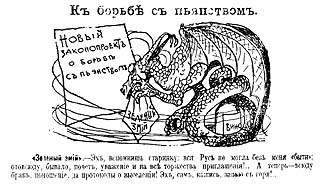
Figure 7. On the Campaign against Drunkenness (February 20, 1914). Russians hallucinate green serpents when they get too drunk, just as Americans of earlier generations saw pink elephants. This green serpent is reading a “Legislative Proposal for the Campaign against Drunkenness” and mourning the days when drinking was revered rather than condemned. He quotes the famous words of the medieval Grand Prince Vladimir, who declared that Russians could not live without drink, and he announces that he must “drown his own sorrows.”
On the question of motive, some observers agreed with the ministry that hooliganism was typically motiveless or aimless, but the proposed legal formulation of this aspect of hooliganism did not satisfy legal professionals. Krumbmiller noted that, according to accepted legal practice, if will and reason are not in evidence, a person cannot be held legally responsible.[68] The Moscow Justice of the Peace Council pointed out that the lack of correspondence between motive and act is recognized by both judicial and psychiatric authorities as the most important feature of the mental condition that acquits defendants of criminal responsibility. As such it could hardly be the basis for increasing punishment.[69] Governor Bashilov tried to sharpen the issue by proposing an examination of the prior relationship between victim and accused, suggesting that a crime should be considered hooliganism if the victim in no way provoked attack. Such a formulation, he argued, would not need to be decided by a psychological expert.[70] But others pointed out that from a psychological point of view unmotivated maliciousness simply could not exist.[71]
The emphasis on psychological analysis in these comments was not unrelated to contemporary juridical theory and practice. The role of medical and psychological expertise at criminal trials was a subject widely discussed throughout Europe in the late nineteenth and twentieth centuries. Russian jurists and criminologists were thoroughly integrated into the international juridical community and would have been familiar with the issues of forensic psychology as they were understood at the time. Nonetheless, although mental incompetence as a factor in assessing criminal responsibility had been introduced into Russian criminal law, it remained a controversial issue within the legal profession.[72] The psychological features that could be introduced as evidence were still being debated, but it was generally agreed that their purpose was to establish competency, not culpability. The draft’s emphasis on motive and intention, as opposed to psychological competence, introduced features of crime that were normally beyond the court’s role to decide. Ordinarily the law required a court to decide whether a crime had been committed by the person charged—not how, why, or how nasty the criminal. A. N. Trainin, a Moscow criminologist, Justice of the Peace, and outspoken critic of the government’s efforts to combat hooliganism, challenged the ministry’s use of psychological factors for defining hooliganism, arguing that “there was a logical blunder in the very attempt to give hooliganism a juridical definition.” Unlike other crimes, Trainin said, hooliganism had “no objective content.” It was rather a reflection of “the world of inner psychological turmoil,” and therefore outside the range of psychological factors that the court was to take into account.[73]
The legislative proposal, in fact, was not much more than a rendering of popular opinion into legal language. The Ministry of Justice captured the popular definition of hooliganism as insolent self-assertion in the absence of traditional agents of social control, but this definition proved difficult to translate into law. Discussions in the State Duma of the draft proposal provoked harsh criticism from the left: “This is philistinism!…This project is juridically illiterate, cannot withstand legal criticism, and has no rationale other than the protection of the nobles’ own social interests.”[74]
As the tsarist government whittled away at the rights guaranteed in the Fundamental Laws issued in 1906, anger and concern about government arbitrariness understandably increased.[75] The opposition to the ministry’s proposed law against hooliganism reflected these fears and attracted the interest of eminent legal experts. The inclusion of three reports on the hooliganism question at the Tenth Conference of the Russian Group of the International Association of Criminologists in 1914 testifies to the authenticity of concern about hooliganism and the law among Russia’s most distinguished jurists. Most of the members of the Russian Group were liberals; many were prominent Kadets—V. D. Nabokov was president at the time. A few members were non-Marxist socialists. The issues raised at the conference concerning legal measures to combat hooliganism show that the left’s motives for rejecting various law proposals were not based on a denial of the severity of the hooligan problem but rather on an insistence that hooliganism be treated as an ordinary legal problem with standard legal solutions. These jurists viewed hooliganism within the context of criminal law rather than as a manifestation of social or political conflict.
The conference of criminologists rejected the ministry’s draft proposal in near unanimity. Individual members, however, presented various and even contradictory reasons for this. Trainin aroused the greatest controversy by claiming that hooliganism was not on the increase, but he won consensus in arguing that hooligan offenses were all already prohibited by existing law and that the proper role for the court was to decide whether an offense was committed by the person accused, not what the motives or attitudes of the perpetrator were.[76] Nabokov spoke against the ministry’s draft proposal and against another set of proposals offered at the conference on the grounds that their definition of hooliganism and the laws based on it were not legally practical. He added, however, that events of recent years had demonstrated the need for reform of laws concerning personal inviolability. All were agreed that any new law had to be precise in its definition of hooliganism and had to refrain from impinging on the legal rights of both victim and criminal.[77]
Jurists at the conference were particularly outspoken in their rejection of extra-legal methods. Most of Trainin’s speech, and, indeed, many of the other speeches at the conference, centered on the pernicious use of binding decrees and extra-judicial administrative measures employed by the police and central government against hooliganism.[78] Among such measures, Octobrists had introduced a proposal in April 1913 in the Fourth Duma for appointing an official with special judicial powers similar to those land captains had wielded. It should be noted that in 1912 the government had finally finished its reform of the local court system, a central feature of which had been the extension of legal rights to the peasantry and the abolition of land captains.
Duma opposition to proposals of administrative measures for hooligans was vigorous, eloquent, and frustrated. The Kadet F. I. Rodichev charged that the original introduction of land captains brought massive repression, but to no good purpose.[79] An Octobrist and supporter of the proposed judicial officers, Count Kapnist, argued in contrast that land captains were essential because the peasant (volost’) courts refused to prosecute hooligans for fear of revenge, a charge supported by evidence elsewhere.[80] Rodichev responded to these and other claims by referring to the new legislation on local court reform just passed. He insisted that what was needed was “court, gentlemen, court, court, court,” not new land captains, not new binding decrees.[81] The Octobrist delegate who introduced the motion reinstituting land captains argued that Russian society should not have to wait for the implementation of new courts while hooliganism was multiplying with each passing day.[82] By the spring of 1913, enough Duma liberals deserted Rodichev to approve the measures.[83] A binding decree for use against hooliganism was issued in February 1913, and it was applied widely thereafter. Duma Kadets argued, but to no avail, that such administrative measures violated the provisions of the statutes on Extraordinary Security, which were supposed to be used only against sedition. More persuasive to the government no doubt was the positive response of the St. Petersburg gradonachal’nik, who claimed within a few months that the new binding decree made a significant impact in helping to control hooligan crimes.[84]
Conservatives generally called for repressive measures, not worrying too much about the legal means employed to impose them. It was widely believed that hooliganism had proliferated because legal punishment was limited, and hooligans regarded prison as a vacation. The absence of serious deterrence, it was thought, further eroded both formal and informal authority.[85] There was also wide support on the right for the ministry’s proposal to reintroduce corporal punishment. At the IX Conference of the United Nobility, speaker after speaker called for a return to corporal punishment and longer prison terms for hooligans.[86] When Gurko tried to propose cultural and educational improvements as preventive measures he was shouted down.[87] When another speaker, Prince Unkhtomskii of Kazan, presented a resolution to force hooligans to pay for damage they caused, the audience responded “coldly,” viewing such measures as too soft. When Unkhtomskii maintained that the nobles’ fear of hooligans might be exaggerated and that hooliganism was rare in his province, someone shouted: “Lucky for you! You should stand for a while in our shoes.”[88] Applause and cheers greeted Mosolov when he stood to defend himself against charges of exaggerating hooliganism. Mosolov called for steps insuring immediate relief: “At such an acute time, it is impossible to speak of various educational measures.…Hooliganism is a filthy wave flooding all of Russia.…We need urgent and decisive steps. We cannot wait twenty or thirty years while enlightenment takes effect.”[89]
The portrait of hooliganism painted by the rural nobility matched its portrayal in the most sensationalistic pages of the boulevard press. This vision produced an atmosphere of terror and established the pretext for the revival of corporal punishment and other harsh punitive measures, just as the left feared. Governor Bashilov opposed corporal punishment in principle (on humanitarian and political grounds), but he believed that it was the only form of punishment appropriate to the hooligans’ own cruel behavior.[90] Tsar Nicholas himself supported the revival of corporal punishment. In response to a proposal to construct workhouses for hooligans in the annual police report for 1909, Nicholas wrote: “Yes, or better yet, the rod, as is done in Denmark.”[91] Goranovskii argued that hooligans were so debased and vicious that only the most brutal punishment could have any effect on them. Prison would only encourage their natural laziness, and workhouses could not reverse their moral degeneration; so, he maintained, “corporal punishment should not disturb our consciences.” The only way to control hooligans, he believed, was to make punishment severe enough to frighten them “the way an animal is frightened.” He observed that “when what distinguishes human beings from animals is lacking, the only possible response [on our part] is an animal one.”[92] It was this sort of writing, more than the conservatives’ analyses of hooligan crimes, that most angered jurists on the left.[93] They did not deny that hooliganism was a serious problem, only that the criminal should not be viewed as a subhuman species outside the scope of human law. The liberal view struck conservatives as too abstract to cope with reality. A. E. Riabchenko complained that the measures necessary to combat hooliganism were obstructed by “cheap liberals among the bureaucrats, who philosophize and quibble over the legality and the efficacy of physical reprisal.”[94]
Noble representatives, however, were not unanimous in calling for corporal punishment. Governors’ reports to the Lykoshin Commission showed that the rod was favored by thirteen governors, seven provincial assemblies, six provincial bureaus, and eleven zemstvo assemblies.[95] This was a sizable portion, to be sure (especially for a measure that had been largely abolished with serfdom in 1861), but far from the majority. The Lykoshin Commission itself was divided on the issue.[96]
Objections to corporal punishment within the legal establishment were unequivocal. At the Conference of the Russian Group of the International Association of Criminologists in 1914, Nabokov spoke for all his colleagues when he rejected corporal punishment out of hand.[97] The volume of support for corporal punishment, however, compelled other opponents to argue in more detail. One Peterburgskii listok columnist reminded his readers that under serfdom corporal punishment had proven to be the “least effective, most degenerate” form of punishment. “The stick has two ends,” he wrote, suggesting that the cure might be worse than the disease, since it would give the government one more opportunity to abuse its power.[98] Many believed that corporal punishment would harden offenders, especially young offenders, in their anti-social attitudes, making them more likely to enter the ranks of professional criminals. Unlike those who saw hooligans as depraved animals, Ivanov and others believed that hooligans could be rehabilitated. Their social instincts could be reborn and their souls healed, he argued, but only by genuinely humane treatment.[99]
This position rested on the belief that hooliganism was a cultural and social problem that required cultural and social cures rather than physical punishment and retribution.[100] In place of extra-legal sanctions and corporal punishment, liberals and other leftists recommended measures intended to raise the cultural level of the people as well as their respect for law and individual rights. Universal education, “healthy” entertainment to lure people away from alcohol, economic relief to prevent women and girls from turning to prostitution, and better care for orphaned and abandoned children were among the most commonly proposed measures. Not incidentally, those who argued for cultural rather than punitive steps tended to be the people least threatened by hooliganism directly. They also understood least of all that in many cases hooliganism was a defiant rejection of such cultural development projects. And while right-wing observers tended to favor the immediate benefits of extra-legal sanctions, several of them also supported long-term cultural measures as well.[101] If culture could not rehabilitate inveterate hooligans, it was expected to prevent the development of hooliganism in the future. Many liberals and criminologists also pleaded eloquently for a uniform legal system, for equality of all before the law, and legal guarantees for individual rights in order to instill the respect for law and order needed for a stable and secure society.[102] They tended to see government arbitrariness and popular violence as mutually reinforcing. I. V. Gessen, a leading Kadet jurist and publicist, argued that society’s indifference to legal political activity, and its widespread disillusionment with Duma politics, precluded the possibility of compelling the government to obey its own laws. The result of official disregard for the law was the encouragement of anarchy and violence, “the most threatening signs of which” could already be observed: “Contempt for the principles of legality has taken on monstrous proportions and, in connection with [Stolypin’s land reforms], has born terrible fruit. Hooliganism has become a serious social problem.”[103]
The legal debate over hooliganism displays typical responses to a pressing social issue in late imperial Russia. Those who argued that sufficient laws already existed for prosecuting hooliganism in the present and that cultural measures would eradicate it in the future were expressing the most sanguine view of the crime to be heard in Russian society. By placing hooliganism in a purely legal context they removed the shadow of political subversion and social disintegration that darkened government and right-wing arguments and colored commercial-press portraits. In doing so they removed the justification for employing extra-legal methods, but they also showed themselves insensitive to the genuine cultural and social conflicts involved in the hooligans’ challenge to authority.
Much has been made of the tsarist government’s eagerness to resort to extra-legal procedures for immediate, repressive solutions to long-range problems. The case of hooliganism is no exception. Various central institutions, individual noblemen, and local organs of administration and police called for, and instituted, extra-legal sanctions repeatedly, beginning with the Petersburg police ruling against rowdy street behavior announced in December 1901. While it is undoubtedly true that legal norms were regularly violated without scruple or constraint for political, repressive reasons, it is important to recognize the motives in operation. Liberal jurists assailed the right for its wilful disregard of law, but the writings and speeches of the conservative nobility and government officials reveal a mentality less vengeful than shortsighted, ignorant, and impatient. After all, officials had good reason to argue that the law was failing to deter hooliganism and was incapable of providing effective punishment for hooligan crimes. Even the more frantic among the gentry displayed a greater sense of urgency than narrow self-protectionism. It is clear that they viewed special administrative rulings and provisions for administrative justice as stopgap measures necessary in a crisis situation. It is equally clear that supporters of such measures had little understanding of the effects of bending the law, to say nothing of the hostility engendered by such measures, not only among those convicted for such crimes but within the surrounding community as well. Indeed, the residue of hostility deriving from prior treatment was in large part responsible for the crisis in the first place. That hostility was undoubtedly not eased by the nobles’ expression of their view that the common people deserved to be treated no better than animals.
Liberals were understandably skeptical of crisis justifications for skirting the law, given the state’s extended use of the “temporary” security statutes instituted in 1881; they were still in place in the 1910s. From the conservative perspective, however, there was equal reason to doubt the effectiveness of the long-term solutions proposed by the liberal intelligentsia. Liberals had been speaking about “raising the intellectual and moral level” of the people at least since the Great Reform era. Clearly, the broader cultural measures proposed by liberal jurists incorporated greater respect for individuals and gave greater consideration to certain aspects of the socioeconomic origins of hooliganism. But while liberals may have displayed some awareness of the social roots of hooliganism, their rational legalism either ignored or misconstrued the depth of the social conflict that lay at the root of the problem and the power hooligans possessed to destabilize society. Furthermore, however humane and equitable liberal proposals appeared on the surface (and, of course, with regard to lifelong exile or fifty lashes there could be no comparison), the liberal conception of culturalism may also be construed as a form of cultural tyranny. Those features of culture so enthusiastically espoused by liberals often appeared utterly alien to some members of the Russian lower classes, who tenaciously resisted being culturally “improved.”
The national debate concerning the origins of hooliganism and the campaign against it provide a case study of the place of law in a society with an ambivalent commitment to the rule of law. Historically, conservatives have been more prone to advocate repressive measures for dealing with criminals, while liberals have favored preventive measures. The proponents of administrative justice, of corporal punishment, and of extra-legal methods for dealing with hooligans were, for the most part, shortsighted, terrified, and brutal in their own disregard for the principle of individual rights. Their opponents, the supporters of legal integrity and long-term culture projects, were certainly more humane and were deeply committed to the importance of upholding the rule of law. But their purely legalistic view of hooliganism blinded them to the genuine conflict and challenge to traditional authority that animated the majority of hooligan crimes. In taking such a view they contributed to the continued weakness of judicial institutions and judicial authority, which allowed hooliganism to proliferate. Ironically, it may have been the refusal of the liberal jurists to support any law prohibiting hooliganism that enabled several provinces and cities to implement binding decrees allowing them to bypass the judicial system altogether.
This national discourse reveals from a new perspective the animosity between the haves and the have-nots in late imperial Russia. It shows that the breakdown of authority occurring in the countryside, as in the city, had roots in the cultural changes taking place alongside the better known political discontent. The discussion concerning measures to control hooliganism reveals a lack of support for the cultural measures proposed by judicial professionals and intelligentsia groups. Conservatives doubted the effectiveness of cultural improvement projects because they saw all around them an increase in the number and brutality of the “uncultured.” At the same time, the cultural project of the old intelligentsia was besieged by members of the artistic community, who in the past had shared a belief in cultural progress and improvement. During the 1910s some of these cultural challenges closely resembled hooliganism. The avant-garde extended the hooligans’ challenge, further undermined intelligentsia culturalism, and contributed to the social and cultural fragmentation of the period.
| • | • | • |
Hooliganism and Modernism
In the years after 1905, elite avant-garde artists used shocking behavior and offensive public pranks in the same way hooligans had: to attack old authorities, advertise an alternative set of values, attract attention to themselves, and assert their own power. The futurists in particular found hooligan tactics useful, inspiring, and amusing, but artists of the first rank from outside futurist circles also incorporated hooligan behavior, values, and images in their work. A full study of the hooligan motifs in Silver Age culture is beyond the scope of this study, but some mention must be made of the links between street hooliganism and the “hooligans of the palette” to show how central hooligan discourse had become in the 1910s and how fragmented the intellectual elite, and to establish the broader social and cultural context in which the Russian avant-garde, and indeed all urban society, operated.
Like hooligans, futurist poets, painters, musicians, and dramatists were rebellious, confrontational, self-consciously crude or “anticultured,” and unabashedly self-promoting. Futurists chose to perform in public spaces where they could make their message heard and felt most sharply. And like hooligans, they embedded a serious message in their prankish behavior. The serious aesthetic challenge they dramatized was to the great artists and artistic traditions of the past. They used hooligan tactics to proclaim that the Russian and European classics had no relevance for the present. On the contrary, their power to influence succeeding generations had become a stultifying straitjacket. The futurists offered themselves in place of the dead past. Their most notorious manifesto called for “Pushkin, Dostoevsky, Tolstoy, etc., etc., to be thrown overboard from the ship of modernity.”[104] In addition to past masters, the futurists assailed (what they imagined to be) the bourgeoisie, because they saw the fetters of traditional aesthetic authority symbolized in the philistine commercialization of culture, in the superficial, unreflective reverence for the great works of the past, and in the equally deadening restrictions on behavior embodied in bourgeois respectability.[105] The futurists’ attacks on Pushkin and bourgeois philistinism originated in the same impulse as the hooligans’ invasion of Nevskii Prospekt. Benedikt Livshits, the astute if eccentric chronicler of futurism, captured the invasion well in his depiction of the painters Ekster, Goncharova, and Rozanova: arriving from the provinces, these “Scythian riders” galloped into Moscow and Petersburg to challenge the pretension, refinement, and Westernism that reigned there,[106] not unlike the hooligans who infiltrated the main streets of the capital from their outposts on the city’s periphery.
The futurists were hardly the first artists to challenge or reject past models of artistic achievement. But rebellion and iconoclasm take forms specific to time and place. In Russia in the 1910s the most important form of artistic rebellion—futurism—was hooliganistic. The futurists’ most famous public pranks were designed to “shock the philistine,” as Livshits put it, or to “throw a bombshell into the joyless, provincial street of the generally joyless existence” of conventional life, in Vasily Kamenskii’s words.[107] Shocking the public both symbolized and attracted attention to their more serious aesthetic iconoclasm. Like hooligans, they used the streets in new ways to create and seize a new kind of authority. They freed art from institutional control by exhibiting paintings and reciting poetry right on the streets.[108] Mikhail Larionov, Natalia Goncharova, Vladimir Mayakovsky, David Burliuk, and others strutted about Moscow in 1912 and 1913 (and later in provincial capitals) with painted faces and with wooden spoons or radishes in their lapels. Their outrageous clothes and their faces painted with flowers, letters of the alphabet, and abstract designs drew crowds of speechless onlookers, whom they tried to shock and entertain by declaiming poetry, reciting nonsense, or advertising that evening’s public reading or lecture.[109] In one of the many manifestos futurists produced, Larionov and Ilya Zdanevich claimed: “We paint ourselves because a clean face is offensive, because we want to herald the unknown, to rearrange life.”[110]
In a more serious vein, futurists defied artistic convention and “shocked the philistine” at the same time by creating serious works of art that appropriated elements of the culture that society considered “uncultured.” They rejected the realism and social didacticism of the nineteenth century and the ethereal aestheticism of their symbolist contemporaries. The futurists invaded the territory of “proper art” with the coarse, crude, primitive, childlike, blasphemous, and erotic, all previously considered inappropriate in the realms of high culture, and they relished the discomfort they caused.[111] To cite but one example, here is Livshits’s description of Burliuk’s response to a reading of Rimbaud, which celebrates the primitivism and destructiveness in Burliuk’s creative method:
Primitivism in modernist art had numerous sources, but here one cannot help but see the hooligan with his impudent grin (or the real knife in his hand) lurking behind Burliuk. Other painters, Goncharova and Larionov, for example, took pleasure in shocking audiences with their use of simple folk motifs to portray exalted subjects. The hooligan’s defiant swagger can be seen behind Goncharova’s peasantlike saints or Larionov’s common soldiers and barbers. These gestures perfectly adapted the dualism inherent in the boulevard-press discourse on hooliganism—its coarseness in the face of propriety and tradition, its seriousness and prankishness, its pettiness and its genuine challenge to cultural verities.In front of my very eyes Burliuk was devouring his own god, his momentary idol. That’s a real carnivore! The way he licked his teeth, the aping triangle on his knee: “The whole world belongs to me!” Could the Makovskys and Gumilevs withstand a folk-giant like this!…And how tempting is this predatoriness! Wherever you look, the world lies before you in utter nakedness, around her tower beskinned mountains, like bloody chunks of smoking meat. Seize it, tear it, get your teeth into it, crush it, create it anew—it’s all yours, yours![112]
The futurists’ most famous synthesis of artistic statement with attack on artistic tradition and bourgeois culture was the manifesto with the hooligan gesture for a title, “A Slap in the Face of Public Taste.” Issued in 1912 and signed by Burliuk, Mayakovsky, Aleksei Kruchenykh, and Velimir Khlebnikov, the manifesto combined a challenge to the authority of past literary masters (this is where they threw Pushkin, Dostoevsky, and Tolstoy overboard) with an attack on the superficial philistine standards of artistic merit that seemed to determine a work’s success:
The manifesto also promised the coming of a radical new art, but it was the futurists’ rejection of the established masters that created a sensation.[114]And if for the time being the filthy marks of your “common sense” and “good taste” remain in our lives, nevertheless, for the first time the lightning flashes of the New Future Beauty of the Self-Sufficient word are already on them.[113]
No one was more successful at fusing the playfulness and seriousness of futurism, at refusing the authority of traditional aesthetics while retaining a respect for its achievements, and at rejecting realism’s social didacticism while addressing pressing social themes than Mayakovsky. In his poem “We Also Want Meat” Mayakovsky reversed conventional roles (celebrating a soldier’s license to kill) and welded lyricism to violent, brutal imagery rejecting poetic tradition:
Soldiers I envy you!It is not hard to understand why the boulevard press responded to futurism the same way it did to hooliganism: with outrage at such exuberant desecration of cherished values of human life and military heroism.
You have it good!
Here on a shabby wall are the scraps of human brains, the imprint of shrapnel’s five fingers. How clever that hundreds of cut off human heads have been affixed to a stupid field.
Yes, yes, yes, it’s more interesting for you!
. . . . . .
You don’t need to think that you owe Pushkin twenty kopecks and why does Yablonovsky write articles.
For us—the young poets—Futurism is the toreador’s red cloak, it is needed only for the bulls (poor bulls!—I compared them to the critics).
. . . . . .
Today’s poetry—is the poetry of strife.
Each word must, like a soldier in the army, be made of meat that is healthy, of meat that is red!
Those who have it—join us!
Never mind that we used to be unjust.
When you tear along in a car through hundreds of persecuting enemies, there’s no point in sentimentalizing: “Oh a chicken was crushed under the wheels.”[115]
The futurists’ varied artistic experiments and public extravaganzas had in common an attempt to create a new realism capable of conveying the fragmentation and cultural complexity of the modern industrial city: in their own words, “to join art to life.”[116] The chaotic, violent, and materialistic world ushered in by urbanization and the trauma of the 1905–1907 Revolution required a new kind of social message—one that reflected a new understanding of the complexity of society, a cynicism about traditional cultural and political methods for change, and yet a continued faith in the possibility of transformation. The message also required a new language that transcended the debasement of language in the ubiquitous commercial press and that recognized the failure of traditional realism to capture the fragmentation of daily life and the modern psyche. With typical realism, cynicism, and optimism Larionov redefined the achievements of civilization: “We declare the genius of our day to be: trousers, jackets, shoes, tramways, buses, aeroplanes, railways, magnificent ships—what an enchantment—what a great epoch unrivalled in world history.”[117] Larionov wanted to join art to life, but he meant a life unfettered by social conventions and free from philistine expectations. He celebrated the simple material objects of everyday life, but not with the venal acquisitiveness of the crass bourgeoisie. He wanted trousers and shoes to be infused with a higher, spiritual, aesthetic meaning. This dual goal was at the heart of the basic contradiction in futurism: on the one hand, its attraction to popular or mass culture and its belief that art has a genuine social purpose, and on the other, its arcane aestheticism. Art historian Camilla Gray condemned the futurists as “rude,” “ludicrous,” “twisted,” and “naive,” but she found in their “frantic desire for self-advertisement…the social conscience that has always been so active in the Russian artist.”[118] Yet the futurists’ rejection of their middlebrow audience and their search for pure forms in abstract painting, zaum (transrational) poetry, and dissonant music isolated them from a mass audience and from the street spirit that inspired them. And their aestheticism and modernist social sensibility differed radically from the “social conscience” of the old intelligentsia.
In practice “joining art to life” often meant staging a theatrical confrontation between art and life. This is not the contradiction it seems. The futurists’ confrontations with bourgeois respectability served to illustrate a contrast between the dead emptiness of propriety and the genuine vitality of the futurists’ crude manners and spontaneous nonsense. Futurist public performances always included a lively interaction with the audience, whether in a theater, a lecture hall, a cabaret, or on the street. In public readings and lectures the futurists went beyond the theoretical attack of their manifestos and insulted their audience directly.[119] At a 1913 lecture performance, “The First Evening of the Speech Creators,” Mayakovsky offended and provoked the audience when he addressed the military officers in the front rows as “folds of fat in the stalls.” He went on to attack a young man (and by extension all respectable society) with “You men, you all have cabbage stuck in your mouths,” and he condemned the artificiality of respectable society by pointing at a young girl and proclaiming: “You women, the power is thick upon you. You look like oysters in shells of objects!” Soon, however, the whole audience, according to Livshits, “learn[ed] a rapid lesson in budetlianin (futurist) good taste” and settled in for the fun of the repartee, trading insults with the speakers.[120]
Despite the generally good humor that greeted many of their performances, the futurists reveled in their role as outsiders, much as the hooligans at times seemed to take pleasure in theirs. Kruchenykh claimed that his zaum poem “dyr-bul-shchyl” was “more Russian than all the poetry of Pushkin,” and he was frequently heard to declare that he had “a sensual longing to be booed.” It was Kruchenykh who initiated the futurist convention of throwing tea at the audience, adopted later by Mayakovsky, Burliuk, and Kamenskii on their seventeen-city provincial tour of futurist performances.[121]
Public reactions to futurist street theater ranged from disgust to amusement.[122] The boulevard newspapers responded with derision and outrage to everything the futurists produced (fig. 8, for example). But the futurists’ critical audience—the literary press and “thick” journals—tried to ignore futurism.[123] The more sophisticated members of the futurists’ audiences came to their performances for the fun of the scandal and participated with bemused detachment. The performances were well attended by the fashionable world of the capitals; so at least some portion of the audience must have shared the futurists’ distaste for respectable culture. For the most part, it was understood that an attack on “Pushkin, Dostoevsky, Tolstoy, etc., etc.,” was an attack on philistine reading habits and the constrictions inherent in canonization rather than an attack on the artists themselves. Even Livshits, a futurist and a great fan of futurist performance, was uncomfortable with the belligerent tone and style of “A Slap in the Face of Public Taste.” “I slept with Pushkin under my pillow,” he wrote, “and who didn’t?”[124] This clearly seems to have been the case at the futurists’ most ambitious undertaking, the tandem performances on alternating evenings of Vladimir Mayakovsky: A Tragedy and Victory over the Sun in December 1913. Mayakovsky later claimed that “they cat-called like hell,” and at one point during Victory over the Sun spectators shouted: “You’re an ass yourself,” and some “heavy fruit buzzed by [one actor’s] ear,” but for the most part the audience responded to Kruchenykh’s nonsense libretto, to Kazimir Malevich’s extraordinary modernist sets and costumes, and to Mikhail Matiushin’s cacophonous music with good-natured, though vocal, amusement and appreciation.[125]
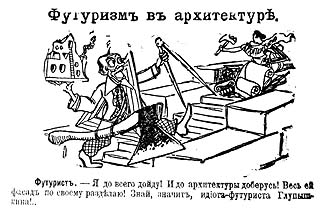
Figure 8. Futurism in Architecture (January 19, 1914). The Futurist is proclaiming that he will do whatever he wants to do; he wants to remake the entire facade of classical architecture, so that his name, Stupidman, will be known worldwide.
For the futurists, the role of society’s misfits provided an important source of creativity. As outcasts they could transcend conventional behavior and thought, which allowed them to challenge the standards that defined them as misfits. Just as hooligans challenged conventional behavior in order to “act as they pleased” in public, to quote one young hooligan,[126] the escape from convention freed the futurists from traditional aesthetics and enabled them to exercise their creativity in new directions. The spontaneity of street theater, the use of “inappropriate” elements of popular culture, collaboration with one another and with their audiences: these were the building blocks of the futurists’ imaginative achievements.
The freedom of the outcast was also explored by artists who were not futurists but who shared the futurists’ fascination with hooligan behavior. Aleksei Remizov, for example, was intrigued by and identified with outsiders and socially marginal characters (such as minstrels [skomorokhi] and holy fools) and was well known among his friends as an irreverent prankster. Pranks and imaginative play created a theater in which he could cross the boundaries of socially acceptable behavior and free himself to imagine alternative worlds. Viktor Shklovsky, who participated in Remizov’s group “The Great Free Order of Monkeys” (a “theater without makeup and masks”) and who parlayed the futurists’ verbal experimentation into one of the basic tenets of Russian formalism, claimed about their group that “we play holy fools in order to be free.”[127]
Fascination with some form of hooliganism entered the work of some of Russia’s most prominent writers. Alexander Blok was unusual in his sensitivity to the divisions between the cultured and the uncultured in late imperial society, but he also believed that some hooligan characteristics—iconoclasm, blasphemy, vulgarity, drunkenness, and profligacy—were “an essential if contradictory part of the Russians’ spiritual nature,” that is, of Russian culture as a whole.[128] In so thinking, Blok chose to view the intelligentsia’s alienation, creativity, and political opposition as akin to hooligan alienation and defiance. But of course that view assumed that there had long been something to challenge: an entrenched conservatism or the weight of tradition. Blok thus declared his identification with the hooligans rather than with the traditional or philistine commercial classes whom the hooligans assaulted. But he also understood that hooliganism represented a destructive force and, because educated society (himself included) had virtually no understanding of the common people, an unpredictable one as well.[129] The action in Blok’s great poem of the revolution, “The Twelve,” revolves around the paradoxically (and hooligan) creative potential in violence, death, and destruction. Stylistically, too, Blok provocatively brought together his own contribution to the great poetic tradition with folk rhythms, chastushki, and the harsh, foul language of the streets (while he leaves the bourgeois stranded forlornly on a windswept corner with his tail between his legs).[130]
Sergei Esenin’s attraction to hooliganism was less abstract than Blok’s and more personally troubling, as well as more artistically stimulating. Esenin adopted a hooligan persona in his poems “Hooligan” and “A Hooligan’s Confession,” but he also engaged in public hooligan acts: he boasted about chopping up icons for firewood to heat tea, and in 1919 he painted blasphemous and obscene verse on the walls of the Novodevichi convent.[131] Adopting the public pose of a crude, brazen hooligan allowed Esenin to reenact his own crossing of both cultural (especially religious) and class boundaries in his journey from peasant to poet. “A Hooligan’s Confession” captivatingly alternates lyrical self-knowledge with vulgar self-assertion. Andrei Bely also employed a hooligan pose to explore serious, even spiritual issues. His short poem “A Little Hooligan’s Song” depicts a jaded and ironic indifference in the face of death by joining the light singsong of a nursery rhyme with a violent hooligan’s cynical disregard for the value of others’ lives.[132]
It is not that these writers condoned hooligan crimes but that they saw hooliganism as representative of an attitude that resonated throughout Russian culture in the 1910s. They recognized in the hooligans’ behavior the same challenge to respectability and to the old intelligentsia’s culturalism that the boulevard press recognized, only the artists embraced those challenges as a source of creativity—or as purifying destruction necessary for some kind of rebirth. The hooligan persona appealed to writers and artists of this period for the same reasons Rabelais’s “carnivalesque” intrigued Bakhtin later on. Futurist performances, appearing like carnival in a “theater without footlights,” allowed writers to stand outside the cultural establishment and look to the streets for “support in the struggle against the official culture.” Acting as hooligans, the Russian modernists could throw off the weight of tradition, they could hurl tea at the seriousness with which Russian culture viewed itself, and they could revitalize Russian culture by mocking and destroying the old and starting anew. Bakhtin’s “popular-festive carnival spirit” was, in the same way, profoundly ambivalent: at once degrading and transcendent. Carnival freed people to bring vulgar behavior out into the open, to mock authorities, and to invert hierarchies of power—to laugh at everything serious—but this “destruction and uncrowning are related to birth and renewal” in Bakhtin: “The death of the old is linked with regeneration; all the images [of carnival] are connected with the contradictory oneness of the dying and reborn world.”[133]
| • | • | • |
Cultural Diversity and Social Fragmentation
Obviously there is a world of difference between young thugs throwing tea out a doorway at unsuspecting pedestrians and artists throwing tea on spectators who are expecting scandal and paying for the privilege. However, the manifold differences in class, purpose, context, danger, and audience cannot efface the importance of the similarities. The two phenomena were both responses to and agents of the same cultural changes then taking place in Russian society. The simple fact that hooliganism was appearing in new contexts was evidence of its cultural significance and its wide evocativeness. The similarities between futurism and rural and urban hooliganism show why hooliganism was evolving into a broad and enduring cultural category, able to convey important messages to many audiences. Specifically, the appearance of hooliganism in new settings demonstrated the general importance of cultural issues in Russia in the 1910s, the breakdown of consensus about them, the value of the public street as an arena for enacting the cultural conflicts involved, and the inability of the law to regulate such behavior.
The similarities between hooliganism and futurism began with the comparable public responses they provoked. The critics who attacked one attacked the other, and those who dismissed one dismissed the other, often in the same terms. Significantly, those who paid these criminals and rebels the least attention were also those who failed to appreciate the cultural challenge inherent in their ill-mannered public behavior. The boulevard press portrayed futurist artists much like hooligan ruffians, as incomprehensible, uncultured savages out to destroy civilization and its classic achievements. The established intelligentsia, professional art critics, and legal specialists tended to minimize the importance of both hooliganism and futurism. Among artists, although some attention was given to the futurists’ publications and productions, their public antics were ignored in most serious literary circles and journals. Notably, the artists were often dismissed as “hooligans.” Vasily Kandinsky repudiated “A Slap in the Face of Public Taste” as “hooliganism,” and Burliuk was known as “a hooligan of the palette.”[134] The disparaging implication here was that just as hooliganism was no real crime, Burliuk was no real innovator, and “A Slap in the Face” no more than irritating public rowdiness. The futurists’ wild exhibitionist behavior was perceived as purposeless and unnecessary self-indulgence, just as hooliganism was seen as motiveless, petty self-assertion.
Time has proven the philistine boulevard press, despite its outraged tone, to have been more astute (if less sympathetic) than the guardians of law and high culture. In retrospect it is clear that the cultural conflicts embodied in the hooligans’ and futurists’ mockery of bourgeois respectability and traditional authorities and their challenge to the cultural standards of the old intelligentsia represented a genuine and deep-seated hostility toward the power of elite culture.[135] The increasing fragmentation and complexity of Russian social and cultural life was more readily acknowledged, though not explicitly and certainly not approvingly, in the boulevard press than among the country’s political leaders, including opposition liberals and radicals, with their continued faith in the intelligentsia’s mission to civilize the Russian people. The futurists recognized changes in the urban context that required a new language, new behavior, and new skills. But their abrasive behavior, their incomprehensible utterances, and their own didacticism won them little support in late imperial society.[136]
Both hooligans and futurists used public space in innovative ways, changing the quality of street life. Art and literary historians have long perceived the futurists’ public behavior—their street theater and stage antics—as a component of their aesthetic message. As cultural products these public acts expressed the futurists’ aesthetics, their values, their response to the social environment, and their demand for recognition of an alternative to the culture of the status quo. The hooligans’ public behavior should be seen in the same light, as a cultural product. Although they were not making an aesthetic statement, their rowdy and crude behavior expressed their values, their response to the world around them, and their demand for attention. Both hooligans and futurists understood (though again not necessarily consciously) the power of public performance and the cultural significance of public behavior. They both adopted street theater as a medium because they were aware of the ways in which behavior (like clothing or manners) defined people and identified them with a set of values. Hooligans found behavior a useful weapon in part because they lacked a sophisticated political language; for futurists, dramatic behavior filled the gap left by a literary language that inadequately captured their message. For both, the seizure of public space attracted immediate attention, and their public performances created new kinds of power.
Hooligans and futurists used their new powers to invade the “cultured” world with rowdiness and blasphemy and to “shock the philistine,” in order to challenge the elitist, purposive, rationalist cultural ideology of the nineteenth-century intelligentsia and the forms it took when adopted by the new intelligentsia. The futurists’ attack on bourgeois philistinism and the old intelligentsia’s culturalism was articulate and explicit: they claimed that nineteenth-century aesthetics were outdated, and they provided their own alternatives. The hooligans’ challenge to culturalism was implicit in their attack on the respectable bourgeoisie. Hooligans openly refused to accept the role of cultureless objects who could be transformed with a simple infusion of what educated society, playing Pygmalion, considered culture. Whether people celebrated or deplored it, the spread of hooliganism in its multiple forms convinced a significant portion of the educated population—including important cultural figures, prominent urban political activists and commercial-press journalists, and reactionary defenders of the regime—that Russia’s capacity to assimilate its people into a single cultured society and become a civilized and politically unified nation was diminishing with each passing day.[137]
These similarities force us to reconsider the designation of any cultural artifact as a product solely of class. Hooliganism and futurism were not devoid of class issues, but the futurists’ use of hooligan tactics indicated that class was only one component of the conflicts in question, and that cultural politics crossed class lines. When one views each as part of a broader cultural movement one can understand why a rash of petty crimes and a series of silly public displays gained extraordinary prominence.
Just as hooliganism in St. Petersburg before 1905 advertised the existence of cultural diversity while most of society was still attached to universalist ideals, rural and modernist hooliganism represented forms of cultural pluralism their audiences only partly perceived. Together modernism and hooliganism not only dramatized the breakdown of traditional authority (which had assumed the submissiveness of the young, the poor, and the unpublished) but also revealed the collapse of cultural consensus and the rise of alternative ideas about behavior, values, and traditions. When writers from Zaslavskii to Goranovskii to commentators in Peterburgskii listok wrote about the hooligans of the privileged classes they were not associating Mayakovsky with the nameless knife wielder in a back alley or claiming that throwing rocks at pedestrians was identical with wearing radishes in buttonholes. They were defining a broad cultural environment in which the dominant motifs were diversity and challenge. Paradoxically, the similarities between hooligans and futurists across classes reveal the extent of cultural diversity and social fragmentation in Russia. In the context of simmering political discontent, the multiplication of cultures and the erosion of the power of culturalism to unify educated society contributed to the overall fragmentation and instability in Russia at the end of the old regime.
Andrei Bely articulated this fragmentation and its consequences better than anyone in his great symbolist novel Petersburg, and he used hooligan motifs (among many other techniques) to do so. Set in October 1905, Petersburg captured the bewildering insecurity and uncertainty of public life, partly through continual shifts in tone and perspective, but also by describing a city whose open spaces had become dangerous, unfamiliar, and ominously swollen by the “human myriapod.” The Petersburg streets “transform passersby into shadows,” Bely wrote, and even when one can escape indoors, “the street flows in your veins like a fever.”[138] The forces that threaten the city expand or flow out into its streets: the “swarm” of workers from the factories encircling Petersburg and the Mongol or Asiatic hordes hovering on Russia’s borders. The novel’s plot pits Nikolai Ableukhov, a student intellectual, against his father, Apollon Ableukhov, a high government official, after the son is recruited by shadowy radicals to assassinate his father. But when the revolutionaries’ bomb finally explodes, no one is hurt and nothing is destroyed except the already frayed relationship between father and son. For Bely the key conflict in Russia was not the obvious one enacted in 1905 between the intelligentsia and the state, which he depicted as father and son, embattled but essentially members of one family. More fundamental was the clash between the obsolete forces that had structured Russian society since the time of Peter the Great and the multiple forces of disorder threatening to destroy Russia. Though the state and the intelligentsia had once been creative, responsible for Russia’s great achievements, both had become stuck in a lifeless, abstract, dogmatic, overly rational, and cowardly rut, protected from the anarchy of the streets but also cut off from their vitality.[139] Both father and son are terrified of life on the streets, in open spaces, in the “immeasurable expanses” of their country. Apollon feels safe only when he has retreated behind walls: in his carriage, “cut off from the scum of the streets by four perpendicular walls,” or better yet deep inside his house, in his bathroom. Nikolai feels safe only outside, wearing a mask and a costume.[140]
But in this novel of shifting perspective, even these divisions are meant to be partial and overlapping. Peter the Great is both Creator and AntiChrist, “authoritarian father figure and rebellious son.”[141] Nikolai is an enervated intellectual, but he is also a hooligan. He agrees to murder his father for hooligan reasons (not for ideological or philosophical ones), his “clownish stunts” evoke “loathing and horror,” and he sulks about the city disguised in a red domino, alternately amusing and terrorizing people (and getting noticed in the crime chronicle). Bely’s Petersburg is a nightmare carnival, where the freedom from structure does not offer a temporary release into subversion and parody but a permanent plunge into contingency. Nothing in the novel is grounded: motives and even events are murky, all knowledge and meaning is conditional and contested, and the city itself floats in and out of focus, rising behind a scrim of dust and fog: all that is solid melts into air. In Petersburg, Russia’s crisis is not a struggle between one or another ideology or even one or another vision of Russia, but fragmentation itself. Peter the Great thunders his bronze steed through the streets of the novel (still capable of terrifying people), but his vision for Russia has run its contradictory course; it is being swamped by the weight of its own divisive legacy and by Larionov’s trousers and tramways. The popular revolt of 1905 (portrayed—and dismissed—in the novel as spontaneous turmoil punctuated by isolated sputtered slogans) could challenge the moribund old powers but held out slim promise for reunification or renaissance. The old forces for progress in Russia, whether reform from above or intelligentsia culturalism, could not cope with the multiple new problems of the modern city or face the challenges to their authority from seemingly every direction, and new alternatives seemed to promise only more contention. Bely portrayed a thoroughly divided and rudderless society marked by aimless and fruitless, but often destructive, challenges to authorities. He used the fractured, symbolic forms of his novel to convey the irreversible fragmentation of social and intellectual life in Russia, to reject the optimistic, rationalist realism of the old intelligentsia and the revolutionary movement, and to represent the ominous (but possibly creative) forces swelling the streets. Bely’s apocalypticism has been read, in part as a transcendent, unearthly vision, but it was, at the same time, rooted in the everyday street life and historical reality of the city. The social coordinates of Bely’s Petersburg correspond to the issues raised by the discourse on hooliganism: the seizure of public space, the challenge to traditional authorities, the fragmentation of society, and the discord over cultural issues. The prominence of these themes in the greatest Russian novel of this period helps explain why the boulevard-press battle with hooliganism could spread such wide and powerful ripples.
Notes
1. Jürgen Habermas, The Structural Transformation of the Public Sphere, trans. Thomas Burger (Cambridge, Mass., 1991); for applications of Habermas to Russian society see McReynolds, The News, 3, 12, 29, 288; Brower, The Russian City, 94, 172.
2. Roberta T. Manning, The Crisis of the Old Order in Russia: Gentry and Government (Princeton, 1982), 147.
3. Quoted in Manning, The Crisis of the Old Order, 146.
4. Quoted in Manning, The Crisis of the Old Order, 147.
5. I. Zhilkin, “Provintsial’noe obozrenie,” Vestnik evropy 2 (1913): 365–66 and passim; and 4 (1913): 363 and passim.
6. In his article on rural hooliganism, “Rural Crime in Tsarist Russia: The Question of Hooliganism, 1905–1914,” Slavic Review, vol. 37, no. 2 (1978), Neil Weissman relied primarily on the documents of this commission. Some Lykoshin Commission documents, including provincial governors’ reports and the final report, are also to be found in “Ob obrazovanii pri zemskom otdele Osoboi mezhduvedomstvennoi Komissii dlia vyrabotki nekotorykh meropriiatii pri khuliganstve,” TsGAOR, fond 102 (Department of Police), delo 14, chast’ 21a and chast’ 21b (2-oe deloproizvodstvo).
7. Cited in M. D-ii, “Bor’ba s khuliganstvom,” Rech’, February 12, 1913.
8. P. P. Bashilov, “O khuliganstve kak prestupnom iavlenii, ne predusmotrennym zakonom,” Zhurnal ministerstva iustitsii 2 (1913): 222–24.
9. V. Ivanov, Chto takoe khuliganstvo?(Orenburg, 1915), 8.
10. I. A. Rodionov, Nashe prestuplenie (Ne bred a byl’), 1st ed. (St. Petersburg, 1909).
11. K. I. Fomenko, Khuliganstvo (Kiev, 1913).
12. D. Zaslavskii, “Bor’ba s khuliganstvom,” Sovremennyi mir 1 (1913): 125.
13. A. Petrishev, “Khronika vnutrennei zhizni: O khuliganakh,” Russkoe bogatstvo 1 (1913): 334–39; Manning, The Crisis of the Old Order, 145; Zhilkin, “Provintsial’noe,” Vestnik evropy 4 (1913): 362.
14. There is no doubt that crime rates were rising rapidly, but, it bears repeating, rising rates signify increased prosecution of crime. On crime rates in this period, see A. P. Mel’nikov, “Kolebaniia prestupnosti v tekuschchem stoletii,” Zhurnal ministerstva iustitsii 5–6 (1917): 61–63, 113; S. S. Ostroumov, Prestupnost’ i ee prichiny v dorevoliutsionnoi Rossii, 2d ed. (Moscow, 1980), 168–70.
15. Petrishev, “Khronika,” 340–41, 346; V. Brusianin, “O khuliganakh i khuliganstve,” Novyi zhurnal dlia vsekh 4 (1913): 147–48; S. I. Elpat’evskii, “Bezchinstvo,” Russkoe bogatstvo 5 (1912): 86; Zaslavskii, “Bor’ba,” 122–24; Weissman, “Rural Crime,” 231.
16. Petrishev, “Khronika,” 343, 346–47; Zaslavskii, “Bor’ba,” 127.
17. Zaslavskii, “Bor’ba,” 126–27.
18. Petrishev, “Khronika,” 354.
19. Ibid., 334–35, 342–45.
20. Ibid., 352.
21. M. A. Goranovskii, Khuliganstvo i mery bor’by s nim (Grodno, 1913), 6.
22. Vasilii Kniazev, “Sovremennaia derevnia o sebe samoi: Chastushki Peterburgskoi gubernii,” Sovremennik 4 (1912).
23. A. Sh-v, “Khuliganstvo v derevne i ego ‘poeziia,’ ” Vologodskii listok, June 23, 1913. As is typical of folk songs, these examples exist in many versions. “The Porcupine Boys” was a widely recorded song, preserved in numerous versions from different regions, including this Tver’ version: “My rebiata ezhiki/ U nas nozhiki litye/ My otchaianny, otpety/ Iz otchaiannykh otchaianiia/ Kolotili, bukhali/ Kolotit’ nas khoteli//My rebiata ezhiki/ U nas v karmanakh nozhiki/ My Sibiri ne boimsia/ Iz Sibiri ubezhim/ Kupim nozhiki podol’she/ Vsekh liudei peresvezhim.” See V. I. Simakov, Sbornik derevenskikh chastushek (Iaroslavl’, 1913), 561–64. Simakov’s and Kniazev’s books were cited and reviewed widely in the urban press as part of the public discourse on hooliganism; for example, Gazeta-kopeika published one version of “The Porcupine Boys” in its December 16, 1912, issue.
24. Weissman, “Rural Crime,” 238–39; Weissman found that another similarity to the revolutionary disorders was the “strong evidence” suggesting that there was considerable sympathy for hooligans among the peasants, but there is equally strong evidence of peasants’ fear and disgust for at least some hooligan offenses, including such widespread practices as drunkenness and violent brawling. See “O bor’be s narusheniem obshchestvennoi tishiny i poriadka,” TsGAOR, fond 102, delo 14, chast’ 21b, list 258; Riabchenko, O bor’be, 11, applauded peasant samosud for hooliganism.
25. Scott, Weapons of the Weak.
26. Bushnell, Mutiny, 47.
27. Leopold Haimson, ed., The Politics of Rural Russia, 1905–1907 (Bloomington, Ind., 1979).
28. The circular and questionnaire are in TsGAOR, fond 102, delo 14, chast’ 21 (no list).
29. “K voprosu o merakh bor’by s khuliganstvom,” Zhurnal ugolovnogo prava i protsessa 4 (1913).
30. “K voprosu,” 103–4; also “Khronika,” Pravo 27 (1913): col. 1665.
31. “O bor’be s narusheniem,” TsGAOR, fond 102, delo 14, chast’ 21b, list 259; P. A. Blagoveshchenskii, O bor’be s khuliganstvom: Iz eparkhial’noi zhizni (Petrograd, 1914), 3ff.; Riabchenko, O bor’be, 5, 11; Goranovskii, Khuliganstvo, 11.
32. The Lykoshin Commission described hooliganism as “not limited to any one class or environment”; “Zhurnal obrazovannogo pri MVD Osobogo Mezhduvedomstvennogo Soveshchaniia po voprosu o merakh bor’by s khuliganstvom v sel’skikh mestnostakh,” TsGAOR, fond 102, delo 14, chast’ 21b, list 361.
33. Goranovskii, Khuliganstvo, 11–12.
34. “X s"ezd russkoi gruppy mezhdunarodnogo soiuza kriminalistov,” Pravo 10 (1914): col. 817.
35. Elpat’evskii, “Bezchinstvo,” 87; see also A. Mertvyi, “Khuliganstvo,” Utro Rossii, November 11, 1912.
36. Norman M. Naimark, “Terrorism and the Fall of Imperial Russia,” University Lecture, Boston University, 1986; Avrich, The Russian Anarchists, 48–50, 61, 67–68. Avrich described groups of anarchists who called themselves Bezmotivniki (the Motiveless) and who engaged in violent terrorist acts directed against not the state but the whole of bourgeois society by assaulting its random representatives. Among their favorite tactics was hurling bombs into theaters and restaurants, the prime gathering places, and symbols, of the middle classes.
37. In addition to Goranovskii, Khuliganstvo, 11–12ff. see Riabchenko, O bor’be, 14, 22–23; Blagoveshchenskii, O bor’be, 5; “O bor’be s narusheniem,” TsGAOR, fond 102, delo 14, chast’ 21b, listy 257–58.
38. Zelnik, A Radical Worker, 1–75 passim; esp. “The Beginning of My Apostasy,” 27–36.
39. E. Militsyna, “Derevenskaia ‘khuliganka,’ ” Rech’, April 6, 1913.
40. “Zhurnal Osobogo Soveshchaniia,” TsGAOR, fond 102, delo 14, chast’ 21b, list 372.
41. Blagoveshchenskii, O bor’be, 8. The survey was carried out by the Holy Synod in March 1913 “in the wake of” the inquiry of secular officials carried out by the Ministry of Internal Affairs.
42. “O bor’be s narusheniem,” TsGAOR, fond 102, delo 14, chast’ 21b, list 258.
43. The Holy Synod survey cited alcoholism, the weakness of law and the judicial system, and the influence of the city and its revolutionary propaganda as more important causes. Blagoveshchenskii, O bor’be, 4–9. See also Fomenko, Khuliganstvo, who cited hooligan mockery of priests walking on the streets; also “O bor’be s narusheniem,” TsGAOR, fond 102, delo 14, chast’ 21b, listy 257–59; Riabchenko, O bor’be, 11.
44. Gurko quoted in Zhilkin, “Provintsial’noe,” Vestnik evropy 4 (1913): 362–63; Zaslavskii, “Bor’ba,” 127.
45. Blagoveshchenskii, O bor’be, 6.
46. Ibid., 6, 9–10.
47. The authors of this “harmful literature” were thought to be insulting and mocking authority while glorifying crime and making criminals sympathetic; see “O bor’be s narusheniem,” TsGAOR, fond 102, delo 14, chast’ 21b, list 259.
48. Blagoveshchenskii, O bor’be, 6. “O bor’be s narusheniem,” TsGAOR, fond 102, delo 14, chast’ 21b, list 259. See also “Zhurnal Osobogo Soveshchaniia,” TsGAOR, fond 102, delo 14, chast’ 21b, list 361; Goranovskii, Khuliganstvo, 1; [A. I. Mosolov,] Doklad chlena Postoiannogo soveta A. I. Mosolova po voprosu o razvitii khuliganstva (St. Petersburg, 1913), 4; M. P. Chubinskii, “O khuliganstve,” Izvestiia S.-Peterburgskogo politekhnicheskogo instituta 21 (1914): 187; Brusianin, “O khuliganakh,” 145, 154.
49. “Zhurnal Osobogo Soveshchaniia,” TsGAOR, fond 102, delo 14, chast’ 21b, listy 361, 368; also Weissman, “Rural Crime,” 230–32.
50. Theodore Von Laue, “Russian Labor between Field and Factory, 1892–1903,” California Slavic Studies 3 (1964); Haimson, “Social Stability”; Zelnik, “Russian Bebels”; id., “The Peasant and the Factory,” in The Peasant in NineteenthCentury Russia, ed. Wayne S. Vucinich (Stanford, 1968); Robert E. Johnson, Peasant and Proletarian: The Working Class of Moscow in the Late Nineteenth Century (New Brunswick, N.J., 1979).
51. In discussing the role of literacy in urban culture, Michael Hamm also suggests that the gap between city and village was expanding; see his “Continuity and Change in Late Imperial Kiev,” in The City in Late Imperial Russia, 110.
52. Fomenko, Khuliganstvo; Riabchenko, O bor’be, 5; “Zhurnal Osobogo Soveshchaniia,” TsGAOR, fond 102, delo 14, chast’ 21b, list 362.
53. Goranovskii, Khuliganstvo, 2–3; Mertvyi, “Khuliganstvo,” 2; Elpat’evskii, “Bezchinstvo,” 97; Blagoveshchenskii, O bor’be, 6.
54. Shcheglovitov cited in I. [V.] Gessen, “Vnutrennaia zhizn’,” Ezhegodnik gazety Rech’ na 1913 god (St. Petersburg, 1914), 31–32; see also “K voprosu,” 103–4; Bashilov, “O khuliganstve,” 224; [Mosolov] Doklad, 5; “Zhurnal Osobogo Soveshchaniia,” TsGAOR, fond 102, delo 14, chast’ 21b, list 362.
55. Ustav o nakazaniiakh nalagaemykh mirovymi sud’iami (St. Petersburg, 1864), articles 35–58; “Po vysochaishim otmetkam na otchet za 1909 SPb gubernii,” TsGAOR, fond 102, delo 20, chast’ 1; A. V., “Grustnyi fakt.”
56. K. Asoskov, “Iz sudebnoi praktiki,” Sudebnaia gazeta, December 14, 1903; also A. V. Likhachev, “Ob usilenii nakazanii dlia khuliganov,” Zhurnal ministerstva iustitsii 5 (1913): 83; “Zhurnal Osobogo Soveshchaniia,” TsGAOR, fond 102, delo 14, chast’ 21b, list 362; Blagoveshchenskii, O bor’be, 4–5; “Khuliganstvo,” NV, April 9, 1913.
57. Chubinskii, “O khuliganstve,” 207.
58. Blagoveshchenskii, O bor’be, 11.
59. The original text is “ob osoboi zlobnosti ili raspushchennosti vinovnogo, libo o iavnom nesootvetstvii pobuzhdenii vinovnogo s predpriniatymi prestupnymi deistviiami, libo o namerenii vinovnogo grubo nadrugat’sia nad lichnost’iu poterpevshego” (“K voprosu,” 106–7).
60. Some interpretive latitude was also granted to the Russian Justices of the Peace; see Joan Neuberger, “Popular Legal Cultures: The St. Petersburg Mirovoi Sud,” in The Great Reforms, ed. John Bushnell and Ben Eklof (Bloomington, Ind., forthcoming).
61. “Khuliganstvo,” NV, April 9, 1913.
62. Ivanov, Chto takoe, 2.
63. For a survey of professional legal opinions of the draft proposal see the minutes of the 1914 conference of the Russian Group of the International Association of Criminologists, Otchet X obshchego sobraniia russkoi gruppy mezhdunarodnogo soiuza kriminalistov, 13–16 fevralia 1914 g. (Petrograd, 1916). The speeches and discussions on hooliganism were reprinted in Pravo 9–11 (1914).
64. “Otzyv Moskovskogo stolichnogo mirovogo sъezda o ministerskom zakonoproekte o merakh bor’by s khuliganstvom,” Iuridicheskii vestnik 3 (1913): 229–31, 237–38.
65. “Otzyv Moskovskogo,” 230.
66. V. V. Krumbmiller, Zlobodnevnyi vopros: Khuliganstvo i bor’ba s nim. Po povodu proekta Ministra iustitsii (Khar’kov, 1913), 3–4.
67. PMS 1913, 277–78.
68. Krumbmiller, Zlobodnevnyi vopros, 4.
69. “Otzyv Moskovskogo,” 230.
70. Bashilov, “O khuliganstve,” 226–27.
71. Chubinskii, “O khuliganstve,” 190–92; A. Makletsov, “K voprosu o iuridicheskoi otsenke khuliganstva,” Iuridicheskii vestnik 2 (1913): 237.
72. See A. I. Iushchenko, Osnovy uchenii o prestupnike, dushevnobol’nom i psikhologii normal’nogo cheloveka (St. Petersburg, 1913); A. F. Koni, “Psikhiatricheskaia ekspertiza i deistvuiushchie zakony,” Vestnik evropy 2 (1910); V. Bekhterev, “Obъektivno-psikhologicheskii metod v premenenii k izucheniiu prestupnosti,” Vestnik evropy 8–9 (1909).
73. A. N. Trainin, “Khuliganstvo,” Pravo 10 (1914): col. 748 (transcript of Trainin’s speech at the Tenth Conference of the Russian Group of the International Association of Criminologists [hereafter RGIAC]).
74. Gosudarstvennaia duma, Stenograficheskii otchet [hereafter GDSO], 4-yi sozyv, 1-aia sessiia, chast’ II, zasedanie 38 (April 29, 1913), cols. 637–38.
75. On late imperial Duma politics, see Geoffrey Hosking, The Russian Constitutional Experiment: Government and Duma, 1907–1914 (Cambridge, 1973); on the political crisis of confidence see Hans Rogger, “Russia in 1914,” Journal of Contemporary History, vol. 1, no. 4 (1966).
76. Trainin, “Khuliganstvo,” Pravo 10 (1914): cols. 747–49; “X sъezd,” Pravo 10 (1914): cols. 817, 819, 820. Trainin’s argument about the decrease in hooligan crimes was based on an incorrect and incomplete reading of local mirovoi sud statistics on hooligan offenses. Among other things his figures stop before 1912, when the upsurge in hooliganism became indisputable; see “Otzyv Moskovskogo,” 232–35.
77. V. D. Nabokov, “Desiatyi sъezd kriminalistov,” Pravo 9 (1914): cols. 658–62; “X sъezd,” cols. 815–16; Chubinskii, “O khuliganstve,” 183–90.
78. Trainin, “Khuliganstvo,” Pravo 10 (1914): cols. 755–57; and Pravo 11 (1914): cols. 857–62.
79. GDSO, 4-yi sozyv, chast’ II, 1-aia sessiia, zasedanie 38 (April 29, 1913), col. 627.
80. Ibid., col. 655. On local fears of hooligans see the exchange of letters published by “Skitalets” in his regular column in Gazeta-kopeika for December 12, 1912, January 6, 1913, and January 7, 1913.
81. GDSO, cols. 642–43.
82. Ibid., col. 632.
83. Ibid., cols. 650–59. See also Weissman, “Rural Crime,” 234–35.
84. Report of the St. Petersburg gradonachal’nik, TsGAOR, fond 102, delo 14, chast’ 21b (no list).
85. [Mosolov], Doklad, 5–6.
86. Zhilkin, “Provintsial’noe,” 361–66; [Mosolov,] Doklad, 4–6.
87. Zhilkin, “Provintsial’noe,” 362–63.
88. Ibid., 363.
89. [Mosolov,] Doklad, 6 and passim; Zhilkin, “Provintsial’noe,” 363–64.
90. Bashilov, “O khuliganstve,” 229–30.
91. “Izvlechenie iz vsepoddaneishego otcheta za 1909 g. o sostoianii S.-Peterburgskogo gradonachal’stva,” TsGAOR, fond 102, delo 20, chast’ 17, list 1.
92. Goranovskii, Khuliganstvo, 20, 22–23.
93. M. N. Gernet spoke effectively on this issue at the RGIAC conference; see “X sъezd,” col. 819.
94. Riabchenko also referred to the Fourth Duma as “our more than liberal Duma” (O bor’be, 10–11, 21).
95. N. F. Luchinskii, “Mery bor’by s prazdnoshataistvom i khuliganstvom,” Tiuremnyi vestnik 3 (1915): 576.
96. “Zhurnal Osobogo Soveshchaniia,” TsGAOR, fond 102, delo 14, chast’ 21b, listy 361, 373ff. According to the report on the survey of marshals of the nobility, marshals from northern provinces tended to support the revival of corporal punishment more than southern marshals; see D-ii, “Bor’ba s khuliganstvom.”
97. “X sъezd,” Pravo 10 (1914): col. 819.
98. V. P-v, “Kak borot’sia s khuliganstvom,” PL, August 16, 1913.
99. Ivanov, Chto takoe, 11–12.
100. Ibid., 11.
101. “Zhurnal Osobogo Soveshchaniia,” TsGAOR, fond 102, delo 14, chast’ 21b, listy 373–82; Zaslavskii, “Bor’ba,” 122–23.
102. Chubinskii, “O khuliganstve,” 185, 189, 207; speeches of S. K. Gogel’, P. I. Liublinskii, G. Krugliakov, and V. D. Nabokov in “X sъezd,” Pravo 10 (1914): cols. 818–19, 821, 828.
103. I. [V.] Gessen, “Vnutrennaia zhizn’,” Ezhegodnik gazety Rech’ na 1913 god (St. Petersburg, 1914), 31–32.
104. First published in the futurist collection of the same name, Poshchechina obshchestvennomu vkusu (Moscow, 1912), the manifesto has been translated and republished numerous times; see Vladimir Markov, Russian Futurism: A History (Berkeley, 1968), 45–46.
105. Benedikt Livshits depicted the futurists’ disgust with bourgeois commercialization and propriety: “We were choking in a sea of well-intentioned, legalized triviality, and the energy with which a handful of people were trying to clamber out of this putrid mess of necrotic conventions was already prompting the legitimate suspicions of the powers that be” (The One and a Half-Eyed Archer, trans. John E. Bowlt, [Newtonville, Mass., 1977], 148).
106. Livshits, The One and a Half-Eyed Archer, 128–29; M. N. Yablonskaya, Women Artists of Russia’s New Age, 1900–1935, ed. and trans. Anthony Parton (London, 1990), 117.
107. Livshits’s phrase referred to the futurists’ manifesto “A Slap in the Face of Public Taste” (The One and a Half-Eyed Archer, 121); Kamenskii’s to the futurist publication Sadok sudei, variously translated as “A Trap for Judges” or “A Hatchery for Judges,” cited in Markov, Russian Futurism, 9; this iconoclastic spirit was apparent in all futurist productions.
108. Camilla Gray, The Russian Experiment in Art: 1863–1922 (New York, 1962), 114.
109. Markov, Russian Futurism, 133–38; Livshits, The One and a Half-Eyed Archer, 141–42; Gray, The Russian Experiment, 115, 186; Edward J. Brown, Mayakovsky: A Poet in the Revolution (Princeton, 1973), 43–44; Ilya Zdanevich and Mikhail Larionov, “Why We Paint Ourselves: A Futurist Manifesto,” in Russian Art of the Avant-Garde: Theory and Criticism, 1902–1934, ed. and trans. John E. Bowlt (New York, 1976), 79–83.
110. Zdanevich and Larionov, “Why We Paint Ourselves,” 83.
111. Gray, The Russian Experiment, 106–8, 137; John E. Bowlt, “David Burliuk, The Father of Russian Futurism,” Canadian-American Slavic Studies, vol. 20, nos. 1–2 (1986): 17, 29; Markov, Russian Futurism, 33–35, 42; Patricia Carden, “The Aesthetic of Performance in the Russian Avant-Garde,” CASS, vol. 19, no. 4 (1985): 375.
112. Livshits, The One and a Half-Eyed Archer, 42; see also Markov, Russian Futurism, 33–34.
113. Reprinted in Markov, Russian Futurism, 46.
114. Elizabeth Kridl Valkenier disagrees, arguing that the futurists achieved public prominence only after Repin blamed the futurists’ iconoclasm for indirectly inciting a mentally deranged icon painter to deface a Repin painting (“Il’ia Repin and David Burliuk,” CASS, vol. 20, nos. 1–2 [1986]:55–57).
115. Originally published in Nov’, November 16, 1914; here translated by Helen Segall in The Ardis Anthology of Russian Futurism, ed. Carl Proffer and Ellendea Proffer (Ann Arbor, Mich., 1980), 187–88.
116. Zdanevich and Larionov, “Why We Paint Ourselves,” 81.
117. Quoted in Gray, The Russian Experiment, 136.
118. Ibid., 106–7, 116, 137.
119. The manifestos also became more offensive. “Go To Hell,” the manifesto in Futurists: Roaring Parnassus, consisted largely of personal insults without theory to justify them. The symbolists, for example, became “crawling little old men of Russian literature” (Markov, Russian Futurism, 168).
120. Livshits, The One and a Half-Eyed Archer, 150–51. Although it is hard to imagine a contingent of officers at a futurist reading (as spectators, not guards), they appear regularly in descriptions of such audiences. See K. Tomachevsky, “Vladimir Mayakovsky,” in Victory over the Sun, trans. Ewa Bartos and Victoria Nes Kirby, in Drama Review, vol. 15, no. 4 (1971): 99–100.
121. Markov, Russian Futurism, 138; Livshits, The One and a Half-Eyed Archer, 150–51; Brown, Mayakovsky, 44–46. Throwing tea became a regular event at futurist evenings and a symbol of the futurists’ insolent challenge to their spectators, closely associated with the movement after the provincial tour in 1913.
122. For examples, see PL, January 19, 1914, and March 18, 1914, on the withdrawal of “blasphemous” paintings from a futurist exhibition.
123. To some extent the futurist challenge was a generational one: the young rebels against the art establishment; see Tomachevsky, “Vladimir Mayakovsky,” 98; Viktor Shklovsky, Vladimir Mayakovsky and His Circle, trans. Lily Feiler (New York, 1972), 52.
124. Livshits, The One and a Half-Eyed Archer, 121.
125. Ibid., 161; Markov, Russian Futurism, 146–47; Tomachevsky, “Vladimir Mayakovsky,” 100.
126. Svirskii, “Peterburgskie khuligany,” 252.
127. This material on Remizov, including the quotations, is from Greta Nachtailer Slobin, “The Ethos of Performance in Remizov,” CASS, vol. 19, no. 4 (1985): 419–25.
128. The quote is Chukovsky’s formulation; see Kornei Chukovsky, Alexander Blok as Man and Poet, trans. and ed. Diana Burgin and Katherine O’Connor (Ann Arbor, Mich., 1982), 136–37.
129. Blok’s essays on these subjects span the period between 1908 and 1918: “Narod i intelligentsia,” Zolotoe runo 1 (1909); “Ironiia,” Rech’, December 7, 1908; “Stikhiia i kul’tura,” Nasha gazeta, January 6, 1909; “Intelligentsia i revoliutsiia,” Znamia truda, January 19, 1918; these and other essays were republished together as Rossiia i intelligentsiia (Petersburg, 1919).
130. “Dvenadtsat’ ” was originally published in Znamia truda, February 18, 1918.
131. The painted lines included “Look at the fat thighs/ Of this obscene wall./ Here the nuns at night/ Remove Christ’s trousers,” quoted in Gordon McVay, Esenin: A Life (New York, 1976), 119–20. Esenin’s hooligan poems were originally published as “Khuligan,” Znamia 5 (1920); and “Ispoved’ khuligana,” Poeziia revoliutsionnoi Moskvy, November 1920.
132. Andrei Belyi, “Khuliganskaia pesenka,” Korabli (Moscow, 1907), reprinted in Vecherniaia zaria, May 7, 1907.
133. Bakhtin, Rabelais, 7, 11–12, 75, 217, 273–75.
134. Markov, Russian Futurism, 392 n. 26; Bowlt, “Burliuk,” 25.
135. That hostility erupted during and after the 1917 revolutions, as Richard Stites has shown, in similar forms of iconoclasm (“Revolutionary Iconoclasm,” in Revolutionary Dreams: Utopian Visions and Experimental Life in the Russian Revolution [Oxford, 1989], 59–78).
136. Many in the new generation of professional and commercial circles were also more aware of the need for new solutions to urban problems and were proud of the practical skills they might contribute, contrasting themselves with the old intelligentsia. But Bowlt argues that the merchant patrons of the avant-garde artists of the 1890s and 1900s were repelled, or at best amused, by the futurists’ antics in the 1910s; see West, “The Riabushinskii Circle,” 43, and Bowlt, “Moscow Art,” 127–28, in Between Tsar and People.
137. Further discussed in chapter 5.
138. Bely, Petersburg, 14, 17, 22, 51.
139. What follows is based partly on a discussion of Bely’s article “The Line, the Circle, the Spiral—of Symbolism,” in Robert A. Maguire and John E. Malmstad, “Petersburg,” in Andrey Bely: Spirit of Symbolism, ed. John E. Malmstad (Ithaca, N.Y., 1987); Vladimir Alexandrov, Andrei Bely: The Major Symbolist Fiction (Cambridge, Mass., 1985); David M. Bethea, The Shape of Apocalypse in Modern Russian Fiction (Princeton, 1989).
140. Bely, Petersburg, 10, 12, 82, 122, 248.
141. Bethea, The Shape of Apocalypse, 125.