
3. The Reign of
the Iron Amir
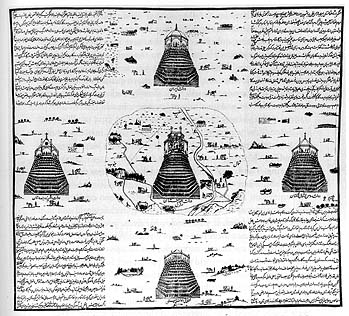
Proclamation and map issued by Amir Abdur Rahman. Reproduced from Curzon, Tales of Travel.
I am Amir Abdur Rahman Khan, the king [padshah] of Afghanistan. During the time of my reign, I have always been sympathetic and benevolent to you people of Afghanistan, and I have not overlooked my responsibility to you for a single moment. I have told you people a lot through books of advice, publications of preachings, and in many other ways. I have now prepared a map [naqsha] of your own country and also a map of those countries which are located on the four sides of your country [see map 3]. If you people consider well the map which is drawn for you, it will allow you to see with your eyes how blessings may accrue to you in your religion [din] and also in this world [dunya].
There are enough details of the affairs of your religion and your life in this world on this map for you to understand that everyone's share [nasib] is determined by God on the basis of his merit, circumstances, and capabilities. Your king also pays attention to these ranks among the people. He has appointed each one of you in one of these ranks from the commander-in-chief to the common soldier. Each one stands in his own place and position, and hence you people should be grateful to God and to the king. In whatever rank and position you are and wherever you stand look downward to know how many people are lower than you. When you look downward and see your high rank and position you will receive three blessings [ni‘mat]. First is the consent and contentment of God, for it is written, “If you express your gratitude to God for the blessings He has given you, He will increase them for you.” Second is the approbation and good will of your ruler for you. The third is that you can keep that rank or position that you have, and you can be hopeful for more progress and promotion in the future. God has said that “if you are grateful for His blessings, He will increase them for you.” The increase of blessings, in fact, is progress in rank [daraja]. All other blessings of the world are apparently related to the rise in grade and gaining advancement. When one makes progress and [earns] promotion, he can easily obtain other blessings and privileges.
But if you people are not contented with your present state and neglect to offer your thanks to God, and do not look to those who are inferior to you in position, but rather envy those who are above you, and ask in your hearts why such persons are superior to yourselves, you lay the foundation of envy and hatred, and cause many calamities to fall upon you. First, you bring down God's anger on you because it means that you criticize God. People can get something only if God wants to give it to them. No doubt if God likes someone, He leads him to the right path and makes him do good things and makes him honest in his life and job to achieve good services. On the basis of these qualities which God has given to a person, He will undoubtedly make the king benevolent towards him and give him promotions. In addition to this, [recitation of the phrase] “I take refuge in God” is, first of all, infidelity. Second, the person will face the calamity and misfortune of not being grateful to God. Being ungrateful for God's blessing can decrease God's blessings and the honor that God bestows upon the human being. Third, one will definitely fall down from the position he has, and when one falls down from a high position, two things happen to him. First, he will break his neck. When one breaks one's neck, it means he has lost everything in this world and in the other world [akhira]. If you break your neck, you will remain in a state of unconsciousness for so many years. When you become conscious you will see that someone else has occupied your position because the work of the world cannot be stopped for a person. When one leaves someone else occupies his position. When you lose your position, you will be walking down a street in a state of disgrace [be abru] and dishonor [be ghairat]. No one will even mention your name. You will be forgotten. If they mention your name, they will curse you. You will become famous for being foolish and ignorant. You will not be able to obtain the position that you lost to the very end of your life. These kinds of behavior also have another bitter fruit which is the destruction of the base of your religion and your life in this world. That is to say, if you do not look downward but rather look only upward, and if you are led by spite [bughz], contumacy [‘anad], and envy [hasad], and if you make envy and spite the watchwords of your life, and if you feel happiness over the disgrace of others, and if you accept corruption as a way of life, the neighbors around you will laugh at your way of life night and day. All the countries will criticize your way of life. At that time you will not be able to do anything useful. You will be regretful and remorseful.
Please be cautious! Think wisely and listen carefully to my words and sayings, I who am the king of you people of Afghani- stan. Listen, obey, and weigh well what I am saying to you, for no use can come from lamenting later if you do something wrong now. This advice is for all of you, from the commander-in-chief down to the common soldier and also for the subjects who are inferior to all. It has been said that a common soldier who stands with a gun on his shoulder to fulfill his duty has the lowest rank in all the military, but he shall look downward to the common subjects [ra‘iyat] who are even lower in rank than him. He shall think to himself that once he was one of them, but now because of the grace of God and due to the kindness of the king he has obtained this rank. You should sympathize with the subjects, who are your own tribesmen and who are continually employed in cultivating their lands, in cutting their crops, in thrashing their corn, in gathering in the harvests, and in winnowing the wheat from the chaff. They are also occupied in commerce and undergo hardships and troubles by night and by day and only enjoy a portion of the produce themselves after they have paid the taxes which are necessary for the expenses of the state. Whatever money and goods I, the king of Afghanistan, take from the people is spent every month for you the people of the army. It therefore behooves you all, whether you are high ranking commanders, soldiers, or subjects, to be grateful, because all that you pay to your government is given back to your brothers, sons, and tribesmen. It is as if their own money is spent by their own government for their own brothers and their own sons. By doing so, God is pleased, religion prospers, and our dignity and honor are preserved. In a like manner, the subjects should also be grateful, so that God's blessings may increase day by day, for it is written that, “Those of you who are grateful for My blessings shall have them increased.” It is therefore incumbent on you to be grateful both to God and to your king. You people have to gird your loins and honestly serve your religion and state. In doing so, you have to have only one objective and that should be the welfare and prosperity of your religion and state and obedience to your king. Obeying the order of the king with complete devotion and loyalty is just like obeying the commands of God. It is based on this verse of the Qur’an: “Obey Allah, his Prophet, and the king who is from among you.” Thus it is incumbent on all of you, on account of the ranks and responsibilities that you have, to be thankful for this blessing which is the obedience of God.
The most important thing for you to know is that the kindness and mercy of the king for his subjects is like the kindness and mercy of a father for his son. In the same way that the kindness and mercy of a father is natural towards his son, the kindness and mercy of the king to his subjects is also natural. This is also the command of God to the king that he should be kind to his subjects. But when a father notices that his son is involved in illegal activities, then he will try to admonish or reprimand him. The reprimand of a son by his father to prevent him from committing a crime is not a sign of unkindness to the son, but rather should be considered as a kind of favor to him since a father does not want his son to have a bad name and habits. In the same way, the king has the same feelings towards his subjects as a father has towards his son. The king only wishes to spread the blessings of peace and order among his subjects if they do anything wrong. The king wants his subjects to be happy, prosperous, and have a good reputation and name. As long as the son is young and ignorant, he will hate his father's words, actions, and exhortations. But when he gets older and becomes endowed with wisdom and intelligence, then he will never consider anyone kinder and dearer than his father. By that time, he may have no other desire than obeying his father's wishes. As the ruler of you people of Afghanistan, my objective and desire towards you is the same as the desire that a father has for his son. I want a good name for you. I want to be kind to you. This is my desire. If you are wise enough to understand and benefit from my advice, you will see that your religion will flourish and that your country will be prosperous. May it so please God.
This was written on the day of Sunday, the thirteenth day of the month of Jamadi al-Sani, 1316.
| • | • | • |
Mapping the State
Amir Abdur Rahman, who ruled Afghanistan from 1880 until his death in 1901, was never content to command his subjects. He also wanted to school them, to teach them how to better perform their divinely appointed duties as workers in the field, as subjects, as human beings. Throughout his reign, he published numerous pamphlets and broadsides instructing his people on a variety of topics. The document translated above, which could probably be categorized as a firman, or proclamation, was one expression of this tendency. According to Lord Curzon, who visited Abdur Rahman in Kabul and who later reproduced the firman in a book of travel memoirs, the original document was huge—five feet by four and a half feet—and printed on canvas. As both a map and a public lecture, its size and durability were required by the fact that the proclamation was designed to be “read out in the bazaars and mosques of all the principal towns and posted in every village” as a way “to stimulate the patriotism and ensure the due subordination of his people and incidentally to render them more amenable to military conscription.”[1]
The date appended to the end of the document translates to 1898 in the Christian calendar, eighteen years after Abdur Rahman ascended the throne and just three years before his death. That yearwas a time of relative peace in the kingdom. The last of the many rebellions that had punctuated Abdur Rahman's reign ended two years before, and no ambitious kinsman loomed on the horizon to challenge the Amir's right to dynastic supremacy; however, from the evidence of this document, it does not appear that Abdur Rahman relaxed his guard even at this moment, when other rulers might have retired into the confines of their harems. To the contrary, the old warrior remained wary to the end, for he knew how tenuously held were the reins of power and believed as well that he would have been long since dead if any of his retainers had had the resolve or resourcefulness to do him in.[2] That he proved to be one of the few Afghan monarchs who died in bed and in power can be explained not only by his vigilance, but also by the fact that he availed himself of every opportunity to demonstrate the force of his will and the moral imperative of his rule to those around him and to the nation at large.
I have reproduced the firman in its entirety because it provides a succinct précis of the moral principles of kingship that Abdur Rahman hoped to instill in his subjects. While the language of the proclamation might lead one to suspect that these are venerated principles of rule, there is no indication that this is the case. Indeed, that Abdur Rahman felt the need to produce this proclamation in outsized form and to have it carried around the country lends the impression that these principles were neither time-honored nor widely accepted; so too does the fact that, since its founding in 1747, the central state had been subject to repeated upheavals and therefore Abdur Rahman had been required to expend the majority of his labors for most of two decades to protect his throne and gradually consolidate the authority of his state.
The proclamation, however, makes one think otherwise. It conveys an impression of confidence. Its attitude is both lofty and paternalistic, pietistic and exhortatory. In one sense, a primer on the obligations of rulers and those they ruled, in another, it is a warning to those who would defy the king and incur his wrath. While we cannot take its message at face value and assume that Abdur Rahman's subjects held these principles to be self-evident, we can nevertheless use this document as a source for understanding the moral foundation of kingship as envisioned by the ruler who essentially founded the modern Afghan state. More than anyone since the Ahmad Shah Durrani, the founder of the kingdom of Kabul, Abdur Rahman made Afghanistan a reality. He is the Iron Amir, who brought the disparate and antagonistic tribes and petty chiefdoms to heel; he is the ruler who transformed a small cohort of scribes into an administrative bureaucracy; he is the general who molded a motley collection of mercenaries and militias into a standing army; he, more than anyone else, is the visionary who established the boundaries, the offices, the apparatus of the modern nation-state.
These developments have been well analyzed by other scholars and need not be reanalyzed here, but what has been less well attended to and does need to be considered are the moral imperatives that animated, provoked, and legitimated the practical measures that were transforming the kingdom into a new species of state.[3] The time when these changes were occurring represents a crucial moment in Afghan history. It was a time not just of internal change but also of external peril, with the Russian and British empires at the peak of their power and advancing from the north and east. Given the state of imperial competition, consolidation was not just a matter of private ambition; it was also a practical necessity, and the proclamation gives us an idea of the grounds on which Abdur Rahman imagined such consolidation might be justified and sold to his people.
Besides containing text, the proclamation also has on it an image, an image that is part map and part icon and that tells us a great deal about kingship and the kind of community that Abdur Rahman imagined Afghanistan to be. Given that over ninety percent of the population at the time was illiterate and given the size of the original artifact, we must conclude that, even more than the words, it was the image on the document that mattered. This is what people saw first even as they listened to someone else—a government official or a mulla perhaps—read the words. In addition to the text then, it is also important that we consider what the people might have seen when they stared up at this mappa mundi of the Afghan universe.
The image that Abdur Rahman asks his subjects to survey shows five multitiered structures, each surmounted by a canopied pavilion. The five structures are arrayed in a cruciform grid, the centermost one being labeled in small letters at its base “The Government of Afghanistan.” The pavilion at the top of this innermost edifice is of a traditional design often seen in Afghan architecture—two short minarets rising above three columned arches. Several other unidentified (though probably recognizable) buildings can be seen in the center section of the picture, each connected to the others by little roads. Snaking vertically through the terrain is a large river, apparently the Oxus, since it is on the side of the image labeled “North.” On the “East” side of the map (which is on the lower half of the map), one notices rocky crags that apparently indicate the rugged Pamir Mountains on Afghanistan's northeastern border. Other than these few features, no other geographical details are provided except the boundary itself—a dotted line that frames the central oval representing Afghanistan (map 3).
Beyond the borders, there are four other structures, all more or less identical in size. The topmost structure on the map, which is on the side labeled “West,” is identified as “the Government of Iran” and surmounted by a canopy design that is at least vaguely reminiscent of Iranian shrine architecture. The building on the right side of the image (to the “North”) is referred to as “Government of Russia and Northern Turkistan” and bears a spire with a Christian cross at its top. The structure on the bottom, or “East” side, is the “Government of China,” and its pagoda-like form appears Chinese in inspiration. The last edifice, on the “South” side of Afghanistan, is marked as the “English Government in Hindustan” and is crowned with a cross and pediment that seem to represent an Anglican church.
In the opening sentences of his proclamation, Abdur Rahman tells his subjects that they should “look at this map carefully and think about it deeply, so that you will see with your eyes the ways of life from which you can get benefit in your religion and also in this world.” Perhaps, but for us, deciphering the image is difficult without the aid of the surrounding text because we are not subjects of the Amir and our eyes are blurred by many more media images than the few that came before the Afghan people in 1898. However, even without the text, certain lessons are still available to us. One such lesson is that Afghanistan exists as a state among other states, and from the visual geometry of the interlocking images, we might also conclude that each of these states has its own allotted portion of the earth. (The text immediately informs us of the correctness of this deduction when it notes, “You can understand that everyone's share is determined by God on the basis of his merit, circumstances, and capabilities.” Divine apportionment as the basis of all social and political relationships is a central tenet at work here, and the text and image reinforce this basic principle.)
We can also conclude from an inspection of the map that the world is divided into domains and that each of these domains is ruled by a government. In visual terms, rulership is represented by the towers, the height and solidity of which reflect the power and stability of the separate regimes. That all five of these towers are more or less equally stable at their base and tall at their summit tells us perhaps that all are equal in their sovereign authority. This is not an unexpected assertion from our point of view, but it is surprising when we consider it in historical and political context. When the Amir published this proclamation, `Afghanistan' was a relatively novel idea (not long before it had been referred to as the kingdom of Kabul), and it was an idea that had only really come into being because policy makers in London had come to the conclusion that a buffer state on their northwestern flank would be more useful to British interests than the perennially mutating satrapy that had existed up until that point. Here, shortly after that decision, we see the Afghan amir claiming a status for his state equal to that of apparently more stable states on his borders and, in the process, abandoning any grander aspirations for expansion into the Indian subcontinent or central Asia.
That is one of the surprising notions intimated by the map. Another comes when one considers its religious iconography and the clear association of states with religious symbols. That association is an established one from an Islamic point of view, but what is more interesting is the Amir's apparent acceptance of Afghanistan's status as an Islamic nation bordered on two sides by non-Muslim states. If we take into account the fact that Abdur Rahman was given protection in Russian-held Tashkent for the ten years prior to his ascension to the throne, his position makes sense, but we must assume that his apparent avowal of the notion that God has apportioned the share of each state, including that of non-Muslim ones ruling over Muslim populations, would have been a difficult idea for many of his more religious subjects to accept.
One more point about the towers concerns their relation to the people represented on the map. Close inspection of the towers indicates that each tier is articulated by the black silhouettes of people lined up shoulder to shoulder. Given the evidence in the text, it is clear that we are supposed to see these silhouettes as people who occupy appointed positions in the government. These are the ones whom the Amir addresses when he declares, “He has appointed each one of you in one of these ranks from the commander-in-chief to a common soldier. Each one stands in his own place and position, and hence you people should be grateful to God and to the king.”
Below the tower, in the expanse of landscape that represents the Amir's domain, we are confronted with a more pastoral and spacious scene in which we can make out scattered dark figures engaged in a variety of domestic pursuits such as tilling the soil, driving bullocks, and carrying bundles of straw on their backs. In the text, these figures are referred to as “common subjects…working night and day on the farm, shoveling, reaping, and cultivating to get the produce [of the land], they separate wheat from straw.” The Amir wants his soldiers and officials to look on these common folk and be grateful that their lot in life is better than that of their peasant kinsmen, but he has another objective as well and that is for his people to set aside the traditional understanding of themselves as members of separate communities accepting the suzerain authority of a king conceived of as the first among equals.
In place of this conception of kingship, the Amir propagates—in the visual language of the map—the novel idea of Afghanistan as a single, undivided community unified by common obedience to a sovereign authority. While the people are to go about their business in the fields below, the ruler must go about his, high astride the tower of state. From this lofty vantage, he can supervise the peaceful pursuits of his peasant subjects and survey as well (at eye-level and with unblinking vigilance) his fellow rulers, who stand in their towers beyond the borders of the kingdom. What divisions there are in this imagined community of Abdur Rahman's are those of apportioned rank; otherwise, no divisions, whether of tribe, ethnicity, religion, or language, are recognized. To the contrary, all subjects are defined by either the position they hold (a position bestowed by the king) or the tasks they perform (tasks determined ultimately by God and carried out in the shadow of the state).[4]
The map also indicates something else about the state—that it is bounded. Boundaries, it would seem, are important, and it is somewhat surprising that they appear this way, given that Abdur Rahman had grudgingly accepted the British demand for a demarcated border between Afghanistan and India only five years earlier. At the time, he had suspected that British cartographers would use the opportunity to remove parts of his dominion, and he also worried that his own ability to control his subjects, particularly the recalcitrant border tribes, would somehow be diminished and constrained by the presence of fixed boundary lines. But just a few short years later, he is displaying to his people a visual representation of that very border he had been so loath to accept. The question which this image raises is not so much why he accepted the boundary line—that question can be answered if one considers the state of relations with Great Britain and the power it wielded in the region—but, rather, why he seems to have embraced the idea of the border to such an extent that he would proudly advertise its existence.[5] How is it that an act of capitulation had become a point of pride with his people?
On the most mundane level, of course, recognized boundaries offered some protection against external encroachment; because the border was sparsely guarded, this protection was more diplomatic than military, but it was still something that could be counted on. To my mind, however, a more important factor in explaining Abdur Rahman's acceptance of the boundary is the help it provided in legitimating his regime and his sometimes draconian policies to his subjects. This reason can be seen in the following analogy taken from the Amir's autobiography:
It is easy to understand that before furnishing a house one must think of making or finding a house to furnish; and in case of building a house it must be surrounded by walls to keep the goods safe which are put in it; and if the house is full of holes, ditches, snakes, scorpions, etc., it is necessary to get rid of these before anyone can live in it. In the same way, it was of the first and greatest importance to mark out a boundary line all around Afghanistan.
A prosaic image no doubt, but one that the humblest Afghan could readily identify with and abstract from. Who could object, after all, to the importance of “a strong wall around the country, shaping it, as it were, into a house”? And who could argue against the need “to clear that house of all the injurious scorpions existing in it, scorpions that formed a great obstacle in the way of peace and progress”? As Abdur Rahman goes on to explain, the scorpions he is referring to are “those hundreds of petty chiefs, plunderers, robbers, and cutthroats, who were the cause of everlasting trouble in Afghanistan.” To end their depredations, the Amir had to resort to desperate measures that included “breaking down the feudal and tribal system,” but the result, he was quick to note, was the creation of “one grand community under one law and under one rule.”[6]
| • | • | • |
The Once and Future King
The visual images adorning the proclamation created an idealized picture of the Afghan nation as Abdur Rahman wished his subjects to see it. I now want to examine in greater depth the principles of monarchical authority by which he thought that nation should be ruled. Monarchical authority, of course, is illuminated on the map we have been analyzing (can a more striking depiction of the king's stature and power be imagined than this image of the great tower looming over the agrarian landscape?), but it is more systematically revealed in the accompanying text, which neatly articulates the principles of kingship on which Abdur Rahman based his rule. In explicating these principles, I will make reference both to the proclamation itself, which supplies the essential outline of those principles, and to the previously cited autobiography, which demonstrates in dramatic fashion the way in which Abdur Rahman saw these principles guiding and defining his own life experience.
Originally published in Kabul in 1886 as Pandnama-i dunya wa din (Book of Advice on the World and Religion), the autobiography details the trials and tribulations of the Amir's early years up to his ascension of the Afghan throne in 1880. The work was translated from Persian into English by a Punjabi official named Sultan Mahomed Khan (who had served for many years as a secretary [munshi] to the Amir) and was then published in London as the first volume of The Life of Abdur Rahman Khan: Amir of Afghanistan (1900). While Afghan historians have questioned the extent of Abdur Rahman's input on the second volume (which provides an account of the Amir's daily life and the government he established), they have confirmed that the first volume is a more or less faithful rendition of the Persian pandnama previously published under the Amir's direction in Kabul.[7]
Periodically tapped for information on Abdur Rahman's early life and the historical events of that time, the narrative contained in volume one of The Life has been otherwise overlooked by scholars, and its virtues, both as a story and as a treatise on kingship, have been largely ignored. This is a strange oversight, if only because Abdur Rahman's life history is a fascinating tale of adventure and intrigue. As the translator of the autobiography notes in his preface, Abdur Rahman's early life is “like a chapter of the `Arabian Nights,' [and] the reader cannot help being interested to notice that a monarch like the Amir, setting aside the idea of boasting, should condescend to make a clear statement of how he was a prisoner in fetters at one time, and a cook at another; a Viceroy at one time, and a subject of the Viceroy at another; a general at one time, and under the command of the general at another; an engineer and a blacksmith at one time, and a ruler at another.”[8]
Beyond its sheer drama, however, the story of Abdur Rahman's early life deserves attention for what it tells us about the Amir's vision of kingship and his understanding of the reciprocal obligations of ruler and ruled. Written originally as a book of advice, The Life retains its sense of moral instruction even in its English incarnation. The Amir wanted the readers of the original work to learn from his life and to follow his example, and this sense of direction, injunction, and exhortation is visible in the account of his life experiences, just as it is in his official proclamation. In the case of the life history, however, the idiom of instruction is more often stories than outright admonition, and we are thus afforded the opportunity, as we watch Abdur Rahman's odyssey from displaced heir to rightful king, to see enacted the principles of royal authority that are abstractly delineated in the royal firman.
A second merit of The Life is its coherence as a narrative. While it is replete with interesting characters and strange encounters, the story of Abdur Rahman's early life is not a pointless picaresque. Rather, it is a clearly moralized account of a king's coming of age and bears a striking similarity to the saga of Sultan Muhammad's youthful ordeal that was presented in the last chapter. The story of Abdur Rahman's youth is far more detailed, of course, and the canvas is broader, but the essential outline of both stories is much the same, and the moral pivot around which each revolves is the relationship between father and son.
Like Sultan Muhammad's father, Abdur Rahman's father, Muhammad Afzal, was a man of influence and authority, but in his case the authority was on a grand scale. Muhammad Afzal was, in fact, the eldest son of the Afghan amir, Dost Muhammad, who twice ruled the kingdom of Kabul (1826–38, 1842–63). As the narrative begins in 1853, Abdur Rahman is called away from his mother's home in Kabul to join his father, who is serving as governor of Afghan Turkistan. Though only nine years old, Abdur Rahman was Muhammad Afzal's eldest son, and it was time for him to sit by his father's side and imbibe the lessons of rulership. Much of the first part of the story is taken up with a depiction of the joys and vicissitudes of this apprenticeship. But we also encounter our first indications of the misunderstandings that are to plague Abdur Rahman's relationship with his father; they are, in fact, the same sort of tensions that we have already seen in the story of Sultan Muhammad and his father.
The first sign of trouble occurs when Abdur Rahman is about fourteen years old. He has been assigned by his father to serve as the governor of Tashkurgan district, but shortly after beginning his appointment, he is rebuked by his father for reducing the taxes of his impoverished subjects and giving presents to some of his loyal attendants. Abdur Rahman resigns over this infringement on his authority, but he gets into even more trouble with his father shortly thereafter when a treacherous advisor persuades his father that his son has taken up wine and hashish. Trusting the word of his advisors over that of his son, Muhammad Afzal has Abdur Rahman thrown in prison, where he languishes in chains for a year.
Abdur Rahman eventually regains his father's favor and the command of his father's armies, but after serving faithfully and well in this capacity, Abdur Rahman's position in society is again endangered by another error of judgment on the part of his father. These events transpire following the death of Amir Dost Muhammad in 1863. The great amir had ruled for more than thirty years, and his demise created a power vacuum in which his two eldest sons, Muhammad Afzal and Muhammad Azam, were pitted against their younger half-brother, Sher ‘Ali Khan, who had succeeded in gaining the favor of the late amir prior to his death. Through the first of many acts of treachery, Sher ‘Ali managed to defeat Muhammad Azam, and he then turned his attention to Muhammad Afzal who, as Dost Muhammad's oldest son, had the strongest claim to the throne.
Although he enjoyed a stronger position than Sher ‘Ali, Muhammad Afzal once again committed a fatal error. This was the error of trust—the same offense that precipitated Sultan Muhammad's travails when his father set off alone and unprotected to claim a bride. In that case, the incautious father had rejected the warning of his worldly wise son, and here too we find Abdur Rahman cautioning his father when a messenger from Sher ‘Ali arrives in their camp carrying a Qur’an and professing good faith: “My father being deceived by these assurances, took the Koran on his eyes, and kissed it, starting out for the camp of Shere Ali, leaving his army to return, although they all begged him to fight it out.”[9]
Against his son's advice, Muhammad Afzal sets off for Sher ‘Ali's camp and is soon taken prisoner. As one would expect, Abdur Rahman prepares to retaliate for this treachery, but before he can do so, he receives a letter from his father threatening to “disown” him if he took to the field.[10] At this juncture, there is a slight deviation in the two stories, for unlike Sultan Muhammad, Abdur Rahman decides to obey his father's wishes. This choice proves significant for the meaning of the story, but on a narrative level Abdur Rahman's obedience has the same effect as Sultan Muhammad's disobedience, as Abdur Rahman is abandoned by his troops and—like Sultan Muhammad—forced to take refuge with one of his father's old allies, in this case, the king of Bokhara.
Residence in the Bokharan court places Abdur Rahman in the same ambiguous situation that Sultan Muhammad faced in exile when he had to choose between returning to Pech and accepting the secure but demeaning status of a court scribe. In Abdur Rahman's case, the dilemma is presented to him shortly after his arrival in court when a message arrives indicating that the king “wishes to make you one of his Court officials, so that you should attend on him every day.” Like Sultan Muhammad, Abdur Rahman declines the offer and adds the comment, “I had never been a servant, and did not know how to behave as one.”[11]
Abdur Rahman's father was taken prisoner in the summer of 1864. Two years later, in May 1866, Abdur Rahman returns to Afghanistan to release his father and gain for him the throne from which he had been deprived. To do so, he has to raise an army, a task that requires the same sort of diplomacy employed by Sultan Muhammad when he gathered together his grim band of avengers. This skill is evident in the following letter which Abdur Rahman wrote to his former troops, then under the command of a treacherous relative: “You are my army, therefore I will not fight against you. If you wish to kill me, I will come to the fort to-morrow, and you shall shoot me, and obtain rewards for killing your old employer.”[12]
This appeal to honor and old loyalties (like that of Sultan Muhammad) “melted their hearts,” and he is soon able to engage and defeat Sher ‘Ali in battle. Following the release of his father from Sher ‘Ali's clutches, Abdur Rahman enters Kabul at the head of his victorious army and immediately avails himself of the opportunity to read “the Khutba [Friday sermon] in the name of my father as king.” Responding to Abdur Rahman's lead, “the chiefs gathered together to congratulate [Muhammad Afzal] on becoming amir, saying that he being the rightful heir, they were pleased to acknowledge him as their ruler.”[13]
Thus Abdur Rahman achieves redress for the wrongs he has suffered, and we see enacted once again what would appear to be a paradigmatic narrative of fathers and sons, dispossession and vindication. The difference here, of course, is that father and son are reconciled. In this case, obedience to the father has allowed both father and son to reclaim their rightful place in society, or so it would appear, but the story does not end here. Within a year of mounting the throne, Abdur Rahman's father is dead, and Abdur Rahman has ceded his own right to the throne in favor of his uncle, Muhammad Azam. Like his older brother, Muhammad Azam is prone to misjudgment and heeds the advice of courtiers who convince him of Abdur Rahman's bad intentions. He therefore dispatches Abdur Rahman to the north and loses his assistance when the army of the resilient Sher ‘Ali threatens from the south. Because of Muhammad Azam's cruelty, once-loyal troops desert to Sher ‘Ali's side, and Abdur Rahman, with his uncle in tow, must flee to Turkistan. There he remains until 1880, when he finally succeeds in claiming the throne for himself.
Regardless of these later complications in the story (which repeat rather than alter its principal themes), a remarkable series of parallels can be noted between the “coming of age” narratives of Sultan Muhammad Khan and Abdur Rahman. In both cases, certain basic cultural preoccupations are illustrated, among them the ambivalent relations that the two protagonists enjoy with their fathers (an ambivalence that is as much structurally given as individually arrived at), the persistent threat posed by paternal cousins (Paindo and his brood in the first story, Sher ‘Ali and his in the other), the danger of trusting those inferior in rank to oneself (be they women or courtiers), and perhaps most important of all, the overriding importance of continually remembering who you are and adhering to the responsibilities entailed for you by your situation and station (as seen in the exemplary actions of Sultan Muhammad and Abdur Rahman themselves). In both stories, the failure of senior kinsmen to abide by this last precept creates the obstacles that each protagonist encounters in the course of the narrative, and it is finally only the steadfastness and resolve of the hero that allows these obstacles to be conquered and the moral order to right itself.
The similarity in these two otherwise disparate stories indicates that we are in the presence of something like a “cultural script,” but at the same time it is important to note that there are significant differences in the stories as well. Thus, despite the commonalities outlined above, these two stories are ultimately about very different things, and they illustrate dissimilar principles of social action and political relationship. Quite simply, Sultan Muhammad's story is about the individual requirements of honor and the moral authority that joins together the coequals who claim common descent in the universe of tribal relations. Abdur Rahman's story, on the other hand, is about the personal requirements of kingship and the hierarchical moral authority binding the monarch to his dependent and subservient subjects. Both honor and kingship as moral systems draw elements from each other; both, in fact, have the intrinsic capacity of being transformed into the other. But, in their basic constitutions, the two systems are opposed, and it is therefore necessary to focus on the nature of the differences that lie between them in order to understand how they can also be, in certain respects, alike.
| • | • | • |
The Armature of Royal Rule
Having provided some background on Abdur Rahman's life, I now want to relate principles of kingly authority contained in the proclamation that was reproduced and translated at the beginning of this chapter to specific episodes in Abdur Rahman's life story. The organization of this section will be thematic rather than chronological, as I will outline three aspects of kingship revealed in the proclamation and correlate them with scenes and situations found in the autobiography. The three aspects to be explored are those of king as instrument of God's sovereignty, king as patriarch and kinsman, and king as grantor of benefits and rewards.
God and King
The first and most important principle of Islamic kingship, be it an Afghan version or any other, is the paramountcy of God as creator of the universe and the ultimate judge of human affairs. All power in nature and society emanates from God. It is God who “determines the share” that everyone receives, which is to say, the station that they are born into and the capability which they have to improve their situation. As creatures of God, people can achieve something only if God allows them to do so. If He does not, then no amount of effort can alter their destiny. The proclamation builds on this principle of divine control by closely aligning the interests of the monarch with those of God. The king, like other human beings, is subject to God's ultimate authority, and he too will be judged for his actions and his obedience to divine commandments. But in distinction from other people, the king has been allotted an added burden—that of ensuring the general order that will enable those subject to his authority to fulfill their assigned duties as Muslim believers.[14]
In the autobiography the most dramatic means by which Abdur Rahman conveys his belief in the obligation of the ruler to provide the conditions within which his subjects can fulfill their religious obligations is through his portraits of unjust rulers who fail to live up to their divinely appointed responsibilities. The most egregious of these rulers was the king of Bokhara, whom Abdur Rahman encountered several times on his travels in central Asia. During one journey to the Bokharan court, there occurred an episode that is emblematic of this ruler's sins.
Abdur Rahman was passing a village when he spies “a high piece of ground, which had been prepared to receive the tents of the king.” The ground was covered with blood, which Abdur Rahman assumes was “due to the amount of cows killed for charity to celebrate the king's victory” in a recent campaign. On inquiring of the local residents why the sacrifice had not been performed further from the tents, however, he is informed that this was not the blood of cows but of men. Fifteen days earlier the king's tents had been pitched in this spot, and one thousand prisoners had been brought before the king, who had ordered their throats cut in front of him. Abdur Rahman's response to this news is “shock” that prisoners should be treated in this way, and he goes on to ruminate that the then ongoing conquest of Turkistan by the Russians was caused by “the neglect of the Muslim rulers of God and His religion. They make the true believers slaves, and kill human beings, who are God's creation, without fault.” Ordering his soldiers “to cover over the blood with earth, in the shape of graves,” Abdur Rahman laments, “Bokhara, which had the reputation of being a very religious country, acted so contrarily to the teachings of Mahomet. I regretted the carelessness of the Muslims who are mad in their own conceit, so that the unbelievers, finding them ignorant and hostile to each other, take advantage of this.”[15]
If Abdur Rahman portrays the king of Bokhara as a ruler who ignores his responsibility to uphold God's law, he paints himself as a ruler who succeeds in this responsibility and is favored by God for doing so. One way God expresses His favor is through a series of miracles that aid Abdur Rahman before he assumes the reins of royal power. The first of these interventions occurs while Abdur Rahman is still a young man and serving as governor of Kataghan in northern Afghanistan. He receives a letter from his fiancée and first cousin, the daughter of his uncle Muhammad Azam, who wrote that the letter was to be delivered into his hands, that it was to be shown to no one else, and that he himself was to write and seal the reply. Never having paid attention to his studies and consequently unable to read or write, Abdur Rahman “wept bitterly” out of frustration and shame, for “while I boasted of being such a fine man, I was really most unmanly, being so ignorant.”
On retiring that evening, Abdur Rahman prays to God “with all humility, beseeching the souls of the Saints to intercede” for him and asking that his heart and mind be enlightened so that he would not be “ashamed in the eyes of Thy creation.” After Abdur Rahman falls asleep, a holy man appears to him and twice tells him to rise and write. Both times, the younger man raises his head from his bed only to fall back asleep, but the third utterance of the command is punctuated with the threat: “If you sleep again, I shall pierce your chest with my staff.” At this, Abdur Rahman rises and begins to search his memory for the letters he had learned as a child. One by one they come back, and before dawn he is writing words in an awkward scrawl. By late afternoon, he is responding to his fiancée's letter and perusing official correspondence. The holy man's intervention thus enables him both to maintain privacy in his domestic relations and to overcome that great obstacle to proper rule—overreliance on court advisors.[16]
In the course of his autobiography Abdur Rahman recounts several other divinely inspired dreams “from which I drew much comfort, as they gave me hope that I should not fail in my mission as a king, and that I should be successful in the end.”[17] Perhaps the most dramatic occurs just before he leaves Turkestan to make his drive on Kabul. In this dream, two angels take him by the arms and bring him into the presence of a man he does not recognize: “He had a very mild, gentle face, of oval shape, a round beard, and beautiful long eyebrows and eyelashes. He was wearing a large loose garment of a blue color, and a white turban. His whole appearance was the perfection of beauty and gentle nature.” Seated beside the man, whom he perceives to be a ruler of some sort, are four other men—two on each side and all dressed in Arab robes. Into this august assembly is brought a man who, when asked a silent question “in the unspoken language of the eyes,” replies that he “will destroy the churches of other religions and build them into mosques, if I am made king.” The sovereign is displeased with this answer and orders that the man be taken away. Then the same question is asked of Abdur Rahman who responds that he “will do justice and break the idols and [uphold the Islamic declaration of faith] instead.” Hearing these words, the sovereign's four companions look at him with kindly expressions on their faces:
It was an expression of consent to appoint me king. I was inspired at the same moment with the knowledge that the king was the Blessed Prophet Mahomed, the two men at his right hand were his companions Abu-Bekr and Osman; the two at his left hand were his companions Omar and Ali. Upon this I awoke, and was so happy to believe that the Prophet and his Four Companions, whose authority it is to appoint the sovereigns of Islam, had chosen me as the future amir.[18]
Like many Islamic rulers before him, Abdur Rahman uses dreams not only to legitimate his efforts but also to lend them a sense of inevitability. This practice can be seen in a series of episodes that occurs just as Abdur Rahman, accompanied by a tiny contingent of cavalry, is setting off on his final, desperate bid for power in 1880. On the eve of his departure from central Asia, he has a dream in which a saint tells him to take one of the flags flying over his nearby tomb and “erect that flag in front of thine army, and thou shalt always be victorious.” Abdur Rahman does as he is told but, shortly after setting out for Kabul, is confronted by an opposing army that he guesses to be 10,000 men strong. Despite the numerical superiority of the force arrayed against him, Abdur Rahman never loses heart or wavers from his goal: “I knew that no courage, however great, could succeed against such a number, but as I had given my life for the service of God, and knew all the verses of the Koran which promise rewards to those who sacrifice themselves for the suffering, to me 10,000 were the same as 1,000,000.[19]
The next day, as he marches to face the enemy contingent, an astonishing sight greets his eyes. “The enemy began to disperse gradually in different directions, as if under the influence of an evil spirit. I could not understand what had happened. In the meantime, a body of sowars [cavalry] belonging to the Mir of Badakhshan…was approaching from another direction praising God.” Soon thousands of chiefs and common people from the surrounding areas are flocking to his camp and swearing fealty to his cause, an outcome that he explains thus: “A wise man will understand how I conquered the hearts of these 20,000 men in one day, because the hearts of men are in the hands of God, who turned them that day towards me.”[20]
Such are the claims of kings, of course, but it is still important to recognize the significance to a ruler of his being able not only to convince the people that God supported his cause but also to believe it himself. If a ruler can convince the people that God is behind him, and if he can support that conviction through successful action, then popular support will mushroom. Likewise, if a leader can convince himself of his own divinely favored status, he can act in a fearless manner that befits his station. While it is undoubtedly true that many of those rendered fearless in this way wind up dead, those who survive are fortified by their survival and become formidable indeed. Abdur Rahman is one such survivor who was favored by circumstances and possessed of the requisite credentials to achieve what he took to be his destiny.
Kingship and Kinship
Patriarchal authority is the binding cement of Afghan society, and it is therefore not surprising that Abdur Rahman exploits that tie in the proclamation when he notes “the kindness and mercy of the king for his subjects” is as natural as “the kindness and mercy of a father” for his son. Like a father, the king's desire for his subjects is that they should earn a good name for themselves and accomplish in their lives what God has given them the capability to achieve.[21] If instead they act in illicit ways and disobey lawful commands, their ruler, acting again like a dutiful father, is required to reprimand and punish his subjects in order lead them back to the right path and preserve the general prosperity of the community at large.
According to Bernard Lewis, the use of patriarchal symbols of authority is unusual in Islamic political writings, and one rarely finds instances in which a king is referred to as the “father” of his country.[22] The language of the proclamation suggests, however, that patriarchal images are vitally important in Afghan political culture, and that conclusion is buttressed if we consider the evidence of the autobiography, in which virtually every important political relationship is negotiated in and evaluated through the terminology and ideology of kinship relations. One area in which this can be seen is in the relationship between dynastic rivals. The first such example in the book occurs between Abdur Rahman's father, Muhammad Afzal, and his younger half-brother, Sher ‘Ali Khan. The meeting between them that is described below was initiated by Sher ‘Ali after he has learned from his spies that Muhammad Afzal's army is “too strong for him to stand against, and that he must resort to intrigues, or he would meet with defeat.”
Shere Ali, listening to this, sent Sultan Ali, son of Sirdar Kuhandil of Kandahar, with an oath on the Koran, in which he undertook to look upon [Muhammad Afzal] as his father, and saying he was determined not to disgrace the name of their father Dost Mahomed by fighting against his son. My father being deceived by these assurances, took the Koran on his eyes, and kissed it, starting out for the camp of Shere Ali. … On his arrival at his brother's camp [Sher ‘Ali] walked out to welcome him, and kissed his stirrups, thus treacherously flattering him, and expressing his sorrow for thinking of going to war with his elder brother.[23]
Not long after this scene, Sher ‘Ali breaks his oath to Abdur Rahman's father and throws him in prison. As mentioned earlier, Sher ‘Ali's power was short-lived—within two years, he was overthrown and Muhammad Afzal was installed on the throne. The issue of succession again arose when Muhammad Afzal died a short time later, but the bloody battle that most observers expected between the dead Amir's brother, Muhammad Azam, and his eldest son, Abdur Rahman, never transpired. The following description of the meeting between Abdur Rahman and his uncle purports to tell why:
Three days after [the funeral], I said to my uncle (Mahomed Azim) that as long as my father was alive, he was his younger brother, and I was as a younger brother to him (my uncle); now my father was dead, I would look upon him as occupying his place, and I would take his myself, leaving my place to his eldest son. My uncle replied that I was the rightful heir, being the late amir's son, and he would be my servant. But I replied: “Your white beard, uncle of mine, makes it unfitting for you to be a servant of any one. I am young, and therefore will serve as I served my father.”[24]
In the first of these two scenes, the illegitimacy and infidelity of the pretender, Sher ‘Ali, is illustrated in multiple ways: by his breaking of a sacred oath, by his treacherous invocation of his grandfather's name to a kinsman he was conspiring to destroy, and finally by his use of kinship etiquette to lull his rival into a false sense of security. In the second vignette, the respect properly shown by a son to his father is invoked as a model for the decorum that a subject should exhibit to his king. Use of this kinship model in the latter instance allows a potential political crisis (in which the principle of seniority conflicts with that of lineal succession) to be peacefully resolved.
Another arena in which kinship terminology is used as a basis for negotiating uncertain political relationships is in meetings between unrelated rulers. An example of this sort of negotiation can be seen in Abdur Rahman's description of his arrival at the court of the Khan of Khiva:
They fired fifty guns as a salute to me, and the Khan walked out to receive me. I dismounted, and we shook hands, and hand-in-hand we walked into the Durbar hall. … We spoke together for two hours, during which time he told me that he regarded me as his elder brother, as his father Mahomed Amin was most friendly to my father at the time of his residence at Balkh, and he thanked God that we had met. He offered me two of the seven cities now under his rule, and at any time I chose to go to Balkh, he would lend me 100,000 sowars and footmen, who would conquer the city for me, so that we might remain friends and neighbors.[25]
In analyzing this scene, it is useful to point out that in traditional Afghan society there are a limited number of relational frames which can be used to structure encounters between unfamiliar people, and of those frames that are available the one most frequently called upon is that of kinship. Time and again I have observed that when first introduced, Afghans will question one another in order to find a prior connection between them. The questioning continues as long as it takes to discover a point of reference: an uncle of one of the two men whose cousin had married a relative of the other man's, an elder brother of one of the men who had been a classmate of the other's, and so on. Once a connection has been uncovered, the two men greet each other all over again, familiarly hugging each other and reciting the litany of salutations appropriate to their newly discovered relationship. From that moment on, they will address each other with such terms as are appropriate to that relationship.
Although the meeting between the Khan of Khiva and Abdur Rahman occurred more than a century ago and in a different world, it appears that a similar dynamic is going on as the Khan declares Abdur Rahman to be his “elder brother” because Abdur Rahman's father had long ago played host to his father. In modeling their own relationship on the earlier one of their fathers, the Khan of Khiva not only provides a set of protocols for their interaction but also imparts dignity to his guest, who is, as they both recognize, in a dependent and highly vulnerable situation.
If the khan of Khiva is the epitome of the noble and generous king, the antithesis of this ideal can be seen in his neighbor, the king of Bokhara, who was renowned not only for his cruelty (evidence of which was shown in the last section) but also for his decadence and incivility. In keeping with this reputation, the first meeting between Abdur Rahman and the Bokharan ruler is notable for its cynical manipulation of ritual to gain advantage. Thus, before he has even greeted Abdur Rahman (whose father, as governor of Afghan Turkistan, was well known to him), the king feasts Abdur Rahman and his retainers for nine days and sends them expensive gifts. The generosity of their host is much admired until, at the conclusion of the feast, a messenger arrives to inform Abdur Rahman that he is expected to reciprocate in kind. Never one to be caught unawares, Abdur Rahman has brought sufficient valuables with him to meet the king's demand for tribute, but Abdur Rahman is less forthcoming when he is told by the king's doorkeeper that before entering the royal sanctum, he should stoop over so that the coins which he intends to present the king can be placed on his back. Abdur Rahman's curt response to this demand (“I am created by God, and shall kneel to no one but Him”) annoys the doorkeeper, “who had never heard such a reply from any one before” and is disinclined to allow him entrance. However, another courtier intervenes, and Abdur Rahman is at last allowed to meet his royal host.
Instead of bowing to his host, Abdur Rahman says, “in the ordinary way, `Salam Aleikum' (`Peace be on you').” Not appearing to mind the informality of the greeting, the king chats amicably for some minutes but after that single meeting ignores his guest until some two months have passed. Finally, the king dispatches one of his servants to inform Abdur Rahman that he is kindly disposed toward him and “therefore it was advisable that I should give him 1000 sovereigns and three handsome page-boys” as a sign of good faith. Abdur Rahman refuses this extortion, replying, “These boys are to me as sons. To give gold away is the part of sovereigns. I gave to the king presents, according to the custom, and now I expect gifts and grants from him in return.” Ten days after this exchange, the same servant returns, this time to offer Abdur Rahman a position as a court official. Abdur Rahman is once again outraged by his host's behavior, and he signals his displeasure with a declaration of his independence and equal standing: “ `Neither is a camel's load on my back, or am I on a camel's back,' i.e., `Neither the king of subjects, [n]or a subject of the king.' ”[26]
For the king of Bokhara, there is apparently no basis for relationship except the hierarchical one of master and servant, and in his hands this relationship is an exploitative and estranging one. Abdur Rahman, however, expresses a contrary notion of the master-servant relationship that highlights the naturalness and mutual benefit animating this bond. This ideal is evident throughout the proclamation that begins this chapter, one of the main themes of which is that God has determined that mankind should be divided into ranks, that certain men should occupy superior positions, and that others should serve and obey them. While this relationship undoubtedly has the potential for exploitation, the proclamation translated at the beginning of the chapter indicates that the wise ruler will prevent this from happening by treating his subjects with paternal concern and benevolence: “Whatever money and goods I, the king of Afghanistan, take from the people is spent every month for you the people of the army. … It is as if [the people's] own money is spent by their own government for their own brothers and sons.”
In a world of contending dynastic rivals with no strong central government, troops were quick to change sides if they felt it was in their interest to do so, and kinship was one of the few idioms a leader had at his disposal to bind men to his cause. This is readily apparent in the proclamation and throughout the life history as well. One typical example from the latter work is provided below. The scene takes place in northern Afghanistan where Abdur Rahman's father is governor. Although still a young man, Abdur Rahman has just been appointed commander-in-chief of his father's army, and he is meeting his troops for the first time: “I found the army of Kataghan very pleased to see me, and I conveyed to the soldiers a message from my father, that he looked upon them all as sons, and felt the same fatherly affection for them as he felt for me, Abdur Rahman. At this they cried out with joy, saying, `Every one of us will sacrifice his life for our father, Sirdar Mahomed Afzul Khan.' ”[27]
Kinship is the bedrock of traditional Afghan social relations, of course, but it is important to realize that its appropriation in a context like this one can also alter its meaning in fundamental ways. For an officer in command of an army—or a ruler governing a nation—the expression of a kinship relationship between himself and those under him is an explicitly metaphoric act, which says, in effect, “I am like unto you as a father to his children.” Such a statement is expansive and potentially far-reaching in its consequences, for the man who utters these words is not simply trying to ingratiate himself with those beneath him. He is also attempting to transform their relationship in such a way that he can expect the same devotion from men who are in effect strangers that a father can expect from his sons.
For the tribe, on the other hand, kinship is a more rigidly applied idiom of relationship that has the effect of dividing groups from one another and making them more self-reliant. Tribesmen are also capable of using kinship metaphorically and of referring to non-kin acquaintances by kin terms, but the application of kinship categories to non-kin is generally interjected as a temporary measure to solidify a relationship until such time as actual marital ties can be established to make it substantial. Thus, kinship in tribal culture tends always toward the real. Fictive uses blur discrepancies and gaps, but only so as to preserve the integrity of the original frame, which remains inviolate and unbreachable. Kinship, in this sense, serves as a barrier to the world beyond the tribe, for so long as individuals remember who their kin are and honor their obligations to them, the distinction between insider and outsider can be upheld, and the world beyond the tribal homeland can be better kept at bay.
Gratitude and Ingratitude
In Islam, the relationship between ruler and ruled is premised on the belief that mankind stands in a covenantal relationship with God and that all worldly pacts partake of the moral force of the divine covenant binding mankind to God. As Roy Mottahedeh points out in his study of kingship in eleventh-century Buyid Iran, “In the Koran, benefits that God has granted to men, for which men are repeatedly urged to be `grateful,' extend from the very substances of life and the beauty of creation to the blessing of revelation and the Koran itself.…The Koran repeatedly emphasizes that the Believer is `thankful' (shâkir) for these countless benefits; and that gratitude is one of the basic spiritual qualities that accompanies true belief.”[28]
The proclamation that introduces this chapter extends the Qur’anic principle of gratitude binding believer to God to include the relationship between subject and king. Thus, the proclamation informs us that positions and salaries received from the state cannot be looked upon merely as compensation for work performed; rather, they are the divinely sanctioned gifts of God, and those persons who have the temerity to bemoan their rank or to complain about the size of their portion demonstrate ingratitude not just to their king but also to God. Calculations of a material nature are clearly inappropriate within the domain of the state, and those who view the king simply as their employer debase the spiritual foundation of kingship and undermine their own position in this world and in the hereafter.
Given the importance of the military to the stability of the throne and given the fact that the army was originally composed to a large degree of tribal levies and recruits whose loyalty to the king was often questionable, it is not surprising that Abdur Rahman refers specifically to his army in the proclamation and that he cautions them in several places against invidious comparisons with those who have a higher position or larger salary than themselves. As I discussed in the last chapter, the ethos of tribal culture is one that accentuates rivalry by encouraging individuals to uphold their own rights to preeminence in the face of self-assertions by others. The functional result of this imperative in the tribal context is to limit the development of social stratification as successful individuals attract an ever-increasing number of rivals and are ultimately forced to rely on the assistance of a corresponding number of allies to protect themselves from assault and offense.
Abdur Rahman seems to have recognized the fundamental tension that existed between the egalitarian ethos animating tribal contests of valor and supremacy and the hierarchical ethos on which a successful army depended. If the proclamation is any indication, it would also appear that the Amir realized that, when transplanted to the ranks of the army, the tribal ethos of rivalrous comparison and continual self-assertion represented a serious challenge to the government's authority and his own particular efforts to institutionalize an army based on ordered ranks in which those lower in the hierarchy obeyed those higher up.[29]
Past rulers had been content to rely on the fealty of retainers and soldiers whose personal loyalty was ensured through their receipt of favors, positions, and booty. But Abdur Rahman's own experience indicated the fickleness of such loyalty, and he sought to break with this tradition in his plan to create a more rationalized army and impersonal government bureaucracy. This ambition to alter the way in which people viewed their personal circumstances is seen in the proclamation in which he informs those who serve him to evaluate their worldly fortunes not—as in the case of Sultan Muhammad—by “what people say,” but by the objective measure of their “progress in rank.” The status of the individual should not be judged in relation to the position (or wealth or success) of a rival individual, but rather by the rank which the individual has achieved. Accordingly, if one wants to best a rival, the proper strategy is not to attack him directly but rather to be a better soldier than he and thereby gain advancement above him in the ranks.
The fact that a soldier (or other employee of the state) focuses his ambition on promotion reflects his obedience to the king and his gratitude for the position he enjoys in the world. Contrarily, disobedience to those above one in rank and an unwillingness to fully accept one's position in the hierarchy reflect the fundamental ingratitude of an individual. Frequently in Afghan history, disobedience to the king has been justified as obedience to God, but Abdur Rahman speaks out in the proclamation against those who preface their own acts of disobedience to the state by “taking refuge in God.” Recitation of the phrase “I take refuge in God” is a means by which an individual indicates his indifference to state sanctions and his obedience to God as the final arbiter of human actions. Those who “take refuge in God” indicate their readiness to defy the ruler's anger and risk punishment in order to carry out what they take to be a proper and justified action. Abdur Rahman, however, cautions those who might contemplate disobedience to his orders that such disobedience will be harshly judged not only by the state but also by God who has designated the Amir as his sovereign authority in temporal affairs.
Disobedience to the state and coveting the position of superiors in the administrative and military hierarchy are both examples of ingratitude, and Abdur Rahman demonstrates the seriousness with which he views these sins by the amount of space that he devotes to cautioning those who might contemplate either path of action. The ultimate sanction, of course, is that God will judge the individual harshly and send him to Hell. Abdur Rahman invokes this penalty in the proclamation, but he pays far more attention to those penalties that he himself is in a position to administer and that he knows have a particular resonance in Afghan culture. Thus, the Amir promises those who are ungrateful that not only will they lose their position and the privileges associated with their positions, but also they will suffer shame and humiliation: “When you lose your position, you will be walking down a street in a state of disgrace (be abru) and dishonor (be ghairat). No one will even mention your name. You will be forgotten. If they mention your name, they will curse you. You will become famous for being foolish and ignorant.”
This, of course, is language we have encountered before. Abdur Rahman's threats are ones that derive ultimately from the tribal lexicon of honor and that presumably would work especially well among the deracinated tribesmen who serve in his army. At any rate, the fact that he feels the need to invoke such threats here indicates that, however much progress he may have made in transforming and modernizing the apparatus of rule, he recognizes both the danger which the ethos of honor still represents to the state and its potential utility if its injunctions can be harnessed to the interests of state rule.
Turning to the autobiographical narrative, we see that if there is a single thread running throughout this work, it is this same theme of gratitude and obedience that is so evident in the proclamation. Whenever Abdur Rahman introduces an individual into his narrative, the reader quickly discovers whether that individual was loyal or disloyal to the author. Likewise, virtually all of the misfortunes that befall Abdur Rahman in the course of his journey to the throne of Kabul come about because of the treachery of one or another individual who chooses to act out of self-interest rather than gratitude for his benefactor and rightful ruler.
Given the many misfortunes detailed in the autobiography, it is not surprising that in this document we find many more examples of ingratitude than of fidelity, but the latter do exist and are instructive. One such example is in the actions of a servant named Parawana Khan, who accompanied Abdur Rahman through both of his periods of exile and remained “the most beloved” of the Amir's subjects “up to the last moment of his life.”[30] The extent of this man's loyalty can be gauged by the fact that he allowed himself to be sold into slavery on at least three occasions when Abdur Rahman needed money. Each time, he remained in bondage until his patron could secure the funds to redeem him. A second case of abiding loyalty is provided by the story of an unnamed servant of Abdur Rahim, one of Abdur Rahman's close companions, who accompanied the Amir during his several exiles:
Imagine our gratitude when a servant of Abdur Rahim came from Kabul on foot to bring us 2000 sovereigns. The man had formerly been Abdur Rahim's treasurer, and having no shoes, had bound up his feet (which were torn and bleeding) with bits of carpet. He asked leave to return to Kabul to look after the family of Abdur Rahim, and also to execute further commissions for us. I gave him permission to return, also offering him a horse, which he refused, preferring to go on foot in case we might need the horse for our own use.[31]
As exemplary as these stories are, the most telling case is that of Abdur Rahman himself who encounters tremendous hardships in his early life due to the loyalty that he displays to those in power over him. The most dramatic demonstration of Abdur Rahman's constancy comes in his relationship with his uncle, Muhammad Azam, who repeatedly ignores the sage advice of his nephew in favor of the self-interested counsel of his courtiers. One instance of this occurs shortly after his uncle's assumption of power following the death of Abdur Rahman's father. At the time, Muhammad Azam's younger brother and perennial rival, Sher ‘Ali, remained in the field, and Abdur Rahman wanted to stay in Kabul to help defend the capital in case of attack. Not trusting his nephew, however, Muhammad Azam sends Abdur Rahman to conduct operations in the north where he could be of no assistance if an attack on Kabul were undertaken: “My uncle would not heed any of my advice, writing that if I was his friend I would go; if I was not, I could do as I chose. I was much disappointed, and felt inclined to write: `If I am not afraid of Shere Ali's enmity, I am not afraid of yours.' But, on second thoughts, I desisted, considering that as I had put him on the throne, I ought to uphold him in everything.”[32] One mistake follows another until Sher ‘Ali takes control of Kabul. When Abdur Rahman sends a letter to military officers who had defected to Sher ‘Ali's side, he receives the reply that “they hated my uncle, and being tired of his cruelties, had joined Shere Ali; also adding that, if my uncle were not with me, they would submit to me.”[33] Not heeding these requests, Abdur Rahman remains loyal to his uncle, the result of which is continued defeat and the liquidation of his once considerable treasuries.
Thus commences Abdur Rahman's second and longest exile from Afghanistan, and it is clear from his repeated descriptions of his uncle's mistakes in judgment, of his intransigence when confronted with his errors, and of his cruelty to his subjects that Abdur Rahman felt that the fate of defeat and exile would have been avoided if he had been ruler instead of his uncle. Nevertheless, the lesson we are to learn from this episode in his life is that once he made the decision to support his uncle's claim to the kingship and took the oath of allegiance, he never wavered in his loyalty, continuing to accompany him as they searched for a place of refuge and even to minister to him when he was stricken with illness. As he self-righteously notes at one point in the narrative of their exile in central Asia, “I was more fond of him than his own son was, for during his illness, which lasted forty days, Sarwar had only called twice to inquire after his father's health, occupying himself instead with private business.”[34]
Far more plentiful than depictions of loyalty are illustrations of disloyalty, particularly of servants who fail to reciprocate the trust and care of their patron. One example occurs during Abdur Rahman's first exile in Bokhara when a number of his servants abandon him to work in the service of the king of Bokhara. Given what we come to know of this particular king, we are perhaps intended to draw the conclusion that a king such as this deserves servants such as these, but Abdur Rahman is nevertheless greatly offended when, on encountering these same servants in the court of the Bokharan king, they “ignored me, not even salaaming.”[35] Even greater outrage is expressed when disloyalty comes from men of noble birth and station who have benefited from the kindness and friendship of Abdur Rahman and his family in the past but then betray their benefactors. Such is the case with one Sultan Ahmad Khan, an officer in the army of Abdur Rahman's father, who was captured by Sher ‘Ali Khan at the battle of Herat. Muhammad Afzal had secured his release and appointed him as the governor of the central Hazarajat province, but he responded to this act of generosity on the part of Abdur Rahman's father by abandoning his post to join the ranks of his former tormentor, Sher ‘Ali Khan, who then made him the head of his cavalry. In this position, he later took up arms against the man who had once rescued him, an act that leads Abdur Rahman to the following rumination: “What can be thought of the character of one who fights against the man to whom he owes his freedom, and joins him who took him prisoner? An evil-minded man cannot be made good by culture. In gardens grow flowers, and in jungles grow thorns.”[36]
While Abdur Rahman peppers his narrative with comments on this or that ingrate he has had the misfortune to encounter, he reserves some of his harshest denunciations for the ministers and officials who haunt the court. More consistently than any other class of people, it is these courtiers who bring grief to Abdur Rahman and his family. As we have seen, it was a court official who first caused the young Abdur Rahman to become estranged from his father when he convinced his father that he had begun drinking wine and smoking hashish, and it was in large part on the advice of his court officials that his father was led into the trap that resulted in his imprisonment. Abdur Rahman's uncle was equally prone to weakness in the face of his advisors' admonitions, and the Amir blamed courtly “mischief-makers” for bringing about his uncle's overthrow since it was they who “turned my uncle against me, persuading him that while I was in Kabul his influence was limited.”[37]
Reading Abdur Rahman's fulminations against ministers of court, one is reminded of Sultan Muhammad's words concerning the danger of listening to the advice of women. Sultan Muhammad, it will be recalled, believed that female involvement in male affairs was necessarily deleterious to the interests of the male. A woman's perspective was simply not the same as a man's, and the interjection of women's concerns tended to confuse issues and weaken the ability and willingness of men to act in a manner appropriate to their station.
Advisors, it would appear, have a similar effect on kings; their perspective is also different and their interests do not always coincide with those of the ruler. Advisors, like women, have their place and their utility, but when the ruler allows them to get too close, he blurs the necessary distinction between ruler and ruled and encourages his subordinates to imagine that they are entitled to power and privileges to which they are by nature unsuited and undeserving. One imagines that Sultan Muhammad and Abdur Rahman would both have shared the opinion that any individual who allowed the difference between male and female, king and courtier to be transgressed deserved the fate he received, for it is in the nature of women and courtiers alike to act out of self-interest, and it is consequently the responsibility of the dominant party to control that self-interest and to keep their subordinates in their proper place.[38]
While Abdur Rahman is consistently scathing in his comments on court officials, the tone of most of his statements tends to the sardonic and rueful rather than censorious and damning. Since they are not his equals, court officials are not as much to blame for their actions as those who empower, and thereby ruin, them. The same cannot be said of members of his own family who follow the path of self-interested treachery. Among this number the one who stands out is Abdur Rahman's paternal cousin—his tarbur—Ishaq Khan, whose rebellion in 1888 was the most serious challenge Abdur Rahman faced during his reign. As the story of Sultan Muhammad illustrated, paternal cousins are perennial rivals and, under the right circumstances, can become the most vicious of enemies. But because they are the closest of kin, they also share in one another's honor, a fact that undoubtedly contributed to Abdur Rahman's belittlement of his “disloyal and traitorous cousin” as “an illegitimate child of Mir Azim, my uncle, and his mother was an Armenian Christian girl, who was one of the women in the harem, and not one of my uncle's wives.”[39] Following the traditional pattern of attributing the bad character of a rival to the defects of his parent, Abdur Rahman reminds his reader of the many services he had rendered for both his uncle and his cousin and then notes: “These kindnesses were all forgotten, and my readers can form their opinion of the ingratitude of Ishak. It must also be remembered that all the mischief caused in our family was from the hands of Mir Azim, who made my father and Shere Ali enemies to each other. The same love of mischief-making was in the nature of Azim's son, Ishak, and was sure to show itself sooner or later.”[40]
The first of the cousin's sins is the betrayal of an oath (“signed and sealed by Mahomed Ishak” in a Qur’an) according to which he offered his cousin “loyalty, sincerity, and allegiance.”[41] Trusting the veracity of this oath, the Amir placed complete trust in the younger cousin and, upon appointing him as his viceroy and governor in Turkistan, instructed his other governors and officers to “look upon Mahomed Ishak Khan at all times as my brother and son.” For his part, Ishaq Khan sent frequent missives to Kabul assuring the Amir of “his obedience and faithfulness” and always addressed his cousin “as a most sincere son and obedient servant would address his father and master. He signed his letters, `Your slave and humble servant, Mahomed Ishak.' ”[42]
Abdur Rahman claims that throughout the period preceding Muhammad Ishaq's rebellion, he continued to supply his cousin with the best armaments available to help him defend the northern border and repeatedly dispatched additional funds to augment the revenues he obtained locally so that he would always be able to pay his troops and meet his other expenses. The son proved “as false as his father,” however, for all the while that he was receiving aid from Kabul, he was “collecting gold and guns, making secret preparations, and intriguing against me.”[43] The ultimate sign of Ishaq's falsehood was his adoption of the guise of “a holy saint and a very virtuous strict Muslim” in order to lure the people of Turkistan to his cause:
He would get up early in the small hours of the morning to attend prayers in the mosque, a procedure which misled one portion of the Mahomedans, namely, the mullahs, who only care for those people who say long prayers and keep fasts without taking their actions into account.…The second deceit that Ishak practiced upon the uneducated Mahomedans was that in addition to being an ecclesiastical leader and mullah, he entered into the group of the disciples of one of the Dervishes of the Nakhshbandis.[44]
According to Abdur Rahman, all of these exertions were no more than a ruse to entrap the gullible Turkman people into supporting Ishaq Khan's cause, but he went even further than this into the realm of blasphemy when, after the commencement of his revolt, he undertook to strike his own coins and placed upon them an invocation that placed himself in the syntactical position reserved for the Prophet Mohammad himself: “ `Lâ illah Amir Mahomed Ishak Khan' (There is no God but one, and Mahomed Ishak Khan is His Amir).”[45] Through these various deceits, Ishaq Khan is able to field an army even greater than Abdur Rahman's own, but in the end, he is undone by his own cowardice and the will of God: “Though the enemy's forces were at first victorious, and my army was defeated, yet still, as it was the wish of God that I should continue to be the ruler of the flock of His creation—His people of Afghanistan—the enemy fled, and the victory was in my hands.”[46] Thus ingratitude receives its just reward, thus the man of impure ancestry and improper ambition meets his preordained end.
While all ingratitude is bound to receive the punishment it deserves, Abdur Rahman is quick to assume responsibility for expediting this process whenever possible—and in ways that ensure that others will take note. One such instance crops up early in the narrative and involves a group of bandits that had been posing as merchants so as to prey on traders traveling the road between Badakhshan and Kataghan:
On questioning these men, they owned they had acted as highwaymen for the past two years, owing to the contempt in which they held the Afghans, and although they offered 2000 rupees per head to purchase their lives, I ordered them all to be blown from the guns, as they had committed many crimes on my unoffending people. This punishment was carried out on market day, so that their flesh should be eaten by the dogs of the camp, and their bones remain lying about till the festival was over.[47]
Blowing criminals from the mouths of cannons was a common form of execution under the Iron Amir. So too was the expedient of hanging highwaymen in cages by the side of the road so that their bleached bones would serve as a deterrent to all those who might consider banditry a desirable career path.[48] On several occasions, the Amir also chose the less thunderous, but no less effective route of public humiliation, particularly with local potentates or religious leaders who chose to defy his authority. Such was the case of a Badakhshani chief who demanded that Abdur Rahman release the merchant/highwaymen who had been causing him so much trouble. Unbeknownst to the local chief, the bandits were already dead, but Abdur Rahman nevertheless decided to teach the chief a lesson through the instrument of his messenger: “Without further conversation I ordered my servants to pull out his beard and moustache, and to dye his eyebrows like a woman's. I then took him to the place where the remains of the merchants lay, and put his beard and moustache in a gold cloth, advising him to take it to his Mir, both as a caution, and as a reply to the letter he had written me.”[49]
One of the more grandiloquent of the Amir's various punishments was the construction of towers made from the skulls of rebels who rose up against the government. On at least three such occasions, the Amir had towers built “to strike fear into the hearts of those still alive.”[50] As dramatic as this gesture was, however, it was by no means extraordinary, for the Amir confessed without apparent compunction or compassion to having executed 120,000 people during his life. Those who were most likely to incur the Amir's wrath were, of course, those who rebelled against his authority, but even the most ordinary of criminal acts was viewed as treasonous and liable to exemplary, if not summary, justice. This can be seen in the following description penned by Lord Curzon after his visit to Kabul:
Crimes such as robbery or rape were punished with fiendish severity. Men were blown from guns, or thrown down a dark well, or beaten to death, or flayed alive, or tortured in the offending member. For instance, one of the favourite penalties for petty larceny was to amputate the hand at the wrist, the raw stump being then plunged into boiling oil. One official who had outraged a woman was stripped naked and placed in a hole dug for the purpose on the top of a high hill outside Kabul. It was in mid-winter; and water was then poured upon him until he was converted into an icicle and frozen alive. As the Amir sardonically remarked, “He would never be too hot again.”[51]
British writers of the time (perhaps no more than those who quote them) were fond of citing examples of Oriental violence and cruelty, but Curzon at least was equally quick to rationalize this behavior in relation to the difficulty of exercising rule in this corner of the globe.[52] The Afghan, Curzon wrote, is “one of the most turbulent people in the world by force alike of his character and of arms.” Whereas “no previous sovereign had ever ridden the wild Afghan steed with so cruel a bit, none had given so large a measure of unity to the kingdom” as had Abdur Rahman.[53] In like manner, Abdur Rahman asked those who condemned the harshness of his rule to compare the state of the kingdom at the close of the nineteenth century with the situation that existed twenty years earlier when he took power or even with the situation that existed across the border in the British-controlled tribal districts, where “nobody can move a step without being protected by a strong body-guard.”[54]
In Afghanistan, according to the Amir, “persons possessing great riches and wealth can travel safely throughout my dominions, by night as well as by day.” The hired robbers and thieves that had preyed on travelers in the past were gone. Merchants could pass unmolested on the roads, and in towns and villages throughout the country people could count on a degree of security and courts of redress to prevent the tyrannical excesses and lawlessness that had kept the country in a state of continuous alarm. Perhaps his was a reign of terror, but from Abdur Rahman's point of view the terror he directed was aimed solely at the ungrateful few—be they bandits, rebels, or local despots—who threatened the order and stability of the nation. Whatever their identity and whatever their crime, it was these criminals who disturbed the security of the realm and they alone who broke the covenant ordained by God and upheld by His Amir.
| • | • | • |
Kingship and Honor
Having outlined some of the principles of monarchical rule set forth by Amir Abdur Rahman and the ideal of kingship and state rule that they embody, I now want to compare in a more general way the moral imperatives of kingship indicated in this chapter with those of honor that were developed in the examination of Sultan Muhammad's story. A number of similarities between the two life histories were noted earlier in this chapter, but it was also pointed out that while these two narratives shared a number of common features, they were finally about different things and illustrated opposing notions of individual action and the nature of moral authority. In concluding this chapter, I want to consider these differences more systematically, first by making some general comments concerning the kinds of texts we have been examining and then by comparing the organizing principles that can be discerned in each.
Person
With regard to the story of Sultan Muhammad's coming of age, the most important fact to note is that it was about rather than by him. Thus, the version of the story that we read was one told by his son. Compressed within the rendering of the events of Sultan Muhammad's early life that I have recorded here are, of course, many earlier tellings that the son has absorbed and made his own, but what must be noted is that it is not finally Sultan Muhammad's story or his version of events that is inscribed, but someone else's. In the course of the telling, the son “quotes” his father several times, giving him a place within the text in which his own interpretation can be set forth, but regardless of such concessions, it is clear that the text belongs to the son (and to those others who tell it) and not to the man whose actions it purports to record. The father's quotes are patently fictitious, and his presence and position in the text are wholly dependent upon the narrator, who is free to tell the story according to his own recollection and those of others who remember the life and times of Sultan Muhammad Khan.
This situation is obvious, but it is important to stress because it shows the dependent status of Sultan Muhammad in relation to his own history. The way he is remembered is not within his control, and given the ethos of tribal culture, this is exactly as it should be; which is to say, the fact that the memory of this man of action is held hostage by those who come after him is entirely in keeping with the cultural concern for reputation, for “what people say.” Securing the respect of those around him was, after all, what motivated Sultan Muhammad. More than anything else, he sought through his actions to secure the encomium “the tribe said good things” about what he had done. For him, this approval was what was at stake. So it is just and fitting, first, that we discover this man not in his own words, but in those of someone from his own tribe; second, that it be someone who has come after him (we see thereby that his actions have outlived his presence on the earth—the mark of greatness in this cultural system); and, finally, that it be his own son (whose honor is most directly implicated and who has most to gain by the endurance of the father's life in the collective memory of his people).
The situation with Abdur Rahman is very different, for whereas the tribesman was ultimately dependent on what others would say about him, the king asserted his right to have his own say and to shape what people thought of him and how they interpreted his actions. Thus, when we look at the proclamation and autobiography, what is most striking (particularly next to the story of Sultan Muhammad) is the overpowering voice of the protagonist himself. The proclamation illustrates this quality most succinctly, for here we encounter the Amir looming in front of us from the very first statement: “I am Amir Abdur Rahman, King of Afghanistan.” Just imagine the scene of government agents throughout the country intoning those words, raising their voices to be heard, declaring that they are “Amir Abdur Rahman, King of Afghanistan!” Each individual spokesman, in making this declaration, became an extension of the king. Each magnified the royal presence and made the Amir's subjects aware that in a tangible sense he was there, that it was his voice they were hearing, and that in ways they could barely fathom he was able to be among them and to hear what they were saying in the privacy of their own homes, perhaps even in their own thoughts. “Please be cautious!” he warns. “Think wisely and listen carefully to my words and sayings, I who am the king of you people of Afghanistan. Listen, obey, and weigh well what I am saying to you, for no use can come from lamenting later if you do something wrong now.”
If we recall that the original text was printed on a canvas five feet wide by four and a half feet tall and that it was designed to be carried from town to town and read aloud in public, then it becomes clear that its intent was not just to school the king's subjects; it was also meant to produce a kind of awe and trepidation in the audience as each person listened to the Amir's message with its mixture of paternalistic compassion and dire threat, its references to everyday pursuits side-by-side with lofty quotations from the Qur’an, and its juxtaposition of simple homilies familiar to peasants and tribesmen with elevated rhetorical idioms common to courtiers and kings.
Although we don't know how listeners would have reacted to the public reading of this text, it is quite obvious that they would not have comprehended all of it in a single hearing. Much of its language is more formal than ordinary people would have been accustomed to, and that being the case, one wonders what effect might have been intended by the use of obscure language. One can only speculate on this question, but it does seem quite probable that obscurity would have been used to overawe the populace by conveying the sense of a ruler “out there” who knows more about the world-at-large and local activities than the person listening to his words. The intimidating effect of formal Persian idioms intoned before an audience of common people would have been reinforced by the admixture of Qur’anic quotation which lent the imprimatur of scriptural sanction to the Amir's declarations.
The different modes of “self” presentation in the story of Sultan Muhammad and the proclamation of Abdur Rahman are significant, for whereas the man of honor is ultimately powerless to shape what matters to him most, the king asserts a more active control over his subjects: to school them, to cajole them, to threaten, and finally, to punish them. For Abdur Rahman, “what people say” was not significant, at least not in the same way that it was for Sultan Muhammad, because the Amir had no equals in honor. The fact of sovereignty put Abdur Rahman above the concerns of reputation and appearance, above even honor itself, for the dynamics of honor entail the existence of others who can claim a more or less equal standing. Having no equals other than his fellow rulers, Abdur Rahman was able to posit his honor beyond the reach of challenge and his actions and person as answerable only to God.
The most telling difference between the textual persona of Sultan Muhammad in his social context and that of Abdur Rahman in his is expressed in the lines that summarize the two texts. In Sultan Muhammad's case, it would be the statement “People said good things about this,” which indicates that it is the tribe that stands as the final arbiter of his virtue. In contrast, Abdur Rahman's proclamation ends with the Amir himself in charge, as shown by his final statement:“I want a good name for you. I want to be kind to you. This is my desire. If you are wise enough to understand and benefit from my advice, you will see that your religion will flourish and that your country will be prosperous. May it so please God.”
The irony here, however, is that while Abdur Rahman did not need to worry about “what people said” in relation to his own honor, he did worry about their utterances in relation to his own power. The Iron Amir, in fact, was as deathly afraid of his subjects' words as Sultan Muhammad was of his neighbors', and he went to extreme lengths to find out who was saying what to whom and when. According to one observer, the Amir was so obsessed by the possibility that his subjects might be conspiring against him that he set up an elaborate network of spies and informers modeled on the Czarist intelligence system that he had seen in operation during his exile in Tashkent:
Consequently, every fourth man was a “reportchee” (spy), who sent in his private reports to the Amir. These spies were of all classes and ranks, and every large house had one or two spies among the servants who reported all they saw and heard, and as it is a custom of the country for servants to sit in the same room as their master…they of course hear all that is said at any time. … The Amir had spies in the houses of his sons, and among the women of their harems, and spies in his own harem too, while his wives and his sons in their turn, had their spies among his servants, who informed them of all that concerned themselves.[55]
Probably more than any Afghan ruler before or since, Abdur Rahman depended on spies and informers to uncover conspiracies and confound his enemies, both within the confines of the court and in the distant corners of his kingdom. Even up to his death, when he was confined by illness to his bed, it is said that the Iron Amir continued to send out his spies, receive his reports, and prepare for the secret betrayers who would seek his undoing. Thus, even the mighty Amir, who never hesitated to speak for himself and announce his virtues to the world, found himself as entrapped by others' words as did the honor-bound tribal khan.
Devotion
Another comparison between the two sets of texts centers on the role of Islam. In Sultan Muhammad's narrative, Islamic principles (or the local interpretation thereof) are seen sometimes to contradict those of honor, for example, when Sultan Muhammad contravenes his father's desire for a martyr's death. However, when Sultan Muhammad has finally triumphed over his rivals and all is well and done, he is quick to depict God not merely as compliant with his actions, but also as complicit: “Then what did God do? God did the work that they wanted to do to us.”
God (through His Prophet and saints) plays a similar interventionist role in Abdur Rahman's life history through the miraculous visions that lead the once and future king toward his rightful place as head of the Afghan state. Likewise, in the proclamation, we see the manner in which Abdur Rahman invoked appropriate Qur’anic sources to bolster his authority and warn those who contemplated disobedience to his rule. Like Sultan Muhammad, Abdur Rahman not only used Islam to justify his own actions but also condemned those of his enemies who used religion to legitimate their purposes; and he too takes his ultimate victory over those enemies as divine providence: “This is the experience of my life, that if they have true hearts in the service of God, He will ensure their success. The result of my belief is, that I am a king to-day.”[56]
Despite the apparent conviction with which he expresses his claims to divine support, Abdur Rahman feared the power of religious leaders who, after all, made claims similar to his own and had the credentials and insignias of religious standing to back up those claims. In response to their challenge, Abdur Rahman expressed his own contemptuous view that many religious figures “taught as Islamic religion strange doctrines which were never in the teaching of Mahomed, yet which have been the cause of the downfall of all Islamic nations in every country. They taught that people were never to do any work, but only to live on the property of others, and to fight against each other.”[57]
Of this noxious breed, none was more objectionable to Abdur Rahman than Najmuddin Akhundzada, also known as the Mulla of Hadda (whose life will be discussed in the next chapter). In the Amir's view, the Mulla of Hadda was the epitome of the “priestly” breed who would gladly “extort money from the people” while leading them down the path of sedition. The Amir was convinced that the vast majority of his subjects would be content with their lot were it not for these troublemakers who were all too eager to kindle insurrection and thereby violate God's intention for mankind: “Allah says in the Holy Koran, by His Blessed Prophet, Mahomed, `Live ye on God's earth with justice and peace, and do not be the cause of quarrels and bloodshed, as the Almighty Allah loveth not those who break the peace on His earth.' Alas! the actions of the priests are quite contrary to the teachings of the religion to which they belong.”[58]
The bitterness that Abdur Rahman evinces in this passage does not simply derive from anger over the role of religious leaders in leading people astray; it was also their success at calling into question the ideological foundations of his rule that enraged him. Thus, while unruly tribes represented a practical danger to his control of the throne, the challenge posed by the mullas was more pernicious, for theirs, finally, was a moral threat. And as we shall see in the following chapter, it was one that plagued the Amir up to (and even after) the end of his days.
Obedience
While the principle of obedience plays a role in the cultures of honor and kingship, the nature of that role is very different in each. This difference is evident if we consider, first, Sultan Muhammad's decision to disobey his father and, second, Abdur Rahman's consistent determination to follow the commands of his father (and, later, those of his uncle). In the story of Sultan Muhammad, regaining the status of being “the son of Talabuddin Akhundzada” is represented as more important than obedience to the father. Obeying the father would entail that he lose his identity as his father's offspring in the eyes of his peers. This being the case, he casts off the obligation to obey so that he may exist.
This sort of disobedience to a senior kinsman never occurs with Abdur Rahman and (his autobiography would have us believe) is never contemplated. To the contrary, he complies with the orders of his father and uncle even when that compliance makes him vulnerable to his enemies and causes him to act in a manner that is contrary to the way he believes a king should act. Obedience, it is clear, is more important than being right and must be accepted even when it puts in doubt the personal honor of the one who obeys. This being the case, we must conclude that just as he was when he was the son of a king, so he expected his subjects to be now that he was “as a father” to them. Just as he risked death and dishonor to obey his leader, so he assumed the same unquestioning loyalty on the part of those who now followed him.
Here then is a crucial difference in the application of kinship in the tribal and kingly molds, for while obedience to one's father (and other senior agnates) is an important and respected tradition in the tribal world, it is one that is in continual conflict with the expectation that sons will also seek their own self-determination. The same is not true with kings, for they are inclined to judge individuals principally by the obedience that they display to sovereign commands. In the universe of ruler and ruled, obedience holds sway over all other obligations that an individual might have, including the obligation to uphold one's own honor. Those who insist on prosecuting their own vendettas rather than seeking redress through the offices of the state are committing violence not only against their enemy but also against the king, to whom is restricted the rightful use of force.[59]
Obligation
The next principle to be considered is that of obligation. In developing the comparison in this case, I want to focus on a single scene from the earlier story—that in which Sultan Muhammad brings his in-laws, servants, and tenant farmers together and seeks their assistance in carrying out his plan of revenge. This encounter comes at a crucial juncture in the story, and it provides us with our most concrete sense of how community is negotiated and maintained in the tribe. As noted in the earlier discussion of this meeting, cooperation is brought about through the mutual acceptance of the honor and right to self-determination on the part of each individual. Unlike similar scenes of negotiation in the story of Abdur Rahman, there is no claim of benefit on the part of the dominant individual, nor is there any obligation imposed or gratitude expected. To the contrary, the servants and tenant farmers of Sultan Muhammad make reference to gratitude only to deny its significance (“We don't serve you for the sake of your barley, or because of your crops or for your money”).
The loyalty called forth and sworn to in the meeting of Sultan Muhammad and his followers is a situationally circumscribed one calibrated to ongoing actions and outcomes rather than fixed statuses, obligations, and privileges. The oath that the tenants undertake is a pledge of assistance toward the accomplishment of a specific task, and even if they do not know what that task is when they make their pledge, they do know that theirs is not an obligation in perpetuity and that the task expected of them is restricted in nature—even though the labor asked of them may involve their death, it will not entail their subordination, and when it is completed, so too will their obligation cease. There is, of course, an awareness on the part of leader and follower alike of an ongoing liability that attends the followers' assistance, and this liability is no doubt recognized as a reason why continued association and assistance will be called for, but the oath itself, as it is expressed in the story, in no way impinges upon the sovereignty of those individuals who freely undertake it. This is the critical difference between the oath sworn between tribesmen and that which subjects swear to their ruler, for the subject does relinquish his independence when he accepts the benefit of the king. Benefit betokens gratitude, which in turn calls forth an obligation to obey.
Like Sultan Muhammad's tenants, the subjects of the king are bound by economic ties of exchange, but in contrast to the situation of the tenants, it is neither legitimate nor meritorious for subjects to deny the permanent nature of these ties or the dependency they imply. The oaths that subjects take to their king are binding and sanctify the covenantal relationship of king and subject, much as the act of prayer sanctifies and binds the believer in submission to God. That being the case, it is not surprising that those who break oaths are portrayed in Abdur Rahman's story as particularly pernicious. As much apostates as traitors, those who are ungrateful to their benefactors are unfaithful as well to God, and Abdur Rahman assures us that they will feel God's wrath, either directly or secondhand through the agency of God's representative, the king.
Punishment
Discussion of ingratitude brings us naturally to the subject of violence that seems so conspicuously a part of both Sultan Muhammad's and Abdur Rahman's lives. Like Sultan Muhammad, Abdur Rahman uses violence as an instrument of moral suasion, albeit one that is obsessively and self-righteously wielded. At the same time, the moral valence of violence in each case is starkly different, a fact that is succinctly demonstrated if one considers a point of correspondence in each man's history: specifically, their punishment by freezing of men who have compromised the honor of women. The first story, it will be recalled, ended with an account of how Jandad took away a rival's rifle in front of the man's wife and how Sultan Muhammad punished his son for this act by strapping him in a chair and having freezing water poured over his head. In Lord Curzon's account of his visit to Abdur Rahman's court, we find an analogous story in which a man is thrown in a hole in the middle of the winter and covered with water until he turns into an icicle. The nature of the man's crime is not detailed, but Curzon does inform us that he has “outraged a woman.”
Despite the appearance of similarity between the two accounts, their chief effect is to highlight the difference between Sultan Muhammad and the Amir, for however severe the punishment may have been that he ordered, Abdur Rahman was still exercising a prerogative of his position. As king of Afghanistan, he had the right to retaliate to the extent of his power against an offender because it was his honor (as well as the woman's) that was violated in the commission of this crime. To paraphrase Michel Foucault (in his discussion of crime and punishment in eighteenth-century France), any crime committed within the realm of a king was recognized as a crime against the ruler himself, for “the crime attacks the sovereign: it attacks him personally, since the law represents the will of the sovereign; it attacks him physically, since the force of the law is the force of the prince.”[60]
Although it would be simplistic and misleading to draw too many parallels between eighteenth-century France and late-nineteenth-century Afghanistan, Foucault's explanation for why French kings sanctioned severe forms of torture does help to make sense of Abdur Rahman's employment of equally brutal punishments. In both contexts, public executions were less about law and legality than they were about reactivating the diminished power of the state by reconstituting the injured presence of the sovereign. This was especially true of executions that posited a metonymic relationship between offense and penalty—such as when a “hot-blooded” rapist is turned into an icicle. In these cases, the penalty quite literally fits the crime and in the process, reinstates that part of the sovereign's authority compromised by the original infraction.
The same logic does not apply to Sultan Muhammad's violence because in tribal society each individual retains for himself the right of redress. When Jandad Khan disarmed his rival in front of his rival's wife, the insult was absorbed by the rival, who must seek his own revenge. As Sultan Muhammad came to realize in his own moment of crisis, no one else can gain vengeance for a man, least of all a relative of the attacker. But whereas Sultan Muhammad has applied this rule in his own life, he has not extended the same courtesy to his enemies. Rather, he has arrogated to himself the exercise of vengeance, and in doing so has transgressed not only against the rights of his enemies but also against the tribe as a whole which alone has the power to punish criminal acts (as opposed to acts of violence between rivals).[61]
That is to say, the tribe ascribes to itself the right of collectively punishing individuals who offend public morality. Whatever the crime, it is the tribe as a whole, acting through the tribal assembly (jirga) and in accordance with tribal precedents (nerkh), that traditionally decides on the form of punishment befitting any given crime and carries that punishment out. To this degree then, the tribe claims sovereignty for itself just as surely as the king, and generally the only occasion when an individual will act unilaterally against another member of the tribe is in retaliation for a personal assault that has offended his honor; however, in such cases it is not punishment that is being exacted but revenge, and the range of violence that can be inflicted is limited to a reciprocal exchange of deadly force and excludes further acts of humiliation and compensatory violence which remain the sole prerogative of the tribe.
Of the several transgressions committed by Sultan Muhammad, the punishment of Jandad is perhaps his worst since it involves an arrogation of an act of collective violence by an individual. In assuming the right to punish his son in the way that he did, Sultan Muhammad not only violated a fundamental rule of tribal culture, he also exposed the most serious contradiction afflicting the society bound by honor. That contradiction is the mutually irreconcilable desire of each individual to demonstrate his precedence over all other individuals and the opposite need of society for all individuals to submit equally to its customary codes and moral strictures. When individuals like Sultan Muhammad can exercise summary justice, they destroy the balance of power between individual desire and social restraint that must prevail if the society is to survive.
The same logic does not apply in the case of Abdur Rahman, for he is allowed, even expected, to operate by a set of ethical principles that demarcate a fundamentally different set of responsibilities and privileges for the ruler than for those he rules. At the same time, whereas Abdur Rahman has the right to monopolize the use of force and is obliged to administer justice to those who infringe upon this right, the creative forms of the violence that he employs and the incommensurate relation between crime and punishment that characterize his administration of justice place him outside the bounds of what is assumed just and appropriate, especially for a Muslim ruler. Turning rapists into icicles, blinding escaped prisoners, leaving highwayman to die in cages—none of these are condoned under Islamic law, and their employment by Abdur Rahman made him subject to criticism from tribal and Muslim opponents alike.
In both tribal and Islamic law, a clear relationship is maintained between the seriousness of the crime and the severity of the punishment, but one of the hallmarks of Abdur Rahman's justice was a disregard for proportion—a disregard evinced in ways both grandiose (the construction of his skull towers) and arbitrary (the summary execution of a tannery worker for the theft of a piece of leather, the beating of the pregnant wife of a sweeper who was absent from his job, the dismemberment of men who had spread rumors of the Amir's death). These examples are by no means isolated, and they leave one with the question of why Abdur Rahman resorted to such cruel punishment for even the most insignificant of crimes.
I am not sure of the answer, but it appears that Abdur Rahman's extreme actions in defense of his throne are similar to those of Sultan Muhammad in defense of his honor, at least in part because both cases are so problematic. As in Sultan Muhammad's story, where the inherent contradictions of honor are made accessible to view by being played out to an extreme degree, Abdur Rahman's history reveals the inherent contradictions of kingship, one element of which is reflected in the Qur’anic injunction (cited by the Amir in his proclamation) to “Bey Allah, His Prophet, and the King who is from among you.” In the king's eyes, his mandate is from God and Muhammad, to whom he is joined in the hierarchy of authority. From the point of view of those who are ruled, however, the king is “from among” them and therefore more like them than not. Because of his position, the king is entitled to certain perquisites and privileges, but he is never more than the first among equals, and any king who forgets that he is “from among” the people is guilty of arrogance and potentially liable to forfeiture of his claim to rule.
The dialectics of governance and dissent in Afghanistan have long centered on whether the king is primarily the representative of God to the people or of the people to God. The king's subjects, particularly those from the tribal areas, viewed the king as a khan writ large. As with a khan, they were obliged to pay respect to the king and obey his orders, but they were partially aloof; and to the extent that they demonstrated obedience in their actions, they did so in a way that made it clear that loyalty was freely offered—for now—but could as easily be withheld if circumstances warranted. Kings themselves, on the other hand, tended to adhere to the notion that their power was divinely ordained and that they were entitled by their position to demand absolute compliance on the part of their subjects.
In the case of Abdur Rahman, in particular, compliance alone appears to have been insufficient. His desire, it appears, was to see gratitude reflected in the eyes of his subjects, and if it was not forthcoming, then he would at least see fear. The desire to have his authority confirmed in the expression and posture of those he ruled led him to exercise ever greater increments of force. While that force helped secure the reins of power for the Amir, it did not endear him to his subjects. To the contrary, it seems to have hardened the resolve of many of his people to demonstrate their own status as men of honor and independence.[62] To this extent then, the predicament of Abdur Rahman was like that of Sultan Muhammad who, as he enlarged his status as a man of namus, also made himself ever more vulnerable to the assaults of his rivals. As Abdur Rahman increased his power (to preserve and protect his status as king), he also exposed himself to the assaults of his subjects who viewed his expanded power as a diminution of their own.
| • | • | • |
Coda: the Death of the King
As we saw at the end of the last chapter, Sultan Muhammad's obsession with honor led to the alienation of many members of his family: honor pursued ultimately meant a family estranged. But what of Abdur Rahman? What was the ultimate result of his obsessive pursuit of power and the prerogatives of kingly authority? Abdur Rahman was one of the few Afghan rulers who died in bed while still in power, and this knowledge might lead us to the conclusion that all finally was well in the kingdom of the Iron Amir. However, the peacefulness of Abdur Rahman's death masks several important facts, the first of which is that his ability to retain power was largely a result of his having so thoroughly terrorized the population that no one dared challenge his rule, even during his last years, when he was bedridden and intermittently deranged from his various illnesses.
The relative tranquillity of his passing also obscures the popular response to the Amir's death, which was anything but calm. According to the testimony of Frank Martin, an English engineer resident at the Afghan court at the time of Abdur Rahman's death, it was “confidently expected by the people of all classes in Kabul that the death of the amir would be the signal for a general insurrection, in which the army would lead.”[63] Throughout the capital, the population prepared for calamity, the wealthy burying their treasure, the Europeans barring their doors and loading whatever weapons they had at hand, and everyone hoarding flour, water, and other basic provisions in preparation for the expected tumult. The city's residents were not the only ones mindful of trouble, however, for news of the Amir's impending death quickly spread to the outlying areas, leading many to descend from the mountains so that they would be there when the king finally expired: “Wild-looking, scantily dressed men came down in numbers from the mountains, carrying battle-axes and old flintlocks, and overran Kabul and the roads round about, for the news of the Amir's death had acted on them like the sight of a dead carcass on vultures, and caused them to flock round from great distances in an incredibly short space of time to see what looting was going.”[64]
As Martin records, the rural peoples who came to Kabul as word of the Amir's death spread had their eyes set on booty, but it wasn't just lucre that drew them from their villages and encampments. Something else also motivated them—a desire for vengeance against the ruler who had so long and successfully suppressed their revolts, forced their acquiescence to his rules, and exacted summary justice when they failed to comply with his commands. The people may not have been able to gain their revenge while the king was alive, but it appears that they hoped to make up for this deficiency by wreaking indignities on the king's body after his death.
Thus, on the day of the funeral, Martin was informed that there was a plot afoot “to get the amir's body on the way to the tomb…and cut it into pieces that dogs might eat it.”[65] This ignoble and religiously improper end was, of course, little different from that suffered by many of the Amir's own victims, a fact certainly not lost on the throngs who crowded the route along which the Amir's body would have to pass: “The road from the hills along the route, were black with people about two o'clock that day, waiting for the funeral procession to pass, and there was a general air of suppressed excitement among all the people as the time fixed for the funeral drew near, which showed itself in a quickness of movement and alert look, foreign to their usual leisurely style, and betrayed the nervous excitement under which all labored.”[66] Given that Islamic law enjoins that a corpse must be buried by sundown on the day of the death, the host of people that formed along the procession route had had less than twenty-four hours to hear the news, leave their homes, and make their way to the capital. Rumors of Abdur Rahman's imminent demise had long been circulating, so his death was certainly not unexpected, although this fact does not make less remarkable the speed with which the Amir's subjects responded to intimations of his passing.
But finally, the hopes that the crowd might have had to disrupt the procession never materialized. No one was to have the satisfaction of watching the great king's body rent to pieces and fed to the dogs, for reports of the intended disruption caused court officials to change their plans. Instead of the regal funeral that had been ordained—a funeral that was to have culminated with the king's burial in a specially-built shrine outside Kabul—the court officials (whose loyalty and trustworthiness Abdur Rahman had so often suspected) chose to follow the safest course of action, which was to inter the Amir's corpse on the grounds of his palace. Rather than risk a popular frenzy, the ministers of court opted for the ignoble measure of depositing the remains of the Iron Amir, the man who had almost single-handedly forged the Afghan nation, in a hastily dug trench as close to his deathbed as they could manage.
Thus the story of Abdur Rahman ends in a fashion not unlike that of Sultan Muhammad, for just as the status of the man of honor needed continual protection from the potential slights of those around him, so the authority of the great amir is seen finally to be founded not on lofty principles, but rather on fear and intimidation. Just as the tribal hero was condemned to a life of ceaseless vigilance that isolated him even from his own family, so this mightiest of rulers—the man who had “ridden the wild Afghan steed”—spent the last years of his life fretting in solitude over his enemies' plots and received a final burial whose dispatch would have shamed the memory of the poorest peasant. The power Abdur Rahman wielded—a power that he claimed emanated from God Himself and that he represented to his people as a mighty tower looming over the Afghan countryside—proved ultimately insufficient to guarantee him the most basic of dignities. For in the end, the subjects he addressed so grandly in his proclamation, the subjects he looked upon as his children and whose gratitude and obedience he so forthrightly expected, wanted nothing so much as to tear him limb from limb.
Notes
1. Curzon 1923, 69. While Lord Curzon translated most of the document, he did not analyze it or provide transliterations of key terms. As a result, I have included here a revised translation of the document that I prepared with the help of Nasim Stanazai. The same document, it should be noted, is also reproduced by Vartan Gregorian (1969, 131), but neither he nor Curzon examined the document in any depth. Note that the date of the proclamation—1898—is four years after Curzon's visit to Kabul, which would indicate that Curzon collected the document at a later point in his career, presumably during his tenure as Viceroy of India between 1899 and 1905.
2. Curzon notes, “Great as was his contempt for his people, he did not mean to run any risks or to give them any opportunity of getting rid of him before his time. On one occasion he was suffering severely from toothache and decided to have the offending tooth taken out. The surgeon prepared chloroform, whereupon the Amir asked how long he would have to remain insensible. `About twenty minutes,' said the doctor. `Twenty minutes!' replied the Amir. `I cannot afford to be out of the world for twenty seconds. Take it out without chloroform!' ” (Curzon 1923, 94).
3. The best studies of Abdur Rahman's reign are two works by Hasan Kakar (1971, 1979). In addition, Gregorian's book (1969) has useful sections, both on Abdur Rahman's reforms and on the place of the Amir in the larger history of Afghan state-building.
4. In contradistinction to the Durkheimian vision of nation-state as a form of “organic solidarity” (different parts making a complexly unified whole) and the tribe as a form of “mechanical solidarity” (similar parts linked by their sameness), Abdur Rahman's vision is of the nation-state as a mechanical solidarity in which each separate unit subordinates (or, better yet, dispenses with) its uniqueness while accepting a common identity in relation to the center. There is hierarchy here, of course, but what is more telling perhaps is the assumption that identity is more or less uniform and undifferentiated. The social vision articulated to me by a number of tribal Pakhtuns was arguably more complex than Abdur Rahman's, for it recognized differences between individuals and groups as fundamental. It also supposed a functional interdependence of subgroups within the social whole since it assumed that different groups have their own proper and indispensable place in the social order (e.g., certain groups are by nature potters, ferrymen, or peasant laborers).
5. On the question of why the two sides came to accept the idea of demarcating fixed boundaries with Great Britain, Fraser-Tytler has made the following observations: “Abdur Rahman, though anxious to settle his south-eastern boundaries, was also anxious to include under his temporal as well as his spiritual authority as much as possible of the territory occupied by his Islamic followers. And so throughout the eighties he watched with displeasure any tendency on the part of the British to advance their boundaries. He was much disturbed when they, `having cut a tunnel through the Khojak hill, were pushing the railway line into my country, just like pushing a knife into my vitals.' In reply he pushed forward his outposts into Waziristan, threatened the Turis of the Kurram, assumed virtual sovereignty over the Afridis and strengthened his connexion with the Mohmands. If unchecked, his dominion would in a few years have extended to the administered border of India, and threatened Peshawar. In the north-east he disregarded the Government of India's injunction not to meddle with Bajaur and Dir by seizing the district of Asmar. By 1893 relations were becoming increasingly strained,and the settlement of some form of boundary to check these encroachments was becoming urgent” (Fraser-Tytler 1950, 188).
6. S. M. Khan 1980, 2:175–77. (The Life of Abdur Rahman: Amir of Afghanistan was originally published by John Murray, London, in 1900.)
7. Hasan Kakar, the preeminent scholar of this period of Afghan history, has provided the following information on the Amir's autobiography: “only the first part [of The Life of Abdur Rahman] covering the events of `Abd al-Rahman's early life up to his arrival in Afghanistan, was written by the Amir himself. The manuscript is undated and preserved in the Mss Department of the Kabul Public Library. It is not definite when the Amir wrote it, but in 1303/1886 it was published under the title of Pandnamah-i dunya wa din (A Book of Advice on the World and Religion). Sultan Mahomed has simply incorporated its English translation in the so-called Autobiography of the Amir” (Kakar 1971, 217–20). The provenance of the second volume of The Life is a good deal more uncertain, for although Sultan Mahomed claims that he wrote it directly from the Amir's dictation, it appears more likely that the account has been cobbled together from a number of original documents and Sultan Mahomed's own eyewitness testimony. According to Kakar, Abdur Rahman commissioned Sultan Mahomed Khan to compose an account of his administration and his views on various issues—such as indeed appears in the second volume of the autobiography. However, since Sultan Mahomed Khan fled Afghanistan prior to completing the manuscript (reportedly because of his embezzlement of government funds) the finished work was never officially approved by the Amir himself.
While the authenticity of the first volume appears certain, the quality of the English translation is another matter, and it is one that has never been closely considered as far as I can ascertain. Sultan Mahomed Khan claimed to have “translated every word of the Amir's own narrative of his early years,” including the “Eastern stories” that the Amir loved to recount and that are “an object of special interest to the European mind” (S. M. Khan 1980, xxx). The only alteration that the Amir's former secretary acknowledges is to “have given different titles to the chapters from those given by the Amir. The change, however, does not affect the book itself, or its real `Matlab' [meaning]” (S. M. Khan 1980, xxxi). For further details on the autobiography and Sultan Mahomed's role in its production, see Kakar 1971, 217–20
8. S. M. Khan 1980, xxxi–xxxii.
9. Ibid., 46.
10. Ibid., 48.
11. Ibid., 55.
12. Ibid., 67.
13. Ibid., 77.
14. In emphasizing the supremacy of God and the responsibility of the Muslim ruler for ensuring that his subjects are able to lead a good Muslim life, Abdur Rahman is drawing on time-honored principles of Islamic political authority. As Bernard Lewis has noted, “The worth of the state, and the good and evil deeds of statesmen, are measured by the extent to which this purpose is accomplished. The basic rule for Muslim social and political life, commonly formulated as `to enjoin good and forbid evil,' is thus a shared responsibility of the ruler and the subject, or in modern terms, of the state and the individual” (Lewis 1988, 29).
15. S. M. Khan 1980, 138–39. It should be noted that Abdur Rahman himself was renowned for cruelty, and the same condemnations that he leveled against the king of Bokhara have frequently been made against him. Indeed, if even half of the stories told of him have any basis in reality, then the forms and extent of his violence matched—if they did not exceed—what he attributes to the king of Bokhara. The implications of this violence will be discussed in depth in the final section of this chapter.
16. Ibid., 37–39. Margaret Mills has pointed out the similarity between this story and the account of the Prophet's first Qur’anic revelation. According to this account, Muhammad was either asleep or in a trance when the angel Gabriel appeared to him and three times commanded that he “read.” The first two times, Muhammad replied that he could not read, but after the third command he found that he could. Upon awaking, the words remained “as if inscribed upon his heart” (Margaret Mills, personal communication). See N. J. Dawood's introduction to The Koran (1990, x) for a description of this scene.
17. On the subject of dreams in Muslim culture, see the collections edited by G. E. von Grunbaum and Roger Caillois (1966) and Ewing (1980).
18. S. M. Khan 1980, 231–33.
19. Ibid., 171.
20. Ibid., 172–73.
21. The general cultural pattern in Afghan society is for fathers to maintain an air of reserve in front of their sons, whereas sons are expected to be deferential and circumspect in the presence of their fathers (and all other senior agnates). Thus, while “kindness and mercy” may have been the natural feelings that fathers experienced for their sons, the expression of this feeling was generally muted, as can be seen in the following report concerning Abdur Rahman's own family relations: “The Amir, although always treating his sons in a kindly manner, was never familiar with them, and his attitude toward them was that of king to subject, rather than father to son. If they committed a blunder or offended in the discharge of their duties, he punished by ordering them not to show themselves in durbar, and so kept them under the ban of his displeasure for a longer or shorter time, which he ended by sending them an order to come to him, and then the one in disgrace would come and kneel before his father, and be allowed to kiss his hand in recognition of forgiveness” (Martin 1907, 120–21).
22. Lewis 1988, 17.
23. S. M. Khan 1980, 46.
24. Ibid., 88. British political observers of the day had long been speculating on the rivalry between Abdur Rahman and his uncle and fully expected the death of Muhammad Afzal to be followed by a full-scale dynastic war. It must have come as a surprise to them, therefore, when the following communication (dated 9 October 1867) was received from their native reporter and not only confirms the accuracy of Abdur Rahman's description but also employs the same metaphoric language to describe the reconciliation between uncle and nephew: “Sardar Abdul Rahman Khan at first entertained the belief that on the demise of his father, the Wali (Sardar Muhammad Afzal Khan), he would succeed to the throne, his uncle, Sardar Muhammad Azam Khan, taking the second place in the conduct of affairs as Naib; but Sardar Muhammad Azam Khan, sending for his nephew…explained in a private audience that, in event of his (Sardar Abdool Rahman Khan's) being able to undertake the responsibilities of the Government, he (Azam) was willing to bow to his will, and reside at Candahar or Khooram, or any other place he might indicate…and that he would always look on him (Abdool Rahman Khan) as his son, and would do nothing to injure his own family. The Sardar, owing to his isolation (tunhaee) and to diversity of opinions at Cabul, replied that he would give way to his uncle, and consider him in the light of a parent; accordingly, to day, after the conclusion of third day's mourning for the Wali, the Sardar Abdool Rahman Khan in public Durbar made over the sword of his deceased father to Sardar Muhammad Azam Khan and tendered his allegiance to him” (Enclosure 6 in No. 11, “Correspondence Respecting the Relations between the British Government and That of Afghanistan since the Accession of the Ameer Shere Ali Khan” [Great Britain. Parliament, 1882]).
25. S. M. Khan 1980, 134–35.
26. Ibid., 54–56.
27. Ibid., 26–27.
28. Mottahedeh 1980, 72–73.
29. On Abdur Rahman's efforts to reform the army, see Kakar 1979, 93–115.
30. S. M. Khan 1980, 216 n. Sultan Mahomed, the editor of the autobiography, notes in this footnote that Parwana Khan was “the most trusted” of the Amir's courtiers and that his sons continued to enjoy a position of importance in the court of Abdur Rahman's son, Amir Habibullah Khan.
31. Ibid., 110.
32. Ibid., 94.
33. Ibid., 101.
34. Ibid., 127.
35. Ibid., 57. Similar offense is also expressed concerning an incident that occurred during his exile in Russian Turkistan when he was taken from his house and arrested by Russian authorities. At the time of his arrest, it appeared that he faced an uncertain future and might be imprisoned for a considerable period of time. Unexpectedly, however, he was released that same day and returned to his home that night to find the garden door locked: “On ordering my servants to open it I found my cousins, with their friends, already asleep, and quite regardless of what might happen to me. …was disappointed and heart-broken at seeing my cousins and all my servants asleep. I had brought these men up like my children, and this was my reward” (Ibid., 157). This ingratitude on the part of his servants is clearly meant to contrast with the compassion and concern which he, their master, feels for those who enter his service. This benevolence is seen in several places in the autobiography, including a scene in which Abdur Rahman and his followers have just succeeded in crossing a Turkistani desert during which endeavor they had found no water for days and had lost a number of men to the heat. At this moment of distress, Abdur Rahman indicates that his thoughts turned not to himself , but to “my lost servants, and [I] could not help weeping at their fate” (Ibid., 133. See also, 105).
36. Ibid., 83.
37. Ibid., 89. One of the ways Abdur Rahman signals the self-interested nature of courtiers is by depicting their manners, particularly at table, where they are shown “eating the food before them, like so many cattle, who also require no plates” (Ibid., 57; see also, 225–26). The Amir is likewise disparaging of the intelligence of his officials as seen in the following anecdote: “Once, when bread and flour were very dear in the market, there was fear of famine; and my ministers, whom I consulted at that time, strongly advised me to nail the ears of the corn and flour sellers to the doors of their shops, in order to force them to make the corn and flour cheaper. I could not help laughing at this valuable advice, and since that day till the present time, I have never asked advice from my counsellors!” (Ibid., 226).
38. According to the British engineer Frank Martin, who worked for Abdur Rahman for a number of years in Kabul, Abdur Rahman had a view of women that was remarkably similar to that of Sultan Muhammad: “The Amir seldom spent much time in the harem serai amongst his women, it being his custom to devote an occasional evening to them only, and his opinion of women in general was not a high one. On some occasions he spoke rather plainly of the length, and lying propensities, of a woman's tongue, and her general inaptitude for anything of worth, and love of intrigue” (Martin 1907, 106).
39. S. M. Khan 1980, 261.
40. Ibid., 261. It is worth noting here the resemblance between Abdur Rahman's association of actions and heredity and that of Shahmund, the Mohmand tribal elder quoted in chapter 1, who noted that “the foal of the donkey” will inevitably prove itself “unbaked.”
41. Ibid., 262.
42. Ibid., 262.
43. Ibid., 263.
44. Ibid., 264.
45. Ibid., 267. The declaration of faith (shahadat) which is the sine qua non of Muslim belief is as follows: “There is no god but Allah, and Muhammad is His messenger.”
46. Ibid., 270.
47. Ibid., 34.
48. See page 218 of The Life for mention of this practice by the Amir. Other references are contained in Bell 1948, 13; Martin 1907, 163; and Curzon 1923, 65. I have also seen photographs of such cages, including one taken by the American journalist Lowell Thomas during a trip through the Khyber Pass in the mid-1920s.
49. S. M. Khan 1980, 35.
50. Ibid., 21.
51. Curzon 1923, 66.
52. Frank Martin devotes two chapters of his Afghan memoirs to the subject of “Prisons and Prisoners” and “Tortures and Methods of Execution,” the latter of which has the following lively subheadings,
Amir's Iron rule—Hanging by hair and skinning alive—Beating to death with sticks—Cutting men in pieces—Throwing down mountain-side—Starving to death in cages—Boiling woman to soup and man drinking it before execution—Punishment by exposure and starvation—Scaffold scenes—Burying alive—Throwing into soap boilers—Cutting off hands—Blinding—Tying to bent trees and disrupting—Blowing from guns—Hanging, etc. (Martin 1907, 157).
53. Curzon 1923, 59.
54. S. M. Khan 1980, 219.
55. Martin 1907, 151.
56. S. M. Khan 1980, 172. In The Life, we see examples of a thief disguising himself as a sayyid (descendant of the Prophet) (p. 113); traitors masking their evil intentions by intoning Qur'anic oaths (p. 154); and the aforementioned instance of Isaq Khan, Abdur Rahman's great rival, assuming a quasi-messianic identity in his attempt to subvert Abdur Rahman's authority (p. 263).
57. Ibid., 218.
58. Ibid., 252.
59. In discussing the instability of the government at the time of his ascension, Abdur Rahman notes that his predecessor, Sher ‘Ali, “being unable to fight against the chiefs of his subjects himself, introduced another system, which he thought was a very wise one. This was to set his own chiefs and officials against each other, and to encourage them to cause bloodshed, and a law was made, that if any one wanted to kill his enemy, he had only to place 300 rupees per head in the Government Treasury and to kill as many as he liked” (Ibid., 227). However much of an exaggeration this might be, it is nevertheless the case that Afghan rulers have long relied on their ability to divide their subjects in order to rule the country. On a number of occasions when local rebellions threatened to get out of hand, Abdur Rahman himself was forced to use one tribe or group in order to defeat another, but he was also aware of the long-term dangers of this practice and was determined to develop a sufficiently loyal military that his successors would not have to resort to this tactic.
60. Foucault 1979, 47–48.
61. Samiullah Safi noted in one of our interviews that his father had once summarily shot a man and a woman who had been flirting with one another near his house. He also recounted another incident in which his father had captured a man who had committed adultery and turned him over to the husband of the woman with whom he had been involved.
62. As we will see in the next chapter, religious leaders have traditionally interposed themselves in the space afforded by these different interpretations of rule. In some cases, their role was to support the king by branding recalcitrant tribesmen as infidel for resisting the king's legitimate authority. In others, religious leaders have sided with tribes against authoritarian rulers, branding them despotic and unfit to govern. Such leaders forfeited their moral entitlement to rule under Islamic law, and the people who believed themselves yoked to such a tyrant could look to a number of legendary examples in early Islamic history of tyrants whose acts of injustice caused them to lose their thrones.
63. Martin 1907, 128.
64. Ibid., 129.
65. Ibid., 129.
66. Ibid., 130.