
3. The Fatimid Public Text and the Sign of Isma‘ilism
From the Reign of Caliph al-Mu‘izz to the Appointment of Wazīr Badr al-Jamālī (953–1073/341–466)
The key to understanding the Fatimid use of writing signs as a public text is the recognition that the Fatimid rulers were Ismā‘īlī Muslims, a sect of Shī‘ī Islam. From the time they declared their Caliphate in North Africa in 910/297[1] until the end of the dynasty in 1171/567, they ruled over a population predominantly Sunni Muslim.[2] Their position as leaders of empire was fundamentally different from that of the other major contemporary Muslim rulers, the Abbasid Caliph in Baghdad and the Umayyad Caliph in Cordoba. This difference was not simply a matter of numbers of adherents to different sectarian positions within Islam. It was, rather, that the Fatimid Ismā‘īlī ruler functioned in a dual role: both as Caliph to all those within his empire (all Muslims, Jews, and Christians), and as Living Imām to Believers (Ismā‘īlīs).
As Caliph, the Fatimid ruler exercised the same prerogatives of office as other Muslim rulers: his name was read in the khutba (the sermon at the Friday midday prayer) in the mosques of his realm; coins were minted in his name (sikka); and textiles woven at government establishments (tirāz) displayed his titles. However, only to Believers was the Fatimid ruler a divinely guided and infallible Imām, vested with ultimate authority to interpret the Qur’ān in his lifetime.[3] His ability to interpret rested on his knowledge of the true reality found in the esoteric dimension (bātin) behind the literal or obvious (ẓāhir) words of the Qur’ān. His ability to function as interpreter was traced to his direct descent from the Prophet Muḥammad through his daughter Fāṭima and son-in-law ‘Ali.
For Fatimid Ismā‘īlīs, interpretation (ta’wīl) was a system of allegorical or symbolic understanding. It was the vehicle for reaching the dimension of the esoteric from that of the exoteric. This system was both written down and passed on orally. Ultimate interpretation was the prerogative of the Imām. He was the final authority, after the Prophet Muḥammad, for interpreting God’s laws, and the promulgator of rules of social conduct.
Believers came to know the ta’wīl, and thus the dimension of the esoteric, through formal and gradual training or initiation. The Fatimid ruler, the Imām, established institutions in Cairo such as the dār al-‘ilm or dār al-ḥikma (House of Learning or Wisdom) in a part of their palace where such instruction took place. The Fatimid Imām was the head of the organization, or da‘wa, of religious dignitaries established to help initiate Believers. The core of inner beliefs was revealed only to those properly initiated. In fact, Ismā‘īlī missionaries (dā‘ī, sing., du‘āt, pl.) traveled from the edges of the empire, even into northern India, to properly initiate Believers.[4]
As the foregoing suggests, the position of the Fatimid Imām-Caliph involved an especially complex interweaving of roles. As Caliph, like rulers everywhere, he was the center of socio-economic power. Those who were members of the ruling group participated in the benefits that such a status conferred. The Fatimid ruling group included Sunni Muslims, Shī‘ī Muslims (Ismā‘īlī and Imāmī), Coptic and Armenian Christians, and Jews. But the Fatimid ruler was the infallible Imām only to Believers. Originally, Believers constituted a significant proportion of the Fatimid ruling group, especially as members of the army. However, over the course of the two hundred years the Fatimids ruled from Cairo, the numbers of Ismā‘īlīs, within both the ruling group and the population, greatly diminished.
From the point of view of the audience, or population, and especially the Muslim population in the Fatimid empire, this Caliph-Imām role of the ruler, and all the networks of associations related to each role, created groups with different bases for perceiving the laws, building programs, communal actions, and so forth of the ruler.[5] The important issue here is that Fatimid public texts—that is, writing signs placed prominently in the public space—were viewed by a broad general audience. But the meanings those signs conveyed depended on the differing perceptual judgments of the varying groups within this audience.
Of course, during the two centuries the Fatimids ruled from Cairo, these dual roles of Imām-Caliph were not static, nor was the composition of the ruling group stable, nor were the socio-economic conditions continually prosperous. Obviously, many factors contributed to making the social situation in Cairo particularly receptive to the use of writing signs as public texts. But all that the dual nature of Fatimid Ismā‘īlī rule entailed was certainly primary among them. Accordingly, the Fatimid creation of the public text is described in terms of the actions of the Imām-Caliphs in the first century of Fatimid rule, and primarily in terms of the activities of the wazīrs, in the second one hundred years.
| • | • | • |
The Sign of Isma‘ilism: Concentric Circles and Coins
The first example of the Fatimid public text was the display of writing in the format of concentric circles (fig. 19) on new coins minted in Ifriqiya.[6] The choice to display writing in this format was a brilliant strategy, one that came to be used not only on coins, but on precious objects and on buildings throughout Fatimid rule, especially in their Cairene capital. What made the choice of the concentric circle format a vehicle useful in supporting Fatimid rule was the referential function of that format. To those who saw the concentric circle format, it was a sign of Fatimid rule and law. To Ismā‘īlīs among them, it was that and more. It was a sign of Ismā‘īlī ideology.

Fig. 19a. Dinar, al-Mu‘izz (1002.1.1178 Collection of the University of Pennsylvania Museum in the Cabinet of the American Numismatic Society)

Fig. 19b. Dinar, al-Mu‘izz (1002.1.1178 Collection of the University of Pennsylvania Museum in the Cabinet of the American Numismatic Society)
That ideology may be said to have been written large in the circular city that Imām-Caliph al-Manṣūr (r. 946–53/334–41) ordered to be built outside Qairowan in 948. Though today it survives only as an archaeological site, evidence reveals that the city was circular in design, and even more important for my argument here, the Imām’s palace was in the center.[7] Moreover, al-Manṣūriya was a wholly Ismā‘īlī city. Residence was limited to the Ismā‘īlī members of the government, the army, and the chief Ismā‘īlī qadi. For Ismā‘īlīs there, the structure of the city provided a template for Fatimid rule and law; they all knew that the Imām-Caliph lived at the center of their lives.
It remained for Imām-Caliph al-Mu‘izz (r. 953–75/341–65), the son of al-Manṣūr, to impose the concentric circle format on his coins in order to emblematize Ismā‘īlī rule and law as well as ideology.[8] By adopting the format of writing in concentric circles on his coins, al-Mu‘izz made it possible for all to distinguish coins of the Fatimid Ismā‘īlī realm from those of the Abbasid lands. Al-Mu‘izz issued these coins throughout the remainder of his reign. In the first year, there was writing which displayed a forthright, aggressively Ismā‘īlī message in the inner concentric circles on the coins.[9] In all subsequent coins for the next twenty-three years (953–75/342–65) that central space contained only a raised dot (fig. 19). Al-Mu‘izz reinforced these references on coins by changes in the aesthetic dimensions, specifically the purity of gold in the dinar. The use of the format not only on coins, but also on objects and buildings related to Fatimid patronage, strengthened the linkage between format and Fatimid Ismā‘īlī rule.
The years of Imām-Caliph al-Mu‘izz’s rule (953–975), spanning the conquest of Egypt and the foundation of the royal city of Cairo (al-Qāhira), also witnessed the works of two major scholars, the philosopher and dā‘ī, Abū Ya‘kūb al-Sijistānī (d.c. 971),[10] and the jurist Qāḍī al-Nu‘mān (d. 974).[11] These two scholars made major contributions to the discourses within Isma‘ilism of that time. Al-Sijistānī’s writing were part of the discourse of metaphor,[12] the esoteric dimension. Qāḍī al-Nu‘mān’s writings were substantial in both discourses, but his position within the Fatimid government as qadi, provided him with a venue for making lasting contributions in law (fiqh).[13] It is his contributions to the discourse of law, the exoteric (ẓāhir) dimension, that are relevant here.[14]
Both scholars used concentric circle diagrams within their texts as what can be called memory devices.[15] They appear to be the first Ismā‘īlī scholars to use such memory devices, one copied by later Ismā‘īlī writers such as al-Kirmānī[16] and Nāṣir-i Khusraw[17] in the eleventh century. The memory devices used in each of these two discourses, while sharing the basic typology of concentric circles, were nevertheless geometrically different. Likewise, the audiences these texts and memory devices reached, while overlapping, were different. When this essential form—that of concentric circles—was used not as a memory device in an intellectual discourse but as an element of an appropriately placed public text, it was intended to be apprehended by viewers who were Ismā‘īlī as referring to a whole system of associations specific to Ismā‘īlī belief. To Muslims who were not Ismā‘īlī, and to non-Muslims, this same form was perceived in a variety of other, different contexts.[18] Exploring the relevant writings of al-Sijistānī and Qāḍī al-Nu‘mān allows us to explore the differing networks of references in which the concentric circle memory device functioned for its varying audiences.
As used by al-Sijistānī within the discourse of the bātin, the discourse of metaphor or truths (haqā’iq), the concentric diagram related to the mode of explication by analogy. In his Kitāb al-yānabī‘ (The Wellsprings of Wisdom), al-Sijistānī uses four different concentric circle diagrams.[19] The concentric circle diagrams are used intentionally to help the reader perceive at a glance the correspondences among the dimensions of the universe. They function to stabilize, fix, and order sequences, oppositions, and relationships, and in so doing aid the memory in the mind’s intellectual journey toward the central truths.
The esoteric realm itself formed a system based on a cyclical interpretation of hierohistory and a cosmology. In that system, time is a limitless progression of cycles within seven major cycles. Each of the seven cycles (of varying duration) is begun by a Speaker-Prophet (nātiq) who announces a revealed message constituting the exoteric religious law of that period. Adam, Noah, Abraham, Moses, Jesus, and Muḥammad, in turn, were the Speaker-Prophets who began the first six cycles. In each era, the prophet was succeeded by a Spiritual Legatee (waṣī), also known as a Foundation (asās) or Silent One (ṣāmit), who interpreted the esoteric meaning of the revelation. For example, Aron was the waṣī (ṣāmit or asās) of Moses, Simon Peter that of Jesus, and ‘Alī of Muḥammad. Each waṣī in turn was followed by seven Imāms, or a series of heptads of Imāms, who maintained the revelations and the laws in both their ẓāhir and bātin dimensions. We live in the penultimate cycle for which Muḥammad is the Prophet, as the Fatimid Ismā‘īlīs did then.
The cosmology in this discourse involves a heptad of letters (KUNI-QADR) relating to created things as well as the cycles of hierohistory.[20] Each letter of this heptad stands for a Speaker-Prophet (nātiq): K for Adam through R for the nātiq beginning the seventh era. Similarly, the physical realm is analogized by important letters such as those making up the word “Allah”—a-l-l-h (alif, lām, lām, hā).[21] In The Wellsprings of Wisdom, for example, ha, the final letter in the word “Allah,” described as shaped in the form of a circle, relates symbolically to the Asas (or the Imām), to ta’wīl, and to the earth. The second lām corresponds to the nātiq and to water, and so forth in a complex inter-relationship.[22]
In addition, every word and letter of the shahāda (the profession of faith)—la ilāh illa allah (“no God but The God”)—as well as the negation and affirmation of its grammatical structure—were highly symbolic. Its letters and syllables, like those in KUNI and QADR and in Allah, corresponded to numbers which in turn related to hierohistory, nature, and the creation of the cosmos.
Looking at one of al-Sijistānī’s diagrams helps explicate how the diagram functioned as a memory device for the complex realms of the esoteric dimension. This device diagrams the thirty-fourth “wellspring” which discusses the perfect number six.[23] The text explains in detail what is compressed here into very abbreviated form. Six is understood as a perfect number because the sum of its divisors equals itself, that is, 3+2+1=6. Six indicates that there are six Speaker-Prophets. God created the world in six days. Nature has six powers—motion, rest, prime matter, form, place, and time. The effects of these powers abide in six directions—above, below, right, left, front, and back. The human form has six members—two hands, two legs, a back, and a belly. Six also represents the hierarchy of Speaker-Prophets (nātiq), Imāms, and Adjuncts, a total of twenty-one. This number is reached by adding together the numbers 1+2+3+4+5+6.
The diagram fixes the correspondences of these realms. Each of the six is represented in its own sphere. The elements of the spheres move counterclockwise around the circle, a direction dictated by the decision to have the center be the viewing point for reading the writing.[24] The center circle indicated by words written in lines is the fixed center of the universe: God and the seventh, final Imām or Mahdi. Each of the elements in each realm also corresponds to a specific element in the other realms, and each is also fixed in the diagram in its appropriate wedge. This structural patterning serves as an aid to memory.
Concentric circle diagrams with typological equivalencies to the one discussed above are presented by al-Sijistānī in two other sections of The Wellsprings of Wisdom—one in the section discussing the qualities of the Intellect,[25] and two in the section discussing the manner in which mankind worships the Originator.[26] In the second of the two latter diagrams, the profession of faith, the phrase la-ilāh, illa allah, is meticulously related by letter and syllable to the intellect and cosmos. Each of these diagrams help the Believer make an intellectual journey, though they are not maps in the modern sense of that word. They do not represent, that is, stand for, either the words or concepts in the text or a model of the real universe. Rather, they are devices to remember with, which Ismā‘īlīs as a group were trained to use when they thought about the realities (haqā’iq) of the world. As such, they were a community memory device, the sign of Isma‘ilism.
The concentric circle diagram was used at the same time in the discourse of the exoteric. Qāḍī al-Nu‘mān used this same basic form to illustrate an important point about the relationship of Belief (Imān) to Islam in his widely disseminated text The Pillars of Islam (Da‘ā’im al-Islam).[27] In this text, Qāḍī al-Nu‘mān expounds the basic tenets of Be-lief (Isma‘ilism): Expression, Attestation, and Work. Expression is minimally fulfilled by utterance of the shahāda. Attestation is recognition of God’s messengers and Knowledge, and the recognition of the Imām of the Time (Imām al-Ẓamān), at this time, Imām al-Mu‘izz. Work is doing all that God commands (zakāt, ṣawm, jihād, etc.) as well as obeying and accepting the words and actions of the Imām of the Time.
Islam is also characterized in this text, although less space is devoted to its explication than to Belief (Imān). Qāḍī al-Nu‘mān presents Islam, as the title of the book suggests, in terms of the pillars, salat, zakat, sawm, ḥajj, jihād, and in the metaphors of the marriage contract, rules for inheritance, and settlement of feuds. Qāḍī al-Nu‘mān reports that Abū Ja‘far (an earlier Imām) first drew on the palm of his hand a circle representing Belief (Imān), and then he drew around that another circle showing the relation of Islam to Belief (fig. 21). This second, outer circle is exoteric, and its range is more constricted. It includes many elements but not Belief.

Fig. 21. Diagram, from the Da‘ā’im al-Islam of Qāḍī al-Nu‘mān
Qāḍī al-Nu‘mān characterizes the inner circle as bātin because it involves recognition of the Imām of the Time and Knowledge of historical revelation. Such a recognition was an acknowledgment that the Fatimid ruler, at that moment al-Mu‘izz, was more than simply a Caliph with the power to collect taxes: he was the Imām, the final interpreter of the Qur’ān. Acknowledging the ruler as the Imām of the Time was an act of Ismā‘īlī Believers only, and both in Ifriqiya where this text was written, and later in Egypt where the Muslim population was overwhelmingly non-Ismā‘īlī, the interface between Isma‘ilism and the rest of the Muslim population was an important issue both for the government and for those who lived within the society.
In addition to the description of Abū Ja‘far drawing these circles on the palm of his hand to demonstrate to his audience how these relationships are visually manifest, Qāḍī al-Nu‘mān drew concentric circles in the text of his manuscript, represented in all known copies by a central dot-circle and another, outer circle. No writing is included in this memory device. But no writing was necessary, not simply because the diagram ostensibly indicated the correspondence of only two elements, Belief and Islam, but primarily because of the use Imām-Caliph al-Mu‘izz (and succeeding Fatimid rulers) made of the text in which it was embedded. They made the text and its diagram accessible to a broad audience by the sponsorship of its reading. Long after Qāḍī al-Nu‘mān’s death it was read to those who came to learn about Isma‘ilism in the al-Azhar and al-Ḥākim mosques in Cairo, and the mosque of ‘Amr in Fusṭāṭ. It was also read in Cairo at the sessions of the majlis al-ḥikma where Ismā‘īlī doctrine was taught. Held on Thursdays and Fridays, these sessions and those in the mosques were important for conveying Ismā‘īlī knowledge.[28]
These sessions were performative. Readers at the sessions read the texts out loud and explicated them. One phrase in The Pillars particularly associated with the drawing of the concentric circles reinforced the diagram of the circles drawn on the hand, and helped to fix the key element in the memory of the hearer. Just before drawing the two circles on his hand, Abū Ja‘far is reported as saying: al-imān yashrik al-islām wa’l islām la yashrik al-imān (Belief embodies Islam while Islam does not embody Belief). This phrase is repeated in The Pillars (and in other writings of Qāḍī al-Nu‘mān) almost as a refrain whenever the relationship between Islam and Belief is discussed. In fact, this phrase is repeated so often in The Pillars that it is impossible not to wonder whether it was spoken in a special voice. Perhaps it was chanted.
In addition to its repetition, the powerful association of its verb yashrik, translated here as “embodies,” immediately relates this phrase to Qur’ānic usage, where it refers to those who associate others with God, a negative reference.[29] Using the verb first in the positive and then in the negative, a kind of grammatical construction that echoes the shahāda itself, strongly emphasizes the sense of association and then of disassociation of the two parts, Belief and Islam. Belief embodies Islam, that is, a Believer (Ismā‘īlī) is a Muslim, but Islam does not embody Belief, that is, a Muslim is not (necessarily) a Believer.
Imām-Caliph al-Mu‘izz used this concentric circle format on coins—a public text—not by replicating the diagrams in either of the two discourses of Ismā‘īlī writings (either bātin orẓāhir), but by strategically creating a three-dimensional sign consisting of the salient visual features of each: concentric circles and central dot-circle. At the same time, he maintained the commonly used Kufic style for the writing within this new sign. In this way, Imām-Caliph al-Mu‘izz changed the format on his coins from one that imitated Umayyad-Abbasid traditions to one that emblematized Ismā‘īlī ideology.
Imām-Caliph al-Mu‘izz further melded the aesthetic and referential dimensions of the new coin in support of the rule and ideology behind it, by making the gold in his dinars more pure than that in the coins of neighboring, competitive authorities.[30] Fatimid dinars came to be valued in the market for their purity and that purity guaranteed that the coins would pass readily into neighboring as well as distant lands. Then as well as now, sound coinage strongly suggested a sound economy and a strong government.
The content of the writing on the new coins presents the relationship of Belief to Islam, and as such relates to Qāḍī al-Nu‘mān’s text, The Pillars of Islam, and its intent. That text was aimed at expressing the interface of Isma‘ilism and Islam both to Ismā‘īlī audiences and to others beyond the Ismā‘īlī community. It was used as the text in the introductory level class because it dealt with the religious law according to the system of the Ismā‘īlīs. Intended as a primer, its message reached a broad audience.
From the outer to the inner circle, on both the obverse and reverse of this new coin, the sequence of the reference bases relates the general or obvious to the more specific, recalling the differences between Islam and Belief and ẓāhir and bātin.[31] All the referents of the writing are found within Ismā‘īlī ta’wīl, except for the date and mint site. The outer rings contain the mint name and date (obverse) and a Qur’ānic verse (reverse). This Qur’ānic verse, 9:33, has a bi-valent referent. The verse, “Muḥammad is the Prophet of God. He sent him with guidance and the true religion to prevail over all other religions,” is meaningful to all Muslims because it is a quotation from the Qur’ān, and as such belongs in the realm of the ẓāhir. To Ismā‘īlīs, in addition, the verse is one specifically referred to in ta’wīl. In Qāḍī al-Nu‘mān’s interpretation it relates to the Qā’im (Righteous Imām who ended a cycle) and the triumph of Isma‘ilism over other religions.[32] The inner rings contain the name of the Imām (obverse) and the shahāda (reverse).[33] Thus, on both sides of this coin, the inner circle relates to the Imām and the Originator (or God), just as the central core of the diagram. In looking at the format as a whole, with all of the writing presented in a circular format so that it has to be turned to be read, one is tempted to suggest that this format resonates also with the Ismā‘īlī cyclical view of history.[34]
That all the specific aspects of the Fatimid ideology expressed by the change in the format and in the content of the writing on these coins was understood by everyone is clearly doubtful. Ismā‘īlīs viewing these coins undoubtedly recognized the referent of the concentric circles. A portion of the general public in greater Cairo who attended the readings and discussions of Qāḍī al-Nu‘mān’s writings—a sizable number documented into the early decades of the eleventh century—would have been made aware of the emblematic aspects of the concentric circles.[35] Texts, such as the writings of al-Sijiṣtānī and Qāḍī al-Nu‘mān, as well as those of al-Kirmānī and Nāṣir-i Khusraw many decades later, carried the knowledge to scholars and to advanced students beyond the empire. In addition, ample evidence confirms that the circular format on coins itself was recognized as a part of the public text in the service of Fatimid rule, and some suggests that the format was viewed specifically as an emblem of Shi‘ism.
When the Mirdasid ruler of northern Syria, Ṣāliḥ ibn Mirdas (r. 1023–29/414–20), recognized the power of the Fatimids, he struck dinars in Aleppo imitating the design.[36] Likewise, when Abū al-Ḥarith Arslān al-Muẓaffar al-Basāsīrī (r. 1058–60/450–51) revolted against the Seljuks in Iraq in support of the Fatimids, he struck coins in Baghdad[37] with concentric circles and writing. These represent a break with minting coins in the Umayyad-Abbasid format. Two Buyid rulers, themselves Shī‘ī but not Ismā‘īlī, struck a “bulls-eye” type coin as a silver dirham.[38]
| • | • | • |
Imām-Caliph al-Mu‘izz and the City of Cairo
Imām-Caliph al-Mu‘izz’s armies led by the general Jawhar conquered Egypt in 969/358. That conquest ended Ikhshidid rule in Egypt that had lasted only three decades (935–69/323–58). Jawhar began at once to make overtures to the conquered populations in the existing urban areas, and at the same time he undertook construction of a walled, royal urban center, ultimately known as al-Qāhira (Cairo), “the Victorious” (map 2).
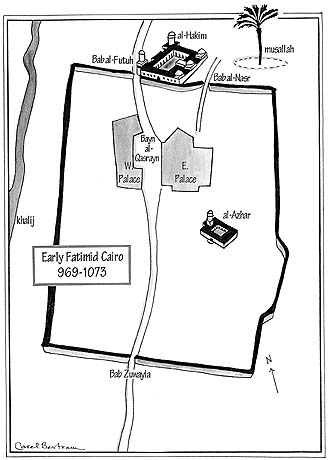
Map 2. Cairo, early Fatimid period 969–1073
The existing populations lived in a series of urban centers built on the east side of the Nile.[39] Fusṭāṭ, the southernmost section, had originally been built as a garrison town for the conquering Muslim armies in the mid-seventh century, and expanded from that time forward. The population, initially comprising soldiers, their retainers and families, soon began to include Christians (mainly Copts) and Jews who had lived in the areas in the pre-Muslim times. By the tenth century, this area housed a large Jewish and Christian population, as well as Muslims, mainly Sunni.[40] The central focus for the Muslims of this area was the mosque of ‘Amr ibn al-‘As, named after the conquering general. The mosque was located close to the channel (khalīj) of the Nile which served as the western boundary of this city (map 1).
North of Fusṭāṭ another urban center, known as al-Qaṭā’i‘,, was built during the rule of the Ṭūlūnid governors (868–905/254–92). It was the site of the largest mosque in the area named after its patron, the governor Aḥmad ibn Ṭūlūn (r. 868–84/254–70). The administrative seat (dār al-imāra, literally “house of the princes”) was attached to the mosque, forming the locale for much of the administrative business during the ninth century. The public treasury for the Muslims (bayt al-māl), nevertheless, remained to the south, in Fusṭāṭ, in the mosque of ‘Amr ibn al-‘Aṣ.
No walls separated these parts of the urban area from each other, although in the inundation season some depressions throughout the area gathered water, while still others held water almost year round. Rather than creating boundaries, these areas, known as birak, became recreational magnets bringing populations from all areas for boating, bathing, and parties on the water’s edge.
Mixed populations, members of the provincial ruling groups, as well as merchants and traders, glassmakers, tanners, potters, and the like lived in both these areas. It also appears that neighborhoods were mixed; Muslims, Jews, and Christians lived in the same areas and even in the same apartment complexes.[41] Social considerations did shape this pattern, however. Jews lived close to their synagogues. But the main mosque complexes, serving the major portion of the population, dominated the areas spatially and socially, reflecting the administrative activity. The practices of Islam shaped the pace of the days and the year. The adhan or call to prayer, formulated according to Sunni practice, was heard five times a day throughout both areas.
These two areas—Fusṭāṭ and al-Qaṭā’i‘,—were known collectively as Miṣr, although some later writers called it Miṣr-Fusṭāṭ. The inhabitants expressed preferences for prime locations within these linked areas.[42] North of these areas stretched plains dotted with monasteries and retreats where the more leisured groups often hunted. North was also the area of agriculture and gardens, and fresh air, as the prevailing winds come from that direction.
When Jawhar conquered Egypt he dealt with the existing populations reasonably and with great care. He allowed them to continue the call to prayer in their own fashion, and allowed them privileges that eased the transition to the new rulers of the area.[43] That this predominantly reasonable relationship on several social levels was sustained throughout the rule of Imām-Caliph al-Mu‘izz is attested to by the pages of the History of the [Coptic] Patriarchs.[44] At the same time, Jawhar was preparing a walled royal enclosure north of these population centers for the Imām-Caliph, his family, retainers, and army. It was an urban area for Believers (Ismā‘īlīs).
Although a segregated city,[45] this new area of Cairo had walls that were permeable like those of the central core in Abū Ja‘far’s diagram as shown in Qāḍī al-Nu‘mān’s text. Cairo’s walls were symbolic, indicating a boundary; they were not defensive. It is almost possible to suggest that at this moment the urban geography of the area resembled a wedge taken from that concentric circle diagram and laid alongside the Nile, narrow end or core pointing to the north. In the north was the core, the royal city where the Imām-Caliph and the Believers lived. To the south, and larger in size, was the rest of the population, primarily Muslim. Echoing the phrase, “Belief embodies Islam while Islam does not embody Belief,” those in the north were Ismā‘īlī Muslim; in the south, Muslims were not Ismā‘īlīs.
The royal city of Cairo was a rectangle oriented to the northeast, and divided almost in the center lengthwise by a street known as the Great Street (shāri‘a al-a‘ẓam).[46] In the south the street met the double-arched gateway, the Bāb Zuwayla; in the north the street branched (map 2). The main path continued to the gate popularly known as the Bāb al-Futūḥ, and a branch went northeast to a second gate, the Bāb al-Naṣr. Within this large enclosure, somewhat north of center, on the east side of the Great Street, a palace was built for the Imām. Some years later, across this street, on the west side, a second palace was built. Together these two palaces framed the Great Street, making an area between them known as “between the two palaces” (bayn al-qaṣrayn). South of the Eastern Palace, across an open area (rahba), and off to the east of the Great Street, the mosque known as al-Azhar (the shining) was built.
This mosque, also called the mosque of Cairo, was relatively small in size and primarily served the Ismā‘īlī population of the royal city, although as mentioned above, lectures and readings of Ismā‘īlī writings drew interested members of the population from outside the royal city.[47] The call to prayer from this mosque included the formula “come to the best of works” (hayy ‘ala khayr al-‘amal), a Shī‘ī formula. North, outside Cairo at the Bāb al-Naṣr was a muṣalla (a defined open space) used for prayer during Islamic holidays. The major part of the Fatimid troops were also stationed outside, and north of Cairo. Imām-Caliph al-Mu‘izz came to this city in 971/362 from his capital in Ifriqiya, Sabr al-Manṣūrīyya, in procession and bearing the bodies of his ancestors, the first three Fatimid Imāms. They were interred in the southern section of the Eastern Palace which became the mausoleum for subsequent Fatimid Imāms.
Beyond his coinage and its newly devised sign of Isma‘ilism, Imām-Caliph al-Mu‘izz appears to have used writing both territorially and referentially in more conventional ways. An anecdote discussed below reveals contemporary recognition of the range of his practice in regard to the public text.
In conformity with the practice continuing over many centuries in the eastern Mediterranean, he put inscriptions over the main thresholds or gates into Cairo. He used writing to frame depictions inside the mosque of al-Azhar.[48] As in earlier practice, that writing was smaller in scale and less visually prominent than the depictions it framed. Its referential base was the Qur’ān. The medium of both the writing and the depictions was stucco, continuing the aesthetic practice of the capital area. Judging from some aspects of the archaeological remains, it is possible that he put the sign of Isma‘ilism in this mosque.[49] What is reported clearly, however, is that the year after he came to Cairo, 973/362, Imām-Caliph al-Mu‘izz displayed a gift for the Ka‘ba prominently in his palace.[50] This gift did display the sign of Isma‘ilism.
Al-Maqrīzī describes this gift, a shamsa (sun, ornament, or collar), which Imām-Caliph al-Mu‘izz raised on high so that it could be seen both from inside the palace and from the street. Close attention to the description indicates that the design of this ornament and the sequences of references on it—from the inner to the outer rings—both have equivalences with those on the coinage, and the diagram of Abū Ja‘far.
Further, in describing the shamsa, al-Maqrīzī recounts that on a background of red brocade, twelve spans in each direction, an open-work golden ball was displayed inside a circle of writing in Arabic. Inside the central golden circular ball were pearls the size of dove’s eggs and red, yellow, and blue precious stones. The writing around this center displayed the sūrat al-ḥajj written in emeralds. Stuffed with musk granules, the whole gave off a costly perfume. Ismā‘īlīs who saw this precious object undoubtedly would relate its concentric circle format to that of the coins and the diagram. Others saw it simply as a precious gift, a fact that al-Maqrīzī records.[51]
On this shamsa, the golden orb stuffed with pearls and gems can be understood to function as an aesthetic metaphor for the Imām, resonating with the center raised dot-circle on Imām-Caliph al-Mu‘izz’s coins. This reading of the metaphoric center is plausible in the context of Imām-Caliph al-Mu‘izz’s experience with his early issue of coinage in Ifriqiya and with the intended destination of this gift. The coinage on which Imām-Caliph al-Mu‘izz first placed names and titles directly and exclusively relating to Isma‘ilism might have drawn great protests from the Sunni population in Qairowan, the population center near his capital in Ifriqiya, or, for other reasons, negative reaction from the Ismā‘īlī population in al-Manṣūriya. For whatever reason, he chose to alter the references of the inscriptions to ones which would be acceptable to all Muslims, although he chose ones which would carry meanings in the dimension of the bātin for Ismā‘īlīs.[52] It was clearly appropriate for al-Mu‘izz as Caliph to give a costly gift to the Ka‘ba. But, on a gift intended for the Ka‘ba at Mecca for the pilgrimage month when all Muslims would gather, reference to his role as Imām would most effectively be metaphoric.
Some sense of Imām-Caliph al-Mu‘izz’s attitude toward public texts can be gathered from an anecdote in Ibn al-Muqaffa‘’s History of the Patriarchs. The anecdote suggests how the contemporary population understood the ruler’s power to play with the public text. Written from the point of view of the Christian inhabitants of Miṣr, it also gives us insights into the role of public texts on impermanent materials, here a sijill, or decree, written on paper.
The story is as follows.[53] Caliph al-Mu‘izz is reported as having occasion to give the population of Miṣr a test. He commanded that a large roll of paper (like that upon which a sijill was written) be rolled up without being written on and sealed. He then sent the bearer of this roll, along with the town crier and a trumpeter, to Miṣr to present the “decree,” and sent trustworthy spies to report back. The trumpeter played and the crier called the local inhabitants to gather around because the sijill of the Caliph was to be read. Some inhabitants wanted to hear the sijill, but others said not to bother because the decree was blank. The news that the inhabitants knew the sijill had no writing on it was brought back to the Caliph who marveled exceedingly.
The story presents the Caliph as playing a trick with the text-ness of the sijill. The aesthetic dimensions of a sijill were present: the roll of paper, the trumpeter, the crier. But the local residents were not persuaded by the aesthetics of this public text without its writing. The story suggests public texts such as sijills convey their meaning primarily through their writing, the close link of writing and authority, the referential dimension.
This story provides a contrast to the argument made in chapter 2. There, the referential bases of the writing on the interior of the imperial sectarian spaces in the eastern Mediterranean of all groups was equivalent. I argued then that the aesthetic dimensions of the writing—gold and glass mosaics the most costly—were the primary conveyors of meaning by such “expected” sectarian texts.
This story recorded by a member of the local population portrays that society as smart—because it is a text-based and literate society. In such a society even if many cannot read, the actions of the educated elite by their writing, by their knowledge of what is written and what that writing can effect in society, serve as a guarantee or proof that authority is vested in writing. The local population demonstrated that they knew that where there was no writing there was no power and authority.
| • | • | • |
Imām-Caliph al-Ḥākim and the Public Text
Imām-Caliph al-Ḥākim was the ruler who significantly augmented the way officially sponsored writing was used in the urban social network. He used writing in the urban areas of Cairo and Miṣr as a visual sign that defined and re-defined his relationship—as an Imām and as a Caliph—to the population he ruled. He used it to define his authority as Imām to certain audiences; he used it to express his power to all beholders. In highly visual ways, Imām-Caliph al-Ḥākim’s uses of writing signs were part of Fatimid shaping and using the new capital area, both the royal city, Cairo, as well as the adjacent urban area.
In the early part of his reign, Imām-Caliph al-Ḥākim used writing in the public space in dramatically new ways in each of the two zones of the capital city. North of Cairo, in the royal enclosure, he placed writing on the outside of the minarets and on the monumental portal of the mosque he completed which had been begun by his father Imām-Caliph al-‘Azīz in 990/380 (fig. 1).[54] This mosque was known by its location just outside the Bāb al-Futūḥ, and also as the al-Anwar (the lights) mosque, although it later was named after Imām-Caliph al-Ḥākim who completed it. The minarets and portal of this mosque remain tangible archaeological evidence for this display of writing.
In contrast, in the south, in Miṣr, Imām-Caliph al-Ḥākim placed at about the same time writing in gold letters and colors on the outside and inside of all the mosques and Muslim tombstones, and on the doors of the houses and of the bazaars.[55] Al-Maqrīzī records this official act whereby writing which cursed the companions of the Prophet Muḥammad and the first three Caliphs was placed on all these structures in 1004.[56] We are told specifically that this writing was executed in gold pigment and color, but not the style of the script. We are told about its semantic content—not its specific words. For this display of writing, however, no archaeological evidence exists.
These two uses of officially sponsored writing, on the mosque of al-Ḥākim and on the mosques, houses, and bazaars in Miṣr, can be seen as successive messages conveying various aspects of Fatimid ruling power, while at the same time supporting certain permanent values of maintaining social order in a mixed population.[57] These two uses of writing are different parts of the same ideology, both related to each other and to the nature of Fatimid authority and rule in Egypt. The two different populations and zones within the urban social networks to which they were addressed together made up the whole of the urban environment. It becomes clear from observing how writing in public space—public texts—was used, that those who orchestrated it were conscious of actively shaping the urban social networks of the capital to establish varying relationships of the parts under the regulation of the Fatimid ruling group.[58]
Both these initial sets of Imām-Caliph al-Ḥākim’s officially sponsored writings (on the al-Ḥākim mosque in the north, and on the mosques, houses, and stores in the south) were officially sponsored writing occupying the public space, visually accessible to the whole range of the population. The referential bases of these writings, extracted from Islamic evocational fields, were addressed only to Muslims and not to Christians and Jews. Clearly, in Miṣr, the widespread display of the golden curses must have saturated the visual environment for all inhabitants, but they were not put on churches and synagogues.
The semantic content of the writings on the minarets and doorway of the mosque of al-Ḥākim was based primarily in the Qur’ān. But on the mosques, houses, and stores in the population centers of Miṣr south of the royal city, the referential base of the writing was Ismā‘īlī Muslim practice.[59] This practice of cursing the Companions of the Prophet and the first three Caliphs, although sometimes written, was very much an oral practice coeval with al-Ḥākim’s publishing or making the curses visual.[60] In attacking the leadership within the early Muslim community who took political authority away from the ‘Alī immediately after the death of the Prophet Muḥammad in 632, it must be recognized that these curses attacked those Muslims in Miṣr who believed legitimate authority in the Muslim community followed from the succession of the Rashidun Caliphs to the Umayyads and Abbasids, thus bypassing the lineage of ‘Alī. Primarily then, these curses were aimed at the Sunni Muslims, and the ruling authorities who derived their legitimacy from such a lineage—for example, the Umayyads in Spain and the Abbasids in Baghdad, the primary Muslim rivals of the Fatimids.
Clearly Imām-Caliph al-Ḥākim made these officially sponsored curses function territorially by marking only certain places within a specific zone of the greater urban complex. By marking them uniformly with officially sponsored curses written in gold letters, he bound them together visually. While other color pigments were also used to inscribe the curses, gold, because of its costliness, drew attention both to the importance of the message and to the economic position of the Imām sponsoring the writing. The golden medium and the curse-filled message also drew attention to the nature of the power and authority of the ruler who in that society was able to write such signs on buildings and make that writing last, in this case for some twenty-six months.
It should be noted in support of the interpretation here, that al-Maqrīzī transmitted these curses because he understood them as creating a boundary that was spatial and a territorial zone that was socio-political. He understood the act as an action aimed against Sunni Muslims.[61] Himself a Sunni Muslim, al-Maqrīzī saw the Fatimid period (some three hundred years before his time) as an interlude of rule by outsiders.
It seems that in the early years of the eleventh century, Imām-Caliph al-Ḥākim was very conscious of maintaining this socio-spatial boundary distinguishing north from south, Ismā‘īlī from non-Ismā‘īlī, in the urban area. Another account of his actions relates other ways in which he visually reinforced that boundary, even as it demonstrates just how dynamic were his uses of public texts, by creating successive messages that support the primary permanent value of maintaining the ruling group in power. After the defeat of the almost successful rebel, Abū Rakwa, Imām-Caliph al-Ḥākim had Abū Rakwa’s head displayed on a manzara (belvedere) outside the royal city, on the south side, facing the population centers.[62] The placement of this rebel’s head between the royal city and the population centers visually reinforced the separation of group spaces within the urban complex that the previous writing had already demarcated. By this action, Caliph al-Ḥākim and the ruling group in the north, displayed to the others—the ruled in the south—the consequences of revolt.
This rebel and his severed head—in the sense that the latter indicated his defeat—are important for the reconstruction of the dynamic aspects of how the public text functioned during this period of Imām-Caliph al-Ḥākim’s reign. It is ironic that this very rebel caused the socio-spatial boundary marked by his head to begin breaking down. Simply put, the defeat of Abū Rakwa, who claimed the title of Caliph through Umayyad lineage, was extraordinarily costly to Imām-Caliph al-Ḥākim both in monetary outlay and troops killed.
Imām-Caliph al-Ḥākim needed all the goodwill and support he could generate from the population of the entire capital area. As al-Maqrīzī recounts, in making rapprochement to the Sunni Muslims, he was compelled, in 1007, to erase the very golden curses he had put up on the mosques in the south.[63] Further, he appointed Shāfi‘ī and Mālikī scholars to the dār al-‘ilm within the royal city. By this act, more Muslims from the southern areas had official reason to be in the northern royal enclosure, and access to the northern zone became somewhat easier.
Obviously this example of a public text disappeared in the wake of Abū Rakwa’s revolt. But the writing on the mosque outside Cairo’s Bāb al-Futūḥ remained. Punctuating this northern space, it addressed all Muslims, not dividing audiences along sectarian grounds, in the commonly accepted reference of the words of the Qur’ān. Like the golden writing, it excluded Jews and Christians by marking territory that was Muslim.
The mosque of al-Ḥākim, as far as we can reconstruct, was the only mosque in the entire capital area, as well as in the northern zone, that displayed visually prominent writing on its exterior (fig. 1).[64] This was not the only distinctive feature of the mosque. To any pedestrian, this structure was strikingly different from any other sectarian structure in Cairo or Miṣr, especially any other mosque. It had two differently shaped minarets, one on each corner of its facade; other mosques had only one (fig. 22). It had a monumental doorway; other mosques had none. Its facade was constructed of stone; others were of brick and stucco. This display of officially sponsored writing may have seemed at first to be only another difference in construction practice. But his subsequent use of writing on the bastions of this mosque is further indication of how central writing was to his political praxis and role of Caliph as well as to his role as Imām.
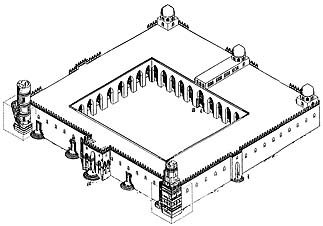
Fig. 22. Al-Hakim mosque
In the early years of the eleventh century, the mosque and the route in front of it were not the common ground for the general population. This mosque and the way in front of it were the central area for only some members of the social order, mainly those having official business with the ruler in the royal city who entered through that door. Located in the northern part of the northern zone, it was almost as far away as possible from the old centers of population in the south. Yet although the major part of the population of the capital area did not have reason to pass this spot daily, the mosque occupied a public location. It was outside the Bāb al-Futūḥ, a gate of the royal city, and thus access to it was not physically limited by walls.[65]
As to the congregation of this mosque, written accounts indicate that the Imām-Caliph al-Ḥākim and his entourage from the royal city attended this mosque exiting the city through the Bāb al-Futūḥ. They did this on ceremonial occasions, and often at the start of processions. Dignitaries visiting the palace in the royal city of Cairo passed by this mosque because they customarily entered the city through the Bāb al-Futūḥ, near the palaces, which served as a formal, official threshold.[66] And we assume that the regular congregation of this mosque was the Fatimid army which was mostly settled in the north, the direction from which the military threat was greatest (e.g., Abū Rakwa’s major foray was in the Delta). The size of this mosque alone suggests the army as a congregation because it was the only mosque of considerable size in the northern zone.[67] The mosque of Cairo, al-Azhar, was small in comparison and large numbers of troops would overflow it. Indeed, for an army whose various contingents were uneasy cohorts, a mosque outside the walls of the royal city offered distinct safety advantages to the ruler.
The genius of the public text on the mosque of al-Ḥākim rested in the choice of its semantic content and in its aesthetic strangeness. Writing with a semantic content from the Qur’ān was the one sign of power around which all Muslims could rally because of its profundity. To all Muslims the Qur’ān is the word of God, and it makes possible varying levels of signification defined by the exegesis and interpretation of each group. Unlike the golden curses, which came from specific sectarian practice, the semantic content of this officially sponsored writing expressed permanent values for all Muslims. As Paula Sanders points out, the writing from the Qur’ān in this mosque must be analyzed for its meaning in both its ẓāhir (exoteric) and bātin (esoteric) dimensions.[68] The analysis she has done points to the rationale behind the choice of the ayas (verses) on the part of the Ismā‘īlī patron, and for the impact of the semantic content on Ismā‘īlī beholders. It is important not to let the knowledge of a specific Ismā‘īlī meaning mask the fact that the semantic content of this writing was directed to a Muslim group audience in a public space. This message, then, was permanently accessible to all Muslims, whether Ismā‘īlī or non-Ismā‘īlī, who would have understood it through tafsīr, or ta’wīl or somewhat later, through asbāb al-nuzūl.[69]
In fact, the very choice of writing based in the Qur’ān was probably the only fundamental reference that would rally all Muslims of the ruling group together, as well as Muslims within the population at large. Introducing and using such an emblem was in itself an important decision especially in the reign of Imām-Caliph al-Ḥākim. He had to maintain the Fatimid power base which demanded balancing the various Muslim elements, including various Sunni amīrs whose strength was land based and whose power pre-dated the Fatimid conquest of Egypt, as well as the new elements of the army which Imām-Caliph al-Ḥākim, himself, was supporting and introducing.
Imām-Caliph al-Ḥākim reinforced the changes in the composition of the army begun by his father, Imām-Caliph al-‘Azīz, which sought to balance, really to undermine, the power of the maghariba, or Berber North African forces (literally, “westerners”) who had been part of the conquering force of Egypt. They were Muslims, and more specifically, Ismā‘īlīs.[70] They believed in the Imām as the authority who preserved the permanent truths (haqā’iq) of the Qur’ān and the relationships in the universe, in addition to their support of his rule. The newly recruited troops, mainly Turks, Daylami, and mashriqiya, or Easterners, were mostly non-Ismā‘īlī Muslims. They supported and enforced the political rule of the Imām-Caliph, but did not recognize Caliph al-Ḥākim as Imām. All of the army, of course, and the members of the bureaucracy (many of whom were non-Muslims), were members of the Fatimid ruling group. All these groups sought their own interests in a system headed by a Fatimid Ismā‘īlī Imām and the Imām, in turn, preserved his power by balancing these various factions, as well as the factions within the palace structure itself.
When this audience passed by the mosque of al-Ḥākim, they saw officially sponsored writing based in the Qur’ān not only placed prominently, but displayed in an innovative assemblage.[71] In addition, this innovative assemblage included the sign of Isma‘ilism. From the evidence presented in chapter 2, we know that many of these formats were new to the public space.
From the viewing stance of the pedestrian, the writing most readily visible on the northern minaret was displayed in two signs of Isma‘ilism, two concentric circle medallions (fig. 1). Rather than adopting Imām-Caliph al-Mu‘izz’s format for these medallions, one that combined the visually salient features from the diagrams in the discourses of both the bātin and ẓāhir, Imām-Caliph al-Ḥākim used a format with the salient feature of the diagram from only one discourse—that of the bātin, found in al-Sijistānī’s writings, and reinforced in his own time by ones used in the dā‘ī al-Kirmānī’s writing in the same discourse.[72] Those diagrams, as the medallions on this mosque, displayed a center filled with a line (or lines) of writing, fixing an orientation for the concentric circles. This is the format for the sign of Isma‘ilism that Imām-Caliph al-Ḥākim also adopted for his coinage, and one that subsequent rulers maintained for a number of decades (fig. 23).

Fig. 23a. Dinar, al-Ḥākim

Fig. 23b. Dinar, al-Ḥākim
In the center of the small medallion closest to the street, the word “Allah” is displayed in very clear, unadorned Kufic (fig. 24).[73] This appears to be the first time that the word “Allah” framed in this manner, highly visible and easily readable, only 6 feet (2 m.) from the ground, is displayed in a public space.[74] In a society where Christians and Jews were also using Arabic, the word “Allah” (The God) was also used by them to refer to the Supreme Being. It is, for example, found in churches and on Christian objects from this period. Framing it as a single word for display is traceable in Muslim use to Fatimid practice.
The word “Allah,” and the letters and the syllables of the word, have elaborate significance in Ismā‘īlī ta’wīl, even as they are important to every Muslim. Al-Sijistānī records the importance of this word in five sections of The Wellsprings of Wisdom, one of which is perhaps most relevant here.[75] In the first chapter the letters of the word are related to what they resemble in the physical world, to the exaltation of God, the elements and the Speaker-Prophets, as well as to the numbers four, ten, seven, and eight. These serve to underscore the importance of placing this word in the concentric circle format closest to the pedestrian, a concentric circle format where points along the circle relate to significant numbers.
The next writing on this same minaret also appears within a sign of Isma‘ilism. Here the reference to the diagram and to the format on Imām-Caliph al-Ḥākim’s coins is rendered large in scale, almost 1 meter (3.28 ft.) in diameter (fig. 25).[76] Qur’ān 5:55 is displayed in the outer circle, and in the center the Qur’ānic phrase “from the shadows into the light” is written in two lines.[77] The choice of this Qur’ānic phrase about light relates directly to Ismā‘īlī understanding of creation, when God made the single command, “Be” (kun) and God made darkness light. This formulation from al-Sijistānī was reinforced by the dā‘ī Abū ‘Isa al-Murshid, who wrote at that same time, elaborating that God produced out of light a creature.[78] Indeed the centrality of this conception is underscored by the writings of dā‘ī al-Kirmānī, a contemporary of Imām-Caliph al-Ḥākim. In his text, Rāhat al- ‘aql, one of the diagrams displaying only two concentric circles relates to this concept (fig. 26). This attention in Ismā‘īlī discourse relates to the several mentions in the Qur’ān of the specific phrase “from the shadows into the light,” and of light in general.

Roundel displaying word “Allah”, after Flury
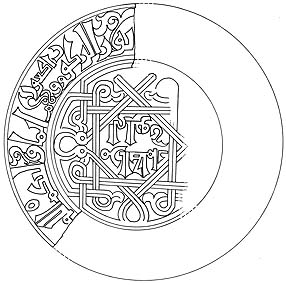
Roundel, mosque of al-Ḥākim (drawn by Hampikian after photo by Creswell)
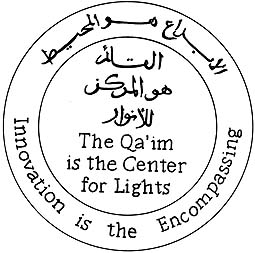
Al-Kirmānī, memory device rahat al-‘aql
The sequences of references of the writing in the concentric circle medallion parallel those on the coins. In the outer ring, aya (5:55), “only God is your Friend and His messenger and those who believe, those who keep up prayer and pay the poor-rate and they bow down” can be understood as relating to Islamic practice.[79] The inner circle, with its direct relation to Ismā‘īlī ta’wīl, fixes the position of Isma‘ilism in the center as the more encompassing element.
Above the medallion on the minaret, writing displaying āyas from the Qur’ān frames four windows (figs. 1, 27). In aesthetic terms, how the writing was placed around these windows serves to highlight how closely the writing in the medallion they surmount replicated the sign of Isma‘ilism. In the medallion, the writing in the outer circle, like that on the coins and in the diagrams, runs counterclockwise continually around in a circle. The writing at the bottom of the circle, therefore, is upside down to the viewer. On the windows, however, the inscription begins on the lower right-hand side of each window, and runs counterclockwise until the bottom frame of the left-hand side of the window, where the direction is reversed and the phrases are produced upright to a beholder in the street. The ayas (24: 36–37) chosen to surround these windows also refer to light, and to prayer. They are taken from the surat al-nūr, or the chapter on light in the Qur’ān. Placed around the windows they relate both to the physical light that comes in the windows lighting the stairwell of the minaret as well as to Ismā‘īlī hierohistory as related by Qāḍī al-Nu‘mān.[80]
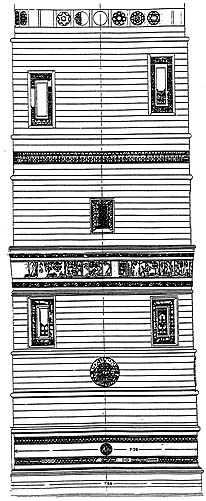
Northern minaret, after Creswell, Muslim Architecture of Egypt, vol. 1
Further above, a band of writing in large letters (68 cm./24.8 in.) displays the name and titles of the Imām.[81] This band was particularly highly visible for reasons which we can know, but which would not have been obvious to the beholder in the street, namely, that the band cants slightly outward.[82] Thus the writing was intentionally made more visible to a pedestrian than it would have been had the band of writing been kept parallel to the minaret as was that on the medallions.
The western minaret, different in shape from the northern one, also displayed writing in a different pattern, although the references of the inscriptions were equivalent (fig. 28). No sign of Isma‘ilism appears on this minaret. The name and titles of Imām-Caliph al-Ḥākim, and the year and the month are displayed at greater distance from the ground, but larger in scale (almost 1 m./3.28 ft.) While this band was not canted, the moulding above it projects more than any other moulding, and could have served as a kind of awning in the direct sunlight, giving some shadow to the writing which is carved deeply into the limestone.[83] Below this band is another one displaying Qur’ān 9:18, and although partially effaced, the name of al-Ḥākim. This, too, is a prooftext from Qāḍī al-Nu‘mān.
The writing in the bands of the two minarets can be understood as reinforcing each other and offering visual and semantic support for al-Ḥākim’s claims to place “this mosque in the hierarchy of mosques, and reiterate the link between this mosque and the Ismā‘īlī mission (da‘wa).” [84] He further reinforced these claims made to an Ismā‘īlī audience by the writing in bands by placing the sign of Isma‘ilism on this mosque. To other Muslims, and to all others who beheld the large concentric circle medallion on the northern minaret, its resemblance to al-Ḥākim’s coinage must have been obvious.
The monumental doorway of the mosque also displayed writing in Kufic (fig. 29).[85] Just how much writing was displayed, and its layout in Imām-Caliph al-Ḥākim’s time, we cannot now reconstruct. Presumably, however, there was much more than survived into the early twentieth century when all that remained was a part of a Kufic inscription (3:199) on the north side of the monumental gateway.
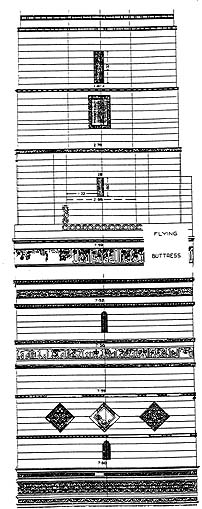
Fig. 28. Western minaret, after Creswell, Muslim Architecture of Egypt, vol. 1
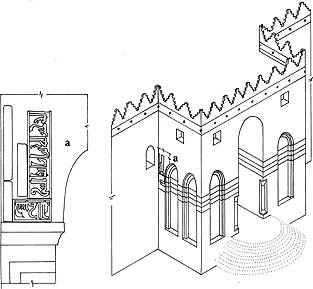
Fig. 29. Monumental doorway, mosque of al-Ḥākim (drawn by Hampikian)
What has been stressed in the above is primarily the referential function of the writing on the outside of the mosque of al-Ḥākim, and to some degree its aesthetic functions. Other ways can be reconstructed to indicate how this writing functioned to convey meaning to its primary audience, the ruling group. The formal distinctiveness of the assemblage of writing on the exterior of this structure called attention to the structure itself and its location. Yet, despite the distinctiveness of the whole, some additional elements—beyond those discussed above—did relate to other social patterns for displaying officially sponsored writing within Fatimid society at that time. First of all, the writing itself was in a basic geometric style; all of it was Kufic. As the evidence in chapter 2 indicates, the traditional script for such writing was a geometric one. Except for the signs of Isma‘ilism, the remainder of the writing on both minarets and the door was displayed in band format familiar to all because, as noted above, it was the common format within sectarian spaces. The semantic content of this writing was the most accessible to the beholder, in addition to the single word “Allah” on the north minaret. The accessibility of the semantic content was due, in part, to the linear format, which lends itself more readily to being read than writing around a window frame, or upside down in a concentric circle.
What could be read in these bands was more than āyas from the Qur’ān. More space in these bands was allocated to the name of the Imām al-Ḥākim, his titles and date, than to words from the Book.[86] This difference in semantic content is tied to a difference in aesthetic content of the writing. While the basic style of the script in these bands was also geometric, vines and floral terminations extrude from various letters and fill the background. This is especially apparent in the topmost band on each minaret (figs. 30, 31). This augmented aesthetic display was an innovation that separated the writing in these bands from the traditional script of officially sponsored writing; moreover, it broke the traditional linkage between officially sponsored writing and the Book hand.
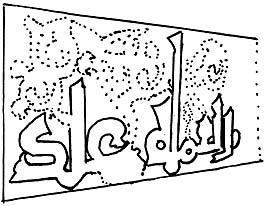
Fig. 30. Inscription, northern minaret, mosque of al-Ḥākim
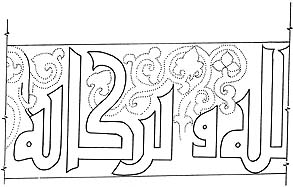
Fig. 31. Inscription, western minaret, mosque of al-Ḥākim
Judging calligraphic practice from Qur’āns of the period, letters forming the words of sūras (chapters) were unelaborated.[87] Elaboration was reserved for sūra headings, and for the functional devices that aided recitation which were usually presented in the margin, although some were placed intertextually. Until this time, officially sponsored writing was scripted in the same unadorned manner as the writing in the Book. Undoubtedly the elaboration of the innovative-looking writing in the bands served to call the beholder’s attention to the writing, attracting people to read and thus to know that: “Imām al-Ḥākim bi Amr Allah, Commander of the Believers, may the blessings of God be on him and on his pure ancestors, ordered to be done in the month of Rajab of the year 393.” Thus in these bands the aesthetic dimensions of writing served to emphasize the semantic content.
Yet the link between this stylistic elaboration of the writing and its semantic content displaying the name and titles of the Imām may have evoked another level of associations to Ismā‘īlī beholders that further indexed the authority of the Imām. What suggests this association is the even more elaborated writing on the interior of this mosque that permanently framed Imām al-Ḥākim (and those that succeeded him) when he visited this mosque on ceremonial occasions (fig. 2).[88] The members of the ruling group who entered this large prayer space on such occasions entered a mosque where the Imām prayed, delivered the khutba, and sat on the minbar at the qibla wall, in which position he was revealed to the congregation. The mosque of al-Ḥākim, in particular, was a showcase for the Imām-Caliph in an Ismā‘īlī Muslim context. As the large mosque outside the walls of the city closest to the Imām’s palace, it was a space where prayers, sermons, and lectures were conducted according to Ismā‘īlī formula. Moreover, as Sanders has pointed out, to Ismā‘īlīs, the mosque and especially this mosque, as understood through its bātin dimensions, was the initiation house (bayt) into the Ismā‘īlī mission.[89]
Here Imām al-Ḥākim was surrounded by writing that was especially visually prominent, accessible, and elaborate. In this mosque, writing did not frame depictions, as in conventional practice or even earlier Fatimid practice. Rather, it was a solitary feature, larger in scale than previous writing in sectarian spaces, almost two feet (60 cm.) high. In addition, efforts were made to facilitate the visual accessibility of this writing, especially in the central aisle under the dome where the Imām-Caliph sat on the minbar. There, again, writing was canted out at the top.[90] Members of the congregation who saw the Imām on the minbar, saw him framed by Qur’ānic quotations, the real truths (haqā’iq) of which only he himself could fully reveal. In such a setting, the presence and authority of the Imām and obedience to him was visually linked with the words of God and obedience to them.[91] Yet despite this linkage of Imām and the Book, created by spatial proximity, the extraordinarily elaborated style of the writing of the Qur’ānic quotations even further distanced the direct relationship that traditionally existed between the Book hand and writing in sectarian spaces.
It seems plausible to suggest that this distance created by the elaborated script style was intended to emphasize the role of the Ismā‘īlī Imām as sole knower of the fundamental truths of the Book. This message was directed at Ismā‘īlī Muslims. To non-Ismā‘īlī Muslims elaborated Kufic script was understood as a distinctive sign of the Fatimid Imām’s patronage of this mosque.
As in the case of the golden curses, even these officially sponsored writings on the minarets of the mosque of al-Ḥākim were temporary signs of power. They were seen for barely seven years. In Ṣafar 401 (September–October 1010), bastions (arkān) were added around the minarets, completely covering the writing, and they remain in place today (figs. 22, 33).[92] They are composed of two stacked cubes, with the lower one the same height as the walls of the mosque. Why these bastions were added was not addressed directly by the medieval writers, nor by Creswell who undertook the architectural examination of the inner minarets. One obvious speculation is that the minarets themselves proved structurally unsound and the bastions were conducted to support them. Certainly the only reason that we today have any segments of these minarets is that the bastions protected them in the severe earthquake of 1303/702 which destroyed all the other minarets of the Fatimid mosques on this axis of Cairo.[93]
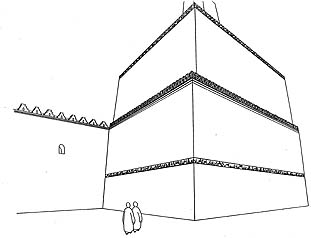
Fig. 33. Bastion (arkān), al-Ḥākim mosque
But whatever prompted Imām-Caliph al-Ḥākim to add these bastions, they added a more solid, almost military, aspect to this large structure. Moreover, what has occurred to me more than once in walking along the main north-south axis between the al-Ḥākim mosque and that of Aḥmad ibn Ṭūlūn, especially when approaching the latter from the southwest, is that the additions of these bastions brought the silhouettes of the minarets of al-Ḥākim’s mosque more in conformity with that of the minaret of Aḥmad ibn Ṭūlūn’s mosque, which was visited by the Imām on official occasions.
On these bastions officially sponsored writing was displayed much less innovatively and prominently than on the minarets which they surround. At least that is so on the western one, because only that writing and outer covering is the original. The northern bastion also originally displayed writing in the same manner as the western one, if Creswell is correct in suggesting that Badr al-Jamālī used the marble from the northern bastion for his inscription on the Bāb al-Futūḥ.[94] The bastions could have been left plain, or writing could have been carved into the stone itself as it had been on the minarets. But on the bastions the writing is carved in marble and in letters some 17 inches (43 cm.) high. The marble band is placed approximately halfway up and run around the bastions.[95]
The difference between the marble bands and the stone bastion called attention to the writing, executed in an elaborated Kufic style. Certainly there is a clear distinction between the style of this writing and any of those on the minarets, and between this writing and that on the interior or on the top bands of the minarets. Still, vine and floral elaboration extrude from letters to fill blank background over horizontal letters. The writing itself was clearly legible to a beholder in the street, as it is today.
The semantic content of this writing was also addressed to a Muslim audience since it is based entirely in the Qur’ān. Yet the verses chosen are not used in Ismā‘īlī ta’wīl. It is difficult, by any interpretation, to understand most of these new quotations as particularly appropriate for indicating the functions of a mosque.[96] Only the short verse, displayed closest to the mosque, mentions Friday prayer (62:9). Still, writing with this semantic content was placed on the bastion of this mosque and addressed Muslim beholders in the public space. The question remains about the likely context of these quotations given the nature of the congregation of this mosque.
The connection of these verses with the Jarrāḥid revolt in Palestine is one that Sanders has made, although she has suggested that they respond to the original inscriptions on the minarets.[97] While fully agreeing with the importance of the context of the Jarrāḥid revolt, I would nonetheless suggest that they are better understood in the light of polemical uses of Qur’ānic quotations, which would account for the totally different tone of these quotations from the earlier ones on the minarets. Such polemical uses of the Qur’ān were at that time engaged in by al-Rashīd li-Dīn Allāh, the new Jarrāḥid anti-Caliph, an Alid Sherīf of Mecca, proclaimed leader of the Jarrāḥid movement. When he returned to Ramla, his new capital, the khatib recited the first six verses of surāt al-Qaṣaṣ (The Narrative) in which Moses as prophet, and Pharaoh as overly exalted ruler, are compared, with favor, of course, to the former.[98]
The negative aspects of the comparison of Imām al-Ḥākim to Pharaoh cannot have escaped Imām al-Ḥākim who had barely recovered from Abū Rakwa’s revolt (d. 1007), and who was engaged in a shake up of high and low officials within his immediate government.[99] The strident tones of the phrases of the bastion fit well with a situation in which such a revolt was underway in Palestine led by a non-Ismā‘īlī Shi‘i, and one in which ideological differences were being expressed in Qur’ānic words. The impact of this revolt was heightened by Imām-Caliph al-Ḥākim’s reorganization of the personnel within his government, and the severe measures he addressed toward the Christians and Jews.[100] The official text on the bastion thus can be understood as a strong warning, couched in the words of God, to the Muslims of the ruling group in the northern sector of the city, to remain unified and committed to obedience to the Imām-Caliph. These phrases remained (and still remain) on the outside of the bastion as Imām succeeded Imām, and the audience and events changed. Because this original context was lost, scholars came to question the appropriateness of the semantic content of the inscription. What remained identifiable is the style of the inscription.
Flury, in the early twentieth century, identified the group responsible for the inscription by its style.[101] The aesthetic dimensions that were recognizable for him as group specific were the vine and leaf terminations. Yet eleventh century beholders would have been visually attuned to recognize that that specific style was not the only one in use at the time, and that the elaborated style had a specific use in terms of placement, for it was a style used only on the exterior of buildings.
| • | • | • |
Textiles and the Public Text
The writing on the portal and the bastions of the mosque of al-Ḥākim remained a public text in Cairo until the end of the dynasty, and beyond, until today. But it was not the only place people could be addressed by the public text.[102] In the rule of Imām-Caliph al-Mustanṣir (r. 1036–94/427–87) the accounts of Nāṣir-i Khusraw, the Ismā‘īlī traveler, indicate that writing was used prominently on textiles in the procession he saw for the opening of the canal. Imām-Caliph al-Mustanṣir processed to the head of the canal for the breaking of the dam. Nāṣir-i Khusraw described the procession of ten thousand horses with saddlecloths into which the name of the Imām was woven.[103] His report indicated a visually significant use of the written name of the Imām. If not actually ten thousand, at least many displayed it.
Although processions began in the rule of Imām-Caliph al-‘Azīz (r. 975–96/365–86), and continued through the reign of al-Ẓāhir (r. 1021–36/411–27), the clothing worn by the Imām-Caliph and the court was singularly unornamented, especially during the reign of Imām-Caliph al-Ḥākim. Writing on clothing or animal trappings is not mentioned until the reign of Imām-Caliph al-Mustanṣir.
The official writing Nāṣir-i Khusraw described was embedded in the medium of official processions which the Fatimid Imāms used in a systematized way. As Sanders has detailed, they made official progress from the royal city of Cairo to the mosque of Aḥmad ibn Ṭūlūn and that of ‘Amr ibn al-‘As on certain occasions based on the Ismā‘īlī Muslim calendar and, as with the ceremony opening the canal, on occasions important in the economic life of Egypt.[104] Officially sponsored writing thus appeared in a new medium, and derived some of its meaning from the function of the processions themselves. Although the various Fatimid processions commemorated different events throughout the year, and thus had different immediate goals, fundamentally they were vehicles which connected the royal, Ismā‘īlī center in the north with the population centers of Miṣr in the south as Sanders has so ably argued. While more will be said on this point below,[105] these processions were all rituals that “set up [a range of] visible public definitions,” fixing public meanings that classified the whole urban population as well as stabilized the relationships of various groups within it.[106]
These processions were structures linked to conscious social intentions of the ruling group. Thus while the processions fixed the connection between the northern and southern sectors of the city, they equally continually emphasized the separation between the participants and the audience; the rulers and the ruled. Those who watched knew their place in part through the location of their viewing position, where along the route they stood, and how close they could come to the Imām himself. Those riding and marching knew their place within the ruling group through their position in the ritual.[107] There is great concern, for example, to maintain proper position with respect to the Imām-Caliph.
Judging from Nāṣir-i Khusraw’s effusive report, these ritual processions were highly effective because of their display of costly goods. In this context of fixing public meanings through ritual, officially sponsored writing played a role that associated the name of the Imām-Caliph with the ability to consume extravagant goods. It seems fair to assume that it was the medium in which the writing was embedded and not the style of the writing itself, or its specific semantic content, that evoked the primary meaning to Nāṣir-i Khusraw. Although he tells his readers about the content of the writing, he does not give the exact words, nor does he mention the style of the script. What he does discuss is the quality of the medium. Power to him was displayed by extravagant consumption. The choice of the goods displayed, as part of the continued ritual, created a pattern of discrimination that he recognized as making available to the Imām, and those who reinforced his rule, wealth in such prodigality that it invited quantitative and qualitative evaluation. The assemblage, rather than a specific discrete part, was what conveyed the meaning. Nāṣir-i Khusraw certainly engaged in the activity of evaluation and seems to have well understood the social purposes of the ritual.
He reported that ten thousand horses displayed “saddlecloths of Byzantine brocade and būqalamūn woven seamless to order.[108] In the borders of the saddlecloth are woven inscriptions bearing the name of the Sultan of Egypt.” [109] By these words Nāṣir-i Khusraw conveyed to his readers very specific evaluations about the extraordinary abundance the Imām-Caliph commanded as his name label made clear. The horses of the ruling group were distinguished by the display not only of imported Byzantine brocade but Byzantine brocade that had been made to order and imported. Since Nāṣir-i Khusraw described the cloth as seamless, we can assume that was his way of noting that the size of the saddlecloths was wider than the standard loom width, so that without commanding special order, the requisite width for the saddlecloth could have been achieved only by sewing pieces together. This Imām’s procession did not display goods that had to be pieced. Moreover, the special order included the weaving in of the Imām’s name. The Fatimid Imām was able to command the Byzantine weavers, not only to weave the Imām’s name, but to weave it in Arabic. By this description Nāṣir-i Khusraw distinguished what he viewed as the command of weaving in a foreign land, from the less masterful alternative of adding the Imām’s name on an imported luxury fabric by embroidering it locally in Cairo.
Nāṣir-i Khusraw’s evaluation did not stop there. The official writing on Byzantine brocade was itself embedded in still further extravagance. Camels, mules, and horses displayed reins studded with jewels and saddles of gold. Thousands upon thousands of soldiers walked or rode in rank, followed by contingents of princes from foreign lands and of scholars and literati who were maintained on stipends at court.[110] Jeweled weapons and musical instruments abounded. To Nāṣir-i Khusraw the meaning of this procession had less to do with the opening of the dam on the canal than with the evaluation of the Imām-Caliph al-Mustanṣir, who was the Imām of the Time (Imām al-Ẓaman) for him. He did, of course, describe the Imām throwing a spear at the dam, and the men who then quickly set to work breaking the dam so that the floodwaters of the Nile were opened into the fields, but he gave that part of the procession minimal treatment.
Nāṣir-i Khusraw was quick to understand how this display of abundance could be misunderstood by his readers. He carefully noted that the thousands upon thousands of soldiers beautifully outfitted were paid by the Imām and that no governmental agent or peasant was ever troubled by the army.[111] This is indicative of a refrain that is part of his description of Egypt. The Imām-Caliph who displayed his power through effective rituals involving material things did so even though he paid full measure to the weavers, the peasants, and the merchants. To Nāṣir-i Khusraw, Imām al-Mustanṣir, whose name he saw in procession passing to the head of the dam, was a beneficent ruler to all his subjects. Nāṣir-i Khusraw, of course, was a partisan, that is, an Ismā‘īlī. We can assume that his view was shared by many in the audience, and he notes the number of Ismā‘īlīs and Shi‘is he saw. That other non-Ismā‘īlī members of the audience of these processions would have seen the goodness along with the power of the Imām from this display cannot be assumed.
The public text displayed on cloth in this manner was part of a more intensely social process than that displayed on buildings. It was an intensified spatial and temporal display that evoked meaning by its repetition rather than its permanence. That the name of the Imām-Caliph was associated again and again with such abundance conveyed to the beholders and reassured the participants that the social order or social boundaries were maintained despite the fluctuation in the categories of that order that were severely challenged at that time.
One further observation that Nāṣir-i Khusraw made about movement within the city of Cairo needs to be mentioned here. It relates not to writing directly so much as to a format for writing, namely, the sign of Isma‘ilism, and thus brings us full circle to where this chapter began. Nāṣir-i Khusraw makes special reference to the one thousand guards that surround the palace of the Imām-Caliph (the Eastern Palace). Five hundred guards are mounted; five hundred on foot. They form two rings and continually circle the palace. After evening prayer while continuing this circular procession, they play trumpets and drums[112] until morning. We are left to wonder whether Nāṣir-i Khusraw recounted this circling because he recognized the relationship between the performance of concentric circles around the palace of the Imām and the concentric circle diagrams in Ismā‘īlī discourse. Nāṣir-i Khusraw himself contributed several volumes to Ismā‘īlī ta’wīl, in which he used concentric circle diagrams as memory devices.[113]
It is ironic that we are left Nāṣir-i Khusraw’s report of harmonious social order and economic stability on the eve of the most severe economic crisis of Fatimid rule, which compelled the wazīr Badr al-Jamālī to stop these processions, and to alter the urban social and spatial order of Cairo-Miṣr drastically.
Notes
1. Proclaimed in the khutba on Friday, 21 Rabī‘ II 297, January 910.
2. Mainly Mālikī in North Africa and Shafī‘ī in Egypt.
3. On this issue see: Farhad Daftary, The Ismā‘īlīs: Their History and Doctrine (Cambridge: Cambridge University Press, 1990), esp. chap. 4, “Fatimid Isma‘ilism”; S. M. Stern, “Cairo as the Centre of the Ismā‘īlī Movement,” Colloque International sur l’histoire du Caire (Cairo: Ministry of Culture of the Arab Republic of Egypt, n.d.), 437–50.
4. S. M. Stern, “Ismā‘īlī Propaganda and Fatimid Rule in Sind,” Islamic Culture 23 (1949): 298–307.
5. The issues revolving around the social uses of writing—what kinds of messages were published in what ways in the society—have not per se been discussed for the medieval Islamic period, but the issue of writing, mainly in books, and its social effects has been provocatively considered by Jack Goody and Ian Watt, “The Consequences of Literacy,” Comparative Studies in Society and History 5, no. 3 (1963): 304–45, esp. 311–26; and Jack Goody, “Writing, Religion and Revolt in Bahia,” Visible Language 20, no. 3 (1986): 318–43, where he discusses the role of (contextual) literacy in Arabic in the Yoruba Muslim slave revolt in Brazil in the first half of the nineteenth century.
6. A readily available reference for this coinage is George C. Miles, Fatimid Coins in the Collection of the University Museum, Philadelphia, and the American Numismatic Society (New York: American Numismatic Society, 1951). Michael Bates discussed the changes in Fatimid coinage in, “Shī‘ī Inscriptions on Buyid and Fatimid Coins” (paper delivered at the Annual Meeting of the Middle East Studies Association, Chicago, November 1983). He generously has sent me this unpublished paper, in which he tentatively suggests that the format might have related to the Ismā‘īlī cyclical world view. Doug Nichol, whose major catalogue of Fatimid coinage is forthcoming, has guided me in understanding the changes in Fatimid coinage over time. See also Stanley Lane-Poole, Catalogue of Arabic Glass Weights in the British Museum (Paris: Rollin, 1891), for coin weights with a similar format.
7. Personal communication from Dr. Mourad Rammah. Consult also the forthcoming study by Dr. Ibrahim Chabbouh on “The Three Fatimid Cities.”
8. For the reign of al-Mu‘izz, see: al-Qāḍī Abū Ḥanīfah al-Nu‘mān ibn Muḥammad, Al-Majālis wa’l-musāyarāt, ed. Al-Habīb al-Fāqī, I. Shabbūḥ, and M. al-Ya‘lawī (Tunis: n.p., 1978); ‘Arif Tāmir, al-Mu‘izz li-Dīn Allah al-Fātimī (Beirut: Dār al-Afāq al-Jadida, 1982); and Farhat Dachraoui, Califat Fatimide au Maghreb (Tunis: n.p., 1981).
9. Michael Bates generously shared his research notes with me on this topic. The writing on the first stage coins included such phrases as: wa ‘Alī ibn Abī Ṭālib waṣīyy al-rasūl wa al-nā’ib al-faḍūl wa-zawj al-zahrā’ al-batāl (‘Alī is the designee of the Prophet and the representative of the most radiant virgin) and muḥā sunnat Muḥammad sayyid al-murṣalīn wa-wārith majd al-a‘imma al-mahdiyyin (Revivifier of the sunna of Muḥammad, pre-eminent of the messengers, and heir of the rightly guided imams.) See also A. Launois, “Catalogue des monaies Fatimites entrées au Cabinet des Médailles depuis 1896,” Bulletin d’Études Orientales 24 (1971): 19–53.
10. The date of al-Sijistānī’s death is still a matter of discussion. See especially Paul Walker, The Wellsprings of Wisdom (Salt Lake City: University of Utah Press, 1994), 15–16.
11. For both Qāḍī al-Nu‘mān and al-Sijistānī, see the individual entries in Ismail Poonawala, Biobibliography of Ismā‘īlī Literature (Malibu: Undena Publications, 1977).
12. For al-Sijistānī’s contributions to Ismā‘īlī thought, see: Husain F. al-Ḥamdani, “Some Unknown Ismā‘īlī Authors and Their Works,” Journal of the Royal Asiatic Society (1933): 359–78; Henry Corbin’s introduction (in French) to his edition of al-Sijistānī’s Kashf al-mahjūb (Tehran: Institut Franco-Iranien, 1949): 5–25; and more recently, Walker, The Wellsprings of Wisdom, where he discusses the writing of al-Sijistānī, and offers an annotated translation of Kitāb al-yanābī‘, which he translates as “Wellsprings of Wisdom.” Earlier authors, such as Corbin, translated the title as “The Roots of Wisdom” or “The Book of Sources.”
13. On the use of al-Nu‘mān’s texts in teaching, see Stern, “Cairo as the Centre,” 437–50.
14. For issues relating to the plurality of Ismā‘īlī discourse, see Azim Nanji, “Between Metaphor and Context: The Nature of Fatimid Ismā‘īlī Discourse on Justice and Injustice,” Arabica 37 (1990): 234–39.
15. On the role of memory devices in the Latin language-based Middle Ages, see Mary Carruthers, The Book of Memory, A Study of Memory in Medieval Culture (Cambridge: Cambridge University Press, 1990).
16. The Fatimid dā‘ī Ḥamid al-Dīn Aḥmad ibn ‘Abd Allah al-Kirmānī, philosopher and prolific writer, died c. 1021/ 422. He was most active during the reign of the Fatimid ruler al-Ḥākim.
17. Nāṣir-i Khusraw lived and travelled in the mid-eleventh century. Perhaps best known for his Safar-nāma, his treatise, Kitāb-i Khvān al-Ikhvān (Tehran: n.p., 1929), is most relevant here. It relates in significant ways to the writings of al-Sijistānī a century earlier.
18. See Irene A. Bierman, “Cairo: A Parallax of Judgment,” in Identities in Medieval Cairo, ed. Irene. A. Bierman, Working Papers, Gustav E. von Grunebaum Center for Near Eastern Studies (Los Angeles: Gustav E. von Grunebaum Center for Near Eastern Studies, 1995).
19. Walker, The Wellsprings of Wisdom, reproduces the one such diagram that is present in some of the manuscripts, and recreates the diagrams that are called for in the manuscripts and for which space has been left. H. Corbin, Trilogie Ismaélienne (Tehran-Paris: Department of Iranology, Institute Franco-Iranian, 1961), 5–127, describes the diagrams, but reproduces only the one from Nāṣir-i Khusraw’s Khvān al-Ikhvān as an example, esp. pp. 64, 105–6.
20. The creation of the world is likened to God’s imperative “Be” (kun). The two letters—kaf and nun—forming this word result in two principles, the words kuni and qadar. Wilfred Madelung, “Aspects of Ismā‘īlī Theology: The Prophet Chain and the God Beyond Being,” in Ismā‘īlī Contributions to Islamic Culture, ed. Seyyed Hossein Naṣr (Tehran: Imperial Iranian Academy of Philosophy, 1398 /1977), 51–55. S. M. Stern, Studies in Early Isma‘ilism (Jerusalem: Magnes Press, Hebrew University, 1983), esp. chap. 1, “The Earliest Cosmological Doctrines of Isma‘ilism,” 1–29; and Heinz Halm, Kosmologie und Heilslehre der frühen Ismā‘īlīya (Weisbaden: Franz Steiner, 1978).
21. In al-Sijistānī, Kitāb al-yanābī‘, “Allah” is an important word. It is discussed both as an isolated word, and as part of the shahāda (the profession of Faith).
22. Walker, The Wellsprings of Wisdom, 45–49.
23. Ibid., 98–99.
24. The counterclockwise direction is not dictated by the fact that Arabic is written from right to left. It would have been possible to have the writing “face” the outside. Then, the stance for reading the writing would be outside the circles.
25. Walker, The Wellsprings of Wisdom, 70.
26. Ibid., 82–83.
27. Qāḍī al-Nu‘mān, Da‘ā’im al-islām, ed. Asaf A. A. Fyzee, 2 vols. (Cairo, 1951–61), 1:12. Partial English translation, Asaf A. A. Fyzee, The Book of Faith (Bombay, 1974), 14, n. 7.
28. For which texts were read to which levels, see Stern, “Cairo as the Centre.” See also Paul Walker, “The Ismaili Da‘wa in the Reign of the Fatimid Caliph al-Ḥākim,” Journal of the American Research Center in Egypt 30 (1993): 160–182, esp. 164–65.
29. Q 22:31; 16:100 are two of the many references.
30. Of course, rulers changing their coinage often required taxes and certain kinds of other payments to be made in their new issue coins, with a fixed exchange for the old coinage. This type of exchange was always to the advantage of the issuer of the new coins, and took place often. Such an exchange took place, in fact, under the direction of wazīr Ya‘cūb ibn Killis, who made the previously issued dinar equal to only 75 percent of Fatimid Imām al-Mu‘izz’s new dinar, and then demanded payment of taxes in the new dinar. Aḥmad ibn ‘Alī al-Maqrīzī, Itti‘āẓal-ḥunafā bi-akhbār al-a’immah al-Fatimiyīn al-khulafā, 3 vols. (Qāhira: n.p., 1967–73), 1:146. I thank my colleague Jere Bacharach for constantly reminding me of this aspect of coinage change.
Still, the purity of these coins kept them in circulation a long time. Jewish merchants, Goitein informs us, collected payment in Mu‘izzi in 983, 1004, 1026, and even as late as 1057. Goitein, Mediterranean Society, 1:236–37. These coins are understood today as “surpassing the standard of fineness of the best medieval gold coins,” Andrew S. Ehrenkreutz and Gene W. Heck, “Additional Evidence of the Fatimid Use of Dinars for Propaganda Purposes,” in Studies in Islamic History and Civilization in Honour of Professor David Ayalon, ed. M. Sharon (Jerusalem and Leiden: E. J. Brill, 1986), 146; W. Oddy, “The Gold Content of Fatimid Coins Reconsidered,” Metallurgy in Numismatics 1 (1980): 99–188.
31. The semantic content, however, reads from the inner to the outer circles.
32. See Yves Marquet, “La pensée philosophique et religieuse du Qāḍī al-Nu‘mān à travers La Risala Mudhiba,” Bulletin d’Études Orientales 39–40 (1987–88): 141–81, where he provides a corpus of Qur’ānic verses cited by Qāḍī al-Nu‘mān.
33. Some phrases on the Fatimid issues were found on the coins of their contemporaries. The legend, ṣalla Allahu ‘alayhi wa ‘ala ālihi (May God bless Him [the Prophet Muḥammad] and his family) appeared on Fatimid dinars. Some scholars consider this an Alid phrase, but I understand it, in this medieval context, to be simply a non-Abbasid statement. The detailed arguments behind either stance are not as germane here to the main point as is the reality that this phrase appeared on Fatimid coinage, on the coinage of the Sunni Ikhshidids beginning in 947/356, and on the coinage of the Imāmī Shī‘ī Hamdanid, Sayf al-Dawla, beginning in 944/333. What is important is that although this phrase occurred in the writing on the Ikhshidid and Hamdanid coins, they maintained the Abbasid format for the display of the writing. For a provocative discussion of this coinage, and one with which I do not fully agree, see Ramzi Jibran Bikhazi, “The Struggle for Syria and Mesopotamia (330–58/941–69) As Reflected on Hamdanid and Ikhshidid Coins,” American Numismatic Society Museum Notes 28 (1983): 137–73.
34. See note 6 above.
35. See note 26 above.
36. Norman D. Nicol, “Islamic Coinage in Imitation of Fatimid Types,” Israel Numismatic Journal 10 (1988–89): 58–70, plates 10 & 11.
37. Madīnat al-salām is the mint site.
38. Sulṭān al-Dawlah’s (r. 1012–21/403–12) issue in 407 (1016) is especially interesting because it seemed to straddle the fence. The design on the obverse side displayed concentric circles, while that on the reverse retained the Umayyad-Abbasid format.
39. Jean-Claude Garcin, “Typonymie et topographie urbaines mediévales à Fusṭāṭ,” Journal of the Economic and Social History of the Orient 27 (July 1984): 113–35; “Pour un recours à l’histoire de l’espace vécu dans l’étude de l’Egypte Arabe,” Annales Economie, Société, Civilizations 30 (1980): 437–65; Wladyslaw Kubiak, Al-Fusṭāṭ Its Foundation and Early Urban Development (Warsaw: Wydawn, Universytetu Warszawskiego, 1982); Janet Abū-Lughod, Cairo: 1001 Years of the City Victorious (Princeton: Princeton University Press, 1971).
40. Primarily of Shafi‘ī and Mālikī.
41. See especially Goitein, Mediterranean Society, 4:1–104, where he details the marriage negotiations in which the bride stipulated that she would always reside in Fusṭāṭ. This section also mentions apartment housing shared by Muslims and Jews.
42. Ibid. This evidence leads Goitein to describe the area as housing a bourgeois population. He discusses zoning and its implications, esp. pp. 15–21.
43. He did not impose the Ismā‘īlī calendar on the population. He did suppress, however, the pronouncing of the formula “Allahu Akbar” (God is Most Great) after prayer. See Sanders, Fatimid Cairo, 45 and nn. 32–33.
44. Sawirus ibn al-Muqaffa‘, History of the Patriarchs of the Egyptian Church, translated and annotated by Antoine Khater and O. H. E. Burmester, 4 vols. (Cairo: Societé de l’Archéologie, 1943), vol. 2, pt. 2. This volume covers the years 880–1066.
45. That an Ismā‘īlī uniformity was required is strongly suggested by the episodes reported in Al-Khitat where men carrying a Sunni text inside the city were beaten and sometimes executed. For one such incident, see al-Maqrīzī, al-Khitat 2:341.
46. Cairo was approximately 1 km. 200 m. x 1 km. or 1 ¼ miles x 6/10 mile. See MAE, vol. 1, chap. 3, on the foundation of Cairo.
47. See note 3 above.
48. MAE, vol. 1, chap. 4 on the mosque of al-Azhar and related plates.
49. It seems likely that the mosque built during his reign would have displayed this sign. What is unusual about the articulation of the walls on the inner courtyard is the presence of a circle motif, new in Egypt in this mosque. When these were put in the mosque is unclear. What was in these circles originally is also unclear. It could have been concentric circles of writing. What is clear, however, is that what fills the circles now was chosen by the Comité de Conservation.
50. Al-Maqrīẓī, Al-Khitat 1:135; also found in al-Maqrīzī, Itti‘āẓ, 1:140–42; and in Ibn Muyassar, Akhbār Miṣr (Annales d’Egypte), ed. Henri Masse (Cairo: Impr. de l’Institut français d’archéologie orientale, 1919): 94.
51. Al-Maqrīzī transmits the reaction of pilgrims to Mecca (Egyptians, Syrians, and Khurasanis) who saw this ornament. They found it grander than earlier gifts they had either seen or heard of. Al-Maqrīzī, Al-Khitat 1:135; and Itti‘āẓ 1:140–42.
52. Paul Balog, “Monnaies Islamiques rare Fatimites et Ayyubites,” Bulletin de l’Institut d’Egypte 36 (1953–54): 327–41.
53. Ibn al-Muqaffa‘, History of the Patriarchs, vol. 2, 146–47 (English); 97–98 (Arabic).
54. This mosque was originally begun by the wazīr Ya‘cūb ibn Killis during the reign of Imām-Caliph al-‘Azīz who said the khutba in this structure. In 1012–13/403 various furnishings in the mosque were completed by Imām-Caliph al-Ḥākim. See MAE, vol. 1, chap. 5; Jonathan M. Bloom, “The Mosque of al-Ḥākim in Cairo,” Muqarnas 1 (1983): 15–36. In this same year, Imām-Caliph al-Ḥākim completed other mosques outside the royal city: one at al-Maqs to the northwest of Cairo, and one in Rashīda to the south built on the Birkat (lake) al-Ḥabish. Al-Maqrīzī, Al-Khitat 2:133, 283–85. Since these mosques are no longer extant we do not know whether any of these buildings displayed writing. The only mention that I have found about writing on mosques—other than that which is discussed in the text—is by Abū Ṣāliḥ who noted that a mosque on the edge of Birkat al-Ḥabish (south of Fusṭāṭ) had a minaret and that Imām al-Ḥākim’s name was displayed on it. Abū Ṣāliḥ, al-Armani, Churches and Monasteries, 130.
55. Al-Maqrīzī, Al-Khitat 2:341.
The text is as follows: “In the year 395 slander and monstrosity occurred concerning Abū Bakr and ‘Umar.…It was written in Safar of this year [395] on all of the mosques and on the old mosque of Fusṭāṭ (Miṣr), outside and inside, and on all of its sides (walls) and on the gates of shops, and rooms and on tombs, insulting the ancestors and cursing them. It was variegated and colored with colors and gold. And that was done on the doors of houses and bazaars. And people were forced to [do] that.”
56. Such curses would include the Kharaji, too; however, they were so few and so isolated that they would not provoke significant ire. At this time, however, the Fatimid army had defeated an Ibadi group in the central Maghrib.
57. For these issues concerning public meaning in architecture, see Manfredo Tafuri, Theories and History of Architecture (New York: Harper & Row, 1976), esp. chap. 5, “Instruments of Criticism.”
58. For a provocative discussion of group space within an urban area and the ways in which it was marked, see Natalie Zemon Davis, “The Sacred and the Body Social in Sixteenth-Century Lyon,” Past and Present 90 (1981): 40–70.
59. This Ismā‘īlī practice was part of the larger Shī‘ī practice. Curses were put on the walls and gates of masjids in Baghdad in 963/35. G. Makdisi, Ibn ‘Aqil et la resurgence de l’Islam traditionaliste au XIè siècle (Damascus: n.p., 1963), 312. From 1051–53/443–45 gold inscriptions praising ‘Alī and Muḥammad (but not directly cursing Abū Bakr and ‘Umar) were put on a gate in Karkh. Ibn al-Jawzī, Al-Muntaẓam fī tarīkh al-mulūk wa-l-umam, 18 vols. (Beirut: Dār al-Kutub, 1992), 8: 149–50, 154, 157, 172–73. I want to thank Michael Morony for calling my attention to these instances.
60. There was perhaps more oral cursing, because there are prohibitions against cursing.
61. Al-Maqrīzī, Itti‘āẓ 2:54, 96. He also saw it as an attempt to urge people into the Ismā‘īlī da‘wa. He mentions how effective this policy was for men and for women. See also Heinz Halm, “Der Treühander Gottes: Die Edikte des Kalifen al-Ḥākim,” Der Islam 63 (1986): 11–72, esp. 34–38.
62. Al-Maqrīzī, Itti‘āẓ 2:65; for comments on the revolt as a whole, see 60–67. For a political interpretation of these events, see Thierry Bianquis, Damas et La Syrie Sous La Domination Fatimide(395–468/969–1076), 2 vols. (Damascus: The University of Paris, 1986) 1: 279–85.
63. Al-Maqrīzī, Itti‘āẓ 2:96.
64. We are left only with Abū Ṣāliḥ’s minimal notation about the Rāshīda mosque which Imām-Caliph al-Ḥākim built the same year that he completed the mosque outside the Bāb al-Futūḥ. If we are able ever to know that it did, in fact, display writing prominently on the outside, the thesis here is further supported. By such an action, Imām al-Ḥākim would then have surrounded Fusṭāṭ with writing. The Rāshīda mosque was built outside, and to the south of Fusṭāṭ, and was a mosque for prayer by Ismā‘īlīs. Al-Hakim tore this mosque down and then rebuilt it, suggesting that it was far smaller in scale than that outside the Bāb al-Futūḥ.
65. In contrast, those attending the al-Azhar mosque obviously had to first have access to the royal city. Thus, generally speaking, in this period the congregation of the al-Azhar mosque were mainly residents of the royal city.
66. Many examples of the use of the Bāb al-Futūḥ exist in the Itti‘āẓ and the Al-Khitat. Al-Maqrīzī, Itti‘āẓ 2:84 is one rather dramatic example. See also Sanders, Fatimid Cairo, for procession routes.
67. The only mosque in the entire urban area that rivaled the mosque of al-Ḥākim in size was that of Aḥmad ibn Ṭūlūn.
68. Sanders, Fatimid Cairo, 55–57.
69. For example, it might be quite possible for the surāt al-Nūr (the Light) to have been placed on the minaret to evoke for Ismā‘īlī beholders the bātin dimensions of those verses concerning the light of the Imām; as well as, as Bloom suggested (“Mosque of al-Ḥākim,” 20), to imply the function of the minaret and, I should add, to convey several other understandings of these verses in various exegetical works. Asbāb al-nazūl, literally, “the causes for the coming down,” is the collection of accounts that documents the conditions or reasons that caused God’s messages to be given to the Prophet Muḥammad. As such, they served a Sunni population.
70. For a synthetic study of these changes, see Yaacov Lev, “The Fatimid Army, A.H. 358–427/968–1036 C.E.: Military and Social Aspects,” Asian and African Studies 14 (1980): 156–92; Yaacov Lev, “Army, Regime and Society in Fatimid Egypt 358–487/968–1094,” International Journal of Middle East Studies 9, no. 3 (1987): 337–66; see also Jere L. Bacharach, “African Military Slaves in the Medieval Middle East: the Case of Iraq (869–955) and Egypt (868–1171),” International Journal of Middle East Studies 13 (1981): 471–95.
71. MAE 1:85–98, and S. Flury, Die ornamente der Hakim-und Asher-moschee (Heidelberg: Carl Winters, 1912).
72. Hamīd al-Dīn Aḥmad ibn ‘Abd Allah al-Kirmānī, d.c. 1021/411, in Rāḥat al-‘aql (Peace of Mind), ed. M. Kamil Hussein and M. Mustafa Hilmy (Cairo: Dār al-Fiqr, 1953), uses innumerable concentric circle diagrams as memory aids. All but one have lines of writing in the center circle.
73. The medallion is about ⅓ meter (1 ft.) in diameter. These are Creswell’s measurements. EMA, vol. 1, chap. 5.
74. These heights are approximate because Creswell’s measured drawings give measurements of the parts of the minaret to each other. As a true ground was not established, elevations cannot be established.
75. Walker, The Wellsprings of Wisdom. The word “Allah” is treated specifically in five out of the forty wellsprings: wellsprings 1, pp. 45–50; 23, pp. 79–85; 30, pp. 91–93; 32, pp. 94–95; 39, pp. 107–9.
76. This sign of Isma‘ilism is about 4 ½ meters (14.7 ft.) from the ground.
77. Bloom, “Mosque of al-Ḥākim,” 35.
78. Stern, Early Isma‘ilism, chap. 1, “The Earliest Cosmological Doctrines,” 3–29, relates that al-Murshid was a member of the entourage of Jawhar, and composed a treatise said to be related by Imām al-Mu‘izz: “He (God) created a light and produced out of this light a creature” (p. 18, paragraph 132 in the Arabic text).
79. The easiest reference for the writing program on this mosque is Bloom, “Mosque of al-Ḥākim,” 34–36, where a useful summary table translates and cites the phrases both in the Qur’ān and in their listing in the MCIA, RCEA, with references to plates in the MAE.
80. Sanders, Fatimid Cairo, 56.
81. The inscription is incomplete; the date is missing.
82. MAE 1:93. This canting is still readily visible from inside the bastion.
83. Creswell notes the projection of the moulding, EMA 1:96. I measured the depth of this inscription and that on the upper register of the northern minaret, and found that they were approximately the same, about four centimeters (1 ½ in.). This depth seems to be maintained over the minaret surface, although I could not readily check surfaces.
84. Sanders, Fatimid Cairo, 56.
85. MAE 1:68–71.
86. For the content of these bands see: RCEA, nos. 2090–92; Bloom, “Mosque of al-Ḥākim,” nos. 2–4, p. 34.
87. Irene A. Bierman, “Near East Gallery,” Arts of Asia 22, no. 3 (May–June 1992): 120–27, esp. 120–22, no. 84. Martin Lings and Yasin Hamid Safadi, The Qur’ān: Catalogue of an Exhibition of Qur’ān Manuscripts at the British Library (London: World of Islam Publishing Co. Ltd. for the British Library, 1976), 25, no. 11. Jonathan M. Bloom, “Al-Ma’mūn’s Blue Koran?” Revue des Études Islamiques 54 (1986): 59–65.
88. I have used the photograph from Flury’s study of the mosque (1904) rather than a contemporary photograph because the original writing is more clearly discernible there.
89. Sanders, Fatimid Cairo, 55–57, and nn. 104–9.
90. MAE 1:83–84. The entire frieze along the qibla may also have been canted. This canting was preserved in the recent restoration so that it is still possible to read the writing in the central aisle easily.
91. See Nu‘mān ibn Muḥammad, al-Qāḍī, Ta’wīl al-da‘ā’im, ed. Muḥammad Ḥasan al-A‘ẓamī (Miṣr: Dār al-mā‘ārif, 1967), the sections on Imāmate.
92. Creswell, MAE 1:58–90, gives a detailed history of the bastions, or salients as he calls them. His archaeological/architectural studies enabled him to clarify that on the northern bastion yet a second outer wall was added in the time of Badr al-Jamālī when he built the new northern wall of Cairo (1087/480). Thus the outer surface we see today on the northern minaret is one which conformed to the bastion of al-Ḥākim but is different from it. The western bastion is the original one from the time of al-Ḥākim. Bloom, “Mosque of al-Ḥākim,” 20–21, reconfirms Creswell’s statements.
93. Thus the minarets of the mosque of al-Ḥākim were destroyed above the bastion line which is basically the roof line. The Fatimid period minarets of the mosques of al-Azhar, al-Aqmar, and Ṭalā’i‘ also fell and were replaced in the early fourteenth century (and then later in the Ottoman period, and removed by the French). See Irene A. Bierman, “Urban Memory and the Preservation of Monuments,” In The Restoration and Conservation of Islamic Monuments in Egypt, ed. Jere L. Bacharach (Cairo: American University Press, 1995): 1–12. An elaborate support system inside the bastions maintained access to the minarets, and an ability to see the carved writings.
94. MAE 1:88, where he remarks that the marble from the northern salient would have provided all but about ten meters of the length of the marble needed to put the inscription over the new Bāb al-Futūḥ which Badr al-Jamālī built.
95. The inscription runs approximately fifty centimeters (15 ¼ ft.). MAE 1:87 lists the verses, Q 33:56; 9: (part of) 108; 14:26–28; 62:9.
96. The verses in full are:
33:65
Surely God and His angels bless the Prophet. You who believe call for blessings upon him and salute him with an appropriate salutation.
9: (part of) 107
And those who built a mosque to cause harm and unbelief, and to cause disunion among the unbelievers, and as a refuge for him who made war against God and His Messenger before. They will swear: we desired nothing but good. And God bears witness that they are certainly liars.
24:26–28
Unclean women for unclean men, and unclean men for unclean women; good women for good men, and good men for good women; these are declared free from what they say. For them is forgiveness and an honorable sustenance. You who believe, enter not houses other than your own house, until you have asked permission and saluted those therein; this is better for you that you may be mindful; But if you find no one therein, enter them not until permission is given to you; and if it is said to you, Go back, then go back; This is purer for you. And God is the knower of what you do.
62:9
You who believe, when the call is sounded for the prayer on Friday, hasten to remembrance of God and leave off trafficking. That is better for you, if you know.
97. Sanders, Fatimid Cairo, 59–60.
98. For a readily available reference to this incident, see Bianquis, Damas et la Syrie 1:302–3; and s.v. “ Djarrahid,” Encyclopaedia of Islam, new ed. (Leiden: E. J. Brill, 1960–95).
99. Most wazīr wasta were executed. He also executed ‘Abd al-‘Azīz ibn al-Nu‘mān, the grandson of Qāḍī al-Nu‘mān. He executed al-Faḍl ibn Ṣaliḥ, the general who led the defeat of Abū Rakwa, as well as Hasan ibn ‘Umar and Ḥusayn ibn Jawhar.
100. These measures are well known: Christians were made to wear heavy crosses in public; Jews had to wear black belts and turbans. Selling wine was prohibited as was the public celebration of Christian festivals. Churches were torn down (mosques were put up in their place, e.g., the Rāshīda mosque was built upon a Jacobite church), which culminated in the destruction of the Holy Sepulcher in Jerusalem (1009–10). Imām-Caliph al-Ḥākim later relaxed these measures and permitted churches to be rebuilt and the Holy Sepulcher to be reconstructed.
These measures have to be seen against a background of the other measures he took toward shaping the public morality: honey and raisins were prohibited for they could be used to make wine and beer. He prohibited eating lupine, watercress, and mulūkhiyya (a soup made from pounded greens) as well as fish without scales. Music was outlawed. No one (male) could appear in a public bath without a loin cloth; chess was prohibited. Women were forbidden to go to cemeteries and to public baths and to display jewelry in public. Most of these measure are detailed in al-Maqrīzī, Al-Khitat 2:286–88; Ibn al-Muqaffa‘, History of the Patriarchs, vol. 2, 174–209 (English); 112–37 (Arabic).
These rules were not always enforced, but al-Ḥākim would ride out on a donkey both daily and at night, often with a small retinue to escape recognition, so that he could observe daily life. M. A. Shaban, Islamic History: A New Interpretation A. D. 750–1055 (A. H. 132–448), 2 vols. (Cambridge: Cambridge University Press, 1976), 2:206–11, suggested that these measures show his acute sense of how to stabilize a growing agricultural-economic problem resulting from the neglect of the irrigation system and the shrinkage of arable land. What these measures show is an attention to public behavior and a highly tuned normative intent. In this context, the warnings to Muslims in the public text on the bastions seem quite appropriate.
101. MAE 1:87 recounts the story of asking Samuel Flury to identify, by the style of the inscription, the group responsible for displaying the inscription because it did not contain a name or date. Flury decided that the writing belonged to Badr al-Jamālī, although some stylistic differences existed between the presentational mode of this inscription and all others sponsored by him. What convinced Creswell of the date of the inscription—the time of al-Ḥākim’s adding the bastions to the minarets—was the bonding and fit of the marble into the stonework masonry of the bastion itself.
102. It seems that the kiswa Nāṣir-i Khusraw saw in Mecca that had been sent by Imām al-Mustanṣir may have displayed a public text. Nāṣir-i Khusraw describes the kiswa as having three arches on each side and bands. Safar-nā ma, 133.
103. Ibid., 77–79.
104. Sanders, Fatimid Cairo, esp. chaps. 3–5.
105. See chap. 4.
106. Mary Douglas and Baron Isherwood, The World of Goods (New York: Basic Books, 1976), 64–65.
107. For an interesting insight into these perspectives, Daniel Dayan and Elihu Katz, “Electronic Ceremonies: Television Performs a Royal Wedding,” in On Signs, ed. Marshall Blonsky (Baltimore: The Johns Hopkins University Press, 1985), 16–32.
108. Exactly what būqalamūn was in terms of a cloth is not known. But some of the properties are known from a later description by Nāṣir-i Khusraw (Safar-nāma, 64). He states that in “Old Cairo they make all types of pottery—they make cups, bowls and plates…and paint them to resemble the būqalamūn so that different colors show depending on how the article was held” (Safar-nāma, 93). Apparently, then, būqalamūn was a fabric that appears to be a different color when the light strikes it differently. Edward Meader suggested to me that būqalamūn might have been what is known today as “shot-silk” and what in Italy in the eleventh century and later was known as “Saracen silk.” See his “Costumes Worn by Christians in Michelangelo’s Sistine Chapel,” Il Convegno Internazionale di Studi Michaelangelo, La Cappella Sistina, March 1990 (forthcoming).
109. Khusraw, Safar-nāma, 82.
110. Ibid., 82–87.
111. Ibid., 66.
112. Ibid., 79. Buq, dohol, and kaseh are the instruments mentioned.
113. See especially Khusraw, Khvān al-Ikhvān, 178, 182 ff.