
3. Hollywood in Berlin
The Initiation, 1921–1923
Commercial realities constituted one facet of the relationship between Hollywood and Berlin in the Weimar period. On balance they favored collaboration. But they were not neatly separable from filmic, aesthetic or broader cultural considerations. The modus vivendi which came into being between Hollywood and Berlin generated protracted resistance as well as accommodation. G. W. Pabst’s lament in 1927 that producers, bowing to commercial realities, were compelling filmmakers to adopt “the American style” is only the best known of many allegations that pressure to conform to American standards and sell in the United States perverted German cinematic development.[1] Persuasive arguments for preserving cultural independence clashed head on with economic imperatives. Although cultural historians have tended to measure Americanization by the volume of anti-American discourse, Weimar’s experience of Hollywood did not begin in 1924, the year that American films flooded the market and provoked a backlash. Between 1921 and the complete collapse of the currency in late 1923 Germany was reintroduced gradually to American film culture. This process of rediscovery, an historical narrative in its own right, reveals Weimar’s experience of Hollywood as more than rationalization of vested interests or articulation of prejudices rooted in long-standing images of American culture.
Unlike the dramatic advent of Soviet film in Germany in 1926 with the premiere of Sergei Eisenstein’s Battleship Potemkin, Hollywood’s return to Germany in 1921 is a forgotten chapter in Weimar cinema history. In one sense this is justified, for the event made headlines neither in the press at large nor in trade papers. In fact, the first American releases were little more than curiosities. Until 1923 quantitatively insufficient to provoke trade concern, they stood qualitatively in the shadow of domestic features and did not command broad respect. Nor did they initially compel revision of prewar stereotypes applied both to Hollywood and American culture. Action-packed, violent, superficial and ethically naive, they confirmed visions of the United States as a prosperous, optimistic and technologically sophisticated but culturally adolescent country.[2] While Hollywood’s return does not, therefore, make compelling drama, it had much more than casual significance for Weimar cinema and popular culture. The enormous expansion of American cultural export since the outbreak of World War I, in conjunction with cinema’s rise to prominence in Germany, gave familiar images and approaches a new edge. Postwar Germany could no longer smugly assume general cultural superiority vis-à-vis the New World. Weimar cinema could not avoid comparison and competition with Hollywood.[3]
Until the restoration of legal import in 1921 Weimar’s dialogue with Hollywood was muted and derivative. Since Germany was isolated from the international market, both information and interest in the subject were slight.[4] Attempts to characterize Hollywood fell back on received wisdom, reinforced by modes of cultural stereotyping popularized during the war. Limitations of evidence encouraged extrapolation from general visions of American culture to Hollywood. Reports from abroad and isolated showings in Germany quickly established a contrast between Hollywood’s strengths in acting, directing and technical work and feebleness in selection and structure of subject matter. At the root of the contrast was the discrepancy between talent for tempo, suspense and sensationalism and American ineptidude in creating logical, original screenplays.[5] Scenarios contained, at best, some interesting ideas; more commonly they were labeled thin or elementary; at worst they were roasted for intellectual superficiality and classified with the cheap novels upon which the cinema had fed in its infancy.[6]
None of this, any more than the sketchy character of the sources on which it was based, prevented the postwar rush by importers to secure stocks of American motion pictures: since Hollywood had entertained the world, it would also presumably entertain Germans. And although the stereotypes were generalized to the point of being analytically unrewarding, they served a discernible purpose. German sources made repeated reference to incoherent or inconsequential screenplays to expose the incommensurability between Hollywood as industry and Hollywood as producer of cultural values. In what critics dubbed characteristically American fashion, magnitude served as surrogate for substance. It followed that Hollywood’s international ascendancy rested on a hollow and challengeable base.[7]
While critics jumped at the opportunity to identify a competitor’s Achilles heel, they also rapidly adopted Hollywood as a source of cinematic prescriptions. Immediately after the war, reviews and advertisements involving domestic pictures began to compare German and American quality. A German work applauded for pictorial grandeur became a model on the grounds that this was a key to the international success of American motion pictures. It became increasingly common to congratulate a native film for demonstrating German ability to match or even outdo foreign, above all American, competition.[8] German commentators at least in part used American film as their reference standard, even though they were as yet scarcely conversant with it. Brainwashed, as one of them admitted, by tales of American movie expertise, they claimed, despite very little opportunity to make comparisons, that Germany’s best works equaled or even surpassed America’s.[9]
Hollywood’s shadow also lengthened rapidly in explicit attempts to predict or program the evolution of the German cinema. Shortly after the armistice a poll was conducted among German screenwriters to ascertain their views on the evolution of German film production. Opinions varied tremendously. One author felt that America would profoundly influence the plans of German film producers and compel the foremost directors to rival Hollywood by making more sensational, expensive pictures. Another believed German filmmakers would pursue an independent path, although he conceded that some would attempt unsuccessfully to imitate French and American styles. If there was a unifying theme in this prophetic mélange, other than concern for international competitiveness, it was the attempt to make the logical structure and psychological depth of German dramaturgy Germany’s answer to Hollywood.[10] Karl Figdor, script author and lead copy writer for Film Welt, argued that domestic pictures were unique on the grounds of their psychological perceptiveness and coherence. In substance, English, American and Italian films were all superficial.[11] Most emphatic was the prominent Danish author and director, Urban Gad, who in early 1919 identified monumentalism, brutality and sentimentality as America’s dominant film traits and advised German producers to focus on internal consistency and substance.[12]
Even when allowance is made for self-advertising on the part of script writers, these opinions confirm that the contradictory impulses of Americanization emerged even before American movies were familiar to experts or audiences. On the one hand, German filmmakers wished to match American accomplishments; on the other hand, they played German strengths off against American weaknesses and advocated pursuit of an independent path. Although this ambivalence was rooted in domestic uncertainty about the public function of cinema, it was also inseparable from perceptions of the American challenge and the formulation of strategies to counter it.[13]
A general appraisal of Hollywood from mid-1919 illustrates how early analysis was typecast to serve a national agenda. A sometime correspondent for Kinematograph, R. Genenncher, sorted American film production into three categories: westerns, social dramas and comedies. To each film type he assigned a national identity. The first he labeled quintessentially American, the second quite the reverse and the last a no-man’s-land in between. Westerns epitomized American film culture because they exploited a native environment and motifs, honestly captured American moral sentiments and drew on unique performing and cinematographic qualities. Social dramas exhibited excellent acting, directing and set work, but were plagued by unsatisfactory plot composition. The psychological subtleties, upon whose skillful handling the interest and success of such films depended, were lacking in American screenplays and inadequately camouflaged by lively tempo, moralizing or sensationalism. American film comedy fell between these two extremes, blending unrivaled inventiveness and unbearable repetitiveness.[14]
The rationale for these characterizations is sufficiently transparent to require little elaboration. Westerns were uniquely American because Germany produced nothing to rival them. American social dramas, by contrast, failed to match their European, especially German, counterparts because Hollywood lacked sophisticated screenplays. American film humor assumed an intermediate position because it boasted achievements which Germans could not attain yet did not always prove digestible abroad. Thus, all three categories provided ideal types against which to program domestic production. Genenncher believed domestic filmmakers had yet to consolidate a characteristic style, but clearly intimated that the social drama offered the greatest potential for success.
Genennecher’s approach, apart from graphically confirming the truism that criticism of a foreign culture cannot be divorced from self-appraisal, indicates the primary role of Hollywood in the formative period of Weimar cinema. During the war some of Germany’s best minds cast about for cultural virtues which justified the uneven struggle against east and west. Postwar identification of cinematic qualities worth cultivating followed a similar research method, scrutinizing American cinema to locate the areas in which Hollywood was vulnerable to foreign rivals. Arguing that Hollywood’s weakness was Germany’s strength, experts, among them screenwriters and directors, invented a formula which promised success against America. Although Hollywood had conquered the world, native cinema still enjoyed a “monopoly on intellect and logic which even the Treaty of Versailles was unable to take from the ‘nation of poets and philosophers.’ ”[15] Description of American film therefore served a blatantly prescriptive function, being conceived from the start as a guide to national advance.
Hollywood’s function as touchstone for domestic endeavors applied whether it was perceived in flattering or critical terms. Two commentators with experience abroad who rejected the conventional wisdom that American motion pictures lacked substance were still intent on securing for German cinema a place in the sun. Both urged acceptance of the American model for German filmmaking. This essentially meant that German filmmakers should create more heroic lead roles, accommodate the viewer’s desire for emotional identification with screen characters, devise morally edifying plots with happy endings and inject a judicious element of humor into serious scenes.[16] This stereotypical contrast of German and American cinemas really amounted to a value judgment on two types of filmmaking, one geared to a general, undiscriminating audience and the other with pretensions to innovation and aimed at sophisticated viewers. In this respect, whether selected as a positive or negative model, Hollywood became a reference point in the debate about evolution of Weimar cinema.
In the first half of the 1920s that debate revolved mainly around whether to pursue a national or international motion picture identity. Before the war film reformers had lamented German subjection to foreign movies and urged the foundation of a German cinema.[17] By 1918, when domestic producers controlled the market, the industrial prerequisites for national identity were in place. But the contours of German cinema remained indistinct. Within trade circles the matter revolved less around whether to target foreign markets—economic considerations decided that in the affirmative—than around how best to succeed there. Should producers attempt to create a distinctly German cinema (whatever that might be) or should they assimilate the best of foreign trends to yield a hybrid offering something to all viewers? For artistic and economic reasons, majority opinion plumped for the former. However, in practice, lack of consensus on what constituted German cinema and the inevitable urge to share some of Hollywood’s international profits meant that choices were rarely so clear-cut.[18]
Even before American movies gained legal re-entry to the German market contemporaries identified domestic trends conditioned by Hollywood. The emergence of the star system, the growing numbers of monumental films and the manufacture of serial films, such as those by Fritz Lang and Joe May, suggested that German producers were attuned to American precedents. As one expert put it: “America is currently in style. We imitate it in order to steal a march on it and would like if possible to be more American than the Americans.” Given the ambition to break America’s international hegemony Hollywood served both to rationalize a national motion picture orientation and as a model to emulate.[19]
The problem which Hollywood posed for German filmmakers was a special case of a dilemma increasingly to confront Weimar industry and culture in general. Was it possible to challenge America without adopting American methods, without becoming Americanized? More precisely, was a revolt against Hollywood tantamount to a revolt against cinema, or were there alternative cinematic forms of equal potency which had yet to be discovered?[20] These queries applied as much for Hollywood enthusiasts as for cultural nationalists. Moreover, they had consequences well beyond the confines of the cinema. The observer who divided the world into American/Anglo-Saxon and German/Latin cinematic spheres which would duel to decide global hegemony demonstrated the persistence of wartime thought patterns, indicated the possibilities and dangers imagined by the postwar film community and captured the dilemma of German cinema vis-à-vis Hollywood in the 1920s. Since motion pictures disseminated more effectively than any other medium the essence of a national culture, the loser in the film war would be bombarded by foreign influence. Still worse, the vanquished would be forced to tolerate representation by the victor to the rest of the world. If Hollywood were to squeeze the German film industry at home, other countries would eventually be exposed to an image of Germany made in America.[21]
From all these perspectives it became increasingly impossible to define the German cinema without reference to Hollywood. Ironically, it mattered little, indeed it proved advantageous, that American motion pictures remained generally unfamiliar. They functioned admirably as symbol, as the “other,” precisely because from a comfortable distance they could be summarily classified and defined. Hollywood became a slogan derived from commonplaces about American culture—exciting, lavishly staged and technically polished but lacking substance. Although virtually no one outside trade circles showed interest in the coming film war, because German cinema was engaged in carving out artistic and cultural space for itself, its spokespersons approached Hollywood with language appropriate to cultural struggle. Trying to consolidate a domestic position they employed stereotypes which highlighted differences between German and American film cultures. While convenient so long as American film remained a distant specter, this proved problematic once American motion pictures began to appear again in German theaters. The long-awaited film war then became a confrontation of cultures as well as industries.
The wider domestic context for this confrontation dated to before the war when writers, artists and critics began to debate the distinctiveness of film vis-à-vis other modes of communication. Broadly speaking, two currents of thought collided. Reformation and ennoblement of the cinema through borrowing from established art forms promised respectability; the Autorenfilm, the marriage of film and literature, was the industry’s answer to criticisms that the movies failed to speak to the educated middle class.[22] Simultaneously, a younger generation of Expressionist leanings sought to use film to explode respectable bourgeois cultural norms. Though unable to shed its literary heritage, this generation in revolt contended that the motion picture was a case sui generis which did not answer to a literary muse.[23] While neither approach proved successful in capturing the mainstream of film production, together they set the parameters for the initial reception of American motion pictures in Germany.
America’s incorporation into the discussion of the cinema’s nature and purpose became explicit and general in 1921 on the eve of restored import. A debate on cinematic principles, launched in the radical political-cultural weekly, Die Weltbühne, evolved with first exposure to Hollywood into a full-scale confrontation over the relative merits of German and American motion pictures. Its instigator, Hans Siemsen, an essayist who directed his considerable energies to denunciation of capitalism, militarism and nationalism, was an outsider to the trade with a passion for cinema fed by his loathing of bourgeois cultural pretensions.[24] His socialist convictions meant that he deeply distrusted the capitalist structure of the motion picture industry. In 1919 he had savaged an article by Rudolf Kurtz, scenarist for UFA, film advisor for the Chancellory, later editor of Lichtbildbühne and author of a study of Expressionist cinema, for suggesting that artistic maturation of the cinema was simply a matter of time. Siemsen believed motion picture production would remain regressive so long as it was ruled by the profit motive. Only socialization could redeem it.[25]
Early in 1921 Siemsen resumed his polemic against German production. The immediate target for his criticism was the confidence with which the domestic industry assessed its own accomplishments. Despite breakthroughs in the United States it did not, in his opinion, face a bright future. The problem lay this time less in capitalism than in German cultural presuppositions. Against the pundits who proclaimed German superiority in matters of substance, Siemsen argued that domestic production failed to grasp the fundamentals of the medium. The essence of film was not grandeur, glitter and exoticism, three popular devices in early Weimar filmmaking, but naturalism. By virtue of its intrinsic tie to the real world, the cinema relied primarily on simplicity, naiveté and human spontaneity. Screenplays were not to be complex, psychologically subtle constructs, but frameworks within which a cast of human beings, as opposed to performers, enjoyed freedom to be innovative.[26]
Siemsen’s rudimentary theory of film had little claim to originality, building as it did upon conceptions of the naturalist impulse behind the medium that circulated widely both within and outside trade circles.[27] It was the timing and application of the theory which distinguished his polemic. Not only did he direct it squarely against German filmmakers, but he also indicated direct indebtedness to Hollywood. On the basis of experience abroad he used American examples (primarily Charlie Chaplin) to confirm his arguments, despite his undiminished opposition to capitalism in American or German incarnation.[28] Others, such as French avant-garde authors like Guillaume Apollinaire, had earlier responded enthusiastically to American comedy and westerns, above all the films of Charlie Chaplin.[29] Claire and Yvan Goll directly anticipated Siemsen in mid-1920 by arguing that America had rightly comprehended the moving picture as a medium impervious to the canons of literature or theater and the social distinctions which these presupposed.[30] But because Siemsen aimed his polemic directly against the domestic industry on the eve of German reacquaintance with Hollywood, he precipitated a major debate on the relative merits of German and American motion pictures.
The first to take up Siemsen’s challenge in the pages of Die Weltbühne was Rudolf Kurtz. In an angry outburst which reads more as a rebuttal to Siemsen’s article of 1919, Kurtz styled Siemsen an outsider to the film trade unable to fathom the financial realities of motion picture production. Without adequate capital and respect for commercial considerations Siemsen’s demands on the medium were noble but fanciful. Before Siemsen could reply to these charges, the famous satirist, Kurt Tucholsky, joined the debate, endorsing Siemsen’s opinions on the character of the medium and the nefarious character of capitalist production. From the other side, Film-Kurier reprinted Kurtz’s article, appending editorial support for his opinions, and then published a reply from Willy Haas to Tucholsky’s insinuations that the capitalist system had corrupted film criticism.[31]
As the controversy began to form along the line separating trade critics from “outsiders” Siemsen rebounded in a manner which brought Hollywood closer to center stage. In reply to Kurtz he dissected and then damned five current German releases as demonstration that deplorable films could result despite ample financing. Over against these he set American models, principally the westerns of W. S. Hart, to illustrate the laws of the medium. Unlike the German cinema, which had a disastrous penchant for forcing performers into pretentious but boring milieus, or ignoring them altogether to emphasize settings or literary relevance, Hollywood achieved unity of personality and setting, thus naturalness. One shot of Hart rolling himself a cigarette therefore carried greater filmic weight than all five German pictures under review.[32] This characteristically provocative assertion prompted a sharp response from one of the script writers and directors whose work Siemsen had blasted. Ludwig Wolff took aim at what he read as endorsement of the emerging and very controversial star system. Insofar as films were scripted to suit the performer(s) Wolff judged both screenplay and finished film weak.[33] To this charge Siemsen retorted by citing first the achievements of two giants of the German cinema, Paul Wegener and Asta Nielsen, as proof that films conceived and produced for unique personalities were valuable. He then lauded Charlie Chaplin, W. S. Hart and Douglas Fairbanks for never playing roles other than those designed and tailored to fit them. The only problem with the star system was the quality of the star. He admitted that American scripts were frequently rather stupid concoctions, but they at least permitted the star to perform and generated much better motion pictures than the literary and logical masterpieces made in Germany.[34]
The final round of the debate addressed the contrast between Hollywood and Berlin most directly. Another respondent, Hans Glenk, attempted to turn the theory of the “primacy of the performer” against Siemsen by establishing a subtle link between film content and performance. He conceded American expertise in making westerns but asked patronisingly whether movies existed merely to provide a forum for boxing. American motion pictures amounted to displays of physical prowess. Siemsen’s favorite model, Charlie Chaplin, was overrated and overpaid. Among Hollywood stars only Mary Pickford merited closer attention, yet despite performing genius her motion pictures were miserable productions because of the incoherence, silliness and sentimentality of their screenplays. Though the very best in foreign film, they were only average by German standards. In short, Glenk revived the centrality of screenplays: without textual substance acting could not be highly rated.[35]
Noteworthy here, and indicative of the broader cultural issues at stake, is the fact that both parties perceived Hollywood in essentially identical terms. Like Siemsen, Glenk commended the western for its naturalness and excitement, and he applauded Mary Pickford’s artistry in words which echoed Siemsen’s theory that naiveté and naturalness were cinematic virtues. What he could not accept was Siemsen’s valorization of these traits and his corresponding toleration of American screenplays. The same divergence is evident in the much more elegantly formulated opinions of Willy Haas. As a participant in the early stage of the debate, Haas took the occasion of a press showing in February 1921 of Mary Pickford’s Daddy-Long-Legs to explore the relationship between Hollywood and American culture.[36] Anticipating the Siemsen-Glenk argument, he evaluated Daddy-Long-Legs qua film and qua culture. On the first test he gave it high marks: it boasted marvelously straightforward directing and comprehension of visual effect, a storehouse of admirable acting techniques, and simply inimitable photography. On the second count, however, it scored miserably. Its screenplay, which related the rise of an orphaned girl to wealth and happiness, was such absolute kitsch that Haas claimed the least of German producers would have tossed its author out of his office. As content it was not only silly and sentimental, as Glenk was later to assert, but it betrayed infatuation with social conventions and prejudices borrowed from Old Europe. With a medium which epitomized the youthfulness and modernity of the New World, Hollywood advertised archaic values.[37]
In restating the tension between form and content thematized in the Weltbühne debate, Haas indicated that the challenge which Hollywood posed for German cinema was how to learn from one without absorbing the other. In a slightly later article which explicitly endorsed Siemsen’s film theory, Haas commissioned domestic filmmakers to exploit the childlikeness and naturalness of American film to develop an art form which Hollywood lacked the other prerequisites to discover.[38] However, even Haas had doubts that his dream would be fulfilled. His concluding comments on Daddy-Long-Legs hinted that the appeal of this film to every social class and national audience could frustrate the progression of film art. So long as polished kitsch captivated international audiences there was scant incentive to pursue a higher cinematic form.
As the Weltbühne debate reveals, on the eve of Hollywood’s return to the German market three interlocking questions preoccupied experts: the character of American cinema vis-à-vis its German counterpart, the feasibility of borrowing from it to enhance native production, and the potential responses of German audiences. As yet, given isolation from American motion pictures, answers to all three questions were highly speculative. Willingness to engage them in the absence of extensive filmic evidence testifies to ambitions to program the cinema’s development. Siemsen’s parting shot to his interlocutors that American motion pictures would quickly demonstrate their superiority in Germany passed judgment on what he saw as a set of moribund cinematic paradigms.
| • | • | • |
When American motion pictures returned to the German market in 1921 they came in quantities and types determined as much by the miserable state of the German economy and currency as by legal restrictions. Since German importers wielded little buying power and American exporters gained limited profit, it paid both parties to deal in older, cheaper motion pictures. First and most numerous were what Germans knew as Sensationsfilme, in the main serialized westerns of five or six feature-length installments, released at the rate of one or two per week.[39] Amidst the deluge with serials, social dramas also began to appear, though they became familiar only in 1922 and 1923. Likewise, slapstick comedies, on the market in late 1921, first generated considerable attention in the subsequent two years. Here, as with the westerns, Germans saw mainly older works. While Charlie Chaplin and Harold Lloyd, for example, had graduated to feature-length production, Germans viewed shorts made during or just following the war.
If German importers had conspired to tar the American cinema with the brush used by Siemsen’s opponents they could not have devised a better plot than purchase of rights to a hefty quota of sensationalist pictures. So readily did these fit what for most was an unflattering stereotype that experts appeared to have their expectations confirmed. Nonetheless, these early imports became such an integral part of Weimar film culture that their public role generated controversy. Critics encountered the novel task of finding words with which to enliven appraisals of a genre characterized to their eyes by endless repetition, while struggling to fathom the reactions of German audiences. For censors these films presented not only the first but also the outstanding challenge from Hollywood.
Critics lost no time reducing American sensationalism to a tidy formula. Three months after first exposure to the genre a critic for Der Film captured general opinion with the declaration that the style and structure of American sensationalist movies were so consistent that to review one was to review them all. The components of the formula were: an elementary plot, truly phenomenal physical stunts, abundant brawls, dynamic camera work, breath-taking tempos and performers intent less on acting than on showing courage and agility.[40] Critical typecasting went beyond the films to embrace Hollywood and American culture. Ludwig Brauner, chief critic for Kinematograph, contended in his very first review of an American film that stunts and brawls slaked the American thirst for sports and were typical of “almost every American film”! Another critic used an early version of Tarzan to deduce the religious and social values of America’s middle class, claiming its tastes were marked by “infantile coarseness and lack of intellectual elasticity.” Others highlighted the value Americans placed on athletic as opposed to intellectual achievements, noting the equation of muscle and moral rectitude to the exclusion of emotional development.[41]
All of these commonplaces were meant as pejoratively as earlier judgments about American screenplays. Incessant violence and unshakable faith in the triumph of good over evil did not make a favorable first impression. The critic who gloated that if Elmo, The Mighty, the most notorious of the early serialized imports, faithfully represented Hollywood, Germany could look forward to international motion picture primacy, voiced the general consensus. That sensationalism, not least in serial form, flourished in postwar German motion picture production was conveniently forgotten, for whereas German thrillers were viewed in the context of other domestic film styles, America’s initially appeared in isolation. The peculiar type and polish of the American variant also encouraged equation of sensationalism with Hollywood. American superiority in this genre led German commentators to believe that sensationalism had to be America’s strong suit.[42]
Although easily categorized, American thrillers raised questions of public impact to which censors as well as critics proved sensitive. The latter plied their trade on the fashionable strip in Berlin’s west end among middle-class audiences which could scarcely be expected to revel in violence. Nevertheless, there is evidence that Hans Siemsen’s prediction of popular interest was not entirely self-serving. Critics found themselves in an uncomfortable position. Fritz Podehl, a screen writer and critic for Der Film, warned almost from first encounter with these imports that despite deviation in certain respects from German counterparts they would become just as tiresome to the public. But in subsequent reviews he reported unmistakably favorable audience response to them, a fact he admitted was doubly significant given the well-to-do and discriminating public of the Kurfürstendamm. Since he considered the pictures in question devoid of dramatic moment, he could only conclude that German audiences did not take them seriously: they were simply captivated by the furious action and fantastic stunts.[43] Ludwig Brauner initially betrayed considerable awe and admiration for American sensationalism, but even when he began to write scorching reviews of major American thrillers he continued to acknowledge popular enjoyment of them. To his amazement the moviegoers of Berlin’s west end, who normally preferred the very antithesis of adventure, the “chamber drama” made memorable by the films of Lupu Pick, Paul Leni and F. W. Murnau, enjoyed the “dizzying riding, alternating ups and downs of the action and forcibly concocted chase scenes,” without worrying about plot coherence. In striking parallel to Podehl he assessed the viewers’ mood as “oscillating between sporting enthusiasm and an ironic smile.”[44]
While signs of interest in American serials among the better public raised critical eyebrows, appreciation of them among the lower classes provoked alarmed responses from German censors. As guardians of public welfare, censors were empowered to protect Germans from depictions of criminal, brutal or immoral behavior which adversely affected the average viewer. Competence to judge in this matter presupposed familiarity with the mentality and behavior of the German public. The conspicuous feature of the official reception of American thrillers was the vacillation, duplicating almost to perfection the ambivalence of critics, between dismissing them as harmless because they were too naive for Germans to take seriously and admitting concern because German watched them eagerly. Censors found themselves defining the similarities and differences between German and American culture. Ultimately they defended a worldview against America which their very role suggested had limited popular support. American films exposed their isolation from the broader public.
When censors first encountered American sensationalist movies they exhibited considerable confidence in national resilience. In September 1921 the Censorship Appeal Board overturned the ban imposed on the first installment of the serial, King of the Circus, for violence which in the first instance had been judged brutalizing. In its decision the higher authority conceded the prevalence of violence but chose to place it in cultural perspective. What was more typical of Hollywood than chase scenes, disasters and wild brawls? Criminal behavior belonged organically to the milieu, the American frontier, in which this picture was set, however incredible its plot line. There was, therefore, no reason to fear that it would incite Germans to crime and violence. Europe was so much more civilized than the American West that Germans would at worst be repelled and disgusted by the brutality of this film.[45]
The extremely smug assumptions about the distance which separated German and American civilization quickly found a check in growing levels of domestic criminal violence. Several weeks after the decision to pass part one of King of the Circus the censors banned part six of the same. Although they judged its chaotic plot line humorous for “serious” viewers they decided that in light of current circumstances it constituted a source of brutalization for an “average” audience. The Appeal Board both upheld the ban and concurred with its justification, labeling this picture a “serious social menace for the lower part of the populace.”[46]
Following the assassination in June 1922 of the Republic’s foreign minister, Walther Rathenau, the crackdown continued. The day before Rathenau was shot the censors banned an American criminal thriller, Outside the Law, for its detailed depiction of violence and death.[47] Two weeks later the Appeal Board upheld the ban with the argument that the lead role in the film was played by the revolver. Circumstances in Germany made this impermissible.
While conceding that Hollywood’s imagination fitted German reality to an uncomfortable extent, censors also concerned themselves with the cultural implications of exposing Germans to pure sensationalism. Preservation of social control was compatible with release of motion pictures focused so heavily on stunts and acrobatic feats that the events portrayed lacked the menace of realism, but sensationalism for its own sake, if preferable to thrills of the sort that might encourage criminal behavior, found little favor with the censors.[49] A convoluted case from the height of the inflationary spiral in the fall of 1923 lays bare their presuppositions.There is no doubt that in recent years crime has increased in Germany at a frightening rate. Robbery, manslaughter [and] murder are more and more frequent. A depiction of such American gunslingers has to have a provocative effect and rouse the imitative instinct.[48]
The case opened with a ban on the first episode of a pirate adventure which the censors judged brutalizing. One week later the Appeal Board reversed the decision on the grounds that because worthless as drama and cinema, the picture presented no dangerous influence: the only effect of such juvenile adventure on adults was to produce boredom. Thus part one was passed for adults only.[50] Here the matter would have been resolved had not the lower tribunal banned the subsequent episodes. Once again the charge was brutality, but the judgment sustaining it concentrated less on its impact on German viewers than on the failure of the film to provide anything but sensations. The board evidently valued sensationalism negatively and believed movies devoted to it merited screening in Germany only when offset by what was called a “compensating factor.”[51] This rating scheme had nothing to do with the censorship laws but everything to do, as the above discussion of critical opinions makes clear, with the prejudices of cultural spokespersons in Germany. These had, of course, to be given legally binding form. The Appeal Board, already sympathetic, as its aside on the “worthlessness” of part one indicates, to the argument of the lower board, followed it when faced with the three subsequent installments. This time the initial decision was upheld. Incessant raids, beatings and violence characterized these pictures, but did not in themselves justify the ban. More disturbing were signs of audience enthrallment by such characteristics.
In addition, the censors made public appreciation of the American thrillers both the symptom and the cause of the German malaise:The Board is aware that precisely American films of such inferior subject matter are greatly enjoyed by the German populace. This enjoyment presupposes growing attenuation of healthy emotion and thereby proves [the existence of] a corrupting influence according to the Motion Picture Law. That precisely these films . . . had the prospect of being screened in Germany with particular success becomes apparent from the plaintiff’s statements, according to which the plaintiff succeeded in acquiring these films only with great effort and at unusually high expense, in strong competition with other buyers.[52]
Liberated from official jargon, American sensationalism was trash which, because it was appreciated by German moviegoers, had to be kept off the German market.This enjoyment has . . . the prerequisite and likewise the consequence that a healthy moral perception on the part of the populace is flattened and deadened by such films, that, therefore, according to the Motion Picture Law, a corrupting influence is exerted on the populace.[53]
As the sequel to the Appeal Board’s handling of this serial reveals, American sensationalist films landed German censors in a dilemma. It will be recalled that part one passed on appeal because it was judged childishly romantic and harmless for grown-ups. Subsequent episodes were banned, at the initial and appeal levels, for the same reason that the first installment was passed. What changed were censors’ presuppositions about the consequences for German viewers. The company affected by these decisions recognized their incongruity and tried yet again to have a revised version of the third installment passed. When this too was promptly banned by the lower board as violent and without compensatory features to mitigate its impact on viewers, the firm launched an appeal which chose to confront the board with its own inconsistency. The company claimed disingenuously that the film was of such exceptionally poor quality that its content would have no effect at all on the viewer, apart perhaps from seeming ridiculous and generating apathy. The Appeal Board was doubtless tempted to accept this curious admission, but must also have realized that there were then precedents of its own making to pass the film. Caught somewhat by its own vagaries, but refusing to be cowed, the Appeal Board upheld the ban:
The events portrayed [here] consist of brutality and repulsiveness emanating from the basest instincts, [events] whose overall impact on a large portion of the populace is certainly not to seem ridiculous or produce apathy, but which in the striking character of their brutality satisfy the need for thrills of a large portion of the populace.[54]
The early American serials therefore provoked from censors an inconsistent blend of condescension toward Hollywood, confidence in German cultural resilience and deep unease about public susceptibility to the content and form of American motion pictures. Like critics, censors therefore experienced considerable tension between their roles as spokespersons for and spokespersons to broader opinion. Unable to ignore audience receptivity to movies they considered worthless, they fought a rearguard action to impose their values on the public. Admittedly, their concern about the impact of screen violence predated the resumption of American import. It is also the case that domestic motion pictures of similar nature—the infamous enlightenment films for instance—had already caused serious alarm: bifurcation of critical and audience opinion occurred not only in response to American motion pictures. Nevertheless, American films drove each point home, both because they were intruders from abroad and because they appeared capable of triumphing in Germany as they had done elsewhere. Censors inadvertently paid tribute to what seemed an ineluctable force behind Hollywood’s penetration of foreign markets, even when spearheaded by inferior or downright harmful entertainment. With critics, they reluctantly admitted that German viewers were spellbound by the amount of action Americans crammed onto a strip of celluloid. This spell demanded explanation. Why American motion pictures pleased viewers across the globe, a question which until this juncture had had only international dimensions, now became applicable to German audiences.
In the controversy unleashed by Hans Siemsen, explanations for Hollywood’s international ascendancy remained largely implicit. Siemsen himself believed American movies more attuned to the laws of the medium than German films and accordingly judged them superior. His opponents presumed domestic motion pictures to be competitive in terms of directing and technical expertise and superior in the screenwriting and performing arts. Yet even in the period before Hollywood’s economic clout was so strongly felt that it shaped explanations for American dominance, straightforward equation of excellence and public success could not be sustained. Despite the unmistakably plebeian, commercial history of the medium, German experts tended to blame Hollywood for seducing viewers with inferior pictures. Willy Haas feared the seduction of Daddy-Long-Legs but at least granted qualities which attracted audiences. Other prominent voices, among them the producer Paul Davidson and Fritz Engel, literary and theater critic for Berliner Tageblatt, characterized American cinema as an endless chain of chase scenes and brutality without deeper purpose, implying that public appreciation was an inverse function of quality.[55] The eminent director, Urban Gad, concurred, rationalizing Hollywood’s success, despite the relative weakness of its set work, performing, directing and screenwriting, in terms of American wealth. Thanks to the strength of the dollar Hollywood cranked out a glossy product which avoided all serious issues and portrayed life as beautiful and carefree. This assured its popularity in less fortunate parts of the world, not least in postwar Europe: “The world, the poor old impoverished world needs a smile, [yet] it can no longer muster one itself and therefore must import it preserved on celluloid. That is why American film triumphs.”[56]
Such concessions of popularity despite allegations of inferior quality are strongly reminiscent of the opinions entertained by German censors. Behind them lay prejudices about public tastes which were the stock-in-trade of film reformers, namely, that the masses could be corrupted by primitive entertainment. Hollywood was cast in the role of servant to the lowest common denominator and made the antipode to domestic production, which had allegedly demonstrated ambition to raise cinema above its plebeian roots. Even though the American product was inferior and more expensive, German motion pictures could not compete in playing down to the audience.[57]
With American cinema cast as the villain, but nonetheless popular, trade experts found themselves in an equivocal position vis-à-vis German moviegoers. Audiences either deserved castigating along with Hollywood, or needed to be pried loose from a momentary failure of judgment. In late 1921 Film-Kurier published a piece by Dr. Paul Meißner which tried to do both. Meißner presented the usual stereotype of Hollywood as the home of sensational stunts and intellectual immaturity, but his main agenda was to account for and counteract the appreciation of American sensationalism in Germany. Much to Meißner’s chagrin, German producers had begun to ape American methods and audiences had condescended to devour a recipe they should have rejected. Meißner could make sense of German susceptibility only by recourse to the proverbial German interest in things novel or foreign which had been sharpened by the isolation of wartime. He appealed plaintively to producers and viewers not to abandon their roots. Instead of copying America, filmmakers should make “good German films . . . from which the public benefits.” Audiences should avoid American screenings and thus force their banishment from German theaters.[58] In the words of another expert, German and American expectations were fundamentally incompatible.
It is unquestionably true that America is still as ever superior to us in stunning film feats. It would, however, be unjust not to recognize that the German moviegoer will always object to the modesty of American requirements in respect to logic and structure, and does not approve of a film merely on the basis of its sensationalism. . . . The German cinema will always, even in this area, have a complexion different from the American. Thank God![59]
Against this attempt to assert distance between German and American viewers, those who accepted audience behavior as authentic showed willingness to reconsider domestic cinematic agendas. Representative is the position taken by Hans Siemsen. In September 1921 Siemsen took up the thread of his earlier argument, armed now not only with further personal exposure to Hollywood, but also with evidence of public responses. What he had seen of the American thrillers confirmed his earlier observations. One movie of this type differed only superficially from another. Screenplays, if such had ever existed, were essentially identical and never more sophisticated than the most childish tale of cowboys and Indians. To this extent he agreed with Hollywood’s denigrators. Nevertheless, Siemsen judged these films superior to those made in Germany for the simple reason that they were entertaining instead of boring. These straightforward terms, already juxtaposed in the earlier debate, now became loaded by correlation with two distinct types of German response. From his experience the cultivated segment of German film audiences rejected entertainment not legitimized by literary or psychological accoutrements. These viewers responded in the spirit of one highly cultivated academic who remarked that an American western was more entertaining than German movies but had “no intellectual value whatsoever.” The average viewer, by contrast, was indifferent to the benefits conferred by entertainment and preferred the uncultured American picture to the cultured German one. Good-looking performers, magnificent natural settings, abundant action and technical brilliance—features virtually all critics ascribed to American adventure movies—assured their value as entertainment.[60]
Siemsen’s appeal to popular tastes appeared to align his interests with those of the industry which he otherwise so soundly abused. But if his demand for film-specific approaches freed cinema from theatrical or literary paradigms, his opinions did not endear him to the industry. His selection of Hollywood as the relevant model for domestic filmmakers went not only almost without echo in 1921, but also represented an offense to critics, who generally viewed the early American imports with a mixture of condescension, boredom and exasperation. The closest Siemsen’s perspective came to programmatic formulation was in a review of a Tarzan film which reflects culture shock, amusement and fascination at the peculiarities of Hollywood’s motion picture practice. Its argument deserves quoting at length.
Instead of intellectual gratification this film offered captivation by technical finesse. Rather than encouraging contemplation it frustrated it. In place of permanence—art as reference to lasting values—the viewer found diversion in transitory sensory perceptions. Yet as the concluding observations suggest, this did not preclude the attainment of a still vaguely conceived notion of cinematic art. The binary pairs of this analysis—probability or adventure, truth or attractiveness, logic or suspense—exploited conventional wisdom about domestic and American cinema to encourage a fresh perspective. In short, this review worked with the peculiarities of American sensationalist film enumerated by its enemies, but reversed their point. Hollywood became the basis from which to urge on critics and filmmakers a veritable revolution in domestic motion picture agendas.With this film we must throw overboard all our previous experience, perceptions, convictions, as well as demands on the cinema, and create a new foundation. In other words: in order to adjust to this film we must relinquish everything we have always striven for, are fighting for and what we are demanding programmatically. “Tarzan” is something completely new, something completely different, and in any case something which sets itself with sovereign self-glorification above probability, truthfulness, logic and other such modest criteria of modern thought. The greatest thing about it, however, is that one does not notice or even sense this flaw as long as the film is showing; one only becomes aware of the inner incoherence and improbabilities when on the way home one smokes a cigarette and tries to rework intellectually what has been seen. Then one suddenly confronts closed doors, then the strange accidents stand out all the more conspicuously, and one—smiles. For despite all this the film is a masterpiece of modern technique, is extremely suspenseful, adventurous, interesting and attractive in the abundance of its happenings. Individual scenes are of simply exquisite fineness; here and there is a flash of something which creates artistic impact.[61]
| • | • | • |
Although the early debate on Hollywood was loaded heavily in favor of those who resisted this revolution, the next two years were to witness some measure of revisionism in informed opinion. Initially, denial of Hollywood’s ability to fulfill the artistic and entertainment requirements of cinema meant some contradiction between perceived and prescribed reality. The incongruity lamented between visual grandeur and spiritual emptiness, repeated complaints about chaotic screenplays and superficial acting and, finally, puzzlement at apparent public enthusiasm, reflected tensions which were largely inherited from the period prior to resumption of import.[62] In the course of 1922 and 1923, broader exposure to American film revised its image while simultaneously deepening the challenge it posed. In three overlapping phases American imports qualified and sharpened generalizations drawn from the sensationalist films and compelled reconsideration of Hollywood’s importance.
Phase one saw destruction of the belief that American cinema excelled only in sensationalism. Though in retrospect a mundane development, some contemporaries evidenced considerable surprise that westerns and adventure films were not the dominant or necessarily most popular films produced in the United States. Hollywood made society dramas which omitted the customary thrills and spills without reversion to tear-jerking sentimentality. Furthermore, Americans showed competence, even excellence, in a genre allegedly more suited to German capabilities. One of the earliest American society dramas released in Germany, Madame X (starring Pauline Frederick), sparked this revisionism. A tragic story of a woman rejected by her husband and separated from her son, Madame X drew particular attention for an extended courtroom scene in which the son, in the presence of his father, defends on a murder charge a vagabond woman who, unknown to both, is mother and wife to them respectively. Those able to see past its sentimentality and moralizing shared the surprise of Paul Ickes, the editor of Film-Kurier, that American film was not pure sensationalism, incapable of transmitting “soul” or “emotion.” Contrary to the German shibboleth, Americans could act, that is, succeed in dramatically respectable roles. Ickes had the extreme audacity to place Pauline Frederick on par with the dramatic goddess of the German cinema, Asta Nielsen, and he prophesied a conceivable victory of American film in Germany in a genre on which Germans prided themselves. The fulfillment in an American motion picture of ideals previously realized only in native and Scandinavian chamber dramas demonstrated that Hollywood could meet German critical requirements.[63]
Phase two in the revision process added a twist to phase one: Hollywood did not need to employ German formulas to match Berlin in dramatic intensity. Whereas the charges of shallowness, incoherence and improbability had previously sufficed to damn American motion pictures, a number of films, among them Madame X, showed that content was not decisive. Despite naive, improbable and sentimental screenplays, dramatic intensity could be communicated through sensitive directing, superb photography and gripping acting. It appeared that in this genre, as in sensationalist pictures, the form or “how” counted more than substance or “what.” A review by Dr. Max Prels of Forbidden Fruit, the first of Cecil B. De Mille’s satirical society dramas released in Germany, which labeled it a wonderful rather than a significant film, vividly communicates the disproportion of form and content with a series of mixed metaphors.
The innovative twist dominates, the blossoms exhale their fragrance in an unattractive field, the ornament sparkles out of the surface. So it goes in film-America. Delicacies on an earthernware dish. Story: very simple. Cinderella motif transposed into the world of oil trusts.[64]
This admiring discrimination is particularly noticeable in commentary on the motion pictures of Viola Dana. Although Dana does not belong to the foremost rank of American silent stars, she won an oversized critical reputation in Weimar Germany, not least because a series of her dramas and comedies appeared before those of other American film idols. Neither the roles in which she was cast nor the films in which she starred drew praise. Those concerned with content found almost nothing pleasing in her films.[65] Those enthralled by her were indifferent to content. The only other American actress to receive comparable praise was Pauline Frederick, who although a surprise, could be classified with Asta Nielsen. Dana, however, was a novelty in the stricter sense that she was a type for which Germany had no counterpart. What astounded critics was the range of Dana’s expressiveness, especially given the inanities of the roles she filled and her disregard for accepted means of maximizing impact. Rejecting the contemplative or “inner” approach, she succeeded, paradoxically, in communicating “soul.” Naiveté, the instinctive capturing of moods and emotions which performers normally approached with extreme deliberation, meant subtlety rather than the exaggerated mimicry usual in silent cinema.[66]
These traits contrasted so obviously with those on which German film prided itself that their enumeration alone was a tacit reprimand to native producers. Several experts pointed the barb more openly, recommending Dana as a female type needed by the German cinema to lend it vitality and fluidity and as a revelation about the nature of the medium. Paul Ickes indulged in paeans of praise which he recognized were self-contradictory. He raved about her artistry precisely because there was no artistry involved in it. Dana demonstrated to German directors and production heads that film acting was less about performing than about naturalness.[67] Ickes’s conclusion thus closely approximated Siemsen’s and implied what Siemsen stated polemically: German production operated on mistaken premises. It was underscored by a Tagebuch critic who saw Dana as a palpable threat to German cinema. Her acting style so outclassed that cultivated in Germany that the failure to emulate it would take German pictures out of the running on the international market. It also provided the key to elevation of film to an independent art form.[68]
Familiarity with Dana’s talents marked the transition from the second to third phase of Hollywood’s initial challenge to Berlin. In this last stage, broad exposure to American imports yielded revised generalizations. Having experienced Hollywood’s diversity, experts sought the unifying thread which characterized the specifically American grasp of the medium. Crucial to this stage was the proliferation of slapstick films and a trade show staged by William Fox in 1922. Slapstick, which struck at the heart of the attempt to ennoble the cinema with sophisticated subject matter, presented a special case which will be analyzed closely in a later chapter. The Fox trade show, since it included slapstick shorts, provides a convenient locus for summation of discourse in the period of initiation.
In July 1922 William Fox staged three consecutive days of promotional showings in Berlin to introduce his products to German trade circles. His belated but grand German open house offered critics a timely smorgasbord. Society dramas, slapsticks, westerns and historical pageants were all on the table, giving commentators the opportunity to rank one against another and reach interim conclusions about Hollywood. The rank assigned each genre tells much about German understanding of American cinema at this particular juncture. Slapstick stood at the top of the list; historical films sat at the very bottom; westerns and society dramas fell between them. The basis for these designations remained essentially as it had been before resumption of import. Slapstick won recognition as an American specialty while the historical film, for which Germany was renowned in 1922, encountered some of the most caustic criticism yet directed at Hollywood because it betrayed America’s almost total lack of historical consciousness.[69] Superficially, little had changed. Critics still defined and ranked American film by reference to domestic achievements. However, despite vast differences in rank, experts paid attention to a generic quality of these films, namely, the nature and breadth of their public appeal. The Fox showings focused attention on the source of Hollywood’s popularity.
Previous explanations for Hollywood’s public appeal, as outlined above, hardly rose above the level of cliché. Denigrators of American thrillers implied that viewers either tolerated these pictures as novelties after a period of isolation or were seduced by the tempo and titillation they offered. They also implied that Hollywood was unscrupulous enough to capture audiences with inferior motion pictures, principally by tapping darker instincts and passions. The gap which this opened between critical and popular opinion could be blamed on America’s indifference to cinematic art. Simple, down-to-earth screenplays combined with technical brilliance scored at the box office. Alfred Rosenthal summed up conventional wisdom in response to the Fox films with the phrase that the American “adapts himself completely to the audience and lets art be art.”[70]
Rosenthal’s restatement of received wisdom did not, however, find universal assent. A number of critics noted that even the historical epics, Nero and The Queen of Sheba, shared in what Max Prels called an “undefinable magic” which overwhelmed an appalling ahistoricity. Prels pinpointed this ineffable magic in his review of the latter picture.
What stands out here is not alone the refusal to play content off against form, but both the admission that even discriminating viewers could be captivated by an approach which disturbed them and the implicit surrender of standard critical canons. Very few trade reviews escaped the categories of plot, acting, directing and cinematography. Prel’s substitution of “inner rhythm” for these conventions challenged both standard critical categories and production values.They captivate one precisely by virtue of their inner, certainly not always admirable rhythm. They drag one along, although one senses plainly: here the machinery runs itself, here the pose is exhibitionist. Everything is very deliberate here, nothing originates from the heart; it is cold but fired-up machinery; anyone who sees a glow has an illusion of getting warm. Unbiblically conceived, unbiblical in the style of acting, unbiblical where it pleads naiveté and primitiveness. It challenges our European taste [and] it does not satisfy it, provokes contradictions; and this critical European taste still lets itself be conquered by the élan of the whole affair. One disapproves and is— chanted, inundated, drawn into the pull of the Fox films.[71]
Although no paradigm shift occurred in response to the Fox show, there is evidence of strikingly parallel arguments from other quarters. A prominent trade critic in Munich, Wolfgang Martini, discovered in the Fox films the key to cinema’s unique place in current culture. Every other art form had its origins in a nonurban, nonindustrial environment, whose elemental driving force had been human muscle. Film, however, was the offspring of the modern metropolis, industrial development and global communication. The motive power of this new world was no longer human muscle, but human nerves. These determined the tempo of life and in turn the character of the moving picture. From this perspective the Fox films demonstrated that the cinematic muse prescribed a distinctive rhythm or dynamic.
Although more arcanely phrased, Martini’s analysis dovetailed with rationalizations used with respect to the screen version of Tarzan. It also shared the explicit demand for fundamental revision of German attitudes toward the medium. Finally, it cast serious doubt on the value of debating the artistic properties of cinema with the categories usually applied in German film circles.[73] The Fox films underscored the kinetic character of cinema, demonstrating the primacy of pictorial rhythm over lighting, acting and innovative mise-en-scène which earmarked classical Weimar cinema. As another critic reflected, employing even while aiming to overthrow cultural stereotypes:These films definitely have an artistic style. It does not, however, lie in the pictorially static where it is often still sought in Germany. It lies purely in the rhythm which acquires expression through tempo and dynamic force. This rhythm corresponds to the laws of reaction of the nervous system and functions in a purely artistically-symbolic fashion, completely independent of naturalistic or historical logic. Into its place steps a new artistic film logic whose secrets the true film artist must partly instinctively and partly consciously master, like every artist his art.[72]
The point here is not the commonplace that American culture was less literary and more democratic than German. Rather it is that discourse within the film community on the nature of the American challenge underwent substantial revision after 1921. Even though association of film with the pace of urban life and dissociation of it from older cultural forms predated reintroduction to Hollywood, direct and sustained confrontation with the American alternative drove these lessons home. While domestic filmmakers were experimenting with Expressionist stylization, chamber plays and historical spectacles, Hollywood appeared able to place a generic, filmically defensible and commercially viable stamp on a variety of motion pictures. Given its global hegemony and rapid inroads into Germany, contemporaries could no longer treat it dismissively as primitive and uncultured.In the course of its intellectual development the nation of ponderers and thinkers has buried itself too deeply in the underground labyrinth beneath matter to find its way easily back to the illuminated surface of all forms and shapes whose colourful, kaleidoscopic diversity can alone give to film what belongs to it. . . . German film development is suffering from an excess of intellectual culture as a racial characteristic: In the beginning was the word. In its films as well. The beginning of all filmic matters is, however, illuminated, moving shapes.[74]
In the aftermath of the Fox series, as the period of initiation drew to a close, the reputation of American cinema reached an all-time high. Family drama, comedy, society films and sensationalism made a powerful impression on critics and audiences. The first films starring Jackie Coogan, My Boy and The Kid, the former released before, though made after the latter, created a veritable Coogan cult. Audiences wept and critics spoke in reverent awe of this childhood wonder.[75] Two social satires by Cecil B. De Mille, Saturday Night and The Affairs of Anatol, drew praise for their cinematic fluidity and human charm. Critics confessed shock that a potboiler by Maurice Tourneur, The Isle of Lost Ships, could be so consummately filmed as to overwhelm all objections. It now appeared that Hollywood had earned its international standing more honestly than initially believed.[76]
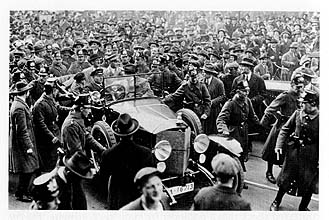
Jackie Coogan, Hollywood’s boy wonder, accompanied by his father, greeted by Berlin crowds, 1924. (Photo courtesy Ullstein Bilderdienst)
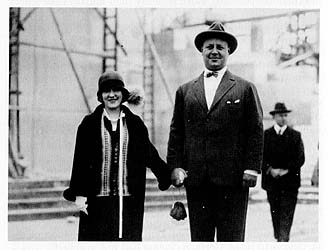
Mary Pickford with Emil Jannings at the Babelsberg studios, 1924. (Photo courtesy Ullstein Bilderdienst)
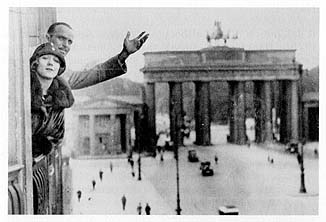
Douglas Fairbanks and Mary Pickford in Hotel Adlon at the Brandenburg Gate, 1926. (Photo courtesy Ullstein Bilderdienst)
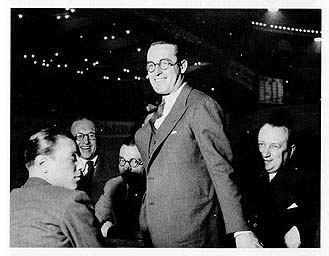
Harold Lloyd at the six-day races, 1925. (Photo courtesy Landesbildstelle Berlin)
| • | • | • |
Viewed as a whole the extended period of initiation into American movies both confirmed and overthrew much accepted wisdom. First exposure, overwhelmingly to sensationalist films, vindicated the prevailing opinion that Hollywood was a hothouse for action and adventure. The only cause for concern, and one which could be rationalized in terms of previous isolation from American motion pictures, was popular interest in these imports. Acquaintance with American society dramas partially confirmed established belief—Hollywood stumbled in the scenario department and had an irritating bent for sentimentality and moralizing—yet caused some serious rethinking of conventional assumptions. Hollywood could achieve dramatic impact comparable to Berlin. The fact that it did so without adoption of German methods intimated what became increasingly evident in contact with the films of Viola Dana and the series presented by Fox. America posed a threat because it displayed a confidence and consistency in its exploitation of the medium which the German cinema had not matched.
Acknowledgment of this aptitude was by no means universal, nor did it necessarily reconcile critics to all Hollywood’s quirks. It did, however, in its elaboration on ideas espoused early in 1921 by Hans Siemsen, suggest that the American cinema was a more dangerous competitor than it had originally appeared. Behind the apparent inconsequence of Hollywood’s output lay both generic forces—industrialization, urbanization and mechanization of life—which were also systemic in Germany, and filmic principles consistent with the technological and kinetic character of the medium.[77] German cinema had impressed discriminating viewers in Europe and America but by the admission of its own spokespersons had yet to establish an unequivocal public role. The period from 1921 to 1923 therefore witnessed growing recognition that Hollywood had tapped the intrinsic and public dimensions of the medium at their point of mutual reinforcement.
Notes
1. Pabst’s remark is cited in K.M. (Kenneth MacPherson), “Die Liebe der Jeanne Ney,” Close-Up, 1 (December 1927), 17–27, here pp. 18–19. Cf. Willy Haas, “Die Amerikaner beleidigen uns . . !?” Film-Kurier, 5 November 1924.
2. Cf. Rainer Pommerin, Der Kaiser und Amerika (Cologne/Vienna: Böhlau Verlag, 1986), pp. 208–209; Frank Trommler, “The Rise and Fall of Americanism in Germany,” in Trommler and McVeigh (eds.), America and the Germans, vol. II, pp. 332–342.
3. The characterization of American as cultureless refused to die. Cf. Beck, Germany Rediscovers America, pp. 2–3; Laqueur, Weimar, p. 32.
4. Some American pictures appeared among approximately 250 smuggled into the country during 1919 and 1920. Traub, Die UFA, p. 40.
5. See, for example, “Die Krisis des französischen Films,” Der Film, 3 August 1918, p. 55. Cf. in Kinematograph: “Französische Filmsorgen,” 22 August 1917; “Neues vom Ausland—Der südamerikanische Markt,” 5 September 1917; “Neues vom Ausland-Russland,” 7 November 1917.
6. Cf. the review of “Gehetzte Menschen,” Lichtbildbühne, 20 March 1919, p. 29, and Egon Jacobsohn’s reviews in Kinematograph, 2 April 1919. Cf. reviews of “Schmutziges Geld,” Der Film, 10 May 1919, p. 34; Lichtbildbühne, 24 May 1919, p. 29; Der Film, 28 February 1920, p. 47, and 17 April 1920, p. 48.
7. “Neues vom Ausland,” Kinematograph, 27 February 1918; “Das Ende des amerikanischen Filmtrusts,” Der Film, 14 September 1918, pp. 53–54.
8. Egon Jacobsohn reviewed Ernst Lubitsch’s Carmen from this perspective: Kinematograph, 15 January 1919, as did a critic in Lichtbildbühne, 21 December 1918, p. 71. The international cinema was likewise the yardstick in Alfred Rosenthal’s comments on Veritas vincit: “Der Triumph des deutschen Films,” Erste Internationale Film-Zeitung, 15 April 1919. Ludwig Brauner adopted the same approach in reviews of Paul Leni’s Prinz Kuckuck and Fritz Lang’s Die Spinnen: Kinematograph, 1 October 1919, and 8 October 1919. Most explicit in this regard was a panegyric for Lubitsch’s Madame Dubarry by Arthur Liebert, which claimed that more works of this caliber would end America’s international dominance: Der Film, 20 September 1919, p. 46.
9. Karl Figdor in Erste Internationale Film-Zeitung, 25 October 1919, p. 36.
10. See “Der Filmautor—Der deutsche Film in Frieden,” Kinematograph, 30 April 1919.
11. Erste Internationale Film-Zeitung, 18 October 1919, pp. 42–43.
12. Urban Gad, “Der amerikanische Grossfilm,” Lichtbildbühne, 15 March 1919, pp. 14–16, and 22 March 1919, pp. 28–30. Cf. Robert Bogyansky, “Der deutsche Film,” Film-Kurier, 4 March 1920; Lichtbildbühne, 26 July 1919, p. 21.
13. See Thomas Saunders, “History in the Making: Weimar Cinema and National Identity,” in Bruce Murray and Christopher Wickham (eds.), Framing the Past (Carbondale: Southern Illinois University Press, 1992), pp. 42–67.
14. “Die Amerikaner,” Kinematograph, 13 August 1919.
15. Karl Figdor in Erste Internationale Film-Zeitung, 3 January 1920, p. 24.
16. “Stockholmer Kino-Bericht,” Kinematograph, 10 July 1918. “Der amerikanische Film,” Erste Internationale Film-Zeitung, 22 November 1919, pp. 30–32. Historians would disagree with the value judgments and choice of language, but the essential contrast sketched by Genenncher is that taken up by Kracauer, Eisner et al.
17. See the summary in A. Hellwig, “National Kinoreform,” Soziale Kultur, 38 (1918), 218–223.
18. Saunders, “History in the Making.”
19. In review of Liebe in Der Film, 21 December 1919, p. 39; Lichtbildbühne, 1 February 1919, p. 26. Hans Richter (ed.), Das Kinojahrbuch, 1921 (Berlin: H. Richter Verlag, 1921), vol. III, pp. 9–10. Cf. Ihering, Von Reinhardt bis Brecht, vol. I, p. 448. Cf. the later reflections of Heinz Michaelis, “Wahrer und falscher Internationalismus im deutschen Film,” Film-Kurier, 5 January 1923.
20. See Buscombe, “Film History and the Idea of a National Cinema.”
21. “Die Schicksalstunde der deutschen Filmindustrie,” Erste Internationale Film-Zeitung, 19 June 1920, pp. 10–11. Cf. P. Schmitt, “Von der Weltgeltung des deutschen Films,” Der Türmer, 20 (1918), 256–258 for a nationalist lament about prewar compulsion to view the world through French glasses.
22. See Heller, Literarische Intelligenz und Film, pp. 39–44, 67–98. Cf. Bier, “Max Reinhardt und die PAGU,” p. 29.
23. See Hugo Zehder, Der Film vom Morgen (Berlin/Dresden: Rudolf Kaemmerer, 1923). Elsaesser, “German Silent Cinema,” notes the self-conscious character of these ambitions.
24. Siemsen was a member of the left-wing splinter Socialist Workers’ Party. See Wolfgang Jacobsen’s biographical sketch in H.-M. Bock (ed.), CineGraph. Siemsen’s own writings, now collected as Schriften, 3 vols. (Essen: Torso Verlag, 1985–1989) are indispensable, especially those from the collection of travel anecdotes and reflections, Wo hast du dich denn herumgetrieben: Erlebnisse (Munich: Kurt Wolff Verlag, 1920) which includes commentary on the war and capitalism and a biting attack on militarism (“Potsdam oder Döberitz,” pp. 58–69). Through the mid-1920s Siemsen wrote film reviews for Die Weltbühne and edited the film section of the liberal 8 Uhr-Abendblatt.
25. Siemsen, “Film-Reform?” Die Weltbühne, 15 (1919), vol. I, pp. 292–294. Cf. Rudolf Kurtz, “Der Reform-Film,” ibid., pp. 117–119; Laroche, “Kinokritik,” Der Kritiker, 1, 25 (1919), 9–10.
26. Siemsen, “Die Filmerei,” Die Weltbühne, 17 (1921), vol. I, pp. 101–105.
27. Cf. Paul Beyer, “Film! Kunst?” Der Kritiker, 3 (March 1921), 88–90; Hugo Zehder, Der Film von Morgen, especially Siemsen’s “Das Filmmanuskript,” pp. 52–60; eu. (Erich Hamburger?), “Das Tier im Film,” Berliner Tageblatt, 4 March 1923. Béla Balázs, Der Sichtbare Mensch, in his Schriften zum Film, vol. I, pp. 108–112. Cf. Joseph Zsuffa, Béla Balázs, The Man and the Artist (Berkeley: University of California Press, 1987), pp. 109–122.
28. In a chapter from Wo hast du dich denn herumgetrieben entitled “Amerika” (pp. 108–111), Siemsen wrote in 1920 that he had wanted to visit America until he read about grain growers there destroying their harvest while malnutrition was prevalent in Europe. He blamed this lunacy, like the war, on the logic of capitalism and lost all desire to see America. His respect for American film was nonetheless genuine.
29. See Albersmeier, Die Herausforderung des Films an die französische Literatur, pp. 32–34.
30. See Yvan Goll, “Das Kinodram,” Die neue Schaubühne, 2 (1920), 141–143, and Claire Goll, “Amerikanisches Kino,” ibid., pp. 164–165. Both are reproduced in Kaes, Kino-Debatte, pp. 136–139; 146–148.
31. Rudolf Kurtz, “Kampf ums Kino: Wider Hans Siemsen,” Die Weltbühne, 17 (1921), vol. I, pp. 166–168; with reply from Peter Panter (Kurt Tucholsky), “Für Hans Siemsen,” pp. 168–170. For the reprint and Haas’s rejoinder see Film-Kurier, 10 and 11 February 1921.
32. Siemsen, “Deutsche Filme,” Die Weltbühne, 17 (1921), vol. II, pp. 253–257.
33. Ludwig Wolff, “Brief an Hans Siemsen,” ibid., 315–316. Cf. “Friede,” Kinematograph, 9 July 1919; K. Figdor, “Ensemble- oder Star-System im Exportfilm?” Erste Internationale Film-Zeitung, 25 October 1919, pp. 36–37.
34. Siemsen, “Erwiderung an Ludwig Wolff,” Die Weltbühne, 17 (1921), vol. II, pp. 358–360.
35. Hans Glenk, “Auslandsfilme,” ibid., pp. 415–417.
36. Glenk spoke of Pickford in a way which suggested he too had seen the film; he was in all likelihood also familiar with Haas’s review.
37. Haas, “Ein Mary-Pickford-Film in Berlin,” Film-Kurier, 28 February 1921.
38. Haas, “Die Degeneration der Filmkunst,” ibid., 6 April 1921. Not long after, Béla Balázs, then resident in Vienna, saw an ideal future in the synthesis of European art and American technology: “Achtung! Amerika kommt!” in his Schriften zum Film, vol. I, pp. 154–155.
39. One expert, disgruntled by the fact that with five years of foreign production to choose from German distributors were importing miles of these serials, accurately estimated that a single American company, Universal, was swallowing up one-half of the import quota: Quintus Fixlein, “Filmwirtschaft: Auslese des Schlechtesten,” Das Tagebuch, 2 (1921), 1026–1027. Cf. Wolffsohn (ed.), Jahrbuch der Filmindustrie, vol. I, p. 165.
40. Der Film, 3 July 1921, pp. 46, 49. Cf. the preview based on foreign experience by H.K., “Der amerikanische Sensationsfilm,” Vorwärts, 15 April 1921.
41. Brauner’s review of “Goliath Armstrong” in Kinematograph, 1 May 1921. Cf. ina (Paul Medina), “Tarzan,” Film-Kurier, 7 May 1921; 1f., “Tarzans Roman,” Film-Kurier, 27 August 1921, and “Mit Büchse und Spaten,” in Film-Kurier, 3 September 1921, and Berliner Börsen-Courier, no. 317, 10 July 1921, p. 13. C. F. W. Behl, editor of Der Kritiker, argued that two features almost always distinguished American movies—“sugary femininity and brutal manliness”: Freie Deutsche Bühne, 2 (1921), 1194.
42. Laupp, “Film,” Der Kritiker, August 1921, p. 16. A convenient point of entry to the range of opinion on the early American sensationalist films is the short-lived journal Film und Presse, nos. 17/18–33/34, 1921, which presented a digest of contemporary reviews. Cf. the poll among producers before the first wave of American films which linked the popularity of sensationalism to public restlessness and the industry’s desire to capture markets abroad: “Die Produktion der neuen Saison,” Der Film, 26 March 1921, pp. 28–29. Laqueur, Weimar, pp. 234–235, explains the postwar preference for what he calls horror films as a demand for stimulation as intense as the war.
43. For reactions to “Goliath Armstrong” see Der Film: 30 April 1921, p. 39; 10 July 1921, p. 26; 17 July 1921, p. 47; 24 July 1921, p. 38.
44. Cf. Kinematograph, 1 May 1921, and 7 August 1921, on “Goliath Armstrong;” 3 July 1921, 10 July 1921, 17 July 1921 on The Red Ace.
45. See folio at Deutsches Institut für Filmkunde, Frankfurt, Filmprüfstelle Berlin, 15 September 1921, and Film-Oberprüfstelle Berlin, 22 September 1921; henceforth DIFF-FP and DIFF-FO respectively.
46. Cf. DIFF-FP, 15 October 1921; DIFF-FO, 20 October 1921.
47. DIFF-FP, 23 June 1922.
48. DIFF-FO, 5 July 1922.
49. Cf., for example, DIFF-FO, 22 July and 25 August 1922; 11 November 1921; DIFF-FP, 23 June 1922.
50. Cf. DIFF-FP, 9 October 1923; DIFF-FO, 16 October 1923.
51. DIFF-FP, 8–9 October 1923. The absence of mitigating circumstances was clearly stated: “The film piles one sensation on another. There is no thought, no psychological motivation in it .…Its style is beyond that of the worst trashy novel.”
52. DIFF-FO, 1 November 1923.
53. DIFF-FO, 22 June 1923.
54. Cf. DIFF-FP, 13 December 1923; DIFF-FO, 21 December 1923.
55. “Der deutsche Film im Ausland,” Berliner Tageblatt, 5 April 1921; Fritz Engel, “Amerika-Film,” ibid., 17 July 1921.
56. Urban Gad, “Warum siegt der amerikanische Film?” Lichtbildbühne, 20 August 1921, p. 15. It may be more than coincidental that Gad came under fire just weeks later for sacrificing stylistic consistency in order to incorporate American sensationalism: Krft. (Arthur Krefft), “Insel der Verschollenen,” Der Kritiker, 3 (December 1921), 219–222.
57. For a dissenting view see L. A. Hermann, “Schiefe Urteile über die amerikanische Produktion,” Kinematograph, 6 November 1921.
58. Paul Meissner, “Amerikaner,” Film-Kurier, 17 October 1921. Without mentioning Siemsen by name Meissner commented acidly that after the warnings issued about Hollywood’s superiority American film had proven imposing only in its length.
59. Der Film, 5 March 1922, p. 44.
60. Siemsen, “Deutsch-amerikanischer Filmkrieg,” Die Weltbühne, 17 (1921), vol. I, pp. 219–222.
61. gl. (Oscar Geller?), “Aus der Praxis,” Kinematograph, 18 September 1921. Cf. the more modest recommendation of Herbert Ihering responding to “Goliath Armstrong:” “This American film is a crude, vulgar affair, and one should be careful not to imitate it in Germany .…Nevertheless, one should still take note of it, one should still take a lesson from its resolution in foregoing assumptions, in shortening, in omission of motivation. That seems to me to be the task: to exploit for the expression of acting in Germany the tempo which the Americans have for daredevil acrobatic stunts.” Berliner Börsen-Courier, no. 341, 24 July 1921, p. 9.
62. Siemsen, “Deutsch-amerikanischer Filmkrieg,” Die Weltbühne, 17 (1921), vol. II, p. 221, observed that Berlin’s film critics had “no taste for the boundless naiveté of a film like “Goliath Armstrong.” ” Cf. Franz Schulz, “Definitionen zum Film,” in Zehder, Der Film von Morgen, p. 46: “The disdain toward the cinema, especially among cultivated, respected Germans, can be traced to the native dogma that boredom is a necessary attribute of art.”
63. Paul Ickes, “Vorstellungen und Irrtümer,” Film-Kurier, 27 June 1921. No critic praised the sentimental, moralizing qualities of the film. Cf. reviews of “Die fremde Frau” by -d- (F. Podehl), Der Film, 28 August 1921, p. 50; L. Brauner, Kinematograph, 4 September 1921; and -a. (P. Medina), Film-Kurier, 25 August 1921. Brauner used the term Kammerspiel to describe the focus on emotional/psychological conflict.
64. Max Prels, “Verbotene Frucht,” Kinematograph, 25 June 1922. Cf. Paul Medina, “Amerika und wir,” Film-Echo, 19 June 1922, who noted the financial freedom Hollywood enjoyed to work for a national audience, one it understood, rather than chasing an unpredictable international market, as Germans were doing with emphasis on historical pageants.
65. Balthasar, “Inland und Ausland,” Das blaue Heft, 3 (1922), 957. M.Z., “Kinoides,” Der Kritiker, 4 (June 1922), 15: “The how may be quite nice, but the what is too foolish.…So the villain gets his just punishment, so passionate love overcomes class prejudices triumphantly: it is too banal, too inconsequential in its banality.”
66. Vossische Zeitung, no. 609, 27 December 1921.
67. Paul Ickes, “Viola Dana,” Film-Kurier, 29 August 1922, Cf. J.S. (Julius Sternheim?), “Im Reiche des weissen Elefanten,” Film-Kurier, 22 May 1922; Berliner Tageblatt, 18 March 1923.
68. Frank Furter, “Viola Dana,” Das Tagebuch, 3 (1922), 1107– 1108.
69. For the broad distinctions of type and quality see “Sechs Fox-Filme,” Lichtbildbühne, 22 July 1922, p. 42; Bz., “Der Fox-Film,” “Vossische Zeitung,” no. 343, 22 July 1922. For specific, slashing criticism of the historical pictures see J-s (Paul Ickes), “Die Königin von Saba,” Film-Kurier, 19 July 1922; F.K., “Nero,” Film-Kurier, 22 July 1922.
70. Aros (Rosenthal), “Fox-Parade,” Film-Echo, 24 July 1922. Cf. Willy Haas’ response to Daddy-Long-Legs discussed above; Kreimeier, Die Ufa-Story, p. 151.
71. Kinematograph, 6 August 1922, p. 123.
72. Wolfgang Martini, “Vom Wesen des amerikanischen Films. Vom Wesen des Films überhaupt,” Süddeutsche Filmzeitung, 14 September 1923, pp. 1–2. Cf. Erich Hamburger, “Harald Lloyd [sic],” Berliner Tageblatt, 4 May 1924.
73. See R-th. (Joseph Roth?), “Foxfilme in der Alhambra,” Berliner Börsen-Courier, no. 341, 23 July 1922, p. 8: “Among us doctrinaires the controversy over the question: is film art or not? has never been terminated. The Fox films demonstrate the superfluity of this controversy.…Sometimes the event on which the film is based is banal—but then details and nuances are enriched by the acting. Sometimes the subject is an improbable exaggeration—but then the details are of gripping truthfulness. By laying, therefore, a real foundation for castles of fantasy, as it were, one commands the interest of the most demanding viewer. This basically constitutes the success of American films.”
74. A. K. Rosen-Lohr, “Der amerikanische Film in Deutschland,” Film-Kurier, 14 January 1922: “One cannot take America too seriously as the homeland of film. It has the advantage that the leap there from a mechanical invention like cinematography to an art form like film-art is not as great as in old Europe. Pioneering in America, in which the forests still resound with the ax clearing the land, in which steel is bent into technical wonders, has the right mind for the immediate art of film. For it is an art form for industrial pioneers who have a feeling for the thirst of film for ever new impressions of a changed locality.” Cf. Hans Tintner, “Umwege zum Weltgeschmack,” Süddeutsche Filmzeitung, 15 December 1922, pp. 6–7.
75. See the review of My Boy in Der Film, 16 September 1923, p. 24; Hi (Fred Hildenbrandt), “Jackie,” Berliner Tageblatt, 5 September 1923; E.H. (Erich Hamburger), “König Jackie,” Berliner Tageblatt, 30 March 1924; and Egon Jameson (Jacobsohn), Mein Lachendes Spree-Athen (Berlin: Haude & Spenersche, 1968), pp. 24–34.
76. By contrast, The Sheik, starring Rudolph Valentino, and D. W. Griffith’s Orphans of the Storm provoked very mixed reactions. For general perspectives see Walter Thielemann, “Der amerikanische Film,” Reichsfilmblatt, 22 December 1923, pp. 7–8; Kurt Pinthus, “Die Insel der verlorenen Schiffe,” Das Tagebuch, 4 (1923), 1790–1791. For later reflections by Fritz Lang on the appeal of Hollywood’s action, romance and comedy see “Was ich in Amerika sah,” Film-Kurier, 13 and 17 December 1924.
77. Cf. Fulks, “Film Culture and Kulturfilm,” p. 8.