
2. Italian Jewish Preaching: An Overview
Marc Saperstein
On a day between Rosh Hashanah and Yom Kippur, probably in the year 1593, Rabbi Samuel Judah Katzenellenbogen of Padua delivered a eulogy for Judah Moscato. As befits the time of year, he began with a discussion of repentance, proceeding to argue that one of the primary functions of the eulogy was to inspire the listeners to repent. He went on to discuss the qualities of a great scholar: perfection of intellect and behavior and the capacity to communicate wisdom to others, both by capturing the listeners’ attention with appealing homiletical material and by teaching them the laws they must observe, which are essential for the true felicity of the soul, even though most contemporary congregations do not enjoy listening to the dry halakhic content. At this point the printed text of his sermon reads, “Here I began to recount the praises of the deceased, and to show how these four qualities were present in him to perfection, the conclusion being that we should become inspired by his eulogy and allow the tears to flow for him, look into our deeds, and return to the Lord.”[1]
This passage encapsulates for me something of the challenge and frustration of studying Italian Jewish preaching, and to some extent Jewish preaching in general. Here is a leading Italian rabbi eulogizing per- haps the best-known Jewish preacher of his century. We are given some important statements about the function of the eulogy, the proper content and structure of the sermon, the expectations and taste of the average listener. Then we come to the climactic point, where the preacher turns to Moscato himself. We expect an encomium of the scholarship and piety of Moscato and, what is more important for our purposes, a characterization of his preaching, an indication of his contemporary reputation, an evaluation from a colleague who apparently had a rather different homiletical style. None of this is forthcoming. This climactic section of the eulogy is deemed unworthy of being recorded, presumably because of its specificity and ephemeral character. What for us (and perhaps for at least some of the listeners) is the most important content has been lost forever.
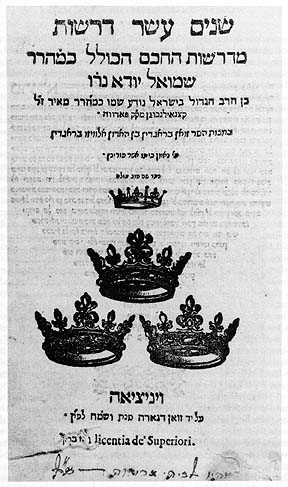
Title page from Samuel Judah Katzenellenbogen’s Shneim-Asar Derashot (Venice, 1594). Courtesy of the Library of The Jewish Theological Seminary of America.
In Kabbalah: New Perspectives, Moshe Idel argues that even after the life work of Gershom Scholem and two generations of his disciples, the literature of Jewish mysticism is by no means fully charted: important schools may never have committed their doctrines to writing, significant works have been lost, certain texts may have arbitrarily been given undue emphasis at the expense of others no less important, and there is as yet no comprehensive bibliographic survey of the literature that does exist.[2] How much more is this true for Jewish sermon literature, which has had no Gershom Scholem to chart the way. The history of Jewish preaching in general, and that of Italy in particular, may best be envisioned as a vast jigsaw puzzle from which ninety percent of the pieces are missing and seventy-five percent of those that remain lie in a heap on the floor—and for which we have no model picture to tell us what the design should look like. Generalizations about trends or characteristics of the homiletical tradition are like speculations about the design of the puzzle based on individual pieces or small clusters that happen to fit together. And without a clear map of the conventions and continuities of the tradition, all assertions about the novelty or even the significance of a particular preacher or sermon are likely to be precarious and unfounded.
The magnitude of what we lack is astonishing. Leon Modena’s Autobiography informs us that he preached at three or four places each Sabbath over a period of more than twenty years, and that he had in his possession more than four hundred sermons. Yet only twenty-one from the early part of his career were published, and the rest have apparently been lost.[3] When we think of the pinnacle of Italian Jewish preaching, Moscato is probably the name that comes first to mind. Yet a contemporary of Moscato’s nominated David Provençal, the author of the famous appeal for the founding of a Jewish university, as “the greatest of the Italian preachers in our time.” Like most of his other works, Provençal’s sermons (if written at all) are no longer extant, leaving us no basis for evaluating the claim.[4] It does, however, give us pause to consider that our standard canon of important Italian Jewish preachers may be highly arbitrary.
The record before the sixteenth century is almost entirely blank: one manuscript by a mid-fifteenth-century preacher, Moses ben Joab of Florence, described and published in part by Umberto Cassuto more than eighty years ago.[5] We have no known extant sermon reacting to the popular anti-Jewish preaching of such Franciscan friars as Bernardino da Siena, John Capistrano, and Bernardino da Feltre; or to the notorious ritual murder charge surrounding Simon of Trent; or to the arrival on Italian soil of refugees from the Iberian peninsula; or to the exploits in Italy of the charismatic David Reubeni, including an audience with Pope Clement VII; or to the burning of the magnificently printed volumes of the Talmud in Rome and Venice; or to the arrest, trial and execution of former Portuguese New Christians who had returned to Judaism in Ancona and the attempted boycott of that port; or to the papal bull Cum nimis absurdum and the establishment of the Ghetto in Rome.
There can be little question that Jewish preachers alluded to, discussed, and interpreted these events in their sermons. Nor can it be doubted that the records of these discussions would provide us with precious insight into the strategies of contemporary Jews for accommodating major historical upheavals to their tradition and, conversely, for reinterpreting their tradition in the light of contemporary events. But it apparently did not occur to these preachers that readers removed in space and time from their own congregations would be interested in learning about events in the past, and they therefore had little motivation to write what they said in a permanent form.[6]
Much of the material that exists has yet to be studied. Isaac Ḥayyim Cantarini of Padua does not appear in any of the lists of great Italian preachers known to me. Yet he may belong in such a list; no one has ever taken a serious look at his homiletical legacy. He left behind what appears to be the largest corpus of Italian Jewish sermons in existence. The Sefer Zikkaron of Padua gives the number as “more than a thousand,” and a substantial percentage of these are to be found in six large volumes of the Kaufmann manuscript collection in Budapest (Hebrew MSS 314–319), each one of them devoted to the sermons for a complete year between 1673 and 1682; there may be more such volumes as well. In many cases there are two sermons for each parashah, one delivered in the morning, the other at the Minḥah service. The sermons are written in Italian, in Latin letters, with Hebrew quotations interspersed.[7]
I once thought of looking through the volume containing the sermons for 1676–1677 to see if I could find any reaction to the news of the death of Shabbetai Ẓevi, but I soon realized the enormity of the task: that volume alone runs to 477 pages, and there is no guarantee that the preacher would have referred to the event explicitly as soon as the news reached his community. Needless to say, for someone interested in intellectual or social history during this period, not to mention the history of Jewish preaching or the biography of a many-talented man, these manuscripts may well repay careful study with rich dividends.
The first desideratum is therefore bibliographical: to compile a complete list of all known manuscripts of Italian sermons—let us say through the seventeenth century—to complement the printed works identified by Leopold Zunz and others. Then we need a data base that would include a separate entry for each sermon, including the place and approximate date of delivery, the genre (Sabbath or holiday sermon, eulogy, occasional, etc.), the main biblical verses and rabbinic statements discussed, the central subject or thesis, and any historical connection with an individual or an event. This would at least spread out all the known pieces of the puzzle on the table before us and facilitate the process of putting them together.
In addition to actual sermons, related genres need to be considered. Rabbi Henry Sosland has given us a fine edition of Jacob Ẓahalon’s Or ha-Darshanim, a manual for preachers from the third quarter of the seventeenth century.[8] But the “Tena’ei ha-Darshan,” written by Moses ben Samuel ibn Basa of Blanes, is no less worthy of detailed analysis.[9] Nor should the various preaching aids be overlooked: works intended to make the preacher’s task easier by collecting quotations on various topics, alphabetically arranged, analogous to a host of such works written by Christian contemporaries.[10]
Once the material has been charted, we can define the questions that need to be addressed. Perhaps the most obvious deal with the sermons as a reflection of Italian Jewish culture, as documents in Jewish intellectual history. To what extent can we find in the sermons evidence for the continued vitality of philosophical modes of thought, for the popularization of kabbalistic doctrines, for the influence of classical motifs or contemporary Christian writings? As these are the questions that will be addressed most thoroughly in the following presentations, I will not pursue the theme further here.
What can we say about the native Italian homiletical tradition, and the impact of the Spanish tradition in the wake of the Sephardic immigration? We can outline the broad contours of the Spanish homiletical tradition as it crystallized in the late fifteenth century, and trace its continuity within the Ottoman Empire.[11] The manuscript sermons of Joseph ben Ḥayyim of Benevento, dating from 1515 until the 1530s, provide an example of preaching on Italian soil very much in the Spanish mold: a verse from the parashah and a passage of aggadah (often from the Zohar) as the basic building blocks, an introduction including a stylized asking of permission (reshut) from God, the Torah, and the congregation, followed by a structured investigation of a conceptual problem, sometimes accompanied by an identification of difficulties (sefekot) in the parashah.[12] But the paucity of Italian material from the fifteenth century and the first half of the sixteenth century makes it very difficult to delineate the process by which Spanish-Jewish preaching influenced home-grown models.
What is the relationship between Jewish and Christian preaching in Italy? I am referring not to a rehashing of the debate about the influence of Renaissance rhetorical theory,[13] but to an assessment of the more immediate impact of published Christian sermons and actual Christian preachers. Did the notorious conversionist sermons influence Jewish preaching style? Did conversionist preachers learn from Jewish practitioners the most effective ways to move their audiences?[14] Nor should we forget that Italian Jews did not always need to be coerced to listen to Christian preachers, as we learn from a passing reference to “educated Jews” (Judei periti) at a sermon delivered by Egidio da Viterbo in Siena on November 11, 1511.[15]
That Christians attended the sermons of Leon Modena is known to every reader of his Autobiography;[16] not as widely known is the passage in which he refers to his own attendance at the sermon of a Christian preacher,[17] and the fact that he owned at least one volume of Savonarola’s sermons and an Italian treatise on “The Way to Compose a Sermon.”[18] His letter to Samuel Archivolti describes the sermons in Midbar Yehudah as a blending of Christian and Jewish homiletics, and he uses the Italian terms prologhino and epiloghino to characterize the first and last sections of his discourses.[19] All of this bespeaks an openness to what was happening in the pulpits of nearby churches. Extremely important work has been done during the past two decades on various aspects of the history of Italian Christian preaching;[20] the task of integrating this with the Jewish material remains to be accomplished.
Another aspect of this subject relates to the use of Italian literature by Jewish preachers. Extravagant claims have been made; an Encyclopaedia Judaica article asserts that “Like Petrarch, Dante was widely quoted by Italian rabbis of the Renaissance in their sermons.”[21] I do not know what evidence could support such a statement. The written texts contain few examples of Jewish preachers using contemporary Italian literature, and there is no reason to assume that such references would be eliminated in the writing, or that those who quoted Italian authors would be predisposed not to write their sermons. Nevertheless, those examples which do exist are instructive. Joseph Dan has discussed Moscato’s citation of Pico della Mirandola which, though incidental to the preacher’s main point, shows that there was apparently nothing extraordinary about using even a Christological interpretation for one’s own homiletical purpose.[22]
More impressive are stories used by Leon Modena. The allegory he incorporates into a sermon on repentance, in which Good and Evil exchange garments so that everyone now honors Evil and spurns Good, is presented as one he “heard,” probably from a Christian or from a Jew conversant with Christian literature. Another story, used in the eulogy for a well-known rabbinic scholar, tells of a young man who tours the world to discover whether he is truly alive or dead. The answer he receives from a monk is confirmed in a dramatic dialogue with the spirit of a corpse in the cemetery. Modena attributes this story explicitly to a “non-Jewish book.” While I have still not succeeded in identifying the direct source of the story, it certainly reflects the late medieval and Renaissance preoccupation with death and dying that produced not only the various expressions of the danse macabre motif but a host of treatises on good living and good dying, including dialogues involving a non-threatening personification of Death.[23]
What do we know about the training of preachers? For no other country is there such ample evidence for the cultivation of homiletics as an honorable discipline in the paideia as there is for Italian Jewry. The kinds of evidence range from the exemplary sermon of Abraham Farissol dating from the early sixteenth century to the letters of Elijah ben Solomon ha-Levi de Veali almost three hundred years later.[24] There seems to have been a special emphasis on students accompanying their teacher to listen to sermons delivered during religious services, especially on major preaching occasions. In addition, preaching was actually taught in the schools.[25] Public speaking and the delivery of sermons was to be part of the curriculum in David Provençal’s proposed Jewish college in Mantua.[26] The preaching exercises in which Modena participated when he was no older than ten do not seem to have been unusual.[27] The delivery of a sermon by a precocious child may well have had the effect that the playing of a concerto by a young prodigy would have had in the age of Mozart. But the actual mechanism for instruction—whether printed collections of sermons were studied and sermons by noted preachers were critiqued, what written guidelines for the preparation of sermons were used in the schools—remains to be fully investigated.
A work like Medabber Tahapukhot by Leon Modena’s grandson Isaac provides dramatic evidence of the tumultuous politics of the pulpit. Indeed, the ways in which the selection of preachers for various occasions could reveal a hierarchy of prestige, unleashing bitter quarrels, is one of the central subjects of the book.[28] Conflicts over the limits of acceptable public discourse—what content could and could not properly be addressed from the pulpit—were part of the same cultural milieu that produced the battles over the printing of the Zohar and the publication of de’ Rossi’s Me’or Einayim.[29] Sometimes these issues were directed to legal authorities who issued formal responsa, but in addition to evoking decisions from the scholarly elite, they reflect problems in the sensibilities and tastes of the listeners in the pews. A full range of such nonsermonic texts is necessary for an adequate reconstruction of the historical dynamic of Italian Jewish preaching.
A final set of questions relates to the writing and printing of sermon collections. Although sermons were undoubtedly delivered in the vernacular throughout the Middle Ages, Italy seems to have produced the first texts of Jewish sermons actually written in a European vernacular language.[30] Why did some Jewish preachers begin to write in Italian in the late sixteenth and seventeenth centuries? What does the transition from Hebrew to Italian in Hebrew characters (Dato) to Italian in Latin characters (Cantarini) reveal about contemporary Jewish culture? Despite the new linguistic variety in the manuscripts, however, printed collections remained in Hebrew. The number of such books published in Venice between 1585 and 1615, by both Italian and Ottoman preachers, is an astounding indication of public demand for this kind of literature. Modena decided to prepare a selection of his sermons for print in the hope that the proceeds would help ease his financial pressures, although in this, as in so many other pecuniary matters, he was apparently disappointed.[31]
In addition to the economics of sermon publishing, the format seems worthy of attention. While most collections of Spanish and Ottoman sermons are arranged in accordance with the weekly parashah, most Italian collections are not. We have relatively few ordinary Sabbath sermons, particularly in print; most of them are for special Sabbaths, holidays, occasions in the life cycle or the life of the community. Yet there is abundant evidence that weekly preaching on the parashah was the norm throughout Italy. Could there have been a conscious avoidance of the Sephardic format in these published collections? We have no answer as yet.
I turn now to a more detailed discussion of certain aspects of Italian preaching. Among other roles, the preacher appears as a guardian of moral and religious standards, and therefore as a critic of the failings of his listeners. Frequently this was just the kind of material the preacher would omit when writing his words for publication, assuming that readers in distant cities would have little interest in the local issues he had addressed.[32] But some of this social criticism has been preserved. If we are careful to distinguish generalized complaints, the commonplaces of the genre of rebuke that recur in almost every generation, from attacks that target a specific, concrete abuse, we may find clues to the stress lines within Jewish society, clues that become more persuasive when the sermon material is integrated with the contemporary responsa literature.[33]
The proper assessment of the sermonic rebuke is not always obvious. I am not quite certain what to make of the accusation, made by both Samuel Katzenellenbogen and Jacob di Alba, that among those who leave the synagogue after the Tefillah and who therefore miss the sermon are congregants who hurry to return to their business affairs.[34] Can they be talking about Jews who engage in work on the Sabbath after attending only part of the Saturday morning service? This would be a violation so serious that one wonders why any rabbi would focus on the much more trivial offense of missing the sermon or insulting the preacher.
Is this particular rebuke then merely a rhetorical device used to discredit those who walk out early by suggesting to the remaining congregation that the exiters might be going to work? If so it could not be used to prove that serious Sabbath violation was actually occurring, but only that the possibility of such violation was plausible enough for the listeners not to dismiss the suggestion as absurd. Or could the entire passage be referring not to the Sabbath but to the weekday morning service? If this is the case, it would be evidence of a very different dynamic: the cultivation of the practice of a daily “devar Torah,” and the resistance on the part of Jews who were committed enough to attend the service, but resented the homiletical accoutrement as an imposition on their time. As with the Moscato eulogy, Katzenellenbogen leads us to the brink of something rather important but fails to give us quite enough to use it with confidence.
Other passages of rebuke are more straightforward. Cecil Roth wrote that “the employment of adventitious aids to female beauty was a perpetual preoccupation of Renaissance [Christian] preachers and moralists, and it is certain that Jewish women followed (or anticipated) the general fashion.”[35] He provided no documentation for this, or for the subsequent assertion that “in Italy generally no sort of ornament was more common than false hair, generally blond,…and the wealthy Jewess was able to keep abreast of fashion simply by remodeling her wig.”[36] Sixteenth-century Jewish literature reveals the concern of Jewish moralists with this practice.
In a sermon for the Sabbath of Repentance, Katzenellenbogen turns to the women in the congregation and raises a rather sensitive issue. Women, says the preacher, must heed the moral instruction of the religious authorities even when they do not like it. The example chosen to illustrate the point is one in which the preacher claims the women of his city are particularly susceptible to failure: the prohibition against revealing their hair or adorning themselves with a Gentile wig that is indistinguishable from their own hair. “In all the Ashkenazi communities, for generations, our ancestors have protested that women must not wear even a silk ribbon that has the color of hair”; the preacher refers here to a lengthy legal decision of his in which he argued against authorities who permitted these practices. But this is not, as Roth would suggest, simply a matter of Jewish women being influenced by their surroundings. Katzenellenbogen argues that the fashions of Jewish women are particularly scandalous “in a place where the Gentile women are accustomed to cover their hair, and the nuns strictly prohibit adorning themselves with a wig.” The function of the Christian environment is not merely to serve as a source of seduction; the preacher uses his Christian neighbors as a rhetorical goad to bring the listeners back to their own tradition.[37]
Preachers were also moved to condemn what they considered to be a deterioration of sexual mores. Israel Bettan cited a passage by Azariah Figo condemning the practice (perhaps more widespread in Italy than in other countries?) of recreational gazing at women, both married and single, “an indulgence that must inevitably lead to graver offenses.”[38] But this is at most a minor infraction of the traditional code of Jewish norms. A far more serious charge is leveled by Figo elsewhere:
Unlike the more concrete condemnations by the preachers in Prague 150 years later,[40] this passage remains too vague to be of much value to the social historian, although listeners in the audience may well have thought of specific examples. Nevertheless, the contrast drawn between what the preacher does not consider to be a real problem in his community (the attraction of Christianity, crimes of violence) and what he does (the more serious kind of sexual sins), and the claim that such behavior is tacitly condoned by many Jews, may point to a genuine sense of breakdown in the core of the traditional Jewish ethos.[41]From then [the destruction of the second Temple] until now, the first two of these sins, namely idolatry and murder, have ceased from the people of Israel. Thank God, there are no reports of a pattern or even a tendency to commit these two sins among our nation—except as a result of compulsion, or in a rare individual case. But the third sin, sexual immorality (gillui arayot), has not been properly guarded against. Jews have violated the rules in these sinful generations in various ways, engaging in all kinds of destructive behavior publicly, out in the open, without any shame or embarrassment.[39]
Financial arrangements also had the potential to create deep conflicts. With considerable power, Azariah Figo addressed the complex problem of impermissible loans. The poor are forced to seek loans from the rich, who “devour their flesh with several forms of clear-cut, open interest.” Even worse, in his eyes, is that the sense of sinfulness about such forbidden arrangements has been lost. “If a group of Jews were to be seen going to a Gentile butcher and were then seen publicly eating pig or other forbidden meat, they would be stoned by all, although this entails only one negative prohibition, for which the punishment is lashes. Yet here we see those who lend money on interest, which involves six transgressions for the lender, as well as others for the borrower, the guarantor, the witnesses, and the scribe, and all are silent.”[42]
Like the passage about sexual immorality cited above, this reflects a serious gap between the values of the community and those of its religious leadership. The prevalent social norms deem the dietary laws to be crucial to Jewish identity even though from a legal standpoint they do not entail the most serious of sins. Taking interest from a fellow Jew has more serious legal consequences, but ordinary Jews consider it innocuous. Those who are aware of the prohibition, we are told, show deference to the tradition by hypocritical attempts to avoid the appearance of transgression, through ruses such as an arrangement by which the creditor may live in an apartment without rent. As for the cambio (exchange contract), some may be permissible, but many others are totally forbidden, so that even the well-intentioned merchant may unwittingly err. “My quarrel with them, is this,” the preacher concludes: “Why don’t they consult with experts in these matters, who can provide them with proper guidance?”[43] The passage is extremely rich, revealing the frustrations of religious leaders in the face of economic and social forces they are unable to control.
In addition to areas of major conflict, the sermons may reveal aspects of the norms of social life and mentality. Wedding sermons must surely reflect the attitude of the preacher toward women and marriage. The earliest Italian preacher whose sermons are preserved, Moses ben Joab of mid–fifteenth-century Florence, speaking at a betrothal celebration of a certain Abraham of Montalcino, delivered himself of what reads today like a misogynistic diatribe, but must have seemed to him like a conventional assessment of woman’s limitations and perils. He then proceeds,
The use of the occasion of a betrothal celebration to incorporate into a religious discourse an attack against the prevailing standards of marriage brokers shows that Italian preachers, though frequently ponderous, were not without humor.[44]What can a man do who wants to find himself a wife? All around him are “brokers of sin,” who find something good to say about those who have no merit. Today they tell him one thing, tomorrow another, until their combined efforts wear him down. In order to lead him into their trap, they tell him, “This woman who is coming into your home will bring some dowry!”…Whoever escapes from the snares of these people like an energetic bird or deer, and finds himself a decent woman, has indeed “found something good.”
A passage in a sermon by Katzenellenbogen gives us a glimpse of child-rearing practices that might be related to the burgeoning scholarly literature on attitudes toward children and private life. At issue is an aggadic statement (B. Ḥag. 3a) that small children should be brought to hear sermons, even though they cannot understand them. But this is obvious, the preacher says: if the small children were left home alone, their parents would stand impatiently and resentfully during the sermon, not listening to what was being said but wishing it would end, afraid that their children might be harmed. Thus, “even if parents were not commanded to bring their pre-school children, they would bring them of their own accord out of fear lest they be harmed if they are left at home with no adult around.” The preacher does not address the problem of concentrating on the sermon if the infant or toddler is present in the synagogue, but we have here a rather moving indication of concern for the welfare of small children left without adult supervision.[45]
The fact that Italian preachers such as Katzenellenbogen and Modena made eulogies a significant component of their relatively small selection of published sermons may well have solidified the prestige of that genre as a written text. No consideration of Jewish attitudes toward death and beliefs about the afterlife can claim any semblance of respectability unless it is based on a thorough study of this literature. Though often stylized and filled with conventions and commonplaces, the eulogies also reveal the texture of interpersonal relationships: the feelings of a student for his teacher (or the teacher for a young student), the bonds of genuine friendship, the pain at the loss of a member of the immediate family.[46] No branch of Jewish homiletical literature is more deserving of systematic study.
I must mention one other kind of occasional preaching. Not infrequently, the sermon was used as a vehicle to raise funds for a worthy cause. Each community supported the central institutions of Jewish life through a system of self-imposed taxation, and there were standard funds for freewill offerings. But there were also unusual cases that warranted a special appeal from the pulpit. The causes deemed worthy of such special appeals reflect the shared values of the society, and the arguments used to convince the listeners give point to a consensus about the expectations of responsibility in Jewish life. In addition, these arguments exhibit one aspect of the rhetorical arsenal at the preacher’s disposal.
For example, Moscato devoted a significant part of a sermon for the holiday of Sukkot to an appeal on behalf of the impoverished sick. He notes that this has been “imposed upon me by the [lay] leaders of our people to make known in public their suffering, for their numbers and their need are greater than usual.” After dwelling on the importance of charitable giving and the special claim of the impoverished sick, he moves on to other exegetical material, but later in the sermon reminds the listeners that he expects their pledges. The entire solicitation section is an integral part of the sermon, crafted with no less artistic sophistication than the rest.[47]
Katzenellenbogen delivered a eulogy for R. Zalman Katz of Mantua “in the public square of the ghetto…for all the synagogues were closed because of the plague,” a circumstance repeated several generations later (in 1657) when Jacob Ẓahalon preached from the window balcony of a private home to Jews standing in the street below.[48] At this time, when “the line of judgment is stretched out against us,” donations to charity are a traditional safeguard from harm. The eulogy ends with a direct appeal:
In this dramatic gesture, the preacher establishes a model not only for the congregation of listeners, but for subsequent fund-raisers as well.There is no need to dwell at length on these matters, for I know that your excellencies are not unaware of the great power of this mitzvah of charitable giving, particularly at this perilous time. But I beseech your excellencies to contribute speedily as much as you can, in accordance with the needs of the hour. And I will be the first to perform this mitzvah; see my example and do likewise.[49]
Even in more normal times, the eulogy was apparently an occasion for appeals on behalf of needy members of the family of the deceased. Leon Modena excelled in this, as in so many other areas. His Autobiography reports that as part of his eulogy for a friend in 1616, he exhorted the congregation to take up a collection to provide a dowry for the orphaned daughter. Five hundred ducats were raised, about twice Modena’s own maximum annual income, though lower than the dowries he was able to provide for his own daughters, which were by no means high. The achievement was unusual enough to be taken as a model for emulation by Christian preachers, who would say on their days of penitence, in inspiring their audiences to charity, “Did not one Jew in the ghetto raise five hundred ducats with one sermon to marry off a young girl?”[50] Unfortunately, he left no known written record of the eloquence of his appeal.
The Days of Awe were often an occasion for pulpit-inspired philanthropy. Azariah Figo devoted part of his sermon on the second day of Rosh Hashanah in 1643 to a collection for the impoverished Jewish community of Jerusalem; forced to pay an enormous tax, they had sent emissaries to all the communities of the Diaspora. Figo’s thematic verse is actually only a strategically chosen phrase wrenched from its syntactical context: Ha-makom ha-hu Adonai yireh (Gen. 22:14). This expresses both the unique providential relationship with the holy city and the hope that “God will see the affliction of that place, and bring it healing and recovery through the extraordinary kindness and generosity of your excellencies, as befits the sanctity of the place and of this time.” The practice of emergency appeals for the land of Israel on the Days of Awe was not an innovation of the past generation.[51]
I hope this sketchy introduction to the riches and challenges of Italian Jewish preaching will serve to whet the appetite for the subsequent presentations by my colleagues. It is a topic about which much more could be said, but I am already chastened by one of the wisest sentences Leon Modena ever wrote: “In all of the congregations of Italy where I have preached, I never heard anyone complain that the sermon was too short, only that it was too long.”[52]
Notes
1. Samuel Judah Katzenellenbogen, Shneim-Asar Derashot (Jerusalem, 1959; reprint of Warsaw, 1876 ed. [for a reason that escapes me, the Warsaw edition identified the author as “MaHaR I Mintz,” leading to confusion with the fifteenth-century Talmudic scholar R. Judah Mintz]), p. 21b (page references are to the “Arabic” numerals). See also p. 58a, a eulogy for R. Joseph Karo: “After that I went into a recounting of the praise of the deceased ga’on,” and p. 61a, a eulogy for R. Zalman Katz of Mantua: “After that I began to recount the praise of the deceased ẓaddik.” Despite its elliptic character, the eulogy for Karo contains some important historical information. See Robert Bonfil, Ha-Rabbanut be-Italyah bi-Tekufat ha-Renesans (Jerusalem, 1979), p. 194. That the elimination of material about the deceased from the written eulogy was not unique to Katzenellenbogen can be seen from Azariah Figo’s eulogy for Abraham Aboab, Binah le-Ittim (Warsaw, 1866), sermon 75, p. 122c: “I spoke at length on some other such aspects of his personal behavior; I have not written it at length.”
2. Moshe Idel, Kabbalah: New Perspectives (New Haven, 1988), pp. 18–21.
3. Mark Cohen, ed., The Autobiography of a Seventeenth-Century Venetian Rabbi (Princeton, 1988; henceforth Autobiography), pp. 95, 102. In July of 1991, Dr. Benjamin Richler, of the Institute of Microfilmed Hebrew Manuscripts in Jerusalem, informed me of the recent discovery of a manuscript of sermons apparently by Leon Modena.
4. Abraham Portaleone, epilogue to Shiltei Gibborim (Jerusalem, 1970), p. 185c. JTS MS Rab 172 was a collection of sermons written “by one of the scholars from the Provençal family in Mantua,” and acquired by Leon Modena in Venice in 1595. While some are not without interest, they do not seem to be the work of a master preacher of Moscato’s rank, and there were many other members of the family who could have written them.
5. Umberto Cassuto, “Un rabbino fiorentino del secolo XV,” Rivista Israelitica 3 (1906): 116–128, 224–228; 4 (1907): 33–37, 156–161, 225–229.
6. For a general discussion of the tendency to omit historical references from sermon texts prepared for publication, or to refer to events in a general manner that assumes knowledge by the listener but raises problems for the historian, see my Jewish Preaching 1200–1800 (New Haven, 1989), pp. 80–84 and the passage by Azariah Figo cited on p. 86. See also the historical events mentioned by the fifteenth-century preacher Moses ben Joab of Florence in Cassuto, “Un rabbino fiorentino,” Rivista Israelitica 3 (1906): 117–118, and his statement cited in Jewish Preaching 1200–1800, p. 18.
7. On Cantarini, see Zalman Shazar, Ha-Tikvah li-Shenat HaTak (Jerusalem, 1970), especially pp. 13–15, 18. Another massive manuscript (376 folios) of sermons that, to my knowledge, has not been studied is by Samuel ben Elisha Portaleone: British Library Add. 27, 123. Eliezer Nahman Foa, a disciple of Menahem Azariah of Fano, left four manuscript volumes entitled “Goren Ornan” (Mantua M. 59; Jerusalem Institute for Microfilmed Hebrew Manuscripts 842–845), but these are closer to homiletical commentaries than actual sermons. The only extant collection of Jewish sermons larger than Cantarini’s from before the nineteenth century are the manuscripts of Saul Levi Morteira of Amsterdam.
8. Henry Sosland, A Guide for Preachers on Composing and Delivering Sermons: The OR HA-DARSHANIM of Jacob Ẓahalon (New York, 1987).
9. Columbia University MS X893 T15 Q; the text was written in Florence in 1627. See Bonfil, Ha-Rabbanut, p. 192; Sosland, Guide, pp. 82–83n.
10. Examples from Italy include “Kol Ya’akov” by Jacob ben Kalonymos Segal (Columbia University MS X893 J151 Q; see Bonfil, Ha-Rabbanut, pp. 192–193; Sosland, Guide, pp. 83–84n), Leon Modena’s “Beit Leḥem Yehudah,” an index to Ein Ya’akov (see Autobiography, p. 226), and Jacob Ẓahalon’s alphabetical index to Yalkut Shimoni (see Sosland, Guide, pp. 73–76). For other such preacher aids by Jews, see Jewish Preaching 1200–1800, pp. 16–17, 286.
11. See Jewish Preaching 1200–1800, pp. 66–78.
12. Joseph ben Ḥayyim of Benevento, Parma Hebrew MS 2627 (De’ Rossi, 1398).
13. Israel Bettan, Studies in Jewish Preaching: Middle Ages (Cincinnati, 1939), p. 196; Isaac Barzilay, Between Reason and Faith (The Hague and Paris, 1967), pp. 168–169; Isaac Rabinowitz, The Book of the Honeycomb’s Flow (Ithaca, 1983), pp. liv–lx; Alexander Altmann, “Ars Rhetorica as Reflected in Some Jewish Figures of the Italian Renaissance,” in Jewish Thought in the Sixteenth Century, ed. Bernard Cooperman (Cambridge, Mass., 1983); Sosland, Guide, pp. 105–107, n. 14, all emphasize the citations of classical rhetoricians by Jewish writers. Joseph Dan, Sifrut ha-Musar ve-ha-Derush (Jerusalem, 1975), pp. 190–197 argues that Moscato’s sermons should be seen more in the context of the internal Jewish homiletical tradition. I tend to agree with Dan; see the example of continuity in Jewish Preaching 1200–1800, pp. 71–72. [Cf. Moshe Idel’s essay in this volume.—Ed.]
14. On the forced conversionary sermon in Italy, see S. W. Baron, A Social and Religious History of the Jews, 18 vols. (Philadelphia, New York, 1952–1983), vol. 14, pp. 50–51, 323–324, n. 47; Kenneth Stow, Catholic Thought and Papal Jewry Policy (New York, 1977), pp. 19–21. I am not aware of any study of the actual rhetorical techniques of these sermons.
15. Ingrid D. Rowland, “Egidio da Viterbo’s Defense of Pope Julius II, 1509 and 1511,” in De Ore Domini: Preacher and Word in the Middle Ages, ed. Thomas Amos, Eugene Green and Beverly Kienzle (Kalamazoo, Mich. 1989), pp. 250, 260. Cf. Isaac Arama’s description of Spanish Jews impressed by the sermons of Christian preachers and demanding a higher level from their own rabbis: introduction to Akedat Yiẓḥak, trans. in Jewish Preaching 1200–1800, p. 393.
16. Autobiography, pp. 96, 117. See Jewish Preaching 1200–1800, pp. 26, 51, n. 19, and Isaac min ha-Levi’im, Sefer Medabber Tahapukhot, ed. Daniel Carpi (Jerusalem, 1985), p. 80. For Montaigne’s description of a Jewish sermon he heard in Italy, see Jewish Preaching 1200–1800, p. 9.; for Giordano Bruno’s praise of a contemporary Jewish preacher, see Cecil Roth, The Jews in the Renaissance (Philadelphia, 1959), pp. 36, 342.
17. In the Church of San Geremia: Autobiography, p. 109; see also his letter cited by Yosef Yerushalmi, From Spanish Court to Italian Ghetto (New York, 1971), pp. 353–354.
18. Modo di comporre una predica, by Panigarola (Venice, 1603); see Clemento Ancona, “L’inventario dei beni di Leon da Modena,” Bolletino dell’istituto di storia della società e dello stato veneziano 10 (1967): 265–266. I am grateful to Howard Adelman for bringing this article to my attention. Modena himself claims to have written a work called Matteh Yehudah “on how to compose a well-ordered sermon” (Sosland, Guide, p. 82, n. 1). [See Joanna Weinberg’s essay in this volume.—Ed.]
19. See Jewish Preaching 1200–1800, pp. 411–412.
20. Examples of book-length studies include John O’Malley, Praise and Blame in Renaissance Rome (Durham, N.C., 1979); Roberto Rusconi, Predicazione e vita religiosa nella società italiana: Da Carlo Magno alla controriforma (Turin, 1981); Carlo Delcorno, Exemplum e letteratura: Tra Medioevo e Rinascimento (Bologna, 1989); Daniel Lesnick, Preaching in Medieval Florence: The Social World of Franciscan and Dominican Spirituality (Athens, Ga. 1989); B. T. Paton, Custodians of the Civic Conscience: Preaching Friars and the Communal Ethos in Late Medieval Siena (Oxford, 1989). There have also been monumental editions of sermons by the greatest preachers, such as Bernardino da Siena’s Prediche volgari sul Campo di Siena 1427, 2 vols. (Milan, 1989).
21. Joseph Sermoneta, “Dante,” Encyclopaedia Judaica, vol. 5, p. 1295. This was apparently based on Cecil Roth’s assertion that “Any person with the slightest pretext to education was familiar with Dante and with Petrarch. Rabbis quoted them in their sermons” (The Jews in the Renaissance, p. 33; note the addition of “widely” in the EJ statement). But Roth does not provide a single example of a sermon in which either Dante or Petrarch was quoted. For a more balanced treatment of Jewish knowledge of Italian literature, which does not address its use in sermons, see Moses Shulvass, The Jews in the World of the Renaissance (Leiden, 1973), pp. 230–231.
22. Joseph Dan, “Iyyun be-Sifrut ha-Derush ha-Ivrit bi-Tekufat ha-Renesans be-Italyah,” Proceedings of the Sixth World Congress of Jewish Studies (Jerusalem, 1973), division 3, p. 108. [But compare Moshe Idel’s essay below.—Ed.]
23. For the stories of Modena, see Midbar Yehudah (Venice, 1602), pp. 15a, 76b–77a; Saperstein, “Stories in Jewish Sermons (The 15th–16th Centuries),” in Proceedings of the Ninth World Congress of Jewish Studies (Jerusalem, 1986), division 3, pp. 105–106; Jewish Preaching 1200–1800, pp. 98–99, 342–343. The literature on Christian attitudes toward death in the fifteenth and sixteenth centuries is enormous; see Alberto Tenenti, Sense de la mort et amour de la vie (L’Harmattan, 1983, from the Italian ed. of 1957); Jean Delumeau, Sin and Fear: The Emergence of a Western Guilt Culture (New York, 1990, from the French ed. of 1983). While the idea that this world was the “land of the dead” was something of a topos (e.g. Delumeau, pp. 352–353, 459), Modena’s story is different from most in that it does not use the macabre (involving the putrefaction of the corpse), or the theme of memento mori, but simply the claim that death is true life as its summons to renunciation of this world. Cf. Innocenzo Ringhieri’s Dialoghi della vita e della morte (Bologna, 1550), set in a cemetery, in which Death serves as a guide to eternal bliss (discussed by Tenenti, pp. 270–271).
24. David Ruderman, “An Exemplary Sermon from the Classroom of a Jewish Teacher in Renaissance Italy,” Italia 1 (1978): 7–38. Robert Bonfil, “Shteim-Esrei Iggerot me’et R. Eliyahu b’R. Shelomoh Raphael ha-Levi (de Veali),” Sinai 71 (1972): 167, 184–185.
25. Simḥah Assaf, Mekorot le-Toledot ha-Ḥinukh be-Yisra’el. 4 vols. (Tel Aviv, 1930–1950), vol. 2, pp. 157, 177.
26. See the text in Assaf, vol. 2, p. 119, paragraph 12, translated in Jacob Marcus, The Jew in the Medieval World (New York, 1965), p. 386.
27. Autobiography, pp. 85–86; see also Jewish Preaching 1200–1800, pp. 405–406.
28. For example, Medabber Tahapukhot, pp. 48–50, 62–63, 74–76, 78–79, 82–83, 104–106.
29. David Kaufmann, “The Dispute about the Sermons of David del Bene of Mantua,” Jewish Quarterly Review 8 (1895–1896): 513–527. See also the responsa of Leon Modena on philosophical and kabbalistic content in sermons, in Jewish Preaching 1200–1800, pp. 406–408.
30. The manuscript sermons of Mordecai Dato; see Robert Bonfil, “Aḥat mi-Derashotav shel R. Mordekai Dato,” Italia 1 (1976): 1–32; Jewish Preaching 1200–1800, p. 41 (and the reservation in n. 41).
31. Autobiography, pp. 101–102, 209 n.r, and the letter translated in Jewish Preaching 1200–1800, p. 411. In his introduction to Midbar Yehudah, Modena speaks of a glut of sermon collections on the market that diminishes their value in the eyes of potential buyers (pp. 3a–b, cited in Israel Rosenzweig, Hogeh Yehudah Mi-keẓ ha-Renesans [Tel Aviv, 1972], p. 45).
32. See the examples cited in Jewish Preaching 1200–1800, p. 22.
33. See my discussion of the methodological issues in “Sermons and Jewish Society: The Case of Prague,” in a volume to be published by the Center for Jewish Studies, Harvard University, and edited by Bernard Cooperman.
34. See Jewish Preaching 1200–1800, p. 52 and n. 23.
35. Roth, The Jews in the Renaissance, p. 48.
36. Cf. Thomas Izbicki, “Pyres of Vanities: Mendicant Preaching on the Vanity of Women and Its Lay Audience,” in De Ore Domini, pp. 211–234, esp. pp. 215–216, 219 on hairstyles and false hair.
37. Shneim-Asar Derashot, p. 9b; see also Gedaliah Nigal, “Derashotav shel Shemu’el Yehudah Katzenellenbogen,” Sinai 36 (1971–1972): 82. For other examples of Christian behavior used by Jewish preachers as a model worthy of emulation, see my “Christians and Jews—Some Positive Images,” in Christians Among Jews and Gentiles, ed. George Nickelsburg (Philadelphia, 1986) (Harvard Theological Review 19, nos. 1–3 [1986]: 236–246).
38. Binah le-Ittim, 64, p. 93d; see Bettan, p. 237. A different sermon (13, p. 47b), in which Figo complains about the same common phenomenon, goes a step further by noting a rationale intended to justify the practice from traditional sources:
Figo concedes that traditional ethical theory recognizes a great merit in overcoming the temptation to sin, which might lead some to conclude that arousing the temptation might play a positive religious role. But “in this generation of ours, with our sins, this is not the way”; the motivation of the young men is not pure, their purpose is only to see what they can see; the practice must therefore be condemned.Let them not heed deceitful chatter (cf. Exodus 5:9) which claims, “On the contrary, by this they increase their merit by subduing the erotic impulses [aroused],” like those who said, “Let us go on the road leading by the harlots’ place and defy our inclination and have our reward.” (B. AZ 17a–b)
39. Binah le-Ittim, 48, p. 43b.
40. See my “Sermons and Jewish Society” (above, n. 33).
41. Needless to say, such passages from sermons need to be integrated with other types of literature, especially the contemporary responsa, before responsible conclusions about actual Jewish behavior (as opposed to the consciousness of the religious leadership) can be drawn.
42. Binah le-Ittim, 10, p. 33d; cf. Bettan, p. 239.
43. Binah le-Ittim, 10, p. 33d. On the complexity of the legal issues relating to the cambio, see Stephen Passamaneck, Insurance in Rabbinic Law (Edinburgh, 1974). For fifteenth- and sixteenth-century Italian Christian moralists and preachers and their distrust of “letters of exchange” as an attempt to camouflage illicit interest-bearing loans, see Delumeau, Sin and Fear, pp. 224–225; for the earlier period, see Lesnick, Preaching in Medieval Florence, pp. 119–121.
44. Cassuto, “Un rabbino fiorentino,” Rivista Israelitica 4 (1907): 226–227. The last sentence alludes to Prov. 18:22, “One who has found a wife has found something good,” frequently used as an ornament on Italian marriage contracts. The elements of humor and wit in Italian Jewish preaching (and in Jewish preaching in general) deserve careful study.
45. Shneim-Asar Derashot, p. 10a. The study of Jewish child-rearing practices (as distinct from more formal Jewish education) and their relationship with those of contemporary Christian neighbors (for example, whether the conclusions of Phillippe Ariès and his critics have any relevance to the Jewish family) has hardly begun. Pertinent to this passage would be Ariès’s claim of a shift in the early modern period from a rather careless indifference toward the child to a regimen involving constant surveillance (Centuries of Childhood: A Social History of Family Life [New York, 1962, from the French ed. of 1960], pp. 94–97).
46. For example, Modena’s eulogy for his mother delivered at the end of the thirty-day mourning period (Midbar Yehudah, pp. 51a–55a); see also Penina Nave, Yehudah Aryeh mi-Modena, Leket Ketavim (Jerusalem, 1968), pp. 143–144. Katzenellenbogen indicates that the prevalent taste considered it inappropriate to discuss in a eulogy the closeness of personal friendship between the preacher and the deceased, but he defends his decision to do so anyway (Shneim-Asar Derashot, pp. 30a–31a). For recent studies of Italian Christian eulogies, see John McManamon, Funeral Oratory and the Cultural Ideals of Italian Humanism (Chapel Hill, N.C., 1989) and the articles by McManamon and Donald Weinstein in Life and Death in Fifteenth-Century Florence, ed. Marcel Tetel, Ronald Witt, and Rona Geffen (Durham, N.C., 1989), pp. 68–104. [see Elliott Horowitz’s essay below.—Ed.]
47. Judah Moscato, Nefuẓot Yehudah (Warsaw, 1871), sermon 36, pp. 97c–98a, 99d.
48. See Sosland, Guide, p. 26.
49. Shneim-Asar Derashot, p. 63b.
50. Autobiography, pp. 109, 41–42.
51. Binah le-Ittim, pp. 13d–14a. Cf. the Florentine preacher Jacob di Alba, Toledot Ya’akov (Venice, 1609), p. 85a:
We might say, How lonely does she sit (Lam. 1:1): the city of God that descended to earth and became like a widow sitting on the ground, bereft of all distinction. But with regard to taxes and exactions, they perform a creation ex nihilo upon her; she is great among the nations, a princess among the states (Lam. 1:1), for she has existed only so that taxes might be taken from her, making something out of nothing. So it is, in our sins, at present: Jerusalem must pay many kinds of taxes, and if they did not send emissaries from various places, the inhabitants would not be able to endure.
52. Modena, She’elot u-Teshuvot Ziknei Yehudah, ed. Shlomo Simonsohn (Jerusalem, 1957), p. 126. The context is a halakhic question sent to him asking whether it was permissible for a preacher to turn over an hourglass on the Sabbath to time the sermon so that it would not be a burden on the congregation. For the use of the hourglass by Christian preachers, see Jewish Preaching 1200–1800, p. 38, n. 33.