
2. The City as Object
Even while all this was being worried over and accomplished, we turned our attention to discovering Banaras. I had started going to the archives within a day of our arrival, a modest and certain project. What was needed now was a feel of the city as a preliminary to fieldwork. We had never seen the river, for example, or any of the ghats, those famous built-up river embankments, indispensable for bathing and rituals. On a cloudy, pleasant monsoon day, we mounted a rickshaw and announced, “Dasashwamedh ghat.” That ritual of swinging over the high step of the rickshaw and proclaiming the destination of the day became for me the pistol shot that started off each day’s work, and it was important to do it in a proper collected mood, as well as to have something fresh and different planned each day.
The rickshaw unloaded us at an unremarkable v-shaped juncture of two roads with parallel rows of shops. These were the two roads that led to Dasashwamedh ghat. One was lined mostly with shops of cloth, clothes, vegetables, and other products recognized as necessities by the people of Banaras, like perfumes, mats, and baskets; the other with pan shops and beggars.
These beggars were different from the ones I was familiar with. They did not crowd you or plead, make you squirm by almost touching you, or sing, or demonstrate sores and amputated limbs. They simply sat in a line all down the steps on one side like normal people going about their jobs. They had their bowls in front of them, which they and donors alike regarded as sufficient declaration of purpose. Some, in fact, were busy cooking, washing, folding clothes, or praying. There are more beggars in Banaras than in any other city its size, and there can be no two ways of thinking about them. It is their lot to beg as it is yours to give. A chance event has placed them there; but for the grace of God, there would be you. There is absolutely no question of brushing them off as undeserving—the common middle-class attitude toward beggars. They do not ingratiate themselves. You can ignore them, as you can ignore an architectural or a natural feature in the landscape, but you do not necessarily feel in the right. They are in the right in being there. It has been sanctioned in the scriptures and confirmed by centuries of social practice.
We were unprepared, however, and dismayed, not merely by the beggars, but even more so by the squalid stalls, by the unlovable cows and bulls ruminating or excreting on the road, and by the whole unexciting, depressed scene and its inhabitants. We walked on to the river, and there it was before us, wide and gray and quite still. And there were the umbrellas on the ghats, a favorite illustration for tourist brochures. Boats lapped at the bank or lazily floated past. All activity was subdued. This was about 11 a.m., the time (I was later to discover) when the riverside takes a break from its early morning and evening peak hours.
As we stood on the top step, clutching our baby in her Snugli, surveying the still water and the umbrellas, I was conscious of not going about this the correct way. Our senses were not alert, our expectations were not readied, our mood was not right. We came perhaps to be wooed, to be surprised and impressed, to be confirmed in our judgment of Banaras as a potentially fascinating place. Instead, here was a scene that didn’t reach out and serve up a feast but waited indifferently to be attended to, if we liked, to be understood and interpreted. At the least, we could have come at a time of characteristic activity, perhaps with a local person who would either communicate or casually let slip his own feelings about the place.
We stood and walked around for some time. We didn’t go down to the water, not only because we could see everything from the top but also because we felt as if we had seen it all. The most interesting thing for us that day was a hawker with a basket of lentils balanced on a bamboo hourglass stand. They were little colorful hills of parrot-green, mustard, brown, and pepper-red dals, and he himself smiled and sang. This active little marionette stood out against the dull, still background as both incongruous and gratifying. We did not note any of the other big or small features that mark Dasashwamedh and other ghats—the Sitala temple, for example, or the Ganga temple, or even people washing clothes—that I was to rhapsodize about later. We were disappointed and bored, and I could sense why. It was a lesson—not very clear, but quite powerful—in the fallacy of tourism. If you want to know a place, start digging to understand it from the first day. Don’t look around as an outsider with the vague notion of “familiarizing” yourself with the surroundings and being charmed by their intrinsic qualities.
We beat a hasty retreat to the covered verandah of the stores, a light drizzle having started. We waited out the drizzle by looking carefully for a sari for our new ayah, or maidservant: not cheap or coarse, but quiet, modest, clean-looking (preferably white), and of course not too expensive. Having made our purchase, we were a little fortified and decided to continue our explorations. We took a rickshaw to Chauk.
The Chauk, or Square, as in every old North Indian city, is the central, crowded, indigenous bazaar area. To me, with the two decades that I have spent in distant Cantonments and Civil Lines, it stands for everything fascinating and glamorous in the Indian city. The Chauk is in fact interesting for everyone, from those seeking bargains and exotic products to those curious about social structure, history, and culture. The Banaras Chauk is on a hill, and to reach its nucleus the rickshawalla had to pull the two of us with our various bundles up a slope of approximately five hundred yards (see fig. 2). Being dragged up the hill by a sweating, undernourished man of unguessable age caught us unprepared and left us with a sense of betrayal and acute discomfort. As with living in filth, it was as if we were suddenly being made to participate in activities not to our taste.
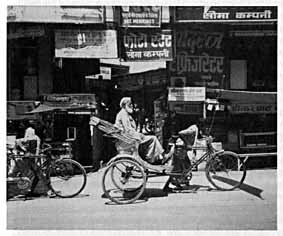
The uphill of Chauk
I should add that those who live in Cantonments never take rickshaws, and New Delhi does not have them at all. We looked around eagerly, but the tourist’s disappointment again awaited us. The shops and signs and people crowded into our vision from all directions but meant absolutely nothing. By the time we reached the top of the hill, the center of Chauk, a drizzle had started again.
That day stands out particularly because we had embarked on two major discoveries: Dasashwamedh ghat, the fabled millennia-old seat of the Ten Horse Sacrifice, and Chauk, nerve center of the city. But most of our early experiences were like that. We had only the vaguest notion of what to expect of places such as, say, Banaras Hindu University. We would pack up baby and baby things and ride away on a rickshaw, falling over ourselves on the way to stare at passing sights. The baby seemed much more in tune with her surroundings, perched high on one of our laps, legs swinging, chortling contentedly. Her world, unlike ours, was limited to warm sun and fresh air and the security of her perch. Ours, or I should say mine, was afloat in boundless space as I strove to construct a map: “What kind of place is this? How shall I understand it?” When we reached our destination, there would be a blank, incomprehensible wall. We would go around, poking at this or that, trying to keep up our enthusiasm. But the truth was that we did not enjoy those early days of discovery. Each trip was a disappointment. There was nothing to make of whatever we saw, partly because of the very nature of the objects of our attention and partly—to be again unfair to tourists—because of our packaged tour approach. But to be fairer, it was more especially because of my lack of preparation as an ethnographer. I had not trained my senses; I had not prepared my questions. That was the missing vital link, a notion of the appropriate questions. I had never read a thick ethnographic account of any Indian city. Having chosen Banaras for its hoary, palimpsest-like venerability, I was discovering that its age did give it an inscrutability which confounded my naive expectation that it would prove alluring and irresistible at first sight. I did not have sufficient information about the place. I could not have had: there was nowhere to get it. I was there to piece it together.
When I compare those early days with later ones, it seems incredible that one can look at so much yet see so little, or want to enjoy and appreciate so intensely yet not be able to do so. Had we by some chance been obliged to leave after one or two months, we would have had practically nothing to report of Banaras, except the aridity of our residential area, the difficulties of survival, the lack of company, and the enigmatic and unattractive nature of ghats and streets.
I carried on my archival work steadily through all this. My first target was the Nagari Pracharini Sabha, the Society for the Spread of Nagari. Nagari in this context was a euphemism for Hindi, not in its literal meaning of the Sanskrit-derived script, but as a cultural-political tool. Located in the northeast, across the city from us, the society’s archives were a clattering, bone-shaking half-hour rickshaw ride away. Luckily for me, the route took me through the heart of the city every day, though the virtues of this route were more evident in the beginning than when my senses became dulled by hundreds of trips. Just as there is an uphill and downhill to the Banaras Chauk, there is an uphill and downhill to fieldwork. Climbing up painfully—pulled up manually by informants, analogous to the Chauk rickshawallas, you might even say—you reach a height of clarity and perception. At a particular point, inevitably, the decline begins, and as you go downhill things become fuzzy again, escaping you, you are worn out, and your experiences are all anticlimactic.
One of the calculations I always had to make as we approached Chauk was, do I leave my rickshaw, walk uphill, and then take another one for the ride down? For I had to negotiate the center of Chauk, from a major crossing called Godaulia at one end to another called Maidagin at the other, and then go a few yards further east. Or, I debated, do I retain my rickshaw but alight and walk alongside it for the steepest part of the climb? I tried each variation several times but never resolved the dilemma. Walking alongside my rickshaw marked me as a fool and a foreigner long after I stopped being these things. Trying to bargain for a new rickshaw in the middle of Chauk, where the rickshawallas were at their most supercilious, was always a doubtful proposition. I would inevitably waste precious minutes, and a trip broken up into two was always more expensive. The days that I refused to make up my mind and sat, dummy-like, on my pathetic little carriage as my man slave inched me up the steep hill were more uncomfortable still. Every moment of the journey was spent in cursing the system, the geography of the place, the quality of the creaking rickshaw, and my own stupid indecision.
Such mental pressures prevented me from thinking positively or imaginatively about the uphill half of Chauk, which was in any case the market for products, such as electrical goods, cloth, timepieces, and eyewear, for which I had no use. I rather despised the large, clean shops and their well-displayed products. The downhill part of Chauk was more subdued and interesting, with a major post office from where you could even make international telephone calls. It ended in the crossing of Maidagin, for which, again, I could not care at all, with its taxi stand, one of the two biggest in the city, displaying rows of, in Banaras, white cars. Who took them and where I couldn’t imagine, seeing that there was barely space to go on foot or by rickshaw in most parts of Banaras. There was also a “tempo” stand—those three-wheeled auto rickshaws that were designed for two and carried, as a rule, six or seven people. I quickly found out who took those. The first time I volunteered to accompany a new informant, Abdul Jabbar and his family on their Thursday trip to the shrine they patronized, we reached the main road and began bargaining with the drivers of different modes of transport. A tempo, at ten rupees, was chosen. Six of us crowded into the vehicle, excluding Abdul Jabbar, who shared the driver’s seat in front. We would have needed at least three rickshaws at five rupees each; I thought, “This is how rickshawallas will be inched out.” At the Maduadih shrine, I had a minor argument with the family when I tried to pay the ten rupees myself. It seemed condescending on my part, but I couldn’t imagine how they could afford so much out of their meager earnings. In fact I was surprised that they argued with me. In their situation, I would have immediately let someone vastly better off than me pay the fare. It was just one of those swift and frequent lessons in their different attitudes toward honor, debt, and equality.
There were two other routes by which I typically arrived at this crossing of Maidagin, and they both deserve to be described here. One went through Pan Dariba, the wholesale market for chewing tobacco, betel nuts, and leaves, and all the related condiments that go into the making of the Banarasi pan. It was a narrow lane fronted by tall attached buildings; on the ground floor was an open store each few square yards. Hills of tobacco, coated with silver, color, or perfume, and baskets of symmetrically arranged pans, accessible only from the central artery, were all displayed to passers-by and were always open to my scrutiny. This extreme openness made for the result that, occasional resolves notwithstanding, I never started a conversation with any of the merchants and never numbered one among my informants. There was not a corner or crevice to take refuge in; to start a conversation there would have meant holding up the traffic and collecting a crowd.
The other route sometimes taken by my rickshawallas was through the locality called Lallapura. The very first time we swung into it, I asked the driver, “Who lives here?” He turned back to gaze at me in skeptical amusement, “Who lives here?!” I explained, “I mean, Hindus, Muslims, artisans, merchants…?” And the rest of the trip was a nice discourse on the social composition of Lallapura, though I have always felt guilty about making rickshawallas talk while pumping. Lallapura had certain features that always struck me as medieval even though I know there is nothing “medieval,” “modern,” or “ancient” about Banaras. There was a large mansion, for example, in which I believe lived elephants, for a sign hanging outside read, “Elephants can be hired here for marriages, processions, etc.” And, true enough, I had seen elephants go to and from that place, clutching large leafy branches in their trunks, grabbing, as it were, a quick snack around the corner. There was no unity to the Lallapura area; sprawling, crisscrossed by lanes, evidently very poor, I could not quite grasp it. I always passed an open workshop where drums of various shapes and of different shades of leather were made and stored. That was medieval.
I was still looking at all this, it might seem, from the vantage point of the tourist. Although I describe my first impressions casually now, even indifferently, I was very serious about everything, and curious to the point of absurdity, though often amused, in spite of my seriousness, not at them but at the confrontation of me and them. I was straining to understand, and I could sense at least how, with every passing day, I had to try less and less hard. One glimpse of something opened up a world of meanings. One comment from a passer-by explained many things. To look into, behind, and under shades and doorways became my second nature. To act swiftly, with question, direction, notebook, or camera became a habit the adeptness of which surprised me.
Both these routes met at Kabir Chaura, a crossing named after the saint Kabir and famous for many reasons. There is something very meaningful about crossings for Banarasis, and they keep referring to their main ones. In a book on Banaras, the old-time resident Vishwanath Mukherjee takes his readers on a trip around the city. All his points of reference are crossings, places where one territory ends and another begins and where cross-movement is possible, a partial reflection of the stable and culturally differentiated constitution of neighborhoods in old cities. Indian crossings are intersections of four roads (chauraha, four paths), hence the hubs of commerce and communication where life at its most intense can be observed. The busiest teashop or pan shop, for example, will be at the crossing, and, with its crowds, serve in turn to make the crossing more packed, impossible, and wonderful.
Kabir Chaura was distinguished by the main public hospital of the city, called by the same name, and by drugstores and fruit vendors for the patients and their families. It was also a “dangerous” crossing, a thought that came to me each time as an involuntary touché to my anthropologist friends with their harping on symbolic and ritual dangers. Here the threat was from the traffic flowing rapidly in all directions, including jeeps, trucks, and bullock carts. The rickshawalla would stick out his arm to signal the direction of his turn and plunge in without further confirmation. Somehow we would always survive, perhaps because everything was proceeding slowly despite the illusion created by the swinging of the rickshaw. I never saw an accident there, although I always clutched my vehicle with all four limbs and noted how I was approximately one inch away from being crushed from the left, the right, and behind.
If Lallapura seemed medieval, then with the next lap of the journey, Lohatiya, we were in the third millennium b.c. of Mohenjo-Daro itself. The road here was of round, polished cobblestones, making rickshaws jerk their passengers roof high. All the stores, again open to the road, sold iron goods, Lohatiya meaning, literally, “place for iron.” The shops looked dark, heavy, and, with all the fat traders and skinny ironmongers, in them, very male. Some of the woks displayed in front were six feet in diameter, the pails four feet high. I tried interviewing here the very first or second day, before I had acquired the necessary techniques or confidence, and was too discouraged by the responses to go back again. I had pressed on bravely with a spate of questions addressed to an ironsmith hammering a metal plate, and our conversation had gone like this:
I: “How [bang] many [bang] hours [bang]…[inaudible]?”
He: “Yahi (Just this)…[bang, bang, bang]”
Some prejudices and mental blocks persist; most, fortunately, are washed away with time. I never made a study of the iron goods industry or of the ironmongers of Lohatiya after my premature and totally unsuccessful initial incursions. But the Lohatiya crossing came to show itself as endlessly fascinating. At the Muslim mourning period of Moharram, the procession called Duldul passed through in its most choking and pushing phase and gave me an intuition about the attractions of crowded places. At Vishwakarma Puja and Durga Puja, and again at Ramlila, there were many stages and canopies for the gods and it was easy to catch the organizers.
To the immediate south of Lohatiya was Nakhas, where carpenters had their workshops. Nakhas led to Kashipura, the locality of the brass workers and coppersmiths. All the neighborhoods bordered on one another, connected by hidden lanes traversable on foot. Every time I was in Lohatiya, the surroundings were less and less opaque. The city was a blank map gradually becoming filled in with lanes, byways, and turnings, dotted with names of localities, individuals, and homes. Because of the proximity of Lohatiya to the archives, it became one of my first exploratory fieldwork sites. On a given day, I would walk hundreds of yards in the galis, with stops to visit a dozen people gradually assuming the status of good friends: a carpenter, a coppersmith, a tea seller, a widow with a pan shop, a policeman yawning on a bench, and so on.
And whatever doubts I may have entertained about informal conversation as a method of fieldwork, upon engaging in it and seeing the incomparable richness of my results I became a total convert. No conceivable questionnaire could have revealed to me the casual details, the ironies, the supremely confident or the hesitant tone embedded in people’s conversations. The pride with which a place was pointed out or an event mentioned, or, on other occasions, the utter indifference, if not downright denigration, of tone and mannerism—these were all prized bits of information to me, and the only way I could have got them was the way I did, by loitering around, adapting to the informant’s pace and inimitable style.
The archives of the Nagari Pracharini Sabha in Visheshwarganj were a few hundred yards further east of Lohatiya, beyond a steady row of teashops. Teashops, around which much of my day revolved, came to figure as pivotal elements in my work. I gave them a fair amount of thought. A tree with a hefty trunk would be taken as the starting point for the construction of a teashop. From one side of this trunk a large stove (say, with four burners) of brick, stone, clay, and cow dung would be built. From the sturdier branches of the tree would be suspended wire baskets of eggs, buns, butter, and cakes. The shady leaves would provide shelter for the customers. A few benches here and there would complete the tea stall. This was its infancy, however. I have seen many teashops at this stage, pleasant and popular enough, but the ones in Maidagin were more elaborate. Walls were hung up on three sides: bamboo frames; discarded matting, jute, and gunny bags; tin canisters hammered out into sheets; even newspapers. These walls were serviceable and were patched regularly. The roof had to have strong beams, but, like the walls, anything might cover the surface. Often tin sheets, still showing off the name of the original canistered or canned products, were used. Inside this cozy room, toasted by the sun in all seasons but always airy and shady, were fitted an amazing number of benches and tables. The teashop became a regular restaurant, and you became oblivious to the composition of the roof and the walls and to the tree that had begun it all. Crockery would clink, little boys darted around to serve and mop, omelets and french toast were created, water was served as you sat down, newspapers were provided, and tips were discouraged.
There was one teashop right next to the gate of the Nagari Pracharini Sabha. It had grown, in fact, not from a tree but from one of the pillars of the gate. Because of its location, it had a rather intense intellectual atmosphere, though all teashops tend to be oriented to discussions of philosophy and politics. I was, typically, the only woman present. Everyone ignored me in a masterly manner, but everyone was aware of me. I began to take a certain amount of protectiveness for granted from this teashop. If a serving boy splashed a little water near me, he was reprimanded. The shopkeeper would inquire, “Biscuits? Sweet? Salty? Bread?” as I placed my order for tea. When I arose to leave, knees would be pulled in and backs straightened on the benches I had to pass. If my way was held up by a person not paying attention, there would be coughs and perhaps a warning announcement. As I brushed past someone with his back to me, the shopkeeper twirled around and barked at him, “Ladies!” No one ever, ever, in my one-and-a-half years of patronage, tried to talk to me. Nor did I speak to anyone. After considering it at length, I decided that in this one case the atmosphere and inner harmony of the place had to be preserved from my active interference.