
2. The Gentle Crusade
The sailors, smiling, point out to me Mount Lebanon;…I looked up to the skies, and beheld the white and gilded crest of the Sannin floating in the firmament over out heads. The fog prevented my observing its base and sides. Its head alone appeared, bright and serene in the blue sky. It occasioned one of the most sublime and sweetest impressions I ever felt in my travels. It was the land to which were directed all my present thoughts as a man and a traveller; the sacred land, the land where I sought, from so great a distance, the recollections of our primitive human nature.
Their spirit instinctively warns the passerby that he is amongst a race of freemen.
“Who dares be skeptical at the foot of Lebanon?” asked Gérard de Nerval, French traveler and author of Voyage en Orient. “Is this shore not the cradle of all the beliefs in the world? Ask the first Mountaineer that you come across: he will tell you that it was on this land that the first scenes of the Bible took place; he will guide you to the place where the first sacrifices were offered; he will show you the rock stained by the blood of Abel.”[1] For the very reasons that Nerval identified—the biblical landscape, the stunning beauty of the mountain chain overlooking Beirut, which appeared to be an inviolate sanctuary—Europeans viewed Mount Lebanon as an ideal site for the reformation of the Ottoman Empire. What their eyes took in as they contemplated the panorama of mountain and sea was not “a terra incognita.”[2] Modern technology, through the production of texts and their distribution to a wide audience; improved communications; and fast ships, which transported painters and poets in record numbers, brought the Orient into the homes of “Christian readers” on an unprecedented scale in the nineteenth century. Writings and paintings evoked a timeless biblical land, a mountain refuge, that pleaded to be saved from Islamic Ottoman domination.[3] The parallel lack of interest in Mount Lebanon on the part of Ottomans gave European travelers room to explore without hindrance from imperial officials. More important, it left them as the unchallenged prophets of the cultural redemption and salvation of Mount Lebanon.
Between poets and writers such as Nerval, who exuded a supreme confidence in European hegemony, and missionaries such as Paul Riccadonna and Benoît Planchet, who strove to be the benevolent face of that hegemony, Mount Lebanon found itself the object of intense, sustained attention by a host of diverse suitors. Some were content to describe and celebrate the land as they saw it; others wanted to save and reform its inhabitants; most tried their hand at both. In any case, the cumulative presence on the land of so many Western writers, travelers, missionaries, painters, and poets heralded the dawn of a gentle crusade in Mount Lebanon. It was gentle in the sense that it was not a military expedition: it sought no territorial gain; it was actively courted by native elites, and it advanced itself primarily through the pen and paintbrush rather than the sword and musket. It was a crusade in the sense that the sum of the travelers’ experiences allegedly reclaimed the history of this region from the morass of decline and the stagnation of time. It was a crusade also in the sense that most travelers imagined themselves to be involved in a historic clash between Christian progress and Islamic despotism, a clash in which they alone held the keys to knowledge and interpretation. They insisted that they narrated and judged with the experience of natives but that such authenticity was tempered by the “superiority of a European who looks down from the height of Christian civilization.”[4] Finally, it was a crusade because travelers and missionaries were the vanguard of an age of reform that in the name of modernity quite simply overwhelmed Mount Lebanon.
The gentle crusade was premised on the notion that the Ottoman Empire delenda est (as Richard Burton put it).[5] But it was also rooted in the conviction that certain communities in it could be redeemed through the active intercession of the “civilized” world. One result, therefore, of individual voyages undertaken by men like Constantin de Volney, Charles Henry Churchill, and Alphonse de Lamartine as well as of the collective efforts of Jesuit and Protestant missionaries was a crystallization of the idea that the natives of Mount Lebanon were waiting to be reformed and reconnected with what Johannes Fabian has described as the evolutionary “stream of Time.”[6] Another result (whose consequences will be taken up in later chapters) was that it laid the foundations of a Maronite and (to a lesser extent) Druze perception that France and England were the loci of a benevolent modernity and that they, as Maronites or Druzes, were entitled to it. How this gentle crusade was articulated by its participants and why it should have—as David Urquhart put it—“withdrawn [Mount Lebanon] from an existence of insignificance” are questions that this chapter explores.[7]
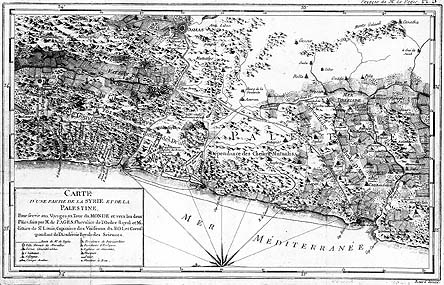
Map 2. Carte d'une partie de la Syrie et de la Palestine (From Pierre Marie François Pagèes, Voyages autour du monde et vers les deux poles, par terre et par mer, pendant les années 1767, 1768, 1769, 1770, 1771, 1773, 1774, & 1776. Paris: Moutard, 1782.)
Travelers had long come to the biblical lands, but in the late eighteenth and nineteenth centuries their arrival coincided with, even reflected, broader developments both in Europe and the Ottoman Empire that created a solid basis for the travelers’ claims to be heralds of modernity to the “tribes” of Mount Lebanon.[8] Drawing on an established motif of Mount Lebanon as a pristine refuge, these visitors exhibited a heightened cultural interest in the region that was set against the backdrop of Syria’s incorporation into a European-dominated world economy and the momentous changes ushered in by the French and Industrial Revolutions.[9] In Mount Lebanon’s rural inhabitants, the travelers saw revolutionaries and counterrevolutionaries, papists and highlanders—in short, all that related them to the dynamism of European history. At the same time, however, the travelers paradoxically insisted that Maronites and Druzes belonged to an inert world that was surrounded, and to some extent contaminated, by an Oriental decadence.
| • | • | • |
Narratives of Stagnation and Redemption
Among the most famous of the travelers was Volney, whose influential portrait of Mount Lebanon shaped much of the romantic discourse of nineteenth-century travel writing. Left with an unexpected bequest of money, Volney chose to visit the Orient, beginning in Egypt and moving on to Syria and Mount Lebanon. During his two-year voyage between 1783 to 1785, Volney spent eight months in Mount Lebanon.
On the face of it, Volney’s work, Voyage en Égypte et en Syrie, was simply the first of the great works of modern travel writing and description.[10] Certainly, as Edward Said has argued, Volney’s portraits were to have a tremendous impact on later voyagers and travelers who, almost to a person, cite him, applaud him, and occasionally correct him.[11] Volney was a man of the Enlightenment. His work was suffused with its vocabulary, and his humanism motivated him to travel to Asia to better understand the nature of “despotism,” under which his native France labored. His arguments about the nature of the Orient and the Orientals provided a ready stage from which to criticize France’s absolute monarchy. His vehement denunciations of the upper Maronite clergy were in obvious but unstated comparison to the corrupt First Estate. Taking his brief stay as a sufficient length of time to judge the character and nature of the Orient, Volney wove an epic narrative—never for a moment questioning his own transience and, in fact, criticizing those travelers who were more concerned with the antiquities than with the people.[12] His central question was how such splendid power in Asia could deteriorate so fast and under what conditions its decline could be arrested.
He found his answer in the nature of government and religion. To Volney, the results of political despotism were obvious. In the Orient, there was a total absence of the notion of public good among the “Turks,” for in Volney’s eyes the pashas were rapacious, and everybody was the Sultan’s slave. The reason for the “indolence” of the Oriental, despite his “lethargy,” his “silence,” and his “inscrutability,” was the despotism of the Sultan. In addition, however, there was the question of “Islam.” Volney claimed the Oriental’s “fanatic superstition” was the cause for a “thousand disorders.” Moreover, unlike “us” in Europe, where Volney assumed there was free communication between the sexes, he insisted that in the Orient women were shut off from society. The harem, stated Volney, was as fatal to the moral conduct of the men in whose hand political power rested, as it was injurious to the women.[13]
Only in Mount Lebanon did he see the “ray of liberty” breaking through the cloud of Turkish and Oriental despotism. Put up in various monasteries by Maronites who welcomed the Frenchman in their midst, Volney described the reasons for the persistence in the East of the Christian Maronites. He saw first the “insurmountable barrier” between Maronites and Muslims, which prevented the ambitious Maronites from uniting with “the stranger” to betray their nation. He also argued that the difficulty of the terrain and the imperative to unite in the face of enemies pushed the Maronites into a rocky outpost. To Volney, Mount Lebanon was a haven from Islam, in which the Druzes too enjoyed the benefits of their relatively isolated existence. Volney remarked that the Druzes nurtured a “republican spirit” but that both they and the Maronites were constantly under threat from the corrupting influence of absolute Ottoman power.[14]
Amidst the supposed stagnation of Syria, Volney thought he discerned timeless communities who yearned to be free and to be set on the path of progress. Volney thought Mount Lebanon unique because of its non-Muslim population, its relation to the Holy Land, and its mountainous and rugged terrain, which provided a welcome contrast, in his eyes, to the coastal cities and their Muslim populations. He was not alone in making this observation. The flamboyant Churchill reiterated exactly this point when he noted that the mountaineers had “a determination and a spirit of independence, which unequivocally indicate that the metal of freemen is lurking within their breasts.”[15] Yet Volney was careful to point out that Mount Lebanon’s uniqueness had been contaminated by its proximity to Islam. According to the French writer, to free and to reform Mount Lebanon was to reincarnate a distant past which he claimed to represent on the basis of a shared Christian heritage and which he desired to reinvigorate at the expense of a more recent, darker, and more unfamiliar history. Volney, therefore, was at once drawn to and repulsed by Mount Lebanon—both at home in and alienated from it.
Other travelers elaborated on this theme of stagnation and redemption. Churchill, for example, framed the task as leading the Orient from the stagnant present, literally from the dearth of hope and the death of time, to a future filled with promise and progress:
This East, which may yet become seat and centre of the Universal Reign!, it also has claims on England’s watchful vigilance and sympathising care, and already invokes her guardian Æegis.
A general, and possibly not incorrect belief is now prevalent, that a revolution of hitherto unprecedented magnitude is closely impending over these interesting regions; one by which they will at length be made amenable to the vivifying impulses of social and political amelioration—one in fact, which will deliver them from the bonds of death unto life.[16]
Concern for the fate of the region’s Christian (and to a lesser extent Druze) inhabitants propelled men like Volney and Churchill to study and decipher the customs and manners of the natives. As in other travel accounts of Europeans in the New World, in Asia, and in Africa, the manners and customs were described as unchanging and hence easily recordable. Churchill apologized in advance to his readers, explaining that the “constant repetition of events so nearly similar in their form and complexion, the perpetual recurrence of actuating motives, so invariably the same in all parties concerned, made it difficult for me to be correct and full, without being monotonous.”[17] Even critics of European imperialism, such as Urquhart, felt compelled to describe Mount Lebanon’s inhabitants as “a primordial society.” “Its children,” he noted, “looked down on events in their course, races in their toil, and ignored history by defying fortune.”[18]
Neither Volney nor Churchill conceived of themselves as strangers among the Maronites. Certainly Volney cast himself as the omniscient objective narrator on one level, but on another he felt some connection with the people of Mount Lebanon; he could extend to them a sympathy that he felt he could not extend to the Muslims of the Orient. In fact, he felt that the Muslims who lived in the Orient were “strangers” to the Maronites, while he as a Frenchman was not. Here lay the central paradox of all Volney’s writings on the Orient. Although he was aligned against political despotism and was opposed to the tyranny of entrenched Catholicism, Volney’s preoccupation with Islam’s difference from Christianity pushed him in the direction of those religious communities which he perceived to be the farthest from Islam. In his opinion, which he elaborated on in his later work, Les Ruines, ou méditation sur les révolutions des empires, suivies de la loi naturelle, salvation could come only from a rational, republican, even revolutionary France and could take root in Mount Lebanon.
The French Revolution, however, never arrived in the Orient. Instead, on the one hand, Napoleon invaded Egypt masquerading as a Muslim—much to the disdain of the Egyptian chronicler Jabarti—and, on the other hand, Lazarist priests and other refugees came seeking the “sanctuary” of Mount Lebanon, where they waited out the “evil days” of the French Revolution.[19] Contrary to Volney’s hopes, France did not provide a revolutionary death blow to “Oriental despotism.” Drawing on France’s historic ties with the Maronites, priests and émigré princes came to take shelter among the people they had vowed to protect.[20] As they wandered through Mount Lebanon, climbed the slopes, and descended into the valleys, they lived the counterrevolution. They too wanted to save Mount Lebanon, but unlike Volney they desired to save it both from itself and from the scourge of the Revolution. They brought with them their fears of Freemasons and of Jews and added to those the greatest of all fears, that of Islam. In the “refuge” of Lebanon, the ancien régime survived and even flourished. The local Christian chroniclers had heard with great dismay that the “gates of hell have opened and the Lord of Darkness has emerged.”[21] They welcomed to their land the victims of the great calamity, encouraged by the fact that post-revolutionary French governments generally instructed their ambassadors in Istanbul to protect the missions and the missionaries.[22]
Into this environment, where Europeans lived “like a colony totally removed from the laws of the land,”[23] the poet Alphonse de Lamartine arrived in 1832. For him the “refuge” of Lebanon provided a secure base from which to conduct his “pilgrimage” to the Holy Land.[24] Lamartine related to the East through his familiarity with New and Old Testament narratives, and his experience in the East became a journey of recovery and immersion in specific Christian icons, symbols, and terrain. Lamartine was no ordinary traveler, for he recognized that his observations were “neither science, nor history, nor geography nor customs” but “fragments” written in the shadow of a palm tree in the midday sun or in the cell of a Maronite convent. Lamartine left the turmoil of politics and the corruption of ideals behind him in France. He escaped, as he put it, from an unspiritual and “crumbling Europe.”[25]
Lamartine believed that in Mount Lebanon the battle for Christianity and for spirituality could be fought and won. He thought that a new Christian could be born and a new spirituality could be fostered which would ultimately save Europe from its own destructive “passions.” The passive Orient, “a sterile and dead branch of humanity,” could be used; its vast space could be harnessed; and its distinctively Christian Maronite population could be the vanguard of a spiritual renaissance. “The Maronite people, be they descended from Arabs or Syrians, share all the virtues of their clergy, and constitute a people distinct from all others in the Orient, one might say a European colony haphazardly cast into the midst of desert tribes. Their personal appearance, however, is Arab.”[26]
Lamartine’s first glimpses of the Holy Land on the afternoon of 5 September 1832 left him overwhelmed with the emotions of a homecoming. “It was the Holy Land,” he scribbled in his diary, and that said it all. When the “Arabs” carried him to shore at Beirut, Lamartine was met by a consular agent sent by Henri Guys, to whom Lamartine carried a letter of introduction. During his visit, Lamartine was given the title of “the foreign prince” by local inhabitants. While he gloried in “the titles, riches, and the virtues which the Arab imagination has given me,” the French poet confessed that the European consuls “are good enough not to disabuse them, and to let a humble poet pass for a powerful man of Europe.”[27]
Perhaps even more than Lamartine, Lady Hester Stanhope, William Pitt’s troubled niece—who was described in a local chronicle as “the daughter of the sister of the English sultan’s vizier”[28]—represented the attempt of European writers and travelers to escape from Europe and to take refuge in the supposedly timeless fastness of Mount Lebanon. Lamartine himself had heard much about this enigmatic lady, who came from a broken household, whose father was a pronounced Jacobin sympathizer, and who allegedly found herself suffocating in the restrictions of Victorian society.[29] She liberally bestowed money on a large number of functionaries, and she was consequently well received. It was even said that she was under the protection of the Sultan himself.[30] She was, with her shaven head, her habit of smoking pipes, and her cross-dressing, a parody of the wandering European. She insisted on proclaiming herself “Queen of the Arabs,” and Lamartine himself said that “she has a great name in the Orient.” He added “I considered that among the most interesting days of my voyage were those in which I got to know a woman who is herself one of the marvels of the Orient that I had come to visit.”[31] She styled herself Zenobia’s successor and surrounded herself with servants and slaves whom she called a “pack of thieves.”[32] That William Pitt’s estranged niece had come to represent the Orient which Lamartine sought out was symptomatic of the self-contained European fantasy which no local could penetrate. Lady Hester, when she finally met Lamartine, was dressed in “Oriental” costume and insisted that her own female housekeeper be veiled. She told the poet what he already knew. “Europe is finished.… You will,” she continued between deep drags of her favorite amber pipe, “go back to the Occident, but it will not be long before you return to the Orient—for it is your patrie.” To this Lamartine philosophically repled, “It is at least, the patrie of my imagination.”[33]
| • | • | • |
Inventing Tribes
European imagination invented the tribes of Lebanon. While most accounts reminisced about a biblical topography, they invariably enumerated and described the different communities that lived in Mount Lebanon. The success of Volney, Lamartine, Churchill, and Jesuit and American missionaries depended on creating a coherent typology of Maronites, Druzes, Greek Orthodox, Shi‘a, Sunni, and Greek Catholics. Naturally, they borrowed freely from one another, and they filtered their own varied experiences through a common conceptual language of native difference and separateness—so that although Druzes and Maronites often lived in the same village, shared the same customs, and owed allegiance to the same notables, they were nevertheless described separately in Western literature and therefore were imagined and experienced separately in Mount Lebanon. The various explorers and missionaries constructed, in other words, a discourse of Mount Lebanon’s tribal characteristics, say of Druze bellicosity, which was largely self-referential (Churchill borrows from Volney, Jessup from Churchill). This discourse existed and was distributed textually and reinforced anecdotally, and from the outset it framed and enmeshed every traveler’s experience.[34] I am not suggesting that these religious communities did not exist or that travelers’ accounts were false or fabricated, but instead that they were conceptualized in certain terms (tribal, free, stagnant, separate) that did not correspond to the way the inhabitants of Mount Lebanon perceived themselves. Such a discourse, which traditional native knowledge could scarcely penetrate, had a tremendous impact on local society as nineteenth-century Mount Lebanon became the venue for competing Ottoman and European notions of reform and progress.
The British and American characterization of the Druzes illustrated one facet of the incommensurability of Western and local understandings of Mount Lebanon. The British authors thought themselves particularly well suited, because of their intimate connections and conversations with the Druze elites, to represent them to Western audiences. Certainly French travelers, especially in the beginning of the century, took an active interest in the Druzes, who were in some accounts considered to be the descendants of a Latin colony led by the Comte de Dreux, just as British and other travelers did not shy away from Maronite regions. As the century advanced and as the region was further drawn into the vicissitudes of rival missionary movements and the politics of the so-called Eastern Question, the French increasingly traveled, resided, and felt most comfortable in the Maronite parts of Lebanon, whereas the Protestant travelers explored and recommended the hospitality of the Druzes with increasing vigor.
The Druzes were objects of a curious sympathy which, on the one hand, elevated them to the ranks of freemen and, on the other hand, regarded them as the most romantic of the Lebanese tribes. “The physiognomy of the Druse,” wrote one author, “is noble, grave, and sometimes even characterised by an expression of high spirit not untinctured with ferocity.”[35] American missionaries, who were themselves continually haunted by their failure to produce enough converts among the “nominal” Christians of Mount Lebanon, sent home ever rosier reports of the potential for a mass conversion among the Druzes. Accordingly, the Druzes were described in the following manner in the Missionary Herald in 1838: “The Druses, although inconsiderable as to number, are a remarkable sect, (1). As an excrescence of Mohammedanism, having somewhat the same relation to Mohammedans that the Mohammedans have to Christians; (2). As holding very peculiar doctrines, which have not yet been revealed, except partially; and (3). As maintaining a free and independent spirit in the midst of despotism, owing perhaps to the mountainous nature of their country.”[36]
The force of such a description, which was culled from a variety of sources including Volney, lay not only in the effort to make the Druzes comprehensible to the Missionary Herald readers in terms that quite clearly would have made no sense to a Druze but also in the implicit assumption that this was the only way to understand the Druzes. Whereas a Druze might have thought that his religion was coherent, the missionaries noted that it was little more than an “excrescence” or, as they put it in 1836, “a compound of paganism, Mohammedanism, and Christianity.” Whereas he might have considered himself part of a complex, living, evolving multicommunal culture, the missionaries viewed him as a member of a “singular race” in a divided sectarian and tribal society.[37] For their part, British writers often sought to identify the Druzes with the Scottish highlanders.[38] “The gathering of the clans, as described by Volney, an eye-witness,” suggested one author, “forcibly reminds us of the speeding of the fiery cross in former days along the braes and glens of Scotland.”[39] Even beyond resembling the highlanders, the Druzes themselves, the travelers alleged, boasted that a branch of the Druze people lived in “Jebel-el-Scouzia,” or the Scottish Highlands.[40] Urquhart claimed to have found amongst the Lebanese (even though it was in a Christian village) a “perfect” tartan of ancient usage which resembled that of the Stuarts.[41] The weapons that the villagers of Mount Lebanon carried also reminded some British travelers of the highlanders.[42] Churchill regarded both the Maronites and the Druzes as “sturdy Highlanders.[43]
English and Scottish accounts of Mount Lebanon constructed a mythic image of the Druze chieftain, who was the authors’ only contact with the local population, as a highland clan leader. This image provided the writers with an “authentic” source who could stand for the whole of this “warlike” people. The Druze leaders were authentic not just because they appealed to a romantic British notion of highland chiefs—a notion which, according to Hugh Trevor-Roper, was invoked at roughly the same period[44]—but because they served as interlocutors with the East. In their fine homes and as guests of their gracious hospitality, British writers could confidently expound on the “realities” of the Druze experience; they could relate the customs and manners of the Druze race, tribe, or nation and contrast them with the general state of the Ottoman Empire, which was uncharitably deemed to be in irrevocable decline. Above all, such descriptions of Mount Lebanon’s Druze elites typified a strong yearning to remake the local elites into what they were not: “authentic” sources for a tribal society, highland chieftains, or, in the words of an American missionary, “patterns of ‘gentlemen’ in manners and courtesy.”[45] It was of little consequence to travelers and missionaries that the local elites did not identify themselves as such and in fact saw themselves as far grander and more illustrious personages than mere leaders of premodern clans.
Perhaps the foreign missionaries best exemplify the spirit of the gentle crusade and reflect the intrusive power of nineteenth-century Western imagination. They provide the clearest example of the will of Europeans and Americans to shape the land according to their expectations, regardless of and indeed despite the realities they found on the ground. Jesuit missionaries in particular had reason for confidence. Theirs was among the oldest missions to the Orient.[46] In 1831, they were invited back by the Greek Catholic and Maronite Churches, who had heard “with joy” of the resurrection of the Company of Jesus.[47] And like their predecessors before the suppression of their order in 1773, they were driven by the exhortation to join their fellow Christians, who were thought to be suffering grievously in “cruel servitude” to an Islamic despotism.[48] Three Jesuits—one Italian, Paul Riccadonna, one Frenchman, Benoît Planchet, and one German doctor, Henri Henze—sallied forth. They were armed with instructions from their superior general, Jean Roothaan in Rome, to maintain at all costs their humility and chastity “among a people whose morals may be licentious.” They were also warned that they must above all maintain their union: “for those of you who are to be found in a country so distant, separated from your brothers, this must be your principal consolation.” What is more, added Roothaan, they “must be alert so that nobody should be given the impression that his ignorance, his lack of culture, the harshness of his manners causes you repugnance.”[49]
Prepared to encounter the “Orient which was always sympathetic to France,” the Jesuits embarked on the Will of God. After a rough crossing, described by Riccadonna as one tormented by the “demons” who had tried to finish the company at sea by inducing tempests and contrary winds, they arrived in the harbor of Beirut. From their vessel they could appreciate the splendid beauty of the land, the orchards and groves and palm trees, and behind the city the dramatic, snow-capped Mt. Sanin. Dressed in Arab costume, they disembarked. Riccadonna confessed that at once “we were surrounded by a mass of turbans, by staffs and pistols.…I can assure you,” he added, “that at first we were overcome by a secret shudder [frisson].” They walked, eyes to the ground, refusing to notice either the camels or “all the other new things” that they passed. In their pockets they had letters of introduction for the European consuls to whom the Jesuits had been recommended. Suddenly and much to their relief, a native Catholic identified himself from within the indistinct “crowd of Muslims” and led them by hand to his house.[50]
But this encounter provided the Jesuits with little relief, for instead of finding the Catholics they had expected to find, they were confronted with a reality for which they were not prepared: the confusing similarity of Christian to Muslim in manners, dress, and habits. Riccadonna was hard pressed to recall Roothaan’s instructions not to show disgust, as he restrained his instinct to judge and condemn the “Orient.” In the house of their Christian host, the discomfort of sitting cross-legged on the Damascene carpets and the strength of the pipe tobacco forced the Jesuits to abandon their efforts at graciousness. The hard floors, their aching legs, and the insects that plagued them at night only added to their initial misery in the land of Christ. The call to prayer—from the mosques of the city—reminded the Jesuits that they were in “ enemy” territory, and the dogs barking in the narrow city streets only added to their sense of alienation from the “Orient” they had thought was their own. Riccadonna could not but exclaim in exasperation that the people were “twenty centuries behind European culture.”[51]
The disjuncture between expectation and experience felt by Riccadonna went deeper. Not only were the Orientals, including the Christians, different, they were physically revolting. Riccadonna complained that their “guttural language, which one might say befits camels” (and which the Jesuits still had not learned), grated on their European ears. He noted the “savage customs and rough and rude manners of the people with whom one must live.” And he loathed the “perpetual company of an ignorant, uneducated, heretical people, Muslims, Druzes and infidels” who practiced no discernible “religion.”[52] Riccadonna’s commentary indicated his alienation from a Christian society which he refused to recognize, and, more important, which he openly wanted to dismantle and destroy. “The Christians here are so only in name. And now to this are added the Egyptians, the emissaries of Satan, the liberals, the carbonari, the biblists, the methodists, the saint-simoniens, sodomites and others, and all have the liberty to proselytize. Oh Lord! What woe! What horror!”[53] Riccadonna’s dismay, finally, was not caused by the lack of Christianity in local society. Precisely the opposite: his horror lay in his realization that it was indeed there but in a form comprehensible to him only as repellent and corrupt and in a world allegedly centuries behind that of European culture. It is to this premodern place, that is to say a society that did not (yet) define itself on a temporal scale of modernization, that we must now turn.
Notes
1. Gérard de Nerval, Voyage en Orient (Paris: Michel Lévy Frères, 1884), 1, pp. 281–282.
2. Charles H. Churchill, Mount Lebanon: A Ten Years’ Residence from 1842 to 1852; Describing the Manners, Customs, and Religion of Its Inhabitants, with a Full and Correct Account of the Druze Religion, and Containing Historical Records of the Mountain Tribes, from Personal Intercourse with Their Chiefs and Other Authentic Sources (London: Garnet Publishing, 1994 [1853]), 1, p. A.
3. See the “Address” printed on the back of Part 1 of John Carne’s Syria and the Holy Land, Illustrated by W. H. Bartlett (London: London Printing and Publishing, 1862). Men like William Bartlett produced a superb range of sketches and paintings of the Orient. His Footsteps of Our Lord and His Apostles in Syria, Greece, and Italy: A Succession of Visits to the Scenes of New Testament Narrative (London: Henry G. Bohn, 1862) had become one of the best-selling travel books on the Levant by the mid-nineteenth century.
4. So Baptisan Poujoulat congratulated Henri Guys, the former French consul who wrote an account of his experience. According to Poujoulat, Guys had reduced the meaning of the Orient to a few eminently readable pages. “You narrate and you judge,” he wrote, “with the experience of a native of the country, but with the superiority of a European who looks down from the height of Christian civilization.” See Poujoulat’s introduction to Henri Guys’s Beyrouth et le Liban: Relation d’un séjour de plusieurs années dans ce pays (Beirut: Lahd Khater, 1985 [1850]), 1, p. viii.
5. Richard F. Burton, Personal Narrative of a Pilgrimage to al-Madinah & Meccah (New York: Dover, 1964 [1893]), 1, p. 259.
6. Fabian, Time and the Other, p. 17.
7. David Urquhart, The Lebanon: (Mount Souria). A History and a Diary (London: Thomas Cautley Newby, 1860), 1, p. v.
8. For an early account of Mount Lebanon as a refuge, see Joseph Besson, La Syrie et la Terre Sainte au XVIIe siècle (Paris: Victor Palme, 1862 [1659]), p. 99.
9. Free-trade treaties were signed first with Britain in 1838, then with France, the United States, Sardinia, Sweden, Norway, Netherlands, Prussia, Belgium, Denmark, and finally Toscana in 1841. For more analysis see Reşat Kasaba, The Ottoman Empire and the World Economy (Albany: State University of New York Press, 1988), pp. 54–56; see also Şevket Pamuk, The Ottoman Empire and European Capitalism, 1820–1913 (Cambridge: Cambridge University Press, 1987). Although there is little concrete information on the process of incorporation of Mount Lebanon before the mid-nineteenth century, Roger Owen, The Middle East in the World Economy, 1800–1914 (London: I. B. Tauris, 1993 [1981]), analyzes the silk trade in the Levant, but mostly for the years following 1860; see also Leila Fawaz’s study of Beirut in her Merchants and Migrants in Nineteenth-Century Beirut (Cambridge, Mass.: Harvard University Press, 1983), p. 61, and Charles Issawi, The Fertile Crescent 1800–1914: A Documentary Economic History (New York: Oxford University Press, 1988), pp. 154–166.
10. Constantin-Francois Chassebouef Volney, Voyage en Égypte et en Syrie (Paris: Mouton, 1959 [1787]).
11. Said, Orientalism, pp. 169–170.
12. Volney, Voyage en Égypte et en Syrie, p. 23.
13. Ibid., pp. 363, 400, 407–409.
14. Ibid., pp. 241, 220–221, 242.
15. Churchill, Mount Lebanon, 1, p. 53.
16. Ibid., 1, p. vii.
17. Ibid., 1, p. xvi.
18. Urquhart, The Lebanon, 1, p. 10.
19. Pierre Corcket, Les Lazaristes et les Filles de la Charité au Proche-Orient (Beirut: L’Imprimerie Catholique, 1983), pp. 59–62. For Jabarti’s reaction to Napoleon, see ‘Abd al-Rahman Jabarti, Al-Jabarti’s Chronicle of the First Seven Months of the French Occupation of Egypt, June-December 1798, ed. and tr. Shmuel Moreh (Leiden: E. J. Brill, 1975), pp. 42–47.
20. As far back as 1649 Louis XIV had proclaimed, “Let it be known: that we, by the advice of the Queen Regent, our very honored Lady and Mother, having taken and placed, as by these signs of our hand we do take and place in our protection and special safeguard the Most Reverend Patriarch and all the prelates, ecclesiastics, and Maronite Christian laics, who dwell particularly in Mount Lebanon: we desire that they should be aware of this at all times.” Proclamation of French Protection of the Maronite Community in Lebanon by Louis XIV, 28 April 1649. Text in J. C. Hurewitz, ed., The Middle East and North Africa in World Politics (New Haven, Conn.: Yale University Press, 1975), 1, p. 28.
21. Haydar Ahmad al-Shihabi, Al-Ghurar al-hisan fi akhbar abna’ al-zaman, published as Lubnan fi ‘ahd al-umara’ al-shiyabiyyin, ed. Asad Rustum and Fouad E. Boustany (Beirut: Editions St. Paul, 1984 [1900]), 3, p. 551.
22. “Rapport sur les missions des Lazaristes et des Filles de la Charité dans le Levant, présenté par M. Etienne, supérieur général, à MM. les membres de l’oeuvre des écoles d’Orient,” BOEO, November 1857, p. 2.
23. Ibid., p. 114.
24. Alphonse de Lamartine, Voyage en Orient (Paris: Hachette, 1875), 1, p. 17.
25. Ibid., 1, pp. 3, 65.
26. Ibid., 1, p. 405.
27. Ibid., 1, pp. 130, 140, 141.
28. Shihabi, Lubnan fi ‘ahd al-umara’, 3, p. 582.
29. Joan Haslip, Lady Hester Stanhope: A Biography (London: Cobden-Sanderson, 1934), pp. 11, 79.
30. Shibabi, Lubnan fi ‘ahd al-umara’, 3, p. 582.
31. Lamartine, Voyage en Orient, 1, p. 150.
32. Bartlett, Footsteps of Our Lord, p. 37.
33. Lamartine, Voyage en Orient, 1, pp. 158, 159.
34. See Said, Orientalism, p. 40, for a more general argument about the construction of Orientalist discourse.
35. Walter Keating Kelly, Syria and the Holy Land, Their Scenery and Their People (London: Chapman and Hall, 1844), p. 144.
36. MHROS, 3, p. 145.
37. Ibid., 3, p. 32.
38. J. Lewis Farley, Two Years in Syria (London: Saunders and Otley, 1858), pp. 126–129.
39. Kelly, Syria and the Holy Land, p. 147.
40. Ibid., p. 151.
41. Urquhart, The Lebanon, 2, p. 116.
42. Ibid., 2, p. 31.
43. Churchill, Mount Lebanon, 1, p. 56.
44. Hugh Trevor-Roper, “The Invention of Tradition: The Highland Tradition of Scotland,” in The Invention of Tradition, ed. E. J. Hobsbawm and Terence Ranger (Cambridge: Cambridge University Press, 1983), p. 30.
45. Benton to Lathrop, July 29, 1857, William A. Benton Papers in the Department of Special Collections, Joseph Regenstein Library, University of Chicago (hereafter referred to as Benton Papers), Box 11, Folder 2 (emphasis in original).
46. As early as 1450, following the Council of Florence, Franciscan friars of the Terra Santa Mission received special papal instructions to tend the affairs of the Maronites. Brother Gryphon of Flanders became the first Roman Catholic resident “advisor” to the Maronite Patriarch. With the fall of Constantinople in 1453, the pace of Catholic involvement with Maronite ecclesiastics quickened. Several Maronites were inducted into the Franciscan order in 1470 and sent to Italy. One of these, Ibn al-Qila‘i, returned to Mount Lebanon in 1493 as a missionary to his own people; during his lifetime, in 1510, Pope Leo X recognized the Maronites as a special Eastern Christian community and described them as a “rose among thorns.” Toward the end of the century, in 1585, a Maronite college was founded in Rome by Pope Gregory XIII for training Maronites in Roman Catholic ecclesiastical discipline. Just over ten years later, a Jesuit, Father Girolimo Dandini, was sent to Mount Lebanon, and there he convened the first synod at Qannubin and began the arduous reorganization of the Maronite Church along more orthodox lines. Over the years several Jesuit missions were sent, fluctuating with the ebbs and flows of the Counter Reformation, and several Maronites, including Istifan Duwayhi, were trained in Rome and became patriarchs of their community. See Kamal Salibi, A House of Many Mansions: The History of Lebanon Reconsidered (London: I. B. Tauris, 1988), pp. 76–81.
47. HLAJ/1. See letter of Maronite Patriarch Yusuf Hubaysh to Jean Roothaan, Superior General of the Company, Qannubin, 2 July 1830, and Convention between Melchite Archbishop Maximos Mazlum and Roothaan, 27 August 1831, pp. 21, 27.
48. Besson, La Syrie et la Terre Sainte, p. 8.
49. HLAJ/1. Instructions given to departing missionaries by Roothaan, 10 September 1831, pp. 30–31.
50. Riccadonna’s letter to his colleagues in the Roman College, Dayr al-Qamar, 29 November 1831, HLAJ/1, p. 45.
51. Michel Jullien, La Nouvelle mission de la Compagnie de Jésus en Syrie 1831–1895 (Tours: Imprimerie A. Mame et Fils, 1898), 1, pp. 13–15.
52. Ibid., 1, p. 19.
53. Ibid., 1, p. 82 (emphasis my own).