
16. Creation
Eastern Pomo
1930
William Ralganal Benson, narrator
Jaime de Angulo, collector and translator
INTRODUCTION BY HERBERT W. LUTHIN
The work of recording this Eastern Pomo creation myth back in 1930 brought together two of the most remarkable figures in the annals of California oral literature: William Ralganal Benson, storyteller and artist extraordinaire, and Jaime de Angulo, a wild and charismatic linguist who became something of a cult figure in his own lifetime. Benson would have been sixty-eight when he told this myth, and de Angulo forty-three. In the latter's books on California Indian life and lore, Benson (or “Uncle William,” as Jaime and his wife, L. S. “Nancy” Freeland, called him) is the model for the character of Turtle Old Man. Because the two men, friends for nearly twenty years, are such important figures in the history of California folklore, I will briefly sketch their biographies before considering the myth itself.[1]
Benson was born in 1862 at Shaxai (now known as Buckingham Point) near the ancient town of Shabegok on the western shore of Clear Lake. It was, in de Angulo's words,
a pleasant region of small fertile valleys where wild roots and seeds once grew in abundance; where acorns, laurel nuts, buckeye chestnuts were once plentiful; where the streams were once well stocked with fish; where the hillsides were once covered with numerous bands of deer. The lake itself, surrounded by mountains, teemed with fish, and flocks of aquatic birds of all kinds were constantly flying by. (de Angulo 1976a:103)
Benson was fortunate enough to have lived his boyhood years during the last decade in which Eastern Pomo speakers enjoyed a more-or-less traditional lifestyle. By the 1870s, the social and environmental disruptions caused by a growing local Anglo-American population would make traditional life impossible, as the lifeways of local Indians became increasingly marginalized.
Benson himself was of mixed-blood descent. His mother, Gepigul (“Sally” to local whites), came from a line of hereditary leaders of the Kuhlanapo (Water Lily People) and Habenapo (Rock People) tribes. His father was Addison Benson, one of the first white settlers in the Kelseyville area—by all local accounts, an intelligent and open-minded man who got along well with his Indian neighbors.[2] Indeed, Addison saw fit to learn the Eastern Pomo language of his wife's people, so despite his mixed heritage, William Benson still grew up in a household where Eastern Pomo was the language of choice. For this reason, Benson didn't really learn to speak English until later in his adult life. Something of a renaissance man, he even taught himself how to read and write.
Benson became not merely a tradition-bearer of his culture's arts and literature, but a master of them. Sally McLendon, who has worked on Eastern Pomo for many years and knew Nancy Freeland in Berkeley, tells me that everything Benson turned his hand to—basketry, regalia, storytelling—came out almost preternaturally ornate or beautiful: not just a mask, but a work of art; not just a basket, but the most beautiful basket you ever saw; not just a myth, but the most detailed and skillful version in the canon.
The Pomo were one of the very few California groups where baskets
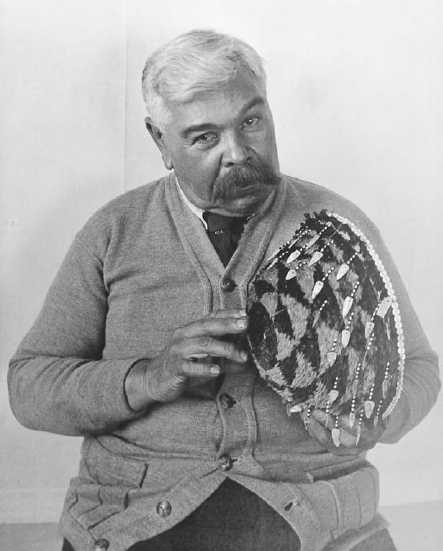
FIGURE 7. William Ralganal Benson, circa 1936. Courtesy Phoebe Apperson Hearst Museum of Anthropology and the Regents of the University of California.
An initiate into Eastern Pomo religion and ceremony, Benson, with his deep cultural knowledge and mixed-blood ancestry, was an ideal consultant for academic researchers—brilliant and informed, yet also familiar with the manners and expectations of the white world. Over the years, he worked and shared this knowledge (not without controversy) with a string of the most important figures in California linguistics and anthropology: Kroeber, de Angulo, Freeland, Loeb. He stands today as one of the most prolific and authoritative sources of information on the Northern California Indian world, particularly that of the Pomo.
William Benson died in 1937, at the age of seventy-five. Among the papers he left behind is a lengthy autobiography, written primarily in English, though with passages in Eastern Pomo. Sally McLendon is working on a scholarly edition and translation of this manuscript.
Jaime de Angulo
Cowboy in Colorado; failed silver miner in Honduras; medical student with a degree from Johns Hopkins; cattle rancher; army psychiatrist during World War I; novelist; gifted and largely self-taught linguistpsychologist-anthropologist-ethnomusicologist with a lifelong interest in the Indians of California—Jaime de Angulo was all these things and more. Born in Paris in 1887 of wealthy Spanish expatriate parents, de Angulo got fed up with his Jesuit schooling and came away to America at the age of eighteen, looking for adventure. He proved to have a talent for landing in the thick of things, like arriving in San Francisco in 1906 on the day of the great quake.
De Angulo had long been interested in anthropology, Jungian psychology, and linguistics, but it was through a mutual friend, Nancy Freeland, that he met Paul Radin and Alfred Kroeber at the University of California. (Freeland was then an anthropology student studying under Kroeber.) Kroeber quickly recognized his brilliance and—though the two men had an uneasy relationship throughout their careers (de Angulo's lifestyle was just too exuberantly bohemian for Kroeber's sense of propriety)—helped to get him established, inviting him to Berkeley to give lectures and, later, courses in anthropological psychology. (It was after his first such lecture, in 1919, that de Angulo met William
During the twenties and thirties, de Angulo, often together with Freeland (whom he married in 1923—his second marriage), did significant fieldwork on a variety of California and Mexican languages, including Achumawi, Atsugewi, Karuk, Shasta, Sierra Miwok, Eastern Pomo, Mixe, Chontal, and Zapotec. But it was Achumawi, the language of the Pit River Indians of Northeastern California, that occupied center place in his life and life's work. From his deep personal and professional involvement with the Achumawi came a grammar, numerous mythological texts, ethnomusicological studies, and what has come to be his bestknown book, Indians in Overalls.
Jaime de Angulo lived a colorful and in many ways tragic life—a life so rich and varied, so full of good times, hard work, and troubles, that I cannot even begin to portray it here. His work in linguistics and music alone (he was one of the pioneers of Native American ethnomusicology) would make him a seminal figure in California folklore and anthropology. But de Angulo was never merely an academic. He had the gift of a poet's ear, and used it to make books of translations and fictionalized retellings that far transcended other treatments of his day for the music, grace, and fidelity of the language, and for their wide-ranging accessibility and popular appeal.
As a writer, de Angulo managed to capture into English not just the contents of the texts he recorded, but something of their rhetorical style and, beyond that, of the worldview that informs them. It is a voice so distinctive as to be unmistakable among translators of Native American oral literature. Nowhere is this voice more evident than in his fictionalized settings of myths and tales jumbled together from his many field trips around California—in books like Indian Tales, How the World Was Made, and Shabegok (many of them ostensibly intended “for children”). It might be argued, perhaps, that de Angulo as much invented this voice in English as discovered it resident in the texts. There is something so easy-going, so engaging and seductive, about this voice that the dreary postmodernist inside us is all but incapacitated by its charm. In any case, he used this voice in his books and stories the way a musician uses his
Benson's Eastern Pomo “Creation”
This myth was first published in the Journal of American Folklore in 1935. De Angulo's commentary prefacing the text, which was presented first in Pomo and then followed by an English translation, was quite minimal. It is reproduced in near-entirety here:
The text of this Pomo tale of the creation is in the Clear Lake dialect [of Eastern Pomo] and was dictated by W. Ralganal Benson. The translation was undertaken primarily as a linguistic study. In the first part of the myth [¶1–17] therefore the original Indian text has been adhered to most closely, and practically a literal rendering is given. This will be of advantage to students of linguistics, but a detriment to the general reader and folklorist. The general reader is likely to be repelled by the awkward English, as a result of the too close following of Pomo idioms and style. On the other hand he may perhaps welcome the guarantee of accuracy. If he is curious to know how the Indian mind [read: Pomo mind] shapes its thoughts in language and style, here he will find it. As the work of translation proceeded, it was deemed unnecessary to render the original so literally. The student of linguistics would by this time be familiar enough with morphology and semantics to supply or delete a few words here and there, by comparing with the original text. In this latter part of the tale the general reader will find a rendering that gives in reality a truer equivalent of the original Indian style with its slightly Homeric flavor.
Though de Angulo much later published a fictionalized setting of this text in a still freer translation that smooths away the “literal rendering” of the opening seventeen paragraphs, I have chosen to present the more scholarly version of the myth here because of its closer adherence to the original text. For contrast, though, here's how de Angulo opens the telling of this myth in How the World Was Made (1976b:41):
After the Kuksu left they were quiet in the Ceremonial-house for a long time. Then Old Man Turtle commenced the long tale of “How the World
― 266 ―Was Made.” He launched into it without any warning, as if he were just making an announcement of what had happened the day before.Then Marumda pulled out four of his hairs. He held out the hairs, he held out the hairs to the east, he held out the hairs to the north, he held out the hairs to the west, he held out the hairs to the south. “Lead me to my brother,” Marumda said to the hairs.
Readers who make the comparison will understand both how the overly literal version submits to change and why the fictionalized version, though more consistent in tone, was not chosen for inclusion in this volume.
Belying its tight cyclical structure, Benson's “Creation” reveals a sweeping, almost panoramic vision. Within its five gyres there is a great wealth of detail, as well as the continuing slight novelty of complex and nonformulaic variation. The particularity lends immense texture to each patch or passage of narrative ground, while the variation imparts a through-momentum to the story that carries it forward rather than backward, so that ultimately it transcends its own circularity. The cumulative e ect of all this variation and detail is less déjà vu than daguerreotype: as in the development of a photographic plate the longer it is bathed in solution, with each pass at creation the image of the world fills in with richer and richer detail.
Though some plot elements exhibit less internal variation than others—for instance, the meetings between Marumda and the Kuksu are highly and ornately formulaic—variation is nevertheless the key to understanding the myth as a whole. Notice how each cycle of creation either involves di erent methods, focuses on di erent facets of culture and existence, or works at refining the establishments of the preceding creation.[3] In some rounds of creation, people are made from sticks or other inanimate objects; in others, like the second, they are simply thought or willed into being. In some creations, such as the first, Marumda's instruction is limited to basic survival skills, like what foods to eat and how to prepare them; in others, such as the third and fourth, in addition to survival instruction, Marumda sets up key social and governmental institutions. In some, he explains to people the fate of the previous creation; in others he does not. In some, he partakes of food with his people; in others he does not. In some, he establishes a dance ceremonial; in some, he decrees the division of labor between the sexes; in some, there is comic relief, like the encounters with Squirrel and Skunk; and so on. Even when
On another level, Benson's “Creation” may be heard as an extended and unabashed love song to Marumda, the Eastern Pomo Creator. One of the most extraordinary features of this myth is the sophisticated way in which the portrait of Marumda is developed across the successive cycles of the world's resurrections. It is not so much Marumda himself but our perception of him as a character or deity that matures so profoundly during the course of the myth. He is lovingly portrayed as a revered and (for a deity) oddly human figure—not through didactic narration, as a lesser storyteller might have done, but obliquely, by showing the increasing respect, a ection, and awe with which he is treated by the succession of peoples he creates and instructs. The belated discovery of generosity in the third creation (¶114–116), which is requited in the fourth (and codified culturally as the ideal of hospitality due a stranger), suggests something of this growth in stature and recognition. By the fourth and fifth creations, children are scolded for making fun of “the Old Man,” as well as for fearing him—the knowledge of who he is and what he has done being passed on as lore from generation to generation.
There is ever an air of mystery surrounding Marumda. He always seems to be wandering o once his work is done, never to be seen again, leaving his people, his creations, behind to express their wonder and gratitude. Marumda reaps this loving adulation despite his role as avenging angel. Nowhere is this essential duality of character more evident than in the aftermath of Marumda's destructions, where we find him going along, inspecting the newly scorched or scoured earth, simultaneously ascertaining that no survivors have escaped his destruction and expressing shock and grief at their extinction. This behavior may seem quixotic to modern readers, given that it is Marumda who calls down their destruction in the first place. It helps, then, to learn that Marumda is historically an anthropomorphic development of a still more ancient mythological figure, Coyote, known across the whole of the California culture area. Once that connection is made, the disparate points of Marumda's personality begin to cohere into a well-known constellation of traits, and we can recognize in Marumda a reflection of Coyote's complex trickster nature in California religious cosmology.[4]
This is a masterful narration, surely with its place in the canon of world literature. The comments I have made here are merely suggestive of a myriad avenues of inquiry into this myth.
ADDITIONAL NOTES
The Kuksu Religion
The Kuksu religion was, at least in historic times, restricted to a portion of North-Central California, involving in one form or another all the Pomo groups, as well as the Coast, Lake, and Plains Miwok, the Maidu, the Patwin, the Yuki, and several other groups distributed around the northern end of San Francisco Bay and up the Sacramento and San Joaquin Valleys. The Kuksu (based on the Eastern Pomo term kúksu) was a godlike spirit figure—the focus of secret societies, initiation rituals, curing ceremonies, and dance cycles where the Kuksu and other spirit figures would be impersonated by society members wearing sacred, highly elaborate costumes. For the space of time that these supernatural figures were brought to life through impersonation during the ceremonies, they “re-created sacred time and in one way or another restored their people to the unsullied state that had prevailed at the time of creation” (Bean and Vane 1978:665). The Kuksu religion (often amalgamated with elements of other, prior or parallel, belief systems) has likely been indigenous to the region for thousands of years, though other more recent religions, such as the post-Contact Bole Maru and Ghost Dance cults, have wholly or partially overwritten its territory in historic times.
Marumda and Kuksu
One characteristic of the Kuksu region is the belief in a true creation of the world, instigated by an anthropomorphic Creator. Unlike the Kuksu, whose name takes essentially the same form throughout the region, this creator figure goes by many di erent names, including K'ódoyapè (‘Earthmaker’) among the Maidu, {olelbes among the Wintu, Nagayo (‘Great Traveler’) among the Sinkyone, and Taikomal among
That evening they were all sitting around the fire. “Well, Tsimmu,” Coyote Old Man was saying, “tonight you will get to attend the Kuksu ceremony, and hear the full story of how the Kuksu made the world. …”
“Kuksu didn't make the world,” Turtle Old Man interrupted. “It was the Marumda who made the world. It happened like this. The Marumda went to see his elder brother, who was the Kuksu, and asked his advice about making the world. The Kuksu didn't care whether there was a world or not. He just sat in his cloud-house, and smoked his long pipe, and dreamed, and thought, and dreamed, and thought. Now he did give Marumda some wax … —but it was Marumda who went out and created the world.”
“All right, all right,” said Coyote. “Marumda made the world, but it was the Kuksu who first put the idea in his head.”
“Has anybody ever seen the Kuksu,” Tsimmu asked.
“Oh yes, from time to time,” Old Man Turtle replied. “At least some people say that you can sometimes find him in the woods, hiding behind a tree, or at noon-time, just sitting in a clearing on a rock. … That was probably the Kuksu we saw hanging from the tree the other night.”
“That was surely a frightening-looking figure,” Killeli said. “Is the Kuksu a killer, like the Giants and the Imps over in my country?”
“Oh, of course not,” Old Man Coyote said. “Why should he hurt anybody? The Kuksu doesn't care about people, one way or another. The Kuksu's no killer.”
“But, Grandfather, doesn't the Kuksu take care of the world?” Tsimmu asked.
“No, Child. The world pretty much takes care of itself. When it doesn't, well, that's Marumda's job. Then that Old Man is liable to come along,
― 270 ―and kick the world to pieces, and make a new one. … That Old Man is always worrying about the People, about whether they are behaving properly or not. …”
Bob Callahan, summing up the situation in his notes to the Turtle Island edition of How the World Was Made, observes that “the central characters of Kuksu and Marumda in the myth seem to function as the left and right hands, or the sons, of the ancestral Coyote figure of California Indian mythology” (de Angulo 1976b:100).
Incest
“Behaving badly,” for Marumda and the Kuksu, means incest. Keep in mind that California's storied richness of habitat a orded high population density and a phenomenal linguistic-cultural diversity. Tribal units, correspondingly, tended to be demographically and territorially small, and the task of observing incest taboos and keeping bloodlines safely untangled was of no small moment. Exogamy was widely practiced (with bi-and even trilingualism a common consequence). It's an interesting subtheme that Marumda, dismayed that his creations keep “going wrong,” comes up with one back-to-the-drawing-board remedy after another. In the fifth creation (¶153–154), he decides to make discrete languages, perversely hoping that the ensuing unintelligibility might isolate people into incest-proof groups. (Though clearly reminiscent of the myth of Babel, notice how this motif has an entirely di erent motivation from the biblical version.) And earlier, in the fourth creation, he thinks to establish two communities (¶141), the incest bans presumably being too diffcult to uphold when there is but a single community. By the fifth and final creation, Marumda has strewn villages all over the place, thus maximizing the possibilities for exogamy, and the feeling is that this time people are finally going to be able to get it right.
Songs
Unfortunately, de Angulo did not record the numerous songs that embellished Benson's original narration. The reference to “archaic language” may indicate that the songs were in fact untranslatable, which might explain
Armpit Wax
I do not, nor does anyone else I've talked to, know what damá-xahwé ‘armpit wax’ really refers to. Clearly a potent mythological substance, its true nature remains a mystery. As in other creation myths, though, where the earth is formed from a dab of mud or sand or mist, the very insubstantiality of the original material serves to emphasize the awesome power of the beings who are able to make a world from such an unlikely substance.
Structure
Because the myth is so long, and because de Angulo was somewhat haphazard with his internal section-headings, here is a more detailed schematic of the text's major thematic movements:
| PARAGRAPH | THEME |
|---|---|
| 1–20 | Meeting and Planning |
| 21–33 | Creation: The Making of the World |
| 34–48 | First Peopling of the World |
| 49–57 | First Destruction of the World (by Flood) |
| 58–70 | Second Peopling of the World |
| 71–86 | Second Destruction of the World (by Fire) |
| 87–117 | Third Peopling of the World |
| 118–127 | Third Destruction of the World (by Snow and Ice) |
| 128–148 | Fourth Peopling of the World |
| 149–171 | Fourth Destruction of the World (by Whirlwind) |
| 172–239 | Fifth and Final Peopling of the World |
| 240–241 | Narrator's Close |
NOTE
1. Sources for the information contained in the following sketches include Gui de Angulo's “Afterword” to the City Lights edition of Jaime de Angulo's Indians in Overalls; Bob Callahan's “Notes” to the Turtle Island edition of Jaime
2. According to Sally McLendon, “Benson grew up in a world that was not ‘wild’ but seems to have been an interesting bi-cultural world of a few, mostly male, white settlers and their ways of doing things and the native world which had its own very rich and patterned way of doing things. The balance of power only shifted during Benson's adolescence, I think, but his first 13 years seem to have been fairly idyllic: sheltered, loved, protected by both parents, and protected from white racism by the standing of his father” (personal communication).
3. Strictly speaking, there is but one “true” creation here—where the physical substance or framework of the world is created out of wax, and beings are created to dwell on it—and this takes place near the beginning of the myth (¶21–33). Subsequent creations are really more like “re-peoplings,” where Marumda adjusts local topography (a spring here, a mountain there) to create a suitable habitat, and then creates the community of people who will dwell in it.
4. In cognate and related myths among other California cultures, including the Pomo, the role of Marumda is sometimes played by Coyote. Indeed, Marumda (Eastern Pomo ma·rúm'da) is an esoteric name suggesting Coyote, most ancestral and important of all California mythological figures. As de Angulo notes, “Marumda alone, however, does not mean Coyote. Coyote in Lake Pomo, is gunula. Marumda is the name of the character in this myth. It may possibly be related to the adjective maru which has a series of very loose meanings, i.e., sacred, mysterious, traditional, dream omen, etc.” (1976b:100–101).
FURTHER READING
On the Pomo culturally, see Sally McLendon and Michael Lowy's “Eastern Pomo and Southeastern Pomo” in the California volume of the Smithsonian Handbook and Edwin Loeb's Pomo Folkways (for which Benson was a major consultant). There are several collections of myths, especially S. A. Barrett's Pomo Myths (1933), Jaime de Angulo and Nancy Freeland's “Miwok and Pomo Myths”; see also McLendon's important ethnopoetic analysis of the Eastern Pomo myth “Grizzly Bear and Deer” in her article “Meaning, Rhetorical Structure, and Discourse Organization in
CREATION
This Is the Tradition of How
Marumda and Kuksu Made the World
1. He lived in the north, the Old Man, his name was Marumda. He lived in a cloud-house, a house that looked like snow, like ice. And he thought of making the world. “I will ask my older brother who lives in the south,” thus he said, the Old Man Marumda. “Wah! What shall I do?” thus he said. “Eh!” thus he said.
2. Then he pulled out four of his hairs. He held out the hairs. “Lead me to my brother!” thus he said, Marumda the Old Man. Then he held the hairs to the east; after that he held the hairs to the north; after that he held them to the west; after that he held them to the south, and he watched.
3. Then the hairs started to float around, they floated around, and floated toward the south, and left a streak of fire behind, they left a
4. He sat smoking. He quit smoking. And then he went to sleep. He was lying asleep, sleeping …, sleeping …, sleeping …, sleeping. … Then he awoke. He got up and put tobacco into his pipe. He smoked, and smoked, and smoked, and then he put the pipe back into the sack.
5. That was his first camp, they say, and then he lay down to sleep. Four times he lay down to sleep, and then he floated to his elder brother's house. His name was Kuksu. This Kuksu was the elder brother of Marumda.
6. The Kuksu, his was like a cloud, like snow, like ice his house. Around it they floated, four times they floated around it, the hairs, and then through a hole they floated into the house, and following them the Marumda entered the house.
7. “Around the east side!” said the Kuksu. Then around the east side he entered the house, and he sat down, he sat, and he took o the little sack hung around his neck. He took out his pipe and filled it with tobacco, he laid a coal on it, and he blew, he blew, and then he blew it afire. Then he removed the coal and put it back into his little sack. After that he smoked, four times he put the pipe to his mouth. After that he o ered it to his older brother the Kuksu.
8. Then Kuksu received it. “Hyoh!” he said, the Kuksu, “hyoh! Good will be our knowledge, good will end our speech! Hyoh! May it happen! Our knowledge will not be interfered with! May it happen! Our knowledge will go smoothly. May it happen! Our speech will not hesitate. May it happen! Our speech will stretch out well. The knowledge we have planned, the knowledge we have laid, it will succeed, it will go smoothly, our knowledge! Yoh ooo, hee ooo, hee ooo, hee ooo, hee ooo! May it happen!” thus he said, the Kuksu, and now he quit smoking
9. Then Marumda sat up, he sat up, and then they both stood up. They stood facing east, and then they stood facing north, and then they stood facing west, and then they stood facing south, and then they stood facing the zenith, and then they stood facing the nadir. And now they went around each other both ways, they went around each other four times back and forth. Then Marumda went to where he had been sitting
10. Then Marumda put tobacco into the pipe that he took out of his little dried-up sack. He felt in his little dried-up sack, he brought out some tobacco, and filled the pipe with it. Then he felt in his little driedup sack and brought out a coal, he put the coal on top of the tobacco, he put it on top and he blew, he blew, and blew it afire. Four times he drew, and then he o ered it to his brother Kuksu.
11. Four times he made as if to take it, and then he received it. Four times he drew, and then he o ered it back to Marumda. He received it, and put it back into his little dried-up sack. He blew out the smoke four times. First he blew it toward the south, then he blew it toward the east, then he blew it toward the north, then he blew it toward the west. Then he blew it to the zenith, then he blew it to the nadir.
12. Then turning to the left, Kuksu gave an oration: “Ooo!” thus he said, “it will be true, our knowledge!” Then Kuksu poked him with the pipe, and Marumda received the pipe, he received it and put it back in his little dried-up sack.
13. And then the Marumda scraped himself in the armpits, he scraped himself and got out some of the armpit wax. He gave the armpit wax to the Kuksu. Then Kuksu received it, he received it, and stuck it between his big toe and the next. And then he also scraped himself in the armpits, he scraped himself, and rolled the armpit wax into a ball. His own armpit wax he then stuck between Marumda's toes.
14. Then Marumda removed it and blew on it, four times he blew on it. Then Kuksu also removed the armpit wax and blew on it four times, and after that he sat down. Then Marumda went around the Kuksu four times, and then he sat down. And then the Kuksu he got up, he got up, and four times around the Marumda he went. Then they both stood still.
15. Now they mixed together their balls of armpit wax. And Kuksu mixed some of his hair with it. And then Marumda also mixed some of his hair with the armpit wax.
16. After that they stood up; facing south, and then facing east, and then facing north, and then facing west, and then facing the zenith, and
17. “We are going to make in the sky the traveling-fire. With it they will ripen their food. We are going to make that with which they will cook their food overnight. The traveling-fires in the sky, their name will be Sun. The one who is Fire, his name will be Daytime-Sun. The one who gives light in the night, her name will be Night-Sun. These words are right. This plan is sound. Everything according to this plan is going to be right!” thus he spoke, the Kuksu.
18. And now the Marumda made a speech. Holding the armpit wax, holding it to the south, he made a wish: “These words are right!” thus he said, the Marumda. And then he held it to the east, and then he held it to the north, and then he held it to the west, and then he held it to the zenith, and then he held it to the nadir: “According to this plan, people are going to be. There are going to be people on this earth. On this earth there will be plenty of food for the people! According to this plan there will be many di erent kinds of food for the people! Clover in plenty will grow, grain, acorns, nuts!” thus he spoke, the Marumda.
19. And then he blew tobacco smoke in the four directions. Then he turned around to the left, four times. Then he put the armpit wax into his little dried-up sack. After that he informed the Kuksu: “I guess I'll go back, now!” thus he said, and then he asked the Kuksu: “Sing your song, brother!” he said. And then the Kuksu sang: “Hoyá, hohá, yugínwe, hoyá [here comes a long SONG in archaic language] … ”
20. After that Marumda floated away to the north, singing the while a wishing song: “Hinaa ma hani ma [another SONG in archaic language] … ” Thus he sang, the Marumda.
21. With this song he traveled north, the Marumda, riding in his house,
22. He was lying asleep, when suddenly the string jerked his ear. He sat up and looked around but he did not see anything, and he lay down again to sleep. It went on like that for eight days, it went on for eight days, and then it became the earth. The armpit wax grew large while Marumda was sound asleep, and the string jerked his ear. At last Marumda sat up, he sits up, and he untied the string from his ear-hole. Then he threw the earth out into space.
23. It was dark. “What shall I do about it?” said Marumda. “Oh! … I know,” and he took the pipe out of his little sack. He also brought out a coal, and applied it to the pipe. Then he blew on it, he blows, and set it afire. He sets it afire, and then he held the pipe to the south. Then he blew away the fire that was in the pipe. The fire traveled to the south, it grew large, and over the earth the sunshine spread.
24. Now Marumda walked around all over the earth. He walks around: “Here will be a mountain, here will be rocks, there will be clover, here will be a valley, there will be a lake, there will be crops, here will be a playground, there will be crops, here will be a clover flat, there will be a grain valley, on this mountain there will be acorns, on that one manzanita, juniper, cherries; on this mountain there will be potatoes, deer, hare, rabbits; on that mountain there will be bear, puma, cougar, fisher, coon, wolf, coyote, fox, skunk; on this mountain there will be rattlesnake, king-snake, gopher-snake, red-striped snake, mountain garter-snake, blue snake, big gopher-snake.”
25. Marumda then walked over the hill; on the other side it was dark; he sat down; there was no light. He went on. Up in the sky there was light. Then he rolled the earth over, it turned over, he pushed it over: “This is the way you will perform,” said the Marumda, “now it is dark, and now it is light, and now it is sunlight.” Thus now it performed.
26. Thereupon he went on: “Here will be a valley, and in it there will be many villages. Here will be a river with water in it wherein the fish will run.” Thereupon he went on and made a big pond, and then he
27. And then he went on and made a mountain: “On this there will be sugar-pine.” And then he went on and made a pond: “Here there will be all kinds of fowl.” And then he went on and made a mountain of flint: “This will be for arrowheads and spearheads.” And then he went on and made a mountain of drill flint. After that he went on and made a spring and on either side he put sedges, rushes, redbud bushes: “This will be for the women to weave their baskets; dogwood, white willow, black willow, wherewith to weave.” And then he went on and made wild nutmeg: “This will be bow-wood.” After that he made another kind of dogwood: “This will be arrow-wood, mountain bitterweed.”
28. After this Marumda went on the other way, he went on and on, and then he thought of making Big Mountain. He makes it, and on each side he made a large river: “This will be for the fish to come out to the lake.” Thereupon he went on and made a wide valley: “Here will be all kinds of crops,” thus he said, the Marumda.
29. And now he arrived at the lake, and going along the shore he made rocks, he makes them, and: “This will be a playground for the waterbears.” Thereupon he went on and made a sand-flat, and then: “This will be a playground for people.” Thereafter he went on and made a mountain: “Here people will not come! Men! Never approach this place!” thus he said, the Marumda.
30. Thus he was going along by the shore, and he found a river barring his way: “Wah!” he said, “what am I going to do?” he said standing on the shore. “Eh!” he said, and laying his walking-cane across he passed over to the other side. “Eh!” he said, “that was the way to do it, there was nothing else to do!”
31. Thus he walked along the shore making rocks, making sand-flats; thus he went around the lake, performing like that. Now he went back inland, and facing the lake he sat on a log. The water was calm: “Water! You will not be like that!” thus he called to the water. Then he went to the water and he splashed it toward the land: “This is the way you will behave!” he told her. Then the wind blew and the water became rough,
32. “Wah! What am I going to do? How am I going to go across? Wah!” he said. “Eh! that oak over there … ” and going to a tree standing there he picked up from the ground an acorn shell, he took it to the shore and laid it by the side of the water. The water made waves and thereby the shell was pushed into the water. It floated, it grew large, it grew larger, it floated toward the shore and became a boat. “Hyoh! That's a good boat for us!” thus he said.
33. He felt around in his little dried-up sack and took out his pipe; he filled it with tobacco; he laid the coal on top; he blew on it; he blew it afire; then he blew smoke in the four directions and a thick fog arose. He put the pipe back in his little sack and hung the sack around his neck, then he sat down in the boat and shoved o. It started to float away, it floated way o toward the center of the lake; then he whirled his cane in the air and that boat started to race, it went like a bird, and in no time at all it went across.
34. He sat down by the side of the water and he looked about, and then he thought to experiment at making people. “Wah! What shall I make people with?” he said. “Eh!” he said, and he picked up rocks: “These will be people!” These rocks became people. They spoke a language. They were short-legged, these rock-people. These rock-people lived in the mountains only. They did not walk about in the valleys.
35. Then he experimented making other kinds of people. The rockpeople were mean, that's why he experimented making other people. He made people out of hair. These people were long-haired; the hair came down to their feet. They found the Old Man Marumda and came up to him: “What are you doing, Old Man?” they said. “I am eating food,” he answered. He was eating clover. He also dug potatoes out of the ground, and ate them. Then the long-haired people took an object lesson and they also ate. “This is your food,” said the Marumda, and then he went away.
36. Sitting down on a hill he looked back. After a while he went over to where there was a valley. And now the idea came to him to make another kind of people. He felt inside his little dried-up sack and brought
37. “These will grow into people!” he said, and he sat down with his back to the valley. Then people also came to life and they too came to the Old Man and asked him: “Where do you come from?” These people were covered all over with feathers, like birds. “What are you doing?” “I am eating,” he answered. Then they also took an object lesson and started to eat. “Thus you will eat! This is your food!” he said, and then he went away.
38. Then he experimented making more people. This time he went over to another mountain and he experimented making people out of wood. He gathered small sticks, he split them, and scooping out little hollows here and there, he planted them in [the ground]. “These will be people!” he said. Then he went o and turning his back to them he sat down. Soon he could hear them talking among themselves: “There is an old man sitting over there,” they said.
39. They came over to him: “What are you doing, Old Man?” “I am eating,” he answered. Then they also took a lesson and started to eat. “This is the food that you will eat! I made it for you!” said the Marumda. Then he departed and went around another mountain.
40. “Wah! This also looks like a good place for people.” He pulled four hairs from his arm and scattered them over the plain, here and there, all over. Then he sat down on a knoll and listened. In no time they also turned into people. “Where do you come from?” they asked one another. The nearest one to the Old Man said: “There is a man sitting over there too,” and they came up to him.
41. “And you, where do you come from?” they said. “Oh! I came from a distance,” he answered. “Are there any other people?” they asked. “Yes, there are other people far away from here. You'll find them after a while.” These people were hairy and cloven-hoofed, and they had horns. They were the deer-people. He didn't like their looks. “Eh! Over there I will make another kind of people,” he said, and went o.
42. Then he went on, northward, and in the hills, in a little hollow he sat down: “And now I will make other people again,” he said, the Marumda. And feeling in his little dried-up sack he brought out some sinew. This sinew he broke into little pieces, he breaks them, and then
43. Then he sat down with his back to it. In no time they became people. Then the Old Man stood up: “Come over here,” he said. Then the people came over to him. “This is your land where you will live,” thus he said. These people were like ourselves; they had no hair, no feathers on their bodies, they were all slick. “Here you will eat your food! There is plenty of food on the ground over there; eat it!” thus he said, and he went away.
44. After this he went over to a hillock. There he took some hair out of his little dried-up sack, and this he scattered over the hill. Then he sat with his back to it and in no time they were people talking among themselves. Then he looked. They were big, hairy people, walking about. These were the bear-people; they had long claws.
45. And now he went over to them: “Here you will eat this kind of food,” he said, and plucking some clover he ate it. Then these people they also imitated him and ate. Then he dug up some potatoes. “These also you will eat,” he said. “Oo! That's good! And are there any other people around?” they asked. “Yes! There are going to be lots of people!” Marumda answered.
46. After this he experimented making still another kind of people: “Wah! What shall I make them of now?” he said. He went to a big valley toward where the sun rises. Here he made people out of flint. These people were the Gilak people. He made this people on the mountain where there are nothing but rocks.
47. These people were like birds flying in the sky. They used to swoop down on people. They had not been taught to do that way. They were mean people.
48. All these were the first people that the Marumda made.
DESTRUCTION OF THE FIRST WORLD
49. Then he went north to his abode. Time passed, time passed, time passed, time passed, and then Marumda saw in a dream that the people were behaving badly. So he decided to go to his elder brother. Then the
50. Four times he floated around it, and then he knocked at the door. Then the Kuksu opened the door and Marumda went in. Then the Kuksu said: “What is it, younger brother?” thus he said, the Kuksu.
51. Then Marumda said: “Oo! It's all wrong! That's why I have come to consult you. The people that we made are behaving wrongly. They are intermarrying, they are turning into idiots, and their children grow puny. Therefore I will wash them away!” thus he said, the Marumda.
52. Then Kuksu spoke: “Wah! It's all wrong! We never taught them to do this!” Then Marumda spoke: “Our people have become like birds, they have become like deer! They sleep with their own children. This is too bad! Therefore I am going to wash them away!”
53. Then Kuksu: “Oo! That is right! They did not believe our wisdom! Well, you know what you must do!” thus he spoke, the Kuksu. Then Marumda filled his pipe, lit it, and o ered it to Kuksu. Kuksu then smoked, he smokes, and he blew the smoke in the four directions. Then he returned the pipe to Marumda. Then Marumda he too smoked to the four directions.
54. Then in no time the skies clouded up, the thunder spoke, and rain began to fall. For four days it rained; it became a flood. Marumda himself was running around among the rocks. Finally he ran for refuge to the top of a mountain peak.
55. But the people followed him there. Then Marumda called for help to his grandmother: “Grandma! Grandma! Quick!” thus he cried running back and forth among the rocks. Then a spiderweb basket floated down to him from the sky, Marumda got in it, and with it he floated away, he floated up to the sky.
56. “Ride and don't look around!” said Old Lady Spider, “or you will fall … !” but as she said the words he looked down and out he fell. He falls, but already the Old Lady Spider she had thrown out her net, she caught him, she pulled him up, she pulls him up, and to the Kuksu's house she carried him.
57. She carried him, she carried him up to the door, and Marumda
58. Now Marumda called his grandmother again, and she sent the basket floating down to him. He got in and floated away. It floated for four days and landed on top of a mountain peak. “Here! Get o !” said Old Lady Spider.
59. Then Marumda got o and looked around the world, he wandered about. Then he gathered some sticks of wood and built a fire. Then he went o to look for people. But he couldn't find a single one. Then he called. Not a single person came out.
60. “Wah!” said the Marumda, “what am I going to do? Eh! On this mountain there will be people!” and he called: “Wulu! Wulu!” … But there did not remain a single person to come out.
61. Four times he called, then he went o toward the lake. He walked along the shore, he sat down, and looked around. “Here there will be a large village!” he said. Then he went on, he goes on, and again he returned, and once more he looked around.
62. Where a while ago there had been nobody now a big village existed. There were many people along the shore of the lake. Here goes the Chief-Woman. Boys, children, are playing along the shore. They are chasing one another playing tag. They play tag in the water.
63. Marumda stood watching the village he had made. “Hyoh! They will be good people. They will be healthy. Their village will be healthy. They will be kindly in their manners.” Thus he spoke, and he went on.
64. He walked, he walked, he walked. “Eh!” he said, “here there will be a big mountain jutting out into the lake.” Then the mountain arose. Then he went on. “Here there will be a valley. In this valley there will be a village and a dance house. In the dance house they will perform their dances, they will enjoy their dances, the boys, the girls, the women, the children, the old people!” Thus he spoke, and then he went away.
65. He goes on, he went on, and then he stood. “Here there will be a hillock!” Thus he spoke, and a hillock arose. Then he stood on the top, he stands, and he looked to where he had wished a village to be. And
66. The Marumda sat on the ground. He unslung his little dried-up sack from around his neck, out of it he pulled his pipe, he put in a coal, on top of it he placed the tobacco, on top of that he placed another coal, he blew on it, he blew it afire, he smokes, he smoked and blew the smoke toward the village.
67. Then a fog arose and a drizzling rain began to fall. Then the people started to run toward the house. The older boys are telling the younger boys to run into the dance house. Thereupon the grown-up men started building individual houses out of dogwood. They set them all around the dance house. The houses of that village were so closely set together that a man could hardly walk between them.
68. Then the Marumda quit smoking, and he made a speech to call the people: “Gather for the dance! Gather for the dance!” he called. Then the people went into the dance house, they all went into the dance house. And then the Marumda went to the mountain he had just made. He stood on the top and listened. Soon after they began the ceremony.
69. Then he told the people of the village on the other side of the hill: “Over here they are dancing. Watch it. Come and watch it!” Then the boys, the girls, they came running, they came running over the hill. They ran to the door of the dance house and they peeped in.
70. Then Marumda made a speech. “‘Come this way!’ thus you must say when a visitor approaches. Claim him as a friend. ‘Sit down here!’ say to your friend. ‘You are my relative! These are your people! Therefore you and I must dance together.’” Thus he spoke, the Marumda, and then he went away.
SECOND DESTRUCTION OF THE WORLD—BY FIRE
71. Time passed, time passed, time passed, time passed, and then the people began again their incestuous ways. And Marumda knew by a
72. Eight days it floated, and then it arrived at the Kuksu's place. Four times it floated around the Kuksu's house. And then it floated to the door on the south side. Then Marumda knocked with his cane.
73. “Ooo!” called the Kuksu, and Marumda also called: “Ooo! Here I have come.” “All right! Come in on the east side,” said the Kuksu. Then Marumda sat down on the east side. Without saying anything he took his pipe out of his little dried-up sack; he placed a coal in it; on top of that he put tobacco; and on top of that he placed a coal. Then he blew on it, he blew it afire. He smoked four times and then he o ered it to the Kuksu.
74. Four times he feigned to take it, then he accepted it, he accepts it, and with the pipe in his hand he went back to his seat. “Hyoh! Sumee!” he cried, “what's the matter? What's happened now? The people are doing wrong! Oo! You must tell me the truth!” Thus he spoke to the pipe before smoking.
75. Now he smoked, he smokes four times, and he gave the pipe back to Marumda. “They are doing wrong!” said the Marumda. “The people that we made, they are not obeying our teachings. They have started again their incestuous ways. That's all wrong! Therefore I will destroy them! This is what I have come to consult you about.” Then the Kuksu answered: “Ooo! All right! Later on you will make more people!”
76. “Oh! I'll go back and I'll cook them!” “All right! That's fine!” said the Kuksu. “Right now you are going to do it!” “I am going back over there and I'll burn them with fire!” “Oh! that's good! Oh! that's fine! Go! Go!”
77. Then Marumda replaced his pipe in the little dried-up sack, he hung the sack around his neck, and he went away, he went away riding in his cloud-house. He went away, and the cloud roared like thunder as he went back north to his place.
78. After this he went west. Then he went south. Then he went east, he went east to where the sun rises. That was where the Fire-Man lived.
79. The Fire-Man was still refusing, saying: “And then, where will I live?” “Never mind! You are going to burn the world! You will start the fire from here. You need have no fear about starting the fire. I will not let it burn your house here!” said Marumda. “When shall I start this fire, then?” said the Fire-Man. “Right now you start the fire!” said the Marumda.
80. Then he took down his fire-bow, he took down his fire-arrows, and he went out. He goes out, and he shot to the north. Then he shot to the west, then he shot to the south, then he shot to the zenith. In the north where he had shot the fire commenced blazing, then in the west where he had shot the fire commenced blazing, then in the south where he had shot the fire commenced blazing, then from the sky where he had shot the fire came blazing down toward his house.
81. He was running around pouring water everywhere around his house. Marumda was crying: “That will not burn!” Then the fire spread in the west. Marumda was running around in his excitement. He ran up the mountain crying: “Grandmother! Grandmother! The fire is raging!” Then, just as the fire was reaching him, his grandmother floated her basket down to him.
82. Marumda dropped in it, and it started to float toward the sky. Then the people arrived down below at that spot after his grandmother had started to pull him up, and they cried to him: “Save us also!” “What can I do? We are all finished now!” he cried back.
83. Then he said to his grandmother: “Take me over there to my older brother's place.” Then the Old Lady Spider took him to the Kuksu's house. Four times she floated him around, and then she floated him down.
84. Then he went up to the door. “The people are finished!” he said. “Oh!” said the Kuksu. “The fire spread all over the earth and cooked them!” said Marumda. “Oh! Now you will make a di erent kind of people!” answered the Kuksu.
85. Then he went back and made his grandmother take him to the Fire-Man. She carried him east to the Fire-Man's house, and when she got him there, “Get out now!” she said, and Marumda got out.
86. Then he found the Fire-Man. “Why! I thought all the people were finished,” said the Fire-Man, “how is it that there is somebody left yet?” Marumda came up to him: “Yes indeed! All the people are finished everywhere in the north, everywhere in the west, everywhere in the south, the people have all been cooked!” “Well then, how do you happen to be saved?” “I had my grandmother carry me o, that's how I got saved.” “Oh! Are there going to be any more people? Will more people come out somewhere now?” “Yes! You will see many people tomorrow in that valley close by.” Thus he said, and he went o north to where there was a big valley.
THIRD CREATION
87. He went along the valley and built a fire. By the side of a river he dug a hole. Then he went o, and breaking o some willow wands he brought them back and planted them around the hole. It was evening.
88. To one of the sticks he tied a string. He passed the other end through his ear-hole and made it fast. Then he lay down with his back to the fire. He went to sleep, and while he slept the string jerked his ear. He sat up quickly.
89. He looked toward where he had planted the sticks, but there was nothing. Then he lay down again, he lies down, and he went to sleep. As he lay, the string jerked his ear. He sat up quickly. He looked toward where he had planted the sticks, but there was nothing. “Wah! Why is it that what I had in mind does not become true?”
90. He lay down again: “Wah! Something has got to happen!” thus he said and went back to sleep. While he was sleeping the string jerked his ear. He sat up quickly. He peered toward where he had planted the sticks: nothing whatever! Then he untied the string from his ear-hole, and going over to where he had planted the sticks he examined them. Some of them had fallen down. “I thought so!” said Marumda, and he planted them again.
91. Then he went back to his sleeping place, and passing again the string through his ear-hole he made it fast. Then he went to sleep. He was sound asleep when it jerked. This time he did not sit up. Then the string jerked and pulled him up.
92. Then he sat up and peered. It was dawn. He thought he could see people moving about. He rubbed his eyes and looked again. It looked like people moving about. Then he said: “Hm! I had better go.” He went there.
93. It was little boys playing outside. The little boys saw him: “Somebody over there, coming this way!” they cried and ran into the house to tell the people inside. “Over there some man was coming this way!” they said.
94. Then the people went out also. “It's an old man!” they cried. “Who can that old man be, limping along, leaning on his cane?” He came, he came to the house, he sat near the entrance.
95. “Where do you come from?” one of the people asked him. “I have come a long ways. I camped over there last night. I have come to teach you something. That's what I have come here for, to teach you. The people who lived here before, they did wrong, and they are no more. That's why I have come: to teach you not to be that way.”
96. Thus he said, and then he picked out four men: “These men will take care of you. What I am teaching you, you must not forget!” Then he led out the four men and stood them apart. He stood in front of them and spoke: “These four men will guard the law for you, they are your chief's lieutenants.” He turned around and pointing to the foremost one: “This one is your Head-Chief. If you behave like the people before you, you also will be destroyed! Therefore, be good people! Keep the law! Do not commit incest! The people before you did it, and they were destroyed; therefore don't do likewise!”
97. Thus he spoke, and then he went o and brought back some straight sticks. One large stick he split, and in a trice he had made a bow out of it. Then he peeled the smaller sticks and made arrows. Then he went and brought back some flint. He warmed it in his mouth and chipped it and made arrowheads.
98. Then he felt inside his little dried-up sack and brought out some
99. Then he strung the bow. “That deer over there standing … shoot it!” The men looked at one another. Then the Old Man called a fellow who was standing behind the others: “Come over here! You have good strong arms … Try this bow!” The man came out and he gave him the bow. Taking the bow he stood looking at it: “What shall I do with it?” he said. “That deer standing over there … try it on him!” and he gave the man an arrow. Then: “Where is he standing?” “There … he is standing behind the bush … Go out toward that tree and then shoot!”
100. Then he went out and the Old Man accompanied him singing the deer-song while the rest of the people watched them. The deer was standing in a waiting attitude. Then the man went out toward the tree, then he shot and knocked him over dead.
101. Then the man who had shot the deer motioned toward the people, and two men came out, they loaded the deer on their backs and deposited him at the door of the house, but they did not know what to do further.
102. Then the Old Man came up, and taking out a piece of flint he skinned him right there and then: “This is the way!” he said. Then calling the man who had shot the deer: “Watch and learn!” he said, and he handed him the flint: “That's the way to skin. You will hunt deer for this village!” Thus he said.
103. After this he led the women to a spring to dig roots [for basketweaving]. He took out the roots, peeled them, split them, and spread them out on the ground. Then he brought out some willow shoots, split them, and commenced a basket. When he was starting to weave the upright part he called one of the women.
104. “This is what you women will do!” he said, and he gave the basket he had commenced to the woman he had called. That woman started weaving right away. Then the others they too started digging for roots, peeling them and drying them in the sun by the side of the willow shoots they had gathered.
105. Then Marumda built another basket and gave it to the same
106. He looked for a spot where acorns had drifted in a pocket in the creek. “These you will gather, and with them you will make mush!” Then they commenced picking up acorns. They spread them on a rock and cracked them the way he taught them, and in no time they dried them. Then they took them home and commenced grinding them and took the meal out to the water.
107. Then Marumda went with the women. He dug a hole in the shape of a hopper and filled it with sand which he patted down, and over this he poured the meal. Then he brought some water and poured it over the meal. “This is how you must do to make it sweet!” thus he taught the women. Then the women they also dug pits in the ground and poured in the meal. They did as he had taught them.
108. Now the Old Man went back to the house with some willow wands and sat down at the entrance. Then he started a basket, a long fish-trap it was, and in no time he finished it. Then he made a little hoop, he wove it into a trap-inset, and when it was finished he set it in the mouth of the basket and braided it in.
109. The people were watching him. “Have you learned?” said the Old Man. “Yes!” they answered. Now he led them to the riverbank. He cut some fence palings, took them into the water, and stuck them into the bottom. The men were watching him. “This is the way to do it!” he said. The trapdoor that he had made, he blocked it on the sides. Then he took the basket-trap into the water and set it facing downstream, and he made it fast with long poles driven into the bottom.
110. He went ashore and after a while he looked back. “It's already filled with fish!” he cried, and: “Bring the trap ashore!” he cried. Then the young men waded into the water and they brought the fish-trap ashore. It was full of fish. They could hardly bring it ashore. Then more young men helped, and they rolled it ashore, and they poured out the fish.
111. Other men commenced weaving pack-baskets. They did it the
112. They carried the fish home. They built big fires. The women now leached the acorn-meal. They brought rocks, cooking-rocks, to the fire. They mixed the meal with water in a cooking-basket, and when the rocks were hot they threw them in. And in no time the mush was cooked.
113. Other women brought their mush-baskets to the fire and filled them with mush. And now they ate the fish they had cooked with the mush they had put on the fire. Meantime in another place they were eating the cooked venison.
114. They had forgotten that the Old Man also might be fond of food. Then the chief said: “O er food also to the Old Man! Invite him to eat! Give him some fish, give him some venison!” One of the men who had brought the fish-trap ashore then said: “Maybe he is still over there in the creek … I'll go and see!” He went o toward the water but did not find him. Then he searched around, but he could not find him. Then he went back to the beach: “I can't find him!” he cried.
115. Then the boys quit eating: “We will all look for the Old Man!” they said. Along the river, in the brush, they searched for him. But they could not find him. “He may have gone o somewhere!” they said, and they returned home.
116. They returned home feeling badly. The chief harangued them: “That Old Man who went around teaching us, he is the one who made us. He was teaching us things that we did not know. In the same way he must have gone somewhere else to teach. He must have left us to teach other people somewhere else.” Thus spoke the chief.
117. After a while the Marumda went back to his place in the north.
THE DESTRUCTION OF THE WORLD—
BY SNOW AND ICE
118. The time passed, the time passed, the time passed, the time passed, and then Marumda saw in a dream that the people he had made were
119. He took his pipe out of his little dried-up sack, he put tobacco in, he placed a coal on top, he blew on it, he blew it afire. He took the coal and put it back in the sack, and then he pu ed smoke. “Yoh! Sumee!” he cried, “may this smoke spread like a cloud over the earth!” and then he quit smoking. “I will ask my elder brother why these people that I made are behaving badly.” Thus he said, and he went to see the Kuksu.
120. He traveled for eight days, and then he got there. Four times each way he went around the Kuksu's house, and then he knocked at the door. “Ooo … !” he cried from inside, “Ooo … ! Come in on the east side! Come in on the east side!” thus spoke the Kuksu.
121. Marumda went in on the east side, and sat down in silence. He felt in his little dried-up sack and brought out his pipe. He filled it with tobacco and placed a coal on top. He blew on it, blew it afire, took the coal and put it back in the sack.
122. Then he smoked. Four times he drew, then: “Here, brother, take it!” The Kuksu made a motion four times as if to take it, then he accepted it, and said, “Yoo! Sumee! What's the matter with the world? They ought to be good, but they are acting wrongly! You made them and they ought to behave according to your plan! They are your people, therefore do as you like with them!”
123. Then he smoked. Four times he drew, and then he gave the pipe back to Marumda. Marumda said: “Oh! You have spoken well! You knew! You knew that the people I had made were behaving badly! Now I am going to destroy them with snow and with ice!” “All right,” said Kuksu, “you may well destroy them. After a while you will try another kind.” “Oh! That is why I came here: to get your approval. And now I will go back, and then I will make it snow!” And right away he left.
124. Then the cloud-house floated back to the north. It floated over above the earth, and the thunder roared in the north. After that snow and hail fell, and in no time the snow mantled the earth. The people were snowed in. Time passed. The people were exhausted from cold and starvation. Time passed. Marumda never looked back. He went on north.
125. After a while he dreamed that all the people were dead on the earth. “Wah!” he said, “I'll go and see if they are all exterminated … ” and he went south. He went to the place where he had first made people and he looked around. There was no one; only birds walking around.
126. “Where are the people?” he asked the birds. The Thrasher answered: “All the people have been destroyed.” The Meadowlark also put in a word: “Yówal quhlíbi'its, down they skipped!” he said, the Meadowlark.
127. Then Marumda walked around. “Ooo!” he said, “there will be people here again!”
FOURTH RE-CREATION OF THE WORLD
128. He walked around the valley. By the side of a mountain he made a spring. Then a little ways from there he dug a hole. Then he planted sticks around it. Then he went away from the spring. Then he built a fire, and with his back to it he lay down to sleep. Then he wished: “Over there where I wished it to be, people will be!” and then he lay down to sleep.
129. Just before dawn he woke up. He lifted his head quickly. It sounded to him like people talking. He held his head up and listened, but he could not hear anything. Then he lay down again and went sound asleep. While he was sound asleep some little boys came upon him. “Here is an old man lying asleep,” said the little boys.
130. Then the Old Man woke up: “Is that you, little boys?” Then the little boys asked him: “Where do you come from?” “I camped a long way from here. Are there any people around here?” “Yes indeed! Over there there are lots of people!” “Lead me over there!” he said, and then the little boys they lifted him up, they pushed him up, and they pulled him up.
131. Then they led him to the people. The people gathered in front of the entrance to the dance house. “Over there the little boys are leading an old man … Where did they find him?” they were wondering. They led the old man to where the men were gathered. “Where did you find
132. Marumda sat down by the entrance. “Men! Gather here!” he called. Then he sat up and walking among the people he took one of them by the hand and led him aside. “Stand here!” he said to him. “Let me teach you! You will be the Head-Chief of these people. You will teach them. You will make plans for them. You will harangue them. You will take care of them. This is your village. And they in turn will take care of you!” Thus he spoke.
133. And now, going again amid the crowd, he took one of the men by the arm. “Come!” he said, “and you also stand here!” And then he went back and took another man by the hand, and he led him to the side of the first one. “Stand here!” he said. And then he went back, and taking another one by the hand he led him to the side of the second one. “Stand here!” he said.
134. “You will be the Lieutenant-Chiefs of all these people! You will take care of them. You will teach them as children. You will take care of this village. Over there on yonder mountain there is deer. In that water over there, there is fish. Over there on that hill there are acorns; there are bay-nuts also; you will eat those. Over there on the lake there are birds; you will eat those. All this is your food.” Thus spoke the Marumda.
135. After a while he went and got some milkweed. He laid it down by the fire, and when it was dry he cracked it with his teeth and scraped it. In no time he had rolled the milkweed into a string: “This is the way you must do.” He whittled a stick and made it into a mesh-stick, then he made a shuttle out of another stick, and he wound the string on it. After that he tied the string to one end of another piece of wood and strung it in the shape of a bow. On this he commenced a net, and in no time he had it finished.
136. Then he went into the brush, broke o two straight sticks, and came back with them. One was for the cross-bow of the net. The other one was for the long handle. And now he led the people to the river. He took the net into the water. And the young men also helped to hold the net in the water. “Now, now! Splash the water!” he said. Then the young men splashed the water. Then the fish went into the net and filled it.
137. Then he called the young men. They ran to him. They took hold of the net and pulled it shoreward. All kinds of fish. The people who had remained on the bank were watching. Then: “Build a fire! Build a fire!” cried the Marumda.
138. Then they built a big fire. First they laid the fish on the fire. The very first batch they had pulled ashore, once it was cooked, was enough to supply the whole village. They did not know what to do with it. It stood in a pile by the side of the fire like a mountain.
139. Then the Old Man took some of the fish, he laid them on the ground, split them open while the people gathered around him, watching. The Old Man ate the fish, he ate it all up. Then: “That's the way to eat!” he said to them.
140. Then he acted as if he were going out for just a little way. But it was to be forever. After that they never saw him again.
141. After that he went over the hill to where there was a big valley, and he walked around. “Here also there will be a village,” he said. He brought some willow wands to the center of the valley, and dug a small hole. He planted the wands around the hole and then he went away.
142. He stood a little way o and he made a wish: “Over there, there will be a dance house! In this dance house there will be people!” Thus he spoke and then he went away. He went away and built a fire on a hillside. He lay down to sleep by the side of the fire. He slept all night.
143. At sunrise the people came pouring out of the house, boys, young men, young women, grown-up men, women, they swarmed out. One of them saw the fire. “Over there … a fire!” he cried. Some of the boys ran over there. “Hey! Here is an old man lying down!” they cried. Thus they said and they ran back.
144. They told the grown-up people. Then the grown-up people, they went there. They went. “Why are you lying here?” they asked. Then the Old Man turned over on his side. “Is it you my people?” he asked. “Yes!” they answered. “Come over there and teach us!” they said, and they pulled him up.
145. Then they led him up, they continued to lead him, they led him toward the dance house, they led him into the house. They made him
146. “You will build houses in which to dwell. This house will be a dance house in which to perform your ceremonies. Over there on that mountain there is flint. You will make arrowheads out of it so as to hunt deer.” Thus he taught them, and then he went out.
147. He watched the boys playing. Then he called the men together. He took one of them by the arm and stood him aside. “This man will be your Head-Chief. He will make plans for you. He will place the knowledge for you.” Thus spoke the Marumda.
148. And then he took another man by the hand, led him out of the crowd, and stood him by the side of the other one. Then he took another man by the hand, led him out, and stood him by the side of the last one. Then he took still another man by the hand, led him out, and stood him by the side of the others. “These people will advise you and harangue you. The first one I took by the hand, he will be your HeadChief. You must not disobey his orders. These four men will take care of you.” Thus spoke the Marumda.
FOURTH AND LAST DESTRUCTION
OF THE WORLD—BY A WHIRLWIND
149. Then Marumda went back to his abode. Time passed, time passed, time passed, time passed, and then he dreamed. “What is the matter with the world? Why don't they do as I teach them? They have thrown away the knowledge! Why have they turned again to incest? I forbade them to do that! I will have to see about it.” Thus he said, and he started his cloud-house floating.
150. He made it float over the earth, and then he looked down to see what was going on. Then he floated toward the Kuksu. He floated out to the Kuksu's house. Four times he floated around it, and then he floated down to it. Then he got out of his cloud-house and knocked at the door. “Ooo!” cried the Kuksu from inside, and he opened the door. “Ooo! On the east side! On the east side!” he said.
151. Then Marumda went in on the east side and sat down against the wall on the east side. He felt in his little dried-up sack, he took out his pipe, he filled it with tobacco, he took out a coal and placed it on top of the tobacco, he blew on it, he blew it afire, he removed the coal and put it back in the little sack, and then he smoked.
152. Four times he drew, and then he gave the pipe to the Kuksu. “Brother, you test it now!” he said. He went out to him, and four times he made as if to take it, and then he took it, and then he went back to the place where he had been sitting before. “Ooo! Yo Sumee! May our conference be good, may we be well inspired!” Thus he said, and then he smoked.
153. Four times he inhaled, and then he returned the pipe to Marumda, and he went back to where he had been sitting. “Ooo … ! Now again they have been doing wrong, the people that we made! Therefore I want your consent to destroy them for the last time. Now, this is what we will do, we will teach them to speak di erent languages so that they cannot understand each other.
154. “Maybe it is because they speak only one language that they are incestuous with their own children, with their older sisters, and with their younger sisters. That is why they are begetting puny and deformed children. Therefore I want to destroy them!” Thus spoke the Marumda.
155. “Ooo … ! That is well. You know your own business. You made these people; therefore it is your right to destroy them. This time you had better blow them away with a whirlwind. You go and get the Whirlwind-Man where he lives in the east under the sun. He will blow them away for you. The people that you destroyed before, maybe they inherit their bad tendencies from the bones in the ground, and that is why they are not quitting their evil ways.
156. “Now therefore you will scatter them with the wind. After that
you will make new people, big ones. You will teach them di erent languages so that they may not understand one another.” Thus spoke the Kuksu.
157. “Oh! That's good! That is what I came to hear. I will wipe o the whole world and then I will come back to you!” thus said the Marumda. “And then we will make a di erent kind of people. You will make people over there as you like them, and I will make people here as I like. Oh! I will find you somewhere! Oh! Now I will go!” “Oh! Go your way! Go your way!” said the Kuksu.
158. “You watch here! Whatever happens I will come back. If not, then I will call you, and you come to me in the north by the side of the water,” thus said the Marumda. “Ooo!” answered the Kuksu, “I will come. Wherever you are I will come!” thus said the Kuksu. “Ooo, go your way, go your way!”
159. Then they separated. Then he got up in his cloud-house, and the house started to race like the wind, going eastward. In no time it arrived at the Whirlwind-Man's house. It stood whirling like a big mountain of smoke.
160. Four times he went around, and then downward he floated to it, and then he knocked at the door. “Kling!” it said, and the door opened. “Hey! hey!” said the Whirlwind-Man, “it looks like the Old Man! Must be something wrong that you came. Come in! Come in! On the east side! On the east side!”
161. “Oh! The people have gone wrong, they are acting badly. That's why I have come for you. Over there on the earth you must destroy the people. They are behaving badly. They practice incest with their children, with their sisters. That's why they are becoming puny and deformed, incapable of hunting their food. Therefore I want you to destroy these people. After that I will make di erent and better people.” Thus spoke the Marumda.
162. “Ooo! All right! It's too bad for them to act that way, to disregard the rules, to forget what they were taught, to throw away their knowledge! All right then, I will blow them away!” Thus spoke the WhirlwindMan. “All right,” said Marumda. “Come! You will go with me.” “All
right!” Then Marumda went out and got into his cloud-house, with the Whirlwind-Man following him.
163. Then the Whirlwind-Man whirled his cane, he made the cloudhouse whirl, he whirled it to the north, and he himself followed. And as he went over the land the water stood up and the trees were uprooted.
164. Now the Whirlwind-Man was in the lead with Marumda following. “Now we are going to destroy! Now we are going to destroy!” he cried as he went ahead. Whenever the Whirlwind reached a village you could not see where the people went. Some ran into the dance house. The Whirlwind blew away the house and scattered the people everywhere. Thus he did and destroyed all the people.
165. Ground-Squirrel came out of his hole. “Why! all the people are destroyed and titsik!” he said. The Whirlwind heard him and he came back and pulled him out of his hole. “Titsik!” he said and threw him in the water. Then he whirled the water into a spout. Ground-Squirrel scooted back under the ground. “That's the way to treat people when they get fresh!” said the Whirlwind.
166. And now the Whirlwind was returning. The people were destroyed. Whirlwind-Man was going home still on the lookout for people. Then it was that he came across the Skunk. He ran up to him and said: “How do you happen to be walking about?” Then he grabbed him and started to whirl him around. Then Skunk farted, and Whirlwind threw him away. “If you were people I would throw you in the water!” he cried to him. Then he chased him into a hole in the rocks, and then he upturned the rocks. That's the way Skunk beat the Whirlwind with his fart.
167. After this the Whirlwind left him and wended his way north, looking for people that might have escaped, but he found no one. “That's what happens to bad people!” he said, and then he started searching for the Old Man. “Maybe something went wrong with him … He was ahead of me … and then I didn't see him any more … I had better search for him … ” and he went north. He ran north like lightning, and in no time he arrived at Marumda's house. “Oh! You are here!” he said.
168. “Yes!” said the Marumda. “And you are alive?” “Yes, I am lying down but I am alive.” “Well, everything is finished, just exactly the way
169. Then he passed the pipe to the Whirlwind. “Yooo! Sumee!” said the Whirlwind. “May it be well! May his knowledge be right! May whatever he does be fit! When he makes people they will be right, they will be fine, they will be thrifty, they will not practice incest with their own blood! If the people that he makes will listen to these words they will be all right! Yooo! Sumee!” thus he said.
170. Then he inhaled four times, and he gave the pipe back to Marumda. “Oh! That's good, my son, that's good! And now you may go back and you will hear whenever I make those people! Oh! You may go!” Then the Whirlwind got into his house. It made “Klink!” and then it raced, the Whirlwind's house, it raced like the lightning, and in no time he got home in the east, and it sounded plain as he went.
171. And now Marumda started to look for people. “Have all the people been destroyed?” he said to himself as he went along. And then: “Eh! What shall I do?” he said, walking along. “Oh! There must be people! This earth cannot stay naked! There are going to be many peoples on this earth. They will speak di erent languages. They will be di erent in color, the people on this earth!”
FIFTH AND LAST CREATION OF THE WORLD
172. And then he went eastward, the Marumda. He arrived at a large valley and walked around it. “Wah!” he said, “why are there no people here? Here there will be a village!” Then he brought some willow sticks to the middle of the valley. There he dug a small hole, and all around he planted the sticks.
173. “Yoh!” he said, and then he went o a little way, there he built a fire, and then he went back. And now to one of the sticks that he had planted he tied the end of a string that he took out of his little dried-up sack. Then he went back to the fire and lay down with his back to it after passing the other end of the string through his ear-hole and making it fast.
174. He was just dozing when it jerked, and he sat up. He looked back to where he had planted the sticks. He did not see anything. “Wah!” he said, and he lay back to sleep. He slept. In the middle of the night it jerked him, and he sat up. He looked to where he had planted the sticks, but nothing. He went back to sleep. Toward dawn it jerked him. He paid no attention. At daybreak it jerked and pulled him up. Then he sat up.
175. This time he peered. Where he had planted the sticks it sounded like people talking among themselves. “Eh! What I planned will stand true!” he said, and he went over. As he was nearing the roundhouse a man came out of the door. “Where are you going?” he asked.
176. “I have come to see how the villages are doing. In this valley you will hunt your food!” Then the man called to the people inside and then came out. “How are we to hunt food?” asked the leader.
177. “That's what I have come to teach you. Break o some of that wood over there and bring it here.” Then the man who was in front of the others broke o some of the wood and brought it back. “Now break o some little ones and bring them here!” Then that man broke o some little sticks and brought them back.
178. Then Marumda split the large piece of wood and scraped it, and in no time he made a bow out of it. Then he peeled the little ones and made arrows out of them. Then: “Bring some flint from over there!” he said. He chipped the flint with his teeth, and in no time he made arrowheads out of it. Then he felt in his little dried-up sack and brought out some sinew.
179. He twirled a string, tied it to the bow, and pulled. “This is called a bow,” he said. Then he felt in his little dried-up sack and brought out some feathers, he split them, and tied them to the end of the arrows. Then he fixed the flint arrowheads. “With this you will hunt deer,” he said.
180. Then he said to the women: “Over there there is kuhum [basketweaving material].” “What is kuhum?” they asked. Then Marumda went to dig some and brought it back. “This is weaving material for you.” He also brought some willow roots. “With these you will make baskets. Over on that mountain there are trees with acorns. These are food for you. In that river over there there is fish for you to catch with nets. Thus you will live.”
181. He felt in the little sack hung around his neck and brought out a string. Then he started a net and in no time he wove a long one. “This is a gunam net [a seine],” he said. Then he wove a buxal [fish-trap]. “You will make a dam in yonder river, you will place this trap in it, and then you will drive the fish into it.”
182. Then he picked up a rock and pecked it, and in no time he made a pestle. Then he brought out a flat rock. “This is called a gushi-xabe [metate], for pounding seeds and acorns.” Then after a while he said: “Now I am going. Live righteously and your people will be healthy!” Thus he said, and he went on.
183. In this fashion he went around the world. Wherever there was a good place, there he made a village. He went where he had first made people. “Are you living well?” he asked. “Yes, we are living well. But where have you been?” “Just a little way.” “Are there other people like us?”
184. “Yes, lots of them! There are people far from here whose language you don't understand. They speak di erent languages. They live on the other side of that mountain. They speak nearly like you. You must make friends with them.”
185. Thus he said. Then the chief sent two young men over. The two young men went over the mountain and found a large village there, and they came back.
186. After this the Old Man went away somehow, and after this nobody ever saw him again in that village.
187. Then he went o. He went over the hill to where there was a big valley, and he walked around it. “Here also there must be a village!” he said. He brought some willow wands to the middle of the valley, and there he dug a little hole. Then he split the wands with his teeth, he took some charcoal and crushed it. Then he painted the sticks with it.
188. “This one will be the song leader. These will be the chorus. These will be the dancers. These will be the women dancers.” He felt in his little dried-up sack and brought out a string. He tied one end to one of the sticks, and the other end he tied to his own ear-hole.
189. Then he lay down with his back to the fire. He was sound asleep when the string pulled him up. Then he got up. It was the dancers. The
190. Then he also started to dance. And the boys, and the girls, and the chorus, they all watched him. They laughed at him: “Hurrah for the Old Man!” But the chief stopped them saying: “Don't do that! This is our Old Man Marumda! He is the one who made us!”
191. Four nights he made them dance. When the sun was high the people got out of the dance house and the chief harangued them: “Now you go and hunt deer so that we may have a feast!”
192. And then the women pounded acorns, and when they were done they carried the meal to the water. They scooped out the ground like a bowl and poured the meal in it. Then they poured water over it to leach it. And the boys brought out a large deer and put it down at the entrance.
193. They had already built a fire in preparation. Now the men quartered the deer. Now the women brought in the dough. The men had already heated the cooking-rocks in the fire. The women soon dissolved the dough. They dropped the cooking-rocks in a basket and cooked the mush.
194. After this the men cut the deer-meat into strings and put it on the fire. As soon as some of the meat was roasted they took it out of the fire and put it on the table while other people cut more venison into strings. Thus all the meat got cooked.
195. And now the chief called: “Gather hither!” Then all the people gathered. The women brought out the cooked mush and the meat. They brought it out, and then the women gathered in one place.
196. Then the chief chose four young men. He took the leader by the arm. Then he [the leader] took the next one by the hand. This one in turn took the next one by the hand. Thus he led them around the food four times back and forth. Then he placed the leader on the south side. The next one he placed on the east side. The next one he placed on the north side. The last one he placed on the west side.
197. Then the chief spoke: “These people I have chosen to be your guardians. They will make plans for you. They will address you in speeches.”
198. Then the Marumda spoke: “This is what you people are going to do. You are going to gather your provisions, your venison-meat, your acorns, your valley-seeds. Then you will store it away, and on this you will live in abundance. You will hold festivals. When visitors come from a distance, take them into the house and partake of food with them. When your friends come from somewhere to visit you, that's the way you must provide them with food.
199. “There are going to be many of you people. Therefore you must take care of each other. Therefore you must claim one another as friends, you must claim one another as relatives. Thus you will live in happiness!” Thus spoke the Marumda. And then he departed.
200. Thus it was that people got acquainted with one another. They acknowledged one another as friends and relations. The young men hunted deer and caught fish. They gathered acorns. They married and brought food in dowry, and deer, and fish. Thus they did.
201. Thus he went, the Marumda, making villages on the shores of the lake, and he came around again to where he had made the first village. The little boys found him. “Here lies an old man!” they said. The older boys came near. “Where have you come from?” they asked him. “Oh! I have come from far away … Say, little boys, bring me an acorn shell.” Then the biggest of the boys said, “I'll bring it!”
202. The boy ran home and came back with an acorn shell. “Are you going to eat it?” he asked the Marumda. “No, give it to me!” The boy gave him the shell. Then Marumda took it and threw it in the water. “Hey!” cried the boy, “what did you throw it away for? Now I won't give you any more. You threw it away! Now I won't give you any more.”
203. “Look over there!” said Marumda. The boys went to the shore and looked at the shell. It was floating. Then they also threw in acorn shells. Marumda's shell floated on [the water] and became a boat. The boys' shells did not become boats. “Why is it that your shell became a boat but ours did not?” asked the boys.
204. “Are you going to ride in it?” they asked then. “Yes, I am going across the lake in it.” “And you are not afraid?” “What should I be afraid of?” said Marumda. “Won't the water-bears eat you?” “The water-bears are my playmates,” said the Marumda. “Look, boys, I am going now.”
205. Not far from there, there were some grown-up people watching. “Who was that old man?” asked the boys. “What did you ask him?” said the people. “That was no old man. He just made himself into an old man. And then he grew wings. His name is Marumda. He is the one who made the world. He made the lake. He made everything that you see. You saw how he made a boat out of that shell that he threw in the water. He made this big lake and he can dry it up. He also made us people. He made everything here on the earth. Understand that, boys!” Thus spoke the chief.
206. Marumda's boat was already across. It skidded ashore. There were some boys playing there who saw him land. “Hey! An old man just landed out of the water!” they cried. Then a crowd of people came out, men and women. “Why! Here is our Old Man! Give him food!” cried the chief.
207. Then the women went to the house to fetch food and they came back with meal and mush for the Old Man. “Thank you! Thank you!” he said, “I will freshen [i.e., initiate] the boys for you when I am through eating. Look toward the south!” The boys saw a monster running. “He is running this way!” they cried.
208. The monster approached nearer and nearer, and the boys ran away, but he headed them o. They ran toward the house. He rounded them up in one place and drove them into the house. Then he went around the house, four times to the right, and four times to the left, he went around. Then he went over to where Marumda was sitting.
209. “Oh!” said the Marumda, “that's my older brother the Kuksu!” “Younger brother, how are the people that you made? Are they behaving? Did everything come right as you wished? You haven't missed anything?” Thus spoke the Kuksu.
210. They were sitting facing the lake. “Yes, I made everything as I wanted, and then I crossed over.” “Then I am happy! Now you must make the people hold a dance, a four-day dance.” “I told them the same thing over there across [the water]. We will watch this dance and when
211. “All right!” said the Kuksu. “You are right, your words are true. Good words, sound knowledge and straight. Therefore make a speech for them so that they may learn from you. Already they have their dancing costumes on.” Thus spoke the Kuksu.
212. Then Marumda got up and went toward the dance house. He stood on top of the dance house and harangued the people: “Gather for the dance! Gather for the dance! My people, my boys, my girls! Gather for the dance! Go into the dance house!” Then the people, the boys, the girls, the children, everybody went into the dance house.
213. The men gathered in front of the center-post. The chorus sat down in front of them. And then Marumda came out in front of them. Then the people tried to sing the song, but they didn't know how.
214. Then Marumda himself sang it. [SONG.] “This is the sittingdown-song,” said Marumda.
215. Meanwhile the men and the women were fixing their dancing costumes. Now they sang the dance-song. Men and boys together were fixing themselves. Women and girls together were fixing themselves. The dance house was crowded with dancers.
216. In the lead went the Marumda. He performed in front of them. Eight times he danced and stopped, and then they rested. They danced all night for four nights. They carried out the dance till just before dawn. Then they took o their dancing costumes and carried them around the dance house four times.
217. After this the men went to the lake to bathe. The young men went to the lake to bathe. The women went to the lake to bathe. The girls went to the lake to bathe. And then they came back to the shore.
218. Thereupon the singers went to the lake to bathe. They came out and started toward the dance house. The singers walked in the lead. Then came the men, then came the young men, then came the women, then came the girls.
219. Four times each way they went around the dance house, and then they went in. And now they went around the center-post four times each
220. Then he commanded: “Make donations of food!” Then everyone in the village brought out donations of food. Now Marumda selected assistant chiefs. He selected four of them to distribute the food. He selected four men, and he selected four women chiefs to distribute the food.
221. They first gave some to Marumda, a ball of mush. In no time he cleaned it up. And then he went o. That was forever that he departed. After that no one ever saw him. No one knows where he went. Thus it happened.
222. In this wise he visited every village, teaching them how to perform the dances. Eight days and eight nights he would perform, and then it was completed.
223. After this he walked about on a mountain, and he called together the coyotes: “You will watch over the villages that are strung out on the land. If enemies should approach, you must cry: Guhmá a'a … guhmá a'a … Enemies … enemies … ” Thus the Marumda instructed the coyotes.
224. After this he called together the wolves of the woods: “You will travel in the woods, hunting your food!” Thus he instructed them. And then he called together the pumas: “You will travel on the mountains, hunting your food!” Thus he instructed them.
225. Then he called together the wiq'a [unidentified animal]: “You will travel amid the rocks, hunting your food!” Thus he instructed them. Then he called together the lynxes: “You will travel in the chamise brush, hunting your food!” Thus he instructed them. Then he called together the foxes: “You will live inside hollow trees amid the rocks!” Thus he instructed them.
226. Then he called together the skunks. He came out with his tail over his head. There was some noise, and he squirted in that direction. He made the whole land stink as he came. “You mustn't do that!” said Marumda. “Only if they threaten to kill you, then you may do it! You will live in holes in the rocks and in the trees.” Thus he instructed them.
227. Then he called together the raccoons: “You will live in holes in the trees and there you will hunt your food!” Then he called together the squirrels: “You will build your nests high up in the trees and from there you will go and hunt your food!” Thus he instructed them.
228. Then he called together the martens: “Amid the rocks you will dwell. From there you will hunt your food.” Then he called together the bears: “On the mountains you will travel. There you will dwell in caves. From there you will hunt your food!”
229. After that he called together the elk: “You will dwell in the hills and you will hunt your food in the valleys.” Thus he instructed them. And then he called together the chamise-animals [the deer], and he addressed them: “You, in the hills you will dwell, amid the sagebrush. You are dwellers of the hills.” Thus he instructed them.
230. Then he called together the rabbits: “You will live in the valleys and in the mountains.” Thus he instructed them. After this he called together the ground-squirrels, the moles, the gophers, the field mice, the wood-rats, the badgers: “You will dwell under the ground, you will live in holes!” Thus he instructed them.
231. Then he called together the rattlesnakes, the large gopher-snakes, the small gopher-snakes, the milk-snakes, the red-striped snakes, the mountain garter-snakes, the snakes with green back and red belly, the big lizards, the common lizards, the salamanders, the giant salamanders, the snails: “You will live in the hills, amid the rocks, in the trees, in holes underground!” Thus he instructed them.
232. Then he called together the birds, the eagles, the condors, the hawks, the falcons, the goshawks, the kites, the big horned owls, the screech owls, the nighthawks, the little horned owls, the ground owls: “You will live in the hills, in hollow trees, in holes in rocks!” Thus he instructed them.
233. Then he called together the bluejays, the blackbirds, the quail, the crows, the flickers, the red-headed woodpeckers, the mountain jays, the grouse, the robins, the mountain robins, the towhees, the blackand-yellow finches, the mountain quail, the roadrunners, the ravens, the sapsuckers, the woodpeckers, the thrushes, the bluebirds, the meadowlarks,
234. Then he called together the water birds, blue heron, sand-hill crane, white crane, bittern, little green heron, swan, goose, mallard, cormorant, grebe, merganser, seagull, pied-billed grebe, little merganser, mud-hen, he called them together and addressed them: “In the water you will live, in the water you will seek your food!”
235. Then he called together the fishes: “Fishes who live in the water, all of you, come ashore!” Thus he spoke. Then Turtle came ashore first, and behind him came all the fishes. “You are not a fish!” said Marumda to the Turtle. “You will travel on the land. You fish, you are not to travel on land! You fish, you must live in the water. You will eat food from the water. And you too, Turtle!” Thus he spoke. Then the fish went back into the water, and Turtle floated back into the water.
236. Thus sitting on top of a mountain spoke the Marumda. Thus he instructed everything on the earth. How they were to behave, what they were to eat, where they were to live, he told them that way, everything. That's what he called them together for.
237. He sat on a large flat rock on top of the mountain, giving instructions to everything that lives. Then he got o and stood the rock on edge. “People must never come here!” Thus spoke the Marumda.
238. Then he departed. “If people come here this rock will fall and the people will live no longer! If anyone comes here he will die forever!” Thus spoke the Marumda.
239. After that he went to see the Kuksu. He arrived at the Kuksu's place and told him what he had done. “You have done the right thing!” said the Kuksu. “Sing a praying song, older brother!” said Marumda to Kuksu. Then: “All right!” he said. [SONG.] Thus spoke the Kuksu. Then Marumda spoke: “Oh! That's good! Ooo … Ooo … Ooo … Ooo!” And then the Marumda pulled out a song. [SONG.] Then he went back to his own abode. And the Kuksu also went back to his own place.
240. Four times he made us people. First he drowned them in the water. Then he destroyed them by fire. Then he destroyed them by snow. Then he destroyed them by a whirlwind. Thus he destroyed them four times. This tale I was taught by the old men, this tale of world-making, of making people, this is the tale as I was told.
241. This is the tale that I heard when I was little, when I was a boy.