
1. The World of the Wills
The Catalan regions in the thirteenth and early fourteenth centuries formed part of an urban-maritime continuum from Valencia up and around the southern French shores and down the Italian littoral. The Catalan speakers had a tenuous grasp on some areas of their linguistic cousins, the various Occitan groups in southern France over whom they held a traditional claim. The Catalan count was now also king over upland Aragon, and king as well over the recent conquests from Islam, the kingdom of Valencia and the Balearic kingdom. The full dynastic complex was called the Crown or realms (regnes) of Aragon. Against Genoa and other rivals, the Catalans struggled to dominate the circle trade with North Africa and Occitania. Though upland Aragon had a significant role in the conquest and settlement of the Balearics and Valencia, Catalan settlers predominated in the new lands and gave them both a Catalan character as an extension of the Catalan homeland.
The realms had recently helped break the power of Spanish Islam, thrusting it into the rump state of Granada, and now stood as inheritor of its Mediterranean role. The count-king was claiming Tunis as his client or “vassal,” was dominating the carrying trade of Alexandria in Egypt, was intriguing for succession to the fallen Hohenstaufens in Sicily, and was challenging the Capetians of northern France both as champion of Occitania and as claimant to Sicily. Most of these expansive movements took shape under Jaume the Conqueror (1208–1276), his son Pere the Great (1276–1285), and his grandsons Alfons the Liberal (1285–1291) and Jaume II the Just (1291–1327). During that period Catalan literary and scientific culture crested, producing such figures as the philosopher Ramon Llull, the troubadour Cerverí de Girona, the physician Arnau de Vilanova, the historian-memoirists Bernat Desclot and Ramon Muntaner, and the jurist Ramon de Penyafort. The institutions of the realms also reached maturity during this period, from parliaments to municipal functions to university life. And though Catalan influence over the Occitans waned in southern France, as the northern Franks encroached on and absorbed Occitania ever more effectively, Catalan dynasts still ruled Perpignan and (for a considerable time) Montpellier, commanded vassals like Foix, and shared many cultural and social influences.[1]
| • | • | • |
The Jews of the Realms of Aragon
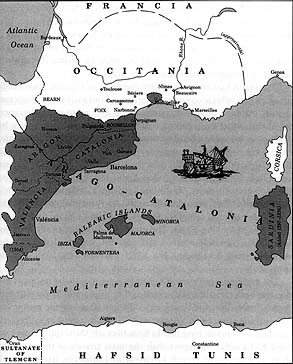
Realms of Arago-Catalonia at Mid-13th Century
The Arago-Catalonian realms were pluricultural. The Catalan and Occitan cultures and languages were cognate, but Aragon proper had its own language, institutions, and folkways. More pertinently, the thirteenth-century conquests had added whole populations of Muslim subjects, both slave and free. Within the new conquests, as well as in the older homelands, a parallel society of Jewish communities flourished. Many Jews had fled north from Almohad Muslim persecution in recent years or were overtaken and incorporated during the crusader advance in Islamic Valencia and the Balearics; the cultural background and frequently the name-forms of this stratum were Judeo-Arabic. Conversely, other Jewish communities and individuals were fleeing south into Catalan lands, away from recurrent Frankish persecutions and expulsions. An even wider immigration movement brought Jews from overseas, for example, from Tlemcen in North Africa, as the crown encouraged Jewish settlement of its new conquests. All this stir and jostle converged on the established native Jewish community, itself older than Christendom or Islam on the peninsula. Though Jews had agricultural interests in the realms and were found in rural towns as well as cities, their urban profile as investors, merchants, and lenders was not in itself alien to the Christian urban profile. The “usurer” of northern Europe became the businessman of these Mediterranean parts. One result was that anti-Semitism, however lively here, would be somewhat differently experienced than in northern Europe.[2]
This convergence of immigrations transformed Jewish society and culture in the realms. The already interrelated Jewish communities of Occitania would funnel ever more into the realms of Aragon and particularly into Catalan cities like Barcelona, Besalú, Gerona, Lérida, Perpignan, and Valencia. The historian Yom Tov Assis, charting the final great waves of flight from the north, especially in 1291, 1306, and 1322, speaks of the “liquidation” of Occitan Jewry and notes the impact of the newcomers on all aspects of Jewish life—social, religious, cultural, and intellectual—in Catalan areas. Resettlement in Catalan lands did not always bring stability, especially in the overstressed border towns. At Perpignan in 1328 King Alfons IV rebuked Christians who were harassing the exiles because he feared the Jews would go to North Africa or especially to France, to which some wanted to return. The economic loss to the crown would be great, he wrote, “because the Jews are a strongbox and a treasury for kings.”
The intellectual and mystical effervescence in Occitan Jewish communities had influenced cognate Catalonia from early in the thirteenth century. As these peoples compressed and ever more intensely experienced each other’s presence due to the migrations, that influence became more relentless and disputatious. As Assis remarks: “These influences were completely contradictory to the fundamental principles of Iberian Jewish culture of the Islamic epoch.”[3] Yet the rationalist and scientific influences from the Judeo-Arabic sector threatened the Occitans with loss of identity. Meanwhile a series of expulsions from Francia, or northern France, brought Ashkenazic Jewry increasingly south, adding another cultural complex of usages and ideas, a more rigorous and more inward-looking legacy. The convergence was not only of Jewish subcultures, variously evolved and adjusted, but of clashing understandings about how to be a Jew, which intensified the ideological debate.
The movement of Franco-Occitan Jews south into the realms of Aragon was both creative and destructive. The medievalist William Chester Jordan has analyzed the two very different stages of the movement. “The steady stream of voluntary exiles” which moved away from the invading and encroaching Franks from the early thirteenth century onward had a different impact than the mass arrivals of those expelled from all France and French Occitania in 1306. The latter “came in droves” and “with virtually no resources,” swelling the Jewish populations all over the Arago-Catalan realms, alarming the Christian population, and challenging the ingenuity of the native Jews to absorb them physically, economically, and psychologically. These displaced persons “never sucessfully integrated in the short time they were given.” Invited back to France by a new king in 1315, they were again expelled in 1322, after which, as Jordan notes, “there were virtually no Jews in France.” Looking back in 1346 Cresques Elias, a physician and confidant to Pere IV, writing in Hebrew for his Jewish audience, contrasted the contemporary “kingdoms that oppressed the Jews” with “the righteous and merciful kings of Aragon,” inspired by God, “who showed mercy on Israel [and] gave refuge to exiles from all corners of the world, [and] treated them with honor.”[4] This kaleidoscope of migrating and interacting subcultures, in an affluent commercial society able to cope and reasonably accommodating in its public policy, transformed the native communities.
The flight from the Islamic south was even more significant for Catalan and European Jewish society, a transfer in the nature if not on the scale of the Early Modern expulsion from Spain with its diaspora into Ottoman lands. The historian Bernard Septimus sees the flight from the south as “an important turning point in Jewish history.” The Jewish communities of western Islam declined and collapsed, he notes, “while those in Europe, despite an increasingly hostile Christian environment, showed an upsurge of vitality and cultural creativity.” This “shift in the center of gravity of Jewish life altered the framework within which Jewish history would unfold,” particularly in Spain. Quite simply, Septimus maintains, “Spanish Jewry had just transferred from the Arabic world to Christian Europe, and no aspect of its culture could remain untouched by this shift in historical environment.”[5]
A side effect of the increase of Arabic-speaking Jews in the realms was their expanding role throughout the thirteenth century in the crown’s fiscal, diplomatic, and chancery structures and their role as courtier savants (the ḥakīm phenomenon). So prominent and effective did some Jews become at court that a baronial backlash in 1283 drastically curtailed their roles in governance and fiscality. A little-noticed contribution by the Judeo-Arabic stratum was their preservation and production of Arabic classics in medicine. In 1296, for example, we find Jaume II paying Vidal Benvenist de Porta the serious sum of two sous per day to “write and translate certain medical books from Arabic into Romance [romana lingua] which are very necessary to Us.” And the same king paid a thousand sous “for translating and rendering from Arabic into Romance [in romancio] a certain book of medicine written in Arabic entitled Halçahahny”; the translator Astruc de Bonsenyor having died, King Jaume in 1313 was belatedly conveying the sum to his son Jahudà. A more general witness to the widespread Arabic culture of this Jewish stratum is the same king’s arrangement in 1302 to have a professor of medicine at his University of Lérida borrow “certain Arabic books of medicine” that “some Jews of Our land have” in order to correct the pecie, or excerpt-textbooks, rented to medical students, “restoring” the books when finished to the respective owners.[6]
Among the radical changes ensuing in thirteenth-century Catalan Jewish society, Septimus describes the displacement of the native Jewish aristocratic and courtier class, hitherto apparently unassailable in their wealth and in their secular and rationalist culture. Worldly-wise and pro-Maimonidean, buttressed by royal power, they had made Barcelona Jewish society “a city of princes.” Rising to displace them was a Jewish merchant-scholar class emerging into new wealth, more centered on the Torah and mystical religiosity, heavily influenced by Provençal kabbalah and by Franco-German talmudic culture. The religio-intellectual scene was complex, with three competing but interacting dynamics: rationalism, kabbalah, and conservative or geonic-Andalusī traditionalism. Robert Chazan finds Septimus’s arguments “for a powerful anti-aristocratic rebellion in Barcelona of the 1230s” to be “not thoroughly convincing,” and he argues that “the Jewish aristocracy continued to exert powerful political control in Catalonia all through the thirteenth (and fourteenth) century.” Whatever the merits of these opposing views on the revolution in social classes, what stands clear is the wider transformation of Jewish society, the shift out of al-Andalus and France, and the turmoil of converging cultures and visions. An intriguing side effect among all these scholars and courtiers was the appearance of a memorable eccentric whose strange career has points of resemblance to that of his Christian contemporary and Catalan, Ramon Llull. Abraham Abulafia, “founder of Ecstatic kabbalah,” was driven by a series of revelations in Barcelona from 1270 to 1280 to go on a mission to Pope Nicholas III (who inconveniently died as Abulafia reached the pope’s residence at Soriano, near Viterbo) and to preach from city to city in Italy to both Christians and Jews (with disappointing results).[7]
To what degree these social developments are reflected in the appearance of Latinate Jewish wills, or in their contents, is not easy to say from our present small sampling. The testators do seem to belong more to the class of “new men,” however, with its confident generalized affluence and its pieties. The Judeo-Arabic stratum is visible in name-forms, as also and very strongly is the Occitan element. Familial, commercial, and cultural links should eventually emerge from multiplication of such wills and their contextualization from other sources. How the Jewish society both interacted and clashed with the englobing Christian society may also be clarified by examining the role of these alien wills within Jewish society and the complex of legal interference they invited from the crown authorities.
| • | • | • |
Parallel Societies
Jewish and Christian societies in the realms lived in symbiotic tension, each experiencing within its autonomous self some presence of the other and each invading in small ways the psychological space of the other. As Mediterranean Europe had evolved over the previous two centuries, from a rural backwater to a world-class urban civilization tied into international markets, the ideology of an exclusivist “Christendom” had intensified the immemorial separation of Jews and Christians. Neither people wished to share the public, or much of the private, existence of the other, compromised as that other was by its own religious memory, symbols, values, and traditions. To do so meant to assimilate, to lose to a degree one’s own pervasive religious expression or spirit and to be exposed to that of the Other. Christian or Jew “could scarcely penetrate into each other’s social sphere,” Solomon Katz notes, “for the life of each community was permeated by its own religious symbols and emblems.” As Bernard Dov Cooperman puts it, “separation of the two societies” was “integral to both their world views.” A mutual exclusivity held the two societies apart like a kind of antigravity.[8]
Paradoxically, however, practical considerations and human circumstance threw the members of each society into various kinds of social, commercial, and governmental interaction. Since members of each society might be careless in such necessary mixing, or even seduced in the direction of conversion, the elites in each society were alert to reduce the inevitable dangers and to maintain the psychological defenses. Yet the Jewish patrician classes sent individuals into the Christian administrative or courtier circles; the Jewish community both appreciated their protective influence and suspected their degree of assimilation. In short, a structure of parallel societies existed, pervious to regular mutual interaction and influence. The continuous task of each party in self-identification and self-protection made for a creative tension in this mutual relationship. It also made inevitable a degree of permanent hostility and harassment by the dominant society, which in times of crisis could become brutal.
If the situation itself dictated some status of separation and autonomy for the excluded subject community, validated from the medieval Christian perspective by scriptural authority, the practical form actually accommodating the autonomy was influenced by the dhimma model of the neighboring Islamic states. Islam tolerated subject Christians and Jews as “people of the Covenant” (ahl al-dhimma) who were allowed to exist in subordinate but semiautonomous parallel societies. Though noncitizens, a dhimmī population had rights and duties, enjoyed a circumscribed religious and personal liberty, and connected with the Islamic state through their own religious leaders. Like that Islamic model, the Christian structure conceded to the many communities both of Muslims and Jews in Spain their own internal administrative and judicial system under their respective religio-social leaders, their interior tax support as well as a voice in collecting state taxes, and a range of religious institutions, education, festivities, and personnel, often within a privileged quarter (not the confining “ghetto” invented for the Renaissance and Early Modern times). The status of Muslims and Jews had come to seem sufficiently equivalent that royal charters in the realms sometimes referred to the encompassing religious law of the Jewish communities as their Sunna, borrowing the common Christian term for Islam’s analogous law.
This Jewish echo of the dhimma had not come directly from a Catalan experience of long reconquest. Catalonian contact with Spain’s Muslims, unlike that of Aragon or Castile, had been limited until the thirteenth century. Her populations of subject Mudejars had largely been on the far borders at Lérida and Tortosa. The extraordinary conquests of the Balearics and Valencia by Jaume I had transformed that situation, but the Muslims remained more than ever at the periphery of Catalonia proper. A domestic empire had been added, but there was little Muslim impact on the home counties. Thus Islam’s dhimma status had not given rise to the structure of Christian-Jewish parallelism, nor did it dominate that situation; rather it nuanced it. And despite ecclesiastical perspectives and fulminations, the historian Norman Roth argues, “the laws established full equality for Jews” in civil legalities, a concept “never abandoned throughout the Middle Ages in Spain.” However many restrictions and impediments to lateral relationships existed between the parallel societies, the vertical relation of Jews directly to the king meant that they enjoyed in their own way “full and complete” subject status with “the right of representation and appeal in courts of law.”[9]
To what extent Spain’s Christian countries borrowed their Mudejar dhimma model from their Muslim neighbors is a complex problem of diffusion and acculturative adaptation. Despite suggestions that the Byzantine imperial system for harboring Jewish populations underlay the Islamic system itself, that Islamic system seems rather a borrowing in detail from conquered Sassanian Persia, grafted onto a koranic root. From another vantage, the dhimma structure reflects the immemorial strategy of empires with indigestible subcommunities. The European West had shared that imperial experience, notably in the Gothic/Germanic peoples of Arian Christianity who managed the proto-European sectors of the Byzantine empire and in the Jewish communities “protected” by Christian scriptural teaching in a providential survival until millennialist mass conversion. However strong such precedents, even as antecedent to Islam, the influence of the full-blown Islamic dhimma institution on Western Mediterranean Christian policy must have been more immediate and insistent. From the late eleventh century, as Christian Spain urbanized and grew in wealth and sophistication, populations of Muslims were incorporated on a large scale. Inevitably the situation of the Jews, paired with the Muslims as subordinate autonomies, must have tended to assume in Christian eyes a dhimma structure.
Many differences remained, however, both in Christian Spain’s application of the dhimma concept and in the practical situation of the Jews as against the Muslims. Even a fully borrowed institution is usually distorted and reexpressed by the borrowing culture because of different host institutions, values, and expectations; moreover, such attitudes and institutions reinterpret the subject population even while seeming to keep it in place. Unlike the dhimmī communities of subject Muslims, the Jewish communities shared a common language with the dominant population, a long history and a nonmilitary relationship, a much wider base as being present in every corner of Christendom, and a more dynamic interaction with the host country in commerce, tax administration, diplomacy, medical service, and even religious learning. Europe was home to the Jews, immemorially so, whereas subject Muslim autonomies were a recent phenomenon and confined largely to Sicily and Spain. If the Jews, unlike the Muslims, had Christian scriptural “protection,” neither Jewish nor Muslim minority enjoyed the solid koranic framework that made persecution rare in Islam. And a rational, Roman law Europe could shift its bases and biases more easily than could a revealed koranic doctrine. The Islamic system might lock its subjects into humiliating subordination and contempt, but it would not betray them further. So even if Jews had a wider and older base, the virus of anti-Semitism could flash along that Europe-wide system, ancient hatreds revivify, and unreasonable expectations suddenly surface.
Unlike the conquered Muslim communities, the Jews had no explicit surrender constitutions or pacts. These were a convenience, however, and not strictly necessary in the borrowed dhimma situation; the essential was the implicit acceptance of subject status and duties within the tradition. Thus it is misleading to say that each Jewish community in the realms “had a different degree of autonomy relative to the king.”[10] For both Muslim and Jewish communities the king did add to the common autonomy special local or regional privileges, the random accumulation of which could at least mark each such community with a special profile. The king could also spread en bloc all such privileges from one locality to another, as when Jaume gave the Jews settling conquered Valencia all the customs and privileges of Barcelona. Nonetheless each community depended directly on the king in all parts of the realms, each an independent small entity jurisdictionally parallel to and outside the municipal system.
The usual form of interior government involved an executive board of “secretaries” or deputies (the ne’emanim, or in Aragon the mukdamim), plus an assembly or council. The numbers in either group, and their manner of gaining office, varied widely from place to place; smaller places might have a less developed government. A general gathering of the community’s adult males might be called to debate and ratify a statute or major decision. Any number of bureaucrats or officials existed for public functions of an economic, juridical, religious, or petty character. Religious leaders included the judge-rabbi (dayyan) as well as auxiliary rabbis for special posts; the title was also employed as an honorific, without office. A developed quarter (Catalan call) centered around its synagogue (there could sometimes be two or even more), with butchery, market, public oven, tavern, hospice(s), probably the ritual baths, and an exterior cemetery.[11]
The perception of both Muslim and Jewish societies in the realms as a kind of Islamic dhimma lent the Jews an adventitious widening of royal protection, because it added to the theological rationale from scripture a practice and tradition long observable among one’s Muslim neighbors. By the same token, this perception also helped target the Jews for the conversionary missionary movement promoted here by the crown. More perhaps than the administrative and commercial networks that joined the older Catalan lands to the new conquests, the conversionist movement placed the two minorities in a single perspective. The “Dream of Conversion” that obsessed thirteenth- and early fourteenth-century Christendom ranged from Morocco into China. Its prime domestic targets became the Muslim and Jewish communities of the Arago-Catalan realms. The new international Mendicant orders—Franciscans but especially Dominicans—put into operation an elite program of Arabic and Hebrew schools and a grassroots program of forced preaching on forays into mosques and synagogues.
The weight of the conversionist movement in the realms fell heavily or mainly on the Jews for a number of reasons: in part on linguistic grounds (Jews spoke Romance as their native tongue), in part from traditional pattterns (Jews had long been an object of conversionary reflection and writing, though not of a systematic program), in part from the friars’ new conviction that manipulating the Talmud was the final key to unlocking Jewish solidarity, and in part of course from the relative paucity of Muslims outside Valencia and the growth and vigor of the Jewish communities. So in addition to the burdens of anti-Semitism and stereotyping or the annoying restrictions imposed by ecclesiastical and civil decrees, Arago-Catalan Jews now had to put up with a disorienting invasion of their inmost autonomy and psychological space. A decisive moment in the conversionist invasion came with the Barcelona “Disputation” of 1263, actually a showpiece confrontation in which the king summoned a Jewish champion to refute Mendicant interpretations of a selection of talmudic propositions. The Jews there were not allowed to defend Judaism or attack Christianity. One result was a widely published defense of Judaism disguised as a report on the Disputation, by the great Nahmanides, and a rallying of Jewish resistance and identity.[12]
The world in which the Latinate wills multiplied was a chiaroscuro, therefore, simultaneously light and dark. The reigns of King Jaume the Conqueror and his son Pere the Great, from 1208 to 1285, have often been called the golden age for the realms’ Jews. Converging immigration as refugees fled here or followed the magnet of opportunity, remarkable intellectual ferment in the many communities, commercial prosperity and expansion for Jews as for Christians while the new conquests (soon to include Sicily and Sardinia and even Athens) created a maritime imperium, and the extensive presence of Jews at the royal court and at various levels of administration (until baronial opposition from 1283 forced its drastic reduction)—all help explain the golden memories. The encroachments of the friars, alienation from an increasingly Christian public culture, the eventual loss of influence within Christian state structures, proliferating restrictions and humiliations in ecclesiastical legislation, and folkloric indignities—all provided the balancing shadows. A troubled silver age followed the golden; then from mid-fourteenth century came crisis, decline, and with the 1391 massacres, catastrophe. An acculturative interchange between Jews and Christians can be charted between 1250 and 1350, however, revealing a dynamic that did not preclude strong and growing religio-ethnic hostility. This century represented a kind of Indian summer in the relations of the two peoples, with lightning flashes warning of disasters to come. The century of tragedy from the 1391 riots to the expulsion of 1492 lay mercifully in the hidden future.[13]
| • | • | • |
Wills: Hebrew, Romance, Latinate
Extant wills for Europe’s Jewish communities are rare and valuable. One might nonetheless expect to find them in the medieval Spanish kingdoms, with their rooted and prosperous Jewish communities. Spain’s Hebrew wills are mentioned in the rabbinic responsa literature, but only when they involved some problem and never with an actual text reproduced. The wills themselves faced many perils to survival. Wills and inheritances were usually family affairs and generally did not require the attention or regulation of the community. Thirteenth-century private charters in any case, whether Christian or Jewish, disappeared on a large scale, save for those in the archives of civil or religious corporations. More to the point, the wave of pogroms which swept over Spain in 1391 wreaked wholesale destruction of early Jewish documentation, while the expulsion of 1492 uprooted communities and records alike. Still, Jews had the same general practice of making wills as did the resident Muslim and Christian communities, a tradition indeed more ancient for Jews.
In his monumental history of early medieval Mediterranean Jews in the Islamic Near East, Shlomo Goitein only reluctantly calls these documents wills. “There are no ‘testaments’ in Islamic and Jewish laws,” he notes, and legators rather than “testators” made them. Last dispositions were made by “men and women, rich and poor, learned and plain” in “astounding” numbers as a “general practice,” whether on the occasion of serious illness, extreme age, new business arrangements, or risk situations such as a long voyage. Despite the different cultural context for Jewish wills, their different juridical meaning or effect, their somewhat different purpose (they often dealt with one or two issues unsettled by previous gifts and funds), and particularly their freedom from the all-encompassing structures of Roman law, the essential human activity remains analogous to that in other communities and is therefore accepted by Goitein and historians as in general “testamentary.” If the Jewish law did not know “the Roman or modern idea of a unilateral testament,” it did provide for last dispositions “dealing mainly with the appointment of executors and the distribution of legacies.”
In his Gifts in Contemplation of Death in Jewish and Roman Law Reuven Yaron traces the evolution of the technical “gift” that served “as a substitute for a testament, which is not known to Jewish law.” Such early transfers allowed some “change in the amount of property” as against the standard rules of the divine law of succession. Not to be confused with ordinary gifts, they fell into two classes: an irrevocable grant but the donor retaining usufruct (somewhat corresponding to the Roman law donatio deductu usufructu), and another irrevocable grant but only at the endangered donor’s consequent death (Roman law had a donatio mortis causa). Allied maneuvers such as disherison or disinheriting could complicate the pattern. The operation was bilateral, however, involving the donee or legatee in a ritual or supposition of acquisition. “Jewish law does not know of any unilateral disposition in contemplation of death” but rather this “cooperative liberality,” and “the step from bilateral gift to unilateral testament was never taken in Jewish law.” Though rising out of similar needs, the Jewish and Roman dispositions had entirely different contexts in this regard and “few, if any,” points of influence in their origins.[14]
Properly drafted Jewish last dispositions, however, did not lack form or regulation. Besides the rules of succession, the formalities in the Jewish community offered three categories of “wills.” First, a healthy person could give a gift immediately to someone not an heir by those rules, keeping the usufruct for life. Second, a testator whose deathly illness confined him to bed could will away his entire property (less than everything would invalidate his intention “in view of death”) in either oral or written form or by an unwitnessed personal note. Third, if facing death but not so debilitated or if facing equivalent danger, such as a long journey or execution, an individual might also prepare a will. A healthy person not in those categories could not make a will. The heirs had a moral duty to carry out the testator’s dispositions. Local communities could add regulations as to execution, such as requiring drafting of the will before a scribe or rabbi or public proclamation in the synagogue.[15] It is hard to say whether Latinate wills add a fourth category or rather presume the second or third categories for Jewish testators. It is also not clear whether the Jewish testator in a Latinate will avoided the small complexities, exceptions, qualifications, challenges, court interpretations, and formalities of technical language hedging the properly drafted Jewish will.
The most immediately visible difference in structure between the Roman law and Jewish wills is that witnesses in the latter do not merely validate but actually present the final wishes of the deceased. This difference “reflects a society that trusted living persons more than written documents.” A typical Jewish will contains both a date for the visit by the two witnesses and a subsequent date of death. The witnesses recall the physical and mental condition of the testator, a significant and explicit section of the will rather than the routine and formulaic counterpart in a Roman law will. The witnesses then recall the substance of the testament along the lines of “This is what he said…,” followed (usually) by a first-person recital by the dying person. The appointment of executors loomed large when business affairs or property were involved; Goitein sees here “a certain aversion to stocktaking and accounting” by the testators, leaving that task to the official postmortem inventory of assets, with a free hand to the executors. The testator also had to clear away debts, which meant for husbands primarily the return of dowry and of the gift promised to the wife in the marriage contract.
Finally, the Jewish will “was bound by God-given laws regulating man’s inheritance, not to be tampered with”: the firstborn son normally got a double share, a husband received the estate of his wife, a daughter as only child became the sole heir, a wife did not inherit her husband’s estate. Goitein’s Egyptian Jewish documents sometimes reinforced such provisions explicitly, lest an appeal to Islamic courts upset merely implicit or weak statements. In such an appeal Islamic law might influence the court’s decisions. (By Islamic law the testator could dispose freely of only a third of his goods; and besides, the unusually elaborate Islamic inheritance theology might be maneuvered by a malicious Jewish claimant against the will.) Though a few of Goitein’s Egyptian wills were detailed and encompassing, usually for a special context, he is convinced that most testators devised their wills “for one main purpose,” or at most a few, and that Jewish wills “were partial in nature,” merely the final act in the decedent’s multiphase disposal of his possessions. An important element of the Egyptian wills, not shared by the Latinate specimens discussed below, is preoccupation with an appropriate funeral and its expenses. Though some wills “were concerned exclusively with charity and burial,” testators seem to have arranged their philanthropies before and outside their wills; a tenth to charity “seems to have been regarded as a proper share.”[16]
In the realms of Aragon a peculiar Visigothic survival called a testament sacramental, that is, “by oath,” echoes something of the Jewish wills’ focus on the witnesses. By this device anyone might prepare a last disposition, orally or in writing, on sea or on land, without notary or formalities. The witnesses then had to appear within six months before the altar at the church of Sants Just i Pastor at Barcelona, with a notary, to swear out the provisions before representatives of church and state. The witnesses could range from two to seven but were usually two or three, often relatives. As in the Jewish will, the document itself was redacted after death, on the word of the surviving witnesses. The testament sacramental, though not common, was enshrined in Catalan law and received a strong reexpression in the 1283 statute Recognoverunt proceres. In any will, Jewish or Christian, there could be two stages of drafting, first by informal notes of notary or scribe and later by a fair copy for the heirs.[17]
The Egyptian evidence raises the question of Islamic intervention in Jewish wills and of the possibility of some practice corresponding to the Latinate will or co-will. Goitein did find Jews applying to Muslim courts, even in family matters. “The great majority of cases,” however, involved not litigation but the making of contracts, and “it was common practice to make contracts before Muslim and Jewish authorities concurrently” to reinforce their legality. Conversely, the Muslim courts could interefere in Jewish law, despite the dhimma autonomy, especially in inheritance cases. A claimant or heir unsuccessful at the Jewish court, believing the Islamic testamentary regulations more favorable to his point of view, could follow this path, though Jewish authorities “in principle” frowned on such recourse “as a religious offense” when not in some way necessary. There seems to be no evidence, in any case, of a testament made solely or concurrently before Muslim authorities and with Islamic juridical structures.
Information directly from Goitein’s earlier wills at Old Cairo will be introduced in chapter 6 for comparison with the Latinate materials from Catalonia. Here his description of the funerary activities that went into operation at a testator’s death will afford some idea of the similar activities in Catalan lands. On the day of death a burst of activity brought any number of officials to the house: a judge to oversee, two trustees to take deposit of valuables, two elders to assess worth, a cantor to make funeral arrangements, synagogue beadles to take stock and “do the physical work,” a court clerk to record the activity and the inventory, a grave digger to measure the body, and two body washers. The rabbinical court immediately sealed the dead person’s possessions and ordered the all-important inventory and assessment. Goitein notes that “it was the policy of the Jewish courts to realize all the assets of the deceased and to sell his inventory immediately after his demise,” transferring the proceeds to his executors. Relatives and friends gathered around to help with arranging the burial clothes (on hand or to be purchased), hiring the special mourners, planning the procession, and comforting the bereaved. A schedule of prayers testified to the communal nature of this death and, by extension, of the deceased’s last wishes. In Catalonia some Jewish communities had burial confraternities, organized in rotating divisions, to carry out and facilitate the many funerary obligations for the bereaved family; Lérida had seven such groups in 1323 and eight by 1348.[18]
To confuse matters, medieval Spain has also given us notable examples of the Hebrew “ethical wills,” of which Goitein finds no trace in his Geniza documentation. These were not real wills, though a rare case does seem to include actual testamentary dispositions. They were instead a literary genre of exhortatory injunctions, a medieval subcategory of Jewish ethical literature. Cast in the form of deathbed advice and instruction, they were short, practical treatises reflecting the ideologies and concerns of the authors and their groups. These ethical statements were very popular and often read by the public as genuine wills. They could include inventories as part of the literary form, or even involve practical commitments.[19]
Of all the wills drafted in Hebrew in the realms of Aragon, only one has thus far surfaced. Unfortunately that document is not a full copy of the original but only a selection of the part relating to the principal heir. Isaac b. Mossé had come of age and wished to manage his own affairs, so he petitioned the Jewish court at Barcelona for his own copy of the will of his father, Mossé b. Isaac of Toulouse (Tolosa), “to serve him as title.” The three Jewish judges who sign off here explain these circumstances and present as much of the will, “letter for letter, word for word,” as pertains to Isaac’s own legacies and to those of his deceased younger brother Shealtiel, half of whose legacies also went to Isaac. Two Jewish witnesses “write down, sign, and place [the will] in the hands” of the guardians appointed by the testator, dating it on the twenty-ninth or last day of Iyyar (second month of the Jewish calendar) in the year 5028, which was the Christian date 14 May 1268. The dying man had established five guardians for his daughters, until they married or reached twenty years, and for his two sons until they reached the age of twenty. His wife is not mentioned in this partial copy and may have been dead. The eldest son, Isaac, received the family house, some properties detailed here, one book of each kind from the father’s library, and a seat in the synagogue. The younger son received a package of houses and other properties or revenues, again listed in detail. Leila Berner, in her history of thirteenth-century Barcelona’s Jewish community, discusses the will, its context and implications, and the family connections of all those involved.[20] This fragment is presumably a representative exemplar of the stream of Hebrew wills which once flowed through the realms of Aragon and whose fugitive traces are visible today only in secondary documentation, Hebrew or Latin, about the legal repercussions of the now-lost originals.
If Hebrew wills were massively destroyed, a fair number at least did remain in Romance versions, hidden away in the registers of Christian notaries or lost in the archives of an obscure convent. Those that do remain in this transcultural garb are almost always post–Black Death and especially fifteenth-century, with late fifteenth-century the norm. For both Christians and Jews, but especially for Jews, those troubled later eras in Spain were in radical contrast to the relative calm of the thirteenth and early fourteenth centuries. The generation of Jews that came after the 1391 universal riots, with their mass forced baptisms, the disappearance or drastic shrinking of communities, the disorientation, the assimilative acculturation, and eventually the Inquisition, inhabited a very different Renaissance world of light and shadow.[21]
The historian José Cabezudo Astrain presented three such very late Romance wills in what has become a standard reference point in approaching medieval Jewish wills in Spain. All three are from Zaragoza in Aragon proper, a highland component of the realms of Aragon as against the Catalan coastal regions. Drawn respectively in 1483, 1484, and 1491, the wills conform to the Fueros de Aragón, the Romanized codification of the laws and customs of the upland kingdom of Aragon, promulgated in 1247, and to the attendant practical applications called the Observancias. In his four-page introduction Cabezudo conjectures that Jewish testaments were done before Christian notaries only “by exception” and only so that a Christian court might not challenge the bequests. He finds in them “very few” differences from the Christian wills of the region. Christian invocations are lacking, of course. A Jewish cemetery is always chosen, frequently something is left to the synagogue, and the wife receives a return on what funds she brought to the marriage. As in Christian wills, arrangements are made for children’s guardians, daughters’ marriages, alternate heirs in case of obstacles, a small legacy (usually five sueldos) for each lesser heir, and a division (often very unequal) among the sons.[22] Why or how such domestic dispositions within the Jewish community and legal tradition should be challenged by a Christian court Cabezudo does not explain.
Encarnación Marín Padilla has recently carried forward Cabezudo’s work, presenting three late wills made before Christian notaries by, respectively, a Navarro-Aragonese woman in 1467, the wife of an Aragonese physician in 1469, and a Zaragozan man in 1473. From her years in the notarial archives of Aragon in this late period, Marín Padilla argues that Jews took one of four options in disposing of property on the eve of death: sale, gift, testament before a Jewish scribe, and testament before a Christian notary. The sale or sale/buy-back option seems a ploy, “almost always fictitious” in effect, by which not only some Jews but also Christians avoided death duties. The gift option, for any motive, was rare.[23] Wills drawn by Jewish scribes are visible usually only by allusion in later litigation in Christian notaries’ records of suits by heirs. Currently M. A. Motis Dolader has examined Jewish wills in the last third of the fifteenth century, again at Zaragoza. He has transcribed two of these and has related the formalities of the Fueros code of Aragon to their structure. He conjectures that Jewish recourse to notarial wills is explained by the authentic and formal force of such documents as compared to other kinds of will, to their precise juridical formulation that avoided confusions or deficiencies, and to their function in forestalling force and abuse.[24]
For this upland kingdom of Aragon proper in the fifteenth century, the contributions of Asunción Blasco Martínez have been especially notable. She has published the wills of five Jewish women, respectively, from 1401, 1405, 1415, and 1418 (two wills). Four testators were widows; all had convert or Christian connections. More pertinent to our earlier study are her interpretive conclusions about Jewish wills of the kingdom in the fourteenth and fifteenth centuries. In exhaustively examining the notarial records in the Archivo Histórico de Protocolos in the capital city Zaragoza as well as those in the Archivo Municipal, she has found Jewish notarial testaments “scarce,” with none at all for the fourteenth century and “only some few” for the fifteenth, mostly indeed for the late fifteenth. Her impression is that Calatayud and other places of Aragon follow the same pattern. She has encountered “no testament written in Hebrew,” though notices show they once existed. Why the imbalance between the fourteenth and fifteenth centuries? Blasco Martínez posits that Zaragozan Jews simply did not usually make notarial wills until the riots of 1391 and especially the Disputation of Tortosa of the antipope Benedict XIII in 1413–1414, with their forced conversions, triggered “sporadic” and then ever-increasing usage. Specifically the wills came “as a consequence of the convert problem at the beginning of the fifteenth century” as it shattered family unity and invited quarrels among heirs. She sees Christian influence in the custom in these late Romance documents of leaving legacies for the poor and in seeking remission of sins, but she notes Jewish particularities in such items as mourning periods, Jewish feasts, and lack of reference to a future life. Our earlier, proper Latinate wills studied below, however, will show a very different context, content, and conclusion.[25] Such very late wills have also been noted from Catalan areas and occasionally transcribed or analyzed: from Gerona (1462 and 1470), Manresa (1391), Majorca (1377, 1388, 1467), Santa Coloma de Queralt (1410), and from the Vives family (1436 to 1514).[26]
Marín Padilla’s typology of four options might well accommodate a fifth, as we shall see: Hebrew wills for which a Latin counterpart existed from the start. Such double wills may have been the norm for Latinate Jewish wills—the Latin alone surviving by reason of Christian administrative archives, but even then barely and sporadically. Double or single in format, Jewish Latin wills belonged to a unique earlier world, to a psycho-social “discourse” unusual for both Jews and Christians. They are as much a function of the revival of Roman law as of the contemporary commercial revolution and the peculiarities of Jewish life in the realms at this time. Latinate Jewish wills survive elsewhere than in the Arago-Catalan and cognate Occitan regions, though early exemplars seem even rarer in other lands. Steven Epstein indicates that the will of “Brachamus [Abraham] Ricius de Chalfono” in 1299 at Erice is the earliest extant in Sicily (then under its Arago-Catalan dynasty) in the Latinate category. Epstein adds: “I know of no other place [in Italy] where medieval Jews made formal public testaments” with Christian notaries.[27] As with the upland kingdom of Aragon, practice had changed by the fifteenth century. Ariel Toaff has exhaustively edited the documents by and about Jews in the Umbrian region from 1245 to 1484. For the first century at least, through 1350, there are no notarial wills, though two documents of 1346 concern previous wills and heirs. Toaff does transcribe a number of wills from 1423, 1439, 1445, and later. Occitan wills for the regions not under Arago-Catalan control also exist for these later periods and are noted below.[28]
In the thirteenth century or the opening decade of the fourteenth, both Christian and Latinate Jewish wills are more likely to turn up in the Catalan regions of Spain than in the Aragonese or Castilian. The Catalan areas were intensely commercial-maritime components of the Mediterranean trade world, multiplying precisely those affluent classes who could most use a will. And as families rose by wealth within the respective Christian and Jewish communities, a corresponding concern to consolidate and maximize a family’s wealth should be expected, with public documentation to trace and validate the family’s rise. The maritime commercial environment here was also a magnet for immigrating Jews with capital. These regions were also a main focus of the revival of Roman law in Europe. In the newly conquered kingdom of Valencia alone, the compilation of customs for incoming Christian settlers, entitled the Furs, was becoming the first Roman code of general application in Europe. Jaume the Conqueror was a major promoter of Roman law, energetically deploying the Bologna graduates who streamed back into his kingdom. His biographer Charles de Tourtoulon praises him as an “apostle” of the new jurisprudence. The legal scholar J. M. Font Rius sees his reign as marking “a stage of high effervescence” in Roman law activity, around whose person the new jurists “swarmed”; laymen “of the highest rank and offices prided themselves on being experts” in Roman law.[29]
An important question needs to be posed explicitly. Why would Jews, established in their own political and juridical semiautonomy, with no Christian legatees or interested parties, submit to the expensive, bureaucratic, and alien forms of the Christian notary, translating their domestic dispositions into Roman law Latin, especially when (as most assert in the opening line) the testators were terminally ill and presumably of limited energies when they summoned the alien notary? First, a personal and commercial overlap joined the two societies so that neither was as alien to the other as might seem. Jews operated easily in the Roman law world of municipal statutes, financial controls, joint ventures, legal procurators, and appeals courts. They entered many business documents in the Christian notary’s register, and wills could easily seem another such contract. In any case, rabbinical prohibition of access to non-Jewish courts had never been accepted by Jews in Spain, though such recourse was viewed with disfavor by the other Jews when not patently advantageous in civil cases.[30]
Second, a Latinate version of a Hebrew will was enforceable at law and thus doubly secured the testator. In Jewish law, unless orphans were involved, the role of public authorities was minimal, and the actions of the executors or trustees would normally not be audited. Jewish authorities might see to the testator’s property inventory, sign releases of legacies, and turn over charity grants to the proper overseers, but normally they were reluctant to do more. The Jewish scribe in drafting private documents brought prestige and a kind of popular esteem to them, but his work on private charters usually fell short of law and legal enforcement. A Latinate testament could also effect ends not compatible with Jewish law; a male testator could nullify Jewish legal prohibitions, for example, by making his wife his heir. Sometimes for various reasons the king’s confirmation was desired for an individual’s last disposition, so a Latinate will had to be drawn. Clues as to the kind of problem precluded by the use of Latin testament and authorities can be gathered from actual cases presented on appeal to the king, a number of which will be described.
How did rabbinical authorities view this transfer into gentile forms? Testaments were part of a larger problem involving charters of all kinds, such as debts, deeds, and contracts, entered for Jews in the ubiquitous notarial registers. Abraham Neuman, citing the responsa of the great Ibn Adret who served King Jaume I, concludes that “the rabbinical jurists, while exhibiting a wavering tendency, finally recognized the full validity of these documents of the Christian notaries not only as prima facie evidence but as contractual instrumentalities.” One result of this plunge into the notarial culture, claims Neuman, was that “notarial reforms were occasionally introduced in Jewish community practices, emulating the example of the gentile courts.”[31] Yom Tov Assis has traced the qualified acceptance of Christian notarial validity by Catalan rabbinic authorities, under various interpretations of the talmudic principle that “the law of the kingdom is law.” This “innovation of Nahmanides” (d. 1270) was adopted by another great Catalan, Ibn Adret (d. 1310), and soon became common. Assis also notes that “although Ibn Adret was strongly opposed to the application of non-Jewish law to matters of inheritance, in Catalonia the local laws of inheritance were widely practiced among the Jews who considered the matter purely financial.”[32] Latinate wills, beyond their intrinsic value and many uses, thus become part of what Bernard Lewis calls “the delicate and difficult question of influences,” where the much studied phenomenon of “Jewish influence on Christianity and Islam” is not yet matched by an exploration of influence or acculturation by those englobing societies on “Jewish religious law” and perceptions, even “in a matter as central as marriage.”[33] The notarial culture was insidious and pervasive. Any window on its activities, its acculturative impact on both societies, and its function as a bridge between them merits attention.
Notes
1. On the realms of Aragon see Thomas N. Bisson, The Medieval Crown of Aragon: A Short History (Oxford, 1986), with bibliographical essay, and for the thirteenth century Robert I. Burns, S.J., ed., The Worlds of Alfonso the Learned and James the Conqueror: Intellect and Force in the Middle Ages (Princeton, 1985), especially the opening chapter. See also Burns, Muslims, Christians, and Jews in the Crusader Kingdom of Valencia: Societies in Symbiosis (Cambridge, 1984), his Islam under the Crusaders: Colonial Survival in the Thirteenth-Century Kingdom of Valencia (Princeton, 1973), and his Society and Documentation in Crusader Valencia (Princeton, 1985) with his other books in its bibliography.
2. Yom Tov Assis’s The Golden Age of Aragonese Jewry 1213–1327 is forthcoming from the Littman Library press in Oxford, and will become the standard general history. More briefly, see his “The Jews in the Crown of Aragon and Its Dominions” in Moreshet Sepharad: The Sephardi Legacy, ed. Haim Beinart, 2 vols. (Jerusalem, 1992), 1:44–102. The Actes of the I Col;mbloqui d’història dels jueus a la corona d’Aragó (Lérida, 1991), by over two dozen specialists, has extensive bibliographical and thematic background on the Jews of the realms. More focused is the collection Mossé ben Nahman i el seu temps: Simposi commemoratiu del vuité centenari del seu naixement 1194–1994 (Gerona, 1994). Less impressive but useful are the studies in Jornades d’història dels jueus a Catalunya (Gerona, 1990), especially Asunción Blasco Martínez on Zaragoza and Christian Guilleré on Gerona. A comprehensive annotated bibliography for Catalonia is Jaume Riera i Sans, “Estudis sobre el judaisme català,” Calls 1 (1986): 93–132 (years 1970–1984), 2 (1987): 181–207 (1929–1969), and 3 (1988–1989): 103–134. For wider bibliographical coverage, not by list but by judicious thematic essays, see Enrique Cantera Montenegro, Los judíos en la edad media hispana (Madrid, 1986). A useful survey is Lluís Marcó i Dachs, Els jueus i nosaltres (Barcelona, 1977), revised as Los judíos en Cataluña (Barcelona, 1985). The standard general survey by Yitzhak Baer, A History of the Jews in Christian Spain, 2 vols. (Philadelphia, 1971), continues to fill a void, as does the more interior and domestic survey by Abraham Neuman, The Jews in Spain: Their Social, Political and Cultural Life during the Middle Ages, 2 vols. (Philadelphia, 1948). An able survey from Roman times to the Ottoman diaspora and today is Jane S. Gerber, The Jews of Spain: A History of the Sephardic Experience (New York, 1992). Yitzhak Baer’s Studien zur Geschichte der Juden im Königreich Aragonien während des 13. und 14. Jahrhunderts (Berlin, 1913) is newly accessible as Historia de los judíos en la Corona de Aragón (siglos XIII y XIV) (Zaragoza, 1985), while his three-volume Die Juden im christlichen Spanien: Urkunden und Regesten (1929–1936) is again available (Farnborough, 1970). The large and growing bibliography on the Jews of the realms of Aragon and particularly of the Catalan-speaking lands there will be drawn upon and cited below in connection with local and thematic materials. Especially noteworthy are Leila Berner’s 1986 UCLA dissertation, “A Mediterranean Community: Barcelona’s Jews under James the Conqueror,” and the works by Yom Tov Assis, Robert Chazan, José Hinojosa Montalvo, J. R. Magdalena Nom de Déu, Jean Régné, Jaume Riera i Sans, David Romano, Bernard Septimus, and Joseph Shatzmiller (see bibliography below). Maurice Kriegel provides a wider interpretive framework in his Les juifs à la fin du moyen âge dans l’Europe méditerrané ne (Paris, 1979). Among doctoral dissertations in progress are Elka Klein on Barcelona’s Jews from 1100 to 1276 (Harvard), those of Rebecca Winer and Philip Daileader (see below in chap. 4, n. 2), and that of Claude Denjean (see chap. 4 below, n. 18).
3. Yom Tov Assis, “Juifs de France réfugiés en Aragon (XIII–XIV siècles),” Revue des études juives 142 (1983): 285–322, and his “Les juifs de Montpellier sous la domination aragonaise,” ibid., 148 (1989): 5–16 (second quote on pp. 15–16). King Alfonso is in Antoni Rubió y Lluch, ed., Documents per l’historia de la cultura catalana mig-eval, 2 vols. (Barcelona, 1908–1921), vol. 1, pp. 92–93, doc. 75 (11 June 1328): “gran dan”; “que·ls dits juheus son caxe e thesaur dels reys.”
4. William Chester Jordan, The French Monarchy and the Jews: From Philip Augustus to the Last of the Capetians (Philadelphia, 1989), 234–238. Crescas Elias is translated by Yom Tov Assis in his “Jewish Attitudes to Christian Powers in Medieval Spain,” Sefarad 52 (1992): 294, from the Hebrew text in Baer, Juden im christlichen Spanien, vol. 1, pp. 311–317, doc. 224a. On 13 August 1306 Jaume II arranged for the Barcelona Jews to receive “sexaginta judeos et uxores et infantes eorum cum omnibus bonis et rebus suis,” whom “ipse rex expulit et expelli mandavit”; in 1307 the king sent similar letters to the Jewish communities of Gerona, Lérida, and Montclus: Arch. Crown, reg. 203, fol. 189v, in Eloy Benito Ruano, “La judería de Montalbán (Teruel),” Medievalia, 10 (1992): 56, listing also expulsions received from France in 1249, 1250, 1252, 1254, 1272, 1290, and 1291.
5. Bernard Septimus, Hispano-Jewish Culture in Transition: The Career and Controversies of Ramah (Cambridge, Mass., 1982), especially chaps. 1, 2, and 6, quotations from pp. vii and 1. See also his “Piety and Power in Thirteenth-Century Catalonia,” Studies in Medieval Jewish History and Literature, ed. Isadore Twersky, 2 vols. (Cambridge, Mass., 1979), 1:197–230. On the Almohad persecution see Norman Roth, Jews, Visigoths and Muslims in Medieval Spain: Cooperation and Conflict (Leiden, 1994), chap. 4, esp. pp. 116–129; and Mark Cohen, Under Crescent and Cross: The Jews in the Middle Ages (Princeton, 1994), chap. 10, esp. pp. 166–167, 182–184.
6. The phenomenon of the Jewish crown bureaucrat and courtier, not only from the Arabic stratum, is elaborated for the brief reign of Pere el Gran in David Romano, Judíos al servicio de Pedro el Grande de Aragón (1276–1285) (Barcelona, 1983). On the ḥakīm as properly a savant, see Burns, Muslims, Christians, and Jews, 158–159. The Arabic translations are in Rubió y Lluch, Documents, vol. 2, p. 9, doc. 11 (2 March 1296): “scribi et translatari faciamus quosdam libros medicinales de arabico in romana lingua nobis valde necessarios…et solvatis dicto Vitali duos solidos barchinonenses qualibet die et dum ipse translataverit libros predictos,” the crown providing all the paper; vol. 2, p. 22, doc. 29 (8 November 1313): “pro translatando et redigendo de arabico in romancio quodam libro scripto in arabico medicine vocato halçahahny”; vol. 2, pp. 13–14, doc. 16 (10 September 1302): “ad opus correccionis librorum medicinalium habeat necessarium quosdam libros arabicos medicinales quos aliqui judei terre nostre habent, ut posset inde facere corrigi pecias que sunt in dicto studio ilerdensi.” See also vol. 1, pp. 142–143, docs. 137 and 138 (3 February 1349), Mestre Salamó translating (aromançar) a libre sarrainesch.
7. Robert Chazan, Barcelona and Beyond: The Disputation of 1263 and Its Aftermath (Berkeley, 1992), 211. Septimus, “Piety and Power,” 1:197–230. See Moshe Idel, Studies in Ecstatic Kabbalah (New York, 1988), on Abulafia, “a central figure” in Jewish mysticism with “a series of prophetic books” between 1279 and 1288. Idel argues for Abulafia’s direct influence on Llull, ca. 1270; see his “Ramon Llull and Ecstatic Kabbalah, a Preliminary Observation,” Journal of the Warburg and Courtauld Institutes 51 (1988): 170–174. See also Idel, “Abraham Abulafia and the Pope: An Account of an Abortive Mission” (in Hebrew), Association of Hebrew Studies Review 7–8 (1982–1983): 1–17.
8. Solomon Katz, Exclusiveness and Tolerance: Jewish-Gentile Relations in Medieval and Modern Times (New York, 1975), esp. 106, 108. Cooperman’s essay is appended to Katz’s Tradition and Crisis: Jewish Society at the End of the Middle Ages, rev. ed. (New York, 1993), 251 (quote). See too the remarkable reconstruction of interrelations between Jew, Muslim, and Christian in a specific dhimma society by Shlomo D. Goitein, “Interfaith Relations, Communal Autonomy, and Government Control,” in his A Mediterranean Society: The Jewish Communities of the Arab World as Portrayed in the Documents of the Cairo Geniza, 6 vols. (Berkeley, Los Angeles, London, 1967–1993), 3:273–407. Even so simple a matter as food—its acquisition, processing, preparation, and consumption—became a principle of exclusion for both sides, a moral contaminant to avoid. Jaume Riera has explored this element in medieval Catalan Jewish life, with its constant vigilance by community leaders and the contention it occasioned between Christian and Jewish authorities, in his “La conflictivitat de l’alimentació dels jueus medievals,” in Alimentació i societat a la Catalunya medieval, ed. M. T. Ferrer i Mallol (Barcelona, 1988), 295–311. Catalan Jews’ meticulous fidelity to their observances and ceremonies found reflection in the fourteenth-century Catalan saying: “There are three remarkable things in the world—the Christians’ faith, the Jews’ observance, and the Moors’ justice [fe de cristians, colre festes a jueus, e justícia de moros]” (p. 296). David Nirenberg’s pioneering “Muslim-Jewish Relations in the Fourteenth-Century Crown of Aragon,” Viator 24 (1993): 249–268, explores the equally complex social interaction between the two minorities, each defining itself also against the other and each reinforcing “the boundaries physically, legally, ritually, and violently” in “a constantly shifting triangle” of three communities. For cognate Occitania see Simon Schwarzfuchs, “L’image du chrétien dans les sources juives du Languedoc (XIIe–XIVe siècles),” in Les juifs à Montpellier et dans le Languedoc à travers l’histoire du moyen âge à nous jours, ed. Carol Iancu (Montpellier, 1988), 113–127.
9. On the very different experience with subject Muslims in the realms of Aragon, see Robert I. Burns, S.J., “Muslims in the Thirteenth-Century Realms of Aragon: Interaction and Reaction,” in Muslims under Latin Rule, 1100–1300, ed. James M. Powell (Princeton, 1990), 57–102; the analogous situations in Castile and Portugal, Sicily, and Palestine are covered in the same volume, respectively, by J. F. O’Callaghan, David Abulafia, and Benjamin Kedar. The dhimma structure as applied by Jaume the Conqueror is thoroughly analyzed in Burns, Islam under the Crusaders: Colonial Survival in the Thirteenth-Century Kingdom of Valencia (Princeton, 1973), especially chaps. 6–11 and 17. The many combining influences that produced both Islam’s expression of the dhimma and Europe’s analogous structures, with their common roots and odd supportive causalities, are discussed in “The ‘Protected Community’: Aliens within Islam and Christendom,” in Burns, Muslims, Christians, and Jews, 54–60 and passim. For a revisionist view of the relative treatment of medieval Jews under Muslim and Christian governance, see Cohen, Under Crescent and Cross, though in chap. 6 he conceptualizes their position in terms of hierarchical marginality in the dominant society rather than, as here, exclusivist parallelism. For examples of the “Sunna of the Jews,” see below, chap. 3, n. 2 and text. For Norman Roth see his “Dar ‘una voz’ ” below, chap. 3, n. 7, with his “Civic State of the Jew” (ibid.), and Assis, “Jewish Attitudes,” below in n. 32.
10. Asunción Blasco Martínez, “Los judíos del reino de Aragón: Balance de los estudios realizados y perspectivas,” in I Col·loqui d’història dels jueus a la Corona d’Aragó (Lérida, 1991), 25. Míkel de Epalza has written penetratingly on the dhimma submission; see especially his “Islamic Fidelity (amān) to Pacts (’ahd) between Mudejar/Morisco Muslims and Spanish Christian Authorities,” in Robert I. Burns, S.J., Paul E. Chevedden, and Míkel de Epalza, “Bilingual Surrender Treaties in Medieval Spain” (in preparation). Goitein notes that a certain measure of practical autonomy prevailed in the parallel societies in any Islamic state also by reason of the defective or extremely limited function of government then: “Their Muslim subjects, too, were left mostly to their own devices” (Mediterranean Society, 2:404), a situation even truer in Christendom.
11. This composite from current scholarship on the Jews of the realms of Aragon is from Blasco Martínez, “Judíos del reino de Aragón,” esp. 65–75. The usual derivation of call from Hebrew qahal or community has now been challenged as coming from Latin callis for street or quarter by J. M. Magdalena Nom de Déu, “Etimologia no semítica de ‘Call,’ ” Calls 2 (1987): 7–16. On rabbis see below, chap. 2, n. 44 and text.
12. On the conversionist movement see R. I. Burns, S.J., “Christian-Islamic Confrontation in the West: The Thirteenth-Century Dream of Conversion,” American Historical Review 76 (1971): 1386–1434; revised, but with much of the notes dropped, in Burns, Muslims, Christians, and Jews, chap. 3. Robert Chazan, Daggers of Faith: Thirteenth-Century Christian Missionizing and Jewish Response (Berkeley, Los Angeles, London, 1989); and his Disputation of 1263, with review article by Burns in Catholic Historical Review 79 (1993): 488–495. Jeremy Cohen, The Friars and the Jews: The Evolution of Medieval Anti-Judaism (Ithaca, N.Y., 1982), with review article by Burns in Catholic Historical Review 69 (1984): 90–93. Jaume Riera i Sans, “Les llicències reials per predicar als jueus i als sarrïns (segles XIII–XIV),” Calls 2 (1987): 113–143. See also Mark D. Johnston, “Ramon Llull and the Compulsory Evangelization of Jews and Muslims,” in Iberia and the Mediterranean World of the Middle Ages: Studies in Honor of Robert I. Burns, S.J., ed. Larry Simon, Paul Chevedden, Donald Kagay, and Paul Padilla, 1 vol. to date (Leiden, 1995; vol. 2 forthcoming), 1: 3–37; and John A. Bollweg, “Sense of Mission: Arnau de Vilanova on the Conversion of Muslims and Jews,” ibid., 50–71. For a wider framework, see especially James Muldoon, Popes, Lawyers and Infidels: The Church and the Non-Christian World, 1250–1550 (Philadelphia, 1979); Benjamin Z. Kedar, Crusade and Mission: European Approaches toward the Muslims (Princeton, 1984); and A. H. Cutler and H. E. Cutler, The Jew as Ally of the Muslim: Medieval Roots of Anti-Semitism (Notre Dame, 1986), chaps. 4, 5.
13. Blasco Martínez, “Judíos del reino de Aragón,” 26, currently endorses the golden age judgment for the two reigns: “es la Edad de Oro de la judería aragonesa desde todos los puntos de vista.” For the discriminating and persecutory “shadows” specific to this time and place, Elena Lourie has gathered examples and placed them in a comparative perspective against the situation of the local Muslims, in her Crusade and Colonisation: Muslims, Christians and Jews in Medieval Aragon (Aldershot, 1990), part 7, pp. 51–69. For very different reasons intrinsic to the Jewish communities in Spain themselves, Yitzhak Baer repudiates the perception of a golden age, citing the taint of philosophical rationalism, the pampered Jewish courtier stratum too receptive to gentile currents, and a chasm between the affluent cosmopolitan upper class and the despised and ignorant lower classes more faithful to Judaism. See the lengthy discussion of Baer’s historiography and underlying philosophy of Spanish Jewish history in David N. Myers, Re-inventing the Jewish Past: European Jewish Intellectuals and the Zionist Return to History (New York, 1995), chap. 5. For the lengthening shadows of the fourteenth century for the Jews of Arago-Catalonia and Occitania, especially for the period 1320–1350, see the revisionist approach on the paradoxical interdependence of violence and toleration there by David Nirenberg, Communities of Violence: Minorities in Medieval Spain and France (Princeton, 1996).
14. Goitein, Mediterranean Society, 5:131–132, and 542, n. 19; and on wills and their inventories 1:10, 180–181, 263–266; 2:36, 110–111; 3:42, 238, 251–255; 4:120–122, and especially 128–155. Reuven Yaron, Gifts in Contemplation of Death in Jewish and Roman Law (Oxford, 1960), quotations from pp. viii, 1, 2, 19, 32.
15. See the long essay by Shmuel Shilo, “Wills,” Encyclopaedia Judaica, 17 vols. (Jerusalem, 1966–1981), 16:519–530. This study, along with over a hundred columns of related articles by specialists in the same encyclopedia, appears in “Family Law and Inheritance,” in The Principles of Jewish Law, ed. Menachem Elon (Jerusalem, 1975), cols. 352–464, including “Firstborn” (434–435), “Ketubbah” (387–390), “Succession” (445–453), and “Widow” (399–403).
16. Goitein, Mediterranean Society, 5:131–132, 142–143, and on funerals 121–122.
17. A. M. Udina i Abelló, “Testament sacramental,” Documents jurídics de la història de Catalunya (Barcelona, 1992), 43–50.
18. Goitein, Mediterranean Society, 1:265; 5:158–160, 165, 400–402. The burial societies are in Neuman, Jews in Spain, 2:172–176; Lérida is on p. 174. See now Yom Tov Assis, “Welfare and Mutual Aid in the Spanish Jewish Communities,” in Moreshet Sepharad, vol. 1, esp. pp. 322, 333–340. Assis ascribes the rise of Jewish confraternities to the worsening economic situation in the fourteenth century, including “polarization and class struggle.” Burial groups were the most important of these associations, dating from the end of the thirteenth century.
19. See the classic Hebrew Ethical Wills, ed. Israel Abrahams, 2 vols. in 1 (Philadelphia, [1926] 1976), esp. 2:163–210 for the Toledo wills of Judá b. Asher (1327). Goitein, Mediterranean Society, 5:143 and 1:10.
20. J. M. Millàs i Vallicrosa, ed., Documents hebraics de jueus catalans (Barcelona, 1927) [Memòries of the Institut d’Estudis Catalans, Secció Històrico-Arqueològica, I, fasc. 3, pp. 61–167], pp. 29–30 [Memòries, pp. 89–90], doc. 25 (14 May 1268), with fascsimile of the Hebrew text on plate 25, p. 149. See Leila Berner, “Barcelona’s Jews,” chap. 4. On the name Shealtiel see below, chap. 3, n. 26.
21. Even beyond Spain and its holocaust expulsion in 1492, a striking shift within the ideational foundations of European Jewry had begun before 1500. The discriminatory barriers to social mixing with Christians became so strong that the two peoples “were almost completely separated from each other,” Jacob Katz explains; paradoxically, however, the consequent loss of Christian presence as threat or assimilative seduction allowed greater adaptability by Jews in intersocietal contacts, halakhic reinterpretations and dispensations, a shift from “hatred and contempt” for traditional Christian symbols to “rooted fear and abhorrence,” and a conceptual reformulation of the very bases for social distancing, from merely credal to an underlying “deeper division in the biological-metaphysical or historical-metaphysical natures of the two camps” in Jewish thought (Tradition and Crisis, chap. 3, “Barriers against the Outside,” esp. pp. 19–26).
22. José Cabezudo Astrain, “Testamentos de judíos aragoneses,” Sefarad 16 (1956): 136–147; he cites two other wills of 1446 and 1484.
23. Marín Padilla, “Ultimas voluntades judías: Testamentos de Duenya Falaquera, Reyna Abenardit y Davit Rodrich (siglo XV),” from the notarial protocols of Zaragoza, Calatayud, and La Almunia, in Anuario de estudios medievales 15 (1985): 497–512.
24. Miguel Angel Motis Dolader, “Disposiciones mortis causa de los judíos de Epila (Zaragoza) en el ultimo tercio del siglo XV,” Homenaje al profesor emerito Antonio Ubieto Arteta (Zaragoza, 1989), 475–498. Drawn from Zaragoza’s Archivo Histórico de Protocolos, the wills are by Mossé Haddax the shoemaker and Nitzim Zanana. (The Hebrew name Hadas is from Aramaic for “myrtle,” unless this is a form of Arabic Ḥaddād; Zanana is a variant of the Judeo-Arabic name Sammana; Nitzim is Hebrew Nissim, “miracles.”) For wider context see his “La documentación notarial como fuente para la historia de los judíos aragoneses en el siglo XV,” El patrimonio documental y la historia (Zaragoza, 1986), 249–260. Further widening the context, see María del Carmen García Herrero, “La muerte y el cuidado del alma en los testamentos zaragozanos de la primera mitad del siglo XV,” Aragón en la edad media 6 (1984): 209–245; F. J. García Marco, “Tipología documental e investigación histórica: Las actas notariales como reflejo de la evolución de la sociedad aragonesa en la edad media,” ibid., 9 (1991): 31–53; and Mariano Alonso y Lambán, “Las formas testamentarias en la alta edad media de Aragón,” Revista de derecho notarial 5–6 (1954): 7–196 and 9–10 (1955): 241–399.
25. Asunción Blasco Martínez, “Mujeres judías zaragozanas ante la muerte,” Aragon en la edad media 9 (1991): 77–120, a revision and amplification of her “Testamentos de mujeres judías aragonesas, 1401–1418,” Tenth World Congress of Jewish Studies: Proceedings (Jerusalem, 1990), 7 vols., Div. B:2 (in press). See too her other articles on the Jews of Zaragoza and Aragon below in the bibliography as well as the long article there by M. A. Motis Dolader on Aragon’s Jews from 1283 to 1479, “Los judíos aragoneses en la baja edad media (1283–1479),” Historia de Aragon 6 (1987): 149– 184.
26. Gabriel Secall i Güell has the 1410 testament of “Mossé Cabrit, draper filantrop de Valls i de Santa Coloma de Queralt (siglos XIV–XV),” Aplec de treballs, Centre d’Estudis de la Conca de Barberà, vol. 6 (1984), appendix, pp. 63–96 (Cabrit is Catalan for “kid”). The testaments of four members of the celebrated Vives family from 1436 to 1514 are all by converso Christians, in Angelina García, Els Vives: Una família de jueus valencians (Valencia, 1987), appendix 3–6, pp. 219–232. Gabriel Llompart has published the will of Regina, wife of the tailor Salamó (A)struc of Perelada, resident of Inca on Majorca, in 1388, in his “Documentos sueltos sobre judíos conversos de Mallorca (siglos XIV y XV),” Fontes rerum balearium 2 (1978): 188–189, doc. 3. Estanislao Aguiló transcribed “Documents curiosos del sigle XIV: Testament de Sayt Milí, juheu, fundador d’un hospital en el calle de Mallorca, 16 Agost 1377,” in Boletín de la Sociedad arqueológica luliana 9 (1901–1902): 203–204. Also Majorcan is the 1467 will in Francisco Sevillano Colom, “Gabriel de Vallseca, cartógrafo mallorquín del siglo XV,” in Homenaje al Dr. D. Juan Reglá Campistol, 2 vols. (Valencia, 1975), 1:159–162. Joaquim Sarret i Arbós provides only a translation from the Latin in “El testament d’un jueu, segle XIV,” Butlletí del Centre excursionista de la comarca de Bages 25 (1929): 356–357, the will of Astruc Jucef at Manresa in 1391. Another translation, from the Latin of 1470, is Enrique Girbal, “Un testamento hebreo de la edad media,” Revista de Gerona 5 (1881): 104–108. The Gerona documents of Luis Battle y Prats, “Judíos gerundenses en testamentarías medievales,” of 1332–1458, are not wills but do include inventories; see Anales del Instituto de estudios gerundenses 4 (1949): 250–253. Also from Gerona, J. M. Madurell i Marimon has a will of 1462 by Benvenist Samuel Benvenist in “Jueus gironins i la seva aljama (1349–1498),” ibid., 22 (1974–1975): 42–44 (interior pagination 20–22), doc. 10, with his wife as “universal heir.” While Ramon Corbella i Llobet, L’aljama de jueus de Vic (Vich, [1909] 1984), has no wills among his eighty documents, notice of an appeal about a will of 1284 (now lost) is transcribed as doc. 41, pp. 195–196. Castile must have its own scattering of Jewish wills; see, for example, Pilar León Tello, Judíos de Toledo, 2 vols. (Madrid, 1979), vol. 2, docs. 291 (s. XIV), 380 (1336), 576 (1374), 647 and 648 (1397), 662 (1398, published in 1624), 785 (1433), 804 (1442), 879 (1454), 1003 (1464), all still unpublished except for these notices and doc. 662 (1398); cf. also docs. 1003 (1464) and 1483 (ca. 1489). A fragment in Castilian but in Hebrew letters is in José Luis Lacave, “Un testamento hebraico fragmentario de Miranda del Ebro,” Sefarad 46 (1986): 271–279. Manuel Serrano y Sanz improbably includes three late wills in his Orígenes de la dominación española en América: Estudios históricos (Madrid, 1918), 186–187, 477 (doc. 31 of 1446), 357 (doc. 18 of 1415), and 498 (doc. 3 of 1465, a converso).
27. Steven Epstein, Wills and Wealth in Medieval Genoa, 1150–1250 (Cambridge, 1984), 15. The Sicilian will is in the Registro of Giovanni Maiorana; see note on p. 244 but also the new edition and facsimile edited by Aldo Sparti (Palermo, 1982), doc. 67 (14 April 1299). The only legible parts of the will inform us that he is a carpenter and has borrowed an ounce of gold and fifteen tarin coins to pay for his needs and present last illness and orders this money repaid to his son “Helya” (Elijah/Eliyahu). Six Christians and two Jews serve as witnesses. For thorough community and notarial context see David Abulafia, “Una comunità ebraica della Sicilia occidentale: Erice 1298–1304,” in his Commerce and Conquest in the Mediterranean 1100–1500 (Aldershot, 1993), chap. 8.
28. Ariel Toaff, The Jews in Umbria, 2 vols. to date (1245–1435 and 1435–1484) (Leiden, 1993–1994), vol. 1, docs. 184 and 186; cf. doc. 165; vol. 2, doc. 953 (1439), doc. 1073 (1445), doc. 1244 (1457), doc. 1327 (1461), doc. 1685 (1475), doc. 1857 (1484) and the related doc. 891 (1435), doc. 1324 (1461), and doc. 1450 (1466). He notes, and has transcribed elsewhere, a very late will of 1423 where a banker is altering his previous provisions, making his wife his universal heir and giving each son 25 florins, an arrangement a Latinate will but not Jewish law could accommodate (vol. 1, doc. 771). Even for so late an era, there are only a dozen wills out of over a thousand notarial contracts. For similar late wills in Provence and Languedoc see the work of Danièle Iancu-Agou and Jacques Chiffoleau below in chap. 6, nn. 11 and 12.
29. See these and other testimony in the opening pages of Robert I. Burns, S.J., “Canon Law and the Reconquista: Convergence and Symbiosis in the Kingdom of Valencia under Jaume the Conqueror (1213–1276),” in Fifth International Congress of Medieval Canon Law, ed. Stephan Kuttner and Kenneth Pennington (Rome, 1980), 387–424.
30. Isidore Epstein, The “Responsa” of Rabbi Solomon Ben Adreth of Barcelona (1235–1310) as a Source of the History of Spain (New York, [1925] 1968), 47. On Jewish courts and on the relation of Jewish law and courts with Spanish, especially Arago-Catalan, royal courts see Neuman, Jews in Spain, vol. 1, chaps. 4, 5.
31. Neuman, Jews in Spain, 1:152.
32. Assis, in his “Jewish Attitudes to Christian Power in Medieval Spain,” Sefarad 52 (1992): esp. pp. 298, 300–301.
33. Bernard Lewis, “Palimpsests of Jewish History: Christian, Muslim and Secular Diaspora,” address to the Tenth World Congress of Jewish Studies, in its Jewish Studies 30 (1990): 9–10, with examples, and “strikingly even in theology.”