
9. Candidates, Donors, and Voters in California's Blanket Primary Elections
Wendy K. Tam Cho and Brian J. Gaines
In March of 1996, by a 59.5 percent to 40.5 percent vote, California voters approved Proposition 198, thereby changing the state's primary election law from closed to open. A large majority of citizens undoubtedly consider electoral law to be exceptionally esoteric, even less worthy of attention than normal party politics. By contrast, professional politicians quite sensibly take great interest in electoral mechanisms, as is evident from the heated arguments at the elite level that preceded and, especially, followed Proposition 198's passage. In this chapter, we do not directly take sides on the merits and demerits of the "blanket" primary. Nor do we thoroughly dissect the logic of arguments advanced by Proposition 198's friends and foes. Instead, we proceed by addressing their claims empirically: did opening the primaries have any of its anticipated consequences? We compare California's 1998 elections with those of 1992, 1994, and 1996 in search of significant, systematic changes in the behavior of candidates, voters, and campaign contributors. Our main conclusion is that these actors were slow to react to new strategic opportunities. Changes in political behavior may have manifested themselves had the Supreme Court not overturned California's Proposition 198 in June of 2000; people require time and practice to understand a new electoral system.
The chapter proceeds as follows. We begin by reviewing the debate that surrounded Proposition 198. Our goal is to extract hypotheses about the anticipated effects of a blanket primary law from arguments made by proponents and opponents in the Proposition198 campaign. We then examine data from recent elections (both primary and general) to assess how accurate these hypotheses were. Specifically, we compare the 1998 election to its immediate predecessors. In examining the hypotheses, we focus on issues related to participation and campaign contributions. Finally, we conclude
In trying to identify what effects the change in California's primary rules (or, indeed, any change in electoral law) ought to have had, a natural way to start is by reviewing who promoted the change and who opposed it. In the next section, then, we consider what effects the pro–and anti–Proposition 198 forces highlighted in the spring 1996 campaign. We then turn attention to 1998's legislative races, especially the contests for the U.S. House, to evaluate these hypotheses against the first run of the blanket primary system in California.
HYPOTHESES ABOUT BLANKET PRIMARIES
Prior to its debut in June of 1998, the blanket primary was regarded as something of a wild card by disinterested observers. In a preview of the election, CQ Weekly Report summarized, "Most pollsters and political consultants have been unable to predict how the new system will affect election results" (Birtel 1998, 1373). In the absence of expert consensus, a natural place to find hypotheses about the likely effects of Proposition 198 is the "official" debate provided to voters by the Secretary of State in the voters' handbook. In this official state publication, opponents and proponents of each initiative present short statements in support of their positions. The state then circulates these pamphlets with ballots.[1] Each side can also rebut the other side's claims, so this exchange provides the interested voter with a four-part debate on the merits of the policy at hand. The debate on Proposition 198 was not atypical, in that the arguments made on both sides were a blend of specific claims with a somewhat clear logic, vague and probably untestable points, and plentiful rhetoric. Again, in this chapter we will not dwell on the task of elucidating the logic behind the various positive and negative claims made about blanket primaries. Instead, we will regard these propositions as worthy of investigation and proceed directly to evaluating their empirical veracity.
Supporters of Proposition 198 broached three direct and two indirect arguments. Their direct arguments were that the switch to a blanket primary would "give voters a choice," "increase voter participation," and "restore healthy competition." One of their indirect arguments was that the blanket primary was not an untried experiment: other states had already adopted such laws (and, implicitly, had thereby succeeded in improving something about their politics). California's "closed" primary system was said to be broadly incompatible with Californians' tastes for independence. Further, Proposition 198's opponents were described as "hard liners" in both major political parties who opposed the blanket primary because it
In the rebuttal to the anti–Proposition 198 claims, the proponents stressed the value of having a choice. The ability to choose from all candidates was said to have a number of beneficial results: it makes elected officials more responsive to voters and not to party chairmen; it encourages candidates to address the issues rather than simply to make partisan appeals; it gives control to the voters and takes it away from special interest groups; and it strengthens the parties by increasing participation and by allowing candidates from both parties to be elected with broader bases of voter support.
The opponents of Proposition 198 adopted a not atypical style of rhetoric and repetition in their argument. The word "No" occurs seven times in the initial one-page brief, four times in capital letters and three times with exclamation points. They stressed that only voters who are registered with a political party should be able to take part in picking that party's flag bearers, but were light on justifications for this position. Their most explicit argument was that "self-serving politicians," "special interests and political consultants" would abuse the blanket system. Mention of "massive checkbooks" implied that the blanket primary might ultimately prove to be far more expensive than its closed counterpart. And, somewhat prophetically, they raised the specter of the "badly drafted" initiative "clogging up" the courts.
In their rebuttal to supporting arguments, the opponents raised one other issue, that the blanket primary would exacerbate convergence of the parties. In this claim, they seem to have been agreeing with those proponents who contended that the blanket primary offers advantages to moderate candidates, while, of course, disagreeing on the normative status of this feature.
In all, we extracted the following testable hypotheses about the blanket primary from the voter's handbook.
- Turnout could be higher, both because of direct expansion of voting opportunities for a significant portion of the eligible electorate and because (as asserted next) races could be more competitive.
- Races—both primary and general—could, on average, be more competitive.
- Nonpartisan registration could soar, as voters were freed from artificial attractions to party registration.
- Moderate candidates could enjoy better results, leading to (more) convergence of parties.
- Primary campaigns could become more substantive and issue-based.
- Spending could increase, and special-interest spending could increase dramatically.
We will not examine all of these hypotheses in this chapter. Some are examined in other chapters of this volume (see, e.g., Gerber's chapter 10 on candidate moderation). Others, such as those concerning the amount of substance in campaigns, would require extremely time-consuming content analysis of speeches, TV advertisements, newspaper coverage, and so forth.
Instead, we focus on the hypotheses related to voter participation and campaign finance. First, did voter turnout increase in 1998? Second, were the races in the primary or the general systematically more competitive? Third, is there evidence that financial contributions and campaign spending were different under the new regime? Did candidates spend more, on average? Did their expenditures become more front-loaded? Did contributors give more to campaigns? Did the timing of contributions shift to the primary election?
These are not, of course, unrelated questions. High turnout, high spending, and close races are frequent companions (e.g., Cox and Munger 1989). It is generally true that close elections are marked by higher turnout and by higher spending than are landslides. What is not obvious is what is cause and what effect. The closeness of the final election is undoubtedly affected by candidates' campaign choices, donors' decisions, and citizens' selections, in a complicated, interactive, multistage process. Fortunately, to answer our central query—Did the introduction of the blanket primary change political behavior?—we need not grapple with the many facets of strategy in elections all at once. Instead, we will examine various electoral issues in sequence, without attempting to delineate a precise causal logic.
Voter Participation
Figure 9.1 shows rates of registration and turnout trends for California for all election years since 1944, when the legislative and presidential primaries were first synchronized.[2] For all four series, the denominator is voting-age population. Figures for registration include nonpartisan registrants, and turnout is measured by the total number of ballots cast. Not surprisingly, citizens are more likely to register and to vote in general elections than in primaries, year in and year out. The gap is especially pronounced in voting. The general election turnout figure displays a familiar saw-tooth pattern also evident in national data: presidential-election years always draw larger shares of the electorate to the polls than do midterms. That effect is much less obvious or regular in primary elections. Finally, both turnout series exhibit (familiar) negative trends over the postwar era, while the registration
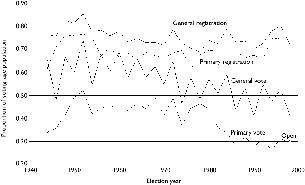
Figure 9.1. Turnout and registration in primary and general elections in California, 1944–98.
What is of immediate interest is whether the blanket primary delivered on the promise of increasing voter participation. Primary turnout in 1998 was 29.8 percent, just slightly lower than the 31.1 percent in 1996. If one compares prior midterms, though, 1998 represents a positive swing. The years 1986, 1990, and 1994 saw primary election turnout rates of 28.1 percent, 28.0 percent, and 26.2 percent, for an average of 27.4 percent. Hence, one can interpret 1998 as having shown a roughly 2.4 percent surge in primary turnout. Note, however, that this surge did not carry over to the general. Also note that the blanket primary almost automatically guaranteed some rise in turnout, since it expanded voting opportunities for about 1.8 million voters who were registered, but not affiliated with any party. These voters could have made the trip to the polls under a closed system, but they were not permitted to participate in partisan primary races, so only ballot initiatives and local elections beckoned. Without a breakdown of participation by registration status, we cannot say definitively if the new primary law increased participation rates in any partisan subgroup, or simply expanded the reasons to show up for a new bloc of voters, who then participated in about the same numbers as did others. Quick calculations show that the numbers are, at least, consistent with this latter interpretation. If about 27.4 percent of registered partisans turned out to vote in the
Did the change in primary law increase registration? Figure 9.1 shows that primary registration rose dramatically in 1994, and then slipped downwards in 1996 and 1998. But the main effect of letting independents participate more fully in primaries could be a rise in nonpartisan registration. Voters with fairly weak attachments to parties might, in the past, have opted to register with parties all the same, in order to maintain access to primary ballots for partisan offices. At 1.86 million, nonpartisan registration was at its highest ever total in 1998. As a share of the voting age population, this is about 9 percent. But while the trend is upwards, 1998 does not exhibit a sharp or dramatic rise. Nonpartisan registration has been increasing slowly since 1988, and the 1998 value is consistent with a mildly positive slope over these six elections, suggesting that it did not increase by an unexpectedly large amount.
Survey data, comparisons with other states, and investigation of turnout and registration values at the county and congressional-district level with controls for such factors as closeness of the races, might flesh out this picture. However, without this more elaborate analysis, it does not appear that Proposition 198's immediate impact on participation rates was very dramatic, and so we will turn our attention to other forms of (possibly strategic) behavior. The next section turns to another of the previously delineated claims about the impact of the blanket primary by discussing candidate entry and competitiveness.
Candidates and Competitiveness in the Spring and Fall
Evaluating the competitiveness of a race is a deceptively complicated task. After the fact, one can easily observe how close a given election turned out to be. Under plurality rule, the margin of victory is an adequate measure of competitiveness in two-candidate races, and multicandidate contests are only a little more difficult to characterize. But a larger issue is that all afterthe-fact measures ignore campaign dynamics completely. Implicitly or explicitly, one invokes some variety of rational expectations assumption when taking the final observed closeness as an indicator of how competitive was a race at the outset and over the course of the campaign.[3] If one's interest
Tables 9.1 and 9.2 show descriptive statistics on California's primary and general elections in the 1990s. The tables contain a large amount of information, and do not instantly convey a simple story. But the trends apparent on inspection run counter to the suggestion that 1998 might have been a year of close races. The ultimate in noncompetitive elections is the uncontested race. In all four 1990s elections, some seats have been completely abandoned by one of the major parties, and others have seen one or both major party nominations won without any challenge. Considering the two major parties' contingents separately, 1998 saw more, rather than fewer, uncontested races than its predecessors. More than half the districts had no more than one Republican candidate, and nearly three-fourths saw no competition for the Democratic nomination. In a blanket primary, there is a clear incentive for voters to participate in a race in which there is actual competition, since, despite the appearance of competition in a multicandidate ballot, any candidate unchallenged within her party is guaranteed to advance to the general election (provided she secures at least one vote). Strategic-minded Californians, though, were thwarted by a paucity of genuine races. In only one district did more than one candidate seek any of the minor parties' nominations: there were two Libertarians running in the First District. In twenty-nine of the fifty-two districts, at least one of the major parties' nominations was contested, but only eight seats saw races on both sides.[4]
Were those races that did involve competition closer than usual? On the Republican side, the election that stands out as most competitive in this set is 1992. The average number of candidates, the average "effective" number of candidates, and the victors' margins over second-place finishers are generally similar for 1994, 1996, and 1998.[5] By contrast, 1992 is an unusually close election in all these respects. The Democratic picture is more striking still: 1998 is the odd election out, but it is less, not more, competitive than the others. Fewer total candidates competed in open and Republican-held seats, the vote was more concentrated in those seats, and margins of victory were abnormally high (in open and in Republican-held seats), or else unchanged (in Democratic-held seats). In short, by a variety of measures, to the extent that the 1998 primaries stand out, it is for their reduced
| Year | Status | n | Republican Primary | Democratic Primary | ||||||||
|---|---|---|---|---|---|---|---|---|---|---|---|---|
| Uncontested Races | Contested Races | Uncontested Races | Contested Races | |||||||||
| No Candidates | One Candidates | N | Ne | Average Margin | No Candidates | One Candidates | N | Ne | Average Margin | |||
| NOTE: For 1998, the columns headed Republican Primary and Democratic Primary show the Republican field of candidates and the Democratic field of candidates, in open primary. | ||||||||||||
| 1992 | Republican incumbent | 16 | 0 | 2 | 2.7 | 2.1 | 38% | 1 | 7 | 3.6 | 2.9 | 21% |
| Democratic incumbent | 21 | 3 | 9 | 3.2 | 2.6 | 16 | 0 | 14 | 2.4 | 1.6 | 60 | |
| Open | 15 | 1 | 3 | 6.1 | 4.1 | 11 | 0 | 2 | 5.7 | 3.6 | 20 | |
| 1994 | Republican incumbent | 20 | 0 | 9 | 2.5 | 1.8 | 49 | 0 | 8 | 2.5 | 2.2 | 26 |
| Democratic incumbent | 29 | 2 | 9 | 2.8 | 2.2 | 27 | 0 | 15 | 2.3 | 1.5 | 60 | |
| Open | 3 | 0 | 1 | 4.5 | 2.5 | 22 | 0 | 0 | 4.0 | 2.5 | 12 | |
| 1996 | Republican incumbent | 25 | 0 | 16 | 2.1 | 1.6 | 54 | 0 | 17 | 2.8 | 2.2 | 28 |
| Democratic incumbent | 24 | 0 | 9 | 2.7 | 2.3 | 28 | 0 | 18 | 2.2 | 1.5 | 57 | |
| Open | 3 | 1 | 0 | 2.0 | 1.5 | 58 | 0 | 0 | 6.0 | 3.8 | 15 | |
| 1998 | Republican incumbent | 22 | 0 | 13 | 2.8 | 1.6 | 64 | 5 | 13 | 2.0 | 1.6 | 46 |
| Democratic incumbent | 26 | 4 | 11 | 2.6 | 2.1 | 28 | 0 | 20 | 2.2 | 1.5 | 61 | |
| Open | 4 | 0 | 1 | 3.9 | 2.7 | 20 | 0 | 0 | 2.6 | 1.7 | 50 | |
| Year | Status | n | Uncontested Races | Contested Races | |||
|---|---|---|---|---|---|---|---|
| No Republican | No Democrat | N | Ne | Average Margin | |||
| 1992 | Republican incumbent | 15 | 0 | 0 | 3.5 | 2.2 | 19% |
| Democratic incumbent | 21 | 2 | 0 | 3.4 | 1.9 | 38 | |
| Open | 16 | 0 | 0 | 3.9 | 2.2 | 20 | |
| 1994 | Republican incumbent | 20 | 0 | 0 | 3.4 | 1.9 | 32 |
| Democratic incumbent | 29 | 2 | 0 | 1.9 | 1.9 | 28 | |
| Open | 3 | 0 | 0 | 2.7 | 2.0 | 16 | |
| 1996 | Republican incumbent | 25 | 0 | 0 | 4.3 | 2.1 | 24 |
| Democratic incumbent | 25 | 0 | 0 | 3.3 | 1.8 | 41 | |
| Open | 2 | 0 | 0 | 5.0 | 2.3 | 6 | |
| 1998 | Republican incumbent | 21 | 0 | 5 | 3.3 | 1.9 | 30 |
| Democratic incumbent | 26 | 4 | 0 | 3.2 | 1.7 | 50 | |
| Open | 5 | 0 | 0 | 4.2 | 2.1 | 18 | |
The general election results are not as clear. Again, 1998 saw unparalleled numbers of uncontested races, which runs directly contrary to the prediction of closer competition. Where there were contested races, on the other hand, there is no general trend in either the number of candidates or the victors' vote margins. These data, in short, do not suggest that 1998 was an unusually competitive year in California's general election races for the U.S. House.
Of course, the change in primary election law is not the only feature that sets 1998 apart from prior election years. The national environment has varied over the four 1990s elections, and such factors as the number of incumbents retiring, how parties qua parties were faring in popularity, and so on may be important explanations of the results described in tables 9.1 and 9.2. We separated seats according to their incumbency status for that very reason, but it might also be useful to set California into national context to evaluate whether or not its U.S. House races were, in any sense, more competitive in 1998. Accordingly, we reconsidered the general election data for the U.S. House using a fixed-effects panel data model designed to decompose election returns into normal district vote, incumbency advantage, candidate quality effects, and national partisan swings.[6] The virtue of this model is that it separates all of the major forces that shape election returns, allowing one to distinguish between such phenomena as rising

Consider California's First District, a marginal seat that has twice changed party hands in the 1990s. When applied to the 1992–96 returns, our model estimates a (detrended) normal Democratic vote of 50.4 percent there, implying that the seat is almost exactly a toss-up in expectation. Adding the 1998 returns revises this estimate upward to 54.4 percent, suggesting substantially less competitiveness. By contrast, the same figures for the Second District (a Republican stronghold continuously held by Wally Herger in the 1990s) are 38.0 percent and 40.0 percent, respectively. Hence, incorporating 1998 returns increases our measure of expected competitiveness for that district, which is, by either value, a fairly safe Republican seat. Both of these changes were exceptional in their magnitudes: no district saw a larger gap in the two normal vote estimates than did the First, and the median change in California was just under 1 percent. Our interest here is in whether the normal votes shifted to being more or less competitive across the state. Averaging over all fifty-two California districts, the net change brought about by characterizing the present California electoral map on the basis of 1992–98 general election returns rather than 1992–96 general election returns is a small increase in competition. The mean absolute value of (50 percent—estimated-normal-vote) using 1992–96 is 10.0 percent. Adding 1998 lowers this value to 9.7 percent. The medians are, respectively, 9.5 percent and 9.1 percent.
These numbers suggest a very small aggregate movement towards greater competition. However, two final points merit mention. The comparable values for the remainder of the country are similarly signed, but higher: the average change across all other states was from 9.5 percent to 9.1 percent (means) or 8.3 percent to 7.8 percent (medians). Second, differences in estimated incumbency-and experience-advantage parameters were far more striking. The specification that fits the data best resulted
Campaign Finance
In examining competitiveness, we focused on the ultimate result of the electoral process. It is possible, of course, for various aspects of electoral behavior to change without substantially altering the outcome. A change in electoral law might, for example, induce various alterations in strategy or behavior that offset one another. We have already examined mass participation, candidate entry, and vote dispersion, and 1998 did not distinguish itself from years past on these fronts. However, we have yet to consider a set of actors especially likely to be sensitive to changes in the institutional environment: campaign contributors. These actors are especially likely to react quickly to electoral law change because they are generally elite figures who pay more attention than most to politics and the electoral process. Moreover, the contributors are not the only players in campaign finance. Instead, campaign finance involves three kinds of actors: candidates for offices, individual members of the public who make financial contributions, and elite contributors such as PACs and parties. The distinction between the latter two, at least implicitly, underlies much of the rhetoric about "special interests" so popular in the debate on Proposition 198. When the primary system changes, all of these actors may have incentives to change their behavior in order to capitalize on the new rules. Hence, this political venue seems particularly prone to exhibiting immediate change following the opening of the primary.
For candidates, the blanket primary seems most likely to affect this firststage
We might expect the consequences of the larger potential electorate base to vary for candidates in different types of strategic situations. Since the results of the blanket primary remain the same—that is, the leading vote-getters from each party advance to the general—the change in the primary law is not necessarily great. Candidates in marginal seats face virtually the same situation. The more competitive the general election is expected to be, the more alluring the primary is for ambitious candidates. Hence, one expects competitive, expensive races in both major-party nomination battles, ceteris paribus. It is not evident that admitting independents or permitting cross-party voting should alter this situation.
By contrast, in seats in which one party is not usually competitive in the general election, there are incentives for voters to increase their influence by voting in the other party's more consequential election.[8] Hence, candidates in safe districts could face new uncertainty under the blanket primary system because of the expanded electorate. This uncertainty does not translate to the general election, which remains a foregone conclusion. But the larger and more diverse electorate might come into play in the primary races in a way that sometimes increases the competition. So, while a candidate such as Maxine Waters, a liberal Democrat with a very safe seat, will win any election over a Republican, she must contend with other Democrats for the nomination. To the extent that independent and Republican primary voters are disinclined to vote for her and more inclined to vote for any candidate who is more moderate, her reelection chances (and the chances of candidates like her) should fall under a blanket system. Adding non-Democrats to the potential Democratic nomination electorate should only make relatively extreme, safe-seat Democrats vulnerable, assuming that many will prefer to participate on the Democratic side in the primary when the Republican is basically not electable in the general. And, of course, parallel logic would apply to safe Republican seats.
Our first look at the data on California campaign finance in the 1990s
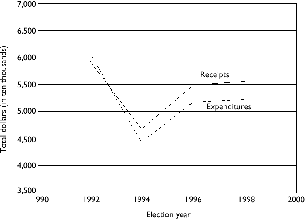
Figure 9.2. Total receipts and expenditures in U.S. House races, 1992–98.
Figure 9.3 displays total PAC contributions in California's U.S. House races between 1978 and 1998. Much like the receipts and expenditures plot, this graph is not very striking. PAC funding seems to be on the rise, and the 1998 value fits comfortably within the general pattern. If we anchor the dollar at its 1988 valuation and adjust the other years for inflation, the pattern is the same, and the trend is even less spectacular. This time, the only plausible candidate for outlier status is 1992: PAC funding increased by over 50 percent between 1990 and 1992. The 1.2 percent rise from 1992 to 1994 paled in comparison. Even the 10.7 percent rise from 1994 to 1996 was not as striking. Most important for present purposes, the 8.1 percent increase in 1998 is well in line with previous trends. Hence, while PAC funding did increase following the change in primary law, the change was neither unusually large nor outside the expected pattern. The Proposition 198 campaign rhetoric about special interests, then, seems to be
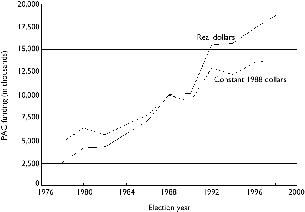
Figure 9.3. Total PAC funding of U.S. House races in California, 1978–98.
Special-interest money is, of course, only one component of campaign finance. Individual contributors also have incentives to change their behavior and contribution patterns. Initially, determining whether individual contributors have changed their behavior may seem to be an easy task, but the rules underlying campaign contributions are surprisingly complicated. It is thus not trivial to determine how individual contributors have reacted to the new primary. At the outset, a simple hypothesis to test is that the new primary system has resulted in contributions being shifted to the earlier part of the election cycle. After all, in order to see one's favored candidate in the general election, one needs to ensure that this candidate emerges from the primary election, now with a potentially larger electoral base. One way to make this more probable is to pile money into a candidate's war chest early.
There are three ways in which one might observe individual contributors shifting their activities toward primary elections. Because of FECA limitations, contributors are limited to giving a total of $2,000 during an election cycle, $1,000 in the primary and $1,000 in the general election, where each contribution is earmarked for a specific election. However, many contributors simply want to contribute the maximum amount to a certain candidate. Hence, while these contributors earmark $1,000 of their total $2,000 donation for the primary election, they do not necessarily want the candidate to spend $1,000 in the primary and $1,000 in the general. If the candidate were Maxine Waters, for instance, she could use her money most
Since each contribution is accompanied by the date of the contribution, a method that bypasses these problems is to separate the data by the primary date. Those contributions given before the primary can be counted as contributions that were intended for use in the primary, while contributions given after the primary obviously were not meant to be primary donations, even if they were thus earmarked. It is, in fact, not unusual for candidates to receive money after the general election that is earmarked for the primary election. This money is clearly not meant to be spent directly in a primary bid, and candidates are free to use this money to pay off campaign debts.
A final option for the researcher is to combine the first two approaches, placing the contributions into four categories: given before the primary and earmarked for the primary; given after the primary but earmarked for the primary; given before the primary but earmarked for the general; and given after the primary and earmarked for the general. This last option, while not flawless, provides a good compromise between the other options.
We present the results of our analysis in table 9.3. The dependent variable in these models is the proportion of all individual contributions that was both earmarked for and given before the primary election.[9] The only exception is the column labeled "1996 (June)," where the dependent variable is the proportion of funds that were contributed before June 2, 1996. In 1996, the primary date was moved forward to March in what turned out to be a futile bid to increase California's influence in the races for presidential nominations. The primary in all of the other years occurred in June. We used this modified dependent variable for 1996 to simulate an unchanged primary environment for that year. The data in column 1 comprise all contributions from the period 1992–98. For subsequent columns, the data are year-specific.
The independent variables in the models are the number of candidates in the primary, a dummy variable indicating if there was at least one quality opponent in both the primary and general, a dummy variable indicating whether the seat was open in the general, a measure of district partisan advantage, and a dummy variable indicating whether the election involved a blanket primary. Candidate quality is operationalized simply: any individual who has ever held any electoral office is a quality candidate (Jacobson 1987). The variable labeled "District partisan advantage" is a signed difference between our estimate of the district's normal vote and 50 percent.[10]
| 1992–98 | 1992 | 1994 | 1996 | 1996 (June) | 1998 | |
|---|---|---|---|---|---|---|
| NOTE: The table reports OLS regression estimates. The dependent variable is the proportion of primary contributions. Standard errors are in parentheses. | ||||||
| p < .10 | ||||||
| p < .05 | ||||||
| Intercept | 0.491[**] | 0.545[**] | 0.463[**] | 0.479[**] | 0.616[**] | 0.550[**] |
| (0.025) | (0.046) | (0.044) | (0.054) | (0.053) | (0.057) | |
| Number of candidates in primary | −0.008 | −0.022 | 0.018 | −0.015 | −0.023 | −0.034 |
| (0.008) | (0.012) | (0.018) | (0.024) | (0.23) | (0.026) | |
| Quality opponents in primary | 0.040 | 0.002 | 0.016 | 0.135 | 0.114 | 0.035 |
| (0.053) | (0.070) | (0.108) | (0.164) | (0.163) | (0.171) | |
| Quality opponents in general | −0.098[**] | −0.080 | −0.164[**] | −0.089 | −0.070 | −0.094 |
| (0.030) | (0.056) | (0.054) | (0.071) | (0.070) | (0.064) | |
| Blanket primary | 0.008 | |||||
| (0.027) | ||||||
| Open seat in general | −0.018 | 0.056 | −0.022 | −0.141 | −0.144 | −0.112 |
| (0.039) | (0.059) | (0.111) | (0.126) | (0.125) | (0.079) | |
| District partisan advantage | 0.88[**] | 1.160[**] | 0.872[**] | 0.413 | 0.578[*] | 0.943[**] |
| (0.135) | (0.252) | (0.227) | (0.308) | (0.307) | (0.306) | |
| N | 412 | 91 | 95 | 92 | 92 | 81 |
| R2 | .32 | .39 | .49 | .16 | .19 | .38 |
The sign is positive if the district generally favors the party of the candidate in question and negative if that candidate's party's normal vote falls below 50 percent. Our observations are all major-party candidates who competed in the general elections.
The model that pools the data for 1992 through 1998 indicates that the change to a blanket primary system did not significantly alter what proportion of individual contributions were given for the primary election, since the blanket primary dummy variable is not significant. Contrary to the arguments of both the proponents and the opponents of Proposition 198, the new primary system apparently had little effect on the timing of contributions. This is a striking result that runs counter to initial expectations and preelection rhetoric. It is also striking in that the results indicate that the 1996 election, not the 1998 election, is the outlier. As we can see from table 9.3, the differing proportion of contributions intended for the primary can be explained by the same variables for each year except 1996. For 1996, none of the independent variables explains the variation in contribution timing. Moreover, the R2 value is significantly lower for both 1996 models than it is for any of the other years.
As noted previously, the most obvious difference between the 1996 election and the others is that 1996 saw a much earlier primary date. So, while the change in primary type did not have a significant impact, the timing of the primary apparently does. Timing, then, trumps institutional design in its ability to alter the proportion of funds available for use in the primary. This claim is further bolstered when we note that the results in the column labeled "1996" are less similar to the results of other years than the results in the column labeled "1996 (June)." In the latter column, we artificially "moved" the 1996 primary date to June to coincide with the other years. That is, we counted all donations prior to June 2, 1996 as primary donations. Further analysis is warranted, but this preliminary inspection suggests that timing is at least as significant as the details of the electoral formula.
Lastly, one might expect individual contributors to behave differently in different types of races. In other words, the funding dynamic may be dissimilar between races for safe seats and competitive races. Certainly candidates running in safe seats generally receive less funding than candidates running in competitive districts. Their constituents and supporters understand that they simply do not need the money. However, the change to the blanket primary may have altered this strategic situation in the aforementioned manner.
In order to test this hypothesis, we separated the data into two sets: safe seats and competitive seats. We defined a competitive seat as one in which the normal Democratic vote was either above 60 percent or below 40 percent. We then ran regressions with the same independent variables that were reported in table 9.3. Again, the 1998 elections did not distinguish
CONCLUSION
As a general matter, identifying the precise effects of various features of electoral law proves difficult. Neither the formal, deductive nor the empirical, inductive literatures on the effects of election law is particularly rich with consensus findings. Debating the veracity, logic, and applicability of Duverger's law, a fairly simple and high-level claim, has kept scholars occupied for decades. Not coincidentally, politicians do not often introduce self-interested reforms in electoral procedures, even when they unambiguously have the power to do so. They may fear a public backlash from too obviously loading the dice, or they may regard electoral institutions as too unpredictable to be manipulated easily. Certainly, examples of changes in electoral law that either failed to produce the predicted outcomes or even backfired by producing unanticipated consequences are not hard to find. In recent years, Italy, New Zealand, and Israel have all made major changes in their national election rules without achieving their respective goals. New Zealand's politics have become less stable, not more so; Italy managed to accentuate its already exceptional partisan fragmentation; and Israel perversely increased the influence of very small parties.
Compared to those efforts, California's alteration of primary election rules was minor. The laws governing general elections were unchanged, and the primary was still based on plurality rule. Should the introduction of fully open (blanket) primary rules have been expected radically to alter the elections, directly at the primary stage or indirectly at the general stage? We regard this "open" question as an open question. Here, we have not dwelt on the logics of optimal behavior under the old and new rules. Instead, we have shown that the most publicized predictions about how the new rules would play out in terms of voter turnout, competitiveness, and campaign finance do not seem to have been realized in the first (and only) trial. There does not seem to have been much change in turnout, so, conditional on the behavior of elites (that is, decisions to run, and campaign styles), the masses do not seem to have changed behavior in this regard. The primary elections were not especially close—they may even have been a little less close than normal. Neither did they feed into newly competitive general elections.
Campaign finance is a complicated world, and inferences about changed behavior are, again, perilous, given that one can provide supply-or demand-side explanations for any trend. Moreover, the supply side includes sophisticated elite actors like PACs as well as ordinary citizens acting on small scales and in (relative) isolation. Again, though, our preliminary analysis
Our conclusion from this analysis, then, is that the blanket primary was a barely noticed and largely irrelevant innovation in California. We should close, though, by hedging our bets in two ways. First, there may be some respects in which the opportunities to cross over or otherwise support another party that a blanket primary presents did make a difference. For example, we eschewed analysis of the ideologies of candidates here, and so we cannot rule out that the potential broadening of the primary electorates did encourage moderation by some of the candidates. Second, election law, it is worth reiterating, is arcane. There is good reason to believe that equilibria may not be quickly discovered. It may take several elections for even elite actors to catch on to the subtle features of a change in rules. It has, after all, taken scholars many decades to formalize properties of election rules—two hundred years elapsed between Condorcet's paradox and the Gibbard-Satterthwaite Theorem! So it may be premature to declare the rules governing primary type irrelevant. One must observe a series of runs under the blanket primary rules to know how behavior settles. Of course, the Supreme Court has now ensured that there will be no such series. Nonetheless, California's experiment in electoral law change is ongoing, and so will remain of interest to political scientists, journalists, and other political junkies, who can celebrate this variance in election law even while carefully qualifying any conclusions they draw about its consequences.
NOTES
Thanks to Mike Alvarez, Bruce Cain, and Elisabeth Gerber for valuable comments. Gaines began work on this project while visiting the Department of Applied Economics at the Katholieke Universiteit Leuven, and thanks KUL for its hospitality. Oana Armeanu, Paul Diperna, and Rebecca Harris provided helpful research assistance.
1. The relevant provisions of the Elections Code date from the Political Reform Act of 1974.
2. The data plotted in figure 9.1 are taken from Jones 1998a, vi, and Jones 1998b, v.
3. Even professional election observers sometimes forget that landslides such as
4. An interesting fact about voter behavior—but an unimportant fact with regard to final outcomes—is that minor-party support soared in 1998. Since independents decline to register not only with major parties, but also with minor parties, there is no reason to expect them to favor small parties disproportionately. Yet, the minor party primary vote went from about 0.9 percent in 1996 to about 5.3 percent in 1998. It fell in only eight districts, and rose in the other forty-four, despite the almost complete lack of actual competition for these nominations in the U.S. House districts (most statewide-office races featured two Peace and Freedom Party candidates).
5. The "effective" number of candidates is an index that weights the number of actual candidates according to their vote shares, so that strong candidates count far more than do very weak ones. We used the most common such measure in the voting literature, the Laakso-Taagepera index (1979), computed district by district. The averages shown in tables 9.1 and 9.2 are computed as:

6. The normal vote is rooted in a conception of elections being subject to shortterm and long-term forces. The former include regional swings to and from given parties on the basis of timely issues as well as district-level forces particular to given elections. Prominent in this latter category are any candidate effects, such as an incumbency advantage or a friends-and-neighbors advantage a candidate enjoys in his or her hometown or region. The major long-term determinant of election returns is the normal vote, the expected breakdown of vote shares when the parties field comparable candidates and there are no election-specific tides favoring one party or the other.
7. See Gaines and Rivers (1994) for technical details on this model and its derivation. Gaines (1998) uses a similar model to analyze British elections, while Levitt and Wolfram (1997) adopt the same basic approach in their analysis of incumbency advantage in the U.S. House. In this application, we omitted Louisiana data completely (because of its odd electoral law and paucity of general elections); dropped all uncontested races; excluded two districts—South Carolina's Second and Florida's Twenty-First—from the first run because they had no contested elections in those three general elections; and dropped Vermont's at-large district, where a non major-party Representative (Bernie Sanders) was both the incumbent and the winner in all four 1990s elections.
8. We have in mind a voter's subjective sense of influence rather than the miniscule objective probability of one's vote actually counting by making or breaking a tie.
9. The primary dates were June 2, 1992; June 7, 1994; March 26, 1996; and June 2, 1998. Analysis shows that models with this version of the dependent variable yield coefficients that lie between the coefficients obtained by the other two methods (i.e., using only the earmarking information, or using only the timing information to identify those contributions intended for the primary).
10. 10. Our method of estimating the normal vote is described in the preceding section.
REFERENCES
Birtel, Marc. 1996. “Ballot: ‘Jungle Primaries' Adopted … Reclassifying Lions Rejected.” Congressional Quarterly Weekly Report54,no.13(March 30):902–3.
Birtel, Marc. 1998. “Changing Demographics Keep Orange County in Play.” Congressional Quarterly Weekly Report56,no.21(May 23):1371–74.
Block, A.G., and Claudia Buck, eds.1997.California Political Almanac 1997–1998.5th ed. Sacramento, CA: California Journal/State Net.
Cox, Gary W., and Michael C. Munger. 1989. “Closeness, Expenditures, and Turnout in the 1982 U.S. House Elections.” American Political Science Review83,no.1(March):217–31.
Dubin, Michael J.1998.United States Congressional Elections, 1788–1997.Jefferson, NC: McFarland.
Elving, Ronald D.; Inces Pinto Alicea; and Jeffrey L. Katz. 1992. “Boxer and Feinstein Victorious in ‘Year of the Woman.'” Congressional Quarterly Weekly Report50,no. 2 3 (June 6):1621–31.
Gaines, Brian J.1998. “The Impersonal Vote? Constituency Service and Incumbency Advantage in British Elections, 1950–92.” Legislative Studies Quarterly23,no.2(May):167–95.
Gaines, Brian J., and Douglas Rivers. 1994. “Incumbency Advantage in the House and Senate.” Working ms. Stanford University.
Gerber, Elisabeth R., and Rebecca B. Morton. 1998. “Primary Election Systems and Representation.” Journal of Law, Economics, and Organization14,no.2(October):304–24.
Jacobson, Gary C. 1987.The Politics of Congressional Elections.2d ed. Glenview, IL: Scott, Foresman.
Jones, Bill. 1998a.Statement of the Vote: Primary Election, June 2, 1998.Sacramento, CA: Office of the Secretary of State, Elections Division.
Jones, Bill. 1998b.Statement of the Vote: General Election, November 3, 1998.Sacramento, CA: Office of the Secretary of State, Elections Division.
Laakso, Markku, and Rein Taagepera. 1979. “Effective' Number of Parties: A Measure with Application to Western Europe.” Comparative Political Studies12,no.1(April):3–27.
Levitt, Steven D., and Catherine D. Wolfram. 1997. “Decomposing the Sources of Incumbency Advantage in the U.S. House.” Legislative Studies Quarterly22,no.1(February):45–60.
Levitt, Steven D., and Catherine D. Wolfram. “March 26 California Primary Results.” Congressional Quarterly Weekly Report54,no. 13(March 30):908–11.
McGillivray, Alice V.1995.Congressional and Gubernatorial Primaries 1993–1994.Washington, D.C.: Congressional Quarterly.
McGillivray, Alice V. “Primary Results.” 1998.Congressional Quarterly Weekly Report56,no.23(June 6):1547–52.