
IX. “Let's Visit Scripps”:
The Thomas Wayland Vaughan
Aquarium-Museum
A public aquarium has been a feature of the Scripps Institution since before it was an institution, because the members of William E. Ritter's summer study sessions, which began in 1892, always had a few display tanks for interested visitors. When the Marine Biological Association of San Diego set out to establish Scripps Institution in 1903, they listed as one of their objectives: “to build and maintain a public aquarium and museum.”[1]
In 1905, in the “little green laboratory behind the bath house” in La Jolla Cove park, a few shelves were set aside for a museum display, and a central counter held open containers of live specimens (some of which vanished with visitors). Five years later the public aquarium was located on the ground floor of the institution's first permanent building, the George H. Scripps Laboratory.
In 1915 a separate public aquarium was built, a wooden building 24 feet by 48 feet, just north of Scripps Laboratory; it held 19 aquarium tanks, in capacities from 96 to 228 gallons. The following year the museum, previously located on the second floor of Scripps Laboratory, was moved into the ground floor of the newly completed library
Barnhart's usual technique of acquiring exhibits for the aquarium was by fishing from the pier. In the 1930s some specimens were gathered from the Scripps and the E. W. Scripps, and, during World War II when the institution had no ship, Barnhart kept a trap set off the end of the pier for gathering new material.
As early as 1925 the curator was complaining, in his annual reports, that the aquarium tanks were gradually disintegrating, and that “bad water, cracked glasses and broken tanks [were] a constant source of worry and aggravation.” He pointed out that the wooden structure had been intended only as a temporary site for the aquarium. In 1931 he added that the museum location would soon be required by the library.
So — while repairing tanks, making plaster casts of some large fishes and skin mounts of others, storing the biological collections, walking through the aquarium at nine each night and at five each morning to check for leaks and other problems, building new shelving, writing a book on the fishes of southern California, and answering visitors' questions — Barnhart also dreamed of the ideal aquarium-museum. His vision was a building in which brightly lighted display tanks would form a periphery around a central museum room. That vision became the design theme of the new aquarium-museum.
Barnhart retired in 1946, while his dream was still only in the planning stage, and Sam Hinton, who had joined the staff a few months earlier, became the next curator.
Hinton is a versatile person: folk singer, illustrator and artist, reptile fancier, curator (versatile there too, for one post was with a desert museum and the other with the marine aquarium), and helpful adviser to high school students. His first job in San Diego was as editor and illustrator at the University of California Division of War Research (see chapter 2). In his 18 years at Scripps, besides handling the aquarium duties, Hinton answered the endless questions of visitors, served as the public information office for news media, and designed the lighted exhibit explanations above the aquarium tanks. He also drew many a certificate for a Scripps expedition, equator crossing, or any other special occasion. On outside time he became a nationally renowned folk singer, and he has livened many local occasions with folk songs from around the world and with an occasional ditty of his own, all cleverly presented.
Hinton began at his new post in 1946 with planning the new building. This led him into “meetings with the University architects and engineers, extensive correspondence with museum people in all parts of the country, research in the literature on the subject, and direct observation of the behavior of visitors in the present museum and aquarium.”[3] Hinton also collected specimens from the E. W. Scripps, and he obtained others from local commercial fishermen. He and Claude Palmer, the only other aquarium employee then, gathered sand crabs and red worms to supplement the fish purchased to feed to the aquarium inhabitants. When the Pacific Division of the American Association for the Advancement of Science met in San Diego in 1947, Hinton gathered enough fresh fish for a fish fry, and he directed a grunion hunt for the group afterward.
The new aquarium-museum building was completed and occupied in October 1950. Its dedication was hailed as a major occasion and was set for the University's Charter
Hinton, who had put considerable thought into the planning, later qualified the result:
… The staff of this Aquarium-Museum is very well satisfied with our aquarium, but there are a few things that we should do differently, given the opportunity. Perhaps one of the strongest restraining factors in the design of aquariums is the fact that so few people ever have the chance to design two of them![5]
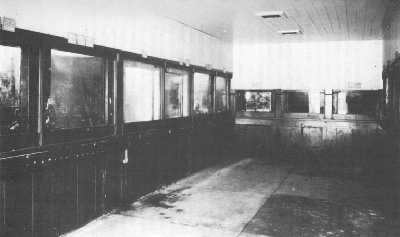
The old aquarium as it appeared in 1933, when it was, to Percy S. Barnhart, “a constant source of worry and aggravation.”
The new building was three times the size of the previous space for the aquarium and museum, but not all of
As the Aquarium-Museum has never been supported by research funds, attempts to make it self-supporting have periodically led to the suggestion of charging admission. Hinton wrote eloquently against the idea in 1954:
… Many La Jollans have a proud sense of proprietorship in the Scripps Institution, and enjoy bringing their visitors to see “their” aquarium and museum. For example, last summer when we had trouble with our water supply, and were losing fish steadily, a number of local people made daily visits as if to a sickroom, inquiring anxiously as [to] the welfare of our creatures. Many local youngsters start nearly every summer day with a routine tour of inspection of the aquarium; these boys and girls are always delighted with new specimens and new exhibits, and frequently conduct their parents on guided tours on weekends. Lots of groups of families organize beach picnics and parties with the Aquarium as a meeting place; a tour of the place before and after is usually the order of things. These examples of the public attitude are individually small, but they add up to the fact that we enjoy a position of high prestige, and are considered by the community as a whole as part of the civic family. It would be most regrettable if this standing were to be lowered, as I feel it would be if each person were required to pay for admittance. It is surprising to realize that a considerable amount of
― 191 ―bitterness still exists because of our having closed the pier to public fishing, nearly fourteen years ago[*][*] The Scripps pier was a favorite public fishing spot from the day it was built in 1915 until 10 December 1941, when wartime studies (and pier disrepair) put a stop to public fishing. An occasional oldtime La Jollan used to present his “lifetime” permit to fish from the pier, but these too were turned away.
; the exacting of a toll would arouse even more ill-feeling.[6]
The issue of charging admission was shelved at that time. Some proceeds were derived from the sale of books, shells, and postcards that Hinton instituted in 1953.
Carr Tuthill joined the staff as a museum preparator in 1952 and was later put in charge of the aquarium exhibits. Richard H. Rosenblatt became overall director of the Aquarium-Museum in 1961, and Sam Hinton continued in charge of the museum displays until 1964, when he transferred to the UCSD office of relations with schools. In January 1965, Donald W. Wilkie became director of the Aquarium-Museum.
A native of Vancouver, British Columbia, Wilkie had taught mathematics, science, and physical education in his native province before earning a B. S. in zoology and an M. S. in ichthyology at the University of British Columbia. He had served as assistant curator at the Vancouver Public Aquarium and curator in charge of mammals and fishes at the Philadelphia Aquarama before becoming director of the Scripps Aquarium-Museum. In his new post Wilkie soon established a laboratory for researches on fish ailments, with microscopes and “behind-the-scenes” aquariums for ailing or for new specimens. The aquarium staff has made significant contributions in diagnosing and curing the ailments of marine creatures and in the handling of them from sea to shore.
In addition to researches on ailments of aquarium fishes,
Sea-water aquariums are much more difficult to maintain than fresh-water ones. Corrosion of pipes, growths of barnacles and other fouling creatures inside the piping, toxic “red tide” blooms, compatibility of various creatures, and ailments and diets of the aquarium inhabitants create constant problems. Under Wilkie's direction, records have been kept of the food preferences and intake of the animals in every tank, and the water has been monitored daily. The use of sub-sand filters has provided more flexibility in the sea-water circulation, which helps to control red tide problems and makes it possible to maintain warm-water fishes throughout the year.
The score of illuminated display tanks, in several sizes up to 2,000 gallons, have presented a colorful array of inhabitants through the years. Recently the displays have been composed of natural habitat groupings, chiefly of the San Diego area and of the Gulf of California region, where a much more tropical fauna dwells. Much admired by visitors are the orange garibaldis, dubbed the “La Jolla goldfish,” and their blue-spotted young. An especially popular aquarium personage for some years was Harvey, a 100-pound grouper, who majestically circled a large corner tank from 1956 until his death in 1973. Morays, as they stretch open their mouths to display an array of needle-sharp teeth, draw awed gasps from viewers. At times sea turtles have swum the rounds of the larger tanks, and at least briefly one tank displayed highly venomous
Visitors sometimes fail to find the well-camouflaged flatfishes and skates against the matching sand. Certain sea anemones provide stunning color in some of the displays, and gracefully undulating nudibranchs — so unlike their relative, the garden slug — add natural artistry. Local fishermen like to compare notes on some of the species that they regularly catch. Whenever an octopus is among the inhabitants on display, it brings pause to most of the visitors, especially when it flashes through remarkable changes in color.
The sea-water line was renovated in 1964, to increase the capacity and improve the filtration system. Sea water for Scripps needs, including the aquarium, is drawn in from the far end of the pier, by means of two vacuum-assisted pumps that lift the water to a wooden trough that slopes to the landward end of the pier. It passes through a sand-bed filter and is then stored in two tanks near the aquarium building. From one the water flows by gravity through the Aquarium-Museum, the Experimental Aquarium, the Physiological Research Laboratory, Ritter Hall, and Scripps Building. From the other storage tank sea water is pumped up to the Hydraulics Laboratory and the Southwest Fisheries Center. At Wilkie's suggestion, a duplicate polyvinyl-chloride (PVC) line was installed on each section; these are used alternately, to hold the growth of barncles, mussels, and other clogging creatures to a minimum. Charles J. Farwell, who joined the aquarium staff in 1969, has, among his other duties, carried out studies on water quality and its control.
As a convenience to the public, a sea-water tap was installed at the landward end of the pier in 1972. Home aquarists stop there regularly to fill jerry cans, bottles, and buckets. One woman takes home sea water to use in cooking — and one man drives to Scripps twice or oftener each
An especially useful service of the aquarium personnel for many years has been the supplying of specimens to other Scripps researchers — some of whom are “softies and laboratory bound,” according to one of them, but dependent upon “a steady supply of live material for daily experiments.” Since 1966 Robert S. Kiwala has been the official collector, and he is often aided by aquarium helpers and other Scripps assistants in the gathering of several thousand marine specimens annually. This group can tell many tales of marine creatures that, for one good reason or another, they did not catch. Collecting trips by the aquarium staff have been as far afield as the Gulf of California, and sometimes collectors have joined more distant expeditions of other researchers. Much of the collecting has been carried out with the aid of Scuba gear in recent years. Rare specimens are sometimes exhibited and observed in the display tanks before they are preserved for the fish collection.
The Aquarium-Museum is the institution's door to the public. In 1950, while the present building was under construction, 50,000 visitors filed through the old wooden structure. One staff member estimated that at least two groups of school children each month were conducted through the aquarium. Within the first month after the new building opened, visitors from all 48 states and from Hawaii, Alaska, and the nation's capital had signed the visitor register. In fiscal year 1975–76 the numbers had reached 411, 914, plus 61,364 students in conducted school groups, from San Diego, from Tijuana and other points south, from Los Angeles and other points north and east.
When the issue of charging admission was again raised in the late 1960s, Wilkie suggested that a voluntary donation box be tried instead. This has proved satisfactory — indeed,
Wilkie has emphasized the educational role of the Aquarium-Museum. Soon after his arrival, he found himself inundated with 800 school children on one frantic morning. The solution, he felt, was a docent program, which he instituted — with one docent — in 1966. The docent group has expanded to number sixty or more each year. Since 1970 Patricia A. Kampmann, who was one of the first docents, has supervised the group. These enthusiastic volunteers primarily conduct school groups, but some visit classrooms and hospitals with displays, and others help with exhibit preparation, collecting, the sales desk, and even patrolling the Scripps Shoreline Reserve to advise visitors not to remove invertebrates from the protected area. The docents and the aquarium staff have prepared lesson packages for visiting school groups, which include study material to be used before, during, and after the group's tour of the aquarium and the museum.
In cooperation with area schools, Wilkie set up a career-training program for high school students interested in aquarium or marine biology careers. Several “graduates” of this program have become student employees at the aquarium, and some have gone on to advanced degrees in biology. The aquarium staff also offers short summer courses for several age groups of school children and organizes symposia on marine subjects for teachers.
The very popular Junior Oceanographers Corps (JOC), for students from fourth to twelfth grade, is also under the auspices of the Aquarium-Museum. Roger Revelle and Sam Hinton began it, originally as a means of allowing enthusiastic young fishermen to fish from the pier and as a source of specimens for the aquarium tanks. Hinton
The central museum area was given a major face-lifting in 1968, when, thanks to several generous donations from local citizens and businesses, it was possible to set up a large number of new exhibits in the rearranged central room. San Diego's Mayor Frank Curran presided at the ribbon-cutting ceremonies in August of that year.
To represent the variety of researches within oceanography, new exhibits are prepared frequently for the museum. Many oldtimers recall the large oarfish and other hand-painted specimens prepared by Percy S. Barnhart. In more recent years exhibits have illustrated and explained scientific concepts such as sea-floor spreading and ocean circulation, the undersea vehicles of the Marine Physical Laboratory, the programs of the Deep Sea Drilling Project and of Sea Grant, and such processes as wave motion and action (by means of a small wave tank). An unusually large manganese nodule has been displayed for many years. Models of the offshore bathymetry and of the submarine canyon that heads just beyond the Scripps pier have also been museum features for some time.
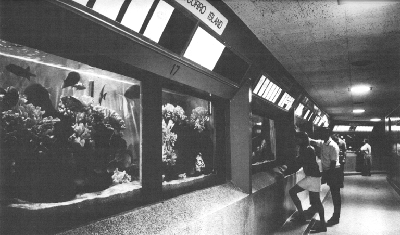
Looking down one corridor of the Vaughan Aquarium-Museum, early 1970s.
In the spring of 1975 the Aquarium-Museum opened its outdoor tide pool exhibit, which was based on a design by Wilkie and supervised by Farwell. The tide pool “rocks” were formed by pouring concrete into latex molds taken
Aquarium tenders learn to avoid the poisonous stonefish and lionfish, and the threatening gape of the morays (only Ben Cox regularly petted those, during his many years of feeding the fishes). They have found the octopus to be the most troublesome aquarium inhabitant, as it is inclined to wander. Several times octopi have been found on the floor by startled janitors or staff. Late one night a restless — or hungry — octopus crawled from his own tank into his neighbors', inadvertently dragging along his probably life-saving refrigeration unit. The neighbors were crabs, which the octopus was eating when discovered. A hastily called aquarium crew wrestled for twenty minutes with the 35-pound octopus, prying loose the 2,000 suckers of his eight arms. As they lifted him out of the tank, he reached back to snatch one last crab.
NOTES
1. Helen Raitt and Beatrice Moulton, Scripps Institution of Oceanography: First Fifty Years (Los Angeles: Ward Ritchie Press, 1967), 21.
2. Report of the Scripps Institution for Biological Research, 1 July 1916, in Annual Report of the President of the University of California for 1915, 222.
3. Aquarium-Museum report to the director, 1946–47.
4. La Jolla Light, 29 March 1951.
5. Brochure of the Vaughan Aquarium-Museum (May 1954), 1.
6. Memorandum to business manager C. Earle Short, 25 March 1954.