
8. The Nature of Work
“Do you see that?” said the Djinn. “That's your very own humph that you've brought upon your very own self by not working. To-day is Thursday, and you've done no work since Monday, when the work began. Now you are going to work.”
“How can I,” said the Camel, “with this humph on my back?”
“That's made a-purpose,” said the Djinn, “all because you missed those three days. You will be able to work without eating, because you can live on your humph; and don't you ever say I never did anything for you.”
Rudyard Kipling, Just So Stories, 1912
THE MORALITY OF WORK, THE ART OF LAZINESS
“Adopt the colonial pace, my friend, and you'll get along all right …. Never run if you can walk, never walk if you can stand, never stand if you can sit, never sit if you can lie down, and never do anything today you can put off until tomorrow. That's the colonial pace. Master it and things won't be so bad.”
Advice to a convict, Francis Lagrange and William Murray, Flag on Devil's Island, 1961
Oh Laziness, mother of the arts and noble virtues, be thou the balm of human anguish!
Paul Lafargue, The Right to Be Lazy, 1880
Returning from nature to culture and the ever-expanding island of civilization amid the forest, we must consider the quality of human action involved in transforming landscapes. The penal colony takes shape at a crucial moment in European colonial understandings of place and
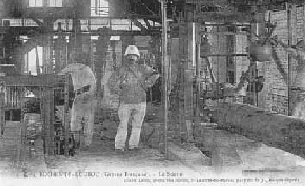
Figure 20. Postcard to Kourou sawmill, ca. 1900.
The axe has lightened these formerly impenetrable forests. It has fashioned the trees that now support elegant structures; precious and useful plantations spread in the midst of these deserts obstructed with unproductive vegetation. Convenient roads divide these newborn fields, dug by industrious hands; canals have received the excess waters and established internal communications; a working population displays its strength in these fertilized places; it fills the arms of the motherland with its trade and provides new food to its industry. Perhaps one day [this population] will be a great people when its Metropolis only offers a spectacle of ruins; and it will make way also, in the continuation of ages, to new nations that rise in their turn from its breast. Such is the work of colonization.[1]
Work represented the route to a better future, to the growth of new, valuable lands. Who, then, would lend backs and hands to the enterprise? If slavery were at an end, then the crucial question facing the colony was that of finding an alternative source of labor.
During the period of the early penal colony we see this search for new slaves, not only in French Guiana, but also throughout colonies built on the plantation model. Thousands of Asian Indians and Chinese found their way to new homes in different corners of the British Empire, serving as contract laborers on plantations. While the French were generally less successful at organizing intercontinental immigration, even in remote Guyane wave after wave of small groups arrived, in response to bureaucratic hopes that their bodies would prove industrious. The penal colony, of course, provided another long stream of captive travelers who were intended to serve both as plantation labor and as an army of industrious, rehabilitated peasants. Yet all these efforts and experiments failed in this particular margin; the plantations, which had been fading anyway, were not reborn, and a productive peasantry failed to materialize. French Guiana remained a land of tropical “deserts obstructed with unproductive vegetation.”
The situation was complicated by the reluctance of the former slaves to stay on the plantations and continue to support the system of largescale agricultural production for export. Indeed, the aversion of the newly freed population to any sort of agriculture or heavy labor beyond subsistence gardening is so striking that the historian Serge Mam-Lam-Fouck underlines it as an origin point for the stereotype of Creole “laziness” and “indolence” common in French Guiana. The fondness of the contemporary Creole population for bureaucratic positions, he argues, must be placed into a historical context, one in which “from the origins of colonial history until departmentalization, slavery, the utilization of overexploited immigrant labor as well as that of convicts, contributed to the devalorization of working the earth, in the eyes of the Creole. It represented, in effect, beyond the humiliation of the slave, the exploitation of the coolie and the downfall of the convict.”[2] The emerging Creole cultural traditions valued freelance gold mining over heavy agriculture and prized administrative positions when the gold rush faded. Even commercial possibilities, such as running a small store, failed to attract many Creoles, which opened the way for Chinese domination of the smallscale retail market.[3] Instead, Creoles in Guyane developed a reputation for idleness and lack of ambition, a stereotype alive among the contemporary Metropolitan population. While the details of this stereotype are particular to Guyane, its general outline conforms to a widespread colonial trope of the “lazy native” and to writings about tropical idleness. This theme, quite popular in its day, merits exploration, because it places that other pole of our concerns—nature—within the field of labor.[4]
CLIMATE, TECHNOLOGY,
AND THEORIES OF INDUSTRY
Whatever may be the cause, it is generally agreed that the native races within the tropics are dull in thought and slow in action.
Ellsworth Huntington, Civilization and Climate, 1915
“These uniforms are too heavy for the tropics, surely,” said the explorer.
Franz Kafka,“In the Penal Colony,” 1919
In addressing climatic theories of action, my purpose is not to revive old prejudices but rather to understand their connection to shifting conceptions of place and development. The worldview expressed in a division of the planet into natural zones of greater and lesser industry is not only an artifact of the politics of imperialism, it is also a statement about the “noncosmopolitanism” of humanity. In this view the social and cultural species would be just as limited as the biological species of our good doctor Orgeas; the human spirit would be held just as captive as the human body by place and milieu.
As an entry into these debates let us look more closely at an American classic of the genre, Ellsworth Huntington's Civilization and Climate, originally published in 1915.[5] Huntington opens his work by comparing races to varieties of trees, each of which brings forth different fruits of civilization. While one does not expect any given species to suddenly produce the fruit of another (a pear on a cherry branch), the quality of the fruit nonetheless depends on factors of the environment. From this point he moves logically to ask whether one can separate the effects of climate from those of race and whether the effects of climate were not more significant than some of his contemporaries thought. Granting strong “racial” differences in levels of ability (and a particularly strong line between white and black—this is America in 1915, ripe with prejudice), he nevertheless suspects that physical environment may be crucial and asks what “five hundred or a thousand years of life in Egypt would do for either Teutons or Negroes if no new blood were introduced?”[6]
Huntington then proceeds to investigate a wide range of topics associated with his environmental position, including “The Effect of the Seasons,” “Work and Weather,” and, of course, “The White Man in the Tropics.” Evaluating climates on the basis of different criteria of work
Although both the methods and the conclusions of Huntington's work merit the most strenuous skepticism, revealing as they do more about the geography of his own biases than of comparative human vitality, nevertheless we should not lose sight of the fact that his is a modified racism, an environmental strain as full of weather as blood.[9] Here again we have a cautionary tale for white men entering the tropics, but this time the caution is more universal than that of our medical guide Orgeas: anyone entering the tropics will lose mental and physical vitality. Evolution recedes in the direction of a refined Montesquieu: the climate of a country dictates the general spirit of its inhabitants, and that spirit shifts over time—rather literally—with changes in the wind. The problem of development becomes one of challenging nature at a deeper level than the soil, of remaking the very air around human beings.
Huntington's call for the conquest of climate found echoes in later arguments linking human energy to the environment. In one of these, S.F. Markham's 1944 work Climate and the Energy of Nations, the point is further refined, fixing the crucial environmental variable on climatic control rather than climate itself.[10] The goal is to achieve an optimum set of atmospheric conditions, but this, the author sensibly points out, can be achieved in a variety of ways, through combinations of clothing and technologies of heating or cooling. The history of relative human energy is then a history of human ability to regulate temperature and humidity, or a general history of “air-conditioning.”[11]
Markham notes that the principle of “conditioning” air appears far earlier than 1907, when the term was first employed, and should include heating and ventilation as well as cooling. Indeed, he imagines a prehistoric man “conditioning” his cave with fire, leading to the impressive
Yet amid this clear triumph of technical space over place, Markham also reminds us that it comes at a price and cautions against assuming too sudden or complete a world transformation: “It should not be forgotten that air conditioning depends almost exclusively at present upon electricity for its motive power, and it is therefore obvious that it will be restricted for many years to those countries which have adequate and economic supplies of electricity.”[13] Control requires power—a point we shall return to in due course. But what about those areas lacking the necessary conditions for the adoption of large-scale artificial cooling? If we accept for the moment Huntington's thesis that a cool climate promotes industry and social growth, and a warm, humid climate sloth and social stagnation, what, we might ask, are the actual techniques of laziness? What do lazy people do? To explore this topic let us return to the penal colony and the issue of its failure to remake the landscape of Guyane.
THE PENAL COLONY AND THE “SYSTÈME D”
débrouiller, se. Beyond a shadow of a doubt, the first word you should learn in French, since without it, you cannot understand the French and their outlook on
― 221 ―life. Se débrouiller and the justly famous Système D (le système de la débrouillardise) express a whole concept, essentially individualistic, which is only very feebly translated by “to manage,” “to get along,” “to muddle through,” “to make out for oneself.” If you call someone très débrouillard(e), you are paying him one of the highest compliments that the list of French adjectives allows for: it means a compound of astucieux, énergetic, indépendent, and volontaire, not to mention imaginatif, in short, resourceful.Michel Levieux and Eleanor Levieux, Cassell's Colloquial French, 1980
One night an English lord came to the hotel and the waiters were in despair, for the lord had asked for peaches, and there were none in stock; it was late at night, and the shops would be shut. “Leave it to me,” said the German. He went out, and in ten minutes he was back with four peaches. He had gone into a neighboring restaurant and stolen them. That is what is meant by a débrouillard. The English lord paid for the peaches at twenty francs each.
George Orwell, Down and Out in London and Paris, 1933
As we noted earlier, it appears that in the first moments of the French system of transportation a degree of enthusiasm reigned. Inmates of the Metropolitan bagnes volunteered to ship to French Guiana, and the initial clearing and construction was accomplished with alacrity. Although the ominous iron sign over another camp lay far in the future, the phrase was already in the air: work could make you free. Released from dreary port confinement and given promises of liberty and small holdings, some of the convicts seem to have briefly embraced the words of penal reformers. However, as disease and despair took their toll, the work ethic rapidly disappeared. The envisioned industrious settlements failed to materialize, and complaints grew over the lack of productivity. By the time of Dreyfus, the meaning of official work had clearly changed, moving further from industry and closer to punishment.
Rather than labor for civil redemption and eventual liberty, the central enterprise of life within the bagne had become a matter of survival, of finding small pleasures in the midst of oppression. In the later penal
Whoever does not work the system [se débrouille] is an imbecile. Even for those who aren't adept with their hands and who don't have a position or job, there is always a way for them to get a hold of a bit of money. They wash laundry for others, replace them in the soup line, help the dealers of the penal colony cut wood, wash containers, go and fetch water. In sum, everybody keeps busy, everybody finds ways to improve the meager fare of the penal colony.[14]
The record is full of examples of minor craft production, petty graft, gambling, and small favors. In and of themselves the examples are sometimes striking—the collecting of butterflies or the carving of miniature guillotines, for example—but not particularly unusual or unexpected. Accounts of prison life in many settings contain parallels.[15] Yet taken together as a part of an entire system, these minor acts acquire wider significance.
The fixation with “getting by” was by no means limited to convicts in the penal colony. The streets of St. Laurent, we are repeatedly told, were among the cleanest in the world: not a single cigarette butt could escape the keen eyes of the libéré, the only creature alive more desperate than the bagnard. The guards, too, often played their own games, extorting money or accepting bribes to look the other way, while beyond the penal colony many in Guyane made money supplying its needs, trimming corners all along the way. In an age of growing industry, of mass, standardized production, this small corner of France thrived on improvisation. Amid the slow heat of tropical days, an impure “Système D” came into being.
In most respects the “Système D” represents a perfect reversal of visions of development. Rather than being productive it is reactive; rather than being planned it is improvised. Here individual action does not build social cohesion or lead to progressive enhancement of life but instead manages to patch things together, to get through one crisis and on to the next. The horizon shrinks to that of immediate situations, retreating from general principles to the day at hand. The nineteenth-century colonial image of the industrious farmer and his teams of laboring servants gives way to that of the traveling tinker and his troop of itinerant handymen. Moreover, the story of the official and the story of the unofficial plainly separate; everyone comes to know that real business takes place in darkness or the shadows of late afternoon, not the full light of day. Rather than simply follow or oppose the system in
The ethos of the “Système D” allows us to reverse our thinking about industry and its absence to consider laziness and its absence, to understand the action of inactivity so stereotypically associated with the tropics. All the accounts agree that while tedious inefficiency lay at the center of the penal colony, between the cracks a great deal took place. Rather than control their surroundings, a possibility largely denied to them, the convicts adapted, finding corners to shave and moments to seize. They negotiated, as only those in a position of structural weakness can. Here we must remember that our construction of the “tropics”— for all that the region may occupy the midriff of the globe—positions it at the side of human affairs. The act of its colonization involved the importation of tools and systems designed elsewhere and left a space between them and their new locale. This gap between a standard structure and a particular milieu creates an area open to negotiation, indeed, an area requiring it. The arts of laziness, then, can be understood as an alternative to the arts of control, as well as another reaction to displacement. Alongside the engineers and architects of colonial policy, we should place the bricoleurs of colonial experience, nimble-fingered amateurs, muddling and adjusting and always making do.
THE MODERN TROPICS, A NEW DEVELOPMENT
In addition it is often said that the French have colonies but no colonists; that even if they had colonists, they would not know how to colonize.
― 224 ―They apply to the jungle the meticulous care of metropolitan bureaucracy. They export nothing into their overseas dominions except damaged officials; and they import nothing from them except the same officials, worse damaged.Albert Guérard, France, 1946
Turning to face the space center, we confront a modified conceptual topography. Kourou is a neutralized, controlled corner of the tropics, with much of its cultural fabric simply imported. Amid the restricted space of artificially cooled buildings and automobiles, in zones free of carrier mosquitoes and amply supplied with wine and cheese airlifted from France, the distance between Paris and Cayenne shortens; the effects of translation between them grow less clear. If the island mimics the mainland successfully, if Crusoe builds a little England—or France—is his task done? What does development mean in this context? To answer this question, let us return to a crucial turning point of Guyane's history: the aftermath of World War II and the period of formal empire. It was during this era that the natural, political, and moral space of French Guiana was neutralized through a combination of DDT spraying, departmentalization, and the final closing of the penal colony.
In 1949, a former teacher at the Lycée Schoelcher in Martinique published an overview of the new overseas departments and territories. His description of French Guiana includes a call to arms for its development, a development still conceived in terms of a need for immigrants, agriculture, and industry:
French Guiana is the most extensive of our possessions in America. It appears the most forsaken, but also the richest in interesting possibilities, in latent resources …. The moment appears favorable. The departure of the bagne liberates the country from a heavy moral mortgage, compensated, it is true, by the disappearance of a labor force that, being penal, accomplished a good part of the most irksome works. Before us is a country practically empty of men, since most of those who are established there live in the town or in large villages and do not always have qualities that would suit pioneers. While respecting the legitimate interests of this population, interests that it knows how to defend with a remarkable energy, it is desirable that the work of reconquest begin, following a methodical plan, rational and above all complete. It would be useless to import the most modern and expensive equipment without at the same time having the specialized personnel to operate it and roads that are indispensable for supply and exploitation. But such personnel, in the current state of things, must inevitably come
The appeal is for an army of Crusoes, advancing ashore to improve their collective island. The questions of race and level of expertise filter through patterns of history and perceived practicality. But the call remains, the call of a wilderness inviting domestication.
Yet even as this schoolteacher's vision takes shape, it has a certain tint of anachronism. For all that these words would find an echo in the official Plan Vert of the mid-1970s, the 1940s were already bringing French Guiana a new kind of immigrant: the specialist bureaucrat. While the presence of these specialists did not completely overwhelm the local population or prevent the arrival of general immigrants (indeed, it would eventually encourage them), it did represent a new element in the administration of things: specificity of purpose. It is this final sharpening of technique that separates different impulses within development and projects of modernization.
The term impulses works better than periods because the watershed of departmentalization constitutes something less than a straight divide. The colonial administration was full of officials, and the penal colony represented a specialized use of the land. But in degree of specialization and training, the officeholders of the postwar era represent a body more actively engaged in the technical process of governing populations; they are Foucault's “specific intellectuals,” detailed practitioners of discrete programs. Let us not forget that one of the first acts of those administering the newly created overseas department was to mount a public health campaign specifically targeting endemic diseases and demographic decline. Similarly, the actual function of the space center is related to the location of French Guiana more intimately than that of the penal colony ever was; the coordinates of rocket launching
In the examples before us we find reflections of two edges of modernization. Writing about urban planning in late-nineteenth- and early-twentieth-century French colonial settings, Paul Rabinow distinguishes between two modern moments: the locally sensitive “techno-cosmopolitanism,” which seeks to administer to the needs of situated groups of humans, and the socially generalizing “middling modernism,” which seeks to satisfy the needs of universal human forms.[19] The structure of the penal colony was neither fully middling nor fully modern. Even in principle, penal colonization is itself a hybrid form bred between punishment and discipline. The material on which the bagne sought to work remained categorically differentiated in administration; the techniques of race balanced those of humanity. Hints of universalism appear in the effort to build an Australia on the equator, but these hints soon vanish into the tropics. Unhealthy spaces and forms consume the debris of Metropolitan modernization, and the impulse is lost in an inversion of progress, a negative techno-cosmopolitanism of spoiled history and spoiled nature, and a noncosmopolitan experience of death. Development collapses into an archaic, stable space of suffering.
In contrast, the architecture of Kourou is both intensely middling and modernist. From the blank concrete of its housing blocks to its list of luminary street names, Kourou is designed for a universal human form, not for a situated group of humans. The space center's representation of purpose is one of relentless purification and transcendence; the gateway created belongs to those who would walk among the stars, leaving the tropics far behind. Indeed, the Space Age can be read as the highest expression of middling modernism, with visions of future colonization of other worlds and galaxies representing the extension of universal human space throughout the universe. From the language of its mission to the gestures of its celebration, the Guiana Space Center enthusiastically embraces such a future, claiming action in the name of science and humanity. Even in its environmental moments, the appeals
THE RHYTHM OF SPACE
At the space center an ethos of efficiency outweighs that of “getting by.” By virtue of its leading position in an international market of importance and its role as a central symbol of French technical prowess, the complex around Ariane assumes a northern work ethic. The system of launch campaigns prevents strict temporal regularization, with activity building over months to the sudden crescendo and dissipation of each launch, and the staggering of responsibilities and projects between different teams and departments keeps tension from being permanently centered. This rhythm is at odds with the leisurely cycle of most local practice, in which an ample siesta dominates the center of the day. But in order to be the leading and “most modern” launch complex in the world, the CSG must operate in synch with many world clocks. The large backlog of satellites awaiting launch accumulated during the late 1980s and early 1990s further increased pressure on the facility to produce quick and regular launches.
Rocket technology as a whole dictates in favor of repeated testing and standardization and against improvisation. Launches are volatile moments; even after a decade of regular launches, the success rate of Ariane—a reliable rocket—hovers just above 90 percent. Every failure represents not only the loss of merchandise but also a costly delay, because the reasons for the malfunction must be determined before operations resume.[20] The possibility of a major disaster (such as an explosion on the launchpad), while remote, hovers unpleasantly in the background, and obsessions over safety are matched by fears about sabotage and industrial espionage. This inherent conservatism and focus on control marks space transport as a strangely static technology, wedded to regulation and structure in an effort to corral its necessary experiments with explosive power.
However, the space center and the engineers who work in it cannot completely escape the tropics. The relative atmospheric stability of Guyane facilitates launching (even if CSG had lost its claim never to have delayed a rocket because of weather). But the local climate, while
The social environment surrounding the space center also creates tensions within its operations. Although European space personnel publicly praise the relaxed sensibility of working in “Mediterranean” Guyane and compare it favorably to European conditions, in private some complain about the lax work habits of Guyanais employees. Beyond the threat of strikes and other protests, which periodically disrupt space activities, they sense a lack of professional commitment to labor, an unwillingness to disrupt patterns of life to achieve greater success. One engineer told me an anecdote about a local automated car wash, which displayed a sign announcing that its hours of operation were limited to the morning. “That,” he said, “sums up Guyane.”
A focus piece on secretaries in the CSG house journal provides a further window into work relations at the space center. Both the content and the form of the article help position the official symbolic location of the local setting relative to the international norms of the project. Tension exists on both sides; against a space official's private complaints about lapsed work ethic, we must place a secretary's complaint about calculating stress. As one such employee commented: “Sometimes CSG makes me think of a jungle where the reason of the strongest is always the best.” A more extended example is found in the story of someone whom, we are told, “many of you know” and her struggles with her immediate superior:
A number of years ago, I had a boss who wouldn't stop persecuting me. He was constantly really unpleasant to me, causing the worst problems, spending his time making unpleasant remarks to me in front of everybody. This went on for a long time, and I'd truly lost all taste for coming to work. Being able to stand it no longer, I went to consult a clairvoyant, and she told me that a very simple method existed to neutralize evil people: I had to obtain some large salt and to sprinkle it on the ground under my boss's seat and everywhere where he was in the habit of passing by, and immediately he would become as sweet as a lamb. Starting the next day, I flooded the place
Placing the anecdote into an interpretive frame, the article concludes with the following comment: “To cast a spell? A very local manner to settle problems with a hierarchical superior. Yes indeed, CSG is also Guyane!” The underlying conflict, already solved in the narrative, is solved again; the action described translates through exoticism into humor. Magic has entered the cathedral of reason, and tradition returns in new and unexpected forms. Its power, however, becomes muted in the presentation; salt is quaintly archaic—even if it reportedly works.
Yet Creole secretaries have no monopoly on tradition or ritual behavior; as we have seen, mythic themes and commemorations weigh heavily in space. Another article, commemorating the tenth anniversary of Ariane's crucial first launch, the moment of the rocket's symbolic and material birth on Christmas Eve of 1979, provides counterbalancing material. An official describes how, once everything “humanly possible” had been done to ensure success, space personnel deposited some eighty ritual candles at the church in Kourou. He continues to claim that this tradition continued for at least the first seventeen launches, with the exception of the second and fifth, both of which were failures. From the sixth launch on, the lighting of a candle became an established protocol. The point is driven home by an accompanying cartoon, which shows a security officer sneaking through the forest to place his candle on an altar, only to arrive and find many already there, grouped around a model Ariane. Here again official publication turns the limits of reason into a joke, though this time without implicating Guyane. Instead, the account covers the tension of imperfection running beneath standardization, the reminder that engineering can fail, and that even a reliable rocket can blow up.[22] Salt or candles, the actions cover similar anxieties over the limits of control, even if one is read down into local superstition and the other out into general humor.
The same founding moment of the initial Ariane provides other interesting details. Because the launch had been delayed into the holiday season, a plane brought relatives from France to join the hardworking rocket crew, a “Charter des Femmes” (charter of wives) to provide solace. Families reconstituted, the pioneers finally delivered. Immediately after the successful launch, we are told, senior officials in the space program engaged in the first snowball fight ever staged in French Guiana, using a frozen pile created by the liquid oxygen of the departed rocket.
In similar fashion, for all the modern rhythms of the space center, everyday life in French Guiana, even in Kourou, remains a matter of partial improvisation amid the structure of grander plans. The barriers defending controlled climates require constant maintenance and power. Heavy rains and steady heat often reveal flaws in buildings designed for other conditions, and some electronic equipment suffers quickly from exposure. Minor crises require bricolage—fiddling, fixing, and making do with the materials at hand. While an impressive and ever-increasing array of consumer goods can be found in French Guiana (mountain bikes, fax machines, Norman cheese, and Algerian wine), not all of them can be found at once, and few are made with the tropics in mind. The world system delivers, but erratically and without guarantees. Similarly, while services up to and including dog grooming are available, they are not cheap, and few operate around the clock. Overall, the pace of life remains relatively slow, as replete with pause as with action. Lacking a landscape reworked by industry, a protective urban cocoon, the urgent line of cars commuting to and fro between the space center and Kourou remains distinctly incongruous.
Deep tensions also lie beneath the surface of imported norms and the translation of modern France to Guyane. An issue of a radical newspaper from 1994 sums up one of these in an article entitled “Il n'y a pas d’été en Guyane” (There is no summer in Guyane). Pointing out that the tropics experience only two seasons, dry and wet, rather than the
A TALE OF TWO ROADS (AND A DAM)
“A road is like the tongue of men; one never knows what it will carry.”
Town official of St. Georges, France-Antilles, September 2, 1994
In the summer of 1994, different threads related to development came together in a set of controversies related to the opening of a dam, the construction of one section of road, and the closing of another. Conflicts over nature, technology, and autonomy that surfaced in debates over the projects illustrate major storm systems blowing through the modern tropics, to and from the rest of the world. In the partial, inconclusive drama of these events we can glimpse the complex ecology of enterprise involved in a technical center like CSG and the manner in which “work” and “development” implicate more than individual action and economic organization.
TROUBLED WATERS AT PETIT SAUT
“Never in the world have so many precautions been taken to master the impact of a development project on the environment.”
Official description of Petit Saut Dam, 1994[25]
Between a demographic explosion and striking shifts in the material habits of its residents, French Guiana confronted an energy dilemma in the mid-1980s. Not only had its population roughly doubled over the preceding decade, but the consumption of energy had risen at an even faster rate and continued to grow at 10 to 12 percent a year. The two largest consumers of power were the system of telecommunications relays operated by TDF (Télé Diffusion France) and the space center, which together accounted for some 30 percent of the total use. CSG required significant energy for both launch operations and general airconditioning, and ambitious plans for the Ariane 5 rocket projected even higher rates of use. But the majority of electricity flowing through Guyane powered smaller enterprises and households replete with a growing range of personnel technologies, including refrigeration and climate control. The result was heavy dependence on imported fossil fuels and ever-rising energy bills.[26]
To diminish the need for fuel imports and to establish a foundation for future growth, the French state utilities company (EDF) decided to invest in a large-scale hydroelectric project. Taking advantage of Guyane's plentiful water, such an installation would simultaneously reduce the cost of electricity production and provide an independent renewable source of energy for the future. The possibility of a dam had been discussed since the 1950s, and an inventory of potential sites begun. After further research in 1987, the final decision was taken to construct a dam across the Sinnamary River at a site known as Petit Saut (Small Rapids). The arguments in favor of this location focused on the relative geography of the department and the relative degree of environmental impact of the project. While a major river such as the Oyapock might generate more in the way of potential power, damming it would also present greater technical problems and, because of its border location, require extensive political negotiation. Petit Saut, in contrast, lay near the center of the department, not far from the coastal areas that consumed the most electricity (Cayenne, Kourou, and St. Laurent). Thus it would be clearly within the jurisdiction
Once the decision had been reached, the dam at Petit Saut materialized quickly. A five-year project of construction began in 1989, employing an average of four hundred workers at a time. In addition to an access road, they cleared the site and built the dam—the largest in “France.” The total cost of the effort ran in the order of 540 million dollars, a significant sum within the context of Guyane.[28] Of this figure, approximately 3.5 percent was directed into a study of the environmental impact of the dam. Experience with major hydroelectric projects in other countries cautioned that flooding a large section of forest could wreck ecological havoc as well as create significant health problems, particularly in malarial areas. However, EDF maintained that the Afobaka Dam constructed in the early 1960s in neighboring Suriname, while causing significant short-term damage, had eventually stabilized in ecological terms and proved greatly beneficial in promoting energy independence.[29] The anticipated impact of Petit Saut was smaller, and EDF promised to support extensive environmental research, including use of SPOT satellite photography. High above, the proud eye of France would watch its hand below.
However, despite these precautions, controversy surrounding the project grew. From a European viewpoint, the impending flood threatened numerous exotic and colorful animals, as well as a segment of tropical rain forest. Perceptions within Guyane were mixed, though they usually took local energy demands more seriously than those positioned at a remove: “Of course, in a Parisian or New York editorial office, it was easy to perceive the subject in quite a different manner, notably from the perspective of the environment—so Amazonian, and above all, so photogenic.”[30] With criticism mounting, the utility company began a rescue operation to save animals within the affected area and heightened its public relations campaign, pointing out that all the activity would actually increase ecological research in the area. In addition to extensively surveying the threatened flora and fauna and working to ensure water quality, EDF sponsored a major archaeological salvage operation, recovering artifacts associated with Amerindian occupations, gold mining, and the camp of Indochinese political prisoners at Saut Tigre.
Environmental activists were not convinced; they continued to express their dismay with Petit Saut, if not actually impede its construction.[32] Support among the Creole population also began to thin, particularly as fears grew over the possibility of accidents, ecological destruction, and decreased water quality. Labor activists organized work stoppages at the site, and political groups favoring increased autonomy for Guyane increasingly identified the project as an imposition of the French state and argued that it had primarily been designed to serve the needs of the space center. By the summer of 1994, with the dam nearly operational, Petit Saut had become a symbol at the center of a range of fault lines in Guyanais politics, a physical reminder of the problems of power in tropical France.
THE FIRST ROAD: CLOSING THE SPACE ROUTE
This reflection led me to put French colonial power into relief. In effect, in the name of colonization, it does what it wants for the development of Guyane, and for that has no limits to its actions, lies, manipulations, repressions, and demagogy.
Reader of a radical paper on the space center, 1994[33]
Even as tension over the dam increased, another source of conflict emerged, this one directly involving the space center. A segment of the major coastal road (named “Route Nationale 1,” or “RN 1,” in honor of its original status as the descendent of the ill-fated penal colony project), crossed directly through the territory of CSG on its way from Kourou to Sinnamary, passing between the major technical installations. Since the success of the Ariane program, concern over security and safety had grown, and particularly with the advent of the Ariane 5 rocket, space officials sought to limit access to their domain. Toward this end they sponsored the construction of a deviation road swinging in a large loop around the space center and neatly hooking up with the access road to Petit Saut. The opening of this alternative route in 1991 facilitated the closing of the crucial segment of RN 1 during launches, as traffic could now be diverted throughout the critical day without major inconvenience. It also allowed CSG to press for complete closure
The public at large, however, resenting the additional length of the new deviation and lack of facilities along it, continued to use the old road whenever possible. Despite an interchange design encouraging the use of the deviation, a steady stream of cars headed straight through the space center on every day it was open. Space officials maneuvered for total closure, urging the state to decommission the road and transfer jurisdiction to them. A number of local politicians had opposed the project since its initiation in 1987, and now a group of the most prominent elected officials staged a preemptive strike. Holding a press conference in early July 1994, they denounced the space center's intentions, warned of increasing estrangement between Guyane and the space program, and called CSG a “state within a state.” Guyane's conservative deputy cautioned that continued strife might lead to a “divorce,” while the socialist president of the regional council proclaimed: “It is unthinkable that a prosperous, rich, and regular activity of such high technology develops, and that less than ten kilometers away there exists the most complete destitution, lacking a minimum of comfort, security, or hygiene.”[34] Reaction was swift. The prefect called a meeting between space officials and the political representatives of Guyane, and on July 13—the eve of the French national holiday—he announced that although the road would close, a new initiative would seek to foster the development of Guyane alongside that of the space program.
Yet the matter was far from closed. A political organization known as “Mouvement de décolonisation et d’émancipation sociale” (Movement for Decolonization and Social Emancipation, or MDES) took up the ball, accusing the space center and the state of colonial practices and the elected officials of betrayal. MDES demanded that the matter be put to a referendum and set about gathering signatures of support. A night rally held in Cayenne drew a crowd of several hundred, with music and speakers who shouted slogans in both Creole and French, decrying the loss of road and the demise of culture and tradition in general. While activists encouraged passing drivers to sign their petition, one woman pointed out that for all the advanced satellites riding up into the sky from Kourou, towns in the interior of Guyane lacked reliable television and phone service. “What use is the space center to us?” she asked, generating applause. Another man reminded the audience that the road had existed prior to CSG's arrival and suggested that it
Meanwhile, the space center went on a counteroffensive. Television news crews from both the state network and its recently legalized competition were given elaborate tours and shown the large stocks of dangerous materials. Space officials granted numerous interviews, citing concerns for public safety and categorically denying any desire on their part to segregate themselves from the rest of French Guiana. Rumors of plans for a separate port and airport were unfounded, they suggested, or misunderstandings of plans for the suspended Hermès spaceplane project. They claimed that the design of the deviation was the best possible, given constraints of safety and the need to meet the access road to Petit Saut. As a gesture of goodwill they even offered to cede land south of the deviation road back to general state control.
The controversy continued, with the Guyanais Socialist Party (PSG) responding angrily to accusations from MDES and Walwari (another relatively radical organization) that they were selling their heritage down the river. While occasionally decrying the racism of the space center, MDES sought to forestall the suggestion that their own crusade smacked of ethnic chauvinism, proclaiming that their movement welcomed members of all groups, not only Creoles but also “Metros and Chinese” who were opposed to CSG. The essential issue, they stressed, was one of popular sovereignty; a decision enforced from outside and above was inherently “colonialist.” In the charged atmosphere of French Guiana, these claims struck a responsive chord, and by August MDES announced they had gathered ten thousand signatures. A letter to the editor of one activist paper decried the actions of the “CSE [Centre Spatial Européen]” and compared the social atmosphere in Kourou to that of a South African town under apartheid, suggesting that it was equally difficult to be black in either place.[35] But by that point, the space section of RN 1 was not the only road to controversy.
THE SECOND ROAD: BUILDING TO BRAZIL
The angel would like to stay, awaken the dead, and make whole what is smashed. But a storm is blowing from Paradise; it has got caught in his wings with such violence that the angel can no longer close them.
Walter Benjamin, Illuminations, 1969
“By itself, French Guiana cannot compensate for the destruction of the Brazilian Forest.”
Statement of business organization, France Guyane, August 2, 1994
Even as the storm over the space road broke, clouds gathered over another end of the coastal route begun by the convicts. A second section of roadway extending south and east of Cayenne and designated “RN 2” ended at the town of Régina, well before reaching St. Georges and the Brazilian border. Despite repeated plans and promises, construction had long showed little signs of life, but in the summer of 1994 crews began clearing the way for further work. On July 19 a group of activists associated with the ecological group WWF decided to block the project, protesting destruction of the forest. In a press release they decried the expenditure of nearly one hundred million dollars and the elimination of an estimated 450,000 trees, all to allow the passage of what they argued would amount to a mere five to ten cars a day. A further petition to French president François Mitterand reminded him that this was a French department and part of the “last primary forest of the Atlantic” and “natural Amazonian heritage”; the expanse of Guyane represented the only “tropical forest of importance” under the administration of a “rich country.” Surely while advising third-world countries to attend to their environmental responsibilities, France could hardly ignore its own.[36]
The response was swift and vitriolic, as the ranks of local opinion joined. The syndicate of Socio-Professionals of Guyane (headed by the primary contractor for the road) accused the WWF of being a “tiny group of French ecological fundamentalists” engaged in “neocolonial practices” under the cover of ecology. Ecology came naturally to the Guyanais, the syndicate argued, and they were in no need of schooling, particularly by outsiders: “All the communities of French Guiana have always lived in symbiosis with their environment, from which they draw essential resources indispensable for their subsistence, except for the European community …. The great majority of the Guyanais people do not want Guyane to be transformed into a nature reserve for pseudo-scientists and French researchers of all sorts.”[37] In any event, they suggested, international opinion was clear that ecology and development concerns could be joined in “eco-development,” and Guyane had so little in the way of roads (420 kilometers in four hundred years, went the slogan) that the whole debate was ridiculous.
The PSG also broadcast a protest against the WWF action, albeit a shorter one expressed in less extreme terms. The conservative deputy of French Guiana sent a letter to the conservative French prime minister, Edouard Balladour, further denouncing the ecologists, suggesting that the WWF's real motives were political and subversive and that their tactics were those of misinformation. Why, he wanted to know, had the WWF not protested when the space center built the fifty kilometers of deviation road? Finally, an article in a radical paper tied to the most outspoken workers' organization attacked one of the leading ecologists personally, insinuating that he was an outsider with a European plot and that the real disappearing species was that of the “Guyanais.” Without development, the local population would grow extinct. Furthermore, the real ecological problem lay elsewhere: where local hunters had always shot only enough to feed their families, now French gendarmes staged trophy hunts, depleting the fauna. The article closed with a call for the ecologist to calm himself and allow the Guyanais to develop in peace, because they had a more intimate link to the landscape than he ever could: “He can teach us nothing about Nature, for we are a part of it.”[38]
The second rejoinder of the business community was cool and cutting, charging the WWF of assuming “nature” to be a simple good and of waging a campaign in the name of ecology that was both superficial and self-serving. Key to their misapprehension was the long French tradition of tending gardens:
Since André Le Notre, the French have cultivated the art of beautiful gardens; we link the idea of a successful landscape intimately with the pleasurable frame of agreeable life. It has even become a social necessity. When discussing the policy of a town, better living, or the environment, the creation of parks and gardens is inseparable from our quest for well-being. But going from there to make a reserve of ninety thousand square kilometers out of Guyane is a limit not to be crossed …. In Guyane it is still only the period of the “conquest.” … To transform it into an immense reserve would perhaps provide a clear conscience to France, its forest, and its ecologists, but the choice of whether to construct a road to lessen the isolation of a region only concerns the Guyanais, who will never be able to accept that this department is “only a preferential field of experimentation” for scientists badly in need of a thesis …. Those who wish a national petition to save this forest of Guyane when 90 percent of the French only know this department for the penal colony, Ariane, and butterflies and would not, for the most part, be capable of finding Guyane on a globe, leave us a bit skeptical.[39]
Rather, the business association suggested, environmentalists should stop sipping cocktails at fancy conferences, pretending nature was “paradise” and blocking the interests of local populations. They should
Faced with this wave of reaction, the WWF rallied their ecological allies and sought to retrieve the moral high ground. After all, business interests, not ecologists, they protested, are more likely to be found at hotel conferences. However, the statement they issued was more conciliatory in tone. They were not against development, not against the road if it should prove absolutely necessary. Rather, they sought only to focus attention on the project and to call for the highest possible level of environmental monitoring and care for any species threatened by the advance of the coastal route.[40]
As the summer faded the different conflicts simmered down; in October the state finally closed the space road without inciting riots, while the route to Brazil crept uncertainly eastward. CNES, the parent of CSG, launched a public relations campaign focusing on French astronauts to generate goodwill, while the activist ecology publication included a letter from a reader defending the Brazilian road. However, the acrimony of the disputes was not quick to dissipate, and together they struck an unsettling chord, reverberating against conflicts past and hinting of more to come.[41]
In the gap between the penal colony and the space center we have more than a contrast between failure and success, between active laziness and displaced industry. The work of high technology is partly a matter of bodies, training, and organization. But it is also a spatial disturbance, a reconfiguration of a greater ecology of enterprise. A web of artifice extends into the environment, and natural elements take on new roles in social relations and cultural representation. Between poles of power and vectors of motion lie the internal divides of modern French Guiana. At one pole lies the space center, limiting motion on the ground to ensure it above the sky. At another pole lies the new dam, built to free the department from imported fuel, while powering rockets, refrigerators, and a cooler climate for all. Movements of people and things cross over each other, producing new assemblages of natural and cultural elements. Slowly, rising waters close over the remains of a penal camp for Southeast Asian nationalists, photographed all the while by satellite. Elsewhere on the ground machines carve a path toward the southern border, a project descended from the penal colony and now opposed by inheritors of Columbus. Development and nature ring through the air, while splintered groups of new and old moderns face both forward and backward. Storms of progress blow, but the angels of history no longer fly in a single line.
LOCAL MEETS GLOBAL
At the beginning of August 1994, a remarkable debate took place on French Guiana's third (and just recently legalized) television channel. Between strikingly awkward camera angles and poorly positioned microphones, one of the major figures favoring the completion of the road to Brazil faced off against a prominent local ecologist opposing the project. By most rhetorical standards the exchange was a mess; the positions expressed quickly lost any semblance of subtlety; the participants interrupted each other, and members of the tiny audience intervened. Yet amid the chaotic hyperbole, there emerge complex social and political tensions stretching between tangled issues of development and the environment in French Guiana. In the world of Ariane we are far from our opening vision of ax-wielding industry and tropical sloth, and yet we are still within its shadow; the debate contains traces of old prejudices as new terms of value, and reversed projections of progress and tradition. Here I offer a partial and loosely translated transcription of selected portions of the argument, closing this narrative on the edge of an uncertain present, one much larger than French Guiana.[42] The two protagonists are Monsieur D, a Creole road contractor, and Monsieur F, a Metro ecologist. Rather than offer direct commentary, I will let their words dangle free, like a live wire.
D:To start with, this is not an internal debate in Guyane, but a case of Guyane against outsiders, ideological fundamentalist ecologists.
F:
I feel Guyanais. Monsieur D is originally from Martinique; I'm from Champagne. We're both from other French departments. Furthermore I represent a world organization [WWF] as well as a local coalition of environmental groups [SEPANGUY, Pou d'Agouti, Ibis Vert]. My credentials are not what you make them; I'm Guyanais, and can show you my identity card. But this is an issue of human inheritance [patrimoine], a global issue.
D:
The Antilles [Martinique, Guadeloupe] share a fundamental culture, a Guyane-Antilles culture. The French are from outside. This is a foreign, world group, not a local interest. Why did you not protest against important French projects, like the deviation road around the space center, or that to Petit Saut Dam?
F:
Other groups did go on record against the dam, but here we're discussing this road—
D:
You can consider yourself what you want—a Brazilian even—but this is a business for those it concerns, not for outsiders. Under cover of ecology, you're forwarding a political agenda [of dependence] ….
MAN FROM AUDIENCE:
In Guyane we're all ecologists, and put trash into cans. We've lived four hundred years without development. What has France brought us? The penal colony, the space center. The space center pays no taxes. You pay taxes Monsieur F (I assume you do), I pay taxes, but they—
F:
What about the two hundred million francs for the road?
D:
The European community is paying the largest share—
F:
Do you want roads everywhere, even to Saül [a town in the interior]?
MAN FROM AUDIENCE:
Yes … we need to protect things, but also need to get places. Everyone talks about tourism, but what kind of tourism can you have without access—[cacophony]—This road only represents 0.001 percent of French Guiana's forest!
F:
The road itself—the line through the forest—is not the real problem. But it leads to much more, devastation on either side of the road, deforestation, immigration—
D:
I visited the United States recently—do you know the U.S.?—and I went to Yellowstone Park, a beautiful park—with many roads. And that is in the U.S., a country with serious environmental legislation [not like here].
F:
No, no, France actually has the most restrictive environmental codes—
D:
The road network in the U.S. is fantastic. And the great ecologists come from the U.S.—the WWF is originally an Anglo-Saxon group, isn't it? Yes, well, remember that all the important currents of ecology flow out of Anglo-Saxon logic.
F:
There are many things in the U.S.—
D:
What do we want? We want to establish the means of development, and it's not for outsiders to tell us what to do—
F:
But you're not president of Guyane—
D:
Look, there are slaves and slave owners. Modern supporters of slavery work under the guise of ecology. The problem with this country is that there's no infrastructure. We need to open up the land and redistribute the population. Saül has the best soil in Guyane, perfect for agriculture. If we want to encourage local production we need to have means of transport. And we must industrialize—France doesn't want us to, so that we'll remain dependent. We're in favor of ecology … the Amerindians, the Saramaka [Maroons] know how to live in harmony with nature. What we have here is a colonialist attitude: Grandfather comes in and says, “No, no, stop this.” We think we're old enough to make our own decisions.
Why not regulate hunting and build the road?
F:
These things go together; we must not separate them. I'm not an evil Metro colonialist; I have been here, working for ecology for twentytwo years. I was one of the first [audience interruption]. Once, yes, you could find populations here in harmony with the environment, but we have to use the past tense. Why build a road to Maripasoula [an interior town] when there is a river? This forest is the heritage of the entire world [patrimoine mondial]. This is the least populated country on the planet; that in itself is priceless. Why populate it?
D:
Someone has to pay for it. Brazilians need something to eat.
F:
You were talking of national parks …. Yes, other countries have problems, but it's not for French Guiana to solve all the problems of Brazil or Haiti.
D:
You speak only in your name.
F:
I represent several groups in Guyane, and besides, you have private interests in this matter, I believe. How many Guyanais work in the construction crew?
D:
There are Saramakas [Maroons, with a homeland in Suriname], and young Guyanais [Creole] interns. It's not your role to determine what should be done here. You're from the national territory—I'm from the one under domination.
F:
I am speaking for other organizations—
D:
Look, I won't play the role of the victim; I have respect for what you did for the turtles—
F:
Thank you.
D:
But your work here should be to train young Guyanais, then to go back to France. No need for Grandfather …
F:
I have worked with the turtles because they're specifically Guyanais, and I employ Galibi [Amerindians]—
D:
You're the chief.
F:
It's not so simple, I'm a scientist … besides, you're also the boss [of your crew].
D:
Guyane is artificially part of the North. As in other parts of the North, people from poorer neighbors, Brazil and so forth, are attracted by its wealth. What we must do is stabilize the border. How to do this? By building the road. Yes, and establishing a frontier trade zone [zone d'activité] that will attract serious investment. That way Brazilians can come to the border and work. People in St. Georges want to stay Guyanais, not to become Brazilian. With a stable, working border they can do so—
F:
They worked hard to have French TV and not Brazilian … a bit of imperialism, no?
Guyane will turn to Europe, not France. The policy of decreasing isolation [désenclavement] will help us develop. Yes, you have technical knowledge, but leave it to Guyanais to develop the method.
F:
I'm a professional ecologist—
D:
You're an agitator. No, I'm not against you, I'm against the role you play.
F:
Immigration isn't so simple. How can you limit—
D:
Some of my friends are ecologists—real ecologists—Americans. You sound like the frontier police, not an ecologist. Ecology is to the left, not on the side of the gendarmes. Guyanais don't condemn the Brazilians, it's the French who do that. You're in charge of this place. Could you do such a thing in Brazil, in Suriname? Brazilians come here to try and eat. Immigration is a problem throughout the North, all the rich countries have problems. Look at the U.S. and Mexico, even Brazil— yes at places in Brazil Peruvians and Bolivians cross the border [to work there]. Any time one neighbor is richer and the other poorer, well, then you have migration. Both Guyanais and Brazilians can benefit from a trade zone.
F:
I knew Guyane when it had a population of fifty thousand. People lived in wood houses—nice Creole, wooden houses. They had a quality life. Now, twenty years later with immigration, people live a stressful life, with air-conditioning. An artificial life, excuse me, but as stupid as certain Metropolitans; people imitate Metropolitans. I feel Guyanais, but I'm told I'm not Guyanais by someone who lives like a European. There is a Guyanais identity that has utterly forgotten Creole life. Let's take roads. I don't know if you've seen those nice signs they've put up by the roadsides, but since January—just since January—they're thirteen dead and three hundred injured. What will your road do? Add another ninety or so. It's a Pan-American project, it will link Belém to Caracas—
D:
When I was little, people used to hide from whites, the vieux blancs, the bagnards [from the penal colony] …. Yes, perhaps things were better before. But it was the French who destabilized things by their behavior.
F:
The forest belongs to humanity.
D:
It's the business of those who live there. This concern is a bit—excuse the expression—co-lo-ni-a-list.
F:
What do you want for the Guyane of the future? Roads to Maripasoula and everywhere else? Harmony with nature is past, people have changed how they live. This is a part of a global heritage, not only Guyanais. More population will lead to problems like Brazil and Haiti. What does development mean?
D:
We must link ecology with development. Remember, [the dam at] Petit Saut eliminated four hundred square kilometers [of forest].
That's EDF [the utility company]; we opposed it. People say Petit Saut is all for the space center, but that's not true. CSG only uses 25 percent of the total energy. The rest is Guyane, especially all the airconditioning!
D:
Europe is bigger than France. You want us to return to trees and live like monkeys. Well, we don't want to; we won't. Against these fundamentalists [integretistes], this tiny outside group—
F:
Your “Guyanais” are the elected officials and companies—
D:
Not ecology for ecology's sake—ecology and development!
F:
Agreed, but … we want to redo the ecological impact report, be more careful …. Remember, this is one of the last primary forests in the world. Not in Guyane, not in South America, in the world. It's a richness for all humanity, as well as Guyane—
[general interruptions and chaos]
D:Economic development is for now and for the future. We need to use the space of our territory. The Saramaka, the Amerindians know how to live in harmony with the forest, they don't need lessons from Grandpa.
MODERATOR:
Yes or No to Development, Monsieur F?
F:
You can't put it that way. But no to this version of the road.
MODERATOR:
Yes or No to Ecology, Monsieur D?
D:
Oh yes. I'm an ecologist.