
7. The Hacienda,
the Factory,
and the Plantation
Thus a stranger, standing upon the table-land above the hacienda, might behold an illustration of the two extremes of Mexican existence. The mansion … was a perfect picture of rural luxury; while at a distance, the small gap of desert soil, crowded with miserable huts … denoted the absence of nearly all enjoyment, and the paralyzing effects of abject, unrequited servitude. … The tenants … were now toiling in their master's fields, or in a factory which he had established upon the river some three miles from the hacienda. To this factory, a novel experiment at that time, the greater portion of the debtors who inhabited this village repaired at early dawn, there to toil till sunset, when, receiving their rations of food, they were permitted to return home to their miserable rest.
—Duganne, The Peon Prince; or, The Yankee Knight-Errant. A Tale of Modern Mexico (1861)
I want no stronger witness of the bald injustice of all servile labor than the contrast of a master dwelling in his palace and the servant in his hut; one reaping riches faster than his lavish hand can squander it; the other drudging hopelessly from birth to death, with all his toil appropriated by an “owner,” and with even the offspring of his loins “sold off” to swell that owner's hoards.
—Duganne, Camps and Prisons: Twenty Months in the Department of the Gulf (1865)
Because Duganne's literary career bridged the transition from the labor newspapers, story papers, and periodical literature of the U.S.–Mexican War era to the dime novels of the Civil War years, his work is especially revelatory of the complex ways that race, empire, and labor and land reform were entangled from the 1840s through the 1860s, as the second “party system” broke down, the Republicans became the dominant party in the North, and the South seceded from the Union. During the 1850s, the Republicans gained support not only by appealing to Northern anti-slavery men who were fleeing both the Whig and Democratic parties but also by supporting a weaker version of the land reform platform that the National Reformers had advocated. Although the National Reformers had pushed for the reservation of public lands for landless actual settlers and for limitations on the amount of land that anyone could own, the Home-stead Bill that was finally passed in 1862 granted settlers 160 acres of land after five years' residency but did nothing to limit the size of tracts acquired through purchase by others. And in the years that followed, Congress allocated massive land grants for railroads and other purposes, effectively foreclosing the National Reformers' dreams that the West would become a utopia for impoverished workers and small producers.[1] Moreover, while many of the land reformers insisted more vigorously on the material underpinnings of democratic freedoms and used the language of wage or white slavery more than the language of free labor, Republicans usually glorified free labor and tended to define it as freedom of contract and “the opportunity to achieve economic independence.”[2] Still, by adopting the slogan of free soil, if not the more radical policies of the National Reformers, which they denounced as socialism or agrarianism, the Republicans appealed to a large body of urban workingmen and small farmers, many of whom viewed the Whigs as the party of the elite but did not endorse the alliance of the Democrats with Southern slaveholders. That this Republican hatred of slavery was quite compatible with a disdain for slaves and free blacks, however, is made clear by the frantic efforts of many Republicans to refute the Democrats' charges that the Republican program would mean equal social and political rights for black people.[3]
White egalitarian beliefs such as these influenced many of the efforts to keep slavery—and black people—out of the new territories. When Democrat (and future Free Soiler and Republican) David Wilmot of Penn-sylvania, a war supporter, defended his famous amendment in Congress, he argued, “I would preserve to free white labor a fair country, a rich inheritance, where the sons of toil, of my own race and own color, can live without the disgrace which association with negro slavery brings
In Wilmot's famous speech, freedom is no abstract term; instead, it is emphatically and repeatedly identified with whiteness:
Men of the North—Representatives of northern freemen, will you consummate such a deed of infamy and shame? I trust in God not. Oh! for the honor of the North—for the fair fame of our green hills and valleys, be firm in this crisis—be true to your country and your race. The white laborer of the North claims your service; he demands that you stand firm to his interests and his rights; that you preserve the future homes of his children, on the distant shores of the Pacific, from the degradation and dishonor of negro servitude. Where the negro slave labors, the free white man cannot labor by his side without sharing in his degradation and his disgrace.[6]
As Wilmot addressed his colleagues, the “Men of the North,” he hailed them both as citizens of the Northern United States and as part of a “race” that he identified with freedom. Wilmot thereby echoed the language of U.S. racial Anglo-Saxonism, which claimed democratic institutions and the ideas of freedom and equality as the particular inheritance of whites.[7] “Shall we give up free territory, the inheritance of free labor? Must we yield this also?” Wilmot implored his audience. “Never, sir, never, until we ourselves are fit to be slaves. … If we do, we are coward slaves, and deserve to have the manacles fastened upon our own limbs.”
Despite the ban on other forms of involuntary servitude as well as slavery in Wilmot's original amendment, in this speech he said nothing about other kinds of coerced labor but instead emphasized an opposition between white freedom and black slavery.[8] In a good deal of U.S.–Mexican War literature, however, free labor and chattel slavery are also often compared to Mexican labor arrangements. In Service Afloat and Ashore During the Mexican War (1851), for instance, Lieutenant Raphael Semmes compared chattel slavery to Mexican peonage as he commented on the unequal division of property in Mexico. At first he described the propertyless “five-sixths of the eight millions of the country” as “laborers dependent from day to day upon their exertions for subsistence.”[9] Although Semmes initially described this part of the nation as a class, however, in
This is the boasted freedom of the Mexican soil, about which there has been so much senseless declamation in our congress, since the conclusion of the war. The well-fed and well-cared-for dependent of a southern estate, with us, is infinitely superior, in point both of physical and moral condition, to the mozo of the Mexican hacienda. The “hewers of wood and drawers of water” are slaves everywhere, as I have found; and whether the slave is so, lege scripta, or lege necessitatis, is, as the lawyers say, a distinction without a difference. (249–50)
Here, Semmes implicitly defends the extension of slavery and attacks the Wilmot Proviso by arguing that labor systems that are worse than slavery are already in place in Mexico. Although his vision of the laboring classes as “slaves everywhere” suggests that white Northern “free laborers” would not escape his contempt, his special focus on the “degraded” state of nonwhite laborers identifies the latter with a natural and necessary system of slavery against which white freedom may be measured.
According to one historian, the term “debt peonage” first appears in English in the mid–nineteenth century as a way of describing an array of labor arrangements.[10] Alan Knight has suggested that in the late colonial period and the early nineteenth century there were two forms of peonage: the first form was coercive, while the second, which Knight calls “traditional” peonage, “rested upon non-coercive foundations.” Although “southern [Mexican] plantations” were the “great bastions” of classic, coercive debt peonage, he argues, “traditional” peonage, in which the worker was not necessarily tied to the hacienda by extra-economic coercion and in which debt did not always function as a bond,
Duganne's accounts of Mexico and of peonage in The Peon Prince and its sequel draw on these earlier forms of imperial knowledge, but they are also shaped by the events and concerns of the Civil War era. The dime novel was itself a new institution in 1861, although the pamphlet novels and story-paper fiction of the 1840s and 1850s provided many of the formulas, settings, and character-types used by the first dime novel authors. The story of how in 1860 Erastus and Irwin Beadle developed a format and a little later a distribution apparatus that turned the dime novel into one of the most successful forms of nineteenth-century mass culture has by now often been told. The introduction of these cheap novels, which were approximately one hundred pages long and which included sensational, eye-grabbing illustrations on the cover, was a landmark innovation in consumer culture that Bill Brown has suggestively compared to the chain-store system and the Five-and-Ten.[14] In an 1862 advertisement, Beadle and Company claimed that their novels were undoubtedly “the most popular series of books ever issued in this country,” and in their catalogue Duganne was described as “one of our most popular writers.”[15] The firm repeatedly issued a special page-long advertisement devoted to descriptions of each of Duganne's dime novels, a promotional tactic that they reserved for only a few of their most celebrated writers. In addition to his two dime novels about Mexico, Duganne also produced Massasoit's Daughter; or, The French Captives (1861), a story about conflicts between Indians and whites in New England, and The King's Man: A Tale of South Carolina in Revolutionary Times (1860).
As the titles and subject matter of these four stories suggest, the early dime novel included a variety of genres and focused on a range of time periods and settings. Philip Durham estimates that approximately three-quarters of Beadle's dime novels were about the frontier and that more than half were concerned with the trans-Mississippi West, but a catalogue published in the early 1860s also referred to numerous sea yarns,
As Brown suggests in the introduction to his recent anthology of dime novel Westerns, although the dime novel is “repeatedly cited to denote the sensationalist version of frontier adventure,” the novels themselves often remain unread and are too often “reduced to a mere stereotype.”[18] Especially because dime novels about Mexico and inter-American conflict have been underanalyzed in studies of this form of early mass culture, I want to consider in some detail these two popular examples of the “Mexico Western.” Because they were among the most popular of Beadle's productions, Duganne's novels were some of the most widely circulated stories of the period, and they therefore offer important evidence about the significance of Mexico and inter-American relations in an emergent mass culture.
What is more, these novels and others like them helped to establish many of the formulas and themes that would be taken up by the movie Westerns of the twentieth century. Although it has become a truism that
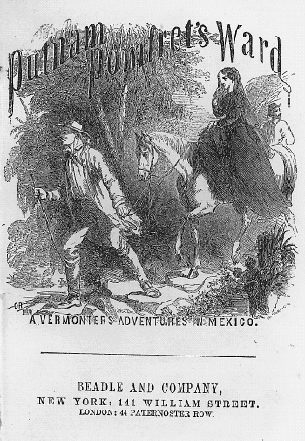
Figure 11. Cover of Augustine Joseph Hickey Duganne's Putnam Pomfret's Ward. (Annenberg Rare Book and Manuscript Library, University of Pennsylvania)
In the opening chapters of The Peon Prince, which take place in the autumn of 1845, an Italian bandit and a Mexican creole soldier vie for the love of Inez, the beautiful daughter of Murillo the Rich, a farmer. The soldier, Antonio La Vega, is a hotheaded and disdainful cavalry officer; the bandit chief Marani, on the other hand, disguises himself as a wealthy gentleman in order to win Inez's heart. Both are described as harboring unruly passions and both plan to kidnap Inez and force a marriage, though she is in love with Lorenzo, a poor artist. What follows is a series of capture-and-rescue episodes in which the Yankee, Putnam Pomfret, and the peon prince, Zumozin, are intimately involved. Ultimately, the Yankee and Zumozin join forces with a Mexican officer, Nunez, and a priest, Padre Herrata, to rescue Inez and expose the malfeasance of the alcalde and hacendado Juan Garcia, Zumozin's master, who had contrived to mislead Zumozin about his true identity and to steal the vast property left to him by his father. And in the sequel, which opens just as the U.S.-Mexican War is about to begin, the Yan-kee, Herrata, and Zumozin are reunited in order to prevent an unwilling woman—Teresa Glinton, who is from New Orleans and whose mother was a Mexican creole—from being married to an unscrupulous
Both of these narratives feature devices and motifs that are typical of the dime novel: disguise, the exposure of secret identities, violence, cliffhanging chapter endings, beautiful endangered virgins, an intense focus on muscular male bodies, and patriotism. They also incorporate many of the conventions of the story-paper international romances that I described in Part 2. By making one of the protagonists a Yankee, Duganne deployed in his novel a regional type that had long been popular in the theater and in cheap fiction, including the story-paper romances set during the U.S.-Mexican War. In the cheap fiction of the earlier period, Mexico was frequently represented as a land of lawlessness and forced marriage, where banditry prevailed over government and where a woman's consent was all too often considered irrelevant by an aristocratic patriarch or a rapacious villain enthralled to his passions. In the 1840s, these representations were deployed to explain the U.S. presence in Mexico even though many of these novels also implied that the annexation of all or part of Mexico was undesirable. As we have already seen, many wartime novels focused on a possible romance between a U.S. soldier and a Mexican woman in which the relationships between lovers suggested possible postwar relationships between nations. In Duganne's novels, however, international heterosexual romance is almost entirely displaced by international homosocial bonding, as the Yankee helps his allies foil the villains who threaten the women.
Like most of the story-paper Yankees in the war novels of the 1840s, Putnam Pomfret is seemingly ineligible for romance. Although the role of romantic hero was usually reserved for U.S. officers in these earlier stories, in Duganne's novels the Yankee is the only U.S. hero who plays a leading part, and international romance is largely foreclosed. This may follow from the changing circumstances of the early 1860s. The United States had pressured Mexico for more land and for transit rights across northern Mexico and the Isthmus of Tehuantepec throughout the 1850s,
Many of these fears and beliefs are voiced by Duganne's Yankee. Although he joins forces with Officer Nunez, Padre Herrata, and Zumozin, his speech is full of racist invective against “greasers” and “Ingens.” This casual racism is characteristic of the Yankee character type. As Saxton argues, earlier Yankee characters tended to accede to class hierarchies, but by the 1830s “the Yankee was opportunistically employing white racism to justify his shift from deference to egalitarianism.”[21] Thus despite his relatively lowly origins and his status as a lower-class type, in The Peon Prince Putman Pomfret repeatedly asserts his superiority to the Mexicans on the basis of his race and national origin: “I cal'late you wont try to come Paddy over a live white man from the States,” “I'm a free born citizen of the States,” etc.[22] What is more, the affectionate references to him as “Our North American” (21), “our free American” (22), and “our Yankee” (32) all suggest that Duganne was constructing his Yankee as a point of identification for his Northern U.S. readers. But it is also important to note that the Yankee was rarely a completely positive character. As Francis Hodge observes in his wide-ranging study of Yankee theater, in many dialect comedies, “the Yankee is not often admirable or idealized; he belongs to a race of not-so-petty bargainers who win because they are more clever, more ‘slick’ than others.”[23] The cleverness and “slickness” of Duganne's Yankee help him to defeat his Mexican foes, but these qualities, as well as his hyperbolic slangy speech, also make him more than slightly ridiculous.
And the Yankee is not the only hero in these novels, for Zumozin, Herrata, and Nunez also play significant roles. When we are first introduced to Zumozin, the Peon Prince of the title, “one of a great class of his countrymen” who toil “in the most abject and hopeless servitude”
(48), Duganne figures him as a Romantic hero, standing on the “highest ridge” of a “sublime” mountain, contemplating his evil fate. Zumozin toils in the “degrading” (91) position of a herd-boy on the hacienda of Juan Garcia, the corrupt alcalde, and dreams of freedom. He is also, however, the leader of one thousand Indians, whom he convenes as part of a ritual at the base of the ancient pyramids, where each swears “to be true to Aztlan” (105). Although at the end of The Peon Prince it is revealed that Zumozin's father was “an Italian grandee” and his mother an Indian princess, “chosen to be [his] bride out of all the dames of Spain's trans-Atlantic empire” (122), Zumozin repudiates wealth and “station,” as well as Mexican “Society and the State,” in order to “redeem and exalt the race of [his] mother—the race of Zumozin” (127). When we next meet him in Putnam Pomfret's Ward, his plans for the “improvement and elevation” of “the Indian population” are already well underway, and he hopes to unite “the scattered and dissimilar tribes, who owned a common country, into a warlike, disciplined nation, federated by a single object, the preservation of their own rude independence.” To this, the Yankee replies that Zumozin should be president, and that the Indians “owned the land before any white feller ever set foot on 't.”[24]
The main villain in The Peon Prince is the alcalde Garcia, “one of the largest landholders in that part of the country, as well as an extensive speculator in mines, and a man, likewise, who was reputed to exercise no little influence in political affairs at the capital” (74). While the Yan-kee and those Mexicans who are represented positively in this novel favor President Herrera, the moderate Mexican leader who wanted to negotiate instead of going to war with the United States over the annexation of Texas, Garcia is an ally of the anti–North American Paredes, a conservative who deposed Herrera and became president in January of 1846, just before the war started. But although U.S. interests clearly govern these distinctions between Mexican heroes and villains, Duganne also denounces the Mexican conservatives allied with Paredes by accusing them, through the figure of Garcia, of ruling through racial tyranny. Garcia hopes that a youth of royal blood “backed by European armies” will marry his niece and rule Mexico as its king; his desire to subvert the republic is rooted in his conviction that Mexico's “unquiet races can be ruled only with an iron scepter” (119).
The Mexican heroes who oppose this vision of Mexico's future are Zu-mozin, the radical priest Padre Herrata, and the army officer Captain Nunez. Herrata, “a patriot, in the highest sense of the word” (91), had
The magnetic homosocial bond between Herrata, Nunez, and Zu-mozin seems to be Duganne's way of imagining an interracial, cross-class alliance between Mexican creoles and Indians as an alternative to the rule of anti-U.S. conservatives such as Paredes. This U.S. interest in Mexican political divisions was no doubt reanimated by Mexico's own recent civil war. In response to the reform laws of the 1850s and the new liberal Constitution of 1857, which banned the corporate ownership of real estate and abolished judicial privileges for the army, the conservatives rebelled, dissolved Congress, deposed President Comonfort, and took power themselves.[25] During the three-year-long war that followed, Benito Juárez, an acculturated Zapotec Indian, radical liberal, and minister of justice under Comonfort, declared himself president and led the struggle against the conservatives from his base in Vera Cruz. On 6 April 1859 the United States officially recognized the Juárez regime, but U.S. leaders refused to provide any support for Juárez unless Mexico granted territorial concessions and transit rights to the United States. In late December the McLane-Ocampo Treaty was agreed upon, which granted the United States transit rights in return for two million dollars, but this treaty was rejected by the U.S. Senate shortly thereafter. Nonetheless, by late 1860 the liberals had won the war, and in June of 1861—two months after the U.S. Civil War began and Duganne's The Peon Prince was published—Juárez was officially declared president of Mexico. A few months later France invaded Mexico and another long struggle on the part of Juárez and his liberal government began. From 1862 through 1867, the years of the war against Maximilian's empire, Juárez appealed to Lincoln for support, stressing “the identity of constitutional principles shared by Mexico and the United States” as well as Mexico's opposition to slavery, but U.S. leaders, who were wary of upsetting France
Given this international context, Duganne must have expected that readers would have thought of Juárez when they read about the Indian Zumozin, the Yankee's choice for president of Mexico. As an embattled liberal government that was friendly toward the Republicans of the North, the Juárez regime would have been preferred by many Northerners to Maximilian, who was courted by the Confederacy. The trio of priest, officer, and Indian “noble” that is featured in these two dime novels, then, is Duganne's way of imagining a Mexican coalition, no doubt in part inspired by the Juárez coalition, composed of Indian leaders and liberal factions within the church and the army, which would be friendly to the United States.
Still, however, given the long history of U.S. debates about the ability of nonwhites to participate in republican government, such as those about the status of the Maya Indians in Yucatán that I discussed in the previous chapter, the place of Indians within this coalition would have been, to say the least, controversial. Proslavery politicians such as John C. Calhoun and Lewis Cass seized upon the Caste War in Yucatán to support their position that the Indians were unprepared to exercise political power.[27] Duganne must have had arguments such as these in mind when he pointed out that “many instances have occurred of pure-blooded Indians attaining to high positions in the State, holding rank in civil and military affairs” (65). Although he suggested that these examples were exceptions, he argued that they served “but to exhibit more forcefully the injustice which creates social distinctions on account of the accident of birth.” Duganne concluded that
Mexico owed, probably, as much to the Indian and Mestizo portions of her citizens, during the struggle for independence, as to any other class. Guerrero, indeed, the first of her actual Presidents, and one of the bravest of her patriot commanders, was scarcely more a white than a negro in the quality of his blood. It is evident, therefore, that the inequality of political power is not the result of natural inferiority in the degraded classes, but rather the offspring of that injustice which repudiates all merit when opposed to prejudice. (65–66)
As Duganne argues against the “natural inferiority” of the “Indian and Mestizo” classes, the overlapping languages of class and race that he draws on lead him to break from the position, which was popular among many Northerners as well as Southerners, that nonwhites were unfit to exercise political rights in a democracy. After Vicente Guerrero,
Of course, the attempted liberal incorporation of Indians into the Mexican nation-state also depended on racial hierarchies, hierarchies that are referenced in The Peon Prince by Zumozin's self-sacrifice, his sense of unworthiness, and his subordination to Nunez within the alliance. If Garcia's niece stands in for the Mexican nation, which Garcia wants to wed to a European prince, then Zumozin's self-sacrificing desire for her and Nunez's marriage to her suggest a political situation in which liberal creoles lead the nation while Indians are cast in supporting roles. Even this representation, however, is a much too cheery rendering of how creole rule and liberal policies actually affected Indian communities. For liberal land laws ultimately aimed at the privatization of all corporate lands, including communal lands held by Indians as well as church property. The attempted liberal shift from particularist forms of community to a universalist, nationalist one also erased the status of Indian, replacing it with the abstract identity of the citizen.[29] That this was a violent, incomplete process which provoked violent responses is evidenced by the large number of uprisings that occurred when liberals tried to enforce the new laws.[30] Even before he became president, Benito Juárez, for instance, found that the liberal policies that he advocated were objectionable to Indian communities in Oaxaca. But according to Jack Spicer, when Juárez, as governor of Oaxaca during the 1850s, suppressed the revolt of the Indians of Juchitan in the Isthmus of Tehuante-pec, who were responding to the land provisions of the new reform laws, “he held that the existence of Indian communities based in the colonial system constituted a threat to the nation. They must be broken up at all costs, so that individual initiative and modern forms of representative government could prevail.”[31]
So on the one hand, Duganne's representation of a liberal Mexican coalition that included a Mexican Indian leader was an important intervention in U.S. debates about whether nonwhites were now, or ever
Wanting Mexico to be remade in the image of the United States, Duganne could not see in his construction of a possible Mexican future what the land reformers also failed to understand in the U.S. context: the role that liberal forms of property and government played in deepening inequalities. This does not mean that there were not significant differences among different liberal positions: the land reformers' emphasis on the importance of the diffusion of land ownership and the material under-pinnings of citizenship countered those aspects of an emerging free
The significance of this comparison between white Northern laborers and chattel slaves has been debated, as I have already suggested, by labor historians. Although David Roediger has argued that this comparison was intrinsically problematic and that those who deployed the wage slavery metaphor were often proslavery, Foner has suggested that despite its hyperbole and its use by some advocates of slavery, the rhetoric of wage slavery was also often used by artisans, factory workers, and others who opposed slavery, and he insists that it “suggested the superiority of a very different conception of labor relations than that embodied in contract thought.”[36] Comparisons among peonage, chattel slavery, and Northern “free” labor were similarly fraught, in ways that both Roediger's and Foner's analysis helps us to understand.[37] When these different labor systems are viewed as like each other, the comparisons can indeed seem strained and hyperbolic: the forms of coercion and control that the “peon” and the slave were subjected to were dramatically different from those endured by the Northern white laborer. That peonage and slavery were racialized labor systems may also disappear from view when these three sets of labor relations are all described as forms of slavery. But arguments that insisted on the differences between free and unfree labor were also problematic. The opposition that David Wilmot, for instance, constructed between free labor and slave labor depended on a white egalitarian belief that nonwhites were degraded and that their presence threatened to degrade whites. On the other hand, abolitionists who emphasized a dichotomy between slave labor and free labor and idealized the latter sometimes helped “to legitimize the wage relationship,” Foner suggests, “even as it was coming under bitter attack.”[38] As Foner argues, it is important to understand how the refusal of the term “free labor” and the use of the wage slavery metaphor by antislavery labor advocates could function as an attack on
This double bind forged by the context of racialized labor relations also affected Duganne's discussions of peonage on a Mexican hacienda. Even the fact that Duganne represents peonage as quasi-ubiquitous in Mexico is already an exoticizing, othering move. According to John Tutino, during the postindependence period the “decline of silver mining and the weakness of commercial elites combined to threaten the power of the dominant class of central Mexico—the great families that during the late colonial era had integrated commercial, mining, and landed activities to rule the core regions of the colony.”[40] In these circumstances, the hacienda became a less viable institution, and in many areas sharecropping and ranchero production expanded. Mexican liberals also almost universally attacked the hacienda in terms very similar to Duganne's, claiming that it was a feudal institution that encouraged dependency and impeded the formation of a class of smaller producers.[41] Finally, in his study of the hacienda during this period, D.A. Brading cites evidence that in the nineteenth century many workers avoided debt peonage; that in the northern province of San Luis Potosí resident peons were a relatively “privileged group within the work-force of the hacienda” who received wages as well as food rations; that tenants and sharecroppers were “more numerous and more deeply in debt”; and that debt was often more “of an inducement than a bond.”[42] All of this suggests that we must examine as an ideological construction Duganne's representation of peonage as an institution “which prevails more or less throughout the whole of Mexico, and by which thousands are held in the most abject and hopeless servitude, sold and transferred with the land they cultivate or the mines they work” (48).
As Duganne describes debt peonage, he represents it as the antithesis of liberal modernity: it is feudal and the peon is a serf, but his degradation is worse than medieval. “It is not generally known that although slavery, as it exists in the United States, was long ago abolished in Mexico, there still remains in that unhappy land a system of serfdom immeasurably more degrading than the vassalage of the middle ages, and at best on a level with the worst forms of African bondage” (48). Like Raphael Semmes, although to different purposes, Duganne sees debt peonage as a
But Duganne also suggests parallels between Mexican peons and Northern laborers, so much so that these representations of peonage could be described in Eric Lott's terms as “displaced maps or representations of ‘working-classness,’” with more sympathy for nonwhite laborers, despite the problems I've indicated, than can be found in the performances of blackface minstrelsy that Lott analyzes.[44] For as Duganne tries to represent debt peonage, he repeatedly adapts generic conventions from Eastern urban gothic fiction. First of all, as I suggested above, within urban reform literature it was not unusual for wage laborers to be described as serfs or slaves, so when Mexican peons are represented in these terms, comparisons between the two labor systems are not necessarily foreclosed. We have seen how writers such as Lippard relentlessly compared New York's “upper ten and lower million” by contrasting the mansions of the rich to the hovels of the poor. Duganne uses a similar rhetoric when he opposes the peons' “miserable huts” to their
Like early advocates of the working class in the United States, Duganne also invoked a distinction between producers and nonproducers by representing the nonwhite peoples of Mexico as a producer class, with Spanish colonizers and Mexican creole elites playing the role that Eastern capitalists occupied in urban reform literature. “While the Guadalupinoes [sic] and Creoles have enjoyed by turns the power and immunities of an aristocracy,” Duganne argues, “the Aborigines, Mestizoes, Mulattoes, and Blacks, in all their various shades, have always, since the Conquest, occupied inferior grades of life, as ‘hewers of wood and drawers of water’” (64). Duganne describes the Spanish colonizers as “petty tyrants, who, by monopoly, extortion and rapacity, amassed the wealth which properly belonged to those whose labor and struggles had opened the avenues to industry and commerce” (92)—the nonwhite laborers of Mexico. Monopoly, extortion, and rapacity were key words in the languages of class developed by white workers in Northeastern cities, who often opposed the productive labor of the working classes to the non-productive idleness of the rich. Here, however, these languages of class are used to construct Spaniards and creole elites as an “aristocracy” that exploits the laboring classes and takes the wealth that “properly belongs” to the latter.
Even as Duganne deplores the cruel treatment of Mexico's nonwhite races and describes them as a class of producers, however, he also invokes the Black Legend, which held that the Spanish colonizers were more inhumane than other European colonizers in the Americas. Despite Duganne's opposition to the war and to U.S. empire-building, this position could fortify imperialist ideologies which suggested that U.S. expansion would bring liberty and enlightenment to the oppressed peoples of Mexico by displacing a tyrannical, largely Spanish ruling class. Such a set of beliefs could also reinforce the anti-Catholic nativism that
The possibilities and limits of Duganne's position are also revealed but in a different context—this time, he focuses on the plantation rather than the hacienda—in Camps and Prisons, a personal narrative that he published at the end of the Civil War. In 1862, one year after his two dime novels about Mexico were issued, Duganne helped to raise a company of New York Volunteers to fight in the Civil War, and he became the lieutenant colonel of the regiment. In the summer of 1863 he was forced by circumstances to surrender to the Confederates in Louisiana, and about half of his lengthy war memoir is about his time in prison. But the first half concerns Duganne's travels through the South, as he passes through New Orleans, “the empress city of the South,” observes ruined plantations, and comments on the differences between Northern and Southern life.[47] Again and again, Northern Republican ideas about land and labor provide the lens through which he interprets what he sees. When he stops among the plantations of Bayou Lafourche in Louisiana, for instance, he observes that half a century ago these lands
promised comfort and competence to a hundred thousand white men, who, settling here, with skill and toil, might build up homes for free-born families. But speculating Capital came also to this treasury of cotton and sugar; and thereafter the curse of “adding field to field” laid grasp upon the future. So
At the beginning of this passage, Duganne's language recalls the white egalitarianism of the Wilmot Proviso, with its emphasis on the debasement of laboring white men who suffer because of the slave system; slavery is condemned, in “free labor” terms, because it leads to Landlordism and the monopoly of the soil, which in turn crowds free white laborers into the swamp bottoms. As Duganne proceeds, however, he focuses more closely on the black laborers who worked these plantations, and he adapts Republican free labor ideology to argue that the plantations should not be returned to their owners but that instead the former slaves should be armed and allowed to run them.
After walking down the road of a sugar plantation, “passing through miles of rotting cane, decadence of ungathered crops” (33), he reaches the quarters of the blacks and encounters Uncle Phil, a plantation-preacher and former slave and overseer's assistant on the estate. Phil takes him on a tour through the abandoned sawmill and sugar mill and demonstrates a knowledge of their workings that proves he could easily run a sugar-plantation himself. Meditating on the fact that thousands of such plantations have been “given over to destruction” while “the toiling people who had made them Edens of productiveness, were cast out on the highways” (36), Duganne imagines
each broad plantation, with its vast machinery, confided to the hands which earned and paid for all the wide improvements. I fancy a “sugar-maker” like Uncle Phil still watching over every reservoir, and—backed by wise authority, assisted by selected men of science and of honesty—producing wealth for Government—large profits to the power that breaks his chain and gives him manhood in exchange for slavery. I see a grand militia, armed and drilled upon these green savannas; no longer chattel-souls, but conscious of their strength and numbers, marching to the cane and cotton-fields by tap of drum, and guarding bridge or railway line with ready rifles, and with surer knowledge of the ground than ever can be gained by Northern regiments. (37)
In this passage Duganne imagines the former slaves producing wartime profits for government; later, when he encounters field hands who have organized themselves into a “labor-phalanx” (62) to cultivate their old domain, he endorses this “free labor experiment” (63) and fantasizes about giving the men tools to work the land and guns to defend it: “I do not think a just or generous share in all the products of their toil would
Duganne offers these suggestions as an alternative to the Union military policy in Louisiana, which was coordinated by two Massachusetts Republican congressmen: first by General Benjamin Butler, a former factory hand who, according to David Montgomery, had been a “Negro-baiting Buchanan [Democrat] right down to secession,” and later by General Nathaniel Banks, who, like Duganne, had been affiliated with the Know-Nothings before the war and who was popular with Massa-chusetts workingmen.[48] In 1862, Butler began to require blacks to work for wages on the sugar estates of Unionist planters; his successor, Banks, “extended this labor system throughout occupied Louisiana.”[49] Banks demanded that the former slaves sign yearly labor contracts or risk being arrested for vagrancy; he also initiated a pass system and did not allow workers to leave the estates without permission.[50] To many observers, this “compulsory system of free labor” looked a lot like slavery, and debates about the meaning of emancipation and free labor increasingly threatened to divide Republicans.[51]
For his part, in early 1863, Duganne criticized the “policy of conciliating planters” (38) and the “kid-glove fingering of slavery-issues, whereby the Louisiana of General Butler is to be made the Louisiana of General Banks” (37). He repeatedly attacked Banks's vagrancy laws and labor contracts by arguing, for instance, that the “great black human Force, whose life-long strength has been expended, for a hundred years, in servile toil, is reckoned in the ‘labor-contracts’ only as the ‘stock,’ whose service is to multiply the gains of capital” (68), and by complaining that Union soldiers were used “to awe the blacks and hold them closely to the ‘labor contract’; to protect the ‘planter's interests,' by hunting straggling recusants, and generally to act as ‘overseers’ in pay of Federal treasury” (51). He concluded that the labor policy of General Banks “practically enforces thraldom worse than former slavery” (48) and worried that such a policy might impede serious attempts “to solve the mighty labor-problem of our nation's future” (68). Duganne made it clear that he hoped that the great estates would not be given back to their “traitor owners” or transferred to “perjured agents of their late proprietors” (37) or to the Northern speculators that “hover, like so many vultures, in our army's rear” (38).
But even though he attacked the Banks labor system and viewed the black workers as a producer class who deserved a just share in the products of their toil, he never went so far as to imagine transferring the land to “the hands which earned and paid for all the wide improvements.” Instead, he continued to imagine reconstructed Southern labor relations in paternalist terms, with black workers “backed by wise authority” producing for the government or, at best, receiving half of what they produced. But many freedmen wanted to grow subsistence crops on land of their own rather than working on plantations and producing for the market. And according to Eric Foner, at “the outer limits of Radical Republicanism, the idea of remaking Southern society produced a plan for national action to overturn the plantation system and provide the former slaves with homesteads.”[52] Pennsylvania Republican Thaddeus Stevens was probably the most passionate advocate of this view in Congress; he suggested that lands be taken from the wealthiest Southerners so that each adult freedman could be given forty acres.[53] But that was not to be. Instead, in 1865, President Johnson initiated various policies that resulted in the return of most confiscated Southern lands to their former owners, bringing an end to hopes of making the diffusion of land ownership the material and economic basis of Reconstruction. The “debate over the land issue illuminated both divisions within Radical ranks and the limits of the Radical ideology,” Foner argues. “Beyond equality, in other words, lay questions of class relations crucial to the freedmen and glimpsed in debates over confiscation, but lying beyond the purview of Radical Republicanism.”[54]
Of course, “beyond equality” lay questions of race relations as well. In Black Reconstruction, W.E.B. Du Bois observes that the two great labor movements of the mid–nineteenth century, “Labor-Free Soil and Abolition, exhibited fundamental divergence instead of becoming one great party of free labor and free land” (21–22). Du Bois identifies the post-1848 battle for the West between opponents of slavery and Southern expansionists as an important chapter in this history. From the perspective of Southern champions of slavery, he suggests, the “foray into Mexico had opened an empire, but the availability of this land was partially spoiled by the loss of California to free labor.” Throughout the 1850s, and notably during the controversy over slavery extension in Kansas and Nebraska, there “was a war,” Du Bois argues, “to determine how far industry in the United States should be carried on under a system where the capitalist owns not only the nation's raw material, not only the land, but also the laborer himself; or whether the laborer was
As I have argued in this chapter and in the previous one, white egalitarianism limited the emancipatory vision of even the most radical of the reformers who hoped that the widespread diffusion of Western lands among small producers might provide a material basis for the political and economic independence that was threatened by Northeastern industrialization. On the one hand, the racialized conception of property assumed by the reformers was in violent competition with other ideas about land held by Indians in the United States and Mexico, and it thereby helped to legitimate the dispossession of the latter even though some of the reformers sympathized with Indians. On the other hand, a racialized conception of free labor and ideas about black “dependency” also impeded the formation of “one great party of free labor and free land” during the Civil War and Reconstruction. As Du Bois suggested, “[To] have given each one of the million Negro free families a forty-acre freehold would have made a basis of real democracy in the United States that might easily have transformed the modern world” (602). Instead, such a transformation was forestalled by widespread fears, which were also harbored by many radical Republicans, that the confiscation of Southern plantations and the redistribution of land to the freedmen would threaten the sanctity of private property and discourage blacks from laboring to earn money to purchase land.[55] Although the views of radicals such as Duganne on questions of land, labor, race, and government represented a meaningful departure from dominant responses to those questions, the white egalitarianism that often remained at the heart of such views prevented the emergence of a truly democratic and inter-racial labor and land reform movement during those years.
Du Bois's analysis conjoins three episodes that are still too rarely considered together: U.S. empire-building in Mexico and the West, the formation of white labor movements, and the battle over slavery and the Civil War. In other words, for Du Bois, “domestic” race, labor, and land issues in the nineteenth century are inextricable from questions of