
7. Spirit Mediumship and Social Identity
Since tromba is a vital aspect of Sakalava culture, participation in tromba possession confirms tera-tany status. Strictly speaking, tera-tany and Sakalava are synonymous, yet the recent participation of migrants in tromba possession necessitates a looser definition. For those who have only recently arrived in Ambanja, tromba is an exclusive and unfamiliar institution but, over time, virtually any outsider may participate. The manner and rate in which they become involved in tromba is determined by their social networks, length of stay, economic constraints, compatibility with Sakalava, and desire to be integrated into the tera-tany community. Tromba creates a sense of belonging, a social cohesiveness that is unmatched by other local institutions. Sakalava structural principles that are associated with tromba possession favor women over men. As this chapter will show, participation in tromba may alter a woman’s life in profound ways. First, as a medium, she may experience shiftsin her identity. This process is facilitated by a special form of fictive kinship which has especially profound ramifications for non-Sakalava. In turn, a shift in her social relations occurs, affecting those who know her in the privacy of her home as well as the public sphere, where she strengthens her personal networks with other mediums and, if she works as a healer, with clients. In essence, tromba enables a medium to redefine her social status and gain access to local power structures.
| • | • | • |
Selfhood and Personhood in the Context of Possession
Tromba possession affects identity on multiple levels. As a medium moves in and out of trance, she experiences shifts in her identity on three different levels: the first is what Mauss (1987: 2) referred to as the idea of moi or “self,” that is, her private (and psychological) sense of who she is as an individual operating in the world. The second is her “person” (personne; again, see Mauss 1987: 2ff), or what I will refer to as her social persona: how she is perceived by others within her social milieu.[1] For example, as a medium a woman elevates her social status when she becomes a healer. She also shifts from being a commoner to a royal personality. The third shift is one that is experienced by mediums who are migrants. They experience a shift in their ethnic identity, that is, their cultural persona. A complex fictive kinship system associated with tromba enables a medium to make these shifts in her social and cultural personae.
Shifting Selves
A medium, because she is a vessel or “house” (trano) for spirits, has multiple selves: her personal (unpossessed) self and each of her spirit’s selves. Thus, a medium with two spirits has, essentially, three selves. Gender is also an important elements of selfhood. As a medium she is female; when possessed, she is usually male. The boundaries between these different states of selfhood are clearly demarcated for the observer as a woman goes in and out of trance, yet these multiple selves blend into one another and carry over into her daily (unpossessed) life.
As the last chapter illustrated, spirit possession provides fertile ground on which to record and interpret collective experience. In turn a dynamic may also develop between collective and personal histories. As Brown deftly illustrates in her study Mama Lola (1991), in the context of Haitian vodou there are multiple layers of history recorded, shaped by Haitian history, generations of mediums within a given kindred, and the personalities of the spirits that possess them. As we learn through the unraveling of the personal and family history of her key informant, Alourdes, different spirits (who are African and Haitian, male and female, and so forth) are, for example, more appropriate for particular time periods, settings, and temperaments of mediums. In this way, not only is possession subjectively experienced, but history, as well, is interpreted from a subjective point of view by a medium, through her spirits. This process in turn has a profound effect on the medium’s sense of selfhood.
This overlapping of histories is also central to tromba possession. A tromba medium, as well as others around her, perceives herself as a composite or a gestalt of interlocking and overlapping selves. This is evident in the way that tromba mediums and their spirits recounted their personal histories during my interviews with them. I found that the events in mediums’ personal lives were often reflected in their versions of their spirit’s personal histories. At times, tromba stories provided a more appropriate arena for articulating a medium’s personal problems. For example, in interviews with a medium named Mariamo, I had great difficulty in collecting any details on her life. After numerous attempts one afternoon proved futile, I asked her to call up her spirits so that I might interview them. Two appeared: the first was a prostitute spirit named Mbotimahasaky, whom I quickly learned had had serious conflicts with her father, brother, and lover, and she had killed her first and only baby as a result of neglect. The second spirit was a soccer player named Djaomarengy. After these two spirits had departed, her assistant (rangahy) and I retold the spirits’ stories to Mariamo, who then explained that she herself had worked as a prostitute for sixteen years in Mahajanga. Previous to this event she had sometimes alluded to her inability to have children, but it was only during (and then after) these interviews with the spirit Mbotimahasaky that Mariamo was able to articulate the great sadness she felt about her barrenness. As I later learned, the antics of the spirit Djaomarengy usually paralleled events in the life of Mariamo’s lover, who was an avid soccer player. As this story illustrates, there is a richness in narrative form here that may allow for a deeper level of introspection than is generally possible in daily social discourse among Malagasy. In essence, mediums may in fact experience a deeper or more integrated sense of self than do non-mediums (cf. Obeyesekere 1981).[2]
The Social Persona, or Mediumship and Personhood
For Mariamo, this overlapping of selves is one that carries over into her everyday life, and which affects her social persona (person) or how she is viewed by others in her social world. Mariamo perceives herself as being composed of all of these personalities, and others do as well: she is both male and female, royal and commoner. This is especially true since she works as a healer. Even in her unpossessed state she experiences this shift, because she is respected and feared by others who are aware of her association with ancestral spirits. Possession also affects how a medium is defined structurally in relation to others. As will be made clear below, her personal relationships with kin and friends are temporarily altered as she shifts in and out of trance yet, by virtue of her being a medium, they are permanently altered as well.
Gender, Age, and Possession
Historically, the majority of mediums for tromba spirits have been adult women. At Nosy Faly, for example, saha are usually women in their forties or older, while men play complementary roles as interpreters for the spirits. In general, a Sakalava ritual cannot be performed if the two are not present and represented.[3] This is evident, for example, during activities that take place at the royal tombs on Nosy Faly. There are both male and female tomb guardians (male: ngahy; female: marovavy or ambimanan̂y), each with their specified duties. When living royalty come to pay tribute to their ancestors, both male and female guardians must participate in order for the spirits to be invoked. Similarly, when the greatest of the royal tromba spirits are consulted, both the female saha and the male ngahy must participate.
Thus, in the precolonial context, possession in Sakalava culture was not evidence of marginal status (cf. Giles 1987 on possession on the East African coast). Instead, it was a central institution associated with adult female status. Similarly, in Ambanja today, tromba possession continues to be almost exclusively a female experience. Tromba spirits may possess men, but this is unusual. Only four (of a total of ninety-eight) of the mediums I encountered throughout the course of my fieldwork were male. In addition, different categories and generations of spirits are associated with different ages and statuses. Possession sickness, involving njarinintsy and other malicious spirits, occurs most often during adolescence, their crises coinciding with troubled or failed love affairs and pregnancy outside of marriage (see chapter 9). Tromba mediumship, however, is associated with culturally sanctioned adult female status: out of eighteen female tromba mediums I interviewed in detail, nearly all had been married (by ceremony or common law) at least once before the onset of tromba, and thirteen had had at least one pregnancy that may or may not have been carried to full term at the time of having a tromba spirit instated (see figure 7.1 and Appendix A).[4] Marriage itself is the idiom that is used to describe tromba possession: a medium and her spirit are defined as each other’s spouse (vady). As will be explained below, this concept of marriage has significant implications for household dynamics. It also provides a framework for a medium to expand her social networks.
The age of onset for tromba possession is typically between eighteen and thirty years, although I did encounter two cases involving girls under fourteen years of age.[5] In addition, different categories of tromba spirits make their debuts at different stages in a medium’s career, so that mediums accumulate more powerful spirits over time. Grandchildren spirits frequently arrive in women who are seventeen to twenty-two, Children arrive most often in women twenty to thirty-two, and Grandparents are almost exclusively seen for the first time in mediums who are thirty-two to forty years of age (again, see figure 7.1).
Boddy’s (1988, 1989) work on zar possession among women in northern Sudan provides clues for understanding gender as a factor in possession experience. She argues that zar is related to concepts of female identity and selfhood and that possession occurs in response to women’s attempts to cope with circumcision and the overwhelming demands associated with adult status: in the Sudan, female “selfhood is…culturally overdetermined” (1988: 16). Even when women have been properly socialized and circumcised, they may still fail to be fertile. As Boddy explains, “When a woman’s fertility mandate is impaired—for whatever reason—her self-image, social position, and ultimately general health are threatened”; it is zar spirits that are “held responsible for procreative mishap” (1989: 186, 188). Within this context it is married and childless women who are most likely to become possessed by zar spirits.
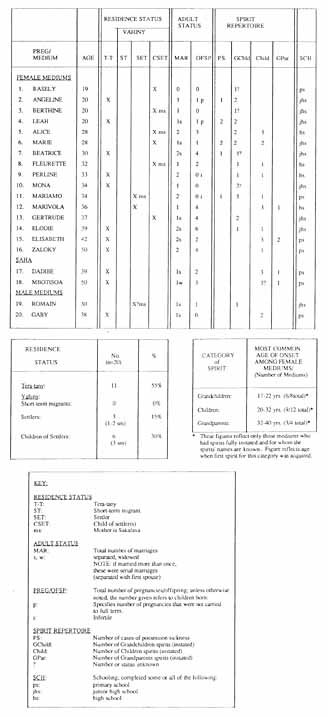
7.1. Table of Mediums. Note: See Appendix A for more details and for descriptions of women who have experienced only possession sickness.
Tromba in Ambanja is likewise associated with female status, but in this case it serves as a confirmation that female status has been achieved. As a woman takes on the role of tromba medium, her identity is transformed in terms of the way it is perceived subjectively and collectively. While in a state of trance, her personality and behavior change in ways that are only limited by the boundaries of her spirit repertoire. Her spirit(s) also impose(s) a new order on her daily life through the complicated categories of taboos that are part of each spirit’s identity and history. Furthermore, as a powerful and respected healer, a medium imposes order on the lives of others: her family, her friends, and her clients are all within her sphere of influence. If she is possessed by a very powerful spirit, then she may affect the actions of living royalty as well. Finally, she joins a special collective of mediums who share the same spirits or who have other spirits from the same genealogies. As will be described below, these women, as spouses to their respective spirits, are redefined in relation to one another as sisters, mothers, and co-wives. Power is inherent to the tromba world, and social integration is also an essential characteristic.
The Cultural Persona: Changing Ethnic Identity
Since it is ancestors that are pivotal in defining Sakalava (and, more generally, Malagasy) identity, it is exclusively through tromba that outsiders may be structurally recognized as Sakalava. Through this process they also gain access to local ancestral power. The significance of tromba in the context of migration is evident in the types of people who experience possession. In the past, tromba possession was exclusively a Sakalava experience; in recent years, non-Sakalava mediums have become involved. They are either settlers or the children of settlers. For these reasons it is not surprising that half of the mediums interviewed during 1987 were themselves migrants, participating in what is viewed as a Sakalava institution. The involvement of migrants in tromba possessionhas occurred through an unusual set of kinship principles that are activated by the spirits. The reasons for this have much to do with local notions of social identity and status and Sakalava conceptions of gender and adulthood.
Migrants as Mediums
Although tromba possession is regarded as a Sakalava institution in Ambanja, the recent proliferation of possession in this town has occurred in part as a result of the active participation of vahiny. As noted earlier, Bemazava royalty especially bemoan the popularity of new and less important Grandchildren spirits, saying that Tsimihety migrants are to blame for bringing them to Ambanja. Nearly all tromba spirits continue to be members of Sakalava royal lineages, either by birth or honorary incorporation (as with Raleva, Raovoay, and their offspring), but tromba mediums are peoples of diverse origins. They include, for example, many Tsimihety, as well as Antakarana, Betsileo, Antaimoro, and métisse. Only Merina are denied the possibility of ever participating, regardless of their personal networks. This is because Merina are taboo to many spirits (they are “fady Merina”). As a result, members of the most powerful ethnic group on a national scale remain among the most peripheral locally in Ambanja. They can never fully participate in tromba, and they are never welcome as members of the Sakalava tera-tany community.
Although I estimate that approximately half of mediums participating in tromba today are of migrant status, they are not short-term (temporary) migrants but settlers or the children of settlers (see figure 7.1 and Appendix A). Drawing again from the sample of twenty mediums (male and female) whom I interviewed in detail, eleven were tera-tany (born locally of a Sakalava mother and father) and nine were vahiny. These vahiny can be broken down into two subgroups: three were settlers (two of whom had Sakalava mothers), and six were the children or grandchildren of migrants (three of whom had Sakalava mothers). All nine were born in the Sambirano. I encountered no short-term (temporary) migrants who had become tromba mediums.
Possession as a means for social integration in Madagascar has been described elsewhere by other authors. Althabe (1969), in his study of possession among the Betsimisaraka of the east coast, has argued that in an area where exogamous virilocal settlement was the rule, possession served as a means to incorporate women into local lineages. Mediumship guaranteed a woman’s participation in her husband’s ancestral lineage, providing her with a way to be involved in local decisions that affected her and her affines. In Ambanja, this incorporating nature of possession has taken one further step. Through tromba, outsiders are incorporated into local Sakalava culture and society. Unlike Althabe’s example, they are not simply affines who are, in a sense, strangers, but more distant non-Sakalava migrants and neighbors. The reason why tromba is so successful in integrating non-kin migrant women is that it operates on kinship-based principles.
| • | • | • |
Turning Outsiders into Insiders: Mediums’ Social Networks and Personal Relationships
Tromba ceremonies are major social events that involve a large group of people and may span several days. As is often true cross-culturally, mediums who participate at these ceremonies are generally part of a network of women who, on a regular basis, attend the same ceremonies. Similarly, zar ceremonies in the Sudan may be a daily social event where women gather to gossip and drink coffee (Kenyon 1991: chap. 6). Giles, writing from the perspective of Mombasa, Kenya, states that possession activities provide cult members with a “close-knit group or ‘family’ for support in a heterogeneous and complex social setting, especially in urban areas” (1987: 248). In Ambanja, tromba networks are composed of women who might be kin, neighbors, or coworkers or who were friends at school when they were young. Socializing among these women extends beyond the spatial and temporal confines of the ceremony. It is in the ceremonial context, however, that these ties are underscored and strengthened.
Active participation in large tromba ceremonies helps to create special bonds between mediums. One network of women I followed throughout 1987 will serve as an example. It was composed of six women: one Antakarana, two Sakalava, two Tsimihety, and one Antaimoro. Five of these six women were mediums. All six participated regularly in ceremonies sponsored by royalty living in town (for example, to celebrate the birth of a child, a child’s first hair cutting, or the circumcision of a son). Four of these women had known each other since childhood, having gone to school together. Two had befriended the remaining two (the Antakarana and one of the Tsimihety women) while they were working at a tapioca factory, which is now defunct. (Today they all work in town.)
During the past decade, these six women have helped each other find housing so that now they all live in the same neighborhood, an area where rents are cheap and where several royal households are located. As dwellings have become vacant, they have alerted each other that a new house is for rent, and now they are clustered as two sets of next-door neighbors, four on one side of the street facing the other two. These women visit each other daily, sitting on the porch or in the yard of one of their houses, chatting, braiding each other’s hair, or preparing food for their evening meals. Two of the six women are single, and all six assist one another in times of need: they watch each other’s children; take turns going to the market; and they keep an eye on each other’s possessions should one of them leave town. The Antakarana woman’s sister had left a son under her care. Near the end of my fieldwork the boy died of diphtheria, and her five friends came to mourn his death and accompany her to the cemetery as if they were kin.
To understand the significance of these ties, one must analyze the structural implications of tromba. It is not simply friendship that binds these six women. In Ambanja, being friends (drakô, an intimate term used between women; or kamarady, from French camarade) is not enough to bind individuals. Among Malagasy, friends do favors for one another, but only kin (SAK: havan̂ana; HP: havana) are obligated to help each other in times of need. As Keenan says of the Vakinankaratra of the high plateaux, “The ties that bind descendants are thought to be the strongest of any interpersonal relationship” (1974: 61). In small villages, neighbors are usually kin (see Bloch 1971), but in Ambanja one generally has no kinship ties to those who live nearby. Among these six women it is participation in tromba ceremonies which cements these ties.
Involvement in tromba in Ambanja is simultaneously evidence of an individual’s integration into the local community and a means to achieve this end. In this community, it is not simply affines who are incorporated but, more importantly, people of diverse ethnic (and thus ancestral and geographical) origins. In order to instate a spirit in a medium, a woman must have either kin or close friends who can help pay for and sponsor the ceremony. She, or others she knows, must also have contacts within a network of mediums who will agree to participate in and run the ceremony for her. Migrants who have been in town for only a short period of time have not had time to develop such networks; those who plan to return home soon are not interested in developing them. Tromba serves as a mechanism that regulates the pace of integration. The personal qualities and sown status of the migrant determine whether she may become a medium. Whereas Angeline’s cermony (chapter 5) provides an example of successful possession, the case of Basely illustrates that if networks are weak, a tromba spirit cannot be instated in a potential medium.
Basely and the Angry, Unrequited Spirit
Basely is nineteen and was born of Tsimihety parents. She moved to Ambanja with her parents and her older brother when she was ten. Basely shares a house in Ambanja with her father, but she spends much of her time there alone. Her mother died when she was twelve, and her brother died a few years ago. Her father, who is both an alcoholic and unemployed, is rarely home, preferring to live instead with a string of lovers in town who support and feed him (and eventually throw him out). Basely reports that her father is cruel to her—he often beats her when he is home, and he never provides her with food to eat or money with which to support herself.
Four months ago Perline hired Basely as a part-time house servant. Perline is thirty-three, Sakalava, and married. She was born in the Sambirano and she owns the land on which she and other members of her household live. Although she has no children of her own, she cares for her present husband’s two children by a former marriage. Perline’s day is very busy: she runs a small grocery store with the help of her husband, and she is an accomplished tromba medium with a large clientele. For two years her younger sister lived with them and helped Perline with household chores, but six months ago her sister went to live in Ambilobe with a lover. Perline found it difficult to see to her housework while running two businesses. Since one of her sisters was, at one time, married to Basely’s brother (who is now dead), Perline decided to hire Basely to wash dishes, carry water, and do the laundry.
Perline pays Basely a minimal salary and feeds her two meals a day. When Basely is in the yard, just out of earshot, Perline often speaks to me of Basely. As she said on one occasion: “I feel so sorry for Basely…she is a little crazy (adaladala)—she is not quite right in the head.…This is because Basely has had a tromba for almost a year and a half now, but she has no one—no friends or living relatives—who will help her raise the money for the spirit so it can be established within her.…Her tromba makes her feel weak and dizzy because it is angry with her.…Oh, it is terrible—back at her house she lives like a dog,[6] eating scraps when she can find them!” Before Perline had decided to pay part of Basely’s salary in the form of meals, Basely used to come by between work hours and beg for food to eat. Now Perline feels she is helping Basely while saving herself some money in the bargain. Perline is worried that if a ceremony is not held soon, Basely will suffer even more than she does already.
Basely’s situation illustrates the necessity of having a supportive network of either kin or a strong social network of friends (something that most tera-tany, settlers, and the children of migrants have). Basely has neither. Since Perline does not consider Basely to be close kin, she is unwilling to help pay for Basely’s ceremony.
Tromba as Fictive Kinship: Spiritual Polyandry and Polygyny
Perhaps a generation ago, the bonds between these women might have been legitimized by a form of fictive kinship called fatidra or “blood brother/sisterhood” (Tegnaeus 1952), yet it appears that this practice no longer operates in Ambanja. I met several Malagasy in Ambanja who had heard of fatidra but I was unable to find anyone, male or female, who had a blood brother or sister.[7] Through tromba spirits, women establish bonds through a complicated fictive kinship system, characterized by inverted and shifting perspectives. Kinship serves as an idiom for defining relationships that a medium has with the spirits and other mediums, and those that exist between her kin and her spirits.
The most important defining principle is marriage. Lambek, in his analysis of possession in the Mayotte, compares trumba initiation ceremonies to weddings since, structurally, the two are quite similar (1981: 141). He also draws a comparison between a spirit and a groom (1981: 143). In Ambanja this relationship is a reality, for a medium’s spirit is her “spouse” (vady) (figure 7.2). An important structural component of tromba is symbolic polyandry (cf. Karp 1987 on polyandry and spirit possession in Kenya). If a tromba medium is possessed by numerous male spirits, all of these spirits are her husbands. If she has a living husband, when she is not possessed, he, too, is her spouse. When she is possessed, she becomes the tromba, and this spirit and the living husband regard each other as “friends” (kamarady) or as “brothers” (miralahy).[8] The ranking of spouses is also important. If a female medium has more than one spirit, these are ranked according to their relative location in the spirit’s genealogical hierarchy. All spirits, in turn, are regarded as being superior in rank to the living husband. Thus, when a female medium is possessed, she becomes the dominant male in her household, and she may appeal to her tromba spirit for assistance in ways that a living spouse should help her. When I asked Mbotisoa, who is widowed and who is a saha at Nosy Faly, if she ever thought of remarrying, she replied, “I have no need for a [living] husband! My tromba [spouse] takes very good care of me.” Mbotisoa is simultaneously a widow, a woman married to a spirit husband, and the embodiment of that spirit husband. She had freed herself from what she perceives to be the constraints of marriage.[9]
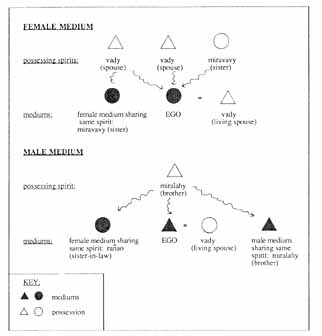
7.2. Mediumship and Kinship Bonds (terms used when medium is out of trance).
Other relationships defined by marriage are also at work here. Poly-gyny was often practiced by Sakalava royalty in the past, since having several wives was a sign of power and prestige. Since one spirit may possess many mediums, structurally all of these mediums are co-wives. When they are together at a tromba ceremony they will sometimes refer to each other as “sisters” (miravavy). If a woman has a female tromba spirit, it, too, is regarded as her “sister.” Men, too, can be mediums, yet they are only possessed by male spirits who are defined as their “brothers” (singular: rahalahy; plural: miralahy) (figure 7.2).
Going In and Out of Trance: Male Versus Female Identities and Their Associated Kinship Ties
This concept of having shifting male and female selves is also structurally embedded in the complex kinship system that is associated with tromba possession. Accompanying tromba marriage are other principles thataffect not only the medium but her living kin as well, and these principles follow general rules of Sakalava kinship, where terms of address change according to the sex of the speaker. In order to examine the relationships of a female medium, the two parts of figure 4.4 (chapter 4) are needed. First, it must be noted that while in everyday practice Sakalava utilize “town” kin terms that are influenced by french vocabulary, in the context of tromba one relies on older, “village” terminology. This is done out of respect for the ways of the past (taloha), since tromba spirits are ancestors. Also, charts for female and male egos are relevant. The terms for the female ego operate when a female medium is not possessed and is addressing her own living kin and the kin of her spirit (spouse). The chart for the male ego becomes relevant when the medium is possessed by a a male spirit. At this time, she is a male spirit who uses this set of terms when he speaks of or to his “wife” (the medium’s displaced self) and his own spiritual kin. This restructuring of relationships between the living and the dead is also relevant to all of the medium’s living kin. I have heard one medium (when out of trance) address another woman as “older sister” (zoky) (figure 4.4, female ego), and then, as soon as she enters trance, refer to her as “sister-in-law” (ran̂ao) since, as a tromba spirit, he (the tromba, that is) is married to the medium who is that woman’s sister (figure 4.4, male ego).[10]
Since spirits have genealogies of their own, mediums are also integrated into a spiritual kinship order. If a medium is possessed at a ceremony, then it is likely that she is surrounded by tromba spirits who are related to her own possessing spirit. When she is possessed, she becomes that spirit, and so she addresses all other related spirits by their proper kinship terms—they are the spirit’s “children,” “parents,” “grandchildren,” “nephews,” “brothers,” and so forth (see again figure 4.4, male ego). Mediums for different spirits are related to one another as affines, so that if one woman is a medium for Raleva, for example, and another for Be Ondry, they address each other as “father” (baba) and “son” (zazakely, zanaka, zanakalahy). Finally, if a medium is not possessed and is in the presence of spirits who are related to her own, she will address these spirits as relatives of her tromba “husband” (figure 4.4, female ego). As should be clear by now, the terms of address shift constantly, depending on whether the medium (and others around her) are in or out of trance.
As a result, unrelated women become kin to one another through a kinship system that involves constantly shifting perspectives. As the above examples illustrate, women involved in tromba are quite comfortable with this notion of shifting selves. Since the majority of mediumsare female, it is women who experience the richness of this experience, which ultimately can deepen her social networks in this community. As a migrant, a female medium becomes established as a member of the tera-tany. This occurs in a number of ways. She becomes Sakalava, since through possession she is transformed into a Sakalava ruler or member of the royal lineage. She embodies the Sakalava past and becomes active in the construction of Sakalava notions of their historical experiences. Ultimately, her actions may be significant within the context of local power. In addition, through fictive kinship, she is incorporated into a network of established mediums who are not only her friends, but who are defined, for example, as her “sisters,” “co-wives,” and “mothers,” bonds that carry with them the obligations of kinship. Through tromba possession a medium joins an “old girls” network that enables her to strengthen and extend her local social ties. Finally, as a healer, she may become a central figure in the community, assisting both tera-tany and vahiny in times of personal crisis. Since tromba is simultaneously the epitome of Sakalava experience, yet one that is associated primarily with female status, it is far more difficult for vahiny men to become integrated as insiders than it is for women.
Tromba in the Home
Tromba possession also affects a medium’s relationships in her household. Among the most significant are those with her husband and children. If the medium and her living spouse have children, then they are also regarded as being the “children” (either direct or classificatory) of the spirit. As one tromba spirit said of his medium’s family, “her husband is my brother, and so his children are my children.” The children, in turn, address the spirit as “father” (papa, baba, or sometimes dada). When Perline (see above), for example, speaks to her children of her youngest spirit, Raleva, she says, “and, so, how is your father’s friend?” (kamarady, or zalahy, the latter being an intimate term of address used between men, similar to drakô, which is used by women). When she and all other members of her household speak of her most powerful spirit, they refer to him as “Grandfather” (Dadabe or Dadilahy).
Spirits become integral members of their mediums’ households, as the following case illustrates.
Alice and Her Merina Husband: Tromba and Marriage
Alice is a medium who is twenty-eight years old. Although she is the child of a Betsileo (settler) father, she considers herself to be tera-tany and Sakalava, since she was born and raised in the Sambirano by a Sakalava mother. She is possessed by five spirits (claiming that three of these arrived when she was six years old) and she works full-time as a medium. Alice met her present (second, by common law) husband, Gaby, four years ago. For the past three years they have lived together in a house she owns.
Both report that they are happy in their marriage. This was not always so, however. Alice had assumed that both of Gaby’s parents were Betsileo, but soon after they started to live together she learned that although his mother was Betsileo, Gaby’s father was Merina. This caused serious problems for Alice, since it was taboo for at least one of her spirits (Kotofanjava) to be near anyone of Merina descent. As Alice said: “After I learned this, I had many restless nights and I would wake up very tired in the morning. I thought that my tromba was responsible for this, but I was too afraid to consult the spirit to ask what to do.…Then, one night, in the middle of dinner, I collapsed.…I don’t remember what happened, but Gaby later told me that Kotofanjava suddenly arrived, without warning.…Gaby said I dropped my spoon and fell over. Then I stood up, and he realized I was possessed.”
Gaby later added: “The spirit sat up abruptly and started to yell at me, saying that as a Merina living in the house, I was making it dirty. I was so scared! You know, Kotofanjava does not like filth [tsy tiany maloto]. He wanted to know why Alice had allowed me, a Merina, to enter her house and live there with her. The spirit was very angry, saying I shouldn’t have assumed I was welcome here.…I asked what I should do.…I said I cared about Alice and I was happy living with her as her husband.…The spirit said he would like to think about it, and that I must make a request to speak to him a second time. Alice fell to the ground again and then she sat up and she asked me what had happened. It was then that I told her the story that I’ve just told you.”
They decided that the best thing to do was to call up the spirit later that month, when the moon was in an auspicious phase. This they did one morning and the spirit stated its terms: Gaby must host a ceremony in order to formally introduce himself to each of Alice’s spirits, and at this time he was to pay a fine of 2,000 fmg to each. This would serve as recompense for his transgression. Gaby agreed to the terms. Although it took more than eighteen months for him to assemble the necessary funds, he did eventually host a ceremony at which time each of the five spirits arrived, greeted him, and, after being paid the fines, gave him their blessing.
Gaby has since become involved in helping Alice with her work as a medium. In addition to working at a restaurant in town, during his days off he also serves as her rangahy. Alice’s spirits know him well and trust him; they often commend him for his skilled work as interpreter. He now brings new clients to Alice, since customers at the restaurant sometimes ask him if he knows of a competent tromba medium in town. When Alice is tired following possession, Gaby cooks their evening meals and washes the dishes afterward. On some days he also goes to the market for her if she needs to get ready to receive clients in the morning.
Tromba spirits are expected to watch over and take care of a mediumand her kin. If the medium is married, ideally her spirit and living spouse regard each other as friends or brothers. As the story of Alice and Gaby illustrates, a husband may become familiar with tromba possession through his wife’s activities as a medium. Also, he may become integrated into the local community through her, since, as a medium, she has a network of friends and clients whom she knows through her possession activities. If the couple has children, a woman’s spirit is regarded as a second father who helps raise them along with the living husband.[11] In this household, tromba strengthened the bond between spouses.
Mediums and Their Rangahy
Although men are not very active in tromba as mediums, they often serve as the rangahy or assistant to one, especially if the medium is his spouse. This relationship illustrates another form of the complementarity of male and female that is so common in Sakalava ritual. Gaby is now indispensable as Alice’s rangahy. The story of Angeline in chapter 5 illustrates how a new husband may begin to learn this role through example, watching another skilled rangahy perform the associated duties as spirits are instated in his spouse.
If a medium works as a healer, it is essential that she have a rangahy, an assistant who helps her as she goes in and out of trance and who can interpret the wishes of the spirit for her clients. Also, since a medium does not remember what came to pass while she is in trance, the rangahy serves as her witness, recounting the events for her (cf. Lambek 1981: xiiff, 70ff; 1988a). Generally the rangahy is not a medium, but is someone who is, nevertheless, very familiar with possession. He or she may be someone who attends ceremonies on a fairly regular basis, for example. The rangahy must also be someone the medium can trust, since it is the rangahy who prevents the medium from hurting herself while she is in trance and who tells her what happens during interactions with clients.
It is also the rangahy who serves as the go-between for the medium and her clients, helping to make appointments. If a medium wishes to work full-time as a healer, she needs help to ensure that her household duties are done (cleaning, cooking, fetching water, going to market, and so forth). It is the rangahy who often performs these duties for her. Since this requires much work on the part of the rangahy, the rangahy is most often the spouse, other kin (for example, a sister-in-law), or a close friend. These are individuals who are tied to the medium in reciprocal relationships that carry with them the obligation to assist one another.
The case of Marie presents an unusual example, since her rangahy, Monique, was a schoolmate and a former client. This case illustrates the closeness of the bond that develops between a medium and her rangahy when the rangahy is not already her kin.
Monique and Her Medium Friend, Marie
Monique is Marie’s closest friend. These two women seem inseparable, for I rarely see one without the other. Monique and Marie met when they were schoolmates in junior high school.
Monique is Tsimihety and came to the Sambirano with her parents when she was seven (she is now twenty-one). She had been an excellent student when she attended grammar school in the village where she lived. Six years ago (when she was thirteen), her schoolteacher convinced her parents to let her continue on to junior high school in Ambanja. Since she had no kin in town, the schoolteacher accompanied her parents there and helped them find lodging for Monique. They found a small, two-room house made of traveler’s palm. This Monique shared with three other schoolgirls. Her mother tried to visit her at least once each month, coming to town for the Thursday market and bringing Monique rice and other food to eat. Although Monique did well her first two years, in her third year, when she had just turned fifteen, she started to go out with a man from Diégo who delivered the mail each week to Ambanja. She began to fail in her studies. Things got worse when, near the end of the school term, she became pregnant and her lover abandoned her for an older woman who worked at the post office. She failed her studies and was told she would have to repeat the year.
When Monique went back to her parent’s village over the school break, she became very ill, possessed by a njarinintsy spirit. In the middle of the night she would wake up and cry, then run out into the street and wander aimlessly for hours. Her mother, father, and older sister cared for her and took her to four different tromba mediums, but none were able to cure her. She continued to be troubled by fits of possession, when she would scream and cry. Her parents were very worried but they were also angry with Mo-nique because she had become involved in the town nightlife, and this had caused her to do poorly in school (and become pregnant at a young age).
Monique had heard of a classmate who had been cured of njarinintsy by the spirit Mampiary, and so two months later she decided to go to Ambanja on market day and see if she could find her friend, Marie, whom she knew was a medium for this tromba spirit. After two consultations, Mampiary (while possessing Marie) successfully drove out Monique’s njarinintsy spirit, and Marie and Monique have remained good friends ever since. A neighbor of Marie’s also directed Monique to an older woman who gave her herbal remedies to make her abort.
Monique did not go back to school that year, nor did she return to her parents’ village. Instead, she moved to Ambanja with her sister, who supports herself by selling bread in the market. Marie is now Monique’s closest friend, and they are together every day. In the morning Monique helps her sister make and sell bread, and by noon she returns to Marie’s house. Monique is Marie’s rangahy: she assists Marie at ceremonies, helps clients make appointments to consult with Marie’s spirits, and she also runs errands for Marie (such as going to market and fetching water) when Marie must work elsewhere or when she is in trance. Friends and neighbors say they are lovers, but I was unable to confirm this with Marie or Monique.
As chapter 9 will illustrate, adolescence is a time of great turmoil for young girls in Ambanja, who are confronted with the expectations associated with womanhood, particularly in terms of fertility and sexuality. Marie cured Monique; Marie, in turn, has gained a much needed rangahy. Whereas the rangahy is generally a spouse, in cases where the spouse is uncooperative or nonexistent, close kin (often female) fill in. In the case of Marie, a classmate and former client is now her closest friend, her rangahy, caretaker, and perhaps her lover.[12]
| • | • | • |
Miasa Ny Tromba: Mediumship as Work
Tromba spirits do not simply affect the personal lives of mediums; these spirits also play essential roles in defining a medium’s place as a healer in the community. In addition, being a medium elevates a woman’s status in the community; and provides a means whereby she may support herself financially. As described in chapter 6, through possession a medium can opt out of working as a wage laborer at one of the enterprises. This is facilitated by the fact that mediumship today is regarded as a legitimate and profitable profession. Mediums possess a special and particular kind of knowledge, which enables them to assist both tera-tany and vahiny.
The professionalism associated with mediumship has developed within the second half of this century. It is often said in Madagascar that spirit mediums can grow rich by working as healers, and that the most famous amass small fortunes serving important government officials. None of the mediums I interviewed made much money, although those who had a large clientele earned enough in a month to pay their rents and to cover almost all food expenses. Comparatively speaking, this is still less than they would make working six days per week at an enterprise sorting cocoa, where a female worker’s monthly salary might reach a maximum of 30,000 fmg. Yet many women prefer towork as healers because this liberates them from capitalist labor relations.
Time and Possession: The Tromba Calendar and Client Consultations
Working as a healer is not required but is a matter of personal choice for a tromba medium. The range and frequency of healing activities vary widely from one medium to another. Some occasionally assist kin or close friends, while others build a large clientele so that they might see half a dozen or more clients during the course of a week. Other mediums prefer to participate only in large ceremonies; at these times their spirits may be asked for advice by participants or passersby.
Although a medium has much to gain as a healer—prestige, fame, and, potentially, an income—not all mediums work as healers. This is because possession is exhausting and time consuming, and so a successful medium is one who plans ahead. After a medium leaves trance she often feels weak and stiff, especially in her arms, back, and neck, and she is usually disoriented for the rest of the day. Since spiritual consultations may take an hour, if not longer, a medium who regularly receives clients at home needs help in attending to her other duties. One medium I knew always made sure she had lunch prepared early in the morning before she would receive clients. If her children returned from school for the midday meal and found her in trance, the oldest daughter (who was fourteen years old) would cook the rice, and her father, who would be busy as the rangahy, would occasionally shout orders to her and the other children from the consultation room. The children would eat, clean up, nap, and return to school while the medium, her husband, and sometimes the client, would eat much later when the consultation was over.
There are auspicious and inauspicious times for possession, determined by the lunar calendar and the solar day. The period between the new or ascending moon (fanjava tondroen̂y, “mounting moon”) and full moon (fanjava bory, “round moon”) is the best time to perform a tromba ceremony. This period is associated with life, vitality, growth, and well-being. The period marked by a descending moon (fanjava maty, “dead moon”) and no moon (fanjava fady, “taboo moon”) is a time of death and danger. This is when, for example, royal funerals are held. No spirits may be called up in a medium (and thus, out of their tombs) during these lunar phases. To do so would be dangerous, since it might bring harm or death (see figure 7.3).
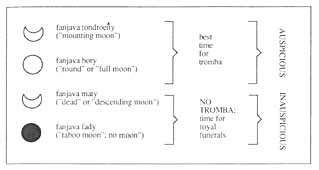
7.3. Tromba Lunar Phases.
Taboo phases also coincide with certain months (the word fanjava means both “moon” and “month”). As noted in chapter 5, tromba is taboo when the royal Sakalava tombs are cleaned. These periods are mid-June to mid-July for Bemihisatra spirits, and mid-July to mid-August for the Bemazava, and they are referred to as fanjava fady (“taboo month[s]”) or sokave. In August there is much tromba in Ambanja following the lifting of the bans. This time also corresponds with the end of the coffee harvest season, when women’s and men’s pockets are full of cash, enabling them to host long overdue (and very expensive) ceremonies.
To a lesser extent, similar meanings are assigned to the positions of the sun in the sky. Morning is associated with well-being, growth, and life, whereas the afternoon, when the sun is descending, is less auspicious. As illustrated by Angeline’s ceremony in chapter 5, large-scale ceremonies generally begin in the morning and proceed through the night and into the next morning. It is just after dawn that a new spirit often arrives in the neophyte. All spirits also have taboo days associated with them which coincide with activities that occur on a regular basis back at the tombs: Tuesday and Thursday are among the most common for spirits active in the Sambirano. In addition, a medium may not go into trance if she is menstruating.
Determining when to hold a tromba consultation is fairly complicated, since overlapping yet distinct systems of lunar and solar time affect possession. As a result, a general rule of tromba possession is that a client must make an appointment to consult with a given spirit. This time is determined in part by when it is convenient for the medium and, more specifically, by phases of the moon and sun. Solar time is more flexible than lunar: sometimes a consultation occurs in the afternoon. In part this is because, by Sakalava notions of time, a new day does not begin at dawn, but around 2:00 p.m., when the sun is descending (for example, Friday begins on Thursday afternoon). Some mediums are willing to hold sessions with clients in the afternoon in order to allow for the constraints imposed by the workday. Thus, they might schedule consultations late in the day since people in Ambanja prefer to go to market in the morning and mediums or their clients may work at the enterprises until 3:00 or 4:00 p.m. The best time to hold a ceremony is in the morning, before 10:00 a.m., and at a time in the month when the moon is new.
Marie and Mampiary: Problems at Work and Spiritual Intervention
As described in chapter 6, tromba possession offers mediums, who work at the enterprises, a way to opt out of wage labor, because of the cash crop fady associated with certain spirits. As a result, tromba mediumship as a profession stands in opposition to wage labor. Mediums say they do not provide services to clients for money since it is their duty or obligation to assist the living when they wish to contact the royal dead. Nevertheless, the income derived from these consultations enables a medium to survive in a world dominated by a cash economy. Again, Marie provides an appropriate example:
Marie, who lives near my house, is twenty-eight and has four spirits, the first one having arrived when she was seventeen. Her parents are both Tsimihety settlers from south of the Sambirano; she herself was born in Ambanja. She was married when she was younger, but she now lives alone. Marie has an eleven-year-old daughter who lives with Marie’s mother in a village in the countryside. Two years ago Marie started to work at a local enterprise, where she sorted cocoa (since one of her spirits has coffee and cashew taboos).
One evening I woke up around 10:00 p.m. and heard someone crying and wailing. I thought it was coming from Marie’s house, since I could see some people inside—maybe one or two—who appeared to be tending to someone. The crying was like that of a njarinintsy…later I thought I heard the person wandering about in the street at night, again crying and wailing.
A few days later one of my assistants and I went to talk to Marie to interview her about her experiences at work. She told us that she had suddenly quit her job at the enterprise. We learned that the other night I had indeed heard her crying and that that was the night she had quit her job. When we asked her why, she told us the following: “There was a young man there who was very interested in me, but I didn’t like him. I tried to ignore him and brush him off whenever he made passes at me, but instead of leaving me alone, he continued to bother me even more…treating me like a prostitute [makarely].…[On the last day of work] I was sitting on the ground beside a truck, sorting cocoa. He came over, sat down on the truck, and put his foot on my head!” When my assistant asked why he had done this, Marie said “Because I would not accept his advances!…I don’t remember what happened, because I passed out [manjary torana]…I was told later that I was taken back to my house in a company car. When I got back to Ambanja and woke up I went straight to Monique’s house. She then went to find my mother in her village.” Marie then explained that the reason why she fainted was that her spirit Mampiary was angry. “He did not like having my head touched by something dirty [tsy tiany maloto, “he hates filth”].…Mampiary also gave me a njarinintsy because he was mad…at the man and…because Mampiary did not want me to work at the enterprise any longer.…My mother and Monique helped me to call up the spirit [nikaiky ny tromba]: Mampiary said they were to have me bathe and oil my body.” Then Monique added, “Before we could do this, Marie ran from the house and went wandering in the forest nearby…that’s where you’ll find the cocoa fields of [the enterprise where Marie worked].”
I then asked Marie to describe her sentiments toward Mampiary after all this happened. She said: “He was not my enemy but my friend because he helped me…he made the man’s foot swell up for a week, and he lost his job! Ha!…I’d like to go back to work, but Mampiary will not let me.…If I want to go back to work I must first make a formal request [hataka] to him.”
This story illustrates the role of the tromba spirit as guardian and protector of Marie, since it is the spirit who intervenes during this crisis. It also stresses the significance of problems associated with work, as well as those that may arise in interactions between men and women. These themes, of work and romance are major concerns for many mediums’ clients and they will be reiterated in the discussion on mediums and their clientele in chapter 8.
During this episode, the man’s actions were an affront to both Marie and her spirit. In placing his foot on her head, he violated strict rules of etiquette. In Madagascar, only individuals of higher status (elders or royalty) may raise their heads above those of other adults. If someone needs to walk through a seated crowd, they always bend over, and as they walk between others they put their hand before them and say aza fady (“excuse me,” lit. “don’t [commit a] taboo” or “pardon my taboo”). For Malagasy, the head is sacred, and so no one ever touches the head of another without first asking if they may do so. Tromba possession is among the few situations where the head may be touched by others: as illustrated in Angeline’s ceremony, lesser spirits place their heads in the laps of Grandparent spirits to honor them and to acquire their blessing.[13] When sleeping in a crowded room, Malagasy generally form a circle with their feet in the middle, so that one’s head does not come into contact with another person’s dirty feet. When the man touched Marie’s head with his foot, his action was also an affront to her spirit, since spirits reside in the heads of their mediums (cf. Feeley-Harnik 1988: 76).
Following this incident, the man was fired from his job. Marie did not return to work at the enterprise.
In August, a month after Marie left her job, she started to work full-time as a medium. She lived in my neighborhood, and when I would pass by her house I often saw clients coming and going from there. Most often she was possessed by Mampiary who, although he is not a very powerful spirit, was well known by the people of Ambanja. At these times Mampiary would call out to me if he saw me in the street and would ask me to come watch him work. Marie held consultations with clients as often as four days a week, when the moon was in auspicious phases, and her friend Monique as always there to assist.
Within two months Marie had assembled a large clientele. During the auspicious times of the month she was able to make as much as 8,000 fmg per week. When I left the field two months later, she was still working as a healer. Her clients included equal proportions of women and men, tera-tany and vahiny, and people she knew as well as strangers. She made additional money by helping friends in her neighborhood who needed to organize large-scale possession ceremonies (romba ny tromba) to appease their own angry spirits. She was, for example, one of the mediums who appeared at Angeline’s ceremony. Marie hosted some of these ceremonies for neophytes in her own house, making arrangements for musicians and inviting other mediums to participate. Marie was usually paid 1,000 to 2,000 fmg for each of her spirits that arrived at a ceremony; generally at least two of her four spirits participated.
Although Marie was able to support herself financially as a medium, describing this activity as work (asa) is problematic, since it it runs contrary to how mediums perceive their actions and, more generally, to Sakalava conceptions of work. When a tromba medium is consulting with clients, one says “miasa izy” (“she is working”), but this is not in reference to the money she might earn. Instead, it bears the same meaning as when she is washing clothes: she is busy or occupied. Tromba mediumship, according to Sakalava concepts of work, is not regarded as a form of wage labor. Furthermore, a medium does not have free access to the goods and cash that are given to her spirit(s).[14]
A medium can make use of the funds paid by clients only through prior agreement with her spirit(s), since payments are made to the tromba spirits and not directly to her. This is because a client comes to consult a spirit, and not the medium, who is simply the vehicle for communication. Payments are made to spirits in several ways. A client is expected to bring gifts of money or food to the spirit to encourage it to arrive and to ensure it will be pleased and will then cooperate. During the invocation, the client initiates the consultation with a payment of one or two silver-colored (nickel) 50- or 100-fmg pieces (vola fotsy)[15] which they place in the plate filled with water and crumbled kaolin. Once the spirit has arrived, the client offers goods for consumption which are appropriate for that spirit, such as soda pop, rum, beer, or cigarettes. These items are for the spirit, and the medium must consume all during trance. If for some reason she does not, they are put aside and used during another ceremony (this happens most often with cigarettes). Even if the actual consultation is brief, the spirit is expected to stay until it has consumed these items. Thus, none of these goods remain for use by the medium or her family after the ceremony is over.
Consultations often require one or more follow-up visits. The client may be instructed, for instance, to find or purchase certain herbs and then return to the medium’s home for further instructions. I have watched spirits write up lists for this purpose which are similar to doctor’s prescriptions. The final payment is made only if the cure is successful. The spirit will usually state its terms beforehand: if the cure is effective the client must pay, perhaps, 500 fmg, a piece of cloth, or a bottle of beer (charges are usually levied on a sliding scale). Again, none of the money or goods can be used by the medium or other members of her household. Only the spirit can wear the cloth, and the money should be used to buy, for example, a new hat for the spirit or to pay for a future ceremony. Mediums keep these funds separate from general household funds, often on a shelf or table in the east or northeast corner of the house, this being a sacred spot that is designated as the storage place for tromba’s items (trano ny tromba, lit. “the tromba’s house”).
There is, however, a certain amount of flexibility here. Mediums do borrow from the tromba’s till, but only after asking permission from the spirit. As in the case involving Angeline and her coffee fady, the spirit may be summoned and asked by the rangahy if it would make an exception. In this way, the rangahy may ask if funds from the spirit’s till can be spent on something needed by the household. I am unsure how often individual mediums actually pay back these loans. Although Malagasy frequently borrow money from one another, they do not necessarily pay back the full amount. Instead, by remaining in debt, a reciprocal relationship is initiated, where the original giver is then free to make a future request of the original borrower.[16] To ask for repayment of a debt shows total disregard for this form of etiquette. This is expressed by the saying tsy manao trosa (lit. “[I/we] don’t do [give] credit”), which implies that if one demands reimbursement it redefines the relationship between these two friends as an unequal one more akin to that between a merchant and client. As among the living, a spirit does not ask for a full repayment of the debt, but requests, instead, another favor. For example, it may ask to have a ceremony given in its honor. In this way the medium can actually sustain herself on clients’ payments, although she does not consider this money to be a salary nor are her activities a form of wage labor. Tromba is work (asa) in the precolonial sense: when a medium is receiving clients, one says asa ny tromba (“the tromba spirit is working”). This a medium does out of duty, since she performs this work to help the living gain access to the royal ancestors.
Feeding the Spirits: Medium-Client Relationships
Within the context of tromba healing ceremonies, there are several shifting relationships between the medium and rangahy, the medium and her spirit, and the client and medium/spirit. In the context of healing sessions, the key relationship is between the client and spirit, whereas that between client and medium is secondary. A medium who works most of the month as a healer will become well known in her neighborhood. A client’s choice to go to a specific medium may be based on practical or sentimental reasons: the medium lives nearby, or perhaps she is a friend or relative. Others seek her out because she is possessed by a spirit that has helped them (or someone else they know) in the past. A client may also wish to speak with a powerful spirit, and so he or she seeks out a medium who is possessed by a Grandparent. Marie’s clients include friends and neighbors, although the majority are strangers (both tera-tany and vahiny) who seek the advice of a particular spirit—in her case, usually Mampiary.
The relationship between healer (medium or spirit) and client is complex. On the surface, it is based on an unbalanced form of reciprocity in which the medium provides services in exchange for money or gifts that are given to her spirit. To gain access to the spirit, the client must have the cooperation of the medium. For example, an adult with sore eyes or a child who cries too much can be treated in a single, brief consultation. The client (or, in the case of a child, another adult) explains the problem to the medium and then again to the spirit. The spirit then uses its powers to heal: perhaps it will draw circles of white kaolin around the first client’s eyes, accompanying this with an incantation requesting assistance from more powerful ancestral spirits. For the child, it might prepare an herbal remedy to sooth a stomachache or sore gums. If the cures work, each client is expected to return later to make a small payment—a bottle of beer or perhaps 200 fmg. Although mediums help clients with physical ailments, more often clients suffer from complicated economic and social problems associated with work and success, or love and romance.
In a sense, the simpler the problem, the less involved the relationship between the medium-spirit and client. With serious problems, relationships may develop over time that are more symbiotic (or even, in extreme cases, parasitic). This is expressed by the proverb “Tromban’ny teta, vola miboaka” (lit. “It’s tromba that’s in the head, it’s money that comes out”). This saying was popular in 1987, when it appeared on a printed lambahoany cloth that many women in Ambanja purchased. The message conveyed by this proverb is that if one wants service, one must pay for it first. Merchants in local boutiques use it to mean “don’t touch the merchandise unless you plan to pay for it.” For them, it is synonymous with the expression mentioned earlier: “We don’t give credit” (tsy manao trosa). The proverb is also a reference to the greedy and demanding nature of tromba spirits—if you seek the advice of a tromba spirit, you may have to pay dearly for it. The extent to which this is true is determined by the nature of the client’s problem, the type of cure the tromba spirit dispenses, and the personality of the medium. Although mediums do not consider their activities as healers to be a form of wage labor, the spirit-client relationship is an unequal one, since spirits are demanding and greedy.[17]
There is much folklore surrounding the centrality of tromba in the lives of the intelligentsia, with stories recounting how the most famous tromba mediums have been flown from northern Madagascar to Antananarivo to treat the urban elite. Malagasy often express great fear (SAK: mavozobe; HP: mitaotrabe) of tromba spirits because of their consuming and unpredictable nature. There are several reasons to be wary of tromba spirits. First, people who commune too often with the spirits run the risk of becoming possessed themselves. Second, tromba spirits can be reckless and they are easily angered, and so they may physically injure observers. Third, they can be very demanding of their clients, consuming an individual’s wealth in exchange for spiritual advice and assistance. As Feeley-Harnik has noted, praise songs about Sakalava royalty speak of their voracious greed and how they desire to encompass and consume all that they see (1982: 30ff). Similarly, one must feed spirits if one seeks their cooperation. The tromba, as royal spirits, may, in turn, devour the fortunes of desperate clients. I have met individuals who have paid as much as 50,000 to 100,000 fmg to a series of healers as they sought treatments for what seemed to be incurable ailments.
Although I would not describe the majority of mediums I encountered as greedy, I did find it to be an appropriate description for the few who dealt in harmful or bad medicine (fanafody raty). This type of fanafody is used for self-advancement, generally at the expense of others or, more directly, to harm an adversary (this will be discussed in detail in the following chapter). Because of the nature of their work, these mediums are very cautious in forming relationships. Whereas many of Marie’s clients are strangers, Marivola, who professes in private that she specializes in bad medicine, screens her clients very carefully. She and other members of her household are very careful in their daily interactions with non-kin.
Marivola’s Bad Medicine
Marivola, who is thirty-six years old, is married and has four children. She is Arab-métisse (her father is an Arab from Yemen, and her mother, who is now dead, was Tsimihety). Marivola is a housewife, and her husband is a bookkeeper at one of the local enterprises. Marivola has four spirits; three of these she inherited from her mother.
Although Marivola possesses a number of valuable skills (she finished two years of high school and speaks French fluently) she prefers not to work. Occasionally, however, as a medium, she holds private healing sessions in her home. She does not have a steady flow of clients. She only assists individuals whom she knows well and whom she trusts. As a result, during certain months there is a flurry of tromba activity in her house, whereas other months may pass when she rarely goes into trance. The amount of activity depends upon the problems that arise in her own household and upon the demands from her limited clientele.
Marivola is very cautious about divulging any information about her work as a tromba medium, more so than most mediums I have met, because she is among the few who are willing to provide clients with bad medicine (fanafody raty). To speak of these things would mean giving away secrets. It might also bring on the wrath of her spirits, since this knowledge is sacred. She and her husband are very suspicious of non-kin, certain that out of fear or jealousy of Marivola’s powers, they will try to harm them or their children with their own bad medicine. Marivola and her husband make a point of buying food and other goods from strangers or non-Malagasy. They prefer to go to the outskirts of town even for everyday items rather than going to the grocery run by their next-door neighbors and risk being harmed by them.
Marivola uses kinship to define close relations with clients; these are the only friends she trusted. When I knew her in 1987, she only received two women as clients on a regular basis, both of whom she defined as being “like sisters” (mira piravavy). The first was a woman who suffered from chronic headaches whom she helped because, as Marivola put it: “I have known her a long time, and, besides, she is Tsimihety, and so I feel I should help her, because we are like family” (mira havana). The second was a friend named Fatima.
The story of Fatima’s relationship with Marivola will be covered in the following chapter. As will become clear, Fatima paid dearly for Marivola’s services. In contrast to Marivola, the profile provided of Marie, above, is more typical for a medium. Marie’s clients learn of her through word of mouth, and many are strangers. If Marie does not treat certain clients, it is not so much because she is suspicious of them or because she has no sentimental ties to them, but because of the limitations of the skills of her spirits. Marivola, on the other hand, is very cautious. She rarely even permits any visitors to enter her house. Instead, they must stay on the front porch or visit her in her backyard. If they appear at mealtime they are rarely greeted with “karibo, karibo sakafo,” (“come in, come in and eat”), as is standard practice in Ambanja. Her cautiousness (which I often felt verged on the paranoid) is a result of the nature of her trade: since she harms others, others might try to harm her. Or, put another way, since she is preoccupied with doing ill to others, she assumes that all people are potentially her adversaries. Because trust is a major concern for Marivola and her husband, strangers are especially dangerous.
Regardless of the nature of their trades, however, for mediums such as Marie and Marivola possession transforms identity and enhances power by granting greater authority over their activities at home, at work, and in the community at large. The idioms of marriage and kinship associated with tromba facilitate the incorporation of women more readily than men. These structural principles help to create special bonds between mediums, turning friends into fictive kin. If a medium is a migrant, her ethnic identity changes, since she will be recognized by her fellow mediums as being Sakalava. As a medium for tromba spirits in the popular realm, she plays an important role in the local community, assisting vahiny and tera-tany clients in their efforts to cope with and control the events in their lives. As Part 3 will show, problems vary for tera-tany and vahiny, adults and children, and even for mediums of different statuses. It is tromba mediums and other practitioners who assist clients in making sense of the crises they encounter in their lives.
Notes
1. Self and person are generally overlapping or may even be indistinguishable since the concept of an individually, psychologically conceived self is not universal cross-culturally. In the context of tromba possession, however, they are in some ways distinguished by private and public realms. For a medium, selfhood is a private or personal experience, and it is in this sense that I use the term, as Mauss did.
2. A detailed discussion of this process extends beyond the scope of this present study. Suffice it to say here that the level of self-reflection that occurs, for example, in the context of Western schools of psychiatry and psychology is not something that characterizes Malagasy culture (see Sharp, in press). If we assume that language shapes in part the way we perceive the world, the Malagasy language is structured in such a way so that the speaker will avoid drawing attention to himself or herself. For example, a common Malagasy sentence structure is the passive voice, where the first-person pronoun often drops out completely. Thus, individuals who speak at too great a length about their problems are perceived as egotistical and rude (for a discussion of this among Vakinankaratra see Keenan 1974).
3. Ideally, these should be zanakan’ vavy and zanakan’ lahy, or “children of women” and “children of men” (for a detailed discussions of the significance of these categories in royal rituals see Feeley-Harnik 1991b). This complementarity of male and female in ritual contexts is something Malagasy share with Melanesian peoples (Betsy Traube, personal communication).
4. Two of the nineteen women surveyed were infertile. I am also unsure if three others had been pregnant prior to becoming a medium. One of the two men interviewed was married prior to possession. Figure 7.1, which provides information on total number of marriages, also reveals that mediums, throughout the course of their possession histories are similar to a significant number of adults in the general population, since they have been engaged in more than one union in their lifetimes.
5. Although a few mediums I encountered had acquired their spirits in adolescence, I know of only three cases of children possessed by tromba. Elisabeth first showed signs of possession around age six, and by age seven her parents had hosted a ceremony to have a Child spirit instated in her. I also saw a young girl (about age eight) become possessed by Mampiary during the course of a royal Antakarana ceremony. Finally, Alice claimed that that she first showed signs of possession by three tromba spirits around age six, although no spirits were instated until much later (again, see Appendix A). These three cases are unusual, and the authenticity of such stories are questioned by Sakalava: when one of my assistants heard that Alice claimed to have become a medium at such an early age, she said: “ma!mavandy izy é!” (“what! oh—she’s lying!”).
6. To compare a human being to a dog is probably the most derogatory statement that one can make about another person in Madagascar. In this context, Perline uses it to stress how dire Basely’s situation is.
7. Most often, the reasons given for not performing fatidra in Ambanja were either that the ceremony was too expensive or that the informant did not know how to do it. It is still common practice, however, elsewhere in Madagascar. Huntington, for example, has a Bara blood-brother (1973 and personal communication). Descriptions from Sakalava territory can be found in Lombard (1988: 84), who describes in detail the materials needed for the ceremony, and Feeley-Harnik (1991: 271ff).
8. Miralahy (“brothers”) and miravavy (“sisters”) are terms of reference. Terms of address used by siblings are zoky (for an older sibling) and zandry (for a younger sibling) (see chapter 4).
9. In Haitian vodou, mediums (female or male) may choose to marry a spirit. In doing so, she or he must save one day out of the week for the spirit spouse: on such days the medium may not date or have sexual intercourse. In return, the spirit is a benevolent guide and caretaker in ways that parallel those of a loving spouse (Brown 1991: 248, 306ff). In the Sudan, a medium may be a bride of zar, where medium and spirit have sexual relations (I. M. Lewis 1991: 3). Crapanzano also describes the Moroccan Tuhami’s relationship with the she-demon ’A’isha Qandisha as a sexual one (1983). Tromba possession in Ambanja is not described as a sexual relationship, however.
10. I encountered no married men with spirits. I assume that a man’s wife would address her husband’s spirit as “brother-in-law” (ran̂ao), since a man’s spirit is his brother.
11. Lambek (1988b) also provides an account of this, describing its psychological significance for the children of mediums in Mayotte. In Alice’s household the process is very much the same.
12. If they are lovers, potentially this relationship would set up interesting structural parallels with male rangahy, since Marie might be conceived of as Monique’s spouse in the context of tromba. I do not have enough data on this at this time, and to date I have not seen references to other similar relationships in the literature on tromba.
13. As will become clear in chapter 10, Protestant exorcists, seeking to undermine the authority of tromba spirits, will place their hands or the Bible on medium’s heads.
14. Similarly, Lambek (1981: 9) reports for Malagasy speakers in Mayotte that “asa conveys a sense of seriousness and responsibility, an activity carried out in the context of long-range goals and of a moral system.” It is used to refer to a large class of activities and performances, of which possession is one.
15. This is not a lot of money. In 1987, 50 fmg would buy five small bananas, and 100 fmg would buy a papaya or one cup of rice.
16. In Haitian vodou spirits also make loans. A client may prefer this, even at usurous rates that exceed credit card interest charges, because of the value of the reciprocal bond (see the example in Brown 1991: 63ff). Kenyon (1991: chap. 6) also reports that zar leaders in the Sudan have begun to provide economic support to those in need.
17. There are different interpretations of this from elsewhere in Madagascar. Estrade has also recorded this proverb, translating it as “Teta’s royal spirit, money appears.” He states the expression is used to describe government officials who accept bribes; those who give such bribes are like the spirit Teta’s victims who have been fooled by a fake tromba (Estrade 1977: 307; also reported in Feeley-Harnik 1991a: 111–112, n. 23). Raison-Jourde (1983: 58) and Chazan-Gillic (1983: 472) report that among the southern Sakalava tromba antety and tromba andrano are two opposing categories of spirits, the latter being “tromba of the earth” as opposed to those of the water.