
6. The Creature
The creature illuminates the other side of modern consciousness. The opposition to the radar type, as manifest in their respective orientations toward the mass media, could not be greater. While the radar type moves among the mass communication media like a fish in water, the creature feels put upon. Unable to decipher the signals to its own advantage, the creature faces an impenetrable destiny.
The logic of a book that begins with conduct codes for the cool persona and ends with the creature nourishes an expectation that this final figure will emerge as the epitome of unmasked essence. It suggests that the path from the armored ego, from the diplomat's costume games and distorted voices, leads to a point where finally a subject will act without masks and speak in authentic tones.
Rather than throw out all notions of the authentic creature, we need to interpose the concept of the discursive mask. As in the case of the cool persona, the mask holds a spectrum of possibilities: the creature's mask, as an artificial device, also regulates closeness and distance; its physiognomy reflects a social situation, shields nakedness, overcomes shame, evidences a defensive reaction to mortal fear or an ambition to be demonic, striking a ferocious pose among the besiegers.
The creature, part of a powerful iconographic tradition in the modern era, gets embedded in the 19205 in the discourses of theology, psychoanalysis, and animal behavior research. In a current Catholic lexicon we find the following definition:
Creature designates that which exists through creation, therefore everything the meaning of which is superior to itself, which is mortal, threatened, open to God and at His disposal (see Potentia oboedientialis), which in turn allows the creatural to exceed itself through grace in the acceptance of divine self-revelation (see nature and mercy).[1]
WAR CRIPPLE
Before getting caught in the cool gaze of the 19205 and turned into an object of behaviorist observation, the creature was allowed for a while to be the medium of pure expression, the vessel of life. As we saw in our discussion of the loss of expressive functionality, the “scream of the creature” provoked vigorous polemic at the start of the 19205. The critics' objections vary. Plessner excludes the scream from the register of civil and diplomatic behavioral modes because he fears overstepping the boundary into the animal world, while Brecht disdains it because he senses in this form of spontaneity the conventions of bourgeois law and theology.
The new objectivity assaults on the creature in expressionism may not do justice to it, but they correctly indicate the prominent position this figure occupies in the literature from 1910 to 1920. It apparently realizes the expressionist notion of the existence of the “essential ego,” without “the incidental adulterants” of the qualities of the persona.[2] But what the new objectivity critics make their target is not expressionist writing's focus on marginal types such as beggars, prostitutes, and orphans, who as outsiders are immune to society's negative traces and pursue an entirely different existence outside it. Their target is the image that a few expressionist authors have of themselves as poeta dolorosus, as creature. Neither literary conventions nor social conditions inform its cries.
Since, as the crudeness of this sketch itself demonstrates, new objectivity's negative image cannot adequately represent expressionism—“And the father is ashamed of the son, whom all disdain”[3]-we turn our attention to a specific variant of the expressionist creature, the war cripple. His is a particularly precarious case: he has what remains of the cool armoring of the soldierly persona and embodies the creature's injured organic substance, which the armor was supposed to protect. His appearance necessarily recalls a situation that overwhelms the survivors with shame and disgrace. And thus society tries to conceal him, a strategy strained by the presence of 2.7 million invalids at the end of World War I and enforcing “restraint” (Verhaltenheit) on the cripples themselves to make their presence tolerable.[4] Embarrassments, whenever at
Both images come from Leonhard Frank's story collection Der Mensch ist gut, published in Zurich in 1918, to which nearly all the polemics by new objectivity writers refer. What prompts their critique is the collection's underlying mixture of naive anthropology and theory of history with a Christian spirit: a waiter says to the author, “The good in man plus boundless horrific suffering will be what causes the [revolution].” Just as hard to endure for the new objectivity writers is the expressionist sons' willingness to generate energy from disgrace.
Frank uncovers and probes two aspects of the creature that are painful from the angle of the armored ego: its scream and its unmasked countenance. Frank's intense formulation of the victim's cry in the amputation hall rummages through the conventions of writing in a desperate appeal for relief:
He went through the alphabet. E didn't help him. I didn't help him. Only U. He roared with all the force he had in his lungs, “Uu!”[6]
Pain forms a semantic field in which words' only value relates to the physiological effort they involve. Frank describes another war cripple's face, the accustomed site of expression: “Everything is gone. Two holes where the nose was. A small, lipless, formless, scarred, crooked hole where the mouth was.”[7] From a man robbed of traditional means of expression Frank fashions the container for a revolutionary “storm of emotion” that-under the staff doctor's direction—raises a rebellion against the war. Emblematically, the creature links the de—naturing of man to his redemption. Images of the creature, as they arose in the decade of the new objectivity, undermined this illusion.
DISCOURSE OF THE CREATURE: FROM
THEOLOGY TO ANIMAL BEHAVIOR RESEARCH
In nineteenth-century literature the creature had a prebourgeois constitution, which was supposed to lend it a depth missing from the rational type. It stood apart from social models or categories: alternatively “noble savage” or lumpen proletarian, agricultural laborer or transport
Twentieth-century social schemata barely define the creature. But now it appears as a figure under extremely remote control, unlike the vagabond, who is untethered, or the anarchist, the last refuge of the individual conscience. No inner regulator is in place. As a rule, the twentieth-century creature is forced to sublimate drives through brute force or in some kind of asylum. It achieves discipline only in stable environments like the military. Its capacity for rationality is strongly qualified by a tendency to think magically, in images.
The fascination exercised by this “outward-turning” figure on a public undergoing disenchantment is easy to understand. As a being subject to external controls and impositions, the creature exposes the autonomous ego's reverse image in the discourses of self-determination. A sense of inescapable destiny answers the ambition to be history's agent. Prominent creatures of the new objectivity decade are Brecht's infanticide Marie Farrar and the parricide Jakob Apfelbock; Doblin's Franz Biberkopf; Arnold Zweig's Sergeant Grischa; Joseph Roth's Hiob; Robert Musil's Moosbrugger; and Ludwig Turek's Brother Rudolf, already dying in his crib, failing even to achieve the status of creature.[9] The great achievement of proletarian literature of these years was to sever the worker's image from the creature's, at the price of moving the worker closer to the cool persona.
Marie Farrar, in the Devotions, exemplifies the stimulus-response schema of a behaviorist animal researcher. Brecht shows that this bundle of reflexes is the object of legal and theological discourses.[10]
ON THE INFANTICIDE MARIE FARRAR
| Marie Farrar: month of birth, April | |
| An orphaned minor; rickets; birthmarks, none; previously | |
| Of good character, admits that she did kill | |
| Her child as follows here in summary. | |
| She visited a woman in a basement | |
| During her second month, so she reported | |
| And there was given two injections | |
| Which, though they hurt, did not abort it. | |
| But you I beg, make not your anger manifest | |
| For all that lives needs help from all the rest. |
| But nonetheless, she says, she paid the bill | |
| As was arranged, then bought herself a corset | |
― 199 ― | |
| And drank neat spirit, peppered it as well | |
| But that just made her vomit and disgorge it. | |
| Her belly now was noticeably swollen | |
| And ached when she washed up the plates. | |
| She says that she had not finished growing. | |
| She prayed to Mary, and her hopes were great. | |
| You too I beg, make not your anger manifest | |
| For all that lives needs help from all the rest. | |
| Her prayers, however, seemed to be no good. | |
| She'd asked too much. Her belly swelled. At Mass | |
| She started to feel dizzy and she would | |
| Kneel in a cold sweat before the Cross. | |
| Still she contrived to keep her true state hidden | |
| Until the hour of birth itself was on her | |
| Being so plain that no one could imagine | |
| That any man would ever want to tempt her. | |
| But you I beg, make not your anger manifest | |
| For all that lives needs help from all the rest. |
| She says that on the morning of that day | |
| While she was scrubbing stairs, something came clawing | |
| Into her guts. It shook her once and went away. | |
| She managed to conceal her pain and keep from crying. | |
| As she, throughout the day, hung up the washing | |
| She racked her brain, then realized in fright | |
| She was going to give birth. At once a crushing | |
| Weight grabbed at her heart. She didn't go upstairs till night. | |
| And yet I beg, make not your anger manifest | |
| For all that lives needs help from all the rest. |
| But just as she lay down they fetched her back again: | |
| Fresh snow had fallen, and it must be swept. | |
| That was a long day. She worked till after ten. | |
| She could not give birth in peace till the household slept. | |
| And then she bore, so she reports, a son. | |
| The son was like the son of any mother. | |
| But she was not like other mothers are—but then | |
| There are no valid grounds why I should mock her. | |
| You too I beg, make not your anger manifest | |
| For all that lives needs help from all the rest. |
| So let her finish now and end her tale | |
| About what happened to the son she bore | |
| (She says there's nothing she will not reveal) | |
| So men may see what I am and you are. | |
| She'd just climbed into bed, she says, when nausea | |
― 200 ― | |
| Seized her. Never knowing what should happen till | |
| It did, she struggled with herself to hush her | |
| Cries, and forced them down. The room was still. | |
| And you I beg, make not your anger manifest | |
| For all that lives needs help from all the rest. | |
| The bedroom was ice cold, so she called on | |
| Her last remaining strength and dragged her- | |
| Self out to the privy and there, near dawn | |
| Unceremoniously, she was delivered | |
| (Exactly when, she doesn't know). Then she | |
| Now totally confused, she says, half froze | |
| And found that she could scarcely hold the child | |
| For the servants' privy lets in the heavy snows. | |
| And you I beg, make not your anger manifest | |
| For all that lives needs help from all the rest. |
| Between the servants' privy and her bed (she says | |
| That nothing happened until then), the child | |
| Began to cry, which vexed her so, she says | |
| She beat it with her fists, hammering blind and wild | |
| Without a pause until the child was quiet, she says. | |
| She took the baby's body into bed | |
| And held it for the rest of the night, she says | |
| Then in the morning hid it in the laundry shed. | |
| But you I beg, make not your anger manifest | |
| For all that lives needs help from all the rest. |
| Marie Farrar: month of birth, April | |
| Died in the Meissen penitentiary | |
| An unwed mother, judged by the law, she will | |
| Show you how all that lives, lives frailly. | |
| You who bear your sons in laundered linen sheets | |
| And call your pregnancies a “blessed” state | |
| Should never damn the outcast and the weak: | |
| Her sin was heavy, but her suffering great. | |
| Therefore, I beg, make not your anger manifest | |
| For all that lives needs help from all the rest. |
Bourgeois law fits out the creature with the mask of the responsible subject; theology makes it the mirror of some distant seat of grace. The bourgeois criminal procedure respects the separation of powers. The executioner, who has the task of liquidating the responsible legal subject, is accompanied by a member of the clergy, who entrusts the depraved creature to grace. Brecht attempts with his language both to portray and dispel the nimbus both discourses throw around the creature.
Brecht shows up the fiction of the responsible subject. Bourgeois society rips away a creature's chance to develop qualities of self-determination, subjecting it to physical torments, in order then to honor it with full responsibility at the precise moment that proper procedure calls for killing it. And Brecht displays what is left once the ideological implications of bourgeois law and theological language are gone. The tormented being must be removed from the web of worldviews that style it the creature before it can be outfitted with other sorts of potential—rebellion, for example.
When Arnold Zweig presents the creatural type as the hero of his Grischa novel, the prospect irritates Brecht.[11] In this hero Brecht sees a touchstone of compassion, which only prolongs the misery. He stresses in contrast-in Nietzschean fashion-how senseless it is to put oneself into the psyche of a man who is condemned to death.[12] Zweig's novel has for him the logic of an appeal for mercy to authorities who—unless they are of a theological sort-are nothing but legal illusion. Brecht is at one in this judgment with Walter Benjamin, who remarks that in dramatic tragedy the “trial of the creature” as a protest against death is in the end “only halfway processed and shelved.”[13] Hopes for reopening the trial in the twentieth century are gone entirely.
GRISCHA IN THE ARMY
Zweig's Grischa character presents the greatest discrepancy imaginable to Brecht's creations. His development proceeds in a direction diametrically opposite to that of the packer Galy Gay in Brecht's Mann ist Mann. Grischa transforms himself from a soldier eager for battle into the very emblem of meekness, from a cog in the army machine into a paltry organic bundle in the death cell. And for good measure, hoping to recapture his human dignity by voluntarily dispensing with resistance, Zweig's hero turns down an opportunity to flee. No longer a prisoner with flight instinct intact, he becomes an adherent of amor fati. Yet the more the character disarms, in his striving after individuation, the more he falls into the control of others. Zweig explains this fatal circumstance in a Hassidic equation, as related by the carpenter Tawje:
Two people cast lots. Then the outcome is important for the one or the other, but not for the lots.
The Grischa creature, as others have observed, is a reflexive form of the cult of the eastern Jew, which fascinated many intellectuals in the 19205.
The legend of the good Grischa belongs to “philosophical physiognomies” generated by this kind of populism.[14]
At the same time Zweig's novel offers images of a shocking modernity, in which a mixture of institution theory and research into animal behavior explains the creature's functioning in the “artificial group” (Freud) of the army. The execution squad moves, Grischa in the middle, toward the gravel pit. In macabre fashion the writing evokes the rhythmic motions of an organism:
The clattering of bridles, chains striking against leather; laced boots, sixteen pairs, crunching evenly in the colder snow. Sidearms strike in a steady beat against thighs, and rifles, sometimes butting off helmets, rise with a rustle and crack to the shoulders.[15]
Describing these “marching bodies,” Zweig stresses the physiological elements. The signs of the group psyche's martial temperament emerge-behavioristically—in the way the soldiers' chin straps cut into their flesh. He includes the advance cohort of two sergeants on horseback. The one at the lead, on an elegant dark brown gelding, represents a cynical consciousness; the other, atop a fat, easy-going mare, is more troubled in his thoughts. Both characters on horseback belong to the working organism of the death squad, raising itself “in tender gold and white” against the indifference of the snowy field. The victim, too, is integrated into the “striding body,” in which touch is the commanding sense. Grischa maintains his bearing in this formation because of the tight belt he wears.
Here, where Zweig illustrates the reasons for the smooth functioning of an organization in rhythms and physiology, lie the novel's extraordinary innovations, which he creates by going back to the genre of physiology. Shortly before writing it, Zweig studied Georg Biichner's drama Woyzeck.
Arnold Gehlen's theory of institutions forms an interesting contrast to Zweig's representation of the execution squad with its rituals. Zweig explains the frictionless operation of an apparatus requiring no legitimation by referring to meanings external to its own functioning. Geh-len, in his essay “Uber die Geburt der Freiheit aus dem Geist der Ent-fremdung,” later writes in praise of human institutions:
People are able to maintain a lasting relation to themselves and their fellows only indirectly; expressing themselves, they must come to themselves by way of detours, and there lie institutions. As Marx saw correctly, it is these man-made forms in which the material of the psyche, also an undulatory material in its supreme richness and pathos, is objectified, woven into the course of
― 203 ―things, and in that way, and only in that way, made to endure. Thus are people at least burned and devoured by their own creations, rather than by raw nature, like animals. Institutions are the great preserving and devouring orders and destinies, which long outlast us as individuals, and of which people, with open eyes, make themselves part. Those who dare to enter into institutions achieve perhaps a higher freedom than obtains in the enclosure of Fichte's self-determining ego or that of his modern stepbrother, Erich Fromm's “man for himself.”[16]
Sascha, the teacher from Merwinsk in Zweig's novel, takes issue with this theory on the level of its argument. As the businessman Weressejew waits downstairs for the priests and the execution train draws near the pit, Sascha formulates his view of the natural history of institutions as arrangements that people “themselves have not made but have carelessly allowed to grow from generation to generation.”[17] The teacher from Merwinsk accords to nature what Gehlen celebrates as emancipation from brute natural forces. Sascha is to a certain extent correct. But in fixing on “carelessness,” his argument is weak. It could not be termed Marxist.
Of greater analytical precision is Zweig's image. It reveals the way the marching body functions, because an institution like the army suppresses the individual's inner regulative devices sufficiently to allow physiological rhythms to absorb consciousness. At the same time, of course, the institution takes on the character of a “second nature,” of something that has grown. With a triumphal note Gehlen lifts human destiny out of the animal realm. “Thus are people at least burned and devoured by their own creations,” he declares, “rather than by raw nature, like animals.” Zweig undermines pathos of that sort by delivering an adequate explanation of the course of things and the psyche in institutions like the army through an animal behaviorist's eyes, registering the motions of the creature. The logic of Zweig's images teaches that, in the army and other such institutions, critical differences between human and animal fall away. To emphasize the point, he builds one more aspect into the image of the execution squad's marching body. Within the group psyche bound together by chin straps, uniforms, and rhythms, one being loses its composure: the lazy mare, who bears troubled consciousness on its back. It loses control, and this collapse of self-discipline in the poorly trained horse—the only living thing that breaks ranks—is also the incident that so obviously “outrages” the squad that it moves the creature into the rearguard.
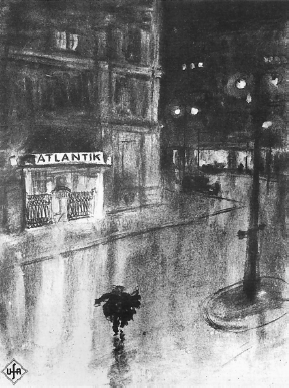
An ex-porter in the Grand Hotel, who ends up in charge of the toilets (Publicity still for The Last Man.)
But you I beg, make not your anger manifest For all that lives needs help from all the rest.
In the first republican decade an assortment of creatures is on parade. The repressed returns as photographic sensation. From war cripples to asylum seekers, they appear in public as objects in need of social solicitude. Their voices matter less than their somewhat exotic, somewhat compassion-inspiring surface appearance, and their mechanical motion. Their appearance forbids overly optimistic replies to the anthropological question, What kind of thing is man?
In art, literature, and film, the creature shows up as the final station in a life story: as the soldier who has lost his armoring; as a defenseless worker put up against the wall by Freikorps rabble; as a pitiful soul at the mercy of the bureaucracy; as an ex-porter in the Grand Hotel who ends up in charge of the toilets (see Figure 13); and “naturally”—barred,
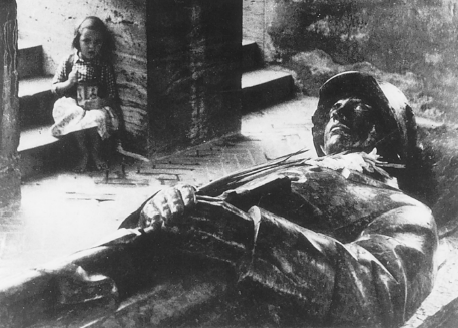
The fear of being abandoned is always present in a shame culture (Bernhard Bleeker's memorial to the unknown soldier, 192.5. With the permission of Stadtarchiv Miinchen.)
From the viewpoint of our typology new objectivity literature alternates between extremes, between the self-confident subject in armor, as soldier or dandy, and the living being, as organic bundle of reflexes, in mortal need (see Figure 14). Songs of the armored subject and legends of creatures in need of mercy fill the space of modernity. The narrative often records the change of armored subject to pitiable creature—and what a “disgrace” it is. A cosmopolitan public indulges its fascination for creatural legends and songs. It finds in these stories a ratification of its state of chronic alarm, of the constant threat of falling victim to social degradation. Its diffuse anxiety seems objectified in the fate of others.
THE CASE OF ANGERSTEIN
The sense of security contained in the concept of the persona disintegrates in the image of the creature. In the persona there remains an ego made autonomous by consciousness of what (through the mask) appears from the outside, while the creature makes its appearance only once the artificial devices of the persona crumble into pieces. The judicial trial seems to be the preferred setting for this spectacle of destruction, because the contest pits the individual's moral responsibility, which in bourgeois society enjoys such a secure status, against the creature's juridical incompetence. In the 19205 such cases capture the attention of psychoanalysis, which attempts to rescue the accused from the grip of the guilt culture, as institutionalized in the form of the tribunal. The effort is successful in that it undoes the fiction of the competent subject. But, by simultaneously consigning the subject to the figuration of childhood, it occasions the return of the core family that the new objectivity generation had so vehemently rejected.
Under the title “Tat ohne Tater,” in July 1925 Siegfried Kracauer reported on the trial of the multiple murderer Fritz Angerstein. The case became for him the symbol of the risk entailed in a world of “objectivity,” in which relationships among people are guided by the functional play of social roles.
For the more relationships among people become objectified, with emancipated things gaining power over people rather than people seizing hold of the things and humanizing them, the more easily it can and will happen that the disfigured humanity that has been repressed into the deepest recesses of unconsciousness will reappear in hideous form in the world of things.[19]
What psychoanalysis represents as the id finds its mask in the creature. The persona, in the form of the “authorized agent,” conjures up one last time the bourgeois illusion of the accountable subject; it remains the purview of such social categories as petit bourgeois or manager. The Anger-stein trial exposes the irreparable discrepancy between the person and the treatment of the person:
A deed without a doer-that is the provocative, the incomprehensible aspect of the Angerstein case. The deed is inconceivable: an orgy of ax blows and arson. Intimidating in its mere magnitude, the crime bursts the bounds of customary statutes as only an elemental event can. It is impossible to do more
― 207 ―than stare at it; it is not to be subsumed within existing categories. Nevertheless, there it is, an undeniable fact that, for well or ill, must be registered.But where is the doer that belongs to the deed? Angerstein? The little, subordinate fellow with modest manners, a feeble voice, and a stunted imagination? In [Arthur] Schnitzler's play Der griine Kakadu, a real murderer seeks to hire himself out as a criminal impersonator to a bar for the Parisian demimonde. But he is dismissed by the proprietor with the remark that the impression he makes is not bloodthirsty enough. The pseudo-perpetrator from Haiger resembles that man. At bottom a mere petit bourgeois, Anger-stein can be outfitted with a vicious appearance only in retrospect by overheated journalists. Had one encountered him prior to the crime on the street, one would have asked him for a light and quickly forgotten his features.
Even today, or today once again, he remains stubbornly at home in the narrow confines of inborn mediocrity. His behavior during the trial has been minimal in every respect. There have been no sudden eruptions to help us chart a connection between the man and what he did, no outbursts to suggest a subterranean fiendishness, nor the kind of silence that would correspond to what happened. Instead, he has withdrawn into trivialities, into a dull state of shock wholly incommensurate with its cause, a confused acceptance of what he himself does not understand.
Angerstein, in Professor Herbertz's depiction of the events, did not commit the deed; the deed happened to him. Having transpired, it detached itself from him and now exists as a purely isolated fact for which there is no proper cause. It rose up out of nothing for the while of the murders, a dreadful “it” out there in space, unconnected with him. If the soup had not been burned—a triviality become a link in a chain of external causation-Angerstein's victims would have gone on living and no one but his fellow citizens of Haiger would ever have heard his name. The crime looms gigantically over him; he disappears in its shadow.
Interrogations and depositions have produced what information there was to produce. Unknown details have become superfluous; a crude whole has been constructed of a thousand statements. The picture is not false, but it is not right. It recalls to the light of day what has descended irrevocably into the darkness, offering it, in a form as inadequate as it is liberating, to judicial measurement.
A petit bourgeois like a thousand others plunged clumsily into atrocity. He married young, worked his way up, even became a manager. Trivial and respectable, not worth wasting a word. The signs of distress are serious, if not extraordinary: leftover adolescent anxieties, localized tuberculosis, a family in financial need, life with an ailing wife. He loved the frail, easily agitated woman-neighbors and visitors praise the marriage. She suffered one miscarriage after the other; she subordinated their erotic life together to the principles of Methodist piety. A life of churchly devotion, which was not easy for him. But, aside from a single sexual dalliance, he was faithful, on the whole anticipating the oversensitive creature's needs. She complained and suffered, her pietistic spirit tormented by morbid premonitions.
And now, in the winter of 1924, the event comes out of nowhere. Minor
― 208 ―illegalities preceded it, a confusing swindle, no one knows how or why. Running amok, it seems that a physician's attentions merely added to the burdens. His previously neatly bounded world was slipping through his fingers. The woman of his obsession draws him with her toward a longing for death, for an end to it all. He may have been thinking of suicide as he stabbed her—but why the frenzy with the hunting knife and the ax, why the senseless bashing of the skulls of uninvolved others? What sucked him, the minor administrator, for a night and a day into the cyclone of devastating violence?The psychiatric reports have neither sought nor found connections between the doer and the otherwise alien deed. They follow the clinical findings; it is not their job to do more. Only Professor Herbertz, the depth psychologist and a judicial outsider, identifies the paths leading upward and outward from the deeper layers of the unconscious.
What happened according to him? Well, petit-bourgeois Angerstein with the apparently easy-going nature must have had to repress mountains of dissatisfactions and worries. It is easy to imagine: the hysterical wife, who wants to be protected and cared for, with her dark biblical fantasies and complexes of her own; the need to keep them secret. Psychic dynamite piles up, while the container holding it looks fine. One day the story explodes-with a bang, impulses break through inhibitions. The bestial instincts, dark desires that have been nourished since childhood, unconscious hatred: all the explosive material in the nether reaches of the soul hurtles toward the surface to discharge like a volcano. It must be right, what Professor Herbertz argues: that during the catastrophe Angerstein was completely out of his mind. Certainly, he wanted to hide the outrage from the eyes of other people; but can it be called normal and customary when he undertakes the most intricate means to that end? Does it testify to sanity that he smashed five human skulls solely so that they would not register incriminating information? This logic is illogical; nor does it have anything to do with Angerstein the sober businessman.
Many details confirm the assumption that the quiet manager was caught unawares by some unknown something inside him. He admits that he himself cannot understand, cannot conceive, that the gigantic fact came out of him. His early attempts to deny it are ridiculously petit bourgeois. Now that he has acknowledged being the perpetrator, he gazes fixedly at what others designate his crime. His evasions from now on have to do with incidentals, his excuses with mere details. The actual misdeeds weigh on him like a block of lead he cannot cast off.
If he is conscious he flees into sleep, sleeping double the usual amount, because his memory wants to disappear. The fact outside there, which is undeniably related to him, is completely overwhelming; he does not like to taste or feel it. Suicide is also beyond the bounds of his horizon, now narrowed to a point. His reading is the Bible, which perhaps brings him by way of detours into contact with his wife.
A deed without a doer that has nothing, but nothing, in common with those great crimes committed by people whose names live on in popular memory. Those crimes were manifestations of a will, however misguided;
― 209 ―they were eruptions of unbridled natures, twisted minds, the expression of outsized drives and passions. They stemmed from a place in the guilty person, were not just there alongside him, existing inadequately in space.The deeds that now go by the name of Angerstein lack a personal point of reference, without, however, that meaning that they were born of mental illness. That there is no sufficient reason for them in the consciousness of the doer is what turns them into a tormenting puzzle, what lends them the uncanny remove of mere facts. It may be that depth psychology is correct in claiming that they emerge to the light of day out of the craters of unconscious psychic life; it has not, however, solved the puzzle of how such a thing is possible.
Suddenness and isolation, the characteristics of disgrace, direct the court proceedings from Kracauer's perspective. The “perpetrator,” overwhelmed in the public gaze, represents himself as creature. In doing so, he opens himself to all manner of dishonor, but that approach is also the only one with any prospect of protecting his life. Creature is the mask that must be relied upon to avert the threat of death. At the same time, Kracauer is required, in order to credibly convey the creatural image, to strip Angerstein of any talent for strategic self-enactment; for the accused must not possess the ability to reflect upon his role if there is to be any chance of avoiding execution. To accomplish this effect, Kracauer's report continuously rehearses the fall of Angerstein's persona into a realm so elemental that a masked performance is no longer a possibility. The defendant's psychological topography, as Kracauer sketches it, takes over elements of Freud's early description of the apparatus of the psyche but is in no way committed to the overall analysis. On the one hand, Kracauer's metaphors demand a thoroughgoing separation between the two spheres of the civilized and the elemental: “psychic dynamite” has piled up in the soul's “nether reaches”; the seeming composure of civilization itself becomes explosive, “volcanic,” its outer shell burst asunder by “elemental events.” On the other hand, Kracauer acknowledges that the natural force that turns Angerstein into a perpetrator is not so elemental but instead falls hostage to the unconscious, which, in turn, struggles in the inauthenticity of the social context—whereby the “hysteria” of the murdered spouse is taken as a given.
In the final passage of the report, Kracauer withdraws from the “demonic” aspect of the case, in which the contents of the “craters of unconscious psychic life” reach the light of day. With no transition, he reaches back to a motif from vitalist philosophy, which blames the deformations of the creature on the reification of the world of civilization. The claim with which he closes his article on the Angerstein case is
BRONNEN'S O. S.
In his essay on Angerstein, Kracauer mentions in passing similarly elemental transgressions of the law, with the difference that popular imagination celebrates the doers in these cases as great criminals. Such malefactors earn admiration, as Walter Benjamin points out in Kritik der Geivalt, because their unlawful acts remind us that the rule of law is rooted in violence and that no new legal orders can be created in the absence of violence.[20]
Arnold Bronnen's novel O. S. attempts to create that kind of admiration for the postwar desperadoes of the Freikorps. But the heroes he depicts occupy an intermediate position between those great authors of misdeeds who want to destroy the system and the faceless members of Freud's “artificial groups,” which even such a loose association as the Freikorps represents. While Kracauer insists that great criminals are “heralds of an otherwise suppressed will,” volitional individuation is precisely what military formations transcend. As Freud maintains, such groups nullify the inhibitions that rule civilian life, stirring up “all the cruel, brutal and destructive instincts, which lie dormant in individuals as remnants of a primitive epoch.”[21]
Bronnen's novel O. S. appears in 1929. On the dust jacket is a military map of Upper Silesia; depicted inside is the struggle of isolated men, who in 1921 are besieged by troops from the German republic, French occupation troops, and Polish “insurgents.” Ernst Jünger welcomes the novel, claiming that O. S. makes it clear “that barbarism is maintained as a necessary consequence of civilization.”[22] The novel depicts not only creatures such as Johann Schramm, a Tirolean roadworker from Ster-zing, who had devoted himself on the Italian front to wiping out “138 sons of this only distantly human tribe,” in order to get hold of their cans of tuna and ground meat. Schramm travels to Upper Silesia with the Freikorps troop Rofibach to act out his annihilating instinct against the Poles:
Since, however, the Pole, to his disappointment, went on trembling, he smashed his skull with his rifle. That felt good. It got him going again and he went rattling up the hill with no comrade save his own shadow…. He surprised them one after the other … killing them with his rifle butt, which slowly splintered apart.[23]
The image of the werewolf from the Tirolean borderland serves to explain why the national conservatives were outraged by the novel's “shamelessness” but it fails to convey the singular atmosphere produced by the book. For the central type of the novel emerges from the dynamism of the city.
The area of movement opened up by the novel holds the most modern of communication systems: travel by road, rail, and air; newspapers, pneumatic message delivery systems, telephones, and telegrams. The unfamiliar combination of modern media with archaic “instinct” shocked the national conservative camp and delighted a reader like Ernst Jünger. The writing of Goebbels's compatriot Bronnen in no way corresponded to the popular borderland literature of the time, which was fond of presenting images of healthy community persisting within agrarian structures.
For Bronnen's O. S. is a traffic novel. It begins at exactly 11:00 A.M. on 29 April 1921, when a taxi pulls up to the utility worker Krenek, who is at work on a streetlight switch box on the corner of Linden and Charlottenstrafie in Berlin. The scene then shifts to the Friedrichstrafie train station, where the express train 0–241 has already departed. The train is missed again at the next station. New characters, whom we will meet again in Upper Silesia, appear at various stations:
As the minute hands on all twenty clocks of the main station in Leipzig jerked forward to 11:00 A.M., shop steward Scholz made his way suspiciously from signal box no. 3 across the tracks to Platform 10, where, waiting behind white clouds of fresh steam, were the damp, black cars of the D-train from Munich to Breslau. (7 ff.)
Seventeen pages later, three more characters enter the action:
At twelve minutes past eleven the Cologne-Breslau D-train was to arrive in Dresden; but it seemed not altogether inclined to punctuality, for at this moment it was still rolling past the gardens of Saxony. Looking worried, three young men dressed in windbreakers stood toward the front of the train, looking ahead at the baggage car. (24)
At 11:20 A.M. it seems certain that Krenek is not going to get to the 0–241 on time. Without giving it much thought he decides, for 200 marks, to drive his mysterious passenger the 500 kilometers to Upper Silesia in the stolen taxi.
The reader is drawn into the narrative space of archaic struggles presented in a futurist light. The battle area is also crisscrossed by traffic networks. The narrative threads of the novel come together at the knots:
Inside, leaning on the dead telephone, was Krenek; but the light didn't work, it was dark. To him, overcome by vertigo, it was even darker. His panting lungs slowly consumed the air. He trembled. (358)
The telephone is dead, the hero irretrievably cut off from the world of mediating signals. The end phase of the betrayal of the “system parties” can begin.
Bronnen's novel casts the new objectivity motto, “Instead of expression—signals, instead of substance-movement,” in a strange light. Language functions in O. S. as in a comic strip; every statement moves the action forward. The way the plebeian characters speak like telegrams accelerates the action, which the labored verbal style of the authorities (when they are not letting their machine guns do the talking for them) only slows. The speeches of the heroes have the function of impelling action and setting off chain reactions. When the hero Bergerhoff is admonished not to make a decision too quickly—“Out of your mouth comes the voice of courage, but also the voice of carelessness”—he replies:
There's nothing speaking in me, Herr Ulitza, but my vocal cords, of course with the help of my teeth. Otherwise, we can talk about anything you like, just not slowing down. (280)
What is going on here is an interlinking of psychological processes and weapons. It is tempting to think that, in Bergerhoff's short course in language, we see the linguistic theory of the avant-garde going to the dogs. The mercenary leaves no doubt: there is no time, gentlemen, for the hermeneutics of the expressive dimension, for the valuation of speech sounds, for unraveling the mysteries of articulation! The faculties of speech work in the same way that weapons talk. The voice, articulated or not, is all the signal we need, as long as it conveys aggression.
At this point, the worlds divide. The sphere of exchange and potential consensus is in enemy hands. That is what Krenek has to learn. In the opening scenes we see him meeting the nationalist slogans with the skepticism of a Rote Fahne reader. But then he leaves the world of Communist
In Bronnen's novel a light from the borderland falls on the systemic world with which it remains entangled: the world of the railway bosses and telegraph officials. That world now becomes, in Schmitt's term, “the intensum of dissociation,” enemy territory as such. But the mechanics of entanglement are not external to the characters. Bronnen stresses the mechanical essence of the affects in his hero Bergerhoff, the critically reflected figure among the mercenaries. Bergerhoff betrays his identity when his gaze, under the influence of “beastly feelings,” gets locked on the figure of a peasant woman, in whom he senses the “breathtaking, rampant machinery of procreation” (376), of which he wants to become a part. (The “male fantasies” Theweleit identifies in the early Freikorps novels reappear here, colored by the cult of technology in the middle-phase of the republic.)
If we compare Bronnen's heroes with Jünger's cool personae, such as the storm troop commander in Stahlgeivitter, their contours become sharper. Bronnen allows his characters no contemplative pauses (which Jünger's diarists consign to reading the classics); Bronnen's werewolves are lonely figures, but not distanced; their goal is to regress into the bonds of blood brotherhood, but there are no conventions or behavioral precepts to regulate the instincts. While Carl Schmitt defines the enemy as a conscious intensification of the “stranger,” for Bronnen's heroes the enemy is never the result of a cognitive operation or anything like an analytical category. The enemy is another race that must be destroyed as soon as it shows up on native territory. Of course, this seems beneath the theoretical level of friend-enemy definition. But since Schmitt intermittently removes moral, economic, and aesthetic criteria from his definition of the enemy, their reintroduction to the empty matrix in the crude form of biologism is easy to arrange; Schmitt demonstrates just how easy it is in the forty articles he writes in the period between 1933 and 1936.
Are the rules we have identified in the conduct codes present in this biologically based novel? Bronnen's hero vaguely recalls them:
Bergerhoff crouched down alone, letting his mind wander in the glow of the approaching fire. Scattered about in the woods, with that strange aura of dead bodies, were German soldiers. In front of him, near the pond, making with their last strength for the water like a single compacted body, lay the
― 214 ―group of prisoners. They had been admirably shot, with precision, like oxen in the slaughterhouse. He looked at them without feeling, without regret, without a thought for a form of justice he did not recognize; it was more a consideration of whether it was playing by the rules. But could this question be decided, here and by him? (333)
Cool persona, radar type, creature. We have become acquainted with three artificial figures, conceived by the “psychology from without” (Gehlen). What remains problematic is how to refer the figures back to sociology's ideal types and—finally—to ask whether the conceptions of the cool persona, the radar type, and the creature are not simply the physiognomic shadows of self-criticism, to which the inner-directed conscientious type rises in times of crisis. It is in any case precisely this inner-directed type, which shines in such exemplary fashion in the texts of cultural criticism, that is difficult to demonstrate empirically.[24] That is why the nineteenth-century publinc devoured it so eagerly in novels, in order to assimilate it as a compensatory orienting value. The numerous documents in the individual's self-stylization as inner-directed subject in the bourgeois novel do not automatically justify the conclusion that inner-direction has ever existed as an operating mode. Many documents in the cultural history of the conscience have been uncovered that call into question this self-confident assumption on the part of the bourgeoisie. It is probably most reasonable to assume that other-direction is roughly constant, although modified in particular epochs such that it appears as if the individual is being guided “from within.” In any case, discovery of the machinelike essence of the inner world collapses the distinction between inner and outer worlds.