
5. Reinventing the Past
Pastiche,
Collage, or “Criticism”?
The seeds of simplification as a reaction against the growing density of Romantic and early modern music were beginning to sprout at the dawn of the twentieth century at about the same time that a new complexity wasgathering momentum in the early music of Schoenberg and Stravinsky. Erik Satie's achievement of a pared-down texture that gave him the undeserved reputation of being trivial dated back as far as the eighteen-eighties, the time during which he wrote the familiar Gymnopedies. It was well inplace when the two twentieth-century giants started out with what was regarded as their blasphemous modernism. Stravinsky's later neoclassicism, such as it was, may be regarded as part of a trend that originated with Satie—a second wave, perhaps—precipitated in Stravinsky's case as a reaction to his own complexity in the Rite and anticipated by the international character of Histoire du soldat (Soldier's Tale, 1918) with its dancenumbers in the manner of a Baroque suite.
It was a similar incentive, the quest for a less rigorous alternative to the lucubrations postulated under the growing influence of serialism, that ledmuch later to the formation of a group of young American composers asdedicated to Stravinsky in his then current mode as the young American serialists were to the twelve-tone Schoenberg. This took place just about atthe start of World War II, its headquarters being Harvard University withwhich I still had contact since I was working on a dissertation that I neverfinished.[1] 1 would call myself a charter member of the group, but as in the case of the French Six, we never thought of ourselves as a formal group until we were called one. We had no name but we were variously referred toas “The New Boston Classical School,” “The Harvard Neoclassicists,” orsimply, “New England School.”[2]
The Harvard composers who were in at the beginning of the “school,”
But this originality of middle-period Stravinsky was completely invisible to members of the press, whose typical response was to complain aboutthe utter lack of personal style and integrity and to bemoan how the disparate sources on which he drew resulted in total incoherence. Yet the verysame reviewers who complained about the lack of style in Stravinsky lostno time in castigating us, the young Harvard Stravinskians, for the slightest trace in our music of the influence of the master's middle manner. I havenever had a more flattering review than the intentionally unflattering onewritten by a Boston newspaper man who observed in a parenthetical aside, “if Mr. Berger's name were not attached one might easily guess it to be oneof that author's [Stravinsky's] smaller ballet scores.”[4] How does one reconcile the claim that middle Stravinsky has no individuality with an observation I quoted above, made by a listener whose musical judgment mustsurely be respected? I refer to Copland's saying he had “never been fooledby the music of Stravinsky.” And how could Stravinsky's influence as aneoclassicist be so palpable if he lacked any style of his own?
Neoclassicism in whatever field of the arts has long had a bad press, itsproducts treated as hand-me-downs, not even as acceptable as something recycled. In an exchange on the subject of The Picasso Papers by Rosalind Krauss, Harvard University's Harry A. Cooper, Associate Curator of Modern
The breach between those of our persuasion (i.e., the Stravinsky camp) and the serialists has been exaggerated. It was and still is the kind of issuein which the press delights. Indeed, as recently as 3 August 1997 an articleunder the by-line of the late K. Robert Schwartz appeared in the New York Times with the headline, “In Contemporary Music, a House Still Divided,” which dug up the old controversy and attempted to get more mileage outof it. The friction that did exist between the young Stravinskians and serialists was scarcely judicious, since we were all accomplices on trial beforethe public for the same offense and in unity there might have been somestrength. The antagonism between the two groups was trivial compared tothe public's antagonism toward both. Nevertheless, the serialists tended tobe condescending. They considered themselves the intellectuals, and wewere a bunch of opportunistic composers pandering to public taste.
It is still believed in some quarters that the neoclassic music's admittedly greater accessibility was what must have fueled the movement. On the contrary, what much of the public saw in middle-period Stravinsky was a grossmishandling of their favorite older masters. They would rather, for example, have had their Bach untouched. If audiences had had it in their power, I used to think, they would have followed the example of the Boston police who marched into Symphony Hall in 1944 and enjoined a performance of Stravinsky's arrangement of the “Star-Spangled Banner” which was about to be repeated under his baton at the second of the weekend concerts of the Boston Symphony Orchestra, offered in conformancewith a wartime directive that the anthem be played at the start of everyconcert. It seems that according to a Massachusetts law any “tampering”
At one time, in order to counter cries of how unnatural it was to “turnback,” I thought it important to demonstrate the logic of Stravinsky's abandonment of his “Russian” period style and to make it perfectly clear thatthe merit of a given work was not established by the degree to which it conformed to some foregone requirement of what historical progress should ormust objectively be.[9] This was not difficult to do. We live at a time wheninterest in the music of the past far exceeds interest in music of the present. This interest has brought an enormous amount of old music to light inscholarly critical editions that make every effort to transmit it in authenticform, in contrast to nineteenth-century musicians (Busoni, for instance) who prided themselves on making Bach sound like Brahms.
There is no reason why an artist should be expected to develop logically, no reason at all why he should need a passport to enter any terrain thatbeckons him, no reason why he cannot change direction in midstream. Butin the thirties the social dialecticians who cautioned us against Schoenberg's lucubrations also considered Stravinsky's new approach, as one leftist commentator put it, a sad casualty of the “prepotency of bourgeoisforces” —a high-flown phrase that has stayed with me for over half a century though I do not know where I read or heard it. In donning the cloakof internationalism, Stravinsky, it was alleged, had deliberately detachedhimself from his native land as if he were embarrassed by its political situation, there by cutting himself off from the sources that were at the root ofhis inspiration.
The assimilation of artistic to political ideologies in the thirties was not exclusively a phenomenon of Communism as it was in the case of the Seegers
I find this idea of musical fascism as unconvincing as the motivations the Communists ascribed to Stravinsky. It is all out of a desperation to explain Stravinsky's direction on the part of those who find it absolutely beyondtheir comprehension. Suppose it were something as insignificant as Serge Diaghilev's request for a ballet score based on Pergolesi that kindled Stravinsky's interest in utilizing the music of the past in some way, much as Robert Craft is said, by introducing him to the literature of serialism, to beresponsible for the composer's conversion to twelve-tone method. Would itrender the evolution any less viable? Many motives have been suggestedas having precipitated Stravinsky's neoclassicism and among them noneare more ingenious than those proposed by that formidable scholar of his “Russian” period, Richard Taruskin, brilliant historian though he admittedly is, who has made a career out of deconstructing the neoclassic Stravinsky, thus giving further credence, as if any were needed, to the average listener's notion that the composer's progress was all downhill from theend of the “Russian” period.[11] Taruskin quotes the French critic Jacques Riviere who wrote of the Rite at the time of its premiere that it was in reality “absolutely pure …no veils and no poetic sweeteners; not a trace ofatmosphere… everything is crisp, intact, clear, and crude.” And more, “Never have we heard a music so magnificently limited.”[12] This prompted Taruskin to observe, “One is tempted at this point to say that by hailing Stravinsky as an 'anti-Debussyste' and a Classicist in The Rite, Riviere ineffect turned him into one.”[13] On another front Taruskin argues, “So farfrom an investment in the 'German stem,' the 'retour á Bach' was an attempt to hijack the Father [an allusion to the once fashionable literary
The French neo-Catholic philosopher Jacques Maritain in his seminalbook on aesthetics Art et Scolastique (Art and Scholasticism) which hestarted to write in 1918 (a few years after the Rite came out) coupled Stravinsky with Wagner among composers whose music would “debauch the ear.” But when he did the second edition Maritain evidently came aroundto Riviére's view and revoked his decision in a footnote that reads in part:
Je m'accuse d'avoir ainsi parlé de Stravinsky. Je ne connaissais encoreque le Sucre du Printemps, j'aurais dû voir déjáque Stravinsky tournaitle dos a tout ce que nous cheque dans Wagner…. son oeuvre admirablement disciplinéd… répond le mieux à la stricte rigeur classique….[I regret having thus spoken of Stravinsky. All I had heard was theRite of Spring, and I should have perceived then that Stravinsky wasturning his back on everything we find distasteful in Wagner…. his admirably disciplined work… best answers the strict classical “austerity….”][15]
As I have already indicated, I am not convinced that Stravinsky's takingup residence in America is what determined his influence among young American composers, though they both happened around the same timeand his presence may have helped. Yet it was altogether appropriate that the movement should have Harvard as its locus and should have had its beginnings just when Stravinsky delivered the prestigious Charles Eliot Nortonlectures there (1939–40). Also Nadia Boulanger, who would have spawnedthe movement without any help from the master, came to Cambridge in 1938 as visiting faculty at the Longy School of Music and remainedthrough most of the war years. (Stravinsky said she knew more about hismusic than he did.) A whole cluster of circumstances was favorable to the burgeoning of a Stravinsky school. Not least among them was the presenceof Walter Piston as the senior composition teacher at Harvard with his neo-classic leanings, for example, and especially the powerful influence of humanism over the intellectual attitude of faculty and students of the entireuniversity as a result of the long tenure of the distinguished proponent of the humanist movement Irving Babbitt. Babbitt's remonstrances against Romanticism echoed and reechoed through the corridors of that hallowed institution for many years after he had departed from it.
Stravinsky's allusions to the music of the past were not directed towardachieving results that would be modeled after the sources, since the interpolated material could be willfully distorted, like the human bodies in Picasso's cubist paintings, or cut into bits and pieces as if they were to be usedfor a collage. Scraps of newspaper in this process are not usually chosenfor their verbal content. Painters do not expect them to be read. What is atissue is the shape and texture and how they relate to other shapes and textures on the same canvas. The listener whose attention is arrested at the point where a musical fragment evokes its past is like the viewer whospends his time reading the newsprint on the scrap of paper of the collage. To the extent that Stravinsky subsumed linear shapes, methods, and ideasfrom the general practice of the music of the Classical era he was doingsomething not altogether unlike what he had been doing when he compiled-ready-made Russian folksong, though in the end the methods, aim, and result were very different. By the time he did the same thing with Classicalmusic it was just as much in public domain as his folk sources. In a veryreal sense, moreover, as many listeners will agree, the Classical sourcesnever really disguised the real Stravinsky: there was still a strong residueof his native rhythmic heritage that animated his later works. Michael Tilson Thomas has observed, “Even in his abstract music …there was anorganic dance-rooted quality.” Further, as a conductor “he made gesturesand let out moans, grunts, and gasps—the kind of thing one could associate with peasant dance and song.”[16]
The late pianist-composer Leo Smit observed, “When Stravinsky reworked older material, it became something so new that even the composerhimself became confused at times over where the other left off and Stravinsky began.”[17] Smit told me about an encounter with the master in the forties at one of the gatherings of musicians my late first wife Esther and I hadat our apartment in New York when the subject came up of Baiser de la fee (The Fairy's Kiss), the ballet based on Tchaikovsky. He asked Stravinskywhere in Tchaikovsky did he find the theme of the fortune-teller. Stravinsky replied that he wrote it himself, but years later Smit found it in a Tchaikovsky song, “Oh Pain, Oh Pleasure,” the key having been changed from A major to A minor. (In one of the many conversations with Craft in a bookpublished in 1962 Stravinsky admitted, “At this date I only vaguely remember which music is Tchaikovsky's and which mine.”)[18]
In the matter of the “return to the past” among the members of the Harvard Stravinsky school there was, as I have indicated, one exception who
Dans le tumulte des opinions contradictoires, mon ami Maurice Ravelintervint presque seul pour mettre les choses au point. II a su voir et ila dit que la nouveauté du Sacre ne residait pas dans 1'ecriture, dans 1'instrumentation, dans 1'appareil technique de 1'oeuvre, mais dans 1'entite musicale. [In the tumult of contradictory opinions my friend Maurice Ravel intervened practically alone to set matters right. He was ableto see, and he said, that the novelty of the Rite consisted, not in the “writing,” not in the orchestration, not in the technical apparatus of the work, but in the musical entity.][19]
Hearers were so overwhelmed by what they considered revolutionary inthe Rite that they failed to perceive, as we do now, that it was essentially afurther stage in Impressionism. The values of traditional and modern arereversed in Shapero's case. To apprehend his individuality within the outward veneer of conservatism will take time, application, and a willing attitude, just as, contrariwise, the capacity to apprehend the traditional inthe Rite did. I am reasonably sure the individuality is there since one candetect its influence when it shows up in a disciple like Leo Smit, or in Shapero's peers, Bernstein, Irving Fine, and perhaps myself as well.
Shapero's Symphony for Classical Orchestra completed in 1947 whenhe was twenty-seven was acclaimed by Stravinsky and Copland and promptly performed a year later under the baton of Bernstein, who recorded it for Columbia Records. But despite this illustrious beginning Shapero's composing activity tapered off in a manner that some of us havefound puzzling. Could it have been the backlash that set in early on thatdiscouraged him? A little over a year after Bernstein gave the symphony'spremiere with the BSO, for instance, the League of Composers presented Shapero's lengthy Sonata in F minor at New York's Museum of Modern Art, and it created what I should not quite call a riot, but certainly a decidedturmoil. (My review of the concert in the New York Herald Tribune, 8 March 1949, will be found in the appendix.) George Perle, the composer(twelve-tone at the time but more recently involved with an interesting system of his own) and the author of the invaluable introductory Serial Composition and Atonality,[20] stood up and shouted, “Viva Beethoven!” I
On the other hand, things can be pretty awkward when the mindset and the actual experience clash, as in the case of the former powerful Times critic Olin Downes, who was vehemently opposed to Stravinsky's internationalism even before it evolved into neoclassicism and who was positive hewould hate any music cast in that mode. Thus, he had to go through somepretty ridiculous linguistic contortions when he found that a Stravinskypiece which in principle he should not have liked was actually to his taste, though his conviction of its allegedly unsavory backward-looking aestheticshould have dictated otherwise: “Histoire du Soldat appeared after he hadceased to be creative…. Perhaps some of the inertia of the creative will, the despair of sterility, contribute to the effectiveness of this score. Stravinsky of obviously waning powers achieves from his very decline somethingof a masterpiece.”[21] (There is a certain irony in the circumstance that Downes's convoluted reasoning is not unlike what Lang—quoted earlier in this chapter—had to say about Brahms, since basically the two composersare so different from each other.) Downes was a master of the art of reversing his position without seeming to contradict himself. Another review that demonstrates his legerdemain in this matter dealt with Apollon musa-gete on the occasion of its world premiere in Washington, D.C., on 27 April 1928, when after constantly complaining about Stravinsky's unwarranted harking back to the past Downes now saw it, so we may gather from hisTimes review, as the “effort, the heroic effort, of an artist who turned awayfrom the anarchies of the present and tried to retrace his steps…,” thusemploying what was formerly his negative criterion as a positive one.
Shapero may have been a charter member of the young Harvard Stravinskians, but he never went in much for the interrupted line, the jaggedshapes, the precipitous cutting, the dissonance, the hiccups and asymmetryof rhythm, the skeletal texture and other such devices of Stravinsky thatappealed to the rest of us. These were what characterized the master's music of his so-called neoclassic period and distinguished him from otherswho have been designated “neoclassicists” —Hindemith and Prokofiev, for
It is idle to quibble about labels but I have some trouble calling the new Romanticists “necromantic,” since that locution was used by Virgil Thomson for a movement that originated in France, particularly among painters, including Eugene Berman. The chief musical representative of the movement was Henri Sauguet, and Thomson singled out Irving Fine as its American representative. What distinguished neoromanticism was its evocation of early Romanticism, the intimacy and unpretentiousness of Schubert or Schumann before the genre was puffed up with the grandiosity of Wagner and Mahler.
The new Romanticists to whom Rockwell was referring included composers like George Rochberg and David Del Tredici. A contemporary Romanticist who does not “go back” to the past is Leon Kirchner. The wholeatonal movement, despite its preference for condensation, ironically hadsome roots in Wagner and Mahler, evident in the Gargantuan Gurrelieder and the hyper-Romantic Transfigured Night. Kirchner's powerful and intensely felt music picks up the thread where Schoenberg and Berg left it before they became engaged in a more rigorously organized approach to serialism. For Kirchner, despite some serial elements, it is almost as if strictserialism never existed, but it has not been his aim to return to the nineteenth century. Nor was a return, in his case to the eighteenth century, the aim of Stravinsky and his satellites, as I have already said, when they hadrecourse to eighteenth-century models. The idea was, rather, to challenge,
In listening to this music, if one does not assume the role of tune detective, dispensing demerits upon every allegedly “illegal” allusion to other music, one must inevitably be aware of the ingenuity and invention thatcan be found to be there, its accessibility not at all occluded as it might bein, say, Webern or Xenakis by difficulty or strange modernist procedure, but clearly audible to the sympathetic and attentive listener. Coached bymusicographers of all types (historians as well as critics) to believe that “looking back” is unnatural, audiences are only too happy to have an excuse to drop any music considered “unnatural” —especially if it is new music such as this—from their usual repertory, and to use their listening timeinstead to bask in the warmly familiar, unchallenging company of their customary “fifty pieces.” True, a work like the Rake is not entirely neglected, but why should it not be a staple, like Der Rosenkavalier? And there are all those orchestral masterpieces of the thirties and forties we almost never hear and for my taste are still too infrequently played: Jeu decartes (A Game of Cards), Danses concertantes,“umbarton Oaks” Concerto, the “Basle” Concerto, and the two symphonies. Also, Persephone and Oedipus Rex, the two choral masterpieces.
The last time I saw Stravinsky it was on the West Coast, shortly beforehe died. I bemoaned with him the sad fact that we heard so little of his music of this epoch at concerts, or even in recordings on the air. He looked atme with a glint in his eyes that prepared me for one of his characteristic barbs, and said, “Only my Scheherazade they play.” I think of this whencomposers of my generation—or I myself—complain that they don't playour music. We have scarce reason to complain when they don't even dojustice to Stravinsky. Incidentally, I thought he coined the witticism onthe spot until I found it in an entry to his diary for 15 December 1961. When proudly told somewhere in New Zealand that half a program of hisworks had once been given he thought to himself, “my Scheherazade nodoubt.”[24]
When I refer to the accessibility of Stravinsky's music of this middle period I have in mind a certain phenomenon that is characteristic of some great artthrough the ages (though it is not obligatory for any artist to conform tothis prescription). As in Shakespeare or Mozart it is as if the music operates on two levels. The blood and thunder, the intrigues in Shakespeare, or
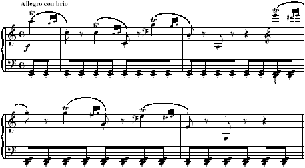
Ex. 9. Stravinsky Chords
It may very well be that Debussy's concern for timbre had something todo with Stravinsky's choice of unusual spacing and doubling. But there seems to have been more to it than that. He once confided in me, when we
Ex. 10. Beethoven, “Diabelli” Variations, No. XXI
Being sensitive to the precise quality of the chords is only one of the requirements for hearing what is essential in neoclassic Stravinsky. There isthe matter of the pitch organization which, because it is often diatonic and may have a pitch priority analogous to the traditional tonic, lends itself torelaxed listening in which one might fancy one hears tonality though the music is essentially nontonal. In my analysis of one of the parameters ofPsalms I have drawn attention to the stratification that made it difficult todecide whether E or G had priority. A somewhat different bifurcation isencountered in the Serenade in A, where the title leads us to expect A astone center, and A major or A minor as the basic key. But it turns out wehave the pitch collection (notes or scale degrees) of F major in which the
Once again we are up against the difficulties of verbalizing, for these arefairly simple operations to hear, but they may sound complicated, even—that forbidding epithet— “intellectual” when described. I shall investigatelater the relationship between such formulations and the proper apprehension of music as heard (see chapter 13).