
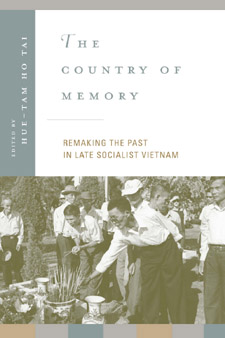
The Country of Memory
Remaking the Past in Late Socialist Vietnam
EDITED BY Hue-Tam Ho Tai Foreword by John Bodnar
Table of Contents
- Illustrations
- Foreword
- Acknowledgments
- INTRODUCTION
- 1. CONSTRUCTING MEMORY
- 1. Reading Revolutionary Prison Memoirs
- 2. “The Fatherland Remembers Your Sacrifice”
- 3. Museum-Shrine
- 2. REPACKAGING THE PAST
- 4. Framing the National Spirit
- 5. The Past without the Pain
- 3. GENDERED MEMORY
- 6. Faces of Remembrance and Forgetting
- 7. Contests of Memory
- AFTERWORD
- Glossary
- Bibliography
- Contributors
- Index
CONTENTS
| List of Illustrations | vii | |
| Foreword John Bodnar |
xiii | |
| Acknowledgments | ix | |
| Introduction: Situating Memory Hue-Tam Ho Tai |
1 | |
| PART ONE: CONSTRUCTING MEMORY | ||
| 1. | Reading Revolutionary Prison Memoirs Peter Zinoman |
21 |
| 2. | “The Fatherland Remembers Your Sacrifice”: Commemorating War Dead in North Vietnam Shaun Kingsley Malarney |
46 |
| 3. | Museum-Shrine: Revolution and Its Tutelary Spirit in the Village of My Hoa Hung Christoph Giebel |
77 |
|
vi
|
||
| PART TWO: REPACKAGING THE PAST | ||
| 4. | Framing the National Spirit: Viewing and Reviewing Painting under the Revolution Nora A. Taylor |
109 |
| 5. | The Past without the Pain: The Manufacture of Nostalgia in Vietnam's Tourism Industry Laurel B. Kennedy and Mary Rose Williams |
135 |
| PART THREE: GENDERED MEMORY | ||
| 6. | Faces of Remembrance and Forgetting Hue-Tam Ho Tai |
167 |
| 7. | Contests of Memory: Remembering and Forgetting War in the Contemporary Vietnamese Cinema Mark Philip Bradley |
196 |
| Afterword: Commemoration and Community Hue-Tam Ho Tai |
227 | |
| Glossary | 231 | |
| Bibliography | 235 | |
| List of Contributors | 251 | |
| Index | 253 |
Illustrations
| 1.1. | Hoa Lo Prison Museum, Hanoi | 24 |
| 2.1. | Soldier's Grave, Phu Tho | 51 |
| 2.2. | Tam Nong District Revolutionary Martyrs Cemetery, Phu Tho |
55 |
| 2.3. | Ho Chi Minh Mausoleum and Shrine to the Unknown Soldier |
68 |
| 2.4. | ARVN cemetery, Ho Chi Minh City 69 | |
| 3.1. | Ton Duc Thang Museum-Shrine, My Hoa Hung Village, An Giang |
83 |
| 4.1. | Mai Van Hien, Meeting | 117 |
| 4.2. | Nguyen Sang, The Enemy Burned My Village | 118 |
| 4.3. | Nguyen Sang, Joining the Communist Party at Dien Bien Phu |
119 |
| 4.4. | Portrait of Bui Xuan Phai | 122 |
| 4.5. | Bui Xuan Phai, Old Hanoi Street | 123 |
| 4.6. | Duong Bich Lien, Woman with Flower | 126 |
| 4.7. | Nguyen Tu Nghiem, Zodiac | 129 |
| 5.1. | Entrance to Cu Chi Tunnel | 147 |
| 5.2. | War Time Souvenir Shop, Cu Chi Tunnel | 147 |
| 5.3. | Renovated Hotel Continental, Ho Chi Minh City | 149 |
| 6.1. | Heroic Mother in front of son's altar, Hanoi | 178 |
|
viii
|
||
| 6.2. | Heroic Mother in front of list of revolutionary war dead, Ho Chi Minh City |
181 |
| 6.3. | Billboard, Ho Chi Minh City | 183 |
| 6.4. | Mother and child statue, Hanoi Museum of Women | 187 |
| 7.1. | Truong Son Revolutionary Martyrs Cemetery | 200 |
| 7.2. | Dien Bien Phu veteran, Phu Tho | 209 |
| 7.3. | American War veteran, Phu Tho | 210 |
Foreword
The world we live in is encased in memory projects, undertakings designed to reconstruct versions of the past suitable for a myriad of purposes in the present. The cohesive narratives and glorious monuments that punctuated the culture and politics of nation-states now appear as mere options on a lengthy menu of books, films, sites, and images of times gone by. Scholars have not been reluctant to advance explanations for this cultural discord. Many have argued that the rise of memory, with its links to individual and group subjectivity and its disdain for the domination of officials, has exploded in the aftermath of the decline of the nation-state. In the most powerful nations in the world, traditional accounts of the relationship between the past, present, and future have withered. In the United States this has given rise to voices that contest interpretations of change over time that have venerated the nation as a source of material prosperity or democratic rights for all. In many nations, images of heroic men who defeated a country's enemies now must fight for cultural space against stories and symbols that expose the evil ways of a nation's leaders themselves. Thus, today in France, Germany, and Japan, significant political debates occur over the degree to which these nations were responsible for violence directed not only toward outsiders but also toward their own citizens.
Hue-Tam Ho Tai's masterful collection of essays that explore how
This book also suggests that the “commemorative fever” that is sweeping Vietnam is about more than Vietnam's history. It also has a great deal to do with the problems premodern cultures presented to those who promoted the creation of contemporary states. In this regard both Vietnam and this book offer all scholars of nationalism and remembering in the West a fascinating perspective on their own nations. Traditions of public debate over commemoration or monuments did not exist in totalitarian regimes; the cultural distance between peasant societies and modern states was immense not only because totalitarian governments could not promise a democratic future but also because they were so far removed from people steeped in premodern traditions. Thus, we can see in this volume that the incredible force of cultural domination in peasant societies produced a countermovement to hold on to memory in unique and compelling ways. When the Vietnamese government attempted to honor the dead who had fought the Americans, they cast their commemorations in predictable tropes of patriotism and heroism. Such images, however, held only a limited value for families deeply attached to rituals that signified that the dead would be reborn in an “otherworld” where they would join a community of ancestors. Thus, in a local community in northern Vietnam studied in this
John Bodnar
Acknowledgments
The present volume grew out of a double panel at the 1996 annual meeting of the Association for Asian Studies. It could not have been put together without the assistance and inspiration of numerous individuals and institutions across several continents. In addition to the acknowledgments included in individual chapters, the authors wish to express their thanks to the two panel discussants, Marilyn Young and Rubie S. Watson, for their insightful comments on the papers. We record as well our appreciation for the very lively interventions by members of the audience. The incisive critiques of Michael Robinson and another reader for the University of California Press greatly improved the original manuscript. Duong Ngoc Dung compiled the glossary. Natalia Puchalt supplied many of the beautifully evocative photographs in the book. Sheila Levine, Juliane Brand, and Rose Anne White of the University of California Press patiently shepherded the manuscript through the many stages of the publishing process.
While we gratefully acknowledge our numerous debts, we also take full responsibility for errors of fact or interpretation. Above all, we hope that our collective effort will inspire others to delve more deeply into issues of history and memory in Vietnam. The present volume should thus be seen as a beginning, not an end.
Hue-Tam Ho Tai
INTRODUCTION
Situating Memory
Hue-Tam Ho Tai
Commemorative fever is threatening to blanket the Vietnamese landscape with monuments to the worship of the past. Every year, it seems, another museum opens, a new memorial is dedicated. Temples are refurbished, and rural roads bristle with signs pointing to historical sites. Volumes of memoirs are constantly being churned out, cemeteries to the revolutionary dead dot the country from north to south. If it were not for the equally ubiquitous symbols of the global economy, such as Coca Cola bottles, karaoke bars, golf courses, and computers, Vietnam would appear to be living in the past.
This upsurge of commemoration is a paradoxical byproduct of the program of economic reforms known as Doi Moi (lit., “changing for the new”), which was launched in the late 1980s. Coming barely fifteen years after the country was unified under communist rule, these reforms were designed to transform its economy from a socialist, centrally planned economy to one driven by the market. Yet the commemorative fever is not just a salvage operation designed to preserve traces of a fastvanishing past before they are obliterated by the forces of relentless capitaliststyle modernization. As the chapters in this volume suggest, the stakes involved in public memory are far more complex. What is being remembered? Who does the remembering? How is it done, and why? What is the context in which memory work is being carried out? These are some of the questions raised in the present volume. Its goal is to present analyses of how Vietnamese pasts have been constructed by
READING THE FUTURE INTO THE PAST
Public memory in present-day Vietnam is characterized as much by confusion as by profusion. A key to understanding this situation lies in the difficulty of assigning historical meaning to the upheavals that form the raw materials of modern Vietnamese history. The divisions they have engendered suggest the need to follow in the footsteps of Maurice Halbwachs and study the social context in which Vietnamese public memory is constructed.1 There is, however, another dimension of memory that needs to be attended to as much as the social one: it is the historical context in which remembering takes place.
The Greek playwright Agathon is reported by Aristotle to have declared: “Even God cannot alter the past.” Samuel Butler answered back across two millennia: “It has been said that though God cannot alter the past, historians can.”2 Others, besides historians, can and do alter it as well. “It's a poor sort of memory that works only backwards,” remarks Lewis Carroll's Queen in Through the Looking Glass.3 Indeed, memory works forward as well as backward; the past is shaped by the future as much as the future is shaped by the past. Memory creates meaning for particular events or experiences by inscribing them in a larger framing narrative, be it personal or collective. Whether implicitly or explicitly, in this larger narrative is embedded a sense of progression and vision of the future for which the past acts as prologue. In Penser la re´volution franc¸aise, Franc¸ois Furet pointed out how the political sympathies of different actors, including historians, led them to conceptualize the French Revolution either as the end point of the narrative of the French nation or as the beginning of the Republican narrative.4 In Vietnam, deciding how to remember a century's worth of historical change is a matter of grave difficulty for a society filled with uncertainty about its future and only just beginning to rethink its past.
The larger narrative capable of giving meaning to otherwise random experiences has changed abruptly over the course of the twentieth century. Vietnamese have experienced imperial and colonial rule and have gone through a prolonged struggle for independence, a Communistled
The political liberalization that is a by-product of economic reforms is widely credited with opening a space for revisiting the past. Yet it is not only the loosening of state control over cultural life that has allowed discrepant interpretations of the past to come to the fore; new historical conditions are forcing them into the open. In opting for Doi Moi, Vietnamese leaders were implicitly setting aside a socialist vision of the future that had sustained them through decades of struggle; nonetheless, they did not abandon their claim to historically based legitimacy, continued monopoly on power, or formal commitment to Marxism-Leninism. Even now that the need to mobilize for war is gone, the leadership retains a stake in promoting a version of the past that inscribes it as the legitimate inheritor of the Vietnamese patriotic tradition and the dominant force in the recent history of the country. Such a version of the past tends to empty the historical stage of alternative scenarios and actors. Yet the decline of High Socialist orthodoxy, relative prosperity, and prolonged peace have encouraged other actors besides the state to try to occupy the space of memory. The new visions of the past must take their place alongside old ones that continue to give solace not only to the state but also to important segments of Vietnamese society. The deconstruction of the official past is thus an untidy, sometimes sur-reptitious, seldom openly confrontational by-product of economic reconstruction.
UTOPIA AND ITS AFTERMATH
To understand how the past is being reimagined, it is important to know how it was constructed to begin with, for the socialist telos of the old historical narrative has never been repudiated, and new visions of the future—and thus, discrepant versions of the past—must be told around it rather than in open challenge to it.
In the midst of the War of National Salvation Against the Americans (Chien Tranh Chong My Cuu Nuoc), as the Vietnam War was known in North Vietnam (and now in the whole country), the scholar-activist Pham Huy Thong gave an interview in which he declared: “History is a source of comfort to us.”6 Previously an aide to Ho Chi Minh and later director of the Institute of Archaeology, Pham Huy Thong was a key actor in the efforts of the North Vietnamese state to use history as an instrument for mobilizing popular support during wartime. By the time the interview took place in January 1973, on the eve of the signing of the Paris Peace Accords, decades of living through war and revolution had turned these experiences into seemingly normal states rather than extraordinary events. Making history serve wartime purposes was achieved by writing the past (history in the lower case) as a narrative of heroic and ultimately triumphant struggle against foreign domination and inscribing the future as a vision of communist utopia achieved through the inexorable workings of History with a capital H, Marxist-style.7 Both time past and time future, so it seemed, was on the North Vietnamese side and firmly under control.
When peace finally came, socialism was on the wane worldwide. Even in Vietnam, where the revolutionary generation remained in power, the future had to be rethought. The Doi Moi reforms saved the Vietnamese communist leadership from historical irrelevance when other socialist regimes throughout Europe were being toppled. But with Doi Moi, History lost its capital H. If revolutions aim to transform the future, and in so doing rewrite the past, so do counterrevolutions. The end of utopia has taken away the telos that had made possible a particular writing of Vietnamese history. One Vietnamese historian told me: “Now we are at peace, we need a new theme around which to organize our historical narrative.” Unlike history, memory is not weighted by the need to unify the past, and its production is proceeding at a faster pace than the rewriting of history. Yet memory does not exist without reference to history. The unmooring of the historical past from its predicted end has undone the carefully erected structures of memory.
GEOGRAPHIES OF MEMORY
Nearly a century after the end of the American Civil War, William Faulkner wrote: “The past is never dead, it's not even past.”8 In Vietnam as in the American South, the past remains a live presence, impossible to ignore, difficult to assimilate. With its share of winners and losers in what, increasingly, is recognized to have been a civil conflict as much as a war against foreign intervention, postwar Vietnam, at first glance, offers striking parallels with postbellum America; yet the issues involved in grappling with the past are quite different in the two countries.
Some Vietnamese families begin their collective narratives of living with and through conflict in the nineteenth century, when the French conquered Vietnam. For many, that narrative did not end until 1990, when Vietnamese forces finally pulled out of Cambodia. While some rejoice in their improved situations, others mourn accumulated losses. Answers to queries about a person's current circumstances are often prefaced with “After 1975” or “Before Doi Moi.” Temporal references such as these function not merely as markers of time gone by but also as indices of economic and political gains and losses and of personal experiences of war and revolution. Gains and losses, triumph and tragedy, however, do not align neatly and predictably on either side of the national divide that was the seventeenth parallel. The postwar era has also become the postrevolutionary era, in which it is unclear who won and who lost, as it was in the American Civil War. This complicated geography of triumph and setbacks has a profound impact on how the past is reimagined.
The complex intertwining of geography and time in Vietnamese memory is illustrated in one of the earliest novels of the Doi Moi period, Duong Thu Huong's Paradise of the Blind. This book was published in 1988, when the Doi Moi reforms were just being launched, and is widely seen as a revisionist account of over forty years of Communist rule in North Vietnam by a veteran of the War Against the Americans.9 At the end of the novel, the heroine decides not to accept the house bequeathed to her by her aunt because she is unwilling to take on the burden of bitter memories that goes with it. The house in question had been confiscated during the Land Reform campaign of the 1950s, and the once prosperous lineage to whom it had belonged had been destroyed. Later, thanks to the Doi Moi reforms and her own unceasing efforts, the aunt was able to rebuild the family fortune and recover the house. It is thus full of ghosts and painful memories, a reminder of the toll of revolution
While it is conceivable that alternative interpretations of the past would not have surfaced into public life had it not been for the reforms, it would be misleading to infer that the “orthodox” narratives all belong to the pre–Doi Moi period. As some of the chapters in this volume suggest, the perpetuation of the state narrative—though sometimes modified—is made possible by enduring collective and personal concerns that have not been rendered moot by reforms even as other actors with different interests have come forth with their own revisions of the past. Everywhere, the prerevolutionary tradition is being revived (and, in many cases, invented wholesale), but its function is highly ambiguous. It is revived by some as an alternative to the cultural legacy of the communist era, and by others as a means of entrenching that legacy even more firmly in the national consciousness. As the heroine of Paradise of the Blind realizes, the struggle over the past is an aspect of the struggle to control the future.
A complicating factor is the emergence of an art market and thegrowth of the tourist industry. These are allowing international actors as well as domestic ones to play a role in this work of revision. The battle sites visited by French tourists are not the same as those that bring back American veterans, to cite two groups of foreign visitors with their own time specific memories of “Vietnam,” while others without personalties to the country are drawn to the “timeless” beauty of its landscape and recreational facilities. More important, there is a definite tension between the uses of the past as a legitimating device and as a means of constructing community and its repackaging as a marketable commodity.
OWNING AND DISOWNING THE PAST
“Who owns the past?” Scholarly attempts to address this question began with a critical look at the politics of historiography and have since
Much has been written about public memory and commemoration in various geographic and temporal settings. By “public,” I refer to ritual performances, speech acts, visual media, and other cultural activities that are articulated and made available or accessible to others rather than kept secret. These representations may be the works of single individuals or the products of collective efforts. I am thus not referring to clandestine counterhegemonic communities of memory on which Milan Kundera or James C. Scott focus, 13 but to individuals and groups who openly try to claim a piece of the past. It would be tempting to study the relationship between history and memory in Vietnam in terms of hegemony and counterhegemony pitting the state against individuals, losers against winners, North versus South. But, although it is certainly possible to study memory and countermemory through these analytic lenses, Vietnamese attempts to come to grips with the legacy of a century's worth of war and revolution raise issues that are far more complex than a simple story of tension and opposition might suggest.
Since Ernest Renan, scholarly attention has been paid to the “collective amnesia” that makes possible national memory.14 Milan Kundera considers memory a powerful weapon against the totalitarian conspiracy of silence: “The struggle of man against power is the struggle of memory against forgetting.”15 This struggle can be waged by constructing a counternarrative out of the suppressions and silences in official history. This counternarrative would have to be lodged in the realm of private memory or to circulate among small, clandestine, counterhegemonic communities in order to endure. In Kundera's novella “Lost
Depending on their age, sex, regional origins, political sympathies, and experiences, different Vietnamese have different versions of what happened over the last century and different ways of dealing with its legacy of memories. The aging southern revolutionaries in Christoph Giebel's chapter, who fought to extend the revolution southward, are now engaged in the struggle to have their contribution to local history remembered by a grateful nation and incorporated in its larger narrative. The desire to make local, and even personal, history align with the national script may explain the production of southern revolutionary memoirs well after 1975, in which the tropes that are used are remarkably similar to those discussed by Peter Zinoman in his analysis of northern revolutionary prison memoirs from the 1960s. Paradise of the Blind, however, features a heroine who embodies a totally different attitude toward this revolutionary past. She belongs to a younger generation of North Vietnamese who do not strive to preserve the revolutionary legacy or to rebuild a prerevolutionary culture they have never experienced. Whereas for her aunt, undoing the revolution had meant restoring the family's fortune, for her it means vowing to “sell the house and leave
STYLISTICS OF COMMEMORATION
Studying memory in Vietnam presents its own set of challenges. Vietnam today is characterized by neither fullblown totalitarianism nor total democracy. In democratic societies, it is possible to explore the commemorative project from the initial proposal through the process of negotiation among various groups of actors to the end result: a new public holiday, a monument, or the naming of an already existing structure. This can be achieved by following records of public debates over budget, design, siting, timing, and wording, reports of protests as well as rituals of celebration. In the United States, monuments such as the Vietnam War Memorial (“The Wall”), special displays such as the Enola Gay exhibit, commemorative occasions such as the Christopher Columbus quintecentennial, the decision to honor Martin Luther King Jr. through a public holiday, and attempts to create theme parks out of hallowed sites such as Gettysburg have all been the focus of intense scrutiny, negotiation, and contestation. Debates over each of these projects reveal profound and lasting disagreements over the meaning of important historical moments, however far removed in time. The Vietnamese, however, do not have a similar tradition of public participation in decisions over official commemoration. Lacking a sanctioned outlet for debating political and cultural differences, Vietnamese public discourse often has an oblique quality; it is full of hidden meanings and allusions. Since substance so often must be presented in oblique fashion, the stylistics of commemoration are an important marker of meaning. Obliqueness depends on deep cultural familiarity.
Through their checkered history, the Vietnamese have acquired a wide array of cultural resources with which to construct discrepant representations of the past, each fraught with multiple interpretive possibilities. The experiences of over a century and a half of exposure to imperial rule, colonial conquest, war, revolution, communism, and
THE ESSAYS
This book is divided into three parts. The first three essays focus on what might be termed an orthodox construction of the past. They are followed by two analyses of the effect of the emerging art market and tourism on representations of the past. The last two essays focus on the use of gendered images to discuss both remembering and forgetting.
In the first chapter, Peter Zinoman takes a new look at a peculiar literary-historical subgenre called the revolutionary prison memoirs and shows that, despite their first-person presentation, they are far from unmediated. Instead, they seek to advance a political agenda; they are structured along a specific model and draw on a variety of literary sources for inspiration. As Zinoman points out, production of these memoirs began in 1960, just as the population of North Vietnam was fully mobilized in preparation for the War Against the Americans. The memoirs were thus an important tool in generating support for the government and Communist Party. Since they were intended to shine the spotlight on the heroic sacrifices of their leaders during the War Against the French, they created a certain vision of the prison population as a microcosm of the larger revolutionary community, which excluded not only common criminals but also anti-Communist or merely non-Communist political inmates. Similarly, the everyday texture of prison life was largely absent from narratives of prison-as-school designed to bolster the leadership credentials of their authors. To construct these variations on a single master narrative, Zinoman suggests, the Vietnamese Communists drew on a wide variety of literary inspiration, including
This narrative of revolutionary heroism constructed through the memoirs continues in the commemoration of Ton Duc Thang, the southern revolutionary who succeeded Ho Chi Minh as president of the Democratic Republic of Vietnam and became the first president of a unified Socialist Republic of Vietnam. In his chapter, Christoph Giebel shows that the museum-shrine that has been erected in Ton Duc Thang's native village in the far south harks back not only to communist practices and symbols but also to a far older commemorative language. And while the memoirs analyzed by Zinoman were produced by members of the Communist Party with a view to securing its monopoly on power during wartime, Giebel suggests that an important aspect of the Ton Duc Thang shrine, constructed just as the Renovation policy was being launched, is to preserve the revolutionary legacy in times that have become decidedly unrevolutionary. One may ask who is the intended audience for the message embedded in the cult of Ton Duc Thang. Unlike the memoirs, which can be considered as emanating from the center of power, the museum-shrine represents an appeal by individuals who have been doubly marginalized—by their southern origins and the turn toward a market economy—to keep alive the revolutionary flame. Their message is not necessarily addressed to the southern population, but to those in power in faraway Hanoi, reminding them of the contributions of southern guerrillas. The shrine thus stands not as a counternarrative but as a corrective to the Hanoi-centered interpretation of war and revolution.
A similar urge to complement rather than contest can be discerned in the dual sets of commemorative rituals designed to honor the war dead in northern Vietnam. While Shaun Malarney details the elaborate measures the North Vietnamese state took to honor the war dead and succor their survivors, he also shows why these measures did not address some fundamental concerns of the latter and describes the steps they took to remedy the situation. In particular, while the state ensconced fallen soldiers in a national pantheon of heroes, their relatives were often more interested in ensuring their safe passage into the otherworld through the proper performance of funerary rites. Yet, as Malarney explains, these rites, which were appropriate for times of peace, were inadequate when it came to the violent deaths far away from home of young men whose remains were not always available for burial or were not intact. There was another area in which the state's concerns did not neatly dovetail
Although the remaining chapters in this collection address a wide variety of issues, they share one theme. In one way or another, different pasts are offered as alternatives to the narrative of heroic sacrifices in the noble cause of war and revolution explored by Zinoman, Malarney, and Giebel. In Nora Taylor's study of the art scene since World War II, one can see clearly the continued politicization of aesthetics, even or especially when a particular painting seems to lack overt political content. As she explains, when the dominant style was socialist realism and the task of the artist was to support the war effort, portraits of gaunt artists or paintings of empty city streets were considered unacceptably decadent. But now the zeitgeist has changed, and what was once deemed lacking in “national essence” is currently praised as more true, more authentic, than the heroic and cheerful paintings of now discredited masters. There is no better illustration of the idea that while the past may live in the present, it is the present that constructs the past and is constructed in the past. The empty streets in Bui Xuan Phai's paintings are reminders of the dire poverty of wartime Hanoi, and their bare electric poles subtly mock Lenin's description of communism as “Soviet power plus electrification of the whole country.” But this recasting of wartime as a period of unheroic privations would not have been possible had the people of northern Vietnam not jettisoned the revolutionary ethos of self-sacrifice in favor of the ethos of acquisitive capitalism.
While the emergence of an art market replacing the previous system of semiofficially sponsored art may have something to do with the decline of socialist realism, it does not quite explain the embrace of folk art. Nora Taylor sees a likely reason for this phenomenon in the desire of artists to strike out into new artistic directions while still working within the context of “national essence.” One can also detect in this rediscovery of folk art an attempt to leapfrog the recent revolutionary past in favor of a more ancient and idealized one, emptied of both ideology and conflict.
The same impulse may also underlie the colonial nostalgia documented by Laurel Kennedy and Mary Rose Williams. But it is not just a means of erasing war and revolution from memory, of turning Vietnam into “a country, not a war” in the fond slogan of the tourism industry. Tourism is the chief means by which the country is going to extricate itself from the poverty that Bui Xuan Phai captured in his paintings. Yet this strategy of modernization depends on the nostalgic exploitation of French colonial architecture. This strategy contains several implications: it projects an image of calm luxury, it helps to gloss over the last half century of warfare, and it replaces peasant guerrillas with sophisticated urbanites as the dominant image of the country. Longings for the trappings of modernity are expressed in a picture of urbanism of the past, while all around the future is being built. What better illustration of the cosmopolitan aspirations of postwar middle-class Vietnamese than the twin attempts to preserve the architectural relics of French imperialism and to erect highrise towers in the new idiom of architectural internationalism? To be sure, the landscape is also an important lure, but it is a landscape emptied of menace. Where once Vietnamese peasants were mobilized to repulse foreigners, now they are expected to welcome them. Visual reminders are in fact everywhere, but the pain has largely been anaesthetized. In the Cu Chi tunnels, tourists— including returning American veterans of the Vietnam War—are greeted by young men and women clad in the drab guise of Communist guerrillas who point out the spots where American B-52s rained bombs on the site and the underground chambers where the Tet Offensive, with its memorable attack on the American embassy, was plotted. In the compound's kitchen, visitors are invited to taste samples of the grim diet of taro roots and salt that guerrillas ate every day; in the souvenir shops, they are invited to purchase silver opium pipes or wooden Disney figures. Shell casings are made into souvenirs tanks, empty soft drink cans turned into miniature helicopters. Commemorative sites such as these
Tensions between images of Vietnam as either an urbanizing, modernizing country or a fundamentally peasant one are sometimes couched in gender imagery, as Mark Bradley and I suggest. In the last two decades, Drew Faust, Catherine Clinton, Claudia Koonz, Nina Silber, and others have tried to reinsert women's voices into overwhelmingly masculinist visions of war both as experience and as memory;20 Maurice Agulhon has analyzed how the figure of Marianne has been utilized in French public discourse to galvanize the public behind efforts to save the embattled Republic.21 Unlike in the West, however, Vietnamese images of war are not so overwhelmingly masculine, and women have long been symbols of heroism in the face of foreign conquest even as they also represent peace and stability. Both Bradley and I point out some ways in which female images can be deployed to symbolize remembering as well as forgetting, peasant Vietnam as well as the new consumerist cosmopolitanism. Issues of morality are also often presented in gendered terms, as Bradley's chapter demonstrates. This deployment of female imagery stands in contrast to the relative insignificance of women in commemorative rituals, alluded to in Malarney's chapter. It is to the parents of the dead soldier, not his wife, that the task of ensuring his safe passage to the world of the dead and the annual ritual of remembrance is entrusted by the community. His widow plays a secondary role in this commemorative exercise. In my chapter, I try to suggest why, when that is so, it is the mothers of dead soldiers who have been honored by the state, and who have become the keepers of memory. But, given traditional Vietnamese gender ideology and attitudes toward trade, I also suggest why young women can also represent contemporary amnesia. The acquisitive urge may be seen as a reaction against the poverty-stricken past, an antidote to the pain of memory. In families with divided loyalties and divergent pasts, poring over new purchases is a far safer strategy for retaining some semblance of unity than contemplating old wounds. Indeed, in order for family communities to include all their members, the dead and the living, it is necessary to forget, or at least to seem to forget, past divisions and rancor.
In the final chapter of the collection, Mark Bradley takes up a number of representational issues touched on in previous chapters. Here the representational language is that of film. Given that medium, it is not surprising
No single collection of essays could possibly do justice to so contested a set of experiences as those of twentieth-century Vietnam or to the vast complexity of memory. This volume is thus offered as a small contribution to the ongoing Vietnamese search for usable pasts.
NOTES
I gratefully acknowledge helpful comments by Jeffrey Wasserstrom and Rubie S. Watson on an earlier version of this introduction.
CONSTRUCTING MEMORY
Reading Revolutionary
Prison Memoirs
Peter Zinoman
A remarkable feature of the personal memoirs (hoi ky) published in northern Vietnam following the establishment of the Communist state in 1954 is how little they have to do with personal memories. Like virtually all forms of writing about the past that were sanctioned by the cultural authorities of the Vietnamese Workers Party (VWP) during the 1950s through 1970s, autobiographical memoirs were fashioned to shape a collective public memory rather than to express an individual private one. As a result, Communist Vietnamese memoirs from the era tend to provide much greater insight into the thinking behind official state projects than the putatively timeless and subjective dimensions of human experience.
Prison memoirs (hoi ky nha tu) form an important subgenre of revolutionary memoirs (hoi ky cach mang), a new literary form pioneered and promoted by the VWP after it came to power. While they describe the party's leading role in colonialera labor and peasant movements and during the heady days of the August Revolution in 1945, a striking number of revolutionary memoirs relate tales of political imprisonment and episodes of prison resistance. Indeed, the genealogy of the genre is often traced back to two classic first-person prison narratives from the late 1930s. According to one party literary critic, “Le Van Hien's Kontum Prison (1938) and Cuu Kim Son's Prison Break (1939) mark the beginning of the genre known today as the revolutionary memoir.”1 These works, along with a handful written during the anti-French
It is tempting to read Vietnamese revolutionary prison memoirs as part of a rich transcultural and transhistorical tradition of writing from confinement. Indeed, the themes that have dominated prison writing historically—prison as a refuge, prison as a catalyst for intense friendship, prison as a matrix of spiritual rebirth—may also be found in the Vietnamese texts.3 More remarkable, however, is the absence within the subgenre of what W. B. Carnochan has called “the larger metaphorical pattern” of prison writing—the theme of artistic expression itself as liberation or freedom from constraints.4 While this absence may be difficult to discern within any single text, a consideration of the subgenre as a whole brings it into sharp relief.
A survey of revolutionary prison memoirs reveals little variation in terms of form, content, or thematic orientation. Virtually all works within the subgenre highlight the political education and successful resistance efforts of jailed Communist activists. They employ structurally identical episodes to illustrate colonial cruelty and Communist heroism. In some cases, different memoirs even use the same stylized language: poor sanitary conditions in colonial prisons are part of a strategy to “murder inmates bit-by-bit” (giet dan giet mon); Communist prisoners, however, maintain an “indomitable spirit” (tinh than bat khuat) and struggle to “transform the imperialist prison into a revolutionary school” (bien nha tu de quoc thanh truong cach mang).
The proliferation of such narrative and linguistic repetitions implies that works within the subgenre should not be read—like the Autobiography of Malcolm X or even Gramsci's Prison Notebooks—as acts of individual resistance to the coercive power of a total institution. On the contrary, they suggest that revolutionary prison memoirs must be understood as versions of the “revolutionary master-scripts” that Christoph Giebel finds in the commemorative installations exhibited in the official museums built by the Communist state.5 Like museum exhibits, they function to “trumpet the accomplishments of the Party, provide shining examples of anti-imperialist heroism, and teach the younger generation the lessons of past struggles.”6 This is not surprising, since they were commissioned, subsidized, and sometimes even transcribed or ghostwritten by state-controlled publishing houses and literary associations
Given the circumstances in which revolutionary prison memoirs were produced, an analysis of the subgenre yields insight into the efforts of the leaders of the new Communist state during the late 1950s and 1960s to construct and promote an official public history of their rise to power. As I will suggest, there are several reasons why prison narratives by Communist leaders played an important role in these efforts. First, images of confinement figure prominently in two literary traditions that were familiar to the reading public: the classical Vietnamese tradition and the French romantic tradition. Second, the notoriously brutal colonial prison system provided a particularly dramatic setting in which to stage heroic revolutionary performance. And third, an emphasis on prison experiences drew attention away from the upperclass backgrounds of Communist leaders during an era in which the party's proletarian and peasant origins were an important component of its public image. In addition, I will suggest how the subgenre systematically highlighted certain features of colonialera juridical incarceration while simultaneously suppressing others to accomplish the goals it had been created to accomplish.
THE LITERATURE OF CONFINEMENT
IN THE CLASSICAL TRADITION
Before examining the way in which political considerations during the 1950s and 1960s shaped the conventions of Communist prison memoirs, it is useful to consider how older literary traditions may have influenced the genre. It is significant that many of the party leaders who determined the parameters of cultural production during the early years of the DRV came from literati families and therefore possessed some familiarity with a classical literary tradition in which images of exile and incarceration figured prominently. Such images anticipated some of the thematics of Communist prison narratives in their emphasis on displacement, isolation, and spiritual resistance. Hence, when the party began to promote the prison writing of its leadership in the mid-1950s, it benefited from the fact that the political classes, if not the reading public more generally, possessed a cultural familiarity with the basic conventions of the genre.
Images of confinement first appear in the classical tradition through poetic depictions of Buddhist monasticism. As with Communist prison
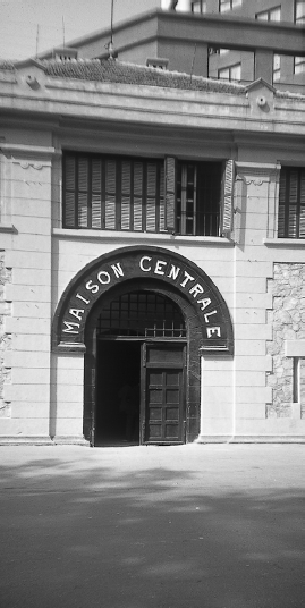
Figure 1.1. Hoa Lo Prison, known during the American War as the Hanoi Hilton, is now a museum. Photograph by Hue-Tam Ho Tai.
By emphasizing the remoteness (“deep in the mountains”) of the “ancient cloister,” the poem recalls important similarities between monastic and prison life. Further affinities can be found in the distinctly carceral
Colonial jails in Indochina might be described as fulfilling a religious function. They forced a significant segment of the Vietnamese intelligentsia to withdraw from the world, endure privation, sort out their thoughts and attempt to master the self and external reality. In this sense, prisons were not unlike Zen monasteries except that the acolytes were not there by choice and those in charge were not seen as teachers but as the enemy.8
Images of confinement in Buddhist poetry extended beyond perceived similarities between jails and monasteries. Compassion for human suffering prompted poets working within the Buddhist tradition to focus on the plight of the poor and destitute. Three centuries before Le Thieu Dinh, the Venerable Huyen Quang, the third patriarch of the Truc Lam Buddhist sect, composed a poem about the emotional devastation suffered by the families of prisoners. Entitled Pity for Prisoners, it is among the oldest surviving Vietnamese poems about jail and prisoners.
While the thematics of early Buddhist poetry may recall features of twentieth-century prison writing, the Vietnamese Confucian literary tradition anticipated the modern genre more directly. This tradition included a subgenre of plaintive appeals by imprisoned scholars, a good illustration of which is Nguyen Trai's A Cry of Innocence, produced after the famous scholar was arrested for treason in 1430.
The prison poetry composed by Cao Ba Quat in the mid–nineteenth century offers another example of writing from confinement within the Vietnamese Confucian tradition. An influential official during the 1850s,
Imprisoned Vietnamese poets sometimes reflected on their own confinement by conjuring up sympathetic images of caged animals. Around 1750, the scholar Nguyen Huu Cau led a failed revolt against the Trinh family in the North. Cau, who was arrested and eventually put to death, is credited with writing the poem The Bird in a Cage while in jail awaiting execution.12
Echoes of Cau's imprisoned but undefeated bird can be found in The Lu's wellknown poem Memories of the Jungle, in which a caged tiger is employed to symbolize the predicament of Vietnam under the French.14 Another metaphorically pregnant caged tiger appears in What's My Crime, a revolutionary poem penned by Tran Huy Lieu in 1938.
For Communist literary critics, the insertion of prison writing by party members into an older, indigenous literary tradition brought Vietnamese Communism's nationalist character into sharp relief. For example, in 1960, Tran Huy Lieu likened the spirit of Ho Chi Minh's Prison Diary to the “strong and proud will” of Nguyen Huu Cau's imprisoned bird.16 In 1966, the poet and critic Xuan Dieu drew similar comparisons between Ho's poetry and Nguyen Trai's A Cry of Innocence.17 The most elaborate effort to place revolutionary prison poetry within an indigenous literary lineage was carried out by Dang Thai Mai, 18 who traced “a long and powerful tradition of prison poetry” from a handful of classical Chinese and Japanese prison poets (Lac Tan Vuong [Lo Xinwang], Ly Thai Bach [Li Po], and Van Thien Tuong [Wen Tienxiang]) to the nineteenth-century prison verse of Cao Ba Quat and his nephew Cao Ba Nha.19
Communist prison writing also drew on a more recent tradition of prison poetry produced by patriotic scholargentry who had been arrested and jailed for political subversion in the early decades of the twentieth century. Much of this work emerged after 1908, when French security forces cracked down on the Eastern Travel Movement (Phong Trao Dong Du), the Eastern Capital Free School (Dong Kinh Nghia Thuc), and an outbreak of antitax demonstrations in Annam. Several dozen scholars involved in these movements, including the influential anticolonialist Phan Chau Trinh, were deported to penitentiaries at Con Dao and Lao Bao and held for the following decade.20 To pass time in prison, the scholars formed poetry-writing clubs, which they ironically referred to as thi dan after the literary associations for cultivated men that were popular during the imperial era.21 Although many of the poems composed in the prison thi dan were lost (or never written down to begin with), some were preserved in memory, copied down, and published by prisoners after their release.
The most energetic anthologist of this early twentieth-century prison poetry was Huynh Thuc Khang.22 In 1904, Khang turned his back on a superb educational career and promising prospects in the imperial bureaucracy to join forces with other Confucian literati devoted to
While the poetry of imprisoned scholargentry tended to convey a more melancholy tone than the relentlessly upbeat writings produced by Communist prisoners in the 1930s, the traditions shared certain thematic preoccupations. For instance, the Communists'attempt to link incarceration and education originated with the writings of Huynh Thuc Khang's generation. On Con Dao in 1908, Phan Chau Trinh advised Khang to try to turn the prison into a “natural school” (truong hoc thien nhien), a comment that anticipated a common trope within Communist prison writing that linked incarceration and political education.24 Moreover, the emphasis in Communist prison writing on spiritual resistance despite physical confinement mirrors a common theme in scholar-gentry prison verse. It can be seen, for example, in Phan Chau Trinh's Dap Da Con Dao (Breaking Rocks on Con Dao):
Although the popularization of scholar-gentry prison poetry intensified with Huynh Thuc Khang's efforts in the late 1930s, political prisoners jailed earlier in the decade were not unaware of the older tradition. In a memoir of his incarceration for political activity published in 1935, future Communist Party member Ton Quang Phiet recalled speculating that imprisonment will make him as famous as Ngo Duc Ke and Le Huan, two prominent prison poets from the generation of patriotic
FRENCH ROMANTICISM
AND THE CULT OF INCARCERATION
Just as the early cultural czars of the DRV were exposed to images of confinement from an older Vietnamese literary tradition, they were also familiar with a wealth of prison narratives found in nineteenth-century French romantic literature.28 During the early twentieth century, Vietnamese students studied Michelet's famed account of the storming of the Bastille and Pascal's depiction of spiritual redemption in a solitary cell.29 In the 1920s, Ho Bieu Chanh became Indochina's first broadly popular prose novelist by rather shamelessly adapting plots from Alexandre Dumas and Victor Hugo.30 His first blockbuster, The Ship Master of Kim Quy Island (Chua Tau Kim Quy), lifted completely the narrative structure of The Count of Monte Cristo, including a melodramatic version of the spiritual rebirth in confinement of the hero Nguyen Van Anh (Dantes in the Dumas novel).31 Chanh's second commercial success, Ngon Co Gio Dua (Blades of Grass in the Wind), a Vietnamese reworking of Les Mise´rables, followed the tribulations of Le Van Do, a petty thief whose fortunes take a dramatic turn after he, like Jean Valjean, escapes from prison.32 The aquatic prison escape in Nguyen Hong's classical colonial novel Cua Bien (The Ocean's Mouth) is also frequently compared to Jean Valjean's.33
Victor Hugo, whose “lifelong obsession” with the death penalty and images of crime and punishment is well documented, was perhaps the most beloved writer in the colony.34 First translated into Vietnamese in 1913, his novels were serialized repeatedly in newspapers and magazines, and his poetry became a staple of the elite Franco-Vietnamese educational curriculum.35 By 1925, Hugo had developed such a reputation among the budding southern middle classes that the Saigonese bureaucratic functionaries who founded the syncretic Cao Dai religion in 1925 placed him alongside Jesus, Confucius, and Buddha as a patron saint of the faith.36 His portrait still graces the entranceway of the Holy See in Tay Ninh.
In a revealing interview conducted in 1991, party General Secretary
I started reading Les Mise´rables and the image of Jean Valjean was very striking to me—a poor man, so poor he had to beg for his daily bread. … It touched the strings of my heart directly—I was very moved. I decided, I could not be satisfied with a society where there is an enormous gap between the rich and the poor.37
Linh's affection for Hugo's tales of crime, punishment, and redemption may also be connected to the fact that he spent over ten years in colonial prison prior to 1945.
Evidence suggests that French romantic carceral images exerted a powerful influence over the welleducated Vietnamese youth who entered radical politics in the 1920s and 1930s.38 Such influence is apparent in the widespread use of the Bastille as a potent symbol within leftwing anticolonial rhetoric. In 1925, the fiery radical journalist Nguyen An Ninh published a provocative account of the storming of the Bastille in his Saigon newspaper, La Cloche Feˆle´e (The Cracked Bell), and questioned why Vietnamese history had never witnessed an equivalent event.39 During the 1930s, revolutionaries intensified their employment of Bastille imagery in the legal oppositional press and in underground publications.40 Consider the following Vietnamese-language leaflet seized by the Security Police (Suˆrete´) at a Bastille Day parade in Qui Nhon in 1931:
Brothers and sisters. Each year in Indochina, as in France and her other colonies, the imperialists spend hundreds of thousands of piasters to commemorate the 14th of July. As spectators, our compatriots unconsciously assist in the celebrations. Here is the origin of this observance, which we mistakenly call French Tet. On July 14, 1789, the Republican Party revolted in Paris. An armed mob demolished the monarchy's great prison, the Bastille, released the political prisoners who demonstrated in the streets. The French decided to celebrate annually, July 14, in order to commemorate their great victory and the triumph of liberty over the absolutist regime. Brothers and sisters, in celebrating July 14, French imperialism extols its love of liberty but conceals its ferocious and barbarous sentiments evidenced here by the prisons of Hanoi, Saigon, Quang Ngai, and all the provinces and in which suffer a considerable number of our compatriots. Brothers and sisters, rise up. Unite with one heart and protest against these arrests and imprisonments, overthrow French Imperialism, and in the spirit of the Parisian revolutionaries on July 14, 1789, destroy the prisons of Hanoi, Saigon, and the provinces and deliver our brothers and sisters who are condemned there.41
Other evidence exists of the popularity of French romantic prison imagery among radical Vietnamese youth. In 1928, the Suˆrete´ seized a Vietnamese-language copy of Silvio Pellico's My Prisons from an illegal publishing house in Saigon.42 This account by the Milanese liberal who spent a decade in Metternich's political prison, the Speilberg, had enjoyed a stunning success in nineteenth-century France, where five separate translations had been completed following its publication in the 1830s.43 Dang Thai Mai, the dean of party literary critics, claims to have read Pellico's memoir while a student in Hue in the late 1920s.44
Still, the sensational prison narratives of Dumas and Hugo, replete with dramatic escape attempts and feats of great personal courage, appear to have exerted the widest impact among Indochinese youth.45 In his 1929 memoir Sitting in the Big Jail, Trotskyist Phan Van Hum compared his own predicament to that of the protagonist of Hugo's The Last Days of a Condemned Man.46 Hugo and Dumas also figure in Pham Hung's 1960 prison memoir, In the Death Cell.47
In the Central Prison there was a library for the French. I borrowed some books and after reading them, summarized the stories for the other prisoners. To their delight, we read Les Mise´rables by Hugo and Les Trois Mousque-taires by Dumas.48
REVOLUTIONARY SCHOOLS
AND HEROICPRISONERS
The central theme of revolutionary prison memoirs is the transformation of colonial jails into revolutionary schools. Education and imprisonment are prominently linked in titles such as Hoang Anh's Nha Tu De Quoc Tro Thanh Truong Hoc cua Chien Si Cach Mang (Imperialist Prisons Become Schools for Revolutionary Fighters), Tran Huy Lieu's Tu Hoc trong Tu (Self-Study in Prison), Nguyen Luu's Nha Tu Son La, Truong Hoc Cach Mang (Son La Prison: A School for Revolutionaries), Nguyen Thieu's Truong Hoc trong Tu (Prison School), Nguyen Duc Thuan's Truong Hoc Xa Lim (Cell School), and Nguyen Duy Trinh's Lam Bao va Sang Tac Tieu Thuyet trong Nha Lao Vinh (Writing Newspapers and Novels in Vinh Prison).49 In the scholastic prisons of such accounts, revolutionaries spend their first months in confinement studying Marxism-Leninism and practical skills and then apply what they have learned to protest poor conditions, organize fellow inmates, and convert non-Communist offenders to the revolutionary cause.
Tran Huy Lieu's depiction of Communist prisoners in Con Dao penitentiary in the early 1930s is exemplary:
Under French colonialism, owing to powerful conviction and innovative and skillful organization, communists turned prisons into schools for the study of literature and revolution. The imperialists tried to use prisons to kill revolutionaries, but we made prisons into a place to recruit and train cadres. After graduating from such schools, many cadres displayed not only a heightened skill and an indomitable spirit but an increased cultural level as well.50
Tran Huy Lieu's reference to the “powerful conviction” and “indomitable spirit” of imprisoned cadres points to another preoccupation in revolutionary prison memoirs. Successful resistance, in these accounts, is always a function of the superior will and psychological doggedness of Communist prisoners. Le Duan's recollections of his experience on Con Dao make the point:
In prison, wherever we chanced to meet, we, brothers and comrades from the north, center and south, spent our time pondering, planning, discussing how to struggle to defeat the imperialists and colonialists. Right from the outset, we decided to turn the prison into a school. When still at large, we had joined the revolution out of love for our country and hatred for the imperialists. But in prison, thanks to our indomitable will, we were able to read, and study and consequently to understand Marxism-Leninism, and thus we became confident in the victory of the Vietnamese revolution.51
In addition to drawing attention to the importance of revolutionary training and political commitment, another concern of revolutionary prison memoirs is to portray Communist prisoners as dauntless and heroic figures. Many accounts contain clearly hyperbolic depictions of physical endurance and courage or episodes in which Communist prisoners masterfully, almost effortlessly, outwit their guards. Elaborate depictions of dramatic escape attempts, a ubiquitous feature of the genre, most clearly reflect this tendency.52 For example, in We Escape from Prison, Nguyen Tao fills nearly three hundred pages with three separate accounts of Communist prison breaks, each more daring and oddsdefying than the last.53
DISTORTIONS AND ELISIONS
Revolutionary prison memoirs function not only through the experiences they repeatedly convey but also by those they continually suppress.
Compounding their neglect of common-law prisoners, revolutionary prison memoirs never mention that the punitive regime applied to ordinary lawbreakers was considerably more onerous and brutal than the one to which political prisoners were subjected. Transported to an inhospitable frontier region, fed an insufficient diet, and forced to perform dangerous corve´e labor from which political prisoners were normally exempt, commonlaw inmates had few opportunities to embark on the ambitious program of self-improvement and personal cultivation compulsively described in revolutionary prison memoirs. For most uneducated and impoverished petty lawbreakers, it is likely that a stay in a colonial prison was less like a semester in school and more like a night-marish term in a concentration camp.
Exemplary is the tragic experience of Con Dao prisoner Nguyen Van Vien, whose case was brought to the attention of a colonial inspector in 1932. Caught stealing a buffalo in 1898 at the age of twenty-three, Vien was exiled to Con Dao by an indigenous provincial tribunal. As a result of a series of bureaucratic mishaps, Vien remained confined on Con Dao for the same theft almost thirty-five years later. That Vien is rescued from historical oblivion by virtue of an apparently sympathetic passage culled from a French inspector's report and not from the voluminous writings of fellow political prisoners is symptomatic of the limited field of vision exhibited by revolutionary prison memoirs.56
While “revolutionary prison memoirs” typically ignore the existence of common-law prisoners, several are instructive in the open contempt they display toward criminals. Such an attitude is evident in one of the genre's progenitors, Huynh Thuc Khang's Thi Tu Tung Thoai [Prison Verse], first published in Hue in 1939:57
In prison there are gangs of scoundrels so violent-tempered that a dirty look or a small comment will provoke them to fight. For prisoners to be murdered in their sleep is unexceptional. During the initial months of our captivity with the common prisoners, we felt miserable. During the day we would rest and at night we'd discuss literature and talk politics—we didn't dare to interact with the common-law prisoners.58
To further explain the absence or denigration of nonpolitical pris-oners in revolutionary prison memoirs, it is important to recognize how strictly the VWP's cultural authorities policed the content of published material in general and prison narratives in particular after coming to power in 1954.59 A pertinent example is the party's heavy-handed response in 1955 to Phung Quan's loosely fictionalized adventure novel, Vuot Con Dao (Escape from Con Dao).60 In a disapproving review article published in Van Nghe (Literary Arts), critic Vu Tu Nam chided Phung Quan for subordinating the heroism of imprisoned Communists to the courage and savvy of common-law prisoners:
Phung Quan's book depicts party leaders on Con Dao as excessively simple-minded and naı¨ve. In reality, the ward of solitary-confinement cells, where our best and brightest cadres were concentrated, was the nervecenter of the island. According to Phung Quan's description, inmates in this ward were demoralized and broken in spirit. Phung Quan deliberately glorifies common soldiers and ordinary prisoners while ignoring the mighty political strength of cadres and party members.61
Vu Tu Nam's critique was buttressed and elaborated in attacks launched by powerful cultural officials such as To Huu and Tran Do, who, unfortunately for Phung Quan, were also former political prisoners.62 As Phung Quan was besieged by the ideological assaults and prison credentials of his critics, Escape from Con Dao fell into disrepute, and he was forced to undergo public self-criticism.63 Apparently, Phung Quan's reprimand was not lost on future authors of fictional and putatively nonfictional prison narratives, virtually all of whom made sure to relegate common-law prisoners to the distant margins of their accounts.64
Like common-law offenders, non-Communist political prisoners are also underrepresented in the accounts of revolutionary prison memoirs. From the 1920s through the 1940s, the colonial state imprisoned anticolonialists of different political persuasions, including various kinds of anarchists, Stalinists, Trotskyists, nationalists, and radical Buddhists, as well as members of syncretic religious sects, secret societies, and underworld gangs. During the late 1930s, French-language newspapers in Saigon
In the rare cases when non-Communist political prisoners are mentioned, it is only to compare their feebleness in captivity with the strength of the Communists. Le Duan's recollections are typical in this regard:
Among the political prisoners, there were also non-communists, such as members of the Nationalist Party, adherents of the “national revolution” tendency such as Mr. Nguyen An Ninh, and Trotskyists such as Phan Van Hum and Ta Thu Thau. But none of them could equal the communists in endurance, dauntlessness and self-sacrifice. The more difficulties and hardships they met, the more the communists were steeled and tempered. They survived the most atrocious ordeals while others did not.67
An irony of Le Duan's comments is that Trotskyists Phan Van Hum and Ta Thu Thau did in fact survive the “atrocious ordeal” of colonial imprisonment, but upon release in 1945 they were executed by Le Duan's Viet Minh during sporadic roundups of prominent figures from rival nationalist groups.68
The tendency of revolutionary prison memoirs to focus solely on Communist prisoners further distorts the historical record by conflating the eighty-year history of imprisonment in Indochina with developments after 1930, the year the Communist Party was founded. While the highly organized defiance of Communist inmates after 1930 represented a qualitative change in the nature of colonial prison resistance, it is important to recognize that the colonial penal system had been generating significant levels of collective violence since its foundation in 1862. In fact, it is arguable that the sporadic and largely uncoordinated resistance to the penal system spearheaded by prisoners during World War I actually surpassed the level of violent opposition attained under Communist leadership in the 1930s. Moreover, enduring features of the colonial penal system that promoted successful Communist activity in prison (i.e., architectural shortcomings, administrative instability, discontented guards, confused and neglected systems of classification, inadequate supervision for forced labor) were equally responsible for facilitating
Also missing from revolutionary prison memoirs are vivid depictions of the texture of colonial prison life or evidence of the development of distinct subcultural formations behind bars. Descriptions of food, labor, discipline, hygiene, and the complex triangular relations obtaining between guards, prisoners, and French penal officials, for example, seem schematic and vague as compared with the meticulously detailed accounts of political education, self-improvement, and collective resistance. Moreover, revolutionary prison memoirs pay little or no attention to the prurient obsessions of French prison writing; there are few tales of betrayal, corruption, or rivalry among inmates and virtually none about suppressed desire, rape, or homosexuality.70
In 1991, following the first significant relaxation of state censorship in northern Vietnam since the mid-1950s, the Institute of History posthumously released a brief prison memoir by Tran Huy Lieu, an important revolutionary from the 1930s and the DRV's most prolific historian. Originally written in 1950 and entitled Tinh trong Nguc Toi (Love in the Dark Prison), the account detailed Lieu's own loneliness and unrequited longings while incarcerated on Con Dao during the early 1930s. In one unusually frank passage, Lieu admitted to a temporary fascination with “brother T,” a fellow prisoner who had performed in drag in a play staged within the ward:
After viewing the play performed during Tet in Bagne II, I sent a letter over ten pages long to brother T, who, on that day, had played the role of a female courtesan. As the prison regime suppressed family sentiments and petty bourgeois romantic sentiments, we were often forced to seek other outlets.71
The meaning of the passage is arguably ambiguous, but it is instructive that while many of Lieu's prison accounts were published during the 1960s, the memoir containing this passage was not released until after the Renovation (Doi Moi) policy of 1986. It is tempting to conclude that the decision to suppress its publication during the late 1950s and early 1960s was driven by a perception that the memoir alluded to
MORALE-BUILDING AND PROLETARIANIZATION
To further understand the most prominent elisions and distortions characteristic of revolutionary prison memoirs, it is useful to reconsider the genre's function within the political culture of the DRV. As has been suggested, one reason for the wide dissemination of the genre is that naked oppressiveness of the colonial prison system provided a dramatic setting for heroic performance. Revolutionary prison memoirs depict Communist militants fearlessly confronting the colonial state's most thoroughly repressive apparatus. They often juxtapose denunciations of sadistic guards, torture, and cramped quarters with celebrations of mass demonstrations, hunger strikes, and prison riots. “Prison writing,” according to party critic Hoang Dung, “simultaneously denounces the cruel crimes of our enemies, describes our intense feelings for the landscape of our homeland, and relates the miseries endured by martyred comrades in prison.”72
In the early 1970s, the Institute of Party History and the Youth Publishing House endeavored to gather and publish Communist prison verse from the colonial era. Anthologists solicited submissions through literary newspapers and, in some cases, visited exprisoners in their homes to record poems that had been committed to memory but never written down.73 Prefacing their two-volume collection, Tieng Hat trong Tu (Songs Sung in Prison), the editors justified their efforts on didactic grounds: “The poetry of revolutionary fighters created in the prison of the French imperialists, from the foundation of our party to 1945, holds excellent educational value for the younger generations who grew up after the August Revolution.”74 At the time, the party's need to harness the “educational value” of prison poetry was based on anxiety about public morale raised by the American War. Thus, the compilation concluded by drawing links from colonialera prisons to those of the American-backed South Vietnamese regime: “Over the past few years, similar verse has unceasingly echoed in prisons of the American puppets in the south.”75
Representations of revolutionary heroism were thought to possess a unique capacity to motivate and inspire in wartime. During Vietnam's war with China in the late 1970s, the Culture and Information
Besides portraying the VWP's leading figures as heroic, courageous, resourceful, and unswervingly dedicated to the revolutionary cause, revolutionary prison memoirs serve the party in another important way. By depicting colonial penal institutions as schools, revolutionary prison memoirs help conceal from their readership something particularly unsettling for the party about the social composition of its founding members. One of the striking things about the VWP is the high percentage of its early leaders who sprang from an elite background.79 According to Bernard Fall's comprehensive study of party leadership in the 1950s, approximately 75 percent of high-level party cadres come from solidly middle-class or upper-class families.80 This is clearly reflected in the privileged educational backgrounds many of them possessed. For example, Pham Van Dong and Truong Chinh received baccalaureate degrees from the exclusive Lyce´e Albert Sarraut in Hanoi. Vo Nguyen Giap and Ho Chi Minh, among others, attended the prestigious Franco-Vietnamese Quoc Hoc high school in Hue. And numerous top-level cadres, including Pham Hung, Le Duc Tho, and Le Duan, came from lowranking mandarin families who ensured that their sons received significantly more education than did most Vietnamese at the time.81
Not only are the exalted educational careers of Indochinese Communist Party (ICP) leaders passively ignored in revolutionary prison memoirs; they are actively obscured by the obsessive comparisons offered between prisons and schools. In other words, a depiction of colonial prisons as the “universities of the Vietnamese revolution” conveniently draws attention away from the fact that the leaders of this explicitly proletarian and peasant revolution were products of the most elite educational institutions the colonial state had to offer. In this sense, revolutionary prison memoirs should be understood as serving a function similar to the party's well-documented proletarianization (vo san
It is in a similar context that the publication and massive dissemination of Ho Chi Minh's Nhat Ky trong Tu (Prison Diary), also in 1960, might be understood.84 During the 1920s and 1930s, when his future colleagues in the Politburo were earning revolutionary credentials in French jails, Ho was abroad carrying out Comintern directives. The fact that Ho did not possess the same colonial prison record as virtually all his colleagues was neatly effaced by the public appearance of the Prison Diary, which he supposedly wrote while incarcerated in 1942 by a warlord in southern China. Released almost twenty years after it was allegedly written and at the outset of a campaign to spread revolutionary prison memoirs of ICP leaders, the Prison Diary, which is easily northern Vietnam's most widely published and translated literary work as well as a core secondary-school text, suggests an explicit attempt to bring Ho's revolutionary credentials in line with those of his comrades.
CONCLUSION
Revolutionary prison memoirs reveal much about the forces shaping cultural production in the Democratic Republic of Vietnam. The party's need to reassert the legitimacy of its monopoly over political power required a popular literary form that cleaned up, embellished, and celebrated the history of its heroic struggles and sacrifices. The “prison-as-school” trope not only could play such a role but also proved useful in its capacity to obfuscate the exalted family and educational backgrounds of many party leaders. Moreover, revolutionary prison writing could draw on colonial and precolonial literary traditions that were both familiar to the reading public and genuinely popular among the Western-educated but nevertheless traditionally oriented leaders of the party. In short, while revolutionary prison memoirs may obscure more than they reveal about the history of imprisonment in French Indochina, they do reflect the political strategies, class anxieties, and distinctive sociocultural background of the first generation of the Communist Party leadership.
“The Fatherland Remembers
Your Sacrifice”
Commemorating War Dead
in North Vietnam
Shaun Kingsley Malarney
The dead soldier was one of the greatest threats to the legitimacy and authority of the Democratic Republic of Vietnam (DRV) in the first three decades of its existence. Tens of thousands of northern Vietnamese died in military service, first in the French War (1946–54), then in the struggle to unify the country from 1959 to 1975. During these years, the DRV government began to articulate what Hue-Tam Ho Tai refers to in the introduction to this volume as the “official narrative” of war in order to legitimize the war efforts and strengthen the population's will to fight.1 This narrative, which highlighted Vietnam's history of repelling foreign aggression, also gave extensive attention to dead soldiers so that their deaths would be regarded as noble and meaningful.2
This chapter will examine how the experience of warfare and the government agenda to glorify war death affected the social and cultural life of Thinh Liet commune, a northern Vietnamese community located to the south of Hanoi.3 It will describe the many social and cultural innovations that years of warfare produced, such as the linkages made between past and contemporary struggles, and the creation of new categories of heroes and heroic action. The main objective is to explore the ritual responses to war death that emerged during the American War (1963–75) in Vietnam. As Mark Bradley points out in this volume, the North Vietnamese state employed numerous methods to ennoble war death that included film, war memorials, museums, novels, poetry, and paintings.4 Among the most important was the government's creation
THE “JUST CAUSE” OF NATIONAL LIBERATION
One of the most important elements in the Vietnamese state's agenda for legitimizing the war attempt was its attempt to draw on the prestige that has historically accrued to those who protected the country from foreign aggression or liberated it from foreign occupation. Over the centuries, the Vietnamese have fought numerous wars, many of which began after outsiders invaded Vietnamese soil. In many of these instances, going into battle and dying to save the nation were portrayed as honorable pursuits. Indeed, fighting for the nation was described in some cases as a “just cause” or “righteous obligation” (chinh nghia).6 The compelling nature of liberating or protecting Vietnam could be seen in the public veneration of military heroes. The Vietnamese pantheon of great historical figures is composed overwhelmingly of men and women who have battled foreign armies. The Trung Sisters, who defeated a Chinese army in a.d. 39, general Tran Hung Dao, who, through a brilliant stratagem, destroyed the fleet of the Mongol invaders in the thirteenth century, or Le Loi, who cast out the Ming and then established the Le dynasty in the fifteenth century, are among the most revered figures in Vietnamese history. While official historiography glorifies these heroes, their importance among the people is equally great. The accomplishments or “meritorious work” (cong duc) of some military heroes were such that supernatural qualities have been attributed to them. General Tran Hung Dao is a case in point. Many Vietnamese consider him to have been a “living god” (than song) sent to rescue the Vietnamese. He is referred to frequently by his spirit name, Duc Thanh Tran; his powers carried on after his death, and his spirit, propitiated
In constructing their narrative of warfare, the Vietnamese Communists highlighted and popularized the historical continuities between their contemporary struggles and Vietnam's earlier struggles. The very first armed military unit formed on December 22, 1944, by the Communists in the caves of Cao Bang Province, a humble group of thirty-four individuals with two revolvers and thirty-one rifles, was called the “Tran Hung Dao Platoon” in honor of the great general.7 Official propaganda also spoke of the great examples of Vietnam's military heroes and the lessons to be learned from them. General Vo Nguyen Giap, Vietnam's key military strategist during the French War and the mastermind of the victory at Dien Bien Phu, even declared:
The contemporary ideas of our party, military, and people for the offensive struggle cannot be separated from the traditional military ideas of our people. During our history, all victorious wars of resistance or liberation, whether led by the Trung Sisters [first century], Ly Bon [sixth century], Trieu Quang Phuc [sixth century], Le Loi [fifteenth century], or Nguyen Trai [fifteenth century], have all shared the common characteristic of a continuous offensive aimed at casting off the yoke of feudal domination by foreigners.8
Communist leaders also described their struggle as a sacred activity. For example, in an August 1965 speech to an antiaircraft unit in Hanoi, Party General Secretary Le Duan proclaimed, “Saving the nation is a sacred obligation [nghia vu thieng lieng] of the people. … Wearede-termined to fight and win to keep our independence and freedom, to secure our health and happiness, and to build the nation into a wealthy and beautiful Vietnam.”9 Throughout both wars, the nation and the military necessity of saving and protecting it, were placed in indisputably sacred space. The wars were not simply described as wars (chien tranh)in official discourse. The French War was described as a khoi nghia, rendered in one dictionary as to “rise up in arms (against an oppressive rule).”10 The American War was described as the “War of National Salvation Against the Americans” (Chien Tranh Chong My Cuu Nuoc). Dying and suffering in the name of such a cause, which was similar to
ARTICULATING THE NEW VIRTUE
The legitimation of Vietnam's military effort extended far beyond the appropriation of the legacy of resisting foreign occupation. One of the most explicit moves in the ideological realm was the creation and elaboration of a new set of definitions for noble and virtuous actions. Prior to the Revolution, official ideology had emphasized the Confucian virtues of devotion to the emperor and the mandarinate. In the Communist state, the act of devotion remained salient; only the objects changed. According to the new definition, the objects of virtuous action became the fatherland (to quoc), the people (nhan dan), the party (dang), and particularly the Revolution (cach mang). Actions carried out in the interest of these four collective entities were virtuous (conversely, actions carried out for the emperor, the mandarinate, or the old order were all stigmatized). The critical element in the construction of the new virtue was the transcendence of selfinterest and the selfless devotion to the collectivity. As Le Duan declared, “The revolutionary differs from the nonrevolutionary in that he knows to forget himself for the service of the collectivity, for the common interest. Before all else he always thinks of the Revolution and the collectivity. He always knows to place the interests of the fatherland, the interests of the collectivity, above the interests of the individual.”11 “To relentlessly think of one's self, of one's family,” the general secretary commented on another occasion, “is inadequate, selfish.”12
The revolutionary formulation of selfless virtue was conjoined with the public glorification of death and personal sacrifice to advance the revolutionary cause. The greatest virtue was achieved with death, a transformation that reached its apotheosis in the concept of “sacrifice” (hi sinh). The word hi sinh predates the Vietnamese Revolution. Semantically, it matched the English-language meaning of sacrifice, that being simply to give up something, usually to gain something else. With the Vietnamese Communists, the semantic domain of hi sinh was recast, and sacrifice was associated with, and virtually restricted to, those who died doing the Revolution's bidding. Sacrifice came to connote giving up one's life in a just cause to protect and improve the collectivity. Party officials provided precise definitions of what constituted sacrifice. “Thus
The willingness to sacrifice was publicly rewarded because a sacrificial death was portrayed as a glorious and noble death, one that further grew in nobility from the willingness and enthusiasm with which it had occurred. It was also a death that was to be eternally remembered and remain an example for those who survived. The glorification of sacrifice was elaborated at the very highest reaches of the party. Discussing the deaths of a number of Party members who were killed or executed by the French, Ho Chi Minh declared, “The blood of the martyrs has made the revolutionary flag dazzlingly red. Their courageous sacrifice has prepared the earth of our nation to bloom into a flower of independence and result in our freedom. Our people must eternally record and remember the meritorious efforts of the martyrs. We must constantly study their courageous spirit to transcend all difficulties and tribulations, and realize the revolutionary work that they have passed on to us.”15 Death by “sacrifice” placed one into a venerable and heroic category, one that transcended the individual's physical annihilation.
The revolutionary elaboration of “sacrifice” has had important linguistic consequences in everyday conversation as well. The verb “to die” in Vietnamese takes multiple forms, with each particular form providing important social information about the deceased. Common people, for example, are generally said to mat, “to be lost,” or bi chet, to “suffer death.” Elderly people qua doi, or “pass from life.” The emperor in prerevolutionary times would bang ha, or “pass far below.” The deaths of Ho Chi Minh and other high officials are often described with the poetic and respectful expression tu tran, “to leave this world.” Communist revolutionaries and soldiers killed during the struggle against the enemy can indeed “suffer death,” but officially and in everyday parlance, people say that they have been “sacrificed” (hi sinh). The death of Hoang Van Thu, a member of the Central Committee of the Indochinese Communist Party who was captured by the French and later executed, provides a fitting example. Thu's death is thus recounted in an official biography: “On May 24, 1944, he was sacrificed at the Tuong Mai Rifle
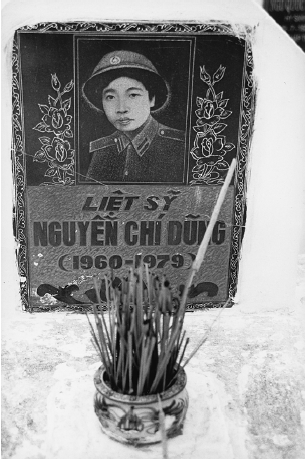
Figure 2.1. Grave of soldier killed during border war with China, 1979, Tam Nong District Revolutionary Martyrs Cemetery, Phu Tho. Photograph by Natalia Puchalt.
The ennoblement of death and sacrifice for the Revolution continued after the death of the individual. Instead of merging them into an anonymous mass of war dead, all those who died carrying out the work of the Revolution were officially grouped into the social category of “martyr” or “revolutionary martyr” (liet si) (fig. 2.1). The construction of this category represented an innovation by the state. Like hi sinh, the word liet si predated the revolutionary era. Party officials, however, recast it semantically to indicate those who had died for the Revolution
SUPPORTING THE WAR EFFORT
In 1959, the North Vietnamese leadership began the struggle to reunite Vietnam. Over the next five years, the government sent tens of thousands of infiltrators to the South, and combat slowly increased. In February 1965, the United States began its Rolling Thunder bombing campaign against North Vietnam, marking America's definitive commitment to the war in Vietnam. Although many North Vietnamese had died in combat in the years leading up to 1965, their numbers increased significantly afterward. As a result, the government began instituting a number of new policies and practices to prevent its efforts to glorify and ennoble people's sacrifices from seeming hollow and to display its gratitude and appreciation for those who had given their lives in battle.
One of the first steps taken by the government in this period was the modification of the structure of public administration and official policies to make them more responsive to the needs of those who had family members in the military. When the government established the original structure of commune-level rural administration in 1945, one of the five
Government policies toward these families also changed. In the late 1950s and early 1960s, the government had instituted the collectivization of agriculture across the North. Officials recognized that having a child serving in the military represented the loss of a high-quality laborer for the family; therefore, the government instructed local agricultural cooperatives to provide policy families with increased food rations. For many families, the policy family designation ended when their son or husband returned home from the war. For the less fortunate who were killed or maimed while fighting in the military, the designation remained in place, and their family continued to benefit from government support. The families of war dead (gia dinh liet si) in particular received a number of special dispensations not available to others. Among benefits that were extremely important in the years before the 1986 introduction of the Renovation (Doi Moi) policy were preferential admissions to hospitals for members of their families, priority status for entering schools
Beyond instituting policies that cared for those with relatives in the military, the government also expanded its ceremonial corpus to recognize those who fought and died. As early as 1947, when the government declared July 27 as War Invalids and Martyrs Day (Ngay Thuong Binh Liet Si), the government began publicly commemorating war dead. This holiday, irregularly organized in the late 1950s and early 1960s, became an annual occurrence starting in 1967.21 On this day, government officials held ceremonies in which they mourned the fallen soldiers and expressed their gratitude, with both speeches and possibly small gifts, for the families of martyrs. The memories of the war dead's singular contributions were also kept alive through the creation of exclusive ceremonies or the delineation of special areas in local cemeteries reserved for war dead. If a martyr's corpse was returned, it was to be buried in this cemetery; in keeping with the revolutionary campaign to simplify funeral rites that had begun in 1954, a small headstone that recorded the deceased's name, rank, and death date was placed on it.22 Officials mandated that these cemeteries should not be neglected or divorced from everyday social life. Regulations from Ninh Binh Province noted that “everyone has the responsibility to protect and care for the martyrs'
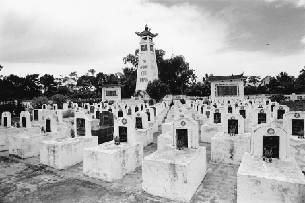
Figure 2.2. Tam Nong District Revolutionary Martyrs Cemetery, Phu Tho. The column reads “The Fatherland Remembers Your Sacrifice.” Photograph by Natalia Puchalt.
The most important ceremonial innovation by the government in this period was the creation of an official memorial service for war dead (le truy dieu). This new ceremony represented an effort by the state to individually recognize the sacrifice of those who died in battle. Its structure is worth examining in detail. The organizational process for the official service was set in motion by the receipt of official confirmation of a soldier's death by the People's Committee of his native commune. Official word was vital because the ceremony could only be performed for those the military recognized as martyrs. In Thinh Liet, receipt of the
The government's memorial ceremony, like regular funerary ceremonies, took place in the home of the fallen soldier. In Thinh Liet commune, it was generally held at two o'clock in the afternoon and lasted for one hour. Unlike a regular funeral in which mourning attire was worn, the family and their guests dressed in their normal clothing. The official presence at the ceremony was extensive. The communal administration was represented by the president of the People's Committee, the village militia commander and the social policy officer. The agricultural cooperative was represented by the chairman. The party was represented by the secretary of the commune's party cell, the secretary of the residential cell in which the family resided, and at least one person from each of the party's mass organizations, such as the Women's Association or the Youth Association. On some occasions every member of the executive committees of the administration and the party cell were also in attendance. Beyond the official personnel, the ceremony was also heavily attended by kin, friends, and covillagers.
The social policy officer presided over the official ceremony. He brought a bouquet of white tuberoses (hoa hue) to the ceremony (white is a mourning color in Vietnam, and tuberoses are commonly featured in funerary ceremonies). When the delegation of officials arrived at the late soldier's home, the flowers were placed on an altar constructed for the dead soldier. After one minute of silence, the policy officer began the eulogy of the fallen soldier. The purpose of his visit, he stated, was to officially commemorate both the person and the sacrifice of the soldier. The soldier had selflessly sacrificed his life (hi sinh) so the war effort could succeed. The nobility of the soldier's death was reiterated in the standardized statement the policy officer then read:
In our people's glorious revolutionary effort against the Americans to rescue the nation, Comrade [the soldier's full name] has with his comrades-in-arms raised up the spirit of struggle, surpassed all difficulties and hardships to carry
out the responsibilities of his unit, and sacrificed his life on (day, month, year).
57The cadres and soldiers of the unit are infinitely sorrowful and proud to have had a person united in will, a comrade-in-arms, who has offered up[cong hien] his life in the struggle for an independent and free country; who swore to never stop raising up the will to fight and the strength to eliminate the enemy; who brought forth all his spirit and strength to carry on to victory in the war of national salvation against the Americans and to fulfill all the responsibilities that the party, government, and the people gave him.
Dear family members:
Comrade [soldier's name] has left us. The fatherland and people have lost a loyal and faithful child. His unit has lost a person united in will, a comrade-in-arms. His family has lost a loved one. All of the cadres and soldiers of the unit respectfully send their wishes and ask to “divide the sadness” with the family. They hope that the family will turn its grief into activity for the revolution, strengthen their hatred for the American enemy and their lackeys, and with the rest of the people and soldiers firmly resolve to realize the sacred words from President Ho's will, “Resolve to completely defeat the American enemy,” to protect the North, liberate the South, and unite the fatherland.
By organizing the ceremony, the government gave thanks to the family for its sacrifice. The grief of the families was evident during the ceremony. Even though the memorial service often occurred some time after the soldier's death, people wept openly throughout.
Following his speech, the policy officer delivered three items to the soldier's family that formalized the state's recognition of the soldier's sacrifice. The family first received a government-issued “death announcement” (giay bao tu). This began with the statement “We very regretfully declare and confirm” and was followed by the soldier's name, rank, and unit. The form also noted if the soldier had been “sacrificed.”26 Other important information included the date of death, place of death, place of burial, and, if it were the case, confirmation that certified the soldier was a revolutionary martyr. Although these categories were helpful, the information on them was sometimes extremely vague. In some cases they noted only that the soldier had died in the South in the struggle against the Americans and that his unit had buried his body near the front. Still, this certificate was necessary for future interactions with the local administration and government bureaucracy. The family was also given a certificate, approximately twelve by fifteen inches, upon which was inscribed in large red lettering, To Quoc Ghi Cong, literally rendered as “The Land of the Ancestors Records Your Work,” but perhaps more accurately translated as “The Fatherland Remembers Your Sacrifice.”27 This certificate recorded the name, natal commune, and death
The Vietnamese state went to great lengths to ensure that its claims regarding the glory and nobility of suffering and dying for the cause were compelling. It not only glorified those who suffered and died in public discourse but also created a range of new public ceremonies that expressed the honor and nobility of those actions. For many Vietnamese, these ideas and ceremonies were indeed compelling. People described dying for the country as an “honor” (vinh du).28 Relatives of those killed in battle often employ the verb cong hien, which in effect means to give something up to something greater than oneself, to describe their family's sacrifice. People gave up their lives to ensure Vietnam's independence and freedom or, as one veteran stated, “to bring back happiness and comfort to the people.” Official commemoration, however, was exclusively dedicated to the glorification and ennoblement of the cause. The Democratic Republic of Vietnam was officially an atheist state that rejected any notions of the supernatural; thus nowhere in the ceremonies was there reference to the ultimate fate of the soul or other existential anxieties that war death could produce.
THE DILEMMAS OF WAR DEATH
It is difficult to describe the extent of the trauma and violence experienced by the North Vietnamese during the American War. For both combatants and noncombatants alike, the war was a period of relentless fear and intense anguish. Parents agonized when their sons went off to fight, knowing that they would probably never return, while the soldiers, stuck in the malarial jungles and forests of southern and central Vietnam,
In addition to the obvious grief and anguish caused by losing a loved one, the death of soldiers in battle presented a number of powerful cultural dilemmas for the Vietnamese. Death is not a taboo subject in Vietnamese social life. People talk about it openly, sometimes in surprising ways. When an elderly person is about to die, family members often go to the homes of friends, neighbors, and relatives and candidly say, “Grandmother [or grandfather] is about to die,” and then invite them to the house to be there when she dies. Nevertheless, local conceptions distinguish between good and bad deaths. A good death has a number of features. Being advanced in years, having many children as survivors, dying quickly and painlessly, having one's corpse complete, and dying at home all constitute a favorable end because they readily facilitate the most important concern following death, the passage of the deceased's soul from this world to what the Vietnamese call the “otherworld” (the gioi khac). When a person dies, his or her soul leaves its corporeal form and begins to wander the area near the corpse. The soul is not yet aware that the body is dead (this recognition will not come for several days). If it is in a familiar place, such as its home or near its family's ancestral altar, and has not died in a violent manner, it calmly stays near the scene. After this, family members can begin the funeral rites that will send it on its way to the otherworld. These will be carried out at the family ancestral altar, the portal through which the soul begins its passage. If the rites are correctly performed, the soul will move to the otherworld to become a benevolent family ancestor who will care for the family and reciprocally be cared for by those it left behind.
A bad death includes such factors as dying young, childless, violently, away from home, and/or in such a manner that the corpse is mutilated
The deaths of soldiers in combat often involved every possible dimension of a bad death. Young, childless men died painful, violent deaths, usually hundreds of miles from home. The corpses of many remained intact to be buried by their comrades, but, as the author Bao Ninh describes in his novel of the American conflict, The Sorrow of War, others “had been totally vaporised, or blasted into such small pieces that their remains had long been liquidised into mud.”33 Some were buried by their comrades with simple rites, often in makeshift graves with no permanent altars, while others were never buried and had no funerary rites performed for them. All these deaths had the potential to create an
FAMILY COMMEMORATION OF WAR DEAD
When soldiers left their training areas for the front, the prospect of death was immediate. North Vietnamese soldiers generally traveled to the front on foot, trekking several hundred miles through the dangerous trails and malarial jungles of the Central Highlands. This region, known to the Vietnamese as the Truong Son (Long Mountain) range, included in its western salient the Ho Chi Minh Trail. Through this thin, rugged, and sparsely inhabited stretch of central Vietnam and southern Laos, thousands of soldiers and countless tons of war mate´riel passed, all under the imminent threat of American air strikes devoted to interdicting the flow of human traffic through the region. Beyond the military casualties, soldiers died of disease, accidents, and even attacks by local wildlife. When a soldier was killed, his unit was responsible for reporting the cause of death and burying the corpse. Military units usually had soldiers attached to them who were in charge of the war dead. After they had discharged their duties, the family was then to be informed of the soldier's passing.
Official confirmation that a soldier had been killed while serving in the military was notoriously slow in coming, sometimes taking years to arrive. To give one example, on October 4, 1971, Nguyen Tien Dat of Giap Tu died in an American air strike on the Ho Chi Minh Trail, yet his family did not receive official notification until May 7, 1974. Delays in notification frequently were caused by poor communications within and between military units, and with the rear areas, although some Vietnamese speculate that the party deliberately delayed notification to keep
The death of a young soldier in battle, in addition to creating a number of anxieties regarding the ultimate disposition of his soul, also complicated the performance of funerary rites for him. Conventional Vietnamese funerary rites, including even the extremely simplified reformed rites propagated by the party after 1954, function under two guiding assumptions: first, that the deceased will generally have surviving children; and second, that the deceased's corpse will be physically present
The deaths of soldiers during the American War necessitated the performance of thousands of funerary rites in which the deceased's corpse was absent. In Thinh Liet, virtually no corpses were returned; this is the main reason that the commune does not have a cemetery for war dead. One common form for these rites in Thinh Liet was a private ceremony arranged by families and known as a le tu niem or le tuong niem. This type of funeral, which can be glossed as a “remembrance of the dead,” was organizationally distinct from the regular funeral held under normal circumstances; its defining characteristic was its modest, familial nature. Funerals typically mobilized people and resources throughout the village; the remembrance ceremony was a family affair in which only a restricted number of family and close kin were present. Funerals also adhered to a lengthy and complex set of rites that began immediately after death. The remembrance ceremony was a simple affair that lasted only a few hours. It was also generally held several days after a family learned of their loved one's death, whereas normal funerary activities began immediately after death. Both events, however, were united in their objective of giving succor to the deceased's soul and helping it make its transition to the otherworld.
When the news of a soldier's death initially arrived, the first task was to set up a funeral altar to commemorate the deceased. These altars were always set up in the home of the deceased's parents and arranged in the
News that a native son had been killed in the war spread quickly throughout the village. The ubiquitous kinship ties between covillagers facilitated this transmission, but a sense of shared experience, perhaps even commiseration, in the face of war and its consequences produced a heightened sense of togetherness that was accentuated when a local villager was killed. Almost all families had or knew someone serving in the military, and everyone knew that next time the loss might be theirs. The news of death therefore disseminated rapidly, and village families were quick to demonstrate their sympathy for the aggrieved family. Just as they would in a normal village funeral, kin and covillagers went to the house of the deceased to express their condolences and “divide the sadness” (chia buon) of the bereaved family. Upon entering the deceased's home they would light three incense sticks, which they had brought, say a brief prayer, and place the sticks in the incense urn on the altar. Their visit gave public expression to their sympathy, simultaneously helping the grieving to cope with their loss and providing a testament to the dignity and esteem of the deceased and his death. What was most remarkable about these visits was their singularly affective nature. Virtually every village family would send at least one representative to visit the family of the deceased soldier to express their condolences. Many sent more. When they arrived, however, they brought no gifts. They were not reciprocating former debts incurred during their own family funerals, nor were they sealing a future obligation with a material prestation. These visits fell beyond the purview of “exchanging debts through eating and drinking” that characterized all other funerary
Village families continued to pay visits to the deceased's family for several days after the news first arrived. During these days the home was full of people, but the family's sobbing was still audible in neighboring homes. At about the same time as the number of visitors began to tail off, the family performed the “remembrance of the dead” ceremony, which was always organized in the home of the deceased's family. All immediate family members who could attend were present, as well as a small number of other close relations. The ceremony usually took place in the daytime. Prior to its conduct, family members would go through the normal preparations that preceded family rituals: cleaning the house and the family altar and purchasing any ritual items, such as incense, that would be used in the ceremony. They would also prepare a nice set of clothes for the event. Family members wore their everyday clothing during the ceremony; the elaborate mourning attire of regular funerals, such as gauzy white tunics and peaked cheesecloth caps, was absent. The only items of standard funeral attire visible at the ceremony were the white mourning headbands worn by those junior to the deceased.
All the rites in the remembrance ceremony were carried out before the altar constructed for the deceased. As in other Vietnamese mortuary rites, the purpose of the ceremony was to propitiate the soul of the deceased so it could rest in peace in the otherworld. The ceremony began with the entire family assembled on the floor in front of the altar to say prayers (khan) for the deceased's soul. Straw mats had been laid on the floor, and the senior members of the family, with the mother and father placed in the most prized positions nearest the altar, were seated in the front of the group. The task of inviting the deceased's soul back to the home was given to a senior male, usually an uncle or greatuncle, from the deceased's patriline. Standing before the altar, the man repeated the invocations to bring the soul home. Once these were completed, and the soul successfully installed in the altar, the family members individually performed a brief reverence of the spirit. Clasping three incense sticks, each person would stand and kowtow before the altar one, three, or five times. These prayers and obeisances were somewhat nonspecific, yet they were dedicated to ensuring the general wellbeing of the soul in the
The second phase of the ceremony involved the direct propitiation of the soul (cung). Apart from the simple act of helping the soul make its transition to the otherworld, the remembrance ceremony was also dedicated to providing specific items, such as food, clothing, or money, that the deceased could use there. Prior to the ceremony, paper votive objects (hang ma) that symbolized clothing or money were placed on the altar along with an array of food items.38 After the initial prayers were said, one person assumed responsibility for propitiating the deceased's soul with the objective of delivering these items to the deceased in the otherworld. A spirit priest (thay cung) assumed this role in some house-holds, but since the Revolution endeavored to eliminate all rites performed by spirit priests and placed them under official surveillance, some families instead chose a younger sibling of the deceased. The choice of a younger sibling was linked to the prohibition against genealogically senior family members propitiating their juniors. The propitiator knelt on the floor before the altar and said prayers to entreat the deceased's soul to accept the assembled items. The food items were transmitted through the smoke from the incense burning on the altar. To deliver the money or clothing, family members took the paper items outside and covertly burned them in the family compound, allowing their substance to travel to the otherworld through the smoke. Although this practice was considered “superstitious” and prohibited by the party, many families still burned these items. When these rites concluded, the deceased's soul had been provisioned for life in the otherworld. It had also been installed in the family altar and thenceforth would always be propitiated there.
The prayers and offerings to the deceased's soul usually did not exceed one hour. The remembrance ceremony then concluded with the family members and guests sharing a meal to commemorate the deceased. The foods were simple meat and vegetable dishes, a selection partially determined by wartime scarcity. When the rites were over, the food offered to the deceased was taken off the altar. It was then placed on trays with other dishes, and the assembled group ate the dishes together, usually sitting on the mats laid out on the floor before the altar. This private family meal was the only occasion in which the consumption of food was involved in commemorating the death of a soldier. Unlike funerals, which sometimes featured grand feasts that lasted for days, the remembrance ceremony included no feast. As such, there was
THE COMMEMORATIVE PROJECT TODAY
The reunification of Vietnam in 1975 did not mark the end of official efforts to commemorate war dead. Soon after the war was over, the government began commissioning the construction of monuments for war dead (dai liet si) in localities across Vietnam. These monuments are now visible in nearly every commune and district. Often tall spires adorned with a red or gold star at their apex, and the words “The Fatherland Remembers Your Sacrifice” or “Eternally Remember the Debt to the Martyrs” written across the base, they provide continued public testimony to those who gave their lives for the nation. The most spectacular monument for war dead, completed in 1995, now sits directly across from Ho Chi Minh's mausoleum in Hanoi's Ba Dinh Square (fig. 2.3). The irony of this nationwide commemorative effort is the fact that it excludes those who died while serving in the Army of the Republic of Vietnam. Like their North Vietnamese counterparts, thousands of South Vietnamese soldiers died in battle during the war years. Although in the pre-1975 period the southern government constructed its own monuments and cemeteries to commemorate its dead, these were removed after the unification of the country in 1975 (fig. 2.4). As a result, when one sees monuments to war dead in contemporary southern or central Vietnam, they commemorate those who fell fighting the French or fighting for the North. Those who died fighting for the South have effectively disappeared from official discourse. The needs of their family members are no less pressing than those in the North, but the state has not dedicated itself to glorifying or remembering them.
In nearly all northern communes today, the administration organizes a ceremony for the local war dead on War Invalids and Martyrs Day. Led by the president of the commune's People's Committee and assisted by the social policy officer, the party and administration reiterate their thanks and appreciation to those who have sacrificed themselves, and restate the glory and nobility of what they have done. When the speeches are completed, the families of war dead receive a small gift, such as
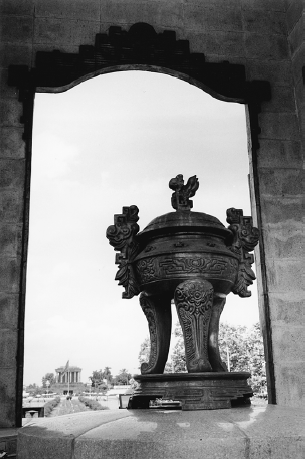
Figure 2.3. The Ho Chi Minh Mausoleum seen through the Shrine to the Unknown Soldier, Hanoi. Photograph by Natalia Puchalt.
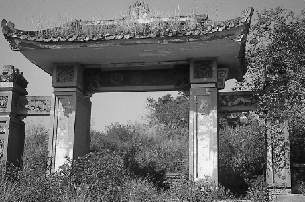
Figure 2.4. ARVN cemetery, Ho Chi-Minh City, razed after 1975. Photograph by Hue-Tam Ho Tai.
The main commemorative ceremony for families remains the soldier's death anniversary. Up until the mid-1980s, wartime scarcities and government regulations prohibiting largescale death anniversary ceremonies restricted their size.39 Over the past decade, families have begun to organize everlarger ceremonies. Today, an average death anniversary ceremony will feature a communal meal for fifty to sixty people. It begins with rites dedicated to caring for the dead soldier's soul, similar to those performed during the commemoration of the dead ceremony. The ceremony is always conducted before the altar in the home of the deceased's parents, the soul is invited back and propitiated, and some votive paper items, such as money or clothes, may be burned for the soul's use in the otherworld. The main participants are also close family members. If the soldier was survived by his widow, she will participate in these rites at her in-laws'home. Almost all widows of war dead in Thinh Liet commune remain in the home of their husband's parents, particularly if they have children, and almost never remarry; doing so is considered an act of infidelity to the late husband. Despite their social importance, in Vietnamese villages, patrilineages have assumed no ritual role in commemorating war dead. The rites remain firmly with the husband's immediate family. Once the rites are concluded, a communal meal is held for the
In recent years, other methods of commemorating and caring for the souls of war dead have emerged. A number of Thinh Liet families have installed the souls of dead soldiers in the local Buddhist temple. The virtue of installing the soul there is that it receives care and sustenance from all ceremonies conducted in the temple. Such souls are said to “eat of the Buddha's good fortune” (an may cua Phat) and will not be left uncared for if there are no more family members to conduct rites. A nun at the temple claims that several dozen families have done this, though the figures are disputed by some local residents and are impossible to verify. Families who perform this rite will later conduct a ceremony at the temple on every death anniversary and will also participate in ceremonies for dead souls at the temple in the first two weeks of the seventh lunar month.40
The most remarkable form of commemoration to emerge in Thinh Liet was the dedication of an altar to war dead in the communal house of Giap Tu village. This communal house had been destroyed during a battle with French soldiers in February 1947, producing a great deal of later conflict over which spirits inhabited it. When the house was refurbished in the late 1980s, local men decided it was appropriate for villagers to pay respects to local war dead there. This movement reached its zenith on the eleventh of the first lunar month in 1992, the lunar year anniversary of the aforementioned battle, when local villagers conducted a ceremony to propitiate the souls of eleven local guerrillas who had died that day. The ceremony featured trays of offerings as well as a moving eulogy by the son of one of those killed. The organizers, mostly older men, hoped the ceremony would become an annual event, but resistance mounted, particularly among older women. They felt that while villagers should propitiate war dead, the communal house was not the appropriate venue. As a result, the ceremony was never organized on a large scale again. In early 1996, the altar for war dead in the communal house was rededicated to the spirit of the land (tho dat) on which the communal house sits.41 For a short period afterward, some villagers continued to pay their respects to the war dead in the communal house, particularly on the battle's anniversary, but public rituals stopped. In 1997, the village succeeded in raising enough money to construct a small monument dedicated to the village's war dead. This monument, which records the name of every Giap Tu soldier who died in battle, as well as the names of a number of “Heroic Vietnamese Mothers” (“Ba Me Viet
The problem of war dead in Vietnam persists to this day, especially for those whose loved one's remains have never been recovered. The number of the missing apparently runs into the hundreds of thousands.42 Many families continue to organize trips to southern and central Vietnam to search for remains. In early 1996, for example, the skeletons of two soldiers were brought back to Thinh Liet commune and buried in the local cemetery near their mothers. Given the widespread practice of secondary burial three years after the initial burial—when the coffin is opened, the bones cleaned and transferred to a large urn, and the urn buried in a different location—the local ritual corpus is well suited to putting the soldiers to their final rest. Concern with finding soldiers'remains is visible in the public media as well. Vietnamese television has broadcast a number of shows that followed both family and military efforts to locate remains. The magazine The New World (The Gioi Moi)even published an article in October 1996 that described a “new method for finding the burial place of soldiers.” This was a form of divination in which a family member placed one chopstick in the ground and tried to balance an egg on top of it. If the egg did not fall, the deceased's remains were directly below. This method was apparently successful in locating the remains of several soldiers, including one who had been missing since December 1946.43 The Ministry of Labor and War Invalids and the Central Committee for War Veterans also publish War Veterans of Vietnam (Cuu Chien Binh Viet Nam), a magazine dedicated to circulating information regarding the location of war dead and their graves. Nevertheless, accurate knowledge is often difficult to find, and several trips by Thinh Liet families have been unsuccessful.
CONCLUSION
Anthropological research has shown that mortuary rites in virtually all societies contain the idea that death is transient and that such rites allow the deceased to be reborn into a new community and existence. Drawing on the work of the French sociologist Robert Hertz, Maurice Bloch and Jonathan Parry have concluded that at the end of mortuary rites, “the collectivity emerges triumphant over death” while the soul is transferred “from one social order to another (albeit imaginary) order.”44 What is most distinctive about the death of soldiers in contemporary Thinh Liet
The existence of two distinct communities of remembrance based on the same subject has a number of historical parallels. After Lenin's death, the Soviet Communist Party attempted to create a secular cult surrounding his person that would serve to unify the people, yet for many Russians, Lenin was absorbed into the community of saints and heroes of Russian history and commemorated as such.45 The Vietnamese Communist Party attempted to construct a similar cult around the person of Ho Chi Minh, but in early 1996 it disbanded a cult in a northern province that worshiped Ho as the nineteenth king of Vietnam's mythical first dynasty, the Hung kings.46 Conversely, the government in contemporary Japan tries to assert that the commemoration of dead soldiers at the Yasukuni shrine is a simple act of gratitude for the fallen, whereas for many rightwing groups and financial supporters, the rites held at the shrine are a celebration of the Japanese empire. What is notable in each of these cases is that the deceased and the rituals associated with them are used to make specific claims about the nature of the social world, be it the necessity of political unity, the glory of empire, or the simple need to put the dead to rest.
The existence of two distinct communities of remembrance around war dead in Thinh Liet does not imply any incommensurability between the two communities or the popular rejection of the state's assertions. To return to the language used by Mark Bradley, we do not see in Thinh Liet the formation of “counter-memory” in these rites. Instead, people
NOTES
Museum-Shrine
Revolution and Its Tutelary Spirit
in the Village of My Hoa Hung
Christoph Giebel
Like Peter Zinoman's and Shaun Malarney's studies in this volume, this chapter focuses on one particular commemorative practice employed by the Communist Party–dominated state in Vietnam to satisfy its need for appropriate self-representation and to shape and control the ways in which the past is remembered. But whereas the commemorative messages in highly selective and stylized prison memoirs analyzed by Zinoman and in official ceremonies for the war dead discussed by Malarney seem, at least superficially, to possess an internal consistency, it is inconsistency in message and form that appears at first sight in the object of this investigation. The commemoration in his native place of Ton Duc Thang (1888–1980), one of Vietnam's most prominent Communist revolutionaries, a southerner who became the country's second president, contains an ostensible paradox. It can be found in the fact that the remembrance by the Party of one of its heroes has taken on openly religious forms since the mid to late 1980s. Put differently, a paradox suggests itself when, under a selfproclaimed secular, even areligious political regime, the childhood home of this highranking Communist in My Hoa Hung village in the Mekong Delta province of An Giang has been turned into a shrine where popular rituals of hero spirit worship are performed.
Closely tied to the shrine of Ton Duc Thang are several museum exhibits in the south of Vietnam that present versions of the life of this leading public persona. These historical displays not only are
First, religious or quasireligious forms of popular or stateled veneration of revolutionary heroes are by no means a new phenomenon— one might only mention the widespread talismanic use of renderings of Mao Zedong's image among Chinese—and have been observed in East and Southeast Asia, including Vietnam.1 But especially in the last case, too little attention has been paid thus far to explaining the social conditions in which these worshiping practices appear, or the ideological-cultural concepts that undergird them and lend these rituals their meanings (and would steer us away from superficially seeing them as paradox).
Second, the analytical or theoretical tools of international debates, for example, in museology, while generally useful, possess certain limitations in describing historical representation and museum projects in Vietnam.2 Again, an attempt should be made to understand more from “within” how local Vietnamese contexts have shaped the specific forms in which these exhibits have appeared.
Third, with the growing interest in issues such as historical memory, commemorations, the “invention of tradition” (to refer to Hobsbawm), public ceremonies, symbols, and the (re)fashioning of historic sites—in Vietnam and elsewhere—what has tended to become emphasized are disjunctures, shifts, contestations, and tensions, discursive and otherwise.3 While these foci certainly can yield important insights and help undermine longheld assumptions, they have been remarkably weak in constructing counterarguments of an explanatory inclusiveness. In the case of the socalled Commemorative Area for Ton Duc Thang in An Giang, an analysis of the shrine and the adjacent museum can easily— and legitimately—demonstrate the stark contrast between the two structures, their inherent contradictions vis-à-vis the revolutionary master script of Marxian provenance, or the multiplicity of contending voices and signs. In this chapter, however, I want to move beyond the uncovering of tensions and instead propose a view—one view—of the Ton Duc Thang worship in which its various elements, far from being paradoxical, might merge into a culturally coherent and intelligible message, with the shrine providing the form and the museum exhibit its contents.
In the end, I will propose that such an integrated commemorative statement, veiled as it might manifest itself at the Ton Duc Thang shrine, needs to be read within its proper regional context. The southern museum-shrine—itself an instrument of official memory construction— seeks to modify and even subtly critique the predominant representations of revolution and war emanating from the North. This last aspect of my argument points to critical differences among the three studies in this volume that are otherwise related in their focus on commemoration by the Communist state. For example, Peter Zinoman does more than Malarney and myself in analyzing the narrative strategies and conventions built into a particular commemorative genre, and how such a customized version of revolution “worked” in the interest of the state leadership. More so than Zinoman and myself, Shaun Malarney is concerned with the popular reception (emendation, supplementation) of such stateinitiated practices—a perspective largely absent from this chapter because, as I will argue, Ton Duc Thang's shrine does not target the local population as its primary audience. Rather, my chapter shows that stateorganized commemoration in Vietnam is not a unified or uniform project, but that even official interpretations of the commemorated past vary in space and time; that is, they are subject to important regional and generational differences. In this sense, Ton Duc Thang's museum-shrine can be seen as an intervention in a debate where, despite its muted and hidden nature, nothing less is at stake than the selfidentity of the revolutionary camp.
In 1887, Ton Duc Thang's parents, Ton Van De (d. 1938) and Nguyen Thi Di (d. 1947), built a house in the hamlet of My An, which belongs to the village of My Hoa Hung. The village is situated on Ong Ho island in the lower Mekong River, just four kilometers from Long Xuyen, the commercial and administrative center of An Giang province. Ton Duc Thang, born in 1888, was the couple's first child. Being a boy, he was tutored, probably from 1897 at the latest to about 1901, by a private teacher in Long Xuyen, who likely had contacts with the famed anticolonialist Phan Boi Chau (when the latter came to An Giang in 1902to recruit for his Eastern Travel Movement [Phong Trao Dong Du]) and, later on, with the anti-French conspiracy of 1916 under emperor Duy Tan. Ton Duc Thang's commemorators in An Giang stress the great influence of this fervent anticolonialist teacher on Ton Duc Thang's early politicization. Ton Duc Thang received instruction in the Chinese script
We do not know how frequently Ton Duc Thang returned to his childhood home between 1906 and 1929, the beginning of his sixteen years of imprisonment under the French. In fact, as is the case with many other aspects of his biography, little of a concrete nature can be said at all about this period of his life. From 1906 to 1915, Ton Duc Thang allegedly became a worker in Saigon and was involved in several early protest strikes there. Records show that he was admitted to Indochina's only vocational school, the Saigon School for Asian Mechanics (Ecole des me´caniciens asiatiques de Saı¨gon), in 1915, but left a year later for metropolitan wartime service at the naval arsenal in the southern French port of Toulon.5
His sojourn as a navy mechanic in France lasted from 1916 to 1920. During that time Ton Duc Thang is said to have accomplished his most famous revolutionary deed. In late 1918, France sent a flotilla to the Black Sea as part of the Allied entry into the Russian civil war on the side of “white,” counterrevolutionary forces. The anti-Bolshevik intervention collapsed in the spring of 1919 amid widespread mutinies of these French navy units. Ton Duc Thang was not among the French expeditionary force in the Black Sea. But since the late 1940s or early 1950s, Vietnamese Communist propagandists and historians have celebrated him for his active and crucial involvement in the Black Sea mutiny as crew member of a French warship. In defense of Soviet Russia, Ton Duc Thang supposedly even raised a red flag on his naval vessel. This fabricated story has become the basis for propagandistically connecting the Russian and Vietnamese revolutions in an act of imagined ancestry.6
Back in Saigon, from 1920 to 1929, Ton Duc Thang apparently was active in early efforts to organize workers. In 1925, he claims to have directed a famous strike of navy shipyard workers, which historian Tran Van Giau subsequently called Vietnam's “first political” walkout.7 In 1926, he joined the newly formed local branch of the Vietnamese Revolutionary Youth League (Viet Nam Thanh Nien Cach Mang Dong Chi Hoi, or, in brief, Thanh Nien), a forerunner to the Vietnamese Communist Party, which had been organized the previous year by Nguyen Ai Quoc (later to become Ho Chi Minh) in Guangzhou in southern China. Ton Duc Thang quickly rose in the ranks of the Vietnamese
After his arrest in 1929, Ton Duc Thang would revisit his childhood home only twice. In the wake of the August Revolution of 1945, when the Communistled Viet Minh, the League for the Independence of Vietnam, seized power, and Ho Chi Minh declared the independence of the Democratic Republic of Vietnam (DRV), Ton Duc Thang was liberated from sixteen years of incarceration on the infamous Con Dao prison islands in the South China Sea. Shortly thereafter, in November 1945, he made his way to My Hoa Hung to see his old mother. But since he was in danger of being captured by the French, who by then had largely retaken control of the South, he stayed only one night, as the story goes, before making his way north to Hanoi to join the DRV government. Subsequently, the French War (1946–54) broke out, followed by Vietnam's division at the seventeenth parallel, massive American intervention in the 1960s and 1970s, and more, drawnout warfare. And thus Ton Duc Thang's next trip back home would not take place until after the end of the American War, in October 1975, after the de facto unification of the North and the South, when then-president Ton Duc Thang was able to visit his native place one last time.
The thirty years in between those two final visits to his birthplace had seen Ton Duc Thang's rapid rise to political prominence in the DRV, even though his actual influence in the power structure of the Vietnamese Communist Party (VCP) always remained negligible. His leadership of, among others, the National Assembly, the United (later, Fatherland)Front, and the USSR-Vietnam Friendship Association, as well as his vice presidency under Ho Chi Minh after 1960 and his presidency from 1969to his death in 1980, attest to the representational usefulness of Ton Duc Thang for the Communist Party–led state. This can be explained by his seniority—he surpassed all other party leaders in terms of both age and the length of imprisonment under the French9—and his unique symbolic value in multiple capacities: as an undisputed proletarian, anticolonial revolutionary, alleged internationalist activist, and a southerner (reinforcing the DRV's claim to authority over all of Vietnam).
In 1984, four years after his death, the Ministry of Culture, upon the suggestion of local cadres, declared Ton Duc Thang's childhood home a culturalhistoric monument. After Ton Duc Thang's brother Ton Duc Nhung (b. 1896) and sister-in-law (b. 1897) both died in 1986, their son's family moved to an adjacent building, and renovations of the original house and the creation of a “commemorative area” (khu luu niem)
In August 1988, in celebration of Ton Duc Thang's hundredth birthday, the commemorative area in My Hoa Hung was solemnly inaugurated.
Ton Duc Thang's childhood home is a rather large structure on pillars, with well over one hundred square meters of living space (fig. 3.1). The house has at least four bedrooms, the main living room, and a spacious porch. Some of the walls show elaborate wood carvings, and the interior is decorated with valuable furniture and several large pieces of lacquer art. The main item on display, in the center of the house and its living room, is an altar with Ton Duc Thang's portrait, electric candles, decorative plants, and incense burners. Behind Ton Duc Thang's altar and standing along a wall is a second altar that can more easily be identified as a traditional place for ancestral veneration. This function is underscored by the display around it of photos of Ton Duc Thang's parents, brother, and sister-in-law. The neatly kept grave sites of these four relatives, which are equally important in Vietnamese practices of ancestral worship, are situated behind the building and consciously drawn into the overall exhibit by way of a wellmaintained, wellmarked path.12
The nearby exhibition building (erected about fifty meters from Ton Duc Thang's childhood home) is a large, rectangular concrete structure on pillars standing in water. Its design hardly conveys the impression,
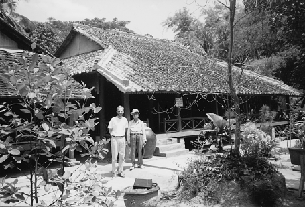
Figure 3.1. The author and Ton Duc Thang's nephew in front of Ton's childhood home and shrine, My Hoa Hung village, An Giang. Photograph by Christoph Giebel.
The exhibit itself consists mainly of pictures tracing Ton Duc Thang's life in chronological manner: from his native place and family, his vocation as a mechanic in Saigon and France, his alleged role in the Black Sea mutiny (symbolized by a painting of a warship with a hoisted red flag), his early revolutionary activities back in Vietnam leading to his arrest, trial, and imprisonment on Con Dao, to his rise to prominence at the side of Ho Chi Minh in the newly independent state, and finally
Overall, the commemorative area in My Hoa Hung serves as a destination point for secular pilgrimages. Since 1988, schools and factories have frequently organized tours to My Hoa Hung, and in the short time span until the Eastern European revolutions of 1989, delegations of “fraternal” East bloc countries paid their respects. Photos of these organized visits are displayed in the museum, and a visitors'album further attests to this function of the site. According to museum personnel, especially around nationally symbolic dates—Ho Chi Minh's and Ton Duc Thang's birthdays, Independence Day—the commemorative area hosts youth camps. During my sojourn in My Hoa Hung, however, the education cadre accompanying me from Hanoi and I remained the only visitors, and my companion's worshiping with incense in front of Ton Duc Thang's altar was the only ritual act I witnessed. None of the local people, in particular, came to the compound. Several staff members were at hand, but they seemed to have few duties. I strongly suspect, though cannot prove, that after a flurry of visits and ceremonies during the initial years, in the 1990s the site has become permanently underutilized and, for considerable stretches of time, practically deserted.
Nevertheless, more so than any other memorial place for Ton Duc Thang, including the Ton Duc Thang Museum in Ho Chi Minh City, My Hoa Hung was conceived to provide the official commemoration of the revolutionary with an immediate spatial quality. Ton Duc Thang's childhood home becomes part of several imaginary maps: reaching back in time, it links up with other popular heroic figures of Vietnamese history, one after the other resisting outside aggression. Reaching out into simultaneous time, it becomes one of the places of origin of the modern Vietnamese revolution where revolutionaries all march in unison. Finally, it becomes part of a global map of revolutionary internationalism and humanism to enhance the national prestige of Vietnam.
As noted earlier, the commemorative area is filled with contrasting images and messages, of which I will mention only a few. For example, Ton Duc Thang's veneration results in the partial superseding of the standard biographical script. In his native place, the official claim that he came from a family of poor peasants is rejected, and no attempt is made to hide that the family was, in the words of Ton Duc Thang's nephew, “rather rich” (and could, after all, afford a private education for the firstborn son). Further, Ton Duc Thang's childhood home, nicely decorated and built mainly of wood in the traditional style of a peasant
What, then, can one make of the commemorative area that is apparently so filled with contrasts and contradictions and that in its quasireligious worship of a Communist leader creates tensions with the state's strictly secular orientation? Is it possible to distill from the commemorative place a unified theme, with a form and contents that fit?
As a first step—one that aims to identify a mold or form for the site— I propose that it is not only ancestral worship rituals with which Ton Duc Thang is venerated. Rather, his childhood home resonates even more with the Vietnamese traditional religious belief in the spiritual properties of the country's landscape and history. Although the building is always referred to only as “President Ton Duc Thang's childhood home,” it in fact is meant to be a shrine or temple (den) for Ton Duc Thang's hero spirit—a tutelary deity for the locale as well as a figure of national stature that has entered the pantheon of Vietnamese heroic guardian spirits.
By this I do not mean that Ton Duc Thang was made the village patron spirit (thanh hoang) of My Hoa Hung. In prerevolutionary Vietnam, the cult of a village patron spirit was always performed in the village's communal hall (dinh) and was based on the community's own choice of its guardian deity, which clearly is not the case here.14 As I will describelater, the local population, which traditionally would enjoy the benevolentacts of its patron spirit, is not really meant to be the recipient of the kind deeds by Ton Duc Thang's spirit; it is thus not the primary audience for the shrine's message. And since veneration takes place at Ton Duc Thang's birthplace—and not at the local communal hall— “origins” of some sort appear as a primary concern to the commemorative project.
I argue, however, that Ton Duc Thang's temple consciously models itself on the religious belief (or state ideology, as Stephen O'Harrow calls
Vietnamese hero spirit tales form a genre with a set of conventional features from which, I will argue, Ton Duc Thang's shrine liberally quotes. To describe their generic makeup, I will briefly turn here to the most prominent collection of such stories of tutelary deities, Ly Te Xuyen's fourteenth-century compilation Spiritual Powers of the Viet Realm (Viet dien u linh tap). Keith Taylor and Oliver Wolters have written detailed studies on the Spiritual Powers of the Viet Realm, which, while differing in their approaches and arguments, complement rather than contradict one another.17 Both Taylor and Wolters argue that the compilation of heroic spirit tales was used for the interests of the court elites. They differ, however, in their interpretations of the spirits'utility to these elites. Taylor traces the tales back to two main concerns: first, to what he terms “Ly dynasty religion,” in which royal authority is sanctioned by spiritual powers. Second, at the time of compilation, when dynastic succession was contested and irregular, these spirits functioned as examples of loyalty to rulers. But also highlighting the psychological comfort that the belief in protective deities continued to give later ruling classes in dangerous times, he concludes that the spirit world was a “protective screen” that “was seen by the Vietnamese as a shelter from alien threats and domestic disorder.” Further, “by ritually acknowledging these spiritual powers, Vietnamese kings opened legitimizing space for their claims upon the obedience of the people.”18
Wolters, who mainly works with later versions of the Spiritual Powers of the Viet Realm, places his emphasis differently: in the spirit tales he
Wolters has characterized the tales'often uniform plots in two ways. First, in instances of outward threats, there is
the invariably successful relationship between Vietnamese rulers … and the local spirits but only if the ruler alertly apprehends a spirit's presence, if necessary testing it, appoints it to a post of military responsibility, and rewards it for its contribution to victory. The spirit, who always salutes the ruler, now joins the entourage. When this procedure is followed, victory is “certain.”
Second, concerning domestic order, the genre would present
a spirit's marvelous “manifestations” of spiritual power, its dramatic disclosure to a ruler …, theruler's wonder and grateful provision of a “shrine,” the villagers’ “incessant” worship at the shrine, the spirit's “response” to the villagers'needs, and the “favours” enjoyed by rulers and villagers alike.20
To sum up what is important for my purposes here, guardian spirits protect the country from external threats and the ruler against internal, village-level challenges. Their role often is to facilitate a harmonious relationship between elite and village (sub) cultures, or between rulers and the people. Although both sides benefit from the tutelary services of the deity, the spirit's mediation is not one of equidistance, but one ultimately done in the ruler's interest. Spirit tales and local temples both are didactic tools, then, to focus popular allegiance toward the ruler. Finally, spirits and rulers can come together either through the ruler's proper apprehension and recognition, or goi hon, the “calling up,”21 of a worthy spirit, or by way of the spirit announcing (disclosing) itself to a worthy ruler.
If Ton Duc Thang's childhood home is indeed a guardian spirit shrine— creating, so to speak, the site's form or mold—and if it were to establish
Again, the works of Oliver Wolters and Keith Taylor are of relevance here. Wolters and Taylor have both undertaken structuralist readings of Vietnamese annals and discerned dominant themes—or what they call “sentences”22 or “statements”23—to shed new light on the histories the annals are concerned with, as well as on their authors and their intentions. Wolters in particular sees such a “sentence” as a signifying system representing the totality of “recurrent ‘units,’” that is, words that are syntactically related but do not necessarily always appear with one another; for those portions of the Complete Historical Records of Dai Viet (Dai Viet Su Ky Toan Thu), annals that were compiled in the mid–fifteenth century, he identifies one such “sentence” as signifying “good government.”24
Coming back to the exhibit on Ton Duc Thang's life, we will disengage ourselves from a primary concern with the ideological (and museological) master script that makes the commemorative site appear such a paradox. Rather, we will take such an idiom less seriously and see it perhaps only as a required stylistic convention in contemporary Vietnam, where one has to draw from the reservoir of Communist Party–sanctioned politicalideological terminology. Once we focus instead on other “recurrent units,” or recurrent expressions, the exhibit can reveal a dominant theme that actually makes sense in conjunction with Ton Duc Thang's hero spirit shrine. I refer here to the museum's repeated and quite prominent emphasis on “simplicity,” “sacrifice,” “selflessness,” “loyalty,” and “service” —all, of course, exemplified by and combined
As in the Ton Duc Thang Museum in Ho Chi Minh City, the exhibits on Ton Duc Thang's life in Long Xuyen and My Hoa Hung indeed pay particular attention to the characteristic frugality, devotion, and unpretentiousness of this revolutionary and national leader. Ho Chi Minh's words of praise of Ton Duc Thang to that effect are prominently displayed right in the entrances to both exhibits. And we are reminded of the concern Ton Duc Thang showed for others throughout his life: for example, for his own family members, whom he supplied in his youth with selfmade sandals (which are shown in the exhibits), or for his Vietnamese coworkers, one of them gravely sick, at the Toulon arsenal. We also meet him loyally caring for his fellow prisoners, even for those who initially tried to harm him, during the hellish years on Con Dao. We see him caring for the nation as a whole when, in 1945, he visits his mother, whom he had not seen since 1929, for only one night because of “urgent business” awaiting him in the capital. At My Hoa Hung, a painting of this last scene and a related quote ascribed to Ton Duc Thang underscore the importance placed on his unselfishness.
The theme of simplicity and selflessness is successfully reproduced beyond the exhibits. Two examples can illustrate this. First, in 1988, a symposium on Ton Duc Thang was held in Long Xuyen. The publication in 1989 of the symposium's proceedings then significantly carried the programmatic title “A Great Ordinary Person” —a phrase coined by Tran Bach Dang, the former Saigon party chief during the American War.25 And second, Dang Kim Quy reports that visitors to the commemorative area are often moved to tears while considering Ton Duc Thang's “life full of hardship and bitterness, yet pure, loyal, kindhearted and simple.”26
The parts of the exhibits dealing with Ton Duc Thang's life after he became an accomplished national leader focus even more on his thriftiness, self-reliance, commonality with the people, and modesty. Among the material artifacts presented are his simple presidential clothes and worn shoes, his bicycle, alarm clock (a gift in 1957 from Vietnamese embassy personnel in Moscow), table fan, and photo camera—all of
Large black and white photos depict Ton Duc Thang's plain attire and rustic furniture in the presidential residence, or his bicycle repair tools, which he is said to have used until old age. The two explanations given are that Ton Duc Thang, even as president, at heart remained a mechanic who loved to tinker, and that he did not want to impose upon his presidential guard to fix his bicycle. Other pictures show him in-volved in practical, down-to-earth, handson, even mundane to trivial activities, like chatting with factory workers, reading to children, and tending his garden plants. Again, it is here that the core of the exhibits'didacticism is to be found. What becomes privileged is clearly not his revolutionary struggles, successes, and fame (a focus that is more pronounced in official biographical treatments emanating from the center of Communist Party power)28 but the fact that power, once achieved, was for Ton Duc Thang not an end in itself but the means to best serve the people—in other words, that power left him humble, committed, and uncorrupted. One plausible reading of the exhibits'statement would thus be about the correct demeanor of those who govern in the name of the Revolution.
How could this kind of ideal revolutionary leadership, of which Ton Duc Thang is portrayed to possess all the essential characteristics, and of which the Communist Party is the legitimate agent, be conceptualized? I have already identified central attributes such as “simplicity,” “sacrifice,” “selflessness,” “loyalty,” and “service.” They point to an activist government of officials operating under a set of ethics that take as their reference the common good. Its sense of self would be one of idealistic (and at the same time paternalistic) confidence in the right-eousness of its initiatives, its unfailing knowledge of “what is best” for the people, and its predictable success. Its continued power and authority would remain an unchallenged given so long as it remained tightly connected to the people, their experiences and circumstances, and in
Such a concept of proper rule extolled in the exhibits'statement is certainly not without historical precedent. Thus, my contention that Ton Duc Thang's museum-shrine produces both in form (hero spirit temple)and in contents (exhibits) a consistent statement must lead us at this point on an argumentative detour into premodern Vietnamese intellectual life. For quite a similar notion of proper rule was once articulated by the great scholar-official Nguyen Trai (1380–1442), and we need to examine his thought here in some detail.
Nguyen Trai lived through the tumultuous decades leading to the fall of the Tran dynasty in 1400, the brief reign of Ho Quy Ly (1400–1407), the harsh occupation of the country by an army of China's Ming dynasty (1407–27), and the subsequent restoration of independence under a new dynasty, the Le. Nguyen Trai himself played an important part in the defeat of the Ming; he joined Le Loi in organizing an anti-Ming resistance—the Lam Son uprising, begun in 1418—and the two men became the movement's key exponents. As emperor (1428–33), Le Loi would retain Nguyen Trai as his chief official; thereafter, their relationship was made a Vietnamese archetype of the fortunate link between a powerful ruler and his able and loyal minister.29
Much has been written on Nguyen Trai in scholarly works. Without doubt, the ascent of Confucian axioms for the first time to a commanding position within Vietnamese elite culture is intimately connected to Nguyen Trai and the early Le dynasty. Tran Quoc Vuong actually called it an “irony of history” that the “Confucian bureaucratic-monarchic regime …, an exogenous element originating from North China …, received a particular boost from the time Dai Viet shook off the Ming yoke.”30 Nevertheless, Nguyen Trai “took … seriously the Confucian dictum of serving the state,” as John Whitmore has observed, and “strongly believed in an active role” [for scholar-officials]; in his work “service was his dominant theme.”31 Oliver Wolters, for his part, accentuates Nguyen Trai's major contributions differently; according to him, it was from
the selfless way peasants rallied against the Ming invaders [that Nguyen Trai]witnessed the people's response when a heroic style of leadership revived.[Therefore, his writings] stressed the ruler's responsibility to the people. … The people's wellbeing now became the test of good government, and the ruler's obligation to use educated officials is confidently formulated.32
Finally, Esta Ungar writes that Nguyen Trai's thought
expressed an attachment to traditional Vietnamese values of the ruler as the heroic protector of the people, … [onto which] he grafted newer political constructs that … enlarged … the scope of activity of previous dynastic governments. … Inhissystem the people's welfare was the basic concern of the state.33
Far from following the inward-looking neo-Confucian interpretation of such central concepts as “humaneness and justice” (ren yi, Vietn. nhan nghia), Nguyen Trai instead believed that nhan nghia obliged a ruler to “calm the people” (an min, Vietn. an dan), in the meaning of “securing the livelihood of the people” —an outwardly looking, activist stance informed by an “ethic of public service.”
Significantly, Ungar maintains that Nguyen Trai adapted in such notions the idealistic postulates of the eleventh-century socalled government school of Confucianism, an activist reform movement with strong roots in Mencian thought during the times of China's Northern Song dynasty. She sees a particular affinity to the work of Fan Zhongyan (989–1052), 34 who spearheaded the shortlived early Song reforms. Fan Zhongyan's famous precept that officials should “be the first to become concerned with the world's troubles and the last to rejoice in its happiness”35 became, in Ungar's words, “an article of faith among fifteenth-century Vietnamese public servants and scholars and was greatly encouraged by Nguyen Trai in his writings and his example.”36 James Liu conceptualized the ultimate vision of officialdom in the policies of Fan Zhongyan and his reform movement as an “ethocracy” based on moral principles and a strict sense of responsibility toward the people. This Confucian idealism with its “practical utilitarian spirit and … active political interest,”37 nicely complemented the emphases on practicality and dynamic leadership in Vietnamese political thought. However, we should keep the important fact in mind that Nguyen Trai adapted, but did not wholly adopt, the positions of early Song reformist Confucianism. Rather, as Ungar argues, he “merged” them with “the traditional Vietnamese leadership ethic,”38 which envisioned a heroic and just ruler in tune with, and aided by, the spiritual powers of the country.
Nguyen Trai fascinated DRV intellectuals already during the earlier years of the regime's consolidation and resumption of armed struggle. Tran Huy Lieu (1901–69), perhaps the most prominent and influential historian in those days, wrote regularly on Nguyen Trai, 39 and Nguyen Trai's collected works were published in Hanoi in 1969. Two reasons, one external and one internal, may best account for Nguyen Trai's appeal to the DRV. First, he, too, had put his service to the task of expelling foreign occupants (and had ultimately triumphed!). Second, by championing a Vietnamese version of Fan Zhongyan's “government school” of Confucianism (which predated neo-Confucianism), with its model of an “ethocracy,” Nguyen Trai spoke directly to the revolutionaries'concern, now that they were in power, about building up an efficient bu-reaucracy with cadres who nevertheless would avoid the corrupting internal dynamics of government and stay selfless and “close to the people.”
It is noteworthy that Tran Huy Lieu's revised and final treatment of Nguyen Trai, in 1966, contained an added chapter where Tran Huy Lieu employed “Nguyen Trai in our present endeavor to defeat America and save the country.”40 Patricia Pelley has argued that a strong anxiety among DRV historians about the persistent collaboration with U.S. overlords in the South made Nguyen Trai an even more compelling example, since he, unlike many of his contemporaries, was said to have resisted working with the occupying Ming. While this point is in itself quite convincing—although North-South collaboration patterns were exactly the reverse in the fifteenth century—Pelley's emphasis of Nguyen Trai as a counterhero, who is set in contrast to the negative types of foreign occupants and their local collaborators, overlooks Nguyen Trai's reaffirming role for the revolution's positive selfimage.41 It is the latter aspect, that is, the revolution's conscious utilization of Northern Song and early Le thought on good government, that I find even more intriguing. Tran Huy Lieu writes that Ho Chi Minh
often used Pham Trong Yem's [i.e., Fan Zhongyan's] precept to educate the cadres. Communists fight for the happiness of humanity and therefore must “be the first to become concerned with the world's troubles and the last to rejoice in its happiness,” and only the communists’ “being the first to become concerned with the world's troubles and the last to rejoice in its happiness” is really consequential and complete.42
If I were to argue for an affinity between Confucianism and Vietnamese Communism, I would have no better argumentative grounds than those provided by the intellectual links from Fan Zhongyan via Nguyen Trai
Thus, much more needs to be done to understand the connections between Confucian idealism/humanism and Vietnamese Communism. For the latter, I suggest that it would be helpful to distinguish between the party in struggle and mobilization and the party in leadership and power, as these fundamentally different positions conditioned the revolution's varying judgments of Confucianism either as obstacle and opponent or as (partial) paragon and precursor. Alexander Woodside has hinted at this split perception with regard to the “mandarin” revolutionaries'concern over how to bridge the divide between their elite social backgrounds and the “masses” they were supposed to lead:
In East Asia, the Confucian gentleman was the universalist concerned with other people's troubles and with the troubles of the universe, the free spirit least bound by the particular concerns of the “petty man.” If memories of
I might add that, to the party in struggle, “self-serving ‘feudal'bureaucrats” not only figured in its memory but were, as “Confucian” bureaucrats serving the French or Emperor Bao Dai, real-life adversaries. The influence of specific, to varying degrees “Confucian,” thinkers like Fan Zhongyan or Nguyen Trai on the twentieth-century revolutionary leadership needs to be studied much more thoroughly. When Ho Chi Minh freely inserted Fan Zhongyan's famous eleventh-century dictum into a “rectification” speech in April 1961, he was not just using “old symbols … creatively” and in a calculated and conscious way, as Marr suggests;48 instead, he revealed a mind-set very much familiar with, and receptive to, Confucian humanism (and not just “less repelled” by it, as Woodside would have it), perhaps similar to how Bible-quoting Western politicians reflect a cultural environment suffused with certain strands of Christianity.
Finally, I should note in conclusion of my brief discussion of Nguyen Trai that his retreat on Con Son mountain in Hai Hung Province was turned into a national hero shrine, 49 and that Nguyen Trai became canonized, and continues to be venerated as, among the most important guardian spirits of the Vietnamese realm.
We can now end our detour through Vietnam's intellectual past and return to present-day My Hoa Hung by observing that Nguyen Trai's thought and his precedent as enshrined hero spirit of a national pantheon resonate clearly in the presentation of Ton Duc Thang's own museum-shrine. Although no specific mention is made of Nguyen Trai at the commemorative area for Ton Duc Thang, the exhibits'statement about the proper ways of a revolutionary government bears such resem-blance to the particular activist-idealist strand of Confucian ethics espoused by Nguyen Trai (and, as we have just seen, consciously utilized as a guideline for DRV cadres) that it is safe to presume a powerful allusion by the former to the latter.
Ton Duc Thang's commemorators hardly implied the correlation with Nguyen Trai's thought and hero spirit status in an arbitrary or random manner. Rather, the timing of important events likely suggested
I have offered ways of reading Ton Duc Thang's museum-shrine against a background of historical allusions and a multitude of cultural quotations and memories. On the one hand, his birthplace shrine establishes Ton Duc Thang as a guardian spirit who has joined the Vietnamese pantheon of historical hero deities. On the other hand, the museum exhibit propagates an ethos of the simple and selflessly devoted cadre, which similarly reaches back in time and connects with certain Confucian concepts espoused by a famous Vietnamese scholar-official.
But are we not dealing here with two quite different and incompatible cultural statements—the markedly non and pre-Confucian tutelary spirits of the Spiritual Powers of the Viet Realm, and Nguyen Trai and his version of Confucian idealist humanism? I would not agree. Esta Ungar has shown how, in Nguyen Trai's thought, Song reformist Confucianism was “merged with,” or “grafted onto,” established Vietnamese concepts of heroic leadership and the interplay between worldly and spiritual powers. And dynamic relations, not incompatibility, are described by Alexander Woodside when he writes of Vietnamese intellectuals:
[Their] inclination to [study popular traditions] accompanied the Confucianization of Vietnamese intellectual life, was provoked by it, and sometimes collided with its this-worldly sensibilities. … The mixture of acceptance and rejections varied with each thinker. … But it was the interplay between Confucian moral theories and the great ancient reservoir of Vietnamese religious and mythical formulations which most decisively shaped Vietnamese views of change before 1860.51
I suggest that there is actually a distinct area of commonality in the two concepts. Nguyen Trai was concerned with an “ethocracy” of officials
It is in this fundamental concern that Ton Duc Thang's spirit temple and museum exhibit finally coalesce in a meaningful way. In its person-ification by Ton Duc Thang, the statement about an idealistic, selfless, and uncorrupted governing officialdom—an ethos of revolutionary cadres—itself is the enshrined spirit of My Hoa Hung. Simple and selfless Communist cadres are the agents (i.e., officials) of an abstract ruler, the Vietnamese Revolution, understood here not simply as the events of August 1945 but as an institutionalized cause or enterprise. Properly called upon and utilized, these officials ensure the ruler's success against outward threats and domestic disorder. Their primary concern with the people's livelihood constitutes the protection that the people expect from the ruler, in exchange for which they recognize the ruler's legitimacy and are loyal.
Instead of tensions, paradox, and subversion, this is, I suggest, the unifying theme that can make sense of the commemorative area. At Ton Duc Thang's birthplace, the uncorrupted cadre, who tirelessly and self-lessly works for the benefit of both the Revolution and the people, is venerated as a guardian spirit of the Revolution, and the museum functions as a modern temple inscription announcing the spirit's merit, achievements, and outstanding character.
I have tried here to find an interpretation that would make sense of what appeared to be a highly contradictory commemoration of a Communist leader at his birthplace. Whereas this search has taken me all the way back to the eleventh century, the site's contemporary context, the late 1980s, requires some attention as well. The waning of the Cold War and the decline and ultimate demise of the socialist camp in the 1980s increasingly weakened the external moral authority and political legitimacy that Marxism-Leninism had long afforded the ruling Vietnamese Communist Party. This process opened up space for a popular reembracing of the “traditional”52 at the same time that the Revolution itself
While the potentials for posthumous commemoration of Ho Chi Minh and Ton Duc Thang are necessarily greatly different for quite obvious reasons, it is nevertheless interesting that the mid-1970s saw the erection of a monumental mausoleum to Ho Chi Minh in Hanoi, with a structure and a culticritual form outside Vietnamese practices, while spirit shrines-museums resonating with traditional political-cultural concepts appeared in the late 1980s in the countryside.
Commemorative confidence is one aspect that needs to be considered in this context. The Ho Chi Minh mausoleum is one such expression of confidence by the Vietnamese Revolution. It was certainly Vietnamese, but it belonged—on equal terms, as symbolized by the chosen architectural-ritual form—to the larger moral order and authoritative structure of the socialist camp. In the “triumphalist spirit”53 of the mid-1970s, it felt firmly embedded in a grander historical design, the validity of which had just been proven by the revolution's singular feat of successfully achieving, against great odds, its outward goals of uniting the country and ending foreign domination.54
In contrast, at the core of the commemorative effort in My Hoa Hung lies a deep crisis of confidence. Gone were the days of triumphalism and the shelter of a greater outside moral authority that would have provided a familiar choice of commemorative form. The Revolution had lost its sense of purpose, and the split between the trajectory it had prescribed for the country and the material-cultural tendencies of the people widened more and more. Amid the dramatic economic downturn of the mid1980s, rising social ills, widespread popular dissatisfaction with, or— worse yet—uninterest in, the revolutionary government, rampant corruption and loss of morale among its cadres, and the ominous decline of the global socialist camp, the organizers of Ton Duc Thang's museum-shrine “turned nativist” and (re)discovered in the traditional a new/old source of legitimacy and guidance. In exchange for one historical model of predictability, the now discredited Marxism-Leninism, they tapped into a model within the Vietnamese cultural repertoire that promised an equally predictable course of events, the invincible alliance between Vietnamese
But this should not be confused with a change of allegiance, or a turning away from the revolution. Despite the confidence crisis, Ton Duc Thang's commemorators remained committed and fiercely loyal to the Revolution. True to the obligations that their role as cadres entailed, their fundamental concern lay with its survival, and they were anxious to improve the quality of the revolutionary ranks. And so, triggered by the disconcerting changes in the fortunes of the socialist camp, yet another imagined ancestry of Vietnamese Communism was established through Ton Duc Thang. This ancestry was to be found in traditional concepts of authority and order of the country's spiritual and this-worldly realms and in the unbroken sequence of national heroes, who, with the aid of the spirit world to which they themselves would belong after death, had risen to defend the country and reaffirm these concepts. Placing the Communist revolution and Ton Duc Thang (and, of course, Ho Chi Minh) within this continuum reasserted a sense of pride in times of bedeviling self-doubts. But the veneration of guardian spirits also afforded Ton Duc Thang's commemorators with the “safe” and prudent form, and Confucian idealism with a consistent language, to express their warnings about revolutionary decline in the present. In that sense, the site entails more of an act of “talking back” at the state than of lecturing down to the people. Through Ton Duc Thang's museum-shrine, the selfless, activist, and uncorrupted cadre who would ensure harmony between the Revolution and the people was idealized. The nostalgia and criticism in this message only become explicit because of the statement's incompatibility with present times—times that to the commemorators likely appeared “out of joint.”55
Amid the loud signals of distress is a faint message of hope. To explain this, I should take a brief look at Ton Duc Thang's commemorators. At the same time, the aspect of regionalism will—once again—have to be considered. The museum-shrine in My Hoa Hung and the symposium on Ton Duc Thang's life that coincided with the site's inauguration in 1988 were organized jointly by provincial cadres in Long Xuyen and former Saigon/southern party leaders, who were equally instrumental in establishing the Ton Duc Thang Museum in Ho Chi Minh City: Tran Van Giau, Tran Van Tra, Tran Bach Dang, Luu Phuong Thanh, and others. All of them were critical of the present and tried to foreground the South's contributions to the successes of the Vietnamese Revolution
And thus, in the end, the enshrined revolutionary ethos of loyal service at My Hoa Hung can be seen as the commemorators'self-image, and they themselves, along with Ton Duc Thang, come to embody the Revolution's guardian spirits. Just like the tutelary deities, they “announce” their willingness to serve the ruler. Once again, I turn to Oliver Wolters, who has described the attraction between ruler and guardian spirit as “the automatic response of local tutelary spirits to a ruler's presence, provided that the ruler had already shown signs of achievement and leadership,” but has also emphasized that spirits can admonish a ruler to “seek and follow virtus” (duc).56 Both dynamics, that is, response and admonition, are at work here and undertaken by people who are, on the one hand, loyal to the Revolution and, on the other hand— spurred by their memories of past glories—pained by its present state.
Their hopeful message is that the Revolution can be saved if it is able to refocus on its fundamental purpose, go back to its origins (symbolized by the temple at a prominent revolutionary's birthplace), “clean up its act,” and rediscover, accept, and use all the talents available—including those in the South. In a remarkable parallelism to traditional notions of authority and legitimacy, this message further implies that the people, when recognizing such a rejuvenated and reinvigorated rule, would certainly abandon their errant ways and once again follow the revolution. The ease with which this nativist reorientation is undertaken can be explained by the congruence of the two models that provide a sense of historical certainty: success will surely belong to the heroic leadership, aided by ethical and unselfish officials, when it is properly aligned with either the inherent spiritual powers of its domain or the correct forces in the dialectical materialism of the historical process.
In their idealization of the earlier days of the Communist Party–led society, when, supposedly, a revolutionary ethos of service guided the officialdom, and the people and their leaders were in harmony, Ton Duc Thang's commemorators reveal their distress over, and protectiveness of, the Revolution in its present endangered state. Idealization and protectiveness are thus both at work in this act of “calling the spirits” (goi hon): enshrined and recalled in the little village of My Hoa Hung are,
NOTES
My discussions with Peter Zinoman and his “Declassifying Nguyen Huy Thiep,” positions 2, no. 2 (fall 1994): 294–317, have helped me to more clearly formulate the concerns expressed in this chapter. In its early phase, this study also profited in many ways from my interactions with Stephen O'Harrow, Keith W. Taylor, and Oliver W. Wolters. The final version owes much to the helpful criticism of Hue-Tam Ho Tai, Keith W. Taylor, Tamara J. Wang, Oliver W. Wolters, and Marilyn B. Young.
REPACKAGING THE PAST
Framing the National Spirit
Viewing and Reviewing Painting
under the Revolution
Nora A. Taylor
Paintings, like monuments and memorials, serve as sites of commemoration in the form of portrayals of historic events or illustrious war heroes. In Vietnam, the National Museum of Fine Arts abounds with paintings depicting legendary battles against Chinese invaders and portraits of soldiers preparing to fight the enemy. Until recently, these paintings, and the artists who painted them, were given more prominence in exhibition spaces, galleries, and museums than paintings whose subject matter bore no visible relation to the revolutionary cause. These paintings and their artists were the Vietnamese art world's counterpart to war memorials and revolutionary heroes described in Shaun Malarney's chapter in this volume.
This chapter will not dwell on the obvious relationship between these paintings and commemorative monuments. Rather, it will focus on the shift that has occurred in art historical memory since the launching of the Doi Moi reforms in the late 1980s from the artgoing public's emphasis on revolutionary period paintings and artists who served the nation in war to artists who did not participate in state politics. In illustrating how the politics of memory have penetrated the art world and how the recent trend toward the marketing of art has informed the way people think about art in Vietnam, this chapter will join issues raised in Christoph Giebel's analysis of Ton Duc Thang's commemorative shrine and Laurel Kennedy and Mary Rose Williams's discussions of the revised view of Vietnam's past to suit the needs of international tourism.
As in other socialist countries, the government of Vietnam spent much of the second half of the twentieth century promoting artworks that reflected communist ideology. Founded in 1957, the Vietnamese Artists'Association (Hoi Nghe Si Tao Hinh) was aimed at creating a national artistic workforce that would produce art to serve the propaganda needs of the government. Although hardly as large in number of artists or in the creative output as in China and the Soviet Union, the Vietnamese art community grew substantially during the years of hardline Marxist-Leninist policies, between 1954 and 1986. As in the Soviet Union and China, the artists who complied with the criteria set out by the government-sponsored artists'unions were favored in the eyes of the state. In addition to the preferential treatment they received, their works were also made more visible to the public in the form of posters, stamps, calendars, and newspaper illustrations. Likewise, those artists who chose to stay out of the unions or were rejected by the authorities received little attention. And similarly, more recently, as in Russia and China, the Vietnamese artists who have been receiving the greatest amount of attention since the government loosened its control on artistic production and allowed artists to sell their works in the open market are those who never participated in state propaganda campaigns.
Although comparisons with China and Soviet Russia are tempting, it is not the point of this chapter to discuss changes that occur when socialist institutions collapse in favor of the international art market. In Vietnam, the transition from a socialist to a market economy is neither as clear nor as straightforward as in Russia or China. Unlike in Russia, for instance, the socialist institutions set up in the 1950s are still in place; the shift in attitudes toward art and the selection of artists displayed in public exhibitions is not due simply to the transfer from official to non-official artists. Unlike in China, the artists now favored in art galleries are not necessarily reacting against their socialist realist predecessors. While China's new artistic stars are denouncing Mao through their paintings, no artist in Vietnam has so far cared to challenge Ho Chi Minh's supremacy in the public eye. In focusing solely on Vietnamese art, this chapter will suggest that this particular situation—although related to what is happening in Russia and China—has more to do with what is going on inside the Vietnamese politics of art historiography and memory than with a transition from socialism to democracy.
The case of a group of painters who have been selected by the new generation of art critics, collectors, and art aficionados as the forerunners of contemporary Vietnamese painting illustrates how memory in
THE CREATION OF A “NATIONAL
REVOLUTIONARY PAINTING” TRADITION
Westernstyle painting, or oil painting on canvas as it is known in the West, first appeared in Vietnam at the turn of the twentieth century, during the French colonial period, when artists came to Indochina from the me´tropole with their easels and palettes to paint the “exotic” Asian landscape. Victor Tardieu (1867–1937), an artist who had won a competition for painting a mural at the Universite´ Indochinoise in Hanoi, decided to establish an art academy in the colony to train local artists and artisans to become professional painters. In 1925, the Ecole des Beaux Arts d'Indochine (EBAI) was founded, and some twenty students enrolled. Most of the students were from local upperclass educated Hanoi families. A couple of students came from Cambodia and Laos, along with a few colonial residents. Classes in composition, anatomy, perspective, painting, and drawing were held in conjunction with a few classes in “indigenous” arts, painting on lacquer and silk.
The EBAI remained open until the 1945 Japanese coup against the French colonial government forced it to close down. Over the course of
The painters who followed To Ngoc Van to Viet Bac fell into two groups. In one were those who had already graduated from the EBAI prior to its closing and enlisted in the army out of patriotic duty serving as illustrators and/or revolutionary fighters. The second group consisted of painters who had not yet begun to study painting and, having joined the revolution, decided to study art simultaneously. The students who studied art in Viet Bac for the first time were given a diploma with the emblem of the Khoa Khang Chien.
The new school remained in operation for nine years. In 1954, after the victory over the French at Dien Bien Phu and the establishment of the Democratic Republic of Vietnam, it reopened in Hanoi. From 1954to 1986, the thirtysome artists who graduated from this class were seen as having contributed some of the most important works of art in the history of Vietnamese modern painting. They were accorded recognition on a par with the soldiers who fought in battle, given certificates of praise, and, in the case of To Ngoc Van himself, awarded the title of “revolutionary hero” (anh hung). To Ngoc Van died of injuries he suffered at the battle of Dien Bien Phu and was subsequently honored as a “revolutionary martyr” who sacrificed his life (hi sinh) for the revolutionary cause. Concurrently, his contemporaries named him Vietnam's greatest artist. However, the current generation of artists and art critics claim he was given the title not so much for his artistic talent but, rather, for having died fighting for his country.
For nearly four decades, the Resistance Class painters produced paintings of soldiers, combat heroes, women warriors, and the good deeds of the army along with more conventionally patriotic landscapes and rural scenes. These works, intended to be accessible to the masses,
The changes advocated by the current generation of artists in Vietnam are more easily understood if we examine the origins of the criteria created by the National Arts Association for selecting works of art worthy of the label “heroic,” “revolutionary,” or “national.” The selection the artists who were to receive the greatest exposure in the public eye was based primarily on political affiliation or personal participation in the nation's struggles against foreign imperialism. But several thematic and stylistic criteria were also established to determine the acceptability of the works of art to be displayed in public exhibitions. One of these revolved around the question of “national character” (tinh dan toc). The term was first used by Ho Chi Minh around the time of the August Revolution in 1945 to define the goals of the cultural policies established by the Democratic Republic of Vietnam. Ho Chi Minh had wanted art and literature to express the spirit of the Vietnamese people. He used the expression dan toc, meaning “nationality,” “nation,” or “national,” to describe the people of Vietnam, and the phrases tinh dan toc and van hoa dan toc to describe the “national character” and the “national culture” of the Vietnamese people.2 The term was again used in the context of literature to define that which best expressed the qualities that the prevalent political discourse desired to associate with the nation or “Vietnameseness.” In the visual arts, it was coined by the Communist
Artists did not always grasp the concept of “national character.” Nor did cultural politicians define it in clear terms. Consequently, many artists chose to ignore this issue, leaving it to the viewer or the judges at the national art exhibitions to decide whether their work contained national character. Still, they were obligated to include aspects of what they perceived to be an acceptable theme or style in their work in order to receive recognition from the Arts Association.
In 1962, at the second congress of the Arts Association, an attempt was made to define the components of national character to provide specific guidelines for artists to follow in the making of their artworks. No concise definition was drawn, but the general parameters of the issue were made clear. According to one definition, “national character is the way of life and expression of a community of people who live together over long periods of time.”4 Elsewhere, it was described as the “most natural element that constitutes humankind. So natural, in fact, that it defies all definition.”5 The general understanding of national character was that it exemplified the spirit of the Vietnamese people in their struggle for independence, their daily work, and their ancient historical culture. Daily life, history, and “traditional” culture were the themes that were considered “beautiful” and “true” by the Arts Association and therefore deemed to be most representative of Vietnamese character.6 The Communist Party's definition of daily life, history, and tradition did not always coincide with artists'understanding of those terms. Often, artists who thought they had displayed national character in their work were surprised to find out that their painting was not accepted by the Arts Association. Le Thi Kim Bach (born in 1938; student at the Hanoi College of Art from 1957 to 1960 and at the Soviet National University of Fine Arts in Kiev from 1961 to 1967) had one of her paintings rejected from a national art exhibition because, she said, the subject of her work, an old peasant woman, seemed overly sad.7
Paintings that represented farmers toiling in the fields, soldiers going to the front, or factory workers handling machinery were considered to contain national character, as were paintings that depicted historical figures, war heroes, and legendary independence fighters. But, if there was any suggestion of misery or violence in association with these images, the painting would be dismissed as unpatriotic. In his essay on Marxism and Vietnamese culture, Truong Chinh, secretary-general of
In the early 1960s, the regulations governing Arts Association artists were particularly strict and rigidly enforced. Several incidents involving artists and writers in the late 1950s had caused the Communist Party to pay close attention to the production of paintings and sculpture to ensure that artists were not going against the rules set by the Arts Association for the public display of artworks. The incidents in question involved a group of writers and artists who, at the first meetings of the Writers Association in 1956, had demanded greater freedom of expression and creative rights. These writers and artists were in fact asking to be allowed to produce “art for art's sake,” a notion that went against Ho Chi Minh's requirement for artists to follow the Maoist notion of “art for the service of the people.”11 After publishing four issues of two art and literature journals entitled Humanism (Nhan Van) and Masterpieces (Giai Pham), several of the contributors were severely punished and sent to prison for “betraying the interests of the Communist Party, the Nation and the people of Vietnam.” The painters Nguyen Sy Ngoc (1919–90; student of the EBAI from 1939 to 1944) and Nguyen Sang (1923–88; student of the EBAI from 1940 to 1945) were directly affected by their involvement in this affair. Nguyen Sy Ngoc was sent to a labor camp for two years, and Nguyen Sang was barred from employment with the Arts Association.12
The other artists and writers involved were also banned from their previous positions and only gradually reintegrated into the artistic mainstream. The artists and writers involved in the criticism of the
In order to understand the role of “marginality” or “dissent” in the 1960s and 1970s, it is helpful to examine in further detail the differences between works of art that were considered “acceptable” and those that were not. One example of “acceptable” illustrations of “national character” is a painting by Mai Van Hien (born in 1923, student at the EBAI from 1943 to 1945) entitled Meeting (Gap Nhau, 1954; fig. 4.1). The painting was praised when it was exhibited at the first National Art Exhibition in 1955 because the subject of a soldier meeting a peasant woman illustrates the idea of community and solidarity between the army and the common people. In the painting, a soldier converses with a woman on the Dien Bien Phu Trail who has visibly helped to carry provisions for the soldiers. On her yoke are two camouflaged baskets that she apparently has been carrying for some time, as her bare feet and rolledup trousers indicate. The mood of the painting is reflected in the artist's simple descriptive style, which lends itself well to its content. The soldier and the woman appear friendly toward each other: the soldier is relaxed, his rifle is casually thrown over his shoulder, far from posing any threat to the woman, and the woman is smiling and concealing
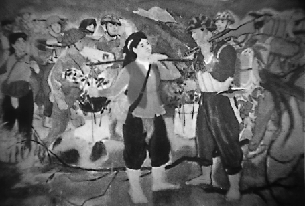
Figure 4.1. Mai Van Hien, Meeting (Gap Nhau), gouache on paper, 1954. Photograph by Nora A. Taylor, courtesy of the artist.
In devising the scene of a meeting between a soldier and a peasant woman, Mai Van Hien was in effect describing the policy of integration of ethnic minorities and people from the countryside into the Vietnamese “nation” after independence from French colonialism. The feeling of camaraderie and equality between soldiers and peasants and between men and women as suggested in his painting also coincided with the goals of socialism outlined by the Communist Party to assimilate people from all classes and create a homogeneous society. Meeting was considered to contain “national character” because it illustrated one of the ideals of socialization and nationbuilding, which was to create a harmonious community. It also followed what Truong Chinh considered was “correctly expressing the feelings of the masses that are pure, sincere and exceedingly warm.”15
In contrast to Mai Van Hien's painting is a work that was initially rejected by the Arts Association: The Enemy Burned My Village (Giac Dot Lang Toi, 1954; fig. 4.2) by Nguyen Sang. In this painting, a
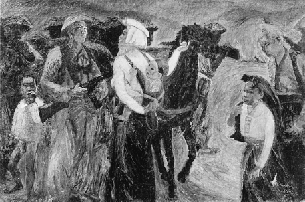
Figure 4.2. Nguyen Sang, The Enemy Burned My Village (Giac Dot Lang Toi), oil on canvas, 1954. Photograph by Nora A. Taylor, courtesy of National Museum of Fine Arts, Hanoi.
In another work, Joining the Communist Partyat Dien Bien Phu (Ket Nap Dang trong Tran Dien Bien Phu, 1963; fig. 4.3), the same artist sets up a conflict between patriotic theme and means of execution. He has used a particularly severe way of representing his figures, drawing them with angular lines, enlarged limbs, and blank features. The composition is centered on the hand of the party officer who reaches out to the soldier seeking admission. Although the gesture seems welcoming, the look on the soldier's face is cold and dispassionate. The wounded soldier appears anxious and lacking in enthusiasm. His expression may betray his doubt or apprehension at joining the party. The soldier behind
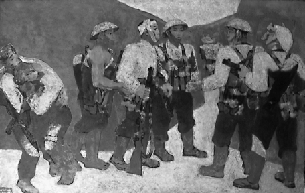
Figure 4.3. Nguyen Sang, Joining the Communist Partyat Dien Bien Phu (Ket Nap Dang trong Tran Dien Bien Phu), lacquer on wood, 1963. Photograph by Nora A. Taylor, courtesy of National Museum of Fine Arts, Hanoi.
While these two paintings by Nguyen Sang were never criticized directly, they were rejected from national art competitions. Criticism or rejection from national art competitions often meant that the work had been placed before an audience of workers and soldiers who, in the absence of any other formal criterion, were simply asked to decide how closely the subjects of the paintings resembled their habitat, moods, or customs. Sometimes, in lieu of a direct criticism, a humiliation campaign was initiated. Letters from workers and soldiers who found the work in question to be “untruthful” or “inaccurate” were published in newspapers. These letters were aimed at discrediting the author of the work in question, for if the masses did not understand it, then it was considered too “obscure” and therefore unacceptable.16 Nguyen Sang had painted both of these paintings hoping for a subsidy from the Arts Association, and although the National Museum of Fine Arts eventually purchased the two works, they were not displayed until shortly before his death in 1984. When Nguyen Sang contributed drawings and poems to the Humanism and Masterpieces journals, his name was put on a
The rejection and subsequent acceptance of Nguyen Sang's views of history illustrate not only the fluctuations in the definition of “national character” but also the changing attitudes toward war and revolution in recent times. Nguyen Sang's vision is no longer threatening to authorities as they have gradually come to terms with the harsher realities of those years. Whereas in the past, as Mai Van Hien's painting illustrates, virtues of heroism and solidarity were considered the only legitimate representations of the struggle for independence, feelings of pain and apprehension have recently become equally acceptable.
REDEFINING “NATIONAL CHARACTER”
IN THE 1990s
In spite of reforms that had begun to be instituted in other sectors of society at the onset of Doi Moi, the Arts Association was slow in recognizing the need for liberalization in the arts. Nudes and abstraction were forbidden from public view until 1990. And it was not until the 1994 congress that a serious attempt was made to recognize those artists who had been marginalized for not participating in the revolutionary movements of the 1950s through 1970s. At the congress of the Arts Association in December 1994, the fourth since the organization's founding, young art critics advocated replacing the revolutionary guard of painters with the “nonrevolutionary” group of artists who either had been marginalized or had marginalized themselves from art circles for over thirty years. Objections arose over the dismissal of the older generation of painters. For example, the painter To Ngoc Thanh (b. 1940), whose father, To Ngoc Van, mentioned earlier, was considered the greatest of all revolutionary artists, exclaimed: “How can you forget these heroic painters when they sacrificed their lives for their country?” A young critic responded: “But they were such mediocre painters.”18 The debate continued, with one side arguing for revolutionary contributions and the other promoting talent and innovation. Until the congress, one rarely heard such outspoken commentary on artists'positions vis-à-vis the Arts Association. Although none of it was truly scathing— critics called the revolutionary period artists at times “boring,” “old-fashioned,”
At the 1994 congress, four artists in particular (Bui Xuan Phai, 1921–88, a student at the EBAI from 1941 to 1945; Nguyen Sang, 1923–88, a student at the EBAI from 1940 to 1945; Duong Bich Lien, 1924–88, a student at the EBAI from 1944 to 1945; and Nguyen Tu Nghiem, born in 1922, a student at the EBAI from 1941 to 1945) were hailed by young art critics and artists active since the mid-1980s as the “masters of Vietnamese modern painting.” Clandestine exhibitions and independent publications had been put out in their honor, but it took some time before the Arts Association recognized their contribution to modern Vietnamese art history. Today, works by these artists cover the walls of private galleries that have multiplied in recent years in Hanoi and Ho Chi Minh City and are highly sought after by a new generation of Vietnamese art collectors.
One question that arises from the debate at the congress is why these four particular artists were selected by critics as better representatives of contemporary Vietnamese painting rather than their more conventional colleagues. Where and when did the shift take place? And what kind of criteria was the new generation using to determine what constituted a “great” artist? A closer examination of the four artists'lives and works will reveal that the artviewing public of the late 1980s identified first and foremost with their personae, their antiestablishment ideas, and their bohemian lifestyles. Second, their works provided them with an interpretation of their own cultural identity that had previously been neglected but that rang truer to their experience than the revolutionary vision supplied by the earlier artists. In sum, what made the four painters the new “modern masters” was not only that time had changed people's perceptions of history and nationalism but also that these artists offered the public a different picture of Vietnamese reality.
Of the four painters, Bui Xuan Phai was best known for his poverty. He has been described as having a “face that reflects the grief of a lifetime”19 (fig. 4.4). People who remember him recall his gaunt features and how he had to exchange paintings for food.20 Yet he was also admired for his intellect. Those who knew him recall vividly the hours of stimulating conversation spent in his company. He was well versed in world art history, something of a rarity in a society that had been cut off from the international community since the end of colonialism in 1945. He had studied the works of French painters, often citing Albert Marquet and Georges Rouault among his favorites. He had friends
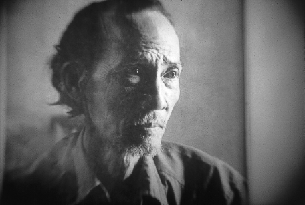
Figure 4.4. Portrait of Bui Xuan Phai. Photograph courtesy of Plum Blossoms Gallery, Hong Kong.
Cafe´ Lam had the makings of a Paris cafe´ litte´raire of the sort frequented by Pablo Picasso, Henry Miller, and the surrealists in the 1920s. In Europe, this kind of establishment was attractive to people who saw themselves as marginal to the social mainstream. But, while bohemian culture may have a certain romantic appeal in the West, to the officials of a nation that had fought bitterly to rid itself of French occupation
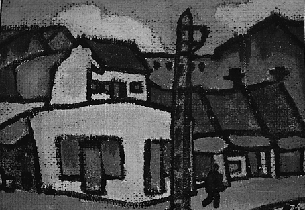
Figure 4.5. Bui Xuan Phai, Old Hanoi Street (Pho co Ha Noi), oil on cardboard, 1967. Photograph courtesy of Plum Blossoms Gallery, Hong Kong.
Bui Xuan Phai's “sadness, reflecting a life of misery,”23 and his passion for painting produced his signature subject matter: scenes of old Hanoi streets (fig. 4.5). While his colleagues, members of the Arts Association, were painting workers, soldiers, and peasants for state art exhibits, Bui Xuan Phai painted the desolate streets of his city, in shades of gray and brown, over and over again, almost obsessively. Although his paintings clearly indicated an attachment to his homeland, it was not the sort of vision that the authorities accepted. His streets were void of life, as if he were mourning the loss of the activities that had filled them in a bygone era.
To art viewers, those who knew him and the many visitors to both his house—for he was a hospitable and generous man—and Cafe´ Lam, his street paintings became synonymous with Hanoi during the economic hardships of the 1960s and 1970s. They captured the bleak, desolate, gray atmosphere of the city during that time. When Hanoians
Bui Xuan Phai's paintings were rarely included in national art exhibitions and were seldom exhibited abroad in traveling exhibitions organized by the Arts Association. In the art history books and brochures about Vietnamese contemporary painting published before 1986, his name is never mentioned as an important figure in the Hanoi art scene. Although he was not accused of undermining Communist Party policy like Nguyen Sy Ngoc and Nguyen Sang, his family has described how closely the government watched him and the restrictions that were placed on him as an artist.25 The original objection to Bui Xuan Phai by officials was most likely a response to his eye for the negative realities of Hanoi life. His view of daily life was contrary to the utopian socialist vision of community living promoted by the state. His subsequent popularity may have been due to the fact that he dared to show what the government refused to see, and his popularity among painters today stems from the fact that he was determined to pursue his own path in spite of government regulations. Young artists today, trying to break free from past conventions, are in awe of the fact that Bui Xuan Phai refused to compromise his artistic ideals for political ones. They, and the artviewing public at large, see him and his paintings as encapsulating the spirit of the nation after the war. Today the war is no longer remembered for its glory but rather as a negative experience, which is why Bui Xuan Phai's paintings resonate more strongly with the public.
Bui Xuan Phai's persona is well captured in a 1964 portrait by his friend Nguyen Sang. In the painting, he is sitting at a table with the cafe´ owner Nguyen Van Lam, facing the viewer and with his chin resting on the palm of his hand. Mr. Lam, also facing the viewer, sits beside him with his hands clasped over his knees. Behind them is a sign indicating the price of a cup of black coffee: thirty cents (dong). Both the artist and
Art historians in the West have often attributed the affinity of painters at the turn of the century for life in the cafe´s and the decadence of society at the time to increased interest in “modern life.” Modern life in Europe referred to urban development, the increase of traffic in the streets, and consequently the surge in the pace of life. According to Marshall Berman, the swelling speed of daily life generated excitement for everything urban, along with an attraction for the dirt and smoke that it provoked.26 Artists and writers in Paris became fascinated with the decadence of society in art. The art historian T. J. Clark writes that “modernism can be described as a kind of skepticism, or at least uncertainty, as to the nature of representation in art.”27
Nguyen Sang's characters seem at home amid the deterioration of Hanoi streets and the degeneration of Vietnamese society as he perceived it. The Communist Party had demanded participation in the revolutionary struggle, but writers and artists such as Bui Xuan Phai and Nguyen Sang were idling away their time in cafe´s. They were not employed by the state as other artists were, partly out of choice for not wanting to participate in the propaganda campaigns and partly by force for having contradicted the official cultural institutions. Instead of supporting the optimism for the future of the nation as declared in the governmentsponsored art campaigns, they represented the cynicism of the people who did not wish to follow the Party. None was more representative of this cynicism than Duong Bich Lien who shunned any exposure to the public and any affiliation with the Arts Association. Although he had taken part in the Revolution, after the restrictions imposed on artists in the 1950s, he deliberately withdrew from the political mainstream. His paintings became legendary for their grace and beauty (fig. 4.6), but he refused to show them to anyone but his friends.28 Unable to afford new canvas, he often painted over his paintings. His peers admired him for his talent, but he was described as “aloof” and “stubborn” when it came to exposing his work to the public. Today the younger generation considers him one of the “masters of modern art,” along with Bui Xuan Phai, Nguyen Sang, and Nguyen Tu Nghiem.
In 1993, the Portrait of Bui Xuan Phai with Mr. Lam was sold to a
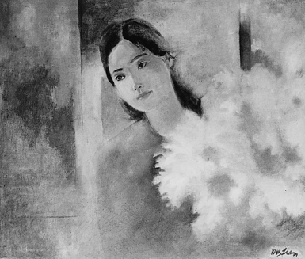
Figure 4.6. Duong Bich Lien, Woman with Flower (Tien nu ben Hoa), oil on canvas, 1980. Photograph by Nora A. Taylor, courtesy of Nguyen Hao Hai.
Ironically, for the post-1986 generation of painters, Bui Xuan Phai and his friends became icons of the rejection of “nationalist” oriented art. In choosing them as their artistic “heroes,” the younger artists and critics were in effect rejecting the concept of national character advocated by the Arts Association. They had realized the limitation of the concept, but at the same time their designation of the three outside un-official painters as the legitimate rulers of the art world was based on criteria that were not too different from the previous generation's, that is, the need for art to depict the “national soul.” This fact only reinforces the plasticity of these conventions. The policy toward the arts after 1945was one of appropriation or elimination rather than construction. Political
TRADITION AND MODERNISM
Art historical revisions after 1986 have not been limited to the fluctuations of reputation among artists but are also reflected in the choice of topics. Village and folk art, which had been the main source of artistic production before the colonial era, had been transformed after independence in 1945 to serve the ideals of socialism. Many artisans were forced to join collective labor forces and abandon their family trade. They were brought into the agricultural and industrial sectors, and household workshops that had operated for centuries were turned into cooperatives. As a result, village art virtually died, only to be resurrected at the initiative of descendants of village craftsmen in the late 1980s.31
In the early 1990s, two art historians, intent on reviving the “village” aspect of Vietnamese art history, began researching the history of village art from the ninth century, at the end of the Chinese occupation, to the present. They published My Thuat o Lang (Art in the Village), which became one of the most influential art history books of the early 1990s.32 The book argued that the origins of Vietnamese art were, in fact, in the village as opposed to the view promoted during colonial times, which held that art originated in royal palaces or was stimulated by religious objects traded from abroad. The idea appealed to the younger generation of artists because it proved that art had a “national” origin yet was not a “state”-oriented production. In other words, village art was given a new interpretation. Instead of serving the state, imperial households, religious, foreign or government decrees, art could be more independent of politics. This gave artists the freedom to express patriotism without
When the movement to reincorporate village art into the art historical canon began, artists started to use village motifs such as temple banners, buffalo herders, fish ponds, and folk heroes in their paintings. Some of these motifs, which were potentially sensitive in the 1960s and 1970s, became dominant in paintings since 1986. At first sight, the use of folklore seemed to indicate a break from the worker, peasant, and soldier themes of the previous decades. But, on closer examination, paintings of village festivals and popular legends have become, in effect, redefinitions of national character. By still maintaining elements that are identifiably “Vietnamese,” painters seem reluctant to abandon the patriotic ideal in art, even though they claim separation from a particular set of nationalist concerns.
The first artist to experiment with village motifs while maintaining links to “modernism” was the fourth of the “masters” of Vietnamese modern art mentioned earlier, Nguyen Tu Nghiem, born in 1922 and still actively painting. The label “hero” is reserved for the deceased, but Nguyen Tu Nghiem's preoccupation with village art mirrors Bui Xuan Phai's obsession with Hanoi streets. He has spent most of his career painting village folk motifs, making multiple sketches of the carvings that adorn the communal houses (dinh) in the villages surrounding Hanoi and transferring them to his canvases (fig. 4.7). He is not interested so much in the content of the sculptures as in their formal aspects. In explaining his work, he likens himself to Picasso, who saw African art as a form of “modernism.”33 Picasso emulated the simple shapes and geometric forms of African art and incorporated them into his experiments with cubism. The “primitive” look of Picasso's work became equated with “modernism.”34 Likewise, Nguyen Tu Nghiem incorporated village folk art into his paintings, giving them a “primitive” look that became equated with “modernism.”
In recent art criticism, Nguyen Tu Nghiem has often been described as both “traditional” and “modern.”35 To use village sculpture as a motif in a painting was a very daring act in the early 1980s, when Nguyen Tu Nghiem first revealed his paintings to the public. At first dismissed for lacking national character, he later won a prize at the National Exhibition in 1990 for his representation of the village folk hero Giong.36 Since abstraction and surrealism were forbidden, artists had not used motifs found in their native culture to express “modern” artistic concepts. Nguyen Tu Nghiem changed that. Furthermore, the
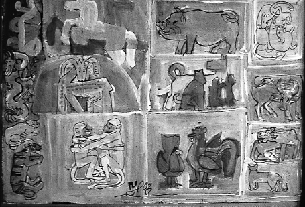
Figure 4.7. Nguyen Tu Nghiem, Zodiac, gouache on paper, 1993. Photograph by Nora A. Taylor, courtesy of the artist.
The art critics of the 1980s hailed Nguyen Tu Nghiem's use of village folk art as “Vietnamese modernism.” His painting style resembled the European postimpressionist concern for form over content, and yet, iconographically, he was able to retain a semblance of “local tradition.” Nguyen Tu Nghiem's and Bui Xuan Phai's work was said to reflect the spirit of the people, but not in the sense that it had been known previously. Far from the heroism of To Ngoc Van's participation in the battle
Naturally, as in post-Communist Russia and to a lesser extent in Deng Xiaoping's China, the market for art has also influenced what artists have chosen to paint. The state no longer being the exclusive patron of the arts, artists have had to cater to a new clientele of international art buyers. Many of the works on display in galleries in Hanoi and Ho Chi Minh City depict scenes of the Vietnamese countryside and village life, not as a political statement against the state nor as a patriotic message, but rather because those images seem to attract foreign buyers. Still, the shift in subject matter is similar to revisions occurring elsewhere as Vietnamese art in general, like the society at large, tries to derevolutionize itself and move on to a more global perspective.
CONCLUSION
For decades, Vietnamese officials defined national character as expressing the Vietnamese spirit in art and literature, but the basis for its definition was utopian and forced. Politics and aesthetics merged to dictate the criteria for acceptable works of art. Artists who did not display “national character” in their works were discouraged from producing art at all. But, by a turn in historical fortune, those who resisted the pressure were designated heroes in their own right by the generation of artists and art critics who came onto the scene in the late 1980s. They became known for their resistance to these restrictions and for their persistence in the face of strongly discouraging signals to abandon their way of painting.
In spite of revisions in the way artists have been given recognition for their work, political concerns are still at the heart of the selection of Vietnam's socalled master painters. Certainly nationalistic or patriotic concerns are still part of the process of naming which artists best represent the country's “soul.” In this way the choices of the late 1980s art critics are similar to those of their mid-1950s counterparts. At least in principle, that is, art is a potential force that could be used to shape consciousness about oneself, one's memory, or collective identity. But it
Bui Xuan Phai, neglected by the official art establishment for wanting to tell the truth, suddenly became Vietnam's greatest painter regardless of whether his paintings showed true mastery of the medium. To Ngoc Van and others of his generation were reduced to mediocrity in popular opinion after having received some of the nation's highest awards in painting simply because the revolution no longer held any significance to the younger generation of artists.
If one looks at “national character” merely as a tool to create propaganda out of art, it is easy to understand why the present post-1986generation of artists would be so opposed to the concept, considering their desire to distance themselves from revolutionary period policies. Many of them were born too recently to remember their country's struggle for independence. As Vietnam opens its doors to global markets, they are eager to join the international art community. Yet they have not rejected nationalist concerns entirely. In an attempt to forget the past and begin paving the way toward the future, they have instead chosen to remember the past in a new way. In commemorating the three painters who were not part of To Ngoc Van's campaign to revolutionize art, the artists and critics of today are making their own political statement about the role of artists in society.
By embracing artists who had previously been neglected by the Arts Association and spent much of their time in Hanoi cafe´s, the younger generation is calling for an artistic standard that is not based on socialist ideals. Bui Xuan Phai, Nguyen Sang, Nguyen Tu Nghiem, and Duong Bich Lien were not the most subversive of painters; others, such as Nguyen Sy Ngoc, mentioned earlier, were put into much more strenuous positions vis-à-vis the political mainstream. But, as Bui Xuan Phai's paintings of Hanoi and Nguyen Tu Nghiem's interest in village art reveal, they were nonconformist and unwilling to partake in the “revolutionary” view of art. Perhaps that was precisely why they were chosen. These artists were not politicized and yet were every bit as political. The younger generation has chosen to emulate them in order to be not
NOTES
Parts of this chapter were presented at the annual meeting of the Association for Asian Studies in Hawaii, April 1996, as part of a panel entitled “Past Forgetting: War and Revolution in Vietnamese Memory.” Some of the ideas formulated here are included in my dissertation, “The Artist and the State: The Politics of Painting and National Identity in Hanoi, Vietnam, 1925–1995” (Ph.D. diss., Cornell University, 1997). Research was conducted between January 1993 and August 1994 and was supported by the Social Science Research Council Southeast Asia Program, through grants from the Andrew W. Mellon Foundation, The Ford Foundation, and Fulbright-Hays. I wish to thank these institutions and the artists, art historians, and friends in Hanoi, too numerous to list, who made my research possible. I also thank Hjorleifur Jonsson, Neil Jamieson, and Hue-Tam Ho Tai for comments on earlier drafts of this chapter.
The Past without the Pain
The Manufacture of Nostalgia
in Vietnam's Tourism Industry
Laurel B. Kennedy and Mary Rose Williams
A remarkable journey occurred in 1996 when a group of ten American veterans of the war in Vietnam returned to the country they had first known as soldiers. Riding Harley-Davidson motorcycles, whose distinctive bass rumble is so loud and overwhelming it is sometimes referred to as “Rolling Thunder,” the vets spent eighteen days traveling from Ho Chi Minh City to Hanoi. It is not difficult to imagine that these riders took Vietnam by storm. Even the busiest and noisiest roadways of Vietnam, a quiet country, would have come to a halt as bicyclists, bus drivers, and pedestrians watched the spectacle of American steel, chrome, and leather roaring past. One can wonder why those veterans chose to tour Vietnam on these loudest and most American of motorcycles, and one can wonder what Vietnamese onlookers thought about as the commonplace was disrupted for a few minutes by the American cavalcade. It is not difficult to discern, however, that for the riding veterans, as tourists if not as soldiers twentyfive years earlier, Vietnam was theirs, reclaimed from history and transformed in memory.
Central to this volume is the question of how the past is remembered in Vietnam, and how disparate memories of that past are reconciled, if indeed they can be. While other chapters consider the work of the state in creating an official history, and of oppositional voices in contesting that sanctioned memory, we consider here the operations of the tourist industry, which offers its own narratives of Vietnam. These are often starkly different from those evident in the funerary rituals, the films and
At first glance, it would appear that the state has just as much control over tourism's imagemaking as it has over other elements of public memory. After all, tourist development must be approved by the state, and international interests involved in that development are required to work with Vietnamese partners. Yet the narratives used in “selling” Vietnam to potential tourists suggest that the state largely delegated authority for its self-representation to commercial, and usually international, image-makers.
At least in part, the strategy of inviting foreign development of the tourist industry reflected the perception that Vietnam might be a “hard sell” among Western travelers. The belief that the country must be rescripted in the popular consciousness was reinforced in a market analysis of Vietnam's nascent tourism industry, published in 1990 for use by travel industry professionals:
Vietnam's current travel status (low visitor arrival count and a poor to nonexistent image with potential travelers) is such that even small improvements canrepresentsubstantialgrowth. … Vietnamisacountry that conjures up many—often contradictory—images. Perhaps the most vivid of these is the overwhelmingly negative picture of the Vietnam War … notsomuchasa result of the communist victory, but rather because the United States was so torn by its defeat. … However, the memories and mood of the international community have since softened.1
Thus the tourist industry needed to tell a new story of Vietnam to potential travelers. A number of narratives could have been written: Vietnam as a nation of quaint and quiet rural villages; as a nation growing beyond the wounds of conflict; as a nation moving rapidly toward modernity and industrialization.
The construction of Vietnam chosen by the international tourist industry has been of a nation of colonial pleasures, of elephant rides, 1930s Citroens, and afternoon drinks in the shade of the veranda. Evoking the days before the troubles began, the narrative creates a memory in the imagination of a Vietnam wherein there was not hostile resistance to external control, and where today there is neither conflict nor animosity toward former enemies. This Vietnam offers to travelers its Asian exoticism and its mystique, as well as a muted and angerless history.
Package tour providers rely on a linkage between tourism and nostalgic longing for the feelings—often the greater simplicity—of a past that exists in one's imagination. This brand of nostalgia has produced Williamsburg in the United States, the Raffles Hotel in Singapore, and the son et lumière displays on the twilit walls of French chaˆteaux. Yet in each of these cases, nostalgia can be seen to be a commodity manufactured for sale to tourists. Indeed, a tourist's impressions of the experiences travel will provide are primarily mediated by the tourism industry. The manufacture of nostalgia, then, is a process in which the tourist's memory itself is mediated. As Lowenthal writes, such nostalgia offers “memory with the pain removed.”
But the nostalgic memories inscribed in tourist sites are not merely commodities that await purchase by targeted consumers. These narratives interact with and alter the composition of personal memory, of the larger public memory, and of official history. Martha Norkunas describes the development of tourist “attractions” as a process in which social value is conferred to particular reconstructions of both the past and the present, which may or may not correspond to those sanctioned by the state.3 The process of value conferral—Dean MacCannell calls this “sight sacralization”4—occurs through tour organizers'selection of sites, the construction and reconstruction of those sites to meet tourists'(preformed) expectations, through the markers that designate the sites, by the locals who contribute their apparent authenticity, and by the tourists who, by their very attention, confer importance on certain articulations of history. These sites also legitimize the relations of power implicit within them. Other constructions are rendered questionable or in need of correction. This process flattens and suppresses—of necessity, in the eyes of tour organizers—the complexity of history into a “simplified … [and] digestible” reconstruction: “Opposed events and ideologies are collapsed into strong statements about the forward movement and rightness of history.”5
Tourism's narratives interact not only with official history but also with personal memory. Maurice Halbwachs's On Collective Memory asserted that individual memory is not permanent and complete, but socially produced, formed and reformed in interaction with others'conceptions of the past.6 Thus, as John Urry writes, “Identity almost
The strands of official history, of public memory, and of personal memory thus tangle, making true and longlasting distinctions between them difficult at best.8 What is perhaps most problematic—and interesting—when considering tourism's narratives among those offered by the state is that while the state is a visible authority whose political objectives are at least usually apparent, the tourist industry's hand is often invisible in the creation of its narratives. Norkunas writes that “the public would accept as ‘true'history that is written, exhibited, or otherwise publicly sanctioned.”9 Yet observers may bring at least a little skepticism to reconstructions of the past offered by the (identifiable) state, while accepting more readily narratives whose anonymous authorship does not alert their critical faculties. This makes consideration of tourism's narratives all the more important.
The analysis that follows considers some of the primary narratives offered by the tourist industry in Vietnam, examining both their origins and their thematic nature. The first part of the analysis describes the political economic catalysts to the formation of the Vietnam tourism industry. Because the shape of the industry is determined at least in part by the motives of those involved in the development of tourism, this discussion is concluded with a review of the three participants in the tourist enterprise: the Vietnamese “hosts” who service both tourists and tour operators, the travel industry professionals whose expertise informs the construction of the narratives we are studying, and the tourists most targeted by the industry. It is out of the needs of these three groups that a particular “story” of Vietnam arises. That story is told through two types of tourist “texts,” which are analyzed in the following sections of the chapter: the sites being developed for use by tourists, and the travel literature that informs tourists' expectations and, hence, their experience of visiting Vietnam. These texts represent Vietnam in ways that affect contemporary understanding of the nation, its history, and its political relations to the West not just for Western visitors but potentially for the Vietnamese themselves.
The rapid development of a tourist industry in Vietnam has occurred through a concerted official effort since the late 1980s. Until 1986, visitors
Few forms of international trade produce such classic economic dependency as tourism. As has been discovered by Cuba, Haiti, and others, natural disasters, political change (or even its threat), or a single season of inclement weather can cause tourist interest to vanish and the economic activity surrounding it to collapse. In assessing the impact of tourism in Vietnam, then, it is useful to consider the motivations that could lead a determinedly socialist nation to recreate itself, within a decade, as an international tourist destination, complete with five-star hotels and golf resorts. The timing of the move suggests that development of a tourist industry was a response to Vietnam's failed economic policies and its increasing economic isolation in the 1980s.
Efforts by the United States to constrict Vietnam's international trade linkages had been initiated in the 1950s, through a trade embargo against North Vietnam under the Trading with the Enemies Act. In 1978, the United States extended the embargo to the whole country following Vietnam's invasion of Cambodia. Until this point, Vietnam had stressed the role of multinational corporations in developing exportoriented industry and had established an attractive international investment climate amid promises of multilateral loans and bilateral aid from
By the late 1980s, Vietnam found itself with few foreign markets open for the sale of its products, and thus a dire need to generate foreign exchange within its own national borders. These conditions emerged at the same time the number of Asiabound travelers was beginning to rise, and when Thailand, despite rapid industrialization, was earning the largest share of its foreign exchange through tourism. Further, Southeast Asian entrepreneurs, unbound by the embargo, were interested in and willing to finance the refurbishing of hotels and urban transportation to jumpstart the industry. A lowtechnology industry with comparatively little market research needed to inform planning, tourism offered Vietnam a relatively cheap and easy industry to enter, with the promise of quick foreign exchange earnings.
Given the immediate and financially tangible response to the opening of its borders to tourists, Vietnamese officials moved quickly in the early 1990s to establish the domestic bureaucratic structures and the international liaisons that would encourage rapid development in the industry. With its experience in this industry limited to serving a few thousand Soviet-bloctravelers per year, it is not surprising that Vietnam's emergent tourism administration was characterized by complexity and inefficiency, with three different groups working sometimes in cooperation and sometimes in competition with one another.
In official terms, control over development of the tourist industry lies with the first of these groups, the Vietnam National Administration of Tourism (VNAT). Reporting to the Council of Ministers, this body is charged with coordinating the development of the nation's tourist industry, including research and planning activities, training of personnel to work in the industry, and approval of contracts involving foreign investors (in coordination with the State Committee for Cooperation and Investment). A special unit of VNAT, Vietnamtourism, is responsible for promoting travel to the country and offering actual tours.
VNAT's policies and plans are implemented by some thirty local
The third group of important players in Vietnam are the People's Committees and the various ministries, which own hotels, control vast amounts of property, and have their own access to official power structures.15 Acting, like the others, as tour operators, the People's Committees and ministries are also centrally important as potential joint-venture partners for the international tourist industry, or as liaisons between international partners and entrepreneurs in Vietnam's private sector.
While certain aspects of servicing the tourist trade could be handled by Vietnamese “ground operators,” the government understood early on that it had neither the investment funds nor the knowhow to develop the amenities sought by well-heeled Western tourists. A 1991 government publication, Vietnam: Investment and Tourism in Prospect, invited the expertise of international travel agencies. The document noted that the government-operated Saigon Tour had “such relations [with international tourism professionals], but more attention should be paid to attract investment and to attain managerial and professional expertise.”16 Inexperienced but hoping not to be naive, the government required that all tourist developments be approved by the state, and that virtually all major foreign financial investments in the industry be undertaken through domestic-international partnerships. Local partners thus become essential to the international agencies, handling the bureaucratic aspects of operating in the market, arranging local contracts, and facilitating incountry negotiations, albeit generally on the terms set by the tour operators. They also provide other essential components, such as property, local knowledge of exploitable resources, Vietnamese currency, and materials or services needed for the venture. While local, usually quasi-governmental, firms may also play a role in serving tourists, they generally do not compete with their international partners, better endowed as those firms are with both knowledge and financial resources.17
For their part, international investors provide foreign currency, certain forms of technical know-how, expertise on the interests and expectations of the tourists being courted, and, perhaps most essential to success, inclusion in the expensive package tours that bring travelers to
Development of the tourist industry necessitates more than just providing services, however. The business of attracting and actually delivering tourists—and the right tourists—is difficult. Passengers on cruises, for example, are usually wealthy, but they stay only a short time, and most of their food and lodging is provided on the cruise ship. The wealthy tourists who arrive on elite package tours, or expensive, individualized tours arranged by upscale travel agents, stay longer, spend more, and patronize hotels and local establishments. But attracting these most desirable tourists involves both knowledge of their expectations and of their motives for travel, and the ability to design the right packages—the right narratives—to assure the fulfillment of those expectations.
APPEALING TO TOURISTS
While each traveler's journey is designed with unique motivations in mind, common reasons for travel and types of travelers are known; these inform package tour providers'efforts to attract clients to the destinations they package into tours.18 Not all types of travelers are likely to voyage to Vietnam: tourists who seek merely a change of venue or a quick getaway would find the very expense and distance of traveling to Vietnam preemptive. And not all types of travelers are desirable clients for the package tours offered by the international tourism agencies discussed here; young Australian backpackers and European “hippie travelers” on shoestring budgets—what Erik Cohen calls “noninstitutionalized” tourists19—are significant in Vietnam's visitor population but contribute minimally to the tourist economy.
For others, however, it is precisely because Vietnam is costly to visit and relatively unknown as an elite tourist destination that they are attracted. For such travelers, tourism enhances social status by displaying the availability of leisure time and expendable income. For these travelers, the more exoticthe destination, the greater the effect—although exoticism need not imply uncomfortable travel conditions. Lenz included Vietnam among the remote and putatively unknown locations
Still others travel to find an “authentic” experience that stands in contradistinction to the modern.21 Such travelers undertake “pilgrimages” that are not explicitly religious but that nonetheless involve a conversion of the self, or at least the hope that such a transformation will occur. These tourists “seek to see life as it really is, to get in touch with the natives, to enter the intimate space of the other in order to have an experience of real life, an authentic experience.”22 They wish to leave behind the superficiality of modern life as they know it at home; one travel writer who toured Vietnam by train (because “flying seemed entirely too abrupt and antiseptic”) described Vietnam as “a place beyond the reach of dollars and the American Express Card”23—although both are, of course, very much in circulation. For many in this group, Vietnam's ancient pagodas and temples and the ethnic minorities of the northern highlands provide the requisite mystic exoticism.
For those who once served in Vietnam or for their families, travel to Vietnam also may be about a pilgrimage, but into the past. Not unlike the pilgrimages undertaken after World War I to the battlefields at Flanders and the Menin Gate of Ypres described by George Mosse, such journeys are centered on healing and renewal.24 Reporter Neil Sheehan worked in Vietnam during the war years and vowed to return to witness it under conditions of peace.25 Others return to relive that period of their own lives, or the lives of a relative who served in the war.26 Another group of “pilgrims,” albeit with a rather different relationship to Vietnam and its recent history, are the Viet Kieu, or overseas Vietnamese, who represented about onefifth of Vietnam's travelers between 1993and 1995.27 Pilgrimage into Vietnam's most recent war history is also undertaken by those without a personal connection to the period, but with a curiosity about what happened and an expectation that travel in Vietnam will tell them. A large number of study tours of Vietnam have been organized by universities, for example, either for current students or for alumni who seek a combination of leisure and education.
Still other travelers are less interested in the search for “authenticity” or what MacCannell calls the “nonmodern,”28 instead seeking culturally anonymous destinations: beaches and golf resorts and dutyfree shopping. Japanese tourists to the beaches of Thailand and Hawaii are often included among this group, and they represent an important
Obtaining these upscale tourists requires the enthusiasm of international travel agents and charter airlines. Travel organizations must invest a great deal of time and money to add new destinations to their existing tour programs, and so must be convinced of the potential of new sites to be both appealing for the clients and profitable for the agencies. Further, there is a great deal of competition for these tourists, particularly in the fastgrowing tourist market in Asia. Thus a new destination like Vietnam, attempting to develop a market out of thin air in the early 1990s, had a formidable task before it, and one in which success depended principally upon the international agencies. It is hardly surprising, then, that Vietnam was willing to delegate to these agencies so much authority over the imagery and narratives to be used in luring tourists.
THE FACE OF THE “NEW VIETNAM”:
AMENITIES AND ATTRACTIONS
The expertise of the tourism firms lies in their ability to coordinate the logistical aspects of their clients'international journeys, but that can only occur after those travelers have been enticed to the destination by the promise of some desirable experience. As Mowlana notes, it is the task of the tour organizers to “create the experience and image that sells and then proceed to make that the reality for the tourist.”29 Thus tour operators pay close attention both to the sites that potential travelers might visit and to the literature that will familiarize them with those sites in advance. These can be understood, then, as the negotiated product of the needs and interests of the tourism industry, its clients, and the government that signs contracts to facilitate the industry's success. Because the establishment of Vietnam as a tourist destination for Westerners has occurred within a short period of time and through a rather concerted effort, there is some transparency to tourism's development efforts: they can be viewed as explicitly intended to recreate Vietnam to meet the needs and expectations of potential travelers. It is clear that industry planners seek the attention of business travelers and upscale tourists, particularly those on charter packages from Europe, the United States, or Japan. Development has emphasized historical sites that might appeal to these tourists, the refurbishing or new construction of luxury
The industry anticipated that many of the tourists traveling to the country would be French or American veterans of the war that ended in 1975, returning perhaps to experience Vietnam's beauty in peacetime, to heal the hidden wounds of the war, or to relive certain aspects of that encounter. As one journalist remarked, “Since the end of the Vietnam war, many American films and books have agonized over the meaning of it all. The Vietnamese, who suffered much heavier casualties, … take a more practical approach. They are intent on turning the war into a tourist attraction.”30
Indeed, a considerable amount of energy has been invested in constructing monuments around sites that foreign war veterans might want to revisit, and much of that energy has come from domestic sources. These can be differentiated from sites created for ideological purposes by the Vietnamese Communist Party or local cadres for Vietnamese observers, such as the museum-shrine for Ton Duc Thang described in this volume by Christoph Giebel. Sites prepared for foreign tourists were constructed (or reconstructed) later, usually after the official efforts to develop tourism began, suggesting their rather explicit goal of attracting foreign tourists. Further, they are highly commercialized, with souvenir stands and food stalls. And, unlike monuments and shrines used for political and/or ritual purposes of war commemoration by the families of Vietnamese veterans or organized school groups, these sites do not so much bear witness to the war as “trivialize” it, in the sense that George Mosse used that term, “cutting war down to size so that it would become commonplace instead of awesome and frightening … [and] by making it familiar, that which was in one's power to choose and to dominate.”31
Turning the war into a tourist attraction means retelling, for profit, the story of Vietnam's victory. Since the profit must come from those who lost the war, aspects of the story must be muted and key roles recast to make the story more palatable. In some instances, the actions taken to mediate and moderate history have been unmistakable. There were, for example, attempts to close the American Rooms of the War Crimes
In other cases, historical reconstruction has been more subtle. Perhaps the best-known of the war sites now opened to tourists are the tunnels at Cu Chi, a network of about 125 miles of underground passageways, built as hideouts, meeting places, bomb shelters, and secret travel routes in southern Vietnam. These tunnels were well-known to U.S. soldiers during the war because of the many dangers associated with them: devoid of light, nearly airless with only the occasional tiny ventilation hole, and built narrow and low to make passage difficult for those with large frames, the tunnels were dreaded by many of those ordered to infiltrate them in search of Viet Cong guerrillas. Today the passages have been enlarged to accommodate Western tourists, and at their entrance a lecture hall, video displays, publicrest rooms, and a souvenir stand have been built (figs. 5.1 and 5.2). In exchange for a few greenbacks, visitors can purchase miniature Huey gunships fashioned out of American soda cans or engraved Zippo lighters like those used to torch entire villages, or they can pick up an M-16 (or an AK-47) and shoot off a round or two of ammunition without fear of return fire. Operated by the Vietnamese army, the tunnels in 1995 attracted up to five hundred visitors a day, served by female guides in black pajamas and rubber sandals— costumes evocative of the Viet Cong.35 The peculiar reversal of roles between defeater and defeated is unmistakable.
Tan Bien is another reconstructed war site, but it is its former elusiveness rather than familiarity upon which its developers hoped to capitalize. Known by the U.S. Pentagon as COSVN, this secret headquarters of the Viet Cong persistently defied American efforts at destruction. Now, as tourists, Americans are invited back, their hard currency a compelling incentive to disclosure of the secret site. In 1992, work began on
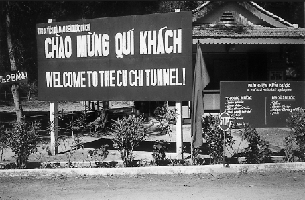
Figure 5.1. Sign at the entrance to the Cu Chi Tunnel complex, Ho Chi Minh City. Photograph by Hue-Tam Ho Tai.
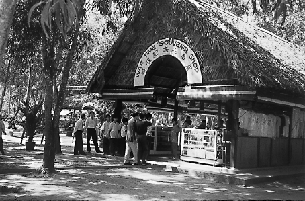
Figure 5.2. War Time Souvenir Shop, Cu Chi Tunnel, Ho Chi Minh City. Photograph by Hue-Tam Ho Tai.
Similar efforts were undertaken to restore the remains of the “MacNamara Line,” an electronic wall of mines once used to keep Communists from entering South Vietnam. The U.S.$2 million project included reconstruction of the blockhouses and bunkers, the observation towers, and the barbed wire, electronic alarms, and odor detectors used to guard the installation. Undertaken by the Vietnamese Ministry of Defense, the site is actually a monument to American technology, complete with literature describing the history and equipment used at the installation, provided at the courtesy of the U.S. government.37
Part of the work of the tourism industry is also, however, to encapsulate the wars of 1945–75 as a single historical moment in the nation's long history and to move tourists'attention along to other images and narratives; hence the slogan “Vietnam: A Country, Not a War.” Another significant period in the development of tourism is the French imperialist era, beginning in the middle 1800s. The legacy of French colonial domination is evident in the Impressionist artwork found in Vietnamese museums, in the highland villas built as retreats for colonial officers, and in the architecture of churches, government buildings, and—where tourists would most likely encounter it—in hotels.
In 1990, which was dubbed “Visit Vietnam Year,” one of the notable shortcomings of the industry was the lack of hotel accommodations. Ho Chi Minh City had only thirteen hundred international standard beds, and Hanoi had only eight hundred, about half the number needed to meet the national goal for visitors that year.38 In both cities, however, work had already begun on noteworthy ventures by hoteliers. In Hanoi, a French hotelier began the restoration and renovation of the Reunification (Thong Nhat) Hotel, which during the French colonial era had been the Hotel Me´tropole. Restoration included not only the classical French colonial architectural motifs of the building and its guest rooms but also the reinstatement of the French name, Hotel Sofitel Me´tropole, in lieu of the Vietnamese. Once work was completed, an advertisement placed in an English-language publication showed a 1930s-era postcard of the hotel and promised “Charme du Passe´ … Aujourd'hui.”
The story of the Reunification Hotel was soon repeated throughout Vietnam. In Ho Chi Minh City, for example, foreign investors renovated
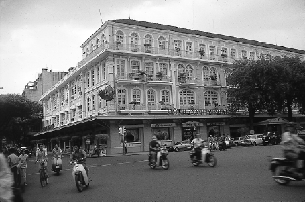
Figure 5.3. The restoration of the Hotel Continental in the heart of Ho Chi Minh City celebrates Vietnam's colonial legacy. Photograph by Laurel Kennedy.
For many wealthy travelers to Vietnam, from both the East and the West, the delight of colonial decadence may itself be a somewhat foreign experience. Many travelers seek more explicitly modern, although culturally anonymous, comforts for their travel experiences: airconditioned suites overlooking expanses of beach, state-of-the-art golf courses and marinas, and the opportunity to shop for souvenirs or duty-free goods. In Ho Chi Minh City, what had formerly been the Four Seasons Hotel on the Australian Great Barrier Reef was relocated by a
The most significant financial investments, however, were in the resort hotels—no more organicto Vietnam than the new discotheques. Outside of Da Nang, in what is once again being called “China Beach,” 536 acres of beachfront and a Soviet-built hotel were purchased by an American firm for U.S.$280 million, for development into a tourist complex of hotels, residential housing for expatriates, a shopping “village,” and a golf course—one of the scores of anonymous resort hotels that continue to be built. In Hue, a Vietnamese-Malaysian joint venture invested U.S.$408 million in new resorts, the renovation of an older hotel, and a tourist center in the middle of the city. By the mid-1990s, a South Korean company was planning a U.S.$290 million resort complex on the Con Dao Islands, once the site of a French colonial prison; five Singaporean partners were considering a U.S.$300 million tourist complex in Da Lat; and Club Med was negotiating to build a resort near Cam Ranh Bay. These developments and others by the Radisson, Marriott, and Choice hotel chains begged the question of whether Vietnam would soon be actually oversupplied with hotel accommodations, particularly the fourand five-star luxury units intended for the wealthiest tourists.
PACKAGING VIETNAM: THE NARRATIVE
OF VIETNAM TRAVEL LITERATURE
With these tourist amenities in place, tourism agencies must still lure visitors to Vietnam, a task complicated by the necessity of creating a new image of the country in the minds of Western travelers. The tourism literature describing travel packages to Indochina is one of the most significant venues in which a representation of Vietnam is offered. While potential travelers to Vietnam can obtain information about the
It is the task of these tourist organizations to create, through travel guides and brochures, a narrative encouraging a potential tourist public to visit Vietnam. Travel brochures, by their very nature, tell the stories of the places tourists will enter into and experience through their various expeditions. These brochures, as narratives, are configurations of “symbolic actions—words and/or deeds—that have consequence and meaning for those who live, create, or interpret them.”39 Thus, the essential human behavior of storytelling serves the rhetorical function of “adjusting ideas to people and people to ideas.”40 The stories in brochures, then, mediate tourists'travel experience even before it has begun.
The narrative analysis of tourism literature for Vietnam that follows is based on catalogs, most of them from 1996, supplied by upscale packagetour providers.41 The catalogs were richly designed guides with heavy, embossed, fullcolor covers, artful photographs, and painstakingly worded text. We also examined a guidebook prepared by the travel industry for its own members: Vietnam: A Travel Agent's Guide, published in 1994 by the Pacific Asia Travel News. These catalogs and guide use words and images to introduce the “new” Vietnam through a narrative replete with ancient mystery and colonial charm.
The travel brochures employ five tactics to frame Vietnam for the targeted publicof wealthy “pioneer” tourists: the establishment of a Europeanized identity; ambiguity in describing the events of the 1945–75 conflicts; depiction of those wars as provincial events; portrayal of U.S. involvement as a social activity; and historical minimization. Through these tactics, wouldbe tourists who remember the Vietnamese as enemies are provided with representations of Vietnam, which suggest new constructs for remembering the country without its nemesis status. The represented landscapes offer Western tourists memories of a past that stabilize and authenticate not the past so much as the tourist's position within it. As Dickinson suggests, memories are “utilized in these sites to create intriguing spaces for [tourists'] consumption.”42
The tactic of establishing a Europeanized identity permeates the
The French character of Ho Chi Minh City is highlighted as well. Indeed, the same publication that described Hanoi as the “Paris of the North” notes that “during the French occupation, Ho Chi Minh City was known as the ‘Paris of the East.’”44 In the course of its nineteen-day tour of Vietnam, Geographic Expeditions promises “a beautiful overnight at the hill resort of Dalat, redolent with touches of the French colonial past.” So as not to completely exclude American travelers from this colonialist experience, InnerAsia Expeditions'brochure describes Dalat's charms as an “old artdecoey French resort favored by Teddy Roosevelt in his post-Presidential hunting days.” By establishing identification with France through their tourism literature, the agencies present Vietnam as an ally rather than a former enemy.
A second persuasive tactic employed in the tourist literature to facilitate a different view of Vietnam by Westerners is the ambiguity of references to the wars of the twentieth century. The brochures give little information, for instance, to identify the opponents in the conflict, the length of military engagement, or its final consequences. In the sixty-five-page Travel Agent's Guide, for example, the war is not mentioned until nearly halfway through the brochure, and then only briefly, in a description of the Marble Mountains of Danang. The first visual image of the U.S. military presence in the country is presented on page 40 of this brochure. A photograph of an American helicopter is placed next to a paragraph listing the “Old Battlefields” in Ho Chi Minh City that tourists can visit. Weeds and deep grass have grown around the helicopter, suggesting that the Vietnamese give little attention to the remnants
Many well-known battlefields and locations of the US army are found here, including Da Spring; Tay Ninh, Chon Thanh, Iron Triangle; D Marquis; Hamburger Hill; Khe Sanh Base; Carol; Rockpile Caps; Con Tien; Doc Mieu; Que Son; An Hoa; Bo Bop; Nui Thanh; and Chu Lai.
Unlike the other descriptions on this page, the list of old battlefields contains no discourse that would associate the Vietnamese people and culture with the sites of war. Like the lone helicopter, American military battlefields appear to be dismissed by today's Vietnamese. Abercrombie and Kent offers similar reassurance, opening the description of its “Images of Indochina” tour by noting, “The turbulence of the recent past has faded.”
Conspicuously absent from the tourist literature are photographs of males who would have been of military age to fight either with or against Westerners. The majority of the pictures included in the brochures are scenic views of landscapes, shrines and other architectural points of interest, and food. Photos with discernible individuals are unusual and exclusively portray young women and children. With fair, flawless skin, the women are models of loveliness who characterize the Western concept of Asian beauty and pose no threat to Westerners. The children who appear in the photographs seem to be calm and well behaved, and surely too young to remember the hostilities; the TBI Tours brochure includes only one photograph, of a gaggle of schoolchildren giggling and waving to the camera, captioned “A Warm Welcome in Vietnam.”
Through an apparent inattention to warrelated incidents, areas, and people, this second tactic creates a present-day Vietnam that is distanced from the past both chronologically and conceptually. The recent war history that most Americans would associate with Vietnam is shown to
Unable to ignore completely the conflict between the United States and Vietnam, the tourism literature employs a third persuasive tactic: depiction of the war as a localized and isolated provincial event. References made to Vietnamese soldiers imply that the fighting involved neither cohesive, organized battalions nor, apparently, any identifiable foreign aggressors. In the Marble Mountains of Danang, for instance, “during the Vietnam War, [the] caves were used by local guerrillas as field hospitals and shelters.” Similarly,
The Cu Chi District, a well-known part of “The Iron Triangle,” features the famous Cu Chi Tunnels, an underground network of tunnels constructed by the local guerrillas and militia in 1945 and then expanded during the Vietnam War. Cu Chi is often called an “underground village” because of its labyrinth of interlaced tunnels used by the guerrillas during the Vietnam War. At certain locations, the tunnels'three floors contained rooms large enough for a commando training center, surgical operation, and army supply stations. It was also the birth place of the historic Ho Chi Minh campaign.45
In Abercrombie and Kent's description of events occurring on day 10of an Indochina tour, Cu Chi is offered as “one of the most intriguing battlefields of the Vietnamese War.” The copy goes on to explain that “during the height of the conflict, Viet Cong and North Vietnamese forces dug an extensive network of tunnels which served as hiding places, storage halls, medical center and dormitory.” In these examples, there is no mention of the enemy against whom the local guerrillas fought. Shaun Malarney notes elsewhere in this volume that Vietnamese historians have generally presented war as sacrificial defense of the motherland against foreign aggressors. In these brochures, those aggressors are rendered not merely anonymous but invisible and unknowable.
Further displacing foreigners from the site of wars in Vietnam is the photograph of the Cu Chi Tunnels that accompanies the copy in the Travel Agent's Guide. In this picture, two men squat in front of a shelter that covers the opening to one of the tunnels. One man appears to be a Westerner, perhaps fifty years old. He is dressed in casual clothes and is
A final depiction of the war as being “localized” to factions within Vietnam occurs in the description of Vung Tau. In addition to beaches, colonial villas, cafe´s, religious sites, and other outstanding views, “one can also see some of the spectacular antinaval guns, a reminder of Vietnam's lengthy territorial struggles.”46 To whom these guns belonged, or the targets at which they were aimed, remains ambiguous, as is the reference to the unspecified “territorial struggles” in which Vietnam has been involved. Foreign tourists may thus exclude themselves from specific military actions that occurred in the region.
On rare occasions when the U.S. military presence is mentioned in these brochures, it is portrayed as part of a fun, social activity—the fourth tactic. In descriptions of Ho Chi Minh City, the Rex Hotel is often said to have served as the U.S. Army's “bachelor officers'quarters.” To those without a military background, this allusion conjures images of swinging singles and a life of parties rather than living within a state of war. Further emphasizing the social aspects of the country is a featured attraction, China Beach, “the site where American soldiers used to relax.”
The final persuasive tactic that appears in the tourist literature on Vietnam is historical minimization. Interactions between Vietnam, France, and the United States during the nineteenth and twentieth centuries are all but lost in the grand expanse of Vietnam's history, from the ancient to the modern. In this way, even if the contemporary travelers recognize the previous antagonism of the countries, it is presented as a historical moment of comparatively little significance in the context of Vietnam's long and culturally rich past.
Historical minimization is achieved in the tourism literature in two ways: by skipping over details of events during the years the U.S. military was active in Vietnam, and by focusing on the distant past of the culture and country. Few references are made to events in Vietnam between 1945 and 1975. In an article documenting the fortyyear history of Vietnam Airlines in the Travel Agent's Guide, for instance, there is commentary about its beginnings in 1956; then the chronology of the airline skips to 1975, when unification “brought a boom in air services due to the dramatic increase in economic, political, cultural and social activities.” The intervening years simply are not mentioned.
Steeped in romance and history, the ruins of the city of Hue (“City of Romance”) receive a two-page color spread in one travel brochure, followed by a third page of photographs and copy. Only time seems to have affected this city that, according to the Travel Agent's Guide, was “considered the most splendid royal capital in Vietnam from the 1700s to the 1940s.” King Khai Dinh's Tomb, built between 1920 and 1930, and the Thien Mu Pagoda, which dates back to 1601, are located near Hue, off the Perfume River. In Danang, My Son Sanctuary, “once the capital of the Kingdom of Champa (from the 5th to the 12th century), was graced with 68 magnificent palaces and temples.” Remnants of the temples were excavated earlier this century. With visible ruins a thousand years old or more, Vietnam is promoted as a country whose importance to the world extends far beyond a comparatively insignificant war of the twentieth century.
Through the strategies of establishment of a Europeanized identity, ambiguity in references to the 1945–75 conflict, depiction of that war as a provincial event, portrayal of U.S. involvement as a social activity, and historical minimization, the tourist industry writes a narrative of Vietnam as welcoming, nonthreatening, and steeped in a history that transcends recent animosities.
CONCLUSION: RECOLONIZING THE PAST
Any explanation made by an individual or a group about events of the past or the future is constructed as a story that, as noted earlier, “adjusts”
The meaning of a narrative comes in part from its form. Dichotomies of fact/value, intellect/imagination, and reason/emotion merge in a narrative: “Stories are the enactment of the whole mind in concert with itself.”47 But a narrative also includes, in addition to essential facts, the value system according to which the facts may be evaluated; a narrative tells a story within an ideological and moral construct. Both intellectual and imaginative processes are engaged because the facts are presented in a framework that seems plausible, possible, and imaginable to the participants in the storytelling activity.48 Providing us with “a way of ordering and presenting a view of the world through a description of a situation involving characters, actions, and settings that changes over time,”49 narratives become crucially important to how we understand our present—and how we remember our past.
Our analysis of the narratives provided in both tourist sites and certain types of tour brochures suggests that Vietnam's tourist industry sees its commercial success as resting on its ability to transform Vietnam in the minds of the travelers who will visit the country. Over a billion dollars has already been invested in the representation of Vietnam. This process, which it is hoped will be rewarded handsomely by the tourists themselves, provides those tourists with an experience of the country very distant from the experience of the people of Vietnam. It is instead a construction of Vietnam—its history, its culture, its people—designed for Westerners, through their own eyes.
The ideological work done by the tourist sites, the local “hosts” who staff them, the literature that sells them, and the travelers who seek them out is an act of complicity. In a sense, there is a clash of the motives brought by each of these participants, which is resolved through the formulation of a historical narrative that appeases those who hold power. In the case of Vietnam, the objectives of many local people to honor their countrymen in victory and in death and to enlighten foreigners about the Vietnamese experience clash with their even greater need to extract from those foreigners the cash that the travelers will turn over only if the experience makes them feel better. So, rather than an
This reordering is evident in the contradictions that exist between the tourist narratives and those offered in Vietnam's official history. A common theme of the tourist industry is its invitation to travelers to view Vietnam through colonial eyes. The refurbishing and renaming of colonialera hotels, the revival of the excesses of imperialism, and the formulation of Vietnam's identity around the French referent all work to reposition Vietnam in relationship to its own past. Wealthy travelers are invited to assume the position of colonial conqueror, enjoying the fruits offered by the lesser, the conquered. In doing so, the power of Vietnamese resistance to colonialism and its oppression is erased from publicmemory and substituted with docile submission.
The tourist industry is, in fact, organized around Vietnamese supplication. Offering up their history, their culture, their art to the gaze of the Westerner, the people of Vietnam can be witnessed by tourists as living in the service of foreign visitors. There is no attention, either in the tourist literature or among the sites developed for tourist visits, to the success of Vietnam's industrialization efforts. The very concept of the modern, of a nation building an independent future, is overlooked by the tourist industry—aside from the foreign-built hotels that serve the tourist trade. On the contrary, the tremendous strength and forbearance which permitted the Vietnamese to overcome efforts at foreign domination and to set their own course are largely hidden from view.
While Vietnam's long history is recognized, it is not its history as defender of independence. Rather, it is Vietnam's ancient religious traditions—inaccurately separated from the country's political history— that are celebrated at the temples and pagodas to which tour buses swarm. Treks to the environs of the ethnic minority hill tribes render the traditions of a lost era another type of tourist attraction. With a population that is more young than old, it is venerability and the constancy of enduring religious convictions that are emphasized. There is a double irony in this, for religious freedom and tolerance for ethnic diversity would not be considered hallmarks of the Vietnamese experience, with tens of thousands of Buddhist monks only recently released from reeducation camps to return to those admired pagodas, 50 and a history of charges against the Vietnamese government of human rights abuses against ethnic minorities.
If there is a group whose imagery in the travel literature is particularly
By foregrounding the delights of colonial decadence and backgrounding both the war years and any evidence of modernity; by foregrounding antiquity and backgrounding the vitality of youth; and by foregrounding women and backgrounding men, there is a constancy of effort to minimize the war's significance and to present it as finished business, now available for amusement. Tourists may witness the war in Vietnam with the same detached curiosity as the picnickers who attend reenactments of Civil War battles in the United States. By recreating as amusement the experiences of the war—the bars, the M-16s, the “R&R” retreats— by showing American military equipment resting in peace, forgotten among the weeds, by offering tranquil French colonial retreats as refuge from the rigors of tourism, the wars with the French and the Americans are shown as resolved, no longer a matter of concern or anxiety. Yet this again belies the experience of some Vietnamese, for whom the divisions between North and South persist.
Far from promoting understanding of the Vietnamese people, their valorous history, their culture and way of life, the tourist industry invites foreigners to experience Vietnam from the position of dominance and control that Westerners appeared to lose forever at Dien Bien Phu in 1954 and in Saigon in 1975. The implications of the tourist industry's representation may extend as well, however, to Vietnam's own political memory and the formulation of its political agenda in the post-Soviet period.
Finally, tourism must be understood as a means of integrating a country into new global systems of power and politics, which must in turn influence the balance of power in a nation's domestic, as well as international, political affairs. Few planned economies have emphasized tourism as a means of generating revenue. As Vietnam continues its novel efforts to develop as a socialist polity with a market-oriented economy, fragile political relations are likely to be strained, and the relative power of private entrepreneurs and the state will surely undergo renegotiation. In international relations, Vietnam's representation offers to the world a warmer and friendlier Vietnam, which may have benefits in a range of political-economic venues. The inherent danger, however, is that the price paid for this nostalgic retelling of quaint colonialism may be a return to it.
NOTES
The authors gratefully acknowledge the comments of John Kirby, Tammy Lewis, and Hue-Tam Ho Tai on early drafts of this chapter.
GENDERED MEMORY
Faces of Remembrance
and Forgetting
Hue-Tam Ho Tai
In Greek mythology, Mnemosyne is the goddess of both memory and imagination. In giving her this dual function, the ancient Greeks remind us that memory is about imagining the past. In Vietnam, memory has no name, but it has many faces, and, like that of Mnemosyne, they are faces of women.1
The burden of remembering the dead and of imagining war and its place in the collective past has fallen to a postwar population in which women vastly outnumber men. Some are mothers and widows hugging to themselves memories of loss; others are young women deprived by war of the hope of having families of their own, as Da Ngan poignantly reminds us in “The House with No Men.”2 Still others, grown up in peacetime, have little patience with war stories. But memory is not just a matter of who does the remembering; it is also about the types of images that are available for doing so. Indeed, there seems to be little difference between men's and women's use of gender stereotypes.
Photographs of peasant women, their faces lined with age and grief, fill museum exhibits that honor both those who gave their lives to the cause of independence and revolution and the mothers who allowed them to make that supreme sacrifice. Along highways, huge billboards show pictures of smiling young women in flowing tunics (ao dai) and conical hats. The billboards beckon foreign investors and tourists with their images of a friendly, peaceful country in which local tradition combines harmoniously with the global economy. Popular magazines,
This varied imagery attests to the importance of the figure of woman in the Vietnamese cultural landscape and to the multiple meanings it inscribes. Mothers, daughters, wives; peasant women and city girls; idle rich and toiling poor; resourceful and powerless; heroic and weak; self-sacrificing and selfish; traditional and cosmopolitan—these are some of the contradictory images of woman that populate the public discourse.
FEMALE CONSTANCY AND MALE ABSENCE
Only by disaggregating the concept of womanhood will we begin to understand how women can symbolize so many conflicting aspects of Vietnamese society and culture and, above all, how they can be made to represent both the power of memory and the fickleness of oblivion, both the debt that is owed to the revolutionary generation and the ingratitude of postwar youth.
If images of women can represent so many different things, it is precisely because woman as a singular conceptual category does not correspond to reality. Gender does not operate on its own but is inflected by age and kinship as well as class. This is especially true in Vietnam, whose language does not recognize the autonomy of the individual but instead enmeshes each and every speaking self in webs of familial and quasifamilial relationships. Images of women thus function in public discourse as a variety of social roles, each a concatenation of attributes and associations. Each image describes a discrete role totally unrelated to others even though, in real life, a woman performs multiple roles, some simultaneously, some successively. Among these, the most often publicly invoked ones are those of daughter, wife, and mother.A woman must negotiate her everyday self among these and many more roles, but in public discourse she is usually portrayed as a young victim of patriarchal oppression or as an admirably competent matron; as a devoted wife or a jealous shrew; as a self-sacrificing mother or a domineering mother-in-law. While one might argue that the necessity of discharging several roles simultaneously is at the origin of both negative and positive images of womanhood, in the symbolic language of public discourse, a woman is seldom described in more than one role at a time.
Some of the contradictions embedded in the different portrayals of
Vietnamese child-rearing practices, when combined with traditional segregation of the sexes, further contributed to the reversal of gendered notions of “inner” and “outer.” Children of both sexes were cared for in the women's quarters until the age of six or seven. At that point, boys ordinarily transferred to the company of men, while girls remained by their mother's side. It has been argued that, in the Confucian patriarchal family system, the continuity of the malecentered lineage entailed discontinuity and rupture for the women, who had to leave their natal families and were thrust into an alien and often frightening environment upon marriage.3 Men, however, experienced dislocation and loss at an even earlier age when they were taken from their mothers to begin the process of socialization into the world of males. Thus, despite the Confucian emphasis on the continuity of the male lineage, it is the image of the mother that represents the nostalgic days of childhood and the sense of connectedness with one's personal past. Idealized pictures of young mothers rocking infants in hammocks form a recurrent motif in the visual arts. Countless odes to motherhood have been penned by poets, while popular music, both traditional and modern, abounds in songs with titles such as “Mother's Love,” “Mother's Lullaby,” and “Mother's Song.”
In contrast to this picture of maternal tenderness and constancy, fathers are often portrayed as unreliable creatures, absent emotionally and often physically. This perception is linked to the cultural belief in the relative autonomy of men as beings who are free to “roam the lakes and the streams” (ho thi tang bong) while women are tied to their hearth. In 1924, while advocating the partial emancipation of women, Pham Quynh offered a metaphorical distinction between the essential natures of men and women:
It is the cloudlike nature of men, their lack of restraining bonds, that frees them and empowers them but also turns them into unreliable patriarchs. The fifteenth-century compilation of folktales Linh Nam Chich Quai (Wondrous Tales from South of the Passes) includes the story of “The Rock of the Woman Who Waits for Her Husband” (Hon Vong Phu). The story concerns a woman who is abandoned by her husband after he realizes that he has unwittingly married his own sister. As a child, he had been told that they would grow up to commit incest, and, wishing to avoid such a fate, he had tried to kill his sister. He had then fled, leaving her for dead. Upon finding that the prophecy had been fulfilled after all, he took flight again. The abandoned wife, ignorant of the exact relationship between herself and her husband or the reason for his abrupt departure, takes their child to the shore to look for him. Slowly, mother and child turn into a rock as they wait in vain. In the sixteenth-century folktale “The Woman of Nam Xuong” (“Thieu Phu Nam Xuong”), a soldier returns home after many years away at war.5 His little son, who had not yet been born when he left home, refuses to acknowledge him and informs him that his father only comes at dusk. The soldier immediately suspects his wife of infidelity. Distraught, she throws herself into a well. When dusk comes, the father takes his son to perform the daily ritual of ancestor worship. The little boy then points to the shadow his father casts on the ground and exclaims: “See, this is my father.” Only then does the man realize that, far from being unfaithful, his wife had tried to keep his memory alive during his long absence. Stories like this, often told to instill in young girls the importance of female chastity, underline instead the fearsome unreliability of male power. The twin images of constant mother and unreliable father continue to thrive in the contemporary Vietnamese imagination. In The Scent of Green Papayas (1991), by the expatriate filmmaker Tran Anh Hung, the father is portrayed as a feckless gambler who absconds with his wife's hardearned savings, plunging her, his mother, and his children into near destitution. His wife, by contrast, exemplifies boundless love, hard work, and uncomplaining selfsacrifice.
MOTHERS AND SOLDIERS
Given the portrayal of the nation as family-writ-large in Vietnamese culture, it is not surprising that the discourse on the nation teems with images of mothers. Ho Chi Minh took the lead in honoring them: “Our people is grateful to the mothers, of both North and South, who have given birth to and raised all the generations of heroes of our country.” Raising heroes for the nation is not the only role a Vietnamese woman performs in either real life or symbolic discourse. Other dimensions of the female condition are also utilized to represent war as well as war losses.
Western war literature largely focuses on the experience of battle and, thus, on the experience of men. In works of scholarship, this focus has only begun to extend beyond the battlefield, making it possible to discuss women's experience. But the face of war, in both fictional and scholarly literature, remains overwhelmingly a masculine one. In Fallen Soldiers, George Mosse argues that the advent of the French Revolution linked citizenship to soldiering, while the democratization of the military through universal conscription gave rise to a countercurrent that, by focusing on the largely aristocratic officers'corps, made it possible to associate the military with manliness.6 Although it emerged in the nine-teenth and early twentieth centuries, this celebration of the officers'corps as embodiment of manly virtues is rooted in the medieval chivalric ideal and goes back even further to the Greek and Roman traditions. In what Mosse calls the “Myth of War Experience,” combat became the ultimate test of manhood, the experience that separated the men from the boys, as well as the passport to full citizenship. Ironically, this myth was shattered by the Vietnam War. As a result, “the Vietnam War Memorial can stand not only as a monument to the fallen of that war, but also, snatching victory from defeat, as a monument to the death, however provisional, of the Myth of War Experience.”7
By contrast, only a few works in the Vietnamese language celebrate combat or the feeling of brotherhood forged in battle. Instead of epic poems, praise songs, and ballads, most of the writings penned by the country's heroes are elegiac meditations steeped in the Buddhist belief in the transitory nature of fame and glory, and in the centrality of suffering to the human experience. One of Vietnam's greatest poems, The Lament of the Soldier's Wife (Chinh Phu Ngam Khuc), was written in the mid–eighteenth century by a male author, Dang Tran Con, not to
This tendency to devalue the military was slowly reversed in the late 1920s when anticolonial activists began seeking recruits from among colonial troops, and later, when both sides of the Vietnam War portrayed military service as an honorable and patriotic duty. As Shaun Malarney writes, the North Vietnamese state devised a whole set of commemorative practices to honor the war dead and generate popular support for its cause. This cause was described as a war of national salvation first against the French and later against the Americans. The valorization of the military, however, did not produce a cult of masculinity because it was in keeping with the traditional depiction of war as something forced on the Vietnamese people rather than initiated by them.
This historiographical tradition conveniently ignores the many episodes in which the Vietnamese have acquired territory by annihilating, displacing, or assimilating whole populations such as the people of Champa in what is now central Vietnam in the fifteenth century, and the Khmers of the Mekong Delta since the eighteenth century. It also obfuscates the numerous times when Vietnamese fought against Vietnamese rather than foreigners, during power struggles and episodes of peasant unrest. It highlights instead the experience of fighting in the defense of the homeland.9 This writing of history as a narrative of patriotic endeavor presents war not as an opportunity for men to test their mettle but as an evil necessity that must be endured by all. It allows heroism to be celebrated without associating it almost exclusively with battlefield combat, as is the case with much Western ideology. Heroism and courage are glossed instead as determination, endurance, the spirit of self-sacrifice, and, above all, the willingness to fight against an invader
Indeed, the representation of war as an exercise in patriotic selfdefense makes possible its feminization. It makes use of images of the country as victim of oppression and as family whose home is being invaded. These two images are linked to two different conceptions of womanhood. The first, the country as victim, is most closely associated with the figure of the vulnerable young girl at the mercy of cruel fate.10 Significantly, however, rape and defilement, which is perhaps the most potent metaphor available to describe the invasion of national space by foreigners, is not often used in Vietnam as it has been in the West from the Rape of the Sabine Women to the present. Women who have lost their chastity, whether willingly or not, are utterly stigmatized in traditional Vietnamese culture and thus cannot serve as national symbols.11 Few anticolonial tracts associate rape with colonial conquest, though appeals to women to join in the liberation of the nation and win their own emancipation in the process were a staple of patriotic rhetoric in the 1920s and 1930s. The most notable exception is Ho Chi Minh's Le Procès de la colonisation franc¸aise, which was written in 1925 with a French rather than a Vietnamese audience in mind and freely describes rape and pillage as colonial crimes.12
If the victimization of the country is rendered through the figure of a young and weak girl, patriotic historiography that celebrates the struggle for independence begins with an uprising led by two women. Conventional history normally elides the lives of women, but the Trung Sisters, who led an uprising against Chinese rule in a.d. 39, are the most famous and perhaps the most beloved figures in the Vietnamese pantheon of heroic figures. They have been the subject of countless local cults since their death in a.d. 43, and of a state cult since the twelfth century. Their importance in Vietnamese culture lies not only in the fact that they were the first recorded heroes in centuries of struggle against Chinese domination but also in their gender. They lived in an era when Vietnamese society was characterized by bilateral kinship and uxorilocal marriages; they were descended in the maternal line from the legendary Hung kings and were daughters of a powerful lord. Over the centuries, however, both oral tradition and Confucian historiography turned them into paragons of feminine meekness and modesty. They have been cast as essentially timid women who set aside feminine decorum to avenge the wrongful death of the elder sister's husband and, in the process,
Stories such as those of the Trung Sisters and Lady Trieu have been used to explain the popular saying “When war comes, even women must fight” (giac den nha, dan ba cung danh), which suggests that women are recruits of last resort into the fight to defend the homeland. Unless war comes so close to them that they have no other alternative, women have no business fighting. As Nguyen Don Phuc reminded advocates of women's emancipation in 1925, “The virtue of the Oriental woman does not lie in quelling revolt in the East or bringing order to the North [danh dong dep bac]; nor does it reside in competing with men for sexual equality or in studying the stars or algebra. Even if they are educated, they should learn only the Four Virtues [tu duc]”15 It is, however, precisely adherence to the Four Virtues that enables women to contribute to the struggle against invaders. Among these virtues, resourcefulness and good management rank first. Women, after all, are charged with managing their households and protecting the wellbeing of their families, duties that call for skills worthy of a battlehardened general. The association between generalship and domestic management is humorously captured in the popular description of the housewife as “general of the interior” (noi tuong).
In Western thought, battle masculinizes the landscape as men organize to defend their homes, their fields, and their women, while the latter retreat to the comparative safety of their homes. As the French national anthem exhorts men, “Citizens, take up arms and form battalions, fight those who would slit the throat of your wives and daughters, and let
Working in a different vein, Drew Faust pointed out that the mobilization of Southern men in the Civil War feminized public space in the American South as women assumed tasks hitherto reserved for men.17 Nina Silber suggests another rationale for the feminization of the Southern landscape, this time focusing on the postbellum period.18 She argues that the defeat of the agrarian South enabled the more industrial, and above all victorious, North to turn it into an object of romance. In her reading, the feminization of the Southern landscape was largely a postwar phenomenon, a product of its defeat.
In Vietnam, however, war feminizes the Vietnamese symbolic landscape. The transformation happens not because women must move into public spaces left vacant by enlisted men but because the division between private and public becomes blurred. The feminization of the landscape is a sine qua non of the strategy of total mobilization that is necessary to rescue the nation from invasion. It works best when the population can be persuaded that it is under attack, that its home is imperiled. This strategy is based on the tradition of guerrilla warfare, which involves luring the enemy deep onto Vietnamese soil, where it would be surrounded by hostile peasants intent on defending their homes and villages. Guerrilla warfare is not only a strategy appropriate to the technologically inferior; it also has the advantage of not relying on the deployment of standing armies with welltrained officers. Instead, it blurs the distinction between the front line and the rear, between combatants and civilians, between the masculine battlefield and the feminine domestic space. When protecting one's home becomes synonymous with defending the homeland, women, too, can be mobilized, for if they can be portrayed as hapless victims, they are also expected to be resourceful, to behave as “generals of the interior.”
The South Vietnamese government ignored this tradition and consistently portrayed the Vietnam War as a civil war arising from ideological conflict; it also employed a high-technology strategy that depended on trained soldiers. Although it tried to generate support among the civilian
The importance of women's contribution to the war effort and of noncombat activities such as production work was publicly recognized by the North Vietnamese state during the War Against the Americans with the award of medals to women who had displayed the “Three Competencies” (Ba Dam Dang): competence in replacing men in production work; competence in mobilizing relatives into the army; and competence in fighting if necessary. Women who distinguished themselves in either of these endeavors received a medal that read: “Loyal, courageous and resourceful.” Of the three virtues thus recognized, only the second is not traditionally associated with femininity.
In a war of total mobilization in the defense of one's home, war service is not an entitlement to higher social status. With the return of peace, social order is restored as well, and all those who fought are expected to resume their prewar lives. The equation of home and homeland is attenuated, and women's managerial skills are once again confined to their domestic spheres. Women's very real contributions to the war effort in the North did not alter gender relations or their symbolic role in the public discourse.
KEEPERS OF MEMORY
If the invaded country can be associated with the figure of a helpless young girl, and if the country at war can summon up visions of the Trung Sisters and transform women's domestic skills into military ones, postwar remembrance has brought forth another image of women.
Memory is an important aspect of cultural production, a production that the state is eager to control. In the two decades since the war ended, the Vietnamese state has tried to shape collective memory to underline the continuity between the Revolution and the War Against the Americans, on the one hand, and past struggles for national independence, on the other. The year 1995, which marked the twentieth anniversary of the fall of Saigon (April 30) and the fiftieth anniversary of independence (September 2) and the founding of the Vietnamese People's Army (December 19), saw an outpouring of commemorative products, speeches, and rituals. It is customary in Vietnam to honor a man by paying one's respect to his mother. In the same spirit, it is the mother, rather than the wife, who is the cultural vector of grief and memory (fig.6.1). At the center of commemoration, therefore, was the face of the mother of heroes, full of pride in their deeds and sorrow for their loss.
War commemoration in Vietnam thus is quite different than in the West. In Western literature, war is often treated as a rite of passage that makes men out of callow boys. If a soldier succumbs, his memory is located with his wife or sweetheart. In the words of James Jones, war is a “widowmaker.” In Vietnamese commemorations of war, however, the dominant voice belongs to mothers rather than wives. Most soldiers were too young to be married when they went into the army, and thus were deprived of the culturally significant rites of passage that would have granted them entry into the community of adult men: marriage and fatherhood. But marriage in Vietnam does not require that a man “cleave only to his wife”; for him, the key emotional relationship remains with his mother. Even hardboiled veterans have been known to wax lyrical on the subject of motherhood: “In the life of each of us, our mother is our support, our faith, our sheltering shade, the stuff of life; always nurturing and raising us to become adults; mothers are ready to bear any burden, to sacrifice everything, never asking anything for themselves, except for the ultimate wish that their children should always be faithful to the Homeland and pious toward the people.”20
The cult of motherhood may account for the abundance of statues,
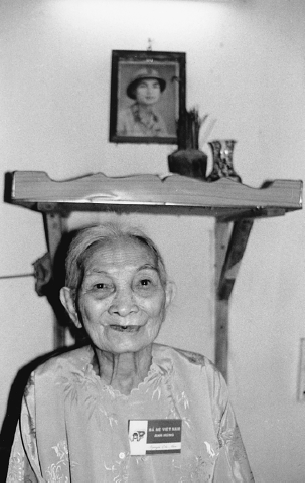
Figure 6.1. A Heroic Mother poses in front of her son's altar, Hanoi. Photograph by Natalia Puchalt.
By fixing on the figure of the grieving mother, Vietnamese culture infantilizes the dead soldier. Unlike the Western soldier who has tested his manhood in combat, he remains eternally a child, as a popular song of the South suggests:
The statues, photographs, and paintings of mothers of soldiers were designed partly in homage to the soldiers, both dead and living, partly as a means of acknowledging the enormous sacrifices of the civilian population. These commemorative productions were functionally equivalent to the military cemeteries in which the soldiers who died during the Revolution and the War Against the Americans are buried. Another
As the anniversaries succeeded one another in 1995, it became clear that there was growing ambivalence about the past decades of war and revolution. Commemorative events were not only opportunities for the state to inject new vigor into its narrative of national glory and heroic struggle; they also occasioned contrapuntal, subversive questioning of this legacy of struggle. The adoption of the Doi Moi program of economic reforms and engagement in the global economy seemed to undermine the very rationale for war and revolution. In the wake of profound economic difficulties and the worldwide decline of Marxism-Leninism, the triumphalist mood of the immediate postwar period had dissipated and the meaning of victory had become clouded.
Commemoration that was structured not around the celebration of triumph but around the acknowledgment of loss seemed appropriate, and honoring the mothers of dead soldiers was particularly fitted to this purpose. But this was not entirely without risk. Focusing on the extraordinary losses suffered by the Heroic Mothers could—and occasionally did—lead to a questioning of the human cost of war. The combined toll for North and South Vietnam is well over three million, which does not take into account the three hundred thousand North Vietnamese soldiers officially listed as missing in action. In 1991, the playwright Ngo Thao, who had taken part in a major landmark of the 1972 Easter Offensive, the battle of Quang Tri, called that battle “a senseless tragedy.”22 Around that time, two veterans, one male and one female, published novels that captured this feeling of senseless tragedy: Bao Ninh with The Sorrow of War and Duong Thu Huong with Novel without a Name.23
Acknowledgment that the Vietnam War was a civil war came late in
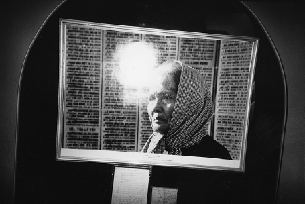
Figure 6.2. A Heroic Mother poses in front of a list of revolutionary war dead, Ho Chi Minh City. Photograph by Hue-Tam Ho Tai.
Heroic Mothers include only those whose sons and daughters died in the cause of the Revolution and the War Against the Americans. There are countless other mothers whose sons died fighting in the South Vietnamese army, and whose grief goes officially unacknowledged. Photographs of wrinkled women who are said to have lost three, five, or nine children blend into the collective figure of Mother Vietnam who loves
MANAGING PEACE
This commemorative silence is striking in light of what some scholars have called the “southernization” of Vietnam under Doi Moi, that is, its conversion into a replica of the pre-1975 South. In both the nostalgic recollections of disaffected southerners and the wishful projections of envious northerners, this pre-1975 South is not marked by war, chaos, or corruption, but represents an era of abundant consumer goods and relative freedom. Yet those who died so that the South could remain what the country as a whole is now becoming continue to be publicly unmourned.
The transformation of Vietnam along “southern” lines makes difficult comparisons between postwar Vietnam and postbellum America. Still, there are some similarities between the Vietnamese South and the American South. Both, unlike their northern counterparts, were heavily agrarian; both were defeated in a civil war; and both have been feminized in the cultural memory of their respective societies. The association of femininity with the Vietnamese South actually predates Communist victory. The lack of strong allegiance to Confucian ideology among southerners, their greater interest in making money rather than in acquiring diplomas or joining the bureaucracy—all these fed into a set of gender stereotypes in which women were associated with economic activities and lack of access to formal education and public life. Even the popularity of Buddhism in the South could be taken as a sign of femininity, since women were its greatest source of support. The North, however, with its stronger Confucian legacy and its role as a source of bureaucratic and political manpower, was cast as more masculine. Other regional differences were also described in gendered terms: southerners, living in the fertile Mekong Delta, were indolent and hedonistic in comparison with the rest of their compatriots.
The very qualities that seemed to explain southern defeat at war, however, may explain southern success in peacetime. With Doi Moi, postwar reconstruction has been cast in economic terms. The two heavily masculine sectors, the bureaucracy and the army, are retrenching while the private trading sector, a traditional feminine domain, is expanding. The social transformation of Vietnam since Doi Moi has generated
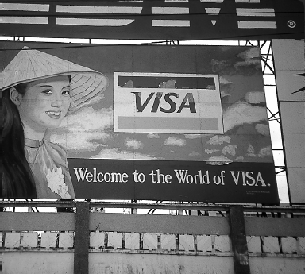
Figure 6.3. Billboard, Ho Chi Minh City. Photograph by Hue-Tam Ho Tai.
The year after Doi Moi was launched, the film How to Behave (Cau Chuyen Tu Te) by Tran Van Thuy was released in Hanoi.27 The film's theme was the search for the meaning of the term tu te, which can mean roughly “decency,” “kindness,” or “appropriateness.” As the filmmaker looked, mostly in vain, for people who lived according to this principle, he came across war veterans whose medals had been earned in battles from Dien Bien Phu (1954) to Khe Sanh (1968) but were now reduced to eking out a living driving pedicabs, repairing bicycles, or peddling vegetables by the roadside. Meanwhile, rich and idle young Vietnamese pursued the good life, which consisted of surrounding themselves with
This self-regarding young woman has her literary counterpart in the short story “The General Retires” (Tuong Ve Huu) by Nguyen Huy Thiep.28 In this story, which created a stir when it was published in 1988, Nguyen Huy Thiep pits a retired general against his daughter-in-law. Their confrontation is narrated in an affectless voice by the general's son, who is supposed to be the head of the family yet does not feel entirely responsible for the welfare of his household. The general symbolizes all the old virtues of the revolution but also its limitations.He clings to the spirit of egalitarianism in the face of growing social stratification. Coming from humble peasant stock, he is uncomfortable among the paraphernalia of middle-class aspirations his son and daughter-in-law are accumulating. He is more at ease with the peasant couple who care for his aged mother than with his own children and grandchildren, who despise his lack of education. Above all, he is made to feel superfluous and he eventually retreats from the domestic battlefield and rejoins his old regiment. The story ends with his son's laconic report that his father has died in battle, presumably in Cambodia.
The old general has been routed from his home (from which he had been absent for decades) by his daughter-in-law, who well deserves the popular nickname of “general of the interior.” She is the epitome of the competent housewife who knows to the last penny how much should be spent on wedding festivities: enough to cut a dash, not so much as to cause financial difficulties. Like her husband, she is well educated and thus a symbol of the postwar preference for knowledge over revolutionary
The loss of status and income of males in the public sector is captured in the short story “The Waltz of the Chamber Pot” (“Vu Dieu cai Bo”)by Nguyen Quang Than.29 The author sets up a humorous but sharp contrast between the poverty-stricken and ineffectual intellectual, the still powerful but obstructive party cadre, and the prosperous and productive (female) entrepreneur with whom both are involved. Although the intellectual is nominally on the payroll of a research institute, there is no money to fund his research, so he has to seek employment in the private sector.He is hired by the woman entrepreneur, supposedly to teach her little boy English, but in reality to be his nursemaid. The chamber pot is thus the symbol of his loss of status and of his fall into a demeaning, feminine occupation. The woman keeps in the good graces of the party cadre because of his remaining political clout but has little use for him personally because he is sexually impotent. Indeed, the only man capable of satisfying this cheerfully hedonistic woman is another (male) entrepreneur who breezes in and out of the story, bringing with him both news of the world outside Vietnam and funds of dubious provenance. The postwar economy, the story seems to imply, has reversed traditional equations between gender and power and has emasculated once powerful males.
WOMEN IN THE MUSEUM
The multifaceted role of women in society and cultural memory has found expression in the split personalities of the two museums dedicated to women, one in Ho Chi Minh City and the other in Hanoi. The Ho Chi Minh City Museum of Women tries to negotiate the multiplicity of roles that Vietnamese society assigns to women by embracing an allinclusive definition of their identity. Thus, visitors are greeted by a large wall poster that details feminine qualities through the ages:
The Vietnamese women have the tradition of being “heroic, unsubmissive, faithful and competent: which are materialized in various fields of activity: the Vietnamese women fight off the enemy for national salvation. … When it was necessary, Vietnamese women also knew how to rule the country. South Vietnamese women are not only talented producers, creating well-known articles, but are also competent housekeepers, experts in family man-agement, tailoring, embroidery, in cooking tasty meals, making cakes and jams—thus embellishing the life of the family and society.30
The Ho Chi Minh City Museum of Women opened its doors to the public on April 4, 1985, in time to coincide with the tenth anniversary of the fall of Saigon. Established before Doi Moi, it devotes far more space to showcasing women's wartime contributions than does its counterpart in Hanoi, which was inaugurated a full decade later.An official of the Hanoi Museum said, “We think that the Museum of Women of Ho Chi Minh City pays too much attention to war.We want to focus on the role of women in peace.”31 By the time the Hanoi Museum of Women opened in November 1995, the great wave of commemoration had largely ebbed, and public interest was refocusing on the present. In the lobby of the museum stands a bronze statue—the winning design in a competition that attracted over fifty entries—of a young mother holding a child aloft on her shoulder. In the words of the museum guide,
The statue is designed to represent the most valuable attributes of womanhood. She is shown with one hand forcing down the forces of disturbance. Her face is full of resolve, her breasts jut out to part the ocean waves. They are full of lifegiving milk.On her shoulder is perched a young child, for it is the responsibility of women to nurture future generations, their most sacred task. The child looks forward to the future, his arms stretched out to embrace all the challenges of life.
Over the statue is a huge chandelier whose lights are “in the shape of milk drops,” reminding spectators once again of the nurturing role of mothers (fig.6.4).A mural will be created as a backdrop for the statue
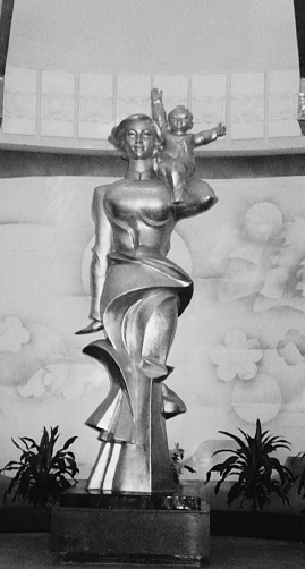
Figure 6.4. Mother and child statue, Museum of Women, Hanoi. Photograph by Hue-Tam Ho Tai.
Instead of trying to integrate women's multiple roles into a single identity, the Hanoi Museum of Women spreads them over three floors. The exhibits begin on the ground floor with celebrations of Vietnamese
In Ho Chi Minh City, the message inside the museum is somewhat more consistent and, as the Hanoi official suggested, more focused on women's revolutionary contributions, in keeping with the state's narrative. Outside, however, the commemorative concerns of the state are being undermined by those of private individuals. Although the museum is open free of charge, it has few visitors and a very small budget.As in other sister institutions in the South, the staff stretches the museum's income by allowing weddings to be held on its lawns and catering banquets.An annex is also used for meetings and dances. When the museum mounted a photographic exhibit in honor of Heroic Mothers in 1995, it flanked the lawn with temporary partitions upon which were affixed photographs of recipients of medals. They were women in their seventies or older, their faces etched with lines of sorrow, and they were invariably clad in drab peasant pajamas.On weekends, wedding parties would assemble in front of the museum for collective photographs. The bride was usually attired in a Victorian dress and the groom in a tuxedo. The pictures of old women who had lost their sons in the war formed a disregarded backdrop for the recording of the bride's passage into marriage and motherhood and the couple's affirmation of their membership in the rising urban, Westernized middle class. In southern towns and villages where museums are unavailable for this purpose, cemeteries to revolutionary martyrs have become a favorite spot for taking bridal pictures. Sites that are meant to commemorate war are thus used as backdrops for the reaffirmation of life and of social continuity. But the life and society they celebrate are very different from the ones that the Revolution
CONSUMING OBLIVION
While the state wished to honor those women who had given more than three sons to the revolutionary cause, it was also seeking to enforce its birth control policy, which limited to two the number of children each family was permitted to have.At the beginning of the campaign, the state had emphasized the need to limit population growth in order to create “a stable society and a prosperous country.” By 1996, that patriotic slogan had been replaced by a less publicminded appeal: “Limit yourselves to two children in order to raise them and educate them well.” Such an appeal bespeaks the end of the wartime ethos personified by the Heroic Mothers and the ascendancy of the middle-class culture represented by fictional females and fashion models.It also signifies the declining power of the official epic narrative of glorious war and revolution to inspire.
In Fable for the Year 2000, a play written in 1991 by Le Hung, a young Vietnamese competes with an older man over the right to pass over a bridge. While the old man claims that the privilege of age and the enormous sacrifices his generation has made give him the right of way, the younger man retorts, “What legacy have you left us but dire poverty?”32 Discussions of postwar greed and selfishness form a strange contrast to 1920s debates about the collusion between the patriarchal family and colonial rule. In the 1920s, it was young people who, using the image of young girls to represent their own sense of powerlessness, attacked the family as oppressive. Their rebellion combined desire for personal emancipation and commitment to a cause that was both larger and nobler than the family: the liberation of the entire nation. In the 1990s, the tables have turned. Old soldiers, like the retired general of Nguyen Huy Thiep's short story, represent the revolutionary cause and the larger community, while the young mother who is unwilling to subordinate the good of her family to that of the nation represents the current retreat from public-mindedness.
Although Fable for the Year 2000 appears to pit revolutionary memory against postwar oblivion, forgetting comes from many sources and in many guises.It is not simple ingratitude, nor solely a matter of generational differences. For some, it can be a rejection of the epic narrative of national glory bought at the price of immense sacrifice which is at the
Forgetting can also be an attempt to keep the past from damaging the present. Memory may be socially constructed.33 It may be shaped collectively, but it also defines the nature and boundaries of community on the basis of shared experience and shared sentiment.It is usually evoked, even constructed, in communal settings such as weddings, funerals, or death anniversaries. These are events in which ties of kinship and community are ordinarily reaffirmed through the recitation of personal anecdotes as much as by participation in common rituals. Yet, the divisiveness engendered by war and revolution confronts many Vietnamese with the impossibility of using memory to reinforce family feelings. In the North, the wounds left by the Land Reform program of the 1950s have not completely healed. Novels such as Duong Thu Huong's Paradise of the Blind expose the rifts it caused in individual families.34 In the South, both war and revolution are behind the suppression of memory. The difficulty of remembering failure and defeat is only one factor in this suppression.35 Whereas many overseas Vietnamese mark April 30 as the Day of Shame (Ngay Quoc Han), in counterpoint to the Vietnamese state's celebration of victory and reunification, those who remain in Vietnam but fought against Communism do not have the luxury of publicly holding their own rites of remembrance. But southern forgetting is not merely a case of individual memory collapsing under the weight of state suppression. Practically every southern family has members who fought on different sides of the Vietnam War and whose sufferings are therefore blamed on different agents. Every memory calls forth a countermemory: stories of imprisonment under the South Vietnamese regime are countered by narratives of experience in reeducation camps under the new Communist one. Anecdotes celebrating heroic deeds in guerrilla bases are met with tales of tragic death on the high seas while trying to escape the country. Some extended families have members who bear the scars of torture and others who have been accused of inflicting torture on prisoners. Satisfaction at the outcome of the War Against the Americans (as its supporters call it) clashes with nostalgia for the prosperity and freedom of the pre-Communist era as others remember it. Sometimes the division of war is not spread across a large extended family but has to be accommodated within a single individual. Some mothers who have been honored because their sons
Thus, for the sake of family harmony, southern dead, absent from national commemoration, often go unmentioned in the collective narratives of their extended families. Condemned to the shadows, they refuse, however, to remain unmourned. Their demand to be recognized, however, threatens the peace of the community at the level of family, community, and nation. The destruction of the cemetery has fed popular stories of ghosts who wander along the highway where it used to be located and disturb the living, as do the wandering ghosts of popular culture who must be appeased by rituals of remembrance in the seventh month.
Bequests sometimes carry with them bitter memories.As the narrator of Paradise of the Blind recognizes, “Forgive me my aunt: I'm going to sell this house and leave all this behind.We can honor the wishes of the dead with a few flowers on a grave somewhere.I can't squander my life tending these faded flowers, these shadows, the legacy of past crimes.”36 New acquisitions, by contrast, come without the burden of memory.It is this dimension that makes them so desirable as building blocks in a new family narrative that is not made up of loss, grief, and divisive bitterness.
The consumer culture is stripping many symbols of war service of their commemorative shadows. The magazine Phu Nu (Women), which is published by the Ho Chi Minh City Women's Union, is full of articles about fashion. In June 1995, when commemorative activities were at their height, it ran an article on hats. The magazine cover featured a model who was too young to have been born while the War Against the Americans was being fought. She was wearing a black sleeveless silk top with a mandarin collar and frog closings, which managed to be reminiscent all at once of the black pajamas worn by peasants and guerrillas and of the Western fashion fad known as “Indochic.” On her head was a pith helmet. Colored green to provide jungle camouflage, this had once been a useful piece of military attire. Repainted shocking pink to attract
The complexity of women's representational roles in Vietnamese public culture should not obscure the fact that women have real lives that are infinitely more complex, and that women's images and women's lives are sometimes in conflict. Political liberalization made possible more open discussion of war and of women's experiences in war; it accompanied the transition to a market economy in which many women, especially the peasant women who contributed the most to the war effort, are losing ground. Thanks to the new openness, the picture of wartime gender equality is being modified.37 Meanwhile, their postwar circumstances are leading some women to rethink their sacrifices. The Heroic Mothers, icons of revolutionary memory, are often forgotten as real individuals.At the end of 1995, a published survey disclosed that half a million women were living alone without children to support them. Because this coincided with the tail end of the festivities honoring Heroic Mothers, it led to discussions in the press of the plight of women whose children had died in the war and were now destitute.It was disclosed that some women, including war veterans, were opting to have children outside marriage because they had little or no hope of finding a husband, yet wanted to experience motherhood and to provide a modicum of security for their old age.38 And while fictional female entrepreneurs seemed to be gaining in power and status in the new market-driven society, the press was also full of articles concerning young peasant women who had been lured into the cities by prospects of jobs in the private sector only to fall into prostitution.
Winners and losers in the market economy, young and old, grieving and forwardlooking, selfsacrificing and hedonistic, icons of memory, symbols of forgetting; women embody the dilemmas and contradictions that are involved in making sense of war and postwar, revolution and counterrevolution in Vietnam.
NOTES
This chapter is a revised version of a paper presented at the annual meeting of the Association for Asian Studies in Honolulu, March 1996.
Contests of Memory
Remembering and Forgetting War
in the Contemporary Vietnamese Cinema
Mark Philip Bradley
In a modest house in a residential quarter of Hanoi, an elderly mother says good-bye to the guests attending the rituals surrounding the death anniversary (ngay gio) for her son who was killed in the American War. After the last guests depart, she collapses onto the floor crying and calls out for her family to assemble around her. Reminding her children that their brother's bones are still lying in a military cemetery in the South, she implores them to bring his remains home so that she can lie next to him when she dies. Her son agrees, adding, “Thank heaven my sister has so many connections.” His observation prompts an increasingly acrimonious exchange between his sister and his wife:
Shouldn't we all help? I'm busy with my husband's business trip to Singapore. You both have never seen Saigon. You could combine business with a little sight-seeing.
My husband is busy with the shop, and I'm taking care of mother. You have more time.
I'll talk straight. You joined this family. Help take care of it. You got my brother's room because he died.
And you got some of mother's gold. We don't get paid for taking care of her.
I had to borrow that gold to grease a few wheels.
Our family has special status because our brother got killed. That's why they let you pass your exam and get a job in Hanoi.
You're wrong. I got that another way. But it is through family status that they don't close your store!
Look at my husband. He can't go. I don't know my way around the South. How could we exhume the bones?
You think I'm good at it? It is hard enough to take care of my husband and his family. It's expensive to transport bones. Where would I get the money?
Stop it! All of you. You're so ungrateful to the dead. But you were quick enough to use our new family status. My son, if only you hadn't died in the South. Let me try to find the bones! If I die trying, none of you will care. As for the money, are these packets enough? If not, let's sell the furniture, the house. But I must bring my son's remains home.
Offering a solution to this impasse, the sister suggests that her husband's brother, an unemployed veteran, could use the money and go on behalf of the family. The veteran agrees but refuses the money. The sister tells him, “Stop living in the clouds. No one is like you now—doing something for nothing.” The veteran replies, “Your brother died asking for nothing.”
This painful symbolic representation of the tensions between remembering and forgetting the American War in contemporary northern Vietnamese society, which formed the core of Tran Vu and Nguyen Huu Luyen's 1987 film, Brothers and Relations (Anh va Em), was a sharp and highly unusual challenge to the official memories of war carefully constructed by the Vietnamese state throughout the wars against the French and the Americans and in their aftermath. The official narrative of sacred war (chien tranh than thanh) celebrated the heroic resistance of soldiers, workers, and peasants in an effort to infuse a larger meaning onto the suffering and death caused by war and to legitimate the state's twin goals of national liberation and socialist revolution. Many of the archetypal figures in the state cults of remembrance are present in Brothers and Relations. The sanctified memory of the fallen soldier, the probity of the simple veteran, and the self-sacrificing heroic mother all occupy a central place in the official pantheon of revolutionary heroes as symbols of selfless patriotic and socialist virtue. But in Brothers and Relations they function quite differently, standing in sharp contrast to the self-seeking daughter and her family intent upon using for their own advancement the special privileges granted by the state because of their brother's death in battle. For the filmmakers, the family's unwillingness to honor their brother's memory comes to represent the wider
Brothers and Relations is one of a number of revisionist films released in the mid-1980s that transformed the shape and content of historical memory in contemporary northern Vietnam. The Vietnamese state had employed film, with its power to capture a particularly broad audience, along with such popular cultural forms of remembrance as war memorials and museums, novels, poetry, paintings, and commemorative rituals honoring the war dead and their families to disseminate its construction of war. In appropriating one of these key mediums, the revisionist films of the 1980s articulated a form of what Michel Foucault termed “counter-memory,”1 the residual or resistant strains of remembrance embedded in popular consciousness that withstand official constructions of the historical past.
The films appeared in a period that favored the advancement of a contrapuntal representation of war in Vietnam. The embrace of market economic reforms at the Sixth Party Congress of the Vietnamese Communist Party in 1986 brought with it a significant loosening of state control in the cultural realm. As one scholar of this period has argued, the policy of Renovation (Doi Moi) in the arts allowed intellectuals to work with a degree of freedom unknown since the Popular Front period in colonial Vietnam in the late 1930s.2 But if official censorship relaxed somewhat, so, too, did the state subsidies for the arts that had provided the single source of funding for the Vietnamese film industry. The demands of the market economy put new pressures on filmmakers to ensure that the content of the films they produced resonated with potential filmgoers.3
Emboldened by this new climate of artistic freedom and market incentives, the works of revisionist filmmakers mounted a powerful, if sometimes oblique, narrative challenge to official memories of the Vietnamese experience of the war and attracted large, appreciative audiences.4 They posed several farreaching questions that undermined the central premises on which the state's memorializing project had rested. Who rightfully possesses the memory of fallen soldiers? Whose wartime sacrifice is deserving of commemoration? And what are the real legacies of war? In framing their responses, filmmakers consciously rejected the prevailing aesthetics of socialist realism that had governed Vietnamese cinema and given shape to the state's heroic narrative of war. In its place they made use of a diverse repertoire of rich visual imagery that reached back to ritual forms of family and village life long suppressed by the
WHO RIGHTFULLY POSSESSES THE MEMORY
OF FALLEN SOLDIERS?
The fallen soldier is perhaps the most potent symbol of official efforts to commemorate and legitimate the national experience of war. As George Mosse argues in his seminal account of state memorializing practices in Europe in the aftermath of World War I, the body of the soldier killed in battle came to transcend death and was increasingly linked to the highest aspirations of patriotic nationalism. Images of the fallen soldier in the arms of Christ, Mosse asserts, “projected the traditional belief in martyrdom and resurrection onto the nation as an all-encompassing civic religion.”6 Central to the European statesponsored cult of the fallen soldier was the construction of war monuments and military cemeteries that functioned both as shrines of national worship and as physical symbols of the superior claims made by the state on the memories of those who died in battle.
The development of memorial holidays and specially designed cemeteries by the Vietnamese state to render the death of soldiers as symbols of national revolutionary martyrdom mirrors key aspects of these interwar European practices. Like its counterparts in Europe, the Vietnamese state sought to own the memory of its war dead, an effort most starkly revealed in the official memorial services organized by local party cadres. Here a fallen solder's sacrifice for the state and revolution, rather than this relationship to his lineage or village, served to exclusively define the meaning of his life and death.7
Fallen soldiers occupy a central place in the symbolic vocabulary of many of the revisionist films of the 1980s, but they are used to subvert rather than affirm the scaffolding of official memories erected by the state and to stake a claim for the primacy of individuals and civil society as the rightful heirs to memories of the war dead.8 Brothers and Relations places the remains of the fallen soldier at the center of its withering critique of an amnesic postwar Vietnamese society (fig. 7.1). At the end of the film, the veteran encounters his brother and his wife in the parking lot of the airport outside of Hanoi as he returns from his trip to recover
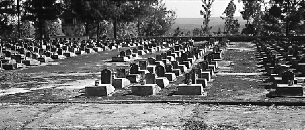
Figure 7.1. The Truong Son Cemetery on the Ho Chi Minh Trail contains the graves of nineteen thousand North Vietnamese soldiers. Photograph by Hue-Tam Ho Tai.
Nguyen Xuan Son's 1987 film, Fairy Tale for Seventeen-Year-Olds (Truyen Co Tich cho Tuoi 17), appropriates official memories of the fallen soldier in gentler but nonetheless subversive ways. The film tells the story of a young student, An, who falls in love with a soldier when she sees his picture and hears his mother read from his letters written from the front. An and the soldier never meet, but their tender relationship emerges through letters they exchange with each other and in a series of dream sequences in which the young girl encounters the spectral figures of the soldier and his regiment, who appear to be taking shelter from the war in a dark cave. An's love for the soldier meets severe official disapproval as a violation of the wartime imperative of collective selfsacrifice. In an early scene, her teacher asks An's class to prepare an
In contrast to these official judgments, Fairy Tale for Seventeen-Year-Olds concentrates on the approving support An receives for her love of the soldier from her father and the soldier's mother. For both of them, the war has taken a deeply personal toll. Her father is a veteran of the French war whose wife died of grief after going years without word of the fate of their son, who apparently died in battle. He tells An her relationship with the soldier is a “fairy tale” but indulgently advises her to continue it as she is too young to know the “realities of war.” The soldier's mother, Mrs. Thu, a political cadre whose own husband was killed in battle during the war against the French, also affirms An's love for her son, sharing his letters with her and urging An to write to him in return.
The film ends on the day of Hanoi's victory in the American War. Just before Mrs. Thu is to give a victory day speech in the courtyard of An's school, she receives a telegram with the news that her son was killed in one of the war's final battles. As she gives her speech celebrating “the heroic sacrifices that won us victory from the American imperialists,” the pain in her face betrays the more personal meaning of her son's death and the memory of her husband. She tells An's father later, “I never thought I would experience such grief on this day of our victory,” to which he replies, “We've won independence at the cost of young lives.” In its focus on the human dimension of a soldier's life and death, Fairy Tale for Seventeen-Year-Olds suggests the necessity of a more intimate interpretation of the memory of fallen soldiers than the one put forward through the state's commemorative practices to provide essential consolations for the private sacrifices of war. As the young girl An says in the final frames of the film after she comes to know of her lover's death, “My love made me happy. I want to retain that happiness … to know nothing but my beautiful fairy tale.”
Perhaps the most complex exploration of the question of who right-fully possesses the memory of fallen soldiers emerged in Dang Nhat Minh's 1984 film, When the Tenth Month Comes (Bao Gio cho den
When the Tenth Month Comes tells the story of the decision of a young woman named Duyen to keep the news that her husband was killed in battle hidden from her husband's family and village. By the end of the film Duyen comes to know that her behavior is improper. Kneeling next to the deathbed of her husband's father, she cries out, “I haven't told the truth. … I'vedone wrong.” From the state's perspective, the nature of Duyen's error would have been obvious: she prevented her husband's memory from fulfilling its officially sanctioned commemorative purposes. At points the film does acknowledge the legitimacy of state claims on the fallen soldier's memory. Early in the film the father of Duyen's husband calls the death of his elder son during the American War a “patriotic sacrifice for the advancement of the national liberation movement and the socialist revolution.” Similarly, the final scene of the film after the dead soldier's family and village have come to know of his wife's deception appears to suggest the official order has been restored. As martial music swells, Duyen's son and his teacher, surrounded by children carrying party banners, gaze admiringly upward at the yellow star and red background of the Vietnamese flag snapping purposefully in the wind. But these rather perfunctory scenes are oddly disconnected from the larger narrative of the film, better reflecting a bow to the very real concerns of continuing state censorship rather than a full embrace of official commemorative practices.
The film concentrates on the impact of the war on the interior lives of Duyen and her husband's family. When the state intrudes on their
By contrast with the film's portrayal of the state, its depiction of Duyen's multiple social roles as wife, opera singer, and widow lends her character a surprisingly sympathetic form despite the evident disapproval of her actions. Duyen's relationship to her husband's family and village is clearly that of an outsider. Within Vietnamese patrilineal familial custom an in-law is “outside” (ngoai), a term used to describe nonpatrilineal kin and suggestive of the secondary role a wife occupies in her husband's family. As an opera singer and a former member of a traveling theatrical troupe, Duyen is also connected to a social group viewed with some ignominy in northern Vietnamese society as an alien presence that should properly remain apart from the closed formal structures of village life.9
In part Duyen's marginal and vulnerable position in her husband's family and village provides Dang Nhat Minh with a more impressionable and less dangerous agent for launching his critique of state claims on the memory of fallen soldiers than if he had chosen to center the film
But if the narrative of When the Tenth Month Comes at times accords Duyen an empathetic place, its broader focus remains a critical examination of the transgressions Duyen acknowledges at the end of the film and the path through which she comes to know her behavior is wrong. The film concentrates on Duyen's failure to fulfill her filial duties to her husband's family and his lineage and her moral obligations to his village in a manner that subtly undermines the state's monopolizing claims on the memory of her dead husband. It articulates its disapproval of Duyen's actions in a crucial scene in which the family of her husband observe the death anniversary of her husband's mother. At the culminating feast marking the anniversary, one family member reads a letter full of filial devotion purportedly written by the heroine's husband. The letter, however, is actually a fabricated one, written at Duyen's request by the village schoolteacher as a way of convincing the family that her husband remains alive.
When Duyen uses a death anniversary at which the soul of the departed ancestor is believed to be present to advance her deception, her actions emerge as a particularly egregious violation of traditional Vietnamese practices of remembering and propitiating the memory of the dead. The rites of the death anniversary, one leading scholar of these practices argues, are essential to affirming the primary familial obligations of filial piety (hieu), “symbolically joining the living, dead and yet to be born members of the family … inan intimate relationship of mutual dependency.”10 The visual dynamics of the scene sharpen the contrast between Duyen's serious breach of familial norms and the proper
The film's particular concentration on the feasting component of the death anniversary also reinforces its focus on the claims of family and village, rather than the state, on the memory of Duyen's husband. The feast marking the death anniversary, in which a family traditionally invited its neighbors in the village to share, was among the central targets of a sustained campaign by the state against superstitious practices in northern Vietnam after its rise to power in 1945. For the state, the elaborate network of social exchange promoted through the feast both incurred wasted expenditure better used for collective economic purposes and represented undesirable feudal customs that promoted social inequality and status competition. In its place, the state promoted a simple didactic ceremony among the immediate family of the deceased that focused on the departed ancestor's contribution to the rise of a new revolutionary society. Dang Nhat Minh's inclusion of the feast in his depiction of the rites of the death anniversary, which reflects the very real return of such traditional ritual practices in northern Vietnamese society in the 1980s, pointedly places the memory of the dead within the world of the village community and suggests that Duyen's deceptions most importantly violate familial and village rather than state norms.11
Significantly, When the Tenth Month Comes guides Duyen toward the self-knowledge that her deception injures her husband's family and village through a series of conversations with the spirit world. This marks another conscious break with the state's insistence on empirically verifiable solutions to human problems rather than recourse to the metaphysical realm that was at the core of its campaigns against superstitious practices. In one of several dream sequences, which draw upon a common traditional belief that the spirits of the ancestors can appear in dreams to warn of approaching calamities, Duyen meets the village guardian spirit (thanh hoang), who tells her he is “a husband like yours who followed a famous king to repel the Mongol invaders from the North,” a reference to the thirteenth-century Mongol invasion of Vietnam. While the state consciously sought to appropriate these ubiquitous village cults to legitimize its prosecution of the wars against the French and the Americans within what it termed the “timeless tradition of
Later the films uses an encounter with the spirit of Duyen's husband to provide the vehicle through which she comes to appreciate the significance of his family's claims on his memory and her obligation to them. The meeting takes place at what the film calls the “Day of Buddha's Forgiveness,” an event Duyen's grandmother recalls as a practice from the “olden days” in which “the dead could meet the living in a midsummer market.” Coming upon her husband, she notes his sadness and asks, “Is there something that needs atonement?” Her husband tells her: “I've done my duty. The living should make each other happy.” “Father thinks you will still return,” Duyen tells him. “Let him be peaceful in his own mind,” he replies. “He and I will meet again.” Her husband's gentle rebuke serves as a reminder of the spiritual dilemmas that Duyen's transgression of filial norms poses for his family. Without the knowledge that their son has died, they are of course unable to properly honor his memory. But an unpropitiated death, according to traditional Vietnamese beliefs, can threaten the family in a number of ways, turning the dead family member into a restless and potentially malignant spirit who can bring ill fortune to the family. Duyen's encounter with her husband at the Day of Buddha's Forgiveness, a loosely fictionalized version of the Buddhist Feast of Wandering Souls (Ngay Xa Toi Vong Hon), in which village communities traditionally sought to pacify the souls of those who had no one to remember them, suggests her actions have wrongfully placed her husband's spirit in a potentially dangerous sacred space. In urging Duyen to give his father peace, a request approvingly rendered by the film, Duyen's husband reminds her of the primary ties of kinship and the urgency of restoring the proper order of familial remembrance for the dead.
This narrative unfolding of Duyen's journey toward selfknowledge through the spirit world is punctuated by the frequent appearance of a small paper kite, which in the end serves as the film's most potent symbol of her husband's ties to his family and village community and the transcendent claims they make on his memory. The kite makes its first appearance in an early scene in which Duyen recalls a visit she and her
Shortly before the end of the film, and the approaching harvest, Duyen and her young son appear on a hillside joyfully flying a paper kite like the one her husband had offered to the village guardian spirit. In that single image—the kite sweeping and arching over the landscape but tethered to the earth by the string the boy holds—the film depicts the soaring spirit of Duyen's husband, whose relationship to the world below gains its meaning through the inviolable bonds of family and community. If fears of continuing state censorship may have prompted Dang Nhat Minh to formally close his film with a reprise of socialist realist imagery that supports official claims on Duyen's husband, When the Tenth Month Comes suggests that at the very least the state must share the memory of the fallen soldier with his widow, his family, and his village.14
WHOSE WARTIME SACRIFICES
DESERVE COMMEMORATION?
Along with their sweeping challenge to official claims on the memory of fallen soldiers, the revisionist films of the 1980s also focused on the postwar betrayal of the broader scope of the Vietnamese state's commemoration of war. Throughout the wartime period, the state celebrated individual acts of self-sacrifice by patriotic workers and peasants, heroic mothers, children and grandparents, and revolutionary cadres and soldiers. If their contributions fell short of the ultimate sacrifice of
Film was a particularly important means through which the state imparted the commemorative meanings it gave to the sacrifices of these social groups. The first featurelength Vietnamese film, On the Same River (Chung Mot Dong Song), 15 told the story of two young lovers, divided by the river that formed the boundary between northern and southern Vietnam in the Geneva Accords, who put aside the individual sorrows of their frustrated love to fight for the reunification of the country and ideals of socialism. It set the tone for filmmaking during the war and in its aftermath, including such wellknown films as The Fledgling (Chim Vanh Khuyen), in which a little girl is killed in her attempts to warn a revolutionary cadre of an impending enemy ambush; Coal Season (Mua Than), set among coal miners in the North who overcome constant bombardment by American jets to produce the coal needed for the war effort; and When Mother Is Absent (Me Vang Nha), which focused on a mother and her five children who responsibly take care of each other at home while their mother fights the enemy on the battle-field.16 This commemorative rendering in film emerged most fully in the 1965 documentary Victory at Dien Bien Phu (Chien Thang Dien Bien Phu), 17 released to coincide with the tenth anniversary of the French defeat at the climactic battle of the first Indochina war. Crosscutting between black-and-white footage of the battle itself and vignettes that celebrated individual acts of heroism by soldiers in battle and by peasants and workers on the home front, the film presented what it called the “spirit of Dien Bien Phu” as a didactic lesson of the necessity of collective self-sacrifice to successfully realize “the struggle against American imperialists for independence, for the land of the peasants, for socialism.”
Many of the revisionist films of the 1980s undermined these larger commemorative pretensions of the Vietnamese state. Depicting a postwar world in which the patriotic and revolutionary figures celebrated in official memory occupied a marginal, often forgotten, place in society, they called into question the state's ability to honor the wartime sacrifices of its people and to sustain the foundational myths of the war experience through which it sought to legitimate its power and authority. The betrayal of wartime sacrifices emerges as a particularly important theme in three of these films. Tran Van Thuy's 1987 documentary, How to Behave (Cau Chuyen Tu Te), opens with historical footage of
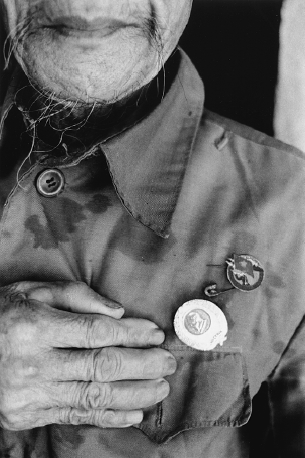
Figure 7.2. Dien Bien Phu veteran, Tam Nong District, Phu Tho. Photograph by Natalia Puchalt.
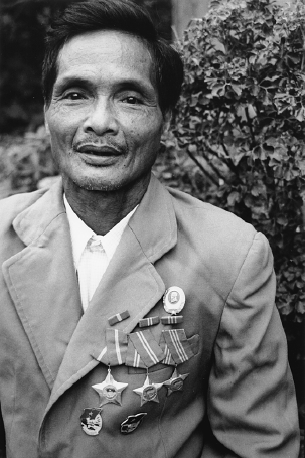
Figure 7.3. American War veteran and Agent Orange victim, Tam Nong District, Phu Tho. Photograph by Natalia Puchalt.
The veteran at the center of Brothers and Relations occupies a similarly peripheral place within his family and in postwar society. From the outset of the film, when the veteran returns to his home in Hanoi, he receives little understanding or appreciation from his family for his experiences in war. Ringing the bell upon his arrival, he is first greeted by a young woman who does not know him but now occupies his former rooms, which his family had rented out believing him to be dead. Confused, he rings again and this time awakens his brother's sleeping wife. Annoyed that someone is at their gate early on a Sunday morning, she asks her husband to receive the caller, but he is preoccupied with collecting the eggs his hens had laid the night before and so refuses. Finally the wife answers the bell. Astonished to see the veteran, she gives him a forced smile that only slightly masks her underlying anxiety that his return will upset the household's economic arrangement with their
The cool reception that the veteran receives from his family is replicated in his encounters with society at large. Potential employers insist they cannot offer him a position because he does not have proper training in a trade; they remain unmoved when he explains he was drafted before he could enter vocational school. Unable to find a job, he passes much of his time with other unemployed veterans in seedy cafe´s frequented by prostitutes. But here, too, the veteran tells his few friends he “just doesn't fit in.”
By focusing on the indifference the veteran encounters from his family and society, Brothers and Relations points to the state's larger failure to honor the wartime contributions of soldiers and its inability to honor its commemorative ideals in the postwar period. In one revealing exchange the veteran's brother says that his failure to find a job “betrays their father's trust,” to which the veteran tells his seemingly uncompre-hending brother: “Betray? You don't think joining the guerrillas for so many years, fighting, not running away, with a bullet in my body is honorable. I come back and look for a job so I won't be a parasite. But if you lack a diploma and have a mind that won't do anything right, you might as well be dead.” In the end, the film suggests, the returning veteran can find a place for himself and his own memories of war only on the margins of society. A chance encounter with his old platoon leader, a kindly and trustworthy figure who has made a quiet life for himself in a small coastal fishing village, convinces the veteran to do the same. Surrounded by the platoon leader's warm and empathetic family, the veteran comes to enjoy an Arcadian existence that the film poses as a virtuous antithesis to the ills of forgetfulness of the rest of contemporary society.
The most probing and critical examination of the state's betrayal of the ideals it had so painstakingly cultivated through official commemorations of war emerges in a second film by Dang Nhat Minh, Girl on the River (Go Gai tren Song), released in 1987. The film opens with a young woman in a hospital who is telling her life story to a woman journalist. The first third of the film flashes back to the period of the American War, when the young woman had been a prostitute in Hue
After the war's end, the young woman realizes the cadre has survived the war and become an important provincial government official. She makes efforts to see him at his office to renew their friendship and seek his assistance. Her papers, however, reveal her to be a former prostitute who had served time in a reeducation camp after the war, and she is refused admittance to him. But while the man's factotums refuse her request because of her “class background,” they remain unaware of her earlier relationship with their boss. The former prostitute leaves, assuming that the cadre himself did not refuse her request. By chance shortly thereafter, the cadre's car is stopped because of road construction. On the construction crew laying piles of asphalt is the prostitute, who immediately recognizes the cadre and approaches his car. In a long, painful scene she circles the car without speaking while the cadre ignores her, gazing straight ahead, almost through her. Devastated by this treatment, she leaves work that day, dazed, and is hit by a truck as she walks down a country road. Recovering from the injuries in a hospital, she encounters the woman journalist to whom she has been telling her story.
Neither the young woman nor the journalist realizes the cadre is the husband of the journalist. Indeed, the journalist is puzzled when her husband responds unsympathetically to her interest in publishing the story (he of course realizes the story is about him and worries that if the connection were revealed it could harm his position). The journalist begins to encounter obstacles to publishing her story, again unaware that her husband is using his connections to make sure it is not printed. Told by her editor that the story will not be published, she threatens to resign her position. When she returns home and tells her husband what she has done, he explodes, not only revealing that the story was about him but also criticizing her for giving up her position and for endangering his career.
If the basic structure of the plot serves to reveal the betrayals and hypocrisies of official commemoration of wartime sacrifice, understanding Dang Nhat Minh's decision to use a prostitute as the heroine is essential to decoding the multiple meanings of the film and how Vietnamese audiences might have apprehended it. The sympathy and quiet heroism he accords to the prostitute and his implicit criticism of the cadre's postwar behavior overturn some of the state's most fundamental political assumptions. During the war, the prostitute often served as a symbol of the corruption and immorality the North Vietnamese state attributed to the South Vietnamese government. In the immediate post-war period, party rhetoric called for the eradication of prostitution in the South because it was inimical to what it termed the “human dignity” of women and the “moral integrity” of the new “socialist man.” Prostitutes, like others associated with the southern regime, were to be made over into socialist men and women, a decision that helps explain why the film's heroine had been sent to a reeducation camp.18
Yet Girl on the River offers the prostitute as a symbol of loyalty and principle to reveal the absence of those qualities in the socialist regime. It emphasizes the contrast between the behavior of the prostitute and the cadre in a scene late in the film. After his angry attack on his wife, the cadre goes to the hospital hoping to see the girl (though whether to affect a reconciliation or silence her is not clear). She has already been released, but as the cadre looks around her empty room and at the white sheets of her bed, he suddenly imagines a stain of red blood on the sheets. A new bride traditionally presented blood-stained silk squares after the wedding night to her husband's kin as proof of her virginity; what the cadre has been visualizing, therefore, is nothing less than the prostitute's essential purity.
Dang Nhat Minh's use of the prostitute as a self-sacrificing patriot also has a deeper resonance in traditional Vietnamese literary culture. Most Vietnamese are familiar with the story of Tay Thi (Ch. Hsi shi), a young woman who in popular legend is credited with assuring the victory of the king of Yu¨eh over the king of Wu during the period of the Warring States (403–221 b.c.). After the king of Wu defeated the kingdom of Yu¨eh, believed to be the embryonic precursor of the Vietnamese state, the king of Yu¨eh presented Tay Thi to the Wu court. A woman of transcendent beauty—the T'ang poet Li Po called her “luminous, ravishing, a light on the sea of clouds” —Tay Thi was reportedly educated in the feminine arts at the Yu¨eh court for the purposes of corrupting the king of Wu. Distracted by Tay Thi's beauty and charms, the
The close links between the story of Tay Thi and the behavior of the prostitute in Girl on the River suggest the film offers an even deeper challenge to the larger symbolic meanings the state accorded to prostitution. Its approving depiction of the prostitute's contribution to the war effort joins it to a sustained indigenous debate that began during the period of French colonial rule over the efficacy of collaboration in which the prostitute came to be seen as a metaphor for an acceptance of foreign rule. At the center of these debates were often-conflicting interpretations of Nguyen Du's nineteenth-century epic poem The Tale of Kieu (Truyen Kieu), in which the heroine's willingness to prostitute herself for her family was widely seen as an apologia for the author's decision to abandon the Le cause and serve the new Nguyen dynasty. In what are commonly known as the “writing brush wars” of the 1860s in the wake of the French conquest of the South, one leading collaborator with the French justified his decision by comparing his plight to that of Kieu. Similarly, Pham Quynh, a leading indigenous supporter of French rule in the 1920s, sought to canonize Kieu as a filial, self-sacrificing daughter who prostitutes herself to save her family in an effort to defend his own collaboration with the French. If collaboration for Pham Quynh was like prostitution, then he, like Kieu, was practicing it for the purest and noblest of motives, prostituting himself for the ultimate good of the nation.20
These defenses of Kieu and of collaboration met with sharp indigenous attacks. Opponents of collaboration in the writing brush wars did not so much direct their ire at Kieu as argue that collaborators attempted to cloak their disloyalty in the false guise of filial piety. But Pham Quynh's detractors, some of whom came to play leading roles in the North Vietnamese state after 1945, chose to attack him through a critique of Kieu. Their argument that Kieu was little more than an unchaste and lewd woman undeserving of veneration was squarely aimed at undermining Pham Quynh's defense of collaboration. These proponents of “art for humanity's sake” in the 1930s, who set many of the parameters for the state's socialist realist aesthetics in the coming decades, had little use for Kieu and prostitution. Far from a model of revolutionary voluntarism, she appeared as little more than a weak, passive victim of an iniquitous social system that the socialist revolution aimed to transform.21 For instance, in To Huu's poem “The Song on the Perfume River” (1938), a work later celebrated by the North Vietnamese state,
Dang Nhat Minh's choice of two women to serve not only as the film's central characters but also as its narrative voice joins the film to a traditional literary idiom in which male authors adopted a female narrative voice that could serve counterhegemonic purposes without interference from the state. In part, his choice may have been a device to evade censorship by employing the practices of the northern radical and progressive authors of the 1920s and 1930s who used the coded language of gender to undertake political debate and avoid colonial censorship.23 The timing of the film's release in 1987, in the very early days of the reform movement, suggests that Minh would have needed to be very cautious in presenting his critiques because the boundaries and implications of the reforms remained uncertain.
Girl on the River employs two gendered literary tropes—women as victims and women as powerless—that give it the freedom to articulate a more sweeping indictment of contemporary society. Drawing on the symbolic resonance of women as victims, an idea that is enshrined in Vietnamese literary classics like the eighteenth-century epic poem Lament of the Soldier's Wife (Chinh Phu ngam), as well as in the literature of the 1920s and 1930s that portrayed a feminized colonial population victimized by Confucian family structures and the colonial state, the film uses the prostitute and female journalist to suggest society at large has been victimized by the state's inability to uphold its commemorative ideals. Similarly, and more bleakly, the film appropriates the common literary and cultural equation that linked women with powerlessness to suggest that just as the women in the film are unable to control their own fates, contemporary Vietnamese society lacks the agency to rescue itself from the state's betrayal of the socialist ideals that underlay its official narrative of war.
The final plot twist in Girl on the River underscores this subtle critique of state practices, starkly revealing the emptiness of the state's commemorative promises. After the argument with her husband, the
WHAT ARE THE REAL LEGACIES OF THE WAR?
The importance the revisionist films of the 1980s attached to the be-trayals of the official meanings of wartime sacrifice reflected a more fundamental unease with the nature of postwar society in northern Vietnam. If revisionist filmmakers took full advantage of the opportunities the Renovation agenda offered to enlarge the parameters of public discourse on the legacies of war, they were far from champions of the market reforms adopted by the state in the mid-1980s to arrest the stag-nation of the Vietnamese economy.24 In almost all their films, the for-getfulness of many of their protagonists serves to emphasize the spiritual malaise they ascribe to contemporary society, in which the wartime virtues of revolutionary self-sacrifice are increasingly disregarded by corrupt and self-seeking cadres. The quest for individual advancement and rising economic inequalities, the revisionist films suggest, belie official promises that the sacrifices of war would bring collective egalitarianism and social justice in the postwar era.
Le Duc Tien's 1986 film, A Quiet Little Town (Thi Tran Yen Tinh), advances this critique through gentle but trenchant satire. On the way to the wedding of a relative, a highranking government minister from Hanoi and his driver are seriously injured in a traffic accident near a small provincial town. A local party official, whose nephew's wedding the minister was coming to attend, orders the better dressed of the two injured men to be sent to his town's clinic while the other man is taken to a neighboring town for treatment. After the local notables realize that their patient may die without surgery, the central question of the narrative becomes how the handling of the minister's case can best promote the fortunes of various members of the small town's party and state bureaucracy. The local party official, aware of the possible rewards that could come from saving a minister's life, urges that he be operated on
In the meantime, back in Hanoi the minister's wife, whose manner and physical presence closely resemble those of Imelda Marcos, browbeats her sons to use their connections in the military to get a military jet to airlift her husband out. Eventually the young doctor takes charge and performs the surgery while the local party cadre organizes a welcoming party, made up of family and friends who had assembled for the aborted wedding of his nephew, to greet the minister's wife and family who are flying by military helicopter to the small town. They arrive just as the patient is wheeled out of surgery. As the doctor proudly pronounces the surgery a success, the minister's wife looks at the patient on the stretcher and realizes it is not her husband but his driver. Suddenly an announcement from the neighboring town reports that the minister's surgery in its clinic was successful and that he is resting comfortably. His wife and family rush off, dashing the hopes of local officials and bureaucrats that the minister's gratitude would advance their careers.
The preoccupation with status and power among agents of the state that infuses the damning portrait of society under the market economic reforms in A Quiet Little Town also emerges in the documentary How to Behave. The film, whose depiction of the lives of veterans in postwar society was discussed earlier, is centered around a group of filmmakers who honor the request of a dying colleague to discover if kindness (tu te), a term the film tellingly defines as “acting in the public rather than individual interest,” could still be found in Vietnamese society. The filmmakers ultimately do find kindness, not among party cadres or state bureaucrats—one of whom claims “No one has time for such outmoded notions these days” —but in a leper colony run by Catholic nuns, a particularly charged choice given the intense and sustained hostility of the socialist state in Vietnam toward the Catholic Church. If the devotion of the nuns to the lepers, as the film claims, rests on “faith,” How to Behave suggests the callousness of society at large represents a loss of faith in the state's socialist ideals. Pointedly noting that “the people”
If wartime experiences are a somewhat muted presence in the narratives of A Quiet Little Town and How to Behave, 25 a gendered construction of war memories serves as a crucial symbolic vehicle for the critique of contemporary society advanced by many of the revisionist films. They pit a series of grasping younger women against the probity of veterans whose virtuous behavior underlines the dominant ethos of corruption and selfishness the films ascribe to contemporary society. This metaphorical dichotomy builds in part upon the traditional Vietnamese division of gender roles that contrasts women as “generals of the interior” (noi tuong), who dominate the domestic sphere and oversee the family's budget, with men who properly inhabit the public realm, where they conduct the more contemplative official business of family life and governance. By rendering the contours of contemporary society as a feminine landscape forgetful of the self-sacrifices of war, the symbolic vocabularies of these films suggest that the power of the market economy has dangerously extended the private domain of women into the masculine public sphere and dislodged the traditional forces of moral order and authority in society.
The oppositional pairing of the behavior of younger women and soldiers to advance this gendered representation of the abandonment of wartime ideals occurs in the majority of revisionist films. In When the Tenth Month Comes, the actions of a female cadre whose preoccupation with material advancement prompts her to chastise the heroine Duyen for her “inability to get ahead” stand in sharp contrast to those of a soldier who had fought with Duyen's husband and eventually tells her son that his father is dead. When the son asks the soldier if he is telling the truth, his reply that “a soldier never lies” emphasizes the moral gulf between wartime revolutionary virtue and the ills of contemporary society. A decorated war veteran in How to Behave serves as an example
In two films the engendered revisionist critique is rendered in a particularly sharp and disturbing manner. The contrast between the behavior of the veteran in Brothers and Relations and the wife of his brother in honoring the memory of her brother who was killed in war was noted at the outset of this chapter. Juxtaposing the selfless virtue of the veteran who collects and buries the remains of the fallen soldier with the obsession of the wife who works with unabashed eagerness to bribe and cajole an expansive network of corrupt officials to facilitate a potentially lucrative business trip to Singapore for her husband, the film suggests that the wife's singleminded pursuit of material advantage blinds her to her obligations to her dead brother. The wife's place in the film as a larger symbol of the perils of the marketplace emerges with particular force in a scene in which she meets her husband on the day of their wedding anniversary. She emerges from a shop carrying a boom box to greet her waiting husband, who has brought a small bouquet of flowers to mark the occasion. “You bought another cassette player?” he asks. “You can't have too many,” she jauntily replies. As the two ride off on their motorcycle, the wife clutches the boom box to her heart while carelessly holding the bouquet in her other hand. The flowers, a potent expression of the humane rather than material nature of social relationships, appear almost expendable; it is the boom box that gets the loving embrace.
In Nguyen Khac Loi's 1989 film, The General Retires (Tuong Ve Huu), a decorated general and the wife of his son serve as the central characters. The general, a figure of quiet authority and simple tastes who is clearly devoted to serving the ideals of the state, comes to live with his son's family after he retires from military service. But he soon feels out of place as he experiences the market-generated rhythms of life in the household. One day he discovers that his son's wife, a doctor at a
The symbolism of gender cuts even deeper in The General Retires and Brothers and Relations, which use the emasculation of husbands by their wives to reveal the corrupting seductiveness of the marketplace and its corrosive penetration into all realms of human relations. The son of the general is depicted as an impotent figure, powerless to resist the moral transgressions of the market that his wife has introduced into the house-hold. When the general tells his son what his wife has been doing, implicitly calling upon him to reassert his authority and end the practice, the son replies somewhat stiffly, as if to hide his embarrassment, “I had known about this but dismissed it as something of no importance.”
The brother of the veteran in Brothers and Relations is a similarly weak figure who is literally seduced into the conventions of the marketplace by his wife. In one key scene that illustrates the wife's domination (and that of the market), husband and wife are seen lounging on a bed after returning home with their new boom box. The wife removes her husband's glasses, unbuttons her shirt, and turns on a cassette of Western popular music. As she leans back seductively and pulls her husband toward her, he looks both at her and at the boom box next to her with an expression full of greed and licentiousness. The close of the film condemningly suggests that his emasculation and his embrace of the market economy are fully consummated. He sits mutely in the back of a car at the airport, his face filled with avaricious anticipation for his imminent business trip to Singapore, while his wife tells his brother that she does not have time to deal with the remains of her dead brother that he has recovered and brought to her.
Not all filmmakers shared the opprobrium with which these films greeted the coming of the market economy. For Luu Trong Ninh, the market economy offered a salutary alternative to what he perceived as the obvious failures of socialism. His 1993 film, Please Forgive Me (Xin Loi), depicts the trials of a soldier turned movie producer trying to make a film glorifying the North's war against the United States by using Vietnamese actors and actresses born after the Communist victory in 1975. The film focuses on the conflicting generational sensibilities of the producer and his cast. The producer, an austere figure proud of his role in
But if Please Forgive Me suggests the presence of generational differences among revisionist filmmakers over the meaning of war and its aftermath, the film is an exception to the largely conservative critique of contemporary society in most revisionist films. In depicting what they saw as the real legacies of war, these films did not so much subvert official memories of war as embrace a war of nostalgia. They offer remembrances of revolutionary morality, purity, and egalitarianism, all essential components of the state's wartime narrative, as a jeremiad against the materialism and spiritual declension of postwar society.
The frequently conservative cast of the revisionist critique of memory, commemoration, and legacies of war should not obscure the radical challenge these films posed to the public construction of historical memory in northern Vietnamese society. Official reaction to these films provides one indication of the boldness of their larger vision and the dangers it posed to state efforts to monopolize the meanings of war.28 A 1989survey undertaken by the People's Army Daily (Quan Doi Nhan Dan)asked technical cadres, political cadres, and senior colonels and generals for their reaction to the film The General Retires. Most technical cadres, whose lowerlevel positions had little connection to official ideology, liked the film. But some 60 percent of political cadres, colonels, and generals surveyed, whose positions linked their ideological outlook much more closely to that of the state, voiced strong disapproval.29 The revisionist films also encountered opposition in the Ministry of Culture, whose official censors requested a number of cuts, arguing, for instance, that the metaphysical setting through which the heroine of When the Tenth Month Comes meets her dead husband promoted improper beliefs in superstitious practices. In most cases, however, the artistic freedom
Nor should the meanings these films gave to memories of war be viewed as an isolated phenomenon disconnected from broader popular discourse on the war in contemporary northern Vietnamese society. Along with filmmakers, a group of writers also drew inspiration from the relaxation of official supervision in the arts to write a series of bestselling novels and short stories that pursue and deepen many of the larger themes of the revisionist films. Their shared sensibilities emerge in the claims of the veteran narrator of Bao Ninh's The Sorrow of War (Noi Buon Chien Tranh), one of the most popular of these works, after recounting his disillusionment over his wartime service: “The future lied to us, there long ago in the past. There is no new life, no new era nor hope for a beautiful future.”31
These articulations of countermemories of war in film and literature also link the discourse surrounding war commemoration in Vietnam with broader global patterns of the contested processes of remembering war throughout the twentieth century. Just as the Vietnamese state's insistence that the fallen soldier served as the preeminent legitimating symbol for its wars against the French and the Americans mirrored the official memorializing aims and practices of interwar European states, the form and content of Vietnamese countermemories of war bear striking, if unconscious, parallels with the works of interwar European artists, filmmakers, poets, and novelists. Although separated by space, time, and culture, works such as Otto Dix's Der Krieg, Wilfred Owen's “Anthem for a Doomed Youth,” Erich Maria Remarque's All Quiet on the Western Front, or Abel Gance's J'accuse and the challenges they posed to the official meaning of World War I find resonant company in revisionist Vietnamese film.32
What joins these works most fully is a common insistence that the ideological base of state constructions of war conceals more than it reveals. Like their European counterparts, the Vietnamese revisionist films of the 1980s—whether reasserting the power of traditional familial claims on the memories of fallen soldiers, recasting official memory to subvert state commemorative practices, or appropriating the ideals of the official memorializing project to voice displeasure with the legacies of war—opened up the process of remembering war, acknowledging and articulating the multiplicity of meanings that the wars against the French and Americans, which claimed the lives of more than three million of their people, hold for northern Vietnamese society.
AFTERWORD
Commemoration
and Community
Hue-Tam Ho Tai
Maurice Halbwachs observed that memory is not the product of individuals acting in isolation but is socially constructed.1 As John Gillis and others have proposed, commemoration and the politics of national identity are closely linked;2 so are memory and community. If a community creates and sustains memory, the reverse is also true: memory creates and sustains the community. The creation of a common past is a means of defining what and who belong, and what and who deserve to be consigned to oblivion. Battles over memory are thus battles over how to draw the contours of community, who is to be included, and who is to be excluded from the community thus defined. This theme runs through, or is implied in, the chapters here by Zinoman, Giebel, Malarney, and Bradley.
As a southerner with my own ambivalent feelings about the recent past, I must therefore point out a significant lack in the present volume: the lack of a perspective from those who, during the war officially known as the War Against the Americans, fought alongside those Americans, or at least did not consider them enemies. The dead of the Armed Forces of the Republic of Vietnam (ARVN) do not figure in the state's commemorative project so eloquently described by Malarney and captured in film in When the Tenth Month Comes. ARVN veterans and their families are not entitled to any of the privileges accorded to northern veterans or survivors of revolutionary martyrs. This is not an unusual postscript to conflict. As Milan Kundera wrote of another set of
It would also need to include the living, especially those who now live beyond the national boundaries. Diaspora and transnationalism have exploded the boundaries of identity and community. Besides local divergences from the national commemorative script alluded to by Malarney, Giebel, and Bradley, Kennedy and Williams and I point out as well the role of foreign visitors in shaping the representation of the past. Even more interesting, however, is the role of Vietnamese exiles. Those who left their homeland after the fall of Saigon (renamed Ho Chi Minh City) have created different communities of memory. April 30, 1975, the day when the Communist forces entered Saigon, is officially called Reunification Day and is one of two state celebrations. The other, Independence Day, celebrates the occasion on which Ho Chi Minh declared independence on September 2, 1945, in Hanoi's Ba Dinh Square. But while Vietnamese at home and abroad can take pride in independence, most expatriates ignore that date altogether. Their commemorative energies are concentrated on April 30, which they call National Day of Shame (Ngay Quoc Han). They mark it with their own set of commemorative practices that signify rupture rather than unity, sorrow rather than joy. This duality of commemoration is, of course, not a unique phenomenon. Chinese on either side of the Taiwan Straits celebrate independence on different days.4
Filled with the anguish of the recent exile from a country where a totalitarian state was still in firm control, Kundera wrote: “The people who have emigrated (there are one hundred and twenty of them) and the people who have been silenced and removed from their jobs (there are half a million of them) are fading like a procession moving off into the mist. They are invisible and forgotten.”5 But his fear has not been realized, either among his compatriots or among the Vietnamese. The exiled Vietnamese poet Du Tu Le wrote:
Exiles provide, mostly from afar, a truly contrapuntal voice to the official discourse, a voice that cannot be ignored entirely because modern communications make it so easily accessible to domestic audiences.
“The past is a foreign country; they do things differently there,”7 wrote L. P. Hartley. For exiles, however, the past is a familiar place and a familiar time; it is the present that is strange. Where they reside does not quite feel like home, but their homeland is now out of bounds. What happens when their own narratives of the past and those circulating in the homeland collide, or when their memories are set side by side with present realities is worth further analysis. As occasional returnees, they come back neither as detached tourists for whom the past has been turned into a marketable commodity nor as American veterans trying to come to terms with their own personal histories by finding out what Vietnam has become since the end of war, nor yet as worshipful pilgrims at sites of memory constructed by the state. The proliferation of ancestral halls and other structures of commemoration refurbished or newly built with the help of overseas remittances attests to their active role in the reconstruction of the past as well as the economy. They are visitors from another place and time. If they come back to Vietnam as the visible symbols of past national trauma, they are also emissaries of a future still waiting to be born, the future that is supposed to replace the Communist utopia of yore. They open windows through which young Vietnamese, like the heroine of Paradise of the Blind, can glimpse different worlds and imagine different futures. They are the ones who pass through the airports and sit in the university auditoriums which form the objects of her longings.
And so, while the essays in this volume have focused on the construction of memory within Vietnam, there remains a need to redefine the meaning of community and expand the geography of memory.
NOTES
Bibliography
- Agulhon, Maurice. Marianne au combat: L'imagerie et la symbolique re´publicaines de 1789 à 1880 (Paris: Flammarion, ).An Giang (July 27, August 5, 12, 1988) (document no. 149, Ton Duc Thang Museum, Ho Chi Minh City).An Giang Culture/Information Department, (document no. 84, Ton Duc Thang Museum, Ho Chi Minh City).An Giang provincial branch of VCP, circular no. 06/TT-TU, Long Xuyen, (document no. 39, Ton Duc Thang Museum, Ho Chi Minh City).Anderson, Benedict. Imagined Communities (London: Verso, ).Andrews, Julia. Painters and Politics in the People's Republic of China, 1949–1979 (Berkele and Los Angeles: University of California Press, ).A. T.“Hai Cuoc Thao Luan ve Viet Bac va Vuot Con Dao” [“Two Debates about Viet Bac and Escape from Con Dao”], Bao Van Nghe, .Bailey, Murray.Travel and Tourism Opportunities in Vietnam: A Blueprint for Development (Hong Kong: Business International Asia-Pacific, ).Banh Bao and Huu Ngoc. L'Itine´raire du film de fiction vietnamien: Expe´riences vietnamiennes (Hanoi: Editions en langues e´trange`res, ).Bao Ninh. Noi Buon Chien Tranh [The Sorrow of War] (Hanoi, ; reprint, Westminster, Calif.: Hong Linh, ). English version by Frank Palmos based on the translation from the Vietnamese by Vo Bang Thanh and Phan Thanh Hao with Katerina Pierce (London, Secker and Warburg, ; New York: Pantheon, ).Barme´, Geremie R.Shades of Mao: The Posthumous Cult of the Great Leader (Armonk, N.Y.: M. E. Sharpe, ).Berman, Marshall. All That Is Solid Melts into Air (New York: Penguin, ).Bhabha, Homi, ed. Nation and Narration (London: Routledge, ).
Contributors
JOHN BODNAR teaches history at Indiana University. He is the author of Remaking America: Public Memory, Commemoration, and Patriotism in the Twentieth Century (1992).
MARK PHILIP BRADLEY teaches history at the University of Wisconsin–Milwaukee. He is the author of Imagining America and Vietnam: The Making of Postcolonial Vietnam, 1919–1950 (2000).
CHRISTOPH GIEBEL teaches history at the University of Washington.
LAUREL B. KENNEDY teaches in the Department of Communications at Denison University.
SHAUN KINGSLEY MALARNEY teaches anthropology in the Division of International Studies at the International Christian University in Tokyo.
HUE-TAM HO TAI is Kenneth T. Young Professor of Sino-Vietnamese History at Harvard University. She is the author of Millenarianism and Peasant Politics in Vietnam (1983) and Radicalism and the Origins of the Vietnamese Revolution (1992).
NORA A. TAYLOR teaches art history in the Interdisciplinary Humanities Program at Arizona State University.
MARY ROSE WILLIAMS teaches at Lane Community College in Ohio.
PETER ZINOMAN teaches history at the University of California at Berkeley. He is the author of The Colonial Bastille: A History of Imprisonment in Vietnam, 1862–1940 (2001)
Index
-
age, gender inflected by, 168
-
Agent Orange: reference to in A Quiet Little Town, 225n25; victim of, 210(fig.)
-
agriculture: collectivization of in North Vietnam in late 1950s and early 1960s, 53; redistribution of land to the peasantry in 1991–92, 54
-
Agulhon, Maurice, 14
-
All Souls' Day, Vietnamese (see also Feast of Wandering Souls), 75n40
-
altar(s)
-
American War. See War of National Salvation Against the Americans
-
anarchists, as political prisoners in colonial prisons, 34–35, 44n65
-
ancestral cult, Vietnamese, 47, 60, 75n30, 82, 170; ancestral altars in homes, 60, 62, 64, 82; role in Commemorative Area for Ton Duc Thang, 82, 85–86
-
Anderson, Benedict, 16n12
-
An Giang Province. See Commemorative Area for Ton Duc Thang;My Hoa Hung village
-
animals, caged, images of in classical prison poetry, 26–27
-
appropriate behavior (hanh), as one of the Four Virtues, 193n15
-
Armed Forces of the Republic of Vietnam (ARVN), 190–91; brothels serving portrayed in Girl on the River, 212; military cemetery razed in1975, 191; privileges for northern veterans and survivors not extended to, 67, 227–28
-
Army Museum (Hanoi), exaggerated death figures for American soldiers, 75n35
-
art(s): politicization of aesthetics, 12–13; state subsidies for, effect on 1980s film industry, 198; visual (see visual art(s))
-
“art for art's sake,” 115
-
“art for humanity's sake,” 214
-
Arts Association, Vietnamese (Hoi Nghe Si Tao Hinh; National Arts Association;Vietnamese
-
Arts Association (continued) Artists' Association), 110, 113–15, 129
-
August Revolution of 1945. See Revolution;War Against the French
-
autobiographies, relationship to “national biographies,” 16n12
-
Autobiography of Malcolm X (Malcolm X and Alex Haley), 22
-
Ba Dinh Square (Hanoi), Shrine to the Unknown Soldier, 67, 68 (fig.)
-
Bastille, the, use as symbol, 30
-
Benighted (Cao Ba Quat), 26
-
Berman, Marshall, 125
-
bicycle and bicycle repair tools, among Ton Duc Thang artifacts, 90
-
Bird in a Cage, The (Nguyen Huu Cau), 26
-
Bloch, Maurice, 71
-
Bodnar, John, ix–xi
-
Breaking Rocks on Con Dao (Dap Da Con Dao) (PhanChau Trinh), 28–29
-
Brombert, Victor, 41n28
-
Brothers and Relations (Anh va Em) (film), 15, 196–98, 199–200, 210–11, 219, 226n31
-
Buddhism, 23–25, 83; Feast of Wandering Souls, 206 (see also All Souls' Day);influence on Vietnamese war literature, 171–72; monks released from reeducation camps, 158; radical adherents as political prisoners, 34; temples, installation of souls of war dead in, 70
-
Bui Xuan Phai (artist), 121–24, 122 (fig.), 125–26, 128, 129–30, 131, 133nn20, 25
-
Butler, Samuel, 2
-
cadres, 93–94, 97, 99, 199; portrayal in revisionist films, 203, 212–13, 216–18; reaction to The General Retires, 221
-
Cadres sociaux de la me´moire, Les (Halbwachs), 193n33
-
Cao Bang Province, formation of the “Tran Hung Dao Platoon,” 48
-
Cao Ba Nha, 27
-
Cao Dai religion, 29
-
carvings adorning communal houses, sketches of used by Nguyen Tu Nghiem, 128–29
-
Catholic Church, 217
-
cemeteries, in Vietnam (see also cemeteries for martyrs and the war dead): Mai Dich state cemetery, Ton Duc Thang's grave, 102n12
-
cemeteries, military, erected following World War I in Europe, 199
-
cemeteries for martyrs and war dead, 1, 54–55, 179, 191, 199
-
Central Committee for War Dead, magazine providing information on location of war dead, 71
-
certificate, given to families of dead soldiers deemed martyrs, 57–58
-
Champa, people of, Vietnamese treatment of, 172
-
chastity, female, importance of instilled in young girls, 170
-
children, 169; of the deceased, role in funerary rites, 62–63; portrayal in travel brochures, 153
-
China, classical (see also Confucianism), 10, 226n32; history and philosophy, Ton Duc Thang's instruction in, 80; Sino-Vietnamese culture, 10, 11, 15, 23–29; Vietnamese independence defended against (from 43 to 1442), 86, 91, 109
-
China Beach (Da Nang), as tourist destination, 150, 152, 155, 156
-
Chinese script, instruction in received by Ton Duc Thang, 79–80
-
cinema. See film(s)
-
Civil War, American: feminization of space in the South, 175, 182; post-war era, postwar Vietnam compared to, 5, 82
-
civil war, Vietnam War as, 190; acknowledgment of in North by 1990s, 180–81; portrayal in South, 175–76, 181
-
Clark, T. J., 125
-
class, social, 12, 189; background of Communist leaders deemphasized in prison memoirs, 23; of EBAI students, 111; gender inflected by, 168
-
Clinton, Catherine, 14
-
Cloche Feˆle´e, La (The Cracked Bell) (newspaper), 30
-
Cloister on Mount Le De, The (Le Thieu Dinh), 24–25
-
clothing
-
Club Med, 150
-
Coal Season (Mua Than) (film), 208
-
coffeehouses: in Europe, 122, 125; in Vietnam, 122–23, 124–25, 131, 133n21
-
Cohen, Erik, 142
-
collaboration, defense of in film and literature, 212, 214–15
-
collectivity, sacrifice of life to protect and improve, as Communist virtue, 49–52
-
Colonial Williamsburg (Va.), 137
-
Commemorative Area (khu luu niem)for Ton Duc Thang, 11, 15, 77–79, 81–86, 95–97, 145; childhood home, 82, 83 (fig.), 84–85, 87–88, 97; exhibition building, 82–84, 85, 88–91, 97; unifying theme, 97–101
-
commonlaw prisoners, in colonial prisons, 33–34
-
communal hall/house (dinh): carvings adorning, sketches of used by Nguyen Tu Nghiem, 128–29; cult of village patron spirit performed in, 85; of Giap Tu village, altar to war dead in, 70–71; men's sphere extended to, 169
-
Communist Party, Soviet, attempt to create secular cult around Lenin, 72
-
Communist Party, Vietnamese (VCP), 10, 80–82, 90–91, 94–95, 97–98; attempt to create secular cult around Ho Chi Minh, 72; criticism of by artist members, 115–16; definition of national character as criterion for the arts, 113–20; easier admission to for policy families, 54
-
community, 6, 190; construction through rituals for fallen dead soldiers, 11–12; diaspora's effect on boundaries of, 228–29; linked to memory, 190, 227
-
compassion for human suffering, in Buddhist tradition, 25
-
Complete Historical Records of Dai Viet (Dai Viet Su Ky Toan Thu), 88–89
-
Con Dao Islands, resort complex planned, 150
-
Con Dao Penitentiary, 27–28, 32, 35; political prisoners as minority in, 33; prison memoirs from, 28–29, 36–37; Ton Duc Thang's imprisonment, 80, 81, 83, 89
-
confinement, images of, 23–29; in French romantic tradition, 23, 29–31; in revolutionary prison memoirs, 23
-
cong (good management), as one of the Four Virtues, 174, 193n15
-
Con Son mountain, Nguyen Trai's retreat on as national hero shrine, 95
-
corpses, of dead soldiers: concern for wholeness of, 60, 75n32; effects of not having at funerary rites, 62, 63–64; not returned, “remembrance of
-
corpses (continued)the dead” ceremony for, 63, 65–67; of soldiers missing in action, 71, 76n42
-
Correction of Errors campaign, decision on execution of Nguyen Ton Duyen during, 52
-
COSVN (Tan Bien), as reconstructed war site for tourists, 146, 148
-
Council of Ministers, Vietnamese, reported to by the VNAT, 140
-
Count of Monte Cristo, The (Dumas), 29
-
“Courageous Sons” (Museum of Women exhibit), 179
-
Cua Bien (The Ocean's Mouth) (Nguyen Hong), 29
-
Cuba, 138–39
-
Cu Chi area, Vietnam, 178; tunnel complex, 13, 146, 147 (figs.), 154–55, 178
-
Culture, Vietnamese Ministry of, 22–23; Arts Association founded as subbranch of, 113–15; censorship of revisionist films, 207, 221, 226n30; declaration of Ton Duc Thang's childhood home as cultural-historic monument, 81–82
-
Culture and Information Committee of Son La Province, collection of prison verse published by in late 1970s, 37–38
-
“cynical realism” (“Maopop”) (Chinese art movement), 134n30
-
Dame aux came´ lias, La (Dumas), 42n45
-
Da Nang (China Beach), as tourist destination, 150, 152, 155, 156
-
Da Ngan, “The House with No Men,” 167
-
Dang Nhat Minh (filmmaker), 15, 202; Girl on the River, 15, 211–14, 215–16, 224n18; When the Tenth Month Comes, 15, 201–7, 218, 221
-
Dang Tran Con, The Lament of the Soldier's Wife, 171–72, 215
-
Dap Da Con Dao (Breaking Rocks on Con Dao) (Phan Chau Trinh), 28–29
-
“Day of Buddha's Forgiveness,” 206
-
dead soldiers
-
death
-
death anniversary ritual (ngay gio), 69–70, 190, 204–5; alternative ceremonies proposed by state, 205; knowledge of date of death necessary for, 62; portrayal in film, 196–98, 204–5
-
death announcement (giay bao tu), delivered during official memorial service, 57, 74n26
-
death certificates for soldiers, official, use of word sacrifice, 51
-
decorous comportment (dung), as one of the Four Virtues, 193n15
-
Defense, Vietnamese Ministry of, restoration of “MacNamara Line” as tourist site, 148
-
diaspora, effect on boundaries of identity and community, 228–29
-
Dickinson, Greg, 151
-
Dien Bien Phu, battle of, 48, 159; 10th anniversary, documentary film released, 208; To Ngoc Van's injuries at, 112, 129–30; veterans of, 183, 209 (fig.)discotheques, 150
-
Doi Moi (Renovation) policy (see also market economy), 1, 3–9, 97, 104n52; adoption of, effect on views of war decades, 180; benefits for policy families, 53–54; and release of Tran Huy Lieu's Tinh trong Nguc Toi, 36; and shift in art historical memory, 109, 120–27; social transformations under, 182–85
-
Doi Trong Nguc (Life in Prison) (Nhuong Tong), 29
-
dream sequences, in When the Tenth Month Comes, 205–7
-
DRV. See Vietnam, Democratic Republic of
-
dung (decorous comportment), as one of the Four Virtues, 193n15
-
Duong Bich Lien (artist), 121, 125, 131, 134n28; Woman with Flower, 126(fig.)
-
Duong Thu Huong: Novel without a Name, 180, 194n23, 226n31; Paradise of the Blind, 5–6, 8–9, 190, 191, 229; as screenwriter of Brother and Relations, 226n31
-
Duong Van Phuc (Ton Duc Thang's soninlaw), 90
-
Du Tu Le (poet), 228–29
-
Duy Tan (Vietnamese emperor), 79
-
Eastern Capital Free School (Dong Kinh Nghia Thuc), 27
-
Eastern Europeans: Vietnamese attempts to expand trade and political relations with, 140; as visitors to Vietnam, 84, 138–39, 140
-
economy, Vietnamese (see also Doi Moi; market economy): failure of policies of the 1980s, 139–40; shifting status of men and women involved in, 182–83; and tourist industry development, 139, 160
-
education
-
elites: early VWP leaders' background as, 38–39, 45n79; heroic spirit tales seen as compiled for the interests of, 85–86; underground intellectuals of the 1960s and 1970s, 122–23
-
embargoes, imposed on Vietnam by the U.S., 139–40
-
emigration, effect on identity and communities of memory, 228–29
-
Enemy Burned My Village, The (Giac Dot Lang Toi) (Nguyen Sang), 117–18, 118 (fig.), 119
-
ethnic minorities (see also peasants): clothing of displayed in Hanoi Museum of Women, 188; policy of integration of seen in Mai Van Hien's Meeting, 117; portrayal of in tourist sites, 158
-
ethocracy: neo-Confucian model of, 93; Nguyen Trai's concern with, 96–97
-
Europe: coffeehouses, 122, 125; Eastern, 84, 138–39, 140; interwar period, 199, 222, 224n14
-
Even the Women Must Fight: Memories of War from North Vietnam (Turner and Phan Thanh Hao), 194n19
-
exiles, Vietnamese: communities of memory, 228–29; as tourists, 143, 162n27
-
Fable for the Year 2000 (Huyen Thoai Nam 2000) (Le Hung), 189, 226n27
-
Fairy Tale for Seventeen-Year-Olds (Truyen Co Tich cho Tuoi 17) (film), 200–201, 219
-
Fall, Bernard, 38
-
Fallen Soldiers (Mosse), 171
-
families (see also kinship system), 5, 52–59; birth control policy, 189; commemoration of the dead (see death anniversary ritual;funerary rites);in contemporary society, portrayal in film, 196–98; of fallen soldiers, 11–12, 54–58, 60–61, 63, 67–68, 70–71 (see also Heroic Mothers);policy families, 53–54; portrayal in revisionist films, 198–207, 210–11
-
Fan Zhongyan (Fan Chungyen;Pham Trong Yem), 92–94, 95, 104n34
-
Faulkner, William, 5
-
Feast of Wandering Souls, Buddhist (Ngay Xa Toi Vong Hon) (see also All Souls' Day), 206
-
feasts (see also food): as component of death anniversary ritual, 205; public, at family funerary rites, 63, 64, 66
-
filial duties to husband's family, failure to fulfill as subject of When the Tenth Month Comes, 202–5
-
film(s), Vietnamese, 14–15
-
film(s), Vietnamese (continued)
-
Fledgling, The (Chim Vanh Khuyen) (film), 208
-
food, role in family ceremonies
-
food rations, 53–54
-
food stalls, at historical sites constructed for tourists, 145
-
foreign aggression, patriotic resistance to: message of in Commemorative Area for Ton Duc Thang, 85; wars against the French and the Americans portrayed as, 205–6
-
Four Seasons Hotel (Saigon Floating Hotel) (Ho Chi Minh City), 149–50
-
-
art and architecture: legacy in Vietnam, 148, 152; painters admired by Bui Xuan Phai, 121; paintings of Paris cafe´ s, 125
-
classical and romantic literature: images of confinement, 23, 29–31; influence on Vietnamese literature, 11, 29–31, 41n29; prominence in of prisons and imprisonment, 41n28
-
republican ideals, 174–75
-
rule of Vietnam (see Vietnam, under colonial rule)suffrage, 175
-
support for “white” Russians in 1918–19, 80
-
tourists from as visitors to Vietnam battle sites, 6
-
Vietnamese war against (see War Against the French)
-
-
French language, learned by Ton Duc Thang, 80
-
French War (1946–54). See War Against the French funerary rites, 10, 71–73, 190
-
funerary rites, Vietnamese, 71–73
-
Furet, Franc¸ ois, 2
-
gender (see also men;women), 176, 192, 215, 218; imagery of in images of Vietnam, 14–15, 159, 167–68; images of female constancy and male absence, 168–70; metaphorical and subversive uses of in revisionist films, 14–15, 199, 215, 218–19; roles, changes in as part of social transformations under Doi Moi, 182–85
-
“General Retires, The” (“Tuong Ve Huu”) (Nguyen Huy Thiep), 184–85, 189; film adapted from, 219–20, 225n26
-
General Retires, The (Tuong Ve Huu) (film), 219–20, 225n26; survey on reaction to, 221
-
Giap Tu Village (in Thinh Liet commune), 54, 70–71, 73n3; notification of families of death of soldiers, 54, 61–62
-
Giebel, Christoph, 8, 11, 12, 15, 22, 77–105, 83 (fig.), 109
-
Gillis, John, 227
-
Giong (village folk hero), 128
-
Girl on the River (Go Gai tren Song) (film), 15, 211–14, 215–16, 224n18
-
golf courses, development for tourist industry, 139, 143–44, 150
-
“good government”: Nguyen Trai seen as champion of, 96; seen as a theme of Vietnamese annals, application to life of Ton Duc Thang, 88–90, 96
-
good management (cong), as one of the Four Virtues, 174, 193n15
-
Gramsci, Antonio, Prison Notebooks, 22
-
“Great Ordinary Person, A” (proceedings of 1988 symposium on Ton Duc Thang), 89
-
Greek mythology, Mnemosyne as goddess of imagination and memory, 167
-
guardian spirits (thanh hoang)(see also
heroic guardian spirits): role in When the Tenth Month Comes, 205–7
259 -
guerrilla fighters (see also Viet Cong), 13; clothing worn by as current fashion for women, 191; Cu Chi tunnels as headquarters of, 146, 154, 178; women as, 159, 175, 178, 188
-
Haiti, 139
-
hanh (appropriate behavior), as one of the Four Virtues, 193n15
-
Hanoi, Vietnam: Bui Xuan Phai's paintings of, 123–24, 128, 131; Cafe´ Lam, 122–23; Ho Chi Minh mausoleum, 67, 68 (fig.), 98; museums, 75n35, 152, 186–88, 187 (fig.); Re-unification Hotel restoration, 148; Shrine to the Unknown Soldier, 67, 68 (fig.);tourism, 150, 152
-
Hanoi Hilton (Hoa Lo Prison): as museum, 24 (fig.);razed to make way for office towers, 146, 162n33
-
harmonious speech (ngon), as one of the Four Virtues, 193n15
-
Hartley, L. P., 229
-
helicopter, American, photograph of in Travel Agent's Guide to Vietnam, 152–53
-
heroes, national pantheon of, 12, 47–48, 86, 95, 97, 174; Ton Duc Thang, 85–86, 88, 91, 95, 96; Trung Sisters, 47–48, 86, 159, 177, 193n11
-
heroes and heroic action
-
Communist: portrayal of as feature of revolutionary prison memoirs, 22, 23, 32, 37–38
-
creation of new categories of, 46
-
Vietnamese government efforts to honor the dead cast in tropes of, x–xi, 72, 73
-
in war: celebrated in literary and historiographic tradition, 171–73; paintings depicting, 109, 114
-
women as symbols of in Vietnam images of war, 14
-
-
heroic guardian spirits, 86–87, 97, 100, 105n54; Ton Duc Thang seen as belonging to, 85–88, 95–97, 99
-
Heroic Mothers (Me Anh Hung), 14, 159, 178–82, 178 (fig.), 181 (fig.), 192; honoring of contrasted with postwar birth control policy, 189
-
“Heroic Mothers” (Museum of Women exhibit), 179
-
hero spirit tales, as Vietnamese genre, 86–87
-
Hertz, Robert, 71
-
hi sinh. See sacrifice
-
historical materialism, Ton Duc Thang interpreted in terms of, 85
-
historical sites (see also individual sites), 1, 144–45; sites from French and American Wars as, 145–50
-
historic events, portrayals of in paintings as sites of commemoration, 109
-
history
-
History, workings of, as Marxist concept, 4
-
History Museum (Hanoi), 152
-
Hoa Lo Prison (Hanoi Hilton): as museum, 24 (fig.);razed to make way for office towers, 146, 162n33
-
Hoang Dung, 37
-
Hoang Van Thu, 50–51
-
Ho Bieu Chanh, 29
-
Ho Chi Minh, 11, 72, 81, 99, 109; Confucian concepts of good government stressed by, 93–94, 95; death of, words used to describe, 50; educational background, 38; mausoleum in Hanoi, 67, 68 (fig.), 98; Les Mise´ rables read by, 42n38; praise for Ton Duc Thang, 83, 89; Prison Diary, 22, 27, 39, 45n84; Le Procè s de la colonisation franc¸ aise, 173, 193n12; requirements for artists, 115; Thanh Nien organized by, 80; tribute to mothers, 171; use of term “national character,” 113; words of used during official memorial service for war dead, 57
-
Ho Chi Minh City, Vietnam
-
Ho Chi Minh Trail, 61; Truong Son Cemetery on, 200 (fig.) 260
-
homoerotic impulses among political prisoners, allusions to suppressed, 36–37
-
honor (vinh du), dying for the country described as an, 58, 75n28
-
Hotel Continental (Ho Chi Minh City), restoration of, 148–49, 149 (fig.)
-
Hotel Me´ tropole (Thong Nhat [Reunification] Hotel) (Hanoi), restoration of, 148
-
hotels, in Vietnam: refurbishing and construction of in 1990s, 139, 143, 144, 145, 148–50, 151, 158; shortages in late 1980s, 139
-
“House with No Men, The” (Da Ngan), 167
-
How to Behave (Cau Chuyen Tu Te) (film), 15, 183–84, 208–9, 217–19
-
“Humanitarian Side-Trips” (packaged tour), 161n17
-
humiliation campaign, as means for criticizing artwork, 119
-
Huyen Quang, Pity for Prisoners, 25
-
Huynh Thuc Khang, 27–28; Thi Tu Tung Thoai, 28, 33–34, 44n57
-
Hy Van Luong, 45n81
-
idealist humanism, Confucian, adapted by Nguyen Trai, 92–94, 96
-
identity: diaspora's effect on boundaries of, 228–29; Europeanized, establishment of in travel brochures for Vietnam, 151–52, 156; national, commemoration linked to politics of, 227; produced out of images constructed for tourists, 137–38; women's, attempts to define in museums dedicated to women, 186
-
Indochinese Communist Party (ICP), educational careers of leaders obscured in prison memoirs, 38–39
-
industrialization, in Vietnam, efforts ignored by tourism industry, 158
-
inner/outer, in Vietnamese kinship system and in gender roles, 169, 218
-
insiders, contrasted with outsiders in Buddhist poetry and Communist prison memoirs, 25
-
Institute of History, Vietnamese, 36
-
Institute of Party History, 37
-
intelligentsia, the: familiarity with classical literary tradition reflected in prison memoirs, 23, 25; leaders of Vietnamese Revolution as members of, 38–39, 45n79
-
In the Death Cell (Pham Hung), 31
-
invasion of national space, rape as metaphor for, 173, 177, 193n11
-
Jamieson, Neil, 94
-
Jewish traditions, sorrow and memory in, 226n32
-
Joining the Communist Party at Dien Bien Phu (Ket Nap Dang trong Tran Dien Bien Phu) (Nguyen Sang), 118–19, 119 (fig.)
-
Jones, James, 177
-
“just cause,” national liberation as a, 47–49
-
Khai Dinh (king), tomb of, 156
-
Khmers, of the Mekong Delta, Vietnamese treatment of, 172
-
Khoa Khang Chien (Resistance Class) (art school), 112–13
-
Khrushchev, Nikita, 103n27
-
kindness (tu te), search for meaning of in How to Behave, 183–84, 217–18, 219
-
kinship system, Vietnamese (see also families), 12, 168–69, 203–4, 218, 290
-
kites, paper, significance in When the Tenth Month Comes, 206–7
-
Koonz, Claudia, 14
-
Labor and War Invalids, Ministry of, magazine providing information on location of war dead, 71
-
Lam Binh Tuong, 82
-
Lament of the Soldier's Wife, The (Chinh Phu Ngam Khuc) (Dang Tran Con), 171–72, 215
-
Lam Son uprising, Nguyen Trai's role in, 91
-
Land Reform campaign (1953–56), 52,
190; portrayal in Paradise of the Blind, 5–6
261 -
Lanfant, Marie-Franc¸ oise, 160
-
Lao Bao penitentiary, 27
-
Last Days of a Condemned Man, The (Hugo), 31
-
League for the Independence of Vietnam (Viet Minh), 35, 81, 116
-
Le Duc Tho, 38
-
Le Huan, 28–29
-
Lenz, Ralph, 142–43
-
leper colony, tu te found in, 217
-
“Let a Hundred Flowers Bloom” (Chinese art and literature program), 116, 133n13
-
Le Thieu Dinh, The Cloister on Mount Le De, 24–25
-
Le Thi Kim Bach, 114
-
liet si. See martyr
-
Linh Nam Chich Quai (Wondrous Tales from South of the Passes), 170
-
Li Po (poet), 213
-
literature, Vietnamese (see also individual works): countermemories of war expressed in, 222, 226n31; hero spirit tales, 86–87; images of women, 204, 215; “national character” expressed in, 113, 130
-
Liu, James, 92
-
living god (than song), General Tran Hung Dao seen as a, 47–48
-
“Lost Letters” (Kundera), 7–8
-
Louis XV (French king), 175
-
Lowenthal, David, 137
-
Lucrè ce Borgia (Hugo), 42n35
-
Lundquist, L. R., 16n12
-
Lyce´ e Albert Sarraut (Hanoi), 38
-
Ly Te Xuyen, Spiritual Powers of the Viet Realm, 86, 96, 195n54
-
Ly Thuong Kiet (1030–1105), as a hero spirit, 86
-
“MacNamara Line” (electronic wall of mines), remains restored as tourist site, 148
-
Mai Dich state cemetery, Ton Duc Thang's grave, 102n12
-
Mai Thuy Ngoc, 133n24
-
Malarney, Shaun, 11–12, 14–15, 46–76, 77, 79, 109, 154, 172, 227
-
Malot, Hector, 42n37
-
Manet, Edouard, 125
-
“Maopop” (“cynical realism”) (Chinese art movement), 134n30
-
Marquet, Albert, 121
-
martyr (liet si; revolutionary martyr) (see also sacrifice): ceremonial recognition of by the government, 54–58, 72, 199; defined, 51–52; monuments for constructed after reunification, 67–68; To Ngoc Van honored as, 112; official memorial service (le truy dieu) for, 55–58; social and economic benefits for families of, 54; Tam Nong District Revolutionary Martyrs Cemetery, 51(fig.), 55 (fig.)
-
Marx, Karl, 218
-
Marxism-Leninism: socialist realism intended to embody values of, 111; studied in Vietnam, 31–32, 112; Vietnam's commitment to, 3, 85, 97, 98; worldwide decline, 180
-
medals, awarded to women: for Heroic Mothers, criteria for, 180; by North Vietnamese government for service in American War, 176
-
memorial days, as means for honoring dead soldiers and war dead, 73n2
-
memorial service, official (le truy dieu), for war dead, 55–58, 199, 201
-
Memories of the Jungle (The Lu), 26
-
memory, ix–x
-
Mnemosyne as goddess of, 167
-
personal, tourism's narratives' interaction with, 137–38
-
public, 1–3, 21; relationship to official history, 6–9, 137–38, 161n8, 190; state control over, delegation of to the tourist industry, 136
-
relationship to history, 4
-
represented by women in film, 15
-
social construction of, 190–91, 193n33, 227; in art field, 109–11; countermemories in film, 196–222; countermemories in literature, 222, 226n31
-
men, experience of focused on in Western war literature, 171, 174–75
-
men, Vietnamese, 169–70; emotional relationship with mothers as key relationship, 177–78; loss of status under Doi Moi, 182–85; outnumbered by women in postwar population, 167; portrayal in Doi Moi era film and literature, 183–85; portrayal in travel brochures, 153, 154–55
-
meritorious work (cong duc), of military heroes resulting in supernatural status, 47–48
-
Michelet, Jules, 29
-
military, the (see also soldiers, Vietnamese)
-
military cemeteries, 199; Vietnamese (see cemeteries for martyrs and the war dead)
-
Ming dynasty (China), occupation of Vietnam 1407–27, 91–93, 96
-
monasticism, Buddhist, poetic depictions of, 23–25
-
mortuary rites. See funerary rites
-
mothers, Vietnamese
-
“Mother's Legacy” (“Gia Tai Cua Me”) (Trinh Cong Son), 181
-
Mother Vietnam, image of, 181–82
-
Mowlana, Hamid, 144
-
Museum of American War Crimes. See War Remnants Museum
-
Museum of Fine Arts (Ho Chi Minh City), 179
-
Museum of Women (Hanoi), 186–88, 187 (fig.)Museum of Women (Ho Chi Minh City), 178–79, 186, 188–89
-
museums (see also individual museums), 1, 22, 23, 46; Hoa Lo Prison commemoration, 24 (fig.), 162n33; images of women, 167
-
museum-shrines (see also Commemo rative Area for Ton Duc Thang), 11
-
My Hoa Hung village (An Giang Province) (see also Commemorative Area for Ton Duc Thang): electrification of, 82; Ton Duc Thang's childhood home, 79–80
-
My Prisons (Pellico), 31
-
My Son Sanctuary, in Da Nang, described in travel brochure, 156
-
“Myth of War Experience,” Mosse's concept of, 171
-
My Thuat o Lang (Art in the Village) (Nguyen Quan and Phan Cam Thuong), 127, 134n32
-
Nam Phong (journal), 42n35
-
National Art Exhibition (1955), 116
-
National Art Exhibition (1990), 128
-
National Arts Association. See Arts Association, Vietnamese
-
National Assembly: 1994 criteria for award of medals to Heroic Mothers, 180; Ton Duc Thang's role in, 81
-
national character (tinh dan toc), 130–32
-
Nationalist Party (Viet Nam Quoc Dan Duang), 35
-
New World, The (The Gioi Moi) (periodical), 71
-
Nghe Tinh Soviets, suppression of in1931, 33
-
Ngo Duc Ke, 28–29
-
ngon (harmonious speech), as one of the Four Virtues, 193n15
-
Ngon Co Gio Dua (Blades of Grass in the Wind) (Ho Bieu Chanh), 29
-
Ngo Quyen (897–944), as a hero spirit, 86
-
Ngo Thao, 180
-
Nguyen Ai Quoc. See Ho Chi Minh
-
Nguyen Anh Tuan, Tho Ca Cach Mang Nha Tu Son La 1930–45 edited by, 38
-
Nguyen Dang Che, 134n31
-
Nguyen Dang Dung, 134n31
-
Nguyen Dang Manh, 42n35
-
Nguyen Don Phuc, 174
-
Nguyen Hao Hai, 134n28
-
Nguyen Hong, Cua Bien, 29
-
Nguyen Huu Luyen, Brothers and Relations, 15, 196–98, 199–200, 210–11, 219
-
Nguyen Huy Thiep, 226n31
-
Nguyen Khac Vien, 94
-
Nguyen Quang Than, “The Waltz of the Chamber Pot,” 185
-
Nguyen Sang (artist), 115–16, 121, 124, 125–26, 131, 133n17; criticism of artwork, 117–20; The Enemy Burned My Village, 117–18, 118(fig.), 119; Joining the Communist Party at Dien Bien Phu, 118–19, 119 (fig.); Portrait of Bui Xuan Phai with Mr. Lam, 124–26, 134n29
-
Nguyen Tao, We Escape from Prison, 32
-
Nguyen The Truyen, 193n12
-
Nguyen Ton Duyen, 52
-
Nguyen Trai (1380–1442), 91–97, 103n29; A Cry of Innocence, 25, 27; as a hero spirit, 48, 86, 95–96
-
Nguyen Tu Nghiem (artist), 121, 125, 128–30, 131; Zodiac, 129 (fig.)
-
Nguyen Van Lam, 134n29; coffeehouse, 122–23, 126, 133n21; in Portrait of Bui Xuan Phai with Mr. Lam, 124–25
-
Nguyen Van Vien, 33
-
Nhan Van Giai Pham (northern literary movement), 44n64
-
Nhat Ky trong Tu (Prison Diary) (Ho Chi Minh), 22, 27, 39, 45n84
-
Nha Trang, Vietnam, advertisement for in travel brochure, 156
-
Nhuong Tong, Doi Trong Nguc, 29
-
Northern Sung dynasty (China), government school of Confucianism, 92
-
Novel without a Name (Tieu Thuyet Vo De) (Duong Thu Huong), 180, 194n23, 226n31
-
Nudes, paintings of, unconditionally barred from public display until1990, 115, 120
-
O'Harrow, Stephen, 85–86
-
Old Hanoi Street (Pho co Ha Noi) (Bui Xuan Phai), 123 (fig.)
-
On Collective Memory (Halbwachs), 137
-
On the Same River (Chung Mot Dong Song) (film), 208
-
otherworld (the gioi khac, world of the dead), soul's passage to after death, 59–61, 62; as concern of relatives of fallen soldiers, 11–12, 14, 15; as objective of all funerary rites, 63–64, 65–67, 72
-
outsiders: contrasted with insiders in Buddhist poetry and Communist
-
outsiders (continued)prison memoirs, 25; inlaws as in Vietnamese patrilineal familial custom, 203–4
-
Pacific Asia Travel News, Vietnam: A Travel Agent's Guide, 151–53
-
Paradise of the Blind (Duong Thu Huong), 5–6, 8–9, 190, 191, 229
-
Paris Peace Accords (1973), 4
-
Parry, Jonathan, 71
-
Pascal, Blaise, 29
-
paternalism, 90–91
-
patriotic nationalism, fallen soldier linked to in post-World War I Europe, 199
-
-
clothing as current fashion for nonpeasant women, 191
-
portrayal in Doi Moi era film and literature, 184
-
redistribution of agricultural land to in 1991–92, 54
-
women: as guerrillas portrayed in Hanoi Museum of Women, 188; market economy's effects on, 192; portrayal in painting by Mai Van Hien, 116–17, 117 (fig.);as prostitutes in postwar cities, 192
-
-
Pelley, Patricia, 93
-
Pellico, Silvio, My Prisons, 31
-
Penser la re´ volution franc¸ aise (Furet), 2
-
People's Army Daily (Quan Doi Nhan Dan) (periodical), survey on reaction to film The General Retires, 221
-
People's Committees: role in ceremony on War Invalids and Martyrs Day, 67; role in official memorial service for war dead, 55–56; role in tourism industry, 141
-
Pham Huy Thong, 4
-
Phan Boi Chau, 79
-
Phan Thanh Hao, Even the Women Must Fight, 194n19
-
Phu Nu (Women) (periodical), 191–92
-
Picasso, Pablo, 125
-
Pity for Prisoners (Huyen Quang), 25
-
poetry, 10, 23–29; images of confinement in classical tradition, 23–29; revolutionary prison memoirs in form of, 22, 25–28, 37–38; use by North Vietnam state to ennoble war death, 46
-
poetrywriting clubs (thi dan), in early 20th-century prisons, 27–28
-
policy families (gia dinh chinh sach), as recipients of state assistance after1954, 53–54
-
political orthodoxy, neo-Confucian emphasis on, 94
-
political prisoners, in colonial Vietnam: Communist (see also prison memoirs), 31–32; as minority in Con Dao Penitentiary, 33; non-Communists as, 34–35
-
Portrait of Bui Xuan Phai with Mr. Lam (Nguyen Sang), 124–26, 134n29
-
prayers, role in “remembrance of the dead” ceremony, 65–66
-
prison breaks, described in revolutionary prison memoirs, 32, 43n52
-
Prison Diary (Nhat Ky trong Tu) (Ho Chi Minh), 22, 27, 39, 45n84
-
prison memoirs (hoi ky nha tu), 8, 10–11, 21–23; distortions and elisions, 32–37; 19th-century French literature influence on, 29–31; portrayal of Communist prisoners, 32–37; relationship to classical literature of confinement, 23–29; on transformation of prisons into revolutionary schools, 31–32
-
Prison Notebooks (Gramsci), 22
-
prison resistance, described in prison memoirs, 21, 22, 32; distortion of, 35–36
-
Procè s de la colonisation franc¸ aise, Le (Ho Chi Minh), 173, 193n12
-
proletarianization (vo san hoa) movement (late 1920s and early 1930s), 38–39, 45n83
-
proper rule, concept of, 90–94
-
prostitute(s): as metaphor, 214–15; patriotic, as stock figure in Sino-Vietnamese classical culture, 15, 213–14; place in revisionist films, 15, 211–13; postwar treatment, 212–13, 224n18; young peasant women as in postwar cities, 192
-
public service, ethic of, 92–94
-
public space: division between private space and blurred by war, 175; feminization of, 175, 182; inhabited by men in traditional Vietnamese gender roles, 218
-
Quang Tri, battle of (1972), 180
-
Quiet Little Town, A (Thi Tran Yen Tinh) (film), 216–17, 218–19, 225n25
-
Quoc Hoc high school (Hue), attended by early Communist party leaders, 38
-
Raffles Hotel, in Singapore, 137
-
rape, as metaphor for invasion of national space, 173, 177, 193n11
-
reeducation camp, prostitutes sent to, 212–13
-
registration requirements, for Western travelers to Vietnam in 1980s, 139
-
religion: freedom of not part of Vietnamese experience, 158; seen in popular or stateled veneration of revolutionary heroes, 77–78 (see also shrines);syncretic sects, 29, 34; temples and pagodas as tourist sites, 158
-
Renan, Ernest, 7
-
Renovation policy of 1986. See Doi Moi policy
-
Resistance Class (Khoa Khang Chien) (art school), 112–13
-
Reunification Day (April 30), as state celebration, 190, 228
-
Reunification (Thong Nhat) Hotel (Hotel Me´ tropole) (Hanoi), restoration of, 148
-
Revolution, the (cach mang)(see also War Against the French), 2–3, 49, 89, 188–89; continuity with War Against the Americans, 177; Heroic Mothers defined by loss of children in, 181; loyalty to among Ton Duc Thang's commemorators, 99–100; positive selfimage, Nguyen Trai's reaffirming role for, 93; term “national character” introduced by Ho Chi Minh at time of, 113; VWP's role in described in revolutionary memoirs, 21; women's contribution portrayed in Museums of Women, 188
-
revolutionary memoirs (hoi ky cach mang)(see also prison memoirs), 21–23
-
righteous obligation (chinh nghia), national liberation as, 47–49
-
“Rock of the Woman Who Waits for Her Husband, The” (folk tale), 170
-
Roualt, Georges, 121
-
rural administration, communelevel, structure of established in1945, 52–53
-
Russian Revolution, Ton Duc Thang's fabricated role in Black Sea mutiny, 80
-
sacred war (chien tranh than thanh), of ficial narrative of French and American Wars as, 48–49, 197
-
sacrifice (hi sinh)
-
Saigon, Vietnam (see also Ho Chi Minh City)
-
Saigon Floating Hotel (Four Seasons Hotel) (Ho Chi Minh City), 149–50
-
satire, use in A Quiet Little Town, 216–17
-
Scent of Green Papayas, The (film), 170
-
scholargentry, Vietnamese, early 20th-century prison poetry, 27–29
-
Scott, James C., 7
-
secondary burial, practice of, 71
-
secret societies, members as political prisoners in colonial prisons, 34–35, 44n65
-
self-criticism: Phung Quan forced to undergo, 34; portrayed in Fairy Tale for Seventeen-Year-Olds, 201
-
self-cultivation, neo-Confucian emphasis on, 94
-
self-defense, patriotic, war represented as exercise in, 172–73
-
self-sacrifice, wartime imperative of, 208, 224n16; betrayal of portrayed in revisionist films, 200–201, 207–16
-
Sheehan, Neil, 143
-
Ship Master of Kim Quy Island, The (Chua Tau Kim Quy) (Ho Bieu Chanh), 29
-
shrines (see also Commemorative Area), 11; to spirit of Tran Hung Dao, 48; spirit shrines-museums, appearance in late 1980s, 98; for war dead, 73n2; worship of hero spirits, 86, 95
-
Singapore, Raffles Hotel, 137
-
Sinh Hoat Van Nghe (Literary and Artistic Activities) (periodical), 44n61
-
Sitting in the Big Jail (Phan Van Hum), 31
-
social assistance, for local families within communelevel rural administration, 53–54
-
socialist economy, shift to market-driven economy (see also market economy), x, 1, 3, 11; approval of in film Please Forgive Me, 220–21
-
Socialist Republic of Vietnam. See Vietnam, Socialist Republic of
-
social policy officer (pho ban chinh sach xa), 53, 56–58, 67, 74n18
-
soldiers, Vietnamese, depiction in paintings, 109, 114; by Mai Van Hien, 116–17, 117 (fig.);by Nguyen Sang, 117–19, 118 (fig.), 119 (fig.);by Resistance Class painters, 112–13
-
“Song on the Perfume River, The” (To Huu), 214–15
-
soul(s): direct propitiation of, role in “remembrance of the dead” ceremony, 66; existence after death not challenged by DRV government, 72; mortuary rites' effect on, 71–73; passage to and wellbeing of in the otherworld (see otherworld);propitiation of, family ceremonies for on War Invalids and Martyrs Day, 68; reference to not found in official memorial services for war dead, 58; as a wandering, hungry ghost (con ma), 60–61, 62, 75n30; of war dead installed in local Buddhist temples, 70
-
souvenir stands, at historical sites constructed for tourists, 145, 146, 147(fig.)
-
Soviet Union: art community compared with that of Vietnam, 110, 116; influence on Vietnamese culture, 10
-
Spengemann, William C., 16n12
-
spirit of the land (tho dat; tho dia), 75n41; Giap Tu village communal house rededicated to, 70
-
spirit priest (thay cung), role in “remembrance of the dead” ceremony, 66
-
spiritual powers, supernatural, bestowed on Vietnam's geography, history, and hero figures, 86, 105n54
-
Spiritual Powers of the Viet Realm(Viet dien u linh tap) (Ly Te Xuyen), 86, 96, 105n54
-
spirit world, conversations held with by character in When the Tenth Month Comes, 205–7
-
Stalin, Josef, 103n27
-
state, service to the, as a Confucian dictum, 91–92
-
State Committee for Cooperation and Investment, role in tourist industry, 140
-
street vendors, in Hanoi, pirated copies of films sold by, 223n5
-
strikes of navy shipyard workers in1925, Ton Duc Thang's possible role in, 80
-
study tours, of Vietnam, 143
-
suffering, human, compassion for found in Buddhist tradition, 25
-
supernatural, the, notions of rejected by DRV, 58
-
Suˆ rete´ (Security Police), seizure of revolutionary literature in late 1920s and early 1930s, 30–31
-
surrealism, and use of village motifs, 128–29
-
Swiss watch, among Ton Duc Thang artifacts, 90
-
Tam Nong District Revolutionary Martyrs Cemetery (Phu Tho), 51 (fig.), 55 (fig.)
-
Tan Anh Hung (filmmaker), 170
-
Tardieu, Victor, Ecole des Beaux Arts d'Indochine founded by, 111
-
Tay Thi, story of, 213–14
-
television shows, on family and military efforts to find soldiers' remains, 71
-
Thailand, tourism, 140
-
Thanh Nien (Vietnamese Revolutionary Youth League;Viet Nam Thanh Nien Cach Mang Dong Chi Hoi), 80–81
-
The Lu, Memories of the Jungle, 26
-
Thien Mu Pagoda, described in travel brochure, 156
-
Thinh Liet commune (see also Giap Tu Village), 46, 73n3
-
remembrance of war dead, 72–73; ancestral altars not built for dead soldiers, 75n30; family funerary rites, 63–67; installation of souls in Buddhist temple, 70; official memorial service (le truy dieu) for martyrs, 55–58
-
skeletons of soldiers brought back to in1996, 71
-
War Invalids and Martyrs Day, official and family ceremonies, 67–68
-
-
Thi Tu Tung Thoai (Prison Verse) (Huynh Thuc Khang), 28, 33–34, 44n58
-
Tho Ca Cach Mang Nha Tu Son La 1930–1945 (Revolutionary Poems and Songs from Son La Prison 1930–1945) (Nguyen Anh Tuan, ed.), 38
-
Thong Nhat (Reunification) Hotel (Hotel Me´ tropole) (Hanoi), restoration of, 148
-
“Three Competencies” (Ba Dam Dang), North Vietnamese women rewarded for displaying, 176
-
Tieng Hat trong Tu (Songs Sung in Prison) (collection of prison verse), 37
-
tigers, caged, images of in classical prison poetry, 26–27
-
Tinh trong Nguc Toi (Love in the Dark Prison) (Tran Huy Lieu), 36–37
-
tombs of unknown soldiers, 73n2
-
Ton Duc Thang (1888–1980), 83, 89–90; burial place, 102n12; Commemorative Area in An Giang province (see Commemorative Area);family, 79–80, 81–82, 83 (fig.), 84–85, 89; life, 79–84, 88–90; 1988 symposium on in Long Xuyen, 89, 99–100
-
To Ngoc Thanh (artist), 120
-
Ton Quang Phiet, 28–29
-
Ton Van De (Ton Duc Thang's father), 79
-
To Quoc Ghi Cong (The Motherland Remembers Your Sacrifice), 57–58, 74n27
-
Toulouse-Lautrec, Henri de, 125
-
tourism, in contemporary Vietnam, 6, 13–14, 135–37, 138–39, 159–60
-
tourism, in contemporary Vietnam (continued) from French and American Wars, 13–14, 145–50
-
tourist visas, expediting in1993, 139
-
trade, international, 139–40
-
Trading with the Enemies Act (U.S.), 139
-
Tran Do, 34
-
Tran Hung Dao (Duc Thanh Tran) (1220s–1300), as national military hero, 47–48, 86
-
“Tran Hung Dao Platoon,” 48
-
Tran Huy Lieu, 26–27, 93; Tinh trong Nguc Toi, 36–37; Tu Hoc trong Tu, 31–32
-
Tran Linh, 42n37
-
Tran Quoc Vuong, 91
-
Travel Agent's Guide, A, 151–56
-
Trinh Cong Son, “Mother's Legacy,” 181
-
Truong Chinh (party secretarygeneral), 38; on the task of the artist, 114–15, 117, 133n16
-
Truong Son Cemetery, 200 (fig.)
-
Truong Son (Long Mountain) range, 61
-
Tu Hoc trong Tu (Self-Study in Prison) (Tran Huy Lieu), 31–32
-
Turner, Karen Gottschang, 194n19
-
tu te (kindness), search for meaning of in How to Behave, 183–84, 217–18, 219
-
UCLA Television and Film Archive, revisionist films available in, 223n5
-
United (Fatherland) Front, Ton Duc Thang's role in, 81
-
United States: embargoes imposed on Vietnam, 139–40; influence on Vietnamese culture, 10; narratives and monuments of culture and politics, ix;postbellum, postwar Vietnam compared to, 5, 182; Vietnam War (see War of National Salvation Against the Americans)
-
University of Architecture (Ho Chi Minh City), 82
-
Urry, John, 137–38
-
USSR-Vietnam Friendship Association,
-
Ton Duc Thang's role in, 81
-
-
VCP. See Communist Party
-
veterans, American and French, of French and American Wars, as Vietnam tourists, 6, 13, 135, 143, 161n17, 162n26, 229
-
veterans, Vietnamese, of the French and American Wars, 209 (fig.), 210(fig.)
-
“Veteran's Tour” (packaged tour), 161n17
-
victims of war (nan nhan chien tranh), as term for civilians killed in American bombing raid, 52
-
Victory at Dien Bien Phu (Chien Thang Dien Bien Phu) (film), 208
-
Viet Kieu (overseas Vietnamese), 228–29; as travelers to Vietnam in the 1990s, 143, 162n27
-
Viet Minh (League for the Independence of Vietnam), 35, 81, 116
-
“Vietnam: A Country, Not a War” (tourist industry slogan), 148
-
Vietnam: A Travel Agent's Guide, 151–56
-
Vietnam: Investment and Tourism in Prospect (government publication), 141
-
Vietnam, before colonial era: Le dynasty, 47, 86, 91, 93; Tran dynasty, 91; village and folk art as main source of artistic production, 127
-
Vietnam, under colonial rule (1883–1945), 2–3, 5, 214
-
anti-French conspiracy of1916, 79
-
arts: Ecole des Beaux Arts d'Indochine founded during, 111–12; freedom during late 1930s Popular Front period, 198; seen as originating in royal palaces or stimulated by religious objects, 127
-
deaths of Communist party members seen as martyrdom, 50
-
French culture dismissed as bourgeois following, 122–23
-
1945 Japanese coup against government, 111
-
portrayal in literature of the 1920s and 1930s, 215
-
prison memoirs from period (see prison memoirs)
-
suppression of the Thanh Nien, 81
-
view of in tourist narratives, 136–37, 158–59, 160; French character restored and reconstructed in the 1990s, 148–49, 152, 158–59, 160
-
-
Vietnam, Democratic Republic of (DRV; North Vietnam), 1945–76, 49–52, 58, 72
-
1945–54 (see also War Against the French), independence declared in1945, 81, 113, 177
-
1954–76 (see also War of National Salvation Against the Americans), 4, 11, 21, 93; reopening of Resistance Class art school in Hanoi in1954, 112–13; revolutionary prison memoirs' function in, 22, 23, 37–39; struggle toward unification 1959 to1975, 46–47, 52
-
-
Vietnam, North (post-1976 reunification): rituals for the war dead, portrayal in film, 196; wounds left by Land Reform program of 1950s, 190
-
Vietnam, Republic of (South Vietnam), 1954–76: Armed Forces (see Armed Forces of the Republic of Vietnam); portrayal of Vietnam War as a civil war, 175–76, 181; prison verse, revolutionary prison verse from colonial era compared with, 37
-
Vietnam, Socialist Republic of (contemporary Vietnam) (see also Vietnam, North;Vietnam, South), x–xi, 1–3, 9–10 ;commemoration of the war dead, 1–2, 67–71 (see also war dead);revisionist account of in Paradise of the Blind, 5–6, 8–9, 190, 191, 229; Ton Duc Thang as president of, 11; tourism industry (see tourism)
-
Vietnam, South (post-1976 reunification), 99–100, 190; and cult of Ton Duc Thang, 11, 77–78, 99–100; similarities to the postbellum American South, 5, 182
-
Vietnam Airlines, 155
-
Vietnam Cinema Department, 223n5
-
Vietnamese annals, structuralist readings of, 88
-
Vietnamese Artists' (Arts) Association. See Arts Association, Vietnamese Vietnamese language, 168
-
Vietnamese Revolutionary Youth League
-
(Thanh Nien;Viet Nam Thanh Nien Cach Mang Dong Chi Hoi), joined by Ton Duc Thang in1926, 80–81
-
Vietnam National Administration of Tourism (VNAT), 140–41, 161n11
-
Vietnam War. See War of National Salvation Against the Americans Vietnam War Memorial (“The Wall”)(Washington, D.C.), 9, 171
-
village customs: art, 10, 13, 127–30, 131; failure of heroine to observe in When the Tenth Month Comes, 206; patron spirits (thanh hoang), 85; role of hero spirit tales, 87; state's attempts to appropriate, 205–6; tradition of endogamy, 193n3
-
Viollis, Andre´ e, 45n83
-
visual art(s), Chinese, in communist China, 110, 116, 133n13; counterrevolutionary movement, 127, 134n30
-
visual art(s), Vietnamese (see also paintings), 10, 12–13, 46, 109–12
-
VNAT. See Vietnam National Administration of Tourism
-
Vung Tau, Vietnam, depiction in Travel Agent's Guide, 155
-
Vuot Con Dao (Escape from Con Dao)(Phung Quan), 34, 44nn63, 64
-
Vu Trong Phung, 42n35
-
VWP. See Vietnamese Workers Party
-
“Waltz of the Chamber Pot, The” (“Vu Dieu cai Bo”) (Nguyen Quang Than), 185
-
war: divisiveness, social amnesia as result of, 190, 193n33; Vietnamese historiographical view of, 171–74
-
war, images of
-
War Against the French (French War), x, 10, 48, 70; cemeteries for war dead (see cemeteries for martyrs and war dead);described as war of national salvation, 172; government policies toward families of soldiers, veterans, and war dead, 53, 67; northern Vietnamese military casualties, 46; official memories of challenged in revisionist films of 1980s, 196–98; tourist literature on, 151, 152–55, 156, 158–59; veterans of (see veterans);war sites reconstructed as tourist sites, 148
-
War Crimes Museum (Ho Chi Minh City). See War Remnants Museum
-
war dead, in interwar France, competing claims to remains of, 224n14
-
war dead, Vietnamese (see also dead soldiers;funerary rites;martyr), 46–47, 73n2
-
casualty rate for North Vietnamese soldiers in American War, 58–59
-
cemeteries for (see cemeteries for martyrs and war dead)
-
commemoration of after 1975 reunification: family and community, 68–71; official, 67–68
-
competing claims for remembrance of, 223n8; portrayed in revisionist films, 199–207
-
deaths seen as bad deaths, 60–61
-
families of: notification of, 54, 61–62; social benefits, 53–54
-
official memorial service for (le truy dieu), 55–58, 61, 199, 201
-
-
War Invalids and Martyrs Day (Ngay Thuong Binh Liet Si) (July 27), 54, 67–68
-
war memorials, use by North Vietnam state to ennoble war death, 46
-
war monuments, in Europe, erected following World War I, 199
-
War of National Salvation Against the Americans (American War;Chien Tranh Chong My Cuu Nuoc;Vietnam War;War Against the Americans), x, 4, 10–11, 59, 75n35, 81
-
American veterans of (see veterans, American and French)
-
cemeteries for war dead (see cemeteries for martyrs and war dead)
-
described by North Vietnam as war of national salvation, 172
-
Heroic Mothers defined by loss of children in, 181
-
literature of, travelogues of return trips to Vietnam by veterans as genre within, 143
-
meaning of debated in American films and books, 145
-
military service seen as an honorable and patriotic duty by both sides, 172
-
official memories of challenged in revisionist films of 1980s, 196–99
-
southern Vietnamese perspective, 227
-
Vietnamese death toll and soldiers missing in action, 180
-
Vietnamese government policies toward war dead and families of dead military personnel, 46–47, 52–58, 54–58 (see also war dead)
-
women's role, 159; floor of Hanoi Museum of Women devoted to, 188; North Vietnam mobilization, 176, 194n19
271 -
-
War Remnants Museum (formerly War Crimes Museum)(Ho Chi Minh City): American Rooms, 145–46; Chinese Rooms closed, 162n32; Mother sculpture, 179
-
Warring States, period of the (403–221 b.c.), story of Tay Thi, 213–14
-
War Veterans of Vietnam (Cuu Chien Binh Viet Nam) (periodical), 71
-
Wasserstrom, Jeffrey, 230n4
-
We Escape from Prison (Nguyen Tao), 32
-
What's My Crime (Tran Huy Lieu), 26–27
-
When the Tenth Month Comes (Bao Gio cho den Thang Muoi) (film), 15, 201–7, 218, 221
-
Whitmore, John, 91
-
Wolf, Margery, 193n3
-
Woman with Flower (Tien nu ben Hoa)(Duong Bich Lien), 126 (fig.)
-
women: corrupting influence of, French republican ideal of universal male franchise as response to, 175; faces of memory as faces of, 167; female narrative voice, 14, 215
-
women, Vietnamese, 14, 15, 167, 173–74, 192 (see also mothers;prostitute[s])
-
birth control policy, 189
-
change in status under Doi Moi, 182–85
-
Confucian patriarchal system effect on, 169
-
images of, 168–70, 175, 192; in bill-boards and magazines, 167–68, 183, 183 (fig.);fashions in Phu Nu, 191–92; as female guerrilla fighters, 159, 175, 178, 188; as “generals of the interior,” 183, 218; as Heroic Mother, 14, 159, 178 (fig.), 180–82, 181 (fig.);in travel literature, 153, 159; as victim image of war, 173–74, 193n10
-
museums dedicated to (see Museum of Women [Hanoi];Museum of Women [Ho Chi Minh City])
-
portrayal in Doi Moi era films and literature, 184–85, 196–208, 211–20
-
wives of dead soldiers replaced by mothers as primary keepers of memory, 14, 177–82
-
-
Women's Union(see also Museum of Women [Hanoi]), 188; Phu Nu, fashion articles, 191–92
-
world of the dead. See otherworld
-
World Tourism Organization, VNAT statistics on number of tourists furnished to, 161n11
-
World War I: European cult of fallen soldier following, 199; pilgrimages to battlefields of, 143; resistance to penal system during, 35–36
-
Writers Association, Vietnamese, 115
-
“writing brush wars” of the 1860s, 214
-
Xuan Dieu, 27