
4. It's a Man's World
Saturday, December 27
Was it only this morning that I stood on the deck and watched the men cast off the lines as we prepared to leave Nukualofa, this land of love? I was sad. I hated to leave this lovely, clean little town that reminded me of a huge park. The cool green carpet of the unending lawn was set off by many flowering trees and shrubs, pink South Sea oleanders, red and yellow kaute (hibiscus), scarlet-blossomed flamboyants.
I looked at the Hifofua, the little 90-foot schooner in the harbor, and waved goodby to the ship where the crew had sung to me for nearly twenty-four hours on end. Some of my friends from the Hifofua were clustered on the dock waving to me, as our ship slowly began to pull away.
“Nofoa, Lino. Nofoa, Harold,” I called out. I couldn't hear their answering “Alua” but I know that is what they said. “Alua” is the goodby spoken by the one left behind. It means “I stay.” Nofoa means “I go.”
Left behind by his ship was scientist John Isaacs below us on the dock, waving to us. I am sure he had mixed emotions, as did I, for he was leaving the ship, his home for the past three months, and I was leaving a land I had grown to love.
But a bunk is a bunk where you find it out here, I had come to realize.
Now I find myself traveling in luxury, on this “best oceanographic ship afloat.” To me, she's an oily, greasy, rough-riding tug, the 760-ton, 143-foot Spencer F. Baird. I see already from my first day aboard how she rolls and pitches. But here we have cold drinks really cold and hot coffee hot, not tea. My first adventure was to have one of the Baird's fabulous breakfasts: fruit, cereal, waffles, bacon or ham and eggs, right in the heart of Polynesia. I hadn't had menus like this for a long time. Russ and I stood in the galley and waited for the waffles to bake.
Kenny, the cook, with his cheerful smile, white cap and apron, stood there kidding me. “So you think you'll try traveling with us for a change?”
“Yes. This chow looks good to me.”
“If those scientists give you trouble, you come to the galley,” he said. And I could see Kenny was going to be my friend. He is a good-natured cook, something quite unusual in ship's cooks, I'm told.
With a steaming hot waffle on each of our plates, we went to the ward room where Frank, the tall, silent messman, served us the rest of our breakfast: papaya, cereal, coffee.
Luckily for me, the ward room was not crowded this time of day and I didn't have to take the stare from fifteen pairs of eyes as they surveyed their new female passenger. Roger Revelle was already in the ward room.
“We'll indoctrinate you right now, Helen,” he said. “You put your plate down, like this,” he said, suiting the action to the words, “and then go under the table.”
I watched this huge, lanky man slide under the long table secured to the deck and pull himself up through the narrow
Down I went under the table, miraculously missing the deck, and up on the other side. Russ followed. So far, all was well.
After breakfast I realized that I was no longer in Tonga where I must conform to the standards of Queen Salote, who prefers skirts on women at all times. Skirts are an impediment, treacherous and out of place on this ship. Quickly and happily, I pulled out my yellow shorts and shirt, discarding shoes in favor of sandals.
In the first free minutes aboard I tried to stow away my gear in our cabin on the boat deck. I didn't want feminine problems to interfere with the business of the ship. I packed away shore-going clothes and put shirts, shorts, and jeans in the handy drawers below my bunk. With Russ I wrapped the large Tongan tapas and pandanus mats I'd been given and tied them to the overhead. It was difficult to get our tiny cabin in shipshape condition. There were ship's boxes of medical supplies, extra suitcases piled on the deck, giant fluted tridacna clam shells in the corner, brightly colored sisis and leis hanging from the pipes on the overhead. I soon discovered that the real problem was to stow my belongings so that when the ship rolled, everything would not crash to the deck.
Russ led me up the ladder to the bridge directly over our cabin to talk to Captain Larry Davis. This dark-haired, conscientious, quiet man made me feel at home at once.
“Did you go aboard the Hifofua?” he kidded Russ, “and see what your wife's been traveling on?”
“It was probably a good introduction to the Baird, ” Russ answered. Then Larry proudly showed me his orderly chart room, the instruments, how the boat was steered.
“Do you get seasick?” he asked with a sympathetic twinkle in his eyes.
“I hope not,” I answered.
“She rides like a cork,” said Davy (Cleveland H. Davis), second mate, who had been all over the world in ships.
The Baird is a converted U.S. Army sea-going tug, which came from the mothball fleet at Olympia, Washington. She is Navy-owned, but operated by the Scripps Institution of Oceanography. This four-month trip in the South Pacific was her first major oceanographic voyage for Scripps. Larry showed me the log book where the sea and weather are described each day, and I learned about the routine checks that are kept on compasses, gyro, and barometer.
“The Baird's navigational equipment is far superior to that of other ships of this size,” Larry said. “She has a gyro pilot, compass, radar, loran, and sonic depth finders.”
“What about her engines?” I was sure this was a question I was supposed to ask.
“She has a twin diesel-electric propulsion engine totaling 2,000 horsepower.”
I was told that on the bridge they stand three watches with two men always on duty. Navigation is particularly important aboard these oceanographic vessels. First mate and navigator Bob Haines tried to explain it to me.
“It isn't enough to finally get a good star sight after four days of bad weather and to know where you are now. These scientists need to know where they've been for the last four days.”
“I get it. They need the exact latitude and longitude of every station for their records?”
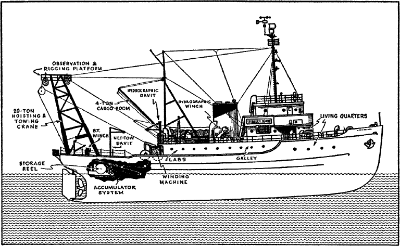
Profile of the Scripps Oceanographic vessel Spencer F. Baird, showing her main features. Horizon had a similar hull but differed somewhat in her superstructure.
“Yes. So we have to work backwards, correcting our dead-reckoning positions where we think we've been in the past four days, on the basis of this new star fix.”
And since there are no loran (longrange electronic navigation) stations in this part of the Pacific, the navigators must rely on star and sun sights for the ship's position at all times.
Leaving the bridge, Russ and I climbed down the steep ladders to the lab, two decks below.
The lab area extends from the midship section to within approximately 40 feet of the stern. It is about 16 by 27 feet in size. There are sinks, work benches, a chart table, and a desk, a circular Nansen-bottle rack and enough instruments to keep me asking questions from here to Samoa. Every inch of available space seems to house some delicate piece of equipment. I see less than two feet of passageway through the complicated maze that these geophysicists have managed to make of their lab. Each man annexed a cubbyhole where he has some drawers and a bench on which to work.
Here in this congested room the men were working, propped on stools or boxes if handy, also standing, either tinkering with their equipment, making measurements, or working on records.
At the chart table three men were huddled over a map of the ocean bottom. Weighty decisions as to the ship's course were apparently under discussion.
When he saw me, Roger stopped his work and handed me the log book that John Isaacs had been keeping and turned it over to me.
“Read this,” he said. “We'll begin work on it tonight after dinner,” and he told me that later I would be taught to stand the four-hour scientific lab watches which were around the clock, day and night.
“Let me learn one thing at a time,” I begged. “No lab watches yet. I'm not very mechanical.”
“Everyone stands watches on this ship except Kenny, Frank, and the mess boy,” he said.
The lab room was very hot, as the ventilation was poor, even though there were a few portholes open on either side and the door was open onto the stern. The men wore shorts, their bodies were covered with sweat. To get a breath of cooler air, I went out on the deck to the stern of the ship, which is called the fantail.
There on the stern was the large “A” frame which rises 32 feet above the deck and is designed to handle loads of equipment up to thirty tons.
Right behind the main deck laboratory were the large drums of the winch. Over a sheave of the “A” frame it was paying out a length of the eight-mile-long tapered steel cable carried below decks on a storage reel.
“When this spool is uncoiling the steel cable, you must stay off this part of the ship,” Russell cautioned me. I listened meekly.
And I began to worry. I knew I would have difficulty explaining how I ever happened to be connected with this two-ship expedition of seventy men. This trip of mine violates all American oceanographic traditions. Famous European oceanographers have taken their wives on parts of their globe-encircling travels. Professional women oceanographers have gone to sea. But I wonder if any other woman in America has ever joined a prolonged deep-sea geophysical exploration of the Pacific?
I hope they will believe me at home when I say it is a man's world, not for women, this cruising about studying the earth beneath the sea. It's not simple or safe. On this first day a
I want to learn everyone's name on this ship—the seventeen scientists and seventeen crew members. Luckily for me I've known most of the scientists for a long time: Roger since college days, our friend Walter Munk, my La Jolla neighbor Willard Bascom, and the young men—Dick Von Herzen and Alan Jones, who work with Russ, have been visitors many times at our home.
Gustaf Arrhenius and Henri Rotschi, newly arrived from Europe, I had known ashore, as well as physical oceanographers Art Maxwell and Ted Folsom.
New to me were Dick Blumberg, University of California engineer, and many of the men on the Horizon. Horizon had fifteen scientists and twenty crew members, and was much the same size as our Baird, but had no big winch like ours. The men aboard the Horizon had different measurements to make, and from their conversation I learned that weather balloons were released around the clock, hauls of plankton and fish were made by nets, and the sea bottom was dredged for samples.
Russell had been right when he had said, “You have no idea what our work or life at sea is like.”
There are no books or movies about geophysical deep-sea explorations for wives such as I. But now I'm learning. I've stumbled on to that once-in-a-lifetime opportunity of seeing Russ's work at sea.
Some scientists are fortunate and marry women with scientific backgrounds. Not Russell. My college degree was in English literature and my newspaper training included such topics as society, early California rancho history, and writing
Now I'll be taking a sea-going course in beginning oceanography. But I'll not receive a grade or a diploma when I get home. I do have one certificate now, which I received at Scripps Institution—for counting grunion. In studying these mysterious fish the biologists once tagged a certain number of them as they made their regular spring migrations to the shore, laying their eggs on the beach in the spring at high tide. I helped the marine biologists count the tagged grunion in the midnight hours and so became initiated as a life member of the “Society for the Investigation of Non-Gastronomical Characteristics of the Grunion,” with permission to spawn on the beach at high tide.
But the work on this ship does not seem to involve such simple tasks as grunion counting. We have geologists, chemists, geophysicists, engineers, and divers doing highly complex work aboard.
I look about our ship and see weird, intricate oceanographic equipment. Huge instruments suspended on a long cable disappear into the sea below for hours on end. Bottles in yellow cases with thermometers attached go overside, like a kite in reverse, only the bottles are fastened along the kite string at regular distances and this long wire penetrates far down into the water below. When these Nansen bottles have reached the correct depth a little “messenger” is sent down the wire and trips the bottles. They fill with water and come back laden with valuable samples of H2O at various depths.
Near the stern of our ship three men are examining a torpedo-like instrument which Russell says is usually towed when the ship is underway. Today our sister ship, the Horizon, 50 miles away, is dropping TNT charges. These make
This is a fascinating new world, and though there is much I do not understand, still, I'm learning. These men are exploring the depths below the surface. They're describing the shape of the ocean floor and what lies beneath it.
“We are gathering information so that we can write a history of the ocean,” explains Roger Revelle, Director of Scripps Institution of Oceanography and expedition leader.
I thought of the illustration I had seen of an area of the ocean bottom near Hawaii, the underwater Mid-Pacific Mountains. One looks at the picture and imagines that the ocean has been rolled away.
Every day, every hour with our instruments we are examining the sea beneath us … what is below?
And I am learning that there are many unanswered questions about our oceans. Have the oceans always been as they are now? Have the oceans grown through geologic time? Is part of the ocean getting deeper or shallower? Are the subcontinents sinking or rising towards the surface?