
3. Working-Class Wilderness
In planning the Adirondack Park, conservationists had envisioned nature as stable and predictable, an entity that followed fixed laws easily comprehensible to trained experts. If park supporters had initially focused little attention on the people inhabiting their new conservation experiment, they soon concluded that the region's human populace possessed few of the qualities that characterized its natural systems. In place of nature's order and harmony, Adirondackers seemed to be governed by a “peculiar moral attitude” that manifested itself in unpredictable, lawless behavior. “I have not found a single instance in which the State forestry laws are obeyed or even respected,” reported an outraged correspondent to the New York Times in 1889. “Instead of the employees of the State guarding against violation of the statutes or trying to enforce their provisions they assist in breaking them. The statement that the Commonwealth owns certain portions of the territory upon which they live has no apparent meaning to the mountaineers. … Not alone are the laws forbidding the cutting of timber upon State lands violated, but the game restrictions are never thought of by the mountaineers.”
This “opposition from the inhabitants of the northern counties … to every serious attempt made for the care and protection … of the North Woods” seemed inexplicable to most conservationists, given the benefits they believed the movement was bringing to the region.[1] As a committee of the New York State Assembly stated following an investigative tour of the park in 1899, “[We encountered much] grumbling by the old hunters
There is, to be sure, much that is correct about such analyses. The settlement of the American countryside was accompanied by tremendous ecological devastation as settlers endeavored to find marketable goods and remake the “wild” nature they encountered into a more familiar world of fields and fences. Yet the current scholarship remains elusive on a number of critical issues. Above all, while many environmental historians place capitalistic economic relations at the center of their analyses, they frequently treat capitalism as little more than a marketplace for the buying and selling of natural resources. Rarely do their discussions touch upon capitalism's social or cultural dimensions: its division of labor, its contesting classes with their distinct ways of conceptualizing the world. Submerging these differences has lent environmental history tremendous rhetorical power, but at the cost of obscuring the diversity of relationships that Americans forged with the natural world. Moreover, by failing to engage the perspective of nonelites, environmental historians have inadvertently recapitulated much of the degradation discourse of early conservation, especially the movement's leaders' vision of themselves as saving nature from “the ignorant or unprincipled.”[4]
The timber stealing and game poaching in the Adirondacks that so troubled the New York Forest Commission provide useful vantage points from which to reexamine this scholarly consensus. After all, at
Because maintaining the region's tree cover was a central rationale for conservation in the Adirondacks, one of the Forest Commission's initial goals was simply to prevent the illegal cutting of timber on state lands in the park. As Theodore B. Basselin, the prominent lumberman appointed forest commissioner, recounted, “When we took office in 1885, we knew but very little of the State management of the forest.” Upon surveying their new holdings, however, Basselin and the other commissioners “found a large number of trespasses, some very large and some small—the number so large that we were very much surprised.” Equally alarming, many residents appeared to consider the theft of wood from state lands a perfectly acceptable practice: “We also found that the people around the borders of this wilderness had been educated from time immemorial, that is, from the first settlement of the country, that what belonged to the State was public property, and that they had a right to go in there and cut as they wanted to; their fathers and grandfathers had been doing that, and that they had a birthright there that no one could question.” Finding it impossible to prosecute so many trespassers all at once, the commission “endeavored to single out the more glaring ones and endeavored to strike terror, as it was, into the people who were trespassing in that way.”[6]
To their dismay, however, Basselin and his colleagues encountered frequent difficulties in persuading locals to testify against the “timber poachers” in their midst. The inhabitants of the Adirondacks, the Forest
The Forest Commission's enforcement problems arose, however, not only from the mixture of neighborliness and intimidation prevailing in many Adirondacks villages but also from an even more fundamental cause: a profound disagreement with local residents over the definition of timber stealing. While conservation officials, in keeping with their program of state simplification, insisted on classifying all cutting of trees on public lands as theft, local residents considered such “crimes” to be, under certain circumstances, perfectly legitimate. These differing perspectives emerged in sharp relief during the investigation into lumber trespasses that the Forest Commission conducted in 1895. Asked about the frequent timber theft in the region, Robert Shaw, a farmer in Long Lake, retorted, “This country has been wild, you know, until within a few years, and the owners of lands here used to let the people, for their own use, cut any timber they were a mind to, anywhere; that was the former practice, and it never has been fully abandoned.” Flabbergasted, state officials queried Shaw as to whether the felling of trees on another's property was not a crime. “No, sir; it is not considered by the majority of the people a heinous crime at all,” replied Shaw. “Half of the people haven't got any wood of their own that lives around the vicinity. … and so they never have considered it any crime.”[10]
Adirondackers typically justified such behavior by claiming a natural right to subsistence. Under this logic, many of the acts recorded in the Forest Commission's trespass files—the cutting of “17–18 cords of stove wood,” the theft of “hard wood for fire purposes,” the stealing of state timber “to build a house and barn”—were not crimes at all but legitimate appropriations of necessary household resources.[11]“Men we would call in this locality honest, straight, lawabiding citizens,” noted Burke, “would consider it no crime whatever to take a few logs from State land.” Indeed, to those Adirondackers who depended on state woodlands for firewood, building materials, and other supplies, New York's Forest Preserve appeared less an exercise in the wise stewardship of nature than the callous denial by the Forest Commission of local access to essential resources. In numerous Adirondacks communities, almost all the nearby woodlands belonged to the state, leaving residents with little option but to steal timber from the new Forest Preserve. “In many localities, e.g., Raquette Lake, Long Lake village, and Saranac Lake village, the State owns nearly all the forest land, thereby making firewood and lumber scarce and high priced,” acknowledged the Forest Commission at the turn of the century. “Consequently, the inhabitants, becoming somewhat desperate, felt justified in obtaining their wood and lumber where it was most convenient, without regard to ownership.”[12]
Although conservation officials realized that many such trespasses were committed “for the sole purpose of obtaining firewood,” they nonetheless insisted that “the people who did the cutting [be] arrested, convicted and fined. … These parties, all of whom were very poor, pled in their defense that the State owned all the land in their vicinity, except for some small private preserves whose owners would not sell to them any timber for fuel. They claimed that they had gathered all the dead or fallen timber for a long distance, and that to go farther for such fuel made it cost more than firewood of any kind was worth. They complained loudly of the worthless quality of the old, fallen trees, which they dislike to burn, accustomed as they have been all their lives to using good ‘body wood’ in their cook stoves.” Several Adirondackers even dispatched anguished letters to the Forest Commission, asking officials to rethink their policies. As William Dunham of Piseco, Hamilton County, wrote in 1899, “I have been informed by one of the officers of your Commission that the people of this vicinity are forbidden to cut any firewood on State lands. … As a good many of the people here have no woodland of their own and cannot buy any of their neighbors, it becomes
Many locals defended their thefts of trees not only by stressing their right to subsistence but by placing their activities outside of the market nexus. As the Adirondacks native Henry Bradley explained in 1895, residents considered it perfectly legal to take firewood or building supplies from state lands if the materials were used for one's immediate household subsistence. From the local perspective, such activities only achieved the status of crimes if, in Bradley's words, one cut trees “for the purposes of marketing and selling the logs again.” “Though the cutting of timber from State lands for the market has been recognized as done in violation of the law,” agreed an investigative committee of the Forest Commission, “it seems not to have been considered a crime or offense of any kind for trespassers to cut timber upon State lands for firewood or for building purposes, chiefly of hardwood.” In keeping with this division between subsistence and market activities, local people also distinguished between which species of trees might legitimately be cut. To fell spruce, pine, or any other marketable softwood remained questionable (the only notable exception to this trend being the special cuts of cedar and pine essential for the construction of guide boats). In contrast, to take nonmarketable hardwoods was considered perfectly acceptable, as William Dunham's letter to the Forest Commission on his need for firewood suggests: “All the woods used as firewoods are hardwoods, no evergreen timber being used.”[14]
If the persistence of this subsistence, nonmarket ideology illustrates the reluctance of many rural folk to embrace a completely capitalist orientation, it also reveals the uncertain ethical terrain Adirondackers had come to inhabit by the close of the nineteenth century. Residents might, in keeping with enduring agrarian notions of simplicity and self-sufficiency, give moral primacy to subsistence practices. But by the 1880s, none lived a completely subsistence lifestyle. Thus, as much as holding up subsistence as a moral ideal may have appealed to Adirondackers' image of themselves as independent pioneers, it curtailed their ability to address the true dilemmas that they faced—issues such as
As a result of this confusion, residents found it difficult to arrive at a consensus as to what constituted an appropriate middle ground between subsistence and capitalist engagement. In the case of timber theft, some Adirondackers reasoned that if the taking of firewood and building supplies for subsistence was a reasonable practice, it should also be justifiable to sell stolen timber if the resulting cash was used to buy household staples. Such logic held a particular appeal for residents with few other means of generating revenue, and throughout the 1880s and 1890s one could find a “mostly … poor class of citizens who own little or no land of any character” pilfering logs from the Forest Preserve. One of the most common targets for such thieves was trees stolen for shingles or “fiddle butts” (the bottom part of large spruce, used to manufacture sounding boards for fine pianos). Those who committed such crimes often claimed that since they possessed little property of their own, they had few alternatives but to sell resources from state lands. When Inspector Seymour C. Armstrong confronted a man he caught stealing logs from the Forest Preserve in 1895, for example, the thief responded that he was “a poor man and was obliged to take the timber to get something to live on.” Foresters reached a similar conclusion about the timber thief Charles Barney: “Barney has no means of support except cutting and selling wood and timber from state lands on which he resides.” Local juries, the Forest Commission soon learned, displayed frequent sympathy to such arguments. “If this man happens to be a poor man who is being prosecuted,” grumbled one inspector, “he has the sympathy of his friends and neighbors, and the very men who are on the jury are men possibly who have been engaged in some such operations themselves.”[15]
Residents may have also tolerated the theft of trees for shingles or fiddle butts because they recognized that neither activity posed an overwhelming threat to local forests. Only a few trees were suitable for either product, forcing trespassers to cut selectively. Furthermore, after felling their trees, the thieves still had to invest a considerable amount of time and labor to transform the raw timber into a marketable commodity. Shingles, for instance, were produced using a shaving horse, on which the shingle maker would sit and, using a drawing knife, shave shingles from a carefully trimmed log. Fiddle butts required less intensive reworking prior to sale, but, unlike other logs, they could not be floated to downstream mills, as water was believed to damage the
Although the Forest Commission devoted much of its resources to stopping such practices, the stealing of trees for fiddle butts or shingles did not constitute the Adirondacks' most common form of timber theft in the 1880s and 1890s. Measured in terms of quantity of trees stolen, by far the most common form of timber theft was in fact the largescale cutting of timber by crews working for lumber companies. Such trespasses were typically planned in advance and sifted through several layers of oral contracts. “A contract to cut timber usually passes through many hands before it comes to the man who actually does the work,” charged state investigators in 1895. “An effort to shift the responsibility for cutting over the lines is shown. … In general the jobbers have cut the timber wherever employed by contractors or lumbermen to do so, without investigation or concern as to whether the land belongs to the State or not; and the common workmen have been, if possible, even more indifferent to the ownership of the land, so long as they have made a living from their work.” These arrangements enabled timber concerns to shield their involvement while leaving the woodsmen who did the actual trespasses on state lands to face the risk of fine or arrest alone. Observed the New York Times in 1889, “The scheme of ‘letting jobs,’ as it is known here, is partly responsible for the difficulty of fastening the guilt of the illegal cutting upon the persons who authorize it. A boss lumberman will direct a lumberman to cut a specified tract. The lumberman employs his men and they henceforth go on with the work not in any sense subject to the direct control of his employer. … Should proceedings be taken by the State, [the subcontractor] is compelled to show his instructions very clearly or he is the man who is regarded as responsible.”[17]
The rise of this widespread theft occurred at much the same time as several other key shifts in the timber industry, which would in the 1880s transform lumbering in New York into an enterprise far different from the one Adirondackers had known just a few years before. While earlier timber operations had focused on cutting large softwoods located within a few miles of waterways, the rise of the railroad and the pulp mill in the closing decades of the nineteenth century altered this longstanding pattern. Liberated by the train from their dependence on rivers for transportation, lumbermen expanded their activities dramatically, cutting many previously untouched portions of the Adirondacks and taking many of the hardwoods that timber crews had previously left
Because of the pressure that these changes placed on wildlife habitats and their own wood supplies, a number of Adirondackers began to insist, in the words of resident D. F. Sperry, on the need “to protect the state lands from the vandalism of the lumberman.” “There is no prejudice existing in Franklin county in favor of lumbermen,” observed the county's chief fish and game protector, J. Warren Pond, in 1891. “On the contrary they are regarded with some suspicion on account of the desire of people to preserve the forests and [waters] and the game therein.” That same year, in a move that would have surprised those who believed that rural folk uniformly favored the rapid exploitation of natural resources, the Adirondack News called for stricter supervision of the region's lumber industry. “Let the state appoint wardens to supervise the cutting of timber and allow no trees of less than twelve inches in diameter to be cut; and let the most stringent enactment be made against charcoal manufacturers and the establishment of pulp mills,” editorialized the News, “and there will always be forests.”[19]
As a result of this local opposition to the timber industries' rapid expansion, those working for illicit timber crews did not always enjoy the same popular acceptance as the region's other timber thieves. To those Adirondackers worried about lumbering's growing impact on their region, such groups seemed too cozy with the timber industry that, in their eyes, constituted the real bandit in the region. Nathan Davis, a local surveyor, contended that it was such companies, not the poor resident taking some firewood or building supplies for his or her own use, that were the Adirondacks' true criminals: “Trespasses are done by men of some considerable means, lumbermen. … ordinary people, as a general thing, do not steal timber from State lands.” To contain such local unease, a few black marketeers took the precaution of organizing themselves into gangs—some sporting names such as the “State Troops” and the “Grenadiers” that offered ironic commentary on the Forest Commission's conservation efforts—and issuing threats designed to keep residents from interfering with their activities. A favorite territory of one
Despite such measures, the heyday of the Adirondacks timber gang lasted little more than a decade. The Forest Commission's ability with each passing year to map and patrol its holdings with greater precision soon made it difficult for organized groups to steal the large quantities of logs that the timber industry sought. By 1900, the Forest Commission could report that of the forty-six cases of trespassing it had prosecuted that year, only one had been connected to a lumber company. Instead of stealing timber outright, many lumber concerns began to exploit the weaknesses of conservation in other, more subtle ways. A number of companies seized upon the confused status of property titles in the region to strike sweetheart land deals with sympathetic members of the commission (several of whom, like Basselin, were drawn from the ranks of New York's prominent lumbermen). In 1894 and again in 1910, such scenarios led New York to investigate charges of fraud in the Forest Commission and to dismiss several leading conservation officials.[21]
Yet, even as theft by the lumber industry declined sharply at the turn of the century, subsistence pilfering continued unabated in the park. Exasperated commission members admitted in 1897 that “petty trespassing” remained widespread throughout the Adirondacks, especially “by residents who wanted some building material or fuel.” Well into the twentieth century, the bureau found itself plagued by “the poorer class of residents who t[ake] trees for firewood,” with thefts of fuel constituting the vast majority of the trespass cases the commission investigated. Because of their detailed knowledge of local conditions, these thieves proved nearly impossible for the commission to apprehend. Typically, local timber poachers slipped onto state holdings late at night, bringing along their dogs to warn them of the approach of any strangers. After tying a coat or blanket around the trunk of a tree to muffle the sound of the ax, they would cut a few logs, which they would then spirit out of the preserve as quickly as possible. “A man will go with his boy or his neighbor and cut two or three trees and take them away in the middle of the night,” declared Warden Samuel Gorman. “There is no way of getting hold of them.”[22]
Although this ongoing pilfering posed little threat to the survival of the Adirondacks forest, it stood as a potent symbol of the standoff that had developed between the Forest Commission and local residents. In spite of its foresters and its attempts at simplification and surveillance,
For all the controversies surrounding timber theft, no facet of conservation proved more contentious in northern New York than the game law. To the deer and other animals of the chase, it doubtless mattered little who was trying to kill them. But to the other participants in the process—sport hunters and local residents alike—who was hunting, how, and why mattered a great deal, turning the pursuit of game into a flash point over the questions of who should control the Adirondacks' natural resources, and to what ends.
Sports' approach to hunting was derived from a curious amalgam of British upperclass tradition, imported to the United States by English expatriates such as Frank Forester, and a homegrown desire to recreate the imagined world of the American frontier through “occasional relapses from the restraints of civilization into the primitive conditions of the backwoods.”[23] Out of this peculiar mixture of history, militarism, and upperclass pretense, there developed during the late nineteenth century a sportsman's code in which how one hunted was almost as important as what one hunted. This approach led, in turn, to impassioned debates among sports hunters over what constituted the best test of the manly skills that hunting was supposed to measure. Some sportsmen contended that “driving with dogs” represented “the fairest, manliest and most interesting” way of hunting, while others asserted that the still hunt (the unaided stalking of game) was “the only fair and manly way of hunting anything.”[24]
If there was one point that sports did agree upon, it was that their behavior was not the cause of game scarcities in popular hunting spots like the Adirondacks. “We believe that more deer are killed by the few score guides in [the Adirondacks] … than by all the sportsmen put together,” declared Forest and Stream in 1874. This indictment of local practices, echoed repeatedly in the pages of the leading sporting journals of the day, pointed toward an obvious conclusion: that protecting the wildlife in the Adirondacks depended on setting stricter limits for
As might be expected, most Adirondackers strongly disagreed with such interpretations. Residents pointed out that wealthy sports hunters did not need the game they killed—hunting, after all, was for tourists a leisure activity. By contrast, hunting was for locals an integral component of household subsistence. “We lived off the land, and the deer were there, and you ate them the year around,” noted resident Bill Smith.[26] To such folk, it seemed unfair that New York's game law failed to distinguish between rural need and elite leisure. Rather than passing laws for “the benefit of the cities alone,” argued Christopher J. Goodsell of Old Forge, the legislature should “make the game laws for the poor as well as the rich.”[27] Many inhabitants fondly recalled an earlier era when the state had not meddled in their hunting practices. “Times is different now,” grumbled Alvah Dunning in 1897: “In them days nobody said a word ef a poor man wanted a little meat an' killed it, but now they're savin' it until the dudes get time to come up here an' kill it an' some of 'em leave a deer to rot in the woods, an' on'y take the horns ef it's a buck, or the tail ef it's a doe, just so's they can brag about it when they go home, an' they'd put me in jail ef I killed a deer when I needed meat.” To Dunning and others like him, this contrast between the seriousness of local subsistence and the frivolity of outside sport highlighted the obvious inequities of the game law.[28]
By the close of the nineteenth century, the growth of tourism had propelled such issues to center stage in the Adirondacks. One glimpse of the resulting clash in perspectives can be found in the brief exchange that took place between Charles Hoffman, a visiting sport, and John Cheney, his guide. The two were out hunting and had already killed some birds and a deer when Hoffman spotted a covey of partridges. To Hoffman's suggestion that they increase their bag by shooting some of the partridge, Cheney replied, “It's wrong, it's wrong, sir, to use up life in that way; here's birds enough for them that wants to eat them; and the saddle of venison on the buckboard will only be wasted, if I kill more of these poor things.”[29] Adirondacks local David Merrill offered an even more caustic critique of sports hunting as a wasteful, even cruel, activity. On several occasions, foresters arrested Merrill, his father, and brother for netting fish in the lake near their home. Yet the Merrills maintained that a net, while illegal under the new game law,
A party of young gentlemen came north to kill some deer;They did not know Brave Golden was well known to hunters here;They struck his track with well-bred dogs and boasted of the same. Lo! soon the king through grove and glen proved both grit and game.
For three long days they chased him o'er hills and mountains high, Till hounds and men surrounded him, each moment pressing nigh;He seemed to plead for mercy. Alas! it was in vain;He was shot and shed his life's blood on the bosom of Champlain.
We miss Brave Golden from his herd, we miss him from his home, We miss him from each grove and glen through which the king did roam;Our hounds will never strike his track to make the valley ring;The stranger's cruel, deadly shot laid low our noble king.[31]
The regret running through Sheehy's poem was not only for the demise of Old Golden but also for the loss of the system of local controls over the environment that the Adirondackers had once exercised. Residents found their environmental practices under attack on several fronts during the 1880s, first by a loss of legitimacy to the state's conservation code and then by the scores of sports hunters, “strangers” unfettered by community ties, pouring into the region.
Initially, most Adirondackers viewed New York's new game laws as offering few solutions to these problems. Locals were quick to observe
Information reaches us that along the Moose river and in many parts of the Adirondack region, deer are being slaughtered in a great number by certain parties who hunt and shoot these beautiful creatures for mere sport. A week or more ago hunters from Utica and Holland patent killed twelve deer near Moose river and the carcasses of the animals were left in the woods to rot. Such “sportsmen” as these should not be permitted to pursue their cruel and destructive business, which will soon rid the forests of the game that is so prized and ought to be in some manner protected from the wholesale slaughterers. … Altho' the letter of the law does not prohibit such unnecessary slaughter, the spirit of it certainly does. The man who shoots more game or catches more fish than he can make use of, is not a sportsman in any sense of the word.
There was only one solution, according to the Herald: “persons who are interested in preserving the game in the Adirondacks should band together for the purpose of keeping out the deer slayers.”[32]
Apparently, others agreed. The closing decades of the nineteenth century witnessed a number of collective efforts by residents to control the hunters in their midst. During a return trip to the Adirondacks in 1875, for example, Headley learned of one sportsman who had recently visited the region, killing large numbers of deer. His overhunting so enraged “the scattered settlers and guides” that “at length [they] sent him word that if he ever came there again they would make an example of him, and he has since prudently stayed away.” Local outrage coalesced into more formal modes of action at this time as well. In early 1883, for instance, a number of the inhabitants of Boonville, upset by the “unscrupulous butchers in the guise of sportsmen [who] have unmercifully slaughtered hundreds of deer in this section of the country,” formed a club to watch over their local forestlands. The club members raised money among themselves to pay for “two able and efficient guides … to secure evidence against parties who engage in illegally killing deer.” Three years later, a similar movement took place in the Keene Valley area of the Adirondacks. Despite the opposition of
Such developments complicate the prevailing interpretation of game laws as an unwelcome sanction from above, imposed on a restive and resisting rural populace. To be sure, many Adirondackers manifested open hostility to the new laws that governed when and how they could hunt. But others came to find ways in which the state's conservation program could be used in place of the region's earlier, community-based regulatory regimes. The forester John Hunkins noted just such a shift in his territory in St. Lawrence County. “On my first trip,” Hunkins recalled, “I was unable to obtain a boat or any accommodations from these people for any consideration. Our lives were in constant jeopardy, either from those we had prosecuted or from those who feared being called to account for their many misdeeds.” With the passage of time, however, some residents began to see Hunkins as a useful ally against those who abused local resources. “Now,” declared the forester, “some who had been the most outspoken are my most valuable and able assistants; ever ready to carry me from point to point and give any information they possess.”[34]
Adirondackers were especially quick to direct foresters against unpopular outsiders such as sports hunters and preserve owners. In the 1890s, for example, people living near Lieutenant Governor Woodruff's private park in the Adirondacks tipped off local foresters that Woodruff was keeping a pack of dogs for deer hunting, in violation of the law against hounding. At much the same time, locals employed at J. Pierpont Morgan's private park confided to the Raquette Lake game protector that Morgan had been fishing out of season. The protector's search of Morgan's camp revealed thirteen lake trout, resulting in a $ 155 fine. In 1903, the Adirondack News celebrated the fact that “twenty-four violators of the game laws, who were hunting on state lands in the Adirondacks, the number including prominent business and professional men of New York, Albany, Troy, Schenectady and Saratoga, have been arrested as the result of good work done by Protectors Mattison and Hawn.” And, in 1906, in what was perhaps their crowning achievement, some friends of Oliver Lamora brought about the arrest of John Redwood, the superintendent of William Rockefeller's private park, and Harry Melville, one of Rockefeller's gamekeepers, on charges of deer hounding, causing them to be fined one hundred dollars apiece.[35]
By exposing elite lawbreakers, Adirondackers sought not simply to punish certain individuals but also to undermine a key assumption of conservation's degradation discourse. While conservationists might depict rural folk as ignorant and environmentally destructive, residents pointed out that many violators in the Adirondacks were in fact drawn from the ranks of ostensibly enlightened sports hunters. “Sportsmen come here and force their guides under penalty of dismissal to fish out of season,” charged C. H. Larkin, a guide from St. Regis Falls. “What is a guide to do under such circumstances? A guide has no influence to inforce [sic] the laws or prevent the infraction of them, particularly when opposed to sportsmen who are oftimes among the richest lawgivers of opulent cities.” In a similar vein, when the inhabitants of Tucker Lake formed a club to “fight Rockefeller's men” in 1903, they called themselves the Adirondack Game and Fish Protective Association—a name that appropriated the very language of conservation to articulate the residents' vision of themselves as the genuine protectors of the Adirondacks wildlife against rapacious private preserve owners.[36]
Yet if Adirondackers insisted on strict enforcement of game laws against outsiders, they rarely applied the same standards to fellow community members. As Forestry Quarterly noted in 1902, residents frequently overlooked violations when “bound by the ties of kin, of friendship, of neighborliness. … The game wardens are prompt against a stranger, but the local offenders who go unpunished are numberless.” Even when foresters did arrest locals for breaking the game law, sympathetic courts often refused to punish the wrongdoers. “It has been said that a Hamilton county jury would not indict a resident for violation of the game law,” griped Seymour Armstrong, the game and fish protector in Hamilton County, in 1887. The career of Isaac Kenwell, Armstrong's replacement, demonstrates the validity of Armstrong's observation. Of the seven people that Kenwell prosecuted in 1894 for violations of the game law, three were acquitted, one never showed up to trial, and one, having pled guilty to killing a deer out of season, received only a suspended sentence. Only two suffered any penalty: fined ten dollars apiece for “illegal fishing,” the defendants never paid, serving ten days of jail time instead. Concluded Kenwell, “It is very hard to get a conviction in the County Court of Hamilton for violation of the Game Law, as the jurors are most all old violators or are friends of the violator, and their sympathy is with the offender.”[37]
To justify their violations of the game law, Adirondackers called upon a complex of beliefs that linked hunting to the proper ordering of
In addition to asserting their right to this republican ideal, residents claimed—just as with the cutting of trees for firewood or building supplies—that they also had a natural right to subsistence. “If I'm hungry, I've a right to furnish myself with venison,” maintained one local when asked about his violations of the game law. “The law of [nature] and necessity permits it, and that I say, again, is higher than the statut' book.” “[The deer] were given to us for food, and it matters not how we kill them,” contended another. Adirondackers asserted that this right to subsistence predated and preempted any claims the state might have to the same resources. As one longtime resident quipped, “When they made the game laws down in Albany, somehow they skipped Spruce Mountain,” his favorite local hunting area.[39]
The ethical framework that residents applied to hunting paralleled their approach to timber cutting in other respects as well. In much the same manner that Adirondackers considered the felling of trees for nonmarket uses to be the most justifiable form of timber trespass, they viewed the taking of game to be most morally defensible when the hunter used the animals for family subsistence rather than selling them. Recalling his boyhood hunting in Herkimer County, Henry Conklin declared, “Everybody got them [white-tailed deer] and supposed they were free as water. There was never any wasted, for they were not killed expressly for their saddles to supply the market. No, they were killed because we were poor and had to have meat.” Questioned in 1885 about conditions in the region, Ernest H. Johnson of Tupper Lake ventured a similar preference for nonmarket hunting: “Stop the hunting and fishing (out of season) for market, and pass an act making it unlawful to buy or offer for sale any venison in the Adirondacks. I would
Much as occurred with lumbering, however, the moral certainties of this subsistence position began to erode in the late nineteenth century. As the market cast an increasingly long shadow over the region, a number of inhabitants fastened upon market hunting as a preferable alternative to other, seemingly more dependent and less profitable forms of capitalist engagement, such as wage labor. Both such factors exhibit themselves, for instance, in the thinking of Albert Page of Lake Pleasant, who enthused after killing a partridge in the early 1900s that “he had … made a good day's wage as he was going to sell [the bird] for $ 1.” At the same time, the activities of market hunters such as Page placed them at odds with residents who adopted other economic strategies during this period—especially guides, who sought to preserve their relatively well-paying jobs by maintaining a pool of wildlife that would attract employers to the region.[41]
As such divisions reveal, the conflicts that unfolded in the Adirondacks over the game law pitted residents against not only outside conservationists but also against members of their own communities. The peculiar mixture of subsistence, lumbering, and tourism that prevailed in the Adirondacks left the region's inhabitants with a number of tensions that were difficult, if not impossible, to reconcile. As a correspondent for the Hamilton County Record reported in 1895, “After a deliberate and diligent inquiry with the people, regarding the proposed changes in the game laws of the state that are now agitating people here … I am forced to the opinion that no law can be framed which will be satisfactory to all.” Some residents hoped to preserve their economic autonomy through market hunting. Others wanted to outlaw market hunting completely because of its potentially devastating effect on the region's game population. Some residents preferred to hunt by hounding and jacking because of the efficiency of such techniques. Others feared that these practices enabled sports hunters to decimate local wildlife. Some residents were willing to accept the larger quantities of deer that sports killed with hounding and jacking, because these successes attracted more
Much like the timber law, then, the game law became the terrain on which Adirondackers negotiated the new circumstances governing their lives. If they were never able to resolve all the competing agendas of their fellow community members, the considerable energy that Adirondackers devoted at the turn of the century to debating game legislation demonstrates that they were not, as conservationists often imagined, opposed to laws per se. Moreover, in many cases residents advocated not “wide open laws” but regulations, such as those against market hunting or the killing of does, that were far more restrictive than New York's existing statutes. Viewed from this context, Adirondackers' violations of the forest code emerge not as a manifestation of their inherent disregard for all law but as a sign of their frustration with a simplistic regulatory regime that failed to take into account their wants and needs. As one resident put it, “The laws were made by men who don't know what we need here. Give us some laws we can take care of and we'll put them through.”[43]
As a result of the coming of conservation, the residents of the Adirondacks inhabited a landscape that, by the mid-1890s, was far different from the one they had known only a decade or so earlier. Many of the forests where locals used to cut firewood and building supplies had become part of New York's Forest Preserve and were now patrolled against trespass by the state's new forester force. The wildlife in the region was now subject to an array of new state laws that limited the season and manner in which game could be hunted. The building of homesteads on unused state land had become criminalized as squatting.
Wage work assumed a variety of forms in the Adirondacks, from sawing logs in a lumber camp to cleaning dishes in a hotel. But the guiding of sports emerged as the most avidly sought position, for it offered comfortable working conditions and, by regional standards, relatively high pay. As the competition for employment increased in the closing decades of the nineteenth century, guides responded by establishing a number of local clubs designed to increase their control over hiring and wages. A correspondent to Forest and Stream explained in 1883 that the Adirondacks' guides had become “nearly all members of associations. … There are Blue Mountain guides, Saranac guides, Long Lake guides, Fulton Chain guides, St. Regis, Raquette, and I don't know how many others, and a migratory sportsman finds that he cannot depend upon a cordial reception being given to his guide if he takes him into the limits claimed by a body of which he is not a member.”[45] Over time, these clubs established a system of work rules that was closely followed throughout the Adirondacks. These practices subdivided the region into different districts, each served by a corps of guides drawn from the local community. “Adirondack guides do not roam aimlessly through the entire wilderness in search of employment,” noted the New York State superintendent of forests, William Fox. “Each one attaches himself to some particular locality. They strictly adhere to the rule that the guides in each locality are entitled to the patronage of all tourists, travelers, or sportsmen starting from within the precincts of certain guides' territory.” Under this system, a guide who lived in the vicinity of Blue Mountain Lake, for instance, would guide only visitors to that area. If his sport subsequently decided that he wanted to journey on to the lakes of the Fulton Chain, the guide would convey his client to a place where
Guides followed other rules as well. No guide, for example, accepted employment for less than a day. Nor did guides rent out untended boats. Visiting sports who wanted the use of a boat were required to hire a guide to accompany them. Should these controls be threatened, it was not unknown for guides to take violent measures to protect what they took to be their prerogatives. When a man named Theodore White brought a steampowered boat, the “Lake Lily,” to Lake Placid in the 1880s, for example, it was consumed not long afterward in a suspicious blaze, said to have been ignited by angry guides who considered transporting tourists to be their exclusive right and the handrowed guide boat the only acceptable vessel for doing so.[47]
Localistic, informal associations throughout the 1880s, the guide clubs reshaped themselves in the 1890s as conservation heightened the importance of wage labor. In 1891, representatives from the region's various clubs gathered together in Saranac Lake to form the Adirondack Guides' Association (AGA)—the first time all the guides in the Adirondacks had ever been unified into a single organization. While the exact membership varied over the years, over 200 guides attended the AGA's formative meeting, and a broadside that the association published in 1897 lists 233 guides as members.[48]
Although the AGA carefully avoided calling itself a union, in a number of key respects it paralleled the craft unions founded by artisanal workers during this same period. Like a craft union, the AGA provided sickness, death, and disability benefits to members and their families, and it strove to maintain a uniform rate of pay: three dollars a day plus expenses. “The rates asked by the guides are uniform throughout the entire region … and firmly fixed,” noted the Forest Commission in 1893. “The tourist and sportsman will find that there is nothing to be gained by haggling over them.” Most important, the AGA sought to limit membership, and thus employability, to a select few. Potential AGA members had to pass through a rigorous accreditation process.
Despite these resemblances to other craft unions, the AGA possessed several features that set it apart from the typical labor organization. By far the most unusual concerned membership. While the AGA accepted only guides as full members, it invited sports hunters to join as “associate members” who paid dues but were unable to vote on any of the association's resolutions. Following his election in 1891, the AGA's first secretary, J. Herbert Miller, initiated an aggressive mailing campaign to attract as many prominent sportsmen as possible to join the AGA. Surprisingly, many sports—perhaps because of the appeal of rubbing shoulders with manly Adirondacks hunters—responded enthusiastically to the opportunity to become duespaying, nonvoting members of what was, in effect, a rural craft union. In the words of Forest and Stream, “Many of the most prominent citizens of New York State have enrolled. Among them are State officials, hotel men, prominent physicians and attorneys, members of the press and of the various Adirondacks clubs.” Another of the AGA's unusual features was its creation of the post of honorary president, which was held not by a local guide but by a prominent outsider. For most of the AGA's early years, Verplanck Colvin, the head of the Adirondack Survey, filled the position. Colvin's main duty was delivering annual addresses, in which he typically celebrated the AGA as a unique organization, able to bridge the class divide that so troubled American society elsewhere. “In this form of association you have set a wonderful example to the labor organizations of the world,” he remarked at the AGA's first annual meeting. His annual speech four years later struck a similar note: “You have brought about … the preliminary steps toward that combination of capital and labor which has been the dream of some political economists and the hope of patriots.”[50]
As Colvin's words underscore, the fact that the AGA was willing to accept both laborers (guides) and their employers (sportsmen) would seem to make it a curious union indeed, one that scarcely seems to demonstrate the class consciousness that, according to some definitions, is essential to a workers' organization.[51] As peculiar as it was, however, this arrangement offered several tactical advantages. The first and most
A final incentive for including sportsmen in the AGA was the leverage that sports provided in the union's efforts to shape regulations in the region. Each year at their main meeting, AGA members voted on resolutions recommending changes in the state's timber and game laws. In 1895, for example, the AGA voted in favor of a measure urging the New York State Legislature to enact a law “that no brook or lake trout, or venison, be sold or offered for sale in any of the counties comprising the forest preserve at any season of the year.”[55] Other measures passed in subsequent years by the AGA and by the Brown's Tract Guides' Association (BTGA, a group from the Fulton Lake district that split from the AGA in 1898 over the issue of hounding) called for increasing the quantity of state land in the park, for an end to the killing of does, and for more protection of the black bear.[56] The inclusion of well-connected associate members provided both groups with a conduit through which such resolutions could reach an audience beyond
Through such measures, the members of the AGA and BTGA sought not simply to improve their immediate working conditions but also to articulate their own vision of conservation. Members stressed their ties to the Adirondacks, which, they argued, made them especially sensitive to the condition of local plants and wildlife. Rather than threatening the region's natural resources, as conservation's degradation discourse posited them as doing, the guides envisioned themselves as “the true gamekeepers of the magnificent park in which most of their lives have been spent.” While conservationists believed that rural folk's economic dependency led them to embrace destructive practices, guides turned this dependency into a positive good, arguing that it forced them to steward local resources. A guide “sees in the forests, in the fish, in the game his stock in trade,” explained J. Herbert Miller, the AGA's secretary, in 1895. “The forests,” Miller added, “can best be protected by those residing within their borders, especially by those who are interested in their preservation that their means of livelihood may be retained.”[58]
With their allusions to virtuous locals and misguided outsiders, the AGA and BTGA shared some of the anticonservationist, antisportsman rhetoric of other Adirondackers.[59] But the guides' language of protection and their economic and social links to prominent sports also gave them the ability to forge alliances with conservationists. In fact, in the 1890s and early 1900s the AGA and the BTGA were active participants in several conservationist schemes to restore the Adirondacks wildlife. The most successful was an effort to increase the beaver population in the Adirondacks, which by 1900 had dipped to an estimated twenty animals, all located in Township 20 in Franklin County. In 1904, the Forest Commission bought seven Canadian beaver. The animals wintered in Old Forge, where they were cared for by the BTGA at its own expense. The following spring, an “Army of Liberation” composed of BTGA members released the animals at various promising spots within the park. In 1906, the Forest Commission purchased twenty-five more beaver, this time from Yellowstone National Park. The BTGA again oversaw the care and release of the animals, which took so readily to their new surroundings that by the 1920s the beaver population within the park had climbed to an estimated twenty thousand.[60]
The fact that some Adirondackers would maliciously shoot the very same animals that other community members were caring for testifies to the deep fissures that had developed within Adirondacks society by the turn of the century. Ironically, at the very moment that the region's guides had begun to accommodate the new conservationist order, other inhabitants were unleashing a wave of spectacular protests against conservation, of which the killing of the unfortunate moose and elk comprised just one example. In 1899, 1903, 1908, and again in 1913, vast forest fires swept across the park, burning more than a million acres of state and private land. While many of these fires could be attributed to the fire hazards created by the region's spreading railroad system, a significant proportion was the work of arsonists. (See Table 5.) After the forest fires of 1903, for example, which scorched over 450,000 acres in the Adirondacks, the Forest Commission declared that “some conflagrations were started by incendiaries and degenerates, prompted by malice, revenge, or criminal instincts.” Commissioners charged that “in nearly every [Adirondacks] village there is a disreputable class whose presence is inimical to the preservation of our forests. They are the men who, having been arrested at some time for violation of the Game Law or timber stealing, have a grievance against the authorities.
One potential answer to this puzzle comes to us from other nations' experiences with conservation. The scholar Ramachandra Guha, for example, has proposed that the frequent arson in India's forest districts reflects an alienation from nature produced by state forestry policies. According to Guha, peasants excluded from woodlands where they had once foraged began to view the forest not as source of sustenance but “as an entity opposed to the villager”—a symbol of their displacement and disempowerment. Consequentially, peasants retaliated by burning the woodlands they had once depended upon. In much the same manner, the historian Eugen Weber has explained the massive fires that greeted the rise of forestry in France by arguing that the French peasantry “had come to hate the forests themselves, and hoped that if they ravaged them enough they would get rid of their oppressors.”[68]
Revenge certainly explains a substantial portion of the arson in the Adirondacks. Asked years later about the region's frequent forest fires, one longtime inhabitant recalled, “Hell, we had to wait for droughts to get even. I remember my father cursing the rain that seemed to be always falling on the Adirondacks. We didn't get much chances, but we took them when we got them.”[69] Residents had multiple reasons for seeking vengeance: the state's restrictive new hunting law (“If they don't stop bothering us with this game law business, the people will burn down the whole north woods”); the Forest Commission's efforts to uproot squatters (“Threats have been made by certain squatters that if ejected they would seek revenge by burning up the North Woods”); and the prosecution of timber thieves (“If the State attempted ‘to slaughter’ these men, it would be the worst thing the State could do to preserve the lands. … the trespassers would retaliate by firing state lands”).[70] Such threats, which transformed the forest into a hostage whose very survival depended on the state not antagonizing local residents, often proved
| Causes | |||||||||
|---|---|---|---|---|---|---|---|---|---|
| Year | Number of Fires | Acreage Burned | Carelessness | Fisherfolk | Berry Pickers[a] | Smokers | Hunters[b] | Railroads | Clearing land[c] |
aBerry pickers set fires to encourage the growth of a fresh crop of berries. | |||||||||
bHunters set fires to drive game and to create new browse for deer. | |||||||||
cFarmers used fire to prepare their fields for planting. | |||||||||
| SOURCE: Howard, Forest Fires, 19. | |||||||||
| NOTE: Forest Preserve counties were located both in the Adirondacks and in the Catskills. | |||||||||
| 1891 | 65 | 13,789 | 4 | 5 | 2 | 1 | 7 | 18 | |
| 1892 | 33 | 1,030 | 1 | 8 | 18 | ||||
| 1893 | 13 | 8,790 | 1 | 2 | 5 | ||||
| 1894 | 50 | 17,093 | 6 | 1 | 10 | 14 | |||
| 1895 | 36 | 2,448 | 2 | 2 | 1 | 1 | 4 | 14 | |
| 1896 | 116 | 29,817 | 4 | 4 | 3 | 2 | 9 | 41 | |
| 1897 | 98 | 26,187 | 6 | 1 | 1 | 5 | 3 | 11 | |
| 1898 | 98 | 9,648 | 3 | 6 | 1 | 1 | 4 | 16 | 28 |
| 1899 | 322 | 51,565 | 7 | 15 | 30 | 11 | 62 | 24 | 31 |
| 1900 | 127 | 14,893 | 6 | 5 | 2 | 6 | 8 | 21 | 19 |
| 1901 | 7,780 | ||||||||
| 1902 | 21,356 | ||||||||
| 1903 | 643 | 464,189 | 6 | 47 | 3 | 23 | 7 | 121 | 89 |
| 1904 | 101 | 2,627 | 3 | 8 | 14 | 9 | 21 | 20 | |
| 1905 | 126 | 4,795 | 9 | 2 | 2 | 18 | 10 | 31 | 8 |
| 1906 | 142 | 12,500 | 1 | 14 | 2 | 14 | 8 | 20 | 9 |
| 1907 | 198 | 5,653 | 6 | 10 | 6 | 5 | 2 | 48 | 21 |
| 1908 | 596 | 368,072 | 15 | 19 | 14 | 34 | 100 | 89 | 21 |
| 1909 | 356 | 11,759 | 28 | 14 | 31 | 25 | 19 | 45 | 38 |
| 1910 | 277 | 12,680 | 12 | 23 | 3 | 39 | 37 | 60 | 24 |
| 1911 | 595 | 37,909 | 40 | 35 | 38 | 72 | 10 | 109 | 35 |
| 1912 | 383 | 6,990 | 13 | 37 | 7 | 59 | 10 | 93 | 17 |
| 1913 | 688 | 54,796 | 120 | 31 | 224 | 14 | 78 | 43 | |
| TOTAL | 5,063 | 1,186,366 | 159 | 375 | 177 | 551 | 310 | 819 | 524 |
| PERCENT OF TOTAL NUMBER OF FIRES | 3.1 | 7.4 | 3.5 | 10.9 | 6.1 | 16.2 | 10.4 | ||
| Causes | |||||||||
|---|---|---|---|---|---|---|---|---|---|
| Arson | Campers | Lightning | Burning Buildings | Children | Logging Engines | Sawmills | Bee Hunters[d] | Blasting | Unknown[e] |
dBee hunters used fire to smoke bees out of their hives. | |||||||||
eMany cases of arson or of fires set to clear farmland may have gone unrecorded by local fire wardens who did not want to antagonize fellow community members by reporting their crimes to the Forest Commission. | |||||||||
| 3 | 2 | 1 | 1 | 21 | |||||
| 1 | 1 | 1 | 3 | ||||||
| 2 | 3 | ||||||||
| 4 | 3 | 1 | 11 | ||||||
| 5 | 7 | ||||||||
| 6 | 4 | 1 | 1 | 41 | |||||
| 8 | 2 | 3 | 58 | ||||||
| 1 | 1 | 1 | 36 | ||||||
| 9 | 47 | 9 | 5 | 7 | 3 | 62 | |||
| 13 | 6 | 3 | 1 | 1 | 1 | 35 | |||
| 6 | 6 | 1 | 6 | 1 | 327 | ||||
| 4 | 4 | 1 | 2 | 1 | 14 | ||||
| 5 | 2 | 6 | 1 | 1 | 31 | ||||
| 11 | 6 | 1 | 4 | 1 | 51 | ||||
| 5 | 8 | 1 | 3 | 83 | |||||
| 48 | 27 | 9 | 1 | 6 | 1 | 2 | 210 | ||
| 21 | 47 | 4 | 3 | 5 | 1 | 1 | 74 | ||
| 22 | 23 | 11 | 9 | 2 | 2 | 10 | |||
| 37 | 29 | 65 | 1 | 1 | 1 | 122 | |||
| 20 | 32 | 34 | 5 | 4 | 1 | 2 | 1 | 48 | |
| 30 | 64 | 26 | 8 | 7 | 2 | 1 | 40 | ||
| 256 | 316 | 165 | 52 | 44 | 6 | 4 | 11 | 7 | 287 |
| 5.1 | 6.2 | 3.3 | 1.0 | .8 | .1 | <0.0 | .2 | .1 | 25.4 |
quite effective in restraining officials. One reason that the Forest Commission tarried so long in ejecting squatters from state lands, for instance, was out of concern for what “a man who had a spite could cause to the State by fires.”[71]
But to focus exclusively on revenge obscures some of the other reasons Adirondackers set forest fires. Timber poachers, for example, frequently burned the area where they had illegally cut wood in the hope of erasing any traces of their trespasses. Other Adirondackers, adopting a longstanding Indian practice, burned local woodlands to encourage the growth of berries or fresh browse for livestock or wildlife. Others set fires on the private parks within the Forest Preserve with the intention of damaging estate property or driving deer and other game animals onto lands where they might be hunted.[72] And still others set fires because they sought the cash wages that employment on a firefighting crew could bring or, once on a fire-fighting crew, hoped to prolong their employment. “The poor people of a certain community cut wood on State land last winter and were fined for it,” reported Forest and Stream in 1903. “Partly to ‘get even’ and partly to earn money to make up the fines by fighting fires, the poachers were believed to have set the fires.”[73]
In addition, any full understanding of the arson that gripped the Adirondacks at the turn of the century needs to situate such acts in relation to the fire control laws that New York instituted in the region in the mid-1880s. Prior to the coming of conservation, Adirondackers had traditionally set “fallow fires” to prepare their fields for planting. This practice came under new state regulation in 1885, when Bernhard Fernow wrote the fire code for New York's new Forest Preserve. (The “first effective law against forest fires” in the nation, Fernow's code was later copied by Maine, New Hampshire, Wisconsin, and Minnesota, among other states.) Because fallow fires sometimes strayed into nearby forests, the code required that all agricultural burning be limited to certain seasons and conducted under the supervision of fire wardens. Should any large fires break out in the vicinity, the law mandated that all residents participate on fire-fighting crews, with anyone who refused being subjected to a fine of up to twenty dollars.[74]
These changes proved unpopular with many residents, for they conflicted with the exigencies of local agriculture. Previously, Adirondackers had fired their fields in the spring, before planting, and in the fall, after the harvest. But as these were also the dry seasons in the region, the new regulations required that locals instead burn their plots in
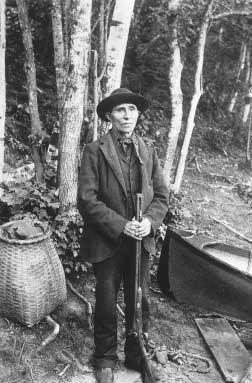
Figure 1. Mitchell Sabattis, an Abenaki Indian and longtime resident of Long Lake, standing between two examples of the hybrid European—Native American material culture that developed in the Adirondacks during the nineteenth century: the pack basket and the Adirondack guide boat. (Photo courtesy of Adirondack Museum.)

Figure 2. A guide transporting his “sport” in the distinctive Adirondack guide boat, which combined elements of both the Native American canoe and the European rowboat. (Photo courtesy of Adirondack Museum.)
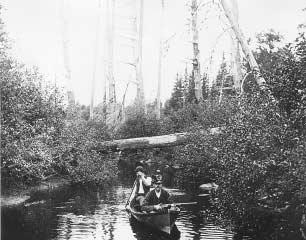
Figure 3. Two Adirondackers “jacking” deer. The man in the bow of the boat used the bright light from the lantern on his head to blind his prey. Although popular among many of the region's residents, this form of hunting was outlawed by the New York State Legislature in 1897. (Photo courtesy of Adirondack Museum.)

Figure 4. Shingles made from trees illegally cut on the Forest Preserve, abandoned by timber thieves fleeing state authorities. (Collection of author.)

Figure 5. Forest Commission officials (note the figure by the stump at right) investigating the theft of a large pine log from state lands near Raquette Lake in 1901. (Collection of author.)

Figure 6. A sign from a private park in the Adirondacks. Most estates in the region were ringed by scores of such signs, which prohibited locals from hunting, fishing, or otherwise using private parklands. (Photo courtesy of New York State Archives.)

Figure 7. One of the many signs detailing New York's regulations for the use of fire that the Forest Commission posted throughout the Adirondacks at the turn of the century. (Photo courtesy of New York State Archives.)

Figure 8. A new fire tower. Following a devastating series of forest fires in 1903 and 1908, New York authorities constructed towers such as this one at many high points in the Adirondacks, enabling Forest Commission employees to expand their surveillance of local conditions. (Photo courtesy of New York State Archives.)

Figure 9. The remnants of a poacher's cabin in Yellowstone. This particular structure was so well hidden that it was not discovered by park authorities until the 1960s. (Photo courtesy of National Park Service, Yellowstone National Park.)
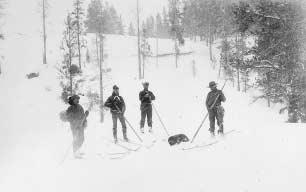
Figure 10. “The National Park Poacher.” The buffalo poacher Ed Howell is on the far right, with his dog curled up by his feet; the scout who brought him in, Felix Burgess, is on the left; two of the U. S. Army soldiers assigned to the park appear between them. All are outfitted with the long wooden skis that patrollers and poachers alike favored for getting around during Yellowstone's harsh winters. (Photo courtesy of National Park Service, Yellowstone National Park.)
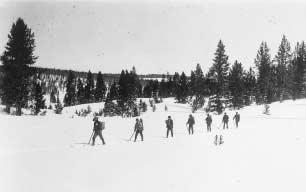
Figure 11. Ed Howell being escorted into Fort Yellowstone by army patrollers, following his arrest. (Photo courtesy of National Park Service, Yellowstone National Park.)

Figure 12. G. J. Gibson, arrested by the army in 1908 for trapping beaver in Yellowstone National Park.(Photo courtesy of National Park Service, Yellowstone National Park.)

Figure 13. Joseph Stukley, a former miner from Electric, Montana, following his arrest for hunting deer in Yellowstone. Stukley had lost his right arm in a mining accident and presumably turned to poaching because his injury made it difficult for him to find employment as a miner. (Photo courtesy of National Park Service, Yellowstone National Park.)
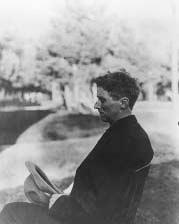
Figure 14. A mug shot of William Binkley, taken by army photographers shortly after Binkley's 1907 conviction for poaching elk in the park. (Photo courtesy of National Park Service, Yellowstone National Park.)

Figure 15. Army officers posing at Fort Yellowstone with fbuffalo heads confiscated from park poachers at the turn of the centuey. (Photo courtesy of National Park Service, Yellowstone National Park.)

Figure 16. A Havasupai woman photographed in the 189os. She is wearing colthing made of calioc and carring mescal ahoots in the basker on her back. (Photo courtesy of Grand Canyon Nationl Park Museum Collection.

Figure 17. Chickapanyesi as he apperared in 1898 in a photograph most likely on the plateau above Havasu Canyon. Note his rifle and the deer antler at his feet (Photo courtesy of Grand Canyon National Park Museum Collection.)

Figure 18. Havasupai men putting the finishing touches on a new trail along the Grand Canypn's South Rim.(Photo courtesy of Nation Archives and Records Administration.)

Figuer 19. One of the cabins constructed by the Havasupai in the early twentieth century from materals salvaged from the Grand Canyon Village drum. (photo courtesy of Grand Canyon National Park Museum Collection.)

Figure 20. A Havasupai family photographed in the early 193os at the camp near Grand Canyon Village.(photo courtesy of Grand Canyon National Park Museum Collection.)

Figure 21. Another cabin in the Havasupai camp near Grand Canyon Village. The assorted barrel and just were used to store drinking water, while the automobile—a reatively recent addition to Havasupai life—eanbled the tribe's men to serch for seasonal wage labor over a much wider geographical area.(photo courtesy of Grand Canyon National Park Museum Collection.)
Given such regulations, the Adirondacker who set local woodlands on fire was engaging in an act that was deviant on a multitude of levels. Not only was he (arsonists, like poachers and timber thieves, seem to have been overwhelmingly male) asserting his disregard for the state's attempts to control the time and space where fires were permissible, he was also rejecting the model of civic duty proposed by the Forest Commission, in which “good citizens” participated on fire-fighting crews. The arson that periodically swept the region can therefore be interpreted not simply as a manifestation of revenge but as an effort by those residents who believed that the Forest Commission's regulations had unfairly deprived them of their rights to hunt, farm, or lumber to assert their—and the forests'—freedom from state supervision.[76]
Unable to halt such arsonists (“the miscreants who start these fires … enter the forest alone and unobserved … and then, aided by their knowledge of the wilderness, emerge at some point many miles distant”), the Forest Commission could only increase its fines, which by 1910 reached two thousand dollars or ten years in prison, and try to limit the fires' spread once they started. Following the devastating conflagrations of 1903 and 1908, the commission erected “observation stations” from which watchers could spot blazes as soon as they began. By 1914, there were fifty-one towers located at strategic high points