
2. Modernism's Aftershocks
Peer Raben's Film Music for Fassbinder
Music admits that the fate of the world no longer depends on the individual, but it also knows that this individual is capable of no content except his own, however fragmented and impotent. Hence his fractures are the script of truth. In them the social movement appears negatively, as in its victims.
—THEODOR ADORNO
Adorno wrote these words about Gustav Mahler, but they describe the collaborative work between Raben and Fassbinder with eerie prescience. Adorno maintained that Mahler moved beyond musical expressionism, subjectivity, tragedy, and unity, not for the sake of novelty, nor even for a modernist jolt, but out of a larger, general fatigue that was passionate yet, as is commonly said of Mahler, ironic. The style of his symphonic movements, for instance, repudiated fantasies of symphonic wholeness while simultaneously acknowledging their allure. Thus Mahler's music conveys "the truth of the unattainable"—another comment that describes Fassbinder and Raben well.[1] Others construct Mahler quite differently, as the apotheosis of romantic decadence and kitsch.[2]
Like Mahler, Raben has been criticized for his simple, even kitschy compositions, a point film music scholar Norbert Jürgen Schneider refutes."Before the listener even realises it," he writes, "the simple themes become complex collages with sophisticated harmony and bi-tonality, and Peer Raben's music completely overtakes [the idea of] ‘film music.’ "[3] My aim is not to compare Raben and Mahler, even if the frequent appearance of the latter in Fassbinder's films makes such a project tempting.[4] Yet the historical contexts of the two composers reveal interesting parallels. Mahler ambivalently straddled the brink of modernity (and musicologist Romain Goldron argues that the conductor/composer was consummately aware of his position as a "counterforce"
Anearlier version of this chapter was published as "The Legacy of Modernism: Peer Raben, Film Music and Political After Shock," in Cinesonic: The World of Sound in Film, ed. Philip Brophy (North Ryde: Australian Film Television and Radio School, 1999), 171–88. Reprinted by permission.
In a 1995 talk, Raben argued that film music should function as a series of "shocks."[6] The aim of the "Musik-Shock" for him was "to support something that isn't yet in the image, nor in the mind either, that isn't yet true."[7] For any serious listener of his compositions or his treatment of existing music, the claim makes immediate sense. Early in The Marriage of Maria Braun, for instance, "O du schöner Westerwald" (Maas), a soldiers' song popular during the Nazi era, is played in a deliberately childish manner on xylophones and glockenspiels as Maria walks through a room filled with athletic equipment. Our ears are privy to the life choices she will be making (naively) over the course of the film; it also testifies to the regressive power such choices have over her (Raben says it was played this way to suggest that the character was recalling her childhood at this point). By deliberately infantalizing a Nazi-era song that would be familiar to German audiences of the time, Raben disabused it of any nostalgic potential or sense of childhood innocence that it may have purveyed. To hear this kind of a melody played like this is, quite simply, a shock.
The modernist notion of shock—in particular, an aesthetic shock that puts reworked forms into new contexts—has been articulated in a number of ways. For Shlovsky, it was part of ostranenie; for Brecht, a Verfremdungseffekt; and, at the other end of modernism's political spectrum, shock followed Ezra Pound's imperative to "make it new." For members of the New German Cinema like Raben, Kluge, Straub/Huillet, and others, the connection to modernist aesthetics is as important as it is nonincidental. Yet commentators have downplayed the movement's ties to modernism by focusing on its more obvious investment in the war and postwar periods, and to the projects of Trauerarbeit and Vergangenheitsbewältigung.
This chapter examines how New German Cinema was marked by the interwar years when European modernism flourished. As Kluge has said, "I wouldn't be making films if it weren't for the cinema of the 1920s, the silent era. Since I have been making films it has been in reference to this classical tradition."[8] The figures and texts of this generation, once removed from the New German filmmakers, have proved to be as crucial as those of their parents' time. There are the remakes of films from the 1920s (Mother Kusters, Nosferatu, Berlin Alexanderplatz); the reworking of period icons (Anita: Dances of Vice, Tenderness of the Wolves, Lola); the authenticating of forebears (Eisner for Herzog, Vertov and Brecht for Kluge, von Horváth[9] for
SHOCK, MUSIC, AND MODERNISM
Because the concept of shock saturates European modernist discourse until the end of the interwar period, it is not surprising that critics and other cultural workers were drawing connections between the arts and the "shellshock" of World War I.(That framework recalls the argument that the Great War swept Europe's aesthetic slate clean, purging it of nineteenthcentury excesses like romanticism, or banal bourgeois tastes like realism.) Shock was a crucial piece of what is widely understood to be modernity's larger oppositional project. For critic Peter Bürger, Russian formalism was one movement in which "shocking the recipient becomes the dominant principle of artistic intent."[11] Picasso: "Art and liberty, like the fire of Prometheus, are things one must steal, to be used against the established order." Of course, moral shocks and the shock of bad taste were key to the effects of Duchamp, Grosz, and even Picasso. But it was the brute physicality of shock, its material sources and somatic effects, that was instrumental to modernists from Eisenstein, who wanted to wire his viewers to their seats, to Marinetti, who enthused over death drives in sexualized cars. Peer Raben seems to descend from this tradition by advocating a provocative use of music that jolts the filmgoer, stating, "When you watch a film there's a riot [going on] in your brain that's not just psychological but physical."[12]
Whereas realist art used materials to appear as transparent as possible and create the illusion of life-likeness, shock, by contrast, abetted the modernist project of foregrounding these materials in order to provoke. This would lead some to align modernist shock with technology itself, be it the futurists' delight in war's destructive machines or Benjamin's guarded hope that film would habituate consumers to the jolts of modernity. Shock's intense materiality, whether from leftists like Eisenstein and Benjamin or proto-fascists like Marinetti, was crucial for its purported ability to impart alternative new worlds to consumers. To take only cinematic examples, consider the widespread vocabulary of attractions, conflict, collision,
Critics and artists often perceived shock to be both produced by and productive of textuality. At once cause and effect, symptom and response, it seemed a constitutive part of an aesthetics that wanted to disrupt conventional perception, cognition, and emotional engagement. The idea was in keeping with modernism's goals of overturning the realist, illusionistic aesthetic of nineteenth-century bourgeois art—or of adapting it to a changed technological, socio-political climate, or using art as an ideological corrective to mass-produced forms of the twentieth century. It is worth noting that, unlike Eisenstein, Peter Bürger didn't believe shock could be wired in or predicted, particularly on a large scale, a point that would be echoed by Fassbinder and Raben. For him, shock was enmeshed in a fundamental meaninglessness and emptiness—lacks that will also prove significant with Fassbinder and Raben."This refusal to provide meaning is experienced as shock by the recipient," Bürger writes, going on to say that "shock is aimed for as a stimulus to change one's conduct of life; it is the means to break through aesthetic immanence and to usher in (initiate) a change in the recipient life practice."[14]
THE ART OF NOISE
It would be a commonplace to note that, even by omission, shock was most commonly linked to vision, availing potentially radicalized ways of seeing. Such was the case for European intellectuals and artists as diverse as Benjamin and Heartfield, Kracauer and Breton. Even Ernst Bloch, advocate of music's utopian expressiveness, maintained that "visual montage [would be] an appropriate vehicle for representing utopianism since its juxtaposition of fragments … provid[e] multiple jumping off points in the present from which to imagine a better future."[15] In his preface to a 1990s book on montage and modernity, Matthew Teitelbaum uses similar language, writing that "montage practice sought not merely to represent the real … but, also, to extend the idea of the real to something not yet seen [or even seeable]."[16]
It would thus be wrong to dissociate modernist shocks and visual techniques like montage from new ways of hearing. Modernist critics, composers, and filmmakers alike all valued music and sound's capacity to disrupt conventional listening patterns. Hanns Eisler advocated "choral montage," and his enthusiasm for music's connection to modern technology is evident in his pride for having composed what he called "blast furnace music" for a Soviet film.[17] Countless examples from the time had music function as a sort of mimetic mouthpiece of the shiny, new machinery of modernity. That tendency finds its most extreme articulation in Italian futurism, the technophilia of which is legendary. In 1913, futurist painter Luigi Russolo championed "the crashing down of metal shop blinds … the variety of din from stations, railways, iron foundries, spinning mills. … [E]very factory will be transformed into an intoxicating orchestra of noises."[18] Futurist musician Francesco Balilla Pratella praised "the musical soul of crowds, great industrial complexes … the domination of the machine and the victorious reign of electricity."[19] Other examples include Stravinsky's remark that music functioned best when it ran like a sewing machine,[20] or Kurt Weill's that "my imagination is not a bird, it's an airplane."[21] There are George Antheil's compositions "Airplane Sonata" (1922) and "Ballet mécanique" (1925), the 1920 "Concert for Factory Sirens," in which factory sirens were orchestrated to call workers to their stations in the U.S.S.R.,[22] or the rhythmic fusion of cinema, trains, and music in Honegger/Mitry's somewhat later Pacific 231 (1949).
Although Eisler, a life-long Communist Party member (and composer of the East German national anthem), may seem to lead the charge in advocating new musical forms and function as a part of larger socio-political transformations, other cultural workers and distributors[23] played important roles in attacking autonomous music, giving music a more significant place in filmmaking practice and redefining its very function. Music had to be changed. As Carl Dahlhaus writes in a different context, "Whereas music, in the form of church music, used to partake of religion as revealed in the ‘Word’ it now, as autonomous music capable of conveying the ‘inexpressible’ has become religion itself."[24]
MUSIC AND MODERNISM
Musicologists generally reserve the term "modernism" to describe the atonal experimentation of the 1910s. The leader of that movement, Arnold
Many German modernists believed that music should play an active, socially conscious, critical role. Paul Hindemith, for instance, wrote that contemporary music should be of "moral foundation."[26] His remark is in keeping with the Neue Sachlichkeit / New Objectivity linked to Hindemith and other composers, as well as painters, cineastes, and other German artists of the 1920s and early 1930s.[27] Though not a stylistically or even ideologically uniform movement,[28] the Neue Sachlichkeit generally affirmed urban culture, its surfaces, detached coolness, and technologies, much as Benjamin and Kracauer had cautiously held out hope for in the cinema. Society itself was perceived as a "city machine."[29] As Eisler asserted in 1928, "When you are composing and you open the window, remember that the noise of the street is not mere noise, but is made by man. … Choose texts and subjects that concern as many people as possible."[30] The outward focus of the Neue Sachlichkeit helped it militate against the emotional subjectivity of Expressionism, against the latter's obsession with psychic states outwardly expressed, only to point back to the special individualism "inside" the artist. Some factions of the movement were in favor of paring down aesthetic forms in favor of function (see below); some were pro-technology, others technophobes.
Closely tied to Neue Sachlichkeit was Gebrauchsmusik, whose aim, if it can be so singularized, was to democratize music, to wrest it from the hands of elite specialists, to compose it with real audiences in mind, and to educate and widen that audience through new technologies like the cinema, phonograph, and radio. For Hindemith, with whom the term was initially associated, Gebrauchsmusik aimed for a democratic society of musicians in Berlin, something impossible after the events of 1933. To close the breach between ostensibly high forms like opera or concert music and light, popular music, some composers utilized new forms of music and modes of transmission. There were the Zeitoper, short, topical operas which, according to Weill, exposed the "rhythm of our time,"[31] workers' choral music, film scores, radio music, Schuloper, and Laienoper. Normally translated as
Kurt Weill tackled the two questions simultaneously. Even though Weill is not normally associated with radical critique—many consider his easy wartime assimilation into American culture sufficient evidence against that—he raised pertinent social issues and changed musical theater form, especially by incorporating different musical forms and styles, and in his unconventional instrumentation. Despite his occasional efforts in cinema and his early association with Brecht, however, he remains surprisingly underdiscussed in film and film music circles. It was he, for instance, who developed the notion of gestus that Brecht would borrow, and it was he who, like Raben after him, found in Mahler an important model (specifically for integrating popular folk forms into his music). Weill's career in Germany was well under way in the 1920s, and it flourished until the Nazis seized power, when his music was triply damned, for its purported decadence (e.g., its use of jazz and other "foreign" forms), its unflattering portrayals of contemporary conditions, and, not least, for the Jewishness of its composer.[33]
Weill shared Eisler's concern that "music for the people" not be modeled after the "hit," but he did not share his colleague's disdain for music's association with beauty. Instead, Weill believed that music could be enjoyable and still perform socially critical functions, much as Brecht advocated that pleasure and learning could coexist. One of Weill's clearest articulations of this interest is found in a letter to his sister Ruth, dated 28 January 1920, regarding an unfinished opera based on a one-act play by Ernst Hardt. He writes: "In this work I would want to give—and would want to achieve—only one thing: beauty. In addition to all of the beauty Hardt has already poured into it … it simply has to result in an exuberance of beauty when combined with the music I have in mind; if this succeeded, it could even become a model for an entirely new lyrical musico-dramatic creation."[34] Another passage, written in 1929, defends Gebrauchsmusik's various forms from attacks on the alleged decay and "superficiality" of their "easily-comprehensive melodies," and emphasizes musical "pleasantness": "In the process the observer all too often overlooks that the effect of this music is not catchy, but instead rousing; that the intellectual bearing of this music is thoroughly serious, bitter, accusing, and in the most pleasant cases still ironic."[35]
Weill's interest in beauty and pleasure suggests the flip side of modernist shock, an idea to which I will be returning, and one which ultimately enables Weill to endure as a stronger prototype for Peer Raben and postwar,
FILM MUSIC AND SHOCK
There were reasons why film music seemed particularly suited to the task of the technologies of shock and dehabitualized perception. As Eisler put it, "By virtue of its character of immediacy—and music still possesses this character to a greater extent than any other art—it should stress the mediated and alienated elements in the photographed action and the recorded words, thus preventing confusion between reality and reproduction, a confusion that is all the more dangerous because the reproduction appears to be more similar to reality than it ever was."[36]
In this way, it is not insignificant that the considerable musical activity of the Weimar era often intersected with film culture, as with Hindemith's 1921 score for Arnold Franck's Im Kampf mit dem Berg / Battling the Mountain and Eisler's for Kuhle Wampe. A famous example outside of Germany was Eisenstein's celebrated collaboration with Prokofiev, and his theories that put music on par with other film elements. Even the very terms Eisenstein used to discuss cinema relied on music. He argued that music should be used "in contrapuntal style" to visual elements; he valued montage for the "music of its intonation," and wrote "without rhythm, montage would simply be the ‘shapeless’ sum of a succession of ‘facts.’"[37] For him, distance between "intervals"[38] was crucial in creating shock-like violence: "There can be cases where the distance of separation is so wide that it leads to a break—to a collapse of the homogeneous concept of art."[39] Intrigued by Russian musical symbolism, Eisenstein wanted to blend cinematic "dominants" and "overtones and undertones" in ways inspired by Scriabin's "colorised" chromaticism, to produce a unity through synthesis.[40] Cinema's metaphoric adaptation of musical terminology is not restricted to Eisenstein by any means, nor to the 1920s,[41] even though these two art forms enjoyed a particularly intense relationship during the period.
If the proclamations of their own aesthetic principles are any indication, composers of the late 1910s and 1920s seemed fearful of driving away potential audiences, publishers, or sponsors by appearing too modern or shocking. Only the most polemical spoke out. The phenomenon may be partially explained by the populist aims of the Neue Sachlichkeit, whose members, as I have already noted, sometimes rejected modernity outright. Yet even the cautious Schoenberg wrote that he hoped his music "stimulates the brain or spinal cord … in its full severity," a somatic reference to
His most widely known argument for film music, of course, was to place it in opposition to the image, a "conflict" that provided "commentary" rather than redundancy. The idea carried over into Eisler's overall theory of music, one enriched by Adorno: "Music can only develop in the contradictory relationship of music to society. Whoever does not understand that is a blockhead, no matter how clever he is."[44] Developing this admittedly questionable correspondence between formal aesthetic practice and socioideological opposition, Eisler describes his work for Kuhle Wampe:"Deteriorated houses on the edge of the city, slum district in all its misery and filth. The mood of the image is passive, depressing: it invites melancholy. Counterposed to that is fast-paced, sharp music, a polyphonic prelude, marcato style. The contrast of the music … to the straightforward montage of images creates a shock that, according to the intention, stimulates opposition more than sympathetic sentimentality."[45] His score for Abdul Hamid (Gune, 1935) revealed another kind of opposition: the patriotic "Hymn to the Sultan" appears just as Hamid is beating his own soldiers. Years later, Kluge would deploy the same technique, taking the movement from Haydn's "Kaiserhymn" on which "The Deutschlandlied" was based in the same ironic, antinationalist vein.
Peer Raben's work involves much the same recontextualization of existing music, a term I select over "recycling" because of the frequency with which meanings derail, often humorously, sometimes ominously. Consider Fassbinder's televised series Berlin Alexanderplatz, set in the late 1920s just prior to the Nazi seizure of power. At the end of the fourteen-hour film (of which eight were fully scored—an unusually high ratio), we hear "The Internationale," the workers' anthem by Eugène Pottier, which then fades into the Nazis' beloved "Horst Wessel Lied" (1933), subtly but ominously clinching Franz Biberkopf's future with the party. It is interesting to compare this with the song used at the beginning of the film and of each installment (it also appears diegetically whenever Franz plays it on his phonograph). It is "Liebe kleine Nachtigall" (Sweet Little Nightingale), performed by the Jewish singer Richard Tauber.(Tauber left Germany in 1933 for Austria, which he subsequently fled in 1938.)[46] By inaugurating the series with a popular song sung by a popular Jewish singer and by closing on the "Horst
Nazi songs do not occur all at once at the end of the film, however."Die Wacht am Rhein," for example, is played throughout.[48] Based on a patriotic poem from the mid-nineteenth century that recounts the threat of invasion to territories near the Rhein,[49] the song had nationalistic and military connotations long before its association with the Nazi regime, much like the history of the "Deutschlandlied" (see Introduction, n.15). Reviving these pieces of music helped perpetuate the fantasy of historical continuity, offering a phantasmatic rationale for Germans to be military and vigilant. Raben would continue to subject them to assault, even in lesser-known work like Bismarck, a 1990 telefilm loaded with nationalist and militaristic war-horses that resonated deeply with domestic audiences. Bombastic though they may be, Raben orchestrates them in such a way as to generate the impression of their being fatigued, worn-out. Eisler's advocacy of what he called the "clichéd" use of "standardized" music in films is relevant here: through overuse, pieces can be bereaved of their initial spellbinding properties. Finding a "certain charm" in Disney's "Pluto galloping over the ice to the ride of the Walkyries," Eisler cites an example that deprives Wagner's music of any claim to auratic uniqueness.[50]
Some of Eisler's other ideas also seem a good match for Raben's. Both advocate an antinaturalist use of music; both champion unexpected soundimage pairings by matching pitch relations to screams, sirens, and other noises; both value segmentation and interruption over continuity and development. Each of them prefers fragmentation to the rich, complicitous identifications of classical filmmaking practice. Both, in short, value shock over seduction. Examples proliferate throughout Raben's work, but a striking one occurs in his use of Mahler's Eighth Symphony at the beginning of Chinese Roulette.
The film opens with alternating shots of the mother and daughter. Carefully framed in separate rooms, the characters are inert and wordless (the mother simply mutters an ambiguous "schön" when she finally reaches her daughter). These are ice-cold tableaux, acoustically overwhelmed by the impassioned aria of a male vocalist with chorus from the Eighth Symphony. That voice, along with the odd reverie of mother and daughter, is abruptly silenced once the father opens the door and enters the house, as if walking into a woman's film. Yet the paternal term has not interrupted anything at all—this is not an enactment of the Lacanian nom du père halting imaginary bliss between child and mother. For the film goes on to detail one of the most hateful mother-daughter relationships imaginable.
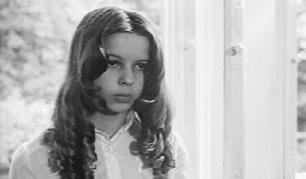
Angela, the daughter, at the opening of Fassbinder's antimaternal melodrama, Chinese Roulette
Chinese Roulette thus appears to set the stage for a maternal melodrama but undercuts it in different ways. The text of Mahler's Eighth Symphony, for instance, is based on Goethe's Faust, probably the most famous narrative of a man making a pact with the devil (not by chance are Fassbinder's characters named Gabriel, Christ, and Angela). Second, the lush symphonic accompaniment of the soloist and children's choir of "angels" stand in sharp contrast to the staged stillness of the two female characters. In spite of the brevity of the quote (a couple of minutes), it thus illustrates Eisler's dictate that film music function as "movement as a contrast to rest."[51] The original music that Raben composed for the film produces the same effect with punning literalness. Using ballet, waltz, and other dance forms, it provides an ironic juxtaposition to the fact that Angela cannot even walk without crutches or braces.
Sound and music destabilize the ending of Chinese Roulette as well. As I described in the Introduction, we hear portions of a requiem mass, after an offscreen gunshot, out of sequence. We don't know who has been shot—the event presumably follows Traunitz's having been wounded—but we do know that Fassbinder believed Chinese Roulette gave his sharpest indictment of marriage. Musically, all is fraudulent; there is no redemption or even grief here. By resequencing and fragmenting the mass, Raben shows that music is not commensurate with the feelings typically associated with it. In other words, grief and mourning are not coterminous with traditional liturgical forms, nor do they proceed from them.
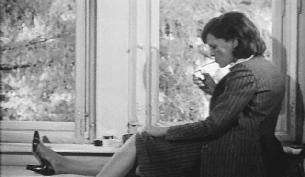
Ariane, the mother in Chinese Roulette
Here it is worth exploring other examples of the seemingly modernist violence of Raben's use and advocacy of "Musik-Shock." Whether Raben selected preexisting music or composed new material for Fassbinder's films, the connection of that music to the diegetic period is disjunctive, undercutting as much as establishing setting, as Chinese Roulette demonstrates. Describing his work for Fassbinder's war trilogy, Raben states: "With each one, my music referred to the appropriate period. In Lili Marleen, it relied heavily on Wagner and Bruckner, judged favourably by the Nazis. In Lola, it was music of the early 50s, influenced by Glenn Miller or Mantovani and therefore with a large orchestra in these styles. For Veronika Voss, you find an American influence of country music, barely sketched out, to be sure, but there to suggest the origin of the drug given to Veronika by her doctor."[52]
Violence prevails in the often-overwhelming silence of many of Raben's scores, especially for Fassbinder's early work. There were pragmatic reasons for this—at the beginning, Fassbinder and Raben were unable to afford rights to music they wanted to include—and historical explanations as well. In a 1998 interview, Raben reminded me of the Young German Cinema's early polemics against cinematic artifice and the aspersion it cast upon indulgences like nondiegetic music.[53] He noted the cleverness of Straub and Huillet, who preempted criticism by claiming their films were actually documentaries of "workers working"—the workers simply happened to be musicians. Economic factors dictated the shape of soundtracks:
Fassbinder's early films featured what might be called stylized dialogue that functioned as music.[54] The near-absence of music suggests the influence of prevailing aesthetic dictates of the time. Yet since we have seen how the almost restive absence of music overturns convention within Fassbinder's early melodramatic output, I hesitate to reduce these scores to so much trend-following. As Norbert Jürgen Schneider observes about Fassbinder's work more generally, silence frequently takes over, even having the last word in the soundtrack.[55] And silence can say a lot."Silence is never a neutral emptiness," Michel Chion writes, "It is the negative of sound we've heard before or imagined; it is the product of contrast."[56] And silence can point to what should be there.
Peer Raben's dense score for Berlin Alexanderplatz reaches a pinnacle in the fourth chapter, in which Franz Biberkopf almost drinks himself to death. This chapter features the barest of narrative movement, and music interrupts what little diegetic action there is. It certainly takes over the linguistic and symbolic interactions eluding Biberkopf at this point (not for nothing is the section named "A Handful of People in the Depths of Silence"). As Biberkopf nearly suicides in a run-down room, we hear only ghostly sounds and voices that reprise earlier dialogue or sing parts from a requiem or sections of Mahler's ubiquitous Eighth Symphony.
The score parallels Biberkopf's passivity as he undergoes one of his several redemptions and rebirths throughout the film. At the same time, the sounds of this chapter partake of a quietly insistent delirium, with female voices coming and going, producing eerie, ethereal "ohhhs" and "ahhhhs."[57] As for Mahler's Symphony, it is important to recall that the piece not only deals with a pact with the devil—a pact Franz will seal on several occasions—but that it incorporates themes of redemption (Läuterung) crucial to Berlin Alexanderplatz. In the film's famous epilogue, Franz undergoes another hallucinatory experience, a "dream" in which all of the previous characters appear, with their accumulated, entangled motifs. Interwoven
Christian Thomsen once observed that the characters of Berlin Alexanderplatz, who are themselves split, exist inside one another.[58] The idea is reinforced musically in the phantasmagoric final sequence and in the film as a whole. Norbert Jürgen Schneider discusses this in terms of the character-centeredness of Raben's score:
[E]ach person has his/her theme, his/her leitmotif. Obviously, this method has been obsolete since Carl Maria von Weber. But in the totality of Fassbinder's style, it still works. It helps with the complex story, creating order and an overview [übersicht] upon first hearing it.[It is] grandiose when, for example, Mieze first appears with a piece of music [a familiar children's lullaby] that tells everyone immediately that this girl is innocent and pure.[As] Peer Raben [puts it]: "with the character the music also enters as his/her musical portrait."[59]
As Schneider notes, Raben's decision to use traditional thematic scoring and his use of character leitmotifs is unusual, even "obsolete." But as he also says, the sheer length and complexity of the story make it a reasonable decision. Because Berlin Alexanderplatz lasts over fourteen hours and first aired in installments on German television, Raben had to ensure that audiences would recall as much as possible of previous installments—events, characters, relationships. Clarity was critical, and Raben knew that leitmotifs offered a way to provide it in an otherwise dense, collagistic text. This is not to say that his thematic scoring was conventional, however. In the famous sequence in which Reinhold murders Mieze, Biberkopf's lover, in the woods, Schneider identifies Biberkopf's motif, thereby holding Biberkopf at least partially responsible for her death, even though only Mieze and Reinhold are present.(Given what has transpired in the plot, this is not an unreasonable reading; flashbacks that repeatedly show Biberkopf killing Lina make clear his murderous potential.) Yet, as Raben himself noted, all of the film's major characters are musically "present" in the woods, just as every character plays a part in Reinhold's violence against Mieze: Meck arranged the deadly rendezvous; Eva had prevailed upon Franz for Mieze to remain a prostitute; landlady Frau Bast interfered with her eavesdropping and gossip.
Returning to Christian Thomsen's observation that Berlin's characters reside "inside one another," let us consider their actual musical motives. Franz Biberkopf is represented by the most frequently heard theme, dominating the soundtrack as much as he dominates the story and mise-en-scène (few scenes do not include him). But Franz has a second theme too, one introduced just over an hour into the first installment, "The Punishment Begins." Played by a flute, we first hear it when he and Lina are in bed where he pledges, with her as his "witness," to "take an oath" to "stay honest" and "conform to society." This secondary oath motif is repeated frequently throughout the rest of the film. That two themes are tied to Biberkopf reveals how even a single character gets "placed inside another," with an acoustically split identity, as many have argued about the themes and visuals of Fassbinder's work thematically and visually. Both of Biberkopf's themes are characterized by a steplike motion followed by a leap.(The principal theme features a major second step upwards and then back down, followed by a minor seventh leap upwards; his second, oath theme has a minor second step downwards and then back up, followed by a minor sixth upwards.)
The motifs of other characters are structurally related as well—indeed, they are entwined with Franz's. Meck's and Reinhold's are both modifications of Biberkopf's, asserting not only their erotic, criminal, and social interconnectedness, but the structuring centrality of Biberkopf to the film as a whole. Meck's theme begins with the leap of a minor sixth followed by steplike descents ending in a minor second that go down and then back up in a sort of inversion of Franz's main theme. Reinhold's resembles Franz's even more closely, a fact that underscores the importance of their relationship to the narrative as well as the "inside-one-another-ness" of their identities and desires. It begins with a major second, moving upwards and then back down, followed by a minor third leap upwards, followed by a leap upwards of a perfect fifth. It is like Franz's theme but compressed, the first four notes showing the same motion as Franz's. Other characters are likewise represented as musical variations of Biberkopf: Eva's theme, a sort of waltz, begins with a leap downwards of a major sixth, which is repeated and then followed by a neighboring motion, down then back up, of a second. A major second neighboring motion (upward then back down) musically depicts Mieze, followed by a downward leap of a minor fifth. Meize is also accompanied by a constant stream of lullabies and children's songs to the point of campiness, as when she is first introduced, bathed in very diffuse light, wearing a girlish white dress and hair ribbon. Franz's acoustic domination of the film does not, however, convey a sense of control or power, but rather shows the extent to which fragmentation and splintering shape his body, his subjectivity, and the film more generally.
How does Raben's decision to deploy motivic composition in Berlin convey a modernist sensibility? In one sense, it follows the aims of neoclassicists of the 1920s insofar as it revisits earlier, traditional compositional styles and techniques, like thematic scoring, to modify them. It doesn't overlook musical predecessors, Nazified or not, preferring instead to rework them. Raben also does this in his score for Werner Schroeter's Tag der Idioten / Day of the Idiots (1981), a film that could be called a latter-day example of the Zeitoper advocated by musical modernists in the 1920s.(The film takes place in a contemporary psychiatric institution, and we follow protagonist Carole Bouquet's arrival and departure there.) Additionally, Hanns Eisler's remark that "well-arranged noise strips might in many cases be preferable to music"[60] aptly describes the amplified typewriters that interrupt Maria Braun periodically. This sound, which critics have understandably mislabeled as that of jackhammers or machine guns, draws equivalencies between war's destructive machinery and that of the postwar capitalist "miracle." For Roger Hillman, for instance, it functions as a motivic theme set in motion by the bombs and sirens of the film's opening, which is framed by the radio transmission of the 1954 German World Cup victory over Hungary blared at the end: "That's it! That's it! The game is over! Germany is world champion! [Deutschland ist Weltmeister!]," cries sportscaster Herbert Zimmerman.[61]Maria Braun trumps up its acoustic explosion of private and public domains with markers of German pride and aggression, moving seamlessly from Beethoven to postwar soccer. Political reference points are made through a number of striking visual details: Hitler's portrait fills and then tumbles out of the film's opening frames; at the end of the film we see negatives of a series of portraits of Germany's postwar chancellors—all except for the less conservative Willy Brandt. Here it is worth recalling the "interpenetration" of public military announcements into ostensibly private spaces in Sanders-Brahms's/Knieper's Germany, Pale Mother. What distinguishes Kneiper's and Raben's treatment of "noise strips" from Eisler's, however, is that Eisler—who preferred the recording of a storm over the musical suggestion of one—revels in the creative potential of technology, whereas Raben and Knieper foreground its destructiveness.[62]
And so the productive shocks and physical violence so cherished by musical modernists before and between the World Wars are turned inward in postwar film. Raben takes conventional form and technique to undo them from the inside out. Recordings are smashed or badly performed, pieces altered or damaged, as he wages violence against Europe's canonic repertoire. Examples range from his dizzying variations on Vivaldi's Violin Concerto in A Minor that constitute part of the Lola"Concerto" to the barely audible, scratchy recording of Beethoven's Ninth Symphony at the beginning
Raben is the first to acknowledge the direct relationship music can have to physical or political violence. In Lili Marleen, Nazi officials actually torture Willie's Jewish lover by repeatedly playing a scratched, skipping recording of "Lili Marleen," the song incessantly performed by and equated with his Aryan girlfriend. The beginning of Martha, in which Martha's sadistic lover pursues her after her father's death, recalls the opening act of Don Giovanni. Martha, moreover, adores Donizetti's Lucia di Lammermoor, an operatic tale of forced marriage that also comments—painfully—on her own circumstances. But Martha's husband forbids her to play it, and she soon finds the record, like her adopted cat, destroyed (curiously, the piece is a favorite of the equally unhappily married Emma Bovary). As I argued in chapter One, the record-smashing scene in Merchant of Four Seasons is even more violent since Hans, who has identified with "Buona Notte Bambino," breaks it himself, acoustically rehearsing the suicide he will soon perform at the drinking table. Alexander Kluge, as we shall see in the next section, also recognizes music's role in larger cultural/emotional/physical violence. His distrust of nineteenth-century tragic opera is strong, and in identifying the opera house as a bombastic "power plant of emotions," he criticizes its institutionalization of music and the human feelings it feeds upon. Like Benjamin before him, Kluge prefers smaller stories and feelings, ones that get left behind—not unlike the debris produced by war, political censure, or indifference. It is instructive to compare his approach to decay and ruins to that of Eisler, who instead urged composers "to check the decay of music … to find a new technique, a new style and thus a new circle of listeners."[65] Kluge and Fassbinder/Raben (as well as the queer, camp filmmakers after them), by contrast, considered these fragments of decay and negativity crucial precisely to allow new "circles of listeners" to emerge.
POSTMODERN DEPARTURES:
RATIONALISM, VIOLENCE, AND BODIES
Thus, despite the references to modernist concepts such as shock and violence, and despite the similarities to earlier composers such as Eisler (a
More telling than this contrast of Eisler and Raben, however, is Raben's own account of the New German Cinema's beginnings. He wrote that German film composers at the time "had no rules, examples, models."[67] They couldn't turn to Hollywood. The symphonic orchestras that Hollywood studio composers like Max Steiner enjoyed had never been a routine feature in German film production, and few individuals enjoyed the kind of profiles that Steiner, Korngold, Waxman, and others had in the States. Though a pragmatic observation, especially given the differences in industrial and funding structures of German and U.S. filmmaking, Raben's comment also stands as an Oedipal, aesthetic, and ideological rejection of German musical forebears like Eisler. While generally subscribing to Eisler's basic position that film music needn't match the image or the historical/ geographical setting of the film's diegesis, Raben found his notion of music-image "opposition" too "flat, too heavy-handed." Like Fassbinder's well-known criticism of Brecht for the latter's purported disregard of emotional response and identification,[68] Raben finds Eisler's aesthetics of contradiction "too active, rational, and unfeeling."[69] Raben's work bears this out because, for all its shocks, it is compellingly beautiful music.
Eisler once wrote that music was "par excellence the medium in which irrationality can be practiced rationally."[70] Sounding much like Kracauer on the mass ornament, he wrote, "Today, indolence is not so much overcome as it is managed and enhanced scientifically. Such a rationally planned irrationality is the very essence of the amusement industry in all its branches. Music perfectly fits the pattern."[71] Interestingly, this critique, made in Composing for the Films, is contradicted by the text's repeated call for an "objective" use of film music. Thus, in spite of Eisler's steadfast critique of music's rationalization, commodification, and overall function under capitalism, one nonetheless detects a certain faith—one marked by the modernist heritage from which he emerged—in a similar form of rationalization.
I don't want to use Eisler too metonymically here, to have him signal every attitude of every cultural modernist in Germany during the 1920s. Nor do I
For someone eager to "check the decay" of musical trends, it is more than a little curious that Eisler selects the metaphor of disease to make the point. Arguing that diseases were once perceived as "matters of chance," misfortune, or demonic possession, he writes that science now acknowledges their basis in germs and since diseases are often a consequence of poor economic conditions, the latter are therefore also "changeable, curable"—not fated."If we modern composers," he goes on to say, "were able to apply some of this objectivity, common sense and knowledge to our own field, we would be more successful."[75] Eisler's desire for healthy social, somatic, and musical conditions is very different from Santner's concept of homeopathic healing, in which decay, disease, and alterity are not projected outward, but taken in.
This is not to say that Eisler's confidence in science and technology was boundless. Many of his writings blast the failure of technology to widen music listenership or to advance proletarian music. He argues, for instance, that "the tempo and rhythm of [contemporary factory workers'] work is dictated by their machines and not by the workers themselves," as opposed to the "Song of the Volga Boatmen," which, he enthuses, moves with the rhythms of the men's labor.[76] Nevertheless, it is clear that Eisler's rhetorical turns to science, technology, and objective presentation are meant to preserve categories of the Expert and the Artist against which are juxtaposed the Amateurs and the Music Lovers, whom Eisler repeatedly laments are taking over. But contradictions punctuate his work. For example, although he rallied vigorously against Hollywood cinema, Eisler reserved a certain optimism about the cinema as a populist art form, and maintained this position even after the war. As he wrote in the late 1940s,
Given these differences, one might position Fassbinder and Raben as textbook illustrations of postmodernism's rejection of some of (German) modernism's indenture to reason, truth, science, and rationalization. For, contrary to their predecessors, they stressed the unexpectedness of audience response and sought playfulness over scientifically derived effects. For Raben and Fassbinder, shock was no longer a calculable or predictable effect, something objectively manufactured or democratically aimed. Instead, it was sporadic, subjective, and chaotic—if no less violent. This shift to what Raben calls the "unexpected" is, I believe, still constitutive of a utopian sensibility. And if the hopes that were raised seemed lower than those of the political modernists before them, that made the impulse behind them all the more crucial.
Other conceptual differences separate Raben and Eisler's enthusiasm for shock in film music. According to Eisler, early film music tried to "help the spectator absorb the shock" of seeing lifelike images lacking sound, a familiar enough remark for film music historians.[78](Perhaps the idea is equally appropriate for a postwar cinematic movement enmeshed with its own ghosts.) Before the war, the idea of adapting to shock was critical. Benjamin famously claimed that cinema and other new technologies offered a training ground for the body to adapt to the shocks of modernity. Overall, however, modernist shock was not something that jolted, moved, or changed the body so much as something that was adopted or integrated into it, like so many homeopathic pills.
THERAPEUTIC SHOCKS AND PILLS, OR MODERNIST
AND POSTMODERNIST DIVIDES
Postmodernity is modernity without the hopes and dreams that made modernity bearable.
—DICK HEBDIGE
As I argued in the previous chapter, Santner's homeopathic-derived model of dealing with the past offers an alternative to the concepts of Vergangenheitsbewältigung
Like Santner's Stranded Objects, Allen Weiss's study of the Swiss art brut movement, whose tortured, traumatized, disfigured bodies appear to convey the unsettled physicality of modern subjectivity, turns to medical treatment as an exegetic source. Weiss admires Francis Bacon, for instance, for having initiated "a realism of deformation, opposed to the idealism of transformation."[79] Such a materialized realism might be exemplified in Franz Biberkopf. Berlin Alexanderplatz likens Biberkopf to every beast imaginable, and in the last chapter, it actually depicts him strung up in an abattoir, and his subsequent "transformation" emerges only after his rebirth as a petit-bourgeois Nazi supporter at the film's conclusion. Weiss's study pushes another connection between bodies and shock when he mentions, "without further comment," the psychiatric "treatments" purportedly developed during the Nazi era, in Axis countries. Electroshock therapy, which "creat[es] violent convulsions of the body, was developed in Rome in 1938; insulin shock therapy, which puts the body in a comatose state, was developed in Vienna in 1933."[80]
I am less interested in Weiss's historical errors[81] than in his desire to equate abusive physical shocks with abusive political regimes. He infers an unmediated commensurability between bodies, technologies, and political epochs that is problematic on a number of levels. Can the shocks and jolts of modernity be captured or conveyed by contemporary cinematic form, or by later film movements like the New German Cinema? Can social/ representational shocks be directly absorbed by spectators? Such correlations place perception, cinema, and body into impossibly neat, unified equivalences. Even Benjamin succumbs to the temptation when he writes that "the shock experience which the passer-by has in the crowd corresponds to what the worker ‘experiences’ at his machine."
Critics frequently assume that people must be fundamentally passive in order to receive these modernist shocks. In the same essay, Benjamin describes Poe's urban pedestrians: "Their behavior is a reaction to shocks. If jostled, they bow profusely to the jostlers."[82] Thus in spite of its constantly
By stressing the absorption of shock, previous modernist discourse had established imaginary bonds between the human body and external stimuli, be this the cinema or a vaguer notion of "the modern experience," in order to habituate the former to the latter, to train and regulate it at the same time that the body was believed to be inoculated against that very externality. Absorbing the shock meant absorbing the lesson. Althusserian structuralism could do no better. Neither could Eisenstein, whose "Montage of Attractions" essay, over thirty years before William Castle's The Tingler hit U.S. theatres in 1959, advocated rigging electrical currents in the seats of designated theatre chairs. Shock has always been grounded in physicality, from its first usage in agricultural measurement and military operations to its more contemporary usage (as with trauma, discussed in the following chapter). Critics retain the physical side of shock while asserting that it prompts new forms of knowledge or perception. The New German Cinema upheld this belief in knowledge's physicality with surprising insistence. Kluge offers an especially literal exemplification in The Patriot. Among many examples from the film is its narration by a talking knee which, we learn, is all that remains of a German soldier killed at Stalingrad, "remains" that stubbornly insist on their historical significance. But even though the New German Cinema was littered with splintered, seemingly modernist, "shell-shocked" bodies, the matter of absorption and of shock's forced integration into the body was constructed differently than in interwar modernism.
For shock retains the threat of what can't be absorbed, of what can only be repeated, recontextualized, or repulsed. Thus in contrast to the internalized shock treatments espoused by Benjamin, Eisler, and others, Kluge and Fassbinder/Raben stress shocks that the postwar body cannot absorb. This is evident in what the body cannot take, as with the death of Hans in The Merchant of Four Seasons or of Fox in Fox and His Friends, or Fassbinder's countless other depictions of drug or alcohol abuse—bodies that have literally absorbed too much. Mendelssohn's torture scene in Lili Marleen, in which the song plays repeatedly in his tiny cell, reveals a strategy of physical
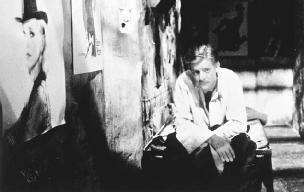
Tiny torture chambers in Fassbinder's Lili Marleen
Without a doubt, shock affects, transforms, and deforms bodies in Fassbinder's films, with the one-armed Franz Biberkopf remaining a particularly striking example. Yet nowhere is there a sense that these bodies are capable of absorbing the shock. No myth of buffering, protection, or internalization is in operation. In a sense, these postwar films suggest that bodies cannot refuse shock any more than they can take it. And if shocks like Raben's still offer enlightenment in unexpected places, it is nonetheless worth recalling the extent to which shock and trauma also create disempowered, victimized subjects.
Another example from Lili Marleen demonstrates that postwar shock, in contrast to modernist shock, depends on the body's alienation from the people and contexts to which it is juxtaposed. During Willie's first performance of the song with which she is associated, a brawl erupts in a small cabaret, whose male patrons make crass remarks about her voice. In her first sponsored performance for the Nazi party, Willie wears a colorful blue dress that exposes her throat and chest, and leaves her arms free to gesticulate and add other emphatic weight to the song. This freedom and energy diminish with each repetition of the endlessly performed song, and by the
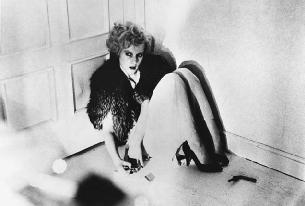
… and in Veronika Voss before her overdose
Just as these recent shocks deaden bodies, nothing guarantees that they will generate productive or desirable results. Given the fundamental alienation of the body from any unifying contexts, shock can be said to affect it but does not buffer or inoculate it from externality. Recent film-shocks thus work to operate on the principle of isolation and emptiness, not protection or assimilation. Such a conception contrasts dramatically with the synergistic assumptions of modernist textuality, where dialectical montage added up to more than the sum of its parts, yielding ideological, epistemological, and political gain. Such gains were crucial to many branches of
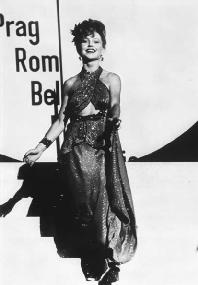
From giddy chanteuse to glitzy mummy: Hannah Schygulla's performances at the beginning of Lili Marleen. Courtesy of the Kobal Collection.
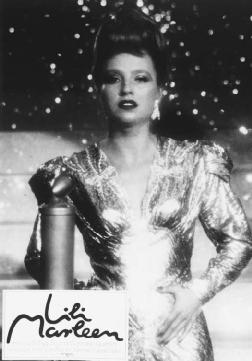
… and at the end. Courtesy of Bayerischer Rundfunk/RGA.
In postwar "modernism," the formal mechanisms that once seemed to be the very guarantors of political effects become emptied debris. Compare the following passages from Adorno. The first is a 1928 review of
How distant I at first feel from music that does not draw any consequences from the current state of musical material, but rather seeks its effects by transforming old, atrophied material: Weill achieves this effect with such force and originality that, faced with the fact, the objection pales. In Weill there is a regression, one which exposes the demonic traits of dead music and uses them.(1928)[86]
The idea of montage and that of technological construction are intimately bound up with each other. Together they are becoming increasingly incompatible with the notion of radically elaborated art with which they used to be identical. The principle of montage was supposed to shock people into realizing just how dubious any organic unity was. Now that the shock has lost its punch … the interest in montage has therefore been neutralized; more and more, it becomes a historical and cultural concern.(1970)[87]
Modernism's novelty and oppositional edge, along with strategies like montage, diminished as they were brought into art history books, museums, and a variety of aesthetic canons. As Fredric Jameson argued in the influential anthology Aesthetics and Politics, the practices and analyses of political modernists no longer held sway. The "culture industry," he argued, had become so massified that it made "an unpropitious climate for any of the older, simpler forms of oppositional art [proposed by Lukács, Brecht, Benjamin, or Bloch]. The system has a power to co-opt and to defuse even the most potentially dangerous forms of political art by transforming them into cultural commodities (witness, if further proof be needed, the grisly example of the burgeoning Brecht-Industry itself!)."[88] Against this seemingly totalizing, self-reproducing machine, Jameson called for a "new realism" built out of the awareness that modernism's emphasis on fragmentation/opposition/estrangement itself needed to be estranged, and "corrected by a more totalizing way of viewing phenomena."[89] Although Kluge had also called for a new form of realism to counter the totalizing effects of aesthetics under capitalism, it was his, Fassbinder's, and Raben's refusal of totalities that enabled them to find goal-less, productive play in the debris of modernism—as well as in the weightier ruins of National Socialism and the Shoah.
In a recent essay, Patrice Petro argues that the banality and boredom evident in the photographer Brassai's images of Paris in the late 1920s and early 1930s are a fundamental feature of the "provocative," sexualized images of modernity in his work. Petro compares Brassai's work with a 1980s
Superficially, the negativity of Fassbinder's films seems linked to their overriding pessimism. But as I noted in the preceding chapter, scholars have aligned this negativity with a utopian impulse. Kaja Silverman's thesis on the masochistic ecstasy that emerges from repudiating phallic identity remains one of the most daring articulations of this utopia, but she is by no means alone in its assertion. Elsaesser's recent work on sexuality in Fassbinder makes similar gestures, and before them, Peter Ruppert had examined Fassbinder's negatively constructed utopias. Fassbinder himself helped set these kinds of claims into motion, remarking—not unlike Brecht and Sirk had—that the unhappiest film endings are the most utopian in drawing our attention to how they could and need to be changed. Peer Raben likewise has drawn focused, explicit links between utopia and shock via music, and even Eisler's cynicism about music, banality, and duping reveals a prescience regarding its utopian potential: "Of all the arts," Eisler writes, "music is the most distant from the world of practical
Postwar critical theorists frequently seem nostalgic for unrealized promises of prewar, political modernism and its supporting technologies. This can be seen with Adorno and Eisler. Eisler: "How poor we musicians have become, if we look back at [the] prehistory of music. … What power music had. Just think of the trumpets of Jericho, of Orpheus, of Odysseus and the Sirens."[92] Now, while Kluge and several other members of the New German Cinema have been accused of the "leftwing melancholy" Benjamin once described, one would be hard-pressed to identify this as nostalgic melancholy. Films like Der Angriff der Gegenwart auf die übrige Zeit / The Blind Director (1985), Kluge's last major film before moving into television and new media on what appears to be a permanent basis, are best described as heavily ironic, bittersweet adieux.
In an influential essay, Thomas Elsaesser once argued that with Fassbinder, "Identity … appears negatively, as nostalgia, deprivation, lack of motivation, loss,"[93] an idea fully worked out in Mother Küster's Trip to Heaven, Fassbinder's 1975 remake of Jutzi's 1929 film. Characters include Father Küster, the suicided husband/father who is never depicted and is constructed solely through the responses of the other role-playing characters. Mother Küster is the suffering wife who desperately tries to clear her husband's name, clinging to what's left of her family, and whose position within that family diminishes as each of her children leaves. Corinne, the daughter, uses the scandal to advance her stage career. Helena, the daughter-in-law—for whom her unborn baby "is everything"—is humiliated by it. The event gives fodder to a sensationalizing press, a martyr to the Communists, and an excuse for terrorism to the Anarchists. Only Ernst, the son, has no reaction and seems bereft of any commitment, ambition, or identity. His figure barely moves and is shown outside of his mother's house only once. But his non-acts are acts, and he seems to embody Elsaesser's observation that in Fassbinder, "victimhood" is presented as "a solution" in which exploitation exists without the support of the standard cultural fictions. Portrayed by the director's lover, Armin Meier, Ernst Küster is likely a stand-in for Fassbinder.[94]
By contrast, the son in Jutzi's original film performs a more active function. Guilt-ridden and remorseful for having taken money from his impoverished mother, he is depicted outdoors, lurking in dark alleyways, carrying out bungled robberies, and so on—an active outcast from the home
These differentiated shocks can partially—and I stress partially—be explained by the divide between modernism and postmodernism as aesthetic "dominants" (Jameson) connected to different socio-historic, economic, and psychological contexts. Fassbinder pushes the idea of modernist shocks as a defense against productivity to its limits, and questions their goaloriented nature. Intellectuals of all stripes have argued that the Nazi deployment of modernism's rationalism, technology, and mass media helped "produce" the murder of people by the millions, bringing modernity's faith in the progressive capacity of new technologies to a definitive end. This is to suggest not that people no longer view new technologies as liberatory or potentially democratizing (one need only consider the high hopes for cyberspace), but rather that novelty and shock, whether tied to technology or to technique, are harder to connect to epistemological, social, moral, or political benefits. The myth of that guarantee is gone, and art's relationship to political agendas has changed. In addition to his oft-cited remark on the impossibility of poetry after Auschwitz, Adorno also maintained that after the war, "committed" political art was impossible, particularly in West Germany. Ironically, that critical function, Adorno argued, had been relocated to fundamentally "autonomous" art, a historical development he argued began with Beethoven's later work.[96]
Although Adorno was keenly aware that aesthetic autonomy was as contingent on capitalism as it was potentially critical of it, it is significant that he, like Fassbinder, evacuated the category of "the" political (whereas he goes on to relocate it, Fassbinder more or less sends it packing). Fassbinder's retreat from political categories is quite explicit in his writings. We also detect it in his harsh portrayal of the Communist couple in Mother Kusters and the strikingly unsympathetic depiction of leftwing terrorists in the same film. For a long time, academic commentators have endorsed Fassbinder's critical yet politically unfixed position(s) and his refusal to affiliate himself with organized groups and parties—his depiction of gay culture in Fox and His Friends is a good example—but that does not discount the outrage his work provoked among some of these very groups in Germany.
Problems of political categories aside, the discourse of refusal and negation goes at least as far back as nineteenth-century modernity and Nietzsche. They remain important tropes for postmodernism, although the terms are less aligned with fully oppositional stances or pure resistance so much as they are colored by a sense of dispersal or emptying out. That shocks still remain—especially in historically sensitive films like Maria Braun and The Patriot—indicates the considerable power of even their modified function for cinema viewers/listeners. On the one hand, shocks still testify to Benjamin's claim that a traditional "linear, progress-and victor-based continuous course of history" can be "blasted open," suggesting some continuity with the functions assigned to "shock" under modernism. On the other hand, aspects of contemporary shock move pointedly away from these earlier models and metaphors of violence.
If the negation and unpredictability associated with postwar shock no longer work toward antagonistic opposition or a full 180-degree "counterpoint" (as Eisler's mantra for film music puts it), it might be said that instead it yields contradictions and dislocations, which auditors may or may not take up. One dimension of these dislocations is elaborated by Chion's term "anempathetic" in his energetic rejection of terms like "counterpoint," "overturn," and "opposition" in film music studies. Chion is responding to the fact that when music doesn't replicate visual or narrative information, people tend to follow Eisler's lead and perfunctorily link it to ironic antiemotionalism or critique. Instead, Chion stresses that music provides a "backdrop of ‘indifference’ … [that] has the effect not of freezing emotion but rather of intensifying it." (That acoustic apathy is precisely what empowers Raben's near-absent score for Merchant of Four Seasons.) He goes on to describe the "cosmic indifference" that film music inherits from opera, "when emotional pitch was so high that it froze characters into inaction, provoking a sort of psychotic regression." Film music's deliberately banalizing indifference is, for Chion, "intimately related to cinema's
Chion's remark may seem more at home within Weimar debates on forms of Gebrauchsmusik and technologies of mass production than in early 1990s film theory, when it was written. Yet if we push what Chion calls cinema's "unveiling" beyond its mechanical "essence," we see how the New German Cinema provided an alternative space for auditors. Claudia Gorbman perfectly translates Chion's provocative reference to music en creux ("in the gap," in between spaces) as false or "phantom" sound—a sound that has no textual existence but is perceptually believed to exist. In other words, it is an absence, an alterity, that is wished present.[102](Eisler once wrote à propos of his score for Lang's Hangmen Also Die that the music "acts as the representative of the collectivity [of the Czech underground]: not the repressive collectivity drunk with its own power, but the oppressed invisible one, which does not figure in the scene.")[103] Surely that psychological presence in the face of physical absence and the desire to hear what Raben calls the "not yet true" are part of a utopian hope for change.
Negativity offers one space in which such change can occur. Though a descendent of modernist shock that acknowledges the violence of (post-) mechanization and its socio-political institutions, it does not attempt to reproduce, internalize, or fuse with social conditions around it. Contemporary negation will not generate remarks like the best film music "runs like a sewing machine" or is commensurate to a gunning machine, or that it functions in pure opposition to either of them. Something else shapes this new, less violent form of shock. Beauty, as I mentioned in reference to Kurt Weill, joins the acoustic landscape. For Raben, "I frequently made use of these [particular kinds of] shocks; it's no contradiction to say that my music doesn't sound ‘shocking’ but indeed sounds ‘pretty.’"[104] Raben's focus on beauty and pleasantness would certainly frustrate strict modernist proponents of shock, who would have it achieved solely through dissonance, aesthetic "difficulty," and aloofness—assumptions that nourished a discourse of antipleasure for decades.
Raben and Weill's interest in beauty is not as a fixed aesthetic property or function. Rather, it openly admits the political and personal power of style, especially when conspicuous enough to be described in terms of materiality, theatricality, posture, or pleasure—terms often discredited by being associated with triviality or kitsch (recall Broch's remark that kitsch strives to "do something beautifully, not well"). Unpredictable moments of
Thus beauty is a component of Raben's Musik-Shock. Music need not be unsettling to jolt or to convey social critique. Interestingly, the illustration he used for me in our discussions was from Weill. Spontaneously, Raben sang the refrain of "Matrosen Song / The Sailors' Tango" from Happy End:
| Ah, the sea is blue, so blue | |
| And all the world goes on its way | |
| And when the day is over | |
| We start another day | |
| Ah the sea is blue, so blue.[108] |
In Weill, Raben finds music strikingly "close to beauty," and about this example said, "Why should it sound dissonant, when one knows that the sea is blue? When something is as beautiful as that, why can't one just leave it and let the irony emerge automatically?" In the song's text, a storm washes over, sinking the ship on its way to the idealized Rangoon ("But of course / One can't let it upset one!").
Thus, under the surface of Raben's seemingly violent advocacy of shock in film music ("riots in your head"), there is a gentle, impassioned hope for change. Unlike his modernist predecessors, he seems less certain of film music's ability to actualize this change (for instance, by retraining the perceptual habits of filmgoers), relying instead on aleatory, random gaps, negation, or ephemeral moments of beauty. We can assess his work by way of a comment James Young made in the late 1990s regarding postwar memorials and "anti-monuments": "Unlike the utopian, revolutionary forms with which the modernists hoped to redeem art and literature after World War I, much post-Holocaust literature and art is pointedly anti-redemptory. The post-Holocaust memory artist, in particular, would say that not only is art not the answer, but after the Holocaust there can be no more
By critically reenergizing ideas and practices of prewar modernism, Raben and Fassbinder's soundtracks rework Germany's cultural and historical movements. Although Raben goes back to modernist musical traditions for important theoretical and compositional ideas, it is important to remember that he did not skip over the Nazi era, but instead used popular songs of the period, orchestrating music "à la Bruckner" in Lili Marleen. His practice may prove a key exception to LaCapra's assertion that the Shoah is a "repressed" of critical thought that formulates a "divider or traumatic point of rupture between modernism and postmodernism."[110] Clearly the brutalizing shocks from the Shoah and its aftermath have shaped the "post"-modernist deployment of Musik-Shock in the New German Cinema. But they may also explain why these filmmakers and composers still articulate, in their varied and displaced ways, what seems like an old-fashioned call for change.