
2. La Lucha
The Religion of Miami
Cuba is a fantasy island, an illusion, a construction of outsiders’ imaginations. The dream of Cuba, in one form or another, has lasted for centuries. This imaginary space becomes superimposed on the island as the viewer's fantasies are projected onto Cuba as object. Yet these fantasies have nothing to do with Cuba's reality. Alan West, an Exilic Cuban linguist, illustrates how such illusions have victimized the island and its people:
From other shores, the island has been imagined and expressed in a series of more familiar discourses with a plethora of images: Pearl of the Antilles, tropical paradise, whorehouse of the Caribbean, Cuba as gold mine, cane field (slave trade), military outpost (strategic location/geopolitical pawn), tourist haven/exotic folkloric locale (flesh depot, fun in the sun, shed your inhibitions), investment opportunity (source of cheap labor), or revolutionary menace/terrorist haven (as U.S. nightmare). Cuba's images of "otherness" come from outside observers or covetous foreign powers. (1997, 2)
If we define history as the memory of a people, who are at times intoxicated by false memories, how do Cubans then recall their own history apart from the imagery imposed on them by the colonial gaze? How can they faithfully represent the historical development of ajiaco Christianity? How did historical religious events shape and form the reaction of the Exilic Cuban clergy during the Elián custody battle (De La Torre 2000, 267)?
Antecedents to the Elián Saga
The reaction of Catholic priests and Protestant ministers to the Elián saga can never be understood apart from the historical fight of the Cuban Church against "godless communism." The Cuban Catholic Church, prior to the Revolution of 1959, was highly influenced by the denunciation of communism presented in the papal encyclical Divini Redemptoris, which understood Catholicism and Marxism as mutually exclusive. This 1937 pontifical document was written as a reaction to the excesses of the Spanish Civil War and the religious persecutions that occurred in Mexico and Russia. The Cuban clergy was predominately from Spain. Of the three thousand Catholic priests in Cuba on the eve of the Revolution, approximately twenty-five hundred were from Spain, trained during the Franco dictatorship and highly influenced by the bitter Spanish Civil War victory over communism, a victory with heavy religious overtones (Thomas 1971, 683–84). These priests transplanted the atmosphere of a religious crusade against communism from Spain to Cuba.
The Cuban Revolution occurred before the churches in Latin America became radicalized by the Vatican II (1962–65), which brought the Church in step with the modern world, and by the 1968 conference of Latin American bishops in Medellín, Colombia, which articulated the basic tenets of liberation theology. These gatherings emphasized the responsibility of Christians toward the poor and afflicted. Not benefiting from these theological developments, the pre-Revolution churches of Cuba concentrated on running schools, which were staffed by foreigners, located in the cities, and, owing to their high tuition, exclusive both of people of color and of low-income families. In an effort to increase their political power, these churches attempted to establish and maintain friendly links with the different conservative political regimes that ruled Cuba, regardless of their corruption and disregard of socioeconomic justice.
Paradoxically, during the Cuban Revolution, before Castro proclaimed his Marxist-Leninist orientation on December 1, 1961, both Catholic and Protestant chaplains actively served in the columns of the Castro brothers and Juan Almeida. Many Protestant leaders cooperated with the guerilla forces in their nationalistic attempt to eliminate Batista. Two early martyrs of the Revolution were Frank and Josué Pais, Baptists who were killed by Batista's soldiers for leading an uprising in Santiago. Esteban Hernandez, a Presbyterian, was also tortured and killed by Batista's police. The boat that brought the rebels to Cuba, Granma, was
Catholic leaders also participated in the insurrection. Father Guillermo Sardiñas served as chaplain to the rebel army and was promoted to the rank of comandante, Father Madrigal was treasurer of the July 26 Movement, Father Chelala was treasurer of the movement in Holguín, Father Antonio Albizú's offered his house in Manzanillo as a rendezvous for rebel messengers, and Father José Chabebe relayed coded messages to the rebel forces via his religious radio program.[1] Although the Church hierarchy remained silent during the insurgence, a significantly large percentage of Catholics, like the martyred Catholic student leader José Antonio Echevarría, participated in the uprising, fighting the forces of Batista (Kirk 1988, 48–49). If Christ's mission was to bring about a just social order, then as followers of Christ, these Catholic Cubans felt called to this task. They saw the Revolution as the vehicle through which they could put their faith in action, specifically through solidarity with those who were marginalized and oppressed in Cuba.
After helping to eliminate Batista, the churches returned to their ministries. Many of them were pleased at first with the government's initial move to end gambling, prostitution, and political corruption. However, this early optimism gave way to disillusion as the new regime tilted to the left. The government's increasingly close relationship with the Soviet Union, the promoters of "godless communism," and its sponsorship of land and education reform (which curtailed Church autonomy), led to the eventual break between the Church and Castro's regime a few years after Batista's overthrow. Catholics as well as Protestants became engaged in counterrevolutionary activities, openly supporting and praising the United States, which was intent on quashing the Revolution and reestablishing its former authority on the island (De La Torre 2002a, 96–97).
The Church eventually took the position that Cuba needed to be "saved" from atheism. By Christmas 1960, Archbishop Pérez Serantes, social reformer, critic of the Batista regime, and early supporter of Castro, wrote a pastoral letter that presented Cubans with an ultimatum, titled "With Christ or against Christ." In it he clearly laid out the existing dichotomy in eschatological tones: "The battle is to wrestle between Christ and the Anti-Christ. Choose, then, each to who they prefer to have as Jefe" (Maza 1982, 91). By 1961, the government nationalized all church
The liberating forces have disembarked on Cuba's beaches. We come in the name of God…. The assault brigade is made up of thousands of Cubans who are all Christians and Catholics. Our struggle is that of those who believe in God against the atheists…. Have faith, since the victory is ours, because God is with us and the Virgin of Charity cannot abandon her children…. Long live Christ the King! Long live our glorious Patron Saint! (Kirk 1988, 96)
As retribution for opposing Cuba's new Marxist orientation, both Catholics and Protestants faced expulsion, were forbidden to run schools as a source of income, and had their private media nationalized. Church members were routinely watched by political organs of the government, while bishops, priests, and ministers were placed under house arrest. Christians were refused entry into the Communist Party, allegiance to which guaranteed economic advancement, and denied high-level positions in the government and university. Many, mostly the middle class, chose flight, rather than fight, as an alternative, creating a brain drain on the island and further weakening the Church's power base. Monsignor Pérez Serantes, now a combative critic of Castro's Marxist leanings, best summed up the Church's predicament. Prior to his death, he said, "All that is happening to us is providential…. We believed more in our schools than in Jesus Christ" (Büntig 1971, 111).
Those Christians who chose Miami in response to Castro's crackdown on the Church brought with them the religiously cloaked sentiments about communism that originated with Franco's victory in Spain. The dialogue that developed between the left and the Church after Vatican II and the rise of liberation theology came too late for Cuba. The Exilic Cuban mind was set. To be an Exilic Cuban Christian meant to participate in the crusade against communism and Castro, period. To recognize any of Cuba's achievements, or to voice an opinion that might in any way be construed as a compliment of present-day Cuba, was to betray God and to proclaim an allegiance with Satan. During the custody battle over Elián, several demonstrators, armed with "Pray for Elián" placards and posters of then–attorney general Janet Reno (a Miamian) shown with diabolical horns sprouting from her head, took their protest to her Miami home.[2] One poster read "Elián is Christ. Reno is
In one of the protest marches following the raid, Cubans dressed in black and laid flowers, a silver cross, and the Cuban flag beneath a photo of Elián's mother, which was erected at the Playa Girón monument. Many cooled themselves with circular paper fans that read "I vote Republican." In this environment religion, politics, and power were fused and confused. What arose was a new religious expression diametrically opposed to the Cuban ajiaco, one I have labeled la lucha. As a religion, la lucha challenges the inclusivity of the Cuban ajiaco by establishing as the starting point the Exilic Cuban social space, a space that is vehemently committed to fighting the forces of darkness, here defined as anything with a leftist slant. La lucha, also known as la causa sagrada (the sacred cause), becomes a religious expression that legitimizes the role Exilic Cubans play in Miami.
La Lucha: Miami's Religion
Some Latina/o religious scholars have used the term la lucha to refer to a form of Latina feminism known as mujerista theology.[5] This is not how the term is being used here. Instead, I am reclaiming this Cuban idiom by returning to its original usage. The term la lucha has its roots in Cuba's nineteenth-century struggle against Spain for liberation. Later it became la lucha against the United States, as represented by the U.S.-backed Machado and Batista regimes. Today the typical Exilic Cuban on the streets of Little Havana understands la lucha as the continuing struggle against Castro and all who are perceived to be his allies.
In the previous chapter we examined how ajiaco Christianity is understood to signify the overall religious milieu of Cubanness. If ajiaco Christianity symbolizes an inclusive Cuban religiosity, then la lucha symbolizes an exclusive one. La lucha becomes a sacred space in which the Exilic Cuban's religious fervor becomes intertwined with the community's political convictions. As such, la lucha comes to represent the cosmic struggle between the "children of light" (Exilic Cubans) and the "children of darkness" (Resident Cubans), complete with a Christ (Martí), an Antichrist (Castro), a priesthood (CANF), a promised land (Cuba), and martyrs (those who gloriously suffer in the holy war against Castro). Add to this cosmology a messiah—Elián.
But to insist on themes of reconciliation out of a religious or biblical conviction is to participate in this cosmic struggle as a false prophet. The use of Christian motifs and biblical precepts about reconciliation has in the past brought about only unfortunate consequences. During the 1970s, the Reverend Manuel Espinosa, pastor of the Evangelical Church in Hialeah and former captain in Castro's military, used his pulpit to preach on themes of intra-Cuban reconciliation. In 1975 his sermons earned him the label comunista and a severe beating. By 1980, the good reverend publicly admitted he was a secret agent for the Castro government (García 1996, 139–40). His admission only confirmed in the hearts and minds of the émigré community that anyone who actively sought or supported reconciliation with Resident Cubans must somehow be connected with the regime and hence a promoter of evil.
The mecca of this new religious expression known as la lucha became the South Florida city of Miami. While small ethnic enclaves of Cubans can be found in New Jersey, New York, Puerto Rico, and California, 65 percent of all Exilic Cubans have migrated to Florida. Although Miami is located within the boundaries of the United States and operates within its legal, political, and judicial systems, in a very real and profound sense, Miami is the capital of the imaginary nation of Exilic Cubans. To visit Miami at the start of the new millennium is to visit the ideal Cuba of the 1950s and to participate in the Cold War that marked that era but has, everywhere else, at least, long since dissipated. As the Exilic Cuban postmodern capital of the Americas, the city serves as a museum to the Cuba of yesteryear. If a person wants to buy Cuban bread, Gilda crackers, Materva soft drinks, café Pilon, malt, or Cuban sandwiches, they must go to Miami, for these items no longer exist in Cuba. Well-known pre-Castro restaurants like La Carreta, El Caney, Río Cristal, and El Patio continue to operate in Miami. Even the Spanish spoken in Miami maintains its 1950s La Habana accent—which no longer exists in La Habana. Likewise, members of Miami's Cuban community express the same religious views as they did when they opposed Castro during the early 1960s, when the only choice that existed was between Christ and the Antichrist.
Exilic Cubans internalize, naturalize, and legitimize their religious view, la lucha, in order to mask their position of power as they shape Miami's political and economic structures according to the tenets of this religion. They construct an ethnic identity, complete with a long and complicated genealogy, so that they can blame Resident Cubans for their own problems. They (re)member their (dis)membered past as a white people coming from a white nation, fleeing tyranny with only the clothes on their backs and leaving behind la Cuba de ayer (the Cuba of yesterday,)
To re-create la Cuba de ayer on U.S. soil is to create a landless Cuban territory, with its distinct cultural milieu and idiosyncrasies, that serves to protect Cubans from the pain of economic and psychological difficulties caused by their initial uprooting. Cuba became more than just the old country; it grew to be the mythological world of Cubans’ origins. Cuba becomes some ethereal place where every conceivable item es mejor (is better), where the sky is bluer, the sugar sweeter, the bugs less pesky, and life richer. Everything aquí (here), when contrasted with allá (there), is found lacking. Unlike other immigrant groups, who left painful memories of the old country behind while joyfully anticipating a country where "the streets were paved with gold," many Cubans did not want to come to what many considered a country with an inferior culture.
Cuban poet and writer Reinaldo Arenas captures the pain of being uprooted by el exilio and the need to remember what was left behind. He wrote: "Someone who's been uprooted, exiled, has no country. Our country exists only in our memory, but we need something beyond memory if we're to achieve happiness. We have no homeland, so we have to invent it over and over again" (Suárez 1999, vix). According to cultural anthropologist James Clifford, "Perhaps there's no return for anyone to a native land—only field notes for its reinvention" (1988, 173). Exilic Cubans avoid the pain of displacement by constructing a mythical Cuba where every guajiro (country bumpkin) has class and wealth, where no racism exists, and where Eden was preserved until the serpent (Fidel) beguiled Eve (the weakest elements of society, such as the blacks and the poor) and brought an end to paradise.
La lucha, as a religious expression, is rooted in the socioeconomic status of Exilic Cubans, which is radically different from that of other Latino/a groups. Of the more than one million Cubans living in the United States, about 73 percent arrived as refugees (Pedraza 2001, 411). When Batista departed from Cuba on New Year's Day, 1959, he triggered panic as party-goers rushed to their homes to collect their sleeping children, money, and valuables. Batista's children and money were already
The economic restructuring of Cuba by the United States prior to the Revolution created these presocialized refugees.[6] A pro-U.S. Cuban elite with connections to upper-class groups in the United States and Latin America was created to protect U.S. interests. Clearly, these refugees represented the political, economic, and social structures of the pro-U.S. presence in the Republic of Cuba. As a way of protecting themselves economically against Cuba's political instability, they hoarded their capital and educated their children in the United States. Few reinvested on the island, instead transferring abroad considerable amounts of Cuban capital. According to the U.S. Department of Commerce, Cubans, by the mid-1950s, were estimated to have more than $312 million in short-term (liquid capital) and long-term (stocks) investments in the United States. Real estate investments totaled more than $150 million, mostly in South Florida (Pérez 1988, 299). Most of those belonging to this elite managed to transfer their assets out of Cuba before Castro's victory, while others held the bulk of their investments abroad (Pérez-Stable and Uriarte 1993, 135). This protection of capital eased the transition to Exilic existence for some refugees.
The first wave of immigration to the States occurred from the day of Batista's departure on January 1, 1959, until the missile crisis of October 22, 1962.[7] This wave brought 153,534 refugees, who were considered "political exiles." These immigrants mainly left the island on their private yachts or on commercial flights and ferries.[8] Demographically, these new
In spite of their cultural status and their whiteness, these early refugees still faced ethnic discrimination in housing and employment. It was common to find signs on apartment buildings throughout Miami that simply stated "No Cubans, no pets, and no children." Yet while I do not want to minimize the trauma and hardship of being a refugee, those who settled in Miami were entering a social environment made familiar through years of prior travel and business dealings, an advantage other immigrant groups never had. These Cubans, especially the habaneros/as (those from La Habana), saw South Florida as a pleasant vacation hub from which to await Castro's immediate downfall. With time, those who belonged to Cuba's elite attempted to re-create their golden past. For example, those who belonged to the five most exclusive yacht and country clubs in La Habana established a new club in el exilio, nostalgically named the Big Five, thereby creating a socioeconomic space for former notables (Pedraza 2001, 419).
The second wave (1962–1973) consisted of two stages. The first stage occurred from the end of the missile crisis until the Camarioca boat lift (the first of its kind) in November 1965, when Exilic Cubans sailed to that port to pick up their relatives. Although commercial flights between the United States and Cuba were suspended owing to the missile crisis, many arrived either through the Camarioca boat lift or through a third country. This stage brought 29,692 refugees. The second stage constituted the airlift from Varadero Beach to Miami, which continued until 1973. A total of 268,040 refugees arrived in this country through these "freedom flights."
The total number of refugees who came to this country during the second wave was 297,732. More than half of all Cubans who migrated to the United States arrived during this second wave (Azicri 1988, 67). Additionally,
Because of their light skin color, first- and second-wave Exilic Cubans identified with white Americans and succeeded in avoiding certain racial barriers that persist in the United States. Unlike any other group of immigrants who has come to U.S. shores, Cubans, as we saw in the last chapter, have risen to the top echelons of a city's sociopolitical structures within one generation. While poverty continues to exist among Exilic Cubans, their national average family income is closer to that of Euroamericans than to that of any other Hispanic group.
According to a 1997 survey conducted by Hispanic Business Magazine, of the eighty U.S. Latino/a multimillionaires, thirty-two are Exilic Cubans, even though Exilics represent only 5 percent of the Hispanic population. Consider this in light of the fact that only twenty-six are Mexican, even though 64 percent of Latinas/os are of Mexican origins. Or that only seven are Puerto Ricans, who represent 11 percent of the Hispanic population. Roberto Goizueta, the late CEO of Coca-Cola, was worth $836 million; the Mas Canosa family, which heads the anti-Castro lobby group, is worth $586 million; while superstar Gloria Estéfan reaches the $100 million mark.[10] Of the top fifty largest Hispanic-owned firms in the United States, about a third are located in the Miami area. "No place in the United States has a Latin community like Miami's" boasts Telemundo (a Spanish-language television station) boss Joaquín Blaya. "Here we are members of the power structures."[11] When we consider that these families arrived on U.S. shores a generation ago, their financial success is quite impressive.
Their quest for economic success, which seemed motivated by a desire to prove that they are not the gusanos Castro says they are, coupled with their anticommunist ideology, formed an integral aspect of la lucha. Their financial success in the States became evidence that God favored the Exilic
The first text is the Exilic Cubans’ ethnic composition as early refugees. The social class of Exilic Cubans affected the construction of their ethnicity once they were in the United States and spared them from the minority status of other Latinas/os. Suzanne Oboler's social scientific work shows how middle-and upper-class, college-educated Hispanics measure their incorporation into U.S. dominant culture against the experiences of Southern and Eastern European immigrants, who were categorized and seen as "white," thus allowing them to assume status as "first-class" citizens. Exilic Cubans’ socialization within Cuban hierarchical society created the expectation of immediate inclusion into the upper echelons of U.S. society. Once here, Exilic Cubans shifted their self-identity according to the predominant ethnic and racial classifications of the United States. As a result, Exilic Cubans have attempted to distance themselves from the ethnic term Hispanic or Latina/o by emphasizing instead their nationality. In contrast, those resembling the working class, whether Mexicans, Puerto Ricans, or Exilic Cubans known as Marielitos (those who came in the third wave of 1980, which will be discussed in the next chapter) measure their progress against their life changes since immigration (1995, 138–41, 163–63). Marielitos, and all subsequent Exilic Cuban immigrants, were brought up under a Castro regime and thus lacked their predecessors’ business acumen, contacts, and familiarity with capitalist paradigms. Even though they faired better than other migrating Hispanic groups, and suddenly improved their standard of living simply by arriving in Miami, they have yet to replicate successfully the rapid economic development enjoyed by immigrants of the first two waves.
It is also important to note that while all strata of Cuban society were represented in the first two waves of Cuban migration, the vast majority consisted of those from the upper echelons and the middle-class who most benefited from the pre-Castro regime. The concept of the "habitus" can help illuminate how these Exilic Cubans ascended in the socioeconomic institutions of Miami. Habitus can be abstractly defined as the system of internalized dispositions that mediates between social structures and practical activities, shaped by the former and regulating the latter (Brubaker 1985, 758). Being born into a position of privilege in Cuba, these Exilics had a socially constructed lifestyle that facilitated their rise
The second text is rooted in the propaganda value of Cubans fleeing communism, especially at the height the Cold War, which made it advantageous for the United States to ensure the economic success of these arriving refugees. Exilic Cubans’ hatred of communism furthered their usefulness in West-East global tensions. Stated then–U.S. representative Walter H. Judd (R-Minn.), "Every refugee who comes out [of Cuba] is a vote for our society and a vote against their society" (Masud-Piloto 1988, 33). The refugees’ arrival in Miami was used to discredit the Castro regime, as a place of "golden exile" was constructed to contrast with Castro's Cuba. Still, their migration to the United States was not so much motivated by a search for the so-called American Dream as it was a direct response to the political situation in the homeland. As such, they adamantly rejected the identity of "immigrant" and instead insisted on being classified as "refugee." This refugee label helps explain why many Exilic Cubans refused to identify with the civil rights movement, resulting in their belief that they were not morally entitled to government assistance in the form of welfare or affirmative action.
Ironically, for the first time in its history, the United States became an asylum to a large group of refugees by assuming the financial burden of resettling them. Total aid of approximately $2 billion was disbursed through the Cuban Refugee Program, providing assistance to more than seven hundred thousand Exilic Cubans. This does not include the millions spent by church and voluntary agencies, which were never fully reimbursed. Over a twelve-year period, aid consisted of direct cash assistance, guaranteed healthcare, food subsidies, retraining and retooling programs, college loans, English-language instruction, and financial assistance in establishing small businesses. Even though most succor was contingent on resettlement to another part of the United States, Miami's
The third text is the construction of an ethnic economic enclave by el exilio that was dependent on a large number of immigrants with substantial business experience acquired in Cuba, access to labor drawn from family members, and access to capital through "character loans." The flight of capital from Latin America to the economic and political security of the United States provided an economic space in which Exilic Cubans could manage said funds, leading to the creation and growth of banks. Once these Exilics were secured in banking positions, they provided "character loans" to their compatriots to encourage business. It mattered little whether the borrower had any standing within Euroamerican banks, whether they had any collateral, or whether they spoke English. Loans (usually from $10,000 to $35,000) were provided based on the borrower's reputation in Cuba. This practice contributed to the development of an economic enclave in Miami (Portes and Stepick 1993, 132–35). It was discontinued in 1973, because the new refugees, who were not part of the more elite first wave, were unknown to the lenders.
This Exilic Cuban economic enclave was organized to serve the needs of the Exilic Cuban's own market. Doctors, dentists, electricians, plumbers, construction workers, and other professionals who lacked proper licenses or proper documentation from regulatory boards continued to work in their professions, either from their homes or from the backs of their pickup trucks, and they were diligent in avoiding the authorities. Little overhead, cut-rate prices for fellow Exilic Cubans, and reliance on informal word-of-mouth networks allowed these early entrepreneurs to establish themselves financially before eventually competing with older Euroamerican Miami firms. Many took advantage of the recession occurring in Miami at that time and of the resulting boarded-up storefronts in economically depressed areas. Inexpensive leases minimized the risks associated with going into business, leading to the transformation of this area into what today is known as Little Havana.
This enclave also allowed Exilic Cubans to avoid the economic disadvantages that usually accompany racial segregation. The creation of an economic enclave fostered upward mobility not available to other Hispanic groups or to African Americans. Not only did the original entrepreneurs benefit, but later arrivals found established community networks providing opportunities for employment and further entrepreneurship. For example, six years after the 1980 Mariel boat lift, half the refugees were employed by Exilic-owned businesses, while 20 percent became self-employed (Portes and Clark 1987, 14–18).
Labor, needed to ensure the success of any business venture, was easily obtained from both family members and from other more recent refugees. With time, Exilic Cubans, with business acumen acquired in La Habana, filled an economic space in Miami by offering U.S. products to Latin America. Even though Exilic Cubans constitute 4.8 percent of the Latino/a population in the United States, as already mentioned, a third of all large Hispanic corporations are based in Miami. Exilic Cuban Guillermo Grenier, head of Florida International University's sociology department states, "As the Western Hemisphere becomes more Hispanic, Miami has become the frontier city between ‘America’ and Latin America" (Booth 1993, 82–85). Exilic Cubans took advantage of this emerging "frontier" space.
Additionally, this ethnic economic enclave provided a secure and familiar space in which Exilic Cubans could avoid losing their identity and hence being absorbed by the dominant culture. While other ethnic enclaves established in this country by European immigrants facilitated gradual assimilation into the dominant culture, the Exilic Cuban enclave created a space that preserved the culture by firmly establishing its economic success. This enclave eased the shock and stress of adjusting to a foreign culture. A psychological need was thus met, as Exilic Cubans developed social networks to protect them from assimilation, forging a group identity in the process. This group's religious expression developed simultaneously with their economic enclave as a holy hatred for the one responsible for causing the pain of el exilio. Castro becomes the sole cause of and reason for this pain, and therefore, acceptance into this enclave was conditional on allegiance to their religion, la lucha.
The final text involves the Central Intelligence Agency (CIA) and its contribution to the influx of capital into the Miami region, facilitating Exilic Cubans’ socioeconomic success. The formation in 1961 of the Consejo Revolucionario Cubano, a provisional government in exile, created a financial relationship between Exilic Cubans and their benefactor, the
It is no secret that the CIA, under the direction of then–attorney general Bobby Kennedy, conducted a secret war against Castro from Miami, code-named Operation Mongoose. Recent declassified U.S. documents show a continuous attempt to undermine and overturn Castro's government. The CIA tried to hatch a scheme for a second invasion of Cuba months after the failed Playa Girón invasion. The development of these plans continued even after the United States made a "no-invasion" pledge with the Soviet Union in order to end the October 1962 Cuban missile crisis. Some of these schemes included "Operation Good Times," which proposed airdrops of doctored photos of Castro consorting with beautiful women, sporting the caption "My ration is different." Operation Free Ride proposed airdrops of one-way airline tickets to other Latin American countries. Operation Dirty Tricks was designed to blame Cuba in the event that John Glenn's Mercury orbit failed. Evidence was manufactured to prove electronic interference from the island. Operation True Blue planned to disrupt Cuban radio and television transmissions with degrading comments about Castro. Operation Bingo would justify an August 1964 invasion by simulating a Cuban attack on Guantánamo Bay Naval Base. Other operations included planning the assassination of Castro, even hiring Chicago Mafia crime boss Sam Giacana, who formerly profited from casinos in La Habana, for $150,000 to do the job. Ironically, the assassins hired where on the FBI's most-wanted list and on Bobby Kennedy's target list of organized crime figures.[12] The Museum of the Ministry of the Interior in La Habana provides displays and documentation of more bizarre plots. One example is a plot to supply Castro with cigars containing botulism or explosives. In another plot, thallium salts (a depilatory) were to be sprinkled on Castro's boots in hopes that his trademark beard would fall off.
Operation Mongoose involved more than five hundred caseworkers, handling more than three thousand Exilic Cubans, at a cost of more than $100 million a year (Baker 1999, 42). Funds to carry out CIA missions made possible the operation of more than fifty-four front businesses, including
Exilic Cubans Bernard Barker, Virgilio González, and Eugenio Martínez, who in 1972 allegedly burglarized the Democratic National Committee in the Watergate complex, were Miami realtors previously associated with JM/WAVE. Their involvement in the burglary was an attempt to document a Castro-McGovern conspiracy. Under the rubric of the Exilic Cuban religion of la lucha, the convicted Watergate burglars became mártires de la lucha (martyrs of the struggle), the highest honor one can expect to receive in Miami. CIA-trained Cubans have also allegedly been used by foreign governments to carry out terrorist acts in the name of the global struggle against communism. For example, it is believed that in 1976, the Chilean state police reportedly hired Exilic Cubans to assassinate Orlando Letelier, former Chilean ambassador under Salvador Allende, critic of the Pinochet military dictatorship, allegedly linked to the Castro regime. His car exploded close to Dupont Circle in Washington, D.C. (García 1996, 142–43).
Ironically, while the CIA continued to support several anti-Castro schemes, as in the case of armed raids on the island between 1963 and 1965, the Justice Department began to clamp down on Exilic Cuban military activities. While the CIA provided support to these groups, FBI agents infiltrated them in an attempt to collect sufficient evidence to prosecute its leaders. When the U.S. Justice Department brought criminal charges against these anti-Castro groups for violating the U.S. Neutrality Act (which forbids U.S. citizens from taking hostile actions against a foreign country), they were prosecuting the same groups that had received their training and funds from the CIA.
The socioeconomic success achieved by Exilic Cubans within a capitalist system in Miami, and their expulsion from a communist homeland,
Miami's Panopticon
Most societies create for themselves a series of opposing systems designed to define what is good and what is evil. This binary system contrasts what is legal with what is illegal, what is acceptable with what is unacceptable, what is criminal with what is not criminal, and so on. Societies can construe political assassinations, restriction of free expression, or brute intimidation as necessary evils in the advancement of a sacred cause. Yet not all people within that society, though they may agree with the ultimate end, may agree with the tactics used to achieve the goal. The question becomes, How do these violent tactics become acceptable in the eyes of a society at large? The answer is, It can be done only by reducing what is good and what is evil to a simple opposition between what is "normal" and what is pathological (Foucault 1973, 73).
When a society is engaged in a holy war—such as la lucha against Satan, personified as Fidel Castro—warlike activities, killings, bombings, and censorship must be employed to ensure the final victory of good. It becomes normal, regardless of how distasteful it may be, to accept the spilling of blood. In fact, it becomes a moral imperative. According to Rodolfo Frómeta, the commander of Commandos F-4 who served three years in federal prison for trying to buy U.S. armaments to be used in Castro's assassination, killing Castro would not be murder but rather "an attempt to do justice about a person who has killed thousands and thousands of persons."[14] These victims include his son, father, and brother. For Frómeta, and for the rest of his community, a new definition of justice is at work in which the actions taken to bring about this justice about become rationalized and justified. In addition, determining what is normal by mounting the social structures of power becomes a way of preserving
Because the "enemies of Cuba" (read, those who are not us) are a threat to "truth," they must be silenced at all costs. A holy war has been waged for more than forty years against the Castro regime, presented to the general public as part of the "evil empire," á la then-president Ronald Reagan. This holy war includes the bombing of the Mexican (1979) and Venezuelan (1983) consulates in Miami, the 1979 bombing of the TWA terminal at Kennedy Airport, the 1978 Avery Fisher Hall bombing at Lincoln Center, the multiple bombings of the Cuban Mission to the United Nations, the machine gun assassination of Cuban attaché Félix Garcia Rodríguez, and the attempted assassination of Cuban United Nations ambassador Raúl Roa Kouri. Other terrorist acts include, but are not limited to, the unsuccessful 1964 bazooka shelling of the United Nations during Che Guevara's speech, the 1978 bombing of the offices of the newspaper el Diario-La Prensa, the 1979 bombing of the Soviet Mission to the United Nations, and the 1980 bombing of Aeroflot ticket offices.
During the 1970s, Exilic Cuban militants formed secret organizations like Frente de Liberación Nacional (National Liberation Front), Acción Cubana (Cuban Action), Omega Siete (Omega Seven), Gobierno Cubano Secreto (Secret Cuban Government), and Jóven Cuba (Young Cuba) to participate in violent confrontations against both Resident and Exilic targets (Gonzalez-Pando 1998, 54). In 1979, after Muñiz Varela was assassinated in San Juan, Puerto Rico, by "Comando Cero" for his participation in the inter-Cuban dialogue, Comando Cero released a statement to the United Press International: "Any Cuban or Puerto Rican,
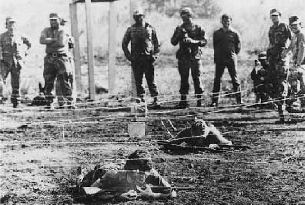
Guerrilla training camps: About eight hundred Exilic Cubans trained in 1981 at a camp near Miami for possible guerrilla operations in Nicaragua, Cuba, and/or Panama. Weapons are AR-15, civilian versions of M-16 rifles. Courtesy of the Historical Museum of Southern Florida.
The 1997 bombings of tourist locations in La Habana, which killed an Italian tourist, wounded seven, and caused extensive property damage, was masterminded by a seventy-year-old Exilic Cuban named Luis Posada Carriles, who has claimed responsibility.[15] Posada allegedly was trained by the CIA in the 1960s, was the centerpiece of the Reagan administration's efforts to supply arms to the Nicaraguan Contras, and has been linked to assassination plots in Colombia, the Dominican Republic, Guatemala, La Habana, and Honduras. During his New York Times interview, Posada alleged a financial relationship with the deceased CANF cofounder, Mas Canosa, whose organization allegedly provided more than $200,000.[16] Posada chuckled when he stated that the money would arrive with a message from Mas Canosa, "This is for the church." More recently, the FBI uncovered a plot allegedly masterminded by
That mártires de la lucha are regarded as patriots is evident in how the Exilic community venerates Orlando Bosch. The U.S. Department of Justice has linked Bosch to terrorist attacks in Miami and Latin America. Such alleged terrorism included a 1963 aerial strike at a Cuban refinery that killed three children, the shelling of a Polish freighter in the Port of Miami (for which he was convicted in 1968), and a 1976 bombing of an Air Cubana jetliner that claimed the lives of seventy-three passengers, most of whom were teenage members of Cuba's national fencing team (for which Bosch was acquitted in Venezuela in 1986). An unsupported allegation was also made during the 1978 House Select Committee on Assassinations placing Lee Harvey Oswald at Bosch's Miami home two months before Kennedy's assassination and both in Dallas around November 20 (Didion, 1987, 134–35). Yet the Miami City Commission, recognizing Bosch as a mártir de la lucha, declared March 25, 1983, to be "Dr. Orlando Bosch Day."
More recently, a grand jury indicted seven prominent Exilic Cubans accused of conspiring to assassinate Castro during the 1997 Latin American summit at the Venezuelan Island of Margarita, a clear violation of the U.S. Neutrality Act. The U.S. Coast Guard, responding to an October 27 distress call from the forty-six-foot yacht La Esperanza (the Hope), discovered five alleged assassins (between sixty and seventy years old) carrying two.50-caliber semiautomatic rifles, night-vision goggles, and satellite positioning devices. One of the men, Angel Manuel Alfonso, blurted out the plot. Among those indicted with the five on the yacht was Jose Antonio Llama (owner of the yacht), who sits on the executive board of CANF, and Francisco "Pepe" Hernandez (owner of one of the weapons), who replaced Mas Canosa as chairman of CANF. These indictments occurred during the Clinton administration, leading Juan Masimi Soler, lawyer of one of the defendants, to profess the veneration of such mártires de la lucha when he said, "If this were Ronald Reagan, or
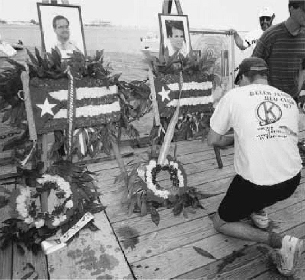
Mártires de la lucha: A year after the event, Orlando Gutierrez kneels before pictures of the fallen Brothers to the Rescue downed in 1996 by Cuban MiG fighters. The Miami Exilic Cuban community recognizes these men as martyrs in the struggle for a free Cuba. Photograph © A. Enrique Valentin/The Miami Herald.
Although Exilic Cubans consider themselves "free," in reality Miami can be understood through the paradigm of the "panopticon" as offered by philosopher Michel Foucault. Panopticism describes a model prison in which the center is occupied by a guard tower enabling guards to gaze at the prisoners in their individual backlit cells, while the prisoners are unable to gaze back at the guard. The guard's ability to gaze confers power on the observer while setting a trap for those being observed, even when the surveillance is not constant. The mere possibility of being watched forces the prisoners as Objects to internalize the power relation. In Foucault's words:
He who is subjected to a field of visibility, and who knows it, assumes responsibility for the constraint of power; he makes them play spontaneously upon himself; he inscribes in himself the power relation in which he simultaneously plays both roles; he becomes the principle of his own subjection. By this very fact, the external power may throw off its physical weight; it tends to the non-corporal; and, the more it approaches this limit, the more constant, profound and permanent are its effects: it is perpetual victory that avoids any physical confrontation and which is always decided in advance. (1995, 202–3)
It would be naive to view power as belonging only to the elite. Power is everywhere, forming and passing through a multitude of institutions. It is most effective when it is exercised through a coercion that appears natural and neutral, a coercion based on the simple ability to observe. The panopticon, as a mechanism of exercising power, serves as a model for how oppressive power works on the streets of Miami. The bomb that is overtly targeted at one offending "heretic" is symbolically directed at all potential "sinners." For this reason the public display of punishment must be spectacular, seen by all as a triumph of "justice." The excess of violence becomes a religious ritual that purifies the whole society through the sacrificial death of the heretic who bears the sins of those who defile what has been defined as good. Public punishment, at its extreme, brings into play the dissymmetry between the heretic who has dared to go against the doctrines of la lucha and the constructed all-powerful will of the Exilic community, which displays its power by communicating what will happen to those who refuse to conform to the "truth" as established and defined by that community.
These public demonstrations are not intended to establish justice but to manifest power, and, through that power, to prevent the repetition of the heretic's peccadillo. In light of several militant groups having declared, as the common phrase has it, "war against the enemies of Cuba's freedom," past punishment serves as the instrument for preventing others from straying from the official religious doctrines of la lucha. Punishment, above all else, is always directed at all potential heretics. Hence it is never a mechanism solely of prohibition but also of production—the production of political and social subservience. All must know about the possibility of violence because all must be made to feel afraid; and all must bear witness to its infliction so as to, to a certain extent, partake in its unleashing. Only an inefficient social structure will continue to constrain through the use of brute force when the religious fervor of la lucha, normalized as truth in the minds of the community, provides a better way of obtaining conformity.
With time, the fear of punishment in the form of bombs and machine guns is no longer needed to maintain discipline within the Exilic Cuban community. These weapons have been so effectively used in the past that the guard's ubiquitous gaze has been internalized. A shift in the "technology of power" takes effect when yesterday's tortured public bodies scattered on Miami's sidewalks in the wake of a bombing become today's docile private bodies confined to their individual "cells." As Exilic Cubans committed to memory the terror of swift punishment, a system of diminishing penalties took hold. Instead of brute force, public ridicule or ostracism from the socioeconomic spaces of Miami became sufficient to ensure obedience. Although the use of brute force may still occasionally be required as a reminder of the punishment awaiting heretics, the bombthrowing patriots operating within the theater of punishment have increasingly become the bureaucratic patriots working within the sociopolitical hierarchy.
La lucha thus includes a comprehensive system of domination. Exilic Cuban radio stations and numerous periodiquitos (tabloids) of Miami become the unblinking eye of la lucha, serving as the guard tower.[21] The gaze of the radio stations and periodiquitos produce conformity to the religion of el exilio. These stations are not the terminal points of power. Rather, they serve as the official pulpit whose sermons spread news, disseminate rumors, denounce heretics, and constantly call for the punishment of in(Fidel)s. The airwaves and printed pages of Miami normalize the "sinner's" punishment, not as vengeance in the hands of terrorists but as a result of divine retribution. And when the instruments of God's wrath are prosecuted by the U.S. government, these instruments become martyrs of the faith. The guard in the tower, the power that demands obedience, is disguised as the basic democratic right to a free press.
Because power cannot be possessed, it can only be exercised by those privileged enough to position themselves within the dominant culture. But if misused, power can be lost and used against those who previously benefited from it. Bernardo Benes, considered one of the leading Exilic Cubans in the late 1970s, lost his position of power and privilege when he met with Castro to explore the possibilities of reconciliation. Benes's trip to Cuba resulted from Castro's appeal (stimulated by secret normalization talks with the Ford and Carter administrations) to engage in a dialogue about possible reconciliation with Exilic Cubans. An olive branch was offered when Castro publicly stated he might have "misjudged" the "Cuban community abroad."[22] El diálogo divided the Exilic community when what became known as el comité de los 75 (the committee of the
Those who participated in el diálogo were labeled traitors, communists, vendepatrias (sellouts), tontos inutiles (useless idiots), and mariposas (butterflies, a euphemism for homosexuals) by Miami's Exilic Cuban radio stations and periodiquitos. One Exilic Cuban periodiquito (La Crónica, translated as the "chronicle" or the "story") published the names, addresses, and telephone numbers of those supporting el diálogo so that "real" Cubans could personally express their anger.[23] On several occasions, as late as 1986, some Exilic Cuban radio stations were fined by the Federal Communications Commission for inciting riots. Benes described the panopticon function of these radio stations and tabloids when he stated, "A million Cubans are blackmailed, totally controlled, by three radio stations. I feel sorry for the Cuban community in Miami. Because they have imposed on themselves, by way of the Right, the same condition that Castro has imposed on Cuba. Total intolerance. And ours is worse. Because it is entirely voluntary" (Didion 1987, 113). To live in el exilio of Miami is to consent to one's own subjugation while hoping that la lucha will radically provide salvation from one's estranged existence.
The events surrounding the scheduled performance of Dolores Prida's one-act play, Coser y cantar (Sew and sing), during the First Annual Festival of Hispanic Theater in 1986 also illustrates how Miami's panopticon functions. Coser y cantar explores the struggle of an Exilic Cuban woman caught between two cultures. A bilingual monologue develops between the Spanish-speaking "Ella" who represents her cultural heritage, and the English-speaking "She" who represents her Angloization. As both sides of her personality bitterly bicker for mastery, Ella/She concludes that both selves are crucial for survival. The play was canceled because of numerous radio denunciations and bomb threats. Why? Dolores Prida was suspected of communist leanings. Her experience in Miami led her to claim that the only city besides Miami where she has been afraid to express herself, "where people look over their shoulder to see if they can say what they were going to say," is La Habana. And on October 19, 1998, someone lit fire to Club Amnesia in Miami Beach in response to a scheduled
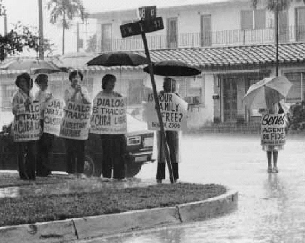
Protesting Bernardo Benes: A group of Exilic Cuban women protests across the street from the Continental National Bank (where Bernardo Benes was a vice president), in spite of the pouring rain. Posters read "Dialogue is treason to our martyrs," "Dialogue is treason to a free Cuba," and "Benes is an agent of Fidel." Courtesy of the Historical Museum of Southern Florida.
In Miami former comrades can easily become deadly enemies. Forty years after the CIA-backed Playa Girón invasion, a conference was held in Cuba to discuss the events of 1961. Nine members of the Brigade 2506, who fought to dethrone Castro, now accepted his invitation to the conference. They were exploring a new strategy for dealing with Castro's government, one of open dialogue. Yet, in spite of their membership in the Brigade, seen as a badge of honor among the faithful, they were now seen as enemies of la lucha, backsliding sinners who had lost their way, traitors sin vergüenza (with no shame). Hence they were officially kicked out of the Brigade 2506, becoming personae non gratae. Mario Cabello, who was among those ousted, had to be escorted out of the building for his own safety. "It's ironic that forty years ago when I was captured by
These wounds are not inflicted by a centralized Exilic Cuban elite. Rather, the power to inflict wounds on the docile body resides in a multitude of networks (such as radio stations and periodiquitos) woven into the political economy of the elite. Therefore, replacing the elite would not suffice in eliminating these networks, which are ingrained in Miami life. Benes's experience proves the autonomy of a disciplinary structure designed to punish dissenters of la lucha, even those among the elite. The tragedy of Miami's panopticon is that those who exercise power are not necessarily aware of their complicity in the power structures of the Exilic community or of their own self-subjugation to those structures owing to their belief in the holy cause of la lucha (De La Torre 2001, 196–200).