
2. The New GPs
The Family Physician Comes of Age
In 1940, three-quarters of America's physicians were still general practitioners. World War II provided a huge boost for specialization, as board-certified physicians received higher rank, more pay, and, in consequence, higher status in the military. Following the war, the G.I. Bill covered medical education, providing an instant subsidy for young doctors pursuing specialty training. The rapid development of employment-based health insurance in the postwar period also stimulated specialty practice by providing much of the population with a payment system for care that was increasingly procedure-oriented and hospital-based. By 1970 only 20 percent of America's physicians counted themselves as GPs.
Through much of this period the GP was a passive player, an increasingly rare victim of what many believed to be a kind of medical Darwinism—a species of practitioner no longer adapted to the world of medicine. The term GP had become a default definition, largely a role that characterized what a practitioner was not. Although the country doctor who took care of Granny and the baby still held a Norman Rockwell appeal, it was the specialist whose image was now celebrated. Facing dwindling numbers, the absence of residency training programs, and the prospect of the loss of hospital privileges, general practitioners began to organize, in 1947 founding the American Academy of General Practice (AAGP) dedicated to improving the fortunes of their discipline.
The next two decades engendered intense conceptual and political debate over general practice. What exactly was the GP of the future to be?
By the mid-1960s, there was general agreement that the idea of a formally trained family physician was a good one. In rapid succession over the next several years, the AMA approved a specialty board for Family Practice, the AAGP became the American Academy of Family Physicians, and family medicine residencies sprang up all over the country. The family practice curriculum maintained surgical and obstetrical training but emphasized the physician-patient relationship and the sociological elements of medical practice. In the 1970s, substantial federal support was provided to family practice residencies to assist in their startup and maintenance, resulting in growth from 150 programs early in that decade to more than 450 today. Between 10 and 15 percent of medical students choose to train in family medicine each year, making it among the most popular of residency programs. (For a more complete discussion of the history of general practice, see chapter 1.)
General practice has not so much been saved, as it has been reborn. The idea of family practice carries on the tradition of the GP but has a new identity of its own, a set of quantified capabilities, and a vision of the medical future. The continuity, nonetheless, between the GP of the past and the family physician of today provides a strong, clear, central legacy to primary care in America.
The story of Eugene McGregor, M.D., of Lisbon, New Hampshire, is a bridge back to the roots of family medicine. Having practiced for forty years in the community where he grew up, he is a reminder of the continuity and connectedness of the rural GP and the spiritual grounding for the family physician of today. Fifty miles to McGregor's west, Connie Adler, M.D., carries on his legacy, but from dramatically different conceptual roots. Urban, feminist, and consciously political in her upbringing, she has migrated to a rural family practice that picks up, in many ways, where the GP of the past left off. A residency-trained family physician, she exemplifies the same principles of continuity and availability practiced by McGregor and his colleagues.
Armed with the same values, Neil Calman, M.D., has reentered the city—in his case New York City—which, like so many areas, had seen the virtual demise of general practice. Using a blend of family physicians and nurse practitioners, Calman has constructed a network of family practice delivery sites that are active in training family physicians as well as delivering care in many poor and working-class neighborhoods. Wrestling with managed care, trade unions, and academic health centers, Calman has led a resurgence of urban general practice.
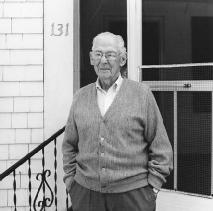
Eugene McGregor in front of his long-time home at 131 South Main Street in Lisbon, New Hampshire.
EUGENE McGREGOR, M.D.
A LEGACY OF GENERAL PRACTICE
Lisbon, New Hampshire
Gene McGregor was born in 1916, six years after Abraham Flexner, the great medical education reformer, published his critical report on the weak condition of medical education in the United States and three years after the founding of the first medical specialty organization, the American College of Surgeons. His life has spanned a period of enormous change in the theory and practice of medicine in the United States, most of which he has observed from the vantage point of Lisbon, New Hampshire—his birthplace and still the site of his medical practice. Spare of words and direct in response, Dr. McGregor displays an alertness and a power of recall that belie his more than eighty years. He sits comfortably on the porch of his green-shuttered white house on Main Street in Lisbon, recalling his days in practice, some fourteen thousand of them. He apologizes for the regular interruptions in his reflections caused by the gearing up of lumber trucks passing noisily out Main Street and by his occasional trips inside the house, necessitated, he explains, by diuretics.
He reminisces about life as a general practitioner in northern New England,
Dr. McGregor is no gypsy, having left northern New England only for two years of medical school and four years in the army. His lifelong practice in his hometown is atypical by today's patterns but represents a genre of traditional practice that is an important line of heredity to the values of current generalists. Continuity, community, intergenerational care, and home visits were all part of the work of Dr. McGregor. He never used a horse and buggy, but he is a bridge to those generations past, their fledgling science and their powerful art.
IN 1948 I CAME BACK to Lisbon, New Hampshire, the town where I was born, to start medical practice. I was getting older, and my children were getting older. A woman in Lisbon offered to lend me a sum of money to buy a house and to start a practice. I decided I'd better do it. I was going to be thirty-two that year, which I felt was too old. Lisbon had three doctors in the 1930s, but only Dr. Pickwick was left and he was getting older. This woman didn't like Dr. Pickwick very much. He was a very crusty character, and I'm sure they quarreled.
Coming home to start practice was nice and it was bad. It was nice because I knew the backgrounds of a great many of the people I saw, and I didn't have to spend a lot of time trying to figure them out. But I'd been away from Lisbon for fifteen years, and there was quite a turnover of people. I realized that I didn't really know as much about these people as I thought I did. Many of the names were familiar, but much of the social activities had changed during those fifteen years.
My parents were still living in Lisbon, and I think they were glad to have me home. My father had been a banker and my mother started as a schoolteacher, but later she stayed home to take care of the family. Both of their families came from this area. I had two great-uncles who were physicians, but the idea of becoming a doctor didn't really occur to me
When I graduated from high school in 1933, a lot of my classmates couldn't go to college because they couldn't afford to. I found that with the scholarship that Dartmouth offered, I could go there cheaper than I could go to the University of New Hampshire. Dartmouth also had a program that required only three years in college before starting medical school, so I entered Dartmouth in the fall of 1933. I worked all the time I was in college, and summers too. I “hopped” bells every summer at the Mountain View House, which was a big resort up in Whitefield. For those of us who worked, there wasn't much of a social life. The premedical curriculum was very much prescribed. We had only a few elective courses so I took history, which I enjoyed very much.
That was a tough time. I think the main worry was the question of war. There was a war in China at that time, a war in Ethiopia, and a war in Spain. A lot of people had to worry just about their existence. When you have 24 percent unemployment in this country, you're in trouble. For instance, my father's salary had been cut in half during the very first part of the Depression. He had some stock holdings, and they had become worthless. Even at that time, though, there was a great deal of wealth around Dartmouth, although I had very little contact with people who had much wealth until I reached medical school.
I applied and was accepted into the medical school at Dartmouth, probably because they wanted to encourage medicine among the residents of New Hampshire. I did have the idea then that I would be a general practitioner, but I didn't really know where. I do remember that I didn't want to be subservient to anyone if I could help it, except my patients maybe.
Medical school was very, very enjoyable. We had a class of twenty, and there were only two classes since it was just a two-year school. Dart-mouth did a deluxe job of teaching. We had some of the best teachers I ever had. In anatomy, there was a corpse for every two students. Spent all year working on it. It was a great time. I believe I am the only general practitioner from that class.
We all had to go on to another school for our clinical training after the two years at Dartmouth. I went to Rush Medical College in Chicago. At that time it was a part of the University of Chicago. It was quite an experience to go from Hanover to the west side of Chicago. I was in a class of 105 at Rush. There were eight or ten women in our class. I'm sure that out of our class of 105, probably 25 percent or 30 percent became general practitioners.
We were in the most impoverished part of Chicago. I'd never seen poverty such as that, not in New England, even at the worst of the Depression. I lived in the YMCA right across the park from Cook County Hospital. I used to walk in town every now and then, and I'd see fifteen or twenty drunks lying on the sidewalk near the entrance of rundown buildings. There were gangsters too. The Mafia was taking over restaurants, bombing and so forth. We were told when we were in obstetrics making home visits that we should never have more than a dollar in our pockets, and a dollar watch, because we might be robbed.
At that time, obstetrics for the poor in Chicago was practiced by the method of Dr. DeLee, I think it was, who established clinics for charitable delivery of obstetric services. The women came to the dispensary for their prenatal care, but when they delivered, they were delivered at home by teams of medical students. We went to tenements and apartment houses and followed the routine of trying to establish a somewhat sterile field with rolled-up newspapers, some hot water, and a pair of gloves. That was about it. The first time you went out, you went out with a student who had been out before, and he taught you what he knew. You could call an assistant resident from Presbyterian Hospital, who would come out and try to help you, but sometimes there were disasters. I had one, actually. A girl was pregnant with her first baby, which was in a posterior occiput position, and she couldn't deliver. Finally we got the assistant resident out, and he tried to put on forceps and rotate the head. I was giving her ether, which I had never done before, and I was scared to death. We were using the dining room table. Friends of the patient came in to hold her legs. One guy crawled under the table and vomited. I was running around the table trying to give ether, or holding up a leg. It was an awful mess. We got the baby out, but I'm not sure how well.
Most of the poor we dealt with were from all over Europe. At that time Chicago had the largest Czech population outside Czechoslovakia, the largest Polish population outside Poland, and so forth. And that was one of the reasons I didn't stay in Chicago, because I had to deal with
In general, Rush was excellent. We had some very good teachers, but the classes were big. The dispensary was excellent. Rush treated largely low-income patients for free. We worked on the wards at Cook County Hospital, where we really learned. We saw patients at Presbyterian Hospital too, but they were mostly private and we did less with them. I think the tuition was $400 a year. The school helped me a little and my parents chipped in. I borrowed some money, about $2,000 I think, while I was going to Rush.
When it came time to apply for internship, I wanted to come back to the Northeast. I went to Maine General Hospital in Portland partly because I wanted to get away from the foreign languages in Chicago. It was an eighteen-month rotating internship with no pay. Interns got room, board, and laundry, and that was all.
There were ten of us interns, and we were all as poor as church mice. We were on call every other night, every other weekend. I was only at Maine General for a year because the war came along. I had joined the Reserves and got called up in June 1941. I was married in May of that year, so it was kind of a busy time. I spent time in Panama toward the end of the war at Gorgas Hospital, a 1,000-bed hospital run by the Panama Railroad and staffed by the army. I was assigned to the contagious disease section, where I saw people with leprosy and typhoid fever. I did rotations on several other services and came home in December 1945.
When I was discharged from the service, I decided I needed more training, particularly in obstetrics, if I was going to be a general practitioner. So I returned to Maine General Hospital and started a surgical residency. I stayed for two years before deciding it was time to start my practice and to take the offer from the lady in Lisbon.
Getting the practice going in Lisbon turned out pretty well. I guess the fact that I probably had more training than almost any of the local doctors helped. Then, some people apparently didn't much like Dr. Pickwick, and they came to me right away. There was a woman doctor up the road who was getting along in age. I didn't know it at the time, but she was also becoming an alcoholic. As a result, I acquired practically all of her patients. I hired Miss Isabella Smith to do my bookwork, my laboratory work, and so forth. She was a graduate of Lisbon High School two years ahead of me and trained as a bacteriologist at Simmons College.
My wife, Phyllis, was a tremendous help to me in the practice right from the start. She was a nurse, and I would say that any general practice
I used the Littleton and Woodsville hospitals, both a bit of a distance and in different directions. It could be nerve-wracking, keeping everything covered. My wife used to have to come out and flag down my car at times to try to stop me, or she would leave messages. I used to call up the operator and tell her, “I'm going to Lyman today, and I'm going to stop and see so-and-so.” If she needed me she would call me. She'd track me down. It was great—far better than most answering services these days.
I made house calls all my life. I think that's the way medicine should be practiced. A doctor should be able to see people in their homes, to see what their hygiene is like, to look in the refrigerator. I probably made three or four house calls every day.
I used to try to get to the hospital by about nine o'clock so I didn't interfere with breakfast and the cleaning up of patients. Then I'd go to the other hospital, maybe make a house call or two. Then office hours in the afternoon. At first I had open office hours from about one until four, and then in the evening usually from seven until eight. In certain seasons, flu season, for example, the waiting room was packed, and other times I had nothing to do. Eventually I went from open office hours to scheduled appointments, sometime in the 1960s.
Lisbon has always been a pretty poor town. We had a woodworking mill and later a shoe factory, and during the last twenty years we have been making wire, at Lisbon Wire Works up the road. The mill did not offer any coverage, so people had to pay as best they could. Blue Cross came along in the 1950s, and I think probably 15 percent or 20 percent of my patients had it. By 1985, when I retired, maybe 75 percent of my patients had insurance, including Medicare and Medicaid. A lot were still not covered, though. Health insurance made a great improvement in many ways, but the whole thing became so complex, it drove me nuts. First of all, go back to the fifties. I can remember when I first began practice, I realized after a while that some of these patients owed me a fair amount of money, which they didn't bother to pay. I looked at their homes, and they would have TV at a time when I couldn't afford TV. So I remember I got pretty angry at one time, and I told Miss Smith to send the bills to a collector.
It didn't work worth a damn. I told her in 1960, “I'll be damned if I'm going to bother with that kind of stuff anymore,” and I didn't. She
As time went on, I was seeing a crosscut of patients from Lisbon and the surrounding towns too. Around 1956 a very well-trained surgeon named Harry McDade came to Littleton, and I realized immediately that it really was foolish of me to do surgery since he was here. I kept on with obstetrics, delivering babies until the middle seventies. At that time fetal monitoring came in and caused quite a commotion. It irked the hell out of me, and quite frankly I despised it. I gave up obstetrics about 1976.
When I retired on July 31, 1985, I tried to get someone to take over my practice. I even advertised. But no one was interested, so I simply closed it up. Eventually Littleton Hospital took over my old office and arranged for two Littleton physicians to use it on a part-time basis. Someone must be there about every day of the week. The office is being renovated and will be a satellite of Littleton Hospital. But I tell you, I don't like it. I think it's producing a nation of gypsy physicians. They go where the best money is, and they stay a short time. Then they're off and away.
I have seen general practice become family practice, and that's been for the good. When the American Academy of General Practice [now the American Academy of Family Physicians] was founded in 1947, I joined immediately and kept up. I thought it was an excellent thing. When I started practice, there wasn't this whole array of specialists. So as a result, you were forced to take everything on and try to do the best you could with it. The old-timers, if they had had a year's internship they were lucky. They had to learn on the job for the most part. I'm sure I did. These physicians had to learn a lot of things very quickly. Most of us were aimed at small towns and rural areas and were going to take care of everything. When I began I was probably taking care of 95 percent of everything that came along. A general practitioner today ought to be able to manage 85 percent of everyone he or she sees; the other 15 percent he probably ought not to be managing. The real question is to know who are the 15 percent you should refer.
As a general practitioner, you could experience some real problems, even when you were careful. A girl had a baby. After the baby was born, she came back to see me several times with minor complaints. I didn't think too much of it. Then she showed me some personal journals—just stream of consciousness stuff. I tried to encourage her; her husband was a minister. The next thing I knew she had taken the car and disappeared with the baby. Everyone was looking for her. She was eventually found
Over the years, of course, I dealt with a lot of family problems and the like. Drugs were practically a nonproblem when I first began practice. I don't think there were so many sexual problems either. I remember one patient telling me a problem she had of a sexual nature and how shocked I had been that she came out with it! At that time, I'm darn sure I didn't offer her any advice whatsoever. I occasionally saw women who had been beaten up by their husbands, and I would try to get them to prosecute, but they never would, even those who said they might.
There were a lot of other things in a small town that militated against this sort of thing. The Masons, for instance, the Boy Scouts, youth groups, religious groups, and so on, exerted quite a bit of power in getting kids not to do things that they ought not to be doing. In addition, the police were not inhibited by some of the things that have gone on in the courts. They had no compunction about beating somebody up if they felt he or she was doing wrong. They did. I think people knew it. If someone was to beat a child, for instance, the father or whoever did it could get one hell of a beating from the police.
Alcohol certainly was a problem. Even when drugs for the treatment of alcoholism came along, they didn't help much. As a matter of fact, years ago, in the fifties, one of my patients—a very wealthy woman—was a terrible alcoholic. She had married a guy who was a drunk himself. One night I was called to her house and found her standing in the middle of the room, not moving. “He's down there,” she said. “Who's down there?” “Louis is down there.” Turned out that her husband hid his liquor in the cellar. He had gone down to get some and she put the trapdoor down and was standing on it and wouldn't let him up. Well, now she wanted a drink. She tried to get me to get her riding boots, which were in a corner of the room; one boot had a bottle in it. Well, I was pretty irked, and I wouldn't do it. I think I just said, “You've got to let him out of there!” She eventually let him come up, and they were calm and peaceful and then had more drinks together, and I just left. I took care of her for many years after that. She caused a lot of commotion and kept on drinking.
I enjoyed my years in practice, but I wasn't sorry to get out when I did. The number one reason was the litigiousness of patients, physicians, everyone. It had gotten much worse over the years. The second reason
I'm glad I don't have to practice today because of the choices involved, the idea of joining an HMO or a PPO, particularly for a physician in a small town. Some of them want you to sign exclusive contracts. That would really pose a problem in a small town. How can a physician possibly function that way? I can see how an HMO can save money, but the only way to save money is if the physicians who are the gatekeepers are the most honest characters that have ever been created, and I don't believe they are.
I've been asked from time to time, “Isn't general practice boring, seeing the same thing all the time?” Actually I think it's the reverse. When I was a resident, I thought about going into urology. But the problem with urology was that I just couldn't believe that I would spend the rest of my life looking at penises and bladders and kidneys. In general practice, you're looking at a tremendous range of medical conditions. It's true that you can't have every bit of knowledge at the end of your fingertips, but you can find it relatively quickly. No, I thought that general practice gave far greater diversity and much more enjoyment. I saw eyes, I saw hearts, I did rectal examinations, I did feet. I pared corns and I delivered babies. Everything. The whole works.
Work as a general practitioner is not necessarily easy for your own family. Phyllis was a great help to me, and we had three wonderful children: Eugene, Jr., born in 1942, who is now a professor of political science at Indiana University; James G., born in 1947, who is a nuclear technician for a radiologist in St. Johnsbury, Vermont; and Kathryn, born in 1950, who is a Methodist minister in Colebrook, New Hampshire. I think my wife felt at times that it was all too much, because we were up all hours of the day and night, with deliveries particularly, and it was a very hectic schedule.
I probably didn't see my children as much as I might have. But I think my family would agree it's been a good life. I think about it a lot. I remember it well. But I am glad I retired.
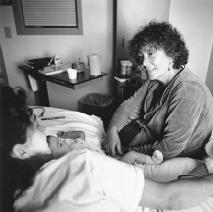
Connie Adler with a new mother and child.
CONNIE ADLER, M.D.
LIVING RURAL MEDICINE
Farmington, Maine
Connie Adler quotes Marian Wright Edelman: “Service is the rent we pay for living.” And she means it. For twenty-five years she has been dedicated to the care of women—women and those important to them, children and families. Working in a free clinic and as a lay midwife in Seattle, Washington, in the early 1970s, she was caught up in the burgeoning women's movement and has never really left it. Her commitment carried her on to medical school, training as a family physician, five years of service in the National Health Service Corps in a migrant health clinic in eastern Washington, and now a family practice specializing in women's health in western Maine.
The daughter of a Jewish immigrant psychoanalyst and an Irish American mother, Dr. Adler grew up in an environment that valued intellectual achievement but discouraged women from entering medicine. It took a degree in history and ten years of vocational wandering before she found medicine and gravitated rapidly to family practice. Primary care was not valued at her research-intensive medical school in the mid-1980s, but with a few colleagues, including her soon-to-be husband, she
She is upbeat and loquacious in discussing her life and her work, chuckling easily and telling stories about herself. She understands what she has accomplished, and she describes it with clarity and a sense of continuing mission. Dressed in brown clogs and burgundy scrubs with her wedding ring and watch neatly pinned to her collar, she is at home in the obstetric suite of the Franklin Memorial Hospital in Farmington, ready to deliver one of the scores of infants she brings into the world each year. She pauses for forty-five minutes in her chat about her career, delivers a seven-pound infant to a sixteen-year-old girl, reflects on the challenges awaiting them both, and returns to her own story. She is never far from giving service to someone.
IN MY MID-TWENTIES IN the early 1970s, I was “called.” That was when I knew exactly what I wanted to be doing—working with women in labor and delivering babies. That was one of the clearest moments in my life, and since then I have known that's really where I belong.
I had moved to Seattle after college and was active in community organizing. I helped to start the Country Doctor Clinic, a collective that was one of the first community clinics in Seattle. A group of ten or so people got the clinic built and going. Then another woman, Margie Joy, and I started the prenatal clinic there. She was doing home deliveries, and I was helping and became sort of an apprentice. She was a lay midwife and had a physician for backup. I started doing deliveries, always with somebody else. The only ones I ever did by myself in those days were by accident when nobody else came out or got there on time. Within a year, though, I felt that I didn't want to be a part of doing what seemed like inadequate medicine to me, that if I was going to say I had some skills, I really needed to have them. And it wasn't enough to know one body system. Women would come in who were pregnant but who also had a sore throat or some other problem, and it just wasn't enough to know only the reproductive system. That's when I started thinking again about going back to school.
The other major and more important thing that happened during those years was that I had a baby. My daughter was born in 1973, and so of course I was involved with raising her. I was in a variety of different collectives at various times, but I did not have a partner. So I was single parenting. At that point came the beginning of a crackdown on lay midwives.
My father was a physician, but I don't think that had a lot to do with my decision about medicine. He escaped from Germany in 1937, a German Jew. The rest of his family was killed in the camps. My father was a product of European Jewish intellectual culture between the two world wars, and he brought this incredible Renaissance-man character to everything he did. He died recently, so I think about him a little bit more right now. He was a psychoanalyst trained in Austria, France, and Germany. He taught neuroanatomy in Turkey for a while. He actually practiced both neurology and psychiatry for a time, and then stopped doing neurology as he got older. During World War II he was in the U.S. Army, practicing largely as a neurologist.
My mother came from an Irish-English family that had been in New York for a century. An interesting combination. The two families would probably not have spoken to each other had my father's family survived, but it never was an issue. My parents shared their love of the arts and took us to the ballet or the opera or museums almost every weekend. Just as an interesting snapshot of my parents, when my father had three months off between when he was demobilized after the war and when he started practice again, he and my mother visited every church and museum in New York City. That's what they did with that time. That's who they were.
I grew up in Queens; later we moved to Upper Brookville on Long Island. My parents were Democrats, but not terribly political. From the time I was very young, justice was an overwhelmingly important concept for me. There certainly were things that promoted that feeling, including learning other languages. My father spoke eight languages, and we all started by age seven taking French lessons, and then, when I was thirteen, I went on my own to France for the summer. When I was fifteen, I went to Guatemala and learned Spanish, and later I went to Germany. Both learning languages and traveling to other countries were politicizing experiences. When I was in Guatemala, I witnessed incredible poverty next to incredible wealth. Guatemala has 95 percent illiteracy, and 5 percent of the people own 90 percent of the land: a tremendous eyeopener for a fifteen-year-old.
We grew up in a racially mixed neighborhood in Queens, which felt completely normal to me as a kid. Later I discovered that people didn't think that was normal. By the time I was in ninth grade, on Long Island, I was getting kicked out of class for being a Communist. During my high
I loved my science courses—except physics. We had aptitude tests. Each time I took one, people said I ought to become a doctor, and every time that happened, they also said, “But that's silly. You're a girl.” And so I went to college as a history major because it was “silly” for me to think about being a doctor, because I was a girl. That was 1965.
I went to Cornell and liked it a lot. I actually loved my history courses, American cultural and intellectual history. It was an exciting time with the antiwar movement and the black student takeover of the Student Union. Dan Berrigan was there; we had Seder with him. But then I went to Yale to do graduate work in history and just hated it. It was the beginning of the women's movement in New Haven, which I became involved in. Actually what I wanted to do was oral histories of women, especially women in the labor movement. The history department was very much Old Guard and thus a real conflict. I left after a semester, eventually moving to Seattle and getting involved in midwifery.
After Seattle, I came back east to start on my uncertain but determined journey to medical school. Women's health was my focus, my goal. The sixties and early seventies, of course, were a time when the women's movement was just taking off. I was a middle-class kid and hadn't suffered any horrible economic discrimination. But I knew from my own experiences the unequal position of women and the violence against us. I had already been involved in some antiviolence issues, violence against women, as well as the abortion issue. I ended up in Boston working different jobs, raising my daughter, taking premed courses. I remember sitting on the beach with my three-year-old so she could play in the water while I studied organic chemistry.
It was 1979—ten years after I graduated from Cornell—when I started Tufts Medical School. I was ten years older than almost everybody. The very first day I sat in class next to this kid who looked like a kid. I said something about my daughter, and he said, “Oh? What does your husband do?” And I said, “I'm not married.” And he said, “But I thought you said you had a daughter.” I felt like I had to explain to him that those two were not necessarily related. I met Mike Rowland, who is now my husband, in the first few weeks of medical school, and that actually helped quite a lot. We had each other to get through school. He was also an older student. He had taught high school in Maine and Vermont, and he was the one who first started talking to me about family
When I started in medicine, I assumed I was going to do obstetrics and gynecology. While learning the science of medicine, though, I became much more interested in how the art of medicine happens and felt that primary care was the way to go. Being there for the family as a unit was the way I could be there for people, and also help steer people in positive directions. But no one was teaching that at Tufts. In fact, both Mike and I got a lot of flak about wanting to do primary care. It was a very specialist-oriented kind of place. People kept saying things like, “Why do you want to be a family doctor? You're a smart person. You could do something really interesting.” But it became just clearer and clearer to me that the unifying of care made a lot of sense.
When I did OB, I felt that way even more. I love OB. It is still the thing I love most in medicine. There's something about that interaction of several hours of labor and coaching and birthing that's special and wonderful, but it's a lot more wonderful when it's somebody you've seen before and you will see later, seeing the child grow up, interacting with the mother throughout her life cycle, or throughout the child-raising years. I wanted to take care of that unit. The further I got into medical school, the clearer it became that I wanted to be able to take care of the whole life cycle. There were about five of our class of 150 who became family doctors.
Mike and I both received National Health Service Corps scholarships to get us through school. Mike needed the help and had planned on doing rural practice anyway, so it was up the right alley. For me, similarly, I was on my own with a child and had to find some way to support her. I really did not want to pile up big debts to influence how I practiced afterward, because I wanted to do shortage-area medicine. I felt that no matter where I went with the National Health Service Corps, I'd be doing shortage-area medicine. I never wanted to do suburban practice.
We had to do residencies before we started our payback practice. We chose the Maine-Dartmouth residency in Augusta because it was a good place—a great place—and we got them to agree to let us do it in four years instead of three because we had the new baby, as well as my eighth-grader. So we split our internship year. We alternated months: one month at home, one month at work. So we both did the internship year over two years. I loved it. We also chose the Maine-Dartmouth program because of the great people there and their attitudes. It was the only place
When we finished residency in 1987, Mike and I owed the National Health Corps four years. We liked the idea of working on the Zuni Indian reservation, but we ended up going to Moses Lake, which was a migrant farm worker site in eastern Washington. The practice was about 70 percent migrant farm workers, 30 percent indigent people from the area. Moses Lake is a town of about 15,000 to 25,000; depending on how big an area you count. We were the only two docs in the clinic when we got there, and there was one physician assistant. There had been two NHSC doctors there before who waved goodbye as we rode into town.
There we were. It was very busy, but the clinic was wonderful. The people who staffed the clinic are still very close friends, fabulous people, very committed. We worked in Spanish half or more of every day, which we enjoyed. It was a very busy obstetrics practice and a lot of pediatrics. The first year was like a fellowship in perinatology. We had a lot of highrisk OB, a lot of very sick babies, a lot of kids with congenital heart defects and congestive heart failure. There was a fifty-bed hospital in town where we did deliveries and hospitalizations. The hospital had a medical staff of about twenty-five; the others were all in private practice. So we took care of everybody who didn't have any money, and they took care of people who did. Some of the specialists supported us but we did almost everything for everybody. I had eight hemophiliacs in my practice, and in fact ended up being sort of the hemophilia expert in eastern Washington. There were several families where I was taking care of four generations of people.
We stayed in Moses Lake for five years. The first two years we were alternating call every other night—with each other! It was ghastly. We never saw each other. Basically the way to change that was to build the practice so we could hire somebody else, and we eventually did. We were seeing lots of patients, we were busy, we took all comers and built up
Moses Lake was a very, very conservative town. I was the only woman I knew who had kept my maiden name, and people gave me a lot of grief about it. It was an atmosphere that was stuck in the 1950s. People mostly identified by their church, and that's how they socialized, by church group. So we were almost never asked out because we didn't belong to any of the local churches. The Hispanic community was very open, and we went to lots of “balls” and parties with our patients and staff. But the Anglo community was not all that open to us, with the exception of the clinic staff and one very supportive obstetrician.
The high school was a trial for our older daughter. She didn't fit in very well in town either, but she ended up doing a lot of independent study. During her first week of school she came home in tears saying, “They have mandatory pep rallies here.” So there was some culture shock, but she got over it. She did well and went on to Columbia University.
At the end of five years, we decided to go back to Maine. We still had a lot of friends there and wanted to do rural shortage-area medicine. We chose Farmington because it has an excellent school system for our youngest daughter, with a lot of emphasis on music, which is her interest. I found two obstetricians here who were willing to let me do family practice and as much obstetrics as I wanted. We certainly saw a lot of communities where there were turf battles: the obstetricians didn't like family docs. I do primary care, but the three of us share call. I do my own C-sections, tubals, and D&Cs, and I share call with the obstetricians. I enjoy surgery and do a lot of it. I also share call with the pediatricians and do all of the pediatrics I want. People talk about a women's health care specialist, and I guess that's what I am, except I do a lot of pediatrics too. I was chief of staff last year at the hospital in Farmington. I get along with most of the specialists. People have idiosyncrasies, God knows, but there is not a lot of turf fighting here.
Farmington is an interesting community because it's very rural, but we do have a college, the University of Maine at Farmington, so there's some element of college professors and students. We have a lot of farmers and people who work in the woods. Maine is a poor rural state, with many folks who have nothing. There's a big ski area nearby, and there are yuppies who work there. It's an interesting cultural mix. Almost everybody
I hate private practice, except for being able to make decisions about my schedule. But I think it's a dumb way to do medicine. I hate doing the business part of private practice. I'm good at it, I'm doing fine. In OB, a lot of people become eligible for Medicaid, so the OB part tends to pay for itself. The folks we see in the office who can't pay, we write off. It all works out. We have some people who will pay over time, or pay with their services. I'm making a perfectly good living, got my kid through college. That's all I care about. I hate having to think about insurance companies and reimbursement problems. I would much rather be working in a community clinic.
I have been active in shelters and domestic violence work for almost twenty years. It has been very exciting in the past few years to see violence against women become more recognized as the tremendous medical problem that it is. Farmington has united in extraordinary and dynamic ways to combat violence against women, and I have found it challenging and affirming to be a part of that process. We now have universal screening in our emergency department and obstetrical department; more physician offices are screening for violence at office visits; and we have signs when you enter town on any road that say that Domestic Violence is a crime and will not be tolerated here.
As far as managed care goes, Maine is way behind the curve. We're probably ten years behind California. So a lot of it here is just speculation. I have a group of managed care patients in my practice. I have learned how to use that system and play the gatekeeper role. I think we are going to have to learn how to talk to each other better and manage patients on a community basis a whole lot better than we have in the past. There are a few specialists who do inappropriate things, and as a medical community we have to learn how to control that.
Right now I think we're going from point A to point B in the system as a whole, point A being this nonsystem of independent practice, B being managed care in some form. It's hard to get very excited about point B, but I think there's a point C. Point C will be a lot more involved in patient concerns—which have gotten lost in managed care—and involved in public health but incorporate a lot of the savings and organization of managed care. I think I won't be able to be involved in getting to point C if I'm not involved in getting to point B. I don't exactly see what the ultimate product is going to look like yet. I had assumed it would be a single-payer system. I was very excited about the Clinton health plan and
I do feel that I'm doing what I set out to do when I decided on medicine. I'm the only woman physician doing women's health in this rural area. The obstetricians are all men and so are most of the family docs. I have patients who are incest survivors, cult survivors, domestic violence survivors, and women with multiple personalities from childhood abuse. These are patients who really want to see a woman physician—and not just a doctor, but a doctor/mom. These are people of all ages. This is the need that I fill in this community. It's important to me to be of service.
I have lot of energy and a lot to give. I get enormous amounts back from my patients—some days. Other days it feels like all outgo, no input. But there are some very special moments with people, with their babies, with people who are dying, with teenagers taking on new tasks and figuring them out, that are rejuvenating, that give me as much energy back as I put into them. So it's very renewing. Not every day. There are days when I drag myself around because I've been up all night and can't figure out which end is up. But overall, it's tremendously rewarding. There's nothing I would rather be doing.
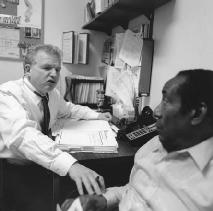
Neil Calman stresses a point.
NEIL CALMAN, M.D.
URBAN WARRIOR
New York, New York
Neil Calman stands in front of a battered Bronx tenement building, one foot up on its broken first step. There is graffiti on the wall behind him. His hands are in the pockets of his lab coat, and a stethoscope dangles from his neck. This picture, appearing in an article titled “The Urban Frontier,” tells a lot about Calman, his values, his strategies, and his chosen battleground. He calls himself “a flagwaving family physician” and “a warrior for urban health.” A third-generation New Yorker, he created the Institute for Urban Family Health almost twenty years ago and has run it as a command post for training and placing family physicians and nurse practitioners in community practices all over New York. Clippings from the New York Times, the Daily News, the American Academy of Family Physicians' Reporter, and the Robert Wood Johnson Foundation's Advances attest to the tenacity of his technique and the success of his public education campaign.
Calman's grandfather was something of an inspiration to him. An oral surgeon, an attorney, and a socialist alderman for the city of New York, he lived by his ideals and got arrested for them a number of times. Calman
I RUN THE INSTITUTE FOR Urban Family Health, a $20 million business with more than three hundred employees. But I haven't always been so comfortable with institutions. I was thrown out of the University of Chicago as an undergraduate, almost got bounced from medical school, and was suspended for two weeks from my residency program. Politics seemed to get me crosswise of administrations wherever I went. In 1983 I solved my rebel problem by building my own organization, which now enables me to practice many of the principles that got me in trouble when I was younger.
Growing up in New York, I couldn't help being exposed to a lot of politics and a fair amount of protest, too. I was born in New York City in 1949, the oldest of three and then later of five kids—my parents had two more children after I was already in college. When I was about four years old we moved across the George Washington Bridge from Washington Heights to Glen Rock, New Jersey. My father was drafted into the army about a year later, and we lived on a base in Virginia for two years before we returned to New Jersey for the rest of my childhood and adolescence.
Medicine runs in my family. My dad, who retired from practice in 1995, is an oral surgeon, as was his father. They both practiced in Washington Heights through the whole transition of that neighborhood from a mostly Jewish immigrant one to a mostly minority immigrant community today, and they worked out of the same office all those years. My dad now teaches at New York University Dental School.
My grandfather's plaque still hangs in my office. He was my inspiration and a very big influence in my life, passing on to me a passion for political causes. His name was Maurice Samuel Calman, and he was a socialist alderman in the city of New York as well as a dentist and an attorney. An alderman is equivalent to being a member of New York's City Council today. He also had a degree in agriculture, and he was a three-letter athlete in college. He had a philosophy about everything, and he lived by his ideals. As an alderman he was arrested a number of times. One of his arrests was for exposing a fake coal crisis. In the winter of 1918, companies were hoarding huge stockpiles of coal in outlying parts
My mother's father was a cantor from the same sort of socialist Jewish tradition. His were more cultural than religious values. He knew everybody that was half Jewish, a quarter, or an eighth Jewish—every entertainer, everybody.
My dad was associated with a small hospital, now torn down, called Jewish Memorial Hospital in Washington Heights. In my dad's day there was an oncologist-hematologist there named Harry Wallerstein who ran a small research laboratory with funds donated by the family of a leukemia victim he had cared for. Dr. Wallerstein allowed the children of hospital staff members to work in the lab during the summer. He literally closed the lab for those months to run his student program, and set up a group of experiments that we would study for weeks. I started working at the lab when I was fourteen, washing beakers and glassware for the first summer and progressing to handling mice the next summer. I learned a bit of biochemistry and became an expert in amino acid metabolism at age fifteen, because Dr. Wallerstein would insist that we learn the basic science behind the research we were doing. By the time I was eighteen, my senior year, I was the second-in-command of the lab's student programs. I don't think this program produced any work of major research significance, but it was responsible for many people going into medicine and assuming leadership positions.
In college I became involved in many political causes, a legacy from my father's father. In fact, when he died during my second year of college, it was a very difficult time for me. My interest in politics led me to the University of Chicago in 1967. An article in Life magazine in 1965 about the students forcing the school to deal with issues in the community really caught my attention. That was my first memory of having any kind of real political thought or interest. We could take courses there in any division of the school and we weren't even allowed to have a major until halfway through our third year. I took literature, poetry, music, and archaeology. It was a great educational environment.
At that time I became very interested in the social issues being discussed on campus, how the school was responding, and what role the students had. The university was like a white island on the mostly black south side of Chicago. The school wasn't integrated at all into the life of
During my second year I was involved in a sitin at the administra-tion building to protest the firing of an outspoken female professor. The school held hearings to determine how to punish us. At my hearing, I basically discussed the need to be true to your values and to act on them. Because I showed up for the hearing and went through the process, which a lot of people refused to do, I ended up only being suspended for the spring and summer quarters. About thirty students who didn't show up at all for their hearings were expelled from school. A number of them joined the Weather Underground. It was a hot time in Chicago.
I spent those two quarters living at home. I didn't want to get totally off track, so I went back to the research lab and talked to Harry Wallerstein. After he gave me a lecture about how stupid I'd been, he gave me a job. I went home and designed an experiment based on the research I had done there years before. Since the experiment was related to work the lab was doing and because Wallerstein believed in it, he spent about $10,000 on special equipment and supplies that I needed. I became totally engrossed in this project, putting in sixty, seventy hours a week at the research lab.
The experiment occupied the period of time that I was suspended from school, and we published four papers from it. I believe the papers were the only reason that I got into medical school. I applied to sixteen schools, but my transcript noted my suspension and I only got two interviews. In a complete quirk, one of the people who interviewed me had actually read one of the research papers I published, on how cancer cells changed their immunologic identity as they became resistant to chemotherapeutic agents over time, as he was doing research in an area very similar to mine.
So, I think I got into Rutgers Medical School for three reasons. First, there were two professors at Rutgers who were really furious about the homogeneity of the student body and the fact that the school was systematically eliminating people interested in political issues related to health care. The admissions committee allowed them to make recommendations for a few slots, and they chose me. Second, the doctor who interviewed me was interested in my research area. And third, the same interviewer was fascinated by my college course work in archaeology,
I really went to medical school to become a researcher. I believed that people with scientific minds had a responsibility to try to solve the big medical problems that people faced. This thought helped me to connect my sense of social responsibility with the fact that I was spending all my time in a lab.
When I landed in medical school, however, I quickly connected with about half a dozen people who were much more socially and politically aware than I had been. This group of medical students used to meet every week or two to discuss political issues in medicine. As I recall, they were very critical of my research interests because the research isolated me from patient care.
At the time my politics weren't well connected to my medicine, but that changed as clinical practice allowed me to integrate these two parts of my life. A pediatric faculty member who ran a free community clinic brought medical students to the clinic in the evenings to learn how to take blood pressures and gain real clinical experience. I went there with the other people in the discussion group and liked it tremendously. The first time, however, I was incredibly frustrated because I spent a whole night being totally unable to take a blood pressure. At the end of the night, one of my colleagues figured out that I was listening with the wrong side of my stethoscope bell.
During my first year of medical school, after I had worked in this neighborhood clinic for a while, I started to get interested in what health care was really about and joined a study group on health care issues. I did the readings and showed up at meetings, but I wasn't a leader. It was all I could do to hang on to the academics of medical school during my first two years because I was never particularly good at memorization. I always looked for logical associations between things, so memorizing the names of bones and veins and nerves was torture for me.
While I loved the clinical experience, I was bored in Piscataway, New Jersey, after the excitement of Chicago. At that time, Rutgers was just beginning to establish itself as a four-year medical school, so most of my class was encouraged to look for another place to finish our program. Leo Hennikoff, a pediatric cardiologist who was then a recruiter for Rush Medical College in Chicago and became Rush's president and chief executive,
Even so, I almost got thrown out of Rush, too; it is one of my claims to fame. My roommate and I joined a group called Concerned Medical Students at Rush, which started in 1972, a year before we came. The group members were more widely read than I was in political issues related to medicine, but I was very much in tune with them philosophically. In 1973 I became involved in opposing a plan put forth by the president of the hospital, James Campbell, to divide up the city of Chicago into health care districts. My recollection is that the plan showed great disfavor to poor innercity communities by sending anyone who couldn't afford to pay to Cook County Hospital rather than to Rush. It was great for Rush, but not, many people thought, for Chicago.
This was a major turning point for me at Rush. I was on my obgyn rotation and worked on two floors, one largely for paying, insured patients and another for the poor from the community. They were staffed differently and had different nursing models. One doctor was doing experiments on black women having caesarian sections without obtaining their consent. After giving an unnecessary general anesthetic, the staff would start taking blood samples before the baby was delivered. Besides the ethics of doing research without permission, the anesthesia increased the risk that the baby would be delivered sedated. I became concerned because we had been taught to deliver a baby as quickly as possible, so I asked the chairman of OB what was going on. In talking with one of the patients I also discovered that nobody had gotten her consent or advised her that she would be participating in these experiments.
The OB department refused to do anything about it. Another student and I copied a whole bunch of medical records of women involved in this study to show that there were no consent forms and that the delivery times after induction of anesthesia were between eight and twelve minutes when they should have been two or three minutes. When we took this information to the OB director and he refused to change the
Since the hospital had been caught in the wrong, they were not in a position to dismiss me, but I was in deep trouble for quite a while. Eventually, they set up their first human experimentation committee at the school in response to this issue and asked us to be on the committee. But inside the school it was clear we had crossed the line. The only thing that saved us was that we had documented every meeting we had with the hospital staff prior to going to the papers. Despite all this controversy, academically I did very well in my third year. Sometime around the end of my third year, when I had to start thinking about residencies, I found out about family practice. Rush didn't open this door to me, however, as there wasn't a single family physician at Rush at the time.
I got my first direct experience in family practice through an advertisement in the back of the New England Journal of Medicine, placed by the United Farm Workers [UFW] Health Clinics. A family doctor there, who'd been working in Delano, California, for years without a break, was interested in finding another doctor to come do a locum tenens. I called to find out more and he said, “Well, you have to go and meet with Cesar Chávez from the UFW and be indoctrinated into the union first. Then you can work in the center. Even though you are only a medical student, I have no help out here and we'd love to have you.”
After getting permission from the dean, I took two months off, got in my car, and drove to California. It was spring of 1974. I went first to a place called La Paz, headquarters for the UFW union, and got my indoctrination. Then I went out to Delano and lived in the emergency room of the UFW clinic there, sleeping on an emergency room cot for two months.
That, I think, was the single most important experience of my medical career because I learned how poorly the health care system met the needs of this community. We were taking care of people who had no health insurance and no access to the general health care system. They went to the health clinic and got whatever was available, or they got nothing. If they were brought by ambulance to Bakersfield hospital, thirty-five miles away, they could be seen as emergency patients, but they were unlikely to be admitted. If there were questions about their immigration
I took with me several lessons from that place. First, I developed the belief that people in medicine could do much more than just what is done in subspecialty areas. The medical world has this view which, I think, we've all become victim to over time, that you can't do anything unless you're a specialist. But the doctor and I did everything. We did our own lab work and X rays. He had a large number of books that we used to treat conditions usually covered by specialists. We also did complex suturing on some brutal farm wounds, as well as setting fractures and casting. We delivered probably twenty babies during the time I was there.
The doctor had a whole group of liberal-minded, caring specialists who made themselves available free of charge by telephone. So we did a lot of telephone consultations with people all over the state and, in some cases, outside the state, who were sympathetic to the farm workers' cause.
The second lesson I learned, which I recorded in my journal at that time, was that you can't separate the way people feel about their work and their family from their health care. The clinic was right there in the community where the people lived. The people who ran the clinic were enormously political. The clinic closed for half a day every week while we all went out marching through some town or grape fields. Only one of the nurses would stay to staff the emergency room. I've got pictures of myself carrying UFW flags and banners from the clinic through nearby farm towns, where people would cheer the clinic staff on. It was very clear that the health care we were rendering existed within this political context.
I headed back to Chicago for my final year knowing that I wanted to be a family doctor. On my way back east I visited some family practice residencies in Sacramento and San Francisco. Then I visited Montefiore Hospital in New York City, and found a couple of faculty people who were really tuned into the same connection I felt between politics and primary care. In the end I ended up entering Montefiore's third class of family practice residents.
It was at Montefiore that I discovered I had a knack for administration. I was one of three chief residents, and I loved setting agendas for meetings, taking minutes, and writing policies and procedures. A woman pediatrician there, Jo Ivey Boufford, became my model for administrative leadership. As director of the social medicine program, Jo ran a staff of very radical and independent physicians, all of whom were moving in
But I also remained active in politics, and I got thrown out of the residency program for about two weeks during my first year, in July 1976. The hospital workers' union 1199 went out on strike, and a group of residents and faculty people within the residency program in social medicine organized to support them. The 1199 strike was a bitter tenday strike, one of the longest struggles that 1199 had. Those of us who didn't have to go into the hospital went out on the picket line and refused to go to our elective rotations. This was my first experience with a labor movement struggle, and my grandfather's support of the labor movement was heavy on my mind. (My father reminds me that when my grandfather died, the gravediggers' union was on strike. Acting against the teachings of the Jewish religion, our family decided to put Grandpa Maurice's body in storage rather than hire scab gravediggers to bury him!) So I didn't cross the 1199 picket line then and have not done so since. The hospital president and some of the faculty members said, “If you don't show up, you're out.” That event dominated my life for about a year afterwards because we were all fired. Then the National Labor Relations Board came in, supported the faculty people that were fired, and forced the hospital to reinstate us. Thirty or forty other residents held a sympathy strike in the hospital to support our being rehired. We even received back pay and a public acknowledgement from the hospital that it had been wrong. It turned out that there were laws protecting people who supported others on strike, which the hospital had conveniently ignored.
Montefiore Hospital attracted a special cohort of independent and socially committed people and gave them opportunities to pursue some of their interests. So when they finished their three years of residency, instead of a traditional system where one comes out like processed cheese, some people actually had an opportunity to put their ideas into practice.
When I graduated from the residency, I knew I wanted a combined administrative and clinical job, so I worked with New York Medical College for two and half years running the Center for Comprehensive Health Practice, on the border of Yorkville and East Harlem. It was interesting—we had people who were poor and uninsured and people who had million-dollar-plus incomes, all coming to the same place for care. Administratively it was a disaster, though. Each of the providers saw six or seven
Because I was the only family doctor in the whole center, I was feeling a little isolated from what family medicine was about. I heard that they needed preceptors for a new family practice residency program affiliated with New York Medical College at Kingston Hospital, a hundred miles up the Hudson River from New York City. So every Friday for two years I drove two hours up to Kingston. The most important part of that activity for me was working closely with the head of the Mid-Hudson Consortium for the Development of Family Practice, Dr. David Mesches. He was a very entrepreneurial family doctor who had merged his private practice with those of a few other family docs and set up a family practice network, a department, and a residency program in the mid-Hudson area. He was bringing medical students up from New York Medical College to do rotations there. I was totally enthralled by the idea that he had set up a separate corporation and, in doing so, had gone from being an employee of a hospital to having an independent consortium of family practice people. He even went back and negotiated relationships with the hospitals as an independent entity. Hospitals were dying to attach themselves to him, even though the hospitals themselves would never want to do anything in family practice. I thought, “Wow, this is perfect for New York City.”
In 1981 I left the Center for Comprehensive Health Practice and became the founding medical director of Soundview Health Center in the southeast Bronx, a federally funded community health center in a Spanish and black community. The director, Pedro Espada, was a social worker in that community and later became a state senator in New York. He was a brilliant guy, also very entrepreneurial, who had a vision of what services he wanted to provide for the community.
It was my first foray into acting like a CEO. I managed the medical and administrative systems, put together the finance department, wrote computer programs for billing and other things, set up the clinical models, and created the charting systems. When I came, I was the only family
We developed a relationship with Bronx Lebanon Hospital Center, which wanted to develop stronger connections with community-based health care centers in order to increase loyalty, admissions, and specialty referrals. In my role as the medical director of Soundview, I went up to Bronx Lebanon and started a Department of Family Practice.
At Soundview I also wanted to establish a training program for students and residents, to help sustain the long-term interest of the doctors coming into the practice. Inpatient training was going to be at Bronx Lebanon and outpatient training at the Soundview Health Center, which would serve as the family practice center. But the community board and the executive director of Soundview, Pedro Espada, did not agree with our plan to turn the Soundview community health center into a training center. So we found ourselves recruiting residents without a family practice center in which to train them. That was how Bronx Lebanon became the recipient of a completely grantfunded new department and residency program. Fortunately they were thrilled, and agreed to clear out of an 8,000–square-foot ambulatory care center for us. We ran the residency program there for four years and then moved it to a beautiful new facility. Over time, almost the entire staff of family doctors from Soundview became the core staff of the new residency training program at Bronx Lebanon.
But none of us actually worked directly for Bronx Lebanon. About the time we made the transition to Bronx Lebanon, four of us decided to found the Institute for Urban Family Health, and basically modeled it after the Mid-Hudson Consortium concept of an independent corporation. We proposed to Bronx Lebanon that we would run the residency program under contract to the hospital. The hospital liked the fact that we proposed to run the program on the previous year's budget for the ambulatory care center. Bronx Lebanon gave us a contract, and we received $872,000 in twelve installments. We created the first model for continuity of care between outpatient and inpatient services by hospitalizing and caring for our own patients. Fifteen years ago, these were all new concepts.
The Institute for Urban Family Health represented for me the marriage of a personal issue and a professional philosophy. At that point I saw two choices in my life. One was to continue to be frustrated working for people who didn't move as fast as I did, and the other was to start my own company and gain independence. I'm a developer; that's what I love to do. The four institute founders became the board of directors of a nonprofit, taxexempt institute with a charitable purpose.
My professional philosophy destined the institute to be a not-for-profit. I describe it as a hybrid between a community health center and a private group practice. It extracts the best of both systems—we take care of uninsured and underserved people but retain our doctors by giving them a real decision-making role. I was sure that the way community health centers employed physicians in the 1970s and 1980s was wrong; they were treated just like clerks. My vision was to create a professional organization that could build on the entrepreneurial spirit of smart people with initiative to achieve our goal of taking care of people who hadn't gotten care before. We had no qualms about not being a community-based or community-controlled organization. We set our salaries according to what people were making in similar positions in the community.
Two months into the program, we heard that the Sidney Hillman Health Center, located off lower Fifth Avenue in Manhattan's Garment District, which served the members of the Amalgamated Clothing and Textile Workers Union, was going bankrupt. This center was supported by a trust fund that was losing a million dollars a year. There was $3.5 million left out of an original $15 million established just six years before. It was clear why they were losing all this money—they had thirty specialty physicians and not one primary care doctor. The specialists would come in and refer the union members to their private offices for surgeries that were covered by their catastrophic coverage. Practically every person that walked in the door ended up in a surgical room or getting an unnecessary procedure. The specialists charged the trust fund $100 an hour to come to the center and do this stuff.
It was the most atrocious health care system anybody could imagine. We called in an independent auditor and found that 78 percent of all of the services done the prior year were medically unnecessary. We proposed that they get rid of the thirty specialists and close their specialty centers—the same type of proposal we'd given Bronx Lebanon Hospital six months before. We offered to make the center financially solvent using just the amount of money lost over the past year and not another nickel.
We met all of our financial projections. I think we lost only $600,000 the first year and then broke even in the second year, two months earlier than expected. We closed down four of the six floors of the building, fired all the specialists, set up a panel of outside specialists we could trust, and brought in four family doctors to run the center. We took about two hundred patients off weekly allergy shots, some of whom had been getting them for twenty years. We opened up to the community, started working with Medicaid, and developed HMO contracts. The building filled up in five years, serving all sectors of the community. Now we have fifteen different programs run out of the building: for HIV patients, the homeless, and many other patients.
When we opened, the union had more than 15,000 members and a hundred shops, and now I think there are only two shops left. The union has shrunk to almost nothing because most clothing is imported now. We still care for the remaining union members, as well as the retirees and laid-off union members. But we guaranteed the union that, after the first year, they'd never have to touch the trust fund again, and they never did. We told them that no matter what the volume of services, we would never charge them more than the amount of interest on the trust fund. Since interest rates were high then, we received $300,000 or more a year from the trust fund interest. By the time interest rates fell and only $100,000 was coming in from the trust fund, the union membership had dropped too.
So, with the Sidney Hillman Center and Bronx Lebanon, the institute inherited two huge projects almost instantly. Then we created a third, a faculty development program. None of our core faculty of community-oriented family doctors had any experience in teaching, so we brought in outside consultants. On the advice of the Health Resources and Services Administration Bureau of Health Professions, the federal agency that provided the funding, we also included spaces for doctors from other family practice residency programs. About 140 people have come through this yearlong training program since it started. We've now started to do advanced faculty development that includes organizational development concepts, budgeting, and some managed care topics, as well as some continuing education for people who've been through the training before. And we have a training program for nurse practitioners, based on a collaborative practice model of how physicians and nurse practitioners should work together—a model very different from that popular in the 1980s.
About a year after we started these programs, we made a pitch to set
The Institute for Urban Family Health is really a business now. I don't think you can have a $20 million-a-year operation with three hundred–plus employees and not be a business. The institute now includes seven family practice centers, and nine part-time sites that cater solely to the needs of the homeless population. These last are run out of soup kitchens, churches, and shelters. While many homeless people are on Medicaid, and federal reimbursements are available for the rest, they don't have anywhere to go except emergency rooms. We provide them with a care system that doesn't depend just on insurance.
It's important to stay true to your commitment to the people you are out there to care for. We have had a number of opportunities to operate networks and primary care sites that cater totally to a commercially insured population, but we turned them down because they aren't consistent with our mission. As much as I've become entrepreneurial in trying to do new things, my colleagues don't let me stray very far from why they came here. In the end, we don't define our mission around insurance, we define it around people who have difficulty negotiating or gaining access to the current health care system in New York City. I think our mission is defined by our being “Ghostbusters” of a sort. If you need primary care and you have a population that's tough to serve, that's the kind of folks that we try to develop health care delivery models for.
We have totally integrated delivery systems for the care of HIV, for instance, because there are very few places where you can go for these services in New York that don't have AIDS or HIV written on the door. We have hundreds and hundreds of people with HIV at our sites, but they're sitting with everybody else, being taken care of by the same providers. We have two or three people who are real AIDS experts who help us provide quality care.
Through our relationship with the Visiting Nurse Service we deliver primary care to a group of about forty homebound people who cannot get in and out of where they live even with assistance. It's a small population,
We also have a program in the Bronx for people coming out of prison, many of whom have been diagnosed as HIV-positive. They have all kinds of other medical problems, and nobody wants to open their doors to them. So we transfer their medical records over after their release and begin caring for them.
I have been accused of being a flag-waving family physician, which I accept. We have one of the largest primary care organizations in the country that delivers care exclusively on a family practice model. It is based upon a singular philosophy that if somebody were to wipe out the current health care system in the United States and start over from scratch, they would create a front line that looks a lot like family practice and a back line comprised of subspecialists. The role of the primary care internist or pediatrician would not exist.
Nurse practitioners, physician assistants [P.A.s], and midwives are going to have an enormous new role in a managed care–dominant health system. People are concerned that the physician glut has eliminated the need for these “physician extenders.” But in the transition to managed care, I think we will all be depending a lot more on P.A.s and nurse practitioners, who will focus on doing the preventive and educational interventions that most physicians don't like to do. Nurse practitioners are much better at sitting down with people for forty-five minutes and teaching them how to use metered dose inhalers and nebulizers to treat asthma. Doctors usually just don't do this, although it makes a critical difference in whether or not somebody ends up in an emergency room or in the hospital.
Managed care, in my mind, is like nuclear energy. It can be a constructive or a destructive force, and it will always remain a little bit dangerous. On the constructive side, it's the first time we've had a financing mechanism that truly supports prevention, that recognizes that keeping people healthy is in an organization's financial interest as well as its philosophical interest. The entire financing system before was designed around illness and sickness to make money. I think that redesigning the system with the opposite incentives has more potential payoffs than problems.
The real danger is that we're designing a system that the American public doesn't yet understand. We're all familiar with being sold something we don't need, and that's the way the old health care system often worked. But the new system is like having prepaid insurance for your car; there's a danger that the garage mechanic will tell you not to worry
At the institute we're working to improve our medical records systems to keep pace with patient and practice needs for immediate information related to drug recalls and interactions. In the future, we will use the Medicaid managedcare company we started to help figure out how all these special-needs populations fit into managed care—HIV-positive patients, homeless people, and others, who will be the most vulnerable during the transition. I would like us to have a network of sites in each of the boroughs and in the neediest communities.
I would know my life was successful if a large number of people from very poor communities in New York City received care at our centers on a par with or better than that dispensed on Fifth Avenue. If we do this right, at least in certain model places, we're going to end up with a truly first-class system of care, serving the people who need it most. My job continues to be to fight the system, but now on behalf of an organization that is trying to serve those who are truly left by the wayside in our health care system. But now I also have to worry about meeting our payroll obligations, raising money for our work, and planning for a future in a health care environment being starved for resources.
I have always believed that one's professional life mirrors one's personal life, and my family life has been both a challenge and a blessing. My father provided stability to my family of origin, teaching by example the rewards of hard work and perseverance. He went to work six days a week and later recruited my mother to work in his office. My
My relationship with my wife, Renée, started in the midst of the 1199 strike in 1976. Her parents were also Holocaust survivors, and we shared many interests. Though she was nonpolitical, a fact that disturbed some of my more radical friends, she always supported me in my struggles with the system and, I think, was more afraid for me than she let on. We were to face many challenges together—first infertility, then the adoption of two boys, and, many years later, divorce. I often wonder if some of the same issues that caused me to challenge authority in my life and work didn't cause me problems as a parent and husband. I recognize that every human trait, like every new drug, has potential ill effects as well as benefits. What keeps me going is a belief that my shortcomings at home and at work are the results of the same traits that have driven me professionally to prove wrong all those who said that the centers we built and the doctors and nurses we trained and the models we created for innercity health were impossible to do. The remaining challenge is to be able to teach that perspective to my children.