
2. Relocation and the Daily Use
of “Modern” Spaces
Short of a certain threshold of likelihood, only magical solutions remain. Magical hope is the outlook on the future characteristic of those who have no real future before them.
Pierre Bourdieu, Algeria 1960
One day in 1994, Amal, a five-year-old girl, sat on my lap to tell me a story. “Praise the Prophet. Once upon a time, there was an old woman who used to live in an apartment that was as small as that tiny table [Amal was pointing to a small table in their living room]. Each time the old woman swept the floor, she found either one pound or fifty piasters that she kept hidden in a place in her window.[1] The old woman was saving to buy a larger apartment. But one day, a thief stole all the money she had saved. She was very sad. An ‘afriit [demon or ghost] appeared and asked the old woman what she would like to have. She asked for a larger apartment. The ‘afriit asked her, ‘Would you like the apartment with a balcony?’ She answered, ‘yes’. He asked her, ‘Would you like a television set, a fan and a bottle of water?’ [Amal was describing some of the things that were in front of us in the living room]. The old woman said yes. Then he asked her, ‘And would you like some pictures of Samira Sa‘id and Latifa?’ [These are two popular female Moroccan and Tunisian singers whose posters were decorating the wall of the living room]. The woman again answered yes. The ‘afriit brought all these things to the old woman. She was very happy and cried out with joy. That same day, however, she smelled the birshaam that was hidden behind the television set [this bir
Amal's narrative was contextualized by her family's attempts to find a larger housing unit to move into from the one-bedroom apartment to which her parents had been relocated in 1980. Amal's parents had been trying without success to save enough money to move to a larger housing unit. Before the story, Amal informed me that she had asked her father, who was going to receive his pay “in the morning,” to buy them an apartment that was as big as my apartment, which she had visited a few days before narrating the above story. Her father, a worker in a government-owned factory and a part-time barber, promised to buy the new apartment “tomorrow.” She realized that “tomorrow” was too distant, so she asked the father to repaint at least the walls of their apartment because the current color was, as described by her eldest sister, very “depressing.” Her mother and sisters had been trying to persuade him to replace the current dark green color, which he thought would be more durable and would not get dirty easily, with an off-white color that the mother's sister, who lived in another neighborhood, had chosen when she repainted her apartment.
As is the case with many other children, Amal's images of the desired home are constructed from global images transmitted through television programs, school textbooks, and visits to different parts of the city. Her dreams, as well as those of her sisters, of the future apartment are informed by the movies and soap operas they like to watch: a big apartment with a balcony, a spacious kitchen, modern furniture, and organized spatial arrangements inside and outside the housing unit. These images contradict the material realities of Amal's life and create desires that cannot be satisfied even through some magical means. Like the dreams of many other low-income people, Amal's discourse “proceeds in a jagged line, the leaps into daydream being followed by relapses into a present that withers all fantasies” (Bourdieu 1979: 69). As signified in the end of the story, disappointment and frustration continually disrupt the dreams of Amal and many of her neighbors.
The story of Amal not only expresses the frustration of young children with the shrinking amount of space allocated to them but also communicates the unsatisfied expectations of the many young men and women who try to find housing in Cairo. Amal's oldest sister, Zahra, has been engaged for two years. She is becoming more and more frustrated with
Amal's family is lucky compared with other low-income families who are pushed outside the city. They still have an apartment that is relatively close to the capital center, they pay low monthly rent, and they expect (according to the promises of the government) to become its legal owners within two years. The limited housing options available for lowincome groups and the continuous increase in rents reinforce the role of the dwelling in providing the family with security and social prestige. When “all that is solid melts into air” (Berman 1988), being rooted in a particular place gains more significance and becomes central to the representation of the self and the formation of identities.
El-Masaakin: A Dream and a Reality
The techniques of enframing, of fixing an interior and exterior, and of positioning the observing subject, are what create an appearance of order, an order that works by appearance.
Timothy Mitchell, Colonising Egypt
Amal and her family live in the new housing project that was constructed in the late 1970s and early 1980s. This project is divided into identical blocks (or bilokat, as they are called in al-Zawiya) that consist of five-story apartment buildings with separate entrances. Each building is divided into individual apartments with separate doors.[2] The smallest unit is called qatou‘ (“chopped off”). This is usually a single bedroom with a hallway (turqa) and is disliked due to its small size and the absence of a separate room to receive guests.[3] The most common-sized units are those with one bedroom and a saala (a living room) and those with two bedrooms and a saala. The largest, which is the least common, has two bedrooms with a larger living space that can be divided into a saala and a third bedroom. These apartments usually have one small bathroom with a shower. The kitchen is either a tiny separate space, which is the dominant
Some of the blocks are organized in parallel rows and others are organized in square shapes or murabba‘at. A square usually consists of 12 blocks with a piece of land that is called wist al-murabba‘ or the middle of the square (see Figure 4). This land was cultivated with flowers when the group was moved to the area. Currently most of it is used by residents for activities such as socializing, raising animals, and gardening, as well as for weddings and receiving condolences after funerals. While the hara or the narrow street was a main social unit in Bulaq, the murabba‘ has become the point of reference in collective activities and interaction in al-Zawiya. These two units resemble each other (and the shari‘ or street in el-ahali) in terms of the social obligations that bind people who live in the same hara and murabba‘, especially in major rites of passage. Weddings that are conducted in the same social unit (murabba‘, shari‘, or hara) are usually opened to all the people who live there, who are also expected to pay condolences when someone in that unit dies. The obligations between the residents of these social units are manifested in various ways. For example, a family that is celebrating a wedding is expected to ask for permission from the family of a deceased person who lives in the same unit if the celebration is taking place within forty days of the date of the death.[4] However, similar to a housing development that Eickelman (1989) described in Morocco, the project in al-Zawiya shows only limited solidarity compared with relationships in Bulaq, a topic closely examined in the next chapter.
Many members of the relocated group, especially women, welcome the new apartments and see in them a big improvement compared to their previous housing. The monthly rent is small, and the residents have been promised ownership of their apartments fifteen years after the relocation date. Ownership is considered a big advantage from the people's point of view, especially given the lack of affordable housing in Cairo. However, soon after the resettlement, the new arrivals started to face problems. In addition to shabby construction (sewage, for example, always leaks, and thus several apartments are stained; in at least one case, water was dripping over people's heads while I was visiting with them), the size of most of the new “modern” apartments does not fit the changing size and structure of the family.
Most families got the same number of rooms that they had in the original settlement. Only when there was more than one nuclear family living in the same housing unit was each family given a separate apartment.[5]

FIGURE 4: In addition to the project buildings arranged in rows, some of the buildings are arranged in murabba‘at (squares). A square usually consists of twelve blocks. The blocks all open on the same shared piece of land that is used for various activities.
The new division of the apartment, seen in the state public discourse as the main feature of modern housing, did not solve the privacy problem, emphasized by the Minister of Housing as a motivation for the resettlement. Most families received one bedroom with a small living space. Despite the concern expressed by officials over males and females sleeping in the same area, there were no extra rooms for children or guests. Because many parents, just like Amal's parents, believe that children should not sleep with them in the same room and that it is better to conduct different activities in designated areas, they soon had to convert the saala to a bedroom for the children. Amal's parents had two daughters when they were first moved to their one-bedroom apartment. Over the last fourteen years, three more daughters have been added to the family. A bed and a couch in the living room are now shared by Amal and her four elder sisters, whose ages range from ten to twenty years. The parents occupy the bedroom. Sometimes the mother is forced to take Amal to sleep with them in the bedroom, something that she considers inappropriate. Other daughters are also moved to sleep on the floor in the parents’
As a structured space, the modern apartment objectifies the state's understanding of modernity. The official discourse, as discussed in the first chapter, assumed that people, after having entered the “modern” apartments, would be transformed into productive subjects who would contribute positively to the progress of the country. In other words, the state promoted the modern apartment as a way to create healthy families and remove social conflicts and “immoral” behaviors. But can the modern apartment determine how it should be used? Can it regulate how people organize their relationships and practices? How do people use the new units? What changes do they introduce to their apartments, and what are the sociocultural meanings of these changes?
Negotiating Modern Space and Daily Life in el-Masaakin
The modern apartment is an element in a system and, as such, it requires its occupants to adopt a certain life-style; it presupposes and calls for the adoption of a whole complex of practices and representations.
Pierre Bourdieu, Algeria 1960
In his analysis of public housing in Algeria, Pierre Bourdieu (1979) showed that the move to modern housing is not sufficient to produce “modern” practices and dispositions but that there are objective conditions that structure people's appropriation of the modern apartment. In this analysis, Bourdieu maintained a clear distinction between the more
Bourdieu's distinction between the different fractions of the working class and how they differently appropriate space should be taken into consideration in the study of urban space. This differentiation, however, is excessively deterministic in the Algerian study, since it assumes that the objective conditions (i.e., economic resources) of the social agent totally regulate how the modern space is used and appropriated. Even when people linked their dissatisfaction with the housing project to the fact that their units were different from the “European” apartments, Bourdieu saw in such statements mere attempts to escape their objective situation or to deny their cultural and economic shortcomings.
Although various issues could be examined in Bourdieu's interesting study of the Algerian rehousing project, here I limit the discussion to two points that are relevant to my study of el-masaakin in Cairo. First, Bourdieu's model works only if we accept a monolithic definition of modernity inscribed in cultural forms that dictate how they are to be used. In this framework, any deviation from the dictated pattern of usage reveals the inability of the actor to “adapt” to modern life. The inability to provide the necessary furniture and utilities for the “modern” apartment “appears as a sort of scandalous absurdity; it objectively testifies to the occupant's incapacity to take real possession of the space available, an inability to adopt the modern life-style which such housing offers” (Bourdieu 1979: 83).[7] In contrast, I examine modernity as a contested set of discourses and images and argue that, as with any other cultural form, the meaning of a “modern” apartment is not stable but is continuously negotiated by different agents with different powers, capacities, and conceptions.
The second point draws on de Certeau's (1988) critique of Bourdieu's concept of “strategy,” a key concept that Bourdieu utilized to challenge the mechanical assumptions that were rooted in structuralism and to avoid the dichotomy between objectivism and subjectivism (Honneth et al. 1986). A strategy, Bourdieu (1990) argued, “is the product, not of obedience to a norm explicitly posited and obeyed or of regulation exerted by an unconscious ‘model’ ” (15), but of a “practical sense of things” (Lamaison 1986: 111) that enables “agents to cope with unforeseen and ever changing situations” (Bourdieu 1977: 3). His usage of this concept aimed to show that “actions can be goal-oriented without being consciously directed towards them or guided by them” (Honneth et al. 1986: 41). A strategy thus is not a conscious or calculated action but the “intuitive product of knowing the rules of the game” (Mahar et al. 1990: 17).
Bourdieu's use of the term strategy has been criticized by several authors (see, for example, Jenkins 1992; de Certeau 1988) because, among other things, it limits the options available to social actors and ignores other forms of action. De Certeau (1988) presented a useful distinction between strategies and tactics, which Bourdieu's work did not address. A strategy assumes a proper place and serves as the basis for generating relations with an “exteriority composed of targets or threats” (de Certeau 1988: 36). A tactic, in contrast, is “a calculus which cannot count on a ‘proper’ (a spatial or institutional localization) locus” (xix). It is “a clever trick” that depends on time and waits to manipulate any emerging opportunities in a system of domination. Tactics and strategies are distinguished by the kinds of “operations and the role of spaces” (30). Thus, while strategies can create, arrange, and control spaces, tactics can only use, maneuver, and invert these spaces.[8]
The distinction that Bourdieu made between the privileged and less privileged segments of the working class corresponds with a distinction that can be made within the relocated group in Cairo. Although the latter is heterogenous in terms of occupation and income, the majority of its members are low-income earners who work in local factories, small crafts, low-level government services, and petty trading. Some members of this group work as skilled or semiskilled laborers in Cairo or in oil-producing countries. This segment enjoys more income and stability in the job market than the rest of the group. Neither the petty trader nor the skilled worker, however, has accepted the “modern” apartment as allocated to them by the state. They both have introduced various changes to the housing unit. I analyze the practices of both of these fractions in al-Zawiya al-Hamra as “strategies” and “tactics,” employed to articulate their
Later in this chapter, I will also discuss gender, an important dimension that was not addressed by Bourdieu's analysis of housing in Algeria, as vital to the understanding of the appropriation of modern housing. Women are key agents in dealing with the Egyptian bureaucracy; they followed the paper work through government offices, answered questions posed by researchers and officials who visited them before the relocation, and bargained for a larger unit or a better location. Women also resist the limitations imposed on them by their economic conditions. They manage the budget, negotiate the family's needs, save money to introduce physical changes to the unit, and cooperate with neighbors to form savings associations (gami‘yyat) to secure enough money to buy many of the consumer goods (such as color TVs) that are becoming signs of distinction. In short, women take care of their family's apartments, alter how they are used, and organize their spaces. Women's views of modern life, therefore, are vital in shaping the housing project in al-Zawiya.
Struggles over the Modern
If we think of modernism as a struggle to make ourselves at home in a constantly changing world, we will realize that no mode of modernism can ever be de finitive.
Marshall Berman, All That Is Solid Melts into Air
The new apartments have brought many changes to people's lives, such as the promotion of the nuclear family, a redefinition of relationships within the household, increasing restrictions on interaction with neighbors, more separation of work from residence and private from public space, and the introduction of new ways to organize and use space. People do not accept all these distinctions and changes that were embedded in the housing project but instead try to reconstruct their individual dwellings and negotiate the use of shared spaces with neighbors and others. Many feel that the new units are superior to their previous housing in Bulaq. Only some financially capable families, especially ex-owners who “could not stand living” in the housing project, have managed to buy apartments or houses outside the project. The majority of the population, however, have not had any alternative but to continue to live in the housing units allocated to them by the state.
Over the past fifteen years, residents of the project have been actively trying to accommodate themselves to the new apartments and to transform several aspects of the new units to meet their needs and visions. In fact, people's willingness to conform to the modern units began even before they were moved. They expected that they were moving to superior housing units and tried to prepare themselves for the move. Those who could afford it bought new furniture and replaced many of the objects that they had, while others repainted their old furniture and fixed the broken parts. They were preparing for a new life. As one woman explained, even the governor and his men were surprised when they saw the new furniture that people were packing. “They thought that we were just a bunch of beggars, but they quickly discovered that we had nice and good things. They even stopped paying the money that they promised to support the needy. They said, ‘Look at what they have. They are not poor and do not deserve the support we planned to give them.’[9] They came with many policemen supported by the Central Security force [al-Amn al-Markazi] because they expected us to resist, but we did not. We simply took our belongings out, placed them in the truck we rented, and moved.”
People's active appropriation of the housing project as a collectivity is manifested in their usage of new concepts to describe their housing units after relocation. Words such as bilook, saala, and murabba‘, which were not used in Bulaq, are used currently in daily conversations and cultural expressive forms (such as jokes and songs). The people, however, are not passive actors who have absorbed uncritically the new organization of space. One example can be seen in how they have collectively redefined state attempts to introduce a new way of designating housing units. Each new bilook was given a number that is still used for mail and some other government-related purposes such as paying the rent and utility charges. These numbers, however, are rarely used in daily life. People gave new names to each murabba‘. One is called murabba‘al-mi‘iiz (goats square) because its residents have many goats, another is called murabba‘ al-itikeet (whose people identify themselves as polite and dress nicely), and still another is called murabba‘al-is‘af (the square where the first aid unit is stationed). These names are used to identify the different murabba‘at, and then names of the family members are used to identify the specific block and apartment.
Individual units have also been appropriated in various ways that were not intended by the state planners as indicated in the design and division of the housing units. Since the modern apartment is not total and finished, people always find methods and ways to redefine the internal and external design and to transform how it is used. Before I discuss these changes, a
The Housing Unit in Daily Life
The centrality of the housing unit to the reproduction of the family as a physical and social unit is clearly manifested in marriage arrangements. The apartment enables the couple to engage in sexual intercourse and to start having children. While a couple may be married legally, the marriage is not consummated and socially acknowledged until they have their own space, whether their own apartment or a separate section of an apartment shared with parents. According to Campo (1991), the word dukhla (the word commonly used to refer to the consummation of the marriage) means that the groom enters the bride and that the bride enters a new house, both of which take place at the same time.
Generally, families prefer that newlyweds live in their own separate apartments. Not only is available space limited, but sharing the residential unit with in-laws is perceived as threatening to the stability of the marriage and deprives the bride of her own furnished space, which is a major source of her pride. A newly married woman enjoys guiding her female guests throughout the apartment to show them the furniture, the appliances, and the clothes that she has accumulated. Gender distinctions are embedded in spatial organization from the moment when the parents arrange a marriage. The groom, who is the wage earner, is the one who should secure the apartment and provide the furniture of the bedroom where sexual intercourse takes place. The bride's role as a homemaker is highlighted by her responsibility to furnish the living room, the center of social interaction, and to obtain most of the kitchen utensils.
Women in particular are sensitive to the importance of the housing unit in the presentation of the self in everyday life. The apartment, its physical features and furniture, embodies messages that manifest the family's financial abilities. If one knows how to read spatial signs, it is possible to learn many things about the unit's residents, such as their religious identity and socioeconomic status. Blankets or clothes that women hang outside the apartment's balcony, for instance, are read by other women as indicators of the family's ability to invest in accumulating household goods, and they update the neighbors on the latest changes in the family's private life, such as the arrival of a family member from abroad, the birth of a child, or the marriage of a daughter. The apartment is not only
SIGNS OF DISTINCTION
The housing unit is thus important for the representation of the self and for showing the family's distinction. As “active users,” people have employed various strategies that have transformed the standardized spaces into personalized homes and diversified the homogenous housing project. These strategies localize change in durable forms so that it is easy for the eye to observe and measure the financial ability of the housing unit's occupants. At the relocation time, all the apartments were identical in the shape and division of space when the people moved to them. They did not manifest the socioeconomic differences between the people. For instance, several ex-tenants and ex–house owners moved to apartments similar in size, number of rooms, design, and location. This similarity made it crucial for financially capable families to signal their social distinction through other means. In addition to consumer goods such as
These physical changes introduced to the individual unit include adding balconies, removing and adding walls to expand the living room or to separate it more from the kitchen, adding windows and doors, rearranging and replacing the old washbasin with a ceramic one, renewing sewage connections and replacing the old toilet with a porcelain one or with a flush toilet, remodeling the kitchen and adding wood cabinets, installing water heaters, and repainting the apartment using oil paint.[11] Here, it is meaningful to note that people use the word hadad or demolition to describe many of these changes. This word indicates that people saw certain aspects of the internal design of the apartment as so unfitting for their needs that they had to be destroyed. Before and after “we demolished” become two distinct stages in the history of the apartment and the life of the family in the unit. People also refer to the apartment that has been changed as muwaddaba (arranged), and its price increases substantially compared to other apartments of the same size but without the same changes. Due to the complexity and diversity of these changes, I will discuss as an example the changes introduced to the balcony, which are the most common and visible to the public and express the socioeconomic status of the family.
ON THE BORDER BETWEEN THE PRIVATE
AND THE PUBLIC
The “eye” is a product of history.
Pierre Bourdieu, Distinctio n
The balcony, which overlooks the public land in the middle of the square, has been changed in various ways over the last fifteen years. In the original design, it was open to the outside, and a wall separated it from the living room. Over time, capable families removed this wall and covered the balcony with heavy wooden or metal shutters (see Figure 5). More recently, families who could afford it have shifted to a more expensive
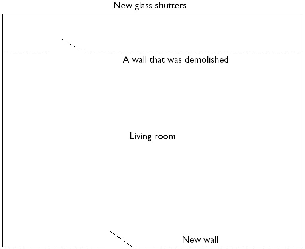
FIGURE 5: Better-off families remove the wall that separates the balcony from the living room and install new glass shutters. These shutters become signs of distinction that convey to others the financial means of the family.
The social significance of these changes becomes clear if we examine the role of the balcony in daily life. The balcony is a “stage” (Goffman 1959) that is used to communicate with others and to present the self in public. Women often read the news of other families, such as the birth of a child or the arrival of a family member from abroad, from the objects and clothes displayed on the balcony's laundry ropes. On the balcony, young men and women subtly exchange love messages. They whistle, signal with hands, and communicate verbally to arrange meeting with one another. The balcony is also the stage where neighbors exchange standard insults when fighting. From her balcony, a woman, Um Sabri, follows the news of her daughter, Hanan, who defied her family's will and eloped with a neighbor and then moved to live with her mother-in-law. Um Sabri tries to provoke Hanan's mother-in-law by using a tape recorder to
The alteration not only expands the living room but also allows a new way of observing and seeing others. From the vantage point of the couch, which is usually placed in front of the glass shutters, men and women engage in various popular activities in al-Zawiya al-Hamra: socializing with others, listening to music, or watching television (which is always placed in the living room) while observing what takes place in the middle of the murabba‘ and other apartments. This couch is the preferred seat that family members compete over and the one that is usually offered to guests. Moreover, the alteration gives more flexibility in controlling who sees whom and when. The new glass-fronted balcony in combination with curtains allows those inside the apartment to see others without being seen or without showing more than their eyes or face. Such an arrangement is not available to families who cannot afford to change their balconies. The moment they step onto the balcony, they are under the gaze of others. So rather than providing a platform for scrutinizing the community, the balcony, which remains separated from the living room, gets used for storing some household items or keeping domestic animals. This is one of the main reasons why Majda (whose family could not afford such alterations) used to go to her neighbors’ apartment to communicate with her boyfriend without being seen by others in the murabba‘. As Gilsenan (1982) argued, “Seeing without being seen is knowledge, perhaps even power” (190). Hence, the new glass shutters not only express the financial ability of the family but also reinforce the symbolic power that the balcony secures for its members. At the same time, a certain resistance to being exposed to the gaze of others is manifested in balconies that have been covered with wooden shutters that do not allow passersby to peek inside the unit (see Figure 6).
While the better offuse relatively expensive material, needy families resort to clay, old wooden boxes, and other cheap materials. Some families, for instance, build small shacklike rooms (especially when living on the ground floor) to sell some groceries to the neighbors or keep their domestic animals. Others turn the lower part of the staircase into a small shop to provide services such as ironing or to sell groceries and candy. Alternatively, such items may be sold from a kiosk placed next to a block. In these cases, the sellers have to negotiate such changes with neighbors
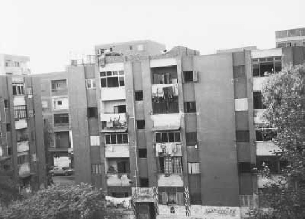
FIGURE 6: The original design of the balcony can be seen on the second and fourth floors (the left side of the photograph). The most expensive alterations are on the third and fifth floors. Notice that to ensure visual protection, balconies on the ground floor are covered with wooden shutters. Photograph by Farha Ghannam.
The Daily Use of “Modern” Space
The blanket that Bourdieu's theory throws over tactics as if to put out their fire by certifying their amenability to socioeconomic rationality or as if to mourn their death by declaring them unconscious, should teach us something about their relationship with any theory.
Michel de Certeau, The Practice of Everyday Life
Contrary to such strategies, which localize change in visible forms and physical transformations, “tactics” are based on shifting meanings and
The shifting meanings and functions of space are clearly manifested in how the various rooms are furnished and decorated. Except for singleroom apartments, most housing units have a similar division of space. As previously mentioned, the unit is usually divided into a place for socialization and receiving guests (saala), a place for sleeping, a place for cooking, and a place for personal hygiene. The saala is usually a small room near the entrance to the apartment. It is the locus of most daily activities, ranging from socializing and watching TVto preparing food and serving it to family members and guests. It is a space that is typically furnished by the bride, who is responsible for receiving guests as well as serving them drinks and food. Currently, the bride's family buy a standard set of furniture for this room, called antireeh (from the French entrée, which indicates an informal sitting room). The set usually consists of one couch with two matching armchairs and a coffee table. Older married couples still maintain their old furniture, which consists of two or three high wooden couches that are placed along the room walls. Many families utilize one or more of these couches for sleeping at night.
The saala, which is open for visitors, is one of the main spaces used to display the social distinction and the religious identity of the family. It has the television set and the VCR if the family has one. Quranic calligraphy, religious items, calenders, clocks, posters of singers and actors, and pictures of family members may decorate its walls. Better-offfamilies usually have a glass-fronted cabinet where they display china cups and glasses that are not used daily. They also have a small high table that is moved from one side to the other to serve drinks (tea and soft drinks) to guests. The pieces of furniture do not always stay in a fixed place. They are moved from one room to another depending on the occasion and the social function of a particular space. Suad, a newly married young woman, for example, moved the antireeh from the saala to one of her two bedrooms in order to protect it from the neighbors’ children. As she explained, mothers come to visit and bring their young children with them, who not only jump on the furniture but also spill tea and water and sometimes accidentally urinate on the couch and the carpet. She furnished the saala with a straw mat and placed some mattresses on the sides for people to sit on. This space is used for receiving the neighbors, while the antireeh is saved for her husband's friends and relatives who visit from outside the neighborhood.
The preferred seat depends on the activities conducted in the saala and
As opposed to the state's original design, people do not worry about separating, ordering, and labeling spaces. The private kitchen was emphasized in the state public discourse as necessary to avoid personal injury and conflicts between neighbors who shared the same kitchen. In the new unit, however, preparing food is not limited to the kitchen. Women do not separate what is seen as “work” (preparing food, for example) from pleasure (such as socializing and watching television). In fact, the more the task is seen as time-consuming work (as is the case with stuffing vegetables and making ruqaq[thin bread] for the Sacrifice Feast), the more it is made an occasion for a festive gathering where women exchange stories and jokes, listen to music, and drink tea. A woman may feel very comfortable sitting on the bed near a window on a sunny day during winter to sort rice, to shell peas, or to peel garlic. She may bring the gasoline burner to the living room to fix tea or prepare mint syrup while chatting with others and warming the room at the same time. She may squat in the staircase to hollow out and stuffeggplants and squash with the help of some neighbors. Thus, women's daily activities continually cross the boundaries that state officials and planners projected in the new apartments as central to modern housing.
Through practices, discourses, and rituals, people define and redefine the meanings of space and protect it against evil spirits. The bathroom, for example, which was emphasized in the state discourse as a sign of a modern and healthy family, embodies contradictory processes and activities. People use it not only for personal hygiene, bathing, and washing clothes but also as a place to perform ablution, an essential prerequisite for praying. It is also seen as the place where jinn and ‘afarit can possess (yalbis) the body and cause the person harm and pain. The person's body is vulnerable in the bathroom, making it easy for a jinn to control it. This is the reason why one should not speak or mention the name of God in the bathroom and why one repeats before entering the bathroom: “God protect me from evil and defilements” (’a‘uzu bi-llaah min al-khubs wa al-khaba’ yis). By the same token, in a Friday sermon, a sheikh describing the rules for dealing with space strongly recommended to mention God's name whenever one enters a place, especially if it is dark or deserted. This is necessary to pacify the jinn and dislocate the devil that inhabits these places. Transforming a place into a safe and blessed one was also done ritually when women slaughtered ducks and chickens on the door step of the new apartment and let the blood run down. Through such rituals and prayers, various spaces are cultivated with meanings and signification.
But What Shall I Do with My Chickens?
Last night, I had a dream. We went back to Bulaq. I was very happy and said, “Now I can buy some chickens.”
(Um Hassan, a fifty-five-year-old woman who was relocated fourteen years ago, reporting on a dream of hers in 1994)
As is clear from the previous discussion, women are the main daily users of the housing unit. They spend much more time than men in the apartments and are responsible for decorating, cleaning, and arranging their housing units.[12] As manifested in Amal's story, cleanliness is highly regarded and socially rewarded. The time and effort that women invest in cleaning and organizing their housing units is related to the social prestige attached to their units and their role in maintaining them. The attention paid to the cleanliness of the apartment increases drastically when people expect visitors. This is especially noticeable during certain occasions such as the two Eids (Muslim feasts), when every corner of the
Women are main agents in negotiating the requirements of the modern space with their families’ economic realities and daily needs. The water heater at Um Magdy's apartment was paid for by her son who works in the Gulf. The heater increased the electricity cost and necessitated more bargaining with the unmarried sons who live with her about how to pay the bill. Um Magdy tries to monitor the monthly expenditure closely and seeks to control when and for how long the heater is used. When the charges increase, Um Magdy refuses to pay the whole bill and insists that her working sons contribute. Rather than allowing the expenses of the new apartment to grow, women also employ several tactics to reduce them. Thus, they use the gasoline burner to heat water for laundry and to cook foods that take time and that require women to stand for lengthy periods. This is the case when they fry fish and potatoes or when they prepare ruqaq (thin bread that is used in cooking for the Sacrifice Feast). These practices are not seen as being in contradiction with modernity. On the contrary, they are viewed as “smart” practices that express the skill of the woman and her ability to save some money for the family and to physically relax, by sitting on the floor, while cooking. Women are also active in physically transforming the structures of their apartments. A woman usually saves the money, finds a contractor, and helps in the performance of the work. She also takes care of the “privatized” land under the control of her family, waters the plants, and looks after the domestic animals.
Women, however, greatly miss many of the spaces in their old neighborhood, such as the rooftop, the narrow lanes (too narrow for cars), the open area around the public tap, the corniche of the Nile, and the local shrines, which were important sites of socialization and where women used to “eat together,” a signal of closeness and strong relationships. Spaces that were used to raise domestic animals not only represented sites for economic investments but were also the locus of interaction between women. Raising poultry and sheep at home not only provided meat,
Many women complain about the time needed and the restrictions on mobility that are imposed by raising domestic animals (for example, women need to provide food and water to the poultry on regular basis). But they still choose to continue raising poultry and refer to this process as “tasliyah” (entertainment). “It is nice to raise chickens and ducks on the roof and sit under the sun while watching the poultry,” Um Khalid comments. “You can feed them the leftovers so that you secure meat and eggs for the family.” In addition to its economic and social roles, raising chickens and ducks is rooted in an ideology that assumes that baladi (or locally produced) food products are tastier and better for the health and the body. Women insist on serving such products to new mothers and to sick people to strengthen them. Some even believe that non-baladi (farmgrown) chicken is not pure (taher) because it is fed fodder (‘alaf). Freshness, a highly regarded quality of food products, is also secured when domestic animals are kept at home.
The freshness, goodness, and purity of baladi products are all behind the efforts, time, and creativity of women in finding spaces to raise poultry. Such spaces range from the area under the bed, rooftops, and balconies to a small shack attached to the apartment (when living on the ground floor) or a balcony that is added specifically for this purpose (when the family lives on other floors), and the garden in the middle of the murabba‘. The use of these spaces is not only informed by women's experience in Bulaq but also reinforced by the prevalence of this practice among people in el-ahali in al-Zawiya.
It is important to note that members of the same family understand and react differently to the modern apartment. Young women tend to prefer more privacy in their future homes and like the idea of being separated from others so that their activities will not be scrutinized. They endorse having separate entrances to kitchens and bathrooms and disapprove of their current apartments, where the saala is in front of the kitchen and the bathroom so that the latter is usually accessible only by going into the former. Such an arrangement means that strange men who need to use the bathroom have to enter the kitchen, while women have to pass in front of the saala on their way to the kitchen and the bathroom. This is why several families use a curtain or add a wall or a door to the kitchen to separate it from the saala. Another example can be found in the
As a result, mothers have to negotiate their desires with the preferences of husbands and children. Um Hassan, who described her dream in the beginning of this section, brought many chickens and ducks when she moved to her new apartment. They were big and healthy. In Bulaq, she had had plenty of space on the rooftop to let the chickens and ducks eat and move more freely. After relocation, she would throw the chickens from the balcony of her apartment on the fourth floor, and they would land in front of the apartment and spend the whole day outside in the open space around the block. The chickens would return only in the evening to sleep on the small balcony, adjacent to the kitchen. When she bought new chicks, they did not grow because they were locked inside a cage kept in the apartment. Um Hassan shifted to pigeons, but soon her husband and children started complaining about the dirt the pigeons left over the place. Little by little, Um Hassan slaughtered all the chickens and pigeons that she had brought with her, and her family members refused to allow her to keep any more poultry on the balcony after they repainted the apartment and remodeled the kitchen. The mother still dreams of going back to Bulaq. The first thing that she would do upon her return would be to buy some chickens to keep on the rooftop. She and other neighbors could not convince the widow who lives on the top floor to open a hole[13] that would give them access to the roof. Given this, Um Hassan was planning to add another balcony to the back of the apartment adjacent to the kitchen. The new balcony, she hoped, would be used for her chickens.
Meanwhile, she managed to successfully negotiate with her children a place in the kitchen to keep the sheep for the Sacrifice Feast (Eid al-Adha). To save some money, determine how fatty the animal should be, and secure its “purity,” the mother decided to buy a small sheep two months before the Eid. She would feed and take care of it until it would be slaughtered during the feast. When the decision was taken to buy the sheep, the children started complaining about the smell, the noise, the dirt, and the work needed to care for it. The mother promised that she would take the
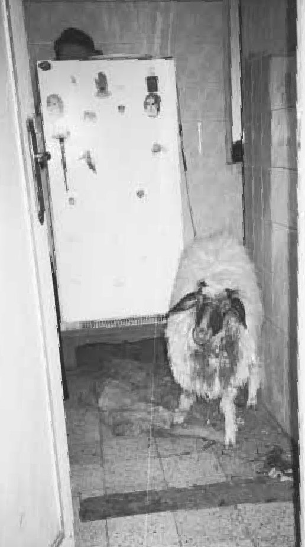
Figure 7: Domestic animals are kept on rooftops, in shacks in front of buildings, and in cages on balconies. During the two months before the Sacrifice Feast (Eid al-Adha), some families keep sheep in the kitchen during the night and in the shared space in the murabba‘ during the day. Photograph by Farha Ghannam.
Dreams and Realities
The way Um Hassan and other women use their apartments and outer shared spaces is part of a larger set of spatial practices. One important thing to notice about these practices is their multiple meanings and consequences. The visible changes that I examined here (such as those introduced to the balcony) aim primarily to communicate social meanings and
As reflected in Amal's story, desires and aspirations are abundant, but the means to fulfill them are few. The flow of information (mainly through the media) creates desires and dispositions that are hard, if not impossible, to translate into concrete realities. The pain expressed in Amal's story is shared by many young men and women who dream of fancy cars, spacious villas, and various consumer goods. How do these dreams and changes shape the group's identity? How is the past constructed in light of these changes? How did relocation reorder relationships within the group, and how are its members being situated in al-Zawiya? In the next chapter, I show that although many of the relocated group view the new housing as an improvement and a valuable gain, especially for ex-tenants, there is a general feeling that relocation negatively shaped their location in Cairo's physical and social space.