
1. Mourning, Melancholia, and "New German Melodrama"
What I like about Sirk is that he makes movies about things, not people.
—R. W. FASSBINDER
MELODRAMA, MELANCHOLIA, AND CULTURAL THEFT
The airing of the U.S. miniseries "The Holocaust" on German television in 1977 was a milestone in the history of the New German Cinema. Enormously well received by a mass audience, its virtues were fiercely contested among intellectuals and filmmakers. Edgar Reitz opined that "the Americans have stolen our history"[1] and retaliated with an even longer family drama, Heimat. The first installment begins with a shot of a rock on which "Made in Germany" is written, emphasizing the homegrown, "authentic" nature of his work. Reviled though the American miniseries may have been among elite cultural producers, it nonetheless paved the way for films that put the war and postwar eras onto German screens: Kluge, Reitz's colleague, produced The Patriot; Fassbinder began his West German trilogy; Sanders-Brahms released Germany, Pale Mother. These were some of the films that attempted not only to reclaim a national history, but to reclaim it from the Americans, whose postwar influence on Germany was summarized in the frequently quoted line from Wim Wenders's 1976 Im Lauf der Zeit / Kings of the Road:"The Yanks have colonized our unconscious."
An intriguing part of the critique against "The Holocaust" was the implicit (and sometimes explicit) condemnation of the series' melodramatic aspects. As survivor Elie Wiesel wrote to the New York Times, the show "transform[ed] an ontological event into soap-opera."[2] Reduced to personal drama, it seemed to diminish that event to the sensationalized fate of
An abbreviated version of this chapter was first published as "Music and the Melodramatic Past of the New German Cinema," in Melodrama: Stage/Picture/Screen, ed. J. Bratton et al. (London: British Film Institute, 1994), 106–18. Reprinted by permission.
Part of that attack may have stemmed from the still-fresh memories of sensationalized tearjerkers sanctioned by Nazi authorities, like Sirk's Zarah Leander vehicles, such as Zu neuen Ufern / To New Shores or La Habañera (both 1937), or the Papaskino of Adenauer's 1950s, whose popular forms critics like Siegfried Kracauer condemned as the brainless progeny of Nazi cinema. The concern was that these older films, now widely seen on nighttime television, evoked a furtive nostalgia for Nazism itself; the feminist film journal frauen und film, for instance, devoted a special issue (no. 29) to Leander's ongoing cult status in 1981. Over the course of German cinema, melodrama had lent shape to the street film of the late silent era, the Kammerspiel films, 1950s spectacle films, the Heimat genre, even leftist cinema in the late Weimar Republic, like Kuhle Wampe (Dudow et al., 1932) and Mutter Krausens fahrt ins Glück / Mother Krausen's Trip to Happiness (Jutzi, 1929). But despite melodrama's considerable role in German film history at large, Reitz's bold decision to revisit the Heimat film during this new era of filmmaking was highly contested. Germany, Pale Mother, Sanders-Brahms's maternal melodrama, also met with controversy, with male German critics deriding its focus on female experience "on the homefront."[3] As late as 1994, Margarethe von Trotta's Das Versprechen / The Promise, an epoch melodramatic tale of two young lovers separated while attempting to leave East Germany for the West, remained a commercial and critical failure.
In spite of its homegrown tradition (or more likely because of it), and in spite of melodrama's European roots, in the 1970s, the New German Cinema and its critics were primarily responding to melodrama as an American product snuck in through the back door by the reviled television series and through the front by the Fassbinder-Sirk connection. The rise of melodramatic output was part of the movement's larger, but by no means uniform,
English and North American critics at the time read things very differently. Influenced by New German Cinema scholar Thomas Elsaesser's 1975 essay "Tales of Sound and Fury," academics were reinventing melodrama as a politically incisive, even progressive genre. "Readings against the grain" performed on melodramas—and other stylized genres like film noir, horror film, and musicals—were drawn to their enhanced referentiality, two-dimensional characters, banality, and especially their style. It was in these deviations from Hollywood's ostensibly invisible style that melodrama critics located critiques—challenges to the status quo that narrative or dialogue was unable to contain or express. That historically specific construction of melodrama also spilled over into the roughly contemporaneous reception (and construction) of the New German Cinema.
For a national film movement attempting to come to terms with recent history, melodrama makes a certain amount of sense, given its own preoccupation with past events, a point I will develop below. I should state at the outset, however, that that "past" is not as singular as the word might imply. Given that melodrama was construed as, among other things, both an American phenomenon and an emblem of repressed Nazi populism, it cannot excavate any pure, prelapsarian national identity or history. That is precisely the point. For melodrama ultimately dramatizes the irretrievability of the "stranded objects" of Germany's postwar psychic, social, and political landscapes—while simultaneously stressing their ongoing importance. The benefits of that dramatization, I contend, are not restricted to the initial audiences of the New German Cinema, despite the specificity of its stories, references, and the circumstances of its initial reception. Those reception conditions, kinds of audiences, and critical discourses, along with the passage of time, have showcased how history is continually renegotiated, with filmgoers taking up different relationships to it owing to a variety of forces and circumstances.
MUSIC AND THE EXCESSES OF THE NEW GERMAN CINEMA:
THE EIGHTIES[4]
Melodrama and the New German Cinema both stressed the ongoing impact of the past upon the present, a thematic obsession that characterized melodramas by Fassbinder, Sanders-Brahms, von Trotta, and others. Lost lives, destroyed ideals, homes, national, psychic, racial, geographic, and political identities took residence in a variety of cinematic "material ghosts."[5] These were irrecoverable pasts, to be sure, but ones that could not be kept down. This partly explains the lure of hysteria as an exegetic tool, with its own emphasis on the "return of the repressed." Melodrama's various longings and elaborate (if not compulsive) restagings of past events recall Freud and Breuer's description of hysterics as people who "suffer from reminiscences."
The hermeneutic power of the hysterical model also derives from the idea that a trauma of the past—one subsequently buried beneath the realm of consciousness—cannot be directly articulated. The censored event seeks expression in displaced, nonlinguistic ways on the body of the patient—aphasic conditions, aches, twitches—through a process of somatic conversion. Geoffrey Nowell-Smith's "Minnelli and Excess" introduced the concept of hysterical somatic conversion into cinema analysis: films gave analyst/critics "bodies" to read symptomatically for signs of repressed meanings. In a sense, trauma renders its bodies unable to speak, forcing articulation out of nonlinguistic means (a point to which I return in chapter Three). Peter Brooks acknowledged that speechlessness in his influential reference to melodrama as a "text of muteness"; David Grimsted called it an "echo of the historically voiceless."[6] It is no surprise that so many speechless characters populate classical Hollywood melodramas: Jane Wyman in Johnny Belinda (Negulesco, 1948), the mute servant in Letter from an Unknown Woman (Ophuls, 1948). Yet they frequently appear in the New German Cinema as well. Films like Wenders's Falsche Bewegung / Wrong Move and Die Angst des Tormanns beim Elfmeter / The Goalie's Anxiety at the Penalty Kick (1975 and 1971), Even Dwarves Start Small and Fassbinder's The Bitter Tears of Petra von Kant and Chinese Roulette feature deaf, mute, and blind figures. Richard McCormick argues that their diminished perceptual abilities emerged from a more generalized alienation and distrust of language, perception, and experience that characterized German culture and politics after the disappointments of the 1960s.[7] These physical and communicative impairments, along with the disenfranchisement they intimate, were characteristic of the "inward turn" of the Neue Subjektivität / New Subjectivity in place by the mid-1970s. It
The ability to speak is a powerful, recurring trope throughout the New German Cinema, and I will return to it in the work of Alexander Kluge. Questions of human speech cover a wide range. At the one end is Lene, the mother of the narrator in Germany, Pale Mother. Her diminished freedom after the war is somaticized through her facial paralysis and the extraction of her teeth that her husband authorized: toothless, she becomes speechless. At the other end of the spectrum is Oskar Matzerath, whose obstreperous screams pierce soundtrack (and eardrums) in The Tin Drum. These disparate depictions reveal not just the importance of the voice to representing the past, but a disinvestment or distrust in its naturalness. In other words, the films show the same suspicion of sound that theorists were elaborating vis-à-vis the cinematic image and its claims to truth, knowledge, naturalness, or objectivity. As a character in Chinese Roulette states, "We overhear the wrong truths," and Maria Braun displays wartime signs warning "Feind hört mit" (The enemy might be listening in). That same deauraticization informed production choices as well: Straub and Huillet would record live, continuous sound, only to subject it to extreme manipulation and fragmentation. Even the market-driven practice of filming in English (Fitzcarraldo; Despair) or of dubbing into German (Fontane Effi Briest[Fassbinder, 1974]) highlights the discrepancy between sound and source, putting in question the reliability and authenticity of the soundtrack.
If, as Brooks argued, the motor behind melodrama is its impulse to "express all," a certain shifting of registers is required in order that its expressive business of "pressing out" may be executed in a way unencumbered by conventional linguistic constraints. Thomas Elsaesser discusses strategies that "compensate for the expressiveness, range of inflection and tonality, rhythmic emphasis and tension normally present in the spoken word."[8] And this is where music steps in. It takes over where language, generically distrusted and lacking, leaves off, filling out what narrative and dialogue cannot accomplish. Working with other formal elements, music forms what Elsaesser calls a "system of punctuation, giving expressive colour and chromatic contrast to the story-line, by orchestrating the emotional ups and downs of the intrigue," indicating how melodrama amplifies music's conventional Hollywood function of providing passive, emotional support and background to visual drama.[9] For Nowell-Smith, melodrama's "undischarged emotion which cannot be accommodated within the action, subordinated as it is to the demands of family/lineage/inheritance, is traditionally
Fassbinder worked collaboratively with Peer Raben for over fifteen years to produce the scores for his films; the director would suggest existing material to use, write lyrics to Raben's songs, and otherwise sustain a close, active involvement with the sound of his films.[11] It was Raben who first introduced Fassbinder to the work of Sirk, an encounter that yielded Fassbinder's well-known written accolade ("On the Films of Douglas Sirk"), meetings and collaborations with the retired director, and the beginning of his own melodrama cycle. Both men were fascinated with Sirk's Universal Studio melodramas and were thus keenly aware of how much their own soundtracks departed from Frank Skinner's heavily orchestrated scores. The brief musical snippets and undeveloped phrases Raben gives us (even in films closely modeled after Sirk's, like Ali or The Merchant of Four Seasons) repudiate music's typical over-the-top function in melodrama, just as they reject the unobtrusive, unifying function it had in many Hollywood studio scores more generally. Its conspicuously small role in these "art-melodramas" of the 1970s only increases our awareness of its detachment from the idea of authenticity of character emotion, background mood, composer's intention, or the purity of musical form or its cultural and historical connotations. This is not to say that music is absent from Fassbinder's early work. Götter der Pest / Gods of the Plague and Warnung vor einer Heiligen Nutte / Beware of a Holy Whore (both 1970), while containing stretches without musical accompaniment, have equally long periods of music as well.
SCORING THE HOLY WHORE
Fassbinder's Beware of a Holy Whore is a film about the making of a film. Completed in 1970, it was not released in German theatres until 1992, well after Fassbinder's death, due to the high costs of procuring music rights.[12] Like other films predating his melodrama phase (which began with The Merchant of Four Seasons in 1971), Holy Whore borrows melodramatic conventions rather than exemplifying the genre tout court. Its narrative is skeletal, and little happens in the way of dramatic twists and turns, as one would expect from melodrama. In fact, the genre's narrative function of unpredictability and
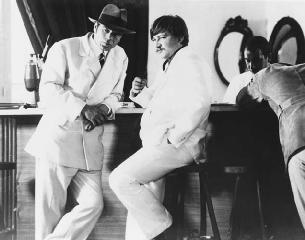
Lounging around in Fassbinder's Beware of a Holy Whore. Courtesy of the Museum of Modern Art Film Stills Archive.
Even after he arrives, however, little happens. Throughout the course of the film, character movement is minimal; several unmotivated 360-degree pans dramatize the extent of their paralysis. Cast and crew drink and pair off indiscriminately for dancing and sex, smash drinking glasses—small, stylized revolts in otherwise eventless time and space. Yet for as visually and psychologically understated as it is, the soundtrack is clamorous and busy. Characters speak in German, Spanish, French, Italian, English, or combinations thereof, in various accents and dialects; often the speech of one character overlays and drowns out others. Dialogue coaches and interpreters are hired for Jeff's film, highlighting the disjointed paths of communication among speakers. The words spoken by characters are not their "own" in a number of ways. Swedish actor Lou Castel plays the Fassbinder character; Hannah Schygulla plays Hannah; Kurt Raab, Fassbinder's actor, ex-lover, and art director, portrays the film's set designer; Magdelena Montezuma hangs listlessly on the arm of the photographer Dieters, played by
Mixed into this Tower of Babel is a steady stream of pop music from the 1960s (Ray Charles and Leonard Cohen), the presence of which is only partly explained by a jukebox in the room. The tunes are just background sound that seems as unmotivated as the characters that languish about: songs are played at a low to mid-range volume, and their lyrics don't provide any clear function or commentary. Nor is there much musically that connects the songs to the scene at hand—though the monotone vocals of Leonard Cohen do parallel the scene's visual stasis and melancholy. The foreign origins of most of the songs establish that music, like the speech just mentioned, is not of the characters' provenance. It is mass-produced, sung in the language of others, imported from the outside, German culture prefabricated in North America. (Interestingly, the characters sing a Protestant hymn at the bar at one point, a piece that appears just as foreign as the U.S. hits.)
Elsaesser has stressed how that sense of outsiderness inhabits the New German Cinema thematically, a trait that separates it from another nonnaturalistic movement, German Expressionism. Though rarely named as such, Expressionism has been crucial in the mechanics of the "melodramatic imagination." With its etymological roots in "pressing out," Expressionism, like "hysteria"—a term that entered psychoanalytic discourse at about the same historical moment as German Expressionism emerged—maintains that the stylistic excesses of a film reveals the internal mental states of a character that are "pressed out" in displaced, distorted fashion onto the text, as in the sets of Das Kabinett des Dr. Caligari / The Cabinet of Dr. Caligari (Robert Weine, 1919), which articulate the instability of its narrator. As the prerecorded music in Holy Whore suggests, the sense of
What is probably the sole musical stinger of the film appears in a music fragment by Peer Raben. At the moment that the overdue director arrives, we hear an over-the-top, heavily attacked chord of an electronic piano made to emulate an organ, in the sappiest of early film melodrama tradition. This diminished fanfare simultaneously acknowledges and ridicules Jeff's narrative significance, his emotional import to diegetic figures, and his importance as a director. The brief, clichéd chord is subsequently joined by strings, soon generating a theme repeated with modest variations and developed somewhat more extensively as we move to the next scene, following Ricky's movement into a different room. The music here accompanies the character as an empty acoustic prop, providing hollow continuity between scenes.
Raben's repetitive music fragments in Holy Whore and in his other work have prompted critics to denounce his scoring style as monotonous or unsophisticated. But as David Raksin's monothematic Laura (Preminger, 1944) proved decades earlier, even history's most acclaimed scores trade in repetition. Moreover, as Russell O. Potter and James Snead have argued, much of the attack on repetitive music is motivated by racist and elitist biases. Detractors often align it with mindlessness or uncritical reception (think of Adorno in this regard), linking it to non-European, African, and African-American cultures in particular. Potter and Snead, by contrast, focus on the differences contained within repetition, and the challenge it poses to linear, developmental, and more goal-oriented forms of musical expression.[13] If the endlessly repeated theme song in Laura may seem to bathe its auditors in the fetishistic aura of its lost woman, Raben's work provides us with something quite different: its sparsely inserted "pieces of pieces" refuse to unify or emotionalize its repetitive fragments.
Given the sheer number of "anti-melodramas" he scored for Fassbinder, and given that he was the most active composer of the New German Cinema, it is easy to discern patterns in Raben's work. He frequently features oboe and piano, he will use children's instruments, and certain progressions and patterns of development recur from film to film. Of particular relevance to the melodramas is the fact that his original music—taking form once again in brief themes, or variations thereof—usually accompanies travel scenes. In Holy Whore it accompanied Jeff as he moved from one room to another, but it usually covers broader spatial and even temporal passages, following the movement of a car and/or movements into the
Elsaesser has made much of the layered, nonlinear temporality in Fassbinder's work. This, I believe, is also evident in Raben's music. Though a bogus indicator of linear space and time, it makes the more important point that history is necessarily intertwined with the present. Malou, for example, weaves from country to country, from one woman's past to another's present. Watching, one cannot delineate where Hannah's search for her mother's past ends and her own begins. The fragmented nature of Raben's themes abets that quasi-permeability between past and present, and the inability to separate fully one era or location from another.[14] Their repetitive nature helps underscore the unsatisfiable, yet insistent, desire of contemporary figures to establish pieces of identity through their pasts in order to change things—or at least understand them.
"THE FOUR SEASONS"
Given this yearning for different pasts (and for other ways in which the present may have worked), it would be incorrect to say that Raben's melodramatic scores are without emotion or affect, however withholding they may seem. Consider Fassbinder's Merchant of Four Seasons, which follows the story of Hans Epp (Hans Hirschmüller), a produce vendor taunted by his mother, his memories, and his current imperfect, inescapable station in life. His marriage has little passion, and after he suffers a heart attack, Epp's new business help becomes his wife's lover. Defying his physician's warning that more alcohol will kill him, Epp goes on a binge and holds court at a table of drinking mates who watch him as he effectively drinks himself to death. Four Seasons was Fassbinder's first Sirk-influenced melodrama, although the story was reportedly inspired by the story of his own uncle and by Fontane's Effi Briest.[15] Raben's score for the film is sparse, containing less than five minutes of original music. When the main theme finally does appear nearly an hour into the film, it is only in pieces, a melody fragment
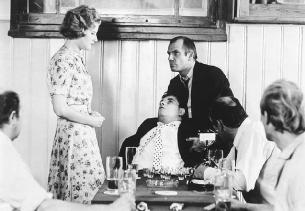
Hans Epp drinks himself to death in Fassbinder's Merchant of Four Seasons. Courtesy of the Kobal Collection.
The pivotal music in Four Seasons is Rocco Granata's "Buona Notta Bambino." (Raben told me that had he used more of his own music, it would have detracted from this work.) Epp plays his treasured recording several times over the course of the film, but finally smashes the record. When he does, we know he is giving up on its phantasmatic promises and hopes (of his mother's affections, or those of his "one lost love") as well as the fragile subjectivity it glued together. Yet internal motives or psychological character traits do not altogether explain the violence of the act. The
REFUSING REDEMPTION: HERRR
Strictly speaking, Warum läuft Herr R Amok? / Why Does Herr R Run Amok? (1970) is not a melodrama, nor even a genre film, although it borrows heavily from melodramatic traditions. It tells the story of a lowermiddle-class man, Herr R, numbed from all sides: boss, coworkers, motherin-law, neighbors, even, apparently, his wife. Without explicit motivation, he suddenly kills her as she is talking with a neighbor, whom Herr R also murders before his own suicide. This tale of a beleaguered bourgeois calls to mind the American melodrama Bigger than Life (Ray, 1956), although there James Mason's final murderous rampage against his family not only is kept in check by buddy Walter Matthau, but is explained by his cortisone treatments. Fassbinder's film, by contrast, withholds answers for R's actions, toying with our expectations by having that basic question appear as its very title. It is arguably a purer melodrama for having its actions occur as abruptly and as irrationally as they do (this occurs in Fassbinder's other melodramas, notably Mother Kusters, which opens on the unexplained murder/suicide of Herr Krausen). Herr R vaguely presents the stifling situation of R's workaday existence by stressing his silence among incessantly chatty people, all of whom operate more or less as position-holders in familial, social, and class structures. The alphabetic rendering of the character's name in the title (Herr R also designates Kurt Raab, the actor portraying him) establishes the commonness of the situation and the ease into which other "names" may be inserted into its deadly genericness.
As is common with Fassbinder's early output, Herr R has no nondiegetic music—a consequence of budgetary limitations, among other things. But
Peer Raben articulates something between the melodramatic and the utopian when he writes that music "supports something that isn't yet in the image, nor in the mind either … a truth we discover in another sense to come." Discussing a melody he composed for Fassbinder's Liebe ist Kälter als der Tod / Love Is Colder than Death (1969) that he had borrowed from a Spanish madrigal, he says, "Melody seemed entirely appropriate to break up Fassbinder's laconic characters and, consequently, made them speak in a different way: At the time I really wasn't aware that they were expressing themselves in Spanish through my music."[19] The remark is in one sense in perfect keeping with conventional melodrama. But by refusing to make a one-to-one match between music and diegesis (historically, culturally, thematically), Raben highlights the alternate scenarios to which it gestures.
HINTS OF ALTERITY
Raben's unwillingness to interiorize musical signs, or for that matter to associate them with any direct utopianism, is evident in his score of Fassbinder's Ali: Fear Eats the Soul, in which Emmi (Brigitte Mira), a middleaged widow, becomes involved with Ali (El Hedi ben Salem), a Moroccan worker much younger than she. The North African music that appears intermittently in its spartan score reasserts the rigid racial divides of the film's diegesis. The music offers no escape to Ali and his friends, who are
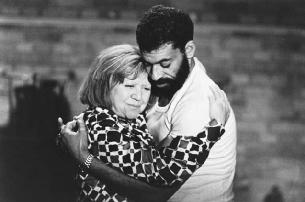
Fragile utopias: Emmi and Ali in Fassbinder's Ali: Fear Eats the Soul
Yet for Emmi the music extends the possibility of a refuge. Fassbinder has long been noted for his interest in disenfranchised people. For a cleaning woman whose labor is ill-paid, and for whom, as a middle-aged woman, her sexual worth plummets, the North African music might offer a momentary escape from western norms and pressures. This is not to say that the music functions as pure metonym for Ali's Arab culture or that Emmi's is a simple, open celebration of it. Far from it. Their initial meeting, for instance, is at the grimly named Asphalt Pub, where they dance to one of the jukebox tunes. The song is not Arab but an old, scratchy popular German tune (later referred to as "that gypsy record"), significantly the only non-Arab music heard in the bar—or most of the film, for that matter. In typical melodramatic fashion, the scene will be restaged at the end of the film as Emmi and Ali try to regain the intimacy and trust of the earlier days.
During their dance Ali comments, "German master, Arab dog." Emmi displays no such mastery and dramatizes the fiction of that kind of identifactory
Nor does music come rushing in to redress such deficiencies, as it would in a more conventional melodrama. The score offers little extravagance or even sustenance to its characters. Take, for instance, the nondiegetic music that appears briefly on three occasions. Initially we hear a brief, aimless melody when Ali and Emmi talk in bed the night they meet, then as Ali goes toward the bar after he's walked out on her, and later at the end of the film as the image fades to black. Thoroughly conventional in style, the short, unmotivated phrase appears to be Fassbinder/Raben's wink at music's typical emotional function in melodrama. Similarly, when Emmi announces, "Now I'll play our record," when putting "the gypsy music" on the jukebox at their engagement celebration, it is difficult to hear anything but hollow promises and doomed identification (by this point, the song's initial promise has been perforated like the ulcers that plague Ali).
MELODRAMA AND WOMEN'S MODALITIES
In the 1980s, scholars considered melodrama a women's genre, due to its historical popularity with female audiences and the spectatorial engagement it was believed to offer. Although these assumptions have been nuanced or overtly challenged since then, it is important to stress their importance in European film culture at the time. Directors like Margarethe von Trotta, Jeanine Meerapfel, and Helma Sanders-Brahms were closely aligned with the genre—as were male counterparts like Reitz who were more centrally positioned in the New German Cinema. Despite this collective interest in exploring the past, however, the women directors' motivations for using melodrama were different, partly due to the genre's historical "feminization." To be sure, some of these directors—von Trotta most vocally—militated against that very feminization:"What does it mean? Every Hollywood film in which
But in light of the various links (historical, scholarly, popular) among women, femininity, and the domestic sphere at the time, melodrama seemed an appropriate form with which to explore historical issues from female-centered perspectives and memory. Critics maintain it provided a way for women's voices and experience to speak; it could also be tied to an autobiographical impulse that their male counterparts left largely unexplored. As Barbara Kosta notes, autobiographical modes gave women directors a way to mediate between the subjective experience of women and women's public construction and positioning in "history."[22] These German melodramas, as Renate Möhrmann, Julia Knight, Susan Linville, and other feminist scholars have stressed, presented history intertwined with subjective and intersubjective connections. Moreover, they argue, the women's melodramas eschewed masculinist norms, assumptions, and perspectives. (As Linville notes, even the Mitscherlichs' theory of a national "inability to mourn" assumed a male German subject with small room for women, gays and lesbians, and people of color, a point to which I will return.) For Möhrmann, women's melodrama achieved something even more radical. Sanders-Brahms's Germany, Pale Mother, she writes, exposed the "deficiency" of the male system through its critical depiction of the return after the war of the "patriarchal project."[23] In contrast to U. S. melodramas, with their abundant clichés of fallen women, or desexualized virgins and mothers, feminist German melodrama of the time "stages the swan song of patriarchal discourse and the entry of mothers into film history. The absence of fathers, their departure for the Second World War, frees the mothers—as these films show us—from the limitations of their gender roles … for everyone to see."[24]
What Möhrmann observes at textual levels also applies to the economic contexts of the films, since financial, political, and social aspects of production, distribution, exhibition, and reception were different for West German female filmmakers. Directors like Ulrike Ottinger, Jutta Brückner, Helke Sander, and Ula Stöckl (in addition to Meerapfel, Sanders-Brahms, and von Trotta) emerged from progressive, leftist contexts that had been largely impervious to women's issues. They were also responding to a newly established cinematic institution—the New German Cinema, populated by celebrated male Autoren who were having a much easier time getting their films made and distributed than the women were. Another context for their work was the contemporary feminist debates over cinema's relationship to social issues, questions about cinematic realism, and the possibility of a female or feminist aesthetics. How, for instance, to represent
Part of that immediate historical context was established by frauen und film, the journal Helke Sander started in 1974. By the early 1980s, the journal had shifted toward theoretical questions of representation,[26] but in the early years it featured essays on directors like Maya Deren, Leni Riefenstahl, and Yvonne Rainer. The journal's position favored documentary and realism for contemporary female directors. Now given documentary's long-standing association with education and social issues, the preference was justified: pressing women's concerns were at hand, such as Paragraph 218 and the threat to criminalize abortion. Yet, as we shall see in chapter Five, for directors working in more stylized or fictional venues—like Sander, Mikesch, and Ottinger—controversy, disdain, or neglect often awaited the release of their films in the women's community.
Among the films that used melodramatic form to explore the intersection of the past with the present were von Trotta's Schwestern, oder die Balance des Glücks / Sisters, or the Balance of Happiness (1979) which, as the name implies, was told from a sister's perspective, as was Marianne and Juliane. Adult daughters tell the family dramas of Sanders-Brahms's Germany, Pale Mother and Meerapfel's Malou, and their quests for personal and historical identities are centered around their mothers. Although these directors did not express interest in American melodrama—compare von Trotta's remarks with Fassbinder's boisterous homage to Sirk—their films nonetheless share the "nonstyle or zero-degree style" of American women's films of the 1930s and 1940s.[27] The formal excesses that characterized the work of Sirk, Minnelli, Ray, and others were simply not there in these German women's melodramas. We can see how they thus operated on the periphery of both typical melodramatic form and the documentary modes of women's filmmaking prevalent in Germany at the time. Some of these films focussed their critique on Germany of the 1950s, not a time of "miracles" for them, but, as the original title of Marianne and Juliane makes clear, a "leaden time," when West Germany was returning to conventional gendered and sexed roles and the (re)formation of the German family and state.
Finding a voice was important for these female directors, and its thematic and formal prominence in their films is not incidental. For all its suspicions of language, melodrama seemed able to provide a voice for these women, even if, as Susan Linville has argued, their films usually suggested a differently gendered relationship to stories, their telling, and the ways of "coming to terms" that could be articulated through the genre. Finding a voice often involved telling histories that had been given little public voice before,
By selecting a personal, melodramatic format to approach a recent and volatile political event, von Trotta conveys the extent to which affect and history are linked. She also conveys that repression is at once a political and psychological phenomenon. The latter is established through the use of film form. If vertical excavation is a central trope for the attempts to dig out new histories in Kluge's The Patriot, here the layers of repression are laterally sculpted into the mise-en-scène. The building in which Juliane is jailed reveals the material, institutional dimensions of the process. When Marianne visits, she enters through an initial series of doors, is then escorted by a guard into a room where she is strip-searched, brought out a door through a courtyard into a new building to a waiting room, and finally sees Juliane in the room next to that. At another point a pane of glass separates them when they "meet." Juliane's story could not be more locked away and separated. Marianne—who is strongly ambivalent about her sister, resenting her "abandonment" of her husband and son for life as a political fugitive—becomes obsessed with learning more. She has to rely on material fragments and affective evidence alone to vindicate her sister, just as Malous's Hannah would comb through photographs and memento to try to tell her mother's story.
Marianne takes measurements and then restages her sister's hanging, basically re-presenting it—much like the work that the film itself does. The film also mimics Marianne's efforts to produce history infused with affect and personal subjectivity. Marianne and Juliane is punctuated by flashbacks
Aware of the pressing psychic, sociopolitical need to find meaningful personal histories, these melodramas, even nostalgic efforts like Malou, seem aware of the fantastic, elusive nature of their project. Access to memories, mastering or even uncovering a clarifying, edifying past was always a messy, mediated affair, almost impossibly so. These films suggested that contemporary identity had multiple relationships to events, facts, or figures of the past, and that one might disidentify as much as identify with them. Like many postwar children, Malou's daughter searches for a past she herself never experienced. Even her mother's story is piecemeal and unsettled, associated with so many different national, religious, and linguistic "homes" as to preclude a singular story or identity in the first place. The film's style dramatizes the difficult access to memory and the past; characters constantly play and work around material scraps and quirky shrines. Martin, Hannah's husband, is commissioned to design a cultural center and is told by officials, "You won't solve anything with that ‘old stuff.’" Angry, he turns on Hannah, chiding her for her "useless" obsession with the photographs of her mother (von Trotta's Marianne is similarly criticized by her male partner, a pattern Susan Linville notes in examining the gendered patterns of remembrance in the two films). After her many journeys back, Hannah is nowhere closer to peace, a sense of identity, or an improved relationship with Martin. The film closes with a dramatic aerial shot of her and Martin literally going around in circles, trying to find each other on the roof of a skyscraper.
Malou places great weight on the material scraps of cinema itself (photographed images, music) as the means by which the past can be approached. That Malou (Ingrid Caven) is a singer—and often performs in the style of Marlene Dietrich, or at least this seems to be the historical recollection she encourages—further foregrounds the staged nature of her daughter's recovery. And even if our attention is drawn to the dramatic
In that regard, the scores of the women's German melodramas function like those of Fassbinder. Music retreats rather than reassures, appearing in fragments without resolution, much as the historiographic assumptions of the films operate. The inability to attain closure vis-à-vis the past is formally suggested by Raben's score for Malou, which reproduces the circularity of the plot. It presents a myriad of variations of "Ein kleines Franzeschen."[32] The song's association with Malou is evident before the story even begins, when we see her performing it over the opening credits. Throughout the film, it moves seamlessly from diegetic to nondiegetic situations, whether sung by Malou/Caven, or nondiegetically accompanying Hannah or Malou as each picks through the photographs of her past, or with Hannah as she seems to travel to that temporal past by driving to Malou's home in Alsace. But the circularity doesn't dramatize a lack of direction, just the fictive nature of resolution.
Jürgen Knieper's soundtrack to Sanders-Brahms's Germany, Pale Mother is similarly sparse and compelling. Nonmusical sounds such as air raids and radio transmissions of political events intrude into key personal moments, such as Lene's birthday party early in the film or, as I have already mentioned, the birth of her child. Some of the sound sources are diegetic, like the radio at Lene's birthday gathering; others are not. Most blur diegetic borders altogether. The intercutting of clearly documentary air raid sirens and footage with the birth scene appears to be nondiegetic, or at least nonsynchronous, but later Lene mentions having given birth during an air raid. Sounds here offer literal examples of public culture, policy, and governance penetrating what would seem to be extremely private, domestic spaces—just as Fassbinder did to ironic effect in the opening of Maria Braun. It is against that invasive backdrop that Knieper's music struggles, as Schneider has observed.
Schneider focuses on the plaintive piano music fragments that recur throughout the film, describing it as a "solo instrument placed on the same level as the commenting voice of the [narrating] author,"[33] a point driven home as the theme fuses with the rhythms of Lene's breath at one point.
As his career developed and budgets grew, Fassbinder's melodramas became more lavishly stylized than his earlier work. They would also concentrate on the experiences of female rather than male characters—Veronika Voss replaced Hans Epp; Lili Marleen, Herr R—and the director would tell interviewers he found women more interesting to work with. But unlike Anna or Hannah, who go in search of history from within the constellation of the family, few domestic frameworks encumber (or abet) the protagonists of Fassbinder films like Die Sehnsucht der Veronika Voss / Veronika Voss (1982) or Lili Marleen. Their identities, drives, and desires are bound up in other social, economic, and cultural institutions of what Elsaesser calls the enticing machinery of "image-making." Fassbinder's bypassing of the family is significant, even if German cinema had never shared the American tradition of presenting family as a utopian haven: "Both visually and in his narratives, Fassbinder in effect distances himself from the Oedipal time of the family romance and the primal scene of ‘the marriages of our parents’ giving the spectator no illusion of depth, of entering or penetrating the recesses of the fiction: his flat, evenly or underlit images invite no ‘inwardness’ but merely complicate infinitely a visual surface, put ‘en abyme’ by the multiple frames and overlaid action spaces of sound and image."[34]
In exchanging an ostensibly private domain for a public, exhibitionist one in these later melodramas, Fassbinder directs our attention to the politics of re presentation. "What emerges," says Elsaesser in a remark more applicable to film sound than it admits, "is the notion that cinema has a claim on history, where this history is spectacle and make-believe, deception and self-deception."[35] For Raben's scores for the "New German Melodramas" bank on that very deception and inauthenticity, even as they establish an "authentic" historical period and a historicized locus of desire. For example, he describes the song "Capri Fishermen" (Winkler/Siegel), which turns up in films like Lili Marleen, Lola (1981), Maria Braun, and Schmid's Hors Saison, as "epitomizing [German] longing of the 1950s."[36] Such scores seem to recognize the generic obligation to provide some form of emotionalism, which they do, but not without self-consciously tweaking the material, historical, and ideological hardware behind that same function,
THE CAMP ENCOUNTER
It should probably come as no surprise that the Fassbinder film that gets the most opprobrium is Lili Marleen, whose focus on "things, not people," is announced by its subtitle, "the story of a song." Loosely based on the memoirs of Lale Anderson, whom Fassbinder's friend and critic Christian Braad Thomsen calls simply a "cheap variety singer,"[37] it concentrates on the singer's wartime affair with Rolf Liebermann, the Jewish administrator, conductor, and occasional composer who would eventually direct the Paris Opera. With Lili Marleen's record-breaking budget, German critics were complaining that Fassbinder had sold out before the film was even released. Thomsen, for his part, opines that the film is recklessly paced and performed and is inattentive to detail, even geographical locale, flaws that he attributes to Fassbinder's purported disinterest in the project.[38] That same spatial and temporal indeterminacy leads Saul Friedlander to compare the film to Nazism's own poisonous mix of transcendence, myth, and death in his study on kitsch and fascism.[39] Along the same lines, Paul Coates argues that Lili Marleen turns German history into "candy floss," a bloated, overproduced spectacle that encourages passive fascination. Like Friedlander, he maintains that it deploys fascism's shimmering tropes of mass spectacle only to repeat them uncritically. To be sure, not all critics find the film offensive or thoughtless—although most of its enthusiastic reception came from abroad and was after its initial release. For Elsaesser, Lili Marleen exposes global capitalism's "commodifying but also charging with desire the material and immaterial fetish objects of the past," thereby making it impossible to whisk Nazism away into a hermetically sealed twelve-year period.[40] In an analysis that is especially sensitive to the soundtrack, David Bathrick argues that Fassbinder's film indicts Nazism's own mass entertainment machinery.[41]
Like most pop tunes, "Lili Marleen" is musically uncomplicated. Originally written as "Der Wachposten," its sentimental lyrics tell of a soldier's longing for women left behind. A popular tune, it was nonetheless pivotal to the largely unsympathetic reception of the Fassbinder film. It simply had too many associations. Anderson had sung it to Wehrmacht troops, Dietrich to Allied ones. Goebbels despised it ("crap with the stench of death,"
For many, however, the glitzy "story about a song" merely traded in degraded registers of camp and kitsch. In what seems a transferal of his own possible contempt for camp onto the film's director, Paul Coates writes:
For all its apparent delectation of Nazism as camp spectacle, Fassbinder is disdainful of camp's empty-headedness. Sadistically cramming an excess of candy-floss into a digestive system addicted to junk food, he is kind to be cruel. His contempt for camp, however, is not dictated by his occupation of the higher ground of analysis. … By trading in melodramatic clichés, the later films flatter the audience into the delusion that [noticing generic conventions engenders insight into historical contexts]. Peer Raben's music—melted-down Weill—performs a similar function, which is less one of camp than of kitsch: As Eco puts it, a quotation unable to generate a new context. … [We conceptualize] kitsch as the product of a desire to work "beautifully" rather than well.[44]
Coates makes a convincing point that Fassbinder's earlier, pared-down melodramas, like Merchant and Fear, provide more sophisticated analyses of fascism's psychological, social, and economic mechanisms than the later films, even though the latter situated their stories in Nazi and post-Nazi eras. He argues that the early films tackle the ostensibly apolitical psychic and social mechanisms that enabled fascist structuration to endure decades after the end of the war. By using contemporary, peacetime diegetic settings, that critique was made all the more trenchant. It is nonetheless strange that given Coates's preference for Fassbinder's early, male-centered melodramas, he selects the term "melodramatic clichés" to attack Lili Marleen. It would seem that, in the final analysis, style is the culprit: "The later films, however, are fatally compromised by pretension: Their empty,
Elsaesser's work contains some of the same kinds of contradictions. While his sensitivity to melodrama and camp influences on the New German Cinema and on Fassbinder in particular is beyond doubt, he has a disturbing take on Fassbinder's 1973 television film, Martha. Based on Cornel Woolrich's "For the Rest of their Lives," Martha tells the tale of an emotionally and sexually underdeveloped woman (Margit Carenson) living at home with overbearing parents. Helmut (Karlheinz Böhm, of Powell's 1960 Peeping Tom fame) first espies Martha on vacation as her father suffers a sudden, fatal heart attack. Aroused, Helmut courts her, and the two soon marry. What follows is gothic overload. Refusing to move into her family home, Helmut forces Martha to live in a dark, overbearing house. He increasingly restricts her movement, removing her from her job, forcing her to stay home, even cutting off telephone service. Their sexual life is a series of painful encounters, most gruesomely dramatized when he lets her fall asleep in the sun and afterwards forces himself on her scorched body. Martha grows aware of the anomalous nature of her relationship (a slow recognition since, in classical Fassbinder style, a female friend advises that "a little roughness is a sign of passion") and tries to escape with a male friend, her only outside connection. Their suspicious car accident kills her companion and leaves Martha permanently confined to a wheelchair. Despite her terrorized protests, hospital officials release her into the care of her husband, and the film concludes showing Helmut wheeling her ominously out of the corridor. Elsaesser describes Martha as one of "Fassbinder's most accomplished comedies."[46]
He is probably not alone in this view. When I show the film to students, their responses are mixed, as they are to most melodramas. Some respond to its pathos; others to its possible social critique; some find it hopelessly misogynistic; for others, it is nothing but ludicrous camp. Given the extent to which Martha hyperbolizes male sadism and female masochism and stages them within a hyperconventional bourgeois marriage, it would be ludicrous to deny its potential camp effects. Yet camp is not coterminous with comedy, and Elsaesser's terminological slippage fits with disquieting ease into Leo Bersani's troubling assertion that gay male camp "lovingly assassinates [a certain type of femininity],"[47] a point I discuss in Chapters Five and Six.
Christian Thomsen, the critic who wants nothing to do with anything remotely camp or kitsch, takes on Fassbinder's Satansbraten / Satan's
Thomsen's fierce objections to the film's camp aesthetic demonstrate that more is at stake than meets the eye. These intimations are fleshed out later in an astonishing claim about Berlin Alexanderplatz (1980): "There are no sexual undertones," writes Thomsen, "to the relationship [between Franz and Reinhold]."[49] What is it that motivates this kind of denial? While arguing on the one hand that Lili Marleen bore the signs of Fassbinder's indifference, Thomsen also maintains that the director sadomasochistically identified with Satan's Brew while knowing it was aesthetically, maybe morally, "repellent" to do so. But does this explain Thomsen's desire to toss Fassbinder's attachment on the garbage heap along with the film? Might not identifying with "repellent" aspects of figures, texts, and stories open one up to difference? It is, after all, a form of listening to perceived unpleasantness, to alterity, and a potential way of avoiding projecting abjection onto images that do not reflect back to us idealized, recognizable selves. Camp is often construed this way.
Kurt Raab's over-the-top performance as Walter Kranz is in keeping with the film's interest in role-playing and socio-sexual place-holding. Dressing up as Stefan George, Kranz "loses" his own identity as he accumulates more signs of the writer's, conspicuously revealed through increased make-up, garb, and accessories. Kranz even hires a group of young men to listen to his readings and adulate him, as if paying performance rights will purchase the sexual cachet and cult value of Stefan George. Characters are mere participants in a fantasy that theatrically attempts to remake a life in the present out of an idealized one from the past. As Fassbinder remarked, "The way I thought of it, Kranz was the central figure, and everyone around him is kind of invented. He treats the people around him as if they were characters in stories he is just telling. Because he lives this life as an artist, all situations are for him moments of play. Even the death of his wife is such a moment of play—for him, this is a character he's dropped, because it's a character he had invented."[50]
Although I return to the degraded status of camp and kitsch in Chapters Five and Six, it is worth noting here that critics often use the terms pejoratively
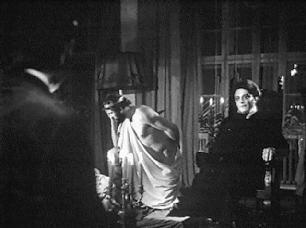
Invented characters: Kurt Raab as Walter Kranz as Stefan George in Fassbinder's Satan's Brew
It is also easy to see how stylistic and affective excesses like campiness have been used to denigrate melodrama or to pathologize hysteria, whether as representational or psychological phenomena. Formally, melodrama and hysteria violate verisimilitudinous norms, but not towards overtly political ends; in other words, not for reasons that conform to the radical aesthetic agenda, say, of materialist filmmakers. The bias of the latter emerges from their modernist separation of high and low aesthetic forms and the tendency to disassociate "low forms" from political critique. Without wanting to reify those very divisions, I find it nevertheless significant that politically motivated minoritarian groups often deploy the so-called low representational strategies like melodrama, kitsch, and camp. For Sanders-Brahms and von Trotta, melodrama offered a way to explore women's social and representational relationships to history; Schroeter embraced kitsch; Treut and von Praunheim have been immersed in camp. The willingness to incorporate such styles without demurring from their sensational or denigrated
MELANCHOLIA AND MELODRAMA:
"SHAMELESS DISPLAY" AND UNEARNED SENTIMENT
It can be argued that hysterics, mourners, and melancholics are all people who remember too much. Specialists in the past, they are consummate historians. Yet only the mourner gets it right, by any conventional measure. For this reason, I believe that those who "get it wrong" may have more to offer. For melancholia acknowledges the impossibility of overcoming the past—and even questions the desirability of doing so. We might start by questioning its existence as mourning's dark, devalued other, with nothing but messed-up circuitry. How can we reexamine its representational assumptions and strategies? In emphasizing strategy over solution and process over conquest, melancholia shows the importance of stylization and the affective props and pieces involved. I believe that the mechanisms of melancholic style invite others into relationships with personal memory and history. That style, I contend, is a key component of "the melodramatic imagination."
For Freud, mourning and melancholia are prompted by similar kinds of losses (of people, places, ideals, potential);[52] what distinguishes them is the manner in which that loss is dealt with. In mourning, Freud avers, there is "nothing about the loss that is unconscious" (245), and because that loss is consciously perceived as separate from the self and the body-ego, the contours of the mourner's identity remain unquestioned. Thus, although the ego laments the departure of the lost object, it does not turn to self-deprecation; it is able to move beyond the loss ("We rely on its being overcome after a certain lapse of time " [243]), to move past the debilitating effects of grief. In this way, the ego is free to form new attachments, to "get past the past," one might say. The rhetoric of conquest and mastery Freud used to describe mourning (with reality "winning the day"; "overcoming" the loss) anticipates the language of the victor retained by the term Vergangenheitsbewältigung
By contrast, melancholia is a kind of failed mourning, a primal, inwarddriven, narcissistic form of dealing with loss. Because the melancholic subject does not consciously grasp the lost experience or object, Freud maintains, the subject cannot separate the body-ego from the loss to which it is purportedly fused. Borders are blurred, and Freudians and non-Freudians alike point to the vagueness of melancholia's object as well as to the instability of its parameters (Günther Grass would refer to it as a utopian objectlessness).[53] Needless to say, this destabilizes boundaries of the ego as well. Unable to separate the self from this loss or negation, the melancholic experiences a diminishment of self unknown to the less distressed mourner. Understandably, melancholia provokes fiercely ambivalent responses from its sufferers, as is evident in the desultory outbursts of characters in Holy Whore and melodramas such as Herr R and Merchant of Four Seasons.
Feminists and others have justifiably taken Freud to task for opposing mourning and melancholia so reductively and judgmentally.[54] How can mourning be untainted by ambivalence or the unconscious? How can it leave ego-boundaries undisturbed, given how they are imbricated in all sorts of desires, attachments, contradictions, and proscriptions? Is melancholia such a tidy pathological other to mourning's "normal" means of coming to grips? Even Freud reveals some ambivalence on the matter, opening his essay with qualifying remarks that mourning and melancholia are but two ways of dealing with loss: they simply paint a "general picture" (243). At one point he maintains that "moral people" are more predisposed to melancholia (247) and that the "melancholic's access is sharper than ours[!] to a fundamental truth" (246), making it difficult indeed to pinpoint the norm that he claims to want.[55]
Mourning and melancholia are both lengthy endeavors. "We rely," Freud says about the former, "on its being overcome after a certain lapse of time " (244). Mourning, in other words, has a conclusion. No such happy ending lies in store for the melancholic, whose narrative contours are so unpredictable as to have no set timetables. Melancholics are condemned to repeated lamentations that cannot get past their object, nor at times even identify it. The serial format of Reitz's two televised Heimats intimates such a process, given its near-inability to conclude and the undirected nature of its longing. In a sense, melancholia and melodrama show that these processes cannot fully close, driven by this pointed lack of progress and goals and the seemingly infinite deferral of resolution. Without wanting to idealize these vicious circles, I believe that they nevertheless articulate the
Just as mourning and melancholia suggest different narrative patterns, each implies different relationships to style. One might visualize the mourner in culturally appropriate, respectable black attire and with restrained conduct, in contrast to the melancholic, prone to sullen, withdrawn moods or, antithetically, to outbursts, screaming, and exhibitionist display. In the New German Cinema, this is evident at the level of character behavior as well as film style. Recall the unmotivated eruptions of music-fragments punctuating texts like Whore, Herr R, or Petra von Kant. Does this suggest that style makes it easier for us to "hear" melancholy's appeals? This may be so, since proper mourning is inconspicuous by social necessity. Sustained in most North Atlantic cultures through religious ritual, respectful social distance and time frames, everything is explained, ceremonialized. Thus even in its private forms, mourning is conducted in socially sanctioned spaces of support. This is precisely what is denied to the melancholic, who must take recourse to more boisterous, deviant ways of demonstrating loss. Even Freud concedes the point: "It is really only because we know so well how to explain [mourning] that this attitude does not seem pathological" (243).
Rather than frame the artifice of a film like Holy Whore as "aberrations of mourning," we might consider it as a form of melancholic refusal. Consider how Freud describes melancholics:
They are not ashamed and do not hide themselves, since everything that they say about themselves is at bottom said about someone else. … [T]hey make the greatest nuisance of themselves, and always seem as though they felt slighted and had been treated with great injustice. All this is possible only because the reactions expressed in their behaviour still proceed from a mental constellation of revolt, which has then, by a certain process, passed over in the crushed state of melancholia. (248)
Obviously melancholia is not the "crushed state" Freud claims, and the passage more than intimates that the melancholic's sense of self-worth is not as damaged as he elsewhere postulates. Freud continues:
The melancholic does not behave in quite the same way as a person who is crushed by remorse and self-reproach in a normal fashion. Feelings of shame in front of other people, which would more than anything characterize this latter condition, are lacking in the melancholic, or at least they are not prominent in him. One might emphasize the presence in him of an almost opposite trait of insistent communicativeness which finds satisfaction in self-exposure. (247)
"Self-exposure" implies an externalization and introjection that Freud and others typically do not associate with melancholia. Moreover, the "insistent communicativeness" of the melancholic belies the claim that its bearer can only be narcissistic, or internally referential. As Fassbinder scholars like Elsaesser and Silverman have noted, Fassbinder's films extend extraordinary tolerance and lack of judgment to his figures, who usually make terrible mistakes and suffer terribly for them. If his texts make appeals to others-outside-the-text, their melodramatic framework only intensifies that appeal. The effect is heightened further by the inability (or unwillingness) of diegetic characters to respond to the cries of others.
PIECES, PROPS, AND PLAY
In spite of its incessant association with interiority, melancholia shows the weirdly communicative, stylized component of articulating grief—in short, its externalized dimension. An important aspect of its performative nature in relation to the New German Cinema can be explored through Santner's contention that "stranded objects," the sundry relics of Germany's war and postwar experience, function as transitional objects required in both mourning and melancholia. The seemingly excessive objects of melodrama and the New German Cinema thus provide "controlled symbolic doses of [poisonous] absence and renunciation,"[56] a way of dealing with grief comparable to the process of homeopathic medical treatment. Santner uses this to describe a specifically post-Nazi, post-Shoah context in which healing is a matter of process, not conquest. Although Santner does not put it in these terms, that is precisely what melancholia acknowledges, more openly than mourning. Given the shadow of Nazism's infamous "final solution," as Santner writes, "Mourning means to abandon the notion that alterity … requires a ‘solution.’ "[57]
Thus rather than working through or past loss, these substitutions and props allow subjects to move forward with loss. Given cinema's existence as physical images and sounds of substitutions, the idea has special relevance. To the extent that these substitutes are always not-the-object itself (in displaced foreign pop tunes, or in the striking resemblance of a photographic image), dealing with loss is an ongoing process. Its staging, in and out of the cinema, is abetted by transitional objects, the bits and pieces that stand in for what is "missing": the lost object, desire, a sense of wholeness, Being, the Real. Objects function like interruptions or substitutions put into play after entry into an Oedipal, symbolically bounded field. Within this field, props, symbols, and fetishes are freighted with
Klaus Theweleit emphasized much the same thing in his work on the Freikorps subject, for whom the protection of ill-established bodily borders from "undifferentiated miasma" was pivotal. (The Freikorps were a rightwing vigilante militia formed in reaction to Germany's defeat in the First World War.) Theweleit's infamous Freikorps subject took pleasure from the degradation of objects and other externalized "others," since their destruction was necessary to construct and maintain his own subjectivity. Theweleit argues that identity can be externally supported in the form of what he calls a borrowed social ego, fused onto the Freikorps subject like armor. The military uniform offered one external boundary to hold identity in place, an observation easily extended to a film like Der Letze Mann / The Last Laugh (Murnau, 1924), or Petra von Kant's frequently changed wigs. Theweleit borrows Michael Balint's concept of ocnophilia, "a term containing notions of dread, hesitation, terror, ‘clinging’" illustrating it with objects like a clenched jaw, or the riding whip Hitler always carried with him.[58] These objects are rather like successors to Winnicott's transitional objects, and Theweleit intimates, in referring to the Freikorps man as being a "not yet subject," that ocnophiliac behavior is an instance of failed mourning. With its investment in partial identifications and restagings, melancholia refuses the illusion of completion. To suggest that that option is undertaken by both Freikorps soldiers and concentration camp survivors shows that repudiating wholeness is not an act with guaranteed political consequences or causes. As Parveen Adams notes, although the objects with which we identify might be "traded in" and "judged, according to political calculations," to be "better" (by identifying with a maternal rather than paternal signifier, for example), ultimately they don't matter so much as the subject's relationship to them.[59] For instance, The Merchant of Four Seasons' opera recording becomes an object into which the notion of completion is placed, performing a phallic function in providing the illusion of a stable, normative identification for the subject. These objects become intermediaries between one subject and those that might witness him or her. They also offer glimpses into the subject's relationship to memory and history.
OCNOPHILIA AND CHINESE ROULETTE
Chinese Roulette is a movie of objects and games tailored to Santner's and Theweleit's analyses. Angela is the crippled daughter of haut-bourgeois parents who are both having affairs. She brings them together for a retreat in their country chateau, knowing that they are unaware that the other will be there with their lover as well. Fassbinder and Michael Ballhaus
Performing a mass after the attempted murder of one character and the shooting of another has a perverse logic, to be sure. Yet religious ritual or form has no place in this houseful of people, despite their misleadingly celestial names, like Angela and Gabriel. Throughout the film, musical appearances are as deceiving as these people. It is nonetheless curious that the vicious, ironic world of Chinese Roulette features one of Fassbinder's more elaborate, sensual soundtracks. The score is littered with choirs, the electronic music of Kraftwerk, symphonic vocals, generic "thriller" film music, a central theme that's repeated several times, and an extended, compositionally varied piece during the Chinese Roulette game itself. Yet for all this acoustic display, and again as Angela warns the groundskeeper Gabriel, "eavesdroppers often hear the wrong truths," the film's soundtrack generates the same epistemological, emotional, and moral uncertainty as its mirrorstudded image track.
The drinking glasses clung to and tossed about in Chinese Roulette or Beware of a Holy Whore (like Dorothy Malone hugging papa's oil rig model at the conclusion of Sirk's Written on the Wind[1957]) establish that melodrama and its ocnophiliac props are born of a melancholic economy wherein they can only gesture towards resolution with the past, not provide it. In "successful" mourning, by contrast, these objects would disperse the affect associated with loss in order to stabilize the wounded human identity. Yet here we see that that kind of conclusiveness is illusory at best.
INTROJECTION AND INCORPORATION
Critics have compared Freud's notion of mourning to Maria Torok and Nicolas Abraham's concept of introjection. Introjection copes with loss by extending autoerotic cathexes outward towards it, thereby extending the self as well. (Like Freud, Torok and Abraham deploy the rhetoric of conquest—claiming that the self "advances, takes over, assimilates" the object.) Introjection includes the instincts and desires attached to the object—the emotions, relations with it, not just the object or loss itself—an observation one might equally make about melodrama, whose worlds are inhabited by so many over-invested, overwrought "things, not people."[60]
Opposed to that is incorporation, a process construed as a sort of failed introjection, just as Freud established melancholia as unsuccessful mourning. Here, in trying to identify with the object, the self internalizes it, seals it off, and disguises it—encrypting it, as Torok and Abraham put it. Jacques Derrida discusses this inauthenticity as follows: "I pretend to keep the dead alive, saved inside me … but it is only in order to refuse … to love the dead as a living part of me."[61] The ego splits, burying the object alive, refusing to mourn it through this psychic mummification. Thus while incorporation may go through the motions of introjection and adopt its superficial signs, as Torok and Abraham describe it, it is not the real thing because it cannot extend outwards. Important here are the means by which it "adopts" "superficial signs," a description that suggests that there is no direct recourse to "the real thing," just artifice and attempts. Clinically speaking, melancholia shares that pathological status, particularly in terms of its inability to distinguish borders (sealing, encryptment) of the self; it also shares its psychic and emotional intensity, its stylized articulation ("superficial signs") and presentations of such attachments, its uncontrolled diversions from "reality"—again, recalling aspects of melodramatic representation. Yet the way that melancholia (and melodrama) depend upon embodiment suggests to me that the encryptment of introjection does not fully explain the process. Interestingly, melancholia (and melodrama) elaborates some of the incorporative processes of extending attachments outwards into discursive situations.
Rather than completely externalize the object (as in classical mourning and introjection) or incorporate it, the melancholic representation I am considering restages the oscillation between the two. It externalizes that which the subject has tried to incorporate by placing it into exhibitionistic cycles, requiring someone to be there to see or hear it. Put into the realm of historical representation, the stakes in the process are high. Objects become the means by which a past/lost object/absence is invoked (along with
Because melancholia presents itself as an ongoing process and not a solution to loss, Freud's characterization of mourning as a conscious act and melancholia as an unconscious, narcissistic one becomes difficult to sustain. Santner writes of the conscious, "lucid melancholy" of postwar intellectuals who have adopted its elegiac tone,[63] and I have stressed the illusory nature of the closure promised by mourning work. Interestingly, Freud repeatedly asserts that his study "Mourning and Melancholia" is itself incomplete, and "call[s] to a halt" and "postpone[s] any further explanation … til the outcome of some other enquiry can come to its assistance" (258). By concluding his essay on these words, Freud proves that mourning work defies the clear-cut closure upon which he otherwise insists.
It is not my intention to celebrate melodramatic representation, nor to argue that it is fundamentally more effective than other forms at presenting stories of history and loss. The point is rather to question the received notion that melodrama is by default too cheap, reductive, American, or inappropriate to tackle historically charged issues. (Anglo-American film scholars in the 1980s may have dispensed with that bias only to construct melodrama at the other extreme, as a "subversive" piece of mass culture.) When all is said and done, the claims for melodrama seem about as ambivalent as the emotional push and pull of its stories. Clearly the Young
INSATIABLE AFFECT
[Fassbinder] deployed filmic means to create a very specific form of "historical" memory, among which his use of melodrama and violent juxtaposition of contrasts, sentimental pop songs and improbable coincidences have a strategically important place. Thus, the "effects of melodrama, sentimentality and prurience" form a part of Fassbinder's aesthetic and moral universe, prompting the question of whether they do not in his work constitute "limits" which any discussion of representation may have to confront, including one that wants to approach German Fascism, Auschwitz, and the relationship between Germans and Jews. For what terms such as melodrama signify, however much they may be coloured by negative judgements of taste and decorum, is an affectivity, and therefore an aspect of subjectivity crucial not just to the cinema. These emotions, one could argue, ought to legitimately belong to any engagement with matters of life and death, on the part of those to whom history has given the role of readers or spectators [and auditors], but also for those who are charged with passing on compassion and preserving memory.[65]
This extended passage comes from Thomas Elsaesser's 1996 Fassbinder's Germany, his swan-song study of the director whose passing fourteen years prior had critics ringing the death knell of the movement at large. Wolfram Schütte's famous obituary used somatic terms that effectively transformed a disperse movement into a single body—mimicking how melodramas were being read as "body-texts" at the time:
Alexander Kluge would be its synthesising intelligence, Werner Herzog its athletic will, Wim Wenders its phenomenological power of perception.
― 64 ―Werner Schroeter emphatically underscores its emotional side, Herbert Achternbusch is its rebellious stubbornness, and Volker Schlöndorff its craftsman. Rainer Werner Fassbinder, however, would be the heart, the beating, vibrant centre of all these partial impulses, these different aggregate states of its energy. … He was the pounding heart. Now it has been stopped.[66]
The publication of Elsaesser's book coincided with what was basically the death of melodrama as a hot object of study in cinema studies. There as well the topic seemed to have run its course. Folks had had their say; some seemed embarrassed for their indulgent "readings against the grain," for having espoused radical politics, for failing to consider melodramatic traditions outside North Atlantic cultures, and for downplaying historical and institutional contexts. For whatever reasons, melodrama had suddenly become as unfashionable as the New German Cinema.[67] In view of that shift, Elsaesser's assertion that Fassbinder's cinematic world view was "essentially melodramatic" is striking.[68]
As his earlier reference to proper decorum reveals, critics closely scrutinize cinematic style when the topic of an appropriate means of representing and addressing the past is raised, particularly when the past is Germany's. Affect and emotions play large roles in these debates, particularly when the supposedly more "tasteless" forms and styles of melodrama, hysteria, and kitsch are involved. This is not the kind of emotion that comes from identifying with characters, but rather the kind that arises from the melancholic strategies that simultaneously encourage and deny our affective responses. As Elsaesser argues, they show that even at their most unruly and distasteful, emotions and desire instigate our involvement with our memories and with those of other people. Since these desires, and the pasts with which they are involved, do not go away (for desire always exceeds its object), objects are all that's left to work with. Hence Fassbinder's admiration for making films "about things, not people" is a bit misleading, since it is only through "things" that people are made.
Psychoanalytic theorists of film spectatorship in the 1970s and 1980s did not put emotion and affect on the table for discussion. Surprisingly, this also characterized melodrama scholarship of the time. Ever the good modernist soldiers, academics distrusted people's emotional connections to film texts, arguing that emotional involvement meant depreciated analytical abilities, and a lack of critical "distance." To this day, melodrama's affective features, as well as those of cinema more generally, remain undertheorized.[69] The relationship between emotions and bodies is significant here for, as Linda Williams observes, emotionalism is often associated with the
Melodrama is set clearly apart from tragedy through its dependence on the sensation of shock—and on shock to induce sensation per se. In tragedy all the reversals and catastrophes grow logically out of the original dramatic material. In melodrama, however, they arrive unexpectedly: Disaster is not precipitated by profoundly rooted character traits … or the deep structures of reality [e.g., myth] but by purely fortuitous events. … If tragic events unfold with the appearance of inevitability, the accidental nature of melodramatic occurrences implies that things could always have been different. … It torments one with an excruciating sense of "if only this had not happened."[71]
Somatic though it may be, the sensation Coates describes is tied up with feelings more than anything else. That is what produces the "excruciating sense of ‘if only this had not happened.’ " Like most scholars of the New German Cinema, Coates does not idealize these hypothetical possibilities, for alternatives do not necessarily point to better or even desirable conditions. Indeed, the movement is renowned for constituting alternatives out of the very systems that oppress, as with the exploitative gay subculture of Fox and His Friends or the female pirates who adulate their tyrannical leader in Madame X. Ultimately the drive to find utopian "elsewhereness" is intensified because the New German Cinema produces few depictions of it. I believe that this is true for melodrama as well, as it searches for its utopias-that-never-could-have-been. As Gilberto Perez remarks apropos of Ophuls's Letter from an Unknown Woman, Joan Fontaine plays "a woman in love with an illusion that no reality can dispel."[72] But where Ophuls uses tragedy to expose the danger of that belief, Fassbinder does the same thing in The Marriage of Maria Braun through irony.
It should be noted that refusing to depict solutions is not the same thing as refusing their importance. As Coates states, "One of the consequences of melodrama's inevitability is its potential endlessness." When he goes on to note that "melodrama's form is dictated by insatiability,"[73] he reveals how close melodrama is to melancholia, whose personages are also dominated by the desire for things to have "happened differently." That desire is punched up all the more since it refuses to disappear and persists in boisterous displays.
When Santner addresses the "lucid melancholia" of postwar intelligentsia, he helps show that refusing to let go of the object is not always a
THE ABILITY TO HEAR
Clearly this approach to mourning and melancholia is distinct from forms of psychoanalytic analysis that relate films back to the psyche of their director (such as Syberberg's conflicted nostalgia) or a nation (allegories of arrested development in The Tin Drum), or even the "body" of the text (the hysterical model). Equally clear is the fact that we are describing more than private, psychic events. After the war, conditions were simply not such that Germans could readily mourn their complicity with Nazism, especially since the auratic super-gaze of the latter had simply been appropriated by American occupiers.[75] By the time of the New German Cinema, however, an affirmative social space was widening, and filmmakers used very public venues like theatres, television, and discussions to stage the processes of exploring the past rather than resolving it. Thus German films of the time exhibit less an inability to mourn than an elaborate apparatus with which to do so.
Melodrama's generic obsession with past events, losses, missed opportunities, and abuse—and the possibility of acknowledging these histories in others—dramatize the work involved in the process of listening to other people. In the films I have examined here, the material self-consciousness of the scores counters the tradition that banks on music's abstractness or transcendence. Its minimized role heightens our awareness of its detachment from the idea of emotional "authenticity." Again, this is not to withdraw emotions from these scores, but to suggest that their obstreperous physicality turns them into demands to be heard.
Bearing in mind how important it is for someone to listen to and witness the memories of others, even modest details like the small parts Fassbinder played in his films (from Holy Whore to Lili Marleen— or his starring role in Fox) and Raben's cameos as musical characters (the music teacher in Four Seasons, a pianist in a bar in Malou, a nightclub bandleader in Berlin Alexanderplatz) become charged with significance. Through them we recognize that these sounds and images were created by historical subjects who are made present to us by being stagily placed in the films. By physically taking places in their own work, Raben and Fassbinder become ideal melodramatic characters, discursive space-holders. In other words, and in contrast to the inward-directed narcissism Freudians use to explain melancholia, these types of performances establish a social, outwardly directed space for others to whom the performances are geared, just as melodrama requires an empathetic jury to confer legitimacy on characters or situations at hand.
I have been stressing that we can characterize melodrama and the New German Cinema in terms of a working-out of the past, one considered to be an irrepressible force upon the text. And if in the 1980s melodrama critics accounted for this by invoking the structures of hysteria, in hindsight one sees that the psychoanalytic model that might offer more exegetical force is that of melancholia. This is not to replace one psychological condition with another, but to suggest a different representational modality altogether. Unlike melodrama and hysteria, melancholic representation is not intent on reproducing a lost or rediscovered truth, or in expressing something from within the depths of a clearly defined subject. Instead it suggests that those things are impossible to begin with. Playing with that impossibility, melancholia leaves us with the distance and differences from what its lost objects, histories, and fantasies might have offered.
If, as André Bazin, Susan Sontag, and Roland Barthes have argued, a photograph works as a ghostly representation people use to hold on to lost people, events, and objects, music cannot "fix" its object to begin with, and that sense of haunting becomes all the more difficult to pinpoint.[76] Similarly, melancholia involves "a sense of disappointment over something which was never received."[77] Here, instead of pathologizing melancholia, as Michael Schneider sees it, we can view it as a strategy of identificatory survival, however utopian its actualization would be. But since nothing exists of the melancholic object in the first place except as identificatory possibility, it cannot be received or given stable articulation, like utopian thought. To pretend that its losses can be so easily managed is absurd. Equally problematic is the effort to freeze melancholia as an aberrant condition: it is more reasonable to reconsider it, and the utopias toward which it fumbles, as key players in the "melodramatic imagination."
Thus we can approach lost objects as a means of reworking the everyday, moving towards new ways of chronicling our experience. One of melodrama's contributions has been in offering the possibility of rereading our everyday existence historiographically, a sort of Alltagsgeschichte. Elsaesser goes so far as to call melodrama the "literary equivalent of a … mode of experience."[78] By narrativizing the past through the everyday, melodrama usually creates the sense of a perpetual present. Yet the New German Cinema knew no such perpetual present; instead it showed that the present could only be read through the past. To elaborate, I return to the film with which this chapter began.
The melodramatic aspects of postwar German cinema suggest that the objects of the everyday, our own histories and identity, are never our own in the first place—much like the pre-and post-recorded voices and music of films like Anna Magdelena Bach, Ticket of No Return, and Germany, Pale Mother. Melancholia's exhibitionist tendencies arguably proceed from that same tension. Even as we see the "Made in Germany" inscribed in flamboyant, Gothic letters on the rock at the beginning of Reitz's Heimat, their home-grown authenticity is put into question: how can a sense of nation or national history possibly remain natural in such a heavy-handed detail? Why is identity still being configured as part of the German soil? The film is self-conscious acoustically as well, with its manufactured sounds, which are often indistinguishable from "natural" or diegetic sounds (birds, trees); music is frequently ominous and unstable rhythmically.
As Heimat's lumbering, rustic chronicle begins, its focus on the everyday is immediately crystallized by the first title: "May 9, 1919: A Friday." Subsequent "year-chapters" are inaugurated by a variety of photographs, family trees, and other souvenirs arranged by the film's diegetic narrator—just like Syberberg's Parsifal, which also opens as a museum of visual clutter: photographs of performances, buildings, ruins, and other frozen mementos. Heimat's soundtrack offers a similar assemblage of parts, mixing, among other things, national anthems, Protestant hymns, and synthesized music. What does sound do here? It seems to extend the promise of escape, at least to the character Paul Simon (an intriguing allusion to U.S. pop music). Through his early experiments with radio technology in the 1920s, Simon believes he can transcend his native Hunsrück. Of course, that "transcendence" is utterly dependent on the material aspects of technology and in fact, at the end of the film, Paul's company is bought out by multinationals. Reitz's depiction of transnational capital suggests that the sounds and sights of the everyday really cannot be authenticated as "German" or possessed by any one owner. American pop songs in Sugarbaby,
Music in the New German Cinema offers little in the way of fixity, stability, or access to utopia, be that access direct, as with Hollywood musicals, or deferred, as in melodramas. In this way, the melodramas of the New German Cinema externalized the "inward turn" discussed by McCormick and others in relation to the Neue Subjektivität movement. The interiority and subjectivity associated with it were tacitly assumed by melodrama's Anglo-American critics as well, using the hysterical exegetic model to "turn inward" in order to excavate meanings (subversive or not) within or behind textual bodies. Although I am no more interested in placing cinematic meanings "on the surface" than I am in finding them within the deep structural recesses of the text, the issue of externalization remains critical. For outward exhibitions are intertwined with subjectivity, and "excessive," melancholic acts are attempts to negotiate identity and structure relationships to other people through objects, props, and sounds.
Scholars of both melodrama and New German Cinema have justifiably stressed these films' lack of faith in the power of human vision (and hearing). Yet rather than retreat from displays of looking or hearing, these films give sights and sounds hyperbolic, concrete presentation. The "shameless display" of melancholia is thus a representational strategy based not on expressivity but on the concrete, externalized expression of melancholia's "utopian objectlessness," to recall Grass's remark. By sweeping characters into the realm of objects, Fassbinder's appreciation of Sirk for making "movies about things, not people" shows the extent to which such "things" are the materials out of which stories and histories are made.