
1. Marxian Class Analysis,
Essentialism, and the Problem
of Urban Identity
In the Introduction, I showed how our conceptions of identities and the city are related in important ways, proposing that conceiving of the urban in terms of “spacing” is useful in understanding the idea of the hybridity of identities. I suggested that we not define the city in terms of atomistic individuals engaged in a rational strategic game, the way economists and political scientists tend to do, or in terms of an organic community, or as the arena of class antagonism.
Instead, I believe the notion of hybrid identities offers a more compelling, if less developed, non-essentialist (or at least anti-essentialist) alternative to the liberal, communitarian, or Marxian perspectives on the possibilities of the liberating power of identity in the city.[1] My aim in this chapter is to show that the notion of “identity”—our beliefs about who we are, our relations with others, and the basis on which we can act in the world—is best viewed primarily as hybrid, overlapping, and undecidable.[2]
A second goal of this chapter is to begin to tell the intellectual history of Marxian urban theory. The work of Manuel Castells provides both a logical starting point for that story and the best opportunity to engage with the way Marxian urbanism has attempted to come to terms with the elusive problem of identities in modern urban societies. In what follows, I suggest that we see his work as successive attempts to develop a non-essentialist or nonreductive account of urban identity or urban agency—a more technical way of pointing to the way social and individual
I distinguish between three phases in his work. The first is characterized by the explicit attempt to integrate the new urban realities within the framework of Marxian class theory. The second represents the attempt to marry a “relatively” autonomous urban dynamic with a less deterministic Marxism. In the third phase, Castells abandons Marxian class theory entirely, positing the autonomous genesis and development of urban contradictions and the agents that embody them. My argument, in brief, is that each phase represents the unsuccessful attempt to develop a conception of urban identity as contingent or hybrid and to overcome an essentialist reductionism in the urban/class relation. This impasse is reflected most clearly in the attempt to reconcile the dimensions of class and the urban within a social theory of urban agency, oscillating between the primacy and autonomy of each term. Whereas in the first phase, the urban is reduced to class, in the third phase, the urban is seen as autonomous—however, both solutions are equally reductive. Only in the middle phase can the tentative outlines of an alternative model that aims at the “articulation” of the two dimensions be detected, a model that is adequate to poststructuralist critiques of essentialism that show how the nature of an entity is partly determined by its relationships with other relevant institutions and actors. For reasons set out below, however, Castells could not make good on these directions, abandoning the project of integrating class and space. As we will see, these two abstract dimensions are reflected in the empirical distinction between workplace and community. Indeed, how the separation between workplaces and residential communities is integrated with the Marxian concept of class is the central connecting link through all the analyses of this book.
At a first level, this trajectory explains well the “history” of not only Castells's work, but of Marxian urban discourse itself. At another level, what this story represents is the recognition and opening up of an alternative urbanism—what might be called, following Richard Rorty and Marshall Berman, the “ironic” city. This is a city where selves and communities are conscious of their own contingency, where a certain playfulness can exist across boundaries, where the myth of a purified identity
THE PROBLEM OF ESSENTIALISM
Before I turn to Castells's work, it might be useful to say a few words about the notion of essentialism and why I have chosen to approach the problem in this way. At the most general level, essentialism is the doctrine that something is that thing by virtue of possessing certain properties and characteristics that thereby distinguish it from things that it is not. More specifically, it is the principle underlying both metaphysical individualism and sociological holism.[3]
Despite the fact that many, if not most, of the fundamental debates in social theory—such as that between liberals, communitarians, and others in political philosophy—still revolve around disagreement over the nature of individualism, groups, and their relation to society, many have grown impatient with much of the debate around essentialism, including theorists otherwise sympathetic to a “post-essentialist” social theory. For others, anti-essentialism has approached becoming the new orthodoxy in academic social theory. For example, Teresa de Lauretis points out how the term is “time and again repeated with its reductive ring, its self-righteous tone of superiority, its contempt for ‘them’—those guilty of it.” Similarly, Diana Fuss wants to move the discussion away from the seemingly prevalent goal to “seek out, expose, and ultimately discredit closet essentialists” to one that traces the implications and effects of essentialist assumptions on the discourses within which they stubbornly circulate. This has led others, such as Terry Eagleton, to wonder in exasperation how such an apparently straightforward doctrine as essentialism became the most heinous crime in the postmodern book.[4]
There is some justification for these reactions. But the cant characterizing some discussions should not obscure the significance of the issues involved. The history of the problem of essentialism, kicked off in Western philosophy by Aristotle's discussion of the accidental and the contingent, does not concern us here. Nor is my aim to call down a plague on the house of all “closet” essentialists. That would be neither constructive nor enlightening. More significantly, it would miss the point of my reading of Marxian urbanism, since the writings of the authors I discuss are explicit attempts to avoid the problems of essentialism in developing a Marxian urban theory. The interesting question for me is not
My goal rather is to trace the effects of reductionist assumptions on attempts to escape it. Since I argue that this attempt is unsuccessful, I draw lessons from this impasse for an alternative model. My approach is to apply enough analytical pressure on the tensions of dealing with the separation of work and home to pry open another way of seeing the spaces of identity in the city. This flows from my conviction that the city has something to teach us about a cosmopolitan ethic. Because of its unique attempt to link structure, space, and agency, Marxian urbanism is as good a place to start as any other, if not better, for thinking about this alternative city.
It should be borne in mind that for the most part, in this chapter, I bring to bear my criticisms immanently in deconstructing the three phases of Castells's work, leaving my own position until the end of the chapter. Furthermore, as is the case with the other authors I discuss, I do not intend to provide a comprehensive assessment of Castells's work, of which there are already adequate treatments. Nor will readers find a consideration of the most popular empirical themes that have been generated by Castells's fecund and wide-ranging work. The substance of what follows in this chapter and in the rest of the book is defined by my agenda, set out in the last chapter, rather than by the author I am considering. The approach is not primarily exegetical. It is what may be called a critical reconstruction: themes are unpacked, deconstructed, and put back together in new ways. Identity is the first of these themes.
THE POWER OF IDENTITY AND THE PROBLEM
OF ALTERITY IN CASTELLS'S WORK
In his most recent and perhaps most ambitious work to date, The Rise of the Network Society and The Power of Identity, Castells puts forth a bold vision of the main contours and contradictions of the emerging global society of the twenty-first century.[5] This new “network” society differs in several crucial ways from the preceding industrial form that has characterized capitalism for the last several centuries. In the network society, economic functions are organized primarily around the exchange of information and operate on a planetary scale, not based on nationally
The central contradiction of this new network society lies in the conflict between the opposing dynamics of what Castells calls “the Net” and “the Self.” The dominance of the Net arises from the emergence of selforganizing structures such as markets and economic actors and organizations, which are instrumental and abstract and whose goal is the management of increasingly complex flows of information and capital at the planetary level.[6] However, these networks threaten and dominate the reproduction of the identities of social groups and individuals. This is because, whereas identity is constructed on the basis of culture and meaning, which are always specific to place and history, the reproduction of the markets, informational loops, and bureaucratic systems operate in a quasi-autonomous fashion, like cybernetic feedback systems, above the heads and behind the backs of social actors. One result of the clash of these antithetical logics is the emergence of social movements that are characteristic of this postindustrial period, such as religious fundamentalism, urban territorial movements, and environmentalism.
Despite significant differences related to whether they are defensive, legitimizing of the status quo, or seek to transform existing power relations, these new forms of agency share the characteristics of being themselves a “networking, decentered form of organization and intervention.” For example, environmental and feminist movements in many countries are organized around local, national, and international coalitions and decentralized networks. This form both mirrors and counteracts the dominant logic of the informational society. These “multiform” networks of social agency are different from the “orderly battalions” of former agents of social change—such as the labor movement—thus making their effects and existence more subtle and decentered. Castells follows Alain Touraine and others in observing that this marks a significant break from the central contradiction of industrial capitalism located in the struggle between classes over the economic product. Indeed, he concludes that labor movements today neither reflect the basic social contradiction nor have the capacity to maintain the privileged positions that they had over other movements in the past.
As with all Castells's previous writings, this new theory of the informational network society is provocative and original and touches on some of the most pressing aspects of contemporary social systems. I would however point to two areas that remain inadequately elaborated. The first relates to the theoretical distinction between the Net and the Self or Identity. It is never made clear precisely what differentiates these two processes and what it is about them that is contradictory or conflictual. For example, it is unclear why there should be resistance to the Net, to the growing domination of everyday life by abstract flows of information, money, and power. The answer to this question I leave until the next chapter. There I will argue that a more satisfactory social theory building on Castells's insights should be constructed around the role of language in social processes and on the theoretical distinction between system and lifeworld.
The second area of difficulty concerns the relationship between identity and alterity. It is important to notice that Castells's objective is to describe and affirm the “liberating power” of an identity that is neither individualist nor fundamentalist, which I take to mean certain forms of communitarianism. The environmentalist, feminist, and gay liberation movements illustrate this liberating power, as do to a lesser extent urban territorial movements for local autonomy, as well as certain kinds of nationalism. This idea prompts at least three questions. First, what is identity a liberation from? This of course returns us to the former question about the distinction between the Net and the Self, and which I will discuss in Chapter 2. The second question is: What is the alternative model of identity that Castells wishes to propose in contrast to the atomism of individualism and the organicism of communitarianism? This is never made clear, either in the case studies or in the theoretical reflections. Third: What is the relationship between these different (liberating) identities? Are they separate, positive identities? Or alternatively, are they related in some way? Do they overlap? How do they constitute each other? What are the implications of this question for Castells's conception of identity? What implication does it have for the idea of an emancipatory politics of identity?
In this chapter, I focus on the latter two questions, and suggest that the answer to these questions are closely related: that is, that the alternative model Castells is seeking is linked to the questions of alterity and the relationality of identities. His emphasis on the “decentered” and “multiform” character of the new social movements is highly suggestive,
In this chapter, I defend this thesis through a reconstruction and analysis of Castells's work as a whole. Many of the questions I have raised have been central to his writings of the past three decades, where he has struggled, unsuccessfully in my view, to come to grips with these problems. More important, however, reconstructing his work can help us think about identities because, as I will show, some crucial answers to the questions set out above can be found in the earlier phases of his work, promising directions that he chose not to pursue. By contrast, I want to pick up at the point where Castells branched off from the promising theroretical implications of his earliest work and go down another path. In this way, I can develop the outlines of a hybrid urban identity as well as tell the story, reconstructed retrospectively, of one of the central figures of contemporary social and urban theory.
CASTELLS'S EARLY WORK: CONTEXT AND THEMES
Castells's early work, written in France in the late 1960s and early 1970s and collected most notably in The Urban Question: A Marxist Approach (1972; trans. 1977),[7] is read most often as the seminal, but flawed, attempt to develop a coherent Marxian theory of the role of space and urbanism in advanced Western capitalist societies.[8] This work was a fresh departure in two important respects. It represented the first sustained attempt to provide a critical alternative to the dominant ecological perspectives in urban sociology and policy thought. It also highlighted social dynamics and contradictions distinct from industrial production and class-based movements. It showed how the state provides mass consumption goods such as subsidized housing and the organization of urban space through urban planning as a way to guarantee the reproduction of labor power, as well as an appropriate geography for capital circulation and accumulation. It also showed how the politicization of these processes could lead to cross-class “urban social movements.”
Castells's work was almost entirely assessed within the confines of the new urban political economy where, understandably, the focus was on the changing configuration of state power, the economy, and, to a lesser extent, the changing character of forms of collective action in cities and localities. Castells's attempt to bring Marxism and the city together therefore was read predominantly in terms of what Marxism could contribute to an empirical study of the city. The theoretical infrastructure and dilemmas of this work were either ignored or rejected for their abstractness and formalism.
Missed in this reception was the other side of the coin, namely, the fact that Castells's project also opened up the question of what the city and space could teach us about Marxism, or social theory more generally. It is rarely noted now, even by Castells himself, that The Urban Question was also a provocative attempt to deploy the key theoretical insights of Althusserian structuralism. In fact, it is in the theoretical dilemmas and tensions engendered by the attempt to marry certain Althusserian themes with the empirical demands of the new urban realities that the most important and far-reaching aspects of Castells's early project are to be found. The full meaning of The Urban Question can be understood only if it is seen as one of several attempts to create a nonessentialist Marxian social theory. This intellectual project, associated with writers such as Stuart Hall, Nikos Poulantzas, Michele Barrett, Ernesto Laclau, Chantal Mouffe, Barry Hindess, and Paul Hirst, was to a significant degree inspired by Althusser's revisionist Marxism, although many of his more fruitful insights have been lost, both because of the discredit he has received for political and personal reasons and as a result of the apparent general amnesia of all Marxian ideas.
THE ALTHUSSERIAN LEGACY
Althusser's work contained a theoretical dimension and a political dimension that many commentators have illegitimately run together. His theoretical project entailed the attempt to overcome the essentialism or economism in Marxist theory, expressed in the dictum that the economy determines all other social forms “in the last instance.” Althusser recognized this as one of a piece with models that posit the truth or reality of the diversity of representations in terms of a deep core or essence that expresses itself in phenomenal forms. Thus political institutions and ideologies could be reduced or traced back to their essential constitution in the economy. Althusser introduced the Freudian concept of “overdetermination”
Castells's early work can be fully appreciated only in this theoretical and political context. The aim of The Urban Question is to develop a non-essentialist Marxian urban theory in which urban spatial dynamics and the diversity of social bases of action around ethnic, territorial, workplace, or consumption communities and neighborhoods were not reduced to the conflict between economic classes. Following writers like Touraine, Castells sought to identify and acknowledge the reality of new socialmovement actors. The strategic commitment of the book, however, reaffirms working-class unions and parties relative to these specifically urban forms of identity as the privileged agents of social(ist) transformation. The project is thus caught in a dilemma between recognizing the relative autonomy of the new urban contradictions and antagonisms and reasserting the primacy of working-class agency. As a result, The Urban Question embodies two competing, and contradictory, themes. There is a dominant narrative in which, in familiar Marxian terms, the urban is defined by role and function in a structural totality that in the final instance is constituted by capitalist class relations. In this story, the urban instance is merely one internal moment of an albeit more complex classstructured totality. In this view, the urban expresses the core principle of class structure, although it does so via mediations. Yet there runs through the book an alternative, but more tentative, account of the urban-class relation. This alternative narrative results from the acknowledgment of the diversity of the bases of social mobilization in cities other than those organized around the (waged) workplace. It is the effect on the discourse of The Urban Question of a new logic of relationality, the logic of overdetermination. I have referred to this model of relationality as spacing. In
THE SEPARATION BETWEEN WORK AND HOME
To grasp this more concretely, it is necessary to consider a central characteristic of modern (Western) urbanization. Since the Industrial Revolution and the demise of the artisanal household economy, urban space and everyday life have been organized around the separation of the realm of capitalist production, that is, wage work and the labor market, from the residential community organized through the housing market. Although the precise configuration and timing of this development has varied by time and place, the fundamental fact of the separation has not.[10] If we start from a recognition of the centrality of this morphology to the organization of social life, then the Marxian notion of class appears in a somewhat different light. This is because from this urbanistic perspective, it becomes apparent that Marx's notion of class embodies within it an implicit spatial dimension and hierarchy that prioritize the workplace over the other spaces of the everyday. When Marx looked out on the landscape of mid-nineteenth-century European industrialization and pointed to the relations in the new factories as the analytical key to the anatomy of civil society and the basis of a working-class identity, he overlooked the fact that everyday life was being constituted in two dimensions: in the places of wage work and, simultaneously, in residential neighborhoods that were becoming increasingly homogeneous in terms of income and status. Whereas the workplace did constitute the space of the emergence of the subject as “worker,” residential communities sorted populations not on the basis of their relation to the means of production but, depending on the context, on the basis of status, income, occupation, ethnicity, or race. Whereas the social relations of production created a space for the constitution of subjects as workers and capitalists, the residential communities were the space for the constitutions of subjects as consumers of housing and land, as well as subjects of political and administrative bodies delivering services. Individuals thus experienced capitalist modernity not only as wage workers and producers in the workplace but also in their residential communities as subjects of political and bureaucratic agencies and other forms of collective identity. Marx designated one space, the workplace, to express
The implication of this spatially one-sided emphasis is that the relationship between the workplace and the community in the construction of class identity (and by extension, between the workplace and all other spaces of identity) is unidirectional: class identity (in the Marxian sense) is constituted by the relations of production and in the workplace. The other part of a worker's life, at home, in the family, in the neighborhood, is also fundamentally constituted by the relations in the workplace. The subject as worker carries with him (it was almost always a male worker in the nineteenth century) the same identity when he goes home at night. The social space of the family—of housing, the neighborhood, and its institutions—does not affect the basic constitution of class identity at the workplace.
Note that I am not arguing that social relations of communities never take on a working-class character that is an extension of the class solidarities formed around the workplace. This is a well-known feature of company towns, for example. Rather, I am arguing that this homology be read not as an expression of an undifferentiated class identity but as the hegemonization of the separation in terms of class. Clearly, the opposite, where work and community take on ethnic dimensions, for example, is also logically possible.
But if the workplace is not privileged over other spaces of identity, then from the point of view of a subject's lifeworld, to speak of an identity is to
To defend this reading of the dual project of The Urban Question as a tension between these two accounts of the relation between work and home, I will lay out briefly the main elements of these two narratives and the tension between them.
PHASE ONE: THE URBAN QUESTION
The Urban Question begins with the recognition of the problem of class essentialism in developing a Marxian urban theory. As we saw in the Introduction, Castells was one of the first to recognize the new constellation of urban contradictions (spatially located, state-organized consumption goods) and urban actors (cross-class, territorially organized collectivities). But he was equally aware of the difficulties these new actors posed for a Marxian account of these new social phenomena, observing that Marxism had so far proved incapable of analyzing urban problems in a sufficiently specific way. This was because Marxian analysts invariably fell prey to two complementary dangers. The first entailed “recognizing these new problems but…moving away from a Marxist analysis and giving them a theoretical—and political—priority over economic determination and the class struggle.” The second trap led, by contrast, to a “left-wing deviation, which denies the emergence of new forms of social contradiction in the capitalist societies…while exhausting itself in intellectual acrobatics to reduce the increasing diversity of the forms of class opposition to a direct opposition between capital and labor.”[13] Although Castells did not succeed in The Urban Question in reconciling the evident relative autonomy of urban agency vis-à-vis economic class actors with the Marxian postulate of determination in the last instance by the economic, examining the
In The Urban Question, the dominant narrative is constructed through several argumentative moves. First, the “urban” and the everyday are defined not in terms of the process of production but in terms of consumption and the reproduction of labor power:
An urban unit is not a unit in terms of production. On the other hand, it possesses a certain specificity in terms of residence, in terms of “everydayness.” It is in short the everyday space of a delimited fraction of the labor force…. But what does this represent from the point of view of segmentation in terms of the mode of production?—Well, it is a question of the process of reproduction of labor-power: that is the precise definition in terms of Marxist economics of what is called “everyday life.”[14]
However, since, in the Marxian scheme, the reproduction of labor power is an internal and necessary component of social production, the result is to restrict the definition of the urban as an internal, analytical moment of the labor process. In this way, the urban also is reinscribed as an internal moment of the production process. Castells maintains, for example, that “we can, therefore, retranslate in terms of the collective reproduction (objectively socialized) of labor power most of the realities connoted by the term urban and analyze the urban units and processes linked with them as units of the collective reproduction of labor power in the capitalist mode of production.” Although urban issues do not directly concern the relations of production, and the urban excludes the workplace, the urban is nothing more than the spatial and institutional manifestation of the reproduction of labor power: “In the last analysis, the ‘city’ is a residential unit of labor power.”[15] Thus, the series of equivalences that invite the heterogeneity of the everyday into the coherent narrative of historical materialism link metonymically the following elements: everydayness—the urban—not-production—consumption—the reproduction of labor power. Castells attempts to resolve the tension that results from privileging class on the basis of the relations of production embodied in the workplace while according a specificity to processes based outside class and the workplace by “retranslating” these nonclass phenomena into the more abstract scheme within which the concepts of class and class struggle were constituted in the first place.
Second, although Castells recognizes the autonomy of the urban at the outset, he gradually eliminates it from the dominant urban theory that unfolds in The Urban Question. This is because there is a measure
In fact, this impasse reflects an inconsistency in the initial formulation of the goal of Marxian urban theory. Castells sought to go beyond those interpretations that reduced “the increasing diversity of the forms of class opposition to a direct opposition between capital and labor.” But by characterizing the “new forms of social contradiction” leading to new types of social movement and contestation as an increasing diversity of class antagonism, he is simultaneously executing two incompatible maneuvers.[16] By empirically recognizing and introducing a nonclass logic of contradiction and social mobilization, he inaugurates a line of inquiry in opposition to the class reductionism of classical Marxism; yet by continuing to characterize the new antagonisms as forms of “class opposition,” he perpetuates the theoretical reduction of their autonomy vis-àvis social class, processes of production, and the latter's spatial embodiment in the workplace.
The model of an expressive totality centered in the economic realm is clear from the dominant argument of The Urban Question. The urban possesses a certain specificity, but the urban is defined in terms of the reproduction of the mode of production, and “the [social] product is not a different element, but only a moment of the labor process. It may always be broken down, in effect, into the (re)production of the means of production and (re)production of labor power.”[17] But if the urban is the combination of the moments of reproduction of the elements of the labor process, and the sum of these processes of reproduction is only the specification of the total social product (which itself “is the basis of the social organization”), and this product is “only a moment of the labor-process,” then it follows that the urban is also an internal moment of the labor process. And if we turn to the empirical realizations of these processes, it must necessarily follow from the structure of the discourse itself that struggles over housing, for example, or the nature of identities structured by relations of community, whatever their apparent empirical characteristics, must be analyzed under the same concepts as are employed for analyzing
The third move of the dominant narrative is to claim that urban actors and antagonism are internal aspects of class antagonism. If the social structure is viewed as a product of the economic realm, as we have seen above, then the urban structure and the practices that derive from it must be as well. Castells defines class as “combinations of the contradictory places defined in the ensemble of the instances of the social structure.” At the level of the urban, there can be no modification of this basic determination. Class struggle is no longer a specific type of empirical collective action: it is the name of all actions that emerge from within the mode of production. In that case, there can be no articulation of the urban with class struggle. The former is internal to the latter, and both are structural combinations or effects of the structure of the mode of production. Unless we can specify some part of the social (such as wage-labor relations around the workplace) as embodying class relations, the specificity of class vis-à-vis other identities cannot be established. Indeed, we would not be able even to begin to answer the question of their relationship, for every maneuver would circle within a closed space. Because of the force of the dominant narrative, Castells is led hesitantly but inevitably to the conclusion that “the so-called problems of the city are simply the most refined expression of class antagonisms and of class domination.”[19] Castells concludes, therefore, that urban movements can contribute to structural change in the trajectory of capitalist development only if they are subordinated to workers' unions and parties, since only the latter fill the space of identity thrown up by the principal contradiction between capital and labor.
COUNTERNARRATIVES
Although not extensive, there are several themes in The Urban Question that point to an albeit tentative counternarrative. This counternarrative
First, it is not accidental that the conceptual structure of The Urban Question was derived from Althusserian structuralism, since the latter itself sought to introduce a counternarrative to oppose the essentialism of orthodox Marxism's insistence on the finality of the moment of class determination. For example, Castells took over Althusser's critique of “theoretical humanism” in his analysis and rejection of Henri Lefebvre's neo-Marxist urban theory. According to Castells, Lefebvre is committed to a theoretical humanism—the belief that all social structures and historical events are determined by an autonomous will—because he believes “that space, like the whole of society, is the ever-original work of that freedom of Man, the spontaneous expression of his desire. This absolute of Lefebvrian humanism … would always be dependent on its metaphysical foundation” and, because it is based on the assumption of a universal human nature or essence, is thus an inadequate starting point to grasp the “social determination of space and urban organization.”[20] Castells asserts: “The argument according to which space is purely the product of social construction is equivalent to the assertion that culture gives birth to nature.”[21] On the contrary, if actors find themselves in situations not entirely of their choosing, then the patterning of social relations cannot be traced back solely to the intentions of acting subjects because of a dislocation between experience and knowledge.[22] Social processes, Castells argues, “are neither ‘wills’ nor strategies, but necessary social effects.”[23] Furthermore, if subjects (individual or collective) are not ahistorical entities, then to an extent, they are constituted by the structures through which they are interpellated as subjects and within which they (desire to) find themselves.
Despite some ambiguity, this critique of essentialism and ahistoricism pushes in the opposite direction from the first element of the dominant narrative in The Urban Question. It is possible to interpret this theory of the production of subjects within the limits of economic class determination, which is what Castells eventually does there. Nonetheless, the notion of breaking with a noncontextual foundation of identity so as to
Once the idea of identity as the expression of an essence is abandoned, the notion of identity is transformed. Identity can be seen to be relational, defined vis-à-vis other identities in a field in which the mutual determination of identities is not arrested at a point of final determination. Castells pursues this insight, the second element of the counternarrative in The Urban Question, at several points. For example, in a discussion of the relationship between culture and space, he observes: “Society is not the pure expression of cultures as such, but a more or less contradictory articulation of interests and therefore of social agents, which never present themselves simply as themselves but always, at the same time, in relation to something else.” The “dislocation between the system of the production of space [i.e., the distribution and patterning of social relations] and the system of the production of values” makes the one-to-one expression or mapping of a group's values (e.g., proletarian, artisanal) onto an area (e.g., a working-class or artisanal neighborhood) not necessarily impossible, but inherently contingent. Any correspondence “is a question…of a specific social relation which is not given in the mere internal characteristics of the group, but expresses a social relationship that then must be established.”[24] Interpreting residential milieus as the social structures of the community, we should read this as the rejection of an a priori relation of determination between the objective social position of agents (e.g., their places in the class structure) and the identities that may arise within a particular place.
Finally, Castells introduces the notion of overdetermination to help reconcile the Marxian theory of economic determination with certain patterns of spatial organization that fit only uneasily into that explanatory scheme. For example, he argues that despite the Marxian assumption that the “social differentiation of space is determined according to the place occupied in the relations of production,” empirical analysis (of the United States, in this case) suggests that “the relative autonomy of the ideological symbols in relation to the places occupied in the relations of production produces interference in the economic laws of the distribution of the subjects among the types of housing and space…. This [class-specific] spatial distribution is overdetermined by the new ideologico-political cleavage of racial discrimination.”[25] That is to say, in this case, it is inadequate to decode the social patterning of space by class analysis alone
By “overdetermination,” Castells, following Althusser and Freud, means that, first, any given phenomenon is a result of multiple determinations, such that the meaning of the phenomenon cannot be traced back to one cause or factor. An overdetermined totality thus is one in which there is no single or final instance of determination and meaning. Second, given the relationality in the constitution of identities, this implies that any given element or identity is never fully present to itself, that its conditions of existence and meaning are not contained fully within itself or its boundaries. In the case of the identity of social agents, overdetermination implies, contra essentialism, that agents are, paradoxically, dependent on their relationships with others for their essential characteristics. Laclau and Mouffe have characterized the overdetermination of identity as a situation where “all literality appears subverted and exceeded….[T]he presence of some objects in others hinders the suturing of the identity of any of them.”[26] Castells's provocative observation that “meaning has meaning only outside of itself” should be read as echoing the Derridian notion of a constitutive outside, the idea that the relations that an identity possesses with another identity outside of it are essential to it being what it is.[27]
One implication for urbanists of this alternative way of looking at things embodied in the counternarrative that I have argued runs through Castells's early work is that it is no longer possible to paint a picture of the relations between two (or more) entities, for instance, those labeled urban (defined by territory or consumption) and class (defined by the workplace or production), in terms of a hierarchy of determinations that are given in advance, or what Althusser called an “expressive totality.” This alternative narrative suggests that the relations between these identities (for example, between trade-union organizations and neighborhoodbased organizations such as tenant associations or territorially defined ethnic groups) should not be understood in terms of an a priori general model of the relations between the economy and any other empirical sets of organizations or social relations. The specific relation between community and workplace identities is contingent upon the historical, political, and economic circumstances in which these groups find themselves, and, equally importantly, on the discourses with which these groups
One consequence of this is that, as Castells is tentatively beginning to indicate, no one identity gives meaning to all the others. We will examine this model in more detail in the next chapter when we consider David Harvey's idea that urban, community-based struggles are merely “displaced class struggles.” Although the dominant narrative in The Urban Question also interprets urban struggles as displaced class/workplace struggles, the counternarrative provides another way to see the problem. A further consequence is that the precise character of urban identities is determined through a process of political, economic, and discursive construction or articulation without an essential core. As we will see, Castells draws on Gramsci's notion of “hegemony” in the second phase of his writings to capture this dimension of urban political life.
THE REDUCTION OF THE URBAN
TO A SECONDARY CONTRADICTION
We are in a position to draw some provisional conclusions. Despite the promising potential opened up by the submerged narrative of overdetermination, contrary to the project's initial ambitions—to clear an analytical space for the development of a Marxian urbanism that neither rejected the Marxian political imaginary nor explained away the specificity of the urban—the acknowledgment of the autonomy of nonclass phenomena had only a limited effect on the basic structure of the dominant framework of The Urban Question. Castells did not find the solution to the dilemma posed for Marxian urbanism by the separation of work and community, a dilemma also faced explicitly by Harvey and Katznelson, and for the most part implicitly by all other Marxian urban theorists. But the tensions in The Urban Question help to clarify this central antinomy.
There are two different models of class in The Urban Question that, from an urbanistic viewpoint, must clash with each other. Class1 is embedded in and arises from the web of labor, work, the relations of production, the labor movement, the transformation of nature, the material base, the creation of surplus value, and so on. From the perspective of the historical development of urbanization, this involves a spatial “centering” or delimitation. Marx took industrial society and the (spatially) integrated lifeworld of the proletariat with which he was immediately confronted to be the referent of a conceptual and transcendental unity, the
However, as soon as the assumption of identity (in the phenomenological sense of the same, the identical, repetition) becomes problematic and thematized, the model shifts to Class2. This reflects Castells's recognition of the historically new nonclass differentiations of antagonistic identities. Here, difference is internal and constitutive of all identities, including that of class. Unity is not a characteristic that resides in one element and gives (unidirectionally) meaning to all others. Concretely, the idea of a unified working class that acts as such (leaving aside the problem of collective “wills” for the moment) must bring together into a new unity previously distinct elements. If the capacity to organize and comprehend the totality of (workers') existence as one of exploitation and oppression by capital, the capacity to break out of the fragmentation of life spawned by the fetishistic masking of a dialectical unity is derived from class consciousness, then from a sociological perspective, class consciousness must of necessity encompass all aspects of an individual's life or subjectivity. It is this understanding that underlies the impetus and attraction of the new social history. But more important, it also reflects the desire and need to extend Marxism so as to encompass social relations outside the workplace. If class is the result of a process of hegemonic construction, to use Laclau's phrase, it cannot refer to any one of the prior constituent elements, such as work, home, community, and so forth. The way in which Class2 is conceived therefore conflicts with the primacy given to the workplace and the determinations following from it. This gap or dislocation between Class1 and Class2 is the precise discursive space that Marxist theory has attempted to fill positively
Although critical of the marginalization of urban issues within the Marxian discourse in which he nonetheless has chosen to remain, Castells at this stage still refers to the worker's struggle as the embodiment of the “principal contradiction.” I have tried to show that the ambiguities inherent in the attempt to assimilate urban processes within a Marxian class scheme forced Castells to adopt a counternarrative that pushed in opposite directions to the essentialist assumptions of the Marxian class scheme. All subsequent theoretical strategies—reflected in the shifts in Castells's discourse as well as the very different approaches of Harvey and Katznelson— are best interpreted as attempts to overcome the impasse illustrated by The Urban Question. It is to these responses that I now turn.
TOWARD HEGEMONY AND ARTICULATION
AS THE LOGICS OF IDENTITY
Even a careful reading of The Urban Question, drawing out the ambiguities of the text, could not have led one to predict the shift of position that Castells subsequently considered necessary to advance the study of the city. Nevertheless, retrospectively and reconstructively, we can see why the move was at least a possibility and why there were pressures tending to push the analysis in this direction. As we have seen, the project of The Urban Question was premised upon the elucidation of the specificity of urban processes, but ended up subsuming its object within a totality conceived in terms of a class structure. The tensions within The Urban Question thus resulted in an ambiguous and unstable foundation on which to build the structure of Marxian urbanism.
The arguments of City, Class, and Power aim to provide a more empirically and theoretically adequate account of the relationship between urban movements and class structure. As Castells became skeptical of the approach adopted in The Urban Question, and less satisfied with the political prescriptions advocating the primacy of workers' organizations, paradoxically, he abandoned many of the Althusserian and deconstructionist themes such as the concept of relationality and the impossibility of essentialist identities that in fact held out alternatives to the essentialist totality sketched in The Urban Question.
Despite a marked withdrawal from the theoretical terrain so explicitly elucidated by The Urban Question, the second phase of Castells's work
City, Class, and Power advances the thesis that “apart from … levels of income… there is a new source of inequality inherent in the very use of these collective goods which have become a fundamental part of the daily consumption pattern.”[29] In the context of the European welfare state of the 1970s, Castells identified access to housing as an example of these new realities. The advent of widespread home purchase through credit supported by governmental means has produced social cleavages and interest groupings that do not simply reflect the levels of income and stratification in the labor market. Government intervention in housing provision, for example, produces nonclass inequalities, since the allocation of these resources is subject to bureaucratic, not profit, mechanisms. The criteria of selectivity governing government forms of housing provision structure a field of contradictions and social relations that are not homologous to those structured through market prices and the wage relation. The relation between these two subsystems, the market system and the bureaucratic/administrative system, cannot be assumed a priori, as in the basesuperstructure model.[30] The political realm possesses its own logic, and “each intervention, even economic, will be marked by it.”[31]
Moreover, state intervention in collective consumption both reinforces class structures and gives rise to new disparities that “do not correspond to the position occupied in class relations but to the position in the consumption process itself…. The positions defined in the specific structure of inequality do not correspond in a one-to-one fashion to the structure of class relationships.” As a result, “contradictions at the level of collective consumption do not correspond exactly with those springing directly from the relations of production.”[32] Castells thus breaks away from a class-centered model of collective identities. What was implicit in The Urban Question here becomes explicit: we cannot trace back the
In a discussion of local politics in Paris, for example, Castells observes that the demands resulting from the politicization of consumption issues “are expressed on the one hand through the union movement organized at the place of production, and on the other hand by new means of mass organization…in the sphere of collective consumption, from associations of tenants to committees of transport users.” Urban problems thus articulate problems of more general scope, and “it is at the level of urban problems that one can see most easily how the logic of capital oppresses not only the working class but all the possibilities of human development.”[33] Thus, to claim that social pathologies—pollution, inadequate housing, lack of neighborhood services, and so forth—no longer affect only a vertically delimited social group organized around wage labor (as they perhaps did in an earlier phase of industrialization)[34] is to sever the umbilical cord tying the experience of deprivation uniquely to the structuring effects of the labor market.
In this new model, urban problems rebound on and affect all social classes. The patterning of deprivation vis-à-vis these problems must be analyzed anew to reveal their specific forms of stratification—the crucial new variables being the level and form of state intervention into the supply of collective (or “public”) goods and the specifically administrative and political logic underlying these policies. They cannot be read back from the class structure or the state of the class struggle, as the theory of The Urban Question suggested. The relationship between labor and urban movements can no longer be analyzed exclusively under the rubric of class struggle, in which all forms of urban or new social movements are reduced to a “direct opposition between capital and labor.”[35]
POLITICAL CONSEQUENCES
If there are qualitatively novel, nonclass patterns of inequality and contradictions structuring advanced capitalist societies (which does not imply that class effects have disappeared), how should we conceptualize collective identities that coalesce within this new terrain? What is the
The way Castells answers these questions in City, Class, and Power, in contrast with the positions he took in The Urban Question, could not be more striking: the Leninist model has been replaced with the politics of the united front.[36] Urban social movements “permit the progressive formation of an anti-capitalist alliance upon a much broader basis than that of the specific interests of the proletariat….In combining social struggles and exemplary democratic management of the cities, [that is,] hegemony at the mass level … the Left begins to win the battle for socialism … beyond the bastions of the working class.” Contrary to the earlier hypothesis that urban political forces must be subordinated to the working-class movement, City, Class, and Power now advances a different hypothesis and prescription: an urban social movement “must be kept independent of a [workers'] political struggle in order to obtain positive urban effects on the one hand and positive political effects on the other; but the two types of processes must be developed”—and this is the key methodological threshold—“not only so that they can achieve specific goals but also so that they can mutually reinforce each other.”[37]
We are now clearly faced with a new set of problems and questions. What is the theoretical status of this relation of what he calls “mutual effectivity”? What conceptual revision must be undergone before this mutual determination can be conclusively integrated into the overall theory? The base-superstructure model limits the mutuality of determination, and we saw that The Urban Question tries more or less rigorously to remain faithful to this topology, the function of which was to delineate in advance the relations between the elements of urban agency, the economy, and the social structure. Without recourse to the essentialist totality espoused by The Urban Question—a complex totality of dialectical mediations ultimately determined by the economic instance— Castells is compelled to draw on new concepts to think this new relation of relative autonomy of urban identities from class-based identities and class structures and marks the decisive break from the objectivistic model of identities as the re-presentation of the economic base.[38] For example, Castells asserts that “a specifically political [that is, class] element can only be grafted on to an autonomous, popular movement based on the daily experience of the masses,” not “the workers,” note, and that as a consequence, we should focus on “the forms of articulation of urban struggle to the historical process of class struggle.” Moreover, he now
These abstract theoretical formulations were grounded in the changing political fortunes and challenges of the European and particularly French Socialist and Communist Parties in the 1970s, challenges reflected in the emergence of actors and issues that were departures from what the working-class parties, inspired by Marxism, viewed as their “historical tasks.” New social movements arising from the urban middle class were advancing new claims around new issues such as environmental protection, peace, and gender equality. Urban social movements and neighborhood mobilizations introduced the criterion of social justice to the design and planning of cities and as a means of criticizing uneven spatial development. Thus, in these essays of his second phase, Castells was offering theoretical means of conceptualizing the expansion of the traditional social bases and defining issues of the Left: the industrial working class, and the nationalization of industry, along with other issues associated with industrial unionism.
Returning to the question of the relationship between class and the urban, the workplace and the community, we are still left with the question of whether these new popular poles of antagonism and identity are simply added on to the original, working-class base. Indeed, to optimize the potential of this innovation, it is necessary to connect the new notions of mutual effectivity and hegemony with the alternative logic of relationality that was hesitantly and unsystematically present in The Urban Question.
In this case, the new, expanded tasks and demands should be interpreted as creating a new discursive totality within which labor and consumption, work and community, class and the urban, must rearticulate and find their (new) meaning. In fact, Castells claims that the new urban politics is “expressed on the one hand through the union movement organized at the place of production and on the other by new means of organization…in the sphere of collective consumption.”[40] Work and community, production and consumption, class and the urban, are now relatively independent moments within a new totality.
One implication of this alternative model is the abandonment of the essentialist conception of an ontological primacy of labor and class, thereby opening the analysis of plural bases, tasks, and identities to a relational and articulatory perspective. This would not mean that labor or class could not possess a practical or strategic primacy; but no identity could possess an a priori ontological (or structural) primacy vis-àvis
LIMITS
Despite the introduction of significant innovations, the concepts of grafting, hegemony, and articulation play in the end only a limited role within the framework of City, Class, and Power, and ultimately Castells does not break from workplace reductionism. This is due principally to the lack of basic concepts. In the end, he views coalitions and hegemonic constructions as the simple addition of preformed identities. In the absence of a new conceptual framework within which to integrate the non-essentialist concepts—a framework tentatively visible in the Althusserianism of The Urban Question—the case studies fall back onto Marxian assumptions and reaffirm the foundational nature of the relations of production, rejecting the possibility that a new “principal” contradiction is being proposed and relegating the politicization of urban, socialized consumption to “a secondary structural contradiction.” The text tries to square the circle by claiming—in this case no differently than in The Urban Question—that a “structurally secondary contradiction can be a conjuncturally principal one.” But this operation simply collapses back into the dominant model of structural totality espoused by The Urban Question. Nonetheless, we can now understand why this unstable model is necessary: it is the only way that Castells can chart the path between either abandoning Marxism or relegating urban contradictions to a status secondary and subordinate to class processes.
The resources for a more profound shift of paradigm and a resolution to the impasse faced by Marxian urbanism thus can be found both in The Urban Question and, more explicitly, in the essays of City, Class, and Power, but these are sharply circumscribed and finally repressed. It is not surprising, therefore, that Castells would feel constrained by the contradictions and antinomies of both attempts to find a way out of the impasse. This second phase of his work is thus suspended between the hesitant commitment to Marxian class theory and the recognition that an adequate interpretation of the new historical realities cannot be accommodated within its framework. It would not be surprising, then, if Castells would be led to undertake yet another attempt to understand the specificity of urban struggles and their relationship to other bases of collective identity.
THE URBAN AS AUTONOMOUS SOCIAL PROCESS
With the publication in 1983 of The City and the Grassroots, Castells's work on the character of urban or territorial social identities entered a third phase, culminating in The Power of Identity (1997).[41] I began by discussing several elements of the latter. Here I turn to the former's more explicit and extended discussion of urban social movements in order to assess the extent to which The City and the Grassroots overcomes the problem of class reductionism of urban identities that bedeviled the two previous phases. In particular, I am concerned with the extent to which this new formulation succeeds in conceptualizing the merger of social identities, their overlapping or hybrid nature. Although I will conclude that The City and the Grassroots does not succeed in overcoming a reductionist interpretation of social identities, the attempt has much to teach us about the problem of essentialism, identities, and the city.
THE CITY AND THE GRASSROOTS AS A RESPONSE TO
CRITICISMS OF CASTELLS'S EARLIER WORK
The City and the Grassroots can be read as an attempt to overcome several criticisms leveled at Castells's earlier work. His urban theory, critics argued, was too tied to the Marxian notion of the primacy of class struggle in social change. It ignored nonclass bases of discontent, such as gender, race, and ethnicity, as elements of collective identity and discontent in most cities. It ignored nonmaterial inequalities and cultural
The City and the Grassroots sought to address these shortcomings through three interconnected innovations. First, it presented an ambitious cross-cultural theory of urban social movements centered on the autonomy and historical distinctiveness of struggles over urban meaning. Second, it abandoned the previous commitments to Marxian theory as the privileged explanatory framework for understanding social movements and social change, because the theory of class struggle had been unable to accommodate the diversity of actors and issues reflected in urban movements. Third, Castells proposed a conceptual model that explicitly recognized axes of domination other than economic class as autonomous sources of urban meaning and conflict.[43]
THE MAIN GOALS OF THE CITY AND THE GRASSROOTS
The chief goal of The City and the Grassroots is to develop an account of urban agency that avoids class reductionism but that at the same time avoids the corresponding essentialism of positing social actors outside of their social, economic, and political contexts or in isolation from other bases of identity. “Neither the assimilation of urban conflicts to class struggle nor the entire independence of both processes of social change can be sustained…. Only by focusing on the interaction between the social dynamics of class struggle and the urban dynamics whose content must be redefined in each historical situation, are we able to understand social change in a comprehensible way.”[44] In contrast to viewing urban
THE SAN FRANCISCO MISSION CASE STUDY
Castells's analysis of the urban mobilizations in the predominantly poor, Latino, yet also multi-ethnic San Francisco Mission District between 1967 and 1973 presents a particularly explicit opportunity to examine these issues.
The case examines the genesis, organizational dynamics, transformations, and ultimate demise of the largest urban mobilization in San Francisco's history. At its peak, it involved over twelve thousand of the roughly fifty thousand residents of the district. The mobilization emerged primarily in response to two factors: the threat of displacement by the city government's urban-renewal program and by the availability of substantial funds for neighborhood revitalization from the federal government's Model Cities program. As a result of the success of the initial neighborhood coalition that succeeded in stopping the urban-renewal plans, over sixty neighborhood-based organizations came together to form the Mission Coalition Organization (MCO). The MCO was intended to be a long-term, viable neighborhood coalition that would represent the interests of the Mission residents, especially with respect to the control, management, and direction of the Model Cities program. But unity was not easy to come by. The divergent interests of the many groups involved were compounded by the tension between two conflicting understandings of the mission of the MCO, which, in Castells's interpretation, led to “organizational schizophrenia.” Most participating organizations viewed the MCO only as a “coalition of existing organized
In the first years of its operation, the MCO struggled with the mayor's office over who should run the federal program at the local level. This was resolved in 1971 when a twenty-one-member public agency was formed, with fourteen members appointed by the MCO. During this time, the MCO's activities were focused on several fronts: the problems of affordable housing and the lack of employment opportunities for Mission residents, as well as the goal of preserving the neighborhood's Latino culture. Nonetheless, internal disagreements continued between those advocating community control, who wanted the MCO to run the Model Cities program, and others who felt that the MCO should remain an independent advocacy organization pressuring and influencing City Hall from the outside. Moreover, the deep tensions between the agenda of different MCO members such as Latino radical nationalists, traditional Latino social service agencies, middle-class white home owners, Alinskyite community activists, conservative church-based groups, and so on, undermined the viability and unity of the MCO. By 1973, the MCO had become a “complex puzzle” of competing interest groups. The result was “organizational paralysis and self-destructive in-fighting.”[47] The organization collapsed.
Castells's central concern is to explain the failure of the MCO to “raise the level of self-definition and organization to the point that would have created unity” out of the different constituent components, such that each element would have transcended its immediate self-interest.[48] He points to several factors. First, the MCO was unable to expand the base of support for their initiatives beyond the neighborhood-based groups, thus forcing them to limit their initiatives to the “level of people's immediate interests.” These initiatives included social programs responding to demands for the preservation of Latino cultural identity, redistributive programs addressing the lack of affordable housing such as rent control, and actions urging local businesses to hire unemployed residents. But the MCO was unable to articulate the discourse of a particular issue or grievance around a more abstract or structural dimension. The MCO failed to transform the limited, parochial, and immediate demands of Mission residents on such issues as urban services and neighborhood space, poverty, and cultural identity into a broader and linked set of
Second, the effect of the successful achievement of some real but discrete and narrow goals was that the MCO benefited the Mission residents only at the expense of reproducing the social fragmentation of different interest groups and identities. The very gains legitimized and institutionalized the MCO as a pluralistic coalition of interest groups operating within the urban rules of the game of redistributive and symbolic politics, rather than making it an agent of the transformation of those rules, an objective expressed by some organization leaders.
Third, the MCO was constrained from pursuing a more global strategy because of the difficulty of forging and sustaining alliances. For example, to have expanded the urban-spatial dimension beyond the neighborhood to the level of the city would have necessitated an alliance with middle-class neighborhoods whose interests in low-density zoning, historic preservation, and environmental quality were at odds with the interests of poor Latinos in the Mission.[49] Similarly, the MCO was unable to relate the problem of neighborhood poverty to the wider class structure determining the dynamics of the labor market because the labor movement in the city supported the city's pro-growth development agenda.[50] (A potential alternative, which Castells describes in the case of the Madrid popular uprisings in the 1970s, was for the MCO to promote a broader agenda of the city around use value and reject the production and management of urban space and services as profitable commodities, an agenda organized around exchange value.)
The fundamental lesson that Castells draws from the experience of the MCO is that interest-group politics is the key obstacle to “the effective merger of the different identities into a popular movement.”[51] Moreover, the Mission case illustrates particularly well the tension between instrumental social agency and cooperative coalitions. There is the “social logic of interest groups” in which discrete groups interact through the strategic trade-offs and bargaining that results from the instrumental pursuit of the “piecemeal satisfaction” of different demands for each interest group. True forms of coalition emerge when there is a common
WEAKNESSES IN CASTELLS'S INTERPRETATION
Many critics have argued that in moving from orthodoxy to skepticism, Castells has abandoned the rigid reductionism of Marxian class theory only to fall into a pluralism lacking structure and an account of determination or causality. Ira Katznelson, for example, has argued that The City and the Grassroots describes only movements across space and time without any sense of a hierarchy of determinations, with no social force or structure being more important than any other. A crucial shortcoming of this empiricist and agency-centered framework (derived in large part from a reading of Touraine's work) is that we cannot expect any type of agency to be more likely than another. The City and the Grassroots cannot give good explanations of the variations of urban movements in large part because it abandons the agenda of urban social theory, the project of linking structure, space, and agency within a comparative framework.[52]
In addition, there are several weaknesses and ambiguities in Castells's third phase that are pertinent to the critique of essentialism as I have presented it so far.[53] The central weakness that runs throughout both The City and the Grassroots and The Power of Identity is that the monism of class reductionism evident in The Urban Question has been replaced with a pluralism in which the different identities are now presented as fully autonomous and in which any sense of relationality between identities, either in their genesis or in their dynamics and interrelations, has disappeared. The element of overdetermination, so provocatively, if incompletely, introduced during Castells's Althusserian phase, has fallen away in favor of an empiricism that, at worst, reduces simply to a catalogue of different movements.
Consider the model summarized in the figure. Castells uses the figure to make the provocative distinction between categories appropriate to the level of experience and those appropriate to the level of social structure.[54] As we have seen, neighborhood (N), poverty (P), and minority status (M) are the experiential correlates of the “structural” components, the city (CY, i.e., the urban), class (CL), and race (R), respectively. Poverty is an expression of the broader class structure at the level of immediate
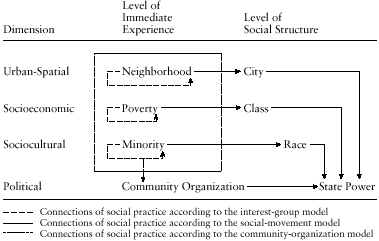
experience, neighborhood expresses the broader dynamics of the “city” at the local residential level, and the minority experience expresses the structural relations of race and culture. These constitute the six “basic” elements of the model. Using these elements, Castells proposes a contingent model for the articulation of political identities. “When an organizational operator expresses N, P, and M, separately, we name it an interest group (IG); when they integrate N, CY, or P, CL, or M, R, to challenge SP [state power], we name it a social movement (SM); when they integrate N, P, M, we name it a community organization [CO].”[55] The relationship between organization and base is itself variable: if an organization merely expresses a base, it seals off its boundaries and relates in a monological manner toward all other exterior forces—in other words, as an interest group. If it relates experiential dimensions of cultural oppression, economic inequality, or territorial difference with “structural” institutions of power, it develops a movement along that dimension. If it fails to make this connection beyond a particular lifeworld, and only links together the experiential dimensions of N, P, and R, it remains a community movement.
The model is useful because it captures how the same basic elements can combine to create radically different political forces. Totalities have been deconstructed: any given movement's organization is a complex structure with relatively autonomous elements, none of which in principle is fundamental. The outcomes are a matter of political practice and
However, this is also where the limitations of the model and of the framework of Castells's third phase as a whole appear. The key problem can be expressed in terms of the following questions: Does the contingency of the totalities extend to the contingency of the elements themselves? Do the “basic” elements remain unchanged after their combination with other elements? If the meaning or nature of the totalities is contingent upon the articulating practice of the movement's organization, does this not also apply to the “basic” elements themselves? Castells goes on to say that the notion of “basic” elements is in fact something of a fiction (“Neither N, P, nor M were present as pure elements. There was actually a combination of NP and MP, with N and M as elements”).[58] Again, is the combination NP qualitatively different from the entity N+P? Although this question may seem excessively nuanced, it will soon become apparent that consideration of it can help shed light on the core of the problem of essentialism.
There are two possible responses to this question, and they reflect the dilemma between autonomy and primacy of the class-urban relation we have traced throughout Castells's work. First, if the answer is “No” in principle, then what we are presented with here is strictly not an articulation but a combination presupposing the closure of the boundaries of the elements, and by extension, therefore, the affirmation of the essentialist assumption of monological action underpinning the interest-group model. The theory would then have ended up affirming what it set out to criticize.
That Castells's model of multiple identities throughout The City and the Grassroots and The Power of Identity does indeed fall into this trap is reflected in the claim that “the first lesson of our historical journey is the need to analyze separately cities and classes….While the forefront of the process of industrialization was occupied by the struggle between capital and labor to share the product and to shape the state, the backyards
If the answer is “Yes” to the question of whether the identity of the elements of a coalition potentially change as a result of their interaction, however, this subverts the notion of “basic” elements whose identity is fully present and positive. The implication of this is that there are no basic elements that themselves remain unchanged as a result of their combination with other elements. Another way of saying this is that the boundaries of all and any elements are not fixed but are formed only within a given contingent totality. But to accept this is to enter into a new discursive terrain wherein, as we have seen, identities are paradoxically constituted by their relations with what they are not, that is, where they depend on their relationships with others for their “essential” characteristics. The contingency of the boundaries of elements (be they class, neighborhood, or race) is what I have referred to variously as overdetermination, articulation, and spacing, the contours of which I will lay out more explicitly below.[61]
Despite these implicit deconstructive possibilities, which we have seen run throughout the three phases of Castells's work, his third attempt to conceptualize the class-urban link, and by extension the links between any set of identities in the urban field, again fails to capitalize on the deconstructive moment of spacing. It is ironic that by the time he begins
CONCLUSION: OVERDETERMINATION,
SPACING, AND IDENTITIES
In their study of the dynamics of social movement organizations, Conflict and Consensus: A General Theory of Collective Decisions, Serge Moscovici and Willem Doise conclude that in a situation of genuine compromise, “each person sacrifices fragments of his conviction, facets of his own reality; he gives up on a degree of individuality in order to seek an understanding and vision in which all can share.”[63] My goal in this chapter has been to bring to light and demonstrate the usefulness of this idea as a way to escape the circle within which Castells found himself trapped. I have tried to show the integral connection between the underlying assumptions of this idea of identity and what I have called the urban experience, or the promise of the city. I have tried to clarify and deepen Moscovici and Doise's claim by asking what kind of identity we need to have in order to experience the city as a place where this genuine kind of compromise is possible. A deconstructive reading of the provocative, if flawed, pioneering work of one of the founders of Marxian urban theory has helped point to the way to this understanding.
I will elaborate the theoretical model I am proposing here in Chapters 3 and 4, but this much already should be apparent: Identities, I propose, should be seen as overdetermined, that is, where “all literality appears as constitutively subverted and exceeded… the presence of some objects in the others prevents any of their identities from being
The city has, if not an exclusive place, then certainly a privileged relationship to this moment of spacing, overdetermination, and alterity. I do not think it is entirely fortuitous that the city has been seen as a risky or dangerous place. In part, this is what connects the city to the politics of difference in its broadest sense, in which we come to find our identities as citizens through the recognition of a part of ourselves in the diverse others that make up the polis. That politics consists of the putting of one's identity at risk. The promise of the city is to suggest a city beyond the twin traps of the enclave, with its forced exclusions, and the commune, with its coerced inclusions, and to provide the possibility of the experience of hybridity, of the experience of the contingency of our spaces.