
I. Harald Sverdrup Sets the Sails
Oceanography is not so much a science as a state of mind. So is the Scripps Institution of Oceanography.
Scripps is the oldest institution of oceanography in the United States (organized in 1903 and dedicated to research in oceanography in 1925), the first to award a doctorate in oceanography (1930), and the largest oceanographic institution in the United States (approximately 1,100 staff and students in 1976). It is officially defined as a research and graduate school of the University of California, San Diego.
As a state of mind, Scripps Institution is a group of scientists and students whose interests lie in the ocean itself. They began as biologists, geologists, chemists, physicists, or even engineers, but they call themselves oceanographers. Their talk of science is sprinkled with Navy terms and fishermen's jargon. Geography of the edges of the sea is as natural to them as was that of the Mediterranean to the Phoenician sailors. Like any sailors, their gaze goes suddenly faraway when they speak of certain ports.
They do not really love the ocean.
“To oceanographers,” said William A. Nierenberg, “the sea is an enormous and restless antagonist. The work is
H. William Menard, who has been going on expeditions for a quarter of a century, has called the ocean “little more than a nuisance to a marine geologist. It provides a convenient medium for transporting equipment, although it is regrettably unstable. Otherwise it seems to be an unnecessary filter which obscures every bit of information that one manages to collect.”[2]
That restless mass of opaque water hides the mountains and troughs, conceals the fishes and the sea serpents, wobbles the sound waves, and churns the stomach. But its power and its mystery hold some people in a spell, and among those are oceanographers. They devise instruments to penetrate the obscurity of seven miles of swirling water. Slowly they wrest secrets from an alien world that holds them back.
“I have often wondered,” mused Roger Revelle, “why it is so pleasant to be on a small, oily, and uncomfortable ship, far from the nearest land. … I am convinced that it is because on shipboard both the past and the future disappear — only the present is left.”[3]
The lowering and return of a rock dredge can take many hours. Time stands still. One can muse over the effortless roll of the porpoise, wonder how the flyingfishes fly, watch the rim of the setting sun turn emerald green. There is time for geography, for history, for listening to the ideas of a colleague in another discipline. Time and the vastness of the sea create oceanographers — interdisciplinary, international, and interesting raconteurs.
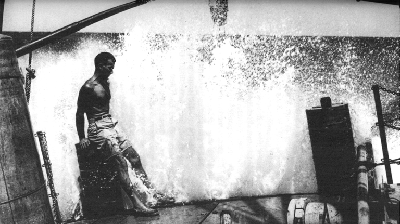
“The sea is an enormous and restless antagonist,” as illustrated by Willard Bascom on Capricorn Expedition, 1953.
It was not always so at Scripps. The institution actually began in the tide pools, and many years passed before it reached the middle of the sea. In 1892 William E. Ritter, then the new chairman of the zoology department at the
Like many others since then, Ritter came under the spell of La Jolla and the Scripps Institution. He moved from Berkeley to La Jolla to become the institution's first director, serving from 1903 until 1923. In 1912 he helped negotiate the transfer of the small, self-sufficient marine station to the University of California. The scope of this philosopher-biologist was broad, and he realized that other sciences were necessary for his biological survey. So he brought a physicist and a chemist to the young institution. Indeed, he laid the foundations deep in the sands of La Jolla for a many-faceted study of everything about the ocean. Ritter's breadth of interests in the ocean created the diversity that characterizes the Scripps Institution.
As his retirement approached, Ritter urged the institution into encompassing all of oceanography, and he favored the appointment of geologist T. Wayland Vaughan as his successor. Vaughan, then with the United States Geological Survey, was already well known in scientific circles for his work on foraminifera, on corals, and on coral reef formation.
In his directorship from 1924 to 1936, Vaughan drew the institution into national and international ventures. For ten years he chaired the International Committee on the
Since the sale of the Alexander Agassiz[*]
[*] To avoid confusion with later ships, see the list of Scripps ships in chapter 14.
in 1917, the institution had not owned a research ship. This Vaughan remedied in 1925 by purchasing a 64-foot purse seiner, the Thaddeus, which was renamed the Scripps. She was a small vessel to face the entire Pacific Ocean. Vaughan's intent, however, was to pursue oceanographic studies by sending Scripps staff members on ships of other agencies. The most extensive program of this kind was the participation of chemist Erik G. Moberg in the cruise of the Carnegie for two months in 1929, from San Francisco to Honolulu.That same year Vaughan began arrangements for a scientific program on the Carnegie over a wide area of the Pacific, to be carried out by the Scripps Institution after the last voyage of that ship for its own organization, the Carnegie Institution of Washington, in 1931. Moberg, in consultation with other staff members, prepared a detailed program of work. In November of 1929, however, the Carnegie was destroyed in Apia, Samoa, by an explosion which also killed her captain. Vaughan wrote:
Those members of the staff of the Scripps Institution who had been associated with the staff of the
― 8 ―‘Carnegie’ were paralyzed when the tragic news first reached us. We both admired and were personally fond of Captain [James P.] Ault and in addition to the grief we felt over his untimely death, there was the regret over the interruption of one of the finest programs of oceanographic research in modern times and the delay of further work on the oceanography of the Pacific.[4]
Vaughan, urged by Moberg, briefly considered carrying out the proposed researches on the Scripps. But, as he said in a plea to Robert P. Scripps: “All of us who are familiar with the ‘Scripps’, notwithstanding its being excellently adapted to short cruises along and off the coast, are of the opinion that it is rather small for making real sea voyages.”[5]
Robert P. Scripps, the son of E. W. Scripps, did respond with interest to Vaughan's plea, and in 1930 advised University President Robert G. Sproul that he could provide $150,000 for constructing a ship to be used for research by Scripps Institution and other institutions. Before this offer could be carried out, however, Robert Scripps found that his resources had been “affected by the financial depression,” and university officials, in consultation with Vaughan, concluded that “the income of the Scripps Institution [was] not adequate for the operation of a sea-going research vessel.”[6]
Director Vaughan's hopes for an oceanographic program in the Pacific were dashed. Even the 64-foot Scripps was not used extensively, according to biologist Winfred E. Allen, who noted in 1931: “In the last six years the Scripps Institution boat has been in operation on about 130 days, in the last four years about 60 days, in the last two years not more than ten days.”[7]
Vaughan was commissioned in 1932 by the Committee
On 1 September 1936, Harald U. Sverdrup became the third director of Scripps Institution. Born in Sogndal, Norway, on 15 November 1888, Sverdrup had already had a distinguished career. His native country was among few in the world then that called oceanography a science. At the University of Oslo, Sverdrup had enrolled in the encompassing course called physical oceanography and astronomy, but he was turned toward meteorology and oceanography by Professor Vilhelm Bjerknes, whom he followed to Leipzig (during World War I) where in 1917 he completed his Ph.D. dissertation: Der Nordatlantische Passat, the North Atlantic Trade Wind. Under explorer Roald Amundsen, from 1917 to 1925, Sverdrup was in charge of the oceanographic and meteorological work on the Norwegian research ship Maud, which was intentionally frozen into the ice in order to be carried across the polar regions for scientific observations. He also served as navigator and occasionally as cook on the Maud, lived for seven months with the native Siberian Chukchi tribe, and wrote a great many reports while icebound. In later years Sverdrup said that he was most proud that “after seven years on the Maud he parted friends with his shipmates.”[8]
He forecast his future, too, while icebound:
During the last winter in the Arctic, in 1924–25 [he wrote many years later], we used to discuss what we wanted to do after returning to civilization. One of our party wanted to go to Peru, cross the Andes and, instead of drifting with the ice, to drift down the Amazon River on a raft. He did. I used to say that I should like an opportunity to do oceanographic work
― 10 ―in the Pacific Ocean. It took me much longer to reach that goal.[9]
Before getting to the Scripps Institution, Sverdrup in 1931 accompanied Hubert Wilkins on the first attempt at exploration beneath the polar ice in the submarine Nautilus. Of that trip, Sverdrup said that “he didn't mind living aboard a submarine, but not that submarine. He had expected to find a perfect machine for the business, but instead was greeted with an ex-naval vessel, the ‘0–12,’ which had laid a number of years idle in Philadelphia. The expedition operated to the north of Spitzbergen, and soon called it quits.”[10]
Sverdrup became a professor at the Geophysical Institute in Bergen, and in 1931 he became a research professor at the Christian Michelsen Institute there. He became acquainted with the United States by spending two six-month periods at the Department of Terrestrial Magnetism of the Carnegie Institution of Washington, where he worked on data collected by the Maud and also data from the seventh cruise of the research ship Carnegie.
Vaughan spoke aright when he called Sverdrup “one of the foremost living authorities on dynamic oceanography” — for Sverdrup helped to make it dynamic. He was, however, a self-effacing person, as indicated in a letter to Vaughan in which he agreed to be the director of Scripps for three years:
I must confess that I have hesitated in assuming the responsibility which the directorship of a great institution like Scripps must involve. My hesitation is, I believe, rooted in my deep respect for scientific research. … It does not worry me that I am not an expert within many of the branches of oceanography which are represented at the Scripps Institution, since
― 11 ―it is impossible to find anyone who would have such qualifications, but I do not want to disappoint those who think me able to carry your plans further and, according to these, to help making Scripps Institution a centre also of dynamic oceanography.[11]
Vaughan had paved the way, for in 1925 he had completed the transformation, in projects and people as well as in name, from the Scripps Institution for Biological Research to the Scripps Institution of Oceanography. So, in the fall of 1936, at his new location Sverdrup found the full spectrum of oceanic studies:
Director Vaughan was completing a report on the fossil foraminifera of Trinidad before his retirement to Washington, D.C.
Professor Francis B. Sumner, a philosophical biologist who had given up his 17-years study of the genetics of deer-mice (Peromyscus) in order to fit into oceanography, was studying how fish change color and what protection their colors afford them.
Professor George F. McEwen, a physicist concerned with ocean currents and temperatures, was predicting a “moderate excess” of precipitation for the season, from his analysis of the many years of temperature measurements recorded daily, usually by Stanley W. Chambers, who also took tide records, plankton samples, and water samples for density and chemical analysis.
Assistant Professor Winfred E. Allen, expert on diatoms, was suggesting that river runoff influenced the productivity of marine plankton, and was statistically analyzing collections of phytoplankton from the daily pier collections at Scripps and at Point Hueneme.
Assistant Professor Erik G. Moberg, chemist and also skipper of the Scripps, had just directed one cruise on the Fish and Game Commission ship Bluefin and was continuing
Assistant Professor Denis L. Fox, physiologist, who had worked as an oil company chemist before earning his Ph.D. at Stanford, was gathering mussels from the pier for studies of their feeding habits and the carotenoids that turned them orange, as well as working with Sumner on the pigments of fishes.
Assistant Professor Claude E. ZoBell, microbiologist, who had come to Scripps from the Hooper Foundation in San Francisco after receiving his Ph.D. at Berkeley, was working on a statistical approach to the distribution and characteristics of bacteria that live in the sea, and analyzing their effect upon sea-floor muds.
Instructor Martin W. Johnson, zoologist, who had earned his Ph.D. at the University of Washington and had come to Scripps from the International Fisheries Commission on the east coast, was making biweekly collections of zooplankton along the pier, having recently returned from a cruise on the Coast and Geodetic Survey ship Guide, and was continuing to work out the life histories and distribution of pelagic copepods.
Associate in Oceanography Percy S. Barnhart, who had recently completed a book on the marine fishes of southern California, was managing the popular public aquarium and bemoaning the damage to his colorful display of mounted fishes that had been loaned to the California-Pacific Exposition in San Francisco.
Instructor Richard H. Fleming, chemist and a Scripps alumnus, had led two trips on the Fish and Game Commission boat Bluefin to set out 4,000 drift bottles for current studies, and was trying to determine seasonal changes in the coastal waters.
Easter Ellen Cupp, who had received her Ph.D. in 1934 for work at Scripps, was completing a taxonomic monograph
Visiting investigator Francis P. Shepard, geologist from the University of Illinois, was rowing out from the pier every few months to take lead-line soundings to measure changes in the Scripps submarine canyon; a commerical model of the canyon had been constructed shortly before from his earlier soundings, and one was on exhibit in the museum.
Visitor La Place Bostwick, formerly a jewelry designer and pearl buyer in St. Louis, was cultivating pearls in abalones.
Visitor Robert T. Young was collecting parasites from fishes and birds, and tracing their life histories.
Fred Baker, M.D., civic leader and a most active founder of the Marine Biological Association of San Diego, held an honorary curatorship of mollusks and owned one of the largest private shell collections in the world, from which he frequently donated shells to the institution's museum.
Five graduate students were registered for studies at Scripps; one of them, Roger Revelle, had received his Ph.D. in May 1936, with a dissertation on bottom samples collected by the Carnegie before her explosion. Six other students were on campus, chiefly for summer work but not registered. Five technical and clerical assistants and six maintenance workers completed the institution's roster, and in addition a number of workers assigned by the Work Projects Administration helped in everything from laboratory analysis to bookbinding, painting, and paving.
Such was the modest, yet diverse, nucleus that Sverdrup found for delving into the mysteries and workings of the ocean.
The assorted researches were carried out in the institution's three main buildings: George H. Scripps Laboratory, William E. Ritter Hall, and the Library-Museum, which was
The director and his family were housed in a two-story residence on campus. Many of the staff, the students, and some visitors lived in the 24 one-story frame cottages on the campus — “terrible cottages,” thought Mrs. (Gudrun) Sverdrup, and she later admitted that she cried when she first saw them. “The tight colony,” recalled Denis Fox long afterward, “like most such communities, received the pulse of any personal news items with the rapidity of an electric current crossing a wire network, and gossip could be extensive at times. It was not easy to keep clear of the busy, sometimes inventive, ‘grapevine’ in those early days.”[12]
An annual income of about $800,000, of which approximately half came from the state of California, kept the research work going. The greatest needs of the institution, according to Director Vaughan in mid-1936, were a new aquarium building and repairs to the pier.
On 13 November 1936, just two months after Sverdrup's arrival, the institution's small ship, the Scripps, burned at its berth following an explosion in the galley. Martin W. Johnson, unhappily landlocked, then penned a Christmas wish for the institution:
IF SANTA WERE A SAILOR
If Santa were a sailor, he'd bring us all a ship.
He'd fill it full of lab supplies and take us on a trip.
He'd bring a lot of citrate flasks, and silver nitrate too,
And heaps of sparkling glassware of curious shapes, and new.
He'd give us Nansen bottles, to bring up ocean brine,
And messengers and what-not, and miles and miles of line.
There'd be a long slide-rule on board to figure out the flow,
For Santa sure would like to know just where oceans go.
He'd bring us nets, and dredges too, to send down in the deep,
To fetch back fish and other things all in a squirming heap.
He'd say, “Now boys, I'd like to know, do mermaids really be?
Do awful scaly serpents torment them in the sea?
It's up to you, my gallant lads, to check these weird tales,
So hoist your flag, your anchors weigh, and set your shining sails.”[13]
Sverdrup, who had already been thinking of acquiring a vessel large enough for truly oceanic work, promptly requested an appointment with Robert P. Scripps, who this time agreed to provide $50,000 for a new ship. Sverdrup moved quickly; he found the 100-foot graceful sailing schooner Serena available for sale, and on 5 April 1937, Robert P. Scripps bought her for the institution. In gratitude
Martin Johnson demonstrated his enthusiasm with a jaunty sketch of the ship on his 1937 Christmas card for the institution's bulletin board.[*]
[*] See illustration. A longtime custom at Scripps was a Christmas card bulletin board for staff members to use to exchange season's greetings throughout the campus. The savings on postage were contributed by many participants to the Red Cross. The bulletin board has been revived in recent years.
From that moment, the direction for the institution was: out. That is, out to sea. From 1937, with a total of 19 vessels over the years through 1976, the Scripps Institution scientists and ships have logged 3,738,526 nautical miles, from Mazatlán to Mahé, from Hakodate to Punta Arenas — and dozens of other ports — in the oceanographers' pursuit of happiness.

“If Santa were a sailor, he'd bring us all a ship. …” Christmas card drawn by Martin W. Johnson, 1937, after the purchase of the E. W. Scripps.
NOTES
1. Quoted in: Allan C. Fisher, Jr., “San Diego: California's Plymouth Rock,” National Geographic, Vol. 136 (July 1969), 145.
2. Marine Geology of the Pacific (New York: McGraw-Hill, 1964), Preface. Used with permission of McGraw-Hill Book Company.
3. Quoted in: Helen Raitt, Exploring the Deep Pacific (New York: W. W. Norton, 1956), xiv.
4. Letter to Harry L. Smithton, 7 December 1929.
5. Letter of 25 January 1930.
6. Letter to ship broker Daniel H. Cox, 15 January 1932.
7. Letter to State Director of Finance Rolland C. Vandegrift, 7 October 1931.
8. Roger Revelle and Walter Munk, “Harald Ulrik Sverdrup — An Appreciation,” Journal of Marine Research, Vol. VII, No. 3 (1948), 127.
9. “Response by the Medallist,” Science, Vol. 90 (14 July 1939), 26.
10. Frederick C. Whitney, “Sverdrup of Scripps,” La Jollan, Vol. 1, No. 8 (4 December 1946), 18.
11. Letter of 11 April 1936.
12. “Again the Scene,” Manuscript in SIO Archives, 1975, 124.
13. In SIO Archives, History in the News, 1936–40, 17.