
1. Relocation and the Creation
of a Global City
Nationalism, as a model of imagining community, articulates with, rewrites, and often displaces other narratives of community.
Akhil Gupta, “The Song of the Nonaligned World”
The phrase Umm al-Dunya (Mother of the World) is used by Egyptians and Arabs to refer to Cairo. The mixture of actions, buildings, people, and activities gives the impression that the entire world is represented in Cairo and that it represents the world. The diversity of its neighborhoods, old quarters and new Western-style areas, high-rise buildings around the Nile, satellite dishes, foreign fast-food chains (such as McDonald's, Pizza Hut, Kentucky Fried Chicken, and I Can’t Believe It's Yogurt), the World Trade Center, the crowded streets, the walls that are covered with advertisements for many international companies (such as Sony and Citizen), and the life that never stops—all of these phenomena blend together to give Cairo its magic and recreate the feeling that this city is “the Mother of the World” and that it has something to offer everyone. It attracts poor immigrants from rural Egypt who come seeking work and a better life and foreigners who work for international organizations, educational institutions, and embassies, as well as Arab and international tourists who are attracted by the pyramids, the Nile, and the nightlife.
Touring Cairo's streets and alleys, one cannot but feel both the presence and absence of the government. The large number of policemen, who are guarding buildings, searching bags, regulating traffic, watching the people, and socializing with each other, give the impression that Cairo
Contemporary Cairo, which in 1900 had a population of six hundred thousand (S. E. Ibrahim 1987: 93), currently houses almost eight million inhabitants in the city proper (al-Ahram Weekly, December 2–8, 1999: 7) and sixteen million in Greater Cairo (Al-Ahram Weekly, August 31–September 6, 2000: 2). Containing around one-quarter of Egypt's population, Cairo is by far the largest city in the country. It is the economic, political, and cultural center of Egypt. Its supremacy is reflected in the tendency of Egyptians to use the Arabic word Misr to refer to both Egypt, the country, and Cairo, the capital. This gigantic city is the product of a rich and complex history that goes back more than five thousand years. The date of the foundation of Cairo proper goes back to a.d. 969, when the Fatimids (the Shi‘ite dynasty that controlled Egypt at the time) gave her its current name, al-Qahira (the Victorious), after “the planet Mars the Triumphant” (Rodenbeck 1998: 67). Over the years, Cairo has been shaped by the Pharaohs, the Arabs, the Ottomans, the Mamluks, the French, the British, and more recently by Italian, German, Canadian, and American architects and planners. Volumes have been written about this rich history, and I would have to write another one to cover even a fraction of Cairo's past.[1] Hence, I provide only a brief background on the most recent attempts to modernize the Egyptian capital.[2]
Histories and Spaces
Cairo's modern spaces are largely shaped by the strategies of the successive political powers that have ruled Egypt since the early nineteenth century. A few years after the unsuccessful French attempt to colonize Egypt (1798–1802), Muhammad Ali, an Albanian Ottoman officer, took over Egypt. With the help of French consultants, Muhammad Ali aimed to modernize Egypt's economy, military, administration, and educational system. Although Cairo became the capital of Muhammad Ali's dynasty, it remained marginal in his grand plans to modernize Egypt's economy and army (Raymond 1993). Aside from building new royal palaces in the
By the time of the 1952 revolution, Cairo was a rapidly urbanizing capital that suffered from unemployment, housing shortage, and a lack of adequate services (Habitat 1993). The Egyptian president Gamal Abdel Nasser promoted the idea that “Egypt could be modern without selling out to the West,” and he adopted a socialist policy that aimed to provide land, education, and housing for peasants, the working class, and the lower segment of the middle class (Rodenbeck 1998: 225). Cairo's new factories and workshops (constructed with the help of the Soviet Union) attracted many immigrants from the countryside. Massive public housing projects, factories, and bridges were constructed in different parts of
Under Nasser, Cairo became the center of the Egyptian bureaucracy, a flourishing capital of the Arab world, and a center that inspired Asian and African national movements (Rodenbeck 1998; S. E. Ibrahim 1987). However, it suffered from regional political instability during the 1950s and 1960s. After the nationalization of the Suez Canal in 1956, the French, British, and Israelis attacked Egypt and caused major destruction to the country's landscape. Due to this confrontation and continuous conflict with Israel (especially the 1967 war), attention was directed towards the army and the reconstruction of towns and cities in the Suez Canal area. Meanwhile, Cairo's infrastructure deteriorated in the 1960s. In 1965, the sewage system broke down, and it took the government three months to repair it. The city suffered from traffic congestion and high density, and its old part was decaying (Habitat 1993). It was under these conditions that Sadat took over the presidency of Egypt. Not unlike Khedive Ismail, Sadat hoped to Westernize Cairo. But whereas Ismail had tried to recreate Paris in Cairo (Rodenbeck 1998), Sadat's ideals were American cities like Los Angeles and Houston (S. E. Ibrahim 1987).
Heading West
With her vast capabilities, the United States is bound in duty, even naturally expected, to assist all those striving for a better future alike for themselves and for the whole world.
Anwar el-Sadat, In Search of Identity
In In Search of Identity (1978), Anwar el-Sadat strongly criticizes Nasser's policies, arguing that they destroyed Egypt's economy and kept the country isolated from the rest of the world. To remedy the country's chronic economic and financial problems, Sadat reversed Nasser's policies by cutting most of the ties with the Soviet Union and reorienting Egypt toward the West. He turned to the United States in particular for assistance in resolving Egypt's conflict with Israel as well as for supporting the economic
Sadat's policy strove to modernize the country by accelerating planned economic growth, promoting private investment, attracting foreign and Arab capital, and enhancing social development (Ikram 1980; Waterbury 1983). Laws were enacted to secure the protection needed to attract foreign investors and to facilitate the operation of private capital (Waterbury 1983). Private domestic and foreign investments were expected to secure the capital needed to construct modern Egypt. Investments in tourism were especially important because they were expected to “yield high economic returns and provide substantial foreign exchange and well-paid employment” (Ikram 1980: 309). Sadat's economic openness and orientation to the outside required several spatial transformations. As the capital, Cairo became central to Sadat's policies. Cairo was to be “renewed to become a city that fits its international position through providing it with the necessary infrastructure, modern [haditha] communication systems, and the facilities needed for work as well as economic and touristic activities” (Sadat 1974: 47). Many changes were needed to facilitate the operation of capital and to meet the new emerging demands. Sadat encouraged private developers and land speculators to build new hotels and buildings, and Egyptians were encouraged to work in oil-producing countries and invest their remittances in the building of their home country. Construction boomed in and around Cairo, hotel chains dotted the Nile Corniche, bridges and new roads were constructed to facilitate the circulation of goods and people, and conspicuous consumption soared. For example, the growing demand for luxury and middle-class housing by the transnational community and Egyptians who worked in oil-producing countries inflated the price of land, especially in the city center, and increased the cost of construction materials (Rageh 1984). At the same time, high-rises proliferated around Cairo to meet the demands of private and foreign investors for work-oriented spaces.
Two tendencies were expressed in the discourses and policies of urban
The State, the “Modern” City, and the Old Quarters
The identity of the modern city is created by what it keeps out. Its modernity is something contingent upon the exclusion of its opposite.
Timothy Mitchell, Colonising Egypt
As part of Sadat's larger plan to restructure the local landscape and build “modern” Cairo, around five thousand Egyptian families were moved during the period 1979–1981 from Bulaq in Central Cairo to public housing projects (masaakin sha‘biyya) built by the state in two different neighborhoods: ‘Ain Shams and al-Zawiya al-Hamra (al-Akhbar, May 19, 1979: 1).[3] Bulaq, once the site of the winter residences of the rich, then a major commercial port, and later an industrial center (Rugh 1979; Abu-Lughod 1971), had become unfit for the modern image that Sadat was trying to construct. This large area, which over the years had housed thousands of Egyptian low-income families, overlooks the Nile. It is adjacent to the Ramsis Hilton, next to the television station, around the corner from the World Trade Center, across the river from Zamalek (an upperclass neighborhood), and very close to many of the facilities oriented to foreign tourists (see Figure 2). Its old houses and crowded streets were not things that tourists[4] and upper-class Egyptians should see. At the same time, the location became very valuable because Sadat's policies, as he proudly announced, increased the price of the land. The old crowded houses were to be replaced by modern buildings, luxury housing, five-star hotels, offices, multistory parking lots, movie theaters, conference halls, and “centers of culture” (al-Ahram, December 27, 1979: 3).[5] Officials emphasized the urgent need to remove the residents of this old quarter because many international companies were ready to initiate economic and tourist investment in the area. Expected profits from these investments would contribute to national income and assist the state in financing new houses for the displaced population (9). The plan to build
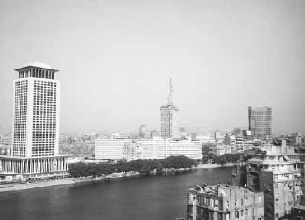
FIGURE 2. Behind these modern buildings overlooking the Nile, including the grand building of the Ministry of Foreign Affairs, the heavily guarded television station (in the middle), and the Ramses Hilton Hotel (in the far back), Bulaq still houses hundreds of thousands of Egyptian families. Photograph by Farha Ghannam.
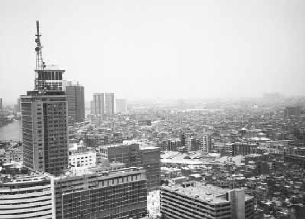
FIGURE 3. A view of Bulaq from the Ramsis Hilton Hotel. Sadat hoped to remove the whole neighborhood, but his death in 1981 put an end to this idea. Photograph by Farha Ghannam.
These ideas were also shared by Egyptian architects and intellectuals (see Hanna 1978; Hamdan 1993). Milad Hanna (1978), a construction engineer and a member of a leftist party at that time, for example, described how the few big buildings in the old quarters that overlooked main streets functioned like “the golden peel that covers the surface,” hiding “the miserable conditions” of the popular areas (65). He described the pain and “terror that hits Egyptian intellectuals when passing with a foreigner through one of these streets where one sees the most amazing things and where housing is turned into a distorted image that makes the hearts of those who still have feelings bleed” (65). He emphasized that the population of Bulaq should be “relocated to the periphery so that the large space that they occupy can be replanned to become the second lung of Cairo's center in the next century” (67).
Similarly, relocation was seen in the state public discourse as “the scientific solution” practiced in many other modern countries (al-Ahram, December 29, 1979: 3). It was viewed as essential to solve the capital's housing crisis as well as to create a “new heart for Cairo” (al-Akhbar, December 27, 1979: 3; al-Akhbar, May 19, 1979: 1).[8] Pictures and numbers
It is important here to note that this project and the state public discourse were based on what Foucault (1984: 8) calls “dividing practices.” They started by separating and stigmatizing the targeted population as an expedient rationalization for policies that aimed to modernize, discipline, normalize, and reintegrate them within the larger community. Not only were the housing conditions attacked by state officials, but the people themselves were stigmatized and criticized.[9] Playing on the popular ambiguity toward Bulaq and its inhabitants (as discussed in chapter 3), the state discourse presented only negative images of the residents who were to be moved. The social scientific study mentioned earlier revealed, as stated by the Minister of Construction and New Communities, that the area of Bulaq had been a shelter for qiradatiyya (street entertainers who perform with a baboon or monkey), female dancers,[10] peddlers, and drug dealers (al-Ahram, December 27, 1979: 3). Thus, the removal of these
Compared to the old conditions, the new settlement, official statements assured, was planned according to the “most modern lifestyle” (al-Ahram, November, 1979: 10). As in other modernist projects (Holston 1989), housing, work, transportation, and recreation were seen as central components of rational planning. In the words of the head of the section that designed and planned the project, the new housing promised to secure “healthy units” and “integrated social life” (al-Sha‘b, September 11, 1979: 12). The promised “modern” lifestyle was characterized by the construction of “good and beautiful houses” that would consist of separate apartments with separate kitchens and bathrooms.[11] The new units would fit the demands of both “the Egyptian family” (assumed to be a nuclear family that would occupy its own separate apartment) and “modern life” (al-Ahram, November 27, 1979: 10). Modern facilities such as piped water, electricity, and sewage were to be installed before people moved into their new housing units. According to the plans, fifteen- to twenty-meter-wide streets were to connect the area with the rest of the capital (10). Officials promised to establish “green areas,” not available in the most “advanced” (arqa) areas in Cairo, that would “secure a healthy environment.” The new location was to include schools, playgrounds, markets, shops, clinics, religious buildings, and, perhaps more importantly, a police station.
All these modern facilities were going to produce more productive social agents who would be integrated into the nation and who would contribute positively to the construction of the mother country. “Thanks to President Sadat's backing of the project, those people will now enjoy a new and decent life” (Egyptian Gazette, December 27, 1979: 1). The move in space promised a leap in time that would bring prosperity, progress, and modernity to people's lives. In short, relocation was perceived as a necessary step to create “modern” subjects.[12] They were to become productive, disciplined, and healthy citizens. Through relocation, Sadat's policies aimed at the construction of the Egyptian identity through “negation” (Stallybrass and White 1986: 89): they aimed at destroying an “image” that did not represent the “modern” Egyptian and at constructing “modern” houses as a basic part of the creation of the “modern” Egyptian identity and the constitution of new productive subjects.
Sadat, the Hero of Construction
[T]he only kind of agency modernism considers in the making of history is the intervention of the prince (the state head) and the genius (architect, planner) with the structural constraints of existing technology.
James Holston, The Modernist City
Sadat, the developer, presented himself as the leader who could bring both material resources (as the Hero of Construction, or Batal al-Bina’) and spiritual resources (as the Believing Leader, or al-Rais al-Mumin) to transform people's lives and create modern realities. In an interview, he said that he had heard of ‘Ishash al-Turguman, the part of Bulaq that was removed first, and its problems before the 1952 revolution. One day, after waiting for more than thirty years, Sadat called the Minister of Construction and told him that he would not allow “the problem of ‘Ishash al-Turguman” to continue and ordered him to secure apartments for the people before removing their housing (Mayo, June 22, 1981: 3). The minister executed the command immediately. Sadat's visions and plans were turned into concrete structures that promised to positively transform people's lives. It is worth noting that Sadat was both present and absent throughout the project. Although state officials emphasized that they were following the guidance and commands of Sadat in planning and carrying out the project, he remained absent in the media until the people were moved to the new area. Only in the last part of the project, when giving the green light to demolish the old houses and when presenting new apartments to the relocated group,[13] did Sadat appear in public, with Egyptian newspapers referring to him as “the Hero of Construction.”[14] On more than one occasion, Sadat described his feelings after touring the project, visiting some apartments, and talking to their residents (Egyptian Gazette, December 30, 1979: 2). In one interview, he said: “I was really glad to see joy on the faces of the new inhabitants. They had left their shacks [‘ishash] and moved to healthy houses in an area that was planned in accordance with modern systems” (Mayo, June 22, 1981: 3).
Neither Sadat nor the government-controlled press referred to the fact that the police were sent to the area to force people to move and to crush any attempt to resist. Instead, daily newspapers described in detail Sadat's visit to the housing projects in al-Zawiya al-Hamra and ‘Ain Shams and how he was received with love. The Egyptian Gazette described how, while visiting a school, Sadat “cheerfully acknowledged the standing ovation
Voices that protested the relocation were quickly silenced, and objections raised by the displaced population were considered “selfish.” Officials emphasized that the benefit of the “entire nation” should prevail over everything else (al-Ahram, July 9, 1979: 9). The project thus was centered on “progress and nationalism,” which were “two central constructions of space and time in the constitution of modernity” (Friedland and Boden 1994: 11). Reports on people's resistance and negative reactions to the project were restricted to a few newspapers with limited circulation, such as the Islamist-oriented al-Sha‘b (in Arabic) and the Egyptian Gazette (in English).[15] A representative of Bulaq in the People's Assembly wrote: “The people in Bulaq live in a boiler [mirjal] … that is capable neither of cooling down nor of exploding” (al-Sha‘b, September 11, 1979: 2). The Egyptian Gazette reported that a group filed a suit against the governor of Cairo to stop his attempts to relocate them and expressed their resentment because he “reached an agreement with an investment company to exploit” their old area and called on the government to help them in reconstructing their neighborhood (Egyptian Gazette, November 4, 1979: 3). The newspaper explained that “the people expressed deep concern over the decision of Cairo's authorities to demolish Eshash al-Turguman slums in order to build modern communities” (3). They complained because the expected price of the land was going to be one thousand
Relocation and the Disciplining of Cairo
Faust has been pretending not only to others but to himself that he could create a new world with clean hands, he is still not ready to accept responsibility for the human su V ering and death that clear the way.
Marshall Berman, All That Is Solid Melts into Air
There was another reason behind Sadat's sudden change of heart and his prompt orders to the Minister of Construction and New Communities to “improve the housing conditions” of Bulaq's inhabitants. President Sadat referred to the area when he was talking about the “communists” who tried to destabilize Egypt during the 1977 riots. These riots, widely known as “the Food Riots” but labeled by Sadat as “the Uprising of Thieves,” protested the increase in the prices of basic daily goods, especially bread. They started as peaceful demonstrations by workers and students in Cairo and Alexandria but soon turned into widespread riots. Rioters attacked and burned buses, stores, nightclubs, and bars. The demonstrators also chanted publicly against Sadat's policies and targeted infitah-related facilities such as five-star hotels and nightclubs (Abdel Razaq 1979).[17] These riots shocked Sadat. Ahmed Baha’ al-Din (1987: 127) reported that Sadat felt betrayed and threatened and strongly resented the demonstrators, who almost reached his house in Giza. Sadat described the language used by the al-ghawgha (mob or rabble) as “obscene.” After these riots, Sadat, according to Baha’ al-Din, hated Cairo and its residents, whom he described as “arzal” (rude or insolent).
Reflecting on these riots, Sadat described how three communists tried to set fire to the paper storage place of two daily newspapers, Al-Akhbar and al-Ahram. When the security forces chased them, they disappeared in ‘Ishash al-Turguman, where it was impossible to reach them, since narrow streets prevented the use of police cars.[18] The relocated group was seen by Sadat as having participated in “a conspiracy organized by communists” that aimed to distort the achievements of infitah. Hence, this area became an obstacle to his policies. It symbolized the sort of community that the bourgeoisie feared in different parts of the world. It represented the community that “the police could not penetrate, which the government could not regulate, where the popular classes, with all their unruly passions and political resentments, held the upper hand” (Harvey, quoted in Scott 1998: 63). So the city center was to be replanned to allow more effective control and policing of Cairo, and the group was divided into two parts, each relocated in a different neighborhood.
It is within this context that the state public discourse and planning policies must be understood. They strategically appealed to hegemonic images of modernity and discourses of social engineering to legitimize relocation and to restructure the local urban scene. Pictures were shown to compare the old dilapidated houses with the new “modern” units constructed in al-Zawiya al-Hamra and ‘Ain Shams. Words such as hadith (modern or new), ‘asri (contemporary or modern), madani (civilized or refined), hadari (civilized), and tatawwur (evolution or development) were widely utilized in the state public discourse. The appeal to modernity was also manifested in the emphasis on progress, scientific solutions, statistical facts, and rational planning, the importance of international investment and the tourist's gaze in representing Cairo, and the separation of the home from the workplace, as well as on the importance of personal and public hygiene, child rearing, family structure, clean environment (through, for example, emphasizing health, hygiene, and green areas), and consumer goods in creating productive agents who would contribute to the construction of a modern national identity. This appeal to modernity was used to offer the people a “Faustian bargain” (see Berman 1988) that forced the relocated group to pay a high price for Egypt's opportunity to be “modernized.” Using force (the police) and seduction (by appealing to images of modernity and offering alternative housing), the project removed them from the center of the city and deprived the group of the benefits associated with modern facilities and new changes that infitah promised would bring prosperity for everyone. The group lost a major part of its economic, social, and symbolic “capital,”
In many ways, Sadat seems to be a “pseudo-Faustian” developer who, like many leaders in the third world, managed to manipulate “images and symbols of progress … but [was] notoriously inept at generating real progress to compensate for the real misery and devastation they bring” (Berman 1988: 77). After fifteen years of relocation, there are no hotels, no restaurants, no high-rise buildings, and no international investments in the area evicted. This area is currently used as a parking lot. A wellknown Egyptian engineer who was working in the public sector and who participated in formulating housing policies during Nasser and Sadat's eras explained to me that “no one in his right mind would take the risk of investing in a small area adjacent to Bulaq, with its bad reputation and miserable conditions.” The original idea, he stated, “was to remove all Bulaq and turn it into a promising area. We wanted to turn the area into a neighborhood for embassies.” Since the project stopped after the removal of only one section of Bulaq, no investors were willing to invest any money in the area. Some argue that the pressure placed by Egyptian intellectuals on the government against its emphasis on foreign investments terminated the project. There are also indications that Bulaq's residents became more vigorous and organized in resisting the attempts to remove other parts of Bulaq (see al-Sha‘b, July 21, 1981: 8).[19]
For many of the relocated population, the empty land signifies the typical failure of the Egyptian bureaucracy to deliver what it promises. Others feel that the government just tried to kick them out of the city center and was never serious about investing in the area. Some think that the land turned out not to be suitable for hotels and big buildings. Many say the project died with Sadat, who was killed a few months after the relocation of the residents of a small part of Bulaq. But did the project really die with Sadat? It is true that the removal of the rest of Bulaq was halted with his death.[20] But the fact that Sadat's policies were translated into physical forms allows us to go beyond this question to examine how a project like this (still common in different parts of Egypt and the rest of the world) has reshaped the urban space and continues to influence the lives of thousands of Egyptian families. Displacement is examined in this book not merely as part of state policies that are motivated by the public good, as the official discourse tries to present them, or that can be subsumed
Discourses, Desires, and Hegemony
I still remember my strong shock, which I managed to hide successfully, when I saw Anwar el-Sadat's picture decorating the living room of the first family I visited in the housing project. The husband pointed to the picture and said, “Do you know how much we pay for this apartment? You will never guess! We only pay three pounds every month. Can you believe that? It was Sadat who moved us to these units that we will own soon.” Except for most ex-owners, who lost their material and symbolic capitals by relocation, most people tend to appreciate Sadat's attempts to improve their housing conditions, and one woman compared his policy with Nasser's redistribution of land that benefited farmers. This was one of the main things that I did not anticipate before starting my fieldwork. Informed by studies of this and other projects (Al-Safty 1983; Hassan 19851991); Perlman 1982), I was sure that people would be resentful of the state and would criticize Sadat and his policies. For instance, Nawal Hassan (1985), who studied a relocation project from the old part of Cairo, argued that although such resettlement projects were designed to create “modern Egyptians,” they have led the displaced communities toward a “slow but certain economic death” and the “destruction of indigenous cultural identity” (61).
While acknowledging the negative aspects of relocation and the social
Therefore, the state public discourse should not be dismissed as mere rhetoric or empty talk. Rather, it is powerful and continues to shape people's identities and their use of space after relocation. As Foucault (1979, 1980a) emphasized, power does not only repress, exclude, and censor. In addition, it “produces effects at the level of desire and also at the level of knowledge” (Foucault 1980b: 59). This is not to say that people embraced everything they heard in the state-controlled media. In fact, they were usually very critical of what they heard, often dismissing it in favor of what they heard from other sources, such as the mosque. They frequently questioned how the country was run, discussed the many problems they faced daily, and linked their problems with the corruption of state officials. These contradictory reactions present another theoretical and methodological issue related to how to conceptualize the relationship between the shifting feelings and views of people in al-Zawiya al-Hamra and the state public discourse. How is it possible for people to both accept and oppose the dominant representations of modernity when these are encoded in physical forms around them? In the coming pages, I aim to account for the desires and effects that the state discourse stimulates without reducing the spatial practices of the “ordinary practitioners of the city” (de Certeau 1988: 93) to a mere reflection or rejection of the state