
SEEING AND PRIVACY
As mentioned in chapter 2, the living room is the main space where family members interact with each other and with visitors. They eat, drink tea, and watch television in this room. Like the maglis in Lebanon (Gilsenan 1982) and the mafraj in Yemen (Gerholm 1977), the saala is on the border of the private and public. During daytime, it is public and open to visitors (both men and women), while at night it is privatized and used as a bedroom for family members. Both men and women tend to secure their privacy in this space by dressing modestly. In addition, when the doors of opposite apartments face each other, families who can afford it have added a new half-wall that separates the living room from the kitchen and creates a space called turqa (corridor or hallway). Without this wall, the saala is exposed to the eyes of the neighbors when the door is open (see Figure 8). The new turqa makes it possible for the person who
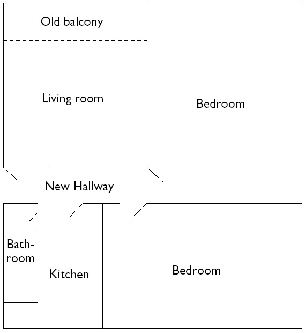
FIGURE 8: Families who can afford it add a new half-wall that separates the living room from the kitchen and creates a space called turqa (corridor). This wall blocks one's view of the living room from the apartment doorway or from other rooms in the apartment and provides visual protection for family members, especially when they sit on the floor to eat.
Central to the regulation of the relationship between the self and others is the control of what, when, and how the self is to be seen by others. Here it is important to point out that regulating acts of seeing does not mean a total shielding from the eyes of others, as argued in relation to “the Islamic city” (see Abu-Lughod 1987). Rather, it is the attempt to control who sees whom and under which conditions. Thus, while young women are encouraged, and in many cases required, to wear the scarf to have access to the workplace and other public spaces, they are allowed to dress in fancy clothes, wear full makeup, fix their hair, and dance in front
At the same time, sharing a bed with a sister, a mother, or a female visitor is accepted. Daughters may prefer to sleep in the same bed with their mothers in winter to keep warm or simply because they feel lonely when sleeping in separate beds. But, the apartment, which may be the most private space, becomes more “public” for women at night. Female members wear pants under their long dresses (galaliib) because the rooms where they sleep are accessible to their male relatives, and mothers describe how the presence of children prevents them from wearing revealing nightgowns or using makeup. The body becomes the most intimate space that should be protected from the gaze of others. Similarly, sexual relationships change to a large extent after the birth of the first baby. Since children are not required to ask for permission before entering their parents’ room (when the parents have their own separate room), intimate relationships between couples are exclusively limited to nighttime and only after the children are completely asleep. Many women reported that they have not seen their husbands’ naked bodies for fifteen to twenty years. The body in this context becomes the most intimate space that should be protected and regulated. This protection is central to the meaning of privacy in al-Zawiya.
Rather than a separation between two domains, this notion of privacy rests on regulating encounters between the family and outsiders as well as among its members. This regulation is crucial to the negotiation of changes that people introduce to their units and that threaten to violate the privacy of others. This can be elaborated through revisiting the changes that people introduced to the main balcony, briefly examined in chapter 2. Over the last fifteen years, this balcony, which overlooks the public land in the middle of the square (murabba‘), has been changed in various ways that enable family members to see what happens in the center of the murabba‘. Because these balconies open on the middle of the murabba‘, they are not seen as violating the privacy of other families. No negotiations are required between neighbors to implement such changes. The situation is different when one family opens a new window that may expose the bedroom or the kitchen of another family. In this case, negotiations are needed, and families who are threatened by the gaze of the neighbors can prevent such changes. “Our neighbors allowed us to open
Privacy is a relational concept that is context bounded rather than a rigid dichotomy between two separate domains. Privacy here indicates all the actions that should be protected from the gaze of others (whether family members, neighbors, or officials). This makes it important to examine the role of social actors in negotiating and redefining the meaning of privacy. For example, domestic violence is considered “public” in that people are expected to step in to stop a fight between family members. Neighbors who fail to do so are blamed. Tension may escalate and relationships may be temporarily severed because one family did not interfere to mediate a conflict in the next-door apartment. This was painfully expressed in a story told by a female informant. One man used to beat his wife, but as soon as she started screaming, the neighbors rushed to help her. To avoid this interference, the man shifted to removing all his clothes before beating his wife. In this way, the man “privatized” an action that is considered public and managed to prevent others from helping the wife. Using his naked body, which should not be seen by others, the man managed to discourage others from helping his wife.