
The dance.
—The climax of each ceremonial period is the prayer drama, a reverential, solemn, ecstatic final dance. It comes at the end of the rigors of retreat and abstinence and concludes the myths and legends the unfolding of which constitutes each ceremonial observance. Originated to give joy and pleasure to the supernaturals, it has been continued as an entertainment for them and as a means of instruction, diversion, and worship for every man, woman, and child in the community. An eminent ethnologist has pointed out that here is "the best round of theatrical entertainment enjoyed by any people in the world, for nearly every ceremony has its diverting side, for religion and drama are here united as in primitive times."[43]
Even the simplest dance has a variety of patterns, and the artistic costuming and stylized action keep the spectators enthralled. A performance may pantomime the story of a certain culture hero, or a legendary figure, or it may exhibit a pageant of numerous and varied characters. The mimetic Animal and Bird dances revert to a belief in an animate world where, in the long ago, man and beast lived together and understood each other. In order to pantomime the hunt, that time must be reinfused with life as when animals gave their lives willingly to aid their human brothers. At the more elaborate dances the clowns are always present. Each village has two groups of very powerful priests who masquerade as grotesque characters symbolic of their mythical origins. The clown-priest phase is universal among all the pueblos, but the grotesquetie varies.
The Mudhead is a well-known Hopi-Zuñi clown with a baglike mask (pl. 40). This mask and the body of the clown are painted earth color with clay from the Sacred Lake. The "Chiffoneti"[*] of the Rio Grande region are unmasked (pl. 39), and their bodies are painted in black and white stripes to represent the spirits of the dead. Although these clowns are the most powerful priests and intermediaries to the gods, they act the buffoon and perform impromptu interludes between the dances. They make sport of individual and group, caricaturing individual eccentricities or satirizing group foibles, and when a direct hit is scored the glee of the nonvictims breaks forth in raucous laughter. They are the censors, the mediators, and the judges for the social life of the village. Sometimes they play games or mimic the performance just ended.
These clowns are always present at kachina dances. Herbert Spinden repeats in part the dialogue with which they drew the Cloud People to a certain ceremony:
"At the appointed time all the villagers go to the underground lodge and seat themselves in readiness for the performance. Soon two clowns appear at the hatchway in the roof and come down the ladder. They
* A present-day Mexican term, commonly used.
make merry with the spectators. Then one says to the other: "My brother, from what lake shall we get our masked dancers tonight?' 'Oh, I don't know. Let's try Dawn Canyon Lake. Maybe some Cloud People are stopping there; Then one clown takes some ashes from the fireplace and blows it out in front of him. 'Look, brother; he says, 'do you see any Cloud People?' They peer across the ash cloud and one says, 'Yes, here they come now. They are walking on the cloud. Now they stop at Cottonwood Leaf Lake'. Then the other clown blows ashes and the questions are repeated. Thus the Cloud People are drawn nearer and nearer until they enter the village. The clowns become more and more excited and finally cry, 'Here they are now!' and the masked dancers stamp on the roof and throw game, fruit and cakes down the hatchway."[44]
Since the Pueblo Indians are fundamentally a peace-loving people, the so-called "war dances" were usually borrowed, sometimes actually purchased, from other tribes which were often their deadliest enemies. These dances then were known by that tribe's name, that is, Navaho, Pawnee, or Apache. The ceremony of the dance is learned in its entirety, even to the chant in a foreign language, and the dress is copied or simulated. Thus the dance can be used as counter-magic against those who originated it, although it is sometimes used merely as picturesque entertainment.
As we have noted, the dance is the event of principal importance in all these ceremonial performances. It is not a dance such as we are familiar with, but a stately movement to a solemn chant—a symbolic and pictorial rhythm which is an outgrowth of prayer just as were the medieval dramas when the Biblical stories were unfolded in action before the high altar. The result is prayer and entertainment, church and theater. Those who perform believe they are benefiting the entire community, even the outside world. Those who watch have also lent their support. During the days of retreat and ceremony the preparation of food for the performers falls upon the women members. Often one society will provide the dance which accompanies the prayers of another society performing the kiva
rites. Each person in the village gives offerings and blessings. For the final performance the people stand silently in solid blocks, looking down from the terraced housetops, or they sit motionless upon the plaza ledges. Between dances there is quiet conversation, gossip, or the subdued hailing of visitors from a far-off pueblo. These are community affairs and everyone must take part at some time during the year. The Zuñi kiva societies are required to present at least three group dances from one winter solstice to the next.[45] Thus those who do not perform are always interested and sympathetic spectators.
At the dances performed in the individual society rooms the audience is composed mainly of the women and children group members, as the men are usually participating. Seated along the sides of the room or at the raised end, they remain quietly attentive, without a change in expression, watching for hours the movement of the dance. Several groups may combine for a presentation in which each performs its own act or dance. These separate numbers are repeated simultaneously in each of the participating kivas.
The dance patterns are very simple. The most common is a long line which moves as a single unit. There may be one row of men working in perfect unison, one foot of each man raised to the same height at the same moment; or there may be two rows facing each other, with steps varied to suit the type of impersonation. Dancers depicting male characters dance more forcefully than those depicting female characters. In the Rain Dance the line of fifty or sixty dancers is squared around three sides of the plaza, but there is no circular action. The dancers themselves turn, and pause, and turn again, the sweep of movement running through the line like a breath of wind through stalks of ripening grain.
A circular pattern is followed in the women's society dances and in
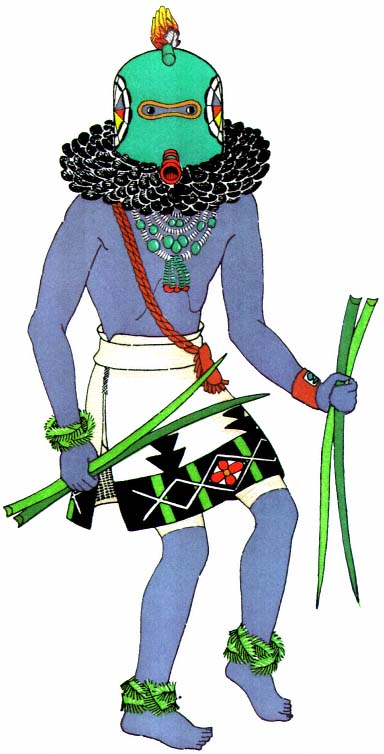
Plate 6.
Zuñi blue Salimapiya of the West, whose body stain is
the fluid from cornhusks. A special kilt bas a wide border
of embroidery. Prophetic yucca leaves are carried.
those performed for curing and for war. The movement is continuous in one direction, with the participants facing the center.
A more elaborate pattern is made up of several movements. In the Rio Grande pueblos, "the public dances in the plaza are more or less processional but the advance is very slow. There are definite spots of stationary dancing and here countermarching is used to make a new quadrille-like formation."[46] Two men are followed by two women, each pair dancing as a single unit. There are no complicated figures or interweaving of dancers.
The dance steps look extremely simple. The usual one consists of a vigorous stamping with the right foot while the heel of the left foot is only slightly raised. In more lively dances both feet leave the ground alternately and give the appearance of sustaining the body in air. About these steps there is a feeling of eternity, as if, since time began, generations, nay, races of dancers had beaten with their feet the surface of the earth to obtain from it strength and power. Women often dance barefoot in order to receive fecundity from the mother of mothers. There are few arm gestures and little posturing. Each dancer has splendid body control. It is enthralling to see the vigorous movement continue without a break for fifteen or twenty minutes at regular intervals throughout the day.
Certain of the Bird dances require great strength and skill for the wheeling and circling movements which give the illusion of winged flight. The footwork is sure and delicate and the precision of each performance is remarkable. These dances as a whole are full of color and imaginative stylization based upon a hypnotic rhythm. The peculiar pulsation is almost impossible to imitate for anyone not born to the sound. The rhythm is regular, but there are skip beats and pauses which occur simultaneously in drumbeat, song, and dance.
Usually, percussion instruments provide the accompaniment for the dance. Drums vary from hollowed logs and pottery jars with skin heads to flat tom-toms. They are beaten with sticks made with a hooped end or wrapped with cotton. Rattles of gourd, turtle shell, and rawhide bags
filled with pebbles or seeds are carried by most of the dancers.[47] Notched sticks may be rasped against each other on a sounding board of wood or gourd. Occasionally, bird-bone whistles are heard—shrill notes above the steady drone of drumbeat and human voice.
All dances are also accompanied by songs or chants sung by a chorus or by the dancers themselves. Some of the songs are so old that the lan-
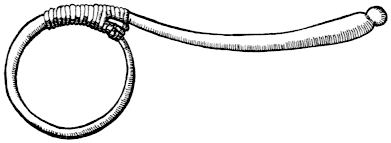
Figure 4.
Hopi drumstick, bent into shape when green and
bound with deerskin thong, forming a looped end.
guage is obsolete and even the singers do not know the meanings of the sounds. On the other hand, some of the old dances have new songs composed for them for each performance.[48]
The masked dances, even those in which female characters appear, are performed exclusively by men. Women take part in most of the other dances. The Corn Dance has an equal number of men and women. The Hunt Pantomimes have one or two maidens who personify the animal mothers. The women's societies perform dances in which only women and girls take part.
The dance leader always takes his position in the center of the line. The priest of the group appears at the head of the line. He does not dance, but stands chanting or praying as he displays a feather badge of office or a banner of ceremonial significance. Whenever a chorus is required, it is grouped around him.