
Three
The Elderly in the Bosom of the Family: La Famille Souche and Hardship Reincorporation
E. A. Hammel
Perhaps the most outstanding demographic characteristic of the human species, one that may have appeared as long ago as one hundred millennia or more, is the extraordinary prolongation of life beyond the age of reproduction. There is no immediately discernible reason why animals should continue to exist beyond their reproductive span, why the forces of natural selection would favor the emergence of such survival and thus of a species that was characterized by it. Salmon, after all, are the ultimate in age-structural efficiency; the support of the elderly is no burden to their spawn.
In the absence of immediate postreproductive death, as in the example of the salmon's nuptial couch, it is not always easy to tell whether males die soon after they cease mating. It is easier to know that for females. With rare exceptions in captivity, there are apparently few examples of living, post-menopausal female primates outside the human species. Primate females, other than humans, reproduce until they die, and these deaths are apparently "natural," not only attributable to predation. Indeed, because the chimpanzee infant is breast-fed for about three years and dependent on its mother for another two or three, the last-born child of a chimpanzee almost always dies, predeceased by its mother in the first few years of its life. Not so with human females, who may nurture not only their children but their grandchildren and even their great-grandchildren for the half or more of their adult life that now falls beyond menopause. And so also with their mates, whose longevity is only modestly less but the termination of whose reproductive activity has often been as much a matter of inquiry for their spouses as for analysts such as ourselves. The prolongation of life is not simply a function of modern health care systems; it is found as well among hunter-gatherers such as the !Kung, where the expectation of life at the age of menopause is about another quarter century.
To what may we attribute this extraordinary change in primate, mammalian, and animal demography? To the existence and selective importance of culture, of course. The experience and skills of a lifetime, the knowledge of heath and meadow, the wisdom that adjudicates dispute, that forges alliances with neighbors, are not to be discarded with the cessation of genetic transmission. The elderly, defined in a Darwinian sense as those over about 50, are the first transgenetic resource bank in the animal world—a place where surplus knowledge is stored.
As with any bank, the resources of this one have to be discounted. In those ancient times when the growth of new knowledge was modest, the rate of cultural inflation was low, perhaps something like the rate of population growth. [1] The stock of knowledge was much the same for cohorts of elderly separated by many years of historical time. Even if their own learning rates were less than those of the contemporary young, there was not so much new to learn, and the knowledge of the elderly was not subject to much discounting. As the rate of knowledge production grew, the value of the knowledge of the elderly, even in the presence of their continued learning, would have to have been more heavily discounted. It would have been all they could do to keep up with those whippersnappers.
Thus, if we think of this knowledge economy and its value to the species, we may conclude that in the old days no one knew very much, but the elderly knew most of that, while in modern times, many people know much more, but the elderly know much less of it, even net of the specialization of labor and expert knowledge that diminish the relative stock of any participant, regardless of age. We can only conclude from this examination that the elderly are worth less to society than they used to be.
But we should inquire into the support structure that has enabled the elderly to contribute to the development of the species. In the old days, when they knew almost everything that anyone else did, they were supported in families and households. One does not have to travel back into the Paleolithic with Dr. Wonmug and Alley Oop to find those conditions; they are encountered in much of the less-developed world today and perhaps everywhere just a few centuries ago. The knowledge that they had, again net of specialization of labor (for what farmer was a goldsmith even in his youth?), was knowledge useful to the same group that nurtured them. Thus the elderly may never have been of much use to society at large (except in some derivative Darwinian sense by the aggregation of small familial advantages) but only to the familial and household group in which they resided. Now, even today, the elderly continue to be of value in those same contexts. [2]
So, from this reexamination, we may conclude that although it might seem that the elderly were once worth more than they are now, their value in the context of their support groups may not have changed so much,
after all. It leads us to ask, in a more theoretically informed way, in what kinds of groups have the elderly been nurtured, and how much difference does it make?
Some Systems of Household Formation
In the history of Europe and its derivative societies, from which comes most of our information on the history of the family and household, there have been a few primary contexts. The first of these is the so-called nuclear family, or at least its residue, in which two elderly spouses care for each other. The second is the solitary household, in which one elderly person is left to care for herself usually, less often himself. Third is the complex household, sometimes called multiple lineal, in which an elderly couple resides with one or more married children. The so-called stem family household, or famille souche of LePlay's notice, is a variety of these. Fourth is the arrangement in which a surviving parent lives with a married child. This last arrangement can occur when one senior surviving spouse in a multiple lineal household dies. It can also occur if on the death of one senior spouse in a nuclear household, the survivor is reincorporated into the household of a married child. In the terminology pioneered so long ago by Peter Laslett, the contrast can be seen as one between systems of the stem family household and those of reincorporation under nuclear hardship.
In this chapter, I examine the mutual effects between two plausible systems of accommodation of the elderly and different levels of mortality between two contrasting and plausible historical demographic regimes. I also examine whether we would be able to distinguish systems of family formation or regimes of demographic rates with the sample sizes ordinarily available in historical censuses.
Microsimulation Modeling
The examination is carried out by computer microsimulation. This technique is useful in the exploration of theoretical relationships, especially when the relationships between components of a model of behavior are very complex, or when one's interest is in the variability of behavior. It is particularly useful in speculating about processes that occur in small samples, such as those typically encountered by historians, in which random error is an important source of differences. Computer microsimulation is extremely helpful in assessing the effects of random sampling error.
Now, microsimulation is a fairly complicated and technical business, the kind of endeavor that many scholars with an interest in family structure and the broad issues raised in my introductory remarks might find uncongenial. I apologize for the technicalities that follow, and I keep them to a minimum
in the text itself, relegating what I can to the notes and to appendixes that can be obtained on request. They are necessary to keep the game honest. It is all too easy to wave one's hand with an abracadabra and a whiff of technology to amaze the uninitiated. The technicalities are here so that the initiated can have a legitimate target for criticism.
Briefly, in this microsimulation model, a population of appropriate age and sex structure is entered into a computer and subjected to some set of demographic rates and rules of household formation. The notional individuals in this population have children, marry, divorce, die, and form and dissolve households. The demographic events occur to individuals by chance, governed by the general set of demographic rates. In the long run, populations so subjected to random occurrence of the same rates will exhibit on average the values of those rates, and differences between them will be a function of sample size and random statistical error. This is not a trivial matter, for one of the lessons most frequently learned from such exercises is that at the sample sizes typically encountered in real historical data, it is actually quite difficult to separate true differences from purely random statistical variation.
The behavior of the notional population is rather different with respect to rules of household formation. Whereas in the simulation of demographic events, occurrences are executed by chance under a set of governing rates, the simulation of household formation is here inflexible . For example, if birthrates are such that on average women between the ages of 20 and 25 could expect to have one child, the simulation does not insist that every woman have exactly one child during that age span, no more, no less. Some women have none, some one, some two, and so on, but on average they have one. Conversely, if our household formation rule is that the youngest son should remain in the parental home on marriage, every son who marries and is not the youngest moves out, and every son who is the youngest and marries stays home. Using such a fixed and rigid rule, we have a terra firma for our questions and can ask what are the effects of changes in fertility and the joint survivorship of parents and children on the attainment of stem family household organization. Of course, in reality, even in a society in which stem families were ideal, not every marriage would follow the kind of rule I have described. Some younger sons would leave to seek their fortunes, some older sons would be better farmers than their younger brothers, and so on. We might like to have a flexible set of decision rules with various contingencies pertaining to the characteristics of the household and its members. Or, we might like to have a statistical distribution of decision rules, so that different principles could compete with one another for the formation of households, in just the same way that alternative demographic events like marriage and death compete for execution in the demographic part of the simulation. [3]
Why do we not treat household formation in the same, sophisticated way that we treat demographic events? Let it be clear that we have nothing against it in principle. The reason is that we have no good knowledge of the statistical distribution of decisions that lead to household formation, other than the events of birth, marriage, and death that are produced by the demographic part of the experiment. We may have historical knowledge of the statistical distribution of household types in a population, but we cannot simply use those distributions to invent decision rules. It would be an empty exercise to use results as causes. Until we acquire the detailed historical or ethnographic knowledge about the actual decision processes and contingencies in specific historical populations, we must rest with this more rigid approach. At least it provides us with a firm background against which to examine the effects of demographic variation.
When the computer has done its work of simulating demographic events and household formation, censuses are taken of the population and the households at appropriate times to learn the outcomes. This kind of electronic experimentation is carried out under the contrasting conditions of interest and for each of these, a sufficient number of times to assess the importance of sampling error. [4]
It is important to realize that such experiments are not intended to recreate a specific past. Even if one used a known historical population as the one subjected to a set of demographic rates and household formation rules, and even if one used the rates and rules appropriate to that population, the very first event to occur to the notional population would with virtual certainty not be the same as that which occurred to the historical population. Any individual population is unique. The knowledge we seek is knowledge of kinds of populations. What we seek is knowledge of the expectable range of outcomes for classes of populations under classes of demographic rates and classes of household formation rules, within which individual historical populations may be deemed to fall.
In this exercise we contrast two different demographic regimes, one putatively almost modern and another putatively ancient. For each of these we contrast two systems of household formation, both of them designed in principle to offer co-residence and aid to the elderly. The first demographic regime used here is that of the United States in 1900, as a fairly typical western European system at the beginning of the industrial revolution. It is here called "Late Premodern," abbreviated LPM. [5] The second is a medieval regime gleaned from historical evidence. It is here called "Medieval," abbreviated MED. [6]
The first system of accommodation of the elderly is a form of the classical stem family. In it the youngest male child of a household to marry remains at home. It is here called "stem," abbreviated S. The second system is one in which all children leave the household on marriage but in which a
widowed parent, on the attainment of some specified age, rejoins the household of the youngest surviving married son. This system is here called "reincorporation," abbreviated R.
The rules of household formation require some explanation and justification. To achieve comparability between the stem and reincorporation scenarios in all but their critical differences, the kind of child whose marriage creates the stem family and the kind of child who takes the lead in reincor-porating an aged parent should be the same. It would not do to have stem families formed on the basis of a son's marriage and reincorporations take place in a daughter's household, because the mortality expectations of sons and daughters are different and could not be separated from other effects. Similarly, it would not do to have stem families formed on the basis of the marriage of an oldest child and reincorporation take place in the household of a youngest child, because mortality chances vary by age. Differences between household formation rules and demographic regimes could not then be clearly attributed; the effects of demography and of household formation rules would be confounded. In this experiment we want to keep them as separate as we can.
The decisions taken were predicated largely on the intuitive ethnographic expectation that in premodern northern European societies aged parents were more likely to be reincorporated into the household of a youngest child than that of an older child. All manner of plausible reasons for this can be imagined. Sentimental ties are usually stronger between parents and younger children. Younger children have accumulated fewer conflicting social obligations than older ones. And so on. Now this expectation is in conflict with that of primogeniture, which of course obtained in some parts of Europe and under which the eldest child (usually the son) would remain on marriage to form the next generation of the stem family. Nevertheless, the decision was to standardize on the youngest children and thus on ultimogeniture.
One must also decide whether these youngest children are sons or daughters. The choice is difficult. Because stem family formation was intimately connected with inheritance of real property, parents most frequently co-resided with sons. However, there are good reasons to anticipate that elderly parents, especially mothers, might be more likely to be reincorporated in the households of their daughters than of their sons, to avoid conflicts between mothers and daughters-in-law. The choice was to opt for sons; the youngest son, in principle, remains in the parental home, and reincorporated parents in principle join the youngest son.
The rules for stem family formation are thus as follows. Sons are preferred over daughters, but if there are no sons, the youngest daughter remains. The effect of having the youngest rather than the oldest child co-reside is to elevate the proportion nuclear, as early-marrying and on the
whole older children are ejected one by one, and to shorten the existence of the ultimately formed stem family households since, although younger children are less likely to predecease their parents, parents are older when their youngest child marries than when their older children do and thus more likely to die. [7]
The rules for reincorporation of widowed parents have to take into account the possibility of competition between the parents of husbands and wives and are as follows. A widowed parent seeks his or her youngest surviving ever-married child, preferring sons over daughters. If a widowed parent (A) finds an available child and has no other qualifying children but a parent (B) already resides in that household with the child, then if B has other ever-married children with whom he or she might live, B leaves to co-reside with that other child. A does not displace B if B has no other place to go. Surviving parents bereft of already co-residing children or children-in-law will seek another place to live even if they have co-residing grandchildren. If the bereft parent does not find a qualifying child but remains in the household with grandchildren, that household is then classified as a special household, namely, one without any nucleus (see below). [8]
It is also necessary to decide whether the reincorporation of widowed parents takes place immediately on widowhood or whether the parents remain independent for a time. For example, it seems strange to imagine the reincorporation of a 45-year-old widow, who might more realistically remain independent. Thus I subdivide the reincorporation scenario into two, one of early and one of late reincorporation. For simplicity, I use two critical ages at which reincorporation takes place. The first is simply the age at widowhood, whenever it occurs, which for notational convenience I here call age 0. The second is age 65, which I select somewhat arbitrarily. Any other reasonable age could have been chosen, but 65 provides a useful comparison point. The reader will later note that for purposes of symmetry, the same distinction is made in explication of stem family formation but that it has no effect under that scenario whatever.
Experimental Results—Means
The average results of the simulations are presented graphically. The graphs incorporate a great deal of information in highly condensed form, so that I must spend some time decoding them.
First I distinguish between the two ages of reincorporation (widowhood and 65, abbreviated 0 and 65, respectively). Then I distinguish within each of these the two demographic regimes, Late Premodern (LPM) and Medieval (MED). Within these I distinguish the rules of household formation, stem formation as S and reincorporation as R. There are three kinds of binary distinctions being made (age at reincorporation, demographic regime,
household formation), with the result that there are 23 , that is, eight different categories of information. Thus there emerge results for each rule of household formation under LPM and MED and under both critical age constraints (0 and 65). In the graphs these are labeled LPM(0), LPM(65), MED(0), and MED(65) for Late Premodern with no age constraint, Late Premodern with critical age 65, Medieval with no age constraint, and Medieval with critical age 65. Each of these four sets occurs under the reincorporation and the stem family formation regimes. Of course, as already noted, the distinction between the two critical ages of reincorporation has no bearing on the formation of stem family households. It was simply more convenient in the computing work to set up the design in a completely cross-classified way, but the design gives us the additional advantage of actually doubling the sample size for the stem family scenario and allows us to see the results of purely chance variation between the inconsequentially different subsets of stem family formation, for any demographic regime, that are normally distinguished by the critical ages of 0 and 65.
The results are first presented graphically in the form of proportional distributions of households by type, out of all households in the population (fig. 3.1). Since some complex types of household occur only rarely under these systems of household formation and are of lesser theoretical interest when the focus is on the elderly, for example, fraternal joint households, I concentrate here on only four types. These are nuclear (NUC), solitary (SOLE), multiple lineal (MLN), and extended lineal (XLN). [9] The data of figure 3.1 are found in table 3.1. [10]
Let me explicate the graph. Along the horizontal axis are first distinguished four situations in which elderly parents are absent. These are nuclear families and solitaries (NUC and SOLE), each of two varieties. Then there are distinguished four situations in which elderly parents are present. These are multiple lineal and extended lineal (MLN and XLN), each of two varieties. Within each set of four (as just given) and for each household type (NUC, SOLE, MLN, XLN), there are distinguished the two basic regimes of household formation that lead to the constellations indicated. These regimes are stem (S) and reincorporation (R). Thus we see along the horizontal axis nuclear households occurring in stem family systems [NUC(S)], nuclear households occurring in reincorporation systems [NUC(R)], and so on, to extended lineal households occurring in stem family systems [XLN(S)] and in reincorporation systems [XLN(R)].
The reader will note that each of these eight combinations of household type of interest and household formation regime of origin has space for four columns in the bar graph directly above it. Thus, for example, NUC(S) has four bars above it. Each of these bars represents a different combination of demographic regime and critical age of reincorporation. Thus, as the legend shows, we have LPM(0) for Late Premodern with critical age 0 (widow-
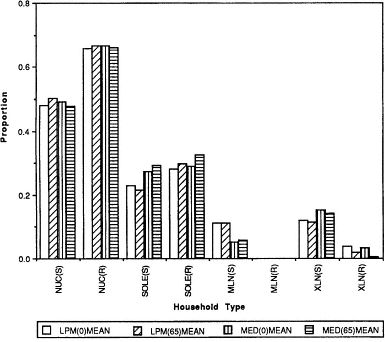
Fig. 3.1.
Household proportions for all households—in the four time periods.
hood), LPM(65) for Late Premodern with critical age 65, and so on. These bars are differently patterned. LPM(0) is clear. LPM(65) is striped diagonally. MED(0) is striped vertically. MED(65) is striped horizontally. These structures and conventions enable us to compare conditions very conveniently. The reader can compare the heights of bars within one of the eight categories on the horizontal axis, for example, comparing the effects of demographic regimes within NUC(S), to see the effect of such different regimes on the formation of nuclear families in a stem family system, or across the eight categories, for example, to see whether NUC(S) or NUC(R) is more prevalent under Late Premodern conditions.
For each of the bars in the graph, the vertical axis indicates the proportion that that kind of household, under those conditions, makes up of the totality of households under those conditions. Let us first contrast the achievement of parent-child co-residence (MLN and XLN) with its absence (NUC and SOLE) across the two regimes of stem formation and reincorporation. We see that the proportion of households that are nuclear is consistently higher across all demographic regimes under a scenario of hardship reincorporation than under one of stem family formation. That is, each of the NUC(R) bars is higher than the corresponding NUC(S) bar with the same
TABLE 3.1 | ||||||||
All Households | Households of the Elderly | |||||||
Type | LPM(0) | LPM(65) | MED(0) | MED(65) | LPM(0) | LPM(65) | MED(0) | MED(65) |
NUC(S) | 0.482 | 0.503 | 0.490 | 0.477 | 0.205 | 0.230 | 0.118 | 0.150 |
NUC(R) | 0.658 | 0.667 | 0.665 | 0.661 | 0.349 | 0.367 | 0.113 | 0.107 |
SOLE(S) | 0.229 | 0.216 | 0.274 | 0.293 | 0.288 | 0.281 | 0.343 | 0.335 |
SOLE(R) | 0.282 | 0.297 | 0.289 | 0.324 | 0.496 | 0.535 | 0.695 | 0.825 |
MLN(S) | 0.113 | 0.112 | 0.053 | 0.058 | 0.183 | 0.168 | 0.083 | 0.093 |
MLN(R) | 0.000 | 0.000 | 0.000 | 0.000 | 0.000 | 0.000 | 0.000 | 0.000 |
XLN(S) | 0.121 | 0.116 | 0.153 | 0.141 | 0.277 | 0.272 | 0.402 | 0.356 |
XLN(R) | 0.039 | 0.019 | 0.031 | 0.006 | 0.123 | 0.079 | 0.165 | 0.068 |
hatching. The same pattern holds for solitary households; each of the SOLE(R) bars is higher than its corresponding SOLE(S) bar. Conversely, the proportion of households that are multiple lineal (MLN) or extended lineal (XLN) is consistently less under reincorporation than under the stem family scenario. MLN(R) is by definition of zero occurrence, since reincorporation affects only widowed parents, and thus there can be no multiple lineal households under a reincorporation scenario. However, extended lineal households can occur under either stem or reincorporation scenarios, and all the XLN(R) bars are lower than all the XLN(S) bars.
These results show that the reincorporation scenario, which is in principle an explicit effort to include elderly parents in the households of their children, is less successful in achieving that accommodation than simple stem family formation. Why should a household formation system (R), striving to maximize the co-residence of parents and children by the explicit reincorporation of isolated parents, yield a lower proportion of such co-residence in a census? The answer is, on reflection, simple. Under a system of stem family formation, the number of person years a parent will spend in the household of a married child is greater than under a system of reincorporation , for the parent does not separate from the child and then rejoin. Thus a census is more like to capture a parent while living with a child rather than in a nuclear family after the child has left but before the parent has rejoined the child.[11] As has so often been pointed out in sensitive studies of family formation, a census is but a time slice through a process and may not reveal it.[12]
Similarly, under stem family formation rules, a widowed parent would remain with his or her child-in-law if the co-resident married child died. Under reincorporation rules, the widowed parent would rejoin a surviving married child, but not the widowed spouse of that child, if the child had been widowed before the parent.[13] Thus, under reincorporation rules, the formation of extended lineal households is depressed by those situations in which married children predecease their widowed parent.[14]
I submit that these relationships of timing and their results are perfectly obvious after they have been detected but that they were not obvious before they were exposed by these experiments.
Smaller differences are induced by changes in demographic regime (i.e., LPM vs. MED), for any system of household formation. This can be seen by comparing the heights of the bars within each block of four. Demographic regime makes almost no difference in the proportion nuclear. Under stem family rules, the Medieval demographic rates yield relatively lower proportions of stem households and higher proportions of sole and extended lineal households than the Late Premodern rates. With their higher mortality, they break up stem family households, making some people solitaries and others extensions in the households of their children. Under the reincor-
potation scenario, the effect of reducing the critical age of reincorporation from 65 to the actual age of widowhood gives the increase in extended lineal households that we would expect; the 0 bar is always higher than the corresponding 65 bar.
Now we shift the point of view. Up until now, the examination of the prevalence of different household types has been that of proportional representation among all households. Such data address questions like, What proportion of all the households in a census, under a particular demographic and household formation regime, are of Type X? But our focus can shift to inquire not holy all persons in the population live but rather holy the elderly live.
Figure 3.2 changes the view to that of the households of the elderly, that is, those households containing persons over age 65. Under LPM demographic conditions, the proportion of the elderly living in nuclear households is higher under the reincorporation than under the stem scenario. The result is just as it was for all households taken together (compare fig. 3.1), again because under the reincorporation scenario parents and children are separated for that period of their joint lives after the marriage of
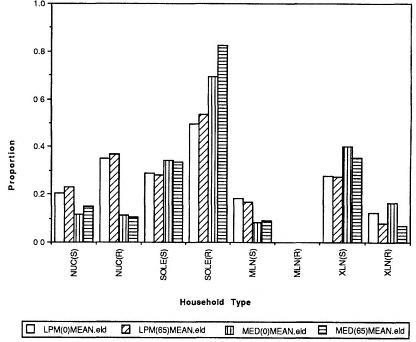
Fig 3.2.
Household proportions for households of the elderly only-in the
four time periods.
the child but before the widowhood of one of the parents. However, the relationship changes under MED demographic conditions, where the proportion nuclear is noticeably lower either under the S or the R regime, and nuclear structure is somewhat more likely under stem family formation rules than under reincorporation rules. Both of these features are a reversal of the pattern for all households taken together (fig. 3.1). The reason is that the higher mortality rates under MED conditions break up elderly conjugal units, lowering their level of occurrence, both in general and also during the period of parent-child separation under the reincorporation scenario. The proportion solitary is also higher under the reincorporation scenario, for the same reasons. Some widowed persons over 65 remain solitary because they have no surviving children. This circumstance is more likely under reincorporation rules because there is a chance for married children to die during the period of separation. The effects are stronger under MED demographic conditions because of the higher mortality levels. The proportion in extended households is higher under the stem than under the reincorporation scenario, again for the same reasons; co-residence is not interrupted other than by death under the stem scenario. Comparing across demographic regimes, we see that the proportion of the elderly living in stem families is lower under Medieval conditions for the same reasons of mortality, and generally the proportion in extended lineal households is higher, because one of the spouses will be more likely to have died.
These data show us that the point of view of the classification is important for interpretation. Asking in what kinds of households people live under various combinations of demographic and household regimes is different from asking in what kinds of households the elderly live. Although some patterns persist despite a change in classification, others change markedly.[15]
Experimental Results—Variability
The estimates of household proportions achieved through these microsimulation experiments can be regarded as statistically stable because the sample sizes were so large.[16] What happens to our view of patterns and differences if sample sizes are realistically smaller? To answer this question, the large samples were used as a sampling frame, and the statistical technique of bootstrapping was employed; that is, small samples were drawn repeatedly and randomly from the large sample. In this way, without going to the trouble of running the simulations again at small sample sizes, one arrives at a good estimate of what the results would have been like if the simulations had actually been done again. Drawing samples of 100 households each 100 times with replacement produced bootstrap estimates of the means and standard errors of the means for samples of 100 households. The bootstrap means are of course almost identical to the simulation ("observed") means,
and the more bootstrap trials we did (say, 1,000), the closer they would be. It is the sampling errors that are of greatest interest and based on them, the confidence intervals. We should be cautious about how we interpret a confidence interval. A confidence interval of, let us say, 95 percent does not mean that we are 95 percent confident of the result. It simply specifies a range about the sample mean within which we would expect 95 percent of a large number of sample means to fall, if we sampled repeatedly and randomly from the same population. The idea is that if the mean of one sample falls within the confidence bounds of another sample, the two samples would in 95 percent of such instances actually be from the same population and are thus not truly distinguishable. This just tells us that sometimes what looks like a difference is not a difference.
Figures 3.3 and 3.4 show, for sample sizes of 100, the range from which sample proportions of household types, under the various demographic rates and formation scenarios, could be expected to come 95 percent of the time by chance alone. Figure 3.3 is for nuclear and solitary households, and figure 3.4 is for the multiple and extended households. They are divided in this way to keep the graphs from being cluttered. The categories along the horizontal axis are different from those employed in figures 3.1 and 3.2. Because figures 3.3 and 3.4 are more complex and must show ranges of data,
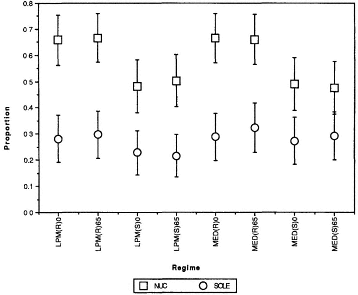
Fig. 3.3.
Ninety-five percent confidence intervals for household
proportions—nuclear families and solitaries.
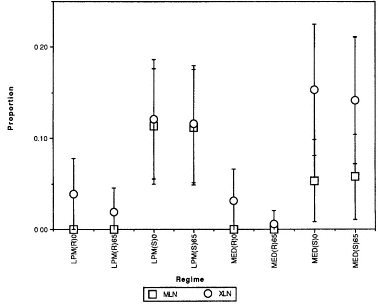
Fig. 3.4.
Ninety-five percent confidence intervals for household
proportions—multiple lineal families and extended
lineal families.
the categories on the horizontal axis are combinations of demographic regime and household formation rules. There are eight of these categories in each figure. The first four are Late Premodern (LPM), and the last four are Medieval (MED). In each set of four, the first two categories are for rein-corporation regimes, and the second two are for stem regimes. For each such pair the first member is for critical age 0, and the second is for critical age 65. Above each category are displayed the information about two different kinds of household: NUC and SOLE in figure 3.3, and MLN and XLN in figure 3.4. Each such display of information is represented by a bar, at the center of which is the mean proportional occurrence of the household type, under the stated conditions, surrounded by the 95 percent confidence interval. For example, in figure 3.3, under LPM(R)0, which means under Late Premodern demographic regimes with a system of reincorporating elderly parents as soon as they are widowed, the nuclear households constitute about 66 percent of all households, and solitary households constitute about 29 percent. We would expect the proportion of nuclear households to fall 95 percent of the time between about 57 percent and 75 percent and that of solitary households to fall 95 percent of the time between about 19 percent and 38 percent, in samples of 100. Of course, we know from statistical theory that if sample sizes are larger, the confidence intervals will be
narrower. Thus, if sample sizes were increased by a factor of 10 to 1,000, we would expect the confidence intervals to be reduced by a factor of the square root of 10, thus about a third of what is shown in the figure.
The question to be addressed is thus whether we could expect to be able to distinguish the demography and household formation regimes from the evidence of their results, at particular sample sizes. We would ask whether the mean for a household type under some scenario did or did not fall within the confidence interval of that same household type under some contrasting scenario. If it did not, then at these sample sizes we could use evidence of the household type proportions to argue for the presence of an underlying demographic regime, or household formation scenario, or some combination of the two. If a mean fell within the confidence interval of another regime, we could not reliably use such evidence.
In figure 3.3 we see that it is never possible, on the evidence of nuclear and solitary households, to distinguish between regimes that differ only by virtue of the critical age of reincorporation. That conclusion comes from the observation that the adjacent members of the successive pairs in the figure, such as LPM(R)0 and LPM(R)65, always show the mean of one member falling within the confidence interval of the other. Critical age of rein-corporation, although it makes a difference, does not make very much difference, and that difference would be reliably detectable only at very large sample sizes, such as the totality of the simulations presented in figures 3.1 and 3.2. Although figures 3.1 and 3.2 are a reliable guide to some large universe of results, they are not a reliable guide to historical reality as we recover it in the activity of being real historians.
We further see that it is always possible even at sample sizes of 100, on the basis of the proportion of households nuclear, to distinguish between stem and reincorporation scenarios under the same demographic conditions, for example, LPM(R)0 and LPM(S)0. However, it is never possible to use the proportion solitary in the same way, for example, MED (R)0 and MED(S)0. If comparisons are made for the proportion nuclear across regimes and scenarios that differ both in their demographic regime and in their critical age, for example, LPM(R)0 and MED(R)65, the only factor that permits clear distinction is that between household formation scenarios. The stem system and the reincorporation system always give different results. However, the proportion solitary cannot be used in this way. Thus the evidence from nuclear households is a more reliable guide to underlying conditions and process than is the evidence from solitary households. The differential quality of the evidence would not have been obvious before undertaking these experiments.
The same exercise can be conducted with figure 3.4. Of course, we must ignore the proportion MLN under nonstem scenarios, since it is by definition 0. Again, by definition, under the stem scenarios it is never possible
to distinguish between systems differing by age of reincorporation, for example, LPM(S)0 and LPM(S)65, because age at reincorporation is irrelevant to stem family formation.
It is usually possible from the proportion MLN to decide between the LPM and MED demographic regimes. Notice that we can only compare the stem (S) regimes and that age or reincorporation is irrelevant. Thus we should compare the error bars for the third and fourth against the seventh and eighth categories of the horizontal axis. The square plotting points that represent MLN in the seventh and eighth categories are just at the limits of the error bars for the third and fourth, while the plotting points for the latter are well outside the confidence limits for the former.
It is scarcely ever possible to distinguish between critical ages of reincorporation on the grounds of the proportion lineally extended (XLN), except under the reincorporation scenario under Medieval demographic conditions. Only in this last instance does the mean fall outside the comparable confidence interval; the open circle for XLN under MED(R)0 falls well above the upper limit of the confidence interval under MED(R)65.
It is always possible to distinguish between the reincorporation and stem scenarios on the grounds of the proportion XLN; it is always higher under stem family formation than under reincorporation rules, for the reasons already noted in the discussion of figures 3.1 and 3.2. Speaking in general, we get less reliable evidence about underlying process from observing proportions of extended and multiple households than we do from observing nuclear and solitary households; the separation of results is rather better in figure 3.3 than in figure 3.4.
Discussion
The conclusion from this exercise is that demographic differences per se are only weakly influential as against differences in household formation rule systems. This is a further confirmation of conclusions reached earlier with respect to stem family formation under plausibly different demographic regimes for historical England[17] and for joint family systems under early medieval rates.[18] The results given in this chapter are also based on ordinary and expectable historical rates. The differences between these plausible rates, however, are rather substantial, with the expectation of life at birth being only about 25 under the Medieval regime but about double that under the Late Premodern one. However, we must note that mortality differences and changes in the past have rested principally on improvements in infant and child mortality, and these have less effect on stem family and reincorporation scenarios than do changes in adult mortality. The results here presented make all the more striking the situation prevailing today in many northern European and American societies, as well as in Japan, in which the
mortality rates for higher ages are sufficiently different from historical experience to provoke sharp changes in household and kinship network constitution. Even for modernizing China, we have shown elsewhere that mortality changes since traditional times have been sufficient to make it more likely that traditional household structures can be reached and maintained now than earlier.[19] Whereas our customary view of demographic differences and their effects on age structure and social structure has focused on fertility and infant mortality, we see that mortality differences at higher ages can also be productive of major effects.
These explorations led to some surprises. The first was that the two household formation regimes could often be distinguished at relatively small sample sizes around 100. In earlier work, devoted to the detection of differences between stem family and nuclear scenarios without reincorporation, sample sizes of close to 200 were required. This is a welcome result for historians, who often deal with samples not much larger than about 100. But this helpful result holds only for the ability to distinguish regimes by examining some household types. For example, the required sample size necessary to distinguish each scenario from any other is only about 30 for the proportion nuclear and between 200 and 300 for the proportion solitary under most regimes but almost 4,000 under the Medieval demographic regime. The minimal size required for extended lineal proportions varies between about 20 and 60. Only trivial sample sizes are needed to distinguish rule systems on the basis of the proportion of multiple lineal households, since they should only occur under stem family formation rules, except as freak accidents of household recombination through remarriages. Working historians should be prepared to follow different strategies to make their points, depending on the household types on which they choose to focus. All households do not give answers of the same reliability.
Also unexpected was the depression of the proportion of extended lineal households, the very goal of reincorporation as an alternative to stem family formation, under an explicit system of hardship reincorporation. The residue of stem families on the death of a senior member yields a higher proportion of extended lineal households than a behavioral system that brings the elderly back from nuclearity when widowhood leaves them solitary, because of the effects of prior mortality on married children.
Conclusion
This chapter began by inquiring into the contribution of the elderly to their nurturant environment. Which social environment permits them their greatest contribution, and what social contract facilitates both it and their nurturance? Who should be responsible for this nurturance? The answer, if one wants to have old Mum at the hearth, is to start early, so that she remains
longer and more continuously in the bosom of the family. From a policy point of view, George Homans's villagers of the thirteenth century had it right; they kept Mum home from the start.
What of responsibility? The contribution of the elderly is surely more to their narrow than to their broad social environment, more to the family and household than to society at large. Surely those who benefit the most from their presence should take the major responsibility for their nurturance. Now, this nurturance need not involve co-residence, and the analyses presented here are only a special case, for the historian bound to four walls by the nature of the scribblings of busybodies. In the modern era we must attend to the cellular telephone, the answering machine, and perhaps even to grandmothers who send electronic mail and faxes. But the general point is the same, even if eased by technology. The care of the elderly is less likely to be a general social burden if it can be made the responsibility of their heirs—not only of their biological descendants but of their social descendants, thus not only of their children but also of their children-in-law. The filial conjugal estate should carry the social debts of both of its coparceners, the younger spouses. Might we realistically expect daughters-in-law to enter with joy into such contracts?
As levels of mortality diminish, of course, the children whom Mum might rejoin through reincorporation are less likely to be widowed, so that Mum is not robbed of a locus through the death of a child and the survival only of a child-in-law. However, as mortality declines, Mum lasts longer herself. The depression of extended lineal households under a system of reincorporation is thus a function of the ratio of the survivorship of adult children to that of their parents, or in the phrase employed in macroanalytic approaches to this same problem, the size of adjacent generations. Although the situation is not precisely analogous to the effects of shifting cohort sizes in social security systems at the macrolevel, it involves, even as there, an element of intergenerational social contract. At the microlevel the situation is conditioned by the cultural fact (at least in Euro-American societies) that blood is thicker than water. The care of the elderly, under these contrasting household formation scenarios, becomes a general social responsibility where reincorporation is the rule because some social descendants may escape an obligation that could be construed as properly theirs by virtue of their survival as coparceners of the conjugal estate that had that obligation. Under the stem family formation system, they would have continued to hold it. The outcome is obvious, but like many obvious outcomes, only after the experiments.
This exercise conducted with computers and focused on a problem from the distant past indeed has a connection to the broad problems raised at the beginning of the chapter. It is, after all, culture that differentiates us from our animal forebears, and that culture with implications for attitudes be-
tween the generations and for the maintenance of the cultural stock itself is closely related to mortality systems. It is these shifting mortality systems that drive the coexistence of the generations and that demand the cultural accommodation. The world now emerging is not like the old one in which parents were never free of their children but is one in which children are never free of their parents until they are themselves old. Childhood, in the psychological sense, reaches unimagined proportions. The responsibility of women as caregivers now extends across generations in two directions, and the usually earlier demise of men unites in a curious dyad the rivals who were linked to them, one as mother, the other as wife.
References
Acsádi, Gyorgy, and J. Nemeskéri. 1970. History of human life span and mortality . Budapest: Akademiai Kiado.
Coale, Ansley, and Paul Demeny, with Barbara Vaughan. 1983. Regional model life tables and stable populations . 2d ed. New York: Academic Press.
Hammel, E. A. 1972. "The zadruga as process." In Household and family in past time , ed. Peter Laslett, 335-373. Cambridge: Cambridge University Press.
——— 1980. "Household structure in 14th-century Macedonia." Journal of Family History 5: 242-273.
———. 1990. "Demographic constraints on the formation of traditional Balkan house-holds." Dumbarton Oaks [Washington, D.C.] Papers 44: 173-180.
Hammel, E. A., and Peter Laslett. 1974. "Comparing household structure over time and between cultures." Comparative Studies in Society and History 16: 73-109.
Hammel, E. A., Carl Mason, and Kenneth Wachter. 1990. SOCSIM II: A sociodemographic microsimulation program. Revision 1.0: Operating manual . Special Publication of the Graduate Group in Demography and Program in Population Research, University of California, Berkeley.
Hammel, E. A., Kenneth Wachter, and Chad K. McDaniel. 1981. "The kin of the aged in 2000 A.D. " In Aging . Vol. 2. Social Change , ed. James Morgan, Valerie Oppenheimer, and Sara Kiesler, 11-39. New York: Academic Press.
Hammel, E. A., Kenneth Wachter, Carl Mason, Feng Wang, and Haiou Yang. 1991. "Rapid population change and kinship: The effects of unstable demographic changes on Chinese kinship networks, 1750-2250." In Consequences of rapid population growth in developing countries , 243-271. London: Taylor and Francis.
Laiou, Angeliki. 1977. Peasant society in the late Byzantine empire: A social and demographic study . Princeton: Princeton University Press.
Reeves, Jaxk H. 1982. "A statistical analysis and projection of the effects of divorce on future U.S. kinship structure." Ph.D. dissertation, Department of Statistics, University of California, Berkeley.
———. 1987. "Projection of number of kin." In Family demography: Methods and their application , ed. John Bongaarts, Thomas K. Burch, and Kenneth W. Wachter, 228-248. Oxford: Clarendon Press.
Ruggles, Stephen. 1987. Prolonged connections: The rise of the extended family in nineteenth-century England and America . Madison: University of Wisconsin Press.
Russell, J. C. 1958. "Late ancient and mediaeval populations." Transactions of the American Philosophical Society , new series, vol. 48, pt. 3.
Wachter, Kenneth, E. A. Hammel, and Peter Laslett. 1978. Statistical studies of historical social structure . New York: Academic Press.