
Industrial Performance
Aircraft production in 1937 was neither strong enough to silence the critics of nationalization nor weak enough to discredit Pierre Cot's policy. Production figures were unimpressive: the industry delivered 418 planes to the air force, down from 569 in 1936. This decline did not reflect as badly on the industry as it seems, as 226 of the planes were bombers—a breakthrough for the air force.[127] By the second half of 1937, moreover, national companies began to construct Morane 406s and Potez 630s, high-speed aircraft designed in 1935 to meet the challenge of the latest German models.[128] To some extent the poor performance of the industry in 1937 reflected the thorough disruption that nationalization had involved—taking inventories, reorganizing plants, and reassigning personnel. By the second half of the year work had resumed in most plants in the nationalized sector; Cot pointed out that it took Renault-Caudron, a private firm, 40 percent more time and 20 percent more money to build a Bloch 210 bomber than it did the national company, SNCAC.[129]
Still, although nationalization had streamlined the airframe industry in a way that would eventually make it possible to modernize and expand production, output declined 11 percent in 1937, according to one study, and the industry was still caught in a thicket of organizational and financial problems.[130] These shortcomings, moreover, loomed all the larger in people's minds because by the end of 1937 the Germans were building airplanes at six times the pace of the French.[131]
As the insufficiency of production became more apparent in the last quarter of 1937, accusations surfaced along predictable lines. Business publicists and conservative politicians blamed labor for the lag, citing low productivity, the "crisis of authority," the deleterious effects of collective bargaining and the forty-hour week, and nationalization itself as the source of the troubles in the industry. Georges Houard, editor of Les Ailes , remained as acerbic as ever in his criticism of Cot's nationalization program, which he viewed as "the eviction of the pioneers."[132] Labor leaders, in turn, repeated charges that employers still exerted too strong an influence over the nationalized sector and that the Air Ministry had been "much too prudent."[133] More should have been done, militants felt, to impede industrialists, financiers, and military officials bent on "sabotaging" nationalization.
In the highly charged political atmosphere of the Popular Front period it was easy for conservative critics to find a receptive audience for their claims that collective contracts, high wages, a forty-hour week, and strong shop stewards lowered output. But it was difficult to substantiate these claims. Some officials argued that the industry was stymied by a chronic shortage of labor made acute by the forty-hour week, and Marcel Bloch complained about it at SNCASO; yet there was also evidence that in some plants skilled manpower went underutilized for lack of financing or orders, as Paul-Louis Weiller, the head of Gnôme-et-Rhône and no friend of labor, told stockholders in early 1938.[134] The forty-hour week may have hampered a few employers. But until mass production finally got under way in late 1938, it does not appear to have been an important obstacle to production except in prototype departments, where the efforts of technicians and designer-draftsmen were much in demand from 1937 on.[135]
The impact of Blum's labor laws on worker productivity in the aircraft industry was even harder to discern. For one thing, in an industry like aviation, where workers produced airplanes in relatively small batches and where some models called for more labor-intensive methods than others, it was difficult to calculate the effects of wages and working conditions over long periods of time. Moreover, in 1937 Cot's Air Ministry deliberately put extra workers to work on bombers as a way to avert layoffs, even though building these bigger planes required fewer work-
ers per ton than did fighters. When Joseph Roos, a young engineer in the Air Ministry with no notable sympathy for labor, made a systematic study of productivity in 1937, his findings were inconclusive. He argued that in the one factory that produced roughly the same kind of airplane in 1935 as in 1937, hourly output per worker had dropped 5 percent in the intervening two years. Roos admitted that "such a study is touchy in the airframe industry, where workers have to change jobs fairly often and where work rhythms vary significantly with the rank of the plane in the series being produced. The elimination of a bonus or its diminished significance owing to a rise in minimum wages can harm output slightly." Roos concluded, however, that "the troubles with output are not fundamentally important."[136] Air Ministry investigations in early 1938 found no evidence that workers' hourly output had declined.[137] Even as hostile an observer as Paul Boutiron, an engineer who in his Riom testimony castigated Cot and the unions, praised workers for their efforts: "To be fair, the work was well done, and generally highly finished, except for that done by inexperienced novices. Professional conscience did not die."[138] The understanding of labor output, in short, remained impressionistic and was certainly insufficient to discredit Blum's labor reforms.
In fact, nationalization seems to have enhanced worker morale. Cot implied as much when he later pointed out that during his stint as Air Minister aircraft workers struck only in private firms—at Latécoère and Renault-Caudron in 1937. Another private company, Bréguet, was saddled with labor difficulties from June to October 1937, especially at its plant near Paris in Vélizy.[139] Certainly the pressures were greater on managers in the nationalized sector to standardize employment practices and consult with shop floor representatives when problems arose. Administrators at SNCASO made a conscious effort to minimize layoffs, and in an industry where job security had figured so prominently in the strike demands of June 1936, the stability of employment levels in the nationalized sector could only improve morale.[140] It was common lore in the 1930s that jobs in the public sector were easier to keep if you were lucky enough to get one.[141] The national companies, moreover, probably did not try to force employees to work on Saturdays in May 1937 to make up for religious holidays the way Paul-Louis Weiller did at Gnôme-et-Rhône.[142] By the same token the stakes workers had in the success of the national companies, the relatively open channels CGT militants had to Cot's Air Ministry, and the commitment Cot's staff had to iron out problems with local militants all helped ease the friction between workers and management in the nationalized sector. As Cot wrote years later, "The fact remains—to the credit of nationalization and of the Popular Front—that from June 1936 to January 1938 the aeronautic industry was the branch of the French economy in which labor and social problems were
settled with greatest facility; nationalization improved the social climate of production even more than it improved the equipment of factories."[143] Robert Jacomet, a high government official in the Daladier government in 1938, agreed. He told a Senate committee in June 1938 that workers in nationalized plants and state arsenals appeared to have more enthusiasm for their work than their counterparts in the private sector.[144] One retired worker at the state-controlled aircraft arsenal at Châtillon has attributed high morale precisely to the fact that "everyone wanted to participate, to show that we could do things better than in the private sector. . . . Because—it isn't an exaggeration to say it—we had the impression of working for ourselves. I'm not just making a poetic spiel. Without being prodded by management or the foreman—we weren't being wound up like clocks—everyone was imbued with the idea that we were going to prove something."[145] Of course, not everyone was. Some workers no doubt felt as alienated from the workplace in national companies as they had been when their factories were private. But on the whole, nationalization under the Popular Front and the support the CGT gave to the policy did more to improve than impede cooperation on the shop floor.
The crucial obstacles to production in 1937 lay not in the workweek or worker morale but in three long-standing problems that nationalization had failed to solve—the needs to coordinate the production of supplies and accessories, modernize production, and, above all, finance production on a far grander scale. Cot's reforms had done much to streamline the airframe sector by eliminating an inefficient structure that had long supported uncompetitive firms. For the first time a serious policy of decentralization had taken hold. For the first time, too, the Air Ministry had established an effective system for pegging prices at levels closer to the costs of production. But shortages remained. Airframe and engine builders still encountered delays in receiving construction materials, aircraft accessories, and propellers. Delayed machinery deliveries plagued them as well. Although the national companies increased the value of their manufacturing equipment (from 60 percent at SNCAN to 300 percent at SNCAM), the level of investment in plant and equipment remained much too modest to match the pace of German production. As General Hederer testified in December 1937, nationalization had not altered construction times appreciably in the course of the year.[146]
Budgetary austerity lay at the heart of these problems. Just as financial policy proved to be the bane of the Blum government during the first half of 1937, so financial constraints blunted nationalization as an instrument of industrial reform. The air force was still too weak a component of national defense, and rearmament too controversial a priority, to give the aircraft industry the money it needed to build more than six hundred
warplanes a year. Despite the growing recognition that war was likely and that air power could be decisive, the Air Ministry still found itself stymied by an army high command committed to a tactical, not a strategic, air force and a Senate unwilling to finance production on a larger scale. In 1937, when a third of the British defense budget went to the Royal Air Force, the French air force garnered only a sixth of France's.[147]
To make matters worse, Cot's relations with the Finance Ministry soured after June 1937, when the Blum government fell and Georges Bonnet replaced Vincent Auriol at the rue de Rivoli. The finance minister had enormous discretionary control over the budget, and as a conservative member of the Radical Party, Bonnet sought to strengthen the franc by limiting expenditures rather than to finance production. Without Auriol at the Finance Ministry, Cot no longer had a colleague there in sympathy with his reforms, and without Blum as premier, Cot had no ally at the top to forge a coherent rearmament policy. Bonnet not only failed to support Air Ministry plans for the 1938 budget; he also held up funds that had been appropriated for aircraft construction in 1937. At the same time, because financial problems were severe in the industry, the Finance Ministry took more and more control over decisions that would otherwise have been the the domain of the Air Ministry. Likewise, Finance Ministry representatives became increasingly powerful figures on the boards of the national companies.[148] Financial constraints, then, not only stymied the Air Ministry but diminished its power as well. Years later, when critics at the Riom trial blamed Cot for the modest budgets of 1937 and 1938, he answered, "If my efforts [to obtain larger appropriations for aviation] were often fruitless, it was because they clashed, especially after Chautemps had replaced Blum as premier, with the holy alliance of military conservatism of which Pétain was the symbol, and financial orthodoxy, whose guardian was Bonnet."[149]
Budgetary constraints also kept the national companies in a state of chronic financial crisis. Employers complained that they had to spend their time searching almost incessantly for liquid funds, and they still found themselves hard pressed to meet payrolls, to say nothing of improving plant and equipment.[150] Furthermore, when the time came to increase the stock capitalization of these firms, it fell to the state to raise funds; private industrialists who sat on the boards and had initially accounted for nearly a third of the capital by and large abstained from further investment.[151] As a result, the national companies, and by extension the Air Ministry as well, had to turn once again to the banks. Although private businessmen by no means reclaimed the degree of control over the industry they had enjoyed before 1936, a poorly financed nationalized sector failed in 1937 to acquire the autonomy reformers had
originally envisioned. Nationalization succeeded as a way to reorganize a fragmented industry but failed to put the industry on a solid financial footing.
By December 1937 Cot was too isolated in the Chautemps government to carry forward a program of industrial expansion and modernization. Ironically, he found himself at the nadir of his influence just as the pieces of such a program were beginning to fall into place. Several important prototypes, such as the Morane 450, the Dewoitine 520, and the Lioré 45, were nearly done. To redress the critical need for a high performance engine, Cot had purchased an important manufacturing license from the American firm, Pratt and Whitney, much to the dismay of some conservative critics, who saw this move as a threat to French firms.[152] What is more, Premier Chautemps was finally becoming alarmed at the need for aerial rearmament; he returned in early December from a trip to Britain troubled by his government's failure to rebuild the air force as rapidly as the British were now proceeding to do. Chautemp's concern at least gave Cot the opportunity to draw up a new plan to boost production to an annual rate of thirty-four hundred warplanes by 1940 at a cost of eleven billion francs over three years.[153] But Cot himself had run out of political capital. Although his plan would serve as a blueprint for his successor at the Air Ministry, Guy La Chambre, Cot had too little influence to win quick support for a vast new extension of credits.
Nor did military officials in the air force strengthen his hand. Cot's efforts to promote young officers to top posts and reorganize the structure of command had made him enemies in the air force. Deficiencies in aircraft production, moreover, had caused the air force to languish without adequate equipment, thereby damaging morale. Although for a time Cot had won a more prominent role for bombing squadrons in military planning, in the fall of 1937 he was forced to retreat when the army high command reasserted its preference for a more limited air force role.[154] By the end of 1937 Cot's relationship to the air force, and the continuing subordination of the air force itself in military planning, had isolated the Air Ministry all the more. It was in this context that General Vuillemin, a leading staff official and commander of the First Air Corps, sent Cot a shocking memorandum on 15 January 1938 in which he said that in the event of a war with Germany "French aviation would be crushed in a few days."[155] Just when the condition of the air force was finally emerging as a major concern at the highest levels of government, a cabinet crisis forced Chautemps to reshuffle his government, and Cot lost his post at the Air Ministry.
Cot's departure marked the end of the Popular Front era in the aircraft industry. Not that the Popular Front as a national coalition of Radicals, Socialists and Communists had completely disintegrated; its final
collapse would come in the fall of 1938 with the Munich Agreement and the general strike of 30 November. But in aviation Cot's ministry had been pivotal to reform, and its collapse signaled the beginning of a new phase in the industry. To be sure, Cot had failed to achieve a number of objectives he had targeted in the heady summer of 1936—support for Spanish loyalists, cooperation with the Soviet Union, the promotion of collective security, and the modernization of the aircraft industry. But by pushing employers to sign a collective contract in June 1936, nationalizing firms, giving labor militants greater access to the Air Ministry, and supporting (albeit equivocally) the participation of the CGT in the management structure of the nationalized sector, Cot's ministry had transformed social relations in the industry. With employers divided over how to respond to nationalization, and with employees galvanized, despite internal tensions within the work force, into a cohesive trade union movement, the balance of power in the aircraft industry had shifted decisively since 1935.
In short, nationalization had political consequences in addition to the economic consequences it was designed to produce. It undermined the capacity of employers to respond collectively to the expansion of the state's role in the industry, although it by no means prevented some industrialists, especially Marcel Bloch and Henry Potez, from wielding enormous power and profiting accordingly. No less important, nationalization encouraged workers, technicians, and their trade union leaders to become more integrated into the bureaucratic politics of the industry. In this respect nationalization had both a radicalizing and a moderating effect—radicalizing insofar as it gave workers an arena to advocate contrôle ouvrier and a real shift in power on the shop floor; moderating insofar as the practice of organizing delegations, serving on boards and committees, and lobbying in the ministries taught militants to cultivate the art of bureaucratic advocacy within what was still fundamentally a capitalist industrial hierarchy. Above all, nationalization politicized the industry by giving workers and employers alike more of a stake in their relationship to the government and in the partisanship of the Air, Finance, and Labor ministries.
These political effects did not derive simply from the fact that the role of the state expanded in the industry; they sprang as well from the expectations people brought to the process of nationalization. In this respect the aircraft industry differed from the railroads. When the Chautemps government negotiated with the railroad companies in the summer of 1937 to create the Société Nationale des Chemins de Fer (SNCF), militants did not see it as a chance to transform the structure of authority in the railroads. Nor did employers divide between proponents and opponents of state control. Rather, an intense set of negotiations
produced an arrangement giving the state 51 percent of ownership of the railroads and ultimate control over management without provoking the former stockholders and directors into revolt. Although the CGT won four seats on the thirty-three-seat board of SNCF, CGT militants had no illusions that they were on the threshold of social reform. L'Humanité viewed the change cynically as state acquisition "without nationalization."[156] Railway workers did not experience nationalization as a major breakthrough.[157] In terms of labor relations it in fact was not: railway workers still lived in the shadow of two traumatic strike defeats, one in 1910, the other in 1920, when militants had promoted the slogan "Railroads to the railroad workers."[158] Indeed, railroad workers had abstained from the strike wave of June '36.[159] Moreover, it was hardly inspiring for workers to witness such moderates in the Radical Party as Camille Chautemps, Georges Bonnet, and Henri Queuille negotiating with the companies after the Blum government had fallen in June 1937—negotiations that culminated a long, incremental process of bringing the railroads under state control that had begun in the late nineteenth century.
What made nationalization so much more important an event in aviation than in the railroads were the conditions in which it was done—on the heels of June '36, at the height of Popular Front power—and the expectations people had for a policy that appeared to represent, at least potentially, a major shift in management structure. Furthermore, employers came into the negotiations over nationalization already more divided among themselves, and with different interests at stake, than did their counterparts in the railways. Conversely, as part of a highly mobilized wing of the CGT in a dynamic, growing industrial sector, aircraft workers and technicians found themselves in a stronger position to influence policy than were their counterparts in a languishing, older industrial sector such as the railroads. Above all, Young Turk Radicals like Cot and left-wing staff associates like Jean Moulin and André Labarthe in the Air Ministry raised workers' hopes and provoked employers' fears during the period of the Blum government much more readily than did the more conservative men around Bonnet and Queuille in the summer of 1937.
By the same token, if nationalization gave aircraft workers greater leverage than before, it also made them more dependent on officials like Cot, Moulin, Labarthe, Lebas, and Auriol—men whose claim to power gradually eroded as Chautemps's succession of cabinets shifted more and more toward the right wing of the Radical Party. Cot's relationship to workers was complex: he was viewed as both a friend to labor and a cagey politician all too cozy with Bloch and Potez. A year and a half of compromises and accommodations had done little to make Cot, or any-
one else in Blum's original Popular Front government, a worker's hero. When Cot lost his ministry in January 1938, aircraft workers were no more prone to take to the streets than workers in general had been when Blum's cabinet fell the previous June. Even so, once Cot had gone, employees faced a new set of uncertainties about what a more conservative government might do in an industry where state officials had acquired a great deal of influence over day-to-day conditions in the plants. There seemed little danger of returning to the autocratic style of industrial management that had prevailed before June 1936. But in early 1938, with CGT militants anxious to make good the promise of "a genuine nationalization as conceived in the original program of the Popular Front," with employers yearning to regain at least some of their lost authority, and with the pressure to boost production growing daily in the face of the German threat, the prospects for a new set of conflicts appeared likely after Cot's ministerial fall.[160]
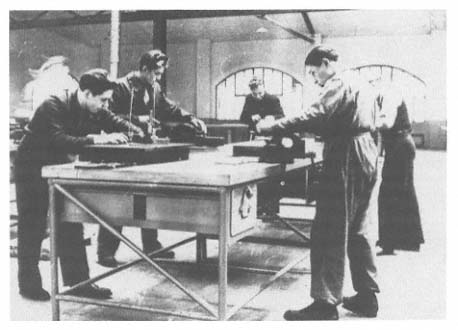
Fig. 1.
Apprentices in training at an Amiot factory near Paris, c. 1939–45. Aircraft companies
depended on a higher proportion of skilled workers than did most metalworking firms.
Many skilled aircraft workers made their start as apprentices in the industry. Others came with
experience from shipbuilding and automobile construction. Even after airplane construction was
modernized in 1938–39, skilled workers remained in high demand. Photo courtesy of SHAA.
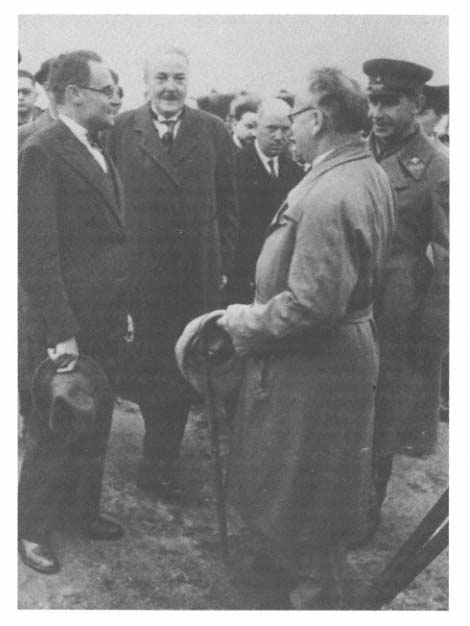
Fig. 2.
Air Minister Pierre Cot (left) and state engineer Albert Caquot (third from left)
on a visit to the Soviet Union in 1937. Cot put great stock in Franco-Soviet
cooperation as a defense against Germany. Photo courtesy of SHAA.
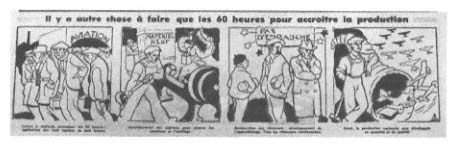
Fig. 3.
"There is a way to increase production other than the sixty-hour week."
After the defeat of the general strike of 30 November 1938 the Daladier government
eliminated the forty-hour week and expanded work hours in defense-related industries.
The CGT argued in vain to rely on other methods than long hours to boost production.
This cartoon from the April 1939 issue of the FTM's L'Union des Métaux called for
reorganizing production into three eight-hour shifts, investing in better machinery, retraining
the unemployed, and expanding apprenticeships.
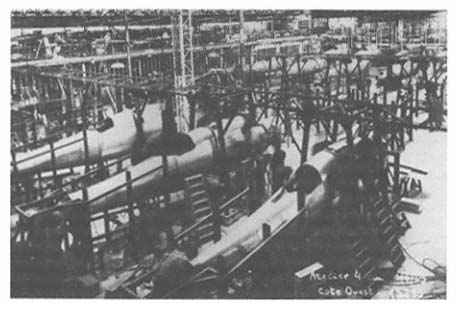
Fig. 4.
Assembly hall for building the Bréguet 691 bomber at the Bréguet factory in Vélizy-Villacoublay
in 1939. Since the First World War airplane construction had taken place in immense assembly sheds
as small work teams put together fuselages and attached wings, fins, cockpits, and accessories to
the emerging aircraft. Yet only in 1938 and 1939 did workers and engineers address the challenge of
building large all-metal airplanes in great numbers. The extensive use of jigs for positioning pieces, tools,
and large structures made the job easier. Photo courtesy of SHAA.
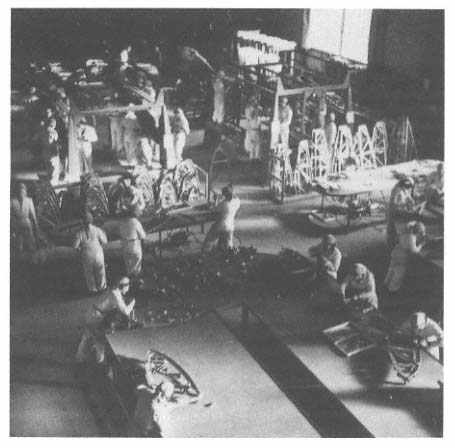
Fig. 5.
Women at work building the Amiot 143 at the Amiot factory in 1939–40.
By simplifying airplane design and reorganizing production methods in 1938 and 1939,
airplane manufacturers found new ways to use semiskilled workers, trained in a matter
of weeks for specialized jobs. Whereas women had comprised a miniscule proportion of
the blue-collar work force in the industry before the war, after September 1939 companies
recruited a great many women to do semiskilled work. They were usually the first to lose
jobs after the defeat of June 1940. Many women later found work in airplane construction
when the industry revived under German auspices during the Occupation. Photo courtesy of SHAA.
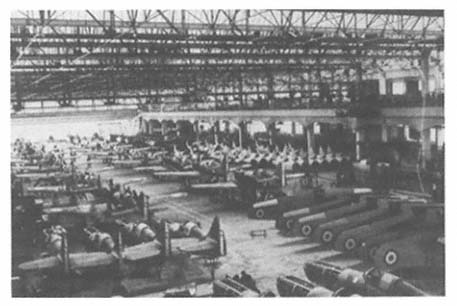
Fig. 6.
Production line for the Dewoitine 520 at the SNCAM factory in Toulouse in 1940.
As impressive as French production turned out to be in 1939–40, the industry never
overcame the handicap of a late start. This picture, taken in Toulouse three days after
the armistice, shows the highly regarded Dewoitine 520 finally coming off the production
line too late for use in the Battle of France. Photo courtesy of the Smithsonian Institution.
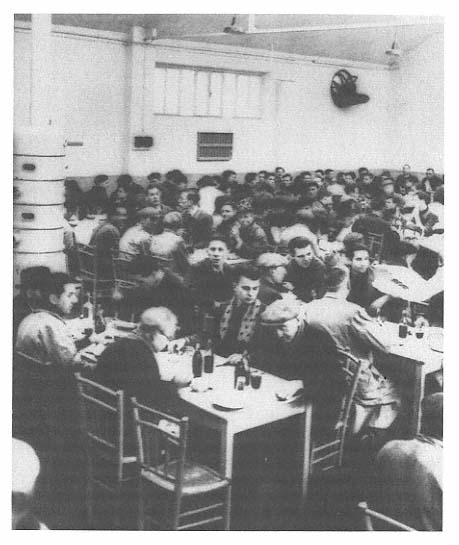
Fig. 7.
Employee dining hall at the Amiot factory, c. 1940. Employers and labor militants had
competing ambitions for factory dining halls. Employers saw them as places to reinforce
their paternalistic authority, militants as places to cultivate support for the CGT. Even
during the Occupation, mealtime in the cafeteria gave militants a chance to promote job
actions and protests. After the Liberation, plant committees dominated by the CGT won
the right to oversee the social-welfare activities of the factory, including the cafeteria.
Photo courtesy of SHAA.
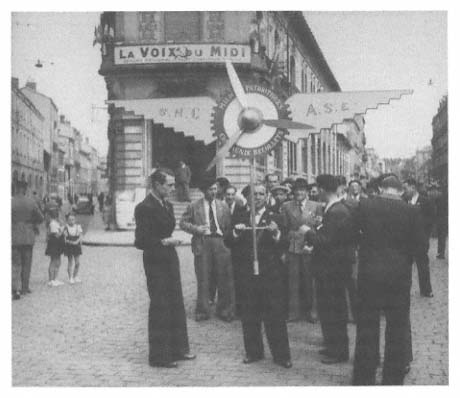
Fig. 8.
SNCASE employees who were members of the Patriotic Militia, a paramilitary organization
designed by the Communist Party to harass the Occupation authorities, gather in the streets of
Toulouse to celebrate the Liberation in 1944. The Resistance enabled Communist militants to
reestablish themselves as leaders of the labor movement in aviation, as in most industries, after
the setback of the Nazi-Soviet pact in 1939. Photo courtesy of the photographer, Jean Dieuzaide.
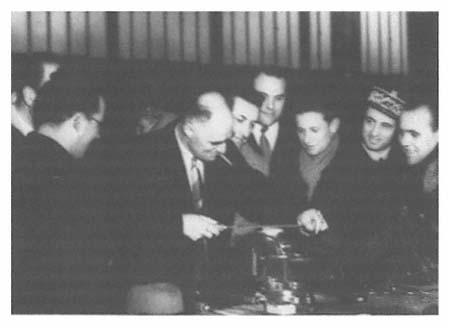
Fig. 9.
Air Minister Charles Tillon visiting the SNCASO plant at Châteauroux in 1945.
As a veteran labor militant and the chief of the military arm of the Communist Resistance,
Tillon tried to make the industry both an arena of labor reform and a model sector for
the party's postwar "battle for production." Photo courtesy of SHAA.
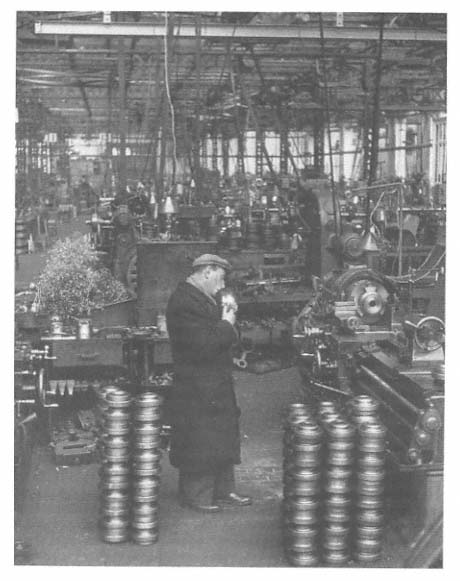
Fig. 10.
"The SNECMA Strike, 1947," by Willy Ronis. Ronis captured this view of a
SNECMA factory during the strike wave of late 1947. The CGT's defeat in the
strike wave made it nearly impossible for aircraft workers to prevent the
massive layoffs and plant closings that followed from government decisions
to restructure the industry. By 1950 thousands of jobs had disappeared, manufacturers
and politicians had established a stable working relationship between the public
and private sectors of the industry, and Communist militants, though still the leading
spokesmen for workers in most airplane factories, had lost much of the political
ground they had won after the Liberation. Photo courtesy of Willy Ronis.
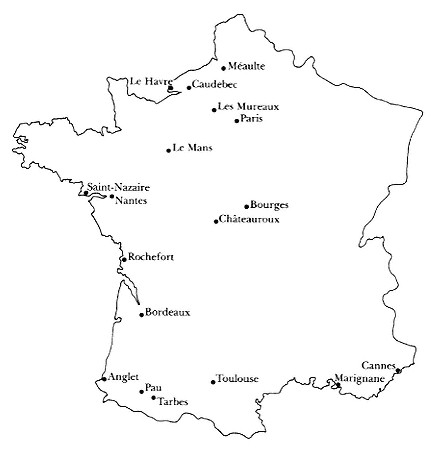
Map 1.
Principal Locations of the Aircraft Factories in France in 1940
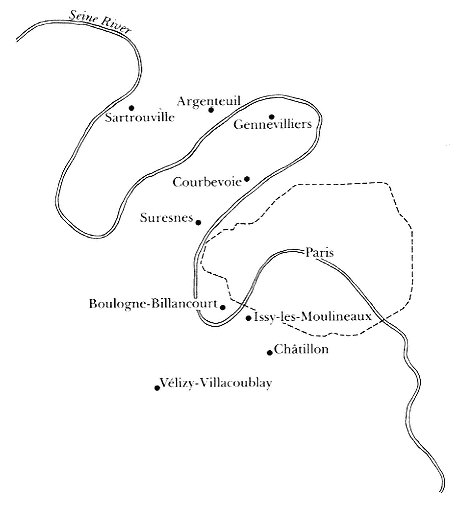
Map 2.
Principal Locations of Aircraft Factories in the Paris Region in 1940