
3
Systematics and the Geometrical Spirit
By John E. Lesch
During the latter 18th century European thinkers embraced a systematic model of order with an enthusiasm and conviction unprecedented before and unmatched since. Systematics—the classification of objects into groups according to degrees of identity and difference, and rationalized description and nomenclature—largely constituted the scientific study of the three kingdoms of nature: animal, vegetable and mineral. Drawing upon a century and a half of groping and hesitant effort by naturalists, Linnæus had succeeded in standardizing names and the process of naming, clarifying and simplifying the criteria of classification, and including the known objects of each kingdom in a simple, coherent, and comprehensive arrangement. Systematics dominated the study of the three kingdoms in the latter 18th century, to the disadvantage of anatomical, physiological, and microscopical approaches. Although most obviously successful in natural history, the systematic model may be found in many other domains. Late Enlightenment thinkers classified, or sought standards of description and naming, for objects as diverse as chemicals, diseases, the vital properties or anatomical elements of organisms, algebraic curves and surfaces, machines, and medicinal drugs. Whether we view these activities as the result of a diffusion of the model from one or a few sources—most probably natural history—or as the synchronous expressions of an underlying disposition, the systematic model formed a major modality of late Enlightenment thought.
The chapter begins by identifying the fundamental characteristics of the model by examination of one of its earliest and most prestigious exemplars, systematic botany, and determining in what sense the model participated in a more general geometrical spirit. It then
surveys the model's manifestations in other areas of thought, emphasizing mineralogy, chemistry, and medicine, and ends by suggesting that the success of the systematic model, and its decline in the early 19th century, must be understood in relation to its coherence with other elements of late Enlightenment culture.
The Systematic Model
Systematic botany emerged as a fully developed science in the first half of the 18th century, as the culmination of a gradual development of concepts and methods over the preceding two hundred years. The stimulus of Renaissance humanism and naturalism in art, the growing popularity of natural history as a leisure pastime, and increasing exploration of the various habitats of European flora as well as the findings of European explorers in Asia, Africa, and America brought rapid increases in the numbers of known plants. A six-to-tenfold increase can be recorded between 1550 and 1623, when 6,000 species were listed in a leading textbook. By 1690, the number had more than tripled again, rising to 19,000.[1]
From around 1600 problems of botanical nomenclature and classification became acute. Writers on botany recognized that creation of a standardized, uniform, and accurate system of naming, describing, and grouping plants was fundamental to the construction of a science of botany. Until such a system existed, the rapidly expanding knowledge of plants would yield more embarrassment than glory. By the time that Linnæus began his scientific career in the 1730s, many of the materials and methods of systematic botany were already in existence. It was only through Linnæus' work, however, that an authoritative system of nearly universal appeal emerged.[2] In Linnæus' Systema naturae (1735–67, thirteen editions), Critica botanica (1737), Philosophia botanica (1751), Species plantarum (1753), and
[1] A.G. Morton, History of botanical science (London and New York: Academic Press, 1981), 115–286. On numbers of plant species, see also Gunnar Broberg, chap. 2 in this volume.
[2] W.T. Stearn, "Introduction" In Carl Linnæus, Species plantarum. A facsimile of the first edition 1753 , 2 vols. (London: The Ray Society, 1957), 1 , 1–176, esp. 3.
other writings, botanists were at last in possession of a comprehensive, rationalized language upon which to found their science.[3]
The result was the relatively sudden appearance, around the middle of the 18th century, of a dogmatic confidence that the correct approach to botany had been found. Although particular points of Linnæus' classificatory schemes were questioned or modified, his methods of nomenclature and description had been generally adopted by botanists by the time of his death in 1778. Linnæus' work not only consolidated earlier developments in systematic botany, it also defined its future tasks. The search for new species and genera, their naming and systematic placement, became the main aim of botany, to the relative neglect of plant anatomy and physiology.
Linnæus' botany was a project of rationalization, an effort to create a set of concepts and procedures that would bring uniformity, consistency, and coherence to the representation of a clearly defined domain of natural objects. "Minerals grow, plants grow and live, animals grow, live, and have feeling," wrote Linnæus in the Systema naturae , thus marking off in epigrammatic style the three kingdoms to be organized.[4] The essential tasks of the organizing system were to describe, to name, and to classify every object within its kingdom by uniform and consistent principles. In the Systema naturae Linnæus wrote that "the first step in wisdom is to know the things themselves; this notion consists in having a true idea of the objects; objects are distinguished and known by classifying them methodically and giving them names. Therefore, classification and name-giving will be the foundation of our science."[5]
[3] Frans A. Stafleu, Taxonomic literature: A selective guide to botanical publications with dates, commentaries, and types (Utrecht: International Bureau for Plant Taxonomy and Nomenclature, 1967), 275–90; William T. Stearn, "Linnæan classification, nomenclature, and method," in Wilfrid Blunt, ed., The compleat naturalist: A life of Linnæus (New York: Viking Press, 1971), 242–49; Gunnar Eriksson, "Linnæus the botanist," in Tore Frängsmyr, ed., Linnæus: The man and his work (Berkeley: University of California Press, 1983), 63–109.
[4] Carolus Linnæus, Systema naturae 1735. Facsimile of the first edition , ed. and transl. M.S.J. Engel-Ledeboer and H. Engel (Nieuwkoop, Holland: B. de Graaf, 1964), 19 (quoted); Julius Sachs, History of botany 1530–1860 (Oxford: Clarendon Press, 1890), 7–9; Stearn, "Introduction," 3.
[5] Linnæus, Systema naturae , 19, 22–4. In practice Linnæus sometimes allowed his sense of affinities to overcome the rigid application of his criteria. See Stearn, "Linnæan classification," 244. On consistency as a criterion of systems, see Michel Adanson, Familles des plantes , 2 vols. (Paris: Vincent, 1763), 1 , xli. Daudin contrasts Linnæus' truly systematic approach, in which the number of categories is universally and necessarily limited to five (class, order, genus, species, variety), with "a simple 'synopsis,' in which the number of successive dichotomies vary at will from one section to another," Henri Daudin, De Linné à Jussieu: Méthodes de classification et idée de série en botanique et en zoologie (Paris: Librairie Felix Alcan, 1926), 38.
In the Critica botanica and Philosophia botanica , Linnæus laid down in aphoristic form detailed rules for describing, naming, and classifying plants. His binomial nomenclature for designating genus and species placed the plant within a logically integrated system. Binomials had been used in a haphazard way before Linnæus to define more or less isolated groups, but in the Linnæan system they became instruments of a rationalizing project to impose unity, consistency, and logical order on the whole field of botany.
Also central to Linnæus' botanical work was his sexual system of classification, the fundamental features of which were abstraction, numeration, and artificiality. Abstraction, because Linnæus proceeded by setting aside as irrelevant all but a few select qualities of the plant. The essence of plants, Linnæus said, consists in sexual reproduction or fructification. The essence of fructification consists in the flower and fruit, and the essence of the flower consists in the stamen and pistil. The essence of the stamen consists in anthers, the essence of the pistil consists in the stigma. Thus did Linnæus justify the narrowing of classificatory critieria to a part of a part of the plant. As W.T. Stearn and James L. Larson have remarked, Linnæus' thinking was informed by Aristotelian logic, and Linnæus drew an analogy between logical and natural forms. Yet it is founded also on a close study of particulars. Linnæus went well beyond his predecessors in distinguishing and naming the organs of fructification.[6]
Having distilled the essence of the plant by abstraction, Linnæus classified it by numeration. The sexual system, in Stearn's words, is
[6] Linnæus, Systema naturae , 22–4; J.L. Larson, Reason and experience: The representation of natural order in the work of Carl von Linné (Berkeley: University of California Press, 1971), 2–3, 149; Stearn, "Introduction," 2–3. See also V.H. Heywood, "Linnæus—the conflict between science and scholasticism," in John Weinstock, ed., Contemporary perspectives on Linnæus (New York: University Press of America, 1985), 1–15.
"a basically simple but ingenious arithmetical system, whereby the genera are grouped into twenty-four classes according to the number of stamens (together with their relative lengths, their distinctness or fusion, their occurrence in the same flower as the pistil or their separation in unisexual flowers, or their apparent absence), while division into orders within each class is determined by number of pistils"[7] (fig. 3.1). Such a system gives a privileged place to the numerical or spatial qualities of its objects, and to the visual sense. In the Systema naturae Linnæus refers to his science as one of "describing and picturing," and defines a naturalist as one who distinguishes and names the parts of natural bodies by sight.[8]
Abstraction and numeration gave the sexual system a clarity and simplicity that translated into ease of use and certainty of identification. These advantages came at a price, however, namely the divergence that opened up between the classifications so constituted and those based on a less sharply defined but more intuitively satisfying grouping of the vegetable kingdom that resulted from simultaneous consideration of multiple characteristics. Julius von Sachs argued that the major aims of systematic botany from the late 16th century to Linnæus were to arrive at a natural grouping of plants and to identify the groups by a few easily recognizable marks. Linnæus was, in Sachs' view, the first to recognize that these two aims were incompatible. Linnæus sketched the elements of a natural system—an outline that became the basis of later attempts by others—but devoted his major effort to a classification, based on the sexual system, that was avowedly artificial. Even his use of the parts of the flower, justified by the flower's functional importance, contained an irony, since just those aspects of the parts used as criteria—number and connection—are functionally irrelevant.[9]
Paying the price of artificiality proved a good investment for systematic botany. In the Systema naturae Linnæus compared tables of
[7] Stearn, "Introduction," 22–6.
[8] Linnæus, Systema naturae , 19.
[9] Linnæus, Systema naturae , 22–4; Stearn, "Introduction," 24–6; Sachs, History of botany , 7–9, 82–3. Linnæus considered his genera to be less artificial or conventional than his classes or orders. Cf. Daudin, De Linné à Jussieu , 34–48.
classification to maps. They were like maps in abstracting from a complex reality, in representing degrees of proximity and distance of a sort, and, above all, in their utility. The sexual system's clarity, simplicity, and ease of use opened up botany to the contributions of amateurs. The very step that constituted systematic botany as a science made it more, not less, accessible to popular participation. In this case, at least, it appears that the simplification effected by a successful effort of rationalization facilitated a real, although subordinate, role for the nonexpert.[10]
In all of this the formal qualities of Linnæus' science are evident. Linnæus' formalism is expressed in his insistence on explicit rules, especially in the Critica botanica and Philosophia botanica , and their consistent application in the systematic works. It is found in the analogy of logical and natural forms that is implicit in the very idea of a system of nature and explicit in the parallel Linnæus drew between the hierarchies of logical and systematic categories. It is embodied in the a priori habit of mind that led Linnæus to embrace an artificial system placing clarity of concept over empirical intuition, and that may have led him to the sexual system in the first place. It is, finally, most obvious in his presentation, which is methodical, concise, impersonal, and—to some—arid. The formality of the Linnæan system was facilitated and reinforced by its atemporality. Time did not appear in the Linnæan scheme because within it species were constant, while each natural group had as its basis a common type, which, like a Platonic form, was beyond the reach of temporal change.[11]
Linnæus' system was universal by intention and also in effect. In ways not yet systematically studied, botanists in the 18th century
[10] Linnæus, Systema naturae , 19; Stearn, "Introduction," 3; Blunt, The compleat naturalist , 183–92; and Stearn, "Linnæan classification," 244
[11] Linnæus, Systema naturae , 18, 22; Sachs, History of botany , 7–9; Stearn, "Introduction," 2–3, 17, 24–26; Larson, Reason and experience , 149–50. The epistemological issues raised by the analogy of logical and natural categories, and by the problematic status of systematics in relation to mathematical physics, were taken up by Kant in the Critique of judgment . See Ernst Cassirer, "Das Problem der Klassifikation und der Systematik der Naturformen" in Cassirer, Das Erkenntnis problem in der Philosophie und Wissenschaft der neueren Zeit von Hegels Tod bis zur Gegenwart (1832–1932), 4 (Stuttgart: W. Kohlhammer, 1957), 127–44.
formed an international community, corresponding, exchanging specimens and visits, and struggling toward a common scientific language. Publishing in Latin, and developing his system through an extensive network of international correspondents, Linnæus achieved widespread acceptance. By his death in 1778, the binomial system of nomenclature was universal and the sexual system in general use.[12]
Related to the universalism of Linnæus' system was its ease of generalization. It was readily—almost promiscuously—transferable from one domain of objects to another. Nowhere is this better illustrated than in Linnæus himself, whom Sachs rightly compared to a "classifying, coordinating, and subordinating machine." Besides plants, he provided systematic arrangements for animals, minerals, and diseases. In the Bibliotheca botanica (1736) he classified botanists, in the process nicely revealing the relative value and place he assigned to the various components of the science (fig. 3.2).[13]
The universality of these qualities of the systematic model may be seen in counterpoint in the work of one of Linnæus' major critics, the French botanist Michel Adanson. Confronted for the first time by a tropical flora during his six-year service in Senegal with the Compagnie des Indes, Adanson brought back to France a conviction of the inadequacy of the Linnean and every other system. In place of "systems," Linnæan or otherwise, which based classification on one or a few parts of the plant defined at the outset, Adanson proposed the "natural method." The botanist was first to consider "the ensemble of all the parts of plants," including roots, twigs, and fruits as well as flowers, insofar as these could be studied in their number, figure, situation, relative proportion, and symmetry. Affinities were to be determined by subsets of common features arrived at empirically and open to revision by new experience. In his Familles des plantes (1763), Adanson elaborated the principles of the natural method and applied it to the formation of fifty-eight families of plants.[14]
[12] Stearn, "Introduction," 2–3.
[13] Sachs, History of botany , 89–91; Sten Lindroth, "The two faces of Linnæus," in T. Frängsmyr, ed., Linnæus , 1–62 (22–4); Linnæus, Bibliotheca botanica (Amsterdam, 1736).
[14] Michael Adanson, Familles des plantes, 1 , esp. clv. On Adanson, see Morton, History of botanical science , 301–14; Frans A. Stafleu, "Adanson and the 'Familles des plantes,'" in Adanson: The bicentennial of Michel Adanson's 'Familles des plantes' , 2 vols. (Pittsburgh: The Hunt Botanical Library, Carnegie Institute of Technology, 1963), 1 , 123–264, and Linnæus and the Linnoeans: The spreading of their ideas in systematic botany, 1735–1789 (Utrecht: Oosthoek, 1971), 310–39. An instructive comparison of "system" and "method" is given by Michel Foucault, The order of things: An archeology of the human sciences (New York: Vintage Press, 1973; translation of Les mots et les choses , 1966), 128–45.
Adanson gave the first full theoretical statement and justification of the method by which a natural arrangement of plants could be constructed. Despite his thoroughness, however, Adanson was not successful in his aim to displace the Linnæan system. That achievement fell to his younger contemporary and associate Antoine-Laurent de Jussieu, who benefited not only from the teachings of his uncle Bernard and of Adanson, but also from detailed study of the many new plants yielded by voyages of exploration, and from his adoption of the popular Linnean binomials. It was largely through A.-L. de Jussieu's Genera plantarum (1789) and other writings that the natural method gained ascendency in systematic botany in the early 19th century.[15]
Although the differences between natural and artificial systems loomed large to their protagonists, on most points the two approaches shared the general features of the systematic model. Adanson's project was one of rationalization that stressed comprehensiveness, internal consistency, and disciplined use of language. Adanson insisted that his method was comprehensive—or, as he put it, "universal"—in that he strove to include all plants, tropical as well as temperate and glacial. Consistency, too, was to be sought in steady adherence to the more empirical rules of the natural method. Even Adanson's rejection of binomial nomenclature resulted from his commitment to principles of the priority and stability of names, in opposition to the precedence given by Linnæus to their significance.[16]
[15] Linnæus' attempt at a natural arrangement—the Methodi naturalis fragmenta —first appeared as part of his Classes plantarum (1738). See Morton, History of botanical science , 301–14; Stafleu, Linnæus , 310–39; and Stearn, "Linnæan classification," 244. Stafleu notes common features in the views of Linnæus and advocates of the natural method. See "Adanson and the 'Familles des plantes,'" esp. 155, 166, 167, 229, 236.
[16] Adanson, Familles des plantes, 1 , clii-cliii, cxci-cxcii. On Adanson and nomenclature, see Stafleu, Linnoeus , 311; and "Adanson and the 'Familles des plantes,'" 187.
Adanson, like Linnæus, abstracted from the totality of the plant's features criteria for defining degrees of identity and difference. The two botanists differed not on the goal of abstraction but on the tactics used to obtain it. Where Linnæus' procedure was a priori and essentialist, at least at the level of classes and orders, Adanson's was inductive or "experimental," first looking at all features, then narrowing to a subset. The two naturalists also converged in their emphasis on numerically or spatially definable traits and the associated precedence of the visual sense. Here Adanson was, if anything, more explicit than Linnæus, remarking that botany "distinguishes plants only by their relations of quantity, whether numerical or discrete, or continuous, which gives us the extent of their surface or their size, their figure, their solidity."[17]
On one point—simplicity, or ease of mastery and use—Linnæus' system had a seeming advantage. Adanson conceded as much and also that artificial systems had increased the popularity of botany and the numbers of botanical publications. But he complained that the result was merely superficiality, the spoiling of the most penetrating minds, and the production of quantities of catalogues on Linnæan principles. Most important, Adanson regarded artificial systems as incapable of bringing a permanent end to the confusion and uncertainty of botany. Certainty, stability—in short, a true system based on true principles—would come to botany only through the slower, more empirical, but ultimately more reliable procedures of the natural method.[18]
In its insistence on explicit rules, its positing of a hierarchy of systematic categories implicitly analogous to logical ones, and its methodical, precise, and impersonal form of presentation, Adanson's natural method can be described as formalistic. The categories of Adanson's method, like those of Linnæus' system, are untouched by
[17] Morton, History of botanical science , 303, 306–8; Adanson, Familles des plantes, 1 , cc–cci (quote).
[18] Adanson, Familles des plantes, 1 , xli–xlii, clii–cliv, cxci–cxcv. Adanson sounded an Enlightenment theme when he appealed to nature as a source of truth in opposition to "the old prejudice in favor of systems and the ideas on which they are based." Ibid., clvii.
time or change.[19] Where Adanson's formalism departed from that of Linnæus was in his clear break with essentialism and with Linnæus' a priori habits of mind. Like Linnæus, Adanson intended his method to be universally adopted. But the success of the Linnæan system, Adanson's rejection of binomials, and his lack of an institutional teaching position doomed the Familles des plantes to an oblivion from which it had to be rescued by Henri Baillon in the following century. Only through its adoption and extension by A.-L. de Jussieu did Adanson's method achieve a delayed acceptance and play a role in the formation of modern systematics.[20]
A collaborator of Diderot and d'Alembert, described by Stafleu as plus encyclopédiste que les encyclopédistes , Adanson conceived a vast work that would extend the natural method to other parts of natural history, physics, chemistry, ethnology, philology, and related subjects. Although never brought to fruition, the project expresses Adanson's conviction of the compatibility of his method with the systematic model.[21]
In one respect, at least, Adanson's natural method had an advantage over artificial systems that added a significant quality to the systematic model. Having identified the general features of a family, the Adansonian botanist could predict that other members of the group as yet unknown would have numbers of features in common. No such predictive quality could be relied upon for artificial systems. Besides its value for systematics, predictiveness enhanced the utility of the method, particularly at a time when voyages of exploration were bringing new plants to Europe in ever greater numbers. For example, plants of medicinal value might be found among the newly discovered specimens belonging to families already known to include medically useful plants.[22]
[19] Morton, History of botanical science , 309–11.
[20] Stafleu, Linnæus , 311, and "Adanson and the 'Familles des plantes,'" 126–7, 187.
[21] Stafleu, "Adanson and the 'Familles des plantes,'" 136, 197; Jean-Paul Nicolas, "Adanson, the Man," in Adanson: The bicentennial, 1 , 1–121, esp. 35–6, 65–78.
[22] Adanson, Familles des plantes, 1 , lxxiii–lxxx, cxcv–cxcvi; Morton, History of botanical science , 306; Stafleu, Linnoeus , 330; and "Adanson and the 'Familles des plantes,'" 161, 196. When, in the first decades of the 19th century, Paris pharmacists turned to the chemical analysis of medicinal plants, they incorporated the botanists' prediction into their research program. See John E. Lesch, Science and medicine in France: The emergence of experimental physiology 1790–1855 (Cambridge, Mass.: Harvard University Press, 1984), 125–44.
The Model and the Geometrical Spirit
The systematic model was one expression of the geometrical spirit of the late Enlightenment. In its most general sense the geometrical spirit may be identified with analysis, a term and concept placed by Ernst Cassirer at the center of Enlightenment thought. In its first meaning analysis is indeed mathematical—or "geometrical" in 18th-century usage—referring especially to algebra. Enlightenment thinkers, however, allowed the term a wider formulation that gave it nearly unlimited applicability. In this formulation, "analysis" refers to a double movement of analysis and synthesis by which the phenomena of a field are reduced to their elements, and then restructured into a true whole that can be known by reason because, in Cassirer's words, reason "can reproduce it in its totality and in the ordered sequence of its individual elements." As Cassirer remarks further, for the Enlightenment "to 'know' a manifold of experience is to place its component parts in such a relationship to one another that, starting from a given point, we can run through them according to a constant and general rule." For Michel Foucault, too, analysis represents a universal method of classical thought that includes but is not confined to its mathematical expression in algebra. Systematics, in this view, is made possible by analysis in the form of a system of signs, and is a nonmathematical expression of the quest for a mathesis or universal science of measurement and order.[23] The kinship of the systematic model with mathematics is therefore not a question of derivation or a direct modeling of systematics on one or another field of mathematics, but of the sharing of a generalized method of analysis and of the qualities that make such a method possible.
The most obvious of these are abstraction and numeration. Just as the mathematical sciences confined their treatment of the physical
[23] Ernst Cassirer, The philosophy of the Enlightenment , transl. Fritz C.A. Koelln and James P. Pettegrove (Boston: Beacon Press, 1955; original German edition 1932), 13–6, 23–4; and Foucault, The order of things , 46–77.
world to its numerable or measurable qualities of extension and motion, so did Linnæan and Adansonian systematics reduce the plant to the number, form, connection, and spatial arrangement of its characters. The formal qualities of Linnæus' and Adanson's approaches—their insistence on explicit rules, their methodical, impersonal, and economical presentation, and, in the case of Linnæus, a priori thinking subordinating the empirical to the conceptual clarity of the artificial—all have clear analogues in mathematics, as do the certainty and simplicity each system offered its users.
Adanson grasped the connection clearly. Insisting that botany was a science not merely of names but also of facts, he added that "we even believe that we find in it an immediate relationship with geometry." This relationship consisted not only in the exclusive use of characters subject to number and measure but also in the botanist's ability to pose questions analogous to "the most sublime geometry" in difficulty and instructiveness. "Find the most sensible point that establishes the line of separation or of definition between the family of the Scabiosa and that of the honeysuckle," or "Find a known genus of plants (natural or artificial, it does not matter) which occupies an accurate middle point between the family of dogbane and that of borage." Properly constructed, such questions would yield conclusions on the possibilities "that would be as evident and as well-demonstrated as the truths of the best geometry." In this way, too, the botanist would be able to estimate how many families or genera were lacking between two distant families or genera whose intermediaries were unknown, "presumptions which, if they would not have all the precision of mathematics, nevertheless would yield large views, and would furnish new means of extending our knowledge in botany." While admitting that absolute perfection in a botanical system—which he equated with "the necessary exactitude, which characterizes mathematical perfection"—was not possible, he nevertheless credited the families determined by the natural method with bringing to botany all the certitude, stability, comprehensiveness, concision, ease of use, and utility of which it was capable.[24]
[24] Adanson, Familles des plantes, 1, cxci–cxcii, cc–cci. Underlying Adanson's presumption of the existence of unknown intermediaries between known families and genera was his commitment to the idea of a progression that connects "in a continuous series the families that resemble one another the most, and in each family, the genera that have the most general relationships." Cf. Adanson, Familles des plantes, 1, clxxxviii; Stafleu, Linnoeus , 328; and "Adanson and the 'Familles des plantes,'" 194. On the idea of series in botany and zoology, see Daudin, De Linné à Jussieu , esp. 79–187.
Another who saw systematics as an extension of the mathematical way of thinking to the ordering of empirical objects was Johann Heinrich Lambert. Much of his life work was an effort to reshape science and philosophy in the image of mathematics and to assure for those fields of knowledge the exactness and certitude of their exemplar. Lambert treated the problem of order and its measure not in relation to natural history or any domain of particulars, but abstractly as a problem of knowledge in general.[25] Mathematics, he pointed out, had been most successfully applied where the objects of knowledge could be construed as homogeneous entities, because only such entities could be added, subtracted, and related to one another as more and less. In its formation of generic names and the abstract ideas derived from them, language often lost sight of the homogeneities on which the names and ideas were originally based. The result was conceptual confusion and failure in communication. Where homogeneities could be defined, however, "mathematics shows us that. . .they present ideas that are simple, very knowable, and exempt from logomachy. And this is what is necessary for a clear and well-arranged system."[26]
According to Lambert, the degree of order of a given arrangement may often be calculated as a proper fraction. In the simplest case, a linear succession of objects, each of which is assigned a rank or value, absolute order is rank order. The degree of disorder that results from displacement of one object from this absolute order is taken as the product of the number of places the object is displaced and the value
[25] Johann Heinrich Lambert, "Essai de taxéometrie, ou sur la mesure de l'ordre," Akademie der Wissenschaften, Berlin, Nouveau mémoires , 1770, 327–42 and 1773, 347–68. See Christoph J. Scriba, s.v. "Lambert, Johann Heinrich" Dictionary of scientific biography (DSB) , 7, 595–600; Colloque international et interdisciplinaire Jean-Henri Lambert (Paris: Editions Ophyrs, 1979); and Gereon Wolters, Basis und Deduktion: Studien zur Entstehung und Bedeutung der Theorie der axiomatischen Methode bei J.H. Lambert (1728–1777) (Berlin: Walter de Gruyter, 1980).
[26] Lambert, "Essai de taxéometrie," 327–9.
of the object displaced. Similar calculations of degrees of order may be carried out in the more complex case of systems of classification. Lambert gives the example of a well-arranged library in which the books are classified first according to the sciences, next according to their age, their format, their binding, and so on. If each book satisfies all conditions, the library will be absolutely well-arranged. Its order will then be unity. It cannot be greater, but can admit of fractions.[27] Suppose that there are n books and that each book must satisfy three conditions, a,b,c . The product n(a + b + c) = 1. But suppose an arrangement in which all books satisfy a , while of the other two conditions m books satisfy b and c, p books satisfy only b , q books satisfy only c , and r books satisfy neither b nor c . Then the degree of order of this arrangement would be expressed as the fraction:
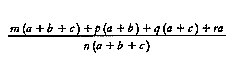
What such a calculation measures is the degree to which a given classificatory system conforms to a set of explicitly defined, consistent criteria. It does not touch the fit of the scheme with nature, and Lambert, who was no naturalist, did not discuss the specific problems of botany or any other particular field. Nevertheless, Lambert's conviction that systematics could be treated as an extension of mathematics, and his implicit commitment to the wide applicability of the systematic model, do indicate once more the confluence of that model and the late Enlightenment's ambition to establish a general science of order.
Considered in a wider perspective, mathematics and the systematic model may also be associated as instruments of a movement of rationalization that was pervasive in the late Enlightenment. This movement found literary expression in numerous encyclopedias and dictionaries, of which the Encyclopédie was only the most famous.[28] It appeared in government in forms as diverse as attempts to monitor
[27] Ibid., 329–37.
[28] Stearn, "Introduction," 11–2.
and improve public health through statistics, formulation of the metric system, and the shaping of armies as tools of the absolutist state. It entered the empirical sciences as an effort to classify their objects and reform their nomenclatures. Often its actions, especially in the sciences, were driven by pedagogy, as professors sought to order their subjects for presentation to students. Everywhere rationalization harnessed the geometrical spirit that, in different ways, informed both mathematics and the systematic model.
The development of systematic botany and of the fields for which it came to serve as a model was conditioned by material and social factors that remain to be investigated in detail. By the mid-18th century botany had long since achieved its intellectual independence of medicine, although—as the case of Linnæus indicates—important institutional links were preserved. Exploration and empire now provided the richest opportunities and resources for botanists and zoologists. Like early Christians spreading their creed over Roman roads, 18th-century naturalists were moved by their own sort of zeal to the far-flung corners of European colonial and commercial empires, and brought or sent back the specimens that gave substance to the systematists' projects. Adanson's experience in Senegal is an excellent case in point. Mineralogy owed much to the increasing need for technical expertise in mining and metallurgy, and chemistry was stimulated by its ever-closer association with pharmacy and industry. Nosology, of course, was an integral part of medical theory. The stimulus afforded by the high popularity of natural history among the educated classes must not be overlooked. Linnæus' productive stay in Holland from 1735 to 1738 was largely supported by the patronage of a wealthy banker, George Clifford. The mineralogist, Jean Baptiste Louis Romé de l'Isle, too, long derived his sole financial support from wealthy patrons with amateur interests in natural history. Another mineralogist, René Just Haüy, was himself an amateur botanist. And the medical profession, historically sensitive to areas of science invested with prestige by the lay public, could not fail to be affected by the popular prestige accorded the natural history disciplines.[29]
[29] Stearn, "Introduction," 8–10; Blunt, The compleat naturalist , 102–8, 116–8.
The need for rationalization was felt most acutely in fields untouched by the great synthesis of Newton and the continental mathematicians. The mathematicians had provided a new basis for sciences—including astronomy, optics, and mechanics—that had already acquired mathematical form. In other fields, for which the conceptual structure was less secure or coherent, the order of the day was the gradual establishment of foundations. For some of these, such as electricity and magnetism, the path led from discursive theorizing and experimental manipulation to mathematization.[30] For others, including chemistry and medicine as well as natural history, the systematic model of order was decisive. Where electricity and magnetism had to deal with specialized physical phenomena, the latter fields had to contend with an ever increasing quantity of diverse specimens.[31]
Mineralogy
The pervasiveness of the model's influence between 1760 and 1810 is well exemplified in mineralogy, chemistry, and medicine. Spurred by the practical needs of mining and metallurgy and the curiosity of naturalists, mineralogy was an active field in the latter 18th century. Linnæus included a scheme for the mineral kingdom in the Systema naturae . His example was decisive both in his implicit commitment to the existence of mineral species, and in his use of crystalline form as classificatory criterion. The formal parallel between crystalline forms and the sexual parts of plants was strengthened by the analogy he perceived between the chemical formation of crystals
[30] J.L. Heilbron, Electricity in the 17th and 18th centuries: A study of early modern physics (Berkeley: University of California Press, 1979).
[31] "If the multiplicity of objects to be described has been the true source of this useful method, and if it was on account of this multiplicity that Linnæus believed he had to imagine a new and short method to characterize these objects, should not all the natural sciences, in which the facts and observations multiply in such a way that they require the presentation of immense details, follow the same path and adopt the same descriptive system?" Antoine Fourcroy, s.v. "Caractères," Encyclopédie méthodique: Chimie, pharmacie et metallurgie , 6 vols. (Paris, 1786–1815), 2 (1792), 784–5.
and the reproduction of living things, an analogy that assured constancy of species in the mineral as in the plant or animal kingdoms. Linnæus distinguished each mineral genus by a basic geometrical figure, and the species within each genus by truncation of the edges or angles of the generic figure. In keeping with his general practice, he assigned each species a genus-species binomial.
Linnæus' system entirely subordinated physical and chemical properties of minerals to the geometrical form of the crystal. In part this may be attributed to the weakness of contemporary chemical analysis and to the absence of quantitative techniques for the measurement of physical properties like hardness. Far more determinative, however, was the compatibility of crystalline form with the requirements of Linnæus' systematic model. Just as the sexual system abstracted from the plant just those visible qualities that could be expressed in numbers or spatial relationships, so did crystalline form abstract from the mineral visible external characters that could be numerically or geometrically defined.[32]
Linnæus' mineral scheme did not enjoy the success of the sexual system. Mauskopf has identified three distinct approaches to mineral classification in the last quarter of the 18th century, based on chemical analysis, groups of external characteristics, and crystal form. All three recognized the need to know chemical composition. Given the state of chemistry at the time, however, chemical criteria were very difficult to apply. The other two approaches looked for characteristics other than the chemical that would still express degrees of essential identities and differences.[33]
In 1774 Abraham Werner, a professor of mineralogy at the mining school of Freiberg, published a work entitled On the external characters of minerals . Aiming to produce a practical handbook for the miner and naturalist, Werner made use of readily accessible mineral characteristics like color, shape, hardness, and texture. He did not
[32] John G. Burke, Origins of the science of crystals (Berkeley and Los Angeles: University of California Press, 1966), esp. 52–77; Seymour H. Mauskopf, "Crystals and compounds: Molecular structure and composition in 19th-century French science," American Philosophical Society, Transactions, 66:3 (1976), 7–20.
[33] Mauskopf, "Crystals," 14.
group his species in higher categories, but did restate the Linnæan concept of primary forms of crystals, and pointed out that certain forms were related and could be derived from one another by truncation.[34]
More theoretical, and more directly in the Linnæan tradition, was the work of the French crystallographers Romé de l'Isle and Haüy. Both came to mineral classification by way of crystallography. In his Essai de cristallographie of 1772 and his revised and expanded Cristallographie of 1784, Romé de l'Isle attempted a comprehensive classification of crystals based on the theory that there were a limited number of primitive crystalline forms. In his theory, the diversity of forms observed in nature arose from variations on the primitive ones induced by different conditions of solution or by varying proportions of the constituent chemical principles. The Cristallographie incorporated steps toward a quantitative science of crystals, including use of the contact goniometer and statement of the fundamental law of constant interfacial angles.[35]
Linnæus had not drawn a hard-and-fast line between the kingdoms of living things and minerals. He had therefore not felt a need to justify mineral taxonomy. As the line between organic and inorganic was more and more sharply drawn, however, the need for justification and explicit methodological discussion became inescapable. Prompted by an essay of Louis Daubenton that denied the existence of mineral species, Romé de l'Isle made explicit his commitment to their reality, distinctness, and fixity. In Des caractères extérieurs des mineraux (1784), he argued that invariable laws of chemical affinity assured the same fixity for mineral species that reproduction did for organic ones. In practice, however, he relied on more accessible external features—crystal form, hardness, density—that he presumed to be the direct expression of uniform chemical composition.[36]
[34] Ibid.; Burke, Origins , 59–62.
[35] Mauskopf, "Crystals," 9–11; Burke, Origins , 62–7, 69–77; R. Hooykaas, s.v. "Romé de l'Isle," DSB, 11 , 520–4. See also R. Hooykaas, La naissance de la cristallographie en France au XVIIIe siècle (Paris: Palais de la Découverte, 1953).
[36] Mauskopf, "Crystals," 16–8; Burke, Origins , 71–7.
Haüy is said to have come to crystallography from botany, seeking a mineral analogue to botanical regularities of form. If so, the botanical inspiration did not immediately extend to questions of mineral taxonomy, for in the Essai d'une théorie sur la structure des cristaux of 1784 Haüy denied the relevance of crystal form to mineral classification. The Essai introduced the concept of the molécule constituente (later termed the molécule intégrante ), a theoretical entity understood as the smallest molecule of a crystal that displayed a characteristic chemical composition and geometrical form. In his emphasis on the geometry of the molécule intégrante and its relationship to the geometry of macroscopic crystals, and in his insistence on the agreement of theoretical and measured results, Haüy took a decisive step in the mathematization of crystallography and attracted the patronage of Laplace. He also provided an original basis for mineral taxonomy.[37]
In a paper of 1793, Haüy defined the mineral species in chemical terms, remarking that just as in botany it is reproduction that assures uniformity in the species, so in mineralogy it is the nature and proportions of the combined chemical principles that guarantee specific identity. In this sense, Haüy argued, chemistry is well suited to accomplish one of the two main purposes of method, that is, classification. For the other purpose—the ready recognition and naming of bodies—chemistry is ill adapted, however, if only because chemical analysis often requires long and laborious procedures that use up all or part of the specimen. Seldom can species be grouped into genera by a single character that is easy to recognize. Thus classification in mineralogy does not compare favorably with that in botany, "where the characters, always drawn from the figure of the organs, that is to say, from a modification that is plainly visible (qui parle aux yeux ) follow a simple, uniform course, and have the merit of offering a picture in which a small number of colors suffice to give a rich and varied expression." In botany, unlike mineralogy, the same means serve the ends of both classification and recognition. A useful
[37] Mauskopf, "Crystals," 18–9; Burke, Origins , 108–13; R. Hooykaas, s.v. "Haüy, René Just," in DSB, 6 , 181–2; Roger Hahn, chap. 13 in this volume.
mineralogical method therefore involves much more groping than is the case in botany.[38]
In Haüy's major work of the early 19th century, the molécule intégrante figures in the chemical composition and geometrical form that defined mineral species. The molécule intégrante was, however, a theoretical entity. In practice the results of crystallography and chemistry sometimes diverged. Bodies grouped together by crystallography might be separated by chemistry, and vice versa. Some of this dissonance might be accounted for, Haüy argued, by the imperfection of current chemical analysis or by impurities in the mineral samples. So far as species determination was concerned, however, crystal structure offered the more certain guide: "Only for geometry are all minerals pure." Crystal form, more accessible and less ambiguous than chemical composition, dominated Haüy's determination of species, while his genera, orders, and classes were decided by chemical composition[39] (fig. 3.3).
The practical difficulties resulting from the use of both chemical and crystallographic criteria in mineral classification are reflected in Haüy's struggles with nomenclature. His ideal was a binomial based on the new chemistry by Lavoisier and his circle. The state of the art did not make the ideal possible. In practice, therefore, the unavoidable mix of chemical and crystallographical criteria blurred the clarity of Haüy's nomenclature, which remained only partially rationalized.[40]
[38] René Just Haüy, "Mémoire sur les méthodes minerologiques," Annales de chimie, 18 (1793), 225–40, on 237 (quote).
[39] Haüy, Traité de mineralogie , 5 vols. (Paris: Conseil des Mines, 1801), and Tableau comparatif des résultats de la crystallographie et de l'analyse chimique relativement à la classification des mineraux (Paris: Courcier, 1809), i-xxxv, on xv. In the Tableau comparatif , Haüy once more showed that he had a close eye on the practice of botanists, calling crystals "the flowers of minerals," comparing crystalline structure to the organization of living things, and citing A.-L. de Jussieu as a model in the presentation of classificatory results. He also justified measures taken to enhance the unity and simplicity of his systematic methods by appeal to l'esprit géométrique. Tableau comparatif , xvii-xix, xxv. For a more detailed discussion of Haüy's double method of classification, see R. Hooykaas, "The species concept in 18th-century mineralogy," Archives internationales d'historire des sciences, 18 (1952), 45–55.
[40] R. Hooykaas, "Haüy," DSB , 181–2.
Chemistry
In mineralogy the two modalities of the geometrical spirit—systematics and mathematics—intersected at Haüy's theory of crystal structure. A similar convergence and intersection may be seen in chemistry, though with a difference. Whereas in mineralogy the point of contact between systematics and mathematics lay in criteria of classification, in chemistry it was most pronounced in the establishment of rationalized nomenclature. The chemists' reform of their system of naming was inspired by algebra, legitimized by philosophy, and modeled on botany.
By the third quarter of the 18th century, pressure was mounting for reforms in the language of chemistry. A growing list of substances, of which the newly isolated atmospheric gases formed only a part, raised the problem of how names should be formulated. Criticism of the dominant phlogiston theory highlighted the potential theoretical content of chemical names. The views of the philosopher Condillac, for whom a science was a well-made language based on the natural order of mental processes and on exact correspondences between words and things, were gaining increasing currency among French savants.
Only after Linnæan systematics became available as a model and was so perceived by chemists was substantial progress made. The initiative came from Linnæus' student, the professor of chemistry at the University of Uppsala, Torbern Bergman. Bergman was disturbed by the lack of system and order in chemical names. A name might be based on the appearance or properties of a substance, its place of discovery or occurrence, the name of its discoverer, or its alchemical association with the planets. As new substances became known to chemists, they were assigned names ad hoc. The resulting confusion and imprecision of language made it difficult for aspiring chemists to master their subject and for established chemists to communicate with colleagues. In the 1770s Bergman set out to formulate a binomial system that would do for chemistry what Linnæus had done for botany.[41]
[41] Maurice P. Crosland, Historical studies in the language of chemistry (Cambridge, Mass.: Harvard University Press, 1962), 139–52; Douglas McKie, Antoine Lavoisier: Scientist, economist, social reformer (New York: Schuman, 1952), 263.
Bergman's project gained a positive reception from the French chemist Guyton de Morveau. In a paper of 1782, Guyton cited the rapid increase in the number of known substances in the preceding twenty years as a major motive for reform. Another motive came from theoretical changes in chemistry as a result of Lavoisier's studies of combustion and the overthrow of the phlogiston theory. In the 1780s Lavoisier's theory was accepted by major scientists, including the physicist Laplace and the chemists Berthollet, Guyton de Morveau, Antoine Fourcroy, and Joseph Black. With the ensuing controversies, the problem of nomenclature became still more acute, since the terminology embodied theoretical views.[42]
In France, Lavoisier, Guyton de Morveau, Berthollet, and Fourcroy joined to suggest appropriate reforms. One of the central pieces of the resulting Méthode de nomenclature chimique , which appeared in 1787, was an article by Lavoisier explaining the principles on which the proposed reforms were based. Lavoisier's interest in precise language and nomenclature was based in part on his impression of the contrast between the systematic, logical exposition of mathematical physics and the confusion and disorder of chemistry. He had also been impressed with Condillac's writings. Citing Condillac, Lavoisier emphasized the need for control of chemical reasoning by consistent reference to observation and experiment, a requirement closely connected with the reform of nomenclature. In Lavoisier's view there was to be an exact correspondence between a fact, the idea of the fact, and the word used to express the idea.[43]
Lavoisier and his collaborators tried to arrive at a list of simple substances, that is, of bodies they could not decompose by any existing means of chemical analysis. The total of these substances came to
[42] Crosland, Historical studies , 153–76.
[43] Guyton de Morveau et al., Méthode de nomenclature chimique (Paris, 1787), 1–25; Antoine-Laurent Lavoisier, Elements of chemistry, in a new systematic order, containing all the modern discoveries (New York: Dover, 1965), xiii-xxxvi; Crosland, Historical studies , 153–92. On Condillac, see Isabel Knight, The geometric spirit: The Abbé de Condillac and the French Enlightenment (New Haven: Yale University Press, 1968), and Robin Rider, chap. 4 in this volume.
fifty-five. Most already had well-known names, which the reformers decided to keep unless they gave rise to confusion. If so, or if the substance was new, a new name would be given, usually derived from Greek and expressing the substance's most general properties. An example was hydrogen, so called because it was one of the constituents of water. To deal with the great many bodies composed of two simple substances, it was necessary to establish a classification. Here the binomial nomenclature modeled on botany took effect. The acids, which Lavoisier thought of as composed of oxygen plus one other simple substance, are a good example. Sulfuric acid is the combination of sulfur with oxygen. The similar acid containing less oxygen was called sulfurous acid . The metallic calces, which Lavoisier had shown to be compounds of metals and oxygen, had the generic name oxide and specific names derived from the names of the metals. The reforming chemists listed the simple substances, and gave a classification of their compounds with examples, in an expansive tableau de la nomenclature chimique . The result was a revolution in the language of chemistry that made the chemical name of a substance a direct expression of its elementary composition.[44]
Underlying Lavoisier's theory of acids was his prior commitment to the existence of a systematic order for chemicals analogous to those already established for the plant and animal kingdoms. Four-croy made this commitment explicit. Writing in the Encyclopédie méthodique , he praised the Linnæan method for establishing the characters by which natural objects are recognized and described, for expressing these characters in concise phrases in which words represent precise ideas, and for reducing the description (tableau ) of immense numbers of objects to a single comprehensive framework. Fourcroy recalled that when he began to teach chemistry his mind was full of the language and descriptions of Linnaeus, and at the same time weighed down with the immense quantity of chemical properties and experiments that he found in the existing literature. The reform of chemical nomenclature in which Fourcroy had
[44] Méthode de nomenclature chimique , 26–100 (table follows p. 100); Lavoisier, Elements , xxv–xxviii.
participated had been conceived and executed in a spirit "analogous to that which had directed Linnaeus," and "we therefore find in modern chemical nomenclature a course similar to that adopted in natural history." Chemical compounds could be arranged in classes, orders, genera, and kinds (sortes ) on the basis of their principal and common properties characterized simply and concisely. In the article "axiomes chimiques ," Fourcroy presented such a scheme, which included 34 genera of salts estimated to total some 240 species. Evidently prompted by Lavoisier's naming of oxygen, Fourcroy suggested that the three species making up the genus alkalis are all formed by combinations of nitrogen with other substances, and that nitrogen or azote should therefore be called alcaligène . Lavoisier and Fourcroy were soon proved wrong in their theories of acids and alkalis, but both theories testify to the strength of the impulse to establish clear generic categories for chemistry.[45]
Medicine
If the role of the systematic model in chemistry was centered on the problem of nomenclature, its influence in medicine was most clearly perceptible in questions of definition, description, and classification of disease. The desire to bring order to a large and ill-integrated body of knowledge, disillusionment with the results of mechanistic or chemical physiology in practical therapeutics, and a need to overcome the opposite extreme of radical skepticism, were among the factors behind the development of nosology, as medical systematics came to be called.
[45] Encyclopédie méthodique, chimie, pharmacie, metallurgie, 2 , articles "Alkalis," "Axiomes chimiques," and "Caractères," on 20–9, 455–89, 784–5, resp. The formlessness that Fourcroy found in chemistry when he began to teach the subject in the 1770s had also been noted by J.H. Lambert, who pointed to chemistry textbooks as examples of "a very inferior degree of order" in the arrangement of the different parts of a science. Lambert, "Essai de taxéometrie," 337. The importance of generic categories in shaping chemical perception and research is discussed for a particular case in John E. Lesch, "Conceptual change in an empirical science: The discovery of the first alkaloids," Historical studies in the physical sciences, 11 (1981), 305–28.
The beginnings of the systematic model in medicine appear early in the writings of the English physician of the late 17th century, Thomas Sydenham. A friend of Locke and admirer of Francis Bacon, Sydenham called for the setting aside of hypotheses and philosophical systems in favor of "a natural description or history of all diseases." He took the significant step of asserting that as there were species of plants, so too there were species of disease. This implied that diseases were distinct entities, not merely disturbances blending into one another, and that these distinct entities could be systematically grouped or classified. In practice Sydenham concentrated on exact definition and description. He gave concise accounts of smallpox, dysentery, cholera, plague, and other diseases. He was the first to differentiate between measles and scarlet fever, and his description of gout made possible its separation from rheumatism. For Sydenham specificity of disease implied specificity of remedy, and it was this idea, as much as the example of cinchona bark for malaria, that was behind his doctrine of specific medicines.[46]
The 18th century continued Sydenham's botanical approach while shifting its emphasis from description of individual species to comprehensive classifications using higher taxonomic categories. The first such effort was made by François Boissier de Sauvages, a professor at the medical school of Montpellier familiar with contemporary botany. Sauvages' Treatise on the classes of diseases of 1731 arranged its objects in classes, orders, and genera as well as species. His major work carried the instructive title Methodical nosology, in which diseases are arranged by classes according to the system of Sydenham and the order of the botanists . Like Sydenham, Sauvages distrusted contemporary physiological theories and rejected the idea that a classification of diseases could be based on knowledge of their
[46] Knud Faber, Nosography in modern internal medicine (New York: Hoeber, 1923), 5–49; Lester S. King, The medical world of the 18th century (Huntington, N.Y.: Krieger), 193–226; Michel Foucault, The birth of the clinic. An archeology of medical perception (New York: Pantheon Books, 1973), 3–21; and Sergio Moravia, "Philosophie et médecine en France à la fin du XVIIIe siècle," Studies on Voltaire and the 18th century, 89 (1972), 1089–1151, esp. 1129–38. On Sydenham, see also The works of Thomas Sydenham , 2 vols. (London: The Sydenham Society, 1848–50), 1 , 3–24.
underlying causes. He insisted that classification be based instead on study of directly observable symptoms. Species definition depended largely on designation of the various circumstances in which symptoms might appear. Species proliferated accordingly, finally reaching 2,400, divided into 315 genera, 44 orders, and 10 classes.[47]
Sauvages set the pattern for the nosology of the latter 18th century. Linnaeus had been a medical student when Sauvages' first book appeared in 1731. Subsequently the two men corresponded, became friends, and influenced one another. When he became professor of medicine at Uppsala, Linnaeus based his lectures on Sauvages' nosological system. In 1763, the year that Sauvages' Methodical nosology appeared, Linnaeus published his own work on Genera morborum . Given the long-standing botanical association of nosology, the increasing success and prestige of Linnaeus' botanical system after midcentury no doubt strengthened the appeal of the nosological approach to medicine. There is a clustering of nosological treatises in the 1760s and 1770s. Vogel published at Göttingen in 1764; Cullen, at Edinburgh in 1772; Macbride, at Dublin in 1775; Sagar, at Vienna in 1776; and Vitel, at Lyons in 1778. All of these works followed Sauvages in departing from Sydenham's original emphasis within the systematic program. Rather than seeking new, more accurate descriptions of disease, the nosologists of the latter 18th century took existing descriptions and tried to catalogue and group them, usually on the basis of symptoms.[48]
The nosologists' insistence on observable symptoms as criteria of classification reveals in several ways the kinship of their enterprise with contemporaneous systematic endeavors in other fields. It is analogous to the use of visible external characters in botany and
[47] François Boissier de Sauvages, Nouvelles classes de maladies, qui dans un ordre semblable à celui des botanistes, comprennent les genres et les especes de toutes les maladies, avec leurs signes et leurs indications (Avignon, 1731), and Nosologia methodica sistens morborum classes, genera et species juxta Sydenhami mentem et botanicorum ordinem , 2 vols. (Amsterdam: De Tournes, 1763). See also King, The medical world , 205–14.
[48] Linnaeus, Genera morborum, in auditorum usum (Uppsala, 1763); Fredrik Berg, "Linnés systema morborum," Uppsala Universitets Årsskrift , 1957:3, 1–132; King, The medical world , 198–204; Faber, Nosography , 25–6.
mineralogy and appears consonant with their empiricist philosophical posture. It is also artificial, not in the sense of limiting the numbers of external characteristics to be considered, but in the sense of ruling out, at least for the moment, consideration of the structural and functional processes underlying disease.
The Paris clinical school of the early 19th century would challenge what it took to be the superficiality of this approach and insist that diseases be studied in anatomical depth, in the structural changes they produced in the organs and tissues of the body. The transition can be seen in the work of the Paris physician Philippe Pinel. Pinel's Nosographie philosophique, ou la méthode de l'analyse appliquée à la médicine , first appeared in 1798, and went through six editions in two decades (fig. 3.4). On the surface it is a work of the 18th century. To be sure, Pinel was critical of the "overloaded tables" and "arbitrary and vacillating" classifications of his predecessors. He granted, however, that there was an "absolute necessity" for some such method to save physicians from uncertainty, perplexities, risk, and precipitous decisions, and to save patients from mistakes. Pinel accepted the validity of the systematic model for medicine, and attempted to describe and classify the full range of known diseases.
In making his nosography "philosophical" and in citing the "method of analysis," he referred to the same views of Condillac that had helped motivate Lavoisier's reform of chemical nomenclature and Haüy's revision of the language of mineralogy. He declared that he would replace the earlier medical motto, "Given a disease, find the remedy," with a new motto of his own: "Given a disease, determine its true character, and the rank that it must occupy in a nosological table." Viewed more closely, however, Pinel's approach does not exactly correspond to that of his predecessors:
We must make every effort [he wrote] to introduce into medicine the method now followed in all the other parts of natural history, that is, a severe exactitude in descriptions, precision and uniformity in nomenclature, a wise reserve in rising to general views without giving reality to abstract terms, and a simple, regular classification founded invariably on the relation of the structure or organic functions of the parts.
The last crucial phrase separates Pinel's work from the nosologies of the 18th century. For Pinel a valid classification had to be based not only on symptoms but also on pathological anatomy. The class of inflammations—to give only one example—Pinel divided into orders on the basis not of symptoms but of the kind of membrane that was attacked. The result was a system greatly simplified by comparison with earlier nosologies. It included 5 classes, 80 genera, and fewer than 200 species of disease. As Pinel's Nosography went through successive editions, the classificatory scheme itself became less and less prominent. With the last edition of 1818, the 18th-century tradition of nosology came to an end.[49]
The varied expressions of the systematic model in mineralogy, chemistry, and medicine only begin to indicate the omnipresence and diversity of its applications in the late Enlightenment. Some idea of this variety may be gained from a brief look at several of the model's less predictable incarnations, in mathematics, physics, mechanics, the theory of machines, physiology, anatomy, and materia medica.
Varia
If the geometrical spirit is found in systematics, the systematic spirit is also found in geometry, more precisely in analytic geometry. The field that joined algebraic analysis and geometry for the benefit of each was the subject of intense activity in the first half of the 18th century. The study of curves was taken up first primarily as a means to determine the roots of equations. Increasingly curves came to be of interest in themselves, however; and by midcentury they had become a candidate for systematization. Leonhard Euler's Introductio in analysin infinitorum (1748) and Gabriel Cramer's Introduction à l'analyse des lignes courbes algébriques (1750) were largely successful, though different, efforts to meet the need for systematic order acknowledged by both.[50]
[49] Phillippe Pinel, Nosographie philosophique, ou la méthode de l'analyse appliquée à la é;decine , 6th ed. (Paris: J.A. Brosson, 1818), iv–xviii; Faber, Nosography , 28–30; King, The medical world , 224–6.
[50] Pierre Speziali, Gabriel Cramer (1740–1752) et ses correspondents (Paris: Palais de la Découverte, 1958), 14–6; Phillip S. Jones, s.v. "Cramer, Gabriel," DSB, 3 , 459–62; Pierre Speziali, "Leonard Euler et Gabriel Cramer," in Leonhard Euler 1707–1783. Beiträge zu Leben und Werk (Basel: Birkhäser, 1983), 421–34; Carl B. Boyer, History of analytic geometry (New York: Scripta Mathematica, 1956), 180–91.
Cramer's treatise, described by Speziali as "a true encyclopedia of algebraic curves," was well received in the latter 18th century and remained a classic text well into the 19th. Although Cramer conceded that the ancients had formulated useful particular propositions about curves, he gave modern mathematics high marks for its method, its art of deducing from a single universal principle a great number of truths, submitting them to general rules, and connecting them so as to stimulate new discoveries. Algebra, the "universal key of mathematics," provided the mathematician with "an ingenious means of reducing problems to the simplest and easiest calculation that the question proposed can admit."[51] And the key to algebra was the curve. A proper distribution of curves into orders, classes, genera, and species would serve mathematicians as a "well-arranged arsenal," enabling them to choose without hesitation the arms that might serve in the resolution of a proposed problem. Cramer credited Newton, whose Enumeratio linearum tertii ordinis had first appeared in 1704, with opening the way to such a classification.[52]
Cramer defines the order of algebraic curves "according to the degrees of their equations. . . . Thus one may form, for each order of lines, a general equation that represents all the possible lines of this order." To do so, Cramer makes use of J.P. de Gua de Malves' analytic triangle, a modified version of Newton's parallelogram arrangement of the terms of algebraic equations. The analytic triangle gives the different terms of a general equation of a given degree on a horizontal line, starting with a degree zero (a ) at the bottom, then degree one (by, cx ), degree two (dy[2] , exy, fx[2] ) and so on.[53]
[51] Speziali, Cramer , 17–8; Boyer, History of analytic geometry , 193–6; Gabriel Cramer, Introduction à l'analyse des lignes courbes algébriques (Geneva: Les Frères Cramer & Cl. Philibert, 1750), vi–vii; Moritz Cantor, Vorlesungen über Geschichte der Mathematik, 2d ed., 4 vols. (Leipzig: Teubner, 1907–13), 3 , 605–9, 823–41.
[52] Cramer, Introduction , vii–ix; W.W. Rouse Ball, "On Newton's classification of cubic curves," London Mathematical Society, Proceedings, 22 (1890–91), 104–43; Boyer, History of analytic geometry , 138–40, 146–7; and D.T. Whiteside, ed., The mathematical papers of Isaac Newton , 8 vols. (Cambridge: Cambridge University Press, 1967–81), 1 , 155–212; 2 , 10–88; 4 , 346–405; and 7 , 565–655.
[53] Using the triangle Cramer derives the formula v[2] /2 + 3v /s for the number of coefficients of the general equation of degree v , and concludes from this that a curve of order v can be made to pass through v /2 + 3v /2 points. The demonstration leads him into presentation of a rule for solving v linear equations in v unknowns. This rule, together with a paradox developed out of the same formula, had its own subsequent history. See Cramer, Introduction , xi, xiii–xiv, 52–70, esp. 52–60; Jones, "Cramer," 460–1.
The subdivision of the first five orders of curves into their classes and genera is accomplished via the number, nature, and position of the infinite branches of each type of curve. The second order contains three classes: the ellipse, of which the circle is one species; the hyperbola; and the parabola. In essentials, Cramer follows Newton's Enumeratio in his division of third-order curves into four classes and fourteen genera. His fourth order has nine classes, based on the number and the hyperbolic or parabolic character of the infinite branches of its curves. For example, the eighth class contains the curves that have six hyperbolic branches. This class contains three genera: those curves that have only two, nonparallel asymptotes; those that have three asymptotes, of which two are parallel; and those that have three nonparallel asymptotes. The fifth order has eleven classes, defined by procedures similar to those for the fourth order (fig. 3.5).[54]
Cramer's classification, although comprehensive for its subject, was confined to plane curves. In the 1770s several mathematicians, including Euler, Joseph Louis Lagrange, and Gaspard Monge, began to take analytic geometry into three dimensions. From the outset of his epoch-making work in this field, Monge had as one of his concerns the groupings of its objects. In his Feuilles d'analyse (1795 and 1801) he discussed some twenty families of surfaces defined by their mode of generation.[55]
The Feuilles d'analyse first appeared as notes to Monge's course at the Ecole polytechnique, where as professor he was responsible for solid analytic geometry. Finding himself without a satisfactory
[54] Cramer, Introduction , 352–99.
[55] Gaspard Monge, Feuilles d'analyse appliquée à la géométrie (Paris, 1795); René Taton, "Une correspondance mathématique inédite de Monge," Revue scientifique , 85 (1947), 963–89, esp. 979–82; Taton, s.v. "Monge, Gaspard," DSB, 9, 469–78; and L'Oeuvre scientifique de Monge (Paris: Presses Universitaires de France, 1951), 209–20; Boyer, History of analytic geometry , 204–25.
textbook, he was compelled to put his results in systematic order. Similar pedagogical challenges created by the new Ecoles helped motivate other efforts at systematization and rationalization during the Revolution and the First Empire. In these efforts, the full systematic model in its Linnæan form, with logically nested categories—especially the canonical five, class, order, genus, species, variety—and binomial nomenclature, was frequently replaced by other arrangements more or less improvised for the matter at hand. Natural history categories might or might not be used, rationalized nomenclature might or might not be a goal, and other qualities of the full model such as numeration or formalism might be present in different degrees. What these undertakings did consistently have in common with the full systematic model were its emphasis on rationalization and method, its aim for comprehensiveness, and its promise of utility.
The work of Etienne Barruel, an examiner in physics at the Ecole polytechnique, is a case in point. As its title advertises, Barruel's textbook, Physics reduced to systematic tables (1799), offered students a complete summary of current physics in tabular form. Apart from brief prefatory remarks, the entire volume consists of thirty-eight tables, most in large fold-out format.[56]
Barruel defined physics "properly speaking" as the science that considers the properties of natural bodies, in contrast to natural history, which studies their varieties, organization, and so on, and chemistry, which considers their combination. "In the methodical order that I have adopted," Barruel wrote, "a science that has for its object the properties of bodies, cannot be subject to any other division than that of these same properties." Accordingly the first table, labeled tableau général de la physique , lists twenty-one fundamental physical properties, divided into two major groups. The first group comprises properties "that affect bodies in a constant manner" (extension, impenetrability, mobility, inertia, gravity). The second is constituted by properties "that affect bodies in a variable manner" (porosity, sonority, affinity, caloricity, electricity, elasticity, solidity,
[56] Etienne Barruel, La physique réduite en tableaux raisonnée, ou programme du cours de physique fait à l'Ecole polytechnique (Paris: Baudouin, an VII).
liquidity, gaseousness, capillarity, hygrometricity, meteoricity, crystallizability, light, magnetism, galvanism). Barruel subdivides the first group into "constant and essential" properties such as extension and impenetrability, and "constant and non-essential" properties, made up of gravity alone. He subdivides the second major group into "variable properties that belong to all bodies in general," such as porosity and affinity, and "variable properties that belong only to certain bodies," for example hygrometricity and light.[57]
The tableau général characterizes each property in one or two lines. For example, hygrometricity is the property by virtue of which liquids capable of wetting bodies enter their pores. Light is the property by virtue of which bodies excite a vivid impression in the organ of sight. At least one additional table is devoted to each property, elaborating on such points as its manner and circumstances of appearance, the laws to which it is subject, its relation to the senses, or instruments that may make use of it. Light, to give a single example, is the subject of seven tables. The initial division is made according to whether light reaches the eye directly, after reflection, or after refraction. Among the later subdivisions under refraction is a table that considers light in relation to instruments including telescopes and microscopes, subdivided in turn into their kinds.[58]
Except for its initial division of physics according to the properties of bodies, Barruel's text does not have the form of a classification of objects of the same general type (plants, animals, minerals, chemicals, algebraic curves, etc.) according to a determined set of categories. Instead it offers an arrangement of the different aspects of knowledge about what Barruel took to be single things (here properties, such as light) in a table formed by successive dichotomizations. No rule limits the number of dichotomies, and the kinds of criteria by which they are made may vary substantially within the same table. Barruel
[57] Barruel, La physique , 3, and table 1. In a second edition of 1806, Barruel added an introduction that expanded on the characterizations of properties. A revised tableau général redefined the major divisions of properties as physical and chemical. He also revised the content of the tables and changed their order, although the total number remained the same.
[58] Barruel, La physique , table 1, 27–33.
does not attempt a rationalized system of names, and indeed he derides reliance on "a simple nomenclature" for its aridity. Barruel's was nevertheless a project of systematization and rationalization, and he remarked that "it is to be desired that the elements of all sciences were accompanied by similar tables."[59]
One who heeded Barruel's call was Gaspard Prony. In 1800, when he published his Mécanique philosophique , Prony could draw upon five years of teaching experience at Ecole polytechnique. The title deliberately imitated Antoine Fourcroy's Philosophie chimique (1792), for, like Fourcroy, Prony intended to present a synoptic view of his science systematically organized on the basis of an analysis of its elements. Every even-numbered page contained formulas, definitions, and brief discussion. Each facing odd-numbered page was divided into four columns, the first defining the letters in the formulas, the second listing items defined in the text, the third and fourth stating theorems and problems. As far as possible, Prony eliminated demonstrations and "intermediate calculations" in favor of a concise presentation of results.[60]
Prony's procedure embodied a double movement of analysis and synthesis. He began with a complex mass of material—his lectures, current knowledge of mechanics in all its detail—and analyzed it into its matériaux primitifs , its simplest, most fundamental propositions or elements. Out of these he then constructed the complex structure of the science of mechanics, but in such a way that its components were grouped so that their relations were transparent. In this effort of
[59] Barruel, La physique , 3–4.
[60] In five major divisions of the text he covered preliminary notions, including elementary concepts of mechanics; the mechanics of solid bodies, statics and dynamics; the mechanics of fluid bodies, hydrostatics and hydrodynamics; the application of mechanics to machines and engineering problems; and "transcendental mechanics," general propositions such as the principle of virtual velocities or the principle of least action. Gaspard Clair François Marie Riche, baron de Prony, Mécanique philosophique, ou analyse raisonnée des diverse parties de la science d'équilibre et du mouvement (Paris: Imprimerie de la République, an VIII). Fourcroy's work, Philosophie chimique, ou vérités fondamentales de la chimie moderne, disposées dans un nouvel ordre (Paris, 1792), was based on Fourcroy's article, "Axiomes chimiques" for the Encyclopédie méthodique , which in turn was directly inspired by Linnæan systematics. Cf. W.A. Smeaton, s.v. "Fourcroy, Antoine François de," DSB, 5 , 89–93.
systematization, in his implicit commitment to a sensationalist theory of knowledge, and in his remarks on science as a well-made language, Prony revealed his links with the encyclopedic tradition and the philosophy of Condillac as well as the kinship of his work with other systematic endeavors.[61]
Mechanics of a more immediately practical sort was the subject of Jean-Nicolas-Pierre Hachette's Traité élémentaire des machines (1811). A colleague of Barruel and Prony and student of Monge, Hachette taught a course on machines for engineers at the Ecole polytechnique. The Traité was based on these lectures and on the ideas of Monge, who treated the theory of machines as a branch of descriptive geometry.[62]
Hachette limited his treatment to machines that transform motion of one type into motion of another type. The types could be exhaustively enumerated: continuous circular, alternating circular, continuous rectilinear, and alternating rectilinear. These four types of motion make six when taken two at a time; and to these six combinations may be added the four that result when each movement reproduces itself. Hachette concluded, therefore, that there are ten different series of elementary machines.[63] Part of his table of elementary machines is reproduced here (fig. 3.6). Each machine is represented by a picture in a small box. The table presents the ten series of machines in numbered horizontal ranks; capital letters placed above the vertical columns allow a brief designation of each box. So, for example, the box 3a D designates a machine (the windmill) of the third series, which changes continuous rectilinear movement (wind) into continuous circular movement (the mill). Two series, the second and eighth, are empty, for no known machines changed continuous rectilinear into alternating rectilinear motion, or alternating rectilinear motion into itself.[64]
[61] Prony, Mécanique philosophique , i–iv, citing Barruel's La physique as a model.
[62] Jean-Nicolas-Pierre Hachette, Traité élémentaire des machines (Paris: J. Klosterman fils, 1811), x; Taton, "Monge," 477.
[63] Hachette counts each pair of different motions as defining a single kind of machine, even though in these six cases the order, and thus the source of motion and the receiver of motion, may be reversed, and although he concedes that this reversal rarely occurs in the same machine. Hachette, Traité , 4–5, 7–8.
[64] Hachette, Traité , 6–8, 261–9.
The inclusion of two empty series in the table reveals in a graphic way the a priori and arithmetically determined character of Hachette's systematization. He identifies an exhaustive set of possibilities, subdivides them, and distributes existing machines into the preexisting categories. Once again, mathematics intersects the systematic model in criteria of classification.
Prompted in part by the same pedagogical needs that moved Monge, Prony, and Hachette, physiologists and anatomists analyzed and reanalyzed the human body into its functional and structural elements, classified these elements, and provided them with rationalized nomenclature. Xavier Bichat, who taught surgery at the Hôtel-Dieu in Paris, ordered the vital properties into which he analyzed the phenomena peculiar to living things into classes, genera, species, and varieties, and associated the divisions with the elementary tissues yielded by his anatomical analysis. Bichat published his work in a series of textbooks. So, too, did the professors of medicine, François Chaussier and Charles Louis Dumas, who were determined to provide their students with a rationalized nomenclature and classification of the parts of the human body.[65]
Physicians and pharmacists disturbed by radical criticism of traditional materia medica and drug therapy turned to the systematic model as the key to rationalization of knowledge of medicines. Pharmacists had an especially strong motive for reform, since the legitimacy of the body of esoteric knowledge on which their claim to a professional status comparable to that of physicians and surgeons was being threatened. From the 1780s on, systematic arrangements of the materia medica proliferated, especially in France, where differing
[65] William R. Albury, "Experiment and explanation in the physiology of Bichat and Magendie," Studies in history of biology, 1 (1977), 47–131; Lesch, Science and medicine in France , 62–8; François Chaussier, Tableau synoptique des muscles de l'homme (Paris: T. Barrois le jeune, 1797), and Exposition sommaire de la structure et des differentes parties de l'encéphale ou cerveau suivant la méthode adoptée à l'Ecole, de médecine de Paris (Paris: Théophile Barrois, 1807), and Planches anatomiques à l'usage des jeunes gens qui se destinent à l'étude de la chirurgie, de la peinture et de la sculpture. . .avec des notes et explications suivant la nomenclature méthodique de l'anatomie et des tables synonymiques , 2d ed. (Paris: Pancoucke, 1823); Charles Louis Dumas, Système méthodique de nomenclature et de classification des muscles du corps humain (Montpellier: Bonnariq, Avignon et Migueyron, an V).
versions were published by Antoine Fourcroy, Xavier Bichat, C.J.A. Schwilgué, Jean Alibert, and Jean Baptiste Barbier.[66]
Conclusions
The diversity of its applications places in clear relief both the ease with which the systematic model could be brought to bear on different subject matters and its prestige and pervasiveness among late Enlightenment thinkers as a way of ordering knowledge or experience. The systematic model rode a wave of enthusiasm that carried it above and beyond its connections to any particular field of inquiry. Its successes may be readily catalogued. They are not so easily explained, although several conclusions may be ventured on the basis of the preceding analysis.
In several cases, the adoption of rationalized nomenclature or the systematic grouping of the objects of a field in hierarchical categories was the result of a direct modeling on systematic botany, and not simply the expression of a more fundamental impulse of which botany itself was one manifestation. As Foucault pointed out, botany enjoyed epistemological precedence in the classical age, if only because the externality of the significant characters of plants lent itself most easily to specification of degrees of identity and difference according to visible marks. The role of the botanical model is also suggested by the temporal priority of systematic botany, which had emerged full-fledged by the middle of the 18th century. Tentative efforts for parallel reforms in medicine, mineralogy, and chemistry are visible before consolidation of Linnæan botany, but it was only after this consolidation that substantial movement took place in other fields. The serious botanical interests evident in the early careers of such key figures as Sauvages in medicine and Haüy in mineralogy, and the involvement of Linnæus himself in the systematics of minerals and diseases, lend further support to the view that systematic botany served as a model for other fields.
[66] Lesch, Science and medicine in France , 130–5, 145–8.
Utilization of the model was not mechanical and uniform. Each field seized on those aspects that promised to meet its own most pressing requirements. For chemists it was above all the possibility of a rationalized and radically simplified nomenclature that appealed. For mineralogists and physicians it was the concept of species, the emphasis on exact description, and the promise of a comprehensive ordering of data that counted most. For all of these fields, and for others such as analytic geometry, mechanics, the theory of machines, physiology, anatomy, and materia medica, the rationalization made possible by the systematic model was in part motivated by, and often served the needs of teaching.
The place and importance of the systematic model in the late Enlightenment was enhanced by its resonance with other elements of the time. The kinship and—on occasion—the intersection of the model with mathematics as modalities of the geometrical spirit have been mentioned. Systematics and mathematics were also associated in the prevailing epistemology, best represented by Condillac. Condillac's name and ideas reappeared again and again in applications of the systematic model to fields as diverse as chemistry, mineralogy, nosology, and anatomy. Although his inspiration came from algebra, Condillac's stress on science as a well-made language helped to motivate and sanction attempts to construct rationalized systems of nomenclature. His emphasis on the epistemological priority of sensations validated the use of externally observable features as criteria of classification. And his notion of analysis underlined the importance of seeking the elementary constituents out of which any larger whole was constituted.
In their efforts to systematize and rationalize all knowledge within their chosen domains, proponents of the systematic model moved easily with the broader currents of the encyclopedic movement. As W.T. Stearn has noted, Linnæus was a born encyclopedist in the extent of his knowledge of particulars, in the clarity and concision of his expression, in his industry, perseverance, and talent for methodological organization, and in his attention to utility. Adanson not only contributed to the Encyclopédie , but conceived vast encyclopedic ambitions of his own. Systematic efforts in particular subject areas
were easily subsumed under the more comprehensive task of organizing all knowledge, as the articles on special fields within the Encyclopédie méthodique make plain.[67]
By the time that Bichat published his books on physiology and anatomy around 1800, the model's prestige and influence were already beginning their decline. Bichat himself was moving away from his taxonomy of vital properties and toward a more strictly experimental approach to physiology. While they continued to do systematics, botanists and zoologists—the latter led by Cuvier—turned increasingly to more natural systems that embraced structural and functional aspects of the organism, and to anatomical and physiological studies in their own right. While classification and nomenclature of minerals continued to be active issues well into the 19th century, the center of interest in mineralogy shifted to chemical composition and physical properties. Inorganic chemists, with rational nomenclature firmly established, moved on to new problems: proximate and elementary analysis, atomic theory, electrochemistry, and so on. Nosology was displaced by pathological anatomy.
No doubt the model proved less appropriate and productive outside botany and zoology than within them. This is clear enough in retrospect, since evolutionary community of descent provides a natural basis for hierarchical grouping of plants and animals that does not exist for minerals, chemical compounds, or diseases. To some extent the model was eclipsed by its very success. At least this was the case in botany and chemistry, where the establishment of rationalized nomenclature and classification enabled botanists and inorganic chemists to carry out more effective studies of other problems in their fields. Where these foundations were not in place, the systematic model could find new life. The appearance of burgeoning numbers of new organic compounds from the 1820s provoked fresh preoccupation with problems of naming and grouping in chemistry. To these problems the model could and did respond, with substantial consequences for chemical theory.[68]
[67] Stearn, "Introduction," 11–2.
[68] N.W. Fisher, "Organic classification before Kekulé," Ambix, 20 (1973), 106–31; and 21 (1974), 29–52.
That is not the whole story, however. The very extravagance with which the systematic model was embraced between 1750 and 1810 suggests that more was involved in its success than its appropriateness for particular sciences at a determinate stage of their development, and more involved in its demise than the evolution of those sciences to a higher stage. The resonances of the systematic model with applied mathematics as a modality of the geometrical spirit, with sensationalist epistemology, with the encyclopedic movement, and with the rationalizing endeavors of the absolutist state, suggest the coherence of systematics with general and characteristic features of the culture of the late 18th century.