
Make-up
There are two modes of approach to the decoration of the face for the ceremonial dances. On the one hand, the Indian used the patterns of the body paint, continuing the color and designs up over the face and into and over the hair. The "Chiffoneti" is a striking example. His black and white striped body is topped with a neck, face, and exaggerated hair-dress which are also striped and circled in black and white (pl. 39). On the other hand, the Indian treated the face as a separate and distinct element of the figure and provided for it a make-up which, like the mask, characterized the impersonation. In neither mode was there any attempt at realism, even in the animal forms. The colors and patterns of make-up depend, like the body paint, not only upon the impersonation, but also
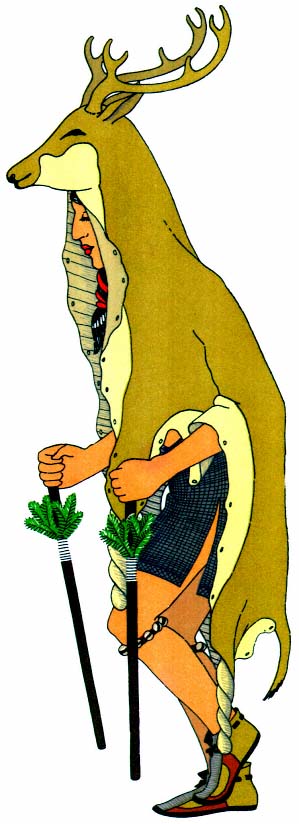
Plate 25.
Deer dancer, Taos. The simplest and most
realistic form of animal impersonation.
upon the pueblo and the society or group which is performing. The Deer Dancers at San Ildefonso paint their faces black with a white rim around the edge (pl. 26). At San Juan the same group paint the face red with no relief trimming (pl. 27).
Face paint may well have originated from the application of a coating of earth to the face in order to protect it from the elements. At Taos today, "red paint is smeared on the faces of the men in very cold weather, against the wind".[86] However, there is hardly a rite from which make-up is omitted. The simplest form of it is found in the brilliant carmine dots which accent the faces of the men and women in the Hopi Butterfly Dance.
The face may be painted a solid color. Occasionally, streaks of another hue may be added under the eyes. Sometimes each side is painted a different color and the division is a vertical line in the exact middle of the face. Racers at Cochiti are painted thus, one side of the face red and the other green.[87] Sometimes the face is divided horizontally. Hopi Snake Dancers are painted black to the mouth and white to the neck. Often other and more brilliant colors are used.
When carefully applied, the paint practically conceals the identity of the impersonator. Dancers often wear make-up under their masks so that they will not be recognized by the children if by chance they are caught without their masks during the rest periods. At Zuñi the face paint under the mask consists of two lines drawn across the face in iridescent black paint or red pigment, or it consists of red or black dots on cheeks and chin.[88] There is never any attempt to delineate human features, as the paint is used for concealment and ceremonial significance. The color and pigment are applied in stipulated patterns to satisfy the occasion.