
The Universal Exposition of 1900, Paris
The 1900 "exposition of the century," like the 1878 exhibition, had a street of nations but at a more visible location (Fig. 50). The Street of Nations now occupied the Quai d'Orsay between the Pont des Invalides and the Pont de l'Alma, the bridges connecting the two principal sections of the exhibition, the Champ de Mars-Trocadéro and the Esplanade des Invalides-Avenue Nicolas II
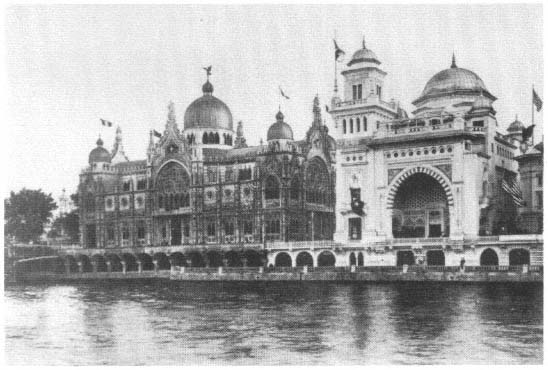
Figure 50.
Rue des Nations, with Ottoman pavilion to the right, Paris, 1900 (Bibliothèque Nationale,
Département des Estampes et de la Photographie).
along the waterfront. Nations considered more important were given larger sites facing both the river and the street.
The allocation of space to Islamic countries in the 1900 exposition made evident a hierarchical classification. The Ottoman Empire and Persia, both sovereign nations, had their pavilions on the Rue des Nations. The Ottoman Empire, perceived as more important politically, also faced the embankment and was located between the pavilions of Italy and the United States, whereas Persia's much smaller pavilion sat on the back row, between Peru and Luxembourg. Egypt, now accepted as a British colony, was with the other colonies in the Trocadéro Park.
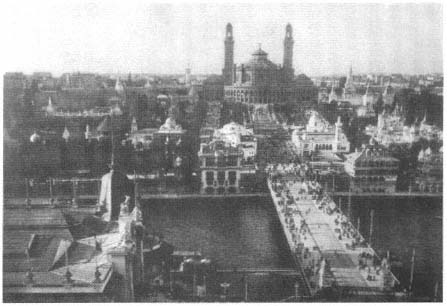
Figure 51.
View toward the Trocadéro Palace, with (foreground) the Iéna Bridge, (right)
the Algerian palace, and (left) the Tunisian palace, Paris, 1900 ( Exposition
universelle internationale de 1900, vues photographiques, Paris, 1900).
The displays of the Ottoman Empire and Persia were confined each to a single building. Egypt still had its temple, bazaar, and theater, but this time in a single three-part structure. Now it was the French colonies of North Africa that represented the full exotica of the Muslim world. The palaces of the two important colonies, Algeria and Tunisia, were in the Trocadéro Park, on the main avenue bisecting the park itself and the Champ de Mars and connecting the Trocadéro Palace to the Eiffel Tower via the Iéna Bridge. Viewed from the Iéna Bridge, with the Trocadéro Palace behind them, they helped to define the axis of the exposition grounds and complemented the larger palace stylistically with their Islamic references (Figs. 51–52). Seen from the palace, with the Eiffel Tower in the background, their white stucco masses and their facades abstracted from various precolonial monuments contrasted with the engineering aesthetics of the tower, thus juxtaposing the industrial progress of the empire and the timelessness of its colonies (Fig. 53). The juxtaposition offered a visual symbol of the French colonial tactics of assimilation and contrast.[66]
The Algerian Palace, given the "place of honor" in the Trocadéro Park, was a "symmetrical and coherent" building.[67] Inside, however, was an entire Rue
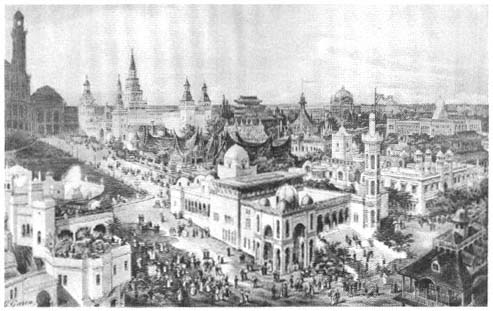
Figure 52.
View of the Trocadéro Park with (center foreground) the Algerian palace, (lower left)
the Tunisian palace, and (background) the Trocadéro Palace, Paris, 1900
(Bibliothèque Nationale, Département des Estampes et de la Photographie).
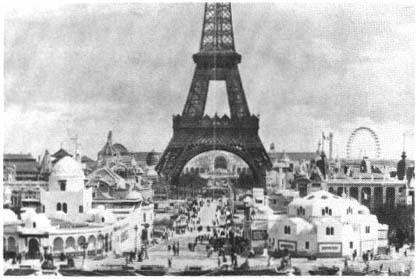
Figure 53.
View toward the Eiffel Tower from the Trocadéro Park, with (right) the
Tunisian palace and (left) the Algerian palace, Paris, 1900 ( Figaro
illustré, no. 124, July 1900).
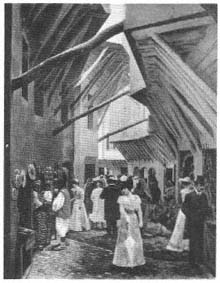
Figure 54.
Rue d'Alger, Paris, 1900 (Bibliothèque
Nationale, Département des Estampes
et de la Photographie).
d'Alger, winding picturesquely, replete with two-story houses with projecting second stories, musharabiyya s, decorated doorways, and shops on the street level.[68] It was considered "a faithful reproduction of one of those tortuous streets" (Fig. 54).[69]
The Tunisian exposition was next to the Algerian village, and the entire complex was called the Ville Arabe. It was an agglomeration of architecture from Tunisia: a replica of a fountain from the Rue Sadun in Tunis, a minaret from the Great Mosque of Sfax, a copy of the Mosque of Sidi-Maklouf from Kef, a zawiya (Sufi convent) from the Casbah Square in Tunis, the Bab al-Jadid gate from the walls of Tunis, and another old town gate from Soussa—all surrounding a large court. The main pavilion was a model of the Mosque of Sidi Mahres in Tunis. In sum, this village represented "all the towns of Tunisia."
The pieces were integrated by vaulted picturesque passageways and irregular streets, all designed "as though by chance." One observer remarked:
One could swear that these buildings are inhabited; the angles are rounded, the rough-cast broken, the tiles frosted—this imperceptible steam which represents time—and the stones, skillfully made up, display the superb reddish color of limestone in the countries loved by the sun.[70]
The appeal to the senses was complete. Even the smells were authentic. Here one could "breathe the smell of Africa," one Frenchman noted, "and for us, the colonizers, the smell of Africa is delicious."[71]
Although a concern for authenticity continued to inform the architectural representation of the French colonies, a new interest in symmetry emerged in 1900, with the result that the picturesqueness was hidden behind uniform screens or regularized along an axis. The enclosing of the Rue d'Alger clearly manifested the first tendency; the site plan of the Tunisian quarter revealed the second: the pavilions of the "village" were placed axially and symmetrically around a central open space. Furthermore, the entire Tunisian section was neatly hidden behind "regular facades, meeting at right angles."[72]
The 1900 Paris exposition expressed changing attitudes about French architecture. The 1889 exposition celebrated great engineering achievements, whereas the two major buildings of the 1900 exposition, the Grand Palais and the Petit Palais, returned to the vocabulary of "high art." Charles Girault, the architect of these buildings, which were intended as permanent structures, used modern engineering techniques and materials but clad the facades in classical masonry.[73] Undoubtedly, the classical architecture of the 1893 World's Fair in Chicago was influential in this change. Along with the return to classicism, a stricter control was exercised in planning the fairgrounds in 1900, and picturesque effects were minimized. Although the buildings on the Rue des Nations were designed in many different styles, they were neatly aligned and their regularized siting complemented the symmetry and axiality across the river. Moreover, in the turn-of-the-century exhibition, the haphazardness of the indigenous villages was tactfully hidden from immediate view.
After four decades, the Islamic world no longer seemed exotic. Islamic nations' displays at the international fairs had entertained Westerners and had taken them to distant lands, nurturing their imaginations by offering them unknown sights, images, foods, drinks, music, and dance. At the fairs, the Orient that European writers, scholars, and artists had defined and described (in Edward Said's word, "constructed") since at least the beginning of the nineteenth century was presented as a three-dimensional living model. Thus it was brought to the West and incorporated into Western culture. Moreover, with the expansion of colonial territories, the exotic increasingly belonged to the Western powers.