
Inclusive Neighborhoods: Old Town Sections
As has been true for centuries, the area of the town in which a family lives (mtaa, pl. mitaa) provides a basis for organizing social relationships. The importance of these now is less than it was twenty years ago, but everyone is actively aware of what his neighborhood is, and it still affects social relationships. Each of these areas (see maps 1 and 2) occupies a fairly substantial territory, far more than the few adjoining houses whose occupancy offers the possibility of people having a close relationship as "neighbors" in the sense just discussed.
The residents of each of these areas are likelier to associate substantially more with those from the same area than with people from other areas, and close ties are likelier within than across area boundaries. Each of the areas is understood as having economic, social, and personality traits that distinguish it from each of the others, with the understandings about each area differing, mainly in emphasis and valence, according to whether they are expressed by the residents of the areas in question or by the residents of the other areas.
As noted in chapter 3, each of these areas was a part of one or the other of the two sections that were the basis of community organization until a few decades ago. This organization has lost its effectiveness as a basis for joint
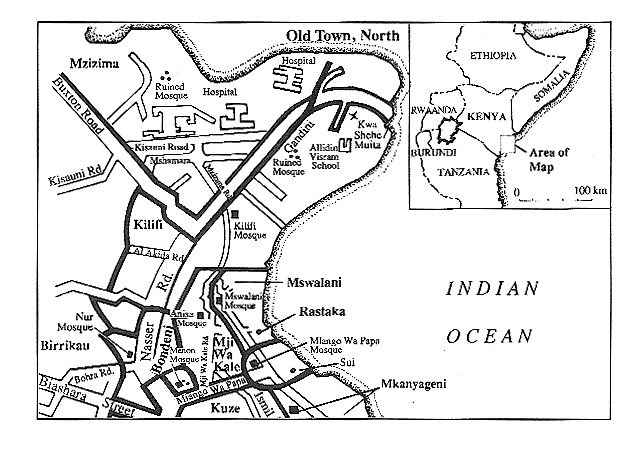
Map 1.
Mombasa showing Old Town North.
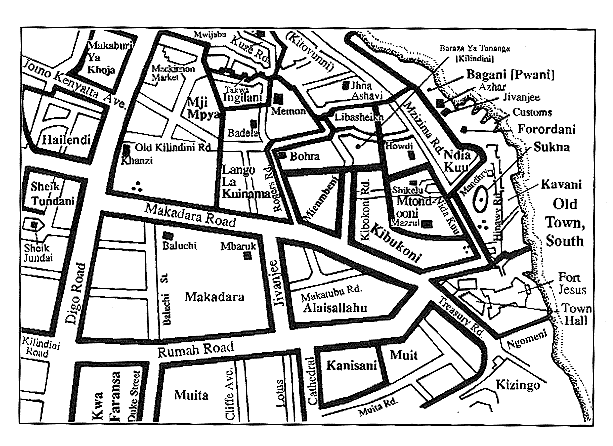
Map 2.
Mombasa showing Old Town South.
or cooperative activity, but to a considerable extent, the people of a given area are still likelier to be in each others' social "pools" than people from other areas are, and marriages seem more common within areas than between them. The areas also serve as a means for categorizing community members according to what are seen as important qualities held in common.
Beginning at Fort Jesus and going northward through the areas (see map 2), the residents of Kavani (including Kibukoni, Mtondoni, and Barani) are spoken of as the richest in Old Town and as having the finest houses. This area includes the largest number of families who view themselves as being of relatively recent Arab descent. They are generally, informants say, seen as educated, refined, and physically unimpressive as concerns fighting for men and hard work for women.
Among non-Swahili Mombasans, a Swahili man is sometimes referred to as Bwana Badi , where "Bwana" (the title meaning "lord" or "sir") is used to mock what is taken to be the Swahili claim to nobility (remember this quality, uungwana, refers to slave-free descent and is a central quality for full membership in the community) and "Badi," the short and familiar form of "Mohammed," a very common name for men in the community. The men of Kibukoni are the ones who are most commonly referred to as "Bwana Badi," including, at least once in my presence, by Swahili from other Old Town areas.
The people of Mkanyageni (including Kuze) are considered the bravest, strongest, friendliest, and most loyal members of the community. They are also considered the poorest, the roughest, the least cultivated, and the most insultingly outspoken and quarrelsome. The people of this area include the newest immigrants (although they have been there for generations) coming from Bajun, the Lamu archipelago, and other Swahili communities along the coast.
The famous fighters of Old Town are all Kuze men, and men from other areas have been heard more than once to say of them (collectively or about individuals), "Walizaliwa na bakora na kisu," i.e., that they are born with a walking stick and a knife. A great fighter from this area who died in the 1940s was said to be able to hit an enemy twelve times with his walking stick and leave a single mark. The most recent murder committed by a Swahili which I am aware of was the stabbing of an outsider by a Kuze man who had been insulted by his victim.
The residents of Mjua wa Kale are characterized as being in between the other two in wealth, refinement, and fighting ability. There are some Omaniderived families in this area, called "the Mjua wa Kale Arabs," who are—or were—associated with the Nine Tribes rather than the Three Tribes as most "Swahili Arabs" (as that term was used in chap. 3) are. The main trait of the residents of this area is thought of as pride expressed as interest in precedence, so, for example, it is said a man from here always refused to follow the pre-
vailing practice of standing when the Prophet's name is mentioned in Maulidi because "nobles don't stand for one another." In a story I heard several times, an Mjua wa Kale man came into a mosque before prayers and was greeted by a neighbor resting on the floor without his hat or gizbau (the traditional men's vest—now rarely seen—worn over the ankle-length kanzu). The newcomer took off his hat and gizbau, lay down on the floor, and, only then, returned the greeting.