
TWO—
BUSINESS LIFE
3—
Apprenticeship
Much of the rest of this book will discuss how people got rich and spent and enjoyed their riches in Augustan London, but first the humbler beginnings of the careers of London businessmen will be considered. These started for the great majority with seven or eight years' apprenticeship, a period of 'genteel servitude' according to a contemporary writer.
This was an attractive institution for the masters since apprentices paid substantial premiums to enter into their servitude, while the free labour might make a net addition to the master's income even in the apprentice's first year and would almost certainly do so by the third or fourth year.[1] The advantages to the apprentices were less obvious, especially for that majority who had no hope of ever becoming a master.[2] Most trades certainly did not require seven years' training—many could be mastered in a few months according to critics—and the restrictions on the freedom of apprentices were irksome.[3] On the other hand, apprenticeship was the commonest way to become a full member of a Livery Company and acquire the freedom of the City, a status which gave social prestige in itself and also provided rights of franchise, rights to office, rights to charitable maintenance in old age and, more significantly for business, various beneficial trading rights, the most important being the right to trade or open shop within the City.
The formal advantages of apprenticeship were to diminish over time as membership of Livery Companies became increasingly open to purchase and as the expansion of the metropolis led to more and more business being done outside the City. Such considerations caused apprenticeship to decline both absolutely and relatively in the eighteenth century,[4] but this was a slow process and for the men considered in this book, most of whom were born between the 1630s and the 1670s,
seven years' 'genteel servitude' remained the commonest introduction to the world of business.
i—
The Origins of London Apprentices
London was a city which relied for its continued growth on an annual stream of immigrants from the provinces and from overseas, and large numbers of these came to the metropolis in their teens to enter on formal indentures of apprenticeship.[5] Such young men, and a few women, came from all over the country but there was a tendency over time for an increasing proportion to be drawn from south-eastern England as opportunities opened up elsewhere for young people to learn a trade or start up a business.[6] Nearly two-thirds of our sample, for instance, came either from London itself or from the eastern and south-eastern counties. Despite this, there are representatives from almost every county and from Scotland, Wales and overseas. Opportunities in the provinces might be growing, but London remained the place where the really ambitious youth was likely to seek his fortune and for many trades it was virtually the only place where a satisfactory training could be obtained.
Historians have noted a marked rise over time in the social and economic status of the fathers of young men who took up London apprenticeships. In the sixteenth century, it was possible to find many fairly poor people, such as husbandmen, as the fathers of London apprentices. This became increasingly unusual and, by our period, most apprentices, or at least those likely to end up as independent businessmen, were the sons of yeomen or gentlemen if they were countrymen, while increasing numbers were the sons of urban professional or commercial people or of such 'middling' members of rural society as innkeepers, clothiers, millers and the like.
The most obvious reason for this change in social origins was the increasing cost of a London training. However, the development also reflects the changing attitude towards trade, which was considered in Chapter 1.[7] This can be illustrated by the large number of apprentices whose fathers were described as gentleman, esquire or even knight in their indentures. Nearly a quarter of our sample were the sons of gentlemen and they were
trained for a wide variety of occupations. Ten became drapers or silkmen, eight merchants, six money-lenders or bankers, three tobacconists or tobacco factors, two each became apothecaries, grocers, haberdashers and cheesemongers, and one each was trained as an ironmonger, jeweller, leather-seller, tavernkeeper, silversmith, bookseller, salter, druggist and lookingglass manufacturer. The sons of gentlemen thus permeated the London business world fairly thoroughly, though they tended to be concentrated in such potentially profitable occupations as overseas trade, linen-draping and finance.
Just what it meant when a man described his father as a gentleman in a document is difficult to say, since the temptation to upgrade one's status when beginning a career in a strange town must have been considerable. Lawrence Stone has suggested that most of these fathers were really 'pseudo-gentlemen', that is, moderately respectable urban tradesmen, a hypothesis which leads him into some delightfully unacademic snobbery. 'They were men of limited means, were actively engaged in retail buying and selling, and probably did not own a single acre of agricultural land, certainly not a country house. They had no knowledge of Latin. They did not dream of swaggering around with a sword at their side, and they would have been completely at a loss if anyone had challenged them to a duel. By any sociological definition, they did not count as gentlemen, yet gentlemen is what they called themselves on public documents.[8]
Stone's hypothesis is certainly refuted by those men in our sample who were described as sons of gentry. Only eight had fathers with the urban address which seems necessary of his pseudo-gentry, three in London and its suburbs and one each in Canterbury, Gloucester, Bath, Colchester and Norwich. The remaining thirty-nine had rural addresses, which were scattered much more widely across the country than was the overall distribution of apprentices' origins. Some may well have been sons of 'parish' gentry, rather than the more distinguished 'county' gentry, as Stone also suggests. However, the fact that twelve fathers were described as Esquire suggests that the gentleman label is not quite as trivial as Stone would have us believe. And indeed if none of these fathers were really gentlemen at all, it seems unlikely that there would have been so much contemporary comment on the subject as there was.
The seventeenth century was in fact rather a difficult time for the sons of gentlemen, especially the younger sons. It was then that the practice of primogeniture took a firmer grip in landed society, with the result that few younger sons could look forward to inheriting a landed estate to support them in the idleness to which their elder brothers were destined. There were also more younger sons than usual as a result of increasing total numbers of gentry and improving mortality chances for their children. What was to be done with them all? The obvious solution was either to educate them for the professions or apprentice them to trade.
The preferred solution in a status conscious society was probably to train them for the professions, though the opportunities for those born in the middle decades of the seventeenth century were fairly limited and some professions which would later absorb large numbers of younger sons, especially the army, had hardly been developed at all. Success in the learned professions also required academic abilities, which only a minority of gentlemen's sons were likely to have, a fact of life quite obvious to most parents. The Sussex gentleman, John French, declared in his early seventeenth-century will that if his younger sons were 'not capable of being scholars', they were to be sent to London to be apprenticed, and such an attitude was a common one. George Boddington showed no great signs of learning at grammar school and so was sent by his father to writing school and then put to learning business. Dudley North, destined to be a wealthy Levant merchant, one of the very few who ever learned Turkish and one of the most respected of early English writers on economics, was 'an indifferent scholar' and his 'backwardness at school and a sorry account that the master gave of his scholarship' led him into a merchant's apprenticeship, though his 'strange bent to traffic' which was demonstrated by successful trading with his schoolfellows was an important indication of his vocation.[9]
Dudley North and his elder brother, the lawyer Lord Keeper Guilford, both claimed that they would never have pursued their careers if they had been assured of even quite a small private income: 'I have heard him say more than once that, if he had been sure of a hundred pounds a year to live on, he had never been a lawyer.' But their family 'was not in a posture to
sustain any of the brothers by estates to be carved out of the main sustentation of the honour', and such was the position of many another estate. Gentry estates were particularly hard hit after 1650 as a result of the accumulation of debts in the Civil War and its aftermath, high taxation and low agricultural prices, but the carelessness or irresponsible behaviour of gentlemen themselves was often the cause of their sons having to seek a career in trade. George Boddington's grandfather, for instance, 'waisted a good estate by gayming and was thereby constrayned to sell all he had to pay his debts'. All three of his sons were put out to apprenticeships in London.[10]
This is not to suggest that only the stupid or the sons of the unlucky sought a career in trade. Such careers were increasingly attractive for their own sake, as the status of trade improved and the potential rewards escalated. There is also no reason to assume that the intellectual quality of London businessmen was below the norm of their day. They might not have been particularly good at Latin, but they seem to have had the ability to learn modern languages and to raise the general level of mathematical competence, while their correspondence suggests that they were quite capable of communicating adequately in their own tongue. This was a highly literate class who had spent several years at grammar school or at the new vocational schools which were discussed in Chapter 2. Such an education was often completed by a year or so at writing school in London before they entered into their apprenticeship, typically at the age of sixteen, though the starting ages of our sample ranged from a technically illegal thirteen to twenty.[11] However, before they could start their apprenticeship, they had to decide what occupation they wished to follow, find a suitable master and settle terms, all difficult decisions to make.
ii—
Finding a Master
One of the most responsible and difficult duties of parents was to see 'their children well dispos'd of, well settled in the world'. This involved the provision of a sound moral upbringing, an education suitable to their talents and expectations in life, and a considerable outlay in money to see them apprenticed and started in the world. Parents were also expected to help children
choose the particular career that they were to follow, ideally helping them discern their vocation and in any case using their worldly wisdom to distract them from unsuitable, unworthy or unprofitable occupations. This was a very difficult task, where parental ambition or fondness could easily lead to serious mistakes. 'Pride, avarice, or whim are the chief counsellors of most fathers when they are deliberating the most serious concern in life, the settlement of their children in the world,' wrote Campbell.[12]
Campbell was sufficiently worried by the problem to produce in 1747 the first really useful guidebook to the London trades, written specifically to help parents make their choice. He outlined the innate skills and talents necessary for each trade, occupation or profession, together with the probable costs of acquiring the competence to practise them and their likely monetary rewards. Before the appearance of this book, it must have been extremely difficult for parents and their adolescent sons, particularly that majority who lived in the country, to have had much idea of what might be a suitable occupation to follow in London and even more difficult to know which master to choose for the period of apprenticeship. Books written on apprenticeship before Campbell considered the subject in such a general manner as to be virtually useless in terms of practical guidance. It was in fact the morals of the master rather than his competence as a businessman or teacher which were most often emphasized.[13] Moral qualities were clearly important in the man who was to be master of one's son for seven years, but they needed to be coupled with practical qualities if a young man was to get on in the world. How then did apprentices find masters in Augustan London?
Family relationship was one obvious link between master and apprentice. Thomas Purcell, for instance, was the son of a gentleman from Shropshire, who was apprenticed to a silkman in 1618. His own apprentices included virtually all the male members of the next generation of his family, the son of his elder brother, two sons of his younger sister and two of his own sons. The cloth merchant, John Randall, followed a similar pattern, five of the apprentices whom he took between 1648 and 1669 being called either Randall or Claxton, his wife's maiden name. Other obvious links included geographical propinquity
and trading partners. Thomas Williams, the son of a yeoman of Walford in Herefordshire, was apprenticed to a stationer in 1635 and nineteen years later he took as his own apprentice, John Harris, the son of another yeoman from Walford. Luke Meredith, a London bookseller, took as an apprentice in 1692 William Wilmot, the son of an Oxford bookseller who was one of his major customers.[14] Such examples could easily be multiplied, but the importance of such relationships should not be exaggerated. Very few men in our sample were in fact apprenticed to masters of the same surname or of that of their mother's family and most apprentices seem to have found masters with whom neither they nor their parents had any prior relationship of any sort.
A master might be found by a professional intermediary, such as a scrivener. In 1676, for instance, Mary Sturges, the widow of a Leicester mercer, 'authorized Mr Hunt, a scrivener in London, to finde some fitt able and discreet person to place her son apprentice to' and this turned out to be Leonard Compeere, citizen and leatherseller, who followed the trade of milliner in the Royal Exchange. This was probably a common role for a scrivener to perform, used as they were to carrying out other services for provincial customers. Advertisement was another source of introductions. John Houghton, a pioneer of newspaper advertising, included several notices of apprentices seeking masters and vice versa in his Collections. 'By reason of my great correspondency', he wrote in February 1693, 'I may help masters to apprentices and apprentices to masters. And now is wanting three boys, one with £70, one with £30, and a scholar with £60.' Similar advertisements can be found in early eighteenth-century newspapers but they would have satisfied only a fraction of the market and most introductions were made on a much more personal basis.[15]
Most apprentices seem in fact to have found their masters through the mediation of 'friends', a word which had a rather different connotation in our period than it does today. A man's friends played a very important part in his life, similar to that played by the kin group in many societies. They tended to be older people, usually male, of the sort that even today one might have to invite to a wedding party whether you liked them or not. They might include relatives such as uncles, possibly
god-parents, business or social associates of one's father and similar people who could be expected to be wise in the ways of the world and often comparatively well off. They were people who needed to be cultivated with care and treated with respect, for a man's friends were his best source of prudential advice and financial assistance and were likely to be his advocates and the upholders of his good character in times of trouble.
Because of the continuous migration into London and the growth of inland trade, most provincial families had at least one 'friend' in the metropolis. Most had several and it was these friends who would seek out a suitable master for their sons and would then keep an eye on them and, if necessary, mediate if they ran into difficulties. The friends of John Parker, the son of a Lancashire man, for instance, were John Ashurst and Edward Rigby, both members of the Merchant-Taylors' Company and countrymen of his father, and Anthony Parker, a lawyer of Gray's Inn, presumably a relative. When John Parker's master turned him out of his house, he went to see Ashurst, and Ashurst and Rigby then went to the master's house to mediate. The friends of William Bullivant, who was apprenticed to a worsted-seller in the early 1650s, were his two uncles, Samuel Holland, a merchant-taylor who arranged the apprenticeship in the first place and often visited the shop to check on the boy and ask 'whether he was being faithless and untrusty', and John Holland of the Charterhouse, aged sixty-five, who also 'oftentimes came to visit him'.[16]
Whoever fixed up the apprenticeship had a lot of work to do. They first had to decide what occupation the boy should follow or interpret the rather vague instructions of parents or widows on this point, decisions which were affected by the amount of money available for the boy's training as much as by any apparent talents that he might have. They then had to find a master following this occupation who wanted an apprentice, who had the reputation of being kind, moral and competent at his job, and whose business was large enough and varied enough to enable an apprentice to get a broad education in the trade. Finding such things out required visits to the prospective master's house to make a judgment on his domestic relationships—a squalid household or a dominant wife, for instance, being seen as a bad sign—and a round of the taverns and
coffee-houses in the vicinity to discover the master's 'reputation', the opinion of neighbours as to his character and business competence being seen as crucial.
Once a decision had been made on a master, it was necessary to hammer out the details of the contract, a process which could take several months. The actual form of the apprenticeship indentures, covering the reciprocal rights and duties of the two parties, was fairly standard. The master agreed to teach and instruct the apprentice 'by the best means that he can' and to find 'his meat, drink, apparel, lodging and all other necessaries' (such as the cost of medical attention), according to the Custom of the City of London. The apprentice promised rather more:
The said apprentice his said master faithfully shall serve, his secrets keep, his lawfull commandments every where gladly do. He shall do no dammage to his said master . . . He shall not waste the goods of his said master, nor lend them unlawfully to any. He shall not commit fornication, nor contract matrimony within the said term. He shall not play at cards, dice, tables, or any other unlawfull games, whereby his master may have any loss. With his own goods or others . . . without licence of his said master, he shall neither buy nor sell. He shall not haunt taverns or play-houses, nor absent himself from his said master's service day nor night unlawfully: but in all things as a faithfull apprentice, he shall behave himself towards his said master.[17]
This was standard stuff. Where the negotiation lay was in the details, such as the number of years' service, which was usually seven, but eight for apothecaries and quite often for younger apprentices or in respect of a lower premium.[18] Another bargaining point was who provided the apprentice's initial wardrobe, how extensive this should be and who was to keep this wardrobe repaired and replaced—no small matter since the clothes suitable for a merchant's apprentice might well cost his parents or friends £40 and the very cheapest outfits for those apprenticed to low-grade trades were likely to cost between £5 and £10.[19] Then, there was the question of security. 'Generally tradesmen who have any considerable trust to put into the hands of an apprentice, take security of them for their honesty
by their friends.' Signing bonds for the good behaviour or 'truth' of apprentices must have been a worrying moment, since they had access to large sums of money and some were far from honest. The penalties of such bonds were sometimes very large, £1000 for apprentices in the Levant trade before they went abroad, £500 for the apprentice to a goldsmith-banker, £100 for a scrivener's apprentice, £150 posted by Eleanor Palmer to persuade a linen-draper to take back her scapegrace son after he had stolen some goods and a promise to take him away if he offended again.[20]
Finally, there was the settlement of the premium. This down payment to the master seems to have been an innovation of the seventeenth century and indicates the value that a London apprenticeship was deemed to have. There seems little doubt that the premiums demanded were increasing but, even at the beginning of our period, they were high enough to explain why so few poor men were the fathers of apprentices. The premiums for merchants' apprentices which we have found between 1650 and 1680 ranged from £100 to £860 asked for a Levant merchant's apprentice. Most were between £200 and £500. A witness in a court case of 1653 said that the typical premium for a woollen-draper was £100 to £120 and similar sums were paid by mercers' and drapers' apprentices in the 1670s. In the same decade a boy apprenticed to a milliner was asked to pay £30 and to a yarn-seller £40, figures which reflect the range of premiums paid in the haberdasher type of business. The premiums paid by artisans were rather lower, though still high enough to deter the fathers of the poor: £10–£35 for coopers, £20–£50 for working goldsmiths, £10–£35 for cutlers, figures which reflect six months' or a year's pay for journeymen in these trades.[21]
These were big sums for parents to pay, though they were only the beginning of the financial outlay necessary to set a young man up in business. There were, however, many sources from which a boy's premium might come and so alleviate the pressure on parents. Friends and relations might well contribute to this vital payment to ensure a boy's future, while legacies (especially by uncles) were often specifically designed to pay a premium. The provision of a fund whose interest was used to pay the premiums of deserving poor apprentices was also a
common form of charitable bequest. Then there was the possibility of deferred payment. The father of an apprentice to the cook's trade was given eighteen months to pay his premium in 1678, while a glover agreed to pay the balance of his son's premium to Robert Foyce, a surgeon, in 'as many gloves as should be expended at the christening of the said Robert Foyce's next child', an interesting gamble in an age of high infant mortality.[22]
Contracts often specified that there should be a period of a few months' trial or 'liking' before the formal binding. John Dunton, for instance, was 'not fasten'd for good and all at this time, but my master and my self were left to make the experiment how we cou'd approve each other'. Dunton in fact ran away after a few days, like many another homesick lad, but his father persuaded him to go back and 'after a month's liking was bound'.[23] All that remained now was the formal enrolment of the new apprentice, first before the Master and Wardens of the master's Livery Company and later before the City Chamberlain, 'who is Guardian of all apprentices and has a right to see justice done between them and their masters'. Enrolment before the Chamberlain was supposed to be done within a year of binding and was the final stage in the process by which master and apprentice committed themselves to seven years in each other's company. Failure to enrol was grounds to break the contract and, judging by the number of cases where such grounds were presented before the Lord Mayor's court, it seems that it was common practice deliberately to neglect this formality in order to give the parties an easy way out of what was otherwise a difficult contract to break.[24]
iii—
The Learning Process
What did the apprentice do and how well was he instructed in his master's trade? The answers to such questions naturally varied enormously and depended on the type of occupation, the diligence of the apprentice and the character and expectations of the master. Some masters did their duty very conscientiously; but many neglected to instruct their apprentices almost completely, some from idleness or because they were rarely resident in London, many from a fear that too much instruction would
create a dangerous competitor in the future and many because they saw their apprentices as unpaid menial servants and nothing else.
Complaints that apprentices were set to menial tasks and denied instruction were a common theme. Sir John Fryer, a future Lord Mayor who was apprenticed to a pewterer, was set to 'doing the servile part of ye trade, such as turning ye wheel, oileing and cleaning ye ware when finished, carrying of baskets of goods to ye inns and other such like things not commonly done by other apprentices'. Such work should have been done by journeymen and porters and not by a young apprentice, whose 'dear mother had not inured me to any hard labour'. Many similar complaints can be found in the records of the Mayor's Court: a soapmaker's apprentice who was 'put to doe such servile and drudging work as was fitter and most usually done by labourers', the apprentice to the master of an East Indiaman who had to do 'the slavish and most drudging parts of the ship's work', was ranked as a seaman, not a midshipman 'in his dyett and labour' and was not instructed in navigation 'in such manner as is usuall and necessary for mariners' apprentices'.[25]
One does not have to believe such complaints, since they were normally denied by witnesses for the masters, but the fact that they were denied helps to define what was expected of apprentices. The language is revealing too, the repeated use of words such as 'servile', 'slavish' and 'drudging' suggesting that public opinion thought that apprentices who had paid large premiums should be taught the business side of a trade and the skills associated with it, but should not be employed as menial servants. The connection between size of premium and type of work is made explicit by Benjamin Clements, a wire-drawer, who claimed that he accepted Thomas Brown as his apprentice with a premium of only £7 10s., instead of the usual £20 or £30, specifically because he was 'not to be trained as a wire-drawer for the first two or three years but only to run errands, he being then young and small of his age'. Witnesses in a case relating to the Norwegian timber trade stated that there were two levels of premium, one much higher than the other for those apprentices who were to be sent abroad to learn the trade at their
master's expense.[26] It seems, then, that one might expect to get the instruction one had paid for.
Drudgery and hard labour actually connected with a trade might well be seen as a necessary part of training; drudgery in the service of the household clearly was not, though many people thought that such work should be done by apprentices. Daniel Defoe, writing in the 1720s, bemoaned the fact that apprentices no longer cleaned their master's shoes and waited at table, tasks which he claimed they had done as a matter of course in the past.[27] However, Defoe had a habit of idealizing the past and there is no doubt that apprentices objected to doing domestic tasks even before he was born. Once again, the fact that masters took the trouble to produce witnesses to deny allegations on this score suggests that contemporaries agreed that there should be a distinction between work done by domestics and apprentices.
For all that, much domestic work was done by apprentices. Francis Kirkman, apprenticed to a scrivener in the 1640s, learned to draw up documents but also did other petty services—cleaning shoes, carrying ashes, sweeping, cleaning the sink, drawing beer, fetching coals. 'When I have bin seriously a drawing writings in the shop, and studying and contriving how to order my covenants the best way, a greasy kitchin-wench would come and disturb me with her errants.' Such complaints were commonplace. In the 1670s we find a merchant's apprentice with a £200 premium 'employed in cleaning shooes, sweeping of cellars and chambers and making of beds'. He asked whether it was 'usuall or common for merchants' apprentices . . . who give considerable sums of money to their masters to do such inferior and drudging business', clearly expecting the negative answers which his witnesses supplied.[28]
Evidence on the master's behalf in this case gives some idea of what was actually expected. One discovers that he was 'kind and loving to former apprentices and used them well in his service and sufficiently instructed them and endeavoured their advancement and preferment in the world and sent them beyond seas with considerable cargoes and also has sent and consigned goods to them both before and after their being his servants'. Such instruction included learning how to enter goods at the Customs House, how to keep accounts and how to buy
cloth at Blackwell Hall, while the apprentice would simultaneously be trying to build up a good reputation with other masters who would be his future customers and correspondents. The merchant's apprentice had to work hard to be competent at his business before being sent abroad in his third or fourth year, there to build up his trading capital through commissions as a factor, before returning to London many years later to set up on his own and take on apprentices in his turn.[29]
Much less had to be learned in shopkeeping trades, Campbell claiming that the 'mystery' of most retail businesses could be learned in a month or two. 'Their skill consists in the knowledge of the prices, properties, the markets for such goods, and the extent of the demand for the various articles they trade in: buying at one price, selling at another, weighing and measuring, is the whole mystery of the retailers in general: the greater number of articles they sell, the greater memory and acuteness is required, but a moderate share of wit serves their turn in general.' Shopkeepers' apprentices therefore found themselves behind the counter fairly quickly. William Browne had only been in the service of a draper for six months when he was acting as his cash-keeper, a fact which we learn when his master accused him of embezzlement. Benjamin Giles served in Jacob Rogers' mercer's shop from an early date in his term and one of Rogers' customers deposed that he 'could sell any goods in the defendant's shop in his absence as well as the defendant himself', though reflection led him to change his deposition to the more politic 'almost as well'. He was after all the master's witness. Wholesalers' apprentices also served in the shop but might well be sent into the country on their own to sell their master's goods, as a distiller's apprentice was in 1679. The other main job was the perennial one of collecting debts, both in the town and the countryside, tasks which are normally heard about because they gave rise either to the fairly trivial complaint that the apprentices, once freed of the shop, spent hours loitering, visiting taverns or staring into the Thames or, more seriously, took the opportunity to put some of the money collected into their own pockets.[30]
It might be comparatively easy to learn to be a shopkeeper or a wholesaler, though one feels that Campbell minimizes the problems of learning to trade successfully, but it was far from
simple to acquire the necessary skills to do well in many other occupations. Most skilled artisans really did need several years to enable them to equal their masters in a period when London was famed for the extremely high quality of many of its manufactures. Lawyers' clerks, who normally served five years, could expect their fair share of drudgery but would also have to study seriously if they hoped to set up independently, and the same was true of scriveners, who usually served seven or eight years. Even more knowledge had to be crammed in by the apprentices of apothecaries and surgeons, who were amongst the few young Londoners whose competence was tested by examination at the end of their term, though some skilled trades such as goldsmiths and pewterers still required apprentices to produce a masterpiece before being made free of their companies.[31] Simon Mason was apprenticed in 1715 to Mr Ralph Cornelius, an apothecary 'who was a very good master to me'. 'I first endeavour'd to obtain a knowledge of simples and their virtues, next the art of composition and making medicines, and to acquire a compleat knowledge of quantity and quality. And as I advanc'd farther in my apprenticeship I attended the sick and made the most strict enquiry into the nature of distempers.' He also read widely and attended St Thomas's Hospital as often as possible. Before the end of his term, he was visiting patients on his own and 'directing most of the medicines our patients took'.
Cornelius was well pleased with Mason's progress and, as a reward, gave him 'a priviledge he never did to any apprentice before', allowing him to treat 'young gentlemen in the venereal way', getting the medicines at cost and keeping the fees, which earned him nearly £50 a year 'which kept me handsomely in clothes and pocket money'. Trading or practising independently of the master, with or without his permission, seems to have been quite common. Merchants' apprentices, for instance, normally took some of their own capital when they were sent abroad, £1000 being typical for a young factor in the Levant trade, and anyone with an easily saleable skill, such as a surgeon or a scrivener, was likely to be trying to make something on the side towards the end of their term. Many shopkeepers' apprentices interpreted such possibilities in a rather liberal manner, such as the bookseller's apprentice John
Martin, who not only sold the books he stole but spoiled the market by selling them cheap, 'one booke that he hath sold for a groat that the defendant did usually sell for half a crowne'.[32]
Other apprentices used their growing skills to bargain with their masters to pay them wages, though taking wages technically disbarred them from acquiring the freedom of the City and so setting up shop on their own. However, by the early eighteenth century, the payment of wages towards the end of an apprentice's term was quite common, the threat of desertion on the grounds of the master's cruelty or some other pretext being a common bargaining point. And indeed, by this stage, most apprentices would be worth wages since their skills were likely to be equal to those of journeymen long before the end of their terms. This was usually the test of competence in court cases, such as that relating to Luke Butler, apprentice to a wine-cooper, who was said to be able to do the work 'the same as a journeyman and could deserve a good wage at it', a point which simply emphasizes the fact that in most trades seven years' apprenticeship was merely a racket which provided masters with cheap labour.[33]
iv—
The Life of the Apprentice
Service in another person's household may seem to us one of the strangest institutions of earlier times, but there was of course nothing strange about it to contemporaries, and service as a farm servant, a domestic or an apprentice was the normal experience of the majority of young people.[34] There were, however, two features of service as an apprentice in London which clearly distinguished it from the normal run of such occupations. In the first place, one's parents or friends paid handsomely for the privilege; in the second, most apprentices of the sort discussed in this book were at least of the same social standing as their masters and many came from families of distinctly higher status. Both these factors caused frictions in the household, quite often leading to a breakdown in the relationship between master and apprentice, though one should not exaggerate this. Many masters treated their apprentices as real members of the family, another son, and were carefully chosen because they promised to do so. However, many were
unable or unwilling to develop such a relationship, the apprentices themselves not always being very helpful in this respect. Young men from good families are not always very tactful or respectful, and a master might well object to being called 'puppy and puppy dog and other ill names' by a youth who must have seemed no more than a puppy to him.[35]
It must have been a fairly traumatic experience for the young apprentice when, at the age of sixteen or so, he arrived with his box of clothes to start his term. For most young men, it was probably the first time they had been away from home and the first that they had seen of the basically hostile environment of the big city. Working conditions varied, but the hours were long, typically from seven in the morning to nine at night with a break of two hours for dinner at mid-day, and it is hardly surprising that young people from leisured homes where they had not been 'inured to labour' should complain of drudgery. Living conditions varied from master to master and depending on the 'degree and quality' of the apprentice, but there was a pecking order which required that the youngest apprentice 'was to be commanded by everyone', a general dogsbody who might well find himself sleeping on a truckle bed beneath the counter in the classic tradition. Food might well be poor and shared with the menial servants rather than above stairs with the master and mistress. Such discomforts might be compounded by harshness and cruelty. One should not take the complaints of apprentices at face value, but beatings and blows from angry, drunken or sadistic masters do seem to have played a fairly regular part in their lives. One can find apprentices who were locked into their room or out of the house, thrown down the cellar stairs, beaten with canes, pistols, spurs or horse-whips, some of these punishments leading to serious injury.[36]
Life could be hard for the apprentice, too hard for many homesick and miserable young people, who took the first opportunity to run away, many never to come back. There were, however, good reasons for masters to treat their apprentices harshly in many instances. An apprentice who bullied the master's children, insulted his wife or caused domestic discord by abusing his servants was hardly likely to be treated kindly, nor was one who lost his master money by his surly demeanour in the shop or by such carelessness as burning cloth in a hot
press. Embezzlement and theft were also rife, not surprisingly given the enormous temptations placed in the way of young apprentices by the careless business methods of many masters, such as the linen-draper who instructed his apprentices to leave the takings 'in bags between the piles of cloth behind the counter' and only counted them and placed them in custody on Saturday night. Some apprentices were simply bad, thieves who broke open tills or their fellow-servants' boxes, louts who came in drunk and woke the household in the middle of the night or went to bed with their clothes and dirty shoes on and so damaged the bedding. Some apprentices were actually dangerous, such as William Palmer, who not only kept low company and was extravagant and idle but was also subject to mad fits, on one occasion attacking his fellow apprentices with a knife and who ended up trying to hang himself in the cellar.[37]
The miserable junior apprentice did not remain so for ever. After a year or two's unpleasantness, there was likely to be a new junior to bully and an improvement in status, a move from the truckle bed under the counter to a room in the house, perhaps a move from the kitchin to the master's table. Custom also allowed senior apprentices greater latitude in dress, even such privileges as wearing their hats in the shop and the house. By this time, apprentices knew their way about London and how to enjoy themselves, even if some keen young men might spend their nights and play-days learning shorthand. Parents who could afford large premiums could afford pocket-money and some apprentices had plenty to spend. They spent it as one might expect, on drink, gambling, the theatre and the dancing school, on late-night feasts of oysters and lobsters in their rooms, and perhaps most extravagantly of all on women, a mistress or a miss being a sure sign that the high-living apprentice had arrived. In short, apprentices systematically ignored every one of the moral clauses in their indentures.[38]
Some young apprentices behaved just as badly as the rakes in Restoration comedies, who could have provided a model if one had been needed. An example is John Todd, the son of a gentleman who was apprenticed to Nicholas Wild, a merchant. According to Wild's younger brother Ralph, who lived in the same house, Todd's behaviour was simply outrageous. He frequently came home drunk very late at night and put the
house into disorder. He would forget to carry letters to the Post Office, sometimes keeping them a week before delivering them. He kept a wench in Covent Garden, where he had taken a chamber for her, and was said to have spent £40 or £50 on her clothes and other expenses. Worst of all, he once pawned the poor girl for 22 shillings when he was losing at hazard and she was forced to leave her petticoat behind as a pledge before being allowed to go home.[39]
Other high-living apprentices were more discreet; sober and reasonably well-behaved in the master's house, wild and far from sober once out of the neighbourhood. Many kept the paraphernalia of high living far away from their master's house, a sword 'at the other end of the town', a mistress in Whitechapel or Covent Garden, and some fighting cocks in Old Street, like Titus Manley who kept six at a time and paid someone to look after them, often winning or losing £5 in a day from gambling on the birds. One often learns such things from the very people who benefited from their licentiousness, keepers of taverns giving evidence of their drunkenness, neighbours of their mistresses attesting to their lewd reputation. Even a servant treated to a night out might provide evidence of an apprentice's extravagance, such as Mary Bethell, who told the Mayor's Court that her master's apprentice had taken her to the playhouse and then out to supper, where he had plied her with oysters and wine, confirming that 'the same was a considerable charge and expense to him'. The same apprentice's addiction to cock-fighting was revealed by Anne Swinstead, another fellow-servant, who when asked how she knew that he went to cock-pits replied rather disingenuously that she had seen him 'pull out of his pockets cocks, spurrs and implements belonging to such business'.[40]
Many apprentices were accused of offences, and many confessed to them, which could have led them to the gallows under England's harsh penal code. Some were indeed hanged, the wayward apprentice being one of the stereotypes found in biographies of criminals. However, prosecution was expensive and the outcome doubtful, and a hanged apprentice was of no value to a master, so only a few apprentices were prosecuted before the criminal courts. It was much more effective to extract 'an ingenious confession on paper' by entreaty or violence or
the threat of violence or prosecution. Such confessions could then be used to recover losses from the apprentice's parents or friends and held in reserve as a guarantee of the apprentice's future good behaviour. Threat of exposure to loving parents was another effective way of bringing an erring apprentice to heel, a maid, Joyce Knight, deposing in one case that 'if his father knew of something he had done, it would breake his heart'.[41]
The other main way to deal with troublesome apprentices was to complain to the City Chamberlain, who might simply give the lad a serious avuncular talk or, more likely, order him to be whipped or imprisoned for a few days in Bridewell, or both. The Chamberlain also acted as mediator in disputes between master and apprentice, hearing evidence from both parties and their witnesses and friends, and arbitrating himself or appointing arbitrators, a role also performed by the Wardens of the master's Company. The Chamberlain often went to great lengths to try to persuade a master to take back an erring apprentice or to convince the runaway that his best interests lay in returning to his master's service. Such intervention was often successful, but by no means always, most of the evidence used in this chapter coming from cases heard before the Mayor's Court, a fact which normally meant that all arbitration and intervention by Chamberlain, Company, parents and friends had failed.[42]
The apprentice has so far been considered as an individual, but 'the apprentices' or more often 'prentices' appear frequently as a generic term in contemporary literature, sometimes meaning what it says but quite often being a synonym for youth in general. Apprentices formed a large group in London society, modern estimates of their numbers in the second half of the seventeenth century ranging from 11,000, which is certainly much too low, to 40,000, which is far too high. In some areas, particularly in the City, they might form as much as 10 per cent of the population of a parish and, since they were nearly all young and male, could make their presence felt in a number of ways from simple youthful high spirits, such as playing football in the streets, to drunken disorder, riot and even the occasional intervention in politics.[43]
However, it is wrong to think of the apprentices as a
homogeneous group since, despite a superficially similar status and experience, they differed one from the other as much as adolescents as they were to do later when they had completed their terms. Older apprentices differed from younger apprentices, merchants' apprentices from butchers' apprentices, sons of gentlemen from sons of husbandmen, and these differences were much more important to the young men than the fact that they were all apprentices. London society was hierarchical at all levels, a fact only too obvious towards the end of the period of service when the majority of apprentices had nothing more to look forward to than a lifetime as a journeyman or clerk, while that minority who are discussed in the rest of the book would be thinking of setting themselves up in business and, before long, taking on apprentices in their turn.
4—
Business
Business is not discussed in detail here since different types of business had their own particular characteristics, some of which have already been discussed in Chapter 2. Nonetheless, all businesses had some elements in common and it is this common ground that is considered in this chapter. How people started a business is examined first, then the central problem of cash flow, a problem which governed most of the tactical and strategic decisions of the businessman, and, finally, some idea is given of the rates of profit and accumulation in the London business world.
i—
Starting a Business
The most obvious initial problem for a man starting a business was to raise the necessary capital. There had been a time when this could be done by spending a few years as a journeyman or factor and saving wages or commission income.[1] However, by the late seventeenth century, it was unrealistic to expect to save enough from wages alone to set up in business, except in the lowest levels of shopkeeping and catering and in artisan trades. Few journeymen or book-keepers got more than £20 a year on top of their board and even several years of such wages would not go very far towards the cost of establishing a shopkeeping or mercantile business, as can be seen in Table 4.1 opposite.[2]
Two mid-eighteenth-century books provide information on start-up costs for London businesses and a selection from this material is presented in Table 4.1.[3] The table shows that, except for some artisan trades, at least £100 was needed to start almost any sort of business. Most shopkeeping businesses required at least £500, while such genteel trades as draper or mercer needed at least £1000 and a man wanting to deal in a big way would
| ||||||||||||||||||||||||||||||||||||||||||||||||||||||||||||||||||||||||||||||||||||||||||||||||||||||||||||||||||
have had to double or treble these sums. Even £100 was a substantial sum for a parent to find and these start-up costs confirm that most parents of potential London businessmen must have been in the middle station themselves.
These figures are of course drawn from a period rather later than ours. However, the intervening years were not ones of inflation and there seems little doubt that young businessmen needed similar sums in our period. This is illustrated in Table 4.2 opposite, where the assets of some of the sample who died young and so had not accumulated very much are compared with the mid-eighteenth-century start-up costs of their occupations. The fit is not perfect but it is good enough to indicate that comparable sums were already required to set up business in Augustan London.
Start-up costs were related both to apprenticeship premiums and to the fortune that a man could hope to accumulate in his lifetime, as is shown in Table 4.3. opposite. The table shows that in most cases those who ended up rich started off rich or at least pretty well off. It also indicates that in most trades accumulation was fairly modest since most of the median fortunes are only about twice the average start-up costs for that occupation. The two main exceptions were artisans and apothecaries. In most artisan trades it was possible to start in a small way, often saving one's initial capital from wages, and the lucky or talented man could expand from this basis into a substantial business, especially in the building trades. However, such opportunities paled beside those of the apothecary and it was this business that the sensible but relatively poor father should have chosen for his son. 'There is no branch of business in which a man requires less money to set him up than this very profitable trade,' wrote Campbell. 'Ten or twenty pounds, judiciously applied, will buy gallipots and counters, and as many drugs to fitt them as might poison the whole island. His profits are unconceivable; five hundred per cent is the least he receives.'[4] The profits may be exaggerated but there is no doubt that the substance of Campbell's observation was true.
It has so far been assumed that parents provided the young man's trading capital and this was certainly the commonest source of funds. There were, however, several others. Other members of the family often helped, either by an outright gift
| ||||||||||||||||||||||||||||||||||||||||||||||||||||||||||||||||||||||||||||||||||||||||||||||||||||||||||||||||||
| ||||||||||||||||||||||||||||||||||||||||||||||||||||||||||||||||||||||
or a loan. An uncle or grandfather might leave £50 or £100 to help set a man up, while aunts, brothers, sisters and cousins could often be touched for a small loan to stretch the beginner's resources. Osbaston Hunlocke, for instance, an apothecary whose business assets were £70 when he died aged twentyseven, owed £10 each to three people called Hunlocke, while the fledgling linen-draper James Hudson must have been pleased to hear from his brother in Cumberland that 'Sister Ann says she will forgive the first years interest but she wants the second' on the £13 that she had lent her faraway brother.[5]
An early marriage might be another solution to a young man's financial problems. About a third of the sample got married when they were twenty-four, twenty-five or twenty-six, almost immediately after completing their apprenticeships, and such timing must have greatly assisted their initial establishment in business.[6] Fortune in this respect normally favoured the already fortunate, since the size of the dowry usually matched the wealth or prospects of the bridegroom, but there were exceptions. John Tarry was a journeyman with no capital when he married Jane Warren, who brought him £900, in 1689. The successful wholesale spirits business which he set up in his wife's house had a turnover of £5000 a year by 1701. The scenario of the apprentice who married his master's daughter and took over his business was also one that happened in reality as well as fiction, while masters could be generous even if one did not marry their daughters. Some left their apprentices or such trusted servants as book-keepers a sizeable sum in their wills, while others loaned money to former servants at low rates of interest. William Ladds, for instance, a bodice-maker in Milk Street, bequeathed a loan of £1000 at 4 per cent 'for the better enabling my servant Jacob Webster to maintaine and carry on the trade by me driven and exercised'.[7]
Charity was another source of low cost loans and W. K. Jordan has shown that, up to 1660, nearly £44,000 had been willed by Londoners to provide loans at no interest or at nominal rates to young men starting in business and nearly as much again had been left to create revolving loan funds 'to be lent with great discrimination' at market rates. John Kendrick, for instance, left £900 to the Merchant Adventurers in 1624 to be lent in amounts of £300 to each of three 'honest, industrious
and frugal young men' for three years without interest. In all, there must have been sufficient of these charities to loan money to several hundred young men a year, though the sums which had seemed sufficient to the charitable of Elizabethan London did not always go very far in our period.[8]
If all these sources of money were insufficient, then partnership was probably the best answer and indeed a partnership was virtually essential for those starting up in businesses with very high entry costs, such as mercers' and linen-drapers' shops and much of overseas and wholesale trade. Partnership was, however, potentially very dangerous in these days of unlimited liability when one's partner might 'incur debts for the partnership by bad judgment or simply by extravagance which could bring you both down'. Fear of the legal dangers seems to have made formal partnership fairly unusual, less than 10 per cent of the sample having such arrangements at their deaths, though considerably more entered into partnerships for a few years or for a particular trading venture. Defoe, who disapproved of partnership, thought that the best type of partner was a young beginner whom one knew personally and whose affairs were as yet unentangled by interests outside the business. Such young men could be watched over by an older and more experienced trader who might welcome the opportunity to withdraw from everyday management, and partnerships for a few years with an apprentice who had proved his competence were fairly common.[9]
The disposition as well as the raising of their initial capital posed problems for beginners, especially for those who needed permanent business premises. A merchant could invest every penny in trade goods and hope for the best; a shopkeeper had to decide how much to spend on shop-fittings, while still leaving sufficient money to acquire his stock and have something left over for living expenses and contingencies. The fashion for fancy shopfitting worried Defoe, who claimed that some tradesmen were laying out two-thirds of their fortune on their shops and so leaving their actual business badly under-capitalized. One suspects that he was exaggerating, but this was certainly a problem for a young starter who wanted both full shelves and a shop that was sufficiently attractive to entice customers into it. Another important decision for the starter was to determine
how much to borrow or buy on credit in relation to his own capital. William Stout provides some information on this subject in his autobiography. His starting capital of £141 enabled him to fit up a shop and stock it with about £300 worth of goods, paying 'about halfe ready money, as was then usual to do of any young man beginning trade'. Nicolas Barbon confirmed this gearing convention in 1690. He stated that most retailers 'are usually trusted for more than double what they are worth'.[10]
These first six months were a desperate time for the beginner, a period of anxiety familiar to those who start a business on a bank loan today. He had probably borrowed some of his trading capital from relatives or, more alarmingly, from professional money-lenders. He then pledged himself to wholesalers for a sum equal to twice his capital, said a prayer and hoped that he could sell sufficient goods for cash or on short-term retail credit to pay the wholesalers' bills when they fell due. During this period, he would be competing with older men with much larger capital who would set the prices for the trade. Such men would almost certainly be able both to buy and sell on better terms than the young beginner, quite apart from having far greater experience in business. Life has never been particularly easy for the small businessman and many, then as now, failed to survive for very long, the dreams of a genteel existence in the middle station being rudely exchanged for the harsher realities of a journeyman's wages or, worse still, a debtors' prison. Nevertheless, most young men did survive and many prospered, and the problems that they faced in doing so form the subject of the next section.
ii—
Cash Flow
Nowadays, business is usually seen as separate from family and domestic life, but things were very different in our period, when household and business affairs were inextricably entangled. Some idea of the flow of payments in and out of the households of businessmen is shown in Fig. 4.1 on p. 113. Starting clockwise, there are first the positive and negative contributions to capital—portion, legacies, dowry and loans being offset by portions and dowries for children and outgoings for the service
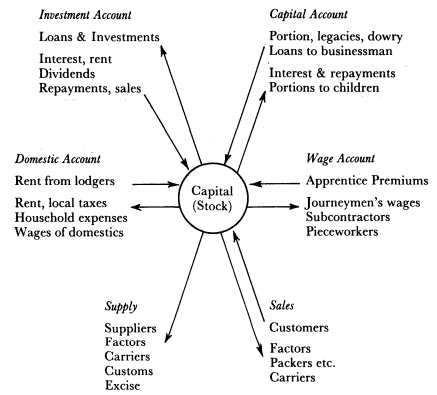
Figure 4.1
Cash Flow of the Businessman
and repayment of loans. Below this is the wage element of the business, the influx of money from apprenticeship premiums being usually well overbalanced by wages to journeymen, porters and other casual labour and by payments to subcontractors and pieceworkers. At the bottom of the diagram can be seen the process by which stock in trade was fed into the business from suppliers and then progressively sold to customers, the incoming goods requiring payment to the suppliers, together very often with payments to carriers, commission agents and to the government for customs or excise, the outgoing goods naturally bringing in payment from customers but also often requiring payments to finishers, packers, factors and carriers. On the left of the diagram is shown the domestic side of life, mainly outgoings in the form of rent, local taxes,
household expenses and wages to domestic servants but sometimes counterbalanced to some extent by rent from lodgers. Finally, in the top left, the businessman's investment account is shown, a flow of money out of capital to advance loans or acquire investments and a flow back reflecting repayments, sales, rent, interest and dividends.
The distribution between these various groups of debits and credits obviously varied between occupations—manufacturers paid more wages, professionals had few suppliers, many people made no investments. The distribution also varied over the lifecycle—both investments and domestic outgoings tended to increase with age. Nevertheless, nearly every inventory one looks at illustrates this general pattern of incomings and outgoings. The central problem of the businessman's life was to keep this complex of payments and receipts in some sort of balance and to ensure that over time more money came in than went out, so that he and his family had enough to live on and there were regular additions to his capital or, as it was normally called, his stock. A simple approach to this problem is illustrated by a remark attributed to the lawyer Erasmus Earl when asked how he kept his accounts. '"Accounts, boy?" said he. "I get as much as I can and I spend as little as I can; and there is all the accounts I keep."[11] ' In the absence of very effective accounting methods, such an approach was probably common enough, though it might be safer for a lawyer to adopt it than a shopkeeper or a merchant. A lawyer relied mainly on fees for his income and had few countervailing payments to make to suppliers or other creditors, so the main problem would be to remember who owed him money or, if he did not have a particularly good memory, to keep a list of his debtors.
The problems of shopkeepers, manufacturers and merchants were of quite a different order and most kept some sort of accounts. Shopkeepers' accounts were generally in the form of a day-book in which debit and credit transactions were recorded on facing pages and from which amounts due to or from outstanding debtors or creditors could be periodically extracted, this exercise sometimes being assisted by posting material from the day-book to a ledger. Many businesses, such as those of coachmakers, jewellers and tailors, involved a series of bespoke orders and these men would normally keep a job book or an
invoice book in which their expenditure and the amount due from the customer on each order could be recorded. Judging from surviving accounting records, only such high-flyers as merchants, big wholesalers and bankers kept a full set of books and even these were normally kept in single rather than double entry, though the latter was well known and was usually referred to as 'merchants' accounts'. Some surviving account books were beautifully and meticulously kept, but many are in a terrrible mess and hardly meet Defoe's requirement that 'next to being prepared for death, with respect to heaven and his soul, a tradesman should be always in a state of preparation for death, with respect to his books'.[12]
The problems of the businessman's cash flow were made much greater by the ubiquity of credit. There was of course a cash basis to the economy but credit, often for very long periods, permeated every aspect of economic life. Goods were sold, both wholesale and retail, on credit; wages, commissions, taxes and rent payments were normally in arrears; even portions, legacies and dowries were normally paid long after they were due. Terms of credit varied enormously, depending on the status, wealth and credit-worthiness of the debtor, the customs and conventions of different types of business and, perhaps particularly, on whether the creditor was sufficiently wide awake, efficient or grasping to claim the debt when it was due and to enforce that claim. The majority of people paid their debts in the long run and, if they did not, the legal system was weighted on the side of the creditor, but it might be a very long run.
Contemporaries always distinguished between retail credit and wholesale credit, the former being seen as undesirable and dangerous both for the customer and retailer. However, despite this, retail credit was a central feature of the London economy and one probably growing more important over time. This at least is suggested by the works of Defoe. On numerous occasions in his Review he attacked retail credit as an evil likely to bankrupt tradesmen and force their gentlemen customers into a desperate search for funds. 'Giving credit to the last consumer', he wrote in 1709, 'is the destruction of credit.' By the 1720s, however, he had completely changed his tune. 'Every tradesman both gives and takes credit, and the new mode of setting it up over their shop and warehouse doors in capital letters, NO
TRUST BY RETAIL, is a presumption in trade . . . and most of those trades who were the forewardest to set it up have been obliged to take it down again, or act contrary to it in their business.' In a pamphlet written a couple of years later, he hammers home the consequences for those who refuse to give retail credit. 'Thousands of buyers who laid out their money freely and who, tho' they might not always pay down upon the spot, yet paid tolerably well, went from shops and bought where they knew they could be trusted.'[13]
Indeed, 'trusting' was essential in a world where the majority of customers had no regular income, and the accumulation of numerous small debts of a few shillings or a few pounds can be found in almost any list of assets. The inventory of the apothecary Owen Crane, for instance, lists nearly 200 small debtors owing £150 between them.[14] What was necessary was not to let these small debts become large ones, to keep one's ear to the ground so that one knew when the customer was in funds, had himself been paid for piecework or had received some other overdue debt from his own customers. Then was the time to present a bill or to send an apprentice round to dun the customer for his money or at least something on account.
Such problems grew in magnitude when the customer was a gentleman or an aristocrat from the West End, as so many customers of London's luxury bespoke trades were. 'Never trust', wrote Tom Brown, '[and if you do] let it not be with men who are protected by their dignity or character.' Such advice was easier to write than carry out. A coachmaker or fashionable tailor had to trust or he would have virtually no business, but such trusting required good nerves and substantial assets or at least substantial credit from his own suppliers. Some idea of attitudes can be seen from a letter written by a gentleman in Penrith to his London tailor promising to pay him six months after delivery, 'which considering how you are generally paid in your way will be next to ready money'. When the famous cabinet-maker Thomas Chippendale ran into cash flow problems he called on Sir Edward Knatchbull to pay an outstanding bill but had no joy. 'As I receive my rents once a year,' wrote Sir Edward, 'so I pay my tradesmen's bills once a year which is not reckoned very bad pay as ye world goes.' There was no exaggeration in this; settling bills once a year,
often at Christmas, was a common practice. Even a barber might have to wait a year for his pay, as can be seen from the diary of the accountant Stephen Monteage, who on 26 December 1738 paid £3 to William Stephens for 'a year's shaving due at Xmas'. Many retailers and artisans waited far more than a year for their money, and many of course waited for ever; one can feel sympathy for the nurseryman Thomas Greening, who found when he searched his books in 1740 that the only money due to him were two bills contracted in the mid-1730s by Lord Weymouth and the Duke of Marlborough 'which God knows when I shall receive'.[15]
It is difficult to discover the terms on which retail credit was granted. Many purchases on tick from shops or taverns were no doubt free of interest in the short run, the seller using tick as a means of increasing turnover, as a credit-card transaction does today. Most customers paid sooner or later and the seller would be better off than if he had refused them credit. However, once weeks of non-payment turned into months, negotiations would take place between seller and buyer involving the latter in a substantial interest payment, the refusal of further credit being a useful lever to obtain profitable terms for the credit already given. When selling goods and services to the wealthy and privileged, self-interest ensured that bills were well-padded from the start and that slow-paying dukes would eventually pay handsomely for their carriages and cloaks, first because the initial price was high and later because they would be charged interest as the months and years went by. This, of course, was the attraction of doing business with such people of 'dignity or character', as it was with the government, who also paid high prices in return for dilatory payment. Dilatory though they were, they paid in the end, as the merchant Michael Mitford wrote in 1704. 'The payment of the government is very certain, but the time when is also very uncertain.' Since the time when was usually years and sometimes decades after the event, such profitable business required a very long purse.[16]
A lower bound to the terms of retail credit can be given by looking at the terms on which wholesale credit was offered, since tradesmen were much better payers than governments or gentlemen and so presumably got better terms. Merchants trading overseas generally received the longest credit, from six
months to a year or even longer being common, while wholesalers normally gave retailers three, four or six months to pay, with 'three days of customary grace'. Some idea of the cost of this credit can be obtained from the letters of merchants and wholesalers, which often quote the prices of the goods in which they dealt at 'ready money' and at various lengths of credit, such as 'at three months'. Such material is too scattered to give an average but it suggests that credit was nearly always offered at a cost higher than the maximum legal rate of interest and often at three or four times the maximum rate. Small men might find 'trust' even more expensive. In 1745, the pawnbroker Richard Grainger claimed that it paid a handicraftsman to borrow from him and buy his raw materials for cash, 'the difference of buying goods with ready money and upon trust, being more in proportion than the pawnbroker takes'. Such rates reflect the risk and inconvenience of giving credit but they also help us to understand why wholesalers tended both to start rich and die richer, despite a substantial proportion of bad debts.[17]
Borrowing and buying on credit naturally meant that most businessmen's inventories include a substantial proportion of liabilities and a breakdown of these is provided in Tables 4.4 and 4.5 on p. 119. These figures underestimate the real state of credit since inventories were often drawn up a long time after death so that executors had time to pay off some of the debts. However, even as a lower bound, the figures give a good idea of the web of debt in which the London business world was entangled. Table 4.4 shows that by the time the inventory was drawn up, the average man still had liabilities equal to nearly a quarter of his gross assets, while the lower quartile of the sample had liabilities equal to over half their assets.
In Table 4.5, the occupations of those with high or low proportions of liabilities are set out to see if any patterns emerge. Individuals from virtually every occupation appear on each side of the table but some tentative conclusions are suggested. Tavern-keepers and most small shopkeepers tended to have high levels of liabilities, reflecting their need to keep high levels of stock and the generally slow rate of turnover. On the other hand, the apothecary's business once again looks a good one to be in from this point of view, and most merchants,
| |||||||||||||||||||||||||||||||||
| |||||||||||||||||||||||||||||||||||||||||||||||||||||||||
rentiers, moneylenders and, surprisingly, most of the building trades also seem to have been able to keep their liabilities down to a reasonable level. Finally, while men of all ages can be found on both sides of the table, the average age of those with high liabilities is five years younger those those with low
liabilities, suggesting that the young were more inclined to overextend themselves, from being in too much of a hurry or because their businesses were often financed by loans.[18]
The extent of liabilities may not seem all that much by the standards of today's mortgage-ridden citizens, but it was a worrying problem in a world of personal credit where the whole edifice was built on confidence in the ability of the debtor to pay and very few debts were supported by collateral. A casual remark in a coffee-house or a tavern might lead creditors to suspect that their debtor had no 'bottom' and to close in quickly for repayment. If this debtor belonged to one of the groups in the table with liabilities equal to 50, 75 or, worse still, 100 per cent of his gross assets, then such suspicion could lead very quickly to disaster.
Disaster could strike even the soundest of businesses for, as can be seen in Table 4.6 opposite, assets were far from liquid.[19] Cash ratios were low for all groups and few other assets could be turned quickly into money, except jewellery and plate. If the cause of the cash flow problem was 'deadness' of trade, then it was unlikely that stocks could be sold quickly or at a reasonable price. The same would be true of investments in the stocks of the trading companies or in ships, while most other investments—in property or government debt—were even more illiquid. This meant that, if a man was in trouble, he normally had little option but to press those debtors to whom he had advanced personal loans and trade credits. These together made up over half the gross assets of the average businessman and might involve literally hundreds of separate debtors. What a cash flow crisis involved was chasing these debtors, who would almost certainly be chasing their own debtors at the same time, since a crisis of confidence was likely to strike everyone together.
Table 4.6 also illustrates the differing structure of asset holding for a few common occupations or groups of occupations. In general, expenditure on domestic goods was inelastic in respect of wealth, taking up nearly 10 per cent of the artisans' assets and less than 2 per cent of the two wealthiest groups. The category 'stocks and fixed assets' is in nearly all cases dominated by stock in trade, most businesses having just a few such items as shelves, counters and presses as their total of fixed assets, not including buildings. Manufacturers naturally had
| ||||||||||||||||||||||||||||||||||||||||||||||||||||||||||||||||||||||||||||||||||||||||||||||||||||||||||||||||||||||||||||||||||||||||||||||||||||||||||
the greatest fixed assets but no one in the sample had as much as £1000 in fixed capital. The two biggest were a distiller with £880 of equipment and a brewer with £538, which in both cases represented just over 15 per cent of their total assets, but most manufacturers had a far smaller proportion of their assets invested in fixed capital.[20] This is still a commercial society where stock in trade and not equipment is what matters. Much the highest proportional investment in stocks (almost entirely wine) was made by the tavern-keepers, which compares very strikingly with the very low investments in stocks made by apothecaries, while of course rentiers and money-lenders had virtually no stocks or fixed equipment at all. Tavern-keepers, on the other hand, were in more of a cash trade than most and so had to give relatively less trade credit than any other group except the money-lenders, while the textile wholesalers held over half of all their assets in the form of credit advanced to their customers. Manufacturers, too, were wholesalers in respect of the selling side of their businesses and they came second in the proportion of assets held as trade credits, nearly 47 per cent.
Investment will be looked at in more detail in the next chapter, but it can be noted here that merchants were relatively little involved in personal loans but were the most important group in other types of investment apart from those specialist investors, the rentiers and money-lenders. Apothecaries were the greatest investors of all groups who actually had a trading business, investing nearly half their assets outside that business, a reflection of the fact that they did not have to invest a lot of money in expensive stocks. If it had been possible to compare the asset structure of such professionals as doctors and lawyers with the others in the table, this would probably have fallen somewhere between the pattern of the apothecaries and that of the rentiers and money-lenders, that is, with high investments, low stocks and a relatively low level of trade credits in respect of their unpaid fees.
Most of the assets held by all these groups were safe enough and could be turned into cash in the long run, though that long run might be too long to satisfy impatient creditors. However, in nearly every case, there would be some assets which were not really assets at all. Inventories are inconsistent in recording bad
debts and in any case it is not exactly clear what a 'desperate' or 'doubtful' debt meant in the conventions of the day. Sometimes such adjectives clearly mean what they say; sometimes, one suspects, they merely reflect laziness on the part of valuers or executors. However, if 'doubtful and desperate debts' are taken as an accurate description, they they represent just under a third of all debts due in those inventories which record them.[21] This may seem a huge proportion, but the number is swollen by the extreme reluctance of Augustan businessmen to write off bad debts. There are no data on the proportion of bad debts to turnover, but in 1734 Jacob Vanderlint suggested that one should expect bad debts to represent about 2 per cent per annum of trading capital.[22] If these were never written off, it would not be very long before they were a third of all debts due.
This approach to bad debts was a major cause of trouble for the London tradesman, whose treatment of them as assets allowed him to believe he was quite safe when he was in fact close to insolvency. Not that such self-deception was the only cause of problems in the juggling act between debit and credit which was performed by every London businessman. Many failed in this act and in the next section the tactics used to recover money from reluctant payers is looked at, followed by the problems of insolvency and bankruptcy in our period.
iii—
Debt Collection
The collection of debts, either in full or as near full as possible, was one of the major tasks of the businessman. Debt collectors, working on commission, provided some assistance but in most cases it was a task which the creditor himself carried out. The first stage was the same as today, a combination of wheedling appeals and threats in person or by letter, the language different but the content familiar to the modern creditor or debtor.[23] If letters and verbal demands had no effect, then it would be necessary to take sterner measures. One obvious procedure would be to secure the debt. This could be done by getting the debtor to bind himself to pay at some future date, the penalty of such bonds being the double of the debt. However, a bond was only secured by a signature and it might be better to find rather more solid collateral, such as a pawn of some of the
debtor's goods, a mortgage on his property or an attachment or garnishee order on his own debtors. The latter were very common, the object being to divert to yourself money due to your debtor from a third party. 'This doth not hurt the person of him that owes the money, but only secures the debt, and is no very great disgrace to the debtor, nor any great charge, and is done with much privacy.'[24]
An alternative procedure was to sue for the debt, a process whose main object was to call the debtor's bluff but which might end up with putting him in prison for the rest of his life. Any creditor whose debtor owed him more than £2 could issue a writ to summons him to court or have him arrested and then either bailed or imprisoned until his appearance in court. Such writs normally worked like magic and a Commons enquiry of 1791 found that less than two-thirds of those issued with writs in the metropolis were actually arrested and less than a tenth went to prison, in most cases because the writ or at least the arrest was sufficient to get the debtor to pay, while many of the remaining tenth settled with their creditors before the hearing in court.[25]
The remaining fraction of non-payers were those who might have to suffer the full rigour of the laws against debtors. If the debt was proved in court, not always easy and one good reason to keep good books, the creditor had two options. He could proceed against the debtor's property by having the sheriff seize and sell his goods or he could proceed against the debtor's body by having him detained in prison until he repaid the debt or the creditor gave up and let him be released. The majority of creditors chose this latter course since it was rarely easy to settle a debt by seizing property. Neither creditor nor sheriff were allowed to break into the debtor's house, shop or warehouse, while what the law called 'choses in action'—bills, bonds, book-debts, stocks and shares, in other words most assets—were safe from the bailiffs' attention. On the other hand, imprisonment tended to concentrate the debtor's mind in a wonderful way, leading him to discover resources or friends which up to that time he had denied. However, in many cases the debtor simply could not pay and, as a result, there were normally several hundred London debtors languishing in prison
at any one time, while many others fled to avoid 'the temporal hell of a gaol'.[26]
Debtors' prisons were periodically cleared of most of their poorer inmates by Acts of Insolvency which empowered magistrates to free prisoners who swore on oath that they had no estate above some small value such as £5 or £10 and whose creditors could not disprove the oath. There was also provision for debtors to live and even conduct business in strictly defined areas outside the prisons known as the Rules, some prisoners being quite wealthy men who chose to abuse the system rather than pay their debts. Nevertheless, debtors' prisons were unpleasant places and they aroused the humanitarian outcries one might expect, especially after a parliamentary committee of 1729 published a damning indictment of conditions in London's prisons. Attention was drawn to the old and unsuitable buildings, the overcrowding and, in particular, to the extortions of the venal wardens and other prison officers. The report sums up nicely the results of private enterprise in the prison service. 'The warden, who pays for the privilege of punishing others [£5000 in the Fleet], does consequently sell his forbearance at high rates, and repairs his own charge and loss at the wretched expence of the ease and quiet of the wretched objects in his custody.'[27]
These wretched objects did not prevent imprisonment for debt being generally supported by middling people, who saw it as essential if the system of credit was to be maintained, a system which was of course the basis of the whole expanding economy. No threat would be effective without the final sanction of prison and, as has been seen, the system did in fact work in the great majority of cases. Most debtors paid their debts and comparatively few went to prison. Defoe spelt out the logic in 1729. 'The retailer, being a woollen-draper, trusts his neighbour with a suit of clothes. How comes he to do it? perhaps the man has no extraordinary character; well but, says the retailer, he is a tradesman as well as I, and he must pay me, or he shall not be able to stand at his shop door or sit behind his counter, for I will arrest him and make him pay me; and upon this power of arresting the debtor and carrying him to prison, or whether he is carry'd to prison or no, the exposing him, disgracing him, and ruining his credit; I say, upon this is founded the freedom
of the tradesman to trust him. If you destroy this power of coercion, you destroy the credit in trade; for if a man cannot be credited, he cannot buy; and if the tradesman cannot arrest him, he will not sell.'[28]
One flaw in this system was the fact that the process could only be begun if the debt was for a sum of £2 or more and of course many retail debts were for much less than this. This was no problem in the City where, since the reign of Henry VIII, there had been a 'Court of Conscience' to deal with small debts. This was not a common law court but one where commissioners consisting of two aldermen and twelve commoners made 'such orders between party and party as they shall find to stand with Equity and Good Conscience'. The court was the first to order debtors to pay by instalments—'generally poverty is pleaded and the debtor is ordered to pay so much per week, 6d. or 12d. or what the Court thinks fit'—and it played an important part in City life. However, attempts to introduce similar courts elsewhere in the metropolis were unsuccessful until 1749–50 when Courts of Conscience for Southwark, Westminster and Tower Hamlets were set up, well-argued cases for the courts being repeatedly set aside by the opposition of the common lawyers and of gentlemen who objected to having 'to submit for small debts to a company of shopkeepers'.[29]
So far cases have been mentioned where the creditor was fairly certain, perhaps mistakenly, that his debtor could pay. What happened when the debtor's business was really unsound and there was no way that he could pay, at least in the short run? A variety of tactics was open to the creditor, but it was a well-worn maxim that 'the first offer is generally the best'; in other words a sensible creditor should accept what a debtor declared was the most he could pay and so avoid legal costs, delays and almost certainly a finally disappointing dividend. A common situation was for a merchant or trader, though fundamentally sound, to get his payments to creditors hopelessly unsynchronized with potential receipts from his debtors. If he kept reasonable books, he should be able to prove his basic soundness and ask his creditors for time, which, if they had any sense, they would give him. 'Whereas he finds himself not in a capacity to pay, he desires a Letter of Licence, and promiseth that in three, four, or five years (more or less, as you can agree)
he will pay the debt, because he hath many debts out, and goods beyond the seas, and must have time to get them in.' Arrangements would be made for serial payments and the debtor bound for twice the debt.[30]
Where the business was not sound, it would still probably pay creditors to arrange a private composition. If the number of creditors was small and the debtor could establish his honesty if not his good business judgment, then a composition had the advantage of a speedy settlement and usually a higher dividend than if the debtor had been sued as a formal bankrupt. The simplest composition was where the creditors agreed to accept say 15s. in the pound of what they were owed and the debtor himself sold his property and called in his own debts in order to pay the agreed dividend within some pre-arranged time. In other cases, the creditors would appoint a trustee, possibly one of themselves, possibly someone more formal, such as a Master in Chancery, to whom the debtor would surrender his effects to be sold. Whatever the particular arrangement, such private compositions allowed the debtor to be discharged of the balance of his previous debts and, in Defoe's metaphor, to rise like a phoenix from the ashes of his former business, a free man who could get fresh credit, open his shop again and ideally recover his honour by paying the balance of his debts at some future date, even though he was not legally required to do so.[31]
Such arrangements were relatively friendly, speedy, cheap and generally in the best interests of both creditor and debtor. However, not all debtors were or were thought to be honest and not all creditors were friendly, while even the kindest of creditors might fear that he was somehow being cheated of an equitable dividend either by other creditors or by the debtor himself. In such situations and in the very common circumstances of the creditors being unable to agree to the terms of a private composition, there was no alternative but to sue out a commission of bankruptcy. In the first part of our period, this would have been done under the bankruptcy statutes of 1571 and 1624, which were very harsh to the bankrupt. Bankrupts were assumed to be fraudulent and creditors had to prove an 'act of bankruptcy', such as the debtor fleeing, keeping his house or allowing himself to be imprisoned for debt, before a commission could be issued. Commissioners were then
appointed with wide-ranging powers—to seize and examine the bankrupt under oath, send him to prison if he refused to answer questions, to examine his wife and his debtors under oath and to do anything else necessary to determine the state of his affairs. 'They can break open houses, seize goods, sell them, extend lands, and in short, do any thing for the advantage of the creditors; and at last make a treasurer and cause a divident to be made to the creditors.'[32] For the dishonoured and now penniless bankrupt, this was not necessarily the end of the matter for he received no discharge and could be and often was later sued for the debts which had not been paid in the dividend. This was usually a purely malicious action by creditors, who could not hope to get any more money, but some creditors were malicious and bankrupts who were subsequently sent to debtors' prisons were the unhappiest of prisoners since, if the commissioners had done their work, they had no funds to sweeten the warders.
Statutes of 1705 and 1706 produced a major change in the bankruptcy laws. For the first time, a distinction was made between the fraudulent and the honest bankrupt, the man whose failure was 'his misfortune and not his fault'. A new stick and carrot situation was created where honesty was rewarded and fraud punished by death or, as one contemporary put it, 'all that run away shall be hang'd if they are caught, and all that surrender clear'd, if nothing is made out against the truth of their discovery'. Those bankrupts who surrendered themselves within thirty days of notice and made a full and honest declaration of their affairs were given a certificate discharging them of the balance of their former debts. They were also entitled to be given five per cent of their net estate if the dividend paid was more than 8s. in the pound, to a maximum of £200. Such leniency was too much for many contemporaries and the law was modified in 1706 in two important ways. It was first declared that no one could become bankrupt unless he owed £100 to a single creditor, £150 to two creditors or £200 to three, thus barring small men from the benefits of the new act and, secondly, discharge certificates could only be issued if fourfifths of the creditors in number and value signed them, thus once again opening the door to the malicious who could 'keep his body, starve him, and never let him out of prison unless
they and four fifths parts of them in number and value voluntarily please to agree to it'.[33]
Nevertheless, even the 1706 Act was a great improvement on the previous situation, so much so that in 1726 Defoe could write that 'men make so little of breaking that many times the family scarce removes for it; a commission of bankruptcy is so familiar a thing that the debtor oftentimes causes it to be taken out in his favour that he may the sooner be effectually deliver'd from all his creditors at once'. Most writers, however, still felt that formal bankruptcy was a slow and not very satisfactory method of dealing with the problem of insolvent debtors. As one put it in 1707, 'when the goods are sold, at 3 or 400 per cent loss, and the sittings, assignments etc. are payed, very little comes to the creditors'. This is probably exaggerated, but everyone agreed that very poor prices were paid at sales of bankrupt stock.[34]
The new legislation encouraged more people to sue out commissions of bankruptcy, so that in the last twenty years of our period there were usually between 150 and 200 bankrupts a year, of whom rather more than half were Londoners, while in the 1650s the numbers had rarely risen above 50. Roughly 100 Londoners a year were thus going bankrupt in the 1710s and 1720s, a number which should be compared with the population at risk, perhaps half of the 20,000 to 25,000 households which have been estimated to be in the middle station, since professionals were not subject to the bankruptcy laws and small traders would be unlikely to have debts large enough to satisfy the minimum requirements of the 1706 Act. This gives an annual rate of bankruptcy of somewhere between 1 and 2 per cent, but the rates varied enormously for different occupations. There were, for instance, somewhere between 400 and 500 each of apothecaries, cheesemongers and tavern-keepers in London in the early eighteenth century but the numbers of bankrupts in these three occupations during the five years 1711–15 were 3, 9 and 39 respectively, figures which suggest that the tavern-keepers with their huge wine stocks were amongst the most vulnerable of all businessmen, while the apothecary's business once again shows up as one of the safest.[35]
The overall bankruptcy rate of 1 or 2 per cent does not seem very high until one recalculates it on a career basis. Assuming
that the average business career lasted twenty years and that those leaving the business world were matched by those entering it, then the career chances of bankruptcy rise to 10 or 15 per cent.[36] When one considers that private compositions remained significant, it shows just how important cash flow problems were in London business life. The commonest end to a business career was death, but bankruptcy must have run retirement very close in second place.
iv—
Business Strategies
'The chief end or business of trade is to make a profitable bargain,' wrote Nicolas Barbon in 1690, a sentiment with which no businessman then or now would argue.[37] However, the desire to make profits had to be tempered by the need to avoid insolvency and this section considers a few of the strategies employed in an attempt to garner profits without ending up in the bankruptcy court.
The simplest answer to the problem was to have no liabilities, since without them there could be no insolvency. Many Londoners, rich and relatively poor, old and young, adopted this strategy. They either invested all their capital or set up as money-lenders; they never bought trade goods, accepted no credit and lived on the 6 per cent or more that they could get as a rentier. If their capital was small, they would live fairly meanly but would have few fears since the worst that could happen would be one of their debtors turning out to be a bad one, which would make them poorer but not insolvent.[38]
Another simple and almost ideal approach, according to Defoe, was 'a few goods and a quick sale'. When small stocks were combined with certain, bespoke cash sales and purchases at three or four months' credit, then life might seem rosy, as it must have done for the jeweller Peter Webb in the mid-1730s. He made attractive and expensive jewellery for fashionable people, but his journal shows that he was in the unusual position of being paid nearly always in cash for his product, only two of his twenty-nine sales between September 1735 and September 1737 being on credit. Meanwhile, he acquired his working materials either from his customers themselves or on credit from other jewellers and goldsmiths. In this two-year
period, he made over £250 a year with very little capital save his tools.[39]
Such a business could very easily come unstuck as a result of just one of his customers not paying the cash promised and maybe, since Webb's papers are in Chancery, that is what happened. It was, in any case, a fairly unusual business and most traders and manufacturers had very considerable liabilities. When payment of these became unsynchronized with incoming payments, there was generally little alternative but to borrow more to get out of trouble. William Stout, for instance, inspected his books after a year's trading and 'found that I had been too forward in trusting and too backward in calling, as is too frequent with young tradesmen'. He solved the problem by borrowing £50 on bond. This was all right if most people were not in the same situation and the bond market was fairly easy, but matters were not so simple in a general crisis. 'These breaking times will make all men more cautious,' wrote the merchant Thomas Boughey in March 1675.[40]
Caution has a price but, in our period, there was no easy mechanism for reflecting that price in a higher rate of interest. Most bonds were secured at or near the legal maximum rate of 6 per cent and the penalty for exceeding that was 'treble the value of the moneys, wares, merchandises, and other things lent'. This statutory limit to the rate of interest made the supply of funds in the 'last resort' much less liquid than it would otherwise have been and could lead to a sudden rush of interconnected bankruptcies, as T.S. Ashton pointed out many years ago. Nevertheless, there have always been ways round usury laws and our period was no different in this respect. The easiest way was simply to ignore them, as Mary Turner of Tottenham Court did in 1679 when she charged John Dawson 10 per cent on two bonds. When he complained that she was liable to be indicted for charging such extortionate interest, the lady replied that he should pay what he owed and indict her afterwards.[41]
Another way round the law was to disguise a loan as an undervalued annuity by calculating the years' purchase at an unrealistically low level. For example, the borrower might contract to pay the lender £100 a year for life in return for a payment of £300, or three years' purchase, the lender either
letting the annuity run on until the annuitant actually did die or allowing him to repurchase the principal when he was in funds. Of course, if the annuitant did die within three years, the lender had no redress since he had no claim on the estate, though it was possible in the eighteenth century to insure the life for the value of the principal. A much simpler way of sidestepping the usury laws was to deduct some of the principal before handing over the money, this extra interest charge being known as a premium.[42]
Retrenchment was an alternative to borrowing oneself out of trouble, but it was a strategy that could rebound seriously on those who adopted it. Today, a man's credit would hardly be impaired if he stopped entertaining or sold the yacht, but matters were very different in the world of personal credit of Augustan London. One reason that Thomas Goodinge thought that 'many good men . . . do insensibly sink and decay in their estates [was] . . . living up to support a credit and shoar up a reputation (no mean mystery in this world)'. The irony of such a situation was not lost on Defoe. 'He must live as others do, or lose the credit of living and be run down as if he was broke. In a word, he must spend more than he can afford to spend, and so be undone, or not spend it, and so be undone.'[43]
The chronic problem of balancing liabilities and assets could be helped by re-scheduling one's asset structure or one's payments. A house and shop could be rented instead of purchasing the freehold or the lease, thus releasing capital but losing income. Trade credit at, say, 10 per cent could be converted into ready money by borrowing on bond at 6 per cent. Something could be done about payments to workmen, too, as Andy Federer has shown. Journeymen, at least those who lived out of doors, had to be paid on Saturday night or starve. Subcontractors might starve too, but they could be held at bay much more easily than a regular workforce, who had to be paid even when there was no trade, as the nurseryman Thomas Greening found in 1740. 'Trade is so bad', he wrote to his father, 'that I have not maid so much out of the nursery as will pay the workmen's labour.' Payment to a poor artisan or food retailer could be put off much longer than payment to a rich linen-draper, who would think nothing of the cost of going to court, while payment to some people could be put off almost
indefinitely, such as the money due on bond to an aunt or legacies from a grandfather due to one's children.[44]
Price as well as cost could be adjusted, for, although some dealers faced situations of near-perfect competition, this was certainly not true of all traders. 'The price that the merchant sets upon his wares is by reckoning prime cost, charges and interest,' wrote Barbon, a simplistic cost-plus approach which may have been common but was certainly not universal. London was a much more aggressively competitive place than that, as Barbon, one of the sharpest businessmen of his day, certainly knew. Defoe complained bitterly about the price-cutting policy of the rich which undermined the cosy small shopkeepers for whom he wrote so many of his books. "Tis fatal to the poorer and little dealers about him; for they stand still, with their fingers in their mouths, as we call it, or walk about at their shop doors and have nothing to do, while they see all the trade run in the great channel of their neighbouring alderman's shop; who gives large credit at a ready-money price, or sells for ready money ten per cent cheaper than they can.'[45]
Price-cutting there certainly was—one good reason for the growth of the market—but the aggressive instincts of the pricecutter were shadowed by the defensive strategy of the monopolist. Where demand was inelastic and the number of suppliers small, there was likely sooner or later to be a ring. There is, for instance, a record of a ring amongst the manufacturers of copperas, a product sometimes called green vitriol which was used in dyeing, tanning and ink manufacture. The ring consisted of sixteen individuals or partnerships who controlled between them all twenty works supplying the metropolis. Their objective was to raise prices by reducing output but, then as now, it was not always easy to reach agreement. 'It is difficult to bring so many men to be of one mind be it ever so much for thare own good or profitt as we are assured this will when it is brought to a conclution,' sentiments familiar to those who have attempted to engage in restrictive trade practices. Such trade associations were not necessarily restrictive in the modern sense. Much of foreign trade was organized by regulated companies whose main functions, apart from keeping outsiders out, were collecting information, organizing shipping, negotiating with
foreign governments and lobbying at home. Less formal organizations existed for other trades. Alison Olson has described the activities of the 'Virginia merchants', who were already well organized as an interest group by 1670, their mutuality assisted by the Virginia Walk on the Exchange and the Virginia Coffeehouse where they held their meetings to discuss lobbying parliament and other bodies on such subjects as taxation or convoying.[46]
Similar associations grew up for other overseas trades, but the interest group was not confined to merchants. Much of the work of the Livery Companies was of a similar nature, while this book has made much use of petitions sent to parliament by such groups as the 'Licensed Hackney Chairmen' or the 'Midling and Poorer Sort of Master Shoemakers'. Such activities required organization, meetings, agenda, minutes and so on, and were another aspect of the passion for clubs and societies which was a characteristic of the period. There is the agenda for a meeting of one such trade association, 'the dealers in tea', in the papers of Henry Gambier. The main business, not very surprisingly, was: '4. That the present execution of the laws of excise are a very great grievance.'[47]
One function of interest groups was to assist their members through the dissemination of information, but this was something that every businessman had to gather for himself if he was to survive for very long in the trading world. Published commercial information was growing in scope but was still thin on the ground and, in any case, what most tradesmen wanted was something exclusive to themselves. Every merchant and wholesaler therefore needed to establish a network of correspondents who could provide commercial and political intelligence, make sales and purchases, and assist in the vital business of remitting money over long distances.
Several letter-books have survived, which enable one to see such networks in operation. Between August 1686 and December 1688, for instance, the merchant Thomas Palmer shipped over £10,000 worth of cloth, tin and lead in twenty-eight consignments, mostly to Levantine ports. To support this operation, he sent 127 letters, over half of them to his factors and correspondents in Constantinople, Aleppo and Smyrna and in Cyprus, where he bought cotton as a return cargo. However,
nearly a third of his letters went to the Italian cities of Venice, Genoa, Livorno and Messina, important centres of information on Mediterranean trade as a whole, but even more important as the residence of bill-brokers through whom payments could be arranged. A similar pattern can be seen in the letter-book of Michael Mitford, a Russian and Baltic merchant. He wrote to his agents in Moscow, Danzig and Konigsberg, to correspondents in many east and south coast English ports, but also to Amsterdam and Hamburg, where he acquired bills to settle his Baltic debts.[48]
It is difficult to find letter-books for wholesalers, but it is clear from the jumbled collections of letters that have survived that they too were eager correspondents. Some wholesalers traded throughout England, but most specialized in particular regions and their correspondence networks were often based on an extended kin network.[49] In such correspondence, one finds the same urgent need as in international commerce for information on prices and markets and on the credit-worthiness of customers, with just the occasional polite enquiry after a correspondent's health or a little bit of home news. One is struck, too, by the dominating influence of the seasons in trade and business generally. There was a season to sell gloves and a season to buy butter, goose quills or linen, while it was a waste of time trying to borrow from a grazier in February when he needed his money to stock his land. At the beginning of winter when he sold much of his cattle it might well be a different matter.[50]
Commercial correspondence also illustrates just how serious a problem remittance was in the days before a national banking and chequeing system. Quite a lot of business was still done by barter. Much of the Levant trade, for instance, consisted of the barter of broadcloth for raw silk, while, in the money-scarce world of the north of England, it was a question of finding the right purchasing medium with which to enter the market. 'I believe ye Spanish lamb wool may command felts sooner than fine hats will do.'[51] However, most business was done for money and arranging for payment could be a major task. Many wholesalers went down into the country to collect their debts in person from their customers and the seasonal fairs continued to
play an important part in this activity. Nevertheless, an increasing proportion of business involved remittance through the medium of some sort of paper rather than through the shipment of bags of specie.
The international bill of exchange had been in use for centuries and played a vital role in the settlement of merchants' accounts, while inland bills were increasingly used from the middle of the seventeenth century. Merchant practice was always ahead of a power in law to enforce that practice, but our period sees some major legal changes which made the use of bills and promissory notes, the two main forms of deferred payment, very much easier and safer, so that merchants did not have to rely so much on the honour of their correspondents. A key date was 1666, when a judgment in the case of Woodward v. Rowe declared that 'the law merchant was part of the law of the land' and so allowed centuries of international custom relating to bills to become part of the English common law. By the end of the century, further legal judgments had determined the liability of the indorsers of bills and so made them truly negotiable, while an Act of 1704 confirmed the negotiability of promissory notes. Such changes, which enormously increased the effective money supply, were very much part of the legal spirit of the age, which in hundreds of large and small ways made the life of the businessman easier and property safer.[52]
The improved status of bills and notes in law did not solve all problems, since it was still necessary to arrange for someone to accept one's bills in London and vice versa, and a large proportion of all commercial correspondence is on this subject. As the trade of the provinces with London expanded, so did patterns of remittance emerge to ease the problem. Provincial merchants and manufacturers who sold in the London market played a key part in this, since they had money due to them in the metropolis and so could sell their 'bills on London' to their neighbours who needed to make payment there. Butchers and graziers were important in such remittance business, as were the country cloth manufacturers. The Huguenot David Compigne, for instance, a Wiltshire grocer and customer of Henry Gambier, a London tea and coffee dealer, was able to pay for some of his supplies by buying the bills of the West Country clothiers drawn on Blackwell Hall Factors in London. These
could then be remitted to Gambier, who could present them for payment. Nevertheless, such networks could break down and alternative and less safe methods of payment had to be found. 'Les billes sont bien difisille a trouver,' Compigne wrote in June 1730. 'Je vous envoieray un billet de cent pieces [i.e. a Bank of England note for £100].'[53]
Such problems were not so great within London itself, where payment could be made at a periodic 'accounting' when the balance accumulated in book debts would be paid in cash. Nevertheless, payment and remittance were major problems for contemporary businessmen, just one more headache for people struggling with the problem of ensuring that they actually did make a profitable bargain in this difficult world of seasons, cash flows, 'breaking times' and other hazards. In the next section, an attempt is made to determine just how much profit people did make, not an easy question to answer but one that should be addressed in order to get some idea of how middling people accumulated and improved themselves.
v—
Profit and Accumulation
It is often thought that people made very high profits in the past, particularly in foreign trade and especially in its more notorious branches such as the slave trade. The evidence for this is often simply assertion either by a contemporary or by a modern historian or polemicist with an axe to grind. Real evidence of the rate of profit is difficult to obtain, partly because few business papers have survived and partly because contemporaries were not particularly interested in 'profit' in the economist's sense of the net annual rate of return on capital.
Most people were more interested in accumulation than in annual profits and some attempted to calculate this from time to time. Once a year, or at more uneven intervals, they would value all their assets, deduct their liabilities and arrive at a new figure for their 'stock', a process which amalgamated housekeeping and shopkeeping gains and losses, normally counted bad debts as assets and made no pretence at estimating a return on capital. Even those who kept really good accounts in double entry did not distinguish in their profit and loss accounts between business capital and total assets or between business
and household expenses. 'There is scant evidence of any attempts at a precise calculation of profits and capital, or of any general endeavour to systematize and to refine the calculation of capital or profits,' writes an expert on the history of accounting.[54]
In such circumstances it is obviously difficult to calculate an average rate of profit. Commentators quite often referred to the average turnover of a business and sometimes related this to what the trader 'got' or 'got clear' from his business, an ambiguous concept which presumably meant the profit on turnover but which took no account of overheads or capital costs. A witness in 1696, for instance, thought that the owner of a public-house who 'took 40 or 50 shillings a day . . . could not gett less than £100 a year'. If his turnover on the basis of 300 days is taken as £675, then the return is about 15 per cent, though the exact meaning of 'gett' remains unclear. The business of pastry-cook seems to have been more profitable than the drink trade, even in 1697, a year when we are told that fruit, sugar and flour were very dear. Ayliffe White was said to take £200 a year or 12s. a day from his trade and his 'profitts' were estimated at 'above a fourth part of ye said summe in a year'. Another case concerned John Tarry, who sold strong waters, mainly wholesale. His business was said to be taking between £12 and £20 a day or about £5000 a year, from which witnesses estimated that Tarry 'does clearly gett ye sume of £300 a year', a rate of profit on turnover of only 6 per cent. This seems a low return for someone whom witnesses described as doing well, and what was meant by 'does clearly gett' was probably the amount that Tarry accumulated clear of all his household expenses in a year.[55]
Rates of profit on turnover can also be discovered in account books, many of which kept separate accounts for each trading venture, thus making calculation relatively easy. Such 'profits' were also generalized by contemporaries into statements that the normal profits in some particular trade were, say, 9 to 10 per cent on wool sales or 50 to 100 per cent in the China trade, to take two late-seventeenth-century examples.[56] These examples suggest a wide range, but profits on turnover in overseas trade normally seem to have been somewhere between 10 and 25 per cent, some individual transactions or risky trades
providing much higher returns and many of course showing losses. In a business world increasingly characterized by free competition, it seems unlikely that much higher profits could have been kept secret for long from newcomers eager to enjoy them for themselves.
When profit on business overall is looked at, the accounting problems mentioned above are encountered. In an article published in 1969, Richard Grassby wrestled with these problems and came up with a set of data which is convincing and not very likely to be improved on. He collected profits and rates of accumulation from surviving account books and the published comments of contemporaries, and, although these naturally varied very widely, the end result of his enquiries was to suggest that profits were fairly modest. Thus, at one end of the scale, successful merchants were making annual profits of 20 to 30 per cent and sometimes more, while the unsuccessful might be earning from trade less than the 6 per cent which was the maximum legal rate of interest, a rate which Nicolas Barbon said was 'the rule by which the trader makes up the account of profit and loss; the merchant expects by dealing to get more than interest by his goods'. Overall, Grassby suggested that in the period after 1650 'the average returns of a working life in trade probably ranged from 6 to 12 per cent'.[57]
Grassby's examples nearly all refer to overseas traders. Other occupations provide much less information since hardly any of their account books have survived and contemporaries were much less interested in the profits of publicans and shopkeepers than in those of merchants. One suspects, however, that the normal profits of such lesser men must have been much greater than those of merchants; indeed, if they had not been, it seems unlikely that they could have accumulated at all, since their living expenses would have absorbed all their profits. This can be shown by examining the articles of agreement of five partnerships—two goldsmiths' businesses, a grocer, a mercer and a saddler. These all provided for individual partners to draw 'for their owne private and particular expenses' sums ranging from £78 to £234 a year. If these businesses had only been making profits of 12 per cent, at the top end of Grassby's range, then the partners' drawings would have exceeded the profits in three cases and only in one, the mercer's business,
would there have been as much as £100 a year addition to the joint stock.[58]
The stock of these businesses did in fact grow over time, so it must be assumed that their profits were considerably higher than those of the average merchant, perhaps in the range of 15 to 30 per cent. Some indication that this is roughly the right range is given from evidence provided by pawnbrokers in 1745. They claimed that their profits were 'not superior, if equal, to those of other middling tradesmen' and with remarkable unanimity stated that their gross profits on their 'whole capital' were 16 or 17 per cent per annum. However, living expenses would have taken a higher proportion of profits for most 'middling tradesmen' than for merchants, since these expenses were income inelastic, the result being that it was easier for a rich merchant to accumulate than it was for a poor shopkeeper, even though the latter's profits might have been considerably higher.[59] For example, a merchant with a capital of £10,000 who made profits of 10 per cent and spent £500 per annum would have accumulated another £8000 in ten years. A shopkeeper with a capital of £1000 who made profits of 25 per cent and spent £200 per annum would accumulate faster but would still only be worth £2650 after ten years' trading. He would be dead long before he caught the merchant up.
It was of course possible for our hypothetical shopkeeper to pinch and scrape and spend much less, and this is what the writers of contemporary treatises urged him to do. If, for instance, he only spent £50 a year instead of £200, he would be worth £2650 in five years instead of ten. However, it was difficult to keep this sort of thing up, since the acquisition of riches nearly always tempted people to use them to improve their image in the eyes of the world. 'The hope of rising in life makes a man a mighty producer and accumulator of riches', as Alfred Marshall wrote, but the passage continues, 'unless indeed he is in too great a hurry to grasp the social position which his wealth will give him.'[60] Most men in Augustan London were in too great a hurry and so the pace of accumulation was not particularly rapid.
It follows that most rich men must have been already rich or at least reasonably well off when they were 'young beginners', though there were exceptions such as Sir Dudley North, who
| ||||||||||||||||||||||||||||||||||||||||||||||||||||||
turned £100 into a fortune of £40,000. However, North is in many ways the exception which proves the rule since his overall trading profit in the prosperous 1680s was only 3 1/4 per cent and he 'made his initial fortune by usury and earned more by his marriage than from a lifetime in trade'. Many other great fortunes were acquired by usury, either by lending to government and courtiers at exorbitant rates or by taking advantage of the absence of an effective loan market in a foreign country, as did North, whose profits from usury were made in the Ottoman Empire where rates of interest were from two to four times those in England. Marriage was an even more effective agent of accumulation for the generality of middling people, most marriages being based on 'equality of fortune', an expression which meant that in many cases the dowry would double the citizen's wealth.[61] However, once again, it was usually rich young men who attracted rich dowries and so one has to conclude that the best way to wealth in Augustan London, as in most places, was to have a rich father.
The other important thing was to stay alive. Whether the businessman accumulated at 5, 10 or 25 per cent, it is reasonable to assume that he would accumulate more the longer he lived. This principle is illustrated in Table 4.7 above by crosstabulating the age and fortune at death of the sample. The distribution satisfies the common sense hypothesis above; on average, businessmen got richer as they got older. Such a process was cumulative, since those who died older and richer could provide larger portions for their sons, who would then
start the accumulation process at an advantage. It will be seen later that middle-class Londoners lived longer in the eighteenth century than in the seventeenth and, as a result, they got richer and provided their children with bigger portions which enabled them to get richer still. Since these children were also more likely to follow their fathers into business in the eighteenth century than in previous times, it is easy to see how even modest rates of profit and accumulation enabled London to become the immensely wealthy city that it was in the second half of the eighteenth century.[62]
5—
Investment
Money-making has so far been considered in terms of the active conduct of a business. However, running a business was only one way in which to make a living and accumulate property. Many people lived entirely on income from loans and other investments, while many others placed varying proportions of their capital into investment assets. Investment required less management and was an attractive way to employ one's wealth, since the returns could well be comparable to those earned running a shop and might exceed the profits from a mercantile business. They were certainly more easily earned. In this chapter, the role of investment in the affairs of the middle station is examined, starting with investments recorded in inventories of personal estate.
i—
Personal Estate
When the inventories of the sample were analysed in the last chapter, it was found that just over a third of all assets were in the form of investments, a fairly high proportion, which suggests that passive investment as opposed to active business was an important feature of the monetary activities of the middling people. This proportion was also seen to vary considerably between different occupational groups. Rentiers and moneylenders invested the most, as one might expect, investing on average over 88 per cent of their assets. Another group investing well above the average were apothecaries, with over 46 per cent, and other professional people probably came somewhere in between these two high investing groups. Merchants were the richest occupational group in London, and so were important in investment as they were important in everything else, but the proportion of their assets invested was the same as the
sample as a whole, just over 35 per cent. Finally, two groups were identified who were investing considerably below the average, textile retailers and textile wholesalers, both of whom invested less than 20 per cent of their assets. This low proportion was probably true of most other wholesalers and retailers, whose need to have much of their assets tied up in stock in trade and trade credit meant that they had little available to invest until they decided to retire from active business.[1]
Age as well as occupation had an influence on investment. Table 5.1 opposite shows that people tended to invest more as they got older, and this is explored further in Table 5.2 opposite. For young men the relationship is fairly clear cut. About two-thirds of all those who died in their twenties and thirties have 20 per cent or less invested and very few people in these age groups have large percentages invested. For older men the situation is more complex. About a third of those who died in their fifties and sixties have over 60 per cent of their assets invested, but roughly the same proportion have only 20 per cent or less invested. Nevertheless, it is clear that men tended to invest more as they got older. They also tended to borrow less as they built up their capital. There was then something which might be called an investment cycle. Young men tended to be net borrowers. As they grew older, they tended to become net lenders and to invest a higher and higher proportion of their assets outside their business. This process of accelerated investment seems to begin when the businessman is in his forties, after some twenty years of business activity.[2]
Such an investment cycle implies that, other things being equal, the volume of investment is likely to be affected by the expectation of life of the business community. If businessmen tend to die young, as they did in the 1670s and 1680s,[3] then fewer men will pass from the borrowing to the lending stage of the investment cycle and fewer will live to become retired men lending all or a high proportion of their assets to other businessmen, the general public or the government. Improvements in life expectancy were to change all this and are an important factor to remember when one tries to understand the ease with which money was raised for war, economic improvement and general business activity in the 1690s and the eighteenth century. It was, quite simply, a period when far
| ||||||||||||||||||||||||||||||||||||||||||||||||||
| ||||||||||||||||||||||||||||||||||||||||||||||||||||||||||||||||||||||||
more businessmen were reaching those ages when they were accustomed to invest a higher proportion of their assets outside their own immediate business.
What sort of investments did the middle station make? Table 5.3 overleaf shows the distribution of investments between a number of sub-groups before and after 1690. The first thing to note is the dominant position held by loans throughout the period, two-fifths of all investment taking this form.[4] Historians have concentrated on change rather than continuity in studies of investment and, as a result, have tended to neglect the more prosaic forms of finance. However, the results in the table should not be a surprise. Lending to relatives, fellow citizens
| ||||||||||||||||||||||||||||||
and the West End gentry is very much what one would expect the middling people to do with their savings. The assessment of other people's credit status was one of the first things a tradesman had to learn and to move from giving trade credit to lending as a rentier would have been a natural progression for him.
The second feature which stands out in Table 5.3 is the rising share of investment taken by government debt and company stocks and bonds in the period of so-called Financial Revolution after 1690.[5] Government debt nearly quadruples, while the two types of investment together rise from 27.4 to 47.6 per cent, an increase sufficiently dramatic to allow the revolutionary label to stand. This proportionate increase naturally affects all the other groups, but is mainly at the expense of investment in shipping, which was no doubt less attractive in wartime, and investment in leases, which had been particularly high in the earlier period when a property boom involved not only rebuilding after the Great Fire but also development of both the East and West Ends.
It would be wrong, however, to adopt the convenient hypothesis that it was money previously invested in leasehold property which was available after 1690 to fund the Financial Revolution.[6] There were in fact two separate investment markets and two separate types of investor in London, a distinction which survives throughout the period. The first comprised the great bulk of the citizenry and concentrated on loans and leases. The
| ||||||||||||||||||||||||
| ||||||||||||||||||||||||||||||||||||||||||||||||||||||||||||||||||||||||||||||||
second consisted of what Dickson has called the 'mercantile bourgeoisie', who concentrated on government debt, company stocks and bonds and shipping, this group remaining distinct well into the Victorian age, by which time they had become 'the City'. These two investment markets can be shown in two ways. Table 5.4 above presents the number of people investing in the five different types of asset. It can be seen at once that there is a striking difference between the numbers investing in loans and leases and in the other three types of asset. Table 5.5 takes this distinction further by tabulating the proportion in different wealth groups who held some of their assets in each of the different types of security. This shows that few people worth less than £1000 held any other asset but leases and loans and
that the wealthy invested in everything but completely dominated investment in government debt, shipping and company stocks and bonds, especially the last.
The relative lack of interest of the wealthy in leasehold property is surprising, since it was potentially a profitable field, giving gross returns of between 8 and 13 per cent.[7] Three main groups of leaseholders can be distinguished. The first and most numerous were those whose only leaseholding was their own dwelling-house, together with adjacent property relevant to their business, such as warehouses, breweries, yards, etc. The second group were those who invested in property which they sublet to provide a rentier income. This, together with money-lending, was the favourite investment of the small shopkeeper, though all types of businessmen and many women were represented in this market. The third group were the developers and speculators, the typical developer being a member of one of the building trades, though property speculation also attracted many people unconnected with building. The two biggest leaseholders in the sample were Levant merchants, James Birkin who had £7797 invested, mainly in Mincing Lane, and George Treadway who had £13,599 laid out in an estate in Hammersmith in partnership with his father-in-law. Other big developers include a cloth-finisher with £3000 invested in 'several tofts of ground in Lothbury with several houses built and some ground unbuilt', a cabinet-maker who built ten houses in the area of the Strand and Fleet Street, a grocer with thirty-eight houses in the East End and many others. Anyone with money or credit and the optimism engendered by a booming property market might plunge into the development business. Most flourished, even if some struggled a bit, like the button-seller Gilbert Savill, whose investment of £1200 in the rebuilding of Wood Street was nearly swallowed up by outstanding mortgages on the newly erected property. But, with a potential profit of twice the rate of interest, no one minded borrowing to develop and the market in mortgages of London leasehold property was a very active one in the second half of the seventeenth century.[8]
While men of any occupation could be found in the loan and lease markets, the same could not be said for the other main
types of investment. Shipping shares were held almost exclusively by merchants, mariners, shipbuilders and suppliers of equipment for ships.[9] Investment in company stocks and bonds was also fairly exclusive, being reserved mainly for the wealthy, particularly wealthy merchants, though more people were drawn in as a wider range of joint-stock securities became available. Before 1690, only fifteen men in the sample (7 per cent) held investments in company stocks and bonds, and they were very rich indeed, with a median fortune of over £19,000 compared with a median of £1353 for the sample as a whole in this period. After 1690, the scene changes a bit. Forty men (24 per cent) had investments in company stocks and bonds and, although they remain rich, their median fortune comes down to £7850 compared with £2076 for the sample as a whole. The increasing spread of investors is particularly marked after 1700, when the New East India Company and the South Sea Company drew new men into the joint-stock investment market.
Investment in the Bank of England, however, reflects very much the old type of mercantile bourgeoisie. Just over 10 per cent of those who died after its foundation in 1694 held Bank of England stocks and these included seven merchants, three rich rentiers, a mercer, a jeweller and an upholsterer. These last three relatively humble men are the only investors with stakes of less then £1000. Investment in the Bank and the East India Company was characterized by a few very big holdings which dominate the total. In the whole sample, there were twelve investments in companies of over £5000—seven in the East India Company, four in the Bank of England and one in the South Sea Company. Together these twelve holdings, which were held by nine men, all merchants or rich rentiers, accounted for 63.5 per cent of all investments in company stocks and bonds.
Finally, there are the investors in government debt, and here it is necessary to distinguish between short-term debt (60 per cent of the total) and those who invested in the lotteries and annuities which formed the innovatory long-term debt (40 per cent).[10] Short-term government debt was clearly perceived as a branch of the normal loan market. In the period after 1690, there were twenty-nine men (17.5 per cent) who invested in the wide range of short-term government paper. They tended to be
fairly well off, but otherwise reflect the general run of the sample. A paper-seller with £157 in Exchequer Bills and £54 in Malt tickets or a grocer with £500 in tallies would be typical examples, though there were also some very big investors in this field, such as Peter Vansittart, who had over £15,000 invested in a variety of government short-term debt.
While the short-term debt tended to be held by a wide variety of citizens, the long-term debt remained a prerogative of the mercantile bourgeoisie until the very end of our period. One would have thought that government annuities carrying interest of up to 14 per cent for ninety-nine years would have been an attractive investment for the citizens in general, a group who were certainly very interested in providing for their children. The sample, however, suggests that such was not the case. The first man with government annuities in his inventory was Francis March, a Levant merchant who died in 1697. There were nine others, 8 per cent of the remainder of the sample. They were all rich, mainly elderly, and were all either merchants or rentiers except Benjamin Boultby, a soapmaker worth over £8000, and Richard Blundell, a surgeon who died in 1718 worth just under £10,000.
The same pattern is found initially amongst the holders of government lottery tickets, again rather surprisingly since the terms were very attractive.[11] The Million Lottery of 1694 entitled all those who purchased one of the £10 tickets 'to an annuity of one Pound or (by chance) to a greater yearly sum for sixteen yeares'. In other words, you were bound to get £16 back for your £10 investment and the holders of 'fortunate' tickets got from £10 up to £1000 a year for sixteen years, though these annuities were difficult to collect as the government ran into financial troubles later in the 1690s. However, the citizenry as a whole seem to have been suspicious of the innovation and there are just six men whose inventories mentioned Million Lottery tickets, roughly one in ten of those who died between 1694 and 1703, when the last holder of a ticket in this lottery died. All six were merchants and only one had a fortune of less than £10,000.
However, the picture changes with the lotteries in the latter years of Queen Anne's reign. Starting with Edward Hancock, who died in 1710 with lottery tickets valued at £35, it is found
that one in three of the rest of the sample held lottery tickets. This group included a wide range of occupations, such as apothecary, leather-seller and printer, as well as merchants and rentiers. One man, Caleb Booth, a soapmaker who died in 1713, had nearly a third of his total assets invested in the Lotteries of 1712 and 1713. It is clear that by this date the government lotteries had become well established and very popular, and one often comes across anxious enquiries about the results of the draws in the correspondence of the period. Winning could set you up for life. The first prizes in the 'First Classis' and 'Second Classis' lotteries of 1711 and 1712 were £20,000, which were won by a merchant of Gray's Inn and a widow of St Bride's respectively.[12]
It seems reasonable to conclude that there was a tendency for investment in both joint-stock companies and long-term government debt to filter down slowly from the 'mercantile bourgeoisie' to the citizenry as a whole, but that this process had not gone very far by the end of our period.[13] Most investment in these fields remained the preserve of the élite members of the middle station, many of whom by the end of the period had well-balanced portfolios of what were increasingly seen as very attractive investments. John Brookes, a merchant who died in 1712, is a good example of such men of the Financial Revolution. Brookes rented a town house in Cheapside and a second home in Hackney, but he owned no real estate nor leases. About 30 per cent of his assets were in domestic goods, jewellery and plate and in the mercantile business which he ran in partnership with his brother. All the rest of his assets (£23,384) were invested in government debt and in company stocks and bonds. He had capital stock worth a total of £12,642 in the Royal African Company, the Sword Blade Company, the United East India Company, the Bank of England and the South Sea Company. He owned bonds of the Sword Blade Company and the East India Company worth £3500. He had lottery investments worh £2076 and annuities worth £4600. He had £239 in Exchequer Bills, £138 in the stock of the Russia Tobacco Company and a share in a lead mine which was valued at £189.[14] No one else in the sample had quite such a wide range of securities, but the inventory of John Brookes is a pointer to the future. The days of stocks and shares
had arrived. Nevertheless, investment in ordinary loans and leases still accounted for nearly half of all investments made by men in the sample who died after 1690, and such investments continued to be the only investments made by the great majority of small businessmen.
ii—
Real Estate
One would not expect to find all of the investment made by the London middle class in an inventory of personal estate, for the citizens in general and merchants in particular have traditionally been thought of as major investors in real estate. Indeed, the dream of owning a landed estate and becoming a country gentleman has been seen as one of the major motivations of the middling sort of people. Contemporaries certainly emphasized this sort of behaviour. Sir William Coventry observed in 1667 that as soon as an English merchant 'has a good stock of money, he presently buys an estate', a remark echoed by B.L. de Muralt, who was in England in the 1690s: 'No sooner do they [English merchants] acquire wealth, but they quit traffick, and turn country gentlemen.' Such behaviour was approved in the 1720s by Defoe, who thought that those who became rich should quit business to make room for younger men: 'When a rich tradesman leaves off with say £20,000 he should buy rents, save half his income of £1000 and thus grow richer.'[15]
Here Defoe assumed, as did most of his contemporaries, that the return on investment in land was 5 per cent, which by the 1720s was the same as the maximum interest allowed on loans. However, this was a gross return. The net return was much lower and compared unfavourably with almost any other form of investment, as Lord Hervey noted in 1707: 'How much better money yields than land, which after taxes and repairs allowed never answers above three per cent.'[16] This observation must make it questionable whether there was quite such a massive investment in land by the business community as contemporary comment suggests. In this section, then, an attempt will be made to estimate the value and type of real estate held by the sample and to compare this with their holdings of other types of investment.
This exercise poses problems since real estate was not of course included in listings of personal estate. However, sufficient clues can be got from inventories, wills and other sources to obtain a fairly good idea of real estate holdings.[17] These make it possible to say that, at a minimum, ninety-four men in the sample (25 per cent) had some real estate; these holdings are listed in Appendix B. The sources provide a valuation or a rental only in a minority of cases; for the rest, there is simply a very general description of the property involved. In order to get some idea of the type and value of real property owned by Londoners, these descriptions and such valuations as exist have been used to grade all the holdings on a five-point scale. This procedure is fairly arbitrary, but it does enable a distinction to be made between a couple of houses in Southwark and a major landed estate in Lincolnshire, to take two examples which were graded 1 and 5. The distribution of real estate on this basis, together with the valuations attached to each grade, is shown in Table 5.6 overleaf. The main point to make here is that there were not many really large holdings of real estate; only eighteen men were estimated to have property worth £2000 to £5000 and only eight had estates worth more than £5000. Since there are seventy-three men in the sample with personal estate worth over £5000 and thirty-five worth over £10,000, one can conclude that the acquisition of a large real estate was not an all-consuming passion for the business community.
The valuation process was taken a stage further by attaching a single value to each grade of real estate. This enables a valuation of real estate to be compared with the other five types of investment asset, as is done in Table 5.7 overleaf. The estimation process used here is very rough and ready but is sufficiently robust to enable one to get some idea of the importance of real estate to the London investor. It was clearly of considerable significance, coming third in importance after loans and mortgages and company stocks and bonds. However, it hardly dominates investment; even if some of the real estate has been missed or undervalued, it is unlikely to exceed a quarter or at most a third of all investment.
Owners of real estate were a little older than the average of the sample and they tended to be a little richer. Nearly half the merchants, for instance, owned some real estate but only a
| ||||||||||||||||||||||||||||||
| ||||||||||||||||||||
quarter of the whole sample. But one should not exaggerate such patterns, which were true of investors overall, whatever the asset. Since many Londoners were of country origin, much real estate was acquired by inheritance as the family farm or part of the family lands descended to them. Other land was acquired as a wife's dowry or was purchased to provide her with a jointure and the owners of such land were likely to be young men when they acquired it. Nor is the value of personal estate a particularly good indication of who will or will not own real estate. Several very wealthy merchants had no real estate at all, as far as can be told from the sources. On the other hand, there were men who were insolvent on personal account but
had more than enough real estate to cover their liabilities. Other men who seemed quite poor from the inventory of their personal estate turned out to be wealthy when real estate is taken into account, such as the salter Richard Langhorne, whose personal estate was valued at £324 but whose real estate in Lincolnshire was worth at least £3000.[18]
Table 5.8 overleaf provides some statistical clothing for these generalizations about the ownership of real estate. The table certainly shows that the rich owned more real estate than the poor, but it also shows that three out of five men in both the highest wealth groups had no real estate at all. The diversity of ownership can be seen by looking at the twenty-six men who are estimated to have had real estate worth over £2000. They include ten merchants, six haberdashers and drapers, two men in the book trade, a silkman, a builder, a salter, a tavernkeeper, a trunk-maker, a druggist, a money-lender and an elderly rentier. They do not include ten of the twelve men with over £20,000 in personal estate, eight of whom had no real estate at all. By this date, there was no need for a wealthy Londoner to invest in low-yielding real estate, if indeed there ever had been.
Table 5.9 overleaf provides some clues to the type of real property owned by Londoners, the item 'Suburban or villa estate' referring to the growing rash of small estates in places just outside London, such as Tottenham, Highgate and Leyton.[19] It can be seen that much real estate was really no more than an extension of the leasehold market which has already been discussed. Any one of the top three types of estate listed might be held either as real or personal estate, a fact which makes the distinction between them rather unrealistic. It can also be seen that much real estate was urban or suburban and had little to do with the conventional view of Londoners buying country estates and setting up as landed gentlemen. In fact, about one-third of the real estate was in London and Middlesex and another third in the other south-eastern counties. Where citizens did own property further afield there were quite often special reasons which help to explain the investment. Peter Short was the son of a Doncaster clothier and his own huge business as a wholesale haberdasher was concentrated in Yorkshire and the East Midlands. His regional interests help to
| ||||||||||||||||||||||||||||||||||||||||||||||||||
| |||||||||||||||||||||||||||
explain his decision to purchase a large real estate based on Easter Keale in Lincolnshire, where he died in 1680. Another fairly large estate in Lincolnshire was owned by Richard Langhorne, who was born in the county and acquired his estate by dowry and inheritance. Sir William Hedges, East India merchant and director of the Bank of England, was born in Cork, which explains his ownership of 'my land and estate called the Plowlands of Cloyne Preist, County Corke and Signiorie of Inchequine'. Such examples do not mean that nobody used their London wealth to transform themselves and their descendants into landed gentry. Many citizens did just that and Defoe, among others, has lovingly documented
examples of such upward social mobility by successful Londoners. However, the findings of this study suggest that such behaviour was unusual.[20]
Real estate played an important part in investment behaviour but it was investment in London itself, the suburbs and the home counties which was of most interest to the London businessman. Such findings mirror those made by the Stones in their recent book The Open Elite.[21] It should, in fact, be expected that a profit-conscious group would invest less in land in the late seventeenth and early eighteenth centuries than they may have done in earlier periods. The later period was one in which the return on land, even including the possibilities of capital gain, must have looked very unattractive compared with the other opportunities open to the investor. It was also a period when there were new and attractive investment assets to be acquired, such as the stocks of joint-stock companies and the long-term government debt, and when the law relating to older types of investment, such as bills and mortgages, had been put on a more secure footing.[22] Land remained an attractive investment, especially if it was in Middlesex, Surrey, Kent, Hertfordshire or Essex, but other assets looked even more attractive to a group who were certainly not blind to the rates of return on their investments.
6—
Women and Business
The impression may well have been gained from the previous chapters that business was something that only concerned men. This was by no means entirely true. Men certainly predominated in business, but there was a role for women too, both as a helpmeet to their menfolk, first to their fathers and then to their husbands, and also as the proprietors of independent businesses. Before this is discussed the legal position of women will be briefly looked at in relation to property ownership and trading.
i—
The Legal Status of Women
By the act of marriage, a woman completely lost her financial independence under English common law, a system which was harsher to the married woman than that of any other European country.[1] In this respect, the legal status of a married woman was in striking contrast to that of a spinster or a widow. A single woman was a feme sole and was able to trade, make contracts, sue and be sued in the same way as a man. Many spinsters of the middle station were in a position to benefit from their legal independence, since it was normal for legacies and orphanage portions to be paid to daughters either at marriage or at the age of twenty-one, whichever was earlier. A single woman of twenty-one was thus quite capable, both financially and legally, of setting up in business, and many did so. Some women remained single and thus retained this independence, but the majority married and so became femes coverts, a change of status which, as Roxana put it, meant 'giving up liberty, estate, authority, and every-thing, to the man, and the woman was indeed a meer woman ever after, that is to say, a slave'.[2]
Roxana was hardly exaggerating. The legal position of married women in common law was based on the doctrine of conjugal unity, a doctrine neatly summarized by Blackstone when he wrote that 'the husband and wife are one, and the husband is that one'.[3] A woman's property passed to her husband at marriage and she could own no goods, not even her own clothes and jewellery; even the wages earned by working women were by law the property of their husbands. A wife could not sue or be sued, nor could she make a contract as an individual since she had no full legal personality. She could, however, make a contract as her husband's agent or servant—shopping in a world of retail credit would have been difficult otherwise—and the law interpreted this fairly widely. Contracts entered into by a wife for her 'necessary' apparel, diet and lodging were assumed to have been made as her husband's agent, even if he had not explicitly instructed her to make them, a necessary extension of the very limited powers of a feme covert if husbands were to be prevented from refusing to pay their wives' shopping bills.[4]
Under common law, it would thus clearly have been impossible for a wife to run a business independently of her husband; the most that she could do was to assist him in his own business as his servant. However, some married women did run their own businesses, despite the common law, for there were two important ways in which wives were able to circumvent its rigidities. The first involved the equitable doctrine of the wife's 'separate estate', which was introduced by the Court of Chancery in Elizabethan times and had become fairly widespread by the Civil War, one authority stating in the 1630s that it was 'no uncommon thing for a wife to have separate property, independent of her husband'. The wife's separate estate was normally created either by a contract entered into by the prospective husband and wife before marriage or by conveying property to friends of the wife, who would hold it in trust for her use. In both cases, it was necessary to gain the consent of the husband, though, by the eighteenth century, a trust set up without consent would stand in equity if it could be shown that it was 'fair and reasonable', on such grounds as the wife being separated from the husband or the husband being a wastrel.[5]
Separate estate enabled at least some wives to own property.
It also presumably meant that they were able to trade independently of their husbands, though in fact there was no need for an innovation in Chancery to allow them to do this, since the custom of London already made provision for married women to trade as individuals and had done so since the middle ages. The custom converted the wife of a freeman from the servile status of feme covert into a 'feme sole merchant' with the legal rights of an independent trader. This privilege was only open to a wife who practised a separate trade from her husband, 'a trade with which her husband does not intermeddle'. Most legal handbooks interpret this as meaning that the wife must practise a distinct trade in the sense that they could not both be vintners or haberdashers, though Bohun says that 'if they both exercise the same trade distinctly by themselves, and not meddle the one with the other, the wife is sole merchant'.[6]
It was, then, possible for a citizen's wife to own property and trade independently of her husband. She would, however, still be a wife and thus liable, both in law and practice, to other constraints. Real independence only came if her husband was dead and it is the rich London widow who has most often caught the attention of historians, just as fortune-hunters sought to catch her attention in the past. A widow, like a spinster, was a feme sole and the widow of a successful London businessman was likely to be rich, for common law was much more generous to widows than it was to wives, guaranteeing them one-third of their former husband's personal property, a provision also made by the custom of London. Widows were also allowed to carry on their former husband's trades, the period of marriage being seen as the equivalent of an apprenticeship. The widow as rentier and businesswoman is discussed in the third section of this chapter, but first a look will be taken at the role that wives played in the running of their husband's businesses.
ii—
Women as Helpmeets
The traditional role of the wife in the English household was as a friend and partner, albeit a junior partner, of her husband. Some tasks, such as running the household, doing the shopping and bringing up young children were more the function of the wife; others, such as running the family business, were more the
function of the husband, but this did not mean that the wife should not play an important part in the business side of family life. One reason that Defoe opposed the marriage of young tradesmen was that their savings would be so small that their wives would be forced to do the housework, as they would not be able to afford servants, and so would not have time to learn the business and help in the shop. This was the place for the wife of a shopkeeper, not upstairs dispensing tea to her friends or gadding around town turning over the stock of other shopkeepers.[7]
Most authors who wrote on this subject emphasized that women should learn their husband's business not simply to provide assistance on a day-to-day basis but also so that they could take over in such regularly occurring situations as his visits to the fairs and country traders or in emergencies, such as a husband's illness or flight for debt. The greatest emergency was the husband's death. As already mentioned, the widows of Londoners could be in an enviably independent legal and financial situation. However, none of this was likely to be enjoyed if the woman was ignorant not just of her husband's business but of business in general, since there were plenty of people around who would be only too happy to take advantage of a widow's ignorance.
Defoe repeatedly stressed this point in his chapter on the role of the wife in business in the Complete English Tradesman, where he points out that women who do not understand business are frequently cheated as widows, find it difficult to recover their husband's debts, cannot get a good price for the goodwill of the business and, far from being able to maintain their former pretensions of gentility, are reduced to beggary. Other writers echoed Defoe, the lengthy subtitle of Advice to the Women and Maidens of London giving the advice away by saying that, instead of learning needlework, lace and pointmaking, women should 'apply themselves to the right understanding and practice of the method of keeping books of accompts, whereby either single or married, they may know their estates, carry on their trades, and avoid the danger of a helpless and forlorn condition, incident to widows'.[8]
Very few girls did learn book-keeping, or anything else which might have helped them fulfil their role as the partner of a
businessman. The provision of education for girls certainly improved in the seventeenth century, and so did their general standard of literacy,[9] but the emphasis for middling girls was on acquiring social graces, domestic skills and perhaps a smattering of French. Girls of this class married quite young and most would probably still be living at home when they got married, so they were devoid of independent work experience and their knowledge of business would depend on how much responsibility or instruction they had been given by their parents. Girls of a rather lower class tended to leave home earlier and marry later. In the meantime, they would have had work experience, but this was unlikely to be particularly relevant to the understanding of business. Much the commonest employment of girls before marriage was domestic service, good experience for a future housekeeper but not of much value for the junior partner of a businessman. Few girls in London were apprenticed to trades and those that were tended to be concentrated in a few 'feminine' occupations such as millinery, mantua-making, lace-making, various branches of the silk industry and some shopkeeping trades. Such girls tended to be poor and remain poor as married women, though some were able to set up as independent businesswomen, as will be seen in the next section. However, the great majority of girls destined to become wives of London businessmen, especially those who were at least moderately well off, had virtually no experience or knowledge of business except what they might have picked up from their parents or brothers. If they were to be of use as business partners, it was up to their husbands to train them to their new responsibilities.
It would certainly be worth the while of husbands to do this, for, quite apart from learning the business as an insurance against widowhood, there was an important role for women to play in many of the businesses that have been discussed. The wives of tavern-keepers, innkeepers or coffee-house-keepers played a fundamental part in attracting and serving customers, and all these catering businesses had a role for daughters to play as well. The same was true of most shops, particularly those which dealt in textiles, clothing, small-wares and food. 'Not one grocer in twenty employs a regular bred journeyman,'
wrote Campbell. 'Their wives, daughters, and perhaps a servant-maid does all the business of the shop."[10] The manual side of manufacturing was much more dominated by men, but selling goods from the front of the workshop, supervising journeymen and apprentices, and buying raw materials might well be the job of the master's wife, while in some industries, particularly in textile manufacture, it was absolutely normal for the wife and daughters to work alongside the master. It might be rather more surprising to find women working in the realm of 'big business', in a merchant's counting-house, a wholesaler's warehouse or a bank, but it was in just these types of business that writers thought that wives should make the greatest effort, learn the business, study accounting and work as the book-keeper and close partner of their husbands in preparation for the possibilities of widowhood.
There was, then, a wide range of occupations where a sensible master might have been expected to employ his wife and daughters, if only to save himself paying wages to someone else, and where a sensible wife would insist on being admitted to all the secrets of the business. However, it is the thesis of Alice Clark, one of the pioneers of the study of women's work in this country, that such expectations were increasingly not being fulfilled in the course of the seventeenth century. She found this to be a period when the concept that women should be 'kept' by men was growing, as wives became either unpaid domestic servants or, if their husbands were rich enough, decorative ornaments.[11] She explained this fundamental change in the life experience of women by the rise of 'Capitalism', a stage of economic development which still warranted a capital letter when she published her book in 1919. Capitalism led to an increase in the scale of business, with the result that fewer journeymen could afford to set up in business for themselves and so had to leave home each day to work on a master's premises where there was no place for their wives to work. Capitalism also made the capitalists richer and placed them in a position where they could not only afford to have an idle wife but would positively want one as a sign of their rise in the world and a recognition of their newly genteel status—idleness and gentility being closely connected in the English mind.
A steady stream of social comment certainly suggests that
good sense was indeed giving way to vanity and extravagance, producing a new breed of idle middle-class women whose husbands and fathers did not make them work. They preferred to see them as the means of displaying their own economic success, thus foreshadowing those very negative attitudes towards women's work which are often seen as a product of the social ethos of Victorian times. As has been mentioned, daughters were in fact educated in needlework and French and not in accounting and, when they were married, they continued to engage in purely decorative activities rather than playing their part in the business. 'The tradesman is foolishly vain of making his wife a gentlewoman, forsooth,' complained Defoe. 'He will ever have her sit above in the parlour, and receive visits, and drink tea, and entertain her neighbours, or take a coach and go abroad; but as to the business, she shall not stoop to touch it.'[12]
Some writers suggested that women disliked this new idleness and wished that their husbands would treat them as something more than ornaments. Lucinda in Bernard de Mandeville's The Virgin Unmask'd of 1709 rebuked her niece, who praised the respectful and tender way in which Englishmen treated their wives. "Tis that respect and tenderness I hate, when it consists only in outward show. In Holland women sit in their counting houses and do business, or at least are acquainted with everything their husbands do.' Holland was the Japan of the day, the place where critical Englishmen looked for evidence of excellence with which to berate their fellow-countrymen, and Sir Josiah Child also made this distinction between the wives of Englishmen and Dutchmen. In Holland, both boys and girls studied accounting and arithmetic, and showed 'not only an ability for commerce of all kinds, but a strong aptitude, love and delight in it; and in regard the women are as knowing therein as the men, it doth incourage their husbands to hold on in their trades to their dying days, knowing the capacity of their wives to get in their estates, and carry on their trades after their deaths'. In England, on the other hand, the family was likely to lose one-third of the deceased businessman's estate, 'through the unexperience and unaptness of his wife to such affairs'.[13]
However, Defoe's Roxana suggests that, by the 1720s, even frugal and sensible Dutchmen were beginning to treat their wives like the frivolous English, Roxana complaining of the 'life
of perfect indolence' which she would live if she married her Dutch merchant. 'The woman had nothing to do, but to eat the fat, and drink the sweet; to sit still, and look round her; be waited on, and made much of.' But such examples of English women complaining of their leisure are rare in the literature of the time. Most writers, admittedly nearly all men, were scathing in their criticism of the mindless pleasure in which middle-class women indulged and the vices to which this led. They castigated them for the endless visits in which idle woman chatted to idle woman, the hours spent in scandal and gossip at the tea-table, the masquerade and the assembly-room, for going to bed late and getting up late, for gambling at backgammon and basset, for window-shopping, extravagance and for their general silliness.[14]
What is one to make of all this comment, much of which suggests that the idle woman is a new phenomenon and one little known in earlier times? Social comment is not necessarily true but, when there is so much of it pointing in the same direction, the historian is bound to take notice. There is also much circumstantial evidence which suggests that there may well indeed have been a growth in the number of idle and frivolous women. Who bought all those silk fabrics being turned out by the rapidly expanding Spitalfields industry and had them made up into garments which were certainly not designed for working? Who sat in all those comfortably upholstered and attractively covered chairs and sofas which will be discovered when the undoubted improvements in domestic comfort are looked at in Chapter 10? Who peered at themselves in the larger and larger mirrors which appear in middle-class homes? Who went to the masquerades, the assemblies and the tea-parties? Who had the time to read the translations of French romances, the play-books, the periodicals and later the novels which were poured out by English publishers for a predominantly female reading public? Much of the demand for all this extravagance and frivolity did of course come from the wives and daughters of the gentry and near gentry of the West End, people who had been idle and frivolous for a long time, but there was just too much feminine luxury around for them to have absorbed it all. There does seem to be little doubt that many citizen's wives had translated their pretensions to gentility into a fairly reckless
round of pleasure which, if not quite genteel, at least appealed to them more than sitting in a shop.
All this does not mean that women completely deserted business. Some of London's business continued to be run independently by women, as will be seen in the next section, and some women continued to be helpmeets in their husband's businesses. There does, however, seem to be a prima facie case for a decline in this role. It is difficult, for instance, to find women of this class playing much part in their husbands' businesses from the many vignettes of everyday life which provide such an important source for social history. The records of the Mayor's Court, which were used extensively for the chapter on apprenticeship, have masses of depositions describing the ordinary situations in which an apprentice might find himself in his master's household.[15] One meets many master's wives in these depositions but one nearly always meets them in their role as housekeeper, maybe bullying an apprentice into doing housework, maybe looking after him when sick or locking up the food and drink. It is rare to find the mistress of the house working behind the counter or keeping the books, the roles which contemporaries thought that they should perform.
Vignettes provide attractive source material, but are difficult to quantify, and alternative methods of analysis are hard to find. However, it is the impression of this author that Alice Clark and the social commentators of the day were more or less right and that the majority of middle-class wives played little or no part in the running of their husbands' businesses, especially if those husbands were reasonably well off. However, this did not mean that there was no role at all for women in the London business world.[16]
iii—
The Independent Businesswoman
Married women may have played a diminishing part in their husbands' businesses, but many widows and spinsters ran their own businesses and virtually any type of record will throw up the occasional female shopkeeper, victualler or clothing manufacturer. The problem is to determine just how sizeable a minority of all businesses were run by women, what sort of
businesses these were and the relative success of women in business compared to that of men.
There were certainly large numbers of women who, as heads of households, were in a position to be independent businesswomen, contemporary data suggesting that some 10 to 20 per cent of London households were headed by widows, while many spinsters lived independently as well. All these women had to make a living somehow, but the records show that for most this living was not a very good one. Of those who paid the 1692 Poll Tax, only 19 per cent of widows but 65 per cent of widowers paid more than the basic 1s. per quarter, while the disparity was greater still for single people living alone, with 13 per cent of bachelors and less than 2 per cent of spinsters being assessed above the basic rate. Women were also over-represented in that majority of people too poor to pay any tax at all.[17]
These figures suggest that only a small proportion of widows and single women were living well, a fact that is no surprise, despite the literary emphasis on the wealthy widow. What the figures do not tell us is how these women acquired their living. There was a wide range of possibilities, quite apart from the poor relief or charity which supported many London women. Both widows and single women might have rentier incomes derived from legacies or the realization of their former husband's businesses, while an income made up of rent paid by lodgers was another common scenario. They might be living off wages or piece-rate earnings or, possibly, off immoral earnings as a bawd or a prostitute. They might be living from the profits derived from running a business which they had either built up themselves or taken over after their husband's death. Finally, they could of course be deriving an income from any combination of the above.
It would be impossible to determine accurately how many women fell into any of these categories and the best that can be done is to look at a variety of sources to see what they can tell one about the business life of women. To start, there are the bankruptcy records for the years 1711–15, which have been analysed for other purposes elsewhere in the book.[18] There seems little doubt that, if women were substantial traders, they would appear in these records, since there is no reason to assume that they were either more careful, more competent or
more lucky than men or that the male creditors of women were particularly chivalrous. One finds in fact that in these five years that were just eighteen women bankrupts from London, who formed 2.8 per cent of the total of metropolitan bankrupts. This is a small number but, in order to place it in context, one should perhaps think more carefully about just what was the population at risk. It seems a reasonable assumption that most potential bankrupts would be drawn from those liable to pay more than the basic rate on the Poll Tax. If this is true, then the 2.8 per cent of female bankrupts should be compared with the 7.7 per cent of heads of households paying surtax in 1692 who were women,[19] a comparison which suggests that just over a third of such women were in 'business' and so liable to become bankrupt. It can finally be noted that the eighteen women bankrupts included six people described as 'chapwomen', probably shopkeepers, four vintners or tavern-keepers, two milliners, a woodmonger, a coffeewoman, a mercer, a barber-surgeon, a silkwoman and a periwig-maker, the last three being the partner of a man.
One gets a rather different picture when one analyses those London creditors who sued bankrupts, fifty-three of whom, or 6.4 per cent, were women whose debtors covered the whole gamut of the London business world. Women were thus more than twice as likely to be a creditor as a bankrupt. Only three of the female creditors were given an occuptional label: two merchants, who were the partners of men and the only two partners amongst the women creditors, and a silk-weaver from Southwark. The remainder of the sample included one infant, eight spinsters and forty-one widows, some of whom possibly had occupations but most of whom probably did not. This analysis provides some clues to the role that London women played in business. Some, but not very many, were independent traders. A much higher number, perhaps twice as many, were investors in metropolitan businesses run by men but most of these women played no part in such businesses except to draw a quarterly interest payment.
Rather more light on women in business can be obtained from the policy registers of the Sun Fire Office. The analysis below is based on seven registers covering the years 1726 to 1729, which record a total of 3531 London policies, of which 317 or just under 9 per cent were taken out by a woman.[20] In
| |||||||||||||||||||||||||||||||||||||||||||||||||||||||||||||||||
Table 6.1 above, this sample of women property-owners is divided into three groups, those who insured household goods and furniture only, those who in addition insured houses or other buildings and finally those who insured stock in trade, the rather bold assumption being that women in the first group lived mainly off wages, annuities or paper securities such as stocks and bonds, those in the second group off rents and those in the third off the profits of a business.[21]
The table also subdivides the sample by marital status but, as can be seen, the clerks in the insurance office were not very consistent in recording this, which is unfortunate for our purposes. This is particularly true of those who insured stock in trade, presumably because one tended to think of such women as innkeepers or milliners rather than as widows or spinsters. Nevertheless, one or two points can be made from the table. First, the ownership of property by wives does not seem to have been very important, unless they dominate the unspecified insurers of stock in trade, which seems unlikely. Secondly, spinsters had a rather more important role in the London business world than one might expect, being over 10 per cent of the sample and probably much more, as many of the unspecified businesswomen were probably spinsters. Finally, widows quite clearly dominate the female property market, especially the ownership of houses, from which they could draw a rental
| ||||||||||||||||||||||||||||||||||||||||||
income possibly supplemented by catering for lodgers, a role which made good use of those household skills which they had acquired as wives.
One can now look at the sorts of business run by women who insured their stock in trade or who can be identified by a trade description. In Table 6.2 above, these businesses are analysed by broad categories. This shows that the typical business for a woman was exactly what might be expected: running a catering establishment selling food or drink, or running a shop selling food, textiles, clothing or such fancy goods as toys, glass, china or perfumes, while pawnbroking was another occupation with a fairly high proportion of female participants. All these businesses might be run by spinsters as well as by widows, such as
the milliners' shop run by Alice Hall and Mary Plume in Exeter Exchange or the cheese shop run by the sisters Ann and Sarah Woodman in St John Street.[22] Where widows did dominate was in the group of occupations headed 'miscellaneous', nearly all of which are really 'male' trades taken over by widows after their husbands' deaths.
This analysis can be continued by looking at post-mortem inventories, starting with the estates of the first fifty London widows whose inventories are kept in the series PROB4 in the Public Record Office, all of whom died between 1660 and 1700.[23] Five of the fifty women had no assets except their clothes, a few household goods and perhaps a little cash, so that no idea is given of how they had supported themselves; maybe by wages, charity or an annuity which died with them. Nine of the women were definitely running a business when they died, since their stock in trade is listed. Two had shops selling mainly muffs and tippets and similar goods. Then there was a shop with the typical stock of the haberdasher/milliner type of business, an alehouse, a carter, a plumber and a glazier, the last being the most valuable business with nearly £2000 worth of assets. Finally, there were two women who were definitely running some sort of business, the exact nature of which cannot be determined from the inventory.
Next, there is an intermediate group of twelve women whose estate consisted of clothing, jewellery, household goods, cash and an item simply described as 'sperate debts', 'debts sperate and desperate', 'debts due to deceased' etc. None of these twelve inventories mentions any stock in trade or a shop, but it is possible that they are small businesses whose stocks have been sold before valuation. On the other hand, these widows might have been money-lenders, quite a common role for women, as has been seen, or they might have been pure rentiers, as were the remaining twenty-four women in this small sample, whose assets, apart from their household goods and other personal belongings, consisted entirely of bonds, bills, leases and unpaid rent or interest. Nine relied mainly on an income from houses and fifteen on an income from loans secured by bonds or bills. The business life of some of these widows could hardly have been simpler—just one piece of property or one bond representing virtually all their assets—such as that of Elizabeth
Dallender, who owned the lease of a property in Buckinghamshire worth £1200 and had total assets of £1250, or of Joanna Stratfold of Shoreditch, who had £168 'oweing on a bond' out of total assets of £173.[24]
A similar pattern can be found in the inventories of widows in the records of the Court of Orphans, though there tended to be rather more businesswomen and rather fewer pure rentiers in this source. Nonetheless, the businesswomen conformed to type and nearly all engaged in 'women's' businesses, in those small businesses concerned with food and drink, textiles, clothing and pawnbroking, which were seen when the fire insurance records were analysed. There is, for example, Rebecca Heatley, whose 1670 inventory reveals a small shop with a wide range of ready-made clothing, such as stockings, drawers, frocks, shirts, shifts, aprons and petticoats; Mary Lee, a small tallow-chandler with thirty-seven dozen candles in stock; Grace Bartlett, who had kept on her husband's business as a poulterer and had sixty-nine chickens and nine ducks in her yard in St Andrew's, Holborn, and twelve rabbits, three pullets, three partridges and over 8000 rabbit skins in the shop within. Then, there were a dyer, a mercer and an upholsterer, silkwomen, haberdashers, hosiers, mealwomen, chandlers, distillers, coffee-shop- and dramshop-keepers, as well as two pawnbrokers, for one of whom an excellent inventory survives.[25]
Anne Deacon, who died in 1675, kept her shop in Limehouse and in the list of goods in the garret and in 'the little roome below the garrett', were fifty-three small and not so small bundles of pawned goods, mostly bedding and clothing, odd assortments of goods bundled together to raise the wind, such as the 'pair of calico sheets, child's coat, calico shirt, tufted holland mantle, shirt, cap, piece of stuff, thimble, pillow and pillow-beer' that were valued at thirty shillings. Furniture and kitchen goods also found their way to Mrs Deacon's shop, as did a large number of rings. One can see a pattern here, similar to that of Victorian and Edwardian England, by which poor families acquired such goods as linen sheets, high-quality clothing and gold rings, which could be admired in times of prosperity and pawned in the times of austerity that would inevitably follow.[26]
Other widows made a perhaps more respectable living by lending money to the prosperous or by renting out apartments
in the houses which they owned. Mary Greene drew £24 per annum in interest from a loan to John Dennett and Co., and she got a further £143 a year from the rents of two houses in Crane Court, Fleet Street, one of which was occupied by the Earl of Suffolk. Hester English drew a similar income from her investments, £135 in rents and over £50 in interest from bonds, bills and mortgages, her business affairs being managed in the traditional way by Mr Walton, a scrivener. These were good solid incomes, sufficient to live a respectable life as a middleclass widow and still accumulate for the sake of the children. Such incomes could be supplemented if need be by selling household skills. Many of these widows had a room in their house called 'the lodgeing roome' and such people often have an unpaid debt listed for the 'dyett' provided for their lodgers. There was also a wide range of other possibilities, apart from running a regular business. Margaret Holloway, for instance, was able to add to the £55 a year which she got from the rents of three houses in Crown Court, Threadneedle Street, by taking in laundry, £5 being owed to her at her death 'by Mrs Smith and severall other persons in small petty debts for washing'.[27]
What can be said in summary about women in business? There certainly was a female presence in the London business world. The bankruptcy records suggest that possibly a third of all women of property ran a business and the fire insurance records indicate that these businesses were some 5 to 10 per cent of all businesses in London. They also show, however, that women concentrated very heavily on particular female types of business and that not many widows carried on their husband's business if it was not suitable to their sex. There were, however, many exceptions to this rule and the occasional woman can be found running practically every kind of business, as merchants, ironmongers, coopers, glaziers, even in the armaments industry, two women's fire insurance policies covering a saltpetre refinery and a sword cutler's business. Nevertheless, most women ran feminine businesses, not many of which were likely to lead to massive accumulation.
The other point that is obvious from this chapter is the enormous importance of women, particularly widows, in the London investment markets. Women must have owned a sizeable proportion of the London housing stock (or at least of
the long leases of that stock) and a woman as landlady must have been a common experience, many such women coupling their simple rent-taking function with the provision of meals, the washing of clothes, nursing and other similar services. Women, too, played a vital role in the provison of loan capital through the bond and mortgage markets, one man's accumulation of business capital being realized by his widow to provide another man with that vital loan which would enable him to build up his business in his turn. It is no wonder that people with such liquid assets should have been so sought after as marriage partners, since marriage enabled the new husband to acquire the assets without paying the 6 per cent interest, and of course to acquire an unpaid housekeeper into the bargain.[28] These material considerations were important aspects of marriage but, as will be seen in the next chapter, there were other aspects, even love and romance, which have to be considered.