
PART 2—
PATHWAYS TO THE DEFINITION OF LABOR AS A COMMODITY
5—
The Disjoint Recognition of Markets in Britain
The example of "labor" strikingly shows how even the most abstract categories . . . are a product of historical conditions and retain their validity only for and within the framework of these conditions.
Karl Marx, Zur Kritik der Politischen Oekonomie
What method of inquiry will allow us to account for the historical emergence of contrasting specifications of labor as a commodity in Germany and in Britain? Pairing German with late-developing British textile mills offered a synchronic comparison for the sake of highlighting the operation of an intelligible cultural logic. The riddle of beginnings remains: how did the contrasting concepts of labor as a ware originate? Formulating a response to this question requires a shift away from the local industrial setting. Looking at the whole spectrum of textile factories within each country, we can see that the distinctive British and German assumptions about labor prevailed in mills that developed under somewhat different regional circumstances. For example, in Britain similar definitions of labor organized practices in early-developing Lancashire and in late-developing Yorkshire. The German specification of labor appeared both in Silesian towns of the east and in the Wupper Valley of the west. The broad distribution of similar ideas about the commodity form of labor in each country suggests that concepts of labor were decisively influenced by the national historical context, not just by local conditions of production.
At the level of the countries as wholes, however, development took such different paths in Germany and Britain that a comparison of these two cases alone is ill suited for discovering and singling out the motivating conditions for divergent impressions of labor. I will proceed by examining these primary cases on their own grounds in order to identify the unique combinations of commercial liberty, feudal authority, and urban corporate institutions that guided their passage to a formal market in wage labor. Then, to confirm the consistent influence of these conditions upon the form of labor as a commodity, I will consider how the same elements interlocked
in France and, in a more summary presentation, northern Italy. These cases illustrate differing timings of similar changes entailed by the European path of capitalist development.
Since the concept of labor as an economic resource appears to have a manifest referent—the performance of work—one might suppose that it arises spontaneously in every society, as a natural reflection of activity in the shop, mine, or farmstead. Yet societies have developed sophisticated networks of trade and techniques for managing the use of labor without generating the idea of labor as a general source of economic value.[1] The ancient Greeks, for example, in their philosophical speculations and political treatises recognized only diverse kinds of concrete work, which they did not compare to uncover labor as a separate, unifying element. Jean-Pierre Vernant demonstrated that the Greeks did not believe the various kinds of artisanal trades shared anything by virtue of carrying out the function of production.[2] Neither Greek nor Latin evolved terms to express "the general notion of 'labor'" for the sake of an economic output.[3] Is this cause for wonder? The ancient world also lacked an extensive, unified market in "formally free" wage labor.[4] Could not the absence of such a market have deprived the ancients of an historical requisite for the concept of labor to emerge as an underlying source of value in popular and scholarly reflections?[5]
[1] On the development of methods for the calculated exploitation of slave or serf labor, without the appearance of labor in the guise of a commodity, see Maurice Godelier, The Mental and the Material: Thought, Economy and Society (London: Verso, 1986), pp. 197–198.
[2] Jean-Pierre Vernant, Myth and Thought Among the Greeks (London: Routledge & Kegan Paul, 1983), pp. 258, 262–263. In the Nicomachean Ethics Aristotle supposes that the goods artisans produce are comparable, not as the creations of labor, but as products for which there is a demand. See Book V, ch. 5, 1133, lines 15–20, in Aristotle, Ethica Nicomachea , trans. W. D. Ross (London: Humphrey Milford, 1925).
[3] M. I. Finley, The Ancient Economy (Berkeley: University of California Press, 1985), p. 81. On the difficulties Roman jurists had in treating what we call labor, see Finley's notes to p. 66 and also Yvon Garlan, "Le Travail libre en Grèce ancienne," in Peter Garnsey, editor, Non-Slave Labour in the Greco-Roman World (Cambridge: Cambridge Philological Society, 1980), pp. 6–22. G. E. M. de Ste. Croix has tried to show that the concept of labor power was alive among the Greeks. The clearest reference to abstract labor de Ste. Croix unearths from ancient sources is a remark from The Republic. Plato comments that people not intelligent enough to be accepted as full partners in the Republic must "sell the use of their strength." The phrase does not establish a social equivalence between various kinds of work as productive actions. See de Ste. Croix's The Class Struggle in the Ancient World (Ithaca: Cornell University Press, 1981), p. 183.
[4] The phrase is Max Weber's, of course. The Protestant Ethic and the Spirit of Capitalism (New York: Charles Scribner's Sons, 1958), p. 21.
[5] Franz Petry, Der soziale Gehalt der Marxschen Werttheorie (Jena: Gustav Fischer, 1916), pp. 24–25.
The experience of Renaissance Italy reveals that the appearance of labor as a separate element of economic discourse coincided with a reliance on free artisanal labor to produce for a dynamic export trade. The Italian peninsula led Europe in dismantling feudal labor dues and in developing an extensive trade in the products of a growing population of urban free persons.[6] As early as the 1470s, Italian administrators who wrote on government policy identified labor as the primary source of a state's wealth.[7] A century later, the noted economist Giovanni Botero reaffirmed the centrality of labor when he said that neither the gold mines of the New World nor the landed estates of the Old produced so much wealth as "the industrie of men and the multitude of Artes."[8] But these early Italian commentators still did not analyze labor as a commodity. They did not theorize its price either as it was transmitted from workers to employers or as it was exchanged among independent traders. This task was first conceived by British thinkers who experienced the consolidation of a liberal commercial order in the seventeenth century. They founded the school of classical political economy that blossomed with Adam Smith. Dare we claim that the formal essays of these economic thinkers, who gave clear expression to new perceptions of commercial development, also depict the process by which the concept of labor as a commodity assumed a central role in organizing manufacturing practice?
Among the enduring analysts of capitalist production, Marx alone considered it essential to uncover the genesis of the concepts he inherited and revised. His Theories of Surplus Value , although unpublished in his lifetime, offers a monumental survey of the development of economic theory in Britain, home to perhaps the most influential commercial ideas of his time. Yet in his account economic categories have an equivocal status: sometimes they represent popular forms of social consciousness, sometimes they are analytic devices that capture the true movement of economic forces. By way of illustration, Marx asserts that the notion of labor as a general productive factor emerged when the free circulation of laborers between occupations made the worker's vocation incidental to the universal function of produc-
[6] Gino Luzzatto, An Economic History of Italy from the Fall of the Roman Empire to the Beginning of the Sixteenth Century (London: Routledge & Kegan Paul, 1961), p. 62.
[7] Joseph Schumpeter, History of Economic Analysis (New York: Oxford University Press, 1954), p. 163.
[8] Botero made this observation in Della ragion di stato libri dieci , Venice, 1589. The translation is from A Treatise Concerning the Causes of the Magnificencie and Greatness of Cities (London: R. Ockould, H. Tomes, 1606), pp. 48–51.
ing something for exchange.[9] This category of abstract labor represented a form of consciousness bound up with historically specific conditions of social life. Marx believed that he refashioned this popular category to arrive at his own concept of the commodity "labor power," his scientific appreciation of the unique form in which human labor was appropriated in capitalist society. In historicizing economic categories, or at least the ones he revised, Marx set up a realm of mechanical development and one of unprescribed invention: the economic ideas that prevail in everyday life are generated involuntarily by the immediate processes of production and exchange; the elaborations of science, or at least his theory of the valorization of Arbeitskraft , may represent original fabrications of the solitary intellect. The underdetermination of his own formal economic innovations and the over-determination, so to speak, of popular economic notions comprise flip sides of an unresolved problem, that of recovering the historical unity of discursive and manufacturing practice. Part Two of this work shows that by misconceiving this problem in his analyses, Marx cast himself as an actor in a history of ideas that was made behind his back. Not that his ideas were "wrong," as so many have prided themselves in complaining. Rather, Marx's discoveries in the field of economics are pivotal for the understanding of capitalist practices, but for reasons upon which he proved unable to reflect.
The Codification of a Market in Products
As in the commercially advanced Italian cities, so in Britain the rise of trade in the products of wage labor coincided with the first reflections on labor as a source of wealth. Clement Armstrong, writing in 1535, concluded in the language of his day that "artificialites"—that is, products manufactured by artisans—provided the mainstay of Britain's foreign-exchange earnings. "Suerly the common weale of England muste rise out of the workes of the common people," he said; " . . . the workes of artificialite encressith plenty of money."[10] Although human industry had emerged as a focus of attention for Armstrong, it did not appear to him as something conveyable as a com-
[9] Karl Marx, Grundrisse der Kritik der politischen Ökonomie (Berlin: Dietz Verlag, 1974), p. 25.
[10] R. H. Tawney and Eileen Power, editors, Tudor Economic Documents (London: Longmans, Green and Co., 1924), Volume III, p. 127.
modity or as an ingredient that determined the relative prices of goods.[11] When the revolution initiated in 1640 swept away restrictions on internal trade, labor time emerged as a national resource with a metric and as the standard of the value of transmittable goods.[12]
Britain drifted into the waters of a formally free market by default.[13] In the course of the revolution, the executive government lost its arbitrary powers over local authorities.[14] The dismantling of the prerogative courts made economic regulation a matter for Parliament.[15] But Parliament, in contrast to the Privy Council, proved too unwieldy a body to pass significant bills of regulation for the country as a whole.[16] The tortuous history of legislation after the Restoration shows that corporate regulation ended not because of a growing allegiance to laissez-faire but as a result of the deadlock between diverse commercial interests.[17]
Britain's unintended transition to a formally free commercial regime was fundamentally different from the more abrupt entry experienced on the Continent. There the passage to a new order could be debated in some measure and decreed. In France the revolutionary legislation of 1791, which abolished provincial and urban guild restrictions on trade, may not have transformed business mentality overnight; nonetheless, these laws marked
[11] Armstrong did not conceive of labor as an item with a cost. The advantage of the growth of trade and industry is that it sets "common people daily to worke in a right ordre of the common weale to kepe theym out of idelnes frome working syne and myschif." Ibid.
[12] M. Beer, Early British Economics (London: George Allen & Unwin, 1938), pp. 170, 172–174, 215.
[13] Harold Laski, The Rise of Liberalism: The Philosophy of a Business Civilization (New York: Harper and Brothers, 1936), p. 117. "Private enterprise," Hobsbawm reminds us, "was and is blind." E. J. Hobsbawm, "The Seventeenth Century in the Development of Capitalism," Science and Society Volume XXIV, Number 2 (Spring 1960), p. 101. Eric Roll, A History of Economic Thought (New York: Prentice-Hall, 1942), pp. 51–52.
[14] G. D. Ramsay, "Industrial Laisser-Faire and the Policy of Cromwell," The Economic History Review Volume XVI, Number 2 (1946), pp. 108–109.
[15] Christopher Hill, "A Bourgeois Revolution?" in J. G. A. Pocock, editor, Three British Revolutions: 1641, 1688, 1776 (Princeton: Princeton University Press, 1980), pp. 117–118.
[16] B. E. Supple, Commercial Crisis and Change in England 1600–1642 (Cambridge: Cambridge University Press, 1959), p. 231.
[17] J. P. Cooper, "Economic Regulation and the Cloth Industry in Seventeenth-Century England," Transactions of the Royal Historical Society , Fifth series, Volume 20 (London: Printed for The Society by Butler & Tanner, 1970), pp. 93–99. Lawrence Stone emphasizes the unintended consequences of the revolution in "The Bourgeois Revolution of Seventeenth-Century England Revisited," in Geoff Eley and William Hunt, editors, Reviving the English Revolution (London: Verso, 1988), p. 287. Some legislation of local or restricted application continued to stray from the rules of formally free exchange. As late as 1773, Parliament passed an act regulating wages on behalf of the journeymen silk weavers of London and Middlesex. Ephraim Lipson, The Economic History of England , Volume III (London: Adam and Charles Black, 1948), p. 270.
a dramatic break in the comprehension of commercial intercourse. In Prussia the bold edicts of 1810 serve as a signpost for the shift to a formal market society. The experience of discontinuity on the Continent versus a prolonged transition in Britain also points to a conjunctural difference in the institutional settings under which tradespeople came to envision the conveyance of labor as a commodity.
The Compass of the Commodity
The launching of the new market society in England was a work of blindness, an interpretation of the sale of labor that followed one of imagination. William Petty was perhaps the first British economist to combine a focus on labor as a creator of wealth with a systematic account of the determination of a commodity's exchange value.[18] All too often his ideas appear as precursors to more refined theories of labor rather than as signals of abiding features of British commercial thinking. In A Treatise of Taxes and Contributions , published in 1662, Petty judged that both land and labor served as "natural denominations" of the value of all goods: "that is, we ought to say, a Ship or garment is worth such a measure of Land, with such another measure of Labour."[19] The dual standards of land and labor remain a part of his thinking even when he focuses upon the more specific question of the principles that determine the relative prices of commodities:
Suppose a man could with his own hands plant a certain scope of Land with Corn, that is, could Digg, or Plough, Harrow, Weed, Reap, Carry home, Thresh, and Winnow so much as the Husbandry of this Land requires; and had withal Seed wherewith to sowe the same. I say, that when this man hath subducted his seed out of the proceed of his Harvest, and also, what himself hath both eaten and given to others in exchange for Clothes, and other Natural necessaries; that the remainder of Corn is the natural and true Rent of Land for that year. . . . But a further, though collateral question may be, how much English money this Corn or Rent is worth? I answer, so much as the money, which another single man can save, within the same time, over and above his expence, if he imployed himself wholly to produce and make it; viz. Let another man go travel into a Countrey where is Silver, there Dig it, Refine it, bring it to the
[18] Marx called Petty the founder of political economy. Theorien über den Mehrwert (Stuttgart: J. H. W. Dietz, 1919), Volume I, p. 1.
[19] Charles Henry Hull, editor, The Economic Writings of Sir William Petty (Cambridge: Cambridge University Press, 1899), Volume I, pp. 44, 68.
same place where the other man planted his Corn; Coyne it &c the same person, all the while of his working for Silver, gathering also food for his necessary livelihood, and procuring himself covering, &c. I say, the Silver of the one, must be esteemed of equal value with the Corn of the other.[20]
Commentators unable to divest themselves of prior acquaintance with Marx are wont to assume that Petty anticipates Marx's premise that goods produced with equal amounts of labor have matching values.[21] But Petty asserts only that the value of one commodity, corn, equals the value of another, silver, if the time spent producing them is equal, after deducting the expense, in labor and seed, of their production.[22] He adds, "The neat proceed of the Silver is the price of the whole neat proceed of the Corn."[23] There is no assurance that the prior expenses of the corn farm and the silver business are equal or that the labor expended by the producers for subsistence is on average equal. In fact, Petty's descriptions make this improbable, because the land makes an independent addition to the subsistence of the husbandman. Petty does not offer a theory in which the value of a product can be determined by adding up the costs of its components. He contends that the value of the product is determined by the surplus land and labor devoted to its production—a tracer for identifying original features of the British concept of labor as a commodity.[24]
[20] A Treatise of Taxes and Contributions , in ibid., p. 43.
[21] Marx himself misconstrued Petty so. Marx, Theorien über den Mehrwert , op. cit., Volume I, p. 1. Shichiro Matsukawa, "An Essay on the Historical Uniqueness of Petty's Labour Theory of Value," Hitotsubashi Journal of Economics Volume 5, Number 2 (January 1965), p. 3. Alessandro Roncaglia summarizes Petty's reception by economists familiar with the Marxist tradition in Petty: The Origins of Political Economy (Armonk, New York: M. E. Sharpe, 1985), pp. 79, 112. Marx found unresolvable contradictions in Petty's account: on the one hand, Petty seems to imply that the magnitude of a product's value is determined by labor time; on the other, land makes a contribution of its own to exchange value. Marx supposed that this inconsistency appeared because Petty appreciated labor only hazily. In his view, Petty merged two aspects of it which ought to remain separate: "Labour as a source of exchange value," Marx wrote, "is confused with labor as the source of use-value; in this case it presupposes material provided by nature (land)." Theorien op. cit., Volume 1, p. 11.
[22] Here I follow the noteworthy lead of David McNally in Political Economy and the Rise of Capitalism (Berkeley: University of California Press, 1988), p. 51.
[23] Ibid., p. 43. My own emphasis.
[24] Petty attempts to equate the value of land and labor in several manuscripts. But in so doing he shifts from looking at labor as the determinant of the relative prices of commodities to looking at labor as the real standard of those prices. See Shichiro Matsukawa, "Sir William Petty: An Unpublished Manuscript," Hitotsubashi Journal of Economics Volume 17, Number 2 (February 1977), p. 48.
Most wage earners and petty commodity producers in seventeenth-century Britain derived part of their subsistence from farming their own parcels, as did Petty's father, who combined agriculture with weaving.[25] Analysts of early industrialization and the putting-out system have long observed that laborers in these situations do not receive equal returns on the time they spend on subsistence farming and that spent on manufacture for exchange. Depending on the sufficiency of their holdings, they can earn far more or far less per unit of time devoted to manufacture than to agriculture at home.[26] Adam Smith commented upon one side of the anomaly: where cottagers derived their subsistence from their own agriculture, he said, their manufacture "comes frequently cheaper to market than would otherwise be suitable to its nature."[27] The price of the product need not cover the labor invested in it, because it does not cover the workers' subsistence. Marx, too, observed that production was not governed by the laws of exchange value if independent workers directly produced their own means of subsistence.[28] What seemed an incidental exception in Smith's century and Marx's was still a frequent occurrence in Petty's. Rather than formulate a "law" of value that was anything but, Petty's examples assume that laborers may have an independent means of subsistence outside the market.[29]
[25] E. Strauss, Sir William Petty: Portrait of a Genius (London: Bodley Head, 1954), p. 20; David Seward, "The Devonshire Cloth Industry in the Early Seventeenth Century," in Roger Burt, editor, Industry and Society in the South-West (Essex: University of Essex, 1970), p. 42; John T. Swain, Industry Before the Industrial Revolution: North-East Lancashire c. 1500–1640 (Manchester: Manchester University Press, 1986), p. 121; Ian Blanchard, "Labour Productivity and Work Psychology in the English Mining Industry," The Economic History Review Second series, Volume XXXI, Number 1 (1978), pp. 11, 13.
[26] The weavers who set up the first trade union in Lancashire in 1756 complained that the labor of those who relied mostly on inherited farms "can never be reckoned upon an Average with those who have nothing but their Trade to subsist themselves and their family by." Alfred P. Wadsworth and Julia de Lacy Mann, The Cotton Trade and Industrial Lancashire 1600–1780 (Manchester: Manchester University Press, 1931), p. 317.
[27] An Inquiry into the Nature and Causes of the Wealth of Nations (Chicago: The University of Chicago Press, 1976 [1776]), pp. 130–131. Smith consigned the division between subsistence farming and manufacture for exchange to "ancient times" and "poor countries."
[28] Das Kapital (Berlin: Dietz Verlag, 1980), Volume I, p. 184.
[29] By far the most thorough and acute analysis of Petty's economic theories appears in Silva Kühnis's Die wert- und preistheoretischen Ideen William Pettys (Winterthur: P. G. Keller, 1960). Part of Kühnis's contribution consists in showing that the standard interpretations of Petty start from incorrect premises: Petty, she shows, does not try to establish labor as a measure of relative exchange values, nor does he consider the exchange value of labor equal to the costs of laborers' subsistence, nor does he aim at showing that the value of a product can be deduced by some formula from the cost of the land and labor employed upon it (pp. 161, 190, 81). Instead, in an exhaustive survey of his ideas, she shows that Petty takes on an impossible task, that of arriving at a universal measure of use value based on land, labor, and their products.
The manufacturer of silver in Petty's excerpted paragraph is not a wage earner but an independent producer who covers the expenses of his undertaking.[30] He has the capital on hand for maintaining himself, lays out the capital needed for the production process, and manages the transport of the goods. By comparison, Petty banished the propertyless wage-earner from the liberal commercial order.
It is observed by Clothiers, and others, who employ great numbers of poor people, that when corn is extremely plentiful, that the Labour of the poor is proportionably dear; And scarce to be had at all (so licentious are they who labour only to eat, or rather to drink). Wherefore when so many Acres sown with Corn, as do usually produce a sufficient store for the Nation, shall produce perhaps double to what is expected or necessary; it seems not unreasonable that this common blessing of God, should be applied to the common good of all people . . . than the same should be abused, by the vile and brutish part of mankind.[31]
Petty dismissed wage labor as something inferior, which ought not be treated as a market commodity at all. He recommended instead that the government fix wage rates by law.[32] "The Law that appoints such Wages," he concluded, "should allow the Labourer but just wherewithall to live."[33] From Petty's standpoint, what an outsider might call labor power has no price set by the market.
In fine, Petty's text marks the emergence of a concept of labor as a commodity restricted to surplus labor traded freely in a market, embodied in a product, and vended by independent commodity producers.[34] Petty was not alone among seventeenth-century writers in assuming that labor as a marketable commodity was traded between self-employed workers. Nicholas Barbon, a successful building contractor, is remembered for picturing trade
[30] I owe this observation to M. Beer, Early British Economics (London: George Allen & Unwin, 1938), p. 168.
[31] "Political Arithmetick," originally published 1690, reprinted in Hull, editor, op. cit., Volume 1, pp. 274–275.
[32] A Treatise of Taxes , op. cit., p. 52.
[33] Ibid., p. 87. If the justices allow wages to rise to double the level needed for subsistence, Petty adds, the laborer "works but half so much as he could have done, and otherwise would; which is a loss to the Publick of the fruit of so much labour." Does not Petty exclude the laborer from the "public"?
[34] The emphasis upon the free exchange of labor when it is above that required for subsistence appears also in Dudley North's tract of 1690. Beer, Early British Economics , op. cit., p. 210.
as "nothing else but an exchange of one mans labour for another."[35] Barbon assumed that this trade took place between independent tradespeople, such as butchers, bakers, and drapers. In the confused succession of oppositional religious and political ideas of the seventeenth century, labor acquired diverse meanings. But the critics of the old order, from worldly critics of idle monks to the Puritan theorists, were united in one supposition: when they contrived explanations for the dignity of labor, they sanctified only the free craftspeople. Their formulations, which amounted to crude versions of a labor theory of value, rested upon the proprietorship of one's person and capacities that the dependent wage laborers, by contrast, had in the popular opinion forfeited once and for all.[36]
These writers may have occupied themselves with general principles, but they did not try to establish a systematic science. Most of the economic thinkers per se were entrepreneurs who wanted to enrich themselves by convincing others of the advantages of adopting certain policies.[37] Petty may have written his most notable work, A Treatise of Taxes and Contributions , in the hope of advancing his fortune as surveyor general in Ireland.[38] Petty and the clever marketers of the time drew upon premises that they expected others to understand easily. They did not create, but expressed, the assump-
[35] In Nicholas Barbon, An Apology for the Builder (London: For Cave Pullen, 1685), p. 67.
[36] The preceding comment draws upon Christopher Hill's studies in Society and Puritanism in Pre-Revolutionary England (New York: Schocken Books, 1964), pp. 133–134, 143–144, and his comments in "Pottage for Freeborn Englishmen: Attitudes to Wage Labour in the Sixteenth and Seventeenth Centuries," in C. H. Feinstein, editor, Socialism, Capitalism and Economic Growth: Essays Presented to Maurice Dobb (Cambridge: Cambridge University Press, 1967), p. 347. See also Beer, Early British Economics , op. cit., pp. 174–175. Several interpreters have concluded that John Locke could not admit the contractual sale of labor power, only the sale of the produce or completed service of labor. The servant who sold labor power itself had, like a slave, lost juridical autonomy. Locke also suggested that independent artisans who merchandized their own products were singularly productive for society. Some Considerations of the Consequences of the Lowering of Interest, and Raising the Value of Money , 1696, reprinted in Patrick Hyde Kelly, editor, Locke on Money (Oxford: Clarendon Press, 1991), Volume One, pp. 241–242; James Tully, A Discourse on Property: John Locke and his Adversaries (Cambridge: Cambridge University Press, 1980), pp. 138, 142; Keith Tribe, Land, Labour and Economic Discourse (London: Routledge & Kegan Paul, 1978), pp. 48–51.
[37] For Josiah Child, Nicholas Barbon, and Dudley North, see William Letwin, The Origins of Scientific Economics (London: Methuen and Co., 1963), pp. 37, 54–55, 184–189.
[38] Letwin, op. cit., p. 141; Strauss, op. cit., pp. 123, 176. Petty reflected upon a general denominator of values of goods not as a theorist but as an advocate with a practical goal before him. To rebut claims that England's economy was in decline, he sought a measure of value apart from the fluctuating worth of currency.
tions of their age.[39] Their ideas about labor corresponded to those held by many common people, as is confirmed in the popular sentiments that came to the surface following the crisis of 1640.
The Levellers, the most inventive publishers of democratic tracts during the revolutionary period, were united by aspirations for change rather than by a coherent program. Nonetheless, the statements of the Levellers about the franchise reveal that for the common people of Britain, the divide between the sale of wage labor and of products made with labor was fraught with significance. As C. B. Macpherson perceptively observed, the Levellers supposed that the capacity to labor was a form of property "not metaphorically but essentially."[40] People who sold their labor power for a wage lost their birthright and claim to freedom, as if they had permanently alienated a piece of land.[41] They no longer had the right to exclude others from the use and enjoyment of their labor power, and so they had forfeited their property in it altogether. Macpherson adduces evidence that prominent spokespersons for the Levellers used this reasoning to deny the franchise to wage earners.[42] By the same logic, independent artisans, however penurious, sold only the products of their labor and thereby retained a claim to freedom and voice in government.[43]
[39] No wonder some of the most notable economic treatises of the seventeenth century have remained anonymous. J. R. McCulloch, editor, Early English Tracts on Commerce (Cambridge: Cambridge University Press, 1954 [1856]), p. xiii.
[40] C. B. Macpherson, The Political Theory of Possessive Individualism (Oxford: Oxford University Press, 1962), p. 153.
[41] Christopher Hill, "The Poor and the People," in The Collected Essays of Christopher Hill (Amherst: University of Massachusetts Press, 1986), p. 250. Hill, "Pottage for Freeborn Englishmen," op. cit., pp. 342–346. Through the end of the seventeenth century, the term to employ applied to the recruitment of an abject servant rather than to the wage-labor relation in general. E. J. Hundert, "Market Society and Meaning in Locke's Political Philosophy," Journal of the History of Philosophy Volume XV, Number 1 (January 1977), p. 41.
[42] See also Keith Thomas, "The Levellers and the Franchise," in G. E. Aylmer, editor, The Interregnum: The Quest for Settlement 1646–1660 (London: Macmillan & Co., 1972), p. 68. Christopher Hill has endorsed Macpherson's interpretation, but others contend that the evidence can be read several ways. See the literature cited in ibid., p. 208. Macpherson's interpretation of the franchise proposals supposes that the locution servants referred to all wage laborers. He defends his position in "Servants and Labourers in Seventeenth-Century England," in his Democratic Theory: Essays in Retrieval (Oxford: Clarendon Press, 1973), pp. 207–223, and in The Rise and Fall of Economic Justice and Other Papers (Oxford: Oxford University Press, 1985), p. 153. Christopher Hill unearths evidence in support of Macpherson in "Pottage for Freeborn Englishmen," op. cit., pp. 341–342.
[43] The political theorist James Harrington also excluded wage laborers from the franchise on the grounds that they were not "freemen." C. B. Macpherson, "Harrington's 'Opportunity State,'" in Charles Webster, editor, The Intellectual Revolution of the Seventeenth Century (London: Routledge & Kegan Paul, 1974), p. 42. J. G. A. Pocock sketches the intellectual setting for reasoning about the franchise in Eugene Kamenka and R. S. Neale, editors, "Early ModernCapitalism—The Augustan Perception, "in his Feudalism, Capitalism and Beyond (Canberra: Australian National University Press, 1975), p. 65.
The outlook of the Levellers, C. B. Macpherson has suggested, reflected their experience of freedom and competition in the market.[44] Among their ranks were many small craftsmen who lacked freehold land or membership in a chartered trading corporation.[45] They learned all too well that workers retained their liberty and self-direction only on condition that they protected their status as independent producers.[46] The semi-servile position of wage earners influenced the vision of the most revolutionary segment of the Levellers' movement. Gerrard Winstanley, a leader of the Diggers, declared it iniquitous for people to work for wages.[47] "We can as well live under a foreign enemy working for day wages," he said, "as under our own brethren." He recommended that the law forbid the institution of wage labor altogether.[48]
When political advisers, merchants, and poor artisans converged upon the view that the only kind of labor sold with a proper commercial value was that of the independent producer, all did so for the same reason: the institutions of work in Britain appeared to reveal labor as a commodity only under this guise. By 1690, according to Gregory King's appraisal, the total of la-
[44] Macpherson, The Political Theory of Possessive Individualism , op. cit., pp. 121, 150.
[45] Thomas N. Corns, Uncloistered Virtue: English Political Literature, 1640–1660 (Oxford: Clarendon Press, 1992), pp. 130–131; Christopher Hill, The World Turned Upside Down (New York: Viking Press, 1972), pp. 91–94. Fenner Brockway, Britain's First Socialists: The Levellers, Agitators and Diggers of the English Revolution (London: Quartet Books, 1980), p. 116; G. E. Aylmer, "Gentlemen Levellers?" Past & Present Number 49 (November 1970), pp. 121, 124.
[46] George Unwin, Industrial Organization in the Sixteenth and Seventeenth Centuries (Oxford: Clarendon Press, 1904), pp. 200–201. Pamphleteers of many sorts commented that people who did not have the working capital needed to maintain their independence could not exchange their labor at its true commercial value. The economist Andrew Yarranton, for example, advanced a plan in 1677 to protect from this abuse laborers who lacked funds. He proposed that a national bank be established from which common people could receive loans. Yarranton told workers that after receipt of some capital, "thy fingers and hands are thy own, and now they are employed for thy benefit and advantage, and not for others." The handicraft makers who lacked sufficient capital could not command the full value of their labor in the market: the "poor Man is forced many times to buy his Materials he makes his Commodity with, with some his own Trade, and is thereby forced to buy dear, and sell cheap. . . . The poor Handicraft Man is forced to let part of that which is gained in the Commodity, go to one of his own Trade." Andrew Yarranton, England's Improvement by Sea and Land (London: R. Everingham, 1677), pp. 169, 172. Without sufficient working capital, workers sacrificed the labor they invested in the product.
[47] Hill, World Turned Upside Down , op. cit., p. 103.
[48] Quoted by Christopher Hill in "Discussion," of "Conference Paper" by Keith Thomas, "Work and Leisure in Pre-Industrial Society," Past & Present Number 29 (December 1964), p. 63.
boring people and out-servants had reached one-quarter of the population. This group did not on average earn enough, he thought, to cover the price of their subsistence.[49] Latter-day research confirms the dismal view that people who depended only on wages could not maintain themselves. How they survived remains as much a riddle for modern economists as it was for contemporaries.[50] Roger North complained that the clothiers of their day kept dependent laborers "but just alive," so that the desperate employees resorted to theft or escaped starvation only by receiving poor relief.[51] Wage earners were called, not "workers," but "the poor," those in need of benefactory employment or handouts.[52]
The low remuneration for wage earners could not help but shape the development of notions of labor as a commodity. People viewed wage labor not as a means of supporting themselves but as a supplement to a primary source of sustenance such as a smallholding.[53] One retrospective calculation of the incomes of the common people found that a licensed beggar in the seventeenth century could expect higher proceeds than the average wage-
[49] See chart in Peter Laslett, The World We Have Lost (London: Methuen and Co., 1971), p. 36.
[50] Alice Clark, Working Life of Women in the Seventeenth Century (New York: Augustus Kelley, 1968 [1919]), pp. 69–90. Historians have corroborated King's estimates of the proportions of the laboring poor among the total population. D. C. Coleman, "Labour in the English Economy of the Seventeenth Century," The Economic History Review Second series, Volume VIII, Number 3 (April 1956), p. 283.
[51] Cooper, "Economic Regulation," op. cit., p. 94. "Many poor," said Matthew Hale in 1683, "must take such wages as they are not able to live upon." Matthew Hale, A Discourse Touching Provision for the poor (London: H. Hills, 1683), p. 18.
[52] David Ogg, England in the Reigns of James II and William III (Oxford: Clarendon Press, 1955), p. 34; Gustaf F. Steffen, Studien zur Geschichte der englischen Lohnarbeiter (Stuttgart: Hobbing & Büchle, 1901), Volume One, p. 483; J. Haynes, Great Britain's Glory; Or, an Account of the Great Numbers of Poor Employ'd in the Woollen and Silk Manufactories (London: J. Marshall, 1715), p. 85. As wage labor and poor relief were fused in public perception, taxpayers feared the introduction of new industries. Roger North, A Discourse of the Poor Shewing the Pernicious Tendency of the Laws Now in Force (London: M. Cooper, 1753), p. 62. Christopher Hill, The Century of Revolution 1603–1714 (Edinburgh: Thomas Nelson and Sons, 1961), pp. 26–27. In Wiltshire, large clothiers had to grant a security deposit for permission to settle employees in a parish. G. D. Ramsay, The Wiltshire Woollen Industry in the Sixteenth and Seventeenth Centuries (London: Frank Cass & Co., 1965), p. 129. "Those places, where there are the most Poor," Matthew Hale wrote, "consist for the most part of Trades-men." Op. cit., p. 7. The "Trades-men" themselves were distinguished from their employees by the circumstance that they did not have to depend upon their labor for subsistence.
[53] A. L. Beier, Masterless Men: The Vagrancy Problem in England 1560–1640 (New York: Methuen, 1985), p. 26; Donald Woodward, " Wage Rates and Living Standards in Pre-Industrial England," Past & Present Number 91 (May 1981), p. 43; Smith, Wealth of Nations , op. cit., p. 130.
earner.[54] Wage laborers as such could not survive as market actors.[55] People in trade and industry who pictured the emerging commercial society saw labor as the wellspring of prosperity,[56] but under these historical circumstances the sale of labor power was ill suited to serve as a model for the exchange of labor as a commodity in general.
The depressed level of wages in England represented a work of political art. The process of enclosing land, which continued through the seventeenth century, deprived people of their livelihood in the countryside faster than new possibilities opened up in urban or rural industry.[57] Where a balance between the labor supply and need for labor did reappear, the employing class used the machinery of local government to restrain any wage increases.[58] The Statute of Apprentices, dating from Elizabeth's reign, gave justices of the peace the responsibility for fixing wage rates for common occupations. These officials were supposed to set minimum levels of remuneration in times of need. In practice, during the seventeenth century they generally confined their efforts to setting maximum rates.[59] Employers who violated the standards by paying a higher wage were subject to fines.[60] The justices set wages at low levels with the expectation that wage earners would find additional support as agricultural tenants or as beneficiaries of poor
[54] Beier, op. cit., p. 27.
[55] James E. Thorold Rogers, Six Centuries of Work and Wages: The History of English Labour (London: George Allen & Unwin, 1884), p. 353. So closely did writers associate poverty with manufacture that they oscillated between asserting that the poor were needed to work up tradespeople's materials and that the materials were important for giving the poor something to do. "Manufacture seems a kind of debt to the laborious part of the people," wrote William Petyt in 1680. William Petyt, Britannia Languens; Or, A Discourse of Trade (London: For T. Dring and S. Couch, 1680), pp. 26–27. See also Haynes, op. cit., pp. 83, 85. Robert Reyce said of Suffolk in 1618, "Where the clothiers do dwell or have dwelt, there are found the greatest number of the poor." Quoted by Hill, The Century of Revolution , op. cit., p. 25.
[56] John Bellers, Essays About the Poor, Manufactures, Trade, Plantations, and Immorality (London: T. Sowle, 1699), p. 10; North, op. cit., p. 66.
[57] E. C. K. Gonner, "The Progress of Inclosure During the Seventeenth Century," The English Historical Review Volume XXIII (July 1908), p. 495.
[58] Michael Walzer emphasizes that this legislation was composed in response to the growth of a class of wage laborers who were perceived as "masterless men." The Revolution of the Saints: A Study in the Origins of Radical Politics (Cambridge, Massachusetts: Harvard University Press, 1965), p. 200. Dobb shows that diverse legislative measures to lower wages were invoked whenever the supply of labor became inadequate. Maurice Dobb, Studies in the Development of Capitalism (London: George Routledge & Sons, 1946), p. 234.
[59] Herbert Heaton, The Yorkshire Woollen and Worsted Industries (2d ed. Oxford: Clarendon Press, 1965), p. 112.
[60] Even during the dislocations of the Interregnum, the machinery of government enforced official maximum wage rates. Margaret James, Social Problems and Policy During the Puritan Revolution 1640–1660 (London: Routledge & Kegan Paul, 1966), p. 175.
relief.[61] In some instances, local officials did not simply block pay increases; they specified a new standard that fell below the previous average.[62] Alice Clark, after comparing the cost of food with the legislated wages, concluded, "The Justices would like to have exterminated wage earners, who were an undesirable class in the community."[63]
Especially in the fledgling textile industries, employers used the statutory restrictions on wages to impede the development of a market in wage labor. In 1673 the justices of Lancashire supported the employers by republishing maximum legal wage rates in the textile trade "to the end that masters and mistresses of families shall not soe frequently tempte a good servante to leave his service by offering more or greater wages than the law permits."[64] Magistrates responded to employers' reports of workers' dickering over wages by ordering strict enforcement of the maximum rates, which covered men and women regardless of the form of wage.[65] In the textile regions justices issued and revised wage assessments most frequently, and in greatest detail, in areas such as Wiltshire, where the small independent clothier was fast disappearing and the divide between master and journeyman had grown widest.[66] Exactly
[61] North, op. cit., p. 43; Rogers, op. cit., p. 422.
[62] Unwin, op. cit., pp. 119–120., W. G. Hoskins, Industry, Trade and People in Exeter 1688–1800 (Manchester: Manchester University Press, 1968), p. 22.
[63] Clark, op. cit., p. 90. See also James E. Thorold Rogers's comparison of living costs with mandated wages in A History of Agriculture and Prices in England , Volume V: 1583–1702 (Oxford: Clarendon Press, 1887), pp. 830, 832. Yet some economic theorists cautioned that wage lists should not make laborers destitute. Joyce Oldham Appleby, Economic Thought and Ideology in Seventeenth-Century England (Princeton: Princeton University Press, 1978), pp. 147–148.
[64] Wadsworth and de Lacy Mann, op. cit., p. 50. The word industry remained synonymous with textile manufacture in the seventeenth century. C. H. Wilson, "Trade, Society and the State," in The Cambridge Economic History of Europe , Volume IV (Cambridge: Cambridge University Press, 1967), p. 491.
[65] The magistrates at the Doncaster sessions received complaints in the 1640s that "servants refuse to worke for reasonable wages, and cannot be hired for competent allowance as formerlye, makeing advantage of the much business of the times." Heaton, op. cit., pp. 111, 114. Herbert Heaton, "The Assessment of Wages in the West Riding of Yorkshire in the Seventeenth and Eighteenth Centuries," The Economic Journal Volume XXIV, No. 94 (June 1914), p. 219. In the textile trade, the wages approved by the justices often applied to men and women alike. In agricultural work, women's wages were established below men's. For an example of women spinners appealing for a new official wage, see Buchanan Sharp, In Contempt of All Authority: Rural Artisans and Riot in the West of England, 1586–1660 (Berkeley: University of California Press, 1980), p. 78. For women's wage assessments in other endeavors, see Clark, op. cit., pp. 66, 72.
[66] In Wiltshire wage rates were proclaimed each year and the small, independent textile entrepreneurs comprised a dying class. Ramsay, The Wiltshire Woollen Industry , op. cit., pp. 125, 129. On the early demise of the small producer in the West of England, see Wadsworth and de Lacy Mann, op. cit., p. 386.
in the regions where the first groups of people dependent on only their wages emerged, there statutory restrictions ensured that labor power was not treated or conceived of as a market commodity.[67] The mass of rural laborers were "brutally repressed," in Walzer's words, but "they were not integrated into a modern economic system."[68]
The reflections of Rice Vaughan brilliantly illustrate how people of the era segregated labor power from market commodities. In one of the earliest analyses of monetary value, published in 1655, Vaughan sought to measure changes in the worth of money due to changes in its supply over more than a century. The prices of commodities—"Cloth, Linnen, Leather, and the like," he said—varied in response to the oscillations of fashion, the supply of raw materials, and improvements in manufacturing technology. On these grounds, fluctuations in the cost of buying these ordinary goods could not measure changes in the purchasing power of money. Vaughan reckoned that labor was unique because its real price was untouched by supply and demand. The "Wisdom of the Statute" fixed wages at the bare level needed for the necessaries of life. So "there is only one thing, from whence we may certainly track out prices," he concluded, "and that is the price of Labourers and Servants Wages, especially those of the meaner sort."[69] Vaughan reversed the modern technique of consumer price indexing. Instead of recording changes in prices to calculate the real purchasing power of wages, he used adjustments in the money wages of labor over decades to chart the shifting value of money.[70] Labor power served as the only orienting point,
[67] Compare C. G. A. Clay, Economic Expansion and Social Change: England 1500–1700 (Cambridge: Cambridge University Press, 1984), Volume II, pp. 12, 93 with Heaton, The Yorkshire Woollen and Worsted Industries , op. cit., p. 114; Rogers, op. cit., p. 428.
[68] Walzer's interpretation emphasizes the exclusion of wage laborers from the new regime of disciplined work. Op. cit., p. 230. Macpherson, The Political Theory of Possessive Individualism , op. cit., pp. 215–220, presents John Locke as a kind of bourgeois theorist who takes for granted the free marketing of both products and of labor power. E. J. Hundert has convincingly shown that, to the contrary, the concept of a free market in labor power is absent from Locke's writings. Locke assumed that laborers could not conduct themselves as reasonable market actors; coercion and imprisonment were necessary to improve productivity. E. J. Hundert, "The Making of Homo Faber: John Locke Between Ideology and History," Journal of the History of Ideas Volume XXXIII, Number 1 (January–March 1972), pp. 5, 17; Hundert, "Market Society and Meaning," op. cit., pp. 33–34, 40–44. Perhaps due to the fact of wage regulation, Locke referred to agricultural workers who bargained over the harvest they would accept in lieu of a money wage but not over the money amount of the wage. Locke, op. cit., pp. 237–238.
[69] Rice Vaughan, A Discourse of Coin and Coinage , 1675, reprinted in J. R. McCulloch, editor, A Select Collection of Scarce and Valuable Tracts on Money (London: Political Economy Club, 1856), pp. 58–59.
[70] This thought comes from Marian Bowley's article "Some Seventeenth Century Contributions to the Theory of Value," Economica Volume XXX, Number 118 (May 1963), p. 137.
because it comprised the only money good excluded from market fluctuations. Until the early eighteenth century, not only people of genius like Vaughan and Petty but almost everyone who speculated about the proper determination of wages endorsed stringent regulation.[71]
By the laws of preindustrial England, persons not lawfully retained, apprenticed, or claiming an agricultural holding were compelled to serve any farmer or tradesman needing labor.[72] Especially if a temporary scarcity of labor arose, the local authorities forced unoccupied men and women into useful occupations.[73] The economic compulsion of a market economy did not suffice for the procurement of labor; extra-economic sanctions made work a legal obligation.[74] Accordingly, Sir William Blackstone, in his famous Commentaries on English law, published from 1765 through 1769, treated the relation between the employer and the laborer as one based not on contract but on status. The labor transaction, Blackstone averred, was "founded in convenience, whereby a man is directed to call in the assistance of others, where his own skill and labour will not be sufficient to answer the cares incumbent upon him."[75] Here, as in the remainder of his discussion of the labor transaction, Blackstone fails to specify whether the subordinate satisfying this "call" for aid does so by consent. To the contrary, Blackstone's treatment of the matter, the definitive codification of mid-eighteenth-
[71] Edgar S. Furniss, The Position of the Laborer in a System of Nationalism. A Study in the Labor Theories of the Later English Mercantilists (Boston: Houghton Mifflin, 1920), pp. 168–169; Roll, op. cit., p. 97. William Sheppard, Englands Balme (London: J. Cottrel, 1657), p. 165. Jürgen Kuczynski cites a revealing body of primary sources: Die Geschichte der Lage der Arbeiter in England von 1640 bis in die Gegenwart (2d ed. Berlin: Tribüne, 1954), Volume IV, Part One, pp. 226–230.
[72] W. S. Holdsworth, A History of English Law , Volume IV (Boston: Little, Brown and Company, 1924), pp. 380–381; W. S. Holdsworth, A History of English Law , Volume XI (Boston: Little, Brown and Company, 1938), p. 475. The law applied to both men and women. George Howell, Labour Legislation, Labour Movements, and Labour Leaders (London: T. Fisher Unwin, 1902), pp. 39 ff.
[73] For examples from the second half of the seventeenth century, see Keith Kelsall, Wage Regulation Under the Statute of Artificers (London: Methuen & Co., 1938), p. 30. Daniel Defoe thought it advisable that persons be compelled to work in the particular occupations where they were most needed, even if they were not on public relief. See The Great Law of Subordination Consider'd , 1724, reprinted in Stephen Copley, editor, Literature and the Social Order in Eighteenth-Century England (London: Croom Helm, 1984), p. 147. Dobb supplies examples of coerced labor. Op. cit., pp. 234–235.
[74] For evidence of an ordinance in Wiltshire from 1655 requiring young "men and maids" to leave home and "with all convenient speed betake themselves to service for the wages aforesaid, which if they refuse to do the justices shall proceed against them," see James, op. cit., p. 178.
[75] Quoted by Otto Kahn-Freund, "Blackstone's Neglected Child: The Contract of Employment," Law Quarterly Review Volume 93 (October 1977), p. 511.
century legal thought, created a category of "permanent" servants, a label which referred not to the length of their employment for a particular master but to an inherent condition in their person which compelled them to work for others. According to Blackstone, custom set some standard hours of work, but an employer could require his laborers to do his bidding at any moment, night or day, as if they were serfs with no time unconditionally their own.[76] In practice as in the collective imagination, only independent producers could treat their labor as if it were freely alienable, individual property; otherwise, labor could be commanded.[77]
At least the group of workers coerced by the local justices to work for an employer had one protection denied those who fell into their jobs by other means. If the workers had been drafted into service by statute, local justices who fixed the wage rates had clear authority to issue orders forcing employers to disburse the wages owed to workers.[78] Otherwise, legal remedies were uncertain and numerous masters fell weeks—even months—behind in paying their subordinates.[79] Some masters forced their workpeople to take promissory notes in lieu of wages.[80] Yet there was more to the legal subservience of labor. When an employer accused his workers of having neglected their duty, claiming that they had left their employment or performed unsatisfactorily, the alleged misdeed was classified not as a breach of a civil contract but as criminal misbehavior.[81] If the obligation to serve arose from
[76] Kahn-Freund, op. cit., p. 521. See Charles Peard, The Woollen Labourer's Advocate (London: Printed by the author and sold by J. Dormer, 1733), p. 4. Naturally contemporaries referred to the sale of "time and labor," but within a relation created by ascribed status. Hundert, "Market Society and Meaning," op. cit., p. 41.
[77] The reduction of idle persons to the semi-servile status of a wage earner became not just a legal but a moral injunction. Bishop Berkeley, for example, reasoned in the mid-eighteenth century that public law should sentence lazy persons to a term of "temporary servitude." Quoted by T. W. Hutchison, "Berkeley's Querist and Its Place in the Economic Thought of the Eighteenth Century," British Journal for the Philosophy of Science Volume IV, Number 13 (May 1953), p. 61. The term did not denote a prison sentence, simply wage labor. Ordinary wage workers in the textile industry who labored on the employer's premises were said to be in "servitude." Anonymous, The Linnen and Woollen Manufactory Discoursed (London: G. Huddleston, 1698), p. 11. The term servitude was well chosen. Peard complained that some masters in the wool trade compelled dependent employees to "make their Hay, without recompense" Op. cit., p. 4.
[78] Holdsworth, op. cit., Volume XI, p. 467.
[79] Hill, "Pottage," op. cit., pp. 339–340; Kelsall, op. cit., pp. 47, 52; Julia de Lacy Mann, The Cloth Industry in the West of England from 1640 to 1880 (Oxford: Clarendon Press, 1971), p. 108; John Rule, The Labouring Classes in Early Industrial England, 1750–1850 (London: Longman, 1986), p. 117.
[80] Lipson, op. cit., p. 278.
[81] Daphine Simon, "Master and Servant," in John Saville, editor, Democracy and the Labour Movement (London: Lawrence and Wishart, 1954), p. 160.
workers' status rather than by agreement, it was only consistent to enforce the obligation to serve through the mechanism of criminal law. Offenders were incarcerated for weeks or months.[82] The alternative of paying money damages to an employer allegedly injured by a worker's absence, as if the labor power withheld were a commodity like any other, was proscribed.[83] The law denied labor power the status of a simple ware.
Meanwhile the sale of manufactures took place in a comparatively unrestricted market. To be sure, foreign commerce remained the monopoly of government-chartered companies until 1689.[84] But competition in domestic trade, despite the ancient licensing of trading corporations, was opened to almost all challengers during the seventeenth century.[85] During this period, the powerful London merchants succeeded in breaking down provincial barriers against traders from distant cities who wished to contract for work in the countryside.[86] Thus the London merchants expanded to include the whole of the country in their commercial web.[87] This provided the stuff for writers to envision society as a network of market exchanges. "The free circulation of trade among the common people," wrote T. Tryon in 1698, "hath made England exceed all here Neighboring Nations in Riches."[88] Catchpenny reasoning was threaded into all layers of the social fabric. "Facts relating to Commerce," opined a commentator in 1680, "branch into almost
[82] Kelsall, op. cit., p. 37.
[83] Sidney Webb and Beatrice Webb, The History of Trade Unionism (London: Longmans, Green & Co., 1894), p. 233.
[84] Hill, The Century of Revolution , op. cit., p. 213; Dobb, op. cit., p. 176.
[85] Unwin says that in London as early as the time of Elizabeth, "As a general rule it was impossible to prevent a citizen who was free of any company from carrying on the trade of any other company, if it seemed in his interest to do so." Op. cit., p. 105. Hill, "A Bourgeois Revolution?" op. cit., p. 118. For the eighteenth century, see Ray Bert Westerfield, Middlemen in English Business Particularly Between 1660 and 1760 (New Haven: Yale University Press, 1915), p. 347. On the absence of restrictions in Lancashire, see Wadsworth and Mann, op. cit., p. 55. For a contemporary description of free domestic trade, see Joan Thirsk and J. P. Cooper, Seventeenth-Century Economic Documents (Oxford: Clarendon Press, 1972), p. 59. The grain trade, on which E. P. Thompson focused his model of the "moral economy," remained a limited exception. Roy Porter, English Society in the Eighteenth Century (London: Penguin Books, 1982), p. 207.
[86] J. R. Kellett, "The Breakdown of Gild and Corporation Control over the Handicraft and Retail Trade of London," The Economic History Review second series, Volume X, Number 3 (April 1958), p. 384.
[87] R. H. Tawney, editor, Studies in Economic History: The Collected Papers of George Unwin (London: Macmillan and Co., 1927), p. 281. John Lie, "Embedding Polanyi's Market Society," Sociological Perspectives Volume 34, Number 2 (Summer 1991), pp. 228–230.
[88] T. Tryon, Some General Considerations Offered, Relating to Our Present Trade. And Intended for Its Help and Improvement (London: J. Harris, 1698), p. 7.
as many parts as there are humane Actions."[89] The term market price no longer referred to the tangible location at which merchandise changed hands, but to the determination of value by abstract forces operating independently of the wills of individuals.[90] In Britain (but not in Germany or France) the development of market thinking followed a separate chronology from the commercialization of labor power.[91]
The views of labor as a commodity invented concurrently with the rise of liberal commercialism in Britain retained their essential form during the eighteenth century. Until the monumental work of Adam Smith appeared, the economist most celebrated by intellectual and financial speculators was Sir James Steuart. Steuart divided the agents of production into two groups: slaves, under either feudal or colonial orders, and workmen. Workmen labored as independent commodity producers. "Those who want to consume," Steuart wrote in his treatise of 1767, "send the merchant, in a manner, to the workman for his labour, and do not go themselves; the workman sells to this interposed person and does not look for a consumer."[92] In Steuart's analysis, the workman covers the entire production expense of the finished ware he sells to the merchant, including tools and materials. This autonomous artisan ordinarily turns a profit for his products above their "prime cost"—that is, beyond the labor and material invested.[93] The laborer who is dependent upon a wage contract is conspicuously absent in this theory. Steuart's division of producers into feudal slaves and masterless workmen illustrates the prevailing assumption that labor entered the market as a free
[89] William Petyt, Britannia Languens , op. cit., Preface, p. iv. E. P. Thompson presents the claims of the common people in the eighteenth century to a "moral economy" as a paternalist ideal revived principally in times of severe food shortages. E. P. Thompson, "The Moral Economy of the English Crowd in the Eighteenth Century," Past & Present Number 50 (February 1971), p. 88.
[90] Mann, op. cit., p. 105; Ronald Meek, "Ideas, Events and Environment: The Case of the French Physiocrats," in Robert V. Eagly, editor, Events, Ideology and Economic Theory (Detroit: Wayne State University Press, 1968), pp. 48–49.
[91] Furniss, in his now classic study of seventeenth-century mercantile writers in England, was forcibly struck by their combination of liberalism in the product market and intrusive legislation in the labor market. Furniss, op. cit., p. 225. G. D. Ramsay remarks upon this combination of product laissez-faire and labor regulation in textiles. Ramsay, The Wiltshire Woollen Industry , op. cit., pp. 124–125. Joyce Appleby presents an analysis of the forces that delayed the acceptance of a market in labor power in "Ideology and Theory: The Tension Between Political and Economic Liberalism in Seventeenth-Century England," The American Historical Review Volume 81, Number 3 (June 1976), especially pp. 511–515
[92] Sir James Steuart, An Inquiry into the Principles of Political Oeconomy , edited by Andrew Skinner (Edinburgh: Oliver & Boyd, 1966), p. 150.
[93] Ibid., p. 192.
commodity only when it was incorporated into a finished good and vended by independent manufacturers.
The Institutionalization of a Market in Labor
The restrictions on the level of wages which had proven so useful to British employers during the genesis of capitalist relations of production were thrown aside but a few generations later. To be sure, the statutory rates of wages could restrain pay increases. Under altered circumstances, however, they also limited wage reductions. Since the employment relation did not arise through free contract, masters could be required to support dependent laborers both when there was work to be done and when there was not.[94] The employing class that had once welcomed legal intrusions to bind and discipline workers came to find the limitations on their purchase of labor power odious. "The Statutes for regulating wages and the price of labour," wrote Dean Tucker in 1757, "are another absurdity and a very great hurt to trade. Absurd and preposterous it must surely appear for a third person to attempt to fix the price between buyer and seller without their own consents. . . . How can any stated regulations be so contrived as to make due and reasonable allowance for plenty or scarcity of work, cheapness or dearness of provisions, difference of living in town or country?"[95] By the time Tucker and others, including textile entrepreneurs, had formulated their criticisms, however, regulation was becoming superfluous.[96] As the landholdings of wage earners shrank, they became increasingly dependent on wage labor for their subsistence and unable to withhold their labor from the marketplace. To curb wages, manufacturers could rely on the coercive power of the market alone.[97]
[94] Kahn-Freund, op. cit., p. 519.
[95] Quoted by Laski, op. cit., p. 198. Although Tucker objected to the regulation of wages, he retained the older belief that low wages spurred productivity. George Shelton, Dean Tucker and Eighteenth-Century Economic and Political Thought (London: Macmillan, 1981), pp. 55–57.
[96] Textile employers in Gloucestershire applied the language of laissez-faire in 1757 to the purchase of labor. In response to a new rating of the weavers' wages, the employers said, "We think it repugnant to the liberties of a free people and the interest of trade that any law should supersede a private contract honourably made between a master and his workman." Quoted by Lipson, op. cit., p. 268.
[97] Kelsall, op. cit., p. 100; Joyce Oldham Appleby, Economic Thought and Ideology in Seventeenth-Century England (Princeton: Princeton University Press, 1978), p. 274; W. E. Minchinton, "Introduction," in his Wage Regulation in Pre-Industrial England (Newton Abbot: David & Charles, 1972), p. 27.
The statutory rating of wages had weakened in some trades when the eighteenth century commenced; by the middle of the century it was moribund in many branches, though not forgotten.[98] The system, Sir John Clapham judged, "died harder than historians used to think—and the memory of it did not die."[99] In the textile trade, as ever the leading department of manufacture, the assessment of wages by the justices became ever more difficult as the varieties of weaving proliferated in response to market enticements.[100] The surviving records do not let investigators date the demise of wage assessments for cloth production with precision.[101] In the West Riding of Yorkshire the steady enforcement of assessments faded after 1732.[102] In Gloucestershire, the clothiers generally ignored the rating of wages issued in 1728.[103] With the slow disappearance of assessments to guarantee minimum earnings, the judicial rationale for compel-
[98] North, op. cit., p. 64. In agriculture, to be sure, wage assessments appear to have guided effective wage rates until 1812. "The wages of labour do conform, notwithstanding the continual increase in the price of the necessaries of life, to the assessments of the Quarter Sessions, and the system continued under legal sanction till 1812." Rogers, p. 353. Perkin shows that wage regulation in manufacture was not only unenforced but unthinkable at the end of the eighteenth century, despite the wool workers' brief campaign, initiated in 1802, to revive ancient employment laws. Harold Perkin, The Origins of Modern English Society 1780–1880 (London: Routledge & Kegan Paul, 1969), pp. 185, 188.
[99] J. H. Clapham, A Concise Economic History of Britain from the Earliest Times to 1750 (Cambridge: Cambridge University Press, 1957), p. 215. For a contemporary reference revealing the survival of wage rating, see P. Colquhoun, A Treatise on Indigence, Exhibiting a General View of the National Resources for Productive Labour (London: J. Hatchard, 1806), p. 16. Marx emphasized the extraordinary longevity of wage regulation in Britain. Kapital , op. cit., p. 768. For evidence that agricultural workers as late as 1833 believed that Justices of the Peace could fix wage rates, see Howell, op. cit., p. 62.
[100] Many statutes were not applied to the new worsted trade, because wage law was considered valid only for occupations existing at the time of its promulgation. Heaton, The Yorkshire Woollen and Worsted Industries , op. cit., p. 310. In 1738 Parliament abolished the requirement that narrow cloth manufactured in the West Riding follow standard designs established by statute. Lipson, op. cit., p. 326.
[101] Ramsay, Wiltshire Woolen Industry , p. 125; for evidence of the survival of fixed customary wages in the textile industry into the mid-eighteenth century, see Robert Malcolmson, Life and Labour in England 1700–1780 (London: Hutchinson, 1981), pp. 125–126. Local authorities occasionally called regulation back to life when perturbations in the supply of labor threatened to push wages upwards. A. Holderness, Pre-Industrial England: Economy and Society 1500–1750 (London: J. M. Dent & Sons, 1976), p. 195.
[102] Heaton, "The Assessment of Wages," op. cit., p. 232.
[103] Lipson, op. cit., p. 266; Mann, op. cit., p. 110. In 1756 Parliament instructed justices in Gloucestershire to rate wages in the textile trade. Mann, op. cit., p. 110. On the Colchester weavers' attempt in the 1740s to preserve locally mandated wages, see A. F. J. Brown, Essex at Work 1700–1815 (Chelmsford: Tindal Press, 1969), p. 25. In 1757 Parliament repealed the legislation that had enabled justices to govern wool weavers' wages. Lipson, op. cit., pp. 269–271.
ling idle laborers to work for any farmer or tradesperson needing help also faded.[104]
The changes in the institutional framework for determining the price of labor established the background for a momentous change in the appreciation of labor as a marketable ware. During the first century of liberal commercialism in Britain, the belief persisted that workers delivered their labor only under the compulsions of law and hunger.[105] Many enterprises in pottery, mining, and textiles bound their laborers by servile terms of indenture that held them to the same employer for terms of one to twenty years.[106] After the middle of the eighteenth century, employers began to rely upon cash rather than coercive stipulations to secure labor. The opinion slowly and tentatively took hold that workers could be stimulated to work harder by the promise of higher earnings.[107] It required several decades for this viewpoint to become general.[108] By 1776 Adam Smith was able to draw upon it confidently. "Where wages are high," Smith observed, "accordingly, we shall always find the workmen more active, diligent, and expeditious, than where they are low."[109] Indeed, some eighteenth-century employers came to worry that if laborers were remunerated according to the quantity of their output, they would overexert themselves and ruin their constitutions.[110] By the time Smith set down his thoughts, the Statutes of Elizabeth that had mandated terms of apprenticeship as a requisite for legal exercise of ancient craft occupations were dead letters.[111] Labor power was belatedly christened as a commodity.
[104] Holdsworth, op. cit., p. 475.
[105] N. J. Pauling, "The Employment Problem in Pre-Classical English Economic Thought," The Economic Record Volume XXVII, Number 52 (1951), p. 59; Peter Mathias, "Leisure and Wages in Theory and Practice," in his The Transformation of England (New York: Columbia University Press, 1979), pp. 150–151; Marx, Kapital op. cit., pp. 290–292.
[106] Pollard, op. cit., p. 191.
[107] A. W. Coats, "Changing Attitudes to Labour in the Mid-Eighteenth Century," The Economic History Review second series, Volume XI, Number 1 (August 1958), p. 46. Pollard, op. cit., p. 191.
[108] See William Temple, A Vindication of Commerce and the Arts , 1758, reprinted in Copley, editor, Literature and the Social Order in Eighteenth-Century England , op. cit., p. 154.
[109] Smith, Wealth of Nations , op. cit., p. 91.
[110] The Monthly Magazine , "On Taken-Work," by "A Farmer" (May 1799), pp. 273–275; Rule, op. cit., p. 124; L. J. Hume, "Jeremy Bentham on Industrial Management," Yorkshire Bulletin of Economic and Social Research Volume 22, Number 1 (May 1970), p. 6.
[111] For testimony about long-standing ignorance of the terms of the apprenticeship statutes and about their nonenforcement, see United Kingdom, Report from the Committee on Woollen Clothiers Petition , PP 1802–1803 VII, pp. 5–7, March 13, 1803; United Kingdom, Minutes of Evidence, Committee on Woollen Bill , PP 1802–1803 (95) VII, pp. 7, 357; United Kingdom, Minutes of the Committee on the Woollen Trade , PP 1806 III, pp. 135, 197, 198,231; Wadsworth and de Lacy Mann, op. cit., pp. 351–352. On the weakening of urban corporations after the revolution and their virtual extinction by the mid-eighteenth century, see ibid., pp. 63–67.
But under what name? The employment of wage labor was assimilated to the prior notion of labor sold as it was embodied in the product of an independent artisan. Strange to say, this continuity is illustrated most vividly in what may otherwise appear to be an historical rupture: the issuance of Smith's Wealth of Nations. Smith's formulations about the efficiency of the market may have recast the field of high theory, but his portrayal of labor rested upon the appropriation of simple, long-standing ideas from social practice.
Adam Smith's Substance
Smith establishes a foundation for the relative prices of different commodities by extending to the contemporary setting the principles he finds effective in a simplified, archetypal kind of exchange. He seeks the determinants of the values of goods in a situation that "precedes both the appropriation of land and the accumulation of stock."[112] In this original state, where capital investments do not enter into the cost of production, Smith adduces that
the proportion between the quantities of labor necessary for acquiring different objects seems to be the only circumstance which can afford any rule for exchanging them one for another. If among a nation of hunters, for example, it usually costs twice the labour to kill a beaver which it does to kill a deer, one beaver should naturally exchange for or be worth two deer.[113]
This hypothetical construction lets Smith introduce a set of paired suppositions: the labor the worker applies to the product equals and determines the product's exchange value; and people do not trade their living labor—or, to introduce an anachronism in this context, "labor power"—directly for goods, but instead receive their dues by exchanging the product of their labor for other products. Smith also refers at moments to such a society of independent producers as if it were a current reality. In an opulent, well-governed society, he claims, "Every workman has a great quantity of his own work to dispose of beyond what he himself has occasion for; and every other workman being in exactly the same situation, he is enabled to ex-
[112] Wealth of Nations , op. cit., p. 72.
[113] Ibid., p. 53.
change a great quantity of his own goods for a great quantity, or, what comes to the same thing, for the price of a great quantity of theirs."[114]
Smith, however, recognized at other moments that not all those who sold their labor in the market did so as independent producers. He commented upon the decay in the statutory restrictions on wages and concluded that people had themselves become wares in the marketplace. "The demand for men, like that for any other commodity," he observed, "necessarily regulates the production of men, quickens it when it goes on too slowly, and stops it when it advances too fast."[115] Whereas Petty and Steuart excluded wage labor from their theory of the market, Smith tries to explain the contribution of labor to the value of goods when the owner of stock invests capital in an enterprise and hires workers for a wage. "In this state of things," Smith reasons, "the whole produce of labor does not always belong to the labourer. He must in most cases share it with the owner of the stock which employs him."[116] When he takes up the question of the source of the capitalist's profit, it seems that Smith alters his initial definition of the determinants of a product's value:
Neither is the quantity of labour commonly employed in acquiring or producing any commodity, the only circumstance which can regulate the quantity of which it ought commonly to purchase, command, or exchange for. An additional quantity, it is evident, must be due for the profits of the stock which advanced the wages and furnished the materials of that labour.[117]
On the face of it, this passage contradicts Smith's ground premise that labor alone is the source of value. Now the amount of capital applied in the production of the good comprises an independent part of its price. Yet he also contends that the worth of the good can still be translated, by another means, into the universal equivalent, labor, because the finished product has the value of the labor for which it can be exchanged. He makes an unacknowledged shift here in the definition of the value of goods between the two cases, from the quantity of labor the goods contain to the quantity of labor that can be gotten in exchange for them.[118]
[114] Ibid., p. 15.
[115] Ibid., p. 89.
[116] Ibid., p. 55.
[117] Ibid.
[118] David Ricardo was among the first to call attention to this displacement. On the Principles of Political Economy and Taxation (3d ed: London: John Murray, 1821), p. 5.
Smith's identification of labor with the delivery of a product permits him to elide this shift in his definition of value while moving from the principles that regulated transactions in the archetypal "nation of hunters" to the conditions when capital has accumulated. In fact, it provides the first occasion for this slippage between the determination of value by the amount of labor a product contains and the determination of value by the amount of labor for which it can be exchanged. A man's fortune is greater or less, Smith says, precisely in proportion to "the quantity either of other men's labour, or, what is the same thing , of the produce of other men's labour, which it enables him to purchase."[119] Here Smith equates the employment of wage labor with the purchase of a product, an equation he repeats when he discusses the value of an article produced in capitalist society: "In exchanging the complete manufacture either for money, for labour, or for other goods , over and above what may be sufficient to pay the price of the materials, and the wages of the workmen, something must be given for the profits of the undertaker of work, who hazards his stock in this adventure."[120] To lay out the circuit of reasoning here: Smith supposes that if the hiring of a person's labor is the same as buying that person's product, then the owners of goods end up receiving the same amount of labor whether they exchange it for labor in the employment relation or on the market for other products. In the second case, exchanges of merchandise, the value of the owners' goods equals the quantity of materialized labor they contain. In the first case, exchanges in the employment relation, the value of the owners' goods equals the quantity of living labor for which they will exchange. If labor as a commodity is exchanged only via its products, however, these two cases become equivalent.[121]
The import of these equations becomes apparent if we pose the question that Marx did: in capitalist society, do we know whether the quantity of labor in the goods that the worker gets back in the form of wages equals the quantity of labor the worker gives to the employer? To be sure, the restricted
[119] Wealth of Nations , op. cit., p. 35. Emphasis added. When Smith recognizes a difference between the state of nature and capitalism, he does so not because he recognizes a difference between the sale of living labor and of a labor product. His only problem in making the shift is that he has difficulty in establishing the contributions of labor and of capital to the value of the output in the capitalist order.
[120] Smith, Wealth of Nations , op. cit., p. 54.
[121] In order to make Smith's alternative definitions of value equivalent, Ricardo assumed that Smith believed labor was exchanged in the form of materialized labor. Op. cit., p. 5. Marx, who imagined the sale of labor in the employment relation only in the form of "labor power," could not understand why Ricardo interpreted Smith in this fashion. Theorien über den Mehrwert , op. cit., Volume Two, Part One, p. 114.
conditions of the archetypal situation prior to the accumulation of capital permit a comparison between the value of the worker's living labor and the value of the "objectified labor" in the commodities for which it trades. In this restrictive situation, where the worker keeps the whole of his produce, the quantity of labor he invests in the product equals the labor he gets by exchanging it. In the actual situation, however, the wage laborer, as Smith says, cannot keep the whole of the produce. How do we decide what the worker ought to keep? In retrospect it appears that Smith's shift to the determination of value by the amount of labor for which a product will exchange makes it impossible to allocate shares to labor and capital based on the value of what they contribute to production. The value of the labor cannot be separated from the capital, because it has a value only when the mixture of the two is conveyed in the market. Smith satisfies himself with the observation that "the real value of all the different components of price . . . is measured by the quantity of labor which they can, each of them, purchase or command."[122] Yet viewing the employment relation as the delivery of labor in the form of a product allows him to assume that it falls under the ethical rules that governed the exchange of products in the archetypal situation. He sees the employer of labor as giving the worker a certain quantity of goods (in the form of wages) in exchange for another quantity of goods (the produce of labor).[123] Even after the accumulation of stock, the product belongs initially only to the laborers who created it, even if they must in the end share portions of it with the owners of capital as a "deduction."[124]
Smith's Wealth of Nations reveals the intellectual reproduction of the assumptions about labor as a commodity that originated during the genesis of liberal commercialism in Britain. Abstract human labor was recognized as a transferable ware only as it was incorporated into a product that circulated in the sphere of exchange.[125] This understanding of labor did not sur-
[122] Wealth of Nations , op. cit., p. 56.
[123] "The value of any commodity, therefore, to the person who possesses it, and who means not to use or consume it himself, but to exchange it for other commodities, is equal to the quantity of labour which it enables him to purchase or command." Wealth of Nations , op. cit., p. 34. Or, again: "The quantity of labor commonly employed in acquiring or producing any commodity is the only circumstance which can regulate the quantity of labor which it ought commonly to purchase, command, or exchange for" (p. 54).
[124] On this point see the commentary by E. H. Phelps Brown, "The Labour Market," in Thomas Wilson and Andrew S. Skinner, editors, The Market and the State: Essays in Honour of Adam Smith (Oxford: Clarendon Press, 1976), pp. 254–256.
[125] Louis Dumont brilliantly captures Smith's inability to think of "value, or surplus value, as already present in the good produced, in anticipation of its future destiny on themarket." From Mandeville to Marx (Chicago: University of Chicago Press, 1977), p. 94. Of course, even Smith remarked that workers who took longer to acquire their skills required higher compensation. Wealth of Nations , op. cit., pp. 113 ff. In the nineteenth century, the skilled labor aristocrats among British workers also saw their expertise as a kind of capital. Patrick Joyce, Visions of the People: Industrial England and the Question of Class 1848–1914 (Cambridge: Cambridge University Press, 1991), pp. 116–117. The issue, however, is not whether economic agents conceive of investment in labor power but how they conceive of and concretely enact the transfer of the commodity of labor to the employer at the point of production.
vive in the minds of armchair readers alone. It was sustained in social relations through everyday practice on the shop floor. When journeymen weavers of the eighteenth century worked in the shop of a master rather than on their own account, their payment was often reckoned as "the third part of the cloth"—that is, one-third of the price the material fetched when the master sold it to the merchant clothier.[126] The labor was remunerated by its concretization in cloth brought to market. The concept of labor as a commodity that prevailed in British economic theory did not "reflect" material practices; it was born incarnate in their overall consistencies.
Other circumstances provided suitable material for sustaining the assumption that the commodity of labor resided in a substance. In many trades, artisans' remuneration followed customary piece rates fixed by custom that reached as far back as workers could recollect. A woolen weaver from the West Country testified in 1802 that the rate for a certain cloth had not changed in his lifetime, "nor yet in my father's memory."[127] When stocking makers struck for higher wages in 1814, they asserted that their rates had changed only twice in two hundred years. The stability in quoted rates veiled the operation of the shifting market, for in times of labor scarcity employers supplemented the rates with perquisites such as a share of the produce or of the work materials. In all events, the compensation did not appear in the form of a simple wage for labor power. Rather, the major, identifiable part of the compensation was fixed in products that had been
[126] Lipson, op. cit., p. 36. The allocation of shares could vary: United Kingdom, Report from Select Committee on Handloom Weavers , PP 1834 (556) X, testimony of Richard Needham, p. 443. Female apprentices were paid by the same method: United Kingdom, Select Committee of the Petitions of Ribbon Weavers , PP 1818 (398) IX, testimony of John Carter, p. 5. In Germany, where, however, craft practices were not yet configured by labor's commodity form, payment of artisanal weaving apprentices by giving them a share of the product's selling price was not unheard of, but it was much more common to pay apprentices a time wage. Krefeld comprised an exception. See Peter Kriedte, Eine Stadt am seidenen Faden (Göttingen: Vandenhoeck & Ruprecht, 1991), p. 113.
[127] Cited by Rule, op. cit., p. 119. Rule provides evidence from other trades as well.
assigned a certain value for decades, as though an established quantity of materialized labor had a self-evident value.[128]
The small instrumentalities of quotidian experience reproduced a specification of labor as a commodity that evolved from the broader context of market development in Britain. The commercialization of artisanal production in Britain since the seventeenth century led to the growth of extensive subcontracting networks and to the separation of master employers, who coordinated the collection of products, from the shops where the manual work was executed.[129] "The employer's role was to initiate the process of production and market the finished goods. What came between," as Clive Behagg recently summed up, "was properly the province of labor."[130] The carpet weavers of Kidderminster expressed this assumption during a long strike in 1828. They collectively sought a new "employer" by advertising in the local press for investors willing to put capital in a weaving undertaking with the strikers as both laborers and, effectively, organizers of the firm.[131] Of course, the decentralized putting-out networks were not sufficient for the genesis of the cultural definition of labor as a commodity in Britain. Otherwise, the same understanding would have prevailed everywhere in Europe. The structure of the networks could only reproduce the specification of labor that originated in the broader market context, due to the staggered emergence of formally free markets in products and in labor power itself.
Autobiographies from hand workers of the eighteenth and nineteenth centuries shed additional light on workers' own perception of the wage relationship in these putting-out networks. They emphasize that the employer was rarely to be seen. The typical work group in the eighteenth
[128] John Styles, "Embezzlement, Industry and the Law in England, 1500–1800," in Maxine Berg, Pat Hudson, and Michael Sonnenscher, editors, Manufacture in Town and Country (Cambridge: Cambridge University Press, 1983), p. 184.
[129] Christiane Eisenberg, Deutsche und englische Gewerkschaften (Göttingen: Vandenhoeck & Ruprecht, 1986), p. 73.
[130] Clive Behagg, "Controlling the Product: Work, Time, and the Early Industrial Workforce in Britain, 1800–1850," in Gary Cross, editor, Worktime and Industrialization: An International History (Philadelphia: Temple University Press, 1988), pp. 45–46. See also Clive Behagg, "Secrecy, Ritual and Folk Violence: The Opacity of the Workplace in the First Half of the Nineteenth Century," in Robert D. Storch, editor, Popular Culture and Custom in Nineteenth-Century England (London: Croom Helm, 1982).
[131] L. Smith, "The Carpet Weavers of Kidderminster 1800–1850," Ph.D. thesis, University of Birmingham, 1982, pp. 224–226. The definition of labor as a commodity did not "reflect" the decentralized organization of craft production, for, after all, such free workers had worked autonomously in mercantile societies of the ancient world. But the subcontracting system provided a site for the incarnation of a specific commodity form of labor in mundane practice.
century consisted of adults of equal rank, with a young helper or two.[132] The organization of production was left to the discretion of workers, who, with the commercialization of the trade, came to see that they were delivering not just tangible products but the commodity of labor materialized in a good. Recent studies of production in early nineteenth-century Britain show that even after industrialization began in earnest and the golden age of Smith's idealized artisans had passed, workers in small shops continued to claim the right to organize the labor process and to control the output until it was delivered to the employer. For example, the workers in a rule shop in Birmingham during the 1840s remained so confident of their control on the shop floor that when their employer tried to spy on them they scared him off by "shying at him rotten potatoes, stale bread, and . . . on occasions, things of a worse description."[133]
Let no one suppose, however, that the permanence of small-scale units of production or the unbroken transmittal of artisanal culture accounts for the formation of the distinct British concept of labor as a commodity.[134] Whereas a superficial continuity appears in the organizational form of production, the cultural code inscribed in work practices changed with the commodification of labor. Even in ancient societies workers sold their products; only in the unique epoch of liberal commercialism could the producers also come to see those products as vessels for the exchange of abstract labor time.[135] Early mercantile businessmen had accepted the delivery of goods from subcontractors at erratic intervals; they had not set down schedules for
[132] John Rule, The Experience of Labour in Eighteenth-Century Industry (London: Croom Helm, 1981), p. 194; Clive Behagg, "The Democracy of Work, 1820–1850," in John Rule, editor, British Trade Unionism 1750–1850 (London: Longman, 1988), p. 168.
[133] Dyke Wilkinson, Rough Roads: Reminiscences of a Wasted Life (London: Sampson Low, Marston & Co., 1912), p. 18; G. C. Allen, "Methods of Industrial Organization in the West Midlands," The Economic Journal (January 1929), pp. 546, 553.
[134] Alas, several analysts have overlooked the profound difference between the simple sale of products as products versus the sale of products as bearers of quantified labor time. These scholars indistinctly contrast the sale of products by independent crafts workers with the sale of labor for a wage by factory workers. Craig Calhoun, The Question of Class Struggle (Chicago: University of Chicago Press, 1982), pp. 117–118; William Reddy, The Rise of Market Culture (Cambridge: Cambridge University Press, 1984), pp. 124, 251.
[135] The employment of small tailors dramatically illustrates the treatment of the product as a container for the transmission of abstract labor time. Tailors in Britain received a piece rate computed by totaling the number of minutes allotted for each stitched component of the complete garment they handed in. The incorporated minutes were remunerated by an hourly standard that varied by city. The Master Tailors' Association attempted to secure a national log book of embodied times that would give "one time for the making of a garment throughout the whole of the kingdom." Royal Commission on Labour, PP 1892 XXXVI, Part II, pp. 115, 117, 160.
delivery that protected their claim to the workers' labor per se.[136] In this blessed era, weavers could work for more than one trader at a time.[137] When traders imposed delivery schedules on workers who depended upon a single contractor for their sustenance, the transaction acquired a new definition: workers delivered, not merely crafts work, but the timed life activity materialized in it, that is, embodied labor.[138] Eighteenth-century legislation compelled male and female domestic workers to meet production deadlines or face prosecution.[139] In parallel fashion, masters at artisanal shops who did not calibrate the hours of attendance still expected each worker to meet delivery quotas.[140] Larger concerns in iron working and in the pottery trades in the eighteenth century also began to insist on the regular delivery of labor products. Long before the installation of powered machinery, they introduced codes that required workers who had once sauntered in and out of workplaces as they pleased to appear instead at fixed intervals on the shop floor.[141]
[136] On the merchants' attention to delivery dates, see C. P. Kindleberger, "The Historical Background: Adam Smith and the Industrial Revolution," in Thomas Wilson and Andrew Skinner, editors, The Market and the State: Essays in Honour of Adam Smith (Oxford: Clarendon Press, 1976), p. 16.
[137] Julia de Lacy Mann, "Clothiers and Weavers in Wiltshire During the Eighteenth Century," in L. S. Pressnell, editor, Studies in the Industrial Revolution (London: Athlone Press, 1960), p. 89.
[138] Testimony of John Niblett, United Kingdom, Minutes of Evidence, Committee on Woollen Bill , op. cit., p. 38. For an example from the eighteenth-century metal file trade, see T. S. Ashton, An Eighteenth-Century Industrialist (Manchester: Manchester University Press, 1939), p. 20. For an example from the textile industry of Essex, see D. C. Coleman, Courtaulds: An Economic and Social History (Oxford: Clarendon Press, 1969), Volume One, p. 103. When weavers depended on the market for their very subsistence, they contracted debts to putting-out entrepreneurs who then had exclusive claim to the weavers' output. Eric M. Sigsworth, Black Dyke Mills (Liverpool: Liverpool University Press, 1958), p. 145. For eighteenth-century cloth traders' calculation of embodied labor times in types of fabric, see Adrian Randall, Before the Luddites (Cambridge: Cambridge University Press, 1991), p. 52. In early nineteenth-century Germany, domestic weavers were not only subject to delivery schedules; additionally, some putting-out traders sent agents to the weavers' homes to monitor the execution of the work itself. Kriedte, op. cit., p. 107.
[139] Report from the Select Committee on Master and Servant , PP 1865 (370) VIII, pp. 3–4. For eighteenth-century reports of male and, especially, female textile domestic workers imprisoned for one month due to failure to complete orders, see Heaton, The Yorkshire Woollen and Worsted Industries , op. cit., p. 431. On the evolution of disciplinary codes for home workers, see Wadsworth and Mann, op. cit., p. 397.
[140] Rule, op. cit., p. 120. At Crowley's ironworks, one of the largest concerns of the eighteenth century, workers entrusted with orders for a week's worth of labor were paid less than full price for late deliveries. M. W. Flinn, editor, The Law Book of the Crowley Ironworks (London: Bernard Quaritch, 1957), p. 138.
[141] Llewellynn Jewitt, The Wedgwoods: Being a Life of Josiah Wedgwood (London: Virtue Brothers and Co., 1865), pp. 131–132. For supervisors, see Flinn, op. cit., p. 135. E. P.Thompson, "Time, Work-Discipline, and Industrial Capitalism," Past and Present Number 38 (December 1967), p. 82.
Labor's progressive envelopment in a commodity form can be traced with flawless clarity in discursive practices as well. Although Petty in the seventeenth century had made labor a standard of value, he had also viewed it as a kind of natural substance, not unlike the raw materials delivered from the land. He observed, for instance, that a calf could increase in value if it grazed unattended. What, he asked, is the general par between the value generated by the land and that created by labor? For him they appeared as equivalent, irreducible sources of wealth.[142] Smith, by contrast, did not suppose that labor created value by making substances equivalent to nature. Human labor represented the sole, independent, and socially generated source of value.[143] Smith made labor constitutive of social relations in high theory at the same time the form of labor as a commodity became a central, organizing principle of micro-practices on the shop floor.[144]
The Transmission of Labor in the Age of the Factory
On the clock of the artisanal world, Smith formulated his ideas at the eleventh hour, when the development of a market in labor itself had become inescapably obvious but the commencement of the industrial revolution was as yet perceived only dimly.[145] With the founding of the Ricardian school of economics at the beginning of the nineteenth century, the most widespread form of considered reflection on the economy in Britain moved to an explicitly industrial view of society.[146] Ricardo envisioned a social order with three classes: owners of capital, owners of land, and wage earners in the owners' employ. He saw all workers as dependent laborers, and he
[142] Tribe, op. cit., p. 93.
[143] Of course, The Wealth of Nations also carried suggestions that labor devoted to cultivation of the land was especially productive. On the reception of this part of Smith, see Tribe, op. cit., pp. 110–112.
[144] What is distinctive in capitalist society is not that labor can be bought as a commodity but that labor appears in the first instance as a commodity. Marx, Kapital , op. cit., Volume II, p. 114.
[145] Hiram Canton, "The Preindustrial Economics of Adam Smith," The Journal of Economic History Volume 45 (December 1985), p. 384. On Smith's ignorance of the changes in techniques of production that would later be termed a "revolution," see Kindleberger, op. cit., pp. 6–7.
[146] Ricardo influenced trade unionists as well, although his popularity never approached that of Adam Smith. Eugenio F. Biagini, "British Trade Unions and Popular Political Economy, 1860–1880," The Historical Journal Volume 30, Number 4 (1987), p. 831 note.
took the mechanization of production for granted.[147] If political economy moved smoothly in the wake of economic change, reflecting and generalizing upon it, would not British thinkers come to discard the notion that wage laborers sold materialized labor? Smith had already found it difficult to reduce the wage contract to the exchange of products. Would not the sale of labor in the form of a product appear increasingly anachronistic in the age of the factory? For social investigators coming after Marx, it may seem more "accurate" to encode labor in the form of "labor power." But this partiality reduces culture to a reflection of social organization. When Ricardo set out to clarify the role of labor in economic life, he did not reject but reinvigorated older suppositions about labor as a commodity.
In his Principles of Political Economy , composed more than forty years after Smith's Wealth of Nations , Ricardo identified some of the major confusions in his predecessor's work. Ricardo uncovered the surreptitious moves Smith made between two specifications of how labor determines the value of commodities: as Ricardo summarized the difference, sometimes by "the quantity of labour bestowed on the production" of the commodity, sometimes by "the quantity of labour which that commodity would purchase."[148] To set the matter straight, Ricardo declared that only with the first definition could an invariant measure of value be obtained.[149] He reached this conclusion by observing that the value of labor in exchange varied—that is, the quantity of labor in the goods that the worker could buy in return for selling his own labor fluctuated with market conditions.[150] By comparison, Ricardo believed that the quantity of labor the worker bestowed on a product provided a fixed standard for comparing the value of goods in the face of apparent shifts in exchange values. Ricardo reasoned that if a commodity suddenly required a lesser quantity of labor for its production due to technological improvement, that commodity would be exchanged for a lesser quantity of embodied labor.[151]
[147] As Marx acutely observed. Theorien über den Mehrwert , op. cit., Volume 2, Part Two, p. 346.
[148] Op. cit., p. 5.
[149] He did not assert that embodied labor provided an absolute measure, only that it allowed for comparisons between commodities. Schumpeter, op. cit., p. 591.
[150] Ricardo, op. cit., p. 7.
[151] In this example Ricardo apparently believed that the cheapened product would hire or "command" the same amount of living labor. Op. cit., p. 8. In his first chapter, "On Value," Ricardo writes, "If the reward of the labourer were always in proportion to what he produced, the quantity of labour bestowed on a commodity, and the quantity of labour which that commodity would purchase, would be equal, and either might accurately measure the variations of other things: but they are not equal; the first is under many circumstances aninvariable standard, indicating correctly the variations of other things; the latter is subject to as many fluctuations as the commodities compared with it" (p. 5). Notice that Ricardo confuses two issues here: finding an invariant measure of value, and explaining the difference between the quantity of "living labor" a commodity "commands" in the market and the quantity of "embodied labor" it purchases. See Schumpeter, op. cit., p. 591 note. Marx says Ricardo's failure to disentangle these issues shows how insensitive he remained to the difference between living and embodied labor even after he realized that Smith's philosophical equation of the two did not apply to the real world. Theorien über den Mehrwert , op. cit., Volume Two, Part One, pp. 113–115.
Given the initial trajectory of his thinking, Ricardo might well have arrived at the view that the owner purchased labor as if it were a potential rather than as if it were already materialized in a product. After all, the very first line of his book, by which he definitely announced his entry onto the front stage of the British intellectual drama, sent him on a straightforward path: "The value of a commodity . . . depends on the relative quantity of labour which is necessary for its production, and not on the greater or lesser compensation which is paid for that labor."[152] He could not have chosen a more auspicious starting point for considering discrepancies between labor costs and labor quantities. His emphasis on the quantity of labor might have led him to consider how employers derive varying quantities of labor from their workers' potential. Yet he retained the idea that labor was delivered in the form of a product even under penalty of introducing inconsistency into his system.[153]
Whereas Smith resorted to his second definition of value in exchange when he observed that with the advent of reliance upon accumulated stock in production the wage of the worker is no longer equal to the entire value of the products created, Ricardo's approach assumes that the transition to capitalist conditions of production in no way compromises Smith's first definition of value, based on the labor materialized in a product. If the relative prices of commodities are determined by the quantities of labor they contain, this remains true no matter how much of this quantity of labor is reimbursed to the workers as a wage. So Ricardo thinks only Smith's
[152] This comprises the introductory heading of Chapter One of his Principles. In his notebooks Marx commented that, as far as he could tell, Ricardo asserted here, at the outset of his investigation, that commodities traded not in proportion to the paid labor they contained (the cost of the labor) but by the total labor, paid or unpaid. Theorien über den Mehrwert , op. cit., Volume Two, Part One, p. 113.
[153] Ricardo, unlike Smith, does not consider it his job to explain the origin of profit, only to show that profit's existence does not contradict his initial premises. If finished commodities normally sell in the market for a price higher than the cost of the labor they contain, this remains consistent with his model. Provided that the commodities normally trade in proportion to the labor they contain, from his viewpoint nothing more need be said. Keith Tribe comments upon Ricardo's recognition of only embodied labor. Op. cit., pp. 135, 138.
first formulation of value, based on the labor bestowed on a commodity, is accurate: "If the reward of the labourer were always in proportion to what he produced, the quantity of labour bestowed on a commodity, and the quantity of labour which that commodity would purchase, would be equal, and either might accurately measure the variations of other things: but they are not equal." If we impose on this formulation a set of categories alien to Ricardo, we can say that the two quantities represent forms of the same thing, labor, but materialized versus living labor. If the difference between them is only a matter of form, why should they not be equals in exchange? With the help of Marx's tradition, we can pose the question.[154] Ricardo could not. For him they were equal because they were the same. When he observed the inequality he saw, not two different forms of labor, but labor products delivered with the help of capital versus labor traded against labor.
Although Ricardo professes to make a theoretical choice in favor of the quantity of labor bestowed on a good as the measure of value, his analysis actually uses the cost of labor as that measure. The most obvious evidence for this slippage lies in his arithmetical examples throughout the Principles. Ricardo expects the reader to understand that if two owners pay the same amount in wages, they receive the same quantity of labor.[155] If Ricardo identifies the cost of labor with the quantity received, he omits the employer's utilization of the labor as a step that decides how much labor the employer actually receives.[156] Did he ignore this process as a simplifying assumption? Could he not have thought that the variations among employers in the quantity of labor actually extracted from the worker for a certain wage averages out for the economy as a whole? And then, in the aggregate, why could he not equate quantity received with cost? Ricardo's use of the famous "wages fund" theory rules out this interpretation. This doctrine starts from the assumption that capitalists in a society "advance" wages to the workers out of their total
[154] Marx himself formulated the question, but he supposed that Ricardo merely failed to inquire into the origins of surplus value. Theorien über den Mehrwert , op. cit., Volume 2, Part 2, pp. 116, 126.
[155] As he told Malthus, "If my commodity is of equal value with yours, its cost of production must be the same." Cited in Oswald St. Clair, A Key to Ricardo (London: Routledge & Kegan Paul, 1957), p. 337. See also Ricardo, op. cit., pp. 46 note, 481. Notice that Ricardo does not say that the cost of production of a single good equals an absolute value. He argues only from comparisons between goods, an important consideration in understanding his treatment of profit.
[156] As Marx points out in Theorien über den Mehrwert , op. cit., p. 114. For a recent quantitative analysis that includes the process of utilizing labor power, see Samuel Bowles, "The Production Process in a Competitive Economy: Walrasian, Neo-Hobbesian, and Marxian Models," The American Economic Review Volume 75, Number 1 (March, 1985).
stock of capital. The capitalists decide in advance what amount of this stock to allocate for the maintenance of productive labor and what part to consume themselves, that is, their budgeting determines the amount of capital "destined" for the payment of wages.[157] Ricardo assumes that if the amount of capital allocated for the payment of wages in a society declines, then, all else being equal, the quantity of labor purchased by employers declines in the same proportion.[158] They cannot use the falling demand for labor to get the real unit cost of labor to decline. (As Marx pointed out, by treating the length of the workday as fixed and irrelevant, Ricardo ignored the process of using labor power itself.)[159] Therefore the reduction of the quantity of labor to its cost does not just represent an averaging out of the use that capitalists can make of labor at the same point in time. It means that even in different circumstances the capitalists cannot make better "use" of or extract more work out of the labor they buy—they purchase it as if it were already embodied.[160]
The second implication of Ricardo's reduction of the quantity of labor to its cost is that it can make his argument appear circular. Samuel Bailey, an early and vociferous critic of Ricardo, called attention to this in 1825:
Mr. Ricardo, ingeniously enough, avoids a difficulty, which on a first view, threatens to encumber his doctrine, that value depends on the quantity of labour employed in production. If this principle is rigidly adhered to, it follows, that the value of labour depends on the quantity of labour employed in producing it—which is evidently absurd. By a dextrous turn, therefore, Mr. Ricardo makes the value of labour depend on the quantity of labour required to produce wages, or, to give him the benefit of his own language, he maintains, that the value of labour is to be estimated by the quantity of labour required to produce wages, by which he means, the quantity of labour required to produce the money or commodities given to the labourer. This is similar to saying, that the value of cloth is to be estimated, not by the quantity of labour bestowed on its production, but by the quantity of labour bestowed on the production of the silver, for which the cloth is exchanged.[161]
[157] Op. cit., p. 107.
[158] At least that is how Ricardo argues in op. cit., Chapter Thirty-One, "On Machinery."
[159] Theorien über den Mehrwert , op. cit., p. 134.
[160] This holds true in Ricardo's famous Chapter Thirty-One, where it is clear that his conclusion does not derive in any way from the notion that real wages, in the long run, tend toward subsistence.
[161] A Critical Dissertation on the Nature, Measures, and Causes of Value; Chiefly in Reference to the Writings of Mr. Ricardo and His Followers (London: R. Hunter, 1825), pp. 50–51.
Even if Bailey misrepresents Ricardo's argument, he insistently identifies labor with its product at moments when he might well have considered labor power itself as a ware.[162] Read literally, Bailey appears correct in saying that "the value of labour depends on the quantity of labour employed in producing it" is nonsensical. As a declaration in which "labor" actually refers to "labor power," however, the words follow perfect logic and anticipate Marx's conceptual shift. A habitual process of interpretation in Britain reduced "labor" to its exchangeable product and rendered a potentially insightful formulation "evidently absurd."[163]
As is well known, Ricardo's formulation of the labor theory of value became the dominant form of economic reasoning both among specialized theorists and among popularizers of political economy.[164] One of Ricardo's earliest followers, James Mill, imagined the factory worker as the owner of the finished product who negotiated with his employers over how much of his realized output he would yield. Mill classified the wage as a form of payment in advance because the worker received it before the product had actually been disposed of in the market. In Elements of Political Economy , Mill wrote that:
the commodity, when produced, belongs in certain proportions to both [capitalist and laborers]. It may happen, however, that one of these parties has purchased the share of the other, before production
[162] For a defense of Ricardo, see Pier Luigi Porta, editor, David Ricardo: Notes on Malthus's "Measure of Value," (Cambridge: Cambridge University Press, 1992), p. xviii, and Mark Blaug, Ricardian Economics: A Historical Study (New Haven: Yale University Press, 1958), p. 54 note 56.
[163] In the last years of his life Ricardo cogitated furiously on the difficulties that had beset his theory of value. J. H. Hollander, "The Development of Ricardo's Theory of Value," in John Cunningham Wood, editor, David Ricardo: Critical Assessments (London: Croom Helm, 1985), Volume II, pp. 33–36. Yet his final writings confirm his earlier definition of labor as a commodity. In an essay on "Absolute Value and Exchangeable Value" he described a worker's wage as a portion of a concrete product in which the worker had materialized his labor. "That part of the value of a commodity which is required to compensate the labourer for the labour he has bestowed upon it is called wages," Ricardo opined; "the remaining part of its value is retained by the master and is called profit." The Works and Correspondence of David Ricardo , edited by Piero Sraffa (Cambridge: Cambridge University Press, 1951), Volume IV, pp. 379–380.
[164] "Ricardo conquered England as completely as the Holy Inquisition conquered Spain." J. M. Keynes, The General Theory of Employment Interest and Money (New York: Harcourt, Brace & World, 1936), p. 32. Donald Winch, "The Emergence of Economics as a Science 1750–1870," in Carlo Cipolla, editor, The Industrial Revolution 1700–1914: The Fontana Economic History of Europe (New York: Barnes & Noble, 1976), Volume 3, p. 541; Ronald L. Meek, Economics and Ideology and Other Essays (London: Chapman and Hall, 1967), p. 73.
is completed. . . . In point of fact, it does happen, that the capitalist, as often as he employs labourers, by the payment of wages, purchases the share of the labourers. When the labourers receive wages for their labour, without waiting to be paid by a share of the commodity produced, it is evident that they sell their title to that share. The capitalist is then the owner, not of the capital only, but of the labour also.[165]
Here the capitalist cannot even be said to have purchased any labor until he buys a completed product. Mill transformed the transaction between the capitalist and the worker into an ordinary exchange between commodity owners, both of whom trade labor already embodied in products—materialized labor.[166]
The postulate that employers purchased only materialized labor became a standard assumption in British political economy. Peter Gaskell, in his celebrated book on The Manufacturing Population of England , suggested that labor had no exchange value until it entered the sphere of circulation as a finished product. "Of itself it [labor] is nothing . . .," he said,"—it must be stamped or moulded to bring it into a state fit for useful exchange."[167] John Stuart Mill, perhaps the most famous purveyor of the nineteenth century's common sense, supposed that wage laborers received loans from their employers, for they were paid before the finished products which they gave their employer had been disposed of in the market.[168] Were employees
[165] James Mill, Elements of Political Economy (3d ed. London: Henry Bohn, 1844), p. 94; see also pp. 40–41. Mill described this work as a "schoolbook," a codification of accepted principles.
[166] Here I call upon Marx's commentary. Theorien über den Mehrwert , op. cit., Volume Three, p. 101. Mill's theory follows the logic employed at the dawn of economic speculation about labor: "The Labourer's share of the Cloth is as much in proportion to the whole Cloth as the price of Labour is in proportion to the whole price." Anonymous, Considerations on the East-India Trade , 1701, in J. R. McCulloch, editor, Early English Tracts on Commerce (Cambridge: Cambridge University Press, 1954 [1856]), p. 588.
[167] (London: Baldwin and Cradock, 1833), p. 291. Robert Torrens, who pondered the effect of mechanization on the wages of dependent factory workers, still imagined the transmission of labor as the exchange of output among autonomous producers. "When the divisions of labour, and private property, are established, then each individual lives by giving the surplus produce of his own, for the surplus produce of his neighbour's industry." An Essay on the Production of Wealth (London: Longman, Hurst, Rees, Orne, and Brown, 1821), p. 15.
[168] John Stuart Mill, Principles of Political Economy (London: Longmans, Green & Co., 1920), pp. 417–418. In a footnote Mill argues that the labor invested in helping people acquire work abilities is productive, because these skills represent a kind of durable good. The worker can "transfer" the skills, in the sense that an employer can hire or purchase them. "If the skill itself cannot be parted with to a purchaser, the use of it may." This is the closest Mill comes to seeing labor as a potential the employer uses, but he does not connect this discussion with theanalysis of profit and exchange in the employment relation (p. 47). Mill also sees that, at the level of the national economy, the ability of labor to produce more than it is paid in a certain time period represents the source of profit, but, again, he does not apply this insight to the capitalist employment relation but says it holds true in societies without the exchange of labor in any form (p. 417).
to wait for payment of a wage until their labor products were resold on the market, they would become capitalists like their employers: investment in products for resale, not authority over labor power, defines the capitalist's role in the employment relation.[169]
The conception of the transmission of labor presented in high theory coincided with that presented in the journals of the factory workers' insurgency during the 1830s. When the factory workers' press theorized the employment relation as a kind of economic exchange, it described the purchase of labor as concretized in a ware. For example, The Poor Man's Advocate said in 1832 that the mill owner who purchased a "stipulated quantity of labor" from workers was comparable to a customer who bought finished cloth in a store.[170]
The course of development of British political economy poses a genuine riddle when one recalls how the accepted definition of value, the quantity of labor embodied, might have caused economists to consider the actual determinants of the quantity of labor delivered. If Adam Smith confused the hiring of labor with the purchase of its product, this might be attributed to the ambiguities that often accompany the founding of a new science.[171] But if Ricardo and his followers, conscious of the need for revision, confused labor with its product, their failure identifies the restricted ways in which the British could imagine abstract labor as an economic factor at all. Of course, British commentators were perfectly capable of describing labor not as a product but as a force. The class of workers supplies "a given quantity of power for the production of commodities," E. S. Cayley wrote in 1830.[172] But remarks such as this define labor as a resource at large. They do not retain this formulation when they analyze the mechanisms by which labor is conveyed in a commercial transaction.
[169] Ibid., p. 417; John Stuart Mill, Essays on Some Unsettled Questions of Political Economy (2d ed. London: Longmans, Green, Reader & Dyer, 1874), p. 104.
[170] The Poor Man's Advocate , January 21, 1832, p. 1. See below, Chapter Nine.
[171] Smith sensed his problems. When he sought to explain "wherein consists the real price of all commodities," he apologized that "some obscurity may remain upon a subject in its own nature extremely abstracted." Wealth of Nations , op. cit., p. 33.
[172] E. S. Cayley, On Commercial Economy (London: James Ridgway, 1830), p. 2.
In the analysis of the social mechanisms of capitalism, the signifier labor served two functions in classical British political economy. First, it establishes the medium for expressing prices, the framework within which prices can mean something. In its second function, labor generates the particular messages that the general medium transmits: it specifies the particular values and the movement of values among commodities. In The Principles Ricardo moves back and forth without distinction between these two symbolic functions. Thus, when he says that labor "determines" prices, this can mean either that it fixes prices or, at other places, that it lets one ascertain prices. Ricardo conflates these two functions by using the words regulate and measure interchangeably.[173] In the end, abstract labor came into sight for the British only in the process of exchange. They could not compare labor as a capacity in production or as an activity, only via the finished goods that were traded against each other. The generalizing of labor occurred at the completion of the production process. Nassau Senior, for example, excluded economically productive actions from the category of "labour" unless people performed them for the purpose of exchange.[174]
An emblematic contradiction between form and content runs through the Wealth of Nations: the argument makes labor the fount of value, preparatory to sale, whereas the language of analysis treats the labor activity—production—as itself a vending transaction. Smith declares, "Labour was the first price, the original purchase money that was paid for all things. It was not by gold or silver, but by labour, that all the wealth of the world was originally purchased."[175] As the German commentator Theodor Bernhardi remarked in 1847, Smith here equates the original process of production—the creation of a good through the labor activity—with the socially organized way of acquiring goods through monetary exchange.[176] When Smith discusses the determination of the level of wages, he transforms the labor of the isolated worker into a system of trade. "The produce of labour," he
[173] This is the insight of Oswald St. Clair, op. cit., pp. 333–335, who diligently traces Ricardo's usages of the terms regulate and measure in books and correspondence. For an analysis of John Stuart Mill's recognition of this slippage but failure to resolve it, see Blaug, op. cit., pp. 173–174.
[174] Nassau William Senior, An Outline of the Science of Political Economy (New York: Farrar & Rinehart, 1939 [1836]), p. 57.
[175] Wealth of Nations , op. cit., p. 35. I am indebted to the astute commentary of Louis Dumont, op. cit., p. 194.
[176] Theodor Bernhardi, Versuch einer Kritik der Gründe, die für grosses und kleines Grundeigentum angeführt werden (St. Petersburg: Kaiserliche Akademie der Wissenschaften, 1849), p. 101 (written in 1847).
asserts, "constitutes the natural recompence or wages of labour."[177] He frequently uses phrases such as the "labour commonly employed in acquiring or producing any commodity," another expression which makes production analogous to acquisition by exchange.[178] Every person who sells his labor, Smith says, "becomes in some measure a merchant," a turn of speech that places the laborer and the tradesman (who merely deals with finished goods) in similar roles.[179]
No wonder Smith's usage makes no distinction between commerce and industry. He assimilated the process of production to that of exchange. Spokespersons for the common people of Britain in the nineteenth century expressed the same point of view. When they criticized the capitalists' abuse of their power, they defined the capitalists not by their position in production but by their position as manipulative peddlers in the market. The holders of capital, William Heighton explained to trade union members in 1827, "effect exchanges by proxy, without working at all themselves and accumulate the wealth which other people's labour has created through the medium of profit."[180]
The British identification of the commodity of labor in the sphere of circulation left its impression upon the English language. The British, but not the Germans, felt the need to emphasize a single word as the signifier of production undertaken for the sake of exchange. History kindly provided an Anglo-German mediator who noticed this long ago. Friedrich Engels called it to the attention of both German and British readers in translations and annotated editions of Kapital. As Engels discovered, the English language in the course of the eighteenth and nineteenth centuries came to rely upon work to refer to the qualitative activity of making use values; whereas labor , the only word that indicated diverse activities as serving a general productive function, became the marker for the activity considered as an abstract creator and quantitative measure of exchange value.[181] Certainly
[177] Wealth of Nations , op. cit., p. 72.
[178] Ibid., pp. 53–56.
[179] Ibid., p. 26. More than a century later, people with factory experience still echoed Smith's words. A spinner, Harold Catling averred, is a "tradesman selling the fruits of his labor." Harold Catling, The Spinning Mule (Newton Abbot: David & Charles, 1970), p. 149.
[180] William Heighton, An Address to the Members of Trade Societies and to the Working-Classes Generally (London: Co-Operative Society, 1827), p. 5, cited in Noel Thompson, The Market and Its Critics (London: Routledge, 1988), p. 61. See also footnotes 31 ff. in Chapter Nine, below.
[181] See Friedrich Engels's comment in the fourth edition of Kapital he edited, cited in Kapital , op. cit., pp. 61–62. For references to the same distinction appearing in later writing in English, see Hartmut Graach, "'Labour' und 'Work,'" in Sprachwissenschaftliches Collo-quium Bonn, editor, Europäische Schlüsselwörter: Wortvergleichende und wortgeschichtliche Studien (München: Max Hueber Verlag, 1964), pp. 293, 295. Edward Aveling relied on the distinction between labor and work in The Students' Marx: An Introduction to the Study of Karl Marx' "Capital" (London: Swan Sonnenschein & Co., 1907), p. 44.
Smith testified to this usage when he argued that "there may be more labour in an hours hard work than in two hours easy business."[182]
The difference in meanings between work and labor in economic discourse did not lie in them as a potential waiting to come to life with the historical development of wage labor; people strove to create the distinction in the course of the eighteenth century. Sir James Steuart, for example, had put forward the same conceptual distinction before Smith but had marked it with another arbitrary pairing of terms, that of simple labor , production for use, versus industry , production for exchange.[183] Steuart's writings show that the need to mark the difference in perspectives on the work activity—the need the terms work and labor happened later to fulfill—preceded the actual semantic differentiation.[184] Therefore we cannot attribute this differentiation to the stock of words that English, as opposed to German, fortuitously had at its disposal. The Germans had equivalent lexical options available to them.[185] The English term work derives from the same source as the German verbs werken and wirken and, before the rise of liberal commercialism, had a parallel range of meanings.[186] Likewise, the Germans had at their disposal the verb arbeiten to correspond to labor , inasmuch as the German term, too, was originally associated with the Latin concept of
[182] Wealth of Nations , op. cit., p. 35. My emphasis.
[183] "Labour which through its alienation creates a universal equivalent, I call industry. " Yet Steuart tried to further restrict industry to voluntary work in such a way that he overlaid the difference between the work activity as a creator of exchange value and as a creator of use value with other meanings. He left it to Smith to extract the difference in its pure form. Op. cit., Volume I, pp. 146 ff. See Volume II, p. 382, for a definition of labour.
[184] Authors of the seventeenth century did not treat work and labor as evident synonyms, but neither did they ascribe indubitable contrasts to them. Petty emphasized that labor was governed by the necessity of maximizing the goods available for exchange. In his table of words he defined labour as a person's devotion to the making of commodities "for so many houres as hee is naturally able to endure the same." Sir William Petty, The Petty Papers , Volume I (New York: Augustus Kelley, 1967), p. 211. Andrew Yarranton may have supposed that the terms work and labor had different connotations when he referred to those who "work or labour in Mechanik arts." Op. cit., p. 170.
[185] See Hannah Arendt, The Human Condition (Chicago: University of Chicago Press, 1958), pp. 79–80.
[186] Ortrud Reichel, "Zur Bedeutungswechsel der Worte 'Werk' und 'Wirken' in as, ahd, und mhd Zeit," diss., University of Tübingen, 1952, pp. 92–93; Klaus Grinda, "Arbeit" und "Mühe": Untersuchungen zur Bedeutungsgeschichte altenglischer Wörter (München: Wilhelm Fink, 1975), pp. 53 ff.
painful exertion or molestia.[187] The Germans did not consecrate the words available to them to differentiate between production for use and production for exchange, although werken survived into the first half of the nineteenth century as a verb referring to productive activity.[188] We can conclude that the divergence reflects a difference in the concepts with which people apprehended economic activity, given the original similarity in lexical resources but the final difference between German and British usage. As components of popular languages, these terms and the conceptual operations to which they corresponded were the property in common of economic agents in each country, not the preserve of speculative intellectuals.
The Insincerity of the Historical Process
Social theorists of capitalist development have long characterized Britain as the pioneer society of a liberal market order. In the seventeenth and eighteenth centuries it certainly led Europe in building a nationally penetrating network of trade.[189] In addition, historical analysts of diverse allegiances, from Barrington Moore to Jürgen Kuczynski, have highlighted Britain's early reliance upon market mechanisms rather than upon seigneurial coercion for the extraction of surplus from the agricultural work force.[190] In manufacturing, the separate processes of developing markets in goods and of relaxing administrative controls for the compulsory delivery of labor
[187] Günther Drosdowski et al., editors, Duden Etymologie: Herkunftswörterbuch der deutschen Sprache (Mannheim: Bibliographisches Institut, 1963), p. 31. Konrad Wiedemann, Arbeit und Bürgertum: Die Entwicklung des Arbeitsbegriffs in der Literatur Deutschlands an der Wende zur Neuzeit (Heidelberg: Carl Winter, 1979), p. 255. The word Arbeit derives from arba , "servant." The verb therefore referred to the activity of a servant. Until the sixteenth century it indicated the activity of feudal workers in agriculture. Arbeit in Friedrich Ludwig Karl Weigand, Deutsches Wörterbuch , fifth ed., revised by Hermann Hirt et al. (Giessen: A. Topelmann, 1909–1910).
[188] The word werken still had currency in the countryside at least up to the First World War and had not become archaic even in the cities by 1854, when the Grimms compiled their dictionary. Jacob Grimm and Wilhelm Grimm, Deutsches Wörterbuch von Jacob Grimm und Wilhelm Grimm (Leipzig: S. Hirzel, 1854), Volume 14, p. 361.
[189] Ellen Meiksins Wood, The Pristine Culture of Capitalism (London: Verso, 1991), pp. 95–96. Adrian Randall shows that even the "moral community" of the eighteenth century, which E. P. Thompson so aptly portrayed, was founded upon market relations. Op. cit., pp. 88–89.
[190] Kuczynski, op. cit., Volume IV, Part One, p. 225; Barrington Moore, Social Origins of Dictatorship and Democracy (Boston: Beacon Press, 1966), pp. 419–420, 424; Robert Brenner, "The Agrarian Roots of European Capitalism," in T. H. Aston and C. H. E. Philpin, editors, The Brenner Debate: Agrarian Class Structure and Economic Development in Pre-Industrial Europe (Cambridge: Cambridge University Press, 1985), pp. 297–299.
occurred very early in Britain in world-historical time, but they were staggered far apart in the country's own developmental time. The elimination of guild monopolies on the exchange of wares and of internal barriers to trade, as well as the attachment of the countryside to merchant enterprise in London, were nearing completion by the mid-seventeenth century. The cessation of the requisitioning of labor and of community controls on wages required in some important regions of the country up to a century more.
In terms of its own developmental sequence, then, Britain is distinguished by the relatively late emergence of a formal market in wage labor, given the advanced commercialization of the finished-goods sector.[191] To appreciate this lag one need only compare Sir William Blackstone's definition of the employment relation with that of the Code Napoleon in France. In France the creation of a unified national market in goods occurred later than in Britain, but its definitive recognition coincided with the annihilation of the guilds and, during 1790 and 1791, the formal abolition of corporate controls on the marketing of labor. The Civil Code of Napoleon, promulgated just after the dawning of a liberal market regime in France, recognized "services for rent"—labor power—as a commodity freely exchangeable on the basis of individual contract alone.[192] By contrast, Blackstone, we have seen, treated the engagement of labor power as a transaction founded on the ascribed inferiority of the worker—on status rather than compact. Until 1867, British law treated the worker either as an inferior, subject to imprisonment merely for failure to deliver labor, or as an independent contractor who delivered products.[193] This archaic disjuncture in British law betrayed
[191] I do not claim that the actual exchanges in goods or labor in Britain ever approached the economists' ideal of a free market. But the institutional structures in place by the mid-eighteenth century recognized labor as a good that in principle was traded according to the unhampered play of the market. Here I adopt the empirical approach to the study of "markets" exemplified in Stuart Plattner's essay "Markets and Marketplaces" in Stuart Plattner, editor, Economic Anthropology (Stanford: Stanford University Press, 1989).
[192] P. A. Fenet, Recueil complet des trauvaux préparatoires du Code civil (Osnabrück: Otto Zeller, 1968 [1827]), Volume 14, p. 339. On the liberality of French labor contracts at the dawn of the new commercial order, see Michael Sonenscher, Work and Wages: Natural Law, Politics and the Eighteenth-Century French Trades (Cambridge: Cambridge University Press, 1989), pp. 366–367.
[193] The application of the Master and Servant Act, by whose terms failure to work was a criminal offense punishable by imprisonment, did not exclude application of the notion that labor was delivered in a product. The act punished domestic weavers or other home workers who delivered products more than seven days later than scheduled. Testimony of John Strahan, PP 1865 (370) VIII, pp. 3–4. In 1836 the court in Preston ruled that weavers who paid loom rent to a master could not be dismissed from their jobs for coming and going as they pleased, unless they absented themselves more than seven days. In that case, the Master and Servant Act could be invoked. Preston Pilot , December 3, 1836. Here, too, the employer was denied aclaim to the workers' labor power, but the act was still enforceable. The act represented a carryover from the enforced sequestering of labor, but after the mid-eighteenth century it was used only to specify the sanctions to be applied if the contractual terms for the transmission of labor were violated. United Kingdom, Second and Final Report of the Commissioners Appointed to Inquire into the Working of the Master and Servant Act, 1867 , PP 1875 XXX, p. 5.
the legacy of the country's early focus upon the enforced delivery of labor power or the contractual delivery of labor as it was embodied in products.
German commentators found it anomalous that even in the twentieth century the British continued to model the contractual elements of the employment relation upon the delivery of goods. In 1904 Otto von Zwiedineck-Südenhorst compared the German and the British legal classifications:
With the modern labor contract the full commitment of the labor power of an individual for a certain time through the employment relation ensues, even if the measurement of compensation proceeds according to labor output. The interpretation of this matter seems to differ in England, as emerges from the Labor Department's report on standard piece-rate wages and sliding scales of 1900 (page ten). There the viewpoint is expressed that only the completion of a certain work forms the content of the piece-rate agreement; in other words, that an agreement for a contractor's work, as understood in our civil law, is present.[194]
The British terms for the conveyance of labor might seem less demanding of the worker, but they scarcely derived from the "liberal" British past.
Historical development in Britain cunningly disguised the origins of the commodity form assumed by labor. The concept of labor as a commodity in Britain resembled the exchange of materialized labor between independent petty-commodity producers, or, in more ennobling terms, between freeborn tradespeople. This ideal was sustained in production but did not truthfully reflect its circumstances. Only a fraction of artisans were truly autonomous producers, as Adam Smith himself acknowledged. The toilsome research of modern historians has revealed that even in London, the hub of the artisanal trades, by 1800 only 5 or 6 percent of workers were genuinely self-employed.[195] The understanding of the labor transaction in Britain as the transfer of materialized labor emerged, not from a preponderance of free
[194] Otto von Zwiedineck-Südenhorst, Beiträge zur Lehre von den Lohnformen (Tübingen: H. Laupp, 1904), p. 18.
[195] L. D. Schwarz, "Income Distribution and Social Structure in London in the Late Eighteenth Century," Economic History Review Volume XXXII, Number 2 (May 1979), pp. 256–257; L. D. Schwarz, London in the Age of Industrialisation (Cambridge: Cambridge University Press, 1992), p. 167.
artisans, but from the protracted subjection of labor power itself to social regulation that denied its sellers the contractual and political rights of free, market agents during the economic and cultural formation of a commercial society. Only as it was objectified in products did labor at this critical step of development receive its commodity form. History succeeded in perpetrating a ruse, because coercion itself gave rise to an apparition of freedom: the repressive yoking of wage labor in this era of transition shifted the commercial model to the independent producer as the celebrated, mythologized seller of labor products, the only free vendor of labor in a precociously founded market regime.
6—
The Fused and Uneven Recognition of Markets in Germany
Every serf knows that what he expends in the service of his lord is a definite quantity of his own personal labor power.
Karl Marx, Das Kapital
Germany's passage to a capitalist regime differed from Britain's not only in speed and deliberateness but in the conjuncture of institutional changes that helped define the significance of the transition for economic agents. In Britain an extensive free intercourse in manufactured products and a market discourse emerged before "labor power"—if we may use the term here as an analytic category rather than as one recognized by the agents—acquired its specification as a commodity. In Germany, the lifting of statutes that restricted the trade of finished products coincided in many industrial sectors with the shift to the formally free sale of labor power. In contrast to cultural development in Britain, in Germany market discourse included labor power itself from the start. This difference did not suffice to create the definition of labor as a commodity that prevailed in Germany, but it presents the initial fork in the road to be explored. This chapter pursues three dividing points for the German case rather than the single temporal disjuncture which illuminated cultural development in Britain.
Apart from the simultaneous creation of formal markets in merchandise and labor, two additional circumstances fixed the background for German producers to find a cultural destination: the survival of feudal definitions of labor service in the countryside, and the continued corporate organization of artisanal work by the guilds. Marx and Engels contended that these survivals deprived the German economy of a crystalline capitalist form, by comparison with the pure classical model of Britain.[1] It was on Britain, of
[1] Das Kapital (Berlin: Dietz Verlag, 1980), Volume One, pp. 12–15; Friedrich Engels, "Die preussische Militärfrage und die deutsche Arbeiterpartei" (1865), in Karl Marx and Friedrich Engels, Marx-Engels Werke , Volume 16 (Berlin: Dietz Verlag, 1973), p. 67.
course, that they fastened their keenest theoretic attention. But if economic change follows a manifest logic, cultural development is the history of the uncanny. The unique articulation of free commercial practices and corporate restraints in the German labor market during the early nineteenth century gave rise to an understanding of the labor transaction which was perhaps more penetrating than that invented by producers in the British setting. At the very least, the German economic agents' appreciation of labor paralleled the key insights Marx developed in his theoretic analysis of the capitalist labor process. The amalgam of formal market intercourse with corporate regulation in Germany did not obscure the essence of the capitalist labor process, but it contributed to a breakthrough in understanding. Marx imagined that capitalist Britain revealed the image of Germany's own future,[2] but who could have dreamed that the less-developed country could show to Britain, the more developed, the image of Britain's true workings?
Corporate Regulation
Was the transition to a liberal commercial order truly less complete in Germany than in Britain, as Marx and Engels claimed? The story of the shift to a juridically free market society in Britain depends upon imperceptible trends; in Germany, where change in the economic constitution was consciously orchestrated from above, it pivots to a greater degree on discrete events. The westernmost regions of Germany entered the era of free commercialism between 1798 and 1810, when the French invaders abolished the guilds and issued the decrees needed to remake economic life in the occupied provinces and towns in their own image of liberty.[3] Official change in the framework of commerce took place very dramatically in Prussia, too, where the government's decrees in 1810 and 1811 attempted to abolish the corporate regulation of trade and occupations almost overnight.[4] Other German states moved more slowly than Prussia. But during the first half of the nineteenth century each of them in a series of grand steps removed legal barriers to trade and to the unhampered exercise of occupations.
[2] Kapital , op. cit., p. 12.
[3] The French abolished guilds in the Rhineland in 1798. T. C. W. Blanning, The French Revolution in Germany: Occupation and Resistance in the Rhineland 1792–1802 (Oxford: Clarendon Press, 1983), p. 155.
[4] Prussia had introduced freedom of trade for cotton and linen production in 1806. Kurt von Rohrscheidt, Vom Zunftzwange zur Gewerbefreiheit (Berlin: Carl Heymanns Verlag, 1898), p. 186.
It is easy to exaggerate the suffocation of intercourse prior to these reforms for the sake of creating more vivid contrasts in business life before versus after their promulgation. The most recent historical research has more realistically emphasized the gradual de facto weakening of guild and merchant privileges over many decades. From a cross-national perspective, however, a crucial finding remains: throughout the eighteenth century, enough of the industry and exchange of Germany transpired within corporate institutions to prevent the market from appearing as a force with laws of its own. Although exceptions abounded, guild regulations in the towns assigned specific lines of products to each type of craftsman. Such rules were effective enough that they prevented small masters from switching to new lines of handiwork in response to consumer demands.[5] Of course the statutes controlled not just the manufacture of goods but their conveyance.[6] Before 1787, guild artisans in Prussia were generally prevented from marketing their wares outside their home towns;[7] and even after this date, the protective laws enacted for many localities excluded import of craft goods from neighboring towns and regions.[8] Putting-out merchants in Prussia and Saxony were required to get special approval to sell their goods to the public, rather than to authorized guild merchants who attempted to arrogate the important distribution outlets.[9] A blanket of regulation enveloped the pro-
[5] Barbara Vogel, Allgemeine Gewerbefreiheit: Die Reformpolitik des preussischen Staatskanzlers Hardenberg (1810–1820) (Göttingen: Vandenhoeck & Ruprecht, 1983), p. 158; Karl Heinrich Kaufhold, Das Gewerbe in Preussen um 1800 (Göttingen: Otto Schwartz & Co., 1978), p. 426. On the regulation of prices and patterns in textiles in Aachen, see P. Sagnac, Le Rhin français pendant la révolution et l'empire (Paris: Félix Alcan, 1917), p. 36.
[6] Martin Herbert Pönicke, Die Geschichte der Tuchmacherei und verwandter Gewerbe in Reichenbach i. V. vom 17. bis Anfang des 19. Jahrhunderts (Plauen: Franz Neupert, 1929), pp. 32–33, 78; Blanning, op. cit., p. 49.
[7] Gustav Schmoller, Umrisse und Untersuchungen zur Verfassungs-, Verwaltungs- und Wirtschaftsgeschichte (Leipzig: Duncker & Humblot, 1898), pp. 427–428.
[8] Ibid.; Hugo Wendel, The Evolution of Industrial Freedom in Prussia 1845–1849 (Allentown, Pennsylvania: H. R. Haas, 1918), p. 14; Wolfram Fischer, Handwerksrecht und Handwerkswirtschaft um 1800 (Berlin: Duncker & Humblot, 1955), p. 37. On the survival of city import taxes, see Rolf Straubel, "Verlage und Manufakturen im Textilgewerbe der preussischen Provinzen Magdeburg und Halberstadt 1763–1800," Jahrbuch für Geschichte des Feudalismus , Volume 14 (Berlin: Akademie-Verlag, 1990), p. 212. In Saxony, nonguild producers in the countryside could not sell their wares to the weekly markets in the cities. Paul Horster, Die Entwicklung der sächsischen Gewerbeverfassung, 1780–1861 (Crefeld: Wilhelm Greven, 1908), p. 27.
[9] This barrier to marketing eroded in Prussia during the second half of the eighteenth century but did not disappear until 1794. Hugo Rachel, Das Berliner Wirtschaftsleben im Zeitalter des Frühkapitalismus (Berlin: Rembrandt-Verlag, 1931), pp. 166–167; Herbert Kisch, "The Crafts and Their Role in the Industrial Revolution: The Case of the German Textile Industry," Ph.D. diss., University of Washington, 1958, p. 8. In Saxony, which reformed itsbusiness laws more slowly than Prussia did, restrictions on the ability of producers to market their own goods were debated into the 1830s. See Die Ameise , January 5, 1838, pp. 11–12.
curement of raw materials as well. In Prussia, Saxony, and other regions, guild masters had either a monopoly on the purchase of wool or the legal right to purchase it before other traders.[10]
Restrictions on the sale of labor prior to the reforms appeared no less comprehensive. In Prussia, Frederick the Great fixed wages for craft and common labor.[11] In several of the German states, authorities ensured that the use of labor did not fluctuate: they forbade both the sudden firing of home workers and severe cutbacks in piece rates.[12] Home workers could not always vend the products of their industry as they wished, as if they were entrepreneurs. Instead, workers such as spinners, whose product represented an input for weavers, were required to sell their goods to the local weavers' guild.[13] In turn weavers in many regions were required to sell their finished cloth to an authorized entrepreneur or to a local merchant guild, which often had a monopoly on the distribution of the product.[14] In Württemberg the master weavers who had to sell their goods at fixed prices to a
[10] Schmoller, op. cit., p. 425; Günther Kesselbauer, "Einige Probleme des Kampfes der preussischen Bourgeoisie zur Durchsetzung der kapitalischen Produktionsverhältnisse 1789 bis 1806," Jahrbuch für Wirtschaftsgeschichte Teil II/III (1964), p. 119; Hans Medick, "Freihandel für die Zunft," in Mentalitäten und Lebensverhältnisse: Beispiele aus der Sozialgeschichte der Neuzeit , Festschrift für Rudolf Vierhaus (Göttingen: Vandenhoeck & Ruprecht, 1982), p. 283.
[11] Johann Landau, "Die Arbeiterfrage in Deutschland im XVII. und XVIII. Jahrhundert und ihre Behandlung in der deutschen Kameralwissenschaft," diss., Zürich, 1915, p. 129. Marx surveys the history of wage regulation in Silesia in Das Kapital , op. cit., Volume One, pp. 767–768. Compared to Britain, however, wage regulation in Germany may not have been so closely tied to a belief in the imposition of poverty to force workers to labor. Cilly Böhle, Die Idee der Wirtschaftsverfassung im deutschen Merkantilismus (Jena: Gustav Fischer, 1940), p. 131.
[12] Landau, op. cit., p. 223, 237; Schmoller, op. cit., pp. 552, 556. On guild control of wages in Berlin, see Wolfram Fischer, Handwerksrecht und Handwerkswirtschaft um 1800 (Berlin: Duncker & Humblot, 1955), p. 35.
[13] Louis Bein, Die Industrie des sächsischen Voigtlandes. Zweiter Theil: Die Textil-Industrie (Leipzig: Duncker & Humblot, 1884), pp. 72–73; Walter Troeltsch, Die Calwer Zeughandlungskompagnie und ihre Arbeiter (Jena: Gustav Fischer, 1897), p. 129.
[14] Bein, op. cit., p. 232; Medick, op. cit., p. 289–290; Walter Schneider, Die Apoldaer Wirkwarenindustrie bis zum Jahre 1914 (Jena: Gustav Fischer, 1922), p. 11; Hermann Lehmann, "Die Wollphantasiewaren im nordöstlichen Thüringen," Schriften des Vereins für Socialpolitik Volume 40, Part Two (1889), p. 21; Hermann Kellenbenz, "The Organization of Industrial Production," in The Cambridge Economic History of Europe , Volume V (Cambridge: Cambridge University Press, 1977), p. 520; Jürgen Schlumbohm, "Seasonal Fluctuations and Social Division of Labour: Rural Linen Production in the Osnabrück and Bielefeld Regions and the Urban Woollen Industry in the Niederlausitz c. 1770–c. 1850," in Maxine Berg et al., editor, Manufacture in Town and Country Before the Factory (Cambridge: Cambridge University Press, 1983), p. 94; Landau, op. cit., p. 223.
chartered merchant company protested in 1753 about their dependence. In a petition to the ducal authorities, they complained that officialdom's regulations deprived the small master "of what he could otherwise realize from the ware, so that he stands in severe personal servitude . . . in which he can earn nothing for his own account and for his family."[15] By comparison with Britain, state controls in Germany established an adverse setting during the eighteenth century for idealizing small manufacturers as independent producers whose products were exchanged in accordance with the labor they contained.[16]
The guild and mercantile constraints proved least effective in the countryside, where competition from unauthorized producers, above all in the textile branch, had by the end of the eighteenth century eroded the guild members' monopolies on manufacture in many parts of Germany.[17] Yet
[15] Medick, op. cit., p. 291.
[16] Of course, petty-commodity producers in eighteenth-century Germany could appreciate mastery over their own labor time without viewing the price of their goods as a measure of their materialized labor. Josef Mooser, "Maschinensturm und Assoziation: Die Spinner und Weber zwischen sittlicher Ökonomie, Konservatismus und Demokratie in der Krise des Leinengewerbes in Ravensberg, 1840–1870," in Karl Ditt and Sidney Pollard, editors, Von der Heimarbeit in die Fabrik (Paderborn: Ferdinand Schöningh, 1992), p. 337.
[17] Yet the textile trade in the Wupper Valley illustrates the continuing influence of corporate organization even in a region that enjoyed relative commercial freedom. Originally entrepreneurs in this area prospered by avoiding the confines of the guild system in Cologne. The valley was protected under the Duchy of Berg from the impositions of excise officials who patrolled manufactures in Prussia. Despite this comparative liberty, however, manufacturers could still acquire exclusive manufacturing privileges. A cartel of merchants in the towns of Barmen and Elberfeld acquired a legal monopoly on the bleaching of yarn for the region's fabrics. The cartel assigned production quotas for each of its members until 1764. Until its dissolution during the Napoleonic occupation, the organization continued to index wages, supervise the manufacture of cloth, regulate designs, and levy fees for the production and sale of traditional yarns and ribbons. Members of the association were prohibited from bidding for each other's workers and from raising workers' benefits. Herbert Kisch, From Domestic Manufacture to Industrial Revolution: The Case of the Rhineland Textile Districts (Oxford: Oxford University Press, 1989), pp. 112, 123, 144; Walter Dietz, Die Wuppertaler Garnnahrung: Geschichte der Industrie und des Handels von Elberfeld und Barmen 1400 bis 1800 (Neustadt an der Aisch: Ph. C. W. Schmidt, 1957), p. 141. The nearby town of Wermelskirchen, which became dependent upon Wuppertal yarn, also limited textile production by charter. Helmut vom Stein, Die industrielle Entwicklung der Stadt Wermelskirchen seit Anfang des neunzehnten Jahrhunderts (Düsseldorf: G. H. Nolte, 1939), p. 2. Krefeld, across the Rhine from the Wupper Valley, offers another example of a town that developed corporate restrictions on manufacture despite the original weakness of the guilds. In this city, which became the center of the Rhineland's silk trade, one merchant family acquired the exclusive privilege to manufacture silk ribbons and handkerchiefs. The family, which employed the largest segment of the region's weavers, also used government sanctions to limit workers' mobility. Kisch, op. cit., p. 182; Peter Kriedte, "Proto-Industrialisierung und grosses Kapital: Das Seidengewerbe in Krefeld und seinem Umland bis zum Ende des Ancien Regime," Archiv für Sozialgeschichte Volume 23 (1983), p. 265.
the independent producers in the countryside were not automatically freed of requirements to sell to chartered traders; moreover, in some instances they were officially forbidden to compete with urban producers.[18] In Silesia, new legislation in 1788 required country weavers to bring their products to authorized traders for inspection and pricing.[19] Until the introduction of freedom of trade in the countryside at the close of the eighteenth century, officials in many regions viewed the putting-out system as ancillary to the essential enterprise of agriculture.[20] Entrepreneurs organized their networks according to the privileges granted by mercantilist officials rather than by considerations of transport and resources.[21] Only the Napoleonic invasions and the Prussian response initiated the reforms that cleared away such thickets of official control and gave clear institutional form to the strengthening current of market development in the rural outlands.[22]
The reception of the Wealth of Nations in Germany serves as a barometer for the country's economic climate. German was the first foreign language in which Smith's opus was published. The initial volume of its
[18] For an example of Saxon prohibitions of rural competition in the textile branch, see Kisch, op. cit., p. 49; for Göttingen, see Walter Höttemann, Die Göttinger Tuchindustrie der Vergangenheit und Gegenwart (Göttingen: Göttinger Handelsdruckerei, 1931), p. 56.
[19] Hermann Aubin and Wolfgang Zorn, editors, Handbuch der deutschen Wirtschaftsund Sozialgeschichte , Volume 1 (Stuttgart: Union Verlag, 1971), p. 537.
[20] Uwe Puschner, Handwerk zwischen Tradition und Wandel (Göttingen: Otto Schwartz & Co., 1988), p. 179. Johann Heinrich Jung, Versuch eines Lehrbuchs der Fabrikwissenschaft (Nürnberg: Grattenauer, 1785), "Vorrede."
[21] Jürgen Kocka, "Entrepreneurs and Managers in German Industrialization," in The Cambridge Economic History of Europe , Volume VII, Part I (Cambridge: Cambridge University Press, 1978), pp. 504–505. In Göttingen the guild merchants in the late eighteenth century were required to sell a certain amount of cloth fabricated by local chartered manufactories. Klaus Assmann, "Verlag—Manufaktur—Fabrik: Die Entwicklung grossbetrieblicher Unternehmensformen im Göttinger Tuchmachergewerbe," in Wilhelm Abel, editor, Handwerksgeschichte in neuer Sicht (Göttingen: Otto Schwartz & Co., 1978), pp. 225, 226. Although manufactories in Prussia were freed of guild regulation upon the use of labor, until the early nineteenth century they relied upon official charters to exclude competition in the marketing of their products. Vogel, op. cit., p. 163. See below, this chapter, p. 291.
[22] The putting-out system in Germany dated back to the Middle Ages. Why did this not contribute in Germany to a concept of labor transferred as it is materialized in a ware? The putting-out system in Germany did not create a concept of labor as a commodity similar to the British specification for the simple reason that production for exchange was still segmented and fractured by restrictions and supervision such that a formally recognized market did come into its own. The dominance of trade regulation in the German countryside can be seen in the appeals of rural putting-out entrepreneurs for restrictions on entry into the trade even in the waning days of trade supervision. "Ein Fabrikant," Praktische Darstellung der Oberlausitzer Leinwand-Fabrikation nebst ihren Mängeln (Herrnhut: J. D. Schöpfische Buchhandlung, 1837), pp. 49, 66.
translation appeared in Leipzig in 1776, the year of the English publication in London.[23] At this early juncture, however, German critics overlooked its substantive innovations and emphasized instead its incidental similarities to the doctrines of French physiocrats, such as the assumption that agricultural rents rise with prosperity.[24] Smith's ideas were not rejected—they were uncomprehended.[25] For us, the categories Smith used may seem commonsensical and "life-like." But German translators and scholarly reviewers of Smith's work found the main arguments perplexing. "The original is extremely difficult," an early reviewer said, "and the language, by reason of the technical and juridical expressions, difficult and obscure."[26] A translator confessed that he had had to read the book several times over to make sense of it.[27] The German interpreters' attempts to rephrase Smith's expressions illustrates one source of difficulty.[28] The first German translations showed some reluctance to conceive of labor as an abstract category. Where Smith referred to "the demand for labor," his interpreters rendered it as "demand for laboring
[23] W. Roscher, "Die Ein- und Durchführung des Adam Smith'schen Systems in Deutschland," Berichte über die Verhandlungen der königlich sächsischen Gesellschaft der Wissenschaften zu Leipzig , Philologisch-historische Classe Volume 9 (Berlin: Akademie-Verlag, 1867), pp. 4–5. Many German scholars read English, so Tribe surmises that translations were intended for broader professional audiences. Keith Tribe, Governing Economy: The Reformation of German Economic Discourse 1750–1840 (Cambridge: Cambridge University Press, 1988), p. 134.
[24] Roscher, op. cit., pp. 8 ff. Carl W. Hasek, The Introduction of Adam Smith's Doctrines into Germany (New York: Columbia University, 1925), pp. 64 ff.; Tribe, op. cit., pp. 145–147.
[25] Roscher, op. cit., pp. 17–21; Alfred Nahrgang, "Die Aufnahme der wirtschaftspolitischen Ideen von Adam Smith in Deutschland zu Beginn des XIX. Jahrhunderts, diss., Frankfurt am Main, 1933/34, p. 29; Hugo Graul, Das Eindringen der Smithschen Nationalökonomie in Deutschland und ihre Weiterbildung bis zu Hermann (Halle-Saale: Paul Malok, 1928), p. 35. For a partial German rendition of the Wealth of Nations in 1779 in which Adam Smith is a person of no consequence for the translator, see Kenneth E. Carpenter, Dialogue in Political Economy: Translations from and into German in the Eighteenth Century (Boston: Harvard University Printing Office, 1977), p. 93.
[26] Cited in Erik Erämetsä, "Adam Smith als Mittler englisch-deutscher Spracheinflüsse," in Suomalainen Tiedeakatemia, editor, Toimituksia: Annales , Series B (Helsinki: Suomalainen Tiedeakatemia, 1961), p. 23.
[27] Comments by Christian Garve, in the introduction to Adam Smith, Untersuchung über die Natur und die Ursachen des Nationalreichtums , trans. Christian Garve (Breslau: Wilhelm Korn, 1794), pp. iv–v. August Lueder complained that many of the examples Smith introduced to illustrate his argument seemed impenetrable. "Smith becomes unclear out of too great a fear of becoming unclear," Lueder said. Über Nationalindustrie und Staatswirtschaft, Part One (Berlin: Heinrich Frölich, 1800), p. xiii.
[28] Roscher, op. cit., p. 17: Sartorius said, "Others are preferred, for they can be understood with greater ease." Cited in Hasek, op. cit., p. 67.
hands" or "demand for workers."[29] Smith endowed the category itself with life, whereas German expositors resisted the detachment of the category from concrete persons. These early exegetes, unaccustomed to the reified form of labor as a commodity, thought of labor only as visible work.[30]
The German publishers of the Wealth of Nations could not find a significant audience for their intellectual merchandise until the revolutionary market perspective entailed by commercial liberty was introduced.[31] They had not long to wait. The Prussian edict of 1810 made the purchase of a license the only requirement for conducting any form of enterprise anywhere in the state. In 1811 authorities abolished the regulation of wages and lifted requirements that craft entrepreneurs join a guild.[32] These expedients, and the similar ones that followed in the other German states, abruptly revised the conditions for conceiving of transfers of goods and services.[33]
[29] This example comes from the neglected dissertation of Gustav Hagan, "Zum sachlichen und sprachlichen Einfluss der englischen politischen Ökonomie auf die deutsche im 18. und 19. Jahrhundert," diss., Humbolt-Universität, Berlin, 1968, pp. 124–125.
[30] German and Austrian economic thinkers of the eighteenth century acknowledged that the labor of the population represented a valuable resource. Josef Sonnenfels made the improved use of labor the ultimate goal of economic policy. He sermonized about diverse forms of unfree labor services and work in manufactories, but he did not combine them under the general category of labor. Ernst F. Scheller, Vorstellung und Begriff der wirtschaftlichen Arbeit (Erlangen: M. Krahl, 1936), pp. 60–61; Josef von Sonnenfels, Grundsätze der Staatspolizey, Handlung und Finanzwissenschaft (2d ed. München: J. B. Strobel, 1801), pp. 259–270. Sonnenfels and other authors discussed means for improving labor's efficiency through machinery, but none conceived of labor as an abstract factor of production voluntarily delivered in a market. Johann Heinrich Gottlob von Justi said that "the blossoming of industry depends in the end on the labor of the lowly rabble." See Gesammelte politische und Finanzschriften über wichtige Gegenstände der Staatskunst, der Kriegswissenschaften und des Kameral- und Finanzwesens (Aalen: Scientia Verlag, 1970 [1761]), Volume One, p. 483. See also Hermann Rebel, "Reimagining the Oikos: Austrian Cameralism in Its Social Formation," in Jay O'Brien and William Roseberry, editors, Golden Ages, Dark Ages (Berkeley: University of California Press, 1991), p. 78.
[31] The book reached a significant public audience in Germany only after the opening of debate over land and trade reform in Prussia in 1807. Georg Sartorius declared in 1796, "On this inquiry Smith really has had little or no influence at all among us up to now." Handbuch der Staatswirthschaft, zum Gebrauche bei akademischen Vorlesungen nach Adam Smiths Grundsätzen ausgearbeitet (Berlin, 1796), p. ix. On Smith's influence after 1806, see Marie-Elisabeth Vopelius, Die altliberalen Ökonomen und die Reformzeit (Stuttgart: Gustav Fischer, 1968).
[32] Wendel, op. cit., p. 20; Shulamit Volkov, The Rise of Popular Antimodernism in Germany (Princeton: Princeton University Press, 1978), p. 166.
[33] German economic thinkers of the eighteenth century wanted to encourage new business initiatives, and they inveighed against the unjust profits that the guilds' abuse of their privileges could create. But they did not appeal to the market as an autonomous force. Unlike their British counterparts, they did not recognize a process so abstract as the formation of natural prices which "the free Market of things will produce." W. Petyt, Britannia Languens; Or, A Discourse of Trade , 1680, in J. R. McCulloch, editor, Early English Tracts on Commerce(Cambridge: Cambridge University Press, 1954 [1856], p. 512; William Letwin, The Origins of Scientific Economics (London: Methuen and Co., 1963), p. 181 Albion Small, The Cameralists: The Pioneers of German Social Polity (Chicago: The University of Chicago Press, 1909), pp. 443–447; Kurt von Rohrscheidt, Vom Zunftzwange zur Gewerbefreiheit (Berlin: Carl Heymanns Verlag, 1898), p. 186. Justus Christoph Dithmars, in Einleitung in die Oeconomische Policei- und Cameral-Wissenschaften (Franckfurth an der Oder: J. J. Friedel, 1745), mentions that "free trade is founded in natural and human law." But he adopts this phrase for foreign commerce to justify the right of states to decide on what terms they will trade with others (p. 118). He makes no reference to a "market."
The Recognition of Labor as a Commodity
In Germany, reflection on market society included from the outset production based on the purchase of labor through the wage contract. It began not just with liberty of trade in manufactures, as in Britain, but with the full regime of capitalism, in keeping with the simultaneous creation of formal markets in wares and in labor power.[34] German economists who interpreted the emergence of industrial liberalism in the first decades of the nineteenth century appropriated many of Smith's insights but resold them by casting the role of labor to conform with the genesis of wage labor in Germany.[35] Long before the extensive development of the factory system in their coun-
[34] Maurice Dobb, Studies in the Development of Capitalism (London: George Routledge & Sons, 1946), pp. 7–9.
[35] At first, however, German writers tried to counterfeit his currency. German economists in the opening years of the nineteenth century could acquire a reputation in their country by demonstrating an ability to recapitulate, accurately or not, Smith's expositions. Christian Jacob Kraus, a respected colleague of Immanuel Kant's, was the first of the German professors to give lectures that belong to the modern discipline of economics. Kraus also achieved a measure of prominence for his influence upon the Prussian administrators who eliminated landlords' rights to tithes in labor in 1807. Hasek, op. cit., p. 96. William Reddy emphasizes Kraus's role in Money and Liberty in Modern Europe (Cambridge: Cambridge University Press, 1987), p. 82. In Staatswirtschaft , his treatise on political economy, Kraus reproduced not only Smith's ideas but his sentences, chapter headings, and anecdotes (including stories which had no particular bearing on Germany). See Staatswirtschaft , Volume I, composed before 1807 (Breslau: G. Schletter, 1837): p. xxvi has the same chapter headings; p. 37 revisits the pin factory; p. 22 borrows the same sentences, as well as some vocabulary unusual for German, such as "frivolste Professionen." By our standards he committed plagiarism; for contemporaries who were grappling with this new school of thought, including those who realized Kraus acted only as a transmitter, Kraus seemed brilliant. The two other German economists who published the first treatises on political economy, Georg Sartorius and August Lueder, advertised their debt to Smith by choosing book titles in which they declared that they had "worked out" Smith's ideas. Sartorius, op. cit.; Lueder, op. cit. Johann Heinrich von Thünen described his own excitement on reading Smith for the first time. Der isolirte [sic ] Staat , Part II (Berlin: Wiegandt, Hempel & Parey, 1875), p. 61 The change in the reception of Smith's ideas indicates the depth of change that economic liberalization since 1776 had effected.
try, German observers of the market were occupied with a distinctive apparition of labor as a commodity which eventually emerged on the factory shop floor itself.
A survey of market theories in Britain can sight the pinnacles of Smith and Ricardo, but the terrain in Germany shows few towering peaks. If German economists of the period did not cast a long shadow, they still serve as indicators of the rise of contrasting economic assumptions. One of the first notable German treatises that presented an alternative to the British appreciation of labor came from the pen of Ludwig Jakob, a professor of philosophy at the University of Halle.[36] In a work published in 1805, Jakob adopted Smith's formulation of the labor theory of value, but already with modification. Smith, he noted perceptively, mistakenly identified the wage for labor with the quantity of labor delivered.[37] "It is not what the worker receives for his labor that forms the measure of exchange value," he wrote in the 1825 edition, "but what it has cost him in the expenditure of power."[38] Jakob was ready to consider the value of a good as determined by the expenditure of labor upon it, apart from the cost of the labor or from its embodiment in the product. In his view, labor did not identify the real values which inhere in the goods; it approximated the outcomes of trading between individuals due to individuals' strategizing.[39]
Jakob's work reveals the transcription of British terms for labor and work into the German field of meanings. When the Germans first transmitted Smith's wondrous ideas into their own language, their translators had had to improvise in two ways: they resorted to the adoption of several words not ordinarily used in German, and they attached more restricted meanings to current words.[40] The word work , however, they did not transcribe. It was not that they merged it with their word for labor (Arbeit ) or that they tried out
[36] Wilhelm Roscher evaluates Jakob's contribution in Geschichte der National-Oekonomik in Deutschland (München: R. Oldenbourg, 1874), pp. 688 ff.
[37] Cited in Roscher, op. cit., p. 690. Here Jakob anticipated by fifty years the critique of Smith that Marx offered. See Grundrisse der Kritik der politischen Ökonomie (Berlin: Dietz Verlag, 1974), p. 232.
[38] Ludwig Jakob, Grundsätze der National-Ökonomie; oder, Theorie des National-Reichtums (Halle: Friedrich Ruff, 1825), p. 122. The choice appears in the first edition of 1805: Ludwig Jakob, Grundsätze der National-Ökonomie oder National-Wirthschaftslehre (Halle: Ruffscher Verlag, 1805), pp. viii, 68.
[39] Jakob reasoned that labor serves as an adequate measure of value because people on average are likely to labor only at occupations through which they can obtain an equivalent amount of labor from others. Op. cit., 1805, pp. 68–72; op. cit., 1825, p. 115. This represented a standard German interpretation of Smith. See Friedrich Hermann, Staatswirtschaftliche Untersuchungen (München: Anton Weber, 1832), p. 133.
[40] Erämetsä, ibid.
a simple surrogate. They wrote around it. When Smith said, "There may be more labour in an hours hard work than in two hours easy business," the German translator rendered it something like this: "There may be more labor [Arbeit ] in one hour's difficult manifestation of power [angestrengten Kraftäusserung einer Stunde ] than in two hours' easy business."[41] Jakob adopted this mode of expression for the work activity as part of his system. In British thinking, work could appear in a system of political economy because it became abstract labor only when examined from the perspective of the later moment of exchange. In Jakob's picture, however, the work activity itself, from the beginning of the process, is seen as abstract labor because it is the expression of a general power. This point of origin, rather than the exchange process, makes heterogeneous kinds of work comparable as abstract labor. Jakob referred to labor as the activation of a latent capacity, defining it as "the activation of human power" and measuring its quantity by "the sacrifice of power."[42]
The difference in Jakob's approach was not only a matter of vocabulary. In his discussion of the employment relation Jakob says that the worker does not merely sell his labor—as Smith, looking at the output, would have expressed it—but "hires out his diligence [Fleiss ]" to the capitalist or landowner.[43] Jakob's refusal to identify "labor" with a material product showed up as well in the contrast he drew between the functions of factory owners and of landowners. "The whole difference [between them]," he said, "comes down to the simple fact that the landowner is master of external nature, the factory owner master of internal nature."[44] Whereas the landowner made his profit through his control of the goods of the earth, the factory owner made his profit through his control of indispensable human labor. If Jakob had thematized the difference between these economic agents by drawing the conventional distinction between land and capital, as happened in British economics, this would have directed attention to differences in the material resources under their command. He emphasized instead the factory owner's disposal over human powers, which he saw as a "nonmaterial" good of an entirely different dimension.
[41] From the translation by Christian Garve, op. cit., p. 53.
[42] These phrases occur on op. cit., 1825, pp. 69, 122, 199. "For it [labor] is only an action, not a thing." Op. cit., 1805, p. 30.
[43] Op. cit., 1825, p. 140. Jakob also asserted that the worker does not receive a wage from a particular employer merely for his "labor," the actually executed work, but for "the sake of his willingness to labor." Op. cit., 1825, p. 153.
[44] Op. cit., 1825, p. 247.
Before long, others used this alternative concept of labor as a commodity to articulate a real theoretic break. Johann Lotz, a contemporary of Jakob's, rejected labor as a measure of the values of goods in the market. In 1811 he emphasized that "the products of labor are always different from the labor itself. . . . Labor," he declared, "is something purely immaterial." The distinction between use value and exchange value, a pairing the British could imagine applying only to finished commodities, he extended to the labor potential hired by the employer. "Viewed as a productive power," Lotz concluded, "it [labor] is always a capacity, a good of high value, but only of use value, not of exchange value."[45] He reasoned that labor could not be used to compare products because the worker's personal expenditure of effort was an immeasurable subjective experience.[46] Lotz's inference, though crudely psychological, betrays the assumption that the value of labor had to be compared at its moment of origin in the production process or not at all. Wilhelm Roscher, in his classic history of German economic theory, completed in 1874, ranked Lotz's rejection of "real" values standing behind prices as an important contribution to the evolution of the country's "national economic grammar."[47] For emphasis on the concrete moment of using labor power led German scholars in the first half of the nineteenth century to abandon Smith's faith that labor establishes a metric for product values.
The insight that labor was conveyed to the employer in the form of a capacity became commonplace in the writings of later German economists. Hans Mangoldt, an economist who after midcentury became particularly well known for his analysis of entrepreneurs' organization of the production process, said that "the wage is the compensation for the use of one's personal labor power that has been entrusted to another person."[48] He referred to hiring labor as "acquiring the disposition over another person's labor power," a phrase which, in keeping with Mangoldt's approach, highlighted the entrepreneur's consumption of a potential.[49] Friedrich Hermann,
[45] Revision der Grundbegriffe der Nationalwirtschaftslehre , Volume One (Leipzig: Sinner, 1811), pp. 101–105; quotation is on pp. 102–103.
[46] Op. cit., p. 61.
[47] Op. cit., p. 666.
[48] Grundriss der Volkswirtschaftslehre (Stuttgart: J. Engelhorn, 1863), p. 122. For Mangoldt's subsequently published lectures, see ibid.
[49] Op. cit., 1863, p. 122. Sale of "the disposition over [one's] labor power" was a common phrase for employment. Georg Hanssen, "Ueber den Mangel an landwirtschaftlichem Arbeitspersonal," Archiv der politischen Oekonomie und Polizeiwissenschaft (Heidelberg: C. F. Winter, 1844), p. 154.
a major expounder of German business economics, distinguished between labor power, the commodity of "the highest-use value," and labor, "the main component of most goods."[50] The Germans' separation of labor from its product was a prerequisite for talking about the "use value" of labor at all. The British could not have theorized about the use value of labor purchased by an employer, because this would have required them to treat the power behind the activity as the actual thing that could be bought and "used" by the employer.
The distinction between labor and labor power which emerged in the Germans' lofty treatises paralleled the development of popular economic thinking in their country. Workers' descriptions of employment highlighted the renting of their labor capacity. For example, Die Verbrüderung , the newspaper of the workers' associations during the revolutions of 1848, complained that workers "chained to the power of capital have to hire out their physical or mental powers."[51] In a petition submitted to authorities in 1850, the weavers from a town near Potsdam called employers of wage labor "renters of labor power."[52] The language of formal remonstrance was no different from that of everyday expression, for a textile worker interviewed by the police in 1858 for having left his job described wage labor as "renting yourself out."[53] The assumption that workers put their person in the hands of their employer formed part of the popular understanding of the vending of labor as a commodity.[54]
[50] Staatswirtschaftliche Untersuchungen (München: Fleischmann, 1870), p. 107 (written in the 1850s but published posthumously). Hermann reserved the term labor power (Arbeitskraft ) for the ability of a worker to produce goods over the duration of his lifetime (p. 13). See also Karl Heinrich Rau, Grundsätze der Volkswirtschaftslehre (5th ed. Heidelberg: C. F. Winter, 1847), p. 234. Sartorius had broached the idea of a "use value" of abstract "labor" in Germany as early as 1806. Georg Sartorius, Elemente des National-Reichtums , Part One (Göttingen: Johann Röwer, 1806), p. 30 The distinction between labor's value in use and in exchange was to become a stock assumption in Germany even among insipid moneymakers unconcerned with the subtleties of theory. The Chamber of Commerce in the textile town of Greiz proclaimed in 1906 that "although the moral value of labor is the same everywhere, its use value and its exchange value are diverse." Reussische Volkszeitung , September 13, 1902.
[51] Die Verbrüderung , October 3, 1848. Analogously, see Freiheit, Arbeit , February 11, 1849, p. 36.
[52] See Zentrales Staatsarchiv Merseburg, Rep. 120, D V Fach 1, Nr. 32, Vol. 1, Nr. 605, February 19, 1850. "Bericht der Kommission zur Untersuchung des Nothstandes der Spinner und Weber in Schlesien, auf dem Eichsfelde und in Westfalen" (p. 10 of report).
[53] Staatsarchiv Dresden, Amtshauptmannschaft Chemnitz, Nr. 16, p. 92, June 7, 1858. Bebel later made a similar observation: "Insofar as the worker sells his labor power for a certain time period, to a certain extent he includes himself in the sale." August Bebel, Gewerkschaftsbewegung und politische Parteien (Stuttgart: J. H. W. Dietz, 1900), p. 14.
[54] J. Georg Eccarius, in his discussion of "labor as a commodity," emphasized that the worker "sells his own personal self." Eines Arbeiters Widerlegung der national-ökonomischenLehren John Stuart Mills (Berlin: Buchhandlung des 'Vorwärts,' 1888), p. 34. For an early factory ordinance relying on this terminology, see "Dienst-Anstellungs-Vertrag," in Das Volk: Organ des Central-Komitees für Arbeiter , July 4, 1848, p. 55.
The evolution of everyday concepts in economic life can be traced through the introduction of new terms into the German language. The translations of Adam Smith for popular consumption at the beginning of the century lacked the term Arbeitskraft ("labor power") to translate the employer's purchase of labor, as well as the plural, Arbeitskräfte , to refer to the work force at large.[55] These terms did not appear in dictionaries of the time.[56] Yet by 1854, when the Brothers Grimm released their German dictionary, they included an entry for Arbeitskraft. They did not define it, but they illustrated its usage: "One views a person with his labor power as a commodity, whose price rises and falls with the level of supply and demand."[57] The Grimms' example emphasizes that the term is linked to the commodification of labor and did not represent a locution, inherited from the precapitalist era, that highlighted merely a person's natural potential or concrete ability to work.[58] What is more, their explanation specified that the commodity inheres in the person of the seller: the producers themselves, not simply their wares, are inserted into the marketplace. The Grimms' compilation, written to codify the national language, scarcely represents a source that can be faulted for its inclusion of arcane vocabulary. To the contrary, scholars have criticized the work for its admission only of commonplace words.[59]
The public's adoption of the term labor power in the first decades of the nineteenth century indicates that the Germans, in contrast to the British, felt a need to mark the workers' contribution in the employment relation by a term more precise than the existing terms for labor available
[55] See the Christian Garve edition, op. cit.
[56] Johann Adelung, Grammatisch-Kritisches Wörterbuch der hochdeutschen Mundart (Leipzig: J. G. I. Breitkopf, 1793), Part One; Theodor Heinsius, Volksthümliches Wörterbuch der deutschen Sprache (Hannover: Hahn, 1818); Joachim Heinrich Campe, Wörterbuch der deutschen Sprache , Part One (Braunschweig: In der Schulbuchhandlung, 1807); Encyclopädisches Wörterbuch , Volume I (Berlin: Zeitz, 1793).
[57] Jacob Grimm and Wilhelm Grimm, Deutsches Wörterbuch von Jacob Grimm und Wilhelm Grimm (Leipzig: S. Hirzel, 1854), Volume One, p. 545.
[58] For another example of passages that use the term Arbeitskraft only in the context of business relations, see Versammlung deutscher Gewerbetreibender, Bericht über die Verhandlungen in der Versammlung deutscher Gewerbetreibender in Leipzig am 7. Oktober 1844 (Leipzig: Friedrich Nies, 1844), p. 13. "The free valorization of free 'Arbeitskraft'" became a philistine cliché. Allgemeine deutsche Arbeiter-Zeitung , September 24, 1865, p. 792.
[59] Alan Kirkness, Geschichte des deutschen Wörterbuchs 1838–1863 (Stuttgart: S. Hirzel, 1980), pp. 15–16.
in their language.[60] May we say that thought impressed itself on language, not language on thought? No lexical or semantic obstacles blocked a similar course of development in Britain. Indeed, the British already applied market terms to human qualities by referring to such intangibles as popular "favor" and "opinion" as commodities, since they represented assets that could bring monetary gain.[61] By the nineteenth century the Germans had forgotten lexical resources which they might have employed to designate the contrast between materialized labor and the execution of work. In the period of Middle High German some writers had used the terms Werk and Arbeit to distinguish between the product of labor and the activity.[62] But in modern German this distinction was no longer sharp enough to enable people to take over the simple word Arbeit to signify the disposal of a person's labor power in the market.[63] The economic agents had to start anew.
The German invention of a fresh term rather than rearranging the connotations of an old one was in keeping, perhaps, with the more thoroughgoing break that the simultaneous transition to formal markets in finished articles and in labor power in Germany entailed. Workers themselves used the term Arbeitskraft for the commodification of labor. A workers' newspaper published in Chemnitz in the revolutionary days of 1848 said that if property relations were not governed by the market, the workers' "property, labor power" could not be assigned a value.[64] Wurm's German dictionary, published in 1858, emphasized the context of market relations when it asserted that the term Arbeitskraft refers "especially to the strength of the commercial worker himself." Wurm also offered a forceful example of usage: "The rich factory masters, who exploit the material labor power of the
[60] The entry for Arbeitskraft in Wilhelm Hoffmann's dictionary emphasizes that it is the "forces or force suitable for carrying out labor." See Wilhelm Hoffmann, Vollständiges Wörterbuch der deutschen Sprache , Volume One (Leipzig: A. M. Colditz, 1853), p. 215. For an example of the adoption of the term in popular journals to describe commercial employment, see Nacht-Eilwagen Volume XVI, Nr. 28 (July 1845), p. 110. As European scholars were to note, economic agents in Germany also distinguished themselves by using the term Arbeitslohn to distinguish the recompense of wage labor from the remuneration received from the sale of labor's products. Riccardo dalla Volta, Le Forme del Salario (Firenze: Fratelli Bocca, 1893), p. 62.
[61] Oxford English Dictionary , Volume III, p. 564.
[62] Ortrud Reichel, "Zum Bedeutungswechsel der Worte 'Werk' und 'Wirken' in as, ahd, und mhd Zeit," diss., University of Tübingen, 1952, p. 92.
[63] Meta Krupp, "Wortfeld 'Arbeit,'" in Sprachwissenschaftliches Colloquium, editor, Europäische Schlüsselwörter: Wortvergleichende und wortgeschichtliche Studien (München: Max Hueber Verlag, 1964), p. 260.
[64] Der Arbeitsfreund , April 11, 1848, pp. 245–246.
people."[65] German society did not wait for Marx to use labor power to describe the extraction of profit; it surfaced in the vernacular beforehand and became commonplace during the revolution of 1848.[66]
The coining of the new term Arbeitskraft , its conscious linkage with the new market regime, and the timing of its appearance show that the difference in British and German expressions was not just a matter of linguistic form, of superficial words used to refer to the execution of work in any economic context. It represented a genuine difference in concepts of employment viewed under a capitalist regime. Where labor was not discussed in the context of commercial relations, other terms could be called to service. In Germany, an alternative locution, Menschenkraft , referred to the contribution of labor that was not necessarily exchanged as a commodity in the market. For example, a Saxony business journal said that good soil, fine weather, and "human power" (Menschenkräfte ) went into growing raw materials.[67] The German labor movement during the revolution of 1848 used the general term labor to refer to the workers' contribution to society, but the term Arbeitskraft to describe the use of labor in production.[68]
[65] Christian Friedrich Ludwig Wurm, Wörterbuch der deutschen Sprache von der Druckerfindung bis zum heutigen Tage , Volume One (Freiburg in Breisgau: Herder, 1858), p. 509.
[66] Freiheit, Arbeit , February 22, 1849, p. 48. In 1848 W. Dieterici referred to the "reigning concepts of the threat of capital and its ascendancy over labor power." Über Preussische Zustände, über Arbeit und Kapital (Berlin: Ernst Siegfried Mittler, 1848), "Preface." Consider also Deutscher Handwerker- und Gewerbe-Congress, Entwurf einer allgemeinen Handwerker- und Gewerbe-Ordnung für Deutschland: Berathen und beschlossen von dem Handwerker- und Gewerbe-Congress zu Frankfurt am Main im Juli und August 1848 (Hamburg, 1848), which defines the capitalist as someone who "profiteers from labor power" (p. 5).
[67] Gewerbe-Blatt für Sachsen , May 16, 1839. See also Gewerbe-Blatt für Sachsen , February 9, 1841, p. 61; Zentrales Staatsarchiv Merseburg, Rep. 120, B I 1 60, Volume 7, January, 1849, p. 108; Sächsische Landesbibliothek, Nationalversammlung, Volkswirtschaftlicher Ausschuss über Petitionen von Webern und Spinnern, "Beilage II zum Protokoll der 184. öffentlichen Sitzung vom 12. März 1849." For examples of workers' journals using Arbeitskraft only in the context of commercial employment of wage labor, see Der Arbeitsfreund , August 19, 1848, title page. Commercial experts who applied the term Menschenkraft to labor in general believed workers should learn that the proper designation for labor as a commodity was Arbeitskraft. V. Funk, Arbeiter-Katechismus (Giessen: Emil Roth, 1881), p. 47. On the other hand, Marx himself used the term Arbeitskraft in two senses: to refer not only to the social construct of labor as a commodity but to a person's "natural" ability to work, "an expression of a natural force." "Randglossen zum Programm der deutschen Arbeiterpartei," printed in Karl Marx and Friedrich Engels, Briefwechsel mit Wilhelm Bracke 1869–1880 (Berlin: Dietz Verlag, 1963), p. 49. In dissecting Marx, however, German exegetes reasserted the distinction between Naturkraft , the strength of the human organism, and Arbeitskraft , the expenditure of social labor under capitalism. Franz Petry, Der soziale Gehalt der Marxschen Werttheorie (Jena: Gustav Fischer, 1916), p. 22.
[68] Consider the use of the term Arbeitskraft in the Arbeiter-Blatt Nr. 3 (October 1848).
The innovative nomenclature for labor as a commodity appeared in the writings of factory directors and other capitalist entrepreneurs concurrently with its appearance in the popular media. On the eve of the revolution of 1848, employers defined the jobless in terms that specified exactly what the subordinates were trying to sell: they were people who "cannot valorize their labor power."[69] Similarly, in 1861 a Saxony newspaper described unemployed wage workers as persons who "let their labor power lie fallow."[70] In the German textile trade the expression labor power appeared in the 1860s in the earliest technical guides to the establishment of a mill.[71] Employers and workers moved toward the locution at the same juncture in history, neither ahead of the other.[72] Despite all the differences between them, both groups responded to a shared societal condition, the regulation of social relations through formally free commerce in human work activity.
The basic difference in the way German and British economic agents conceived of the transmission of labor influenced their views of labor's contribution to national wealth and to employers' profits. Adam Smith created a divide between manufacturing labor, which he designated productive because it was fixed in a product, and services, which he called unfruitful because they did not terminate in a durable good.[73] Ricardo excluded serv-
[69] Gustav Dörstling, Die Arbeitgeber und die Löhne der Arbeiter (Chemnitz: J. C. F. Pickenhahn & Sohn, 1847), p. 12.
[70] "Seine Arbeitskraft zeitweiligbrach gelegt." Sächsische Industrie-Zeitung , January 4, 1861, p. 1.
[71] J. A. Hülffe, Die Technik der Baumwollspinnerei (Stuttgart: J. G. Cotta, 1863), p. 339.
[72] German employers could make the same distinction between the value and the price of labor power that workers did. See the discussion of value in Der Arbeitgeber , January 6, 1866.
[73] Adam Smith, An Inquiry into the Nature and Causes of the Wealth of Nations (Chicago: University of Chicago Press, 1976 [1776]), pp. 351–352. For the views of Smith's successors, John Stuart Mill, Essays on Some Unsettled Questions of Political Economy (2d ed. London: Longmans, Green, Reader & Dyer, 1874), pp. 84–86. For a history of the distinction, consult Mark Blaug, Ricardian Economics: A Historical Study (New Haven: Yale University Press, 1958), pp. 176–177. Mill says that labor devoted to training people is productive even if it does not accumulate in a material product, because the resulting skill has "a certain durability." Principles of Political Economy (London: Longmans, Green & Co., 1920), p. 47 note. Senior objects to the division between manufacturing labor and the provision of a service. But his reasoning is significant: he thinks they are ultimately similar because even services create products in some form. An Outline of the Science of Political Economy (New York: Farrar & Rinehart, 1939 [1836]), pp. 51–53. John Ramsay McCulloch objected to Smith's claim that only labor deposited in a material ware was productive, but, unlike German theorists, he declined to fuse manufacturing and service employment in a single category as the delivery of a service potential. John Ramsay McCulloch, introduction to Adam Smith, An Inquiry into the Nature and Causes of the Wealth of Nations (Edinburgh: Adam Black and William Tait, 1828), Volume One, p. lxxi.
ices from his model altogether. But in the early German reviews of the Wealth of Nations , including the very first, in 1777, German commentators took issue with Smith's separation of productive labor from the delivery of a service.[74] Friedrich Hermann, the theorist who built a new renown for German political economy, illustrated in 1832 the German method for equating the two: whether hiring workers or servants, an employer offers money in return for disposition over labor capacity. "The pay of the master [Brodherr ] goes to the worker, of course; but in return," Hermann reasoned, "the activity [Tätigkeit ] of the worker comes under the authority [Gewalt ] of the employer."[75] In the second edition of this book, Hermann said, "We will no longer distinguish rigorously between service and labor."[76] Hermann could carry out this merger of the two categories because he thought that in both instances the worker sold control over the execution of the activity rather than transferring materialized labor.[77]
British economists defined the efficiency of labor in terms of the employer's ability to obtain produce from his workers at a certain price.[78] German economists, by contrast, defined it in terms of the difference between the use value of labor and its exchange value, that is, in terms of the distinct process of converting labor power to an output. The distinction allowed them to see that the production carried out by "labor" could be worth more than the price the employer [Lohnherr ] had paid for the right to use the "labor." For example, Karl Heinrich Rau, the eminent synthesizer of economic ideas during the 1820s, thought that although labor was not a "material good," it was something from which the employer could acquire unequal amounts of value depending on how he used it.[79] In the case of personal services, Rau said, labor "usually is to be had for a price which stands far under its value."[80] Rau contended here that labor's price in the market could stand below what the employer could get out of the use value of the labor. Such a proposition the British economists could not have entertained, since they did not look at the use made of labor but only at labor's exchange via finished commodities. Rau's own way of interposing a separate
[74] Roscher, "Die Ein- und Durchführung," op. cit., p. 7.
[75] Op. cit., 1832, p. 33.
[76] Op. cit., 1870, p. 167.
[77] On the merger of manufacturing labor and services in German economic thought, see Carl Rotteck and Carl Welcker, editors, Das Staats-Lexikon , Volume One (Altona: J. F. Hammerich, 1834), pp. 634, 639.
[78] Wealth of Nations , op. cit., pp. 183–184; Mill, Principles , op. cit., p. 419.
[79] Rau, op. cit., pp. 234–235.
[80] Ibid.
moment for labor's utilization also entailed a theoretical loss, however. In contrast to the British, Rau declined to put forward any important propositions about the relation between wages and the exchange value of the goods produced.[81]
The Germans' conception of the work activity opened up wider possibilities for envisioning the source of the employer's profit. British economists saw labor as a kind of intervening variable that allowed the capitalist to expand his capital. It operated as a requisite that allowed the investment to yield profit, not as an independent source of that profit. The German economists, by contrast, saw the purchase of labor as potentially realizing a profit quite apart from the earnings on the capital invested. Hans Mangoldt, for instance, argued that the employer made a profit not only by putting his capital to work and not only by acquiring part of the worker's produce in return for the use of the capital stock; he also made a profit by renting labor. The employer engages labor, Mangoldt said, only if he "is in a position to turn the hired labor into a value greater than he has to pay for it himself."[82] Roscher believed that workers got less pay for the same output if they sold their labor to an employer rather than directly to consumers in the form of either a product or a service.[83] In the German tradition, the use of labor in the production process, leaving aside the return on capital invested, generated surplus value.
The German economists not only developed their ideas with reference to the British, but they also offered penetrating textual comparisons between the British concept of labor and their own. Theodor Bernhardi, writing in 1847, thought that part of the difference grew out of the infelicities of the English language. The word production , he said, had a "double sense" in classical English political economy. It referred to the mathematical function of adding units together to yield a result. This described the process of adding together the market prices of inputs to raise the exchange value of a good. The term could also refer, however, to the physical process of creating a good. By using the word production in both these senses, he said, Smith and Ricardo avoided considering labor from the distinct vantage points of commercial exchange value and concrete use
[81] He said only that the exchange value of those goods had "an influence" on the price of the labor hired to make them, because it set an upper limit against which wages could not rise without bankrupting the employer. Ibid., and Autorenkollektiv, op. cit., pp. 442 ff.
[82] Grundriss , op. cit., p. 158.
[83] Wilhelm Roscher, Grundlagen der Nationalökonomie (Stuttgart: J. G. Cotta, 1922), p. 495.
value and overlooked divergences between them.[84] Smith, Bernhardi said, theorized labor only from its appearance in the realm of exchange, so that "labor is immediately conceived as a product."[85] He cited instances from the Wealth of Nations where Smith collapsed the process of production into that of exchange by equating the price of labor with the quantity of labor delivered. He objected in particular to Smith's argument that "labour was the first price, the original purchase-money, that was paid for all things."[86] To Bernhardi, this formulation inappropriately turned every producer into a merchant: the employment of natural materials was equated with a commercial exchange. Bernhardi found it incredible that British political economy neither anticipated German innovations nor incorporated them after the fact. "How could reflection on the matter not lead to the distinction between the price of labor and its value?" he concluded. "It seems almost inconceivable that, based on this point, an entire revolution of the whole doctrine did not come about."[87]
Readers in the twentieth century can nod their heads in assent, for they know that Bernhardi foretold the precise route by which classical political economy would finally be subverted. As the inheritors of this historical process, we believe that the perpetrator was another scholar of German origin—Karl Marx. How does the prior evolution of German economic doctrines in the first half of the nineteenth century illuminate the emergence of Marx's seditious theory? Marx did not arrive at his insights purely by applying the force of logic upon British sources. Nor did he knowingly draw upon the traditions of German economic doctrine. History transpires in a more complex and surprising fashion. The answer not only demonstrates how Marx's analysis of labor and profit emerged but helps us recover the historical processes by which the popular concept of labor as a commodity appeared in Germany.
Marx's Replication of Economic Theory in Germany
In Kapital Marx offered an original permutation of economic ideas which had been laid out in advance on both sides of the channel. He combined the
[84] Theodor Bernhardi, Versuch einer Kritik der Gründe, die für grosses und kleines Grundeigentum angeführt werden (St. Petersburg: Kaiserliche Akademie der Wissenschaften, 1849), pp. 87, 91.
[85] "Die Arbeit wird hier gleichsam als ein Product gedacht." Ibid., p. 161.
[86] Ibid., p. 101.
[87] Ibid., pp. 195–196.
British view of circulation with the German view of production. To lay out the terms of the merger, Marx's analysis in Kapital of the transactions capitalists made in the sphere of circulation, those by which they purchased inputs (including labor power) and disposed of outputs, proceeded according to the hallowed laws of the exchange of equal values and equal quantities of labor. In his account of the generation of profit Marx reaffirms that on the market "equivalent has been exchanged for equivalent."[88] This is the British view of circulation. Yet Marx argued that, looking at the production process as a concrete activity, the laws that govern the trade of exchange values no longer applied. "The seller of labour power, like the seller of any other commodity," Marx wrote, "indeed realizes its exchange value and parts with its use value. . . . The circumstance that . . . the very same labor power can work during a whole day, that consequently the value which its use during one day creates, is double what he pays for that use—this circumstance is, without doubt, a piece of good luck for the buyer, but by no means an injury to the seller."[89] This insight represents the longstanding German view of the use of labor as a commodity in production. Up to this point Marx followed a trail laid by forgotten predecessors.
Marx completed a narrower innovation. He made a contribution by identifying the double character of labor in its role as a commodity—its determinate exchange value—and in its concrete use as the means for generating a surplus for employers. The purchaser of labor manages to turn a profit only by taking advantage of the use value of the labor in the production process. If the owner at this moment properly uses this labor power, it can yield goods with more exchange value than the exchange value of the labor. (The exchange value of labor power Marx defined as the substantial cost, or amount of labor, needed to maintain the employee's ability to work.) The commodity of labor power is unique because it represents "a source not only of value but of more value than it has itself. This is the specific service that the capitalist expects from it."[90] To sum up, the two critical insights which led Marx to this analysis of the source of surplus value in the production process and which appear in earlier German texts were the following: that the owner purchased only
[88] Kapital , op. cit., p. 209.
[89] Kapital , op. cit., pp. 208–209. Marx objected to the rhetorical notion that capitalists did not play by the rules of the game or that their profit was a kind of illicit "deduction" from the worker: "The capitalist, having paid the worker the real price of his labor power , has the good right—that is, the right in terms of this mode of production—to the surplus value." Karl Marx and Friedrich Engels, Marx-Engels Werke (Berlin: Dietz Verlag, 1962), Volume 19, p. 359.
[90] Kapital , op. cit., p. 208.
"labor power," and that the concepts of "use value" and of "exchange value" can be extended from inert wares to this peculiar human commodity.
Marx's interlacing of German ideas of production with British suppositions of circulation was original but not singular. It represented an intellectual outcome that may have already been in the cards. Karl Roesler published a parallel solution in 1861, six years before the first edition of Kapital appeared in the bookstores. He highlighted the dual character of what he termed "labor power" by entitling one chapter of his work "The Use Value of Labor" and the next "The Exchange Value of Labor." He declared that workers' wages depended upon the expense they incurred to develop and reproduce their work capacity:[91]
One must hold on to the fundamental principle that in the process of exchange, including the labor market, values are traded only against like values. Without this rule the amount of use value . . . would determine the amount of value for the sale of labor power and every relation with the general system of other exchanges sundered. If the free resources in the earth, in the air, or wherever they may find themselves cannot be considered in the measurement of exchange value, and thus in the price [of a good], so it is not to be seen why this is not also or possibly the case with human labor power. . . . The use value of labor has no influence on the formation of its price.[92]
Roesler retained the classical principle governing equal exchange in the market while acknowledging that the employer could thereby receive a bonus in unpaid use value of the labor power. This acute insight anticipated Marx's analysis of the double character of labor as a commodity in the market and in the production process. Roesler diverged from Marx principally in supposing that capital could make an independent contribution to the exchange value of goods. For this reason, he did not arrive at the conclusion that all profit derived ultimately from the employment of labor. In its explanation of the extraction of surplus value, as in other ways, Marx's contribution remained unique.
Historians of economic theory have often envisioned their task as one of tracing a lineage or sequence of ideas among the known "greats," from
[91] Zur Kritik der Lehre vom Arbeitslohn: Ein volkswirtschaftlicher Versuch (Erlangen: Ferdinand Enke, 1861), p. 45.
[92] Ibid., pp. 47, 54.
Smith to Ricardo to Marx. Within this overall plan of succession, they have, to be sure, identified the discontinuities that Marx introduced into the British line of development. But they have treated this change in the analysis of the valorization of labor as the fortuitous consequence of Marx's genius.[93] To those unfamiliar with German economics Marx's pair of insights into labor might well seem to have come to him in an inspired dream. His voluminous notes and citations reinforce this view, and rightly so. Marx wrote exegetically as a matter of principle. From his perspective, the economic ideas of previous thinkers did not just offer examples of the play of logic, they expressed, sometimes indirectly, the essential social forces and forms of consciousness at work in prior stages of history. By developing his ideas through reflection upon earlier economists, he could join his thought to the central processes of social development.[94] Accordingly, when Marx set out to write Kapital —subtitled, of course, a critique of reigning views of political economy—he conceived a history of theories of surplus value as an integral part of the project.[95] Most of the theorems he presents in publications or drafts comment upon spirited formulations by other philosophers or pen-pushers. Yet the analysis of the double character of labor power—the undertaking he considered to be his single greatest contribution to the analysis of capitalist production[96] —surfaces in his notebooks and drafts, not to mention in Kapital itself, as an invention without precedent, an intellectual creation de novo.[97] And so it seemed to him.
Marx, the well-read man of letters, steeped in both the high and vulgar analyses of his day, was in all likelihood unacquainted with formulations of
[93] Ernest Mandel, The Formation of the Economic Thought of Karl Marx (New York: Monthly Review Press, 1971), p. 83; Claudio Napoleoni, Smith Ricardo Marx (Oxford: Basil Blackwell, 1975), p. 99.
[94] Allen Oakley, The Making of Marx's Critical Theory (London: Routledge & Kegan Paul, 1983), p. 65.
[95] Projektgruppe Entwicklung des Marxschen Systems, Der 4. Band des "Kapital"? (Berlin: Verlag für das Studium der Arbeiterbewegung, 1975), pp. vi–vii. Even after publication of the first book of Kapital , Marx still envisaged a separate volume on the history of theory. Roman Rosdolsky, Zur Entstehungsgeschichte des Marxschen "Kapital," Volume One (Frankfurt: Europäische Verlagsanstalt, 1968), p. 27.
[96] Karl Marx and Friedrich Engels, Marx-Engels Werke , Volume 32 (Berlin: Dietz Verlag, 1965), p. 11.
[97] Engels recounts Marx's discovery of the extraction of surplus value in the Preface to the second volume of Kapital. There Engels describes Marx's breakthrough as "a thunderbolt that struck out of a clear blue sky." Das Kapital , op. cit., 1989, p. 21. Marx in 1847 cited Proudhon's contention that only labor's potential has value as a commodity, but he dismissed it as unintelligible. Karl Marx, The Poverty of Philosophy (New York: International Publishers, 1963 [1847]), p. 58.
labor as a commodity among elite German economists. The value theorems of bourgeois political economy became his central preoccupation only after he fled to Britain. From there he innocently claimed in 1868 that "The economists without exception have missed the simple point that, if the commodity is a duality of use-value and exchange value, the labor represented in the commodity must also possess a double-character."[98] In his rough draft, Grundrisse , where he presents a full-scale version of the theory of exploitation at the point of production that later surfaced in Kapital itself, Marx cites more than one hundred and fifty economic commentators or economic historians. Of these, only fifteen were of German origin, whereas more than ninety came from Britain.[99] Where Marx makes reference to German economic thinkers in this draft and in earlier notebooks, he restricts himself almost entirely to monetary and currency theory or to the surface history of trade and industry.[100]
The neglect was deliberate. In Marx's view, the economically most progressive country could not fail to invent the most advanced economic thought. Conversely, Germany's deficient economic development "ruled out any original contribution to 'bourgeois' political economy." In the Preface to the second German edition of Kapital , he said, "Just as in the classical age of bourgeois political economy, so in the age of its decline, the Germans remained mere schoolboys, parroters, and hangers-on—petty retailers for the foreign-owned wholesale business."[101] Marx arrived at this judgment by axiomatic deduction well before he launched his intensive study of economics. As early as 1845—that is, before he had begun his formal-analytic essays on economic theory—he had decided that the late appearance of the German bourgeoisie made it "impossible" for representatives of this class to better
[98] Emphasis added. Letter of Marx to Engels, January 8, 1868, in Karl Marx and Friedrich Engels, Marx-Engels Werke , Volume 32 (Berlin: Dietz Verlag, 1965), p. 11. "This," Marx added, "is actually the whole secret of the critical view."
[99] Grundrisse , op. cit. The remainder were French, American, and Italian.
[100] Karl Marx, Exzerpte und Notizen (Berlin: Dietz Verlag, 1986), pp. 47–55. Johann Heinrich von Thünen, a Prussian author whom Marx indicates he read, approximated Marx's definition of the cost of labor power. Thünen rejected as imprecise the notion that the cost of maintaining the working population determined minimum wage levels. He believed that the cost of reproducing the worker's "capacity to labor" provided a clearer analysis of the determination of various levels of wages. Yet Marx's references to Thünen, as to other German writers, are not intended to clarify the use of labor power in the capitalist labor process. Das Kapital , op. cit., 1980, Volume One, p. 649; Thünen, op. cit., p. 82. Marx also cites Roscher and Rau. Theorien über den Mehrwert (Stuttgart: J. H. W. Dietz, 1919), Volume Three, pp. 219, 224; Marx-Engels Werke , op. cit., Volume 19, p. 367.
[101] Das Kapital , op. cit., 1980, Volume One, pp. 21, 22.
the political economy expounded in more advanced countries.[102] Marx's subsequent disregard of German sources may seem inexplicable. Only adherence to a powerful theory—in this case, about the social generation of meritable ideas—could have so narrowed his sight.
The retarded evolution of Marx's vocabulary corroborates the supposition that he developed his distinction between labor and labor power independently of the German economists. In the Grundrisse Marx makes use of the concept but not the term labor power. For example, in some passages he focuses his attention upon the "use value" of what he indifferently terms labor. He writes, "The worker exchanges his commodity, labor, the use value, which like all other commodities, also has a price [an exchange value]."[103] In sentences such as this one, for example, Marx could not refer to the use value of labor without implicitly meaning labor power. In a few sections of this draft where the explanation of the generation of surplus value at the point of production is formally identical to that in the renowned final version, Kapital , Marx contrives to use instead an unfamiliar scholastic compound, Arbeitsvermögen ("labor capacity"), to define labor's commodity form.[104] We have here an extraordinary manifestation of intellectual ignorance: the term Arbeitskraft ("labor power"), the indispensable talisman of conventional Marxist economics, is wholly absent from the Grundrisse even when Marx makes technical use of the concept,[105] whereas we know that this very locution had already gained currency among German economists as an expression highlighting the difference between the use and exchange values of labor in the capitalist labor process. Engels used Arbeitskraft as early as 1843, though without analytic significance or consis-
[102] Draft of an article on Friedrich List's book, in Collected Works (London: Lawrence and Wishart, 1975–1978), Volume 4, p. 274. In Kapital Marx offered a more subtle explanation for German backwardness in matters of economic theory. There he claimed that the prior economic development and maturation of class struggle in Britain provided an example to Germany that deprived the German bourgeoisie of an opportunity to pursue economic theory without vulgar defenses of the capitalist order. Kapital , op. cit., 1980, pp. 21–22.
[103] Grundrisse, op. cit., p. 185. He repeats the imprecise reference when he says, "Labor, which is sold to capital as a use value, is a good with exchange value for the worker, which he wants to receive" (p. 214; see also pp. 178, 183).
[104] See, for instance, ibid., p. 566. "As a use value the labor capacity [Arbeitsvermögen ] is realized only in the activity of the labor itself, just in the same way as a bottle of wine, which is purchased, is not realized as a use value until the drinking" (p. 946). "The labor capacity [Arbeitsvermögen ] appears to the free laborer . . . as his property" (pp. 368–369).
[105] To be sure, Marx, like German economists of his time, does use the plural term Arbeitskräfte , literally, "labor powers," to refer to the supply of workers at large in a society. See, for example, Grundrisse , op. cit., p. 408. But neither the singular nor the plural form is used to explicate the purchase and use of labor at the point of production.
tency, in the first essay either he or Marx wrote on economic method.[106] Marx himself later attached great importance to the proper use of terminology about labor to mark what he saw as a momentous revolution, of his making, inaugurated by understanding the purchase and use of Arbeitskraft.[107] In hindsight Engels realized that Marx's published analyses of the production process before Kapital were absolutely misleading because they used the ambiguous term labor.[108] If Marx had borrowed the conceptual distinction between labor and labor power from German economists, he would have used Arbeitskraft in the Grundrisse.[109]
In the historical unfolding of economic theory, Marx enters the story as a German not because he imparts the legacy of traditional German political economy; rather, his texts reproduce German social experience.[110] How else could he have conceived by separate and independent reflection the same definition of labor as that of the liberal German economists?[111] In his Foreword to the English edition of Kapital , Marx introduced himself as a German. "We," the Germans, he told the English readers, "suffer not only from the development of capitalist production but also from the incompleteness of its development. Alongside of modern evils, a whole series of inherited evils oppress us, arising from the passive survival of anachronistic modes of production."[112] Marx's analysis of the commodity of labor came to him as an inspired vision, but the apparition was historically determined: it con-
[106] "Umrisse zu einer Kritik der Nationaloekonomie," in Marx/Engels Gesamtausgabe (Berlin: Marx-Engels Verlag, 1930), Series One, Volume Two, pp. 393, 396, 403.
[107] Das Kapital , op. cit., pp. 562, 564.
[108] "Einleitung zu Karl Marx' 'Lohnarbeit und Kapital' (Ausgabe 1891)," in Karl Marx and Friedrich Engels, Marx-Engels Werke , Volume 22 (Berlin: Dietz Verlag, 1963), p. 203; Engels's letter of March 4, 1891 to Adolph Sorge, in Karl Marx and Friedrich Engels, Marx-Engels Werke , Volume 38 (Berlin: Dietz Verlag, 1968), p. 45.
[109] Ernest Mandel shows that Marx's mature theory of exploitation in the capitalist labor process, known so well from Kapital , appears first in the Grundrisse even when Marx clumsily uses the indistinct term labor. Op. cit., p. 84 note. Roman Rosdolsky's analysis of the intellectual genesis of Kapital reaches the same conclusion. Op. cit., p. 230 and Chapter Twelve.
[110] In the Preface to Zur Kritik der politischen Ökonomie , Marx says that he was motivated to examine the play of material interests in historical development in part due to the polemic he started in the Rheinische Zeitung against the condition of the Moselle peasantry. Marx recalled the survival of the use of land in common among peasants near Trier. Cited in Heinz Monz, Karl Marx: Grundlagen der Entwicklung zu Leben und Werk (Trier: NCO-Verlag Neu, 1973), p. 370. "Right in my own neighborhood, on the Hunsrück , the ancient German system survived until just a few years ago." Letter of March, 1868, in Marx and Engels, Marx-Engels Werke , Volume 32 (Berlin: Dietz Verlag, 1974), p. 51.
[111] Marx's unpublished "Economic and Philosophic Manuscripts of 1844" said that in the employment relation "the workers are forced to offer their person and their power . . . for a price." Marx/Engels Gesamtausgabe , op. cit., Series One, Volume Three, p. 51.
[112] Das Kapital , op. cit., pp. 12–15.
jured in basic outline the peculiarities of German economic development. We have only to follow its lead.
The Guilds' Residual Control Over the Supply of Labor
If the simultaneous emergence of free trade in goods and in labor power in Germany represented a necessary step for the commodification of labor in the cultural form of "labor power," it did not comprise a sufficient condition. After all, judged by this sole criterion, French producers entered the modern world of liberal commercialism by the same door. Yet, as we will see, they reached a different concept of labor as a commodity from that of the Germans. A single contingency is inadequate even for the German case alone. It must be remembered that when freedom of occupation was introduced in Germany, the urban work force consisted primarily of artisanal manufacturers and included many small masters working on their own account. Did they not stand in the same position as the independent tradesmen who typified the sale of materialized labor in Britain? Could they not have evolved the same assumptions about the exchange of labor as a commodity as the British? To stipulate the historical forces that were sufficient to guide the cultural construction of "labor power" in Germany requires a more discriminating analysis of the ensemble of urban and rural institutions of work during the initial decades of liberal commercialism.
Let us turn to the cities. Among thinkers as diverse as Adam Smith and Paul Sweezy, the towns in Europe have been viewed as the nodal points from which capitalist development emanated. In Germany the urban centers with concentrations of artisanal enterprise had once acted as a force for change by sponsoring the growth of mercantile trade. But during the nineteenth century they shrank from the construction of a laissez-faire regime and resigned from a leading role in the development of labor as a commodity.
The introduction of freedom of occupation in Prussia may have destroyed the town guilds' legal monopolies, but it did not obliterate the guilds themselves. They retained many functions in Prussia: they continued to supervise the recruitment and training of apprentices; they retained the right to certify trainees;[113] they still required that masters pass qualifying examinations in
[113] See the discussion of this issue in the newspaper of Marx's home town: Trier'sche Zeitung , February 19, 1845. For Apolda, see Schneider, op. cit., p. 20. For weaving, Zentrales Staatsarchiv Merseburg, 120 B I, 1, Nr. 62 adh. 3, 1860, pp. 3–4.
order to become accepted as full members in the corporation;[114] and they continued to administer workers' insurance funds.[115] Saxony and the southern German states obtained a similar result, for they refused to enforce the guilds' legal monopolies but also declined to abolish the guilds' claims to the allocation of labor.[116] In some German towns craft guilds were to reassert control over workers by controlling their placement in jobs. The guilds issued employment books to workers which documented the holders' training and conduct.[117] Outside Prussia, the guilds generally had more widespread controls: they could regulate access to craft work by imposing residence requirements for licensing and by subjecting new practitioners to severe examination.[118] To be sure, the guilds no longer had clear statutory power to shut down the businesses of interlopers. But, as corporate associations, to the end of the nineteenth century they maintained regulations for the protection and advancement of their trades and for the supervision of labor.[119]
Guild influence was probably weakest in the Rhineland. During the French occupation, the left bank of the Rhine, incorporated into France, had its corporations abolished altogether. After the ejection of the French, however, this zone rejoined the main path of business development as it was being followed in other parts of Germany. In many trades, the artisans in the Rhineland conjured the guild affiliations back from the dead. The Diet of the Rhine province even appealed to the Prussian king in 1826 and 1833 for a partial lifting of freedom of trade and occupation.[120] The craftspeople
[114] Jürgen Bergmann, Das Berliner Handwerk in den Frühphasen der Industrialisierung (Berlin: Colloquium Verlag, 1973), pp. 51–52.
[115] See Manfred Simon, Handwerk in Krise und Umbruch (Köln: Böhlau Verlag, 1983), p. 33; Bergmann, op. cit., p. 48.
[116] Frank Tipton, Regional Variations in the Economic Development of Germany During the Nineteenth Century (Middletown, Connecticut: Wesleyan University Press, 1976), p. 35.
[117] Volkov, op. cit., p. 119. Jürgen Kocka emphasizes the guild masters' protracted controls of the craft labor market in his "Craft Traditions and the Labour Movement in Nineteenth-Century Germany," in Pat Thane et al., editors, The Power of the Past (Cambridge: Cambridge University Press, 1984), pp. 101, 108.
[118] Kocka, op. cit., p. 101.
[119] On the guilds' continued influence over technical training into the age of the factory, see Adolf Ipsen, Neumünster. Ein holsteinischer Fabrikort in seiner Entwicklung während der Jahre 1852–1863 (Kiel: Schröder und Co., 1870), pp. 45, 47; Bergmann, op. cit., p. 82. In 1884 the Reichstag granted guild masters the exclusive right to hire and train apprentices. Kenneth N. Allen, "The Krefeld Silk Weavers in the Nineteenth Century." Ph.D. diss., Stanford University, 1988, p. 130. In 1904 the guilds still counted half a million artisans under their supervision. J. J. Lee, "Labour in German Industrialization," in The Cambridge Economic History of Europe , Volume VII, Part I (Cambridge: Cambridge University Press, 1978), p. 456.
[120] Theodore S. Hamerow, Restoration, Revolution, Reaction: Economics and Politics in Germany, 1815–1971 (Princeton: Princeton University Press, 1958), p. 32.
failed in their attempts to restore the old constitution of business with production monopolies, but they succeeded in reinstating the condition that only members of the craft associations could hire apprentices.[121]
Guild membership in Germany remained a sign of social status which complicated the terms by which producers conceived the employment relation for craft production. Christiane Eisenberg's inquiries into the legacy of the guilds in Germany have disclosed that corporate designations of status blunted the adoption of terms descriptive of capitalist relations of production. The locutions employer (Arbeitgeber , literally, "giver of work") and employee (Arbeitnehmer ) were slow to replace the guild terms master (Meister ) and journeyman (Geselle ). Where the new words appeared to prevail, their usage was sometimes confused with the old: independent producers with guild certification as masters but with no assistants were classified inconsistently as "employers."[122] In contrast to experience in Britain, "no uniform expression developed for the group of independent producers working on their own account."[123] Economic agents in Britain called the producers in this group "free tradesmen" or "undertakers."[124] But in Germany, the public and the craftsmen themselves imposed linguistic distinctions from the guild system upon producers who shared the same market positions. For example, in the mid-nineteenth century they described these independent producers as journeymen working on their own (selbständige Gesellen ) or as masters working without assistants (Alleinmeister ).[125] Rather than adopting a terminology based on the exchange of products by independent market actors, as in Britain, the Germans used guild designations that drew upon the prior status distinction between masters and jour-
[121] Trier'sche Zeitung , January 7, February 17, 1845.
[122] Ibid.
[123] Christiane Eisenberg, Deutsche und englische Gewerkschaften (Göttingen: Vandenhoeck & Ruprecht, 1986), p. 49. The formulation of this paragraph relies upon Eisenberg's exemplary comparison.
[124] Timothy Shuttle, The Worsted Small-Ware Weavers' Apology (Manchester: James Schofield, 1756), p. 14.
[125] Ibid. The guild term master still marked the status of guild certification even after it came to be applied to people in any position in the production process. For example, during the revolution of 1848–1849, a city association of weavers met in Chemnitz who called themselves "weaving masters in the employ of others" (arbeitnehmende Webermeister ). Stadtarchiv Chemnitz, IX Za 98a, pp. 94–101. The employment rules issued by factory owners in Werdau during 1860 defined those who would be considered "workers" and then, lest any possibility for confusion remained, said that in factories guild members, too, were "workers." Stadtarchiv Werdau, Rep. I, Cap. 27A, Nr. 26, Vol. III, pp. 59 ff.
neymen.[126] Social forms inherited from the guild system were not modified to conform with the capitalist employment relation, but cross-cut capitalist definitions.[127]
During the revolution of 1848–1849, petitions for the recall of commercial liberty came from small textile masters in all portions of Germany. In Leipzig the craft masters wrote an appeal denouncing free trade as a pernicious "French" principle.[128] "Unrestricted commercial freedom," the artisans of Korschenbroich in the lower Rhineland told the government in 1849, "is the origin of all evil."[129] Every craft worker had a different home remedy for the exotic illness. Some guild petitioners wanted to prohibit merchants from buying goods manufactured by artisanal producers. They would have allowed peddlers to sell machine-made products but not hand-made ones—an eloquent indicator of the way craftspeople divided the world of production in two.[130] Craft masters in the textile trade also attempted to prevent the rise of nonguild undertakings by allowing only guild masters to oversee the work of journeymen.[131] Opposition to free trade came not just
[126] Artisans employed in a shop said that they "take work with a master" (bei einem Meister Arbeit nehmen ). The expression emphasized that employment was defined by relation to a guild superior. See Joachim Heinrich Campe, Wörterbuch der deutschen Sprache , Part One (Braunschweig: In der Schulbuchhandlung, 1807), p. 200; Heinsius, op. cit., Volume One, p. 172.
[127] The vocabulary of the bourgeois press during the revolution of 1848 reveals that in urban centers where workers and employers retained membership in corporate groups, terms referring to economic agents' class positions were slower to defuse than in industrial areas such as Elberfeld. Friedrich Lenger, Zwischen Kleinbürgertum und Proletariat (Göttingen: Vandenhoeck & Ruprecht, 1986), p. 168. In Peitz, certified guild "masters" working alone or for others reasoned that they should not enroll in health insurance associations as "workers." Landesarchiv Potsdam, Rep. 6 B, Kreisverwaltung Cottbus Nr. 1256, 1858, pp. 91–98. For many years, the German labor movement refused to classify the guild employers as "capitalists." Kautsky's popularization of Das Kapital , first published in 1887, inserted a section explaining that the "small master" extracted surplus value from subordinate journeymen but nonetheless could not be classified a capitalist. Karl Marx' ökonomische Lehren (Berlin: J. H. W. Dietz, 1980), p. 120.
[128] P. H. Noyes, Organization and Revolution: Working-Class Associations in the German Revolutions of 1848–1849 (Princeton: Princeton University Press, 1966), p. 157.
[129] Zentrales Staatsarchiv Merseburg, Rep. 120 B I 1, Nr. 62, Band 2, letter in the name of the artisans of Corschenbroich, August 2, 1849; 120 I 1, Nr. 60, Band 2, May 18, 1848, pp. 262 ff. See also Georg Quandt, Die Niederlausitzer Schafwollindustrie in ihrer Entwicklung zum Grossbetrieb und zur modernen Technik (Leipzig: Duncker & Humblot, 1895), p. 31.
[130] Zentrales Staatsarchiv Merseburg, 120 B Abt. I, Fach 1, Nr. 60, January 20, 1849, p. 26.
[131] Sächsische Landesbibliothek, Nationalversammlung, Volkswirtschaftlicher Ausschuss über Petitionen von Webern und Spinnern, "Beilage II zum Protokoll der 184. öffentlichen Sitzung von 12. März 1849." For attempts by other artisans to limit competition, see Simon, op. cit., pp. 299–303.
from producers in the cities. The operators of rural putting-out systems wanted to restrict entry into the trade as a way of ensuring high-quality workmanship.[132]
The opposition to free trade did not disappear after the revolution was finally suppressed. To the end of their days, members of some of the urban crafts in Germany remained antagonistic to the emergence of liberal commercialism.[133] During the 1850s the weaving guilds continued to send petitions asking the Saxon ministry of the interior to prohibit liberty of trade in their products.[134] For artisans, the development of an unbridled market did not represent a natural progression in contrast to which regulation appeared as an exceptional constraint: as late as 1860, some craft workers saw free business as an artificial invention dreamed up by essayists. "Freedom of trade is a child of the press," the Magistrat of Conitz wrote in 1860, "supported by people and judgments that have little insight into the essence of craft work."[135]
In Britain, the cultural commodification of labor took place when artisanal work still enjoyed a vigorous youth. In the eyes of seventeenth-century British observers, small manufacture represented one of the most dynamic sectors of the economy.[136] Given the prolonged suppression of market institutions for wage work in Britain, the exchange of merchandise by independent producers in this branch could provide the context for the commodification of labor as it was objectified in a ware. In Germany, by comparison, the introduction of a formal market in labor power and of
[132] "Ein Fabrikant," op. cit., pp. 49, 66.
[133] The statutes from the founding of the association of silk weavers from Kempen-Schmalbroich in 1881 pledge that the group will "intervene with all legally permitted means for the elimination of freedom of business and the introduction of mandatory corporations." Cited in Allen, op. cit., p. 118. Many urban trades accepted the free-market regime in the 1860s, that is, after the cultural constitution of market-industrial society in Germany. Lenger, op. cit., p. 195.
[134] Staatsarchiv Dresden, Ministerium des Innern, Nr. 1385b, 1855. As late as 1850, German weavers in Gera attempted to prevent merchants from placing orders in the guild-free countryside rather than in the city. Staatsarchiv Weimar, Reuss jüngerer Linie a Rep. Gera, Nr. 916, December 17, 1850. The guild masters in Greiz naively said in 1866 that "avarice" was the root of all evil. Their rhetoric still had not accepted the commercial mentality. Staatsarchiv Weimar, Landesregierung Greiz a, Rep. A, Kap. XXI/2c, Nr. 405, Innungsmeister, September, 1866.
[135] Zentrales Staatsarchiv Merseburg, Rep. 120 B I 1, Nr. 62, Adh. 3, October 11, 1860.
[136] Even Adam Smith believed that independent commodity producers were multiplying. Maxine Berg, "Political Economy and the Principles of Manufacture 1700–1800," in Maxine Berg et al., Manufacture in Town and Country Before the Factory (Cambridge: Cambridge University Press, 1983), pp. 47–48.
market discourse coincided with the middle age and deteriorating health of craft enterprise.[137] It accompanied a secular debasement in the conditions of craft labor and a decline in its remuneration. Urban craft work tended to define itself as an opponent of free intercourse in labor rather than, as in Britain, a promoter of its growth within trade-union limits.[138]
The diverging usage of the term artisan in German and English illustrates the role of craft work in the cultural commodification of labor in the two countries. In the course of the nineteenth century the German term for artisan, Handwerker , came increasingly to refer to self-employed persons outside of large enterprises. It implicitly excluded wage laborers.[139] In Britain, by comparison, the term artisan was increasingly used to refer to skilled workers who earned wages in the employ of others. It was applied to the aristocracy of wage laborers, including those in the factory. Unlike the German word, the English term was not shunted to the periphery of capitalist relations of employment but was central to the definition of wage labor. The fates of the terms worker and Werker also illustrate a divergence in the application of words that derived originally from the world of craft work but were extended to the industrial-capitalist economy. In both languages the term originally applied to those in craft and shop work.[140] In English the term came to refer to the entirety of wage earners, marking the centrality of small manufacture for the definition of commercial labor. In German
[137] This is not to say that the eclipse of small units of production was inevitable. Social theorists have of late speculated on the potential viability of small-scale, specialized manufacture in competition with large factory manufacture during the nineteenth century. But to imagine a more vigorous survival of craft production, these theorists change much else in the historical picture. For an example, consider Charles Sabel and Jonathan Zeitlin, "Historical Alternatives to Mass Production: Politics, Markets and Technology in Nineteenth-Century Industrialization," in Past & Present Number 108 (August 1985).
[138] Toni Offermann offers a nuanced portrait of German artisans' splintered and contradictory attitudes toward the new commercial order. Some partially embraced free enterprise as a means of getting ahead. Yet Offermann also provides many examples from meetings of small masters and craft workers in the 1860s to support the contention that "above all the treatment in political economy of labor as a commodity in a system of supply and demand was opposed." "Mittelständisch-kleingewerbliche Leitbilder in der liberalen Handwerker- und handwerklichen Arbeiterbewegung der 50er und 60er Jahre des 19. Jahrhunderts," in Ulrich Engelhardt, editor, Handwerker in der Industrialisierung (Stuttgart: Klett-Cotta, 1984), p. 531. On the precocious dissemination of the market ethos and acceptance of wage labor in British craftwork, see Joyce Oldham Appleby, Economic Thought and Ideology in Seventeenth-Century England (Princeton: Princeton University Press, 1978), pp. 145, 151.
[139] Jürgen Kocka, "Problems of Working-Class Formation in Germany: The Early Years, 1800–1875," in Ira Katznelson and Aristide Zolberg, editors, Working-Class Formation: Nineteenth-Century Patterns in Western Europe and the United States (Princeton: Princeton University Press, 1986), p. 327.
[140] Hagan, op. cit., pp. 124–125.
usage, the term Werker remained confined to the original context of handicraft production, marking the failure of craft work to provide the template for conceiving of capitalist wage labor. The generic term for worker that prevailed in Germany, Arbeiter , came from another domain, that of the serfs on feudal estates.[141]
The urban crafts in Germany did not provide the context for the development of market thinking; instead, the crucible for the cultural specification of labor's commodity form was large enterprise relying upon supervised labor, that is, the manufactory.[142] The employment regulations of Prussia and the other German states had long placed the manufactory and the artisanal workshop in separate worlds. During the eighteenth century, the Prussian state exempted manufactories on a case-by-case basis from the requirement that production of a line of goods rely only upon workers belonging to the guild responsible for that branch of industry. In 1794 Prussia finally arrived at a general rule: manufactories could hire whomever they pleased, including nonguild members and women.[143] In Saxony as well, by the eighteenth century chartered factories were exempt from guild regulations on the use of labor.[144] The German states recognized that the guilds restrained economic development, yet they remained unwilling to abolish them outright, for under the supervision of the masters they provided ready-made organizations for assisting authorities' surveillance and tutelage over workers.[145] Once segmented by state regulation, the two worlds of work, manufactories with unregulated labor and guild craft shops, were never reunited.[146]
[141] Hannah Arendt, The Human Condition (Chicago: University of Chicago Press, 1958), p. 81.
[142] The workers' press associated the appearance of "labor power" as a commodity with the development of the factory system. Arbeiter-Zeitung , February 22, 1863, front page.
[143] Joachim Kermann, Die Manufakturen im Rheinland 1750–1833 (Bonn: Ludwig Röhrscheid, 1972), p. 153; Kesselbauer, op. cit., p. 114. In the small states of Thüringen, which contained important textile districts, the authorities segmented factory and craft work by another means. They prohibited factory owners from hiring guild-trained weavers. Staatsarchiv Weimar, Landesregierung Greiz a, Rep. A, Kap. XXI/2c, Nr. 405a, 1866, pp. 12–19. Early use of the term Fabrik ("factory") indicated nonguild production, not necessarily production with machinery under a single roof. Vogel, op. cit., p. 162.
[144] Horster, op. cit., pp. 20, 34. Wool manufacturers extolled unemployed miners as a source of labor. Curt Bökelmann, Das Aufkommen der Grossindustrie im sächsischen Wollgewerbe (Heidelberg: J. Hörning, 1905), p. 49.
[145] Kesselbauer, op. cit., p. 116; Puschner, op. cit., pp. 185–188. Small wonder that the state reacted to the revolution of 1848–1849 by attempting to restore those corporative functions of the guilds that would "reestablish the authority of the masters." Bergmann, op. cit., p. 128.
[146] As Jürgen Kocka observed, the legacy of separate regulation imparted prominent legal distinctions between craft enterprises and large factories which continue in Germany to thepresent day. Kocka, "Craft Traditions," op. cit., p. 96. Kocka places the nineteenth-century German separation of artisanal work from large-scale manufacture in comparative perspective in "Einführung und Auswertung," in Ulrich Engelhardt, editor, Handwerker in der Industrialisierung (Stuttgart: Klett-Cotta, 1984), p. 467.
Prussia and the other German states continued their dual-track policy during the first decades of the nineteenth century. While they allowed guilds to maintain de facto control over labor in traditional workshops, official labor codes all but disappeared from the new and promising sector of large enterprise.[147] Of course, the owners of the prosperous new factories considered their workers to be servants and supposed that the labor laws pertaining to the employment of house servants extended by implication to factory employees. But in Prussia, as elsewhere, these owners found that officials refused to extend the provisions of the laws for servants to factory workers.[148] In the initial decades after the Prussian commercial reforms of 1810–1811, the police also declined to forcibly return workers who had abandoned their employment without notice.[149] To collect compensation from miscreant workers, Prussian factory owners had to take the tedious step of filing claim for damages in court.[150] Prussia, supposedly the land of heavy-handed state supervision, had a consistently laissez-faire policy toward labor contracts during the introduction of liberal commercialism.[151] Enforcing a web of labor regulations in the factories, Prussian officials declared in 1817, "would reduce the natural freedom of people to dispose over their time and talents in the manner that seems most advantageous."[152]
[147] The contrast between guild-controlled craftwork and unshackled factory production was especially sharp in Saxony. Hubert Kiesewetter, Industrialisierung und Landwirtschaft (Köln: Böhlau Verlag, 1988), p. 172.
[148] Decision of Ministry of the Interior, Zentrales Staatsarchiv Merseburg, 120 B V 33, Nr. 4, Vol. 2, p. 3, January 17, 1839. Journeymen resisted the efforts of the masters to extend guild regulation into the factories during the revolution of 1848. Lee, op. cit., p. 470.
[149] Zentrales Staatsarchiv Merseburg, Rep. 120 B V 33, Nr. 4, Vol. 2, 1838, Meyer & Co., Brandenburg, pp. 33–43. Although factory owners in the 1830s called on officials to discipline workers who left without notice, as if it were a matter of public security, the officials refused to intervene until the courts ruled on the employment contracts. Zentrales Staatsarchiv Merseburg, Rep. 120 B, Abt. V, Fach 33, Nr. 4, Volume 1, pp. 240 ff., and Volume 2, p. 11.
[150] Zentrales Staatsarchiv Merseburg, Rep. 120 B, Abt. V, Fach 33, Nr. 4, January 17, 1839, p. 3; March 12, 1841, p. 11; August 26, 1843, p. 44.
[151] For evidence of the lack of state-sponsored guidelines for factory employment, see Zentrales Staatsarchiv Merseburg, Rep. 120 B V 33, Nr. 4, Vol. 1, March 19, 1816, pp. 43–44.
[152] Zentrales Staatsarchiv Merseburg, Rep. 74 K 3 VIII, pp. 50 ff., 1817. Vogel, op. cit., pp. 164, 180. Likewise, even after the riots of 1830, the labor arbitration board run by local business people in Aachen failed to secure authority from Prussian officials to impose jail terms for workers' violations of contracts. Jeffrey M. Diefendorf, Businessmen and Politics in the Rhineland, 1789–1834 (Princeton: Princeton University Press, 1980), p. 311.
Prussia set a standard for regulation elsewhere. In Saxony, where industrial growth enjoyed an early start, the industrial association reported in 1835 that "a condition of virtual lawlessness" had developed in labor relations.[153] The Saxon state did not issue rules for labor contracts for nonguild factory workers until the 1850s.[154] More remarkable are the steps that authorities there took to prevent town administrators from supplementing those general guidelines with additional disciplinary procedures for workers who left without notice or who damaged machinery. In Saxony provincial officials repeatedly intervened to prevent town administrators from officially sanctioning the employment codes drawn up by factory owners and their Chambers of Commerce.[155] Employers in other regions, too, complained of lack of legal enforcement of employment rules in their mills and shops. "Whereas in other countries the law already regulates labor time, factory ordinances, and rules," the Magdeburg newspaper observed in 1850, "nothing similar occurs with us."[156]
The laissez-faire regime under which factory workers and employers in Germany were left to specify the labor transaction offers a powerful contrast with the fettering of wage labor at the dawn of liberal commercialism in Britain. There, we know, the law in force during the shift to a formal market made labor an exceptional good that employers could requisition by fiat. The law treated the laborer as the holder of an ascribed status rather than as the occupant of a role created through personal contract. In Germany, wage labor outside the guild system was founded on a more thoroughgoing break with the restrictions of the past than was true in Britain.[157]
[153] Horster, op. cit., p. 70. In Saxony, as in Prussia, the police were not to intervene to force back to work factory employees who had left without notice.
[154] See Staatsarchiv Dresden, Ministerium des Innern, Section XIII, Nr. 140, "Fragepunkte für die Ausschüsse der Gewerbetreibenden und Arbeiter." For a report on Saxony's industrial leadership, see Tipton, op. cit., pp. 30 ff.
[155] Stadtarchiv Werdau, Rep. I, Kap. 27A, Nr. 26, Vol. III, April 14, 1860, pp. 40 ff. For other examples where state officials forbade town councils to enforce labor contracts, see Staatsarchiv Dresden, Ministerium des Innern, Nr. 6419, February 1, 1854, pp. 2 ff., and December 22, 1869, pp. 31–32.
[156] Magdeburgische Zeitung , March 13, 1850. Employers were prevented from claiming in their factory rules that violations carried statutory punishments. Staatsarchiv Dresden, Amthauptmannschaft Flöha, Nr. 2892, draft from year 1862, Gunnersdorf.
[157] A spinning-mill director from Viersen complained to a government panel on textiles in 1878 that the laws protecting the freedom of factory workers made it more difficult to control them. The historical novelty of this situation did not escape him. "There is something further to add," he told the board of inquiry, "namely, the effect that our commercial code has on factory workers. The people are free." Germany, Enquete-Kommission, Reichs-Enquete für die Baumwollen- und Leinen-Industrie: Stenographische Protokolle über die mündliche Vernehmung der Sachverständigen (Berlin: Julius Sittenfeld, 1878), p. 621.
In this respect the Germans proved themselves more liberal than the British at similar stages in the institutionalization of free exchange and commercialization of social life. Yet the maintenance of corporate organization of work in artisanal undertakings in Germany excluded this sector from a pioneering role in cultural change. The result was a profound division between large, innovative enterprise and small, traditional concerns.[158] As Wolfram Fischer has observed, industrial policy in Germany "discouraged the transformation of the group of conservative artisans into a stratum of modernizing entrepreneurs and helped bifurcate the face of the economy into a static adherence to old forms and a dynamic, unlimited advance."[159]
The historical divide between traditional craft work and the commercialized manufactories in Germany found its theoretical expression in Marx's reflections. Marx excluded urban craft production from his interpretation of the genesis of capitalist relations of production. To be sure, it represented an early island of free labor within feudal society. Despite a propitious start, however, it remained unsuited for the eventual development of capitalist wage labor. "Although urban artisanal production rests essentially upon trade and the creation of exchange values," he acknowledged, "the direct, main purpose of this production is the subsistence of the artisan and of the craft master."[160] Marx assumed that the urban artisans, under the aegis of the guilds, fought successfully against the attempts of merchant capitalists to govern the production process.[161] In Kapital he emphasized the limits the guilds placed on the size of work-
[158] On the regulatory divide between craft and factory production in Göttingen and Westphalia after 1815, see Assmann, op. cit., p. 227. In Saxony "factory" production in the countryside was freed of all corporate approvals in 1840. Bökelmann, op. cit., p. 11.
[159] Fischer, op. cit., p. 65. Observers in the early nineteenth century believed that the boundary between guild mastership and factory entrepreneurship was almost impermeable. Vogel, op. cit., p. 160. Johann Raudin, Praktisches Handbuch der Tuchfabrikation (Quedlinburg & Leipzig: G. Basse, 1838), p. vi. State requirements in Saxony that guild masters hire only guild workers, whatever the industrial setting, disadvantaged them compared to nonguild entrepreneurs. Stadtarchiv Chemnitz, Kap. V, Sect. II, Nr. 151a, Sept. 18, 1854, letter to Ministry of the Interior.
[160] Grundrisse , op. cit., p. 411.
[161] German artisans, accustomed to controlling the tools of production, were slow to adopt the idea that their labor activity might require capital they did not command. For example, in the 1820s Berlin weavers and other textile workers, so that they might earn their subsistence through labor, considered it reasonable to request looms and carding machines as gifts from the Prussian Ministry of Trade and Industry. See Zentrales Staatsarchiv Merseburg, Rep. 120 D IV, Fach 6, Nr. 13, March 21, 1824, p. 3; February 26, 1827, p. 12; Oct. 17, 1830, p. 25; February 21, 1831, p. 38; August 1, 1832, p. 52.
shops and division of labor in the production process: "The merchant could buy every kind of commodity, with the exception of labor as a commodity. He was tolerated only as a distributor of the artisanal products."[162] The appropriation of materialized labor did not, in Marx's opinion, constitute the purchase of labor as a commodity.[163]
To turn labor into a commodity, from Marx's point of view the capitalist had to take command of the production process in order to control the conditions under which labor power was converted into a product. The creation of a market in manufactures does not suffice to commodify labor; legal restrictions on both trade and the use of labor in production had to disappear. This theoretical supposition recapitulated the invention of the market in German history, where the commercialization of exchange in manufactures and the lifting of legal constraints on the use of labor in production were fused. Britain provided the historical laboratory for a model of capitalist development in Kapital , but the perspective imposed on Britain came from Germany. By the time internal monopolies on trade in manufactures had decayed in Britain, so had the power of the British guilds.[164] By 1689 only a quarter of the towns in England had guilds with a semblance of organization, let alone ones capable of enforcing business prerogatives.[165] They had lost the ability to impose statutory limits on the size of workshops and the division of labor. Marx's supposition that the urban crafts never allowed labor to crystallize as a commodity badly mis-
[162] Das Kapital , op. cit., Volume I, p. 380.
[163] Ibid., p. 183. A good presentation of the theoretical criteria by which labor can be conceived as a commodity appears in Keith Hart, "On Commoditization," in Esther N. Goody, editor, From Craft to Industry: The Ethnography of Proto-Industrial Cloth Production (Cambridge: Cambridge University Press, 1982), pp. 40–41.
[164] J. R. Kellett, "The Breakdown of Gild and Corporation Control over the Handicraft and Retail Trade of London," The Economic History Review second series, Volume X, Number 3 (April 1958), p. 384; Ray Bert Westerfield, Middlemen in English Business Particularly Between 1660 and 1760 (New Haven: Yale University Press, 1915), p. 285. For evidence on the nonenforcement of apprenticeship regulations as early as the sixteenth century, see Buchanan Sharp, In Contempt of All Authority: Rural Artisans and Riot in the West of England, 1586–1660 (Berkeley: University of California Press, 1980), pp. 157–158.
[165] Christopher Hill, The Century of Revolution 1603–1714 (Edinburgh: Thomas Nelson and Sons, 1961), p. 205. By the 1670s, thousands of trespassers had moved without hindrance into occupations formerly reserved for guild members. B. A. Holderness, Pre-Industrial England: Economy and Society 1500–1750 (London: J. M. Dent & Sons, 1976), p. 106. For London, see L. D. Schwarz, London in the Age of Industrialisation (Cambridge: Cambridge University Press, 1992), pp. 216–217. On the expiration of corporations in the woolen trade, see Herbert Heaton, The Yorkshire Woollen and Worsted Industries (2d ed. Oxford: Clarendon Press, 1965), pp. 235, 405. Legislation stipulating standards of quality for trade names of woolen cloth remained in effect until the industrial revolution.
judges British experience but fits Germany closely.[166] What appears here in Kapital as "theory" represents in fact the displaced historical experience of Germany.
Since Marx excluded urban crafts work from the development of capitalist relations of production, his attention was drawn to centralized manufacture in the countryside: "The original historical form in which capital appeared, first sporadically and locally, next to the old ways of production but gradually undermining them everywhere, was not yet the factory, but Manufacture proper."[167] Historians in our day have emphasized that rural domestic industry based on the putting-out system occupied a larger portion of the work force than did centralized manufacture. David Landes has surmised that Marx's exaggerated estimation of the manufactory's importance stemmed from its role on the Continent as a state-subsidized disseminator of technical knowledge.[168] Marx's accentuation of the manufactory's significance may also have derived from his theorization of social relations at the point of production. Workers in these large undertakings, in contrast to those in the guild-controlled shops, were separated from the tools of manufacture, and the conversion of their labor into a product was subordinated to management decree. To Marx's eye, these workers were the first to sell labor power per se in the emerging capitalist order. The prominence Marx gave to the manufactories was intended to accord, not with their quantitative share of employment, but with their importance as a site of the inception of the social categories of wage labor and capital.
The insight that labor itself became a commodity only when workers were supervised by the owners of large enterprises had become a common-place observation in bourgeois German economics before it surfaced in Kapital. J. C. Glaser, a philistine commentator from Berlin, had adduced such an argument in 1858. He claimed that
So long as a worker is self-employed and either consumes for his own use the products he created with his labor or exchanges them for others that he can consume, then the wage of labor is the prod-
[166] Marx no doubt exaggerated the inability of merchant capital to alter the internal structure of the guilds. Gerald Sider, Culture and Class in Anthropology and History (Cambridge: Cambridge University Press, 1986), pp. 189–191. But I am interested only in a negative contention: the guilds failed to sponsor the articulation of labor as a commodity.
[167] Grundrisse , op. cit., p. 410. There Marx includes rural putting-out industries under manufacture. This disappears in Das Kapital. See also Karl Marx and Friedrich Engels, Marx-Engels Werke , Volume 3 (Berlin: Dietz Verlag, 1959), p. 55.
[168] David Landes, "What Do Bosses Really Do?" The Journal of Economic History Volume XLVI, Number 3 (September 1986), p. 601.
uct itself. . . . As soon as the division of labor [in production] is introduced and the individual no longer owns the capital to support his work and therefore no longer works for himself, but for others . . . labor power is rented in return for compensation.[169]
Glaser, in contrast to most economists in Britain, made an explicit contrast in his theory between the selling of mere articles and the offering of labor as a commodity in centralized factories with a division of responsibility. Like Marx, he called labor itself a commodity and applied the term labor power only when certain historically specific social relations obtained at the point of production. In addition, however, Glaser took care to say that workers did not sell but merely "rented" their labor power. This marks an understanding of labor power as something lodged in the person of the worker and reveals an understanding of an essential similarity between wage labor and serfdom or slavery. No wonder Glaser chose his words so carefully at this point to demarcate wage labor.[170]
In Britain, economic agents in the nineteenth century supposed that capitalist relations of labor were exemplified in the small craft shop as well as in the factory; in Germany, by contrast, both employers and workers usually focused upon employment in a centralized factory as the exemplary form of wage labor. During the early phases of mechanization in the German textile industry, the very term Lohnarbeiter , "wage worker," connoted those who worked in a factory.[171] Remuneration in the factory also acquired a name different from that used in the craft shop. During the 1840s, workers of all sorts in the factories, as opposed to those in outside artisanal shops, were paid what were called "day wages" (Tagelohn ), as if they were day laborers. This emphasized the diurnal sale of labor power per se, even if the exact amount of the compensation was based on piece rates.[172] In the textile trade, handweavers in trade associations gave their colleagues who entered the factories the contemptuous label of Tagelöhner , "day laborer."[173] Employers adopted the same lan-
[169] J. C. Glaser, Die allgemeine Wirtschaftslehre oder Nationalökonomie (Berlin: E. H. Schroeder, 1858), pp. 182–183.
[170] Glaser was not alone. Hermann, too, addressed the issue of whether workers could sell their "labor power," deciding that labor's permanent alienation could occur only in slave societies. Hermann, op. cit., 1870, p. 107.
[171] Staatsarchiv Dresden, Ministerium des Innern, Nr. 5826, March 24, 1857, pp. 29–32.
[172] Zentrales Staatsarchiv Merseburg, Rep. 120 B I 1, Nr. 60, Band 7, January 25, 1849, pp. 1–4. See Chapter Eight below, at footnotes 7–11.
[173] Stadtarchiv Chemnitz, IX Za 98a, March 18, 1849, pp. 94–101. Stephan Born's newspaper also used the term Tagelöhner for wage-laborers outside small craft enterprise. Das Volk:Organ des Central-Komitees für Arbeiter , July 6, 1848, front page. In industry the paired terms for employer and employee were Fabrikherr ("factory master") and Tagelöhner. See Allgemeine deutsche Arbeiter-Zeitung , September 3, 1865, p. 763.
guage, singling out the factory operative as the true wage laborer. "The so-called day laborers," declared an industry journal in 1861, represented "the worker in the narrowest sense of the term."[174] Conversely, journeymen weavers contended that merely by virtue of the fact that they worked outside the factory system, they were not wage laborers.[175] In Britain, the commodification of labor appeared as a process separate from its impoundment in centralized, mechanized production under the supervision of the owner; in Germany, language testified to the conjunction of the two concepts.
The German view of employment as the purchase of "labor power" made the exercise of authority over the execution of work—that is, the purchase of labor's "use value"—an integral part of the process of securing a surplus from workers. This perspective unified the relations of appropriation and domination. When capitalists purchased "labor power," their receipt of profit depended on how successfully they converted labor capacity into labor. Without control of the production process, the employer did not appropriate a surplus. Profit may have been realized through exchange in the market, but it was generated and appropriated in production. There the buyers and sellers of labor as a commodity necessarily entered into relations of domination and subordination. Accordingly, Marx's theory ruled out the possibility of a social formation based on the exchange by independent commodity producers of labor as a commodity.[176]
[174] Sächsische Industrie-Zeitung , January 4, 1861, p. 1. Gerhard Schildt illustrates the association of the term wage laborer with labor outside the urban crafts. Tagelöhner, Gesellen, Arbeiter (Stuttgart: Klett-Cotta, 1986), p. 158. For association of Tagelohn with remuneration in factories as early as the eighteenth century, see Arno Herzig, "Vom sozialen Protest zur Arbeiterbewegung: Das Beispiel des märkisch-westfälischen Industriegebietes (1780–1865)," in Heinrich Volkmann and Jürgen Bergmann, editors, Sozialer Protest: Studien zu traditioneller Resistenz und kollektiver Gewalt in Deutschland vom Vormärz bis zur Reichsgründung (Opladen: Westdeutscher Verlag, 1984), p. 255.
[175] Zentrales Staatsarchiv Merseburg, 120 B V 33, Nr. 3, Vol. 6, pp. 128–133.
[176] See "Fragment des Urtextes von Zur Kritik der politischen Ökonomie," in his Grundrisse der Kritik der politischen Ökonomie (Berlin: Dietz Verlag, 1953), p. 904: "Original production is based on anciently arisen communal entities in which private exchange appears only as a completely superficial and secondary exception. With the historical dissolution of such communal entities, however, relations of domination and subjugation emerge at once. Such relations of violence stand in sharp contrast to mild commodity circulation and its corresponding relations." This was far removed from the British emphasis on the exchange of labor as a product, which confines its gaze to the sphere of circulation, wherein buyer and seller contract as equals. The market in labor, "within whose boundaries the sale and purchase of labor power goes on, was in point of fact," Marx says, "a veritable Eden of innate human rights. Here ruleonly Freedom, Equality, Property." Das Kapital , op. cit., Volume I, p. 189. To the workers' misfortune, production itself took place beyond the gates of Eden.
The unique survival in Germany of corporate labor associations in craft work thus represents the second decisive condition for the development of the German specification of labor as a commodity. The resistance of German guilds to the introduction of liberal commercialism confined them to the margins of cultural development in the commercial economy. Their contribution to the cultural construction of labor was primarily negative. The restriction of the unbridled training and employment of labor to manufacture outside the guild system during the first decades of liberal commercialism in Germany meant that new branches of manufacture and the factory could play a pioneering role in the cultural construction of labor's commodity form. The factory provided a suitable setting for highlighting the supervision of labor and the appropriation of the "use value" of labor in the production process. If the immediate circumstances of production offer material for interpretation, however, they cannot impress themselves automatically upon the social imagination to produce a "corresponding" image of themselves. There is no single concept of labor that conforms most naturally to factory conditions. Instead, German producers drew upon cultural precedents to construct their definition of "labor power."
The Feudal Contribution
In Britain feudal tenures had been abolished and agrarian producers separated from the land before the government ceased regulating wages and before labor was formally founded upon contract rather than compulsion. In Germany, by contrast, feudal tenures and compulsory labor dues persisted in the countryside while the state created liberty of occupation and the formally free negotiation of wages for the factories and putting-out shops. This conjunction allowed feudal agricultural labor in Germany to supply a vivid template for the appropriation of labor in the factory during the transition to liberal commercialism.[177] Whereas the contribution of the guilds was negative, that of feudal relations of work in agriculture was positive: they offered a model for the employment of labor on which economic agents could draw to define the labor transaction under the emerging capitalist relations of production.
[177] I use the adjective feudal to indicate nothing more than the conveyance of tribute to a superior in the form of days of unpaid labor service.
The original feudalism of the Middle Ages had been founded on the coercive extraction of dues in labor. By the eighteenth century, of course, much of the tribute in labor services in Germany had been commuted to rents in kind or to money rents. This process followed separate tempos in localities from eastern to western Germany. Landowners who had converted most of the obligatory labor services to rents prior to 1810 did not as a rule manage estates of their own where they engaged wage labor.[178] In a word, they did not support the rise of an alternative definition of the labor transaction based on commercial agriculture. Although the offering of labor tribute to seignors had a diminished economic significance in many regions of the country by the early nineteenth century, it remained the principal model for the employment of agricultural labor to accumulate surplus.[179] In comparison to development in Britain, in Germany the introduction of freedom of occupation and of formally unconstrained market determination of wages in shops and factories began before—or in a few areas, barely coincided with—the complete abolition of dues in agricultural labor. We must examine the course of agrarian reform in each of Germany's key regions to show that despite enormous variation within Germany, this represented a general cross-national difference.
For historical analyses of the transformation of feudal relations in Germany, the Prussian heartlands have long served as the locus classicus. Until the reforms of the nineteenth century, most agricultural production here, east of the Elbe, was carried out on large estates with serf labor. Even the minority of peasants who were already legally free were required to give a labor tithe to the lord of their land in return for the use of a holding. Only in 1807, on the very eve of the introduction of freedom of trade, were the serfs themselves freed by law. Even then, many peasants did not satisfy the
[178] Alexander Conrady, Die Rheinlande in der Franzosenzeit 1750–1815 (Stuttgart: J. H. W. Dietz, 1922), p. 38; Christof Dipper, Die Bauernbefreiung in Deutschland 1790–1850 (Stuttgart: W. Kohlhammer, 1980), p. 50. The abolition of labor services on royal estates in Prussia during the 1790s was an exception. But the king had alternative methods for signifying his authority. J. A. Perkins, "Dualism in German Agrarian Historiography," Comparative Studies in Society and History Volume 28, Number 2 (April 1986), p. 302.
[179] In the first half of the nineteenth century even small farmers who allotted a plot to agricultural laborers (Heuerlinge ) often did so in return for a certain number of days of labor. The dependent persons, called Arbeiter because they stood outside the estates system, were supposed "to stand at disposal for labor at any time" and received no cash wage. Josef Mooser, Ländliche Klassengesellschaft 1770–1848: Bauern und Unterschichten, Landwirtschaft und Gewerbe im östlichen Westfalen (Göttingen: Vandenhoeck & Ruprecht, 1984), pp. 248–250; Friedrich Engels, "Zur Geschichte der preussischen Bauern," in Marx-Engels Werke , Volume 21 (Berlin: Dietz Verlag, 1962), p. 244.
provisions that in principle would have allowed them to redeem their dues in labor. Indeed, when the German cities experienced the heady days of revolution in 1848, the bulk of the Prussian peasantry still were compelled to deliver a quota of labor tribute.[180] No wonder the entry for Arbeit in the German dictionary published in Berlin in 1860 included a feudal illustration of the term's meaning. This compendium, edited by a member of the Society for the Study of Modern Languages in Berlin, listed "going to do compulsory labor at the estate" as an illustration of the word's typical use.[181] At the start of the industrial age, agricultural workers in the east were still bound in feudal relations of work that emphasized the lord's authority over their labor service.[182]
In Saxony, destined to become one of Germany's most heavily industrialized regions, the seignors prior to the era of reform managed only part of their holdings as personal estates.[183] The remaining land had already come into possession of small peasant cultivators who owed the lords money rents as well as labor services. When the value of the money payments depreciated after 1815, however, the lords succeeded in intensifying their subordinates' labor obligations.[184] Not until 1832 did the Saxony government establish a framework for cultivators to release themselves from labor tribute by indemnifying their lords. The peasants who met the eligibility requirements could redeem their obligations by making payments in installments over a span of twenty-five years. When textile mills had become an accepted sight in the Saxony countryside and the mechanized factory an important matter in economic discussions, most of the peasants had not yet paid off their
[180] Hanna Schissler, Preussische Agrargesellschaft im Wandel: Wirtschaftliche, gesellschaftliche und politische Transformationsprozesse von 1763 bis 1847 (Göttingen: Vandenhoeck & Ruprecht, 1978), pp. 92, 107; Reinhart Koselleck, Preussen zwischen Reform und Revolution (Stuttgart, Klett, 1975), p. 499. Until 1850, most of Prussia's peasants did not meet the eligibility requirements for redeeming their labor dues. Jerome Blum, The End of the Old Order in Rural Europe (Princeton: Princeton University Press, 1978), p. 408.
[181] Daniel Sanders, Wörterbuch der deutschen Sprache , Volume I (Leipzig: Otto Wigand, 1860), p. 30.
[182] Few agricultural workers had become true participants in the money economy by this time. They were lodged in quarters granted to them by the lord and received most of their sustenance through in-kind benefits. Frieda Wunderlich, Farm Labor in Germany 1810–1945 (Princeton: Princeton University Press, 1961), p. 17.
[183] The Oberlausitz comprises an exception to the rest of Saxony. There the lords governed large estates as in East Prussia. Reiner Gross, Die bürgerliche Agrarreform in Sachsen in den ersten Hälfte des 19. Jahrhunderts: Untersuchung zum Problem des Übergangs vom Feudalismus zum Kapitalismus in der Landwirtschaft (Weimar: Hermann Böhlaus Nachfolger, 1968), p. 23.
[184] Dipper, op. cit., p. 77; Gross, op. cit., pp. 30, 33–34.
feudal obligation to labor.[185] The outposts of factory development were surrounded by a sea of agricultural workers bound by compulsory labor from another era.
As a mechanism for extracting surplus from the agricultural producers, labor dues had less importance in western and southern Germany than in the east. But there were many exceptions to this rule. In some western and central regions, including Paderborn, Hannover, Brunswick, and Magdeburg, feudal rent in the form of labor services absorbed a large portion of the peasantry's workdays.[186] In the districts of Duisburg and Essen, near the centers of industrial expansion, some peasants were still attempting to release themselves from labor dues in the revolution of 1848.[187] In southern Germany the governments of Baden and Württemberg did not earn their liberal reputations for the agricultural reforms they introduced. Only in 1831 did Baden make labor obligations convertible to money payments.[188] In Württemberg small cultivators continued to deliver labor services until the revolution of 1848. The compensation they paid their lords to abolish labor dues was much greater than they paid for release from other fees and rents.[189] Even outside the Prussian heartlands, labor tribute played a role in defining the use of labor in the early nineteenth century
[185] Versammlung deutscher Gewerbetreibender, op. cit., p. 13. For an earlier example of popular economic discussions that placed the development of factories beside the survival of feudal obligations to labor, see Die Ameise , April 15, 1836. pp. 182–183.
[186] Perkins, op. cit., p. 301. To be sure, cultivators in western Germany had by and large become free in their person and worked without supervision on their allotted parcels. Yet many of these free producers continued to owe at least some services in labor to their lords, who, like their counterparts in the East, also maintained some control of the local administration of justice into the early nineteenth century. In some regions of western Germany, including districts in Brunswick and Bavaria, landholders had aggressively converted labor services into money rents during the eighteenth century. Yet to contemporaries the direction of change was not absolutely clear: the process sometimes reversed itself, as other lords in the same regions happily converted money rents back to days of labor. For a comprehensive survey of labor dues by region, see Friedrich-Wilhelm Henning, Dienste und Abgaben der Bauern im 18. Jahrhundert (Stuttgart: Gustav Fischer, 1969), pp. 71, 82, 83, 85–86, 87, 92, 94, 96. The first critique of the system of labor dues did not appear in print until 1752. Blum, op. cit., p. 316.
[187] Wilhelm Engels, Ablösungen und Gemeinheitsteilungen in der Rheinprovinz (Bonn: Ludwig Röhrscheid, 1957), p. 174. In Westphalia, a center of development in the textile branch, dues in labor were generally substantial until the French invasion. Clemens Wischermann, "An der Schwelle der Industrialisierung (1800–1850)," in Wilhelm Kohl, editor, Westfälische Geschichte , Volume 3 (Düsseldorf: Schwann, 1984), p. 62.
[188] Dipper, op. cit., p. 84. On earlier reforms that lessened but did not eliminate feudal labor dues, see Sigmund von Frauendorfer, Ideengeschichte der Agrarwirtschaft und Agrarpolitik im deutschen Sprachgebiet , Volume I (München: Bayerischer Landwirtschaftsverlag, 1957), pp. 195, 269.
[189] Harald Winkel, Die Ablösungskapitalien aus der Bauernbefreiung in West- und Süddeutschland (Stuttgart: Gustav Fischer Verlag, 1968), p. 42.
Prior to the French invasion, tithes in labor no doubt had less significance in the Rhineland than in other regions of the country. In this area above all, peasants could not be evicted from their holdings.[190] Most of the services the peasants had once rendered in return for use of the soil had been converted to money rents or to levies on the harvest.[191] The producers came close to enjoying a system of pure land rental.[192]
How, then, could historians conclude that in the Rhineland's system of agriculture prior to the French invasions "medieval survivals certainly still had a wide scope"?[193] One answer is that as a modest supplement to agricultural rents, some days of compulsory labor were still rendered in much of the Rhineland.[194] In rare instances, the obligatory service was rendered in the landowners' small manufactories.[195] Even if the landholders did not rely upon tribute in labor for their economic sustenance, the required services still played an important role in defining farmers' subservience to land-owners, as the seignors' reactions to proposed reforms demonstrated. After the French invasion, landholders in western Germany opposed the elimination of labor dues, because they believed they would suffer a "decline of prestige through the future loss of subordinate persons."[196]
[190] Engels, op. cit., p. 24. Since the producers remained dependent upon the feudal judicial authority of landowners, they were subject to extra-economic compulsion in the delivery of their rents. For an analysis of the essential similarity between this late system of feudalism and that of classical feudalism based purely on labor dues, see Erik Olin Wright, "What Is Middle About the Middle Classes?" in John Roemer, editor, Analytical Marxism (Cambridge: Cambridge University Press, 1986), p. 123.
[191] Friedrich-Wilhelm Henning cites an example from Moers on the lower Rhine, where the days of compulsory labor amounted to only eight per year. Op. cit., p. 87.
[192] Friedrich Lütge, Geschichte der deutschen Agrarverfassung vom frühen Mittelalter bis zum 19. Jahrhundert (2d ed. Stuttgart: Eugen Ulmer, 1967), p. 192. For an analysis of the continuing feudal character of labor under the Grundherrschaft, see Ernst Münch, "Feudalverhältnis—Feudalherrschaft—Feudalstaat," Jahrbuch für Geschichte des Feudalismus , Volume 14, op. cit., pp. 123–134.
[193] Conrady, op. cit., p. 38. Cf. Blanning, op. cit., p. 137. August Bebel in his autobiography recalled the revolt of small farmers in 1848 against "all kinds of obligations inherited from the feudal period." August Bebel, Aus meinem Leben , Part One (Suttgart: J. H. W. Dietz Nachf., 1910), p. 18.
[194] Conrady, op. cit., p. 38; Dipper, op. cit., p. 50; Reinhard Feinendegen, Der niederrheinische Adel der Neuzeit und sein Grundbesitz (Bonn: Ludwig Röhrscheid, 1961), p. 128. On the survival of labor dues in Mainz until 1792, see Christof Dipper, "Revolution und Reaktion im Jakobinismus," Quellen und Forschungen aus italienischen Archiven und Bibliotheken (Tübingen: Max Neimeyer Verlag, 1979), p. 318. On the continuation of some feudal dues in personal services in the Rhineland as a whole until the French invasions, see Joseph Hansen, Die Rheinprovinz 1815–1915 , Volume I (Bonn: A. Marcus & E. Webers Verlag, 1917), p. 24.
[195] Engels, op. cit., p. 82.
[196] Von Frauendorfer, op. cit., p. 268. In other regions of Germany as well, landowners opposed the commutation of labor dues even after the economic advantages of wage labor hadbecome evident. Blum, op. cit., p. 328.
Seignors believed that the procurement of labor through dues served as a model of authority relations. Even after some of them began to fathom the inefficiency that accompanied unpaid, coerced labor, they contended that its disciplinary effect was indispensable.[197] Johann Georg Fleischer had put this relation of domination into words in 1775, when he wrote that the dues were "service or labor for the lord" and were "owed as the obligation of a subordinate."[198] For another reason, too, tribute in labor had a significance apart from the bare number of days of work delivered: it could be demanded during the critical harvest period, when the dependent farmer's time was most valuable to himself as well as to the seignor.
The survival of feudal labor services in German agriculture supports the assumption that the labor transaction was based on the offering of a labor potential rather than on the delivery of a product. At the beginning of the nineteenth century, when employers and state administrators first tried to imagine the conversion of dues in labor to a market equivalent, they rejected the view that the dues could be equated with an article of labor. As one adviser, Karl Dietrich Hüllmann, expressed it in 1803, the value of the product delivered could vary, whereas "labor is to be compared only with labor."[199] Hüllmann recommended that landowners replace labor dues with variable money rents indexed by the current price of common day labor. With the funds thereby collected, lords could command the same amount of labor power in the market as they had received by feudal claim. Like others, Hüllmann equated labor dues with the command of living service. Economic theorists put this in a more explicit and commercial form. For example, Fleischer argued in 1775 that the compulsory labor services delivered to the lords represented "active capital,"[200] a living potential that could be used in a way that inert capital could not.
The slow reshaping of the social relations of work in German agriculture in accord with a liberal market regime highlighted the difference between the use value of labor and its price. Commentators observed that the lords extracted far less labor in a day from a vassal than from a free worker.
[197] Blum, op. cit., p. 330.
[198] Johann Georg Fleischer defined them as "Dienst oder Arbeit . . . aus Unterthanspflicht schuldig" in Philosophisch-politische Abhandlung von den Naturalfrohndiensten (Frankfurt am Main: J. G. Fleischer, 1775), p. 37.
[199] Karl Dietrich Hüllmann, Historische und staatswissenschaftliche Untersuchungen über die Natural-Dienste der Gutsunterthanen nach fränkisch-deutscher Verfassung: Und die Verwandlung derselben in Geld-Dienste (Berlin: Friedrich Nicolai, 1803), p. 171.
[200] Fleischer, op. cit., pp. 26, 66.
Fleischer, for example, estimated that the use value of day labor obtained from an unfree subordinate was only half that of a common wage earner; but if both were free laborers in the market, he said, their labor time would have the same exchange value.[201] The conversion of feudal to capitalist institutions of work encouraged German thinkers to determine the distinct moment of converting a labor potential into labor.
Feudal relations of work offered a model for capitalist relations in the eyes of the workers themselves. The recollections of Adam Heuss illustrate their reactions during the critical period of transition. Heuss, born in 1780, worked for a small hand smith in Nürnberg who suffered from a decline in business. He published his observations on this matter in 1845, in a text that was autobiographical in tone and not intentionally political:
In our age of mighty advance it has perhaps been supposed that it is advantageous to have these tradable wares manufactured in factories with machines. This case probably would follow closely the example of the Mecklenburger estate lords [Gutsherren ] who released their subject peasants and turned them into day laborers; in this case the necessity of standing up to competition forces the businessman to do this, but truly the people's well-being has gained nothing through this advance.[202]
In Heuss's account, the appearance of wage labor is conjoined with the rise of mechanized factory production, a typical appreciation based on the German path to a market regime.[203] For him, the transition from compulsory labor dues to officially free labor served as a model for the transition from small craft shops to the factory. Heuss's text, focused on private affairs, was not composed for the sake of public dialogue or condemnation. The change from feudalism to capitalism was in his eyes purely formal: it did not alter the substance of employment. He testified to the transfer of feudal models of employment to the factory.
From the early days of factory labor in Germany during the 1830s, popular journals described the unwilling entry of workers into the factory as a
[201] Ibid., p. 111.
[202] Adam Heuss, Wanderungen und Lebensansichten (Jena: Friedrich Frommann, 1845), pp. 173–174.
[203] C. Quentin, Ein Wort zur Zeit der Arbeiter-Koalitionen (Düsseldorf: J. H. C. Schreiner, 1840), p. 5. German contemporaries viewed the rise of machine production and the official establishment of free markets as separate occurrences whose simultaneous appearance was perhaps distinctive to German history. Ludwig Hoffmann, Die Maschine ist nothwendig (Berlin: Naucksche Buchhandlung, 1832), pp. 47–48.
continuation of forced labor under the feudal system.[204] During the revolutions of 1848 and 1849, the workers' newspaper Die Verbrüderung restated this judgment. It declared that there was no essential difference between feudal labor dues and "the labor that is demanded from the manual worker today." In both situations, it explained, the worker is compelled to work for his subsistence.[205] Colloquial language also testified to the comparison of industrial and feudal relations of work: during the 1830s, the term Fröhnerlohn , the subsistence of the forced laborer, was transferred from agriculture to industry.[206]
The comparison of feudal with capitalist employment relations remained a standard theme into the late nineteenth century. At an assembly of factory laborers and cloth makers in Bautzen in 1873, a speaker for the union movement said that "the serf of the Middle Ages was in a better position than the modern free worker, for the free worker has no means for acquiring the tools for work and thus becomes a vassal of the employer [Brotherr ]."[207] Joseph Dietzgen, a tanner and early interpreter of Marx's investigation of the capitalist labor process, used the dependent servant's obligation to deliver labor to the lord of the property as a model for the wage laborer's delivery of labor to the capitalist. "Those who are working must do compulsory labor to create a product for the owners," he wrote in 1873, "which in twenty years equals the full value of the invested capital."[208]
[204] Die Ameise , April 15, 1836, p. 182. In some instances, the introduction of "feudal" relations in the factory was not purely metaphorical. When lords in the eighteenth century built manufactories on their estates, they obtained labor by compelling subordinates to pay their days of tribute in them. Kurt Hinze, Die Arbeiterfrage zu Beginn des modernen Kapitalismus in Brandenburg-Preussen 1685–1806 (Berlin: de Gruyter & Co., 1963 [1927]), p. 80.
[205] Die Verbrüderung , Sept. 14, 1849, p. 399. The abolition of compulsory labor and tithes served as a model for the abolition of wage labor. Die Verbrüderung , August 10, 1849, p. 361.
[206] Die Ameise , February 29, 1836, p. 102.
[207] Staatsarchiv Dresden, Kreishauptmannschaft Bautzen, Nr. 4333, March 23, 1873, pp. 73 ff. For a similar characterization of the relation, see Ulrich Engelhardt, "Nur vereinigt sind wir stark": Die Anfänge der deutschen Gewerkschaftsbewegung 1862/63 bis 1869/70 , Volume One (Stuttgart: Ernst Klett, 1977), p. 185. For later examples in the textile industry, see Staatsarchiv Dresden, Polizei-Präsidium Zwickau, Nr. 1404, meeting of German Textile Workers' Union, pp. 47–48, October 21, 1905; Der Textil-Arbeiter , March 31, 1911, Langenbielau.
Lassalle drew upon feudal analogies in his critique of capitalism. He said the workers' movement had to fight, not against any bourgeois citizen as a member of an economic class, but against "the citizen insofar as he lays claim to the position of a feudal lord." See Eduard Bernstein, Ferdinand Lassalle: Eine Würdigung des Lehrers und Kämpfers (Berlin: P. Cassirer, 1919), pp. 162 ff.
[208] Joseph Dietzgen, "Dass der Sozialist kein Monarchist sein kann," in Der Volksstaat , August 13 and August 15, 1873, reprinted in full in Cora Stephan, "Genossen, wir dürfen uns nicht von der Geduld hinreissen lassen " (Frankfurt am Main: Syndikat, 1977), p. 285.
The long survival of feudal relations of work in Germany influenced the development of an understanding of the capitalist employment relation among elite economists as well. Many German economists saw the offering of feudal labor services as a forerunner to the sale of services by means of the wage contract.[209] Ludwig Jakob was among those who expressed in clear form the carryover of feudal assumptions about labor to the wage contract. In a prize essay on free and servile labor, published in 1814, Jakob said that with wage labor, "the master does not have anything to do with forcing serfs into his service; rather, he selects among persons who seek to rent themselves [sich vermieten ]."[210] The formulation that free workers compete to "rent themselves" establishes an analogy, suggesting that as serfs confer their person permanently, so wage laborers offer their person to the employer temporarily. Textile workers adopted the same expression. When they looked for work, they said they wanted to "rent themselves."[211]
German economists may have taken liberal commercialism as the foundation for their codifications of economic thought, but they composed their works with many a backward glance at feudal relations of work. Economists such as Jakob, Rau, and Hermann emphasized that labor could be employed most productively if workers received compensation for extra effort and if they remained "free" to bargain for wages that compensated them for their accomplishments.[212] This looks liberal enough, but the writers were not so inured to capitalist relations as to take the officially free labor contract for granted. For the German economists, to say that workers sold their "labor" did not adequately distinguish between feudal and market relations, because
[209] Johann Georg Busch, Abhandlung von dem Geldumlauf in anhaltender Rücksicht auf die Staatswirtschaft und Handlung (Hamburg: C. E. Bohn, 1780), erstes Buch, erster Abschnitt, pp. 19–41. The very term relation of dependency (Abhängigkeitsverhältnis ), used to characterize feudal relations of servitude, was applied by government officials to distinguish the capitalist employment relation from the delivery of goods by petty craftspeople. For an example of its use by officials, see Germany, Statistik des Deutschen Reiches , Volume 141 (Berlin: Kaiserliches Statistisches Amt, 1901), p. 5. On its application to feudalism, see, illustratively, Martin Göhring, Die Feudalität in Frankreich vor und in der grossen Revolution (Berlin: Emil Ebering, 1934), pp. 9–10.
[210] Ludwig Heinrich Jakob, Ueber die Arbeit Leibeigner und freyer Bauern in Beziehung auf den Nutzen der Landeigenthümer (St. Petersburg: Akademie der Wissenschaften, 1814), p. 62.
[211] Staatsarchiv Dresden, Amtshauptmannschaft Chemnitz, Nr. 16, p. 92, June 7, 1858. Industrial commentators continued to use the curious term Dienstmiete ("service rent") for wage labor. Bruno Zeeh, Die Betriebsverhältnisse in der sächsischen Maschinenstickerei (Borna-Leipzig: Verlag Noske, 1909), pp. 74–75.
[212] Jakob, Grundsätze , op. cit., p. 161; Rau, op. cit., p. 138; Hermann, op. cit., 1832, "Ueber die Productivität der Arbeiten," p. 42.
selling one's "labor," in their eyes, could also mean that one bound one's whole person with a feudal obligation to labor.[213] The concept of "labor power," by contrast, identified clearly the commodity the worker sold as something that inhered in the individual but could be separated analytically from the worker's person. At the same time, it maintained the idea that workers sold their labor as if it were a service and a resource rather than as if it were materialized in finished articles, as in Britain.[214] The German thinkers did not contrast the person of the worker and the delivered product, as their British counterparts did, to distinguish the commitment of the whole person to labor from the sale of labor as a commodity; rather, the Germans made a distinction between the disposition over the whole person of the worker and the temporary command over the individual's labor capacity.[215] It is telling that even people of business in Germany emphasized that the wage was "the equivalent for rented human labor power."[216] Unlike the British, the Germans did not interpose a product between workers and employers but instead established an immediate relation between the two parties by retaining the concept of employment as the offering of a capacity.
Marx called attention in Kapital to the continuity between the concepts that ruled the delivery of labor under feudalism and those that operated, in disguised form, in the capitalist factory. In the Middle Ages, Marx claimed, "Every serf knows that what he expends in the service of his master is a definite quantity of his own personal labor power."[217] In the feudal period, "the social relations between individuals in the performance of their labour appear at all events as their own mutual personal relations and are not disguised under the shape of social relations between things, the labor products. "[218] Under the feudal system, the relations of appropriation and domination were fused in experience. When Marx applied feudal common sense
[213] Roscher, Grundlagen der Nationalökonomie , op. cit., p. 477.
[214] German economic theorists long emphasized the identity of wage labor and unfree labor as subordinate, "dependent" work activity executed under the direction of a superior. Käthe Bauer-Mengelberg, "Zur Theorie der Arbeitsbewertung," Archiv für Sozialwissenschaft und Sozialpolitik Volume 55, Number 3 (1926), p. 688.
[215] Hermann, op. cit., 1870, p. 168. The notion that workers sold their "labor power" simply to reproduce that power had disturbed German economists long before Marx made it his own. Roscher, for example, found the idea disagreeable because it struck him as the fundamental one governing slave economies. Grundlagen , op. cit., p. 477. Hence the need to introduce differences by referring to the "renting" of labor power.
[216] Friedrich Leitner, Die Selbstkostenberechnung industrieller Betriebe (3d ed. Frankfurt am Main: J. D. Sauerländer, 1908), p. 77. Emphasis added. For parallel expressions among workers, see above, this chapter, footnotes 51 and 52.
[217] Das Kapital , op. cit., Volume One, p. 91.
[218] Ibid., pp. 91–92. The emphasis is my own.
about the delivery of labor to unmask capitalist nonsense, theory recapitulated history.[219] For Marx's acquaintance with feudal relations in Germany gave him the historical vantage point needed to use the notion of labor power in a critique of the view of materialized labor that governed British economic thought. Marx, like his contemporaries, emphasized the unusual coincidence in Germany of capitalist relations in the factory with feudal relations in agriculture.[220] The musty German past thereby divulged underlying truths about the fresh British future.
The distinctive content of the German specification of labor as a commodity drew in several ways upon the procurement of labor in feudal relations of agriculture. As in the delivery of labor tithes, so in the selling of labor power in a market the German definition of the transaction emphasized the delivery of labor as a service potential, the employer's authority over the use of the labor, and the challenge of converting the use value of labor into a result. Adelung's dictionary of 1793 highlighted the offering of the worker's own person as a tool to another in its definition of an Arbeitsmann ("workman") as someone who "in everyday life lets himself be used for manual labor."[221] The feudal emphasis on the transfer of labor as a potential at the disposal of a superior was to echo inside the walls of the mechanized factory: at the beginning of the twentieth century, the employment contract was not yet termed a "labor relation" in the German business code but a "service relation."[222]
Even after the ancient system of extracting dues in labor was put to rest, other components of feudalism in agricultural work refused a timely burial. Their spirit animated labor law in the German countryside until the revolution of 1918. Up to that year, more than three dozen special ordinances, many dating back to the eighteenth century, condemned the agricultural wage laborer to harsh servitude. For violation of contract, these laborers were still liable to gross physical punishment, imprisonment, and forcible transport by the police.[223] The bondage of agricultural workers to regulations outside those of a free mutual contract differs sharply from German
[219] Marx also emphasized the historical continuity in laborers' servitude during the transition from feudalism to capitalism. "The transition," he said, "consisted in a change of form of servitude." Ibid., p. 743.
[220] Ibid., p. 12.
[221] Adelung, op. cit., p. 421.
[222] Sächsische Industrie , October 10, 1908, pp. 6–7.
[223] Wunderlich, op. cit., p. 21. On corporal punishment, see also Robert Wuttke, Gesindeordnungen und Gesindezwangsdienst in Sachsen bis zum Jahre 1835 (Leipzig: Duncker & Humblot, 1893), p. 223.
officials' deliberate protection of uncoercive agreements in factories at the dawn of the liberal commercial era. This extreme disjuncture in the pace of liberalization between the factory yard and the landed estate gave German producers an unusual vantage point. They could define the commodity of labor in terms of the underlying similarities between feudal and capitalist work regimes, systems whose principles appeared discordant to countries that had not experienced this coincidence of regimes of labor.
Three Conditions for the Cultural Outcome
This chapter has uncovered three major conditions guiding the construction of labor's commodity form in Germany: the simultaneous creation of juridically free markets in merchandise and wage labor in manufacturing, the prolonged supervision of labor in the urban crafts by guilds, and the compressed transition (amounting in a few regions to a genuine overlap) between the rendering of feudal dues in labor and the offering of labor for a wage in factory manufacture. The presentation has not treated these elements as additive factors; it has assigned them separate locations in an explanatory framework that shows how each established negative limits on the result or positively selected it. The conjoint introduction of formally free trade in manufactures and labor power gave German producers the opportunity of inventing labor's commodity form during the initial period in which market thinking emerged. In Britain the suppression of wage labor during the equivalent phase of the institutionalization of free commercial exchange blocked the discovery of labor as a commodity in the guise of "labor power." The two remaining conditions were still necessary to turn the possible into the actual in Germany. They enabled economic agents to transfer the assumptions surrounding the procurement of labor under feudalism to the labor transaction in the capitalist factory. It is only fitting that the word Arbeit , which in capitalist Germany came to designate labor in general, originally referred exclusively to agricultural services rendered by serfs.
To outline the historical origins of the contrasting commodity forms assumed by labor in Germany and Britain, this chapter has unraveled the lost connections between European economic practices lodged in the past and the Marxist analysis of the capitalist labor process debated in the present. We have seen how the categories Marx used to capture the generic logic of capitalist exploitation were unwittingly drawn from the culturally
specific concepts used in nineteenth-century German industrial life. The German producers had the pivotal concept of labor power ready to hand. But the parallels are more ample than that. The logical structure of Marx's theory of capitalist production—its exclusion, on analytic grounds, of independent artisanal producers from capitalist relations, its fundamental exemplification of supervised labor in large manufactories—telescopes and freezes the historically unique development of industrial capitalism in Germany.
As is well known, Marx was acutely aware that the concept of labor as a general factor of production arose only with the unhampered circulation of workers among occupations in a capitalist order. He described the historical development of the appreciation of labor as a commodity in his methodological reflections upon his critique of political economy:
The abstraction of labor in general is not only the intellectual reflection of a concrete totality of kinds of labor. The indifference towards the exact kind of labor corresponds to a form of society in which individuals can transfer with ease from one kind of work to another and the exact type of work is a matter of chance for them, and hence of indifference. Here labor has become a general means for the creation of wealth, not as a category of thought, but in reality. . . . Such a state of affairs is at its most developed in the modern form of existence of bourgeois society—in the United States. Here, then, for the first time, the point of departure of modern economics, namely, the abstraction of the category labor , labor as such, labor pure and simple, becomes true in practice.[224]
Marx uses the concept of labor as a commodity not only as an economic but as a social category; it delineates both the systemic laws of capitalism and the culturally specific lifeworld of the producers in bourgeois society. But if Marx brilliantly historicized and humanized a concept that other economists had taken as a gift from on high, at the same time he continued to postulate a single commodity form for labor in all developed capitalist regimes. When he conducted his own interpretive analysis of the causal laws of commodity exchange enunciated by bourgeois economists before him, he still treated capitalism as a general system that stood outside of himself. He failed to reflect upon his own national location within the movement of history and the process by which his experience came to incorporate na-
[224] Grundrisse , op. cit., p. 25.
tional specificities of development. He investigated what was hidden from his life experience, not what was hidden in it.
The delineation of the three forks in German development led us to the commodification of labor in the form of "labor power," but it left several questions unresolved. What destination does a country reach if it experiences the creation of officially free markets in merchandise and labor simultaneously but lacks the other conditions that prevailed in Germany? Are there other forms in which labor can be molded as a commodity apart from those cast in Germany and Britain? We address these questions in the next chapter.
7—
A Conjunctural Model of Labor's Emergence in Words and Institutions
We built an emporium beside a factory of phrases.
Louis Reybaud,
Jérôme Paturot à la recherche d'une position sociale
If labor assumed the commodity form of Arbeitskraft in Germany and of materialized labor in Britain, what form did it assume in other countries as they negotiated the transition to a capitalist labor market? This issue does not only arise in the move from a two-case comparison to a theory of broader applicability about the commodification of labor. The question appears on the table the moment the critical variables distinguishing the German and British cases from one another are identified. Since more than one differentiating factor is at work in these two primary examples, we must also view the other conceivable combinations of these variables. Otherwise we can portray but not convincingly demonstrate the influence of the historical conjunctures.
Will every country adopt one or the other of the definitions of labor identified in Britain and in Germany? Now that these concepts of labor as a commodity stand revealed as the lived inventions of the historical actors rather than mere analytic categories imposed from without by investigators, there are no grounds for assuming a priori that in the fabrication of a capitalist regime all countries adopt one or the other definition of labor as a commodity. Within the framework of Marxist discourse the two forms of labor seem analytically exhaustive. That limitation reflects the historical vantage point from which Marx sought to universalize his encounter with the particular. The two economic traditions that in different ways impressed themselves most firmly on him and that he interlaced were none other than those of Germany and Britain. The definitions of labor that developed in these two countries imprinted themselves on succeeding scholars, not as historical exemplifications of social consciousness under capitalism, but as logical essences. The intellectual world, with its habit of sequestered con-
templation, reified Marx's portrayal of historical forms of consciousness, restricted them to a deductive economic theory, and thereby deprived them of their capacity to illuminate developmental experience and contingency. The secret power of social theories derives from the inner relation they establish between concepts and historical materials. Now that we have recovered the essential links between Marx's views of labor as a commodity and the progression of economic practice in Germany during his day, not only do we have the foundation to rethink what Marx took for granted—the historical emergence of a cultural specification of labor as a commodity; we can also return his portrayals to the open air of history. They vividly register exactly those circumstances that mark basic divergences in the European routes to the commodification of labor.
In Kapital Marx organized his narratives of the historical unfolding of capitalism to highlight as fact, but not as point of theory, the three conditions in Germany and Britain that we found led to different cultural outcomes. First, his tale brilliantly portrays the long statutory regulation of the price of labor power in Britain after the transition to formally free intercourse in articles.[1] By disgraceful legislation, he concluded, "the state employed the police to accelerate the accumulation of capital."[2] Second, Marx dramatized the consolidation of unshackled capitalist relations of labor in large German factories before feudal relations of labor had been dismantled in the rest of that country's economy.[3] Finally, in his eyes, continued guild control of apprenticeship and of the application of labor power ruled out the crystallization of the social categories of wage labor and of capital in the urban crafts. Marx contended in Kapital that the survival of the guilds did not just hold in place fragmentary obstructions to the development of the capitalist production process; it actually debarred the operation of the fundamental forms of capitalist activity and consciousness in guild trades.[4] These three parts of his narration of capitalism's emergence in Europe represented for Marx variables that produced only temporary differences among countries; in the end, he believed, these contingencies were outweighed by the fundamental logic of the capitalist system, which produced everywhere the same commercial consciousness. If we set aside Marx's emphasis on a convergent lineage,
[1] Das Kapital (Berlin: Dietz Verlag, 1980), pp. 767–768.
[2] Ibid., p. 770.
[3] Ibid., pp. 12, 15.
[4] Ibid., pp. 379–380, 533, 743.
however, these variables can be recast into a multilinear model of labor's commodification in Europe.
The investigation of the origins of labor's commodity form in the previous two chapters proceeded by isolating three essential elements at work behind a wealth of empirical material. At this point we can take a more deductive approach and construct a table of permutations using these components. Figure 10 combines the elements into four major types, following the hierarchy of causes operating in Germany as opposed to Britain. The table is admittedly crude, and this chapter correspondingly differs in method from those preceding it. The presentation is exploratory, intended to provide a ladder for more intensive historical examination into branches on the European tree of possibilities. Nonetheless, against the shared background of European feudalism, the basic model captures the essential patterns of cultural development well enough that it enables us to view the concrete historical outcomes as examples of an underlying system of possibilities. Northern Italy and France experienced two so far unillustrated combinations of these variables. By considering development in those two countries in turn we will not only suggest how the explanatory framework for Germany and Britain can be extended to other European nations, but we may also refine our understanding of the contribution each variable made to the cultural construction of labor as a commodity in the two primary cases of Germany and Britain as well.
Northern Italy: A Preparatory Application of the Model
The course of development in northern and central Italy, the pioneering regions of the peninsula in the transition to liberal commercialism, shares an essential similarity with development in Britain. Northern Italy, like Britain, began its transition to liberal commercialism cleansed of the legacy of feudal relations in the countryside.[5] As early as the tenth century the
[5] Alain Dewerpe, "Politiques, économiques et industrialisation en Italie du Nord pendant la période française," in Gérard Gayot and Jean-Pierre Hirsch, editors, La Révolution française et le développement du capitalisme (Lille: Revue du Nord, 1989), p. 163. Northern Italy and Britain share another conjunctural similarity. Both experienced "late" industrialization, by comparison with other institutional changes in their economies. Far more than a century separates the recognition of free intercourse in products in Britain and the launching of the factory system. Likewise, in Italy the factory system did not appear until the end of the nineteenth century, long after the establishment of a liberal market regime. In both instances, then, the networks of putting-out systems of artisanal work provided a suitable terrain for sustaining (though not by themselves creating) the notion that labor was purchased as it was embodied in products.
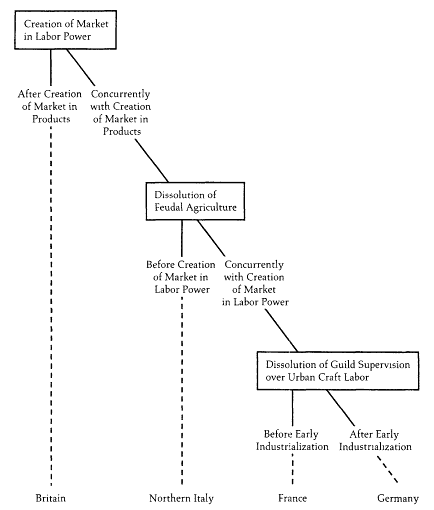
Figure 10.
Hierarchy of Motivating Conditions for Specifications
of Labor as a Commodity
nobles of northern and central Italy began to abandon manorial agriculture. They converted the obligatory labor services of their subordinates into rents.[6] In the fourteenth century, as the economic influence of the buoyant urban communes encompassed much of the countryside, ownership of the land passed from the ancient nobles to new bourgeois owners.[7] Despite the great variety in the size of holdings in different localities, most agriculture was dominated by small peasant farmers paying rents in money or as a share of the crops.[8] The region was perhaps unique in its prolonged experience with a new rural civilization based on commercial exchange rather than formal legal privilege over persons.[9] Peasants were, to be sure, dependent upon the landowners, but their relation was based originally on contract and did not include a model for the delivery of unpaid labor services.
As the Italian economy in the sixteenth century entered its secular decline, the countryside experienced what some observers have vaguely termed refeudalization. The peninsula's many small states, in their quest for revenue, sold rights and functions normally exercised by the central authorities, such as the levying of taxes and administration of justice. The buyers were thereby invested with a "fief." Despite the splintering of authority and the growth of byzantine networks of privilege, this process did not recreate the fusion of property and authority over labor that characterized land ownership in Germany and France. The feudatories received no estate holdings, no right to meddle in the property rights of the people in the fief, and, most important for the development of concepts of labor, no claim to exact dues in work.[10] They acquired the license to levy taxes specified at the time of investiture, to collect fees from public facilities such as grain mills and inns, and to administer justice—although many subjects were exempted from the feudatories' courts or could appeal to central
[6] Gino Luzzatto, An Economic History of Italy from the Fall of the Roman Empire to the Beginning of the Sixteenth Century (London: Routledge & Kegan Paul, 1961), p. 62.
[7] Sigmund von Frauendorfer, Agrarwirtschaftliche Forschung und Agrarpolitik in Italien (Berlin: Paul Parey, 1942), p. 22; Guy Fourquin, Lordship and Feudalism in the Middle Ages (London: George Allen & Unwin, 1976), p. 225.
[8] Von Frauendorfer, op. cit., pp. 13, 16; Marx, op. cit., Volume One, p. 744.
[9] Maurice Aymard, "La transizione dal feudalesimo al capitalismo," in Ruggiero Romano and Corrado Vivanti, editors, Storia d'Italia. Annali I: Dal feudalesimo al capitalismo (Torino: Giulio Einaudi, 1978), pp. 1169–1170, 1178. But for some public works or in periods of emergency, labor in the service of communal authorities remained obligatory into the sixteenth century. Amintore Fanfari, Storia del lavoro in Italia dalla fine del secolo XV agli inizi del XVIII (2d ed. Milano: A. Giuffrè, 1959), pp. 270–273.
[10] Here I closely follow Domenico Sella, Crisis and Continuity: The Economy of Spanish Lombardy in the Seventeenth Century (Cambridge, Massachusetts: Harvard University Press, 1979), p. 164.
authority.[11] On the whole the peasants remained indifferent to this readjustment of administration, so inconsequential did these changes "on high" seem to them.[12] In the centuries of Italy's economic regression the devolution of responsibility for collecting revenue and for staffing the courts created an interminable maze of privilege but did not alter the reliance in agriculture on contracts for labor rather than on obligatory services.
In the seventeenth century Italy diverged from Britain in its failure to develop a liberal market policy. The weakening of the Italian economy made it increasingly difficult to provision the towns with foodstuffs. Most states controlled prices of grain and imposed tariffs on grain shipments.[13] In textiles, cultivators of raw silk had to dispose of their output to registered merchant guilds.[14] In contrast to Britain's precocious development of an integrated national market, the Italian states regulated trade in such a way as to prevent the formation of interregional markets.[15] The guilds continued to control the training and merchandising of labor power until the mid-eighteenth century.
As in Germany, so in Italy a period of rapid reform orchestrated by the state led to the simultaneous recognition of markets in labor and in other commodities. Venice began the gradual abolition of guild privilege in 1719. In Tuscany the government promulgated freedom of occupation in 1770 and abolished the guilds' exams, courts, and statutes.[16] The administration in Lombardy removed the guilds through a series of bold decrees between 1773 and 1787.[17] This period coincided with the removal of legal restrictions on the free marketing and pricing of goods.
[11] Ibid., p. 167.
[12] Ibid., pp. 162–163.
[13] Price controls on grain survived until the Napoleonic era. Dino Carpanetto and Giuseppe Ricuperati, Italy in the Age of Reason 1685–1789 (London: Longman, 1987), pp. 24–25. In Lombardy, estate owners and farmers were required to bring an established fraction of their crop for sale in the neighboring city square. Sella, op. cit., p. 33.
[14] Sella, op. cit., p. 141; Carlo Poni, "Mass gegen Mass: Wie der Seidenfaden rund und dünn wurde," in Robert Berdahl et al., editors, Klassen und Kultur (Frankfurt am Main: Syndikat, 1982), pp. 23, 35.
[15] Luigi Dal Pane, Economia e società a Bologna nell'età del Risorgimento (Bologna: Zanichelli, 1969), p. 476.
[16] Corrado Rainone, Pensiero e strutture socio-economiche europee e italiane nell'epoca risorgimentale 1748–1861 (Milano: A. Giuffrè, 1975), p. 208. For Bologna, see Dal Pane, op. cit., pp. 271, 331.
[17] Commercial law in Lombardy stipulated a laissez-faire regime in labor before the Napoleonic invasions. Anna-Lucia Forti-Messian, "La Législation du travail en Lombardie à l'époque napoléonienne," Annales historiques de la révolution française Volume 49 (1977), pp. 637–652.
Northern Italy's conjoint development of formal markets in labor and in finished products and its lack of a feudal legacy therefore combined aspects of the German and the British experiences. The effect upon the construction of labor as a commodity was perhaps foreseeable. First, the absence of a feudal legacy in Italy eliminated the cultural template for imagining that the employer lays claim to a service capacity and has the right of disposal over the person of the subordinate worker. Accordingly, the specification of labor that dominated Italian economic literature during the classical period of political economy bears a generic resemblance to the prevailing concept in Britain: labor was seen as being transferred from worker to employer as it was materialized in a product. Cesare Beccaria's reflections upon the division of labor, perhaps the most celebrated economic discussions from Italy's eighteenth-century bourgeois Enlightenment, are restricted to the example of independent producers exchanging their articles with each other.[18] Yet the conjoint appearance of markets in labor and in finished products created a difference in development between Italy and Britain: when the concept of labor as a commodity appeared in Italy, it was not subsumed under a preexisting concept of material goods exchanged in a market, as happened in Britain. There the antecedent development of formally free intercourse in finished goods that were believed to be exchanged in terms of the value of the materialized labor they contained lent people of commerce the notion that if labor, too, was a commodity it must acquire its calculable value when it entered the market embodied in a ware. In Italy, by comparison, the transfer of labor occurred via the materialized product, but the value of the product was determined by the labor power people were willing to dispense for its acquisition.[19] The simultaneous development of formally free intercourse in both finished products and labor power encouraged economic agents to see the expenditure of labor power and the amount spent on products as determined by the same utilitarian calculus. Since the amount of labor an individual was willing to disburse for a product could differ from the amount of materialized labor received in it, however, labor seemed to be a source of a product's value, but not its determinant.[20] Yet a key similarity
[18] Cesare Beccaria, Elementi di economia pubblica , in Pietro Custodi, editor, Scrittori classici italiani di economia politica , Parte Moderna, Tomo XI (Milano: G. G. Destefanis, 1804).
[19] Ibid., p. 54.
[20] Graziani, op. cit., p. 121. Francesco Fuoco believed that labor can serve as an index of value because it decides whether something can be easily obtained. "Things that are naturally useful, to put it in rigorous terms, do not have value, because they are not appraised; and they are not appraised because they are lacking one of the principal elements of which an appraisalconsists. This element is rarity; the things that are hard to obtain call for an extraordinary quantity of labor" ("si ricerca una straordinaria quantità di lavoro"). Fuoco, Saggi economici , Prima Serie I (Pisa: Presso Sebastiano Nistri, 1825), p. 176. Fuoco contended that the amount of labor put into a product did not by itself determine the value of the product; yet the amount of labor put into something determines its value because it determines whether it will be rare. Labor serves as an index of value because it expresses the balance of supply and demand for a particular good. But Fuoco does not discuss the transfer of labor except as it is concretized in a product. He has no theory to speak of about labor power's value apart from that of products: "Once the labor becomes a good," he summarizes, "its price will be subject to the laws that regulate the prices of all other goods." Fuoco, Saggi economici , Prima Serie II (Pisa: Presso Sebastiano Nistri, 1827), p. 367. Ferdinando Galiani's work expressed a similar view. "Labor," Galiani wrote, "alone gives things value whether they are entirely works of art . . . or such things as minerals, stones, wild fruit trees, and so on." But, in Galiani's view, labor acquires its value by its scarcity according to the balance of supply and demand. On Money (Ann Arbor: University Microfilms International, 1977 [1751]), p. 29.
between the Italian and British classical economists confirms that the Italians conceived of the conveyance of abstract labor via products: the Italians, like the British, were weak in analyzing the entrepreneurial function. The classical Italian economists, like the British, treated the employer as a capitalist investor rather than as a supervisor of the execution of work.[21]
The development of Italian theories of labor's contribution to the prices of goods may have crested in the work of Francesco Ferrara, who received a chair in political economy at Turin in 1848. Ferrara supposed that labor is transferred between persons in the market via the transfer of articles.[22] He proposed that "labor be considered as a product capable of being sold, the price of which is the wage."[23] To be sure, Ferrara acknowledged that the expenditure of labor entered into the calculation of the value of a product, for value is measured by the sacrifice in effort that consumers are willing to make to obtain the product, whether by making it themselves or by working to make an exchange for it.[24] Every person equates the price of something with their "individual appreciation" of the amount of their own "effort" that would be required to obtain that merchandise.[25] Ferrara treated the fact that people hire services as analytically similar to their purchase of a finished ware in an equalitarian exchange:
[21] Fuoco, op. cit., II, p. 217. Giammaria Ortes could not discover how entrepreneurs who borrowed capital could turn a profit except by stealing from their creditors. See the analysis offered in "Italian School of Economics" in Sir Robert Harry Inglis Palgrave, Palgrave's Dictionary of Political Economy (London: Macmillan & Co., 1917), Volume II, note pp. 464–465.
[22] G.-H. Bousquet, Esquisse d'une historie de la science économique en Italie des origines à Francesco Ferrara (Paris: Marcel Rivière, 1960), p. 83.
[23] Francesco Ferrara, Oeuvres économiques choisis (Paris: Marcel Rivière, 1938), p. 134.
[24] Bousquet, op. cit., p. 80.
[25] Graziani, op. cit., p. 167.
Someone who uses the labor of another will not be disposed to pay more for it than he would pay to procure it in another fashion, that is to say, to "duplicate" it. . . . The labor that one must pay by means of a salary may be "duplicated" personally, just as the purchaser of a material object may, in certain cases, produce it with his own hands rather than purchase it.[26]
As in theories of value, so in theories of practice. Industrial advisers who discussed the use of piece-rate scales in Italy focused on the employer's measurement of the materialized labor. In contrast to German commentators upon industrial relations who saw the piece-rate scale as a surrogate index of the labor activity, the Italian experts saw it as a measure of embodied labor pure and simple.[27] Research in the future must examine the incarnation of labor's commodity form within the instrumentalities of life on the shop floor in Italy.[28] This preliminary sketch suggests, however, that discourse in Italy about labor was cast in a distinctive mold that followed the logic of the region's route to liberal commercialism.
France: A Suggestive Extension
The French case illustrates the construction of labor as a commodity under circumstances that display two initial contrasts to those prevailing in Britain. First, the institutional frameworks for the formally free exchange of manufactures and of labor power were created simultaneously in France during the Great Revolution, not disjointly as in Britain. Second, France began the transition to a capitalist labor market with a legacy of feudal relations of work in agriculture. Both these conditions approximately paralleled the conditions obtaining in Germany during the same process of transition. But development in France diverged from that in Germany: during the initial transition to a formally free labor market, the guilds in France were not just stripped of their lawful monopolies over the marketing of
[26] "In this case," Ferrara continues, "the calculation of the 'duplication' will take place in his mind, by comparing that which the laborer demands to the total of sacrifices involved in personal execution of the work." Op. cit., p. 134. The extraction of a use value through domination of the worker utterly disappears from this analysis.
[27] Riccardo Dalla Volta, Le forme del salario (Firenze: Fratelli Bocca, 1893), p. 198.
[28] There is evidence that late-nineteenth-century Italian factories bolted latecomers out, as in Britain, rather than fine them. Luigi Guitto, La fabbrica totale (Milano: Feltrinelli Economica, 1979), pp. 197–198. Factory design in Italy stressed the need for control of border points as well as total visibility of the production process itself. Carlo Poni, "All' origine del sistema di fabbrica: Tecnologia e organizzazione produttiva dei mulini da seta nell'italia settentrionale (sec. XVII–XVIII)," Rivista storica italiana Volume LXXXVII, fascicolo III (September 1976), p. 489.
goods; they were eliminated altogether. In contrast to development in Germany, urban craftwork in France adapted to commercial liberalism without significant protection and could therefore serve as an institutional locus for the cultural definition of labor as a commodity. The major currents of economic thinking in France in the early nineteenth century gave expression to a distinctive specification of labor as a commodity which was eventually installed on the factory shop floor.
In the decades before the revolution of 1789, the constraints on trade and on the exercise of an occupation eroded in France, but they were not replaced by a formally free market regime in products or labor power. Louis XV's government declared in 1762 that manufacture in the countryside could proceed independently of the guilds, which were centered in the cities.[29] Despite this newly confirmed liberty, exchange in the rural outlands developed under a hodgepodge of shifting local ordinances. At least until 1779, many intendants in the provinces enforced requirements that rural textile makers produce only approved varieties of cloth.[30] In the north of France, by order of the intendant , inspectors from the textile guilds of Lille tramped through the backwoods districts to seize fabrics that deviated from approved patterns.[31] The surveillance of rural output and the fines levied on aberrant weavers did not halt the rise of outland manufacture, but they helped to attach a portion of that production to the regulated trade of the cities.[32] Urban brokers sometimes retained a statutory monopoly on the marketing of certain lines of fabrics created in nearby villages.[33] In some regions, rural
[29] E. Tarlé, L'Industrie dans les campagnes en France à la fin de l'ancien régime (Paris: Edouard Cornély, 1910), p. 53.
[30] Philippe Guignet, Mines, manufactures et ouvriers du Valenciennois au XVIIIe siècle (New York: Arno Press, 1977), pp. 89, 93; for an example of confiscation of cloth in Languedoc in 1773, see J. K. J. Thomson, Clermont-de-Lodève 1633–1789 (Cambridge: Cambridge University Press, 1982), pp. 422–423; William Reddy, The Rise of Market Culture (Cambridge: Cambridge University Press, 1984), p. 36; Harold T. Parker, The Bureau of Commerce in 1781 and Its Policies with Respect to French Industry (Durham, North Carolina: Carolina Academic Press, 1979), p. 33. After 1779, textile producers could manufacture cloth by any standard, but unauthorized fabric had to be stamped as such. Parker, op. cit., pp. 36–37, 108.
[31] Gail Margaret Bossenga, "Corporate Institutions, Revolution, and the State: Lille from Louis XIV to Napoleon," Ph.D. diss., University of Michigan, 1983, p. 301.
[32] Jean-Pierre Hirsch, "Négoce et corporations," in Gérard Gayot and Jean-Pierre Hirsch, editors, La Révolution française et le développement du capitalisme (Lille: Revue du Nord, 1989), p. 360. On the attachment of rural production to regulated urban trade, see also Charles Engrand, "Concurrences et complémentarités des villes et des campagnes: Les Manufactures picardes de 1780 à 1815," Revue du Nord Volume 61, Number 240 (January–March 1979), pp. 68–69.
[33] Bossenga, op. cit., pp. 290, 308, 351. In many branches of manufacture, the state also granted to its favored entrepreneurs exclusive rights within a region to produce a line of textilegoods. Parker, op. cit., p. 53; Serge Chassagne, "La Diffusion rurale de l'industrie cotonnière en France, 1750–1850," Revue du Nord Volume 61, Number 240 January–March 1979, pp. 99–100.
spinners and weavers were still required to sell their goods in an approved marketplace, to prevent unlicensed dealers from poaching on the business of the guild brokers.[34] Amid this forest of regulation, the abolition of guild jurisdiction over labor in the countryside represented only a partial clearing.[35]
Within the walls of the municipalities, officials upheld their right to control manufacture. In principle, magistrates in the textile towns remained the "natural judges" of economic activity. They could allocate yarn to various branches of weaving, authorize brokers to serve as intermediaries between producers and merchants, set up appropriate prices to be paid to both male and female workers for products, and decide whether new branches of enterprise should be established.[36] Finally, of course, the urban corporations used their royal charters and judicial rights to buttress their manufacturing privileges and to control the circulation of labor. Guild masters were officially forbidden to compete with colleagues to at-
[34] Bossenga, op. cit., p. 352; Gay L. Gullickson, Spinners and Weavers of Auffay (Cambridge: Cambridge University Press, 1986), p. 64. William Reddy points out that rural outworkers contested these efforts to regulate trade. He describes a riot that occurred in Rouen during 1752 in protest against a royal ordinance restricting trade in yarn to the guild-controlled Cloth Hall. According to Reddy's interpretation of events, the outworkers objected, not to an unwarranted regulation of commerce, but to the expected insufficiency of wages for the procurement of subsistence at a time of high grain prices. See Reddy's brilliant analysis in "The Textile Trade and the Language of the Crowd at Rouen: 1752–1871," Past & Present Number 74 (February 1977), pp. 70–74. In their comparison of France and Britain, Wadsworth and de Lacy Mann suggest that the subversion of regulation in Rouen comprised an exception for France. Alfred P. Wadsworth and Julia de Lacy Mann, The Cotton Trade and Industrial Lancashire 1600–1780 (Manchester: Manchester University Press, 1931), p. 203.
[35] Jean-Pierre Hirsch, Les Deux Rêves du Commerce: Entreprise et institution dans la région lilloise, 1780–1860 (Paris: Ecole des Hautes Etudes en Sciences Sociales, 1991), pp. 159–160. For an account of the climate of uncertainty in the 1780s brought about by policies that combined regulation and market liberty for textile putting-out systems, see Thomson, op. cit., pp. 379, 455.
[36] Guignet, op. cit., pp. 43, 78, 80–83, 126–138; Michael Sonenscher, Work and Wages: Natural Law, Politics and the Eighteenth-Century French Trades (Cambridge: Cambridge University Press, 1989), p. 67. The judicial authorities of the corporate order may also have discouraged the development of piece-rate lists. Ibid., p. 279. Apart from the prescriptions for textile production, city officials imposed controls on the import of cloth into their domain by checking seals of inspection from brand examiners and certificates proving that the transport duties had been paid on provincial routes. William Reddy, "The Structure of a Cultural Crisis: Thinking About Cloth in France Before and After the Revolution," in Arjun Appadurai, editor, The Social Life of Things (Cambridge: Cambridge University Press, 1986), p. 265.
tract journeymen by offering better terms of work.[37] The corporations' fetters on the exercise of an occupation came under increasing criticism from the reform-minded philosophes in the last decades of the old monarchy. Indeed, Turgot suspended the corporations for several months in 1776 after he began his brief tenure as controler-general. But his edict was never enforced.[38] The guilds were swiftly restored and consolidated between 1776 and 1780.[39] As a well-ordered hierarchy of associations subordinate to the monarch, they seemed indispensable to uphold the organization of society.[40] Even when, in the eighteenth century, the de jure monopolies of the guilds became less effective, the model of constitutory corporations remained dominant in popular conceptions of the social order.[41]
The revolution of course swiftly initiated the transition to liberal commercialism. Internal customs and tolls on the transport of goods disappeared in 1790.[42] The Constituent Assembly moved almost immediately to create a formally free market in labor power as well. In the period of the revolution from February to September, 1791, the assembly passed three decrees that demolished the old framework of corporate production. It first eliminated the guild associations of masters and workers. By contrast with the path of reform in Prussia, in France the guilds lost their function as official corporate sponsors of the employment of artisans. They were suppressed as associations for the training of workers, certification of masters, and cultivation of the trade. Then, in June, the Le Chapelier law put an end to all trade associations, including workers' collective organizations. The law provided instead for the establishment of wages by "freely contracted agreements between individual and individual."[43] Finally, in September of that year the
[37] Henri Sée, Economic and Social Conditions in France During the Eighteenth Century (New York: Cooper Square Publishers, 1968), p. 124.
[38] Ibid., p. 135.
[39] On the controversial survival of guild regulation for textiles in Lyons, consult L. Trénard, "The Social Crisis in Lyons on the Eve of the French Revolution," in Jeffry Kaplow, editor, New Perspectives on the French Revolution (New York: John Wiley & Sons, 1965), pp. 72–77.
[40] William H. Sewell, Jr., Work and Revolution in France (Cambridge: Cambridge University Press, 1980), pp. 73–74; François Olivier-Martin, L'Organisation corporative de la France d'ancien régime (Paris: Librairie du Recueil Sirey, 1938), p. 537; Ellen Meiksins Wood, The Pristine Culture of Capitalism (London: Verso, 1991), p. 88.
[41] Olivier-Marin, op. cit., p. 537. Even Turgot operated within the assumptions of a corporate order, as Reddy discloses in "The Textile Trade," op. cit., p. 72.
[42] Albert Soboul, The French Revolution, 1787–1799 (New York: Vintage Books, 1975), p. 191.
[43] Cited by Sewell, op. cit., p. 89.
assembly set aside the regulations that had prescribed the execution of labor: it dismantled all offices for inspecting the quality and specifications of manufactures.[44] Of course, no perfectly liberated bazaar in articles of commerce or in labor power appeared in France (or elsewhere) that would satisfy the economist's shining ideal of an unbridled play of market forces.[45] But there is a world of difference between community-supported, culturally prominent, foundational restrictions on trade and narrow exemptions from competition or implicit market imperfections such as de facto labor immobility. The revolution brought France across this divide. At one stroke, the outlines of an integrated national market in both products and labor came into view.
The dramatic change in governing economic principle did not allow the concept of labor as a commodity to spring ready-made out of the market stalls and workshops. The current of ideas that surfaced among the sans-culottes during the ensuing months of popular organization and insurrection verify that labor's commodity form had not yet taken shape. The sans-culottes founded their outlook upon the social contribution of concrete labor itself. As William Sewell's study of the language of labor reminds us, the common people of Paris sanctified those who worked with their hands.[46] In their eyes, manual effort provided the moral foundation of the new French republic. When the radical sans-culottes articulated their demands for bread on the morrow or their hopes for greater social equality in times to come, they did not reason from the commercial value of their labor. The dependent artisans and journeymen, Albert Soboul noticed, "did not go so far as to establish a relation between the amount of work and the amount of the wage."[47] They asserted only that their labor made them deserving members of the community and gave them title to a share of its wealth. When they advanced their claims, "wages were not
[44] Jean-Pierre Hirsch, "Revolutionary France, Cradle of Free Enterprise," American Historical Review Volume 94, Number 5 (December 1989), p. 1286.
[45] The literature on the efforts of the nineteenth-century French bourgeoisie to fix prices and establish trade cartels is ample. See, illustratively, Bertrand Gille, Recherches sur la formation de la grande entreprise capitaliste: 1815–1848 (Paris: S.E.V.P.E.N., 1959), pp. 147–162. Jean-Pierre Hirsch has emphasized the conditional and tactical use of a discourse of free enterprise among people of commerce in Les Deux Rêves . But he also acknowledges its power to structure practice. "Revolutionary France."
[46] Sewell, op. cit., pp. 111–112.
[47] Albert Soboul, "Problèmes du travail en l'an II," Annales historiques de la révolution française Number 144 (July–September 1956), p. 239.
in the least conceived as representative of labor."[48] Technically labor power might be acquired by contract, but it had not yet been culturally defined as a commodity.[49]
The fashioning of labor's commodity form in France during the first half of the nineteenth century relied upon the understanding of labor services that was inherited from the old regime. Feudal legacies in the countryside and corporate traditions in the towns encouraged French employers and workers to envision the employer's purchase of labor as his requisitioning of the worker's labor activity. The urban corporations of the ancien régime not only ordered French business and industry, but they formed the constituent units of society and were to serve as a model of social relations in France's early commercial society. Their charters and internal organization were similar to those for the universities and learned professions, grouping trade guilds with other associations as upholders of the arts rather than as organizations defined as providers of productive or manual labor per se.[50] "Labor" was recognized as a contributor to social welfare if it was governed by artistic and intellectual discipline.[51] Urban producers supposed that well-ordered activity, not the exchange of materialized labor, bonded society together.
Present-day historians can no longer romanticize the self-consciously corporate organization of the French urban trades by supposing that it ensured stable, communal relations in the workshops. The arduous research of Michael Sonenscher has demonstrated that artisanal manufacture in eighteenth-century France was characterized by rapid turnover in the work force and by reliance on far-flung chains of subcontractors.[52] In these flexible and dynamic networks, however, relations between outworkers and merchants were officially governed by an extensive code that
[48] Albert Soboul, Les Sans-culottes parisiens en l'an II (Paris: Clavreuil, 1958), pp. 453–454. If Sewell judges correctly that the sans-culottes had "a clear and consistent conception of labor and its place in society," so does Soboul in saying that they nonetheless lacked a definition of labor as an economic category. Sewell, op. cit., p. 109.
[49] What is characteristic about capitalism is not that the commodity labor power can be purchased—which held true even in so-called precapitalist societies such as ancient Greece—but that labor power appears in all events as a commodity. Marx, Das Kapital , op. cit., Volume 2, p. 119.
[50] Sewell, op. cit., p. 25.
[51] Ibid., pp. 22–24.
[52] Sonenscher, op. cit. On the omnipresence of subcontracting long before the destruction of the guilds, see Sylvia Thrupp, "The Gilds," in The Cambridge Economic History of Europe , Volume III (Cambridge: Cambridge University Press, 1965), p. 280.
prescribed the legitimate exercise of the craft.[5] The British model of independent, self-determining small producers exchanging their wares had little resonance against the background of corporate organization in eighteenth-century France.[54] Instead, the rhetoric of the corporate order portrayed production as the execution of an art which was certified, controlled, and protected by the monarch. Despite their revolutionary sentiments, the sans-culottes carried some elements of this outlook forward. They focused on labor executed for the welfare of the community, not on the exchange of contributions produced by autonomous commodity producers. Even as the laws of the corporate order inherited from the ancien régime disappeared, the sans-culottes emphasized mutual devotion to the labor activity rather than the exchange among independent manufacturers of products as vessels of materialized labor.
The ancien régime's definition of feudal work relations in the countryside, where by far the greater part of the population toiled, supplemented the emphasis on the delivery of labor services that prevailed in the towns. The feudal legacy in the countryside could play an important role in defining the labor transaction because the urban crafts under the old regime did not define the transfer of labor from dependent worker to employer. In the cities, no term for employer , such as patron , had yet become current.[55] Most craft masters employed only one or two assistants—or, very often, none.[56] Agriculture offered an important model for large-scale requisitioning of laborers.
Feudal agriculture in eighteenth-century France sustained a view of the transfer of labor as the obligatory delivery of a service. To be sure, the landed elite in France, compared to privileged landowners in German territory east of the Elbe, put scant economic reliance on the receipt of obligatory dues in labor. In the last days of the old regime, dependent peasants by and large tendered no more than twelve days annually of unpaid corvée labor to their landowners.[57] Yet, as in German territory west of the Elbe, these labor serv-
[53] Reddy, The Rise of Market Culture , op. cit., p. 26.
[54] Sewell, op. cit., p. 139.
[55] Michael Sonenscher, "Le Droit du travail en France et en Angleterre à l'époque de la révolution," in Gérard Gayot and Jean-Pierre Hirsch, editors, La Révolution française et le développement du capitalisme (Lille: Revue du Nord, 1989), p. 383.
[56] Ibid.; also F. Furet, C. Mazauric, and L. Bergeron, "The Sans-Culottes and the French Revolution," in Jeffry Kaplow, editor, New Perspectives on the French Revolution (New York: John Wiley & Sons, 1965), p. 247.
[57] Gerd van den Heuvel, Grundprobleme der französischen Bauernschaft 1730–1794 (München: R. Oldenbourg Verlag, 1982), p. 61.
ices were nonetheless essential in France in defining the relation of the laboring peasantry to persons of rural property. The tribute showed that title to the land conferred a claim not only to rents but to service and to authority over the activity of subordinates.[58] This connotation became explicit in an incident narrated by the abbé Clerget: he claimed that a seigneur at the Parlement of Franche-Comté asserted the right to impose a new corvée on the peasantry in exchange for relinquishing ancient rights over vassals to receive oblations and "lead them in the hunt."[59] Not that the corvée had become purely symbolic: peasants from the village of Haute-Marche in the district of Creuse complained in 1790 that they still sacrificed at least one day weekly to discharge their labor obligations.[60] In the last years of the old regime a few seigneurs tried to reimpose labor tributes that rivaled those of prior centuries.[61] Small wonder that the peasants included the corvées among their humiliating burdens when they compiled lists of grievances on the eve of the revolution.[62]
Memory of the corvées survived well into the nineteenth century. When the reins of power passed again to the Bourbons, the peasants associated the restoration of old political principles with the return of ancient relations in economic life. They feared the resuscitation of the unpaid days of labor.[63] As
[58] P. de Saint Jacob, Les Paysans de la Bourgogne du Nord au dernier siècle de l'ancien régime (Paris: Société "Les Belles Lettres," 1960), p. 115; van den Heuvel, op. cit., p. 64; Ernst Hinrichs, "Feudalität und Ablösung: Bemerkungen zur Vorgeschichte des 4. August 1789," in Eberhard Schmitt, editor, Die Französische Revolution (Köln: Kiepenheuer & Witsch, 1976), p. 133. The seigneurs who collected dues in services in the second half of the eighteenth century were reluctant to follow new economic arguments that urged a conversion to money rents. J. Q. C. Mackrell, The Attack on "Feudalism" in Eighteenth-Century France (London: Routledge & Kegan Paul, 1973), pp. 14, 146.
[59] Mackrell, op. cit., p. 121.
[60] Martin Göhring, Die Feudalität in Frankreich vor und in der grossen Revolution (Berlin: Emil Ebering, 1934), p. 20.
[61] Saint Jacob, op. cit., p. 426.
[62] Georges Lefebvre, Les Paysans du Nord pendant la révolution française (Bari: Editori Laterza, 1959), p. 137; P.-D. Bernier, Essai sur le tiers-état rural (Genève: Slatkine-Megariotis Reprints, 1974 [1892]), p. 137; Mackrell, op. cit., p. 4. The peasantry's resistance to landholders' corvées is described in P. M. Jones, The Peasantry in the French Revolution (Cambridge: Cambridge University Press, 1988), p. 52. Peasants complained of being "subject [sic ] en qualité de prévot à aller où il plaira au dit seigneur, pourvu qu'on puisse retourner en sa maison entre deux soleils." Bernier, op. cit., p. 138. The dues in labor formed part of a larger complex of peasant obligations. A landowner often required peasants to bring their grain to a designated mill, for the use of which they paid a fee. When the peasants delivered rents in kind, such as grain or fowl, they resented not just the amount but the method of the exaction: they had to carry the animals or grain to the lord's estate. This was defined as a kind of service and criticized as an obligation of "servitude." Göhring, op. cit., pp. 112, 226; van den Heuvel, op. cit., p. 64.
[63] Mackrell, op. cit., p. 189.
late as 1840 the procurator-general in Bordeaux attributed to the influence of "socialists" the widespread apprehension on the Dordogne about reimposition of the tithes and corvées.[64] The autobiography of the Parisian turner Jacques-Etienne Bédé shows that urban workers, too, used the corvée as a point of comparison. Bédé and his fellow workers on piece rates went on strike in 1819 to protest the unremunerated time they were obliged to spend waiting at the workshop. Their goal, they said, was to abolish "corvées," the supply of unpaid labor.[65]
As employers and workers developed an understanding of the capitalist employment relation in the nineteenth century, they viewed the labor transaction as the offering of a service capacity, paralleling the model of days of service delivered in agriculture. In keeping with the late abolition of feudal relations of work in their respective countries, French workers frequently used corvée and German workers applied Frondienst to characterize the capitalist employment relation.[66] The English and Italian languages, by comparison, did not retain catchwords referring to the delivery of unpaid dues in labor. Language testified to the fundamental forces at work on the route to the creation of a capitalist labor market.
The vernacular discloses how the specifications of labor as a commodity that prevailed in nineteenth-century France and Germany shared important similarities due to their legacies of feudal relations of work; yet there were also important differences between the countries, which were attributable to the annihilation of the guilds in France. The works of political economists reflect both the parallels and the contrasts in cultural outcomes.[67] Elite economists in France believed that labor was sold as a resource. For example, Jean-Baptiste Say, a former textile manager and one of the earliest economists to draw on French sources to counter some of Adam Smith's proposi-
[64] Ibid., p. 190.
[65] Cited in Sonenscher, Work and Wages , op. cit., p. 31.
[66] For France, see Paul Leroy-Beaulieu, Traité théorique et pratique d'économie politique , Volume 2 (Paris: Guillaumin, 1900), p. 291; Le Travailleur , April 4, 1894, "La Liberté du Travail." For Germany, see the transcript from a textile workers' meeting, Staatsarchiv Weimar, Landratsamt Gera, Nr. 2562, November 27, 1905; Stadtarchiv Cottbus, AII 33b, Nr. 33 Oct. 6, 1896, p. 92, "Frondienst"; Staatsarchiv Dresden, Amthauptmannschaft Glauchau Nr. 395, transcript of meeting in Meerane, Nov. 5, 1905, pp. 101–102, regarding "dues in labor services [Frondienste ] to be carried out for capital." Der Textil-Arbeiter , January 20, 1905, Chemnitz; Beilage zur Volkswacht , Bielefeld, Nr. 255, Oct. 31, 1907, Spinnerei "Frondienst."
[67] The destruction of the ancien régime and the popularization of political economy went hand in hand, as if the science were a natural accompaniment of the new commercial order. Gilbert Faccarello, "L'Evolution de l'économie politique pendant la révolution: Alexandre Vandermonde ou la croisée des chemins," in Maxine Berg, editor, Französische Revolution und Politische Ökonomie (Trier: Schriften aus dem Karl-Marx-Haus, 1989), pp. 82–84.
tions, grouped the "industrial services" of workers alongside land and capital in a list of the productive capacities of a nation.[68] He added, "When I hire a laborer by the day, he does not sell me his fund of productive skills; he sells me only the services his capacity can give in the course of a day."[69] Say thereby intended to indicate that renting out any "productive fund," be it capital or labor, equaled the vending of a service.
Say's comment implied that workers were contributing a resource to the production process that had the same status as the contributions of landowners and capitalists. The French concept of labor as a commodity resembled that of the British insofar as both treated the exchange as one that occurred among market equals without necessarily referring to relations of supervision in production itself. But Say's analysis and those of the French economists who followed him differed from those of the British in making a distinction between labor sold as a service and the product of that labor.[70]
The French classical economists highlighted the entrepreneurial function of combining diverse resources to create a product that had a value greater than the sum of its parts. From this perspective, of course, the worker could sell, not a product, but only a resource to be complemented by the employer.[71] To combine the factors of production employers needed only to put tools at the disposal of the workers; they did not require control over the immediate process of production.[72] Pellegrino Rossi, who succeeded Say to the most prestigious chair of economics in France, said that people who put cloth out to tailors to be finished by the tailors' labor bought not a product but a potential. "What do they buy?" he asked in his economics course of 1836–1837. "They buy a force, a means that will produce results whatever
[68] Cours complet d'économie politique pratique (Brussels: Société Belge de Librairie, 1840), p. 55. Say was the first holder of an academic chair for economics in France. Joseph Schumpeter, History of Economic Analysis (New York: Oxford University Press, 1954), p. 492.
[69] Say, op. cit., p. 55. The workers, he said, "sell their time and their effort, without being interested in the [financial] result. " Jean-Baptiste Say, Catéchisme d'économie politique (Paris: Guillaumin, 1881), p. 106.
[70] In contrast to Ricardo, the French economists who inquired into the origin of profit were able to distinguish between living labor and finished labor. "Il a fallu convenir que toutes les fois qu'il [the worker] échangerait du travail fait contre du travail à faire, le dernier [living labor] aurait une valuer supérieure au premier [materialized labor]." J. C. L. Simonde, De la Richesse commerciale (Genève: J. J. Paschoud, 1803), Volume 1, p. 37.
[71] Berke Vardar, Structure fondamentale du vocabulaire social et politique en France, de 1815 à 1830 (Istanbul: Imprimerie de la Faculté des Lettres de l'Université d'Istanbul, 1973), p. 64.
[72] Cours complet , op. cit., pp. 55–56.
the risks and hazards."[73] Workers sold their potential, but its use was not necessarily under the immediate command of employers and did not form part of the understanding of how the exchange of labor was effected.[74]
Still, the French concept of labor resembled the German concept insofar as it made a contrast between labor and labor power. As in Germany, vocabulary offers a suggestive, if preliminary, indicator of the concepts in operation. In the first half of the nineteenth century, French economists used labor power (puissance de travail) as well as industrial services to refer to labor as a commodity.[75] Rossi recognized that what the worker sold was the capacity to work, but he felt uneasy about this monetization of the laborers' life process. In his course on political economy, published in 1842, he said, "To conceive of labor power while abstracting it from the means of subsistence of the laborers during the process of production is to conceive of a phantom. Whoever says labor, whoever says labor power, means simultaneously workers and the means of subsistence, the laborer and the salary."[76] In this passage Rossi attempted to shift the emphasis from the sale of living labor to the provision of necessities of life. His discomfort resulted from the perception that workers in a capitalist regime seemed to be selling themselves, an unpleasantry that British economists avoided by focusing on the sale of labor materialized in a product.
If treating the workers themselves as commodities repelled the French economists, why did they not instead take up the British view of labor as a commodity? Where authors can gain a tactical advantage from altering their concept of labor but let the opportunity pass, the constraint laid by
[73] P. Rossi, Oeuvres complètes (5th ed. Paris: Guillaumin, 1884), Volume I, p. 221.
[74] This specification of labor's commodity form recurred in later French economics as well. Paul Cauwès, professor of political economy, declared that prices were determined by the need to pay people for their "labor services." He believed the compensation was set neither by the amount of the materialized labor delivered nor by the exchange value of the labor power purchased. Rather, labor services transferred to the employer were rewarded according to how much people were willing to pay for the products delivered—an amount determined only after the product had entered the market. Labor power as such had no determinable value. Précis du cours d'économie politique (Paris: L. Larose et Forcel, 1881), Volume One, p. 185. Analogously, see M. Ganilh, Dictionnaire analytique d'économie politique (Paris: Imprimerie de Fain, 1826), pp. 432–433, and Théodore Fix, "De la Mesure de la Valeur," Journal des économistes Volume 9 (Paris: Guillaumin, 1844), p. 3.
[75] Rossi, op. cit., Volume I, p. 237. In the second half of the nineteenth century, the term force-travail prevailed. Le Travailleur , Lille, February 28, 1894, p. 1.
[76] Rossi, op. cit., Volume II, p. 175: "Concevoir la puissance du travail, en faisant abstraction des moyens de subsistence des travailleurs pendant l'oeuvre de la production, c'est concevoir un être de raison. Qui dit travail, qui dit puissance du travail, dit à la fois travailleurs et moyens de subsistance, ouvrier et salaire."
an underlying assumption comes to the surface. A significant example appears in Pierre-Joseph Proudhon's System of Economic Contradictions , published in 1846. In the middle of this work's chapter on value, Proudhon wrote as if he were caught between two goals: he wanted to insist, against the prevailing skepticism in France, that embodied labor served as a measure of value; and he wanted to take the moral high ground by refusing to treat the workers themselves as marketable wares. He did not adopt the convenient escape of imagining that the commodity of labor was sold as materialized in a product. Instead, he presented a weak alternative:
Labor is said to have value , not as merchandise itself, but in view of the values supposed to be contained in it potentially. The value of labor is a figurative expression, an anticipation of effect from cause. It is a fiction by the same title as the productivity of capital. Labor produces, capital has value: and when, by a sort of ellipsis, we say "the value of labor," we make an enjambment which is not at all contrary to the rules of language, but which theorists ought to guard against mistaking for a reality.[77]
With this maneuver Proudhon sacrificed a chance to offer a coherent explanation of how labor determined prices in the contemporary marketplace. He could not compare the value of one person's labor power to another's.[78] Yet he retained the assumption that labor was sold as a potential even as he avoided setting a price tag on the workers themselves.[79]
The French concept of labor as a commodity was embodied not only in words but in legal and economic practice. How to define an employment contract was a difficult question for nineteenth-century French courts. Should home weavers who sold their products to middlemen be considered employees covered by labor law, or were they artisans in charge of an enterprise? Did it make a difference if they supplied their own materials and owned their own tools? The rulings of the French authorities emphasized the character of the market relation rather than the employer's immediate authority over the use of the labor.
[77] Système des contradictions économiques, ou philosophie de la misère (2d ed. Paris: Garnier Frères, 1850), p. 89. Emphasis in original.
[78] When Proudhon is forced to describe how people nonetheless set unequal prices on labor, he says they appraise only the products of this labor, not the labor itself. Op. cit., p. 89.
[79] French socialists in the second half of the nineteenth century emphasized that the market could not assign a value to the labor "force" expended by the worker. "Collectivisme et Socialisme," L'Égalité: Journal républicain socialiste , July 14, 1878, p. 3.
The employment relation in France received legal clarification when the courts ruled as early as 1836 that wage earners remunerated by piece rates were employees, not entrepreneurial contractors.[80] The courts found that the criterion for identifying an employee was the worker's "state of dependence and subordination," not the mode of payment.[81] Was the laborer who worked at home in such a "state of dependence"? The response that crystallized in France in the nineteenth century was distinctive. French officials defined domestic artisans as employees if they sold their products to one buyer at a time rather than offering them to the general public.[82] Home workers who sold products to a single buyer had the legal status of employees because they entered into an ongoing relation in which they cooperated to deliver labor on a regular basis, rather than formulating a separate contract for each piece of work.[83] When German officials in the nineteenth century were asked to decide the question, they did not see domestic artisans who sold products to a single buyer as dependent employees under the general business code, because they emphasized that these workers labored without supervision, off the premises.[84] True, the Prussian
[80] Alexis Martini, La Notion du contrat de travail (Paris: Editions des "Juris-Classeurs," 1912), p. 17. Apart from cataloging employment as a freely incurred contract, the Civil Code of 1804 was virtually silent on labor transactions. Jacques Le Goff, Du Silence à la parole: Droit du travail, société, état 1830–1989 (3d ed. Quimper: Calligrammes, 1989), p. 109.
[81] Martini, op. cit., p. 71.
[82] Ibid., p. 183. Correlatively, in the revolution of 1848 the bourgeois press defined a worker as a person who works "in the account of another." L'Union sociale , 1849, p. 94.
[83] Charles Goldenberg, De la Nature juridique des contrats de travail (Paris: V. Giard & E. Brière, 1908), pp. 39, 53.
[84] Philipp Lotmar, Der Arbeitsvertrag nach dem Privatrecht des Deutschen Reiches (Leipzig: Duncker & Humblot, 1902, 1908), Volume I, p. 311, and Volume II, p. 476; Otto von Zwiedineck-Südenhorst, Beiträge zur Lehre von den Lohnformen (Tübingen: H. Laupp, 1904), pp. 19–20. To be sure, the general German business ordinance offered home workers protection against such abuses as excessive fining. But it excluded them from other safeguards offered to those classified as dependent business employees. The Imperial Statistical Office excluded home workers from some surveys of employees even if they labored for a single contractor. A true "worker," by contrast, was "subject to the control and discipline of the entrepreneur," creating a "personal and economic relation of subordination." Germany, Kaiserliches Statistisches Amt, Streiks und Aussperrungen im Jahre 1900 (Berlin: Puttkamer & Mülhbrecht, 1901), p. 5*. Lotmar shows that German commentators, in contrast to the French, considered it less relevant whether the home worker had an "ongoing relation" with the employer. Lotmar, op. cit., Volume II, p. 480. The Business Ordinance specified that home workers were "independent trades people," since they maintained their "personal (not economic) independence." Germany, Die Gewerbe-Ordnung (Berlin: Carl Heymanns Verlag, 1910), pp. 36–37. For practical rulings, Arbeiter-Sekretriat, Luckenwalde, 2. Geschäftsbericht für die Zeit vom 1. Januar bis zum 31. Dezember 1905 (Luckenwalde: Selbstverlag, 1906), pp. 8–9; Fach-Zeitung: Organ des Niederrheinischen Weber-Verbandes , July 16, 1899. In the 1840s, dependent home workers were said to have "no real master" (keinen eigentlichen Herrn ). GustavDörstling, Die Arbeitgeber und die Löhne der Arbeiter (Chemnitz: J. C. F. Pickenhahn & Sohn, 1847), p. 9.
ministry of trade allowed home textile workers as early as 1856 to enroll as "factory workers" in the municipal funds for insurance against sickness that were administered for mill employees. Despite this administrative ruling to provide social welfare, however, officials noted that home workers, including those who worked for a single contractor without tools or materials of their own, did not stand in a "dependent relation of employment" since they labored "outside the workshop."[85]
In France, by contrast, whether the laborer worked at home rather than under the employer's eye made no difference "from the moment that a certain continuity in the relationship between the parties exists."[86] What defined the exchange of labor in business employment was not the employer's immediate exploitation of the use value of the labor, as in Germany, but the dedication, via the market, of the worker's labor potential to a single person. The definition of business employment in France focused on the offering of a potential but imagined that the employer consumed this potential through market exchanges rather than through immediate relations of domination, as in Germany.
This difference between the commodity form of labor in France and that in Germany derived in large measure from the isolation of German artisanal work from the development of commercial liberalism. As we have seen, even after the revolution of 1848 many German guilds continued their efforts to reacquire trade monopolies, and they blocked the intrusion of liberal commercial thought into the urban artisanal economy.[87] By the wiles of historical process, the very survival of the guilds in Germany placed their
[85] Zentrales Staatsarchiv Merseburg, Rep. 120 BB VII 3 7, May 1, 1856, pp. 25–26. The Chamber of Commerce in Krefeld reasoned that home workers must be viewed as independent producers for a second reason: some of them were responsible for apprentices and journeymen under their supervision. From the chamber's point of view, this position of authority made it all the more difficult to classify the chief workers as wage laborers. The chamber's rumination illustrates yet again the emphasis that economic agents in Germany placed on face-to-face authority relations for the definition of ordinary wage labor. Jahresbericht der Industrie- und Handelskammer zu Krefeld , 1872, p. 27, cited in Kenneth N. Allen, "The Krefeld Silk Weavers in the Nineteenth Century," Ph.D. diss., Stanford University, 1988, p. 74.
[86] Pierre Gerlier, Des Stipulations usuraires dans le contrat du travail (Paris: V. Giard et E. Brière, 1907), p. 24; Le Goff, op. cit., p. 77.
[87] Engels captured the fundamental distinctions among the developmental routes traversed by Germany, Britain, and France (see Figure 10, above). The feudal powers of the landed elites and of the guild masters, he said, were broken "in England gradually, with one blow in France, and in Germany it is not yet finished." "Ludwig Feuerbach und der Ausgang der klassischen deutschen Philosophie" (1888) in Karl Marx and Friedrich Engels, Marx-Engels Werke , Volume 21 (Berlin: Dietz Verlag, 1962), p. 300.
ideas at the periphery of the cultural development of capitalism.[88] In France, by contrast, the annihilation of the guilds meant that some of their collective premises were passed on in new guises, for the urban specialty trades were centrally involved in the development of liberal commercialism and helped shape its course.
Unlike some of their German contemporaries, the small producers in early nineteenth-century France rarely supposed that a refurbished guild system could be reinstated.[89] The corporate idiom inherited from the old regime nonetheless contributed to workers' early visions of an economy founded on association rather than proprietary individualism.[90] As might be expected on the basis of their corporate legacy, French workers in the first half of the nineteenth century sometimes viewed labor as a collective resource rather than as something alienated at a calculable loss or profit to the individual. The journal La Fraternité gave expression to this outlook in 1846. "Labor," it philosophized, "is a social act that gives value to the thing processed." This extrapolation from the cooperation of people of diverse talents for the manufacture of a single product bore implications for the claims to compensation that could be pressed by the laborers: "The true claim issuing from labor is the collective force. . . . None of the [individual] men employed on this piece of work can claim proprietorship of this piece, considering that it was made only by uniting his effort with those of others and that it issues only from the union and combination of heads and arms."[91] This emphasis on labor as a collective power could
[88] "In Germany, one might say, 'archaic' elements of the economy survived longest and strongest in domains that were bypassed by the main process of industrialization." John Breuilly, "Arbeiteraristokratie in Grossbritannien und Deutschland: Ein Vergleich," in Ulrich Engelhardt, editor, Handwerker in der Industrialisierung (Stuttgart: Klett-Cotta, 1984), p. 513.
[89] German small masters supposed in 1848 that a modified guild system was still viable. Toni Offermann, "Mittelständisch-kleingewerbliche Leitbilder in der liberalen Handwerker-und handwerklichen Arbeiterbewegung der 50er und 60er Jahre des 19. Jahrhunderts," in Ulrich Engelhardt, editor, Handwerker in der Industrialisierung (Stuttgart: Klett-Cotta, 1984), p. 529.
[90] Sewell, op. cit. The journal Echo de la fabrique , edited principally for textile workers in Lyon, counted "love of work, of order" as a requirement for joining a workers' trade association, as did the ancient guilds. November 10, 1833, p. 2.
[91] La Fraternité , July, 1846, p. 180. See also Les Droits de l'homme Number 1 (January 1849), "De l'Association"; La Fraternité universelle December 1, 1848, "Organisation du travail." Similarly, L'Echo de la fabrique discussed labor as a "social action." March 23, 1834, p. 1. The French emphasis on collaborative social production contrasts with the commercial dream of the early British labor movement, which envisioned "a community of independent small producers exchanging their products without the distortions of masters and middlemen." E. P. Thompson, The Making of the English Working Class (New York: Vintage Books, 1963), p. 295.
counter the conclusions offered by those who treated labor as a commodity like any other.[92] Yet the collective assumptions were retained when workers went on to describe, as they had to, the reality of their employment as individuals. They maintained that if the social resource of labor was alienated in practice by the individual, no natural price could be attached to it.[93]
The commodity form of labor in France supported the development of industrial practices that differed from those of both Germany and Britain. To be sure, French textile factory organization in the early nineteenth century superficially resembled that of Britain in several respects. For example, some French employers who made the transition from hand-powered spinning equipment to steam-driven machinery imposed weekly steam fees upon the workers in charge of the new, more productive equipment.[94] The weekly fee held workers responsible for covering the greater capital and operating costs of the powered machines in return for enjoying swifter output and correlatively greater returns from piece rates. This practice lent support to the notion that workers—sometimes called entrepreneurs d'ouvrage by the employers—were autonomous renters of the machines, who organized use of the apparatus and delivered finished products to the factory owner.[95] If the French workers were seen as deliverers of products, however, this superficial similarity enables us to ask more precisely what it means to say that labor has taken on a "commodity form."
To place the new form of labor in definitive perspective, let us not forget that even in ancient Mediterranean society, free laborers received payment
[92] In France, bourgeois economists emphasized the contribution of "collective labor" to the accumulation of surplus, but they rarely pointed to the empirical fact of cooperation and interdependence in production as grounds for declining to assign values to individual work. See, illustratively, Ganilh, op. cit., p. 410.
[93] La Fraternité , July, 1846, p. 180.
[94] William Reddy, "Modes de paiement et controle du travail dans les filatures de coton en France, 1750–1848," Revue du Nord Volume LXIII, Number 248 (January–March 1981), p. 142.
[95] Réglement de la filature, Roubaix, Bibliothèque nationale Gr. Fol. Wz 69 (1851). Some French employers gave workers options for how they would divide looms among weavers and assistants, provided, of course, that this did not raise the cost of production. For an example of a firm that constructed various payment plans from which workers could choose, based on how workers decided to divide the looms between weavers and assistants, see Archives départementales du Nord (henceforth cited as ADN) M625/86, February 4, 1908, Estaires. French mill proprietors let responsibility for hiring mule and loom assistants devolve upon each spinner and weaver. For parallel examples from metal-working, see Heinz-Gerhard Haupt, "Frankreich: Langsame Industrialisierung und republikanische Tradition," in Jürgen Kocka, editor, Europäische Arbeiterbewegungen im 19. Jahrhundert (Göttingen: Vandenhoeck & Ruprecht, 1983), p. 60.
for their products from regular buyers. But they did not thereby imagine that they were conveying abstract labor time.[96] Likewise, the rich evidence of William Reddy suggests that French textile workers at the start of the nineteenth century believed that they transferred items pure and simple, not that their products were the vessels for abstract labor. (As Reddy hints, the very term product may be ill-chosen for this period, since the word designates an article as the "produce" of labor rather than as a mere object suitable for exchange.)[97] This represents a major difference from Britain, where textile workers who saw themselves in part as renters of machinery rather than as employees per se also viewed the products they furnished as signs for abstract labor. French textile workers of the 1830s seem not to have referred to their earnings as wages or to have described themselves as deliverers of "labor." The employers at a spinning mill near Colmar showed that as late as 1842 they could take nothing for granted. They had to remind spinners that workers could not make products of their own choosing in the mill, reiterating in their factory ordinance that the decision as to what type of yarn to spin belonged to the employer.[98] Until labor practices in France embodied labor's commodity form, French factory workers presumed that they should receive the same piece rate for yarn whether it came from an old, short spinning mule or a newer, longer, and more productive one. They overlooked the difference in embodied labor times.[99] After all, from the standpoint of a trader, the goods from the old machine did not differ from the product of the new. The commodity form of labor in France was embodied in factory practice only when workers were conceived of as the sellers of labor services.[100]
With the benefit of a cross-national outlook we can ascertain the unique cultural mode by which labor power was sold in France. As in Britain and Germany, so in France the construction of the piece-rate scales for weavers exemplifies the specification of labor as a commodity. In France, as in Germany and parts of Britain, the mechanization of weaving was undertaken in
[96] Arjun Appadurai, "Introduction: Commodities and the Politics of Value," in Arjun Appadurai, The Social Life of Things: Commodities in Cultural Perspective (Cambridge: Cambridge University Press, 1986), pp. 8–9.
[97] This is the import of Reddy's "The Structure of a Cultural Crisis," op. cit.
[98] Règlement de police de la filature de Hausmann, Jordan, Hirn et Cie., August 17, 1842, Bibliothèque nationale, Gr. Fol. Wz 69 (1842).
[99] Reddy, The Rise of Market Culture , op. cit., p. 211.
[100] The textile workers' press referred to the labor transaction as a "contract for the rental of a service." L'Ouvrier textile , March 1, 1907, p. 1.
earnest only in the mid-nineteenth century.[101] In the north, which became by far the most important center for mechanized textile production, the weavers in the earliest factories were paid flat day wages.[102] By 1870, however, piece-rate scales applicable to several towns had emerged.[103] Early examples of district piece-rate scales for handweavers set workers' remuneration for a fixed length of cloth. But the schedules, unlike those in Britain during the same period, fail to reveal a linear relation between the increases in the density of the fabric and increases in remuneration.[104]
With the completion of mechanization in weaving during the second half of the nineteenth century, the French made equal use of scales that paid workers per thousand shots inserted in the cloth and of scales that remunerated workers for a fixed length of cloth.[105] But when they used pay per shot, too, they failed to find a linear relation between the density produced and payment for movement of the shuttle, as did German producers.[106] Through the pre–World War One period, the great majority of French lists display irregular rather than linear increases in pay as the density of the fabric increases.[107] Figure 11 plots onto a graph a schedule for merinos from the north of France. The slopes of the French scales, which indicate the rate at which remuneration rises as the density of the cloth increases, change erratically in woolens as in cottons, in moistened linen as in dry.
[101] Léon de Seilhac, La Grève du tissage de Lille (Paris: Arthur Rousseau, 1910), p. 25.
[102] Maurice Petitcollot, Les Syndicats ouvriers de l'industrie textile dans l'arrondissement de Lille (Lille: Coopérative "La Gutenberg," 1907), p. 299.
[103] Petitcollot, op. cit., p. 300.
[104] Archives municipales de Roubaix, FII ga(3), 1837; Paul Delsalle, "Tisserands et fabricants devant les Prud'Hommes," diss., University of Lille, 1984, p. 213; ADN M625/55 Seydoux, Sieber & Co., Bousies, 1886; ADN M625/66, Cambrai, 1900; ADN M619/19, Cambrai, 1900; Le Grand Écho du Nord , July 10, 1903; Le Réveil du Nord , July 11, 1903; ADN M619/32 Tarif général des façons de la Gorgue-Estaires , M625/55 pièce 84, 1885–1886. For an exception that displays linear relations on a list covering only three densities, see ADN M625/74, June 6, 1903, Estaires. One segment of the Tarif général des façons d'Armentières , for cotton warps, is linear. See ADN M619/32. For an early example of irregular tables from Lyon, see L'Écho de la fabrique , July 7, 1833, p. 221.
[105] Pay per thousand shots: ADN M625/48 Cambrai, December, 1878; ADN M625/51 St.-Rouplet, July 1, 1882; Industrie Textile , September 15, 1903, p. 327, Saint-Quentin; L'Ouvrier textile , November 1, 1907, Caudry; ADN M625/66, Bousies.
[106] For an early example of nonlinear scales, see L'Écho de la fabrique , June 23, 1833, p. 204. For pay per thousand shots, ADN M625/55, pièce 84, 1886; ADN M625/66 Boisies, 1893; ADN M625/56, 1887, Roubaix.
[107] The aberrancies appear whether the scales cover a single width or multiple widths of cloth. See ADN M625/55, 1886, Cateau.
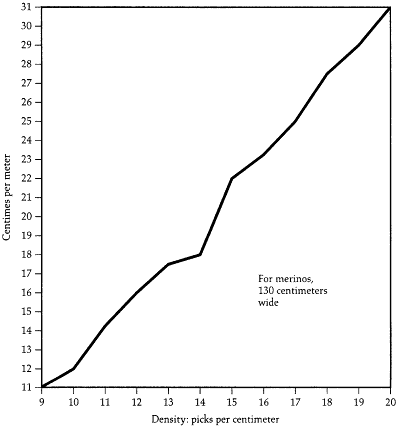
Figure 11.
Tarif of Seydoux, Sieber & Cie., Bousies, 1886
Source: ADN M 625/55
French piece-rate scales based on length of cloth delivered lacked the linear increases of the British scales because French producers did not view the product as the vessel of abstract labor incorporated in the material. Of course, by the second half of the nineteenth century, the fabric delivered may have represented "labor" effort in the eyes of the French producers. But that labor was not conceived of as a social substance, materialized in the product in standard fashion, capable of providing a detectable metric for the value of the good. Without the notion of an underlying substance corresponding to the physical dimensions of the cloth, the different sectors of the piece-rate scales were not unified in a linear system. Nor were those French
piece-rate scales that were founded on the unit of one thousand shots unified by linear relations between density and pay, as in Germany.[108] For the French view of labor as a commodity did not include the employers' appropriation of labor's use value, the supervised use of a concrete activity, which allows one to valorize each motion delivered to the employer. Instead, piece-rates for varying densities of cloth in France followed the vagaries of pricing for each traditional fabric "type" in well-established markets, the nonlinear tensile strengths of the manipulated yarn, and the readiness of heads of households to exploit the labor of family members as assistants in producing certain ranges of better-remunerated cloth densities.[109] If the French
[108] The Germans thought in terms of linear increases in pay per shot, not just for the density of the weave but for the breadth of the loom, another dimension French scales did not incorporate in linear fashion. Staatsarchiv Weimar, Landesregierung Greiz, n Rep. A, Kap. IXa, Nr. 165, p. 139, "Wechselstuhlarbeit," 1905.
[109] William M. Reddy, "Entschlüsseln von Lohnforderungen: Der Tarif und der Lebenszyklus in den Leinenfabriken von Armentières, 1889–1904," in Robert Berdahl et al., editors, Klassen und Kultur (Frankfurt am Main: Syndikat, 1982). Although the customs for entering French textile factories are not easy to document, evidence suggests that the French often combined the practices of the Germans and the British. As in Germany, latecomers paid a fine before they set their labor in motion, in keeping with the principle that the commodity of labor represented a potential. Georges Duveau, La Vie ouvrière sous le second empire (Paris: Librairie Gallimard, 1946), p. 260. As in Britain, the doorway became a symbolic point of contact between workers and owners and entry into the factory a ritual of submission. French employers used the shutting of the door to mark their authority but opened the door periodically for latecomers who paid the fine. The French understanding of labor as a commodity, like the British view, did not highlight the employer's systematic exploitation of the use value of the labor. Employers accentuated their control at the border zone, the entrance gate. Michelle Perrot, "The Three Ages of Industrial Discipline in Nineteenth-Century France," in John M. Merriman, editor, Consciousness and Class Experience in Nineteenth-Century Europe (New York: Holmes & Meier, 1979), p. 157. See Bibliothèque nationale, Gr. Fol. Wz 69, "Règlement de la fabrique de Blanzat" (Clermont: Typographie Hubler, Bayle et Dubois, ca. 1853); "Règlement de la filature" (Wazemmes: Impr. de Horemans, ca 1854); "Règlement pour la manufacture de Duval, Heurthauz et Cie" (Nantes: Impr. Forest, ca 1857); "Règlement du tissage mécanique de M. César Piat fils" (Roubaix: Impr. Béghin, 1866); "Règlement du tissage mécanique S. Willot et Cie" (Roubaix: Impr. Cocheteux, 1880). The concern with control of the perimeter emerges in another fashion through the printed factory injunctions of French textile employers: the rules had separate, sometimes extensive sections defining the responsibilities of the gatekeepers. See, illustratively, Bibliothèque nationale, Gr. Fol. Wz 69, Règlement des usines de Auguste Sourd à Tenay (Lyon: Impr. Chanoine, 1851); Règlement pour la police intérieure des ateliers de filature de M. Ch. Leyberr à Bootz (Laval: Impr. Godbert, 1855); Tissage mécanique de M. Constant-Delanoë à Barentin (Rouen: Impr. Surville, 1859). In contrast to Germany, the procedures for entering the factory became a prominent issue for strikes in France. Le Grand Écho du Nord , July 10, 1903. French workers contested the amount of the fine and the exact time at which the door closed on latecomers. Their strike leaflets discussed these issues in bold print. ADN M625/64, Armentières, factories of Dulac and Villard. Whereas in the piece-rate scales the French have neither the British nor the German idea of linearity, in the control of time and space they combine both techniques of control: employers make the doorway a symbolic divide, and they impose metric fines for loss of time, as ifthey have purchased a labor capacity but do not take for granted their disposition over the labor activity, as in Germany. When French employers adopted precisely delimited workdays, they defined the hours of employment by effective work time, as in Germany, rather than by mere presence within the factory perimeter, as in Britain. Mary Lynn Stewart, Women, Work, and the French State (Kingston: McGill-Queen's University Press, 1989), p. 109.
producers had managed perfectly well without resorting to linear gradations, the design of their scales might seem insignificant, attributable to simple lack of challenges requiring greater regularity.[110] But in fact linearity was not invoked as a natural principle even when it could have helped employers and workers in their efforts to agree upon schedules.[111]
The piece-rate scales held only a nominal status in the eyes of nineteenth-century French textile employers and their workers. Weavers and spinners saw them as an initial element in determining their remuneration, not as a critical measure of labor delivered and an essential yardstick for payment. Handweavers in the first half of the nineteenth century attempted to renegotiate the piece rate when they turned in the completed fabric, based on unforeseen difficulties encountered in the weaving process.[112] Even in the mature factory system it was not unheard-of for weavers to receive a fixed time wage provided they met a production minimum.[113] In some instances workers and employers saw the piece-rate scales as temporary conventions, to be adjusted as necessary to yield a target daily wage.[114] When strikers demanded higher earnings, on occasion they presented employers with alternatives: either the owners could dispense with fines on damaged fabric, or they could revise the piece-rate scales upward.[115] This open-ended request shows that workers looked at the scales as perfunctory contrivances influencing their earnings, not as definitive mechanisms designed to gauge the appropriation of a real substance, labor.
Workers' appreciation of labor as a commodity in France guided the formulation of strike demands. In contrast to their counterparts in Germany and Britain, French weavers on strike for higher piece rates focused their demands on particular densities of cloth, not on the overall construc-
[110] Until about the middle of the nineteenth century, some employers' weaving schedules were imperfectly linear even in Britain. See, illustratively, Kershaw Lees & Co., Weaving Prices Paid (Stockport, 1854).
[111] Le Réveil du Nord , "Les Grèves de la Gorgue-Estaires," July 11, 1903.
[112] Delsalle, op. cit., p. 213.
[113] ADN M625/86, February 4, 1908, Estaires.
[114] For spinning, see ADN M625/96 May, 1893, Roubaix. For weaving, the employers in Lille in 1909 declared that "the schedule is nothing, the wage everything." Seilhac, op. cit., p. 57. For examples of strikes hinging on whether the scales provide the agreed-upon daily average, see ADN M625/87, Fiche 1, 1907, Roubaix, ADN M625/86, 1908, Estaires.
[115] ADN M625/56, 1887, pièce 27.
tion of the schedules. Even when they lodged complaints about particular densities of many different types of cloth, they concentrated on isolated positions in the overall table.[116] In a strike at Avesnes in 1886, weavers asked for minute adjustments in ten different kinds of cloth rather than calling for an across-the-board revision.[117]
The French specification of labor as a commodity may have influenced not only the conduct of strikes on the ground but the economic theory propounded in the intellectual circles attached to the workers' movement. The chief economists who wrote for the French Workers' Party, a Marxist group supported by Engels, consistently misread Marx's economic theory. For example, Paul Lafargue, the country's most influential expert in Marxist analysis,[118] penned a defense of Marx's theory of surplus value in 1884. Lafargue assumed that production for exchange, including that of domestic workers, gave birth to capital and exploited labor. In his eyes, anyone producing goods for profit in a market (and not only a middleman) became a capitalist. Engels rebuked Lafargue for failing to realize that capitalism was distinguished by the social relations of production, in which ownership of the means of production allowed a proprietor to purchase and supervise another person's labor power. Yet Lafargue's analysis reflected perfectly well the French understanding of labor as a commodity, in which the immediate relations of domination were absent from the concept of purchasing another person's labor activity.[119] Marx's analysis of the extraction of surplus under capitalism resonated with the presumption
[116] ADN M625/55, June 17, 1886; ADN M625/66, Bousies; ADN M625/75, June 9, 1903, Tourcoing.
[117] ADN M625/55, Avesnes, 17 June 1886. Analogously, see ADN M625/51, March 27, 1882.
[118] Claude Willard, Les Guesdistes (Paris: Editions Sociales, 1965), p. 146.
[119] Friedrich Engels, Paul Lafargue, and Laura Lafargue, Correspondance (Paris: Editions sociales, 1956), letter of Friedrich Engels to Paul Lafargue, August 11, 1884, pp. 232–233. For parallel analyses of capitalism, see, illustratively, "Deux Conférences," in Le Socialiste , November 10, 1887, p. 2.
Further research is needed to explain why throughout the nineteenth century French workers put so much more emphasis than their counterparts in Britain and Germany on abolishing the subcontracting of labor. In March, 1848, the provisional government abolished "the right of subcontractors to organize labor" as "unjust, vexatious, and contrary to the ideals of fraternity." After the fall of the Second Republic and continuing into the twentieth century, workers demanded that middlemen be prohibited from selling the products of domestic workers to merchants. Perhaps the French drive against marchandage grew out of the emphasis on workers being able to conduct themselves as entrepreneurs to get an equitable price for their labor. Bernard Mottez, Systèmes de salaire et politiques patronales (Paris: Centre de la Recherche Scientifique, 1966), pp. 21–22, 59–60; P. Hubert-Valleroux, Le Contrat de travail (Paris: Rousseau, 1895), p. 62; Industrie textile , April 15, 1903, pp. 155–157.
in France that employers purchased a labor activity, but the French assumed that the exploitation of this activity was effected in the market.
The Hierarchy of Motivating Conditions
This suggestive application of theory to the commercial development of France and, more briefly, to that of northern Italy advances a general model of the development of labor's commodity form while it confirms the individuality of each national case. In France and Italy, as in Germany and Britain, the breakthrough to liberal commercialism was critical for establishing a concept of labor which became an enduring part of national culture. Britain's passage was effected in the second half of the seventeenth century, although its legacy was applied to the free sale of what an outside observer is able to term "labor power" only in the mid-eighteenth century.[120] In France the revolution inaugurated a liberal commercial order that definitively cast labor as a commodity during the bourgeois regime of Louis Philippe.[121] In northern Italy the progression began in the last quarter of the eighteenth century and thereafter followed the rhythm set by France. In Germany the movement extended from approximately 1810 to industrial take-off in the 1850s. During these formative periods, economic agents conceived of and implemented the specifications of the sale of labor that eventually gave shape to the instrumentalities of production in the factory.
These divergent specifications of labor as a commodity developed not from elemental but from conjunctural differences: the four countries in our purview had parallel feudal starting points but contrasting disjunctures and overlaps between major institutional changes in their transition to capitalism. In particular, each country offers its own chronology of change in the demolition of guild constraints on the use of labor, of feudal labor dues, and of local trading privileges in finished articles. The timetable established by the dating of each of these changes in relation to the others in a given country represents the decisive context for the emergence of cultural differences. As delineated in Figure 10, there is a hierarchy in the causal influence of these temporal contrasts. For example, what would have happened in Britain if feudal labor dues had persisted in the countryside after an unfet-
[120] Here the term labor power is obviously a purely analytic concept, not a category of social conciousness.
[121] Georges Matoré, Le Vocabulaire et la société sous Louis-Philippe (Genève: Slatkine Reprints, 1967), p. 29.
tered national market in finished wares had been introduced? The timing of the dismantling of feudal labor dues in agriculture is irrelevant for the British case. The prior triumph of a commercial discourse centered on products alone ensured that whenever constraints on the unfettered purchase of labor power (which might include feudal dues in labor or guild regulation of laborers) were abolished, the exchange of labor in the resulting market would be assimilated to the established model for the vending of finished articles. The traditional restrictions on the sale of labor power proved irrelevant as a positive model for the shape eventually taken by labor as a commodity in Britain. Their contribution was purely negative, that of allowing a market discourse to identify labor as a substance residing in products. We can infer, therefore, that for Britain the precise form of constraint on the vending of labor power, whether by feudal dues in agriculture, by statutory controls on wages, or by other means, was of no consequence for the final shape of labor as a commodity. When viewed in the European context the disjoint recognition of the free exchange of articles and of labor power is sufficient to explain the British outcome.[122]
A concentration on the development of labor's specification as a commodity in Britain and in Germany offers more than a series of rich historical contrasts. A focus on these primary cases offers a theoretic key, because they represent two extremes among the routes of development: the case with the fewest motivating circumstances versus the case with the most complicated and extreme combination of conditions. Once these cases are laid out, we can see that circumstances in France and northern Italy fill in the alternative permutations between the poles of Britain and Germany. The French-German contrast reveals the difference between conceiving of the labor transaction as the receipt of labor activity through the market and thinking of labor as a service over which the employer exercises immediate command. In France, the annihilation of the guilds meant that the urban trades, with their extensive networks of unsupervised subcontractors and home workers, were included as a setting for economic agents to conceive of the sale of labor to employers. Therefore the emphasis on the employer's direct supervision of the worker, which encouraged a distinction between the use and the exchange
[122] In the preceding chapter I compared the timing of the dissolution of the guilds with respect to industrialization in Germany and in Britain. The British case illuminated the conservation of precapitalist mentalities in the German guilds. This discussion advanced a theoretic argument about the causes of the specification of labor as a commodity in Germany but used Britain only for empirical material that contrasted with Germany, not to assess the forces leading to the cultural outcome in Britain.
values of labor and on the employer's exploitation of the use value of the labor, was relatively weak. The Italian-British opposition discloses the difference between conceiving of labor as valorized in a product and thinking of labor as a medium for equating the difficulty of procuring products. Yet the outcomes in Italy and Britain share a generic similarity, because feudal dues in agriculture were absent in Italy and irrelevant in Britain.
The investigation of economic thought in Italy suggests that in the European context the disjoint establishment of formally free markets in products and in labor power represents a sufficient but not a necessary cause for the development of the view that labor is acquired only as it is materialized in an article. In Italy the conjoint recognition of markets in products and in labor power meant that the understanding of labor as a commodity was not assimilated to an antecedent market discourse focused upon intercourse in finished articles alone. But the absence of a feudal template for the receipt of labor as a service ensured that the Italians would nonetheless adopt the view that labor is purchased only as it is materialized in a product. Whether the Italians maintained a residual guild system that controlled the labor market for urban craft workers and blocked the operation of capitalist categories was inconsequential for the eventual cultural outcome. Without the feudal constitution of society as the delivery of services, Italians lacked a prerequisite for thinking of the purchase of labor as the appropriation of a labor service. The circulation of products among urban craft specialists located in dense networks of trade does not in itself highlight the appropriation of labor power. The Italian case indicates, however, that the staggered recognition of markets in products versus labor power is necessary for assuming, as the British economic agents did, that labor becomes a calibrated, monetized substance once it is embodied in a ware. For the simultaneous appearance of formally free markets in products and in labor power submits the labor activity and the acquisition of wares to a commercial calculus at the same time, as is illustrated in Italian economic theory. Because the two appear for consideration together, it does not happen, as it does in classical British commercial discourse, that the material articles alone are subjected to such a calculus.
This chapter brings a chain of thought full circle. Part One of the study set out in pursuit of the systematic logic that culture contributed to the organization of capitalist practices in the workplace. Part Two examined the broader commercial framework on which the fabrication of that culture depended. Does this work as a whole thereby follow the bipartite explanatory method that Weber presented in The Protestant Ethic , emphasizing culture's causal independence once it was ushered into the world, but its dependence upon the
economy for its birth? Do studies of culture's effect and of its historical genesis represent separate, fragmentable inquiries? The response to this question closes Part Two.
Concluding Reflections on Part Two
Of late it has become fashionable among historical investigators to assert that the social explanation of economic ideologies is inappropriately reductionist because it necessarily treats intellectual ideas as a reflection of underlying social conditions. The new cultural history has emphasized instead that changes in the social environment make themselves felt—indeed, come into being—only through the medium of language, which operates with the power and within the constraints of its own logic and own history.[123] Michael Agnatieff formulated this issue for the history of economics some time ago by contesting the assumption that agents spontaneously adopt the language of economics by participating in capitalist development. "Our reflexive, unthinking tendency to assume that the past speaks the same language as our own," he reminded us, "has led us, quite wrongly, to assume that as 'commercial society' takes shape, in their daily experience and in their reading, a language of 'markets', 'classes', and 'social relations' is there at hand to guide them cognitively."[124] Agnatieff and others have suggested that we examine the development of the categories of capitalist thought as an autonomous process, guided as much by the discursive resources and constraints of language as by the imputed economic facts of life. By this line of reasoning, when the economic surroundings change the process of "generating language adequate to one's conception of social reality" poses a challenge whose accomplishment is unpredictable.[125]
In raising culture to the status of an independent object of study, however, this variety of cultural history may inadvertently divide language from the economy. It assumes that the categories of economic analysis belong to the realm of the discursive, outside of which lies "commercial society" proper, whose transactions language tries to grasp. The present study, by contrast, emphasizes above all that commercial practice was itself struc-
[123] For illustrations, consult Joan Wallach Scott, Gender and the Politics of History (New York: Columbia University Press, 1988), pp. 56–57; Keith Tribe, "The 'Histories' of Economic Discourse," in his Genealogies of Capitalism (London: Macmillan & Co., 1981), pp. 124 ff.
[124] Michael Agnatieff, "Marxism and Classical Political Economy," in Raphael Samuel, editor, People's History and Socialist Theory (London: Routledge & Kegan Paul, 1981), p. 352.
[125] Ibid., p. 351.
tured by categories that communicated the form of the labor transaction. Language did not establish discursive rules for conduct which agents then attempted to follow as a norm: such a viewpoint makes the symbolic order external to practice, insofar as each of the customs of the factory derives its meaning by conforming to "ideal" rules articulated by intellectuals, literate workers, or managers. Instead, practice itself embodied symbolic principles, and the constellation of material instrumentalities on the shop floor served as the elements that conveyed messages independently of verbal analyses. The capitalist economy is a realm of symbolic practice that already contains a language of political economy appropriate for the analysis of social life. The concepts of labor as a commodity did not "reflect" or "express" economic conditions in the two countries—they were part and parcel of those conditions. The political economists' reflections on labor as a commodity, which were debated and discussed outside the shop floor, developed in tandem with the emergence of labor's commodity form as the principle that organized the humblest details of everyday life. In the lived experience of their individual transfers of labor, workers and marketeers sustained the principle of the exchange of abstract labor which, behind their backs, united their society into a functioning whole.