
Prisoner of the Desert
Just how far have we come since the fall of 1947? The bulk of Desert Fury 's plot (mother-daughter conflict, woman in thrall to "unsuitable" male) has long served as the stuff of television "soap opera"—both daytime and "prime-time" variety. Fashion "pitches" have their place in this narrative schematic—recently having revived the shoulder pads common to the late forties. Women in these mainstream scenarios are presented as having the "option" of "career" or "family"—though the bias towards domestic "choices" are plain, with attendant "guilt" over "lack of fulfillment as a woman ." "Having it all" is the catch-phrase surrounding this cultural cul-de-sac.
Homosexuality has likewise found its "place" as well. Once confined to the margins of experimental cinema, it's been upgraded to the tributaries of the
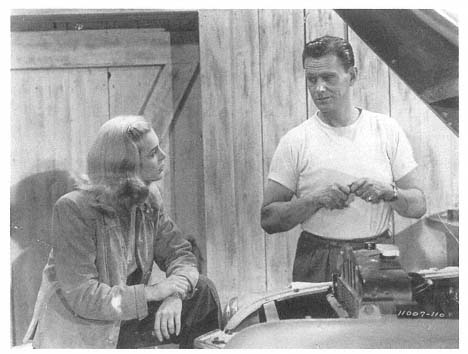
Desert Fury
mainstream—"art" and "independent" cinema, and over-the-counter hardcore pornography. Figures like Johnny Ryan no longer "work" here. And why should they? What role is there for a Johnny in an era of Bruce Weber blatancy, or the lip-smacking, towel-snapping sensuality of a Top Gun ?
Johnny Ryan belongs precisely where he is—a late forties programmer called Desert Fury . A compendium of medium-two-shots (with a handful of long shots and close-ups for spice) ceaselessly pursuing one another round a fixed locale. Here are five figures locked inside a scenario so claustrophobic that they need not move more than a few feet before slamming into one another. Here are a series of problems to be dealt with, demands to be answered: Overbearing parents, social stigma and snobbery, dangerous acquaintances, unsuitable swains, a woman not sure about what she wants to do with her life, homosexual desire. Nothing new here. Nothing "old" either. It's the world in which we live, "brought to life" by the Cinema we love. And in our working through it all, it's still possible to isolate the bases of our fascination, our frustration, our boredom, our obsession, ourselves . But ahistorical "close analysis" can't reach it alone, nor can any other theoretical framework that deals with film solely at
the level of narrative logic, or as a vast preamble to a psychoanalytic technique that can function at best only as a metaphor for cinematic interaction.
Metz seems aware of this when he writes that "the problem of the cinema is always reduplicated as a problem of the theory of the cinema and we can only extract knowledge from what we are (what we are as persons, what we are as culture and society)."[20] But who are these persons, this culture, this society?
"Cinematic images," comments Jean-Louis Schefer, "exercise a powerful preemption over the living being, not simply because he is made to feel present at the spectacle, but because he can't see the spectacle unless he's part of it in some way, or unless he himself is the absolute reason for the spectacle, its profoundest passion. That's the real question for cinema. It's never a partial phenomenon based on a split; it's a participatory phenomenon, generalized and indeterminate, working across all the objects of the spectacle. A cinematic projection has to be diffused—across the hero, and the villain, and the animals, and the objects, and the places on the screen—over the whole world. It's with the entirety of that world on screen that the spectator participates or identifies himself, and it's there that he's most sensitive to the effects of spatial dislocation, temporal distortion, and especially emotions."[21]
There is no set theoretical formulation, no royal road to chart this course of cinema. There are only a series of byways and backalleys—some connecting directly to the narrative at hand, others intersecting with advertising, commerce, and current events. Some of these routes connect. Others are cul-de-sacs. But it's only by following them that we can possibly see our way through this detritus, this Technicolor swamp, this two-penny fashion show, this absurd confluence of fixity and drift, this Desert Fury .