
The Government Payment of Alms
Awadh Shi‘is had for long privately paid Islamic poor-taxes. Even in Shujacu'd-Dawlah's Faizabad the Akhbari physician Hakim Mucalij Khan distributed donations by his rich patrons for the poor (paying himself handsomely to do so). In the 1890s Mrs. Ali noted that wealthy Muslims often gave one-fortieth of their annual income to the poor as zakat and one tenth to indigent Sayyids as khums . She reported that Sayyids could not accept other kinds of charitable donations (sadaqah ), as for instance when someone. distributed gifts on escaping from a deadly illness.[9]
In the 1830s the mujtahids in Awadh began making a major effort to increase official donations of a charitable nature. Since according to Usuli doctrine the mujtahids should be placed in charge of this money as the general representatives of the hidden Imam, any large increase in donations would
[6] Muhammad Mihdi Lakhnavi Kashmiri, Nujumas-sama ': takmilah , 2 vols. (Qumm: Maktabat-i Basirati, 1397/1977), 1 236, 263-64, 268-69, Tota Ram Shayan, Tavarikh-i nadiral-casr (Lucknow. Naval Kishor, 1863), p 112.
[7] Ramasahaya Tamanna, Afdalat-tawarikh (Lucknow: Matbac-i Tamanna'i, 1879), p. 93:
Sharab jo nah pi'e mu'mino voh nari hai
muhibb-i saqi-yi kausar ko abkari hai.
[8] Ibid
[9] Mrs. Meet Hassan Ali Observations on the Mussulmans of India (London: Oxford Univ. Press, 1917), p. 135.
also augment their own power and financial resources. Sayyid Muhammad Nasirabadi wrote a work on the subject for Muhammad ‘Ali Khan Nasiru'd-Dawlah, soon to be Muhammad ‘Ali Shah. It is even possible that when he wrote the book Sayyid Muhammad already knew that the British intended to depose Nasiru'd-Din Haydar and replace him with Muhammad ‘Ali. This secret decision leaked from the residency in Lucknow, becoming common knowledge among political operators like Subhan ‘Ali Khan.[10] (Nasiru'd-Din Haydar's sudden death in 1837 removed the necessity for such a move.)
Sayyid Muhammad Nasirabadi instructed the prince in the intricacies of the Islamic law of philanthropy. The recipients of the poor-tax (zakat ), he said, included the poor, the indigent, those appointed to distribute the alms, converts to Shi‘ism, slaves, debtors, and public welfare projects (from holy war to building mosques and bridges). In the time of the Occultation, he stressed, the poor-tax must be given to the upright mujtahid. He noted that under the Safavids the mujtahids administered the tax. All recipients, Sayyid Muhammad wrote, had to be Shi‘is, and the contributions of Sayyids had to go to other Sayyids.[11]
The other major philanthropy, called the "fifth" (al-khums ), originally formed the early Muslim state's portion of war booty. It benefited both the Prophet and his immediate family as well as various categories of the indigent. In Sunni Hanafi law, prevalent in India, it could be given, but would benefit only the poor and not the Sayyids, who said they were heirs of the Prophet. In the absence of the Imam early Akhbaris tended to see the obligation of Shi‘is to render this tax as having lapsed. Later Usulis believed that it should be divided in two basic parts, one for the mujtahids (the share of the Imam [sahm-i Imam ]), and the other for needy Sayyids.[12] Sayyid Muhammad Nasirabadi said that consensus had settled on the donation of the fifth as a duty. Believers owed this charitable tax on plunder; on precious metals after costs; on found hidden treasure; on profits from commerce, agriculture, and artisanry; on precious stones from the sea; on lawful money any time it was mixed with ill-gotten wealth of unknown origin; and on land sold by a Shi‘i to a Jew, Christian, or Zoroastrian. The whole amount had to be delivered to the upright jurisprudent, who divided it into six parts in accordance with a literal reading of Qur'an 8:41. The mujtahid himself accepted three portions on behalf of God, the Prophet, and the Imam. He distributed the other three
[10] Ardistani, "Al-Hisn al-matin" 2·177 Cf Resident to See Govt. India Seer Dept, 26 Sept. 1836, FDPC, 6 March 1837, no 94: Resident to Seer Dept, 3 July 1837, FDSC, 7 Aug 1837, no. 15.
[11] S Muhammad Nasirabadi, Fava'id-iNasiriyyah , in Musharraf ‘Ali Lakhnavi, ed., Bayaz-imasa'il , 3 vols. (Lucknow, 1251/1835-36), 2·4, see Norman Calder, "Zakat in Imami Shi‘i Jurisprudence from the Tenth to the Sixteenth Century A D" (Bulletin of the School of Oriental and African Studies 44 [1981]): 468-80.
[12] See Abdulaziz Sachedina, "Al-Khums The Fifth in the Imami Legal System," Journal of Near East Studies 39 (1980) 275-89.
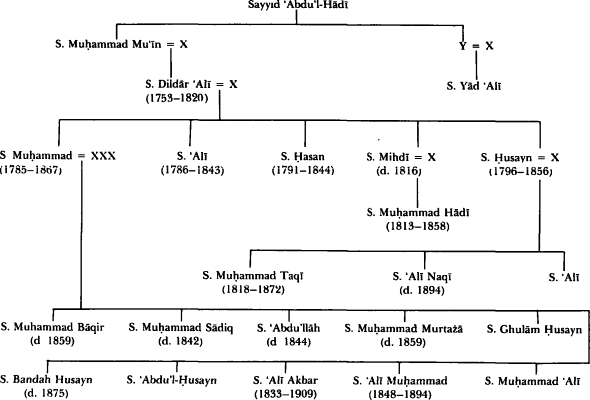
Diagram 3
The Nasirabadi Clerical Family
portions to the poor, orphans, and wayfarers among the Sayyids, excluding other Shi‘is.[13]
The Lucknow mujtahids upheld this exclusivity to the point that they forbade the use of the sum allotted to the Imam for the funding of Muharram mourning sessions, since non-Sayyids participated in them. The rules for the fifth also encouraged centralization, since few recognized mujtahids dwelt in qasabahs and the charity, when donated, would have to be sent to Lucknow. Moreover, the terms of donation favored the educated Sayyids in the cities, who were more likely to receive the philanthropy. Poor, ignorant Shi‘i Sayyids who did not know the rules for daily prayer were ineligible.[14]
Whatever poor-tax Muhammad ‘Ali Shah paid was a personal affair, though the largesse of a king could be considerable. But Amjad ‘Ali Shah went considerably beyond any recorded past practice in making charitable funds available to the mujtahids. He took the unprecedented step of having the government of Awadh pay the Shi‘i poor-tax (zakat ) on its annual revenues. At 2.5 percent, the charitable contribution annually came to more than Rs. 300,000 per year, totaling Rs. 1.7 million over the five years Amjad ‘Ali Shah ruled. The fifth was not, apparently, paid on this scale, although large sums were realized from this religious tax as well. The king gave both the poor-tax and the fifth into the care of Sayyids Muhammad and Husayn Nasirabadi.[15]
The first year the mujtahids distributed the funds they were literally mobbed. The poor, and sudden converts from Sunnism and Hinduism to Shi‘ism, besieged the houses of Sayyids Muhammad and Husayn. A later writer sniffed that "many of the undeserving" received funds.[16] Thereafter the mujtahids established a register with the names of those they considered genuinely deserving Shi‘is, to each of whom they appointed a monthly stipend. Then they set up a department to handle the paper work, with Sayyid Husayn's son Sayyid ‘Ali Naqi Zubdatu'l-‘Ulama' (d. 1893) at its head. During this period hundreds of Sunnis and thousands of Hindus embraced Imami Shi‘ism, many of them in order to gain access to alms. Officials gave Hindu converts to Shi‘ism special preference in acquiring government jobs and, if they were tax-farmers, forgave them revenue shortfalls. Mosques and imambarahs proliferated.[17]
In the 1840s many Shi‘i clerics grew genuinely wealthy through their control of Islamic charities. Sayyid ‘Ali Naqi, who administered the money, paid himself so well that he could build four spacious, lavishly furnished man-
[13] S. Muhammad Nasirabadi, Fava'id-iNasiriyyah 2:6-7
[14] S. Husayn Nasirabadi in Musharraf ‘Ali Lakhnavi, ed., Bayaz-imasa'il , 2:15
[15] Ardistani, "Al-hisn al-matin" 2 144, Lalji, "Sultan al-hikayat" MS 3902, fol 85a, India Office, S. Muhammad Amir ‘Ali Khan, Vazir-namah (Kanpur: Matbac-i Nizami, 1293/1876), pp. 85-86.
[16] Kashmiri, NujumT . 1:267.
[17] Ibid, 1 255-56.
sions, with courtyards anti pools around which he set chairs that could not be matched for elegance in London itself. Each mansion had a name and was kept up by a horde of servants and provided with a stable for elephants. In the afternoon friends and seekers of knowledge would gather for salons around the pool, sitting on the European-style chairs. He also built a magnificent imambarah renowned for its mourning sessions. He was so respected that once when he went to Rampur to pray congregational prayers with the Shi‘is, the Sunni nawab joined in behind him.[18]
In each neighborhood Sayyid ‘Ali Naqi appointed persons he trusted to distribute the charity. The ulama sometimes employed this privilege as a way of bestowing favors. Mawlavi Sayyid Kamalu'd-Din Mohani, a zamindar who preferred to live in Lucknow, fell into financial difficulties because of his large family. To help him out, Sayyid Husayn Nasirabadi put him in charge of distributing charily. In 1845 he left to become the supervisor of a pious endowment in Calcutta, founded by a relative.[19]
In a pluralistic society like Awadh where the Shi‘is formed a small minority, the provision of such huge sums to this group struck many as invidious. Even Shi‘is like the historian Kamalu'd-Din Haydar criticized the system, observing that the mujtahids were obliged to put large sums of money in the hands of high state officials—ostensibly for redistribution to the needy—as bribes to ensure the continuing payment of the Rs. 300,000 per year.[20] The government payment of the poor-tax emerged as an important issue under Vajid ‘Ali Shah (1847-56) during the residency of Colonel Sleeman. Sleeman faulted the system on several counts, pointing out that no Sunni could partake of the charity. Moreover, he said, since Sayyids could receive poor-tax monies only if they fell in the category of the indebted, the Awadh mujtahids
get over the difficulty by borrowing large sums before the money is given out, and appropriate the greater pait of the money to the liquidation of these debts, though they all hold large sums in our Government securities. To his friends at court he [the chief mujtahid] sends a large share, with a request that they will do him the favour to undertake the distribution among the poor of the neighborhood To prevent popular clamour, a small portion of the money given out is actually distributed among the poor of the Sheea sect at Lucknow, but that portion always remains small.[21]
[18] S ‘Ali Akbar Musavi Dihlavi, Sabikatadh-dhahab wa micyaral-adab (Lucknow: Matbac-i Isna ‘Ashari [1309/1891?]), pp 106-7, M. M Kashmiri, NujumT 2.143-45, Sayvid Muhammad Husayn Nauganavi, Tazkirah-'ibe-baha fitarikhal-‘ulama ' (Delhi. Jayyid Barqi Press, n.d.), pp 235-36
[19] Nauganavi, Tazkirah , pp 297-300.
[20] Kamalu'd-Din Haydar Husayni Mashhadi, Savanihat-i salatin-iAvadh (Lucknow. Naval Kishor, 1896), p. 371; cf. Safi Ahmad, Two Kings of Awadh (Aligarh: P. C Dwadash Shreni & Co., 197.1), p. 52.
[21] W H Sleeman, A Journey through the Kingdom of Oude in 1849-1850 , 2 vols (London Richard Bentlev. 1858), 1.309
Sleeman noted that government stipends were in arrears to the amount of five million rupees, and that the government was bound to pay the poor-tax only when free of debt. But, he said, the chief mujtahid, the chief minister, and the court favorites had too great a stake in it to allow it to be discontinued. Vajid ‘Ali Shah acquiesced in its payment, though the treasury was depleted, and the amount paid into the poor-tax had actually increased. At some point Vajid ‘Ali Shah, either bowing to British pressure or for his own reasons, stopped giving the poor-tax and even defaced coins lest he be obliged to give it. This interruption in their income, which became even more serious when the British annexed Awadh in 1856, caught the mujtahids and their families off guard, leaving them heavily indebted and forcing them to sell off their British stocks. This and other royal actions soured relations between the court and the mosque. Sayyid Muhammad ‘Abbas Shushtari mentioned as one of the sorrows in Sayyid Husayn Nasirabadi's life the "opposition of the notables [umara ']," admitting that Amjad ‘Ali Shah showed him much respect but lamenting that he had hastened to the next world. Vajid ‘Ali Shah demonstrated not nearly so much veneration of the ulama.[22]
The substantial poor-tax funds quite aside, Amjad ‘Ali Shah showered the clergy with perquisites. He gave Sayyids Muhammad and Husayn Nasirabadi each an extra Rs. 200 per month as the capital's official prayer-leaders and provided extra allowances to other members of the Nasirabadi clan as well. In addition, the king established a special fund for Sayyids totaling, at one point, Rs. 2,000 each month. The senior members of the Nasirabadi family received Rs. 100 per month each, with altogether Rs. 380 per month out of these monies going to the Nasirabadis. They shared the rest of the allowance (probably deriving from khums ) with other Sayyids of their choosing, the total number of recipients reaching forty-seven at one point. Vajid ‘Ali Shah, immediately upon coming to power, cut the Sayyid fund in half. Still, in 1849 his treasury sent Sayyid Muhammad Nasirabadi Rs. 2,180 per month in various perquisites to be shared out.[23]
The poor-tax and the fifth contributions over which the high ulama exercised control for nearly a decade increased their wealth and power immeasurably. They had, from their point of view, a legal right to half of the khums donations, and the power to decide to whom the other half would go. They employed various devices to gain access, as well, to the poor-tax (zakat ) revenues. Even mere control over the latter, amounting to hundreds of
[22] Ibid., 1:311; Ardistani, "Al-hisn al-matin" 2:133; S. Muhammad ‘Abbas Shushtari "Al-ma'adin adh-dhahabiyyah," Adab ‘Arabi, MS 4446, Raza Lib., Rampur, p 55, Sec. Chief Comm, Oudh, to See Govt India, 5 Jan 1857. FDFC, 20 Feb 1857, no 66. for the mereasing indebtedness of the Nasirabadi fanulv, Bandah Husavn to G C Bart. High Comm. 16 May 1874, Board of Revenue. Lucknow File 1172
[23] "Establishments paid flora the Tieasuiv." enclosure with Resident to, See Govt India, 24 Sept. 1849, FDFC, 17 Nov. 1849. no 225, enclosure 67A with Sec Chief Comm. Oudh, to See. Govt. India, 5 Jan 1857
thousands of rupees per year, would have rendered them important sources of patronage. This money tied them closely to the ruling establishment, drawing them into tight association with the secular state. Most important, by accepting regularized payments of huge amounts of money from government revenues, their position within the ruling class changed from that of small land- and benefice-holders and stipendiaries. They became direct recipients of state-expropriated peasant surpluses. In many ways the prominent ulama joined the class of high notables. Like the Awadh notables, they also became rentiers by investing in East India Company stock.