
7. Contests of Memory
Remembering and Forgetting War
in the Contemporary Vietnamese Cinema
Mark Philip Bradley
In a modest house in a residential quarter of Hanoi, an elderly mother says good-bye to the guests attending the rituals surrounding the death anniversary (ngay gio) for her son who was killed in the American War. After the last guests depart, she collapses onto the floor crying and calls out for her family to assemble around her. Reminding her children that their brother's bones are still lying in a military cemetery in the South, she implores them to bring his remains home so that she can lie next to him when she dies. Her son agrees, adding, “Thank heaven my sister has so many connections.” His observation prompts an increasingly acrimonious exchange between his sister and his wife:
SISTER:Shouldn't we all help? I'm busy with my husband's business trip to Singapore. You both have never seen Saigon. You could combine business with a little sight-seeing.
WIFE:
My husband is busy with the shop, and I'm taking care of mother. You have more time.
SISTER:
I'll talk straight. You joined this family. Help take care of it. You got my brother's room because he died.
WIFE:
And you got some of mother's gold. We don't get paid for taking care of her.
SISTER:
I had to borrow that gold to grease a few wheels.
WIFE:
Our family has special status because our brother got killed. That's why they let you pass your exam and get a job in Hanoi.
You're wrong. I got that another way. But it is through family status that they don't close your store!
WIFE:
Look at my husband. He can't go. I don't know my way around the South. How could we exhume the bones?
SISTER:
You think I'm good at it? It is hard enough to take care of my husband and his family. It's expensive to transport bones. Where would I get the money?
MOTHER (CRYING):
Stop it! All of you. You're so ungrateful to the dead. But you were quick enough to use our new family status. My son, if only you hadn't died in the South. Let me try to find the bones! If I die trying, none of you will care. As for the money, are these packets enough? If not, let's sell the furniture, the house. But I must bring my son's remains home.
Offering a solution to this impasse, the sister suggests that her husband's brother, an unemployed veteran, could use the money and go on behalf of the family. The veteran agrees but refuses the money. The sister tells him, “Stop living in the clouds. No one is like you now—doing something for nothing.” The veteran replies, “Your brother died asking for nothing.”
This painful symbolic representation of the tensions between remembering and forgetting the American War in contemporary northern Vietnamese society, which formed the core of Tran Vu and Nguyen Huu Luyen's 1987 film, Brothers and Relations (Anh va Em), was a sharp and highly unusual challenge to the official memories of war carefully constructed by the Vietnamese state throughout the wars against the French and the Americans and in their aftermath. The official narrative of sacred war (chien tranh than thanh) celebrated the heroic resistance of soldiers, workers, and peasants in an effort to infuse a larger meaning onto the suffering and death caused by war and to legitimate the state's twin goals of national liberation and socialist revolution. Many of the archetypal figures in the state cults of remembrance are present in Brothers and Relations. The sanctified memory of the fallen soldier, the probity of the simple veteran, and the self-sacrificing heroic mother all occupy a central place in the official pantheon of revolutionary heroes as symbols of selfless patriotic and socialist virtue. But in Brothers and Relations they function quite differently, standing in sharp contrast to the self-seeking daughter and her family intent upon using for their own advancement the special privileges granted by the state because of their brother's death in battle. For the filmmakers, the family's unwillingness to honor their brother's memory comes to represent the wider
Brothers and Relations is one of a number of revisionist films released in the mid-1980s that transformed the shape and content of historical memory in contemporary northern Vietnam. The Vietnamese state had employed film, with its power to capture a particularly broad audience, along with such popular cultural forms of remembrance as war memorials and museums, novels, poetry, paintings, and commemorative rituals honoring the war dead and their families to disseminate its construction of war. In appropriating one of these key mediums, the revisionist films of the 1980s articulated a form of what Michel Foucault termed “counter-memory,”[1] the residual or resistant strains of remembrance embedded in popular consciousness that withstand official constructions of the historical past.
The films appeared in a period that favored the advancement of a contrapuntal representation of war in Vietnam. The embrace of market economic reforms at the Sixth Party Congress of the Vietnamese Communist Party in 1986 brought with it a significant loosening of state control in the cultural realm. As one scholar of this period has argued, the policy of Renovation (Doi Moi) in the arts allowed intellectuals to work with a degree of freedom unknown since the Popular Front period in colonial Vietnam in the late 1930s.[2] But if official censorship relaxed somewhat, so, too, did the state subsidies for the arts that had provided the single source of funding for the Vietnamese film industry. The demands of the market economy put new pressures on filmmakers to ensure that the content of the films they produced resonated with potential filmgoers.[3]
Emboldened by this new climate of artistic freedom and market incentives, the works of revisionist filmmakers mounted a powerful, if sometimes oblique, narrative challenge to official memories of the Vietnamese experience of the war and attracted large, appreciative audiences.[4] They posed several farreaching questions that undermined the central premises on which the state's memorializing project had rested. Who rightfully possesses the memory of fallen soldiers? Whose wartime sacrifice is deserving of commemoration? And what are the real legacies of war? In framing their responses, filmmakers consciously rejected the prevailing aesthetics of socialist realism that had governed Vietnamese cinema and given shape to the state's heroic narrative of war. In its place they made use of a diverse repertoire of rich visual imagery that reached back to ritual forms of family and village life long suppressed by the
WHO RIGHTFULLY POSSESSES THE MEMORY
OF FALLEN SOLDIERS?
The fallen soldier is perhaps the most potent symbol of official efforts to commemorate and legitimate the national experience of war. As George Mosse argues in his seminal account of state memorializing practices in Europe in the aftermath of World War I, the body of the soldier killed in battle came to transcend death and was increasingly linked to the highest aspirations of patriotic nationalism. Images of the fallen soldier in the arms of Christ, Mosse asserts, “projected the traditional belief in martyrdom and resurrection onto the nation as an all-encompassing civic religion.”[6] Central to the European statesponsored cult of the fallen soldier was the construction of war monuments and military cemeteries that functioned both as shrines of national worship and as physical symbols of the superior claims made by the state on the memories of those who died in battle.
The development of memorial holidays and specially designed cemeteries by the Vietnamese state to render the death of soldiers as symbols of national revolutionary martyrdom mirrors key aspects of these interwar European practices. Like its counterparts in Europe, the Vietnamese state sought to own the memory of its war dead, an effort most starkly revealed in the official memorial services organized by local party cadres. Here a fallen solder's sacrifice for the state and revolution, rather than this relationship to his lineage or village, served to exclusively define the meaning of his life and death.[7]
Fallen soldiers occupy a central place in the symbolic vocabulary of many of the revisionist films of the 1980s, but they are used to subvert rather than affirm the scaffolding of official memories erected by the state and to stake a claim for the primacy of individuals and civil society as the rightful heirs to memories of the war dead.[8] Brothers and Relations places the remains of the fallen soldier at the center of its withering critique of an amnesic postwar Vietnamese society (fig. 7.1). At the end of the film, the veteran encounters his brother and his wife in the parking lot of the airport outside of Hanoi as he returns from his trip to recover

Figure 7.1. The Truong Son Cemetery on the Ho Chi Minh Trail contains the graves of nineteen thousand North Vietnamese soldiers. Photograph by Hue-Tam Ho Tai.
Nguyen Xuan Son's 1987 film, Fairy Tale for Seventeen-Year-Olds (Truyen Co Tich cho Tuoi 17), appropriates official memories of the fallen soldier in gentler but nonetheless subversive ways. The film tells the story of a young student, An, who falls in love with a soldier when she sees his picture and hears his mother read from his letters written from the front. An and the soldier never meet, but their tender relationship emerges through letters they exchange with each other and in a series of dream sequences in which the young girl encounters the spectral figures of the soldier and his regiment, who appear to be taking shelter from the war in a dark cave. An's love for the soldier meets severe official disapproval as a violation of the wartime imperative of collective selfsacrifice. In an early scene, her teacher asks An's class to prepare an
In contrast to these official judgments, Fairy Tale for Seventeen-Year-Olds concentrates on the approving support An receives for her love of the soldier from her father and the soldier's mother. For both of them, the war has taken a deeply personal toll. Her father is a veteran of the French war whose wife died of grief after going years without word of the fate of their son, who apparently died in battle. He tells An her relationship with the soldier is a “fairy tale” but indulgently advises her to continue it as she is too young to know the “realities of war.” The soldier's mother, Mrs. Thu, a political cadre whose own husband was killed in battle during the war against the French, also affirms An's love for her son, sharing his letters with her and urging An to write to him in return.
The film ends on the day of Hanoi's victory in the American War. Just before Mrs. Thu is to give a victory day speech in the courtyard of An's school, she receives a telegram with the news that her son was killed in one of the war's final battles. As she gives her speech celebrating “the heroic sacrifices that won us victory from the American imperialists,” the pain in her face betrays the more personal meaning of her son's death and the memory of her husband. She tells An's father later, “I never thought I would experience such grief on this day of our victory,” to which he replies, “We've won independence at the cost of young lives.” In its focus on the human dimension of a soldier's life and death, Fairy Tale for Seventeen-Year-Olds suggests the necessity of a more intimate interpretation of the memory of fallen soldiers than the one put forward through the state's commemorative practices to provide essential consolations for the private sacrifices of war. As the young girl An says in the final frames of the film after she comes to know of her lover's death, “My love made me happy. I want to retain that happiness … to know nothing but my beautiful fairy tale.”
Perhaps the most complex exploration of the question of who right-fully possesses the memory of fallen soldiers emerged in Dang Nhat Minh's 1984 film, When the Tenth Month Comes (Bao Gio cho den
When the Tenth Month Comes tells the story of the decision of a young woman named Duyen to keep the news that her husband was killed in battle hidden from her husband's family and village. By the end of the film Duyen comes to know that her behavior is improper. Kneeling next to the deathbed of her husband's father, she cries out, “I haven't told the truth. … I'vedone wrong.” From the state's perspective, the nature of Duyen's error would have been obvious: she prevented her husband's memory from fulfilling its officially sanctioned commemorative purposes. At points the film does acknowledge the legitimacy of state claims on the fallen soldier's memory. Early in the film the father of Duyen's husband calls the death of his elder son during the American War a “patriotic sacrifice for the advancement of the national liberation movement and the socialist revolution.” Similarly, the final scene of the film after the dead soldier's family and village have come to know of his wife's deception appears to suggest the official order has been restored. As martial music swells, Duyen's son and his teacher, surrounded by children carrying party banners, gaze admiringly upward at the yellow star and red background of the Vietnamese flag snapping purposefully in the wind. But these rather perfunctory scenes are oddly disconnected from the larger narrative of the film, better reflecting a bow to the very real concerns of continuing state censorship rather than a full embrace of official commemorative practices.
The film concentrates on the impact of the war on the interior lives of Duyen and her husband's family. When the state intrudes on their
By contrast with the film's portrayal of the state, its depiction of Duyen's multiple social roles as wife, opera singer, and widow lends her character a surprisingly sympathetic form despite the evident disapproval of her actions. Duyen's relationship to her husband's family and village is clearly that of an outsider. Within Vietnamese patrilineal familial custom an in-law is “outside” (ngoai), a term used to describe nonpatrilineal kin and suggestive of the secondary role a wife occupies in her husband's family. As an opera singer and a former member of a traveling theatrical troupe, Duyen is also connected to a social group viewed with some ignominy in northern Vietnamese society as an alien presence that should properly remain apart from the closed formal structures of village life.[9]
In part Duyen's marginal and vulnerable position in her husband's family and village provides Dang Nhat Minh with a more impressionable and less dangerous agent for launching his critique of state claims on the memory of fallen soldiers than if he had chosen to center the film
But if the narrative of When the Tenth Month Comes at times accords Duyen an empathetic place, its broader focus remains a critical examination of the transgressions Duyen acknowledges at the end of the film and the path through which she comes to know her behavior is wrong. The film concentrates on Duyen's failure to fulfill her filial duties to her husband's family and his lineage and her moral obligations to his village in a manner that subtly undermines the state's monopolizing claims on the memory of her dead husband. It articulates its disapproval of Duyen's actions in a crucial scene in which the family of her husband observe the death anniversary of her husband's mother. At the culminating feast marking the anniversary, one family member reads a letter full of filial devotion purportedly written by the heroine's husband. The letter, however, is actually a fabricated one, written at Duyen's request by the village schoolteacher as a way of convincing the family that her husband remains alive.
When Duyen uses a death anniversary at which the soul of the departed ancestor is believed to be present to advance her deception, her actions emerge as a particularly egregious violation of traditional Vietnamese practices of remembering and propitiating the memory of the dead. The rites of the death anniversary, one leading scholar of these practices argues, are essential to affirming the primary familial obligations of filial piety (hieu), “symbolically joining the living, dead and yet to be born members of the family … inan intimate relationship of mutual dependency.”[10] The visual dynamics of the scene sharpen the contrast between Duyen's serious breach of familial norms and the proper
The film's particular concentration on the feasting component of the death anniversary also reinforces its focus on the claims of family and village, rather than the state, on the memory of Duyen's husband. The feast marking the death anniversary, in which a family traditionally invited its neighbors in the village to share, was among the central targets of a sustained campaign by the state against superstitious practices in northern Vietnam after its rise to power in 1945. For the state, the elaborate network of social exchange promoted through the feast both incurred wasted expenditure better used for collective economic purposes and represented undesirable feudal customs that promoted social inequality and status competition. In its place, the state promoted a simple didactic ceremony among the immediate family of the deceased that focused on the departed ancestor's contribution to the rise of a new revolutionary society. Dang Nhat Minh's inclusion of the feast in his depiction of the rites of the death anniversary, which reflects the very real return of such traditional ritual practices in northern Vietnamese society in the 1980s, pointedly places the memory of the dead within the world of the village community and suggests that Duyen's deceptions most importantly violate familial and village rather than state norms.[11]
Significantly, When the Tenth Month Comes guides Duyen toward the self-knowledge that her deception injures her husband's family and village through a series of conversations with the spirit world. This marks another conscious break with the state's insistence on empirically verifiable solutions to human problems rather than recourse to the metaphysical realm that was at the core of its campaigns against superstitious practices. In one of several dream sequences, which draw upon a common traditional belief that the spirits of the ancestors can appear in dreams to warn of approaching calamities, Duyen meets the village guardian spirit (thanh hoang), who tells her he is “a husband like yours who followed a famous king to repel the Mongol invaders from the North,” a reference to the thirteenth-century Mongol invasion of Vietnam. While the state consciously sought to appropriate these ubiquitous village cults to legitimize its prosecution of the wars against the French and the Americans within what it termed the “timeless tradition of
Later the films uses an encounter with the spirit of Duyen's husband to provide the vehicle through which she comes to appreciate the significance of his family's claims on his memory and her obligation to them. The meeting takes place at what the film calls the “Day of Buddha's Forgiveness,” an event Duyen's grandmother recalls as a practice from the “olden days” in which “the dead could meet the living in a midsummer market.” Coming upon her husband, she notes his sadness and asks, “Is there something that needs atonement?” Her husband tells her: “I've done my duty. The living should make each other happy.” “Father thinks you will still return,” Duyen tells him. “Let him be peaceful in his own mind,” he replies. “He and I will meet again.” Her husband's gentle rebuke serves as a reminder of the spiritual dilemmas that Duyen's transgression of filial norms poses for his family. Without the knowledge that their son has died, they are of course unable to properly honor his memory. But an unpropitiated death, according to traditional Vietnamese beliefs, can threaten the family in a number of ways, turning the dead family member into a restless and potentially malignant spirit who can bring ill fortune to the family. Duyen's encounter with her husband at the Day of Buddha's Forgiveness, a loosely fictionalized version of the Buddhist Feast of Wandering Souls (Ngay Xa Toi Vong Hon), in which village communities traditionally sought to pacify the souls of those who had no one to remember them, suggests her actions have wrongfully placed her husband's spirit in a potentially dangerous sacred space. In urging Duyen to give his father peace, a request approvingly rendered by the film, Duyen's husband reminds her of the primary ties of kinship and the urgency of restoring the proper order of familial remembrance for the dead.
This narrative unfolding of Duyen's journey toward selfknowledge through the spirit world is punctuated by the frequent appearance of a small paper kite, which in the end serves as the film's most potent symbol of her husband's ties to his family and village community and the transcendent claims they make on his memory. The kite makes its first appearance in an early scene in which Duyen recalls a visit she and her
Shortly before the end of the film, and the approaching harvest, Duyen and her young son appear on a hillside joyfully flying a paper kite like the one her husband had offered to the village guardian spirit. In that single image—the kite sweeping and arching over the landscape but tethered to the earth by the string the boy holds—the film depicts the soaring spirit of Duyen's husband, whose relationship to the world below gains its meaning through the inviolable bonds of family and community. If fears of continuing state censorship may have prompted Dang Nhat Minh to formally close his film with a reprise of socialist realist imagery that supports official claims on Duyen's husband, When the Tenth Month Comes suggests that at the very least the state must share the memory of the fallen soldier with his widow, his family, and his village.[14]
WHOSE WARTIME SACRIFICES
DESERVE COMMEMORATION?
Along with their sweeping challenge to official claims on the memory of fallen soldiers, the revisionist films of the 1980s also focused on the postwar betrayal of the broader scope of the Vietnamese state's commemoration of war. Throughout the wartime period, the state celebrated individual acts of self-sacrifice by patriotic workers and peasants, heroic mothers, children and grandparents, and revolutionary cadres and soldiers. If their contributions fell short of the ultimate sacrifice of
Film was a particularly important means through which the state imparted the commemorative meanings it gave to the sacrifices of these social groups. The first featurelength Vietnamese film, On the Same River (Chung Mot Dong Song), [15] told the story of two young lovers, divided by the river that formed the boundary between northern and southern Vietnam in the Geneva Accords, who put aside the individual sorrows of their frustrated love to fight for the reunification of the country and ideals of socialism. It set the tone for filmmaking during the war and in its aftermath, including such wellknown films as The Fledgling (Chim Vanh Khuyen), in which a little girl is killed in her attempts to warn a revolutionary cadre of an impending enemy ambush; Coal Season (Mua Than), set among coal miners in the North who overcome constant bombardment by American jets to produce the coal needed for the war effort; and When Mother Is Absent (Me Vang Nha), which focused on a mother and her five children who responsibly take care of each other at home while their mother fights the enemy on the battle-field.[16] This commemorative rendering in film emerged most fully in the 1965 documentary Victory at Dien Bien Phu (Chien Thang Dien Bien Phu), [17] released to coincide with the tenth anniversary of the French defeat at the climactic battle of the first Indochina war. Crosscutting between black-and-white footage of the battle itself and vignettes that celebrated individual acts of heroism by soldiers in battle and by peasants and workers on the home front, the film presented what it called the “spirit of Dien Bien Phu” as a didactic lesson of the necessity of collective self-sacrifice to successfully realize “the struggle against American imperialists for independence, for the land of the peasants, for socialism.”
Many of the revisionist films of the 1980s undermined these larger commemorative pretensions of the Vietnamese state. Depicting a postwar world in which the patriotic and revolutionary figures celebrated in official memory occupied a marginal, often forgotten, place in society, they called into question the state's ability to honor the wartime sacrifices of its people and to sustain the foundational myths of the war experience through which it sought to legitimate its power and authority. The betrayal of wartime sacrifices emerges as a particularly important theme in three of these films. Tran Van Thuy's 1987 documentary, How to Behave (Cau Chuyen Tu Te), opens with historical footage of
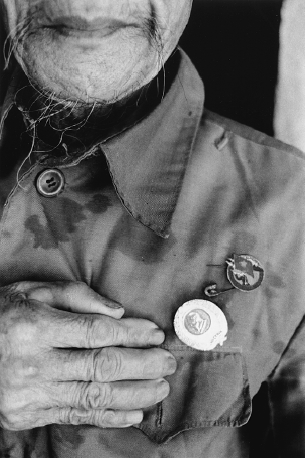
Figure 7.2. Dien Bien Phu veteran, Tam Nong District, Phu Tho. Photograph by Natalia Puchalt.
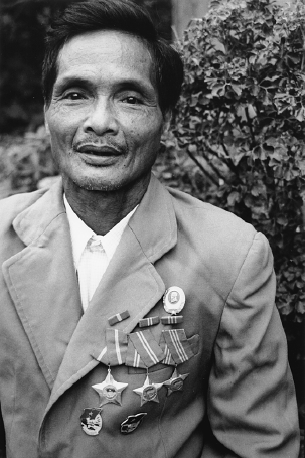
Figure 7.3. American War veteran and Agent Orange victim, Tam Nong District, Phu Tho. Photograph by Natalia Puchalt.
The veteran at the center of Brothers and Relations occupies a similarly peripheral place within his family and in postwar society. From the outset of the film, when the veteran returns to his home in Hanoi, he receives little understanding or appreciation from his family for his experiences in war. Ringing the bell upon his arrival, he is first greeted by a young woman who does not know him but now occupies his former rooms, which his family had rented out believing him to be dead. Confused, he rings again and this time awakens his brother's sleeping wife. Annoyed that someone is at their gate early on a Sunday morning, she asks her husband to receive the caller, but he is preoccupied with collecting the eggs his hens had laid the night before and so refuses. Finally the wife answers the bell. Astonished to see the veteran, she gives him a forced smile that only slightly masks her underlying anxiety that his return will upset the household's economic arrangement with their
The cool reception that the veteran receives from his family is replicated in his encounters with society at large. Potential employers insist they cannot offer him a position because he does not have proper training in a trade; they remain unmoved when he explains he was drafted before he could enter vocational school. Unable to find a job, he passes much of his time with other unemployed veterans in seedy cafe´s frequented by prostitutes. But here, too, the veteran tells his few friends he “just doesn't fit in.”
By focusing on the indifference the veteran encounters from his family and society, Brothers and Relations points to the state's larger failure to honor the wartime contributions of soldiers and its inability to honor its commemorative ideals in the postwar period. In one revealing exchange the veteran's brother says that his failure to find a job “betrays their father's trust,” to which the veteran tells his seemingly uncompre-hending brother: “Betray? You don't think joining the guerrillas for so many years, fighting, not running away, with a bullet in my body is honorable. I come back and look for a job so I won't be a parasite. But if you lack a diploma and have a mind that won't do anything right, you might as well be dead.” In the end, the film suggests, the returning veteran can find a place for himself and his own memories of war only on the margins of society. A chance encounter with his old platoon leader, a kindly and trustworthy figure who has made a quiet life for himself in a small coastal fishing village, convinces the veteran to do the same. Surrounded by the platoon leader's warm and empathetic family, the veteran comes to enjoy an Arcadian existence that the film poses as a virtuous antithesis to the ills of forgetfulness of the rest of contemporary society.
The most probing and critical examination of the state's betrayal of the ideals it had so painstakingly cultivated through official commemorations of war emerges in a second film by Dang Nhat Minh, Girl on the River (Go Gai tren Song), released in 1987. The film opens with a young woman in a hospital who is telling her life story to a woman journalist. The first third of the film flashes back to the period of the American War, when the young woman had been a prostitute in Hue
After the war's end, the young woman realizes the cadre has survived the war and become an important provincial government official. She makes efforts to see him at his office to renew their friendship and seek his assistance. Her papers, however, reveal her to be a former prostitute who had served time in a reeducation camp after the war, and she is refused admittance to him. But while the man's factotums refuse her request because of her “class background,” they remain unaware of her earlier relationship with their boss. The former prostitute leaves, assuming that the cadre himself did not refuse her request. By chance shortly thereafter, the cadre's car is stopped because of road construction. On the construction crew laying piles of asphalt is the prostitute, who immediately recognizes the cadre and approaches his car. In a long, painful scene she circles the car without speaking while the cadre ignores her, gazing straight ahead, almost through her. Devastated by this treatment, she leaves work that day, dazed, and is hit by a truck as she walks down a country road. Recovering from the injuries in a hospital, she encounters the woman journalist to whom she has been telling her story.
Neither the young woman nor the journalist realizes the cadre is the husband of the journalist. Indeed, the journalist is puzzled when her husband responds unsympathetically to her interest in publishing the story (he of course realizes the story is about him and worries that if the connection were revealed it could harm his position). The journalist begins to encounter obstacles to publishing her story, again unaware that her husband is using his connections to make sure it is not printed. Told by her editor that the story will not be published, she threatens to resign her position. When she returns home and tells her husband what she has done, he explodes, not only revealing that the story was about him but also criticizing her for giving up her position and for endangering his career.
If the basic structure of the plot serves to reveal the betrayals and hypocrisies of official commemoration of wartime sacrifice, understanding Dang Nhat Minh's decision to use a prostitute as the heroine is essential to decoding the multiple meanings of the film and how Vietnamese audiences might have apprehended it. The sympathy and quiet heroism he accords to the prostitute and his implicit criticism of the cadre's postwar behavior overturn some of the state's most fundamental political assumptions. During the war, the prostitute often served as a symbol of the corruption and immorality the North Vietnamese state attributed to the South Vietnamese government. In the immediate post-war period, party rhetoric called for the eradication of prostitution in the South because it was inimical to what it termed the “human dignity” of women and the “moral integrity” of the new “socialist man.” Prostitutes, like others associated with the southern regime, were to be made over into socialist men and women, a decision that helps explain why the film's heroine had been sent to a reeducation camp.[18]
Yet Girl on the River offers the prostitute as a symbol of loyalty and principle to reveal the absence of those qualities in the socialist regime. It emphasizes the contrast between the behavior of the prostitute and the cadre in a scene late in the film. After his angry attack on his wife, the cadre goes to the hospital hoping to see the girl (though whether to affect a reconciliation or silence her is not clear). She has already been released, but as the cadre looks around her empty room and at the white sheets of her bed, he suddenly imagines a stain of red blood on the sheets. A new bride traditionally presented blood-stained silk squares after the wedding night to her husband's kin as proof of her virginity; what the cadre has been visualizing, therefore, is nothing less than the prostitute's essential purity.
Dang Nhat Minh's use of the prostitute as a self-sacrificing patriot also has a deeper resonance in traditional Vietnamese literary culture. Most Vietnamese are familiar with the story of Tay Thi (Ch. Hsi shi), a young woman who in popular legend is credited with assuring the victory of the king of Yu¨eh over the king of Wu during the period of the Warring States (403–221 b.c.). After the king of Wu defeated the kingdom of Yu¨eh, believed to be the embryonic precursor of the Vietnamese state, the king of Yu¨eh presented Tay Thi to the Wu court. A woman of transcendent beauty—the T'ang poet Li Po called her “luminous, ravishing, a light on the sea of clouds” —Tay Thi was reportedly educated in the feminine arts at the Yu¨eh court for the purposes of corrupting the king of Wu. Distracted by Tay Thi's beauty and charms, the
The close links between the story of Tay Thi and the behavior of the prostitute in Girl on the River suggest the film offers an even deeper challenge to the larger symbolic meanings the state accorded to prostitution. Its approving depiction of the prostitute's contribution to the war effort joins it to a sustained indigenous debate that began during the period of French colonial rule over the efficacy of collaboration in which the prostitute came to be seen as a metaphor for an acceptance of foreign rule. At the center of these debates were often-conflicting interpretations of Nguyen Du's nineteenth-century epic poem The Tale of Kieu (Truyen Kieu), in which the heroine's willingness to prostitute herself for her family was widely seen as an apologia for the author's decision to abandon the Le cause and serve the new Nguyen dynasty. In what are commonly known as the “writing brush wars” of the 1860s in the wake of the French conquest of the South, one leading collaborator with the French justified his decision by comparing his plight to that of Kieu. Similarly, Pham Quynh, a leading indigenous supporter of French rule in the 1920s, sought to canonize Kieu as a filial, self-sacrificing daughter who prostitutes herself to save her family in an effort to defend his own collaboration with the French. If collaboration for Pham Quynh was like prostitution, then he, like Kieu, was practicing it for the purest and noblest of motives, prostituting himself for the ultimate good of the nation.[20]
These defenses of Kieu and of collaboration met with sharp indigenous attacks. Opponents of collaboration in the writing brush wars did not so much direct their ire at Kieu as argue that collaborators attempted to cloak their disloyalty in the false guise of filial piety. But Pham Quynh's detractors, some of whom came to play leading roles in the North Vietnamese state after 1945, chose to attack him through a critique of Kieu. Their argument that Kieu was little more than an unchaste and lewd woman undeserving of veneration was squarely aimed at undermining Pham Quynh's defense of collaboration. These proponents of “art for humanity's sake” in the 1930s, who set many of the parameters for the state's socialist realist aesthetics in the coming decades, had little use for Kieu and prostitution. Far from a model of revolutionary voluntarism, she appeared as little more than a weak, passive victim of an iniquitous social system that the socialist revolution aimed to transform.[21] For instance, in To Huu's poem “The Song on the Perfume River” (1938), a work later celebrated by the North Vietnamese state,
Dang Nhat Minh's choice of two women to serve not only as the film's central characters but also as its narrative voice joins the film to a traditional literary idiom in which male authors adopted a female narrative voice that could serve counterhegemonic purposes without interference from the state. In part, his choice may have been a device to evade censorship by employing the practices of the northern radical and progressive authors of the 1920s and 1930s who used the coded language of gender to undertake political debate and avoid colonial censorship.[23] The timing of the film's release in 1987, in the very early days of the reform movement, suggests that Minh would have needed to be very cautious in presenting his critiques because the boundaries and implications of the reforms remained uncertain.
Girl on the River employs two gendered literary tropes—women as victims and women as powerless—that give it the freedom to articulate a more sweeping indictment of contemporary society. Drawing on the symbolic resonance of women as victims, an idea that is enshrined in Vietnamese literary classics like the eighteenth-century epic poem Lament of the Soldier's Wife (Chinh Phu ngam), as well as in the literature of the 1920s and 1930s that portrayed a feminized colonial population victimized by Confucian family structures and the colonial state, the film uses the prostitute and female journalist to suggest society at large has been victimized by the state's inability to uphold its commemorative ideals. Similarly, and more bleakly, the film appropriates the common literary and cultural equation that linked women with powerlessness to suggest that just as the women in the film are unable to control their own fates, contemporary Vietnamese society lacks the agency to rescue itself from the state's betrayal of the socialist ideals that underlay its official narrative of war.
The final plot twist in Girl on the River underscores this subtle critique of state practices, starkly revealing the emptiness of the state's commemorative promises. After the argument with her husband, the
WHAT ARE THE REAL LEGACIES OF THE WAR?
The importance the revisionist films of the 1980s attached to the be-trayals of the official meanings of wartime sacrifice reflected a more fundamental unease with the nature of postwar society in northern Vietnam. If revisionist filmmakers took full advantage of the opportunities the Renovation agenda offered to enlarge the parameters of public discourse on the legacies of war, they were far from champions of the market reforms adopted by the state in the mid-1980s to arrest the stag-nation of the Vietnamese economy.[24] In almost all their films, the for-getfulness of many of their protagonists serves to emphasize the spiritual malaise they ascribe to contemporary society, in which the wartime virtues of revolutionary self-sacrifice are increasingly disregarded by corrupt and self-seeking cadres. The quest for individual advancement and rising economic inequalities, the revisionist films suggest, belie official promises that the sacrifices of war would bring collective egalitarianism and social justice in the postwar era.
Le Duc Tien's 1986 film, A Quiet Little Town (Thi Tran Yen Tinh), advances this critique through gentle but trenchant satire. On the way to the wedding of a relative, a highranking government minister from Hanoi and his driver are seriously injured in a traffic accident near a small provincial town. A local party official, whose nephew's wedding the minister was coming to attend, orders the better dressed of the two injured men to be sent to his town's clinic while the other man is taken to a neighboring town for treatment. After the local notables realize that their patient may die without surgery, the central question of the narrative becomes how the handling of the minister's case can best promote the fortunes of various members of the small town's party and state bureaucracy. The local party official, aware of the possible rewards that could come from saving a minister's life, urges that he be operated on
In the meantime, back in Hanoi the minister's wife, whose manner and physical presence closely resemble those of Imelda Marcos, browbeats her sons to use their connections in the military to get a military jet to airlift her husband out. Eventually the young doctor takes charge and performs the surgery while the local party cadre organizes a welcoming party, made up of family and friends who had assembled for the aborted wedding of his nephew, to greet the minister's wife and family who are flying by military helicopter to the small town. They arrive just as the patient is wheeled out of surgery. As the doctor proudly pronounces the surgery a success, the minister's wife looks at the patient on the stretcher and realizes it is not her husband but his driver. Suddenly an announcement from the neighboring town reports that the minister's surgery in its clinic was successful and that he is resting comfortably. His wife and family rush off, dashing the hopes of local officials and bureaucrats that the minister's gratitude would advance their careers.
The preoccupation with status and power among agents of the state that infuses the damning portrait of society under the market economic reforms in A Quiet Little Town also emerges in the documentary How to Behave. The film, whose depiction of the lives of veterans in postwar society was discussed earlier, is centered around a group of filmmakers who honor the request of a dying colleague to discover if kindness (tu te), a term the film tellingly defines as “acting in the public rather than individual interest,” could still be found in Vietnamese society. The filmmakers ultimately do find kindness, not among party cadres or state bureaucrats—one of whom claims “No one has time for such outmoded notions these days” —but in a leper colony run by Catholic nuns, a particularly charged choice given the intense and sustained hostility of the socialist state in Vietnam toward the Catholic Church. If the devotion of the nuns to the lepers, as the film claims, rests on “faith,” How to Behave suggests the callousness of society at large represents a loss of faith in the state's socialist ideals. Pointedly noting that “the people”
If wartime experiences are a somewhat muted presence in the narratives of A Quiet Little Town and How to Behave, [25] a gendered construction of war memories serves as a crucial symbolic vehicle for the critique of contemporary society advanced by many of the revisionist films. They pit a series of grasping younger women against the probity of veterans whose virtuous behavior underlines the dominant ethos of corruption and selfishness the films ascribe to contemporary society. This metaphorical dichotomy builds in part upon the traditional Vietnamese division of gender roles that contrasts women as “generals of the interior” (noi tuong), who dominate the domestic sphere and oversee the family's budget, with men who properly inhabit the public realm, where they conduct the more contemplative official business of family life and governance. By rendering the contours of contemporary society as a feminine landscape forgetful of the self-sacrifices of war, the symbolic vocabularies of these films suggest that the power of the market economy has dangerously extended the private domain of women into the masculine public sphere and dislodged the traditional forces of moral order and authority in society.
The oppositional pairing of the behavior of younger women and soldiers to advance this gendered representation of the abandonment of wartime ideals occurs in the majority of revisionist films. In When the Tenth Month Comes, the actions of a female cadre whose preoccupation with material advancement prompts her to chastise the heroine Duyen for her “inability to get ahead” stand in sharp contrast to those of a soldier who had fought with Duyen's husband and eventually tells her son that his father is dead. When the son asks the soldier if he is telling the truth, his reply that “a soldier never lies” emphasizes the moral gulf between wartime revolutionary virtue and the ills of contemporary society. A decorated war veteran in How to Behave serves as an example
In two films the engendered revisionist critique is rendered in a particularly sharp and disturbing manner. The contrast between the behavior of the veteran in Brothers and Relations and the wife of his brother in honoring the memory of her brother who was killed in war was noted at the outset of this chapter. Juxtaposing the selfless virtue of the veteran who collects and buries the remains of the fallen soldier with the obsession of the wife who works with unabashed eagerness to bribe and cajole an expansive network of corrupt officials to facilitate a potentially lucrative business trip to Singapore for her husband, the film suggests that the wife's singleminded pursuit of material advantage blinds her to her obligations to her dead brother. The wife's place in the film as a larger symbol of the perils of the marketplace emerges with particular force in a scene in which she meets her husband on the day of their wedding anniversary. She emerges from a shop carrying a boom box to greet her waiting husband, who has brought a small bouquet of flowers to mark the occasion. “You bought another cassette player?” he asks. “You can't have too many,” she jauntily replies. As the two ride off on their motorcycle, the wife clutches the boom box to her heart while carelessly holding the bouquet in her other hand. The flowers, a potent expression of the humane rather than material nature of social relationships, appear almost expendable; it is the boom box that gets the loving embrace.
In Nguyen Khac Loi's 1989 film, The General Retires (Tuong Ve Huu), a decorated general and the wife of his son serve as the central characters. The general, a figure of quiet authority and simple tastes who is clearly devoted to serving the ideals of the state, comes to live with his son's family after he retires from military service. But he soon feels out of place as he experiences the market-generated rhythms of life in the household. One day he discovers that his son's wife, a doctor at a
The symbolism of gender cuts even deeper in The General Retires and Brothers and Relations, which use the emasculation of husbands by their wives to reveal the corrupting seductiveness of the marketplace and its corrosive penetration into all realms of human relations. The son of the general is depicted as an impotent figure, powerless to resist the moral transgressions of the market that his wife has introduced into the house-hold. When the general tells his son what his wife has been doing, implicitly calling upon him to reassert his authority and end the practice, the son replies somewhat stiffly, as if to hide his embarrassment, “I had known about this but dismissed it as something of no importance.”
The brother of the veteran in Brothers and Relations is a similarly weak figure who is literally seduced into the conventions of the marketplace by his wife. In one key scene that illustrates the wife's domination (and that of the market), husband and wife are seen lounging on a bed after returning home with their new boom box. The wife removes her husband's glasses, unbuttons her shirt, and turns on a cassette of Western popular music. As she leans back seductively and pulls her husband toward her, he looks both at her and at the boom box next to her with an expression full of greed and licentiousness. The close of the film condemningly suggests that his emasculation and his embrace of the market economy are fully consummated. He sits mutely in the back of a car at the airport, his face filled with avaricious anticipation for his imminent business trip to Singapore, while his wife tells his brother that she does not have time to deal with the remains of her dead brother that he has recovered and brought to her.
Not all filmmakers shared the opprobrium with which these films greeted the coming of the market economy. For Luu Trong Ninh, the market economy offered a salutary alternative to what he perceived as the obvious failures of socialism. His 1993 film, Please Forgive Me (Xin Loi), depicts the trials of a soldier turned movie producer trying to make a film glorifying the North's war against the United States by using Vietnamese actors and actresses born after the Communist victory in 1975. The film focuses on the conflicting generational sensibilities of the producer and his cast. The producer, an austere figure proud of his role in
But if Please Forgive Me suggests the presence of generational differences among revisionist filmmakers over the meaning of war and its aftermath, the film is an exception to the largely conservative critique of contemporary society in most revisionist films. In depicting what they saw as the real legacies of war, these films did not so much subvert official memories of war as embrace a war of nostalgia. They offer remembrances of revolutionary morality, purity, and egalitarianism, all essential components of the state's wartime narrative, as a jeremiad against the materialism and spiritual declension of postwar society.
The frequently conservative cast of the revisionist critique of memory, commemoration, and legacies of war should not obscure the radical challenge these films posed to the public construction of historical memory in northern Vietnamese society. Official reaction to these films provides one indication of the boldness of their larger vision and the dangers it posed to state efforts to monopolize the meanings of war.[28] A 1989survey undertaken by the People's Army Daily (Quan Doi Nhan Dan)asked technical cadres, political cadres, and senior colonels and generals for their reaction to the film The General Retires. Most technical cadres, whose lowerlevel positions had little connection to official ideology, liked the film. But some 60 percent of political cadres, colonels, and generals surveyed, whose positions linked their ideological outlook much more closely to that of the state, voiced strong disapproval.[29] The revisionist films also encountered opposition in the Ministry of Culture, whose official censors requested a number of cuts, arguing, for instance, that the metaphysical setting through which the heroine of When the Tenth Month Comes meets her dead husband promoted improper beliefs in superstitious practices. In most cases, however, the artistic freedom
Nor should the meanings these films gave to memories of war be viewed as an isolated phenomenon disconnected from broader popular discourse on the war in contemporary northern Vietnamese society. Along with filmmakers, a group of writers also drew inspiration from the relaxation of official supervision in the arts to write a series of bestselling novels and short stories that pursue and deepen many of the larger themes of the revisionist films. Their shared sensibilities emerge in the claims of the veteran narrator of Bao Ninh's The Sorrow of War (Noi Buon Chien Tranh), one of the most popular of these works, after recounting his disillusionment over his wartime service: “The future lied to us, there long ago in the past. There is no new life, no new era nor hope for a beautiful future.”[31]
These articulations of countermemories of war in film and literature also link the discourse surrounding war commemoration in Vietnam with broader global patterns of the contested processes of remembering war throughout the twentieth century. Just as the Vietnamese state's insistence that the fallen soldier served as the preeminent legitimating symbol for its wars against the French and the Americans mirrored the official memorializing aims and practices of interwar European states, the form and content of Vietnamese countermemories of war bear striking, if unconscious, parallels with the works of interwar European artists, filmmakers, poets, and novelists. Although separated by space, time, and culture, works such as Otto Dix's Der Krieg, Wilfred Owen's “Anthem for a Doomed Youth,” Erich Maria Remarque's All Quiet on the Western Front, or Abel Gance's J'accuse and the challenges they posed to the official meaning of World War I find resonant company in revisionist Vietnamese film.[32]
What joins these works most fully is a common insistence that the ideological base of state constructions of war conceals more than it reveals. Like their European counterparts, the Vietnamese revisionist films of the 1980s—whether reasserting the power of traditional familial claims on the memories of fallen soldiers, recasting official memory to subvert state commemorative practices, or appropriating the ideals of the official memorializing project to voice displeasure with the legacies of war—opened up the process of remembering war, acknowledging and articulating the multiplicity of meanings that the wars against the French and Americans, which claimed the lives of more than three million of their people, hold for northern Vietnamese society.
NOTES
1. See Michel Foucault, “Counter-Memory: The Philosophy of Difference,” in his Language, Counter-Memory, Practice: Selected Essays and Interviews, ed. Donald F. Bouchard (Ithaca, N.Y.: Cornell University Press, 1977), 113–96.
2. Greg Lockhart, “Preface” and “Introduction,” in Nguyen Huy Thiep, The General Retires and Other Stories (Kuala Lumpur: Oxford in Asia, 1991), v–vi, 5–12.
3. For a discussion of the growth and development of the Vietnamese film industry before and after the reforms of the 1980s, see Banh Bao and Huu Ngoc, L'Itine´raire du film de fiction vietnamien: Expe´riences vietnamiennes (Hanoi: Editions en langues e´trangères, 1984); John Charlot, “Vietnamese Cinema: First Views,” Journal of Southeast Asian Studies 22 (March 1991): 33–62; Ngo Manh Lan, “Looking Inwards: Vietnamese Cinema in the Eighties,” Cinemaya 2 (winter 1988–89): 6–14; and Nguyen Duy Can, ed., Lich Su Dien Anh Cach Mang Viet Nam [History of Revolutionary Cinema in Vietnam] (Hanoi: Cuc Dien Anh, 1983).
4. Centralized accounting of box office receipts and attendance for Vietnamese films, if undertaken at all, is not publicly available, making it difficult to precisely quantify the sizes of audiences. All the films discussed in this chapter, however, were in general release among the estimated eight hundred movie theaters in Vietnam, and my informants in Hanoi indicate that on the whole they were enthusiastically received.
5. Readers who are interested in viewing the revisionist films discussed in this chapter will, unfortunately, find it somewhat difficult. In preparing my analysis, I relied on videotaped copies of the films obtained from the Vietnam Cinema Department and, in a few cases, pirated copies available from street vendors in Hanoi. A limited number of these films, with English subtitles, are available at the UCLA Television and Film Archive in Los Angeles, but they must be viewed at the archive itself. I am currently working on a project with the University of Hawaii's Center for Southeast Asian Studies that seeks to make some of these films more accessible to an international audience.
6. George Mosse, Fallen Soldiers: Reshaping the Memory of the World Wars (New York: Oxford University Press, 1990), 7; see also chap. 7.
7. My discussion of official state commemorative practices in Vietnam is informed by Shaun Malarney, this volume.
8. My examination of the competing claims for remembering the war dead made in these films draws its theoretical inspiration from the work of Maurice Halbwachs. See his “Social Frameworks of Memory,” in On Collective Memory, ed. and trans. Lewis A. Coser (Chicago: University of Chicago Press, 1992), 37–189, and The Collective Memory, trans. Francis J. Ditter Jr. (New York: Harper Colophon, 1980). For a recent discussion of the relationship between state and local forms of remembrance that expands upon Halbwachs's work and informed my thinking, see Alon Confino, “Collective Memory and Cultural History: Problems of Method,” American Historical Review 102 (December 1997): 1386–403.
9. For a useful discussion of the threat outsiders were believed to pose to a
10. Neil Jamieson, “The Traditional Family in Vietnam,” Vietnam Forum, no. 8 (1986): 123.
11. For a discussion of the state's reform of the death anniversary ceremony and the resurgence of traditional ritual practices in the 1980s, see Shaun K. Malarney, “Ritual and Revolution in Viet Nam” (Ph.D. diss., University of Michigan, 1993), 364–66, 419–20.
12. On the role of the guardian spirit in village belief and ritual practice, see Neil Jamieson, “The Traditional Village in Vietnam,” Vietnam Forum, no. 7(1986): 95–100. On the state appropriation of these cults, see Patricia Pelley, “The History of Resistance and the Resistance to History in Postcolonial Constructions of the Past,” in Essays into Vietnamese Pasts, ed. K. W. Taylor and John K. Whitmore (Ithaca, N.Y.: Cornell University Southeast Asia Program, 1995), 232–45.
13. On the traditional symbolism of the kite, see Tran Quoc Vuong, “The Legend of Ong Dong from the Text to the Field,” in Essays into Vietnamese Pasts, 37–38.
14. For an important discussion of the competing claims to the remains of the war dead in interwar France between the state, the Catholic Church, and local communities that displays a number of similarities to the Vietnamese case, see Daniel J. Sherman, “Bodies and Names: The Emergence of Commemoration in Interwar France,” American Historical Review 103(April 1998): 443–66.
15. On the Same River [Chung Mot Dong Song], directed by Hong Nghi and Hieu Dan, 1959.
16. The Fledgling [Chim Vanh Khuyen], directed by Nguyen Van Thong and Tran Vu, 1962; Coal Season [Mua than], directed by Huy Thanh, 1970; and When Mother Is Absent [Me Vang Nha], directed by Nguyen Khanh Du, 1979. Between 1959 and 1975, some thirty-six films were released in northern Vietnam that give similar portrayals of individual revolutionary selfsacrifice during the war. Another forty were released in the postwar period between 1979 and 1985. These figures and plot summaries draw upon selected articles in Dien Anh, the official film journal in northern Vietnam.
17. Victory at Dien Bien Phu [Chien Thang Dien Bien Phu], directed by Tran Viet, 1965.
18. The reality in the South was often quite different, with prostitutes coming to serve the new socialist man, including cadres and government officials, in what one Vietnamese somewhat disingenuously called “the line of socialist duty.” In this sense, the criticisms offered in Girl on the River mirror aspects of these wellknown hypocritical practices. On the state's official rhetoric linking prostitution and the southern regime and the actual practices of the postwar period, see Hoang Ngoc Thanh Dung, “To Serve the Cause of Women's Liberation,” and Nguyen Ngoc Ngan, “In the Line of Socialist Duty,” both in To Be Made Over: Tales of Socialist Reeducation in Vietnam, ed. and trans. by Huynh
19. On the story of Tay Thi, see Edward H. Schafer, The Vermillion Bird: T'ang Images of the South (Berkeley and Los Angeles: University of California Press, 1967), 82–83; David Johnson, “Epic and History in Early China: The Matter of Wu Tzu-shu¨,” Journal of Asian Studies 40 (February 1981): 268; David Johnson, “The Wu Tzu-shu¨ Pienwen and Its Source: Part I,” Harvard Journal of Asiatic Studies 40 (June 1980): 93–156; and David Johnson, “The Wu Tzu-shu¨ Pienwen and Its Source: Part II,” Harvard Journal of Asiatic Studies 40 (December 1980): 497.
20. On the symbolism of prostitution and Kieu in the “writing brush wars,” see Jeremy H. C. S. Davidson, “‘Good Omen'versus ‘Worth': The Poetic Dialogue between Ton Tho Tuong and Phan Van Tri,” in Context, Meaning and Power in Southeast Asia, ed. Mark Hobart and Robert H. Taylor (Ithaca, N.Y.: Cornell University Southeast Asia Program, 1986), 53–77. On Pham Quynh's defense of Kieu, see Hue-Tam Ho Tai, Radicalism and the Origins of the Vietnamese Revolution (Cambridge, Mass.: Harvard University Press, 1992), 109–13; and Huynh Sanh Thong, “Main Trends of Vietnamese Literature between the Two World Wars,” Vietnam Forum, no. 3 (1984): 103–7.
21. On the debates in the late 1930s that presaged the Vietnamese state's embrace of social realism, see David G. Marr, Vietnamese Tradition on Trial, 1920–1945 (Berkeley and Los Angeles: University of California Press, 1981), 361–66.
22. To Huu, “The Song on the Perfume River,” in An Anthology of Vietnamese Poems: From the Eleventh through the Twentieth Centuries, ed. Huynh Sanh Thong (New Haven, Conn.: Yale University Press, 1996), 156–57.
23. Tai, Radicalism and the Origins of the Vietnamese Revolution, chap. 3.
24. For useful overviews of the context in which the Vietnamese state undertook the process of market economic reforms, see Bo¨rje Ljunggren and Peter Timmer, eds., The Challenge of Reform in Indochina (Cambridge, Mass.: Harvard University Press, 1993); and William S. Turley and Mark Selden, eds., Reinventing Vietnamese Socialism: Doi Moi in Comparative Perspective (Boulder, Colo.: Westview Press, 1993).
25. In A Quiet Little Town, memories of war emerge indirectly as a tool through which the head of the clinic tries to advance his preference for returning the minister to Hanoi for treatment. To get an indifferent postmistress to send an urgent message to Hanoi, he says nonchalantly, “Your voice sounds funny. Were you exposed to Agent Orange?” Nervously she replies, “I was in the Youth Combat Troops,” then quickly moves to send the telegram despite her earlier hesitations. Satisfied that his message is being sent, the doctor begins to leave. The woman cries out, “Wait! What about my exposure to Agent Orange?” “You're cured,” he laughs. “I'm a good doctor!”
26. The film is an adaptation of a short story of the same name by Nguyen Huy Thiep, widely acknowledged as one of the leading writers in contemporary Vietnam. Critics have pointed to a certain ambiguity in the story's rendering of the wife's behavior, suggesting that her actions appear “more hardheaded than hardhearted” given the prevailing economic difficulties in the period in which
27. A similar theme underlies the screenwriter Le Hung's 1991 play, Fable for the Year 2000 [Huyen Thoai Nam 2000]. In one crucial scene, an old man and a young man are involved in a standoff on a bridge. The old man insists he should go first because his generation produced everything of value in society: houses, roads, the contested bridge, even the young man. The young man, angry and impatient that old men “occupy all the most important positions except in homes for the aging,” proclaims that he cannot wait until the old man “has walked his last step” and criticizes the “pathetic” legacy the older generation has left. See Murray Hiebert, “Playing for Keeps,” Far Eastern Economic Review, May 7, 1992, 37–38.
28. For a revealing comparative discussion of resistant, subversive, and oppositional memory in the context of other socialist regimes, see the contributors to Memory, History, and Opposition under State Socialism, ed. Rubie S. Watson (Santa Fe, N.M.: School of American Research Press, 1994).
29. People's Army Daily [Quan Doi Nhan Dan], February 18, 1989, as cited in Lockhart, “Introduction,” 3–4.
30. On the efforts of official censors and their evasion by filmmakers, see Charlot, “Vietnamese Cinema,” 39–40. An exception was Luu Trong Ninh's Please Forgive Me, which was banned after a brief release in Hanoi. The Ministry of Culture demanded several cuts before it would permit the film to be shown again. One requested cut was a speech in which Communist troops were criticized for committing the same acts of brutality during the war that the state had attributed to American soldiers. Ninh, who accumulated a huge private debt to make the film, acceded to their demands. See Murray Hiebert, “Vietnam's Censors Tell Producer to Cut Film,” Far Eastern Economic Review, July 22, 1993, 90.
31. Bao Ninh, Noi Buon Chien Tranh [The Sorrow of War] (Westminster, Calif.: Hong Linh, 1992; reprint of edition published in Hanoi in 1991), 67. Along with the short stories of Nguyen Huy Thiep set in postwar Vietnam, well-known novels on the war that parallel the revisionist films of the 1980s include Le Luu, Thoi Xa Vang [The Old Days] (Hanoi: Tac Pham Moi, 1987) and Duong Thu Huong, Tieu Thuyet Vo De [Novel without a Name] (Hanoi, 1989; reprint, Stanton, Calif.: Van Nghe, 1991). In another example of the close ties between revisionist film and literature, Duong Thu Huong is the screenwriter of Brother and Relations.
32. For a penetrating discussion of European countermemories of war, see Jay Winter, Sites of Memory, Sites of Mourning: The Great War in European Cultural History (New York: Cambridge University Press, 1995). Also potentially suggestive for the Vietnamese case is the beautiful and probing comparative analysis of sorrow and memory in the Chinese and Jewish traditions in Vera Schwarcz, Bridge across Broken Time: Chinese and Jewish Cultural Memory (New Haven, Conn.: Yale University Press, 1998).