
6. Roads to Prosperity
The city becomes the dominant theme in political legends, but it is no longer a field of programmed and regulated operations.
Michel de Certeau, The Practice of Everyday Life
Dream 1
Hisham, a thirty-year-old worker in a leather factory, was growing more and more frustrated with his inability to find an affordable apartment in Cairo, a social requirement for the consummation of his marriage. Although he had been working hard and had tried to save as much as possible since he had gotten engaged five years ago, Hisham had not been able to save enough to pay the key money[1] demanded by the owners. Two years ago, Hisham and his family tried to put an end to his long waiting by adding a new unit to his parents’ two-bedroom apartment, which had been allocated to them fifteen years ago by the government. The new unit consists of one bedroom, a small living space, a kitchen, and a bathroom with a separate entrance that opens onto a main street. Hisham's plan was easy to implement because his parents’ apartment was on the ground floor. Still, he needed to discuss it with the other residents who were living on the same side of the building. Four families out of the five welcomed the idea. Only the widow who resided on the top floor did not want to add any extra rooms because she lived alone and did not have the required money. Cooperation of the neighbors was necessary for two main reasons. First, there was a need to pool resources to invest in the rather expensive foundation (’asaas) of the new addition. The neighbors agreed that the residents
Dream 2
I have never met Magdy. Although, since 1993, I have come to know his family very well, I have not had the chance to meet him face to face. A young man in his late twenties, Magdy has been working in Kuwait since 1992 and only visited Cairo twice over the past six years. Still, I feel that I know him. He is often the subject of discussions between his family members and their neighbors. His mother always talks about him with affection and describes his achievements with pride. His sisters and brothers always recall his jokes, retell his stories, and remember his tenderness and sensitivity. Magdy's fiancée and her family also describe his good manners and hard work to secure his future home. I also feel that I know Magdy through reading some of the letters and hearing some of the tapes that he sends to his family. Occasionally his mother has asked me to write to him on her behalf. When the family has gathered, often with some of Magdy's close friends, to record audiotapes for him, I have also greeted him and mentioned a few things about myself and his family.
But more important, I know Magdy because, in spite of his long absence, he still plays a significant role in al-Zawiya al-Hamra, where his
One Building, Two Dreams
The cases of Magdy and Hisham direct our attention to several important issues that have been addressed directly and indirectly throughout this book. First, they communicate to us some of the new boundaries, differentiations, and social inequalities that are being produced, reinforced, and challenged by transnational connections. They show how global processes are producing new inequalities within the same city, the same neighborhood, and even the same family. In addition, they convey how access to and appropriation of global discourses and images are structured along national, class, and gender lines. Class in particular has been significant in regulating travel destinations, work plans, and access to information and resources. Magdy's case also directs our attention to other emerging hierarchies and power relationships that regulate interactions between cities other than New York, London, and Paris.
But above all, these two cases direct our attention to issues related to agency and the production of urban locality. They illustrate the active and creative role of city dwellers in the production and making of Cairo and its landscapes. Even though they differ in terms of the source of funding, size, shape, and organization of space, the apartments of Magdy and Hisham have a similar role in the construction of al-Zawiya. They both display in physical forms their active role in the making of the neighborhood. These forms, in addition to religion, facilitate the integration of the group and their housing project in al-Zawiya. As discussed in the previous chapter, religion is a powerful force in the formation of a collective identity. Religion morally situates the group in al-Zawiya and facilitates their interaction with other residents. In addition to religion, the many changes that people introduce to their housing units and the construction of new ones are strategies that allow the housing project to be physically integrated with the rest of the neighborhood. That is, the apartments of Magdy and Hisham are “techniques for the spatial production of locality.”
I will first share with you how I got to “know” Magdy through the flows that keep him connected with his family and neighborhood. I analyze Magdy's apartment, which he bought in the housing project, and the tapes circulated between him and his family as powerful techniques that keep him part of the life of his siblings and friends, provide him with moral support, and reinforce his attachment to al-Zawiya. Magdy's apartment, in particular, becomes a visible sign that objectifies and reinforces his active role in the making of his neighborhood in Cairo. In the last part of the chapter, I will place the active roles of Hisham and Magdy within a larger historical and spatial context and examine their wider social and cultural significance for the rest of the housing project and the neighborhood at large.
Egypt's Road to Prosperity
When Sadat started his open-door policy in 1974, he also relaxed the constraints previously imposed by President Nasser on migration from Egypt to other countries (LaTowsky 1984). However, while Sadat saw the road to development and modernization as going through the West, Arab
Magdy's Road to Prosperity
In the late 1980 s, Jordan and Iraq were the first countries that attracted Magdy, who after nine years of education quit school to work in a printing company in Cairo. In his early twenties, Magdy traveled with one of his friends to Iraq and Jordan, hoping to find good jobs and reasonable income. During this trip, Magdy failed to secure the money that he desired. According to his sister, Nisma, Magdy and his friend suffered considerably because they did not manage to find suitable jobs. They had to work as street peddlers to secure enough money to be able to return with some gifts for their families. Magdy's next destination was Kuwait. Through an employment agency in Cairo, he managed to find a job as a security guard in Kuwait in 1992. He was hired for one year, but while there, he took an additional part-time job with a printing company to supplement his income. Before the end of the year, he had secured another contract that enabled him to stay in Kuwait as a full-time worker in the printing company. He has been working there for the past six years.
It is worth noting here that national boundaries are important in regulating Magdy's movement and participation in the social, economic, and political domains in Kuwait. Citizenship rights, social security benefits,
Magdy's letters and tapes do not include many details about the condition of his work. It is clear, though, that he works very hard, participates in gam‘iyyat (savings associations), and sends a major part of his income back to his family. Over the past five years, Magdy has financed major reconstructions of his family's apartment. They have remodeled the kitchen and bathroom, expanded the living room, installed expensive glass shutters on their balcony, repainted the apartment with costly oil paint, and installed a water heater. When he sends money, Magdy also includes specific instructions on how it should be spent. Once he asked his mother to buy a new gas stove, a new carpet, and a wardrobe. Another time, he asked her to buy a table and some extra chairs. In addition to monthly allowances to his mother, Magdy also covers extra expenses during Ramadan and pays for the goat that they slaughter during the Sacrifice Feast. He also sends money to his unmarried sisters and younger brother to buy new clothes for the main Muslim feasts and other social occasions.
Magdy's short and few visits to al-Zawiya are joyful occasions. As soon as they know that he is coming, his mother and sisters spend days cleaning and arranging the apartment. They scrub the kitchen floor, carefully wash the bathroom, dust the furniture, and clean the walls and floor of the bedrooms and living room. Just before his arrival, they cover the sofas with brand-new covers, hang beautiful clean curtains, place a carpet in the living room, and spread clean sheets over the beds. They also cook his favorite foods. His sisters describe the excitement of waiting for his arrival from the airport and the joy, tears, and laughter that surround his entering their apartment. Once he is home, his married siblings, his friends, and the neighbors rush to greet him. Visitors and festivity continue until he leaves once again for Kuwait.
Like many other migrants, Magdy comes back to Cairo loaded with gifts for his family and close neighbors. He brings soap, shampoo, hair oil, whitening creams, clothes (such as underwear, training suits, pajamas,
With this flow of money and goods from Kuwait to Cairo and meager wages at home, it is not surprising that many young men and their families view work in an oil-producing country as the only way to save enough money to secure an apartment and get married. Migrants’ descriptions of their lives and work in oil-producing countries also support these views. Mothers and wives try to encourage their male relatives to stay in Saudi Arabia and Kuwait until they secure the money needed. For them, oil-pro-ducing countries are linked primarily with money and goods. Only the migrants themselves are fully aware of the difficulties associated with working abroad. They usually work for long hours and under difficult conditions. Ahmed, a construction worker who has been working in Saudi Arabia for four years, explains that, as an Egyptian worker, he is often at the mercy of Saudi contractors who take advantage of him and of other workers. Some contractors underpay (or refuse entirely to pay) their Egyptian workers. Ahmed emphasizes that the Egyptian embassy there does not do much to help Egyptian workers. At the same time, there are no unions to protect workers’ rights, and many do not think that they would find justice in the Saudi legal system. According to Ahmed, he and other workers try to keep their employers happy by avoiding any problems. So they usually prefer to keep silent or to find Saudi mediators to help in collecting at least part of the pay. Although “new legal regimes” are being created to mediate the interaction between transnational corporations and different nation-states (Sassen 1996: 213), migrants like Ahmed do not find legal protection either in the representatives of their governments or in the Saudi legal system.
Keeping Him Connected
In contrast to women's travel abroad, which is often depicted in negative terms (as discussed in chapter 3), men's travel is desired and encouraged.
TAPES: THE ART OF HEARING
Besides the flow of money and goods from Magdy, there is a continuous flow of ideas, news, and information that enables him to participate effectively in making decisions related to the daily life of his family and friends. Letters, phone calls, photos, and tapes are significant in bridging the physical distance that separates Magdy from his mother, siblings, and fiancée. One of his sisters, Nisma, who is very close to Magdy, is the main letter reader and writer. She is more educated than her other siblings and has better handwriting. While his other siblings can read his letters, they either do not know how to write or think that their handwriting is illegible. Sometimes, when Nisma was not available or when she refused to write to ask for more money, Magdy's mother asked me to write letters on her behalf. Writing to relatives abroad was not a task I had anticipated before starting my field research. It was nonetheless a task I welcomed, as it opened my eyes to several methodological and conceptual points and provided me with an unexpected chance to learn about the dynamics of interaction between migrants and their relatives. Writing letters also allowed me to follow the lives of some women and to grasp how changes in their lives shaped the interaction with male migrants.
Nadia, for example, has been married for five years. After the wedding,
In addition to letters, phone calls and audiotapes facilitate the flow of information between migrants and their families. A phone call is a very fast way of communicating that allows direct discussion of pressing issues. Although the number of phones is limited in al-Zawiya al-Hamra, a migrant can always talk to his family by calling a neighbor who has a phone. Phone calls, however, are very expensive and are used infrequently. Audiotapes are another important alternative for effective communication. A tape represents an intermediate form of communication between the fast but expensive phone call and the cheap but slow letter. A tape, though, is more exposed to the control of the government. Unlike fax and e-mail, both of which are available for upper-class Egyptians and can escape the censorship of the government, tapes have to go through the state apparatus. When Magdy's sister takes a tape to the post office, she also needs her identity card. Her name and address have to be clearly printed on the envelope, and the employee in the post office keeps track of her identity card number. Nisma explains that tapes are monitored and approved before they are sent out: “They listen to parts of the tape. They want to make sure that the tape does not contain religious material or attacks against the government. I am sure that they only
Even though a tape sent via mail is more costly, is monitored by the state, and requires coordination between family members, it is usually preferred to letters for various reasons. First, a tape enables illiterate parents and relatives to communicate with their beloved ones without a mediator (i.e., writer/reader of the letter). Most parents in al-Zawiya al-Hamra are illiterate, and even some siblings who went to school for six years (and sometimes even for nine) cannot write. Thus, with the help of a tape, Magdy's illiterate mother can communicate with him directly. The sincerity and warmth of her prayers are almost impossible to express in writing. Her expressions of affection often turn into cold words when inscribed in a letter written by a daughter or a neighbor. But when she records for Magdy, her soft deep voice reflects her strong emotion, and her words express her longing for him. She also can communicate to him her pride in his achievements, retell her expectations, and repeat her advice. As a letter writer, Nisma is always selective. She sometimes dismisses her mother's requests for money or refuses to write about some problems in the family. No one, however, can stop his mother from saying what she wants when recording for Magdy. They may comment on what she tapes, but still she has the chance to express her ideas without the mediation of a third party. At the same time, a tape from Magdy allows her to hear his voice repeatedly, especially when she misses him. I often saw her happy face and big smile while she replayed one of Magdy's tapes, heard his tender words addressed directly to her, or listened to one of his jokes or funny stories.
In addition, a tape provides flexibility to discuss in detail various issues and to include the voices of several relatives and friends. A tape allows Magdy to address all of his family members and to discuss different topics such as the health of his mother, the future career of his younger brother, and the weight of his younger sister. Tapes also enable Magdy to transmit the latest songs from Kuwait to Cairo and allow his brothers and sisters to provide him with the latest Egyptian songs and jokes. Some sing for him to express how much they miss him, while others, less confident of the beauty of their voices, record a song from the radio. A tape also brings together all his siblings and Magdy's close friends. Taping often becomes a session for telling stories and jokes. Such tapes give Magdy a feeling for his neighborhood, remind him of the days
At the same time, a tape is expected to provide more “spontaneous” communication than a letter, enabling the migrant to analyze the tone and quality of the voice on the tape and to conclude things that his relatives do not verbally mention. Nadia, for instance, asked me to write to her husband in detail about issues such as the relatives who visited her after she delivered her baby, the length of their visits, and how much money they gave as gifts to the baby. Despite this, her husband asked her to send him a tape that would inform him about all of this in even greater detail. Nadia's husband wanted not only to read her words, mediated by writers such as Nisma or me, but also to monitor the voice of his wife to figure out how she really felt about the visits of his family. Similarly, Magdy realizes when his mother is sick or in distress, even though she tries to cover that up while recording for him. When he feels that her “voice is different,” as he stated in one of his letters, he writes or calls to ask for explanations and assurances from his siblings regarding his mother's health.
But above all, a tape can be and is often used as a “document” that is circulated between family members and close friends and that can be replayed several times for literate and illiterate members. While they cannot save a phone call and a letter is accessible only to those who can read, Magdy's family and future in-laws save the tapes that clearly express Magdy's preferences and reactions. These tapes are consulted when disagreements emerge regarding any proposed changes to his apartment.
These tapes, therefore, keep the migrant informed of what happens in his neighborhood and ensure his emotional and material connectedness with his family. They often aim to remind the young man of his obligations, encourage him to save more, and persuade him to invest his money in durable items. Investment in material objects, and particularly in an apartment, becomes a powerful tool that ensures the continuous flow of cash and information from the migrant and that includes him in the production of locality.
BUILDING MODERN DREAMS
As stated in earlier chapters, the apartment, the organization of its space, and the quality of its furniture are all central to the representation of the self in daily life in al-Zawiya al-Hamra. The housing unit is a material manifestation of the man's ability to earn money and the woman's skill in
MAGDY'S APARTMENT
Young men like Magdy are desirable future husbands. Like many other young women, Magdy's sisters dream of marrying men who work in oilproducing countries. They explain that, in a relatively short time, a man who works in Kuwait or Saudi Arabia will have enough money to secure the apartment and its furniture, both of which are essential social requirements for marriage. So when Magdy proposed to Laila, a twenty-three-year-old woman who lives in el-ahali but works as a secretary in a middleclass neighborhood, she and her parents accepted immediately. Besides his good looks and pleasant manners, they knew that he had been working in Kuwait for years and that he could fulfill Laila's dreams. Although Magdy did not have the chance to know his fiancée well, he trusted the judgment of his mother, sisters, and neighbors. In their opinion, Laila is beautiful and comes from a good family. After meeting her a couple of times, he decided to ask for her hand in marriage. He bought her the customary golden jewelry (shabka) and had a big engagement party. Like many other engagement and wedding celebrations, their party was videotaped, and his family and fiancée replayed it for me several times.
Once Magdy was engaged, finding an apartment became even more important. Magdy, however, did not manage to find a suitable unit before going back to Kuwait. So he left the money in a bank account under his sister's name. He chose Nisma not only because she had a more flexible schedule than her working brothers but also because, as he knew, she would not spend any of his money without his instructions and permission. His older brothers had gone through repeated financial crises that had forced them to borrow part of the money that Magdy sent to his mother. Nisma kept her eyes open for vacant apartments. Within a few months, she heard that
Even before the search began, it was clear to everyone that Magdy's apartment would reflect his income and status. His younger brothers were forced to consider renting or buying units in satellite cities outside Cairo, an option that they did not like but that still might be the only one available given their incomes. From the beginning, his family took it for granted that Magdy could afford to buy an apartment near them in al-Zawiya al-Hamra. While his younger brothers were searching for onebedroom apartments, it was assumed that Magdy could afford at least a two-bedroom unit. Compared with the apartments of his married siblings, the unit that Magdy bought is much larger. The original structure of Magdy's apartment consisted of two bedrooms, a living space, a bathroom, and a relatively spacious separate kitchen. This apartment was identical to his family's apartment, where, until recently, ten to twelve individuals lived (see Figure 11). Meanwhile, his older brother Fahmi, a driver in his mid-thirties, lives with his wife and an eight-year-old son in a one-bedroom apartment. Although Fahmi and his wife were lucky to find this unit ten years ago, given that it is close to both of their families, the apartment is considered very small for them. In addition to the bedroom, there is a small hallway, but there is no separate living space that can be used to receive guests. A couch, placed in the hallway next to the entrance, is used to seat visitors (see Figure 12). This area is so small that if two or three people visit simultaneously, the place becomes uncomfortably crowded. Fahmi's wife is especially unhappy with the fact that her “kitchen,” which consists of a sink and a gas stove occupying the corner of the hallway, is exposed to visitors who are seated on the couch in the opposite side of the hallway. Since I met her in 1993, she has been dreaming of saving enough money to install a metal balcony, part of which she can use as a kitchen.
The changes that Magdy is introducing to his apartment increase the
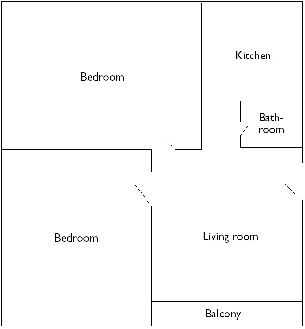
FIGURE 11. The apartment that Magdy bought was originally identical to his family's apartment, where, until recently, ten individuals lived.
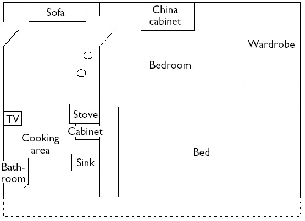
FIGURE 12. The apartment of Magdy's brother. A couch, placed in the hallway next to the entrance, is used to seat visitors. This area is so small that if two or three people visit simultaneously the place become uncomfortably crowded.
Magdy's family and his future in-laws collectively produced a tape that in detail explained to him the plan and the money needed. Magdy approved of the proposal and sent the required money to his family. His siblings, his fiancée, her father, and some of Magdy's close friends supervised the implementation of the expansion. Currently, Magdy's apartment has two bedrooms, one living room, a dining room, a spacious kitchen, two bathrooms, and a large balcony (see Figure 13). Communication with Magdy has continued through tapes, letters, and phone calls to discuss minute developments related to the shape and structure of the additions and the furniture. Magdy, Laila, and their families discussed the choice of door for the kitchen (a beaded curtain or a swinging door) and the bathroom (metal, wood, or glass), the color of the ceramic tiles, and electrical and water installations, taking into consideration expected purchases of appliances such as a water heater and an automatic washing machine.
It is interesting to note that Magdy's migration has brought his family closer to his friends and future in-laws. His apartment in particular has become a link that brings his family closer to his fiancée and her parents. In his absence, his mother and siblings are expected to visit Laila during major religious holidays and to offer her gifts on special occasions. Still, the apartment created another need to communicate with her on regular basis. Currently, the unit represents a blending of Magdy's ideas, the expectations of his family and friends, and the opinions of his fiancée and
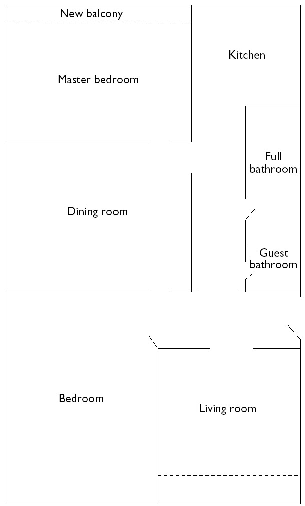
FIGURE 13: Magdy's apartment after the latest additions. Currently, the unit has two bedrooms, one living room, a dining room, a spacious kitchen, two bathrooms, and a large balcony.
Magdy's travel allows his fiancée more freedom in shaping their future home. Although women are active in organizing, cleaning, and decorating their apartments, they usually assume this role after marriage. The bride is rarely involved in preparing her future home until the final stage, when she and her sisters (or female friends) arrange the furniture that she buys (normally for the living room and the kitchen) and organize her belongings in the bedroom. In contrast to this general tendency, the role of Laila and her family has been central to the changes introduced to Magdy's apartment. Laila decided on various issues related to the unit, such as the color of the ceramic tiles, the kind of bathtub, and the paint of the unit. She is also taking initiatives in the organization of the unit. She helped in supervising the work and in removing, with the help of Magdy's sister, the debris left behind by the workers. She also went with her father to their village of origin, two hours by bus from Cairo, to see a carpenter whom he knew and recommended. She showed the carpenter her favorite design of kitchen cabinets and asked him to duplicate it. She and her father visited the carpenter several times to check on his progress and to make sure that he was the right person to hire to make the bedroom furniture. After these visits, she went to her future mother-in-law to inform her about the kitchen, the wood they are using, and the color they will select to paint the cabinets.
Unlike most brides, Laila is also participating in decisions related to her future bedroom. While a bride participates in the selection of the furniture of the living room and kitchen, the furniture of the bedroom, which is closely linked with sexuality, is the responsibility of the groom and his family. In Magdy and Laila's case, she is the one who is deciding on these issues. To be able to select the most fashionable and beautiful furniture, Laila watched TV, looked through magazines, and visited various newly married women to see their bedrooms. After deciding on a style, she sent a picture of the furniture she liked to Magdy to solicit his opinion. She said that Magdy liked the design of the room and suggested a white color. Laila, however, prefers black and wine-red colors. According to her, the white is very common and dated, while the black and the winered are newer and more fashionable. After discussing her preferences with Magdy over the phone, he told her to choose the color that she prefers.
In addition to the structure of the housing unit, people expect Magdy to display his wealth in the furnishings of the apartment. Compared with his siblings and other men of his generation, he will be buying furniture
At the same time, the desired home of Magdy and Laila is constructed by images transmitted via television programs and visits to other neighborhoods. The manner and style in which Magdy has chosen to remodel and furnish his housing unit also reflect his experience outside his neighborhood. Items such as the water filter, the kitchen fan, and the vacuum cleaner, which he purchased in Kuwait, are not common in al-Zawiya al-Hamra. He also decided to invest money in building both a full bathroom and a separate guest restroom (with a toilet and a sink). Among the many apartments that I visited in the neighborhood, Magdy's unit is the only one that has two bathrooms and the only one that has a bathtub.
Making Urban Spaces
Unlike Magdy's spacious apartment, Hisham's unit consists of only a small bedroom, a tiny living space, and a small kitchen and bathroom. Despite differences in the size, shape, organization of space, and the expected furniture, both apartments are part of a large set of strategies that are transforming the housing project and the neighborhood. Along with religious identity, discussed in the previous chapter, these housing additions are techniques that facilitate the inclusion of the relocated group in the neighborhood and inscribe their presence on Cairo's “face.” Unlike the state's discourse, which presented them as unproductive, pathological, isolated fragments of the nation, these changes present Hisham and his neighbors as active agents who creatively participate in the making of their neighborhood and Cairo at large. These additions join the many changes introduced to individual housing units and shared spaces, discussed in previous chapters, that are shaping el-masaakin and al-Zawiya. Although these additions aim to satisfy some direct needs for
BUILDING HOUSES, BUILDING RELATIONSHIPS
Just as Magdy's unit brings his family, in-laws, and friends together, the changes he is introducing demand coordination and cooperation between neighbors. As previously said, neighbors cooperate to secure the money for the foundation and to collect money to pay offofficials. They also gather information about new policies and laws and prepare to defend the additions if threatened by the local police. While the government's interference in changes introduced to the interior of the housing unit has relaxed and almost disappeared over the years, external changes, especially large additions such as those introduced by Hisham and his neighbors, continue to be the targets of the state gaze and its disciplinary regulation. There is the strong possibility that additions will be demolished or that the owners will be fined and/or imprisoned. So people try to monitor government actions and regulations to determine which changes are tolerated. Other housing projects in various areas provide models for changes as well as indicators about how the state is going to react to these changes. People in al-Zawiya have a good sense of which changes are tolerated and know that the state can and did demolish some constructions, particularly roof additions and those introduced by individual families. Adding rooms to the top floor, which is seen as threatening to the structure of the building, is expected to be severely punished, and people refer to cases when such additions were removed. Neighbors are unwilling to support or allow such changes, which may threaten the safety of the whole building.
People know that the critical time is during the construction process itself, which should be completed as quickly as possible because at that time it is easy for government officials to demolish the additions. In some cases, the workers may simply disappear when they notice the presence of government officials and act as if no construction is being conducted. Sometimes the additions are quickly painted with a color that is similar to the rest of the units to give the impression that they are part of the original
Hisham and his neighbors are also careful not to antagonize any officials and police officers who tour the area. I heard of only one incident when additions were destroyed. The reason, as explained by one of my female informants, was that the young male “owner” reacted strongly when a police officer commented on the “illegal” status of his additions. They exchanged verbal insults, which made the officer very angry. He left the scene to come back shortly with a bulldozer, and the partially constructed addition was demolished on the spot. When pleading, bribery, and mediation do not work, women and children become the main agents in protecting the additions and changes introduced to the units. I was told about an incident when government officials tried to demolish a newly constructed balcony. The mother and her children stood in the balcony and challenged the workers to tear it down. The neighboring women also gathered and shouted at the workers, who had to leave without being able to touch the balcony.
Men and women also follow developments in legislation (such as the military decree issued by the prime minister in 1996 that aimed to prohibit any construction on public land) and changes in the governance of the city (such as the appointment of a new governor of Cairo) that may affect their constructions. A new governor, for example, “tries to act tough,” one seller says. For some months after his initial appointment, people are extra careful in building on and using public space. Sahar, for instance, stopped using video games in her small shop for a while after the assignment of Cairo's new governor. She said that all merchants were afraid of the visible increase in the number of policemen touring the area, who might penalize the traders and confiscate their belongings. These additions, therefore, demand and produce a continuous flow of information between neighbors and between al-Zawiya and other neighborhoods. They also foster cooperation and strengthen a sense of solidarity (at least temporarily) between residents of the housing project.[5]
REMAKING ‘EL-MASAAKIN’
One of the di Y cult visual problems of project salvage will be to make these places look lively and urban enough; they have so much grimness and visual repetition to overcome.
Jane Jacobs, The Death and Life of Great American Cities
In addition to their role in bringing neighbors and family members together, the cumulative impact of these changes goes beyond the individual units and the shared spaces and extends to reshape al-Zawiya and Cairo at large. To take one example that shows the larger effect of such changes, we need only to look at how they have been rupturing the visual homogeneity of el-masaakin. As previously mentioned, the buildings were identical in shape, color, number of floors, external design, and internal arrangement of space. The uniformity of blocks and standardization of individual units, which have long been associated by planners and policy makers with order and beauty, clearly define el-masaakin and separate them physically from el-ahali. The monotony and repetition of the same blocks and murabba‘at not only was aesthetically dull but also caused many “to lose their way” when they first moved to the area. As in projects in other parts of the world, “what seems like rationality and legibility” to policy makers and planners “seems like mystifying disorder for the ordinary residents who must navigate the city” (Scott 1998: 127). One young woman described how shocked she was when she came out from the bedroom to find their living room filled with strange men who thought they were in the apartment of one of their relatives. While officials and planners often consider the new changes to be disorderly and chaotic, at the community level, they are important “visual interruptions” (Jacobs 1961: 380) that introduce vitality and diversity to the housing project. Hisham's new apartment, the metal and cement balconies of other neighbors, carts and glass-fronted cabinets, shacks on rooftops or in front of blocks, housing units turned into clinics, stores, and workshops, and gardens in public spaces are all transforming the homogenous project, crossing the boundaries between private and public and between residency and work, as discussed in chapters 2 and 4. The visual effects of these alterations go beyond the individual unit and the satisfaction of important daily needs.
Like many other modernist plans, the housing project was designed as a bounded entity separated physically from the rest of the neighborhood (for a similar case from Brazil, see Holston 1989). As we have seen in the
THE MAKING OF AL-ZAWIYA
Such changes also play a central role in expressing how Hisham and his neighbors belong to al-Zawiya and in legitimizing their presence in Cairo. This is clearly manifested in the way people construct the history of the neighborhood. The presence of multiple groups who came from different parts of Egypt and Cairo and at different times, and who live in different parts of the area, makes it hard to talk about a single history of al-Zawiya. Various histories are told: a man tells the history of his migration from his village to Cairo, a woman narrates her movement from Bab al-Sha‘riya to al-Zawiya when she was a teenager, and her neighbor tells how she moved from the center of Cairo to the old public housing project and then to el-ahali after she got married. Despite these differences, both the old and the new residents emphasize the way their presence altered the area and was central to the construction of the neighborhood.
Al-Zawiya al-Hamra literally means “the Red Corner.” In the old days, many explain, there was a small red mosque, usually referred to as Zawiya.[6] Even though the mosque does not exist any more, al-Zawiya al-Hamra still bears that name. Others link the red color with the red brick houses that dominated the neighborhood until recently. Generally, people use al-Zawiya only to refer to the area and rarely use al-Hamra. This usage of the word al-Zawiya (the corner or the small mosque) is not accidental. Rather it signifies a general feeling among people, especially the youth, that their neighborhood is marginal in the city or, as one young man said, “is not on the map.” They feel that the state neglects their neighborhood
Although neither the old nor the new inhabitants can claim to have given al-Zawiya its name, they compete to claim a more central role in its formation. They all refer to a “moment of colonization” that is common to the production of localities in various contexts (Appadurai 1996: 183). Residents of el-ahali who came in the 1940s, residents who moved to the old housing in the 1960s, and those who moved to the new housing project during the late 1970s and early 1980s all have similar narratives. “When we came to al-Zawiya, it was agricultural fields and the water of a nearby tir‘a [irrigation or discharge canal] covered most of what you currently see as streets, houses, and shops. People used to fear leaving their homes after dark because wild animals and criminals threatened their safety.” Such statements are very common among the relocated and the old residents in describing their contribution to the development of the neighborhood. In addition to wild and dangerous animals, usually signified by the wolf (diib), people emphasize the fear that was cultivated by robbers (qutta ‘a turuq) and fugitives (matarid) who used to hide in the thick plantation that covered the area and who used to steal the belongings of the residents. Not only did the residents inhabit a risky area, but they also cleaned and constructed it. Houses, shops, and mosques are all signs of their positive contribution to the making of al-Zawiya.
To underline the sacrifices and the role they played, the relocated people describe how house owners in Bulaq tried to discourage their tenants from moving by emphasizing the importance of the central location of Bulaq and describing the isolation and the horrible conditions in al-Zawiya. “They used to tell us that there were huge mosquitoes and dangerous animals in al-Zawiya,” one woman explains. “They told us that we would not be able to go outside to buy even our daily foods. When we moved, we brought lots of food with us. We brought rice, macaroni, sugar, tea, and many other foods because we believed that we would not be able to leave our apartments after dark.” These sacrifices are drawn upon to emphasize the role of the relocated population in constructing al-Zawiya. Commenting on the relationships between el-ahali and el masaakin residents, a fifty-five-year-old woman said: “It is like Ahli and Zamalek [the two teams who usually compete over the annual soccer championship in Egypt]. They are both Egyptians but do not want to be defeated by the other team. When we first arrived, the people in el-ahali
New Logics and Global Dreams
The practices of Hisham and his neighbors are producing their own social and economic logic. When I went back to Cairo in March of 1996 after an absence of fourteen months, I was struck by the boom in large-scale construction such as that erected by Hisham in el-masaakin. This recent boom comes at the end of the fifteen-year period that, according to the contracts given to the people when they were relocated, marks the shift of ownership from the state to the dwellers. I was also amazed by how quickly these expansions led to new criteria for evaluating housing units. The changes introduced to an apartment are largely determined by its location. One can easily introduce rooms and shacks to units on the ground floor, but additions to other floors demand cooperation between residents in the floors below and possibly those who are above. Similarly, the distance between the different murabba‘at is now being included as part of the value of the unit. When two or more buildings are very close to each other, the vacant area may be limited, and expansions on either side may not allow enough visual privacy for the residents. Such limitations reduce the price of the unit.
The situation changed even more in 1997 and 1998. Construction increased, some people were taken to court by the government, and the
The aesthetics of these changes are also becoming more elaborate, and different models are emerging. People visit and evaluate these new additions to select what suits their families and aspirations. This can be clearly seen in people's reactions to Magdy's apartment. Through his apartment, Magdy is not only participating in the material production of his neighborhood but also presenting new forms and ideas to the people around him. For many people, his unit has become a signifier of the modern, the new, the beautiful, and the desired. His sisters, for example, like the spacious kitchen of Magdy's apartment. They say that a woman spends most of her time in the kitchen and that having a big kitchen is very pleasant. Magdy's apartment also has become a model that attracts the attention of his neighbors and inspires them as they plan and organize their units. One neighbor, Um Hussam, came to see the unit because her only son is getting married and she would like him to live with her. Um Hussam was very impressed with Magdy's apartment and especially liked the idea of having two separate bathrooms in the same apartment. She thought that such an arrangement would allow her future daughter-in-law some privacy and make her more comfortable in sharing a home with her husband's family, especially in the early days of marriage. Thus, through his ongoing involvement and attachment to his neighborhood,
Through their spatial practices, Hisham, Magdy, and their neighbors situate themselves emotionally and materially in al-Zawiya. Although relocation excluded them from its center, they reinforce their belonging to Cairo through the products of their labor, which is placing al-Zawiya “on the map.” What counts for them is not only the history of the center, which is accessible to visitors and upper-class Egyptians. They are making a history of Cairo from their particular location in the social space. But how are these changes viewed by government officials? Like many other states (for more on this, see Scott 1998), the Egyptian government still views its capital as a single entity that should be controlled through policing, rational planning, and central management. But is the city an entity, a whole that can be managed, controlled, and disciplined centrally? Is this a productive way to view the city and the practices of its dwellers? In the coming conclusion, I examine the implications of the practices of Hisham and his neighbors for the conceptualization of the city, agency, globalization, and religious identity.